Too Young For TikTok, Old Enough To Vote?
Authored by Clive Pinder via DailySceptic.org,
There are few sights more comic than a modern minister pretending to be the stern parent of the nation.
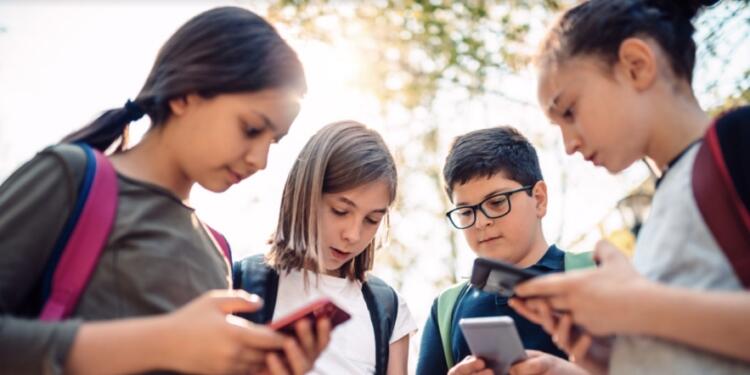
We know the routine. The concerned expression. The voice lowered half an octave. The carefully arranged background of flags, earnest young people and laminated safeguarding jargon. Then comes the announcement. The government is going to protect children online.
At which point every parent in the country is expected to breathe a sigh of relief, put down the gin and thank the Department for Being Sensible on Our Behalf.
This would be comic enough at any time. It is even better when the Government now proposing to supervise teenagers online gives the impression of being unable to supervise itself. Sir Keir Starmer wants to childproof the internet while presiding over a state that cannot produce a defence policy that convinces its own side, let alone our allies or enemies.
Still, never mind the Russian threat. Has anyone thought about Chloe scrolling Instagram?
To be fair, there is a problem. Social media is not exactly a moral health spa. Much of it resembles a Victorian freak show redesigned by behavioural psychologists and funded by advertising executives. It is addictive, vain, cruel, stupid and often deranging. The idea that a 14 year-old girl with a smartphone is simply exercising ‘choice’ while being stalked by an algorithm designed to exploit insecurity is absurd.
So no, this is not a libertarian hymn to TikTok.
The problem is not that politicians worry about the effect of social media on young people. The problem is that they worry about it selectively.
The same political class that increasingly tells us young people must be protected from online manipulation is also very keen to tell us that those same young people are mature enough to vote.
This is where the argument begins to wobble like a drunk on a paddleboard.
Apparently, a teenager may not have the judgement to scroll through Instagram without state supervision, but does have the judgement to help choose the next government.
This is not a principle. It is a convenience.
Defenders of the idea will say social media and voting are entirely different activities. One involves psychological harm. The other involves civic empowerment.
Up to a point. But both depend on the same basic faculties. Judgement, emotional maturity, resistance to manipulation, the ability to process information and some capacity to distinguish truth from nonsense.
These are precisely the faculties politicians tell us young people lack when the topic is social media. Yet they mysteriously reappear when the topic is extending the franchise.
If a 16 year-old is too impressionable to cope with Andrew Tate videos, dieting influencers or Chinese-owned dopamine dispensers, why is he or she suddenly immune to political propaganda?
Modern electioneering is not a seminar in constitutional philosophy. It is organised emotional manipulation. It uses fear, flattery, identity, resentment, slogans and carefully tested nonsense. It promises free things that are not free. It manufactures panic. It tells voters that unless they vote correctly, the planet will boil, fascism will return, public services will collapse and everyone decent will suffer.
But this, apparently, is citizenship.
The difference is not that social media manipulates while politics enlightens. The difference is that one form of manipulation sits outside the control of approved institutions. The other benefits them.
That is the real story.
The modern state has developed an elastic theory of childhood. Young people are treated as children when the state wants more power over families, technology, schools or speech. They are treated as adults when the state wants their votes, their assent or their moral authority.
Too young to smoke. Too young to drink. Too young to rent a car. Too young, increasingly, to open an app without the digital equivalent of a permission slip.
Yet old enough to help determine who runs the country.
Parents have been quietly demoted in this arrangement. A mother and father may apparently lack the wisdom to decide how their child uses a phone. Yet that same child, guided by teachers, activists, celebrities and taxpayer-funded campaigns, is expected to make profound democratic choices.
The absurdity is not hard to spot. It merely requires the increasingly unfashionable skill of noticing.
This is not an argument that teenagers are stupid. Many are thoughtful, curious and better informed than adults who spend their evenings shouting at the television. Nor is it an argument that all social media regulation is wrong. Some of it may be necessary, particularly where very young children are concerned.
It is an argument for coherence.
Parliament cannot say young people need protection from algorithms then invite them to swim in the sewage works of political campaigning and call it citizenship.
It cannot claim to defend autonomy while constantly transferring authority from families to bureaucracies.
This is the contradiction at the heart modern government. It does not want young people to grow up. It wants them managed, mobilised and morally useful.
So by all means let us have a serious debate about children, screens and harm. Let us talk about addiction, anxiety, pornography, bullying, parental responsibility and the tech companies that have turned childhood attention into a commodity.
But let us also drop the pretence.
A government that does not trust teenagers or their parents to navigate social media cannot then turn around and declare those same teenagers mature enough to help govern the nation.
That is not democracy.
It is babysitting with a ballot box.
Tyler Durden
Thu, 06/18/2026 – 05:00
via ZeroHedge News https://ift.tt/mkU6QJR Tyler Durden