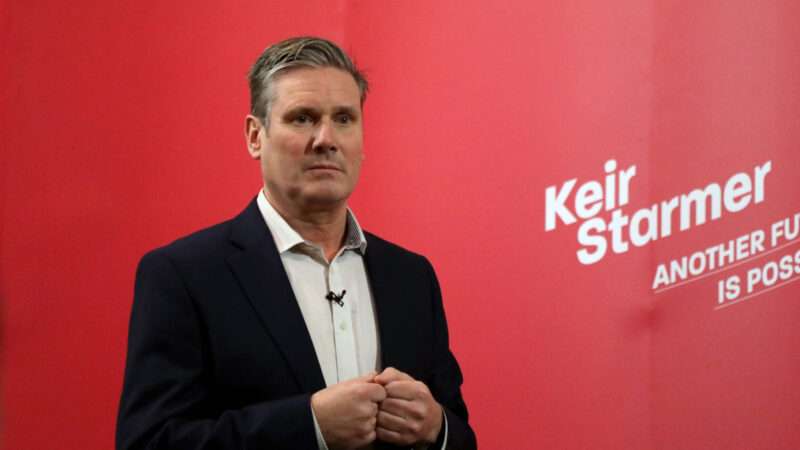
After less than two years in office, British Prime Minister Keir Starmer has resigned. “The question my party is asking now is whether I am best placed to lead us into the next general election. I have heard the answer of my parliamentary party to that question, and I accept that answer with good grace,” he said at a press conference this morning. “Every decision I’ve taken has been about putting the country I love first. That is why I will resign as leader of the Labour Party.”
Starmer said he had spoken to the King to inform him of the decision, and would ask the National Executive Committee, the Labour Party’s governing body, to set out a timetable for the leadership race to decide his successor. Nominations will open on July 9, and if there is a contest, his successor will be chosen by the summer recess. Keir Starmer will remain as prime minister until the leadership contest is complete.
The announcement follows more than half a dozen cabinet ministers privately telling him to leave No. 10 Downing Street, and a weekend of speculation that he was mulling over the decision with his wife at the Chequers country retreat. On Thursday, Andy Burnham, the former mayor of Greater Manchester and favourite to replace Starmer, was elected as the member of Parliament for Makerfield. Burnham, nicknamed the “King of the North,” won 55 percent of the vote in the constituency and said that voters had issued a “call for change” in his victory speech. He is the public’s preferred choice to replace Starmer, according to an IPSOS poll.
Starmer’s resignation is not especially surprising. The last few months have been nothing short of tumultuous for the British government, but Starmer himself has never been overwhelmingly popular with the general public. The main reason the Labour Party were elected to power in 2024 was not because of their appeal, but “to get rid of the Conservatives,” according to YouGov polling. Since becoming prime minister, Starmer has overseen an ever-worsening economic outlook in the U.K.: Youth unemployment is soaring, with the number of young people aged 16–24 who are NEETs (Not in employment, education or training) increasing to 13.5 percent—more than one million young people—in the first quarter of this year. 25 percent of working-age people are out of work, and those who do have a job are set to pay the highest tax burden in British history. If Britain joined the United States as the 51st state, it would be the poorest state.
As the economy tanked, the Starmer administration was embroiled in scandal. Peter Mandelson’s appointment to the role of U.S. Ambassador and his friendship with Jeffrey Epstein were key. Perceptions of cash for access emerged in 2024 when Labour Party donor Lord Waheed Ali was issued a pass to Downing Street, and reports emerged that Starmer had received more gifts than any other member of Parliament. Concerns about immigration fuelled the popularity of the Reform U.K. party. Immigration is still the most important issue for Brits (despite net migration falling sharply), according to an Ipsos poll.
These incidents, coupled with the public’s disapproval of Labour’s immigration policies, led to a wave of wins for Nigel Farage’s Reform U.K. in May’s local elections. Farage’s party grabbed 1,455 council seats across England, 17 seats in the Scottish Parliament, and 34 seats in the Welsh Parliament. The Labour Party suffered the worst local election result on record.
A series of resignations by Cabinet ministers followed, including Health Secretary Wes Streeting and Safeguarding Minister Jess Philips. Close to 100 Labour members of Parliament called for Starmer’s resignation in May.
Any candidate hoping to become leader of the Labour Party, and by consequence, prime minister, will need the support of at least 20 percent of the ruling party’s lawmakers to enter the contest. From there, a final decision will be made via a one-member-one-vote system in which Labour Party members, affiliated trade union supporters, and registered supporters all vote equally. There are a few Labour Party politicians with their eyes on the role of prime minister, all of whom are likely to make the size of the state even bigger.
Burnham, Starmer’s likely successor, has made headlines for promoting “business-friendly socialism” and the nationalization of “basic things that people depend on.” Reports suggest that one of the key influences on Burnham’s economic thinking is Miatta Fahnbulleh, the former chief executive of the New Economics Foundation (NEF). A recent New Statesman profile described “Fahnbullehism” as a philosophy rooted in the co-operative movement that sees markets as incapable of delivering prosperity fairly without much greater state direction. During her time at NEF, the organization proposed a minimum income guarantee, higher taxes on wealth and investment income, tighter controls on consumer credit, and a larger role for public ownership and state-backed investment. More recently, Fahnbulleh has praised proposals associated with Burnham’s emerging “Manchesterism” agenda, which argues for greater public control over housing, energy, water, and transport.
But Burnham is not the only Labour Party politician with his eyes on the keys to No. 10. Wes Streeting, the former health secretary, already launched his leadership bid at a press conference in May. He argued for “a proper contest with the best candidates on the field”, and said that he would be standing. Streeting made headlines the day after the July 2024 general election for admitting that the U.K.’s socialized healthcare system, the National Health Service, was “broken” and promising radical “reform.” However, his track record as health secretary has been much more of the same strategy his predecessors opted for: spending more taxpayer cash.
Angela Rayner, the former deputy prime minister, is also a potential contender. She helped introduce some of Britain’s most stringent labor market regulations, and is often seen at a nightclub or with a vape in her hand (although she has recently quit). Rayner was forced to resign from the government over her tax affairs, and was later reappointed to a junior ministerial position.
Ed Miliband, the energy secretary who has championed net zero regulations and a ban on fracking in the North Sea, has increased his popularity within the Labour Party and could throw his hat in the ring. This wouldn’t be the first time—Miliband led the Labour Party into the 2015 general election, and received a crushing defeat at the hands of David Cameron’s Conservative Party.
With pressure mounting from the increasingly popular Green Party, whoever leads the Labour Party next will be pulled to the left. For voters hoping Keir Starmer’s resignation might mark a turn away from higher taxes, heavier regulation, and a larger state, the likely field of successors offers little reason for optimism.
The post British Prime Minister Keir Starmer Has Resigned. His Replacement Will Likely Be More of the Same. appeared first on Reason.com.
from Latest – Reason.com https://ift.tt/lmF2dEO
via IFTTT