Iran Agrees To Invite Nuclear Inspectors Back As Vance Hails ‘Great Progress’ After A Little ‘Threatening & Whining’
Axios is reporting Monday morning Iran has agreed to invite IAEA inspectors back to the country, according to fresh words of Vice President J.D. Vance, who focused all day prior and much into the overnight on forging a path forward toward permanent peace.
The two sides are seeking to hammer out a long-term nuclear agreement, now amid the technical talks process, as delegation heads depart Switzerland – leaving diplomatic teams behind. The 60-day roadmap begins.
If indeed the UN nuclear inspectors are eventually let back into Iran, this would be a hugely significant step. This would be to verify compliance to the preliminary agreement, Vance further hails:
“Our hope is that we get to the final deal and a permanent settlement. But right now, I think we’ve made great progress and we should all celebrate that in terms of when the nuclear inspectors are going to start,” the American Vice President told reporters.
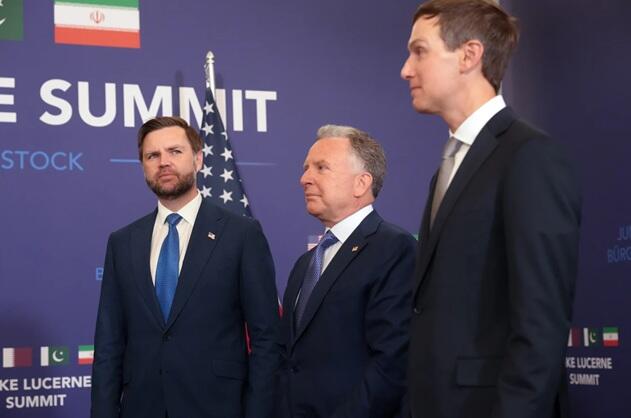
He described that he phoned UN nuclear inspectors at 2am last night to update them on the developments, however, he said that no one picked up the call.
“As you can expect, not many people are answering their phone at two in the morning,” said Vance. “I expect that will happen at the minimum this week, but we think even some of those conversations with the inspectors and with the IAEA could happen as soon as today.”
Both warring sides appear to finally be in the same page in terms of issuing ‘positive’ and ‘encouraging’ assessments earlier. There were reports of last-minute disagreements, threats, and warnings that the process could collapse near the conclusion of yesterday’s formal round one of talks.
“So they didn’t walk out, and their technical team is still here in Burgenstock working with our technical team,” Vance explained.
“What we told the Iranians yesterday is, ‘When you guys exchange in what us millennials might call trash talk, you can’t expect the president of the United States not to respond and not to correct the record’.”
Vance conceded that in the end there was a “a little bit of threatening” and “whining but at the end of the day, the talks continued and we made great progress.”
He further described that a mechanism had been established to keep the Strait of Hormuz open, while noting that significant work remained and that technical negotiations would continue. Also, importantly he said that a “very good foundation” was laid for a successful final agreement with Iran.
JD Vance:
I can’t stay here for the next 60 days. I will go back to the U.S.
The technical teams will be working. pic.twitter.com/s9PSTRvMSR
— Clash Report (@clashreport) June 22, 2026
The Iranian delegation, led by Mohammad Bagher Ghalibaf, also left the venue in Switzerland today – after approximately 18 hours of talks and consultations.
Meanwhile a fresh note from Goldman Sachs comments:
The Pakistan-Qatar communiqué, alongside comments from the Iranian Foreign Minister highlighting progress in negotiations, suggests we are heading into a prolonged period of talks rather than a near-term resolution. My base case remains that Iran will continue to use the threat of disruption around Hormuz as negotiating leverage rather than pursuing a definitive resolution. The most striking feature of the oil market today is the sheer size of speculative short positioning. There is a substantial amount of capital betting on lower prices, which locally makes further downside more challenging. That is before considering the more fundamental point that it is not obviously in Iran’s interest to allow oil prices to fall too far while negotiations remain ongoing.
China too has expressed hope Iran and the US will maintain the momentum and ultimately work towards positive progress, Foreign Ministry spokesperson Guo Jiakun said Monday from Beijing. He praised the mediation efforts by Pakistan, Qatar and other parties when asked about the Iran-US talks in Switzerland, the Xinhua news agency reported. “China supports Pakistan and Qatar and all relevant parties in their mediation efforts,” Guo said.
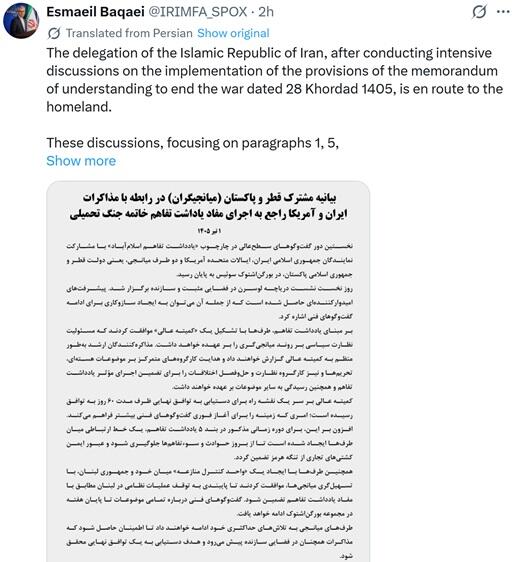
New Iran MFA statement:
However, while an uneasy calm has taken over Lebanon, with analyst Mohanad Hage Ali of the Malcolm H Kerr Carnegie Middle East Center in Beirut stressing: “The conflict now in Lebanon is waiting for another spark,” said Mohanad Hage Ali from the Malcolm H Kerr Carnegie Middle East Center in Beirut.”
“It just became a buffer zone, a kind of a punching bag in which anyone who wants to score can use it, whether to get at the US-Iran negotiations – which Israel specifically is not very happy about – or from the Iranian side, where a faction unhappy with how negotiations are going can sabotage them through the Lebanon front,” he explained.
Tyler Durden
Mon, 06/22/2026 – 08:00
via ZeroHedge News https://ift.tt/EAPT9DQ Tyler Durden