Nadella’s Hedge: Microsoft Wants To Make AI Models Cheap – Then Own The Rails They Run On
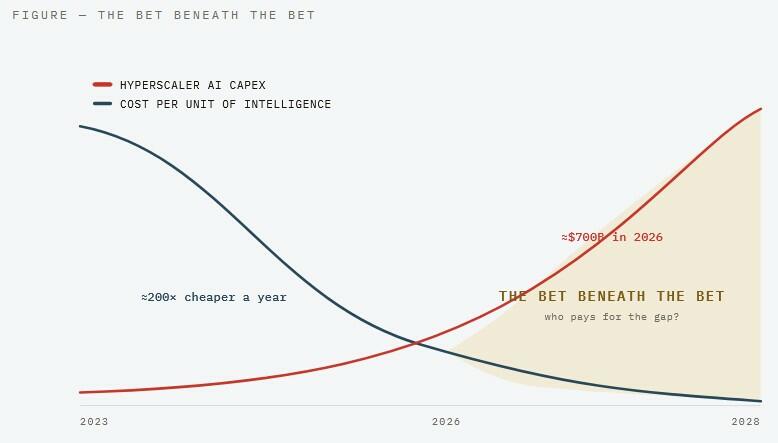
The entire AI capital cycle – roughly $700 billion in hyperscaler capex this year, an estimated $2 trillion-plus through 2028 – is collateralized by one belief: that intelligence is scarce, and therefore priceable. That belief is already under strain. Per-token inference prices have fallen on the order of 200× in a year, and the only thing holding revenue up is volume; the cost of intelligence is dropping even as the cost of deploying it climbs. Hyperscaler free cash flow is rolling over. The Fed has named AI capital spending a systemic risk.
And after falling behind in the race to build the best AI, Microsoft is setting up for a massive hedge. The company is on track to spend north of $120 billion this fiscal year – most of it on GPUs and the data centers that house them, $37.5 billion in a single quarter alone, pushing free cash flow negative for the first time in a generation. That is a company betting intelligence is scarce. Yet to the Wall Street Journal last week, Nadella argued the opposite is coming – that intelligence is about to get cheap. The tell isn’t a contradiction. It’s a hedge: if you can’t win the race to build the best model, you make the model worthless and own the road it runs on.
Microsoft is already executing on the hedge. In the weeks surrounding the interview, the company rolled out a new wave of lower-cost models and made Copilot Cowork generally available worldwide – an autonomous agent designed for long-running tasks that lets users (or the system) dynamically route work across multiple models, explicitly including cheaper options. Axios reported that Microsoft is also actively weighing whether to host a version of DeepSeek, the ultralow-cost Chinese model, directly inside Azure for Copilot customers. The model would be optional for users, fully hosted on Microsoft’s infrastructure, and wrapped in the company’s enterprise security, compliance, and data-residency controls.
These aren’t side-quests, they are the product-level proof of the thesis: make intelligence abundant and interchangeable while keeping the customer, the data, and the workflow inside Microsoft’s perimeter.
Nadella believes intelligence is about to become abundant, interchangeable, and cheap, as a wave of agents routes work to the lowest bidder. And as the cost per unit of intelligence plummets, he wants Microsoft to own the rails it runs on.
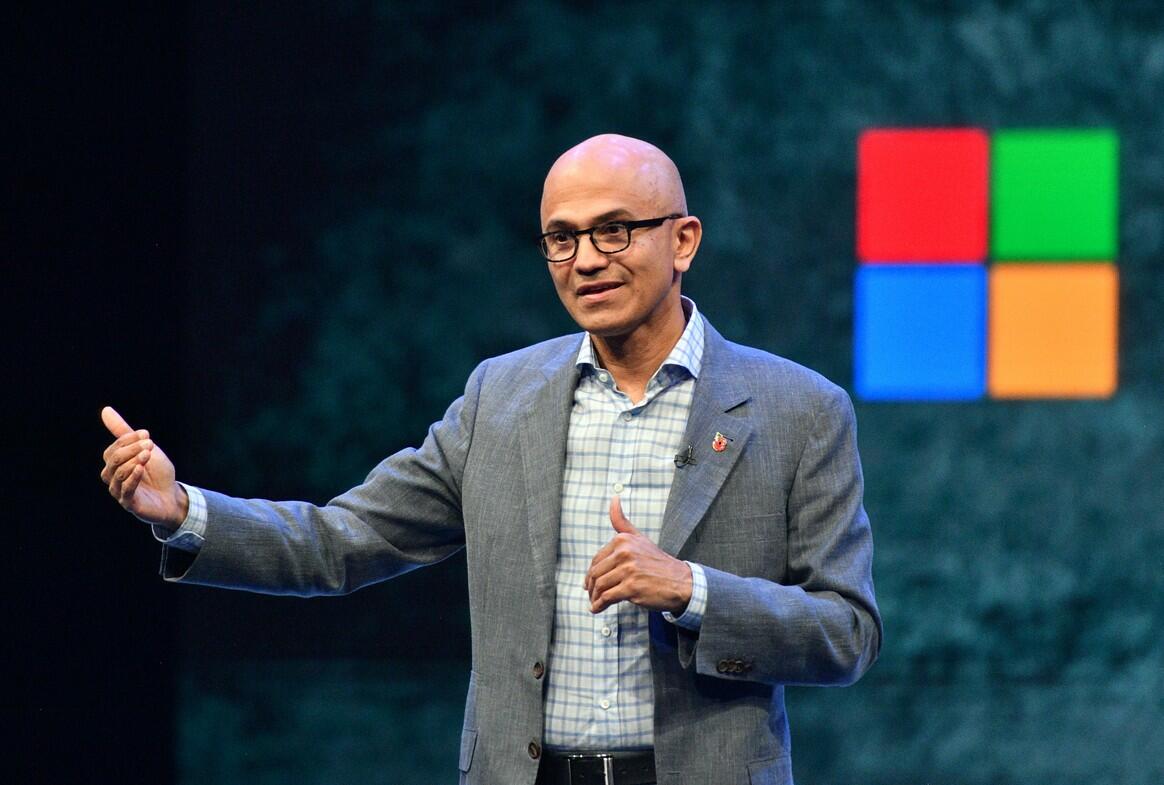
In an interview last week with the Wall Street Journal, Nadella suggested that pitchforks would come out if just a few concentrated AI companies dominate the space, while using massive amounts of energy to do so.
“You can’t say, hey, all white-collar jobs are gone and this could even be a weapon and we will use all the power to build data centers,” he told the outlet, adding that the public wouldn’t tolerate just a few models and companies “doing all of the learning for the world.”
It’s a clean argument. It’s also the argument of a company under federal antitrust scrutiny, repositioning as the people’s champion right before the regulators arrive. The civic case and the competitive case happen to point the same direction.
So it appears Microsoft has concluded it cannot win the model layer on raw capability. Instead, it intends to make that layer less decisive and relocate the moat to the layers it already owns. In Nadella’s framing, models become interchangeable commodities – “all hill-climbing inside a machine you control.” That machine is Azure + AI Foundry, the orchestration layer that decides which model (OpenAI, Anthropic, DeepSeek, open-source, or future Microsoft fine-tunes) handles which task at what price. Copilot becomes the persistent agentic interface that keeps the customer relationship. The real scarcity, and therefore the real moat, is the proprietary enterprise data and existing workflows that already live inside Microsoft 365, Dynamics, GitHub, and the company’s security and compliance boundary. Customers get the benefit of the cheapest or best model for the job without ever leaving Microsoft’s control plane or handing their data to a frontier lab. In short: as the model layer commoditizes, whoever owns the data gravity and the distribution layer gets to drink everyone else’s milkshake.
If Nadella is even directionally correct, the entire $700 billion-plus annual hyperscaler capex cycle – and the $2 trillion-plus cumulative spend projected through 2028 – faces a major structural problem. Per-token inference prices are collapsing far faster than volume is rising for many workloads. Free cash flow at the big spenders is already rolling over. The only way the math works is if intelligence becomes so cheap and abundant that total usage explodes, or if the hyperscalers successfully migrate margin upstream into orchestration, agent routing, fine-tuning on proprietary data, and enterprise distribution.
Microsoft is placing its bet on the second path. By pushing models toward commodity status while locking customers into Azure orchestration, Copilot agents, and their existing data estates, the company is trying to turn the very price collapse that threatens the capex thesis into a competitive advantage. The companies that spent the last two years preaching scarcity and hoarding frontier capability may discover they have built extremely expensive infrastructure whose primary output – raw intelligence – is rapidly losing pricing power.
Tyler Durden
Mon, 06/22/2026 – 15:05
via ZeroHedge News https://ift.tt/N43uAEz Tyler Durden