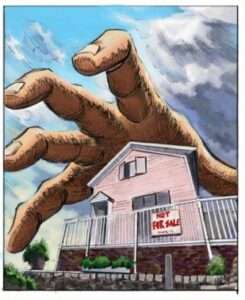
In my last post, I outlined some of the many reasons why today’s Supreme Court decision in Pung v. Isabella County, allowing below-market value compensation for tax foreclosure takings is wrong. The Takings Clause of the Fifth Amendment requires “just compensation” and giving owners far less than the property’s fair market value doesn’t measure up. Here, I add an additional point: The problem with fair market value compensation is not that it is too much, but that – all too often – it is actually too little. This isn’t just my idiosyncratic view. It’s a common criticism of current takings doctrine by scholars across the political spectrum.
I noted that critique in the amicus brief I filed in Pung on behalf of myself, the Cato Institute, and a group of property and takings scholars, and covered it in more detail in Chapter 8 of my book my book The Grasping Hand: Kelo v. City of New London and the Limits of Eminent Domain. Here’s a summary from a 2021 nonacademic article I wrote on the subject:
The Fifth Amendment specifically mandates that owners receive “just compensation,” which the Supreme Court has long interpreted as the “fair market value” of the property. In reality, however, studies show that most owners get less than that, especially less affluent owners. That is true of both takings by state and local governments and takings conducted by federal government, such as those for President Trump’s border wall. Under administrations of both parties, the Department of Homeland Security has a history of low-balling property owners.
Even full fair market value is often not enough to fully compensate owners for their losses. Many people value their property above what they could get for it on the market. Consider, for example, homeowners and small businesses who have been in the same location for years, and have longstanding relationships with friends, neighbors and customers in the area. Nonprofit institutions such as churches and other houses of worship also often have great value that goes beyond the market price of the land they sit on. Such “subjective value” is often left uncompensated when property gets condemned, even if the owners get the full market value of the land. That’s true even in some cases in which the government takes only part of the owner’s property, as when it seizes land to build a road or a border barrier that cuts through the owner’s lot, thereby impairing his or her use of the rest of the property.
As I note in the article and elsewhere, figuring out how much more compensation governments should pay beyond fair market value is often a difficult task. In many situations, it may be so difficult that fair market value is the least bad available option. In addition, there are dangers of overcompensation, as well as undercompensation. If you pay too much, you might even get situations where – perversely – property owners actually lobby to get their property condemned.
Nonetheless, fair market value compensation is often actually far too little; and standard compensation processes often fail to get property owners even the value that the fair market value test is supposed to require. That state of affairs makes the Supreme Court’s decision in Pung even more indefensible.
The post Fair Market Value Compensation for Takings is Often too Little, not too Much appeared first on Reason.com.
from Latest – Reason.com https://ift.tt/5KNdF6m
via IFTTT