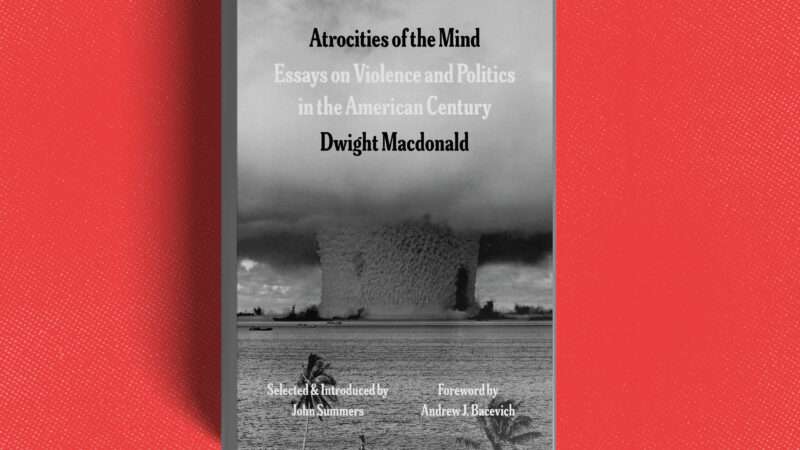
Atrocities of the Mind: Essays on Violence and Politics in the American Century, by Dwight Macdonald, edited by John Summers, University of Chicago Press, 310 pages, $25
If the mid–20th century was the nadir of American liberties and the (Caesarist) salad days of the American imperium, it was also a golden age of literary journalism whose luster was enhanced by the slashing wit of that self-described “conservative anarchist,” Dwight Macdonald. Historian John Summers has compiled 25 of Macdonald’s best essays in Atrocities of the Mind, and boy, is this ever welcome.
There is a rich conservative anarchist tradition in American life and letters. Many of its exemplars (Dorothy Day, Paul Goodman, Norman Mailer) have abided in New York City, as did Macdonald, who was born to a relatively happy Upper West Side family. (His appearance-conscious mother gussied up the family name of McDonald, adding an A and rendering the D in minuscule so as not to be taken for shanty Irish.)
As a lad at Exeter and Yale, Macdonald majored in haughty arrogance. A bizarre early detour led him through the executive training program at Macy’s, but he quickly soured on business, deciding that it was the province of “adroit opportunists,” a judgment from which he never really strayed. He married a bluestocking Trotskyite whose ample trust fund cushioned Macdonald’s fall when he quit his job as a star reporter at Henry Luce’s Fortune after his takedown of U.S. Steel—he called it “bereft of both the social intelligence of Communism and the dynamic individualist drive of capitalism”—was editorially eviscerated.
Macdonald had a brush with the Communist Party in the mid-’30s but found its partisans pious and humorless ideologues. He fell in for a while with the Trotskyites at Partisan Review before launching his own periodical, the lower-case politics, which from 1944–49 gave voice to the anarchist, pacifist, and libertarian views he would express with style and intelligence until his death in 1982.
Macdonald was the sort of anarchist not averse to calling upon President John F. Kennedy to aid the poor with “a massive increase in government spending.” Such jarring incongruities have been one of the charming quirks of American anarchists, whose ancestor Ralph Waldo Emerson spoke of a foolish consistency being the hobgoblin of little minds. No one ever accused Macdonald of having a little mind.
Looking back as an old man, he explained his anarchism: “I believe in the decentralization of authority and the ability of people to decide their own destinies. If politics begins at the bottom, people can decide much better for themselves than well-intentioned liberal bureaucrats or badly-intentioned Nixonian bureaucrats.” He added that “there are dangers to anarchism, if you think of it as just busting up things. I was appalled by the view of some student rebels that libraries were not sacred and that they could fuck up the file cards.” He’d not have been amused by the personality-disordered cretins of antifa.
Macdonald’s populist anti-state politics coexisted with his frankly elitist cultural stance, though his real beef with popular culture was that it was a top-down affair, cynically marketed to the masses, rather than a grassroots phenomenon. And really, how elitist can a man be if he counts himself a fan of Bob Hope, Jimmy Durante, and Moon Mullins?
Macdonald’s sardonic side was displayed in dozens of notorious witticisms, most famously: “The Ford Foundation is a large body of money completely surrounded by people who want some.” Charlton Heston and the cast of Ben-Hur, he wrote, are “at no point in danger of lawsuits for impersonating real people.” Assessing the crucifixion scenes in biblical epics—Macdonald reviewed movies for Esquire in the early 1960s—he called the Romans the “fall goys.”
He cut a distinctive figure in the Manhattan salons and Cape Cod beach houses in which he held court, often drunkenly. He cultivated a Leninist goatee and festooned his lapel with buttons advertising Emma Goldman and Rosa Luxemburg; while Macdonald became a favorite speaker on the New Left circuit, he never fell for Third World pinups Ho Chi Minh, Fidel Castro, or Che Guevara, excoriating them as Stalinists before bemused leftist audiences. Macdonald’s idea of a hero was Randolph Bourne, minter of the timeless aphorism that “war is the health of the state.”
It can be hard to warm up to Macdonald the man, at least as he comes down to us in anecdote and print. He appears to have been a lousy parent and adulterous husband, a forgetter of birthdays and anniversaries and other party occasions he deemed bourgeois frivolities. He was aggressively argumentative, not knowing when to just shut up. Yet Macdonald was also a lovable curmudgeon and a brave dissenter from—tormenter of—dead-end leftist ideologies and the national security state.
In Atrocities of the Mind, Macdonald’s subjects range from World War II to Vietnam, Dorothy Day to Michael Harrington, tax resistance to American manners. He is, ultimately, on the side of the human against the machine, the conscientious against the conformist. And of course there is that smiling, shoulder-shrugging inconsistency to which the writer cheerfully admitted. For instance, he hymns small voluntary communities and deplores the collectivist nightmare of New York City, which he calls an “anthill” in which people make “no eye contact” and likens to “living in a concentration camp.” That he spent more or less his entire life resident in Manhattan is a mere detail.
In both his Trotskyite and anarcho-pacifist phases, Macdonald criticized U.S. involvement in the Second World War. In the former incarnation he saw it as a battle of imperialist powers, and in the latter he saw it as, well, war, to which he was unalterably opposed.
In “The Responsibility of Peoples” (1945), he rejected the concept of collective guilt, though he skated close to the exculpatory edge when he ventured that modern man is a powerless cog in an inhuman machine, almost without agency. On whom, then, do we pin the blame for horrific crimes of state?
Without in any way minimizing the historic evil of Nazi Germany and the Holocaust or the brutality of Imperial Japan, Macdonald was among the brave few to publicly denounce the Allies’ terror bombings of civilians, and in particular the annihilation of Hiroshima and Nagasaki, which he called “morally indefensible, politically disastrous, and militarily of dubious value.”
That our government segregated soldiers by skin color and herded over 100,000 Japanese, most of them American citizens, into internment camps tarnished the white hats in this war. Even more confounding to Macdonald was the U.S. alliance with the Soviet Union. “After Hitler is defeated,” he sighed, “the same evils reappear with the hammer and sickle on their caps instead of the swastika.”
From The Bomb, Dwight Macdonald drew the lesson that “We must ‘get’ the national State before it ‘gets’ us. Every individual who wants to save his humanity—and indeed his skin—had better begin thinking ‘dangerous thoughts’ about sabotage, resistance, rebellion, and the fraternity of all men everywhere.” He found a well of hope in America’s “long and honorable tradition of lawlessness and disrespect for authority.” In the immediate postwar years he spoke at a rally praising those who had destroyed their draft cards.
By the early 1950s Macdonald had aligned himself, hedgingly, with “the West,” as he called it, doubting that there was a pacifist answer to the likes of Hitler and Stalin. Though when the relatively human Khrushchev replaced the monstrous Georgian, he swung back toward the irenic.
Dwight Macdonald is best-loved by me for his well-bred-boor-in-a-china-shop behavior at 1965’s White House Festival of the Arts, which he described unapologetically in the essay “A Day at the White House.” This catastrophe was dreamed up by the court historian Eric Goldman as a way for President Lyndon Johnson to win over American artists, or at least the culture industry.
Painters, poets, novelists, dancers, photographers, critics, and various patrons and administrators of the arts were invited to an all-day festival on the White House grounds. Some—poet Robert Lowell, critic Edmund Wilson—rejected the invite. Macdonald accepted, while acknowledging that “Emerson and Thoreau would [not] have agreed to read from their works if President Polk had staged an arts festival during the Mexican war.” Arriving in sneakers and a rumpled suit, he circulated a statement denouncing the president’s interventionist policies in Vietnam and the Dominican Republic, soliciting signatures.
Only nine signed, but Macdonald had a blast, arguing with the president’s supporters, annoying the first lady, and scoffing at LBJ’s speech. Throw in a killer set by Duke Ellington, and Macdonald counted the day a smashing success.
If any artists or intellectuals engaged in such patriotic misbehavior in the Bill Clinton, Barack Obama, or Joe Biden White Houses, I am unaware of it.
Dwight Macdonald was imperfect, as we all are. He was wrong about any number of things, as we all are. But he was unbossed, unbought, and unafraid. Oh, for more of his (one-of-a) kind in our cowardly age!
The post The Conservative Anarchism of Dwight Macdonald appeared first on Reason.com.
from Latest – Reason.com https://ift.tt/nwbEA1c
via IFTTT