Megacities Are Booming
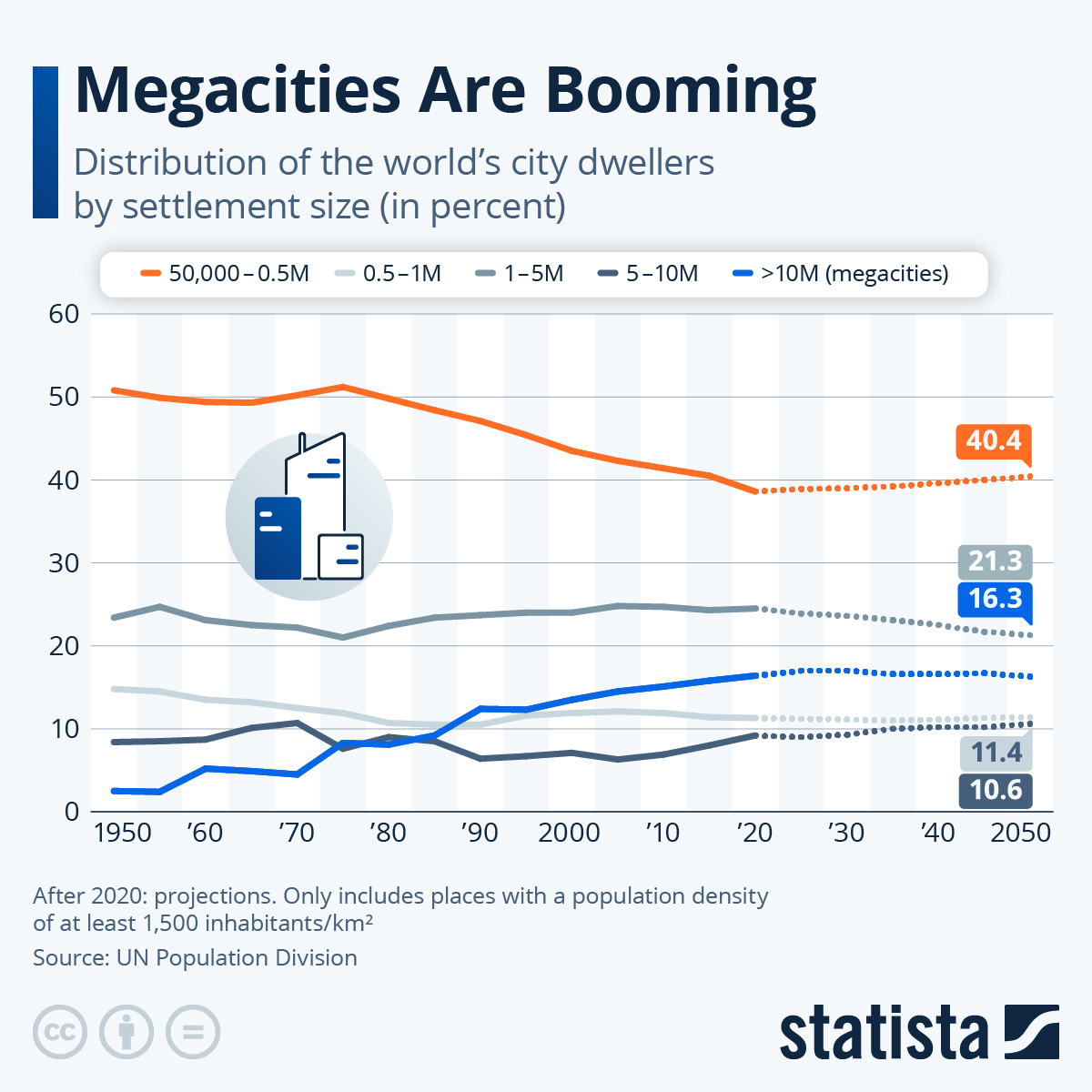
The number of people living in megacities has been growing significantly for decades, rising from 2.5 percent in 1950 to 16.4 percent of city dwellers in 2020.
As Statista’s Katharina Buchholz reports, according to UN projections, this figure will continue to rise slightly before stabilizing at around the current level by 2050. At the same time, living in smaller cities is becoming less widespread.
The share of the urban population living in places with between 50,000 and 500,000 inhabitants fell from 50.8 percent to 38.6 percent during the same period.
You will find more infographics at Statista
This development reflects the global trend of urbanization. Economic opportunities, better infrastructure and in some cases political instability in the countryside have been driving the growth of large metropolitan areas.
However, this increasing concentration has also been exacerbating challenges that are typical for urban centers, for example housing shortages, overcrowded transport and an increased strain on the environment.
Another challenge for city planners are so-called heat islands, where urban concrete jungles act as heat reservoirs and exhibit much higher temperatures than less dense areas with more vegetation and other natural features. The prevalence of tall buildings and narrow streets can also reduce wind speeds, meaning it takes longer for accumulated heat to dissipate. This additional heat stress, combined with the higher levels of air pollution observed in many cities, compounds negative impacts on human health.
However, the UN anticipates that the growth of the largest cities will slow down in the future. While the share of city dwellers living in megacities is expected to rise to 17 percent by 2030, it is then projected to stagnate and decline slightly by 2050 to 16.3 percent. At the same time, the development of medium-sized cities – those with populations of 5 to 10 million – is expected to speed up, hosting a share of 10.6 percent of city inhabitants by 2050.
Tyler Durden
Tue, 07/14/2026 – 06:55
via ZeroHedge News https://ift.tt/Xxrqdmt Tyler Durden