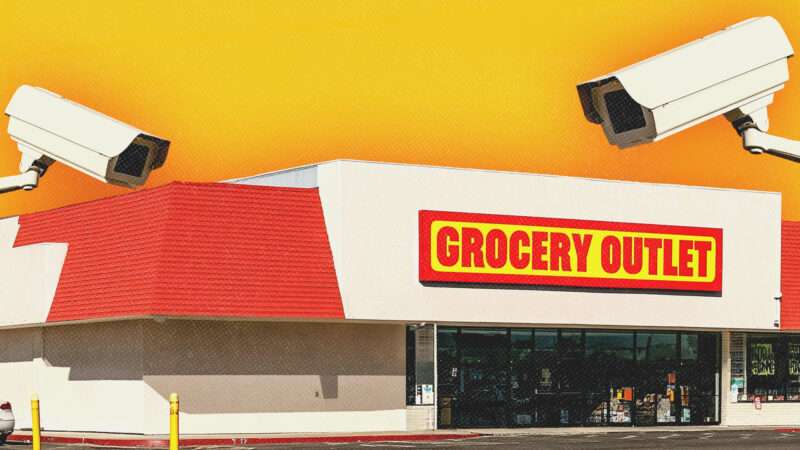
With shoplifting a serious concern, and given the declining cost of security equipment, it’s no surprise that grocery stores in California are rolling out facial recognition technology to identify known thieves when they step through the door. Software-backed cameras that match people’s faces to their names are increasingly ubiquitous at airports, stores, and on the street, spelling the potential end to anonymity in public places. The end, that is, unless people take advantage of gear and tactics designed to confuse facial recognition tech.
Fashion Responds to the Surveillance State
“As facial recognition technology is rolled out across Britain’s public spaces, a new generation of designers say privacy could be the next big fashion trend,” Amelia Hill reported last week for The Guardian. “Companies have started incorporating ‘adversarial patterns’ in their garments—carefully designed arrangements of shapes, colours and repeated motifs said to exploit weaknesses in some computer vision systems.”
If surveillance-conscious clothing becomes a thing, it makes sense that it would be especially popular in the U.K., which has one of the more heavily monitored populations in the world. Last November, The Telegraph described the U.K. as a “surveillance state” with 7.5 million government and private cameras watching public spaces, not counting doorbell installations, dashcams, and the like: “Recent research estimated there were nearly one million private and publicly-owned CCTV cameras in London alone.”
Originally, those cameras required human eyes to interpret the people and events they captured. But Reuters reported in May that Britain is “one of Europe’s leading adopters of live facial recognition policing.” London’s Metropolitan Police credit the technology with “helping officers arrest around 2,500 wanted people since the start of 2024, including suspects accused of violent and sexual offences.” That number is likely to grow as cameras increasingly do real-time matching of faces and names as they monitor people walking along the street, commuting, protesting, or shopping for groceries.
The Reuters story acknowledged that critics “say live facial recognition undermines the presumption of innocence underpinning British law by treating every passer-by as a potential suspect.”
From Dazzling Patterns to Blinding Infrared lights
That creates a market, some entrepreneurs believe, for products that inhibit facial recognition.
Strictly speaking, clothing printed with patterns that confuse software, or embedded with infrared LED lights that blind cameras, isn’t entirely new. I first wrote about the developing market in 2019 when it consisted of a couple of small firms marketing high-tech sunglasses and a few craft producers selling shirts and skirts printed with faces and license plates.
Since then, the market has grown, though it’s far from mainstream. Several companies now sell products designed to deter surveillance through passive and active means.
Based in Italy, Cap_able Design sells AI Camo T-shirts. “The adversarial algorithm embedded in the textile disrupts object recognition software, preventing it from identifying the person wearing the garment — even though it can still detect small printed oranges in the fabric,” the company claims. A patterned knit crew is supposedly identified by facial recognition as a dog or giraffe.
Urban Privacy, a German company, offers the Urban Ghost, a coat that overwhelms surveillance cameras with integrated infrared lights that are invisible to human eyes. It also sells shirts and sweatshirts featuring patterns intended to confuse facial recognition software.
America’s Adversarial Apparel offers a range of clothing “engineered with adversarial patterns that confuse surveillance tech, disrupt biometric profiling, and reject constant data extraction.”
People who don’t especially want to look like the aftermath of an industrial accident in a kaleidoscope factory might prefer anti-surveillance sunglasses of the sort marketed by U.S.-based Reflectacles and China’s Sunphey Optical. They sell products with reflective coatings and infrared blocking that conceal the eyes, which are central to most facial recognition algorithms.
Keeping Up in the Surveillance Arms Race
These companies all operate within a new industry that is trying to demonstrate that demand for such products extends beyond a niche privacy-minded segment of the population. The companies also must show their ability to keep up with the arms race against surveillance innovators who are constantly improving their technology.
Last year, journalist Kari Paul wrote for the Mozilla Foundation that a garment she tested was effective in confusing facial recognition software. But “widely-varying and rapidly-evolving algorithms can quickly render previously functional adversarial patterns less effective,” she added. One of the entrepreneurs she spoke with conceded that “algorithms are getting more difficult to trick.”
That is, the shirt or hoodie you buy today to baffle surveillance may be nothing more than a colorful addition to the wardrobe in a year or two because of advancing technology. But for people who care about privacy, anti-surveillance clothes and glasses might be worthwhile tools alongside others for maintaining some degree of anonymity in everyday life.
People concerned about privacy should also consider the Electronic Frontier Foundation’s Atlas of Surveillance, which maps where surveillance tools are deployed. That’s helpful for avoiding observation, though places saturated with cameras—like the U.K.—leave few options for traveling unobserved.
Low-tech approaches such as hats, sunglasses, and masks also work, since software can only identify what cameras are able to see. That said, concealing your face may work better at a street demonstration than while entering a bank.
It’s worth noting that, while privacy advocates have legitimate reasons for maintaining anonymity, many people deploying surveillance have good reasons of their own. The Bay Area grocery stores adopting facial recognition say they’re trying “to prevent shoplifting,” which is a big concern for retailers.
All of which is to say that security cameras aren’t going anywhere, and neither are efforts to evade the all-seeing eyes of the surveillance state. Maintaining privacy and anonymity will be an ongoing battle.
The post Privacy-Minded Fashion Aims To Baffle Facial Recognition appeared first on Reason.com.
from Latest – Reason.com https://ift.tt/qU0muMh
via IFTTT