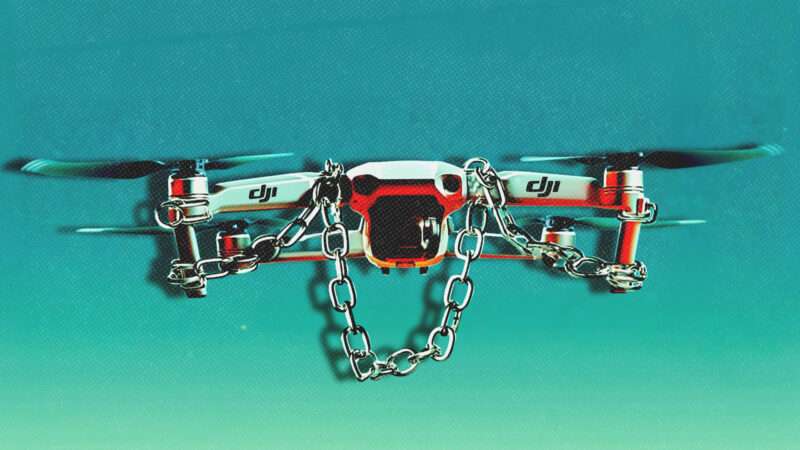
This week, the Federal Communications Commission (FCC) proposed expanding a ban on drones from other countries—including products it had previously approved and that are currently being sold in stores.
Two FCC agencies “propose to prohibit the continued importation and marketing of certain previously authorized equipment that has been determined to ‘pose an unacceptable risk to the national security of the United States or the security and safety of United States persons,'” according to a notice published July 17. “In particular, we propose to apply such prohibitions to certain previously-authorized foreign-produced uncrewed aircraft systems (UAS) and UAS critical components, and certain communications and video surveillance equipment.”
The ban would apply not just to drones and drone parts but also components like cameras. The notice mentions nine manufacturers by name, which the FCC seems to suspect are just front companies repackaging and selling products by DJI, a Chinese company that accounts for over 90 percent of the consumer drone market worldwide. Earlier this month, after eight of the named companies did not respond to requests for information, the FCC proposed instituting a fine of $25,000 to each one.
Federal law directs the FCC to keep a list of “communications equipment or services that pose a national security risk.” The agency then prohibits any equipment on the “covered” list from being sold, imported, or advertised in the U.S. by refusing to authorize its transmitters.
In December, the FCC banned all drones and drone components produced outside the U.S. “Ensuring a strong and resilient drone industrial base is an economic and national security priority. Relying on foreign-made UAS threatens national security,” the notice read, though it gave no specifics.
But the new proposal goes a step further. The December ban clarified it “does not impact a consumer’s ability to continue using drones they previously purchased or acquired,” nor would it prevent “retailers from continuing to sell, import, or market” previously approved models. Now, the agency is explicitly proposing to ban devices it had already approved for sale, which in many cases are currently on store shelves.
The agency granted itself this authority in October 2025, voting to “revise” its rules “by adopting a mechanism to limit the continued importation and marketing of such previously authorized covered equipment.” The new rule directed regulators to conduct a “public interest analysis” on each item, “giv[ing] particular weight to the fact that the relevant equipment was determined to pose ‘an unacceptable risk to the national security of the United States or the safety and security of United States persons.'”
“If the FCC’s retroactive ban goes into effect, [covered products] should disappear from all major online retailers,” Sean Hollister writes at The Verge, “and the company may even need to write off however many cameras are still sitting in US warehouses like Amazon’s.”
FCC Chairman Brendan Carr has long supported banning DJI, calling for adding the company to the covered list in 2021. A 2017 Department of Homeland Security intelligence bulletin warned DJI was “likely providing U.S. critical infrastructure and law enforcement data to [the] Chinese government.”
But for all its talk about DJI and other drone manufacturers posing a grave risk to Americans, the government has not been forthcoming with proof.
“The US government has never provided specific public evidence that foreign drones pose a national security threat to begin with, or why other products like cameras should be caught up in that ban,” Hollister adds.
For its part, DJI claims that an independent security audit of its products found “no evidence of data transmission outside the United States,” “no backdoors or unauthorized remote access mechanisms,” and “no unexplained radio frequency emissions.”
It’s certainly possible for Chinese-made drones to pose a threat to national security. “Beijing’s national security laws give the Chinese Communist Party (CCP) the ability to access any data collected by Chinese companies, including drone imagery,” Chris Wingate of the Heritage Foundation wrote last year. “That means every flight over a power plant, a military facility, or a U.S. city risks feeding information back to an adversary.”
But if the government decides on a whim that a consumer good it previously approved must be pulled from shelves and banned for sale, it should at least go to the trouble of proving its case.
The post FCC Wants To Ban Drones It Already Approved for Sale appeared first on Reason.com.
from Latest – Reason.com https://ift.tt/Mwc1feh
via IFTTT