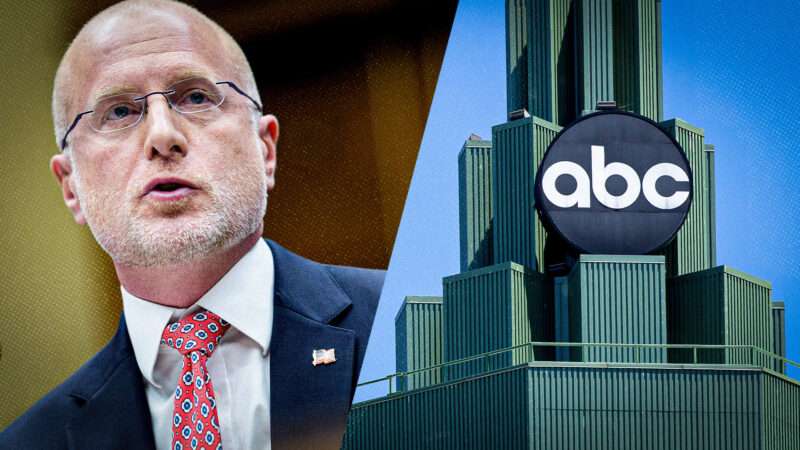
Last week, President Donald Trump said ABC and NBC should lose their broadcast licenses because they had dissed him by declining to air his speech about election security. On Wednesday, Brendan Carr, the Trump-appointed chairman of the Federal Communications Commission (FCC), suggested he is sympathetic to that view, saying ABC’s news-coverage decision will figure in the FCC’s ongoing review of the broadcast licenses held by Disney, which owns ABC and its TV stations in eight cities.
Carr’s comments reinforce the point that his understanding of the “public interest” that broadcasters are legally obligated to serve is indistinguishable from Trump’s personal interests. The idea that the FCC should punish news organizations for exercising their editorial judgment in a way that offends the president is plainly inconsistent with the press freedom guaranteed by the First Amendment. But as Carr sees it, his agency has the authority to restrict that freedom in service of his boss’s petty vendettas.
Trump’s 24-minute speech, which he delivered from the East Room of the White House on Thursday night, was ostensibly about the need to ensure “fair and honest elections.” But before broaching that topic, Trump bragged about his supposed accomplishments for several minutes. And when he got around to discussing election security, he made several dubious statements, including allegations that “members of the deep state” had “worked to actively suppress” information about a “colossal security breach,” that they had “blatantly lied” about “the security of our election infrastructure,” and that “our elections were left vulnerable to being rigged and stolen.”
Although Trump did not explicitly reiterate his long-debunked claim that Joe Biden relied on such chicanery to steal the 2020 presidential election, he described a “plot” to “continue this fraud”—a criminal conspiracy that he said included ABC and NBC. The networks’ complicity was clear, he said, from the fact that they did not provide live coverage of his speech “because they know how corrupt our system is, and they don’t want to reveal it.” He added that “fraud like this should mean a revocation of their licenses.”
An FCC chairman who was actually devoted to defending the First Amendment, as Carr claims to be, would have rejected that suggestion out of hand. Although such defiance might seem inconceivable now that Trump has surrounded himself with toadies eager to do his bidding, it happened during his first term, when FCC Chairman Ajit Pai made it clear that he would not act as Trump’s hatchet man.
“Network news has become so partisan, distorted and fake that licenses must be challenged and, if appropriate, revoked,” Trump declared in October 2017. Pai disagreed in no uncertain terms. “I believe in the First Amendment,” he said. “The FCC under my leadership will stand for the First Amendment, and under the law the FCC does not have the authority to revoke a license of a broadcast station based on the content of a particular newscast.”
That was then. On Wednesday, Carr made it clear that he does not share Pai’s commitment to the First Amendment.
“You were asked before the president’s speech last week if carrying this speech is part of a broadcaster’s public interest obligations, and you didn’t say one way or another,” Communications Daily Associate Editor Monty Taloe noted during an FCC press conference. “Then, during the speech, the president said ABC and NBC should lose their licenses for not carrying it. Does that mean carrying those [presidential] speeches is part of a broadcaster’s public interest obligation?”
Carr’s response: “When you have the president of the United States standing inside the White House delivering an important speech, I think that’s something that broadcasters should be carrying. And so, obviously, this is an issue. There have been lots of concerns raised, including by members of Congress, about whether broadcasters and their decisions there comply with [the] public interest. With respect to Disney [and] ABC in particular, we have an open proceeding right now on whether they’ve been operating in the public interest, and I’m sure that there are going to be points raised in that proceeding that relate to Disney’s decision there.”
Deadline Political Editor Ted Johnson asked Carr to clarify whether he was saying that ABC’s decision not to air the speech “could be held against Disney” because “in your eyes, they’re not fulfilling their public interest obligation.” Broadcasters “should be doing that,” Carr reiterated. “Any time a broadcaster is not operating in the public interest, that raises significant concerns,” he said, and “yes, the FCC is going to hold people accountable to their public interest obligations. “
Johnson noted that the networks say, “Hey, we have made this call before under President Biden, under President Obama, where we did not carry each and every one of their presidential addresses when the White House requested it.” Carr was unfazed. “As a general matter,” he said, “when the president speaks from the White House on a significant matter, I think that’s something that broadcasters should be allowing their viewers to get access to. So whether it happened before or not, I can’t speak to that.”
Carr’s suggestion that NBC and ABC somehow prevented Americans interested in Trump’s speech from seeing it is plainly silly. Fox News and Fox broadcast stations carried the speech live in its entirety, and so did various streaming services and online platforms, including ABC News Live, NBC News NOW, CNN.com, the PBS and Associated Press YouTube channels, and the White House’s website and social media accounts. CBS and MSNBC ran excerpts of the speech, albeit accompanied by commentary and fact-checking.
Trump’s position is that NBC and ABC nevertheless committed an unpardonable sin, worthy of a death sentence for their network-owned stations, by declining to give Americans a couple of other options for watching his speech. And Carr clearly agrees that broadcasting Trump’s speech was part of the networks’ “public interest” obligations. Never mind that TV networks historically have exercised their journalistic judgment in deciding which presidential speeches to air. While that might have been acceptable when Democrats such as Biden and Obama occupied the White House, it is intolerable under Trump, who views personal slights as a justification for government retaliation.
Carr initiated the “open proceeding” that he mentioned during his press conference in April, when he informed Disney and ABC that the FCC was “calling in Disney’s ABC licenses for early renewal” years before they otherwise would have been subject to review. Carr said the FCC was investigating ABC and Disney for “possible violations of the Communications Act of 1934 and the FCC’s rules, including the agency’s prohibition on unlawful discrimination.”
Carr was referring to the FCC’s concerns about “Disney’s DEI practices.” But even at the outset, he signaled a broader inquiry, encompassing “possible violations of the Communications Act of 1934,” which provides the main legal authority for requiring broadcasters to serve “the public interest.” And as Carr’s take on presidential speeches illustrates, he interprets that standard broadly enough to justify FCC interference with freedom of the press.
Such government meddling would be clearly unconstitutional in any other medium. But “when it comes to broadcast TV,” Carr noted at Wednesday’s press conference, “I’ve always said it’s different.” Why? Because, Carr avers, “the American people have subsidized broadcasters to the tune of billions of dollars by providing free access to the nation’s airwaves.”
In reality, companies like Disney do not have “free access to the nation’s airwaves,” because broadcast licenses figure into the price they pay when they acquire TV and radio stations. But Carr thinks this fiction empowers him to penalize news outlets for making decisions that Trump does not like.
The Supreme Court’s 1969 rationale for limiting the First Amendment rights of broadcasters, which hinged on “the scarcity of radio frequencies,” likewise never made much sense. It makes even less sense today given the plethora of media options available to Americans—the reason Carr’s avowed concern about “access to” Trump’s speech is so implausible.
Even taking for granted the arbitrary distinction between broadcast content and speech in all other media, it has never before been understood to justify the sort of heavy-handed intervention that Carr thinks the “public interest” standard demands. “The agency is prohibited by law from engaging in censorship or infringing on First Amendment rights of the press,” the FCC itself says. “Those protected rights include, but are not limited to, a broadcaster’s selection and presentation of news or commentary.”
When a TV network decides whether to offer live, unexpurgated coverage of a president’s speech, it is clearly engaging in the “selection and presentation of news.” Yet Carr thinks such decisions “obviously” raise “an issue” as to “whether broadcasters and their decisions there comply with public interest,” which is the standard that the FCC applies when it decides whether to renew licenses.
During the same press conference, Anna Gomez, the lone Democratic member of the FCC, took a different view. “It is not for the FCC to tell broadcasters how to make their editorial decisions or what content to place on their networks or their local broadcast stations,” she said. “They have a First Amendment right to make those decisions….If we tell them they can’t broadcast something, that’s censorship, and it’s compelled speech if we tell them they have to do so.”
Officially, the FCC recognizes its constitutional and statutory obligation to refrain from such meddling. “The limitations on the FCC’s power to restrict or ban speech begin with the First Amendment,” it notes. And under the Communications Act, “no regulation or condition shall be promulgated or fixed by the Commission which shall interfere with the right of free speech by means of radio communication.”
In light of “these legal mandates,” the commission says, “the FCC has long held that ‘the public interest is best served by permitting free expression of views.’ Rather than suppress speech, communications law and policy seeks to encourage responsive ‘counter-speech’ from others. Following this principle ensures that the most diverse and opposing opinions will be expressed, even though some views or expressions may be highly offensive.”
Carr did not seem to be following that policy when he threatened broadcasters with fines and license revocation if they failed to punish late-night comedian Jimmy Kimmel for comments that offended Carr and the president. In that case, ABC and its affiliates immediately sought to placate Carr by suspending Kimmel’s show—precisely the punishment that Carr had recommended. What happened to tolerating “diverse and opposing opinions” even when they “may be highly offensive”?
Given Carr’s manifest disregard for freedom of speech, he might want to delete the FCC’s online assurances that it will comply with the limits imposed by the First Amendment and the Communications Act. “I continue to say that this vague public interest standard is being used just to punish speech that this administration doesn’t like and to reward speech that it does like,” Gomez said on Wednesday. “That’s inappropriate, and it’s contrary to the law and to the Constitution.”
Carr is undaunted by such objections. “We’re going to hold all broadcasters to [meeting their] public interest obligations, and we’re always looking to make sure that they’re doing exactly that,” he said. “And I think there’s more work for us on this issue ahead.”
The post Brendan Carr Says ABC's Refusal To Air a Trump Speech Could Affect Renewal of Its Broadcast Licenses appeared first on Reason.com.
from Latest – Reason.com https://ift.tt/M2E0fjv
via IFTTT