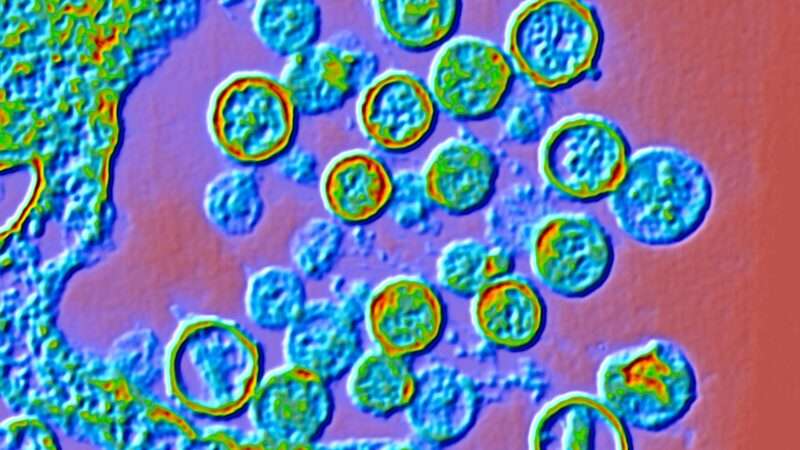
How worried should you be? The cruise ship on which hantavirus had been spreading—the MV Hondius—docked over the weekend and let off its roughly 150 passengers. Medical repatriation flights have been arranged by most of the 23 countries with nationals aboard the ship. Another 32 passengers had already disembarked at an earlier stop (the Atlantic island of St. Helena, near Africa) and flew home on April 24, before the outbreak had been detected.
Three passengers died of hantavirus, which is typically contracted via exposure to rodent droppings, urine, or saliva. The people who died all appear to have had the Andes variant, which spreads via human-to-human contact. Hantaviruses can cause either hantavirus pulmonary syndrome or hemorrhagic fever with renal syndrome; the type currently spreading is the former.
The U.S. Department of Health and Human Services (HHS) is processing all 17 American passengers at a facility in Nebraska, but it’s not clear exactly what next steps look like—likely quarantine, since we know the disease’s incubation periods are rather long. One of the Americans brought home has reportedly tested “mildly positive” for hantavirus, according to HHS—which sounds insane, because being positive or negative for a virus is a binary. How can you be “mildly” positive? But I digress. Another American has developed symptoms. Both were transported aboard the same flight as the rest, but with additional containment measures in placed “out of an abundance of caution.” I’d argue we need even more caution, and that there has not been an abundance of it, if the goal is to actually contain this terrible Andes variant and prevent further spread.
Here’s why: We’re getting more indications that there is asymptomatic spread. And that—coupled with a super-long incubation period—might create big problems.
For a COVID-like virus, it would be a different story. But the case fatality rate for this hantavirus variant that causes severe respiratory illness appears to be about 38 percent so far. If this outbreak grew in size, it would be a very big problem, and it would probably creep up on us, due to the long incubation periods and the fact that it is very hard to convince people to self-isolate for two- to three-week periods if they haven’t developed any symptoms.
Andes Hantavirus analysis:
This chart suggests Cases 2-8 were all a single H-to-H jump from Case 1, since all of the incubation periods cluster at 22 days from Case 1 symptoms.
We are now 13 days from the 'mean' date of symptoms from Cases 2-8.
If there is to be a new… pic.twitter.com/i3NJVAMaKN
— Dr Steven Quay (@quay_dr) May 11, 2026
A new twist. The American who tested positive who was on the ship was tested without having symptoms and was positive. Interesting thread to read which discusses the implications of this: https://t.co/obhWScxQvZ
— Roger Seheult, MD (@RogerSeheult) May 11, 2026
We also need to figure out how close of a contact matters for the spread of this variant. It seems like the health authorities don’t know what they’re doing and didn’t learn much of anything from COVID’s spread:
Honestly, not trying to stir things up or be a contrarian or anything. I do forensic investigations of sick buildings frequently and I approached this w same curiosity – I’m trying to be objective about what’s known and not known, and wanting to understand how it’s spread (so we…
— Joseph Allen (@j_g_allen) May 10, 2026
Then there’s another issue: One country’s specific containment protocol matters less if people are coming in from other countries dealing with their own outbreaks. Of those who got off the MV Hondius yesterday, 38 are bound for the Philippines; 31 for the U.K.; 23 for the U.S.; 16 for the Netherlands; 14 for Spain; 9 for Germany; 6 for Canada; 5 apiece for France, Turkey, and Ukraine; and a couple each for Australia, Ireland, New Zealand, India, Singapore, Russia, Guatemala, and a few others. In order for this virus to stay obscure, all of these countries need to do a good job of getting the repatriated cruise ship crew and passengers to self-isolate for many weeks. Not to mention the countries and states (Texas, California, Georgia, and Virginia) currently monitoring those who already got off the ship in St. Helen. Maybe I’m just cynical, but that doesn’t seem likely.
That said, I won’t tell you to worry or not to worry. It is possible this could snowball and become a bigger problem. It is also possible that our public health authorities learned shockingly little from COVID, and are poorly equipped to handle pandemics, and that this won’t be the big one but that there’s no capacity to handle the big one whenever it comes. It is also possible cruise ships are cursed, even the classy ones.
One outbreak and the entire “sane” side of public health resorted back to the paternalism of telling us not to worry or “panic”, “this isn’t Covid”, etc.
They didn’t learn a thing. We didn’t appoint them to be our therapists or parents. Provide info, don’t dictate how to feel.
— zeynep tufekci (@zeynep) May 10, 2026
I highly doubt the birdwatching was worth it. Anyway, vaya con Dios. More on this front as it develops.
Scenes from Austin: Does anyone have an estimate of how much of Austin’s vehicle traffic is self-driving? I’m back home visiting my family right now, having been away for the past year, and the proliferation of Waymos and Teslas is awesome to behold.
A small anecdote for the Elon haters: My mom just had her car totaled by some dunce and replaced her old car with a Tesla. She was backing out of the driveway over the weekend while my 3-year-old was riding his bike and I reflexively called him over to me, so he wouldn’t be anywhere near the car. But then it dawned on me that, with a self-driving Tesla, we have additional safety mechanisms built in; the perennial parental worry that a child will be hit by a car backing out could blessedly disappear as more and more people use full self-driving. I’m into it!
QUICK HITS
- President Donald Trump and Chinese leader Xi Jinping are scheduled to meet in Beijing this week, with Taiwan, tariffs, and Iran on the agenda. Also: the fate of Hong Kong democracy activist Jimmy Lai.
- “OpenAI is being sued by the family of a victim killed in the April 2025 mass shooting at Florida State University that left two people dead. The lawsuit alleges that OpenAI’s ChatGPT enabled the attack,” reports NBC. “The complaint also names Phoenix Ikner, the man accused in the shooting, as a defendant, citing his ‘extensive conversations’ with ChatGPT. The suit says that OpenAI failed to effectively detect a threat in ChatGPT’s conversations with Ikner, claiming the chatbot ‘either defectively failed to connect the dots or else was never properly designed to recognize the threat.'”
- Lol:
When people picture Communism they're too reliant on feedback from people who actually lived under communism. I think we can get a better image of what Communism would actually look like by delving into the imagination of a middle class Green Party voter.
— wokeandwoofing (@wokeandwoofing) May 10, 2026
The post How Big of a Deal Is Hantavirus? appeared first on Reason.com.
from Latest – Reason.com https://ift.tt/6n9QVWh
via IFTTT