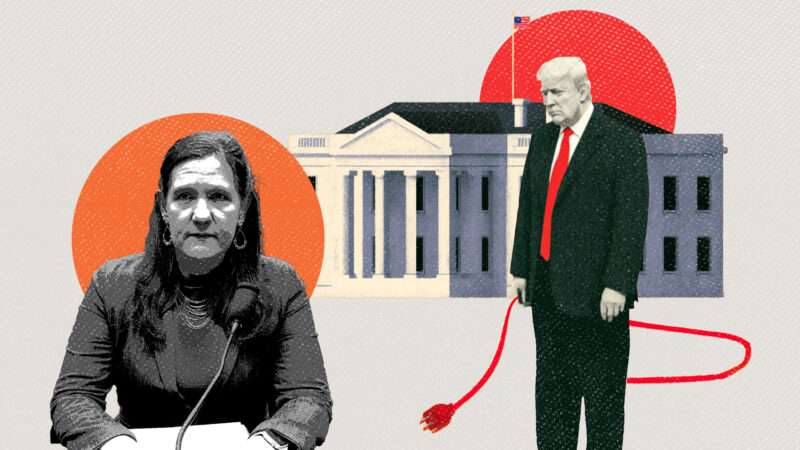
In 1935, the U.S. Supreme Court unanimously stopped President Franklin Roosevelt from firing a commissioner of the Federal Trade Commission (FTC) for purely political reasons. The FTC “cannot in any proper sense be characterized as an arm or an eye of the executive,” the Court declared in Humphrey’s Executor v. United States.
On Monday, by a vote of 6–3, the Supreme Court overturned Humphrey’s Executor and allowed President Donald Trump to fire FTC commissioner Rebecca Slaughter at will. In other words, a theory of broad executive power that was once championed by a progressive president has just been successfully resurrected by a conservative one.
Why did the Supreme Court rule the way that it did?
“The FTC unquestionably exercises executive power, and must therefore be controlled by the Chief Executive, in whom such power is vested,” declared Chief Justice John Roberts in Trump v. Slaughter. “It follows, then, that Slaughter served as the President’s subordinate at the FTC—and that the President was entitled to cut her tenure short.”
But is the matter really as simple as that? Consider what else Roberts had to say about the FTC in the same opinion:
Since its creation in 1914, the FTC has accumulated vast rulemaking, enforcement, and adjudicatory powers under more than 80 statutes. Not only does it promulgate rules that carry the force of law, but it also enforces those rules against private parties, collecting civil penalties in the billions of dollars. [Emphasis added.]
To make or promulgate rules in this context basically means to make new federal laws. Yet the federal lawmaking power does not properly belong to the executive. Rather, it belongs to Congress under Article I of the Constitution. Yet now, as a direct result of Trump v. Slaughter, the federal lawmaking power that the FTC and other “independent” federal agencies have long wielded is suddenly resting in the sole hands of the president.
Doesn’t that upset the constitutional separation of powers?
Notably, one of the six justices who voted for Trump in this case spelled out that very objection in a separate concurrence.
Writing alone, Justice Neil Gorsuch agreed with Roberts that independent federal agencies should be brought under the control of a unitary executive when those agencies exercise executive-like powers. But “today, independent agencies do not just exercise executive law-enforcement powers,” Gorsuch wrote. “Congress has also delegated to them vast legislative and judicial powers, effectively allowing these agencies to make laws and decide disputes under them. And, after today’s decision, the President can effectively exercise all those powers too.”
As Gorsuch notes, this outcome raises a number of troubling new questions:
Would Congress have delegated so much power, including legislative and judicial power, to independent agencies had it known that the President would come to control them? How will Congress respond now—if realistically it can? And what, if anything, will this Court do about it?
It bears repeating that Gorsuch did not write those words of warning in dissent. Rather, he wrote them in concurrence after fully joining the very opinion whose “implications” he is so understandably worried about.
Here’s how I read Gorsuch’s concurrence: He is inviting new cases to be filed against Trump and future presidents if/when those presidents try to wield unconstitutional lawmaking power via their new control over the federal bureaucracy.
But will the Supreme Court actually stop Trump or any other president from doing the unlawful lawmaking that today’s decision enables the president to do?
Gorsuch seems nervous about the answer to that question. Perhaps we should be nervous too.
The post Gorsuch Warns About Executive Overreach While Expanding Trump's Power appeared first on Reason.com.
from Latest – Reason.com https://ift.tt/gfRDXOE
via IFTTT