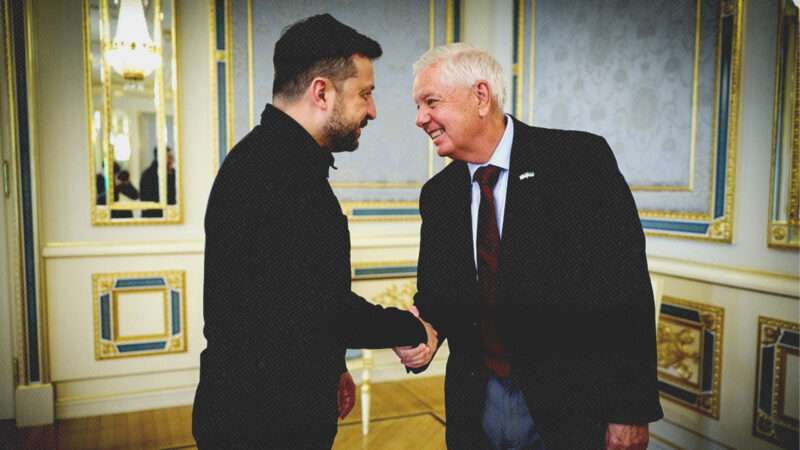
Lindsey Graham died doing what he loved: egging on faraway violence. After returning from a trip to a drone factory in Ukraine, the Republican senator from South Carolina suddenly came down with chest pains. One of his last acts was phoning President Donald Trump—a man who Graham had once called “unfit for office”—to push for more aggressive policies in Europe and the Middle East.
“I can’t die now. I still need to do the Russia sanctions, get Iran sorted out, and do Israeli-Saudi normalization,” Graham reportedly joked to the people around him, feeling ill after his call with Trump. But about half an hour after being called to Graham’s house on Saturday night, medics reported that the 71-year-old senator was undergoing cardiac arrest. The medical examiner declared Graham dead of an aortic dissection caused by high blood pressure.
Graham was the last surviving member of the “Three Amigos,” a gaggle of hawkish senators that included John McCain, a Republican, and Joe Lieberman, a Democrat turned independent. Although he shared their foreign policy goals, Graham may have been the most morally flexible of the three. Unlike McCain, who stuck with his opposition to Trump until his last dying days, Graham twice flattered his way back into Trump’s graces after abandoning him. And he whispered in the ear of Trump’s rival, President Joe Biden, as well.
“If we nominate Trump, we will get destroyed…and we will deserve it,” Graham had declared during the 2016 election, calling Trump a “race-baiting” lunatic. Two years later, Graham was showering Trump with praise and claiming that McCain would have done the same. During the 2020 election, Graham argued that Trump should never concede. When Trump’s supporters attacked the U.S. Capitol in pursuit of exactly that goal, Graham distanced himself from the president: “Enough is enough.”
When Biden took office, Graham started flattering the new leader, claiming that only Biden could secure the kind of U.S.–Israeli–Saudi deal that Trump had been pursuing. “Ask anyone in the Biden administration—they know how deeply engaged [Graham] was,” wrote David Makovsky, director of the program on Arab-Israel Relations at the neoconservative Washington Institute for Near East Policy.
Even this supposed peace deal was really about opening the door for more war. Graham bluntly told Biden that the negotiations were about building American willingness “to go to war for Saudi Arabia,” according to Bob Woodward’s book War. And Graham considered Iran the “spoiler” for Arab-Israeli peace—so naturally, the solution would be war with Iran.
Graham wormed himself back into Trump’s orbit in an almost single-minded pursuit of that goal. (The best way to convince Trump of something, Graham gloated, was to tell him former President Barack Obama would have done the opposite.) He pushed Trump to follow Israel in bombing Iran in June 2025, complained that the end of that war was a “step backwards,” and then pushed Trump to bomb Iran again in February 2026, in what was supposed to be a final regime change war. “Mr. President, you’re not far behind God,” Graham told Trump earlier this year.
The same two-faced flattery extended overseas. Graham made numerous public gestures in support of Kurdish rights, earning himself a glowing eulogy from Syrian Kurdish Gen. Mazloum Abdi and a proposal by Erbil Governor Omid Xoshnaw to build a statue for Graham in Iraqi Kurdistan. But at the same time, Graham helped sell a proposal to let Turkish President Recep Tayyip Erdoğan take over Kurdish areas of Syria, according to the memoirs of former National Security Adviser John Bolton.
Sometimes, Graham complained that Americans were too bigoted against Muslims to support spreading democracy in the Middle East. Other times, he claimed that the doctrine of Shiite Islam “compels them to kill all the Jews” and implied that dropping a nuclear bomb on Gaza would be acceptable. In between his statements of support for the “brave Iranian people,” he declared that “Iranians cheat and they lie” and made wisecracks about their bad genes.
So it went in Europe. For all the eulogies calling Graham a friend of Ukraine, the senator himself was frank about trading Ukrainian lives for other goals. “I like the structural path we’re on. As long as we help Ukraine with the weapons they need and economic support, they will fight [Russia] to the last person,” he said at a 2022 press conference. Two years later, Graham declared that “this war is about money” and bragged about the potential economic benefits.
Despite all of these twists, turns and contortions, Graham clearly had a consistent principle: expanding the U.S. government’s involvement in the world, by force. He started his Senate career supporting the Second Gulf War, pushed for bombing Iran while the Iraq conflict was still ongoing, and argued for staying in Afghanistan permanently. Graham discovered that the U.S. military was in the African nation of Niger only after several troops died there in 2017—and then immediately called for “more actions in Africa, not less.”
In pursuit of that goal, Graham had no problem treating Americans as enemies. In 2011, speaking on the Senate floor about Americans accused of terrorism inside the U.S., he said: “And when they say, ‘I want my lawyer,’ you tell them: ‘Shut up. You don’t get a lawyer. You are an enemy combatant.'” Two years later, when the National Security Agency was caught spying on Verizon phone customers, Graham declared himself “glad” that he and his fellow citizens were being surveilled. And after an American protester was shot by Israeli commandos in 2010, Graham stated: “I’m not asking the Israeli government to apologize to me for killing an American citizen. I’m urging American citizens to act responsibly.”
What drove such intense aggression? One formative experience was Graham’s military career, serving as a U.S. Air Force lawyer in Germany during the end of the Cold War. “I thought I would never live to see the Berlin Wall come down, right? Two years later it’s down,” he told the Council on Foreign Relations in 2011. Graham kept chasing that high, calling Iranian regime change “Berlin Wall stuff” and comparing himself to former President Ronald Reagan.
“I would like to shape world events rather than watch the world fall apart,” Graham continued in his speech to the Council on Foreign Relations. “That unity that we had from administration to administration, regardless of party and winning the Cold War, has clearly been lost in the war on terror, or a man-made catastrophe, whatever you want to call it.”
Graham couldn’t see how his own strategy was destroying that unity. The war in Iraq that he supported was a major factor in destroying trust in the U.S. government and polarizing U.S. politics. Graham used his influence to push both Trump and Biden into supporting policies that their own constituents increasingly hated. The attack on Iran this year, the fulfillment of Graham’s life work, is the first U.S. war to be fought with negative public support from its start. The more Graham brought the parties together in support of forever wars, the further he drove them from the American people.
The post Last of the Neocon 'Three Amigos': Lindsey Graham Dies Unexpectedly appeared first on Reason.com.
from Latest – Reason.com https://ift.tt/1eMnDg9
via IFTTT