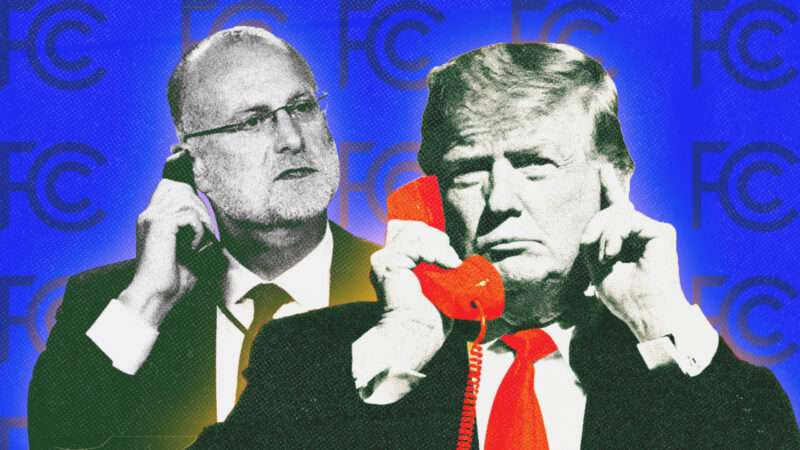
Imagine how Republicans would react if a Democratic president reflexively threatened to yank the broadcast licenses of TV stations because he did not like their news coverage or programming decisions. President Donald Trump has been doing that since his first term, and he did it again last week after ABC and NBC declined to offer live coverage of his speech about election security.
These threats are part of an intimidation campaign that has already yielded striking concessions to Trump’s whims. His weaponization of the Federal Communications Commission (FCC) is designed to chill constitutionally protected speech, establishing a precedent that Republicans may regret when their opponents take control of the White House.
Brendan Carr, the Trump-appointed FCC chairman, seems to think broadcasters have a legal obligation to please the president. “Broadcasters must operate in the public interest,” Carr declared in March, “and they will lose their licenses if they do not.”
As Carr understands it, “the public interest” requires broadcasters to cover the president “fully, accurately, and fairly.” It may also require them to eschew war reporting that embarrasses the president and punish late-night comedians whose jokes offend him.
Any attempt to impose such a vague, open-ended standard on speakers in other media would be plainly unconstitutional. But broadcasters are different, Carr avers, because “the American people have subsidized [them] to the tune of billions of dollars by providing free access to the nation’s airwaves.”
Trump echoed that rationale for speech regulation last Thursday, when he said broadcasters “use our public, multibillion-dollar-in-value airways for absolutely no money.” But that is plainly not true, since broadcast licenses figure in the prices that media companies pay when they acquire TV or radio stations.
Trump nevertheless relied on that false premise in arguing that the failure of ABC and NBC to give his speech the attention he thought it deserved “should mean a revocation of their licenses.” Whether or not Carr follows through on that suggestion, he has made it clear that he views correcting anti-Trump bias as an important part of his job.
That understanding of the FCC’s mission explains why Carr seriously entertained the possibility that CBS committed “broadcast news distortion” by editing a pre-election interview with Kamala Harris in a way that made her seem slightly more cogent. It explains why Carr bragged about requiring changes to journalistic practices at CBS as a condition for approving Skydance Media’s acquisition of Paramount, the network’s parent company.
Carr’s conception of “the public interest” was also at the root of his most flagrant attempt to exert control over broadcast content: the regulatory threats that preceded ABC’s suspension of Jimmy Kimmel Live! last September. It likewise underlies his warning that talk shows like The View can no longer rely on their longstanding exemption from the “equal time” rule—a change that would effectively prohibit them from interviewing political candidates.
So far, Carr has not delivered on Trump’s oft-repeated threats to revoke broadcast licenses. But last April, he announced an early review of ABC’s licenses, ostensibly because of concerns about “unlawful discrimination.”
Actual license revocations are not necessary to cow broadcasters, as illustrated by what happened after Trump filed a ludicrous lawsuit alleging that the Harris interview qualified as consumer fraud under Texas and federal law. Although CBS accurately noted that Trump’s complaint was “completely without merit” and vowed to “vigorously defend against it,” Paramount ultimately agreed to a $16 million settlement.
That decision followed Trump’s threats to revoke the network’s broadcast licenses and Carr’s initiation of the “news distortion” investigation. It came as the FCC was deciding whether to allow the Paramount/Skydance merger, which it finally approved a few weeks later based on the expectation of a Trump-friendlier CBS News.
That episode showed how easily “the public interest” can be conflated with the president’s personal interests. It’s a lesson that Republicans should take to heart if they allow for the possibility that they will not always control these levers of power.
© Copyright 2026 by Creators Syndicate Inc.
The post Trump's Threats To Yank Broadcast Licenses Are Part of a Speech-Chilling Intimidation Campaign appeared first on Reason.com.
from Latest – Reason.com https://ift.tt/QgzFlUB
via IFTTT