The FBI office in charge of maintaining the terrorist watch list is seeking an artificial intelligence system for pre-crime policing, according to procurement documents obtained by Reason. The request for information for vendors, posted by the FBI’s procurement division in March, solicits potential bidders for a project that would supercharge the Threat Screening Center (TSC) with new predictive AI capabilities—just as its focus moves from Islamist terrorism to domestic dissent.
“The solution must leverage existing enterprise datasets that include enriched or enhanced data elements with documented source attribution to develop predictive models. When new data is ingested, the system must analyze similarity, pattern alignment, and attribute correlation against existing records to predict where additional relevant information may be derived across federated systems,” the document reads, listing “Predictive Modeling Using Enhanced Data with Traceable Lineage” as one of six requirements. In other words, the TSC wants to use AI to help predict who might be a terrorist.
The FBI declined Reason‘s request for comment.
The TSC, originally called the Terrorist Screening Center, was founded in 2003. President George W. Bush’s Homeland Security Presidential Directive-6 ordered the FBI to combine all existing government terrorist watch lists into one center with a 24/7 staff on call to respond to queries from other law enforcement and intelligence agencies. Most of the hundreds of thousands of names on the TSC watch list are foreign citizens believed to be tied to jihadist organizations, with fewer than 10,000 Americans on the list at the beginning of President Donald Trump’s second term.
But the second Trump administration has renamed the TSC to focus on broadly defined “threats,” and oriented it toward groups the administration deems subversive—a change that has received little media coverage. Last year, the White House published National Security Presidential Memorandum-7 (NSPM-7), which instructed the entire national security apparatus to focus on incredibly broad threats, including “anti-Americanism, anti-capitalism, and anti-Christianity;…extremism on migration, race, and gender; and hostility towards those who hold traditional American views on family, religion, and morality.”
The FBI’s procurement request for predictive AI explicitly mentions NSPM-7, although the reference is likely connected to a 2017 directive of the same name that expanded intelligence sharing between federal agencies about watch-listed people and groups. Nonetheless, the TSC is actively involved in carrying out the mandates of the more recent NSPM-7: “TSC also supports law enforcement and other communities at the federal, state, local, tribal, and international partners as established by Homeland Security Presidential Directive 6 and more recently, National Security Presidential Memorandum 7,” the document reads. “To help carry out its mission, the TSC requires enhanced technical solutions that will assist its operational staff by providing automation of time-intensive, repeatable manual tasks entailing large volumes of data across multiple domains.”
At a March 2026 congressional hearing, FBI Director Kash Patel bragged that the TSC has rapidly expanded, with a “double-digit increase” in “biometric capabilities” and another “double-digit increase in intelligence production.” He added that “what we’ve also done in the [counterterrorism] space specifically is expand the number of agents and intel analysts that go online and detect based on our biometric capabilities and the intelligence we have from the interagency.”
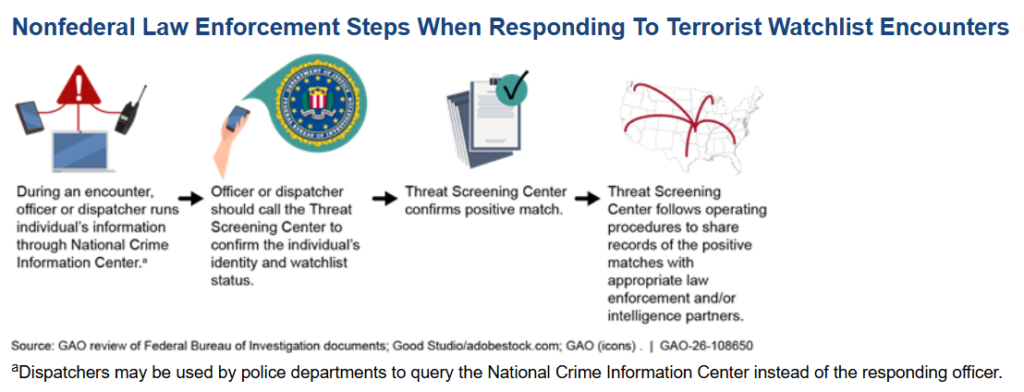
The terrorist watch list maintained by the TSC is by its very nature a pre-crime entity—it seeks to prosecute crimes before they occur. In addition to overseeing the no-fly list at airports, the TSC also shares surveillance data with state and local law enforcement, according to a report by the Government Accountability Office published earlier this year. Police can call in names to the TSC during a routine traffic stop, for example.
But the list’s massive scale, approaching 2 million names by the last count, has often proved counterproductive to its mission. The Boston Marathon bombers, several January 6 participants, and the Pulse nightclub shooter were all on watch lists at some point—ending up as undetected needles in a haystack of hundreds of thousands of names.
An influx of data and a new mission categorizing Americans’ political views as terroristic threats will require ever more effort to compile and query. That’s where AI comes in.
The swelling of the watch list over the years has led civil liberties organizations to criticize the ease with which names are added to the list and the incredible difficulty of both confirming inclusion and having a name removed from the list.
Cases arguing against the constitutionality of the terrorist watch list have also repeatedly risen to the Supreme Court. In FBI v. Fikre, the court ruled against the bureau in a case involving a U.S. citizen whom the FBI had watch-listed and whom FBI agents offered to delist if he cooperated as a confidential informant at his mosque. The Supreme Court also ruled in favor of plaintiffs in Tanzin v. Tanvir, who were suing over a similar threat, meant to turn them into mosque informants.
Even without the use of predictive AI modeling, audits of the TSC’s database have repeatedly found errors in the data it uses to flag individuals to law enforcement and the Transportation Security Administration. Per the bureau’s documentation of the watch-listing process, U.S. citizens can be nominated to the watch list by a host of three-letter government agencies. Although only the FBI can nominate citizens with a solely domestic terrorism connection, the State Department has taken it upon itself to vastly increase political organizations abroad that it claims are terrorists, thus increasing the number of Americans tied to foreign groups that could be funneled into the TSC.
For example, the administration has slapped the terrorist label onto the International Anti-Fascist Defense Fund, a bail fund for self-described anti-fascists. As I reported for Deeper States earlier this month, the fund has come under investigation from the Office of the Director of National Intelligence’s National Counterterrorism Center, which passes nominations on to the TSC. The legal defense fund has supported and drawn donations from U.S. citizens, creating a potential nexus for watch-listing by connecting U.S. citizens to a group that includes foreigners.
Last week, Secretary of State Marco Rubio held an international summit on political terrorism and published a report on alleged Cuban attempts to stoke “left-wing terrorism.” The report identified dozens of U.S. politicians, journalists, and left-wing groups as part of this foreign effort, another apparent attempt to use a foreign nexus to justify domestic surveillance. Among those named in the 100 pages are Rep. Ilhan Omar (D–Minn.), the Amazon Labor Union, New York City Mayor Zohran Mamdani, and Ben Cohen of Ben & Jerry’s ice cream.
The FBI has signaled that its new effort to brand political opponents of the president as terrorists has only just begun, and that soon the power of large language models will be brought to bear on the effort to flag and tag political dissidents en masse.
“I’ve got every major tech company in the world embedded in the FBI, rebuilding our internet capabilities, our classified systems, and the ability for artificial intelligence to be in our counterterrorism program so we can get instantaneous results,” Patel said on Fox News. “What’s the point of collecting terabytes of data if you can’t sift through it?”
The post Minority Report: FBI Seeks AI for Political Watch List appeared first on Reason.com.
from Latest – Reason.com https://ift.tt/D3BxZhW
via IFTTT