West Covina, California, police officer Jose Antonio Garcia has been charged with one felony count of misappropriation of public funds, one felony count of grand theft by embezzlement, and two misdemeanor counts of petty theft. Prosecutors say he repeatedly stole cash from motorists during traffic stops.
West Covina, California, police officer Jose Antonio Garcia has been charged with one felony count of misappropriation of public funds, one felony count of grand theft by embezzlement, and two misdemeanor counts of petty theft. Prosecutors say he repeatedly stole cash from motorists during traffic stops.
Hawkish Baltic States Lead Europe’s Race Back To The Draft
We’ve been documenting new efforts of European countries to drastically ramp up their defense readiness as the proxy war in Ukraine persists with no end in sight. For example, French President Emmanuel Macron last week announced a new avenue of voluntary military service for 18- and 19-year olds with the goal of gradually bolstering both active duty and reserve strength. This is part of a trend of the return of military conscription across the continent.
And this week Lithuania announced it will call up 5,000 conscripts in 2026, a significant increase from previous years. Years ago, Lithuania was the first EU country to restore mandatory military service in the wake of the Ukraine crisis centered on Crimea in 2014. The small Baltic country has also committed 5-6% of GDP to defense through 2030, more than double the existing NATO 2% guideline. It is now expected to expand its conscription plan to run year-round from 2026. Latvia too had been among the first to restore mandatory service based on concerns Russia could expand action beyond Ukraine.
A regional publication reviews the recent history as follows:
Lithuania reinstated conscription in March 2015 after suspending it in 2008, becoming the first EU country to reverse course following Russia’s seizure of Crimea, according to the US Library of Congress. Sweden followed in March 2017 with a gender-neutral conscription system.
Russia’s full-scale invasion of Ukraine in February 2022 prompted Latvia to restore mandatory service in 2023, with mandatory service beginning January 2024. Croatia followed suit in October 2025, with the first conscripts expected in January 2026.
This is also consistent with a pattern of smaller Baltic and northern European states being some of the most outspoken hawks when it comes to Russia.
But broadly, more and more European governments racing to find the quickest and least expensive ways to expand their forces to face down the ‘Russian menace’. One European source says bolstering military personnel – whether active or reserve – is increasingly being seen as an “emergency back-up plan”.
“As defense budgets swell, governments are quietly rebuilding the human backbone of their militaries. It’s not just about guns and tanks. In 2024, EU member states collectively spent a record €343 billion on defence (1.9% of GDP), and much of that went to personnel and readiness,” Euractiv writes in a fresh report.
The report suggests that at a moment Washington seems to be taking more of a wait on the sidelines approach to militarily supporting Ukraine, the Europeans are scrambling to make up for a potential future major lack of NATO manpower.
“NATO currently has 3.44 million military personnel, according to the latest data. But if you take the US out of the equation, the Western military alliance is left with roughly 2.11 million active troops, only 1.5 million of which belong to EU countries,” Euractiv continues.
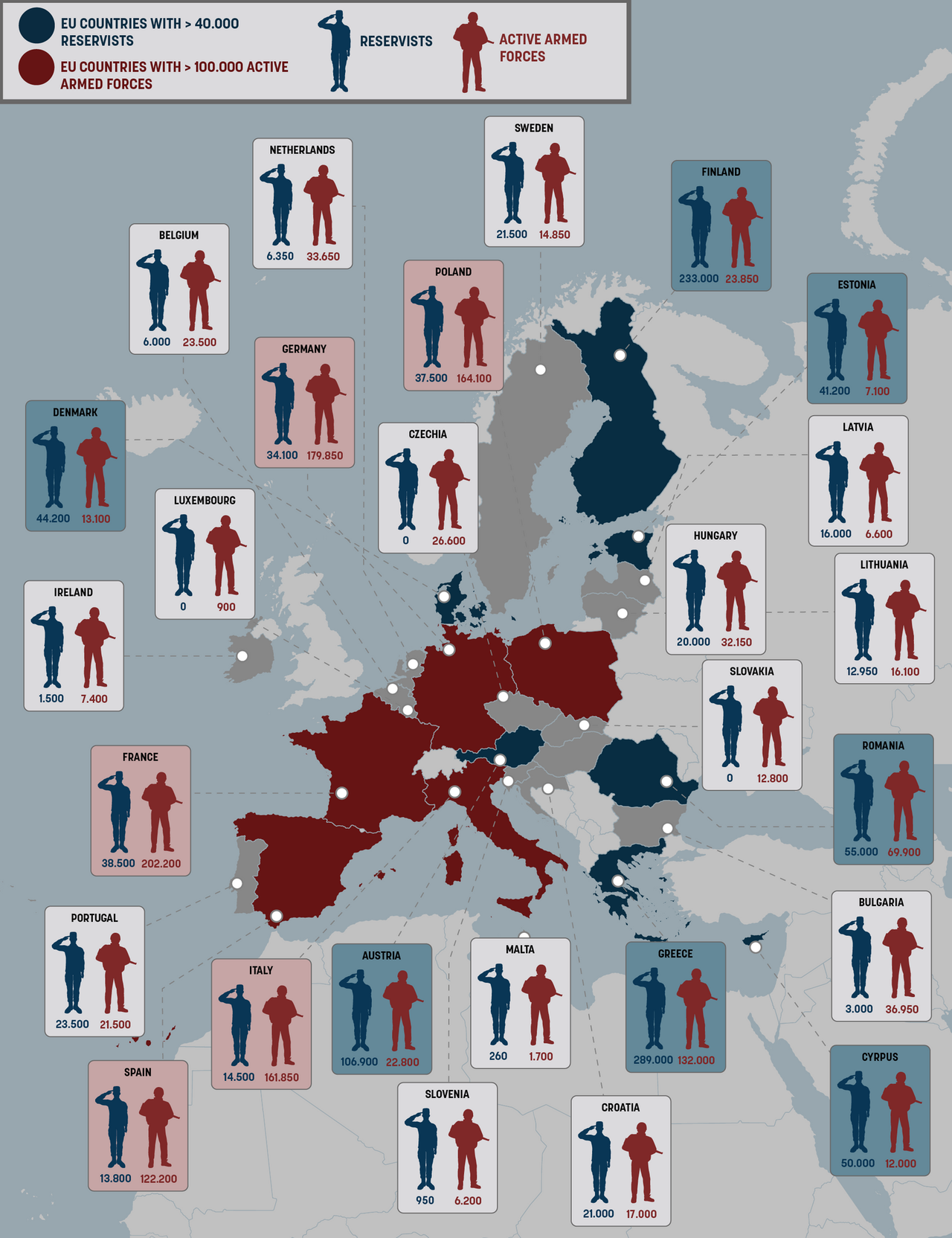
Across the bloc, 9 EU countries have mandatory military service: Austria, Cyprus, Denmark, Estonia, Finland, Greece, Latvia, Lithuania, and Sweden.
France and Germany have recently followed suit in a bid to bulk up their reserves without reverting to full-blown conscription. Paris has moved to roll out a 10-month voluntary national service program by 2026, and Berlin is openly weighing a return to mandatory service, after years of ruling it out.
The models, however, are anything but uniform. In the Nordics, Sweden and Norway use selective, gender-neutral drafts. They screen entire age groups but call up only the numbers they need, roughly 6,000-8,000 people a year, to avoid draining reserves. Denmark relies on a hybrid lottery. Militarily neutral Austria maintains traditional male conscription but provides conscripts with the option to participate in civilian volunteer activities instead of traditional military ones.
The report further provides the following helpful infographic map:
As for reserve programs, a system of part-time service members who are civilians which can be mobilized quickly if called upon helps countries keep defense spending down during times of peace. European nations are trying to bolster these numbers of trained personnel as well.
In the wake of Kyiv’s decision to allow men aged 18-22 to legally leave Ukraine last August, Poland has seen one of the largest waves of young Ukrainians flooding its borders.
From Aug. 26 to Nov. 10, 49,700 Ukrainian citizens have applied for protection status (UKR), linked to a PESEL number, in Poland in recent weeks. As a comparison, for the January-February period of 2025, there were only 16,000 such applications, reports Do Rzeczy, citing data from “Rzeczpospolita.”
Asylum status for Ukrainians provides the right to legal residence (currently until March 4, 2026), work, access to education, and benefits.
It is lost upon leaving Poland for more than 30 days, but can be reapplied for.
In total, over 2 million Ukrainians have applied for refugee status in Poland since 2022, but as of Nov. 12, only 964,400 had active status.
Over the past few months, the share of men aged 18-65 among new applicants has increased from 16.6 percent to 17.4 percent, while the share of women has fallen from 48.3 percent to 47.7 percent.
According to Polish Border Guard data, from Aug. 29 to Nov. 24, 121,000 Ukrainians aged 18-22 entered Poland, of whom 59,000 returned to Ukraine.
This means that approximately 62,000 young men remained in Poland or departed for the EU. Experts emphasize that this is the first such large wave of young Ukrainians in this age group in Poland.
According to Kyiv, the change in regulations is intended to enable young people to study and work abroad. At the same time, men aged 18-22 are exempt from the mandatory mobilization process, which begins at age 25. However, according to data from the Polish Economic Institute, only 39 percent of young men take up employment, primarily in construction, transport, and industry. They often work in closed environments, which, as the Institute points out, hinders linguistic and social integration.
Meanwhile, crime and sabotage perpetrated by Ukrainians have become a problem.
Police indicate that in the first half of 2025, 8,994 foreigners committed crimes in Poland, of which approximately 60 percent were Ukrainians. The most common offenses were drunk driving and fraud, including cybercrime. At the same time, Polish services emphasize that some Ukrainians are being used by Russian intelligence for sabotage activities. In Ukraine alone, 2,800 investigations into espionage and sabotage are ongoing.
While there don’t appear to be any specific, imminent cyber or physical threats to the U.S. power grid, China has been seeking vulnerabilities in network systems to be used in future attacks, panelists said during a U.S. House of Representatives hearing Tuesday on threats to the U.S. energy system.
Volt Typhoon — a group believed to be run by the People’s Republic of China’s state security service — is focused on maintaining ongoing access to U.S. network systems for future potential disruptions, according to Michael Ball, CEO of the Electricity Information Sharing and Analysis Center and senior vice president at the North American Electric Reliability Corp.
China is preparing for conflict over Taiwan, potentially in the “very near term,” and its strategy depends on preventing the United States from mounting a successful rescue mission, Harry Krejsa, director of Studies for the Carnegie Mellon Institute for Strategy & Technology, said during the hearing held by the Energy and Commerce Committee’s energy subcommittee.
Part of China’s plan is to target U.S. civilian infrastructure to create panic and chaos, Krejsa said.
“Our aging infrastructure makes these threats easier, including in our energy ecosystem,” he said. “Today’s electricity grid is too often a hodgepodge of digital tools sitting atop an analog foundation, creating seams where adversaries can slip in.”
China is the most persistent cyber threat to the U.S., according to Zach Tudor, associate laboratory director for national and homeland security at the Idaho National Laboratory.
“Through Volt Typhoon, Salt Typhoon [and] Flax Typhoon, the Chinese Communist Party has embedded itself in our energy communications and water systems to set conditions for destructive attacks during the Pacific conflict over Taiwan,” he said. “They’re winning without fighting, attempting to undermine our infrastructure.”
Although no U.S. blackouts have been attributed to a cyberattack, “the threat landscape is dynamic and requires continuous vigilance,” Ball said.
Panelists called on Congress to expand programs and funding for cyber defense.
Congress should continue to fund information sharing collaboration initiatives, like the Energy Threat Analysis Center, a pilot initiative led by the Department of Energy that brings together power sector and federal officials, according to Sharla Artz, vice president for security and resilience policy at Xcel Energy.
“Expanding programs like [the Cybersecurity Risk Information Sharing Program] enhances industry and government understanding of the threat landscape and thus needs additional government funding to accomplish that expansion,” said Artz, who represented the Edison Electric Institute at the hearing.
Tim Lindahl, president and CEO of Kenergy, a cooperative utility based in Henderson, Kentucky, urged Congress to reauthorize the $250 million Rural and Municipal Utility Cybersecurity Program, which runs through fiscal year 2026.
Lindahl called on DOE to disburse $80 million in RMUC awards that were announced last fall.
“With continued partnership and targeted federal investment, we can strengthen our defenses and ensure the security of the energy infrastructure that powers our nation,” said Lindahl, who spoke on behalf of the National Rural Electric Cooperative Association.
NERC’s Ball urged Congress to reauthorize the expired Cybersecurity Information Sharing Act of 2015 to support information sharing between the private sector and government.
During the hearing, Rep. Robert Menendez, D-N.J., said the Trump administration was undermining U.S. infrastructure protection efforts by cutting $5.6 billion in funding for state and local grid hardening and resiliency programs.
The administration also fired more than 1,000 cybersecurity and infrastructure agency staff, according to Menendez. It also moved Department of Homeland Security Cybersecurity & Infrastructure Security Agency staff to other agencies, like Immigration and Customs Enforcement, which has “no connectivity to what their work has been,” he said.
“Does that make our country safer and more able to respond to these increasing cybersecurity attacks?” Menendez said.
Idaho & Mississippi Saw The Largest Real Wage Growth, New Hampshire The Biggest Decline
Real wage growth in the U.S. has become a central focus as inflation and new tariffs continue to strain Americans’ purchasing power.
Nationally, between July 2024 and June 2025, the nominal average wage rose from $1,200 to $1,250 per week—a $50 increase, or 4.2% growth. After adjusting for inflation, real wages grew 2.5%, giving workers about $30 more in weekly purchasing power.
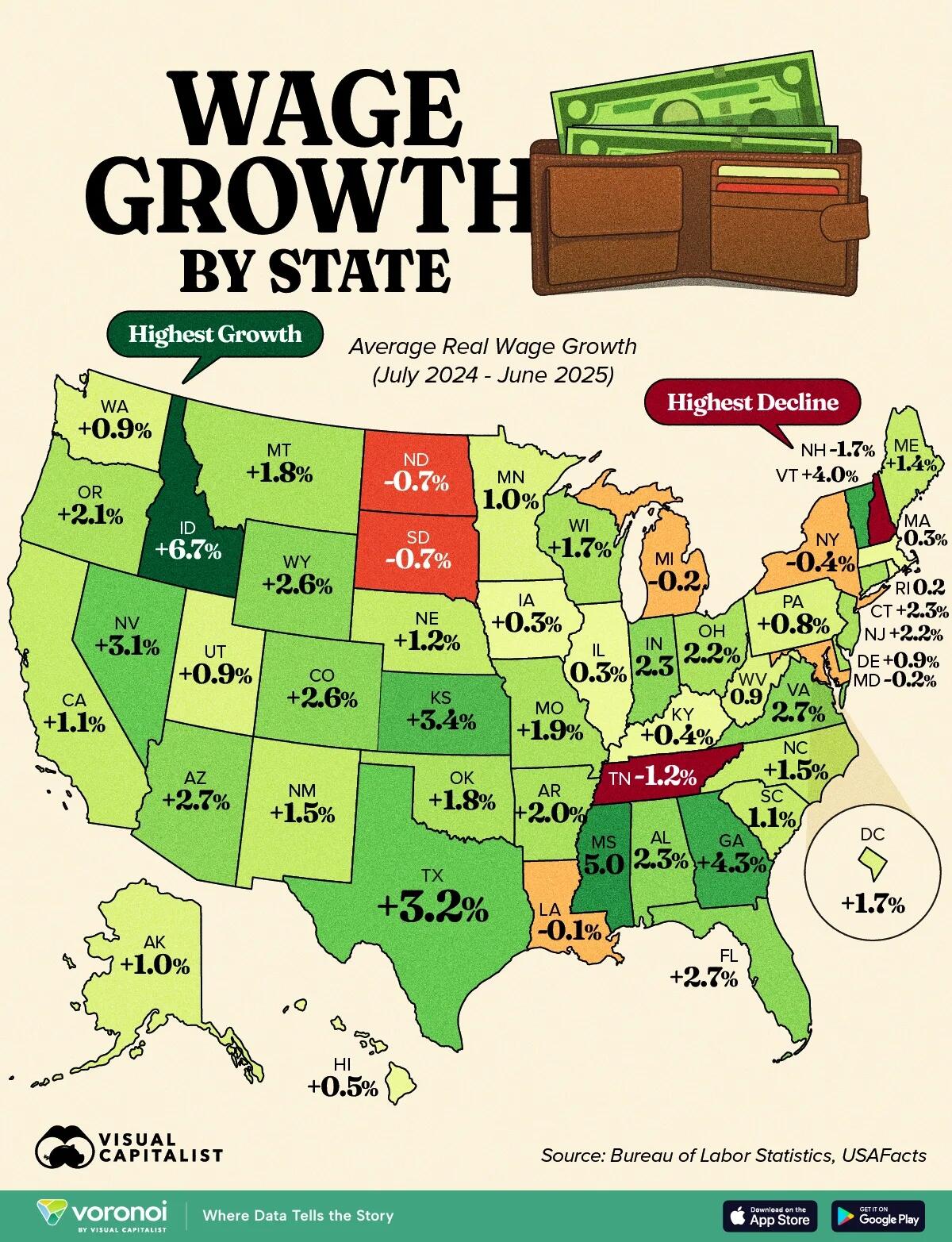
This map, via Visual Capitalist’s Marcus Lu, highlights how each state performed in the 12 months ending June 2025, showing where workers are gaining purchasing power, and where they are still falling behind.
The data for this visualization comes from USAFacts.
States Leading Wage Growth
Idaho and Mississippi top the nation, with real wages rising 6.7% and 5.0%. Both states have seen rapid population inflows and tight labor markets, contributing to stronger wage pressures.
Other high-performing states, including Georgia, Vermont, and Kansas, also recorded gains above 3%.
State
Real wage growth (Avg.)
Idaho
6.7%
Mississippi
5.0%
Georgia
4.3%
Vermont
4.0%
Kansas
3.4%
Texas
3.2%
Nevada
3.1%
Arizona
2.7%
Florida
2.7%
Virginia
2.7%
Colorado
2.6%
Wyoming
2.6%
Alabama
2.3%
Indiana
2.3%
Connecticut
2.2%
New Jersey
2.2%
Ohio
2.2%
Oregon
2.1%
Arkansas
2.0%
Missouri
1.9%
Montana
1.8%
Oklahoma
1.8%
DC
1.7%
Wisconsin
1.7%
New Mexico
1.5%
North Carolina
1.5%
Maine
1.4%
Nebraska
1.2%
California
1.1%
South Carolina
1.1%
Alaska
1.0%
Minnesota
1.0%
Delaware
0.9%
Utah
0.9%
Washington
0.9%
West Virginia
0.9%
Pennsylvania
0.8%
Hawaii
0.5%
Kentucky
0.4%
Illinois
0.3%
Iowa
0.3%
Massachusetts
0.3%
Rhode Island
0.2%
Louisiana
-0.1%
Maryland
-0.2%
Michigan
-0.2%
New York
-0.4%
North Dakota
-0.7%
South Dakota
-0.7%
Tennessee
-1.2%
New Hampshire
-1.7%
U.S. National Average
2.5%
Moderate but Positive Growth Across Much of the Country
A large portion of states saw real wage gains between 1% and 3%. This group includes major population centers like Texas, Florida, Virginia, and Colorado.
Steady job creation and cooling inflation have helped wages outpace consumer prices in these areas.
Where Wage Growth Is Falling Behind
Eight states recorded negative real wage growth, meaning inflation outpaced pay increases. New Hampshire, Tennessee, and the Dakotas saw some of the largest declines, reflecting weaker labor market conditions.
New York and Michigan also posted modest decreases, suggesting ongoing economic transitions are weighing on earnings. These pockets of decline stand out against the broader national trend of improvement.
Israeli Prime Minister Benjamin Netanyahu has asked US President Donald Trump for more help to receive a pardon from Israel’s president, Axios hasreported this week.
Netanyahu made the request during a lengthy phone conversation with Trump on Monday, Axios wrote, citing two US officials and one Israeli official familiar with the matter. The two leaders also discussed Israel’s ongoing occupations of Gaza and Syria.
Netanyahu’s trial on multiple corruption charges began in May 2020, but the drawn-out proceedings were halted in October 2023 due to the start of Israel’s genocide of Palestinians in Gaza. The trial resumed this week, with prosecutors questioning Netanyahu in the Tel Aviv District Court in Wednesday’s session.
In the most serious case, prosecutors say the prime minister provided regulatory and other benefits to the owner of the Walla news site and the telecommunications firm Bezeq, in exchange for favorable media coverage.
Last month, Trump sent an official letter to Israeli President Isaac Herzog calling on him to issue a pardon for Netanyahu.
On Sunday, Netanyahu’s lawyer sent an official letter and 111 pages of documents to Herzog formally requesting a pardon. The Israeli prime minister claims he needs a pardon to lead Israel’s ongoing low-intensity wars in Gaza, Syria, and Lebanon. Herzog said he is reviewing Netanyahu’s request, but the process of reaching a decision could take two months.
During Monday’s call, “Trump told Netanyahu he thinks the pardon will work out but didn’t commit to any further steps,” Axios wrote, citing a US official. “Netanyahu wants Trump to do more, but the president has done all he can do,” a second US official added.
During the call, Trump allegedly told Netanyahu he should be “a better partner” in implementing the peace agreement with Syria. Trump also allegedly told Netanyahu to “take it easy” in Syria after Israeli strikes killed 13 people in the village of Beit Jinn earlier this month.
“The president told Netanyahu that the new leadership in Syria is trying to make it a better place,” one of the US officials said. Since coming to power one year ago with Israeli assistance, Syria’s new government has carried out a series of major massacres against the country’s minority Alawite and Druze populations.
On Wednesday, Israel carried out additional strikes in Syria, this time on the outskirts of Beit Jinn in the western Damascus countryside near Mount Hermon.
PM Netanyahu shares a video in English about his lawfare trial…
— Benjamin Netanyahu – בנימין נתניהו (@netanyahu) December 4, 2025
Trump also questioned the Israeli prime minister’s decision last month to kill 40 Hamas fighters trapped in tunnels in the Israeli-controlled areas of Gaza rather than allowing them to surrender, as Trump had asked.
Trump had allegedly encouraged Netanyahu to give some 200 trapped Hamas fighters amnesty in exchange for surrendering, seeing it as a model for disarming Hamas throughout the strip and as a way to advance the ceasefire.
On Wednesday, Israeli drone strikes killed five Palestinians, including two children, in the Al-Mawasi tent camp in Gaza. Since the start of the genocide in October 2023, Israel has killed at least 70,112 Palestinians, according to Gaza sources, including at least 357 since a US-backed ceasefire went into effect in October of this year.
Trump’s Next National Strategy Will Center On Humanoid Robots
President Trump’s national industrial strategy centers on expanding U.S. dominance in semiconductors, AI, rare earth production, clean technology, space, and other emerging technologies expected to dominate the global economy in the 2030s. Following the administration’s push to accelerate AI data center buildouts and power grid upgrades, Politico now reports that the next major focus is poised to be humanoid robotics.
Commerce Secretary Howard Lutnick has been meeting with the heads of major tech companies and is weighing an executive order next year to spur domestic development and production of humanoid robots, while the Department of Transportation is setting up a robotics working group, according to Politico sources.
The timing is notable: Elon Musk’s Tesla is preparing to scale production of its Optimus robot to one million units by the end of next year. Earlier this fall, Tesla reportedly placed a massive order for linear actuators from China, suggesting that Optimus production is set to ramp up in the near term.
A Department of Commerce spokesperson told the outlet: “We are committed to robotics and advanced manufacturing because they are central to bringing critical production back to the United States.”
Politico explains more about Trump’s emerging national robotics strategy that could be unveiled early next year:
There’s growing interest on Capitol Hill as well. A Republican amendment to the National Defense Authorization Act would have created a national robotics commission. The amendment was not included in the bill. Other legislative efforts are underway.
The Trump administration understands that this period is a transformational moment in human history, and a point where a national strategy is essential to rapidly boost industrial capacity and position the U.S. as the leader in AI, robots, drones, and chips as the world fractures into a bipolar state amid a technological superpower race with China that goes into hyperdrive over the next decade.
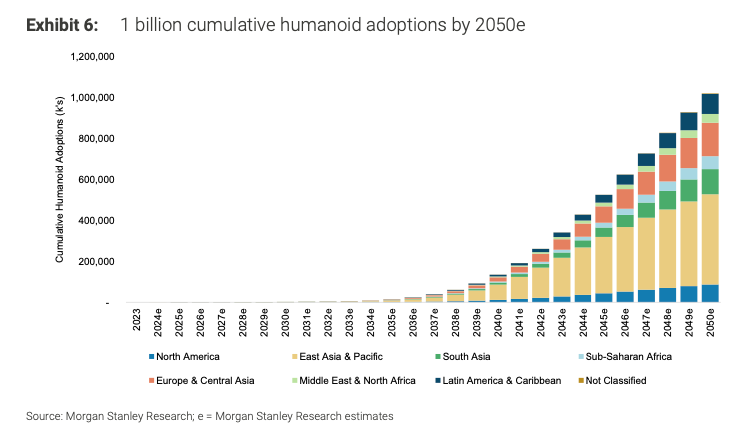
Last week, Morgan Stanley analyst Shawn Kim showed clients that adoption of humanoid robots will top 1 billion units by 2050.
Kim explained:
In their Global Insight report published earlier this year, Morgan Stanley’s global Autos and Industrials teams estimated that global cumulative humanoid adoption could reach 1 billion by 2050. They generally assume a relatively slow pace of adoption until the mid-2030s, after which they believe the pace will begin to materially accelerate into the late 2030s and 2040s, given (1) technological progress across both hardware and AI foundation models, which may take over a decade to create “true” general-purpose humanoids capable of doing the vast majority of useful tasks; (2) price declines as technologies mature and supply chains develop; and (3) greater societal/political acceptance.
ZeroHedge Pro subs can read the full MS report in the usual place. It’s loaded with deeper inudstry analysis and charts that lay out where the whole industry is headed through 2050 as the Trump administration prepares to unveil its national strategy – this report is a must-read.
What Trump is doing today is preparing the nation for the 2030s. Supply chains must be localized, rare earths must be plentiful, and the U.S. must have the industrial capacity to build these innovative technologies domestically or on friendly shores. What you see today is proper stewardship of the nation, versus the previous administration that was so obsessed with nation-killing globalist policies.