FBI Operatives Likely ‘Unindicted Co-Conspirators’, Organizers Of Capitol Riot: Report

FBI Operatives Likely ‘Unindicted Co-Conspirators’, Organizers Of Capitol Riot: Report

Tucker Carlson dropped several bombshells on his show Tuesday night, chief among them was from a Revolver News report that the FBI was likely involved in organizing the Jan. 6 Capitol ‘insurrection,’ and were similarly involved in the kidnapping plot against Michigan Governor Gretchin Whitmer.
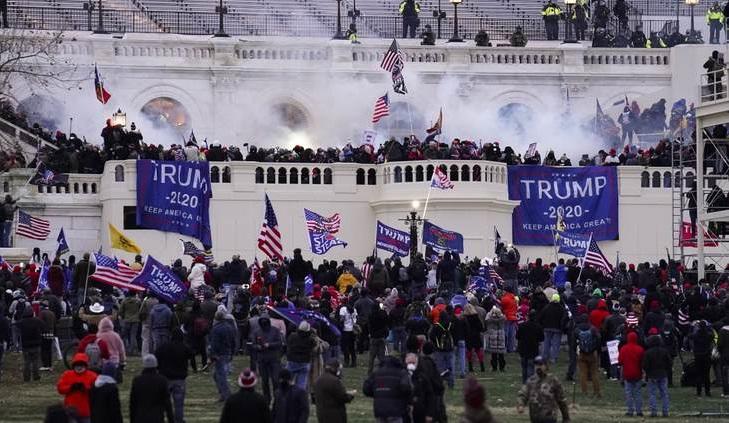
Why are there so many factual matters that we don’t understand about that day?” asked Carlson.

Why is the Biden administration preventing us from knowing? Why is the administration still hiding more than 10,000 hours of surveillance tape from the US capitol on January 6th? What could possibly be the reason for that – even as they call for more openness… they could release those tapes today, but they’re not. Why?”

Carlson notes that Revolver News has dissected court filings surrounding the Capitol riot, suggests that unindicted co-conspirators in the case are likely to have been federal operatives.

We at Revolver News have noticed a pattern from our now months-long investigation into 1/6 — and in particular from our meticulous study of the charging documents related to those indicted. In many cases the unindicted co-conspirators appear to be much more aggressive and egregious participants in the very so-called “conspiracy” serving as the basis for charging those indicted.

The question immediately arises as to why this is the case, and forces us to consider whether certain individuals are being protected from indictment because they were involved in 1/6 as undercover operatives or confidential informants for a federal agency.

Key segment from Tucker:

“We know that the government is hiding the identity of many law enforcement officers that were present at the Capitol on January 6th, not just the one that killed Ashli Babbitt. According to the government’s own court filing, those law enforcement officers participated in the riot – sometimes in violent ways. We know that because without fail, the government has thrown the book at most people who were present at the Capitol on Jan. 6. There was a nationwide dragnet to find them – and many are still in solitary confinement tonight. But strangely, some of the key people who participated on Jan. 6 have not been charged.”

Look at the documents, the government calls those people ‘unindicted co-conspirators.’ What does that mean? Well it means that in potentially every case they were FBI operatives… in the Capitol, on January 6th.”

“For example, one of those unindicted co-conspirators is someone government documents identify only as “person two.” According to those documents, person two stayed in the same hotel room as a man called Thomas Caldwell – an ‘insurrectionist.’ A man alleged to be a member of the group “The Oathkeepers.” Person two also “stormed the barricades” at the Capitol on January 6th alongside Thomas Caldwell. The government’s indictments further indicate that Caldwell – who by the way is a 65-year-old man… was led to believe there would be a “quick reaction force” also participating on January 6th. That quick reaction force Caldwell was told, would be led by someone called “Person 3,” who had a hotel room and an accomplice with them. But wait. Here’s the interesting thing. Person 2 and person 3 were organizers of the riot. The government knows who they are, but the government has not charged them. Why is that? You know why. They were almost certainly working for the FBI. So FBI operatives were organizing the attack on the Capitol on January 6th according to government documents. And those two are not alone. In all, Revolver news reported there are “upwards of 20 unindicted co-conspirators in the Oath Keeper indictments, all playing various roles in the conspiracy, who have not been charged for virtually the exact same activities and in some cases much, much more severe activities – as those named alongside them in the indictments.”

Watch:

Revolver, meanwhile, has important questions about January 6th

  • In the year leading up to 1/6 and during 1/6 itself, to what extent were the three primary militia groups (the Oath Keepers, the Proud Boys, and the Three Percenters) that the FBI, DOJ, Pentagon and network news have labeled most responsible for planning and executing a Capitol attack on 1/6 infiltrated by agencies of the federal government, or informants of said agencies?
  • Exactly how many federal undercover agents or confidential informants were present at the Capitol or in the Capitol during the infamous “siege” and what roles did they play (merely passive informants or active instigators)?
  • Finally, of all of the unindicted co-conspirators referenced in the charging documents of those indicted for crimes on 1/6, how many worked as a confidential informant or as an undercover operative for the federal government (FBI, Army Counterintelligence, etc.)?

Rep. Matt Gaetz (R-FL) has demanded an explanation from FBI Director Christopher Wray:

More:

We recommend you read the entire Revolver piece, which includes the fact that at least five individuals involved int he “Whitmer Kidnapping Plot” were undercover agents and federal informants.

Tyler Durden
Wed, 06/16/2021 – 12:13

via ZeroHedge News https://ift.tt/3xqFMn7 Tyler Durden
Using Facebook Actually Reduces Ethnic Tension, New Study Finds


glen-carrie-ra4vJwxnvAo-unsplash

Facebook is frequently accused of exacerbating various negative social phenomena: hate speech, conspiracy theories, and even ethnic tensions. In Myanmar, for instance, social media accounts associated with the government’s military have stoked considerable violence against the Rohingya, the country’s Muslim minority population.

But a new study suggests there are situations where Facebook actually serves to lessen the odds of ethnic violence. This matters, because the overwhelming tendency within traditional media is to universally pan social media as a significant cause of social strife.

The situation is much more complicated, according to study recently published by the National Academy of Sciences. Researchers conducted the study in Bosnia and Herzegovina in July 2019, during a week of public remembrance for the genocide of Bosniak Muslims that occurred there in the early 1990s. Bosniak, Serbian (who are Slavic and largely Eastern Orthodox), and Croatian (who are Slavic and largely Roman Catholic) participants agreed not to use Facebook, which accounts for roughly 99 percent of the social media market in the country. Researchers ensured compliance by checking their accounts for activity. After the week was over, researchers surveyed participants about their attitudes toward other ethnic groups and compared their answers with a control group that had remained active on Facebook during the remembrance period.

They were surprised by the results: The offline group had a greater dislike of other ethnicities than the group that remained online. Again, the previous assumption made by many critics of social media is that Facebook creates echo chambers for likeminded people that intensify their own beliefs and prejudices, leading to greater tension.

“Vulnerability to echo chambers may be greatest in offline social networks,” wrote the study’s authors. “We have lost sight of the fact that offline social networks are oftentimes even more homogeneous than the online networks.”

The results were most pronounced for participants who lived in ethnically homogeneous communities: Facebook was essentially the only place that these people were likely to encounter someone who belonged to a different ethnicity.

“It is important to note that our results are aligned with two possibilities: that those who stayed active on Facebook experienced an improvement of outgroup attitudes because of their online contact and discussions engendered by the remembrance period or, alternatively, that those who deactivated their Facebook accounts experienced worsening of their outgroup attitudes because they were primarily exposed to discussions within homogeneous offline networks or the official discourse,” wrote the authors.

These findings will likely come as a shock to people who are casually familiar with the popular notion that social media has strong siloing effects. But every time the matter is researched, the results cast some doubt on the entire notion.

“People’s habits do incline somewhat toward their preferred political positions, but a study of Web browser, survey, and consumer data from 2004 to 2009 found that people’s media diets online were modestly divided by ideology but far more diverse than, for instance, the networks of people with whom they talked about politics in person,” wrote Brendan Nyhan, a professor of government at Dartmouth College, in a review of the data for The Washington Post. “This finding of limited information polarization has been repeatedly replicated. Most recently, a new study found that mobile news consumption is even less segregated by ideology than desktop/laptop data used in previous research.”

Many people want to believe that social media, and Facebook in particular, makes everyone more racist, politically paranoid, addicted, and anxious. It’s a narrative that’s equally popular with very conservative Republicans (who somewhat bafflingly view Facebook as an enemy), progressive Democrats (who are ideologically predisposed to dislike large corporations), and the mainstream media (which views social media as a rival). But there is solid evidence undermining many of these claims, and it’s important to remember that taking away technology and shutting off conversations—even fraught and divisive conversations—often increases ignorance and prejudice.

from Latest – Reason.com https://ift.tt/2SHrOhX
via IFTTT

Watch Live: Putin & Biden Hold Separate “He Said, He Said” Press Conferences

Watch Live: Putin & Biden Hold Separate “He Said, He Said” Press Conferences

Having already seen The White House scramble to “clarify” some of President Biden’s actions (a head nod, not words), we look forward to the notably separate press conferences. Just ahead of Putin coming out to give his press conference first, Reuters is reporting Putin’s talks with Biden as “quite successful”.

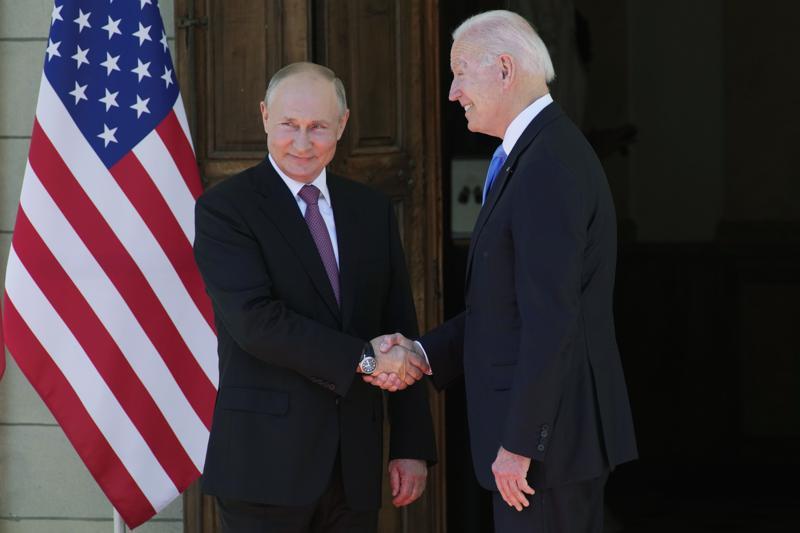
“Killer” Vlad and “Dementia” Joe managed the handshake…

So what actually happened “in the room where it happened”?

Both U.S. and Russian officials have downplayed the expectations of deliverables from the meeting which lasted just under four hours (PBS had reported that Biden officials were prepared for the Russian delegation to try to drag out the talks, making the day longer for Biden, 78, who is at the end of a grueling, eight-day trip…“You always have to be concerned if he’s tired or not articulate,” said the Biden ally).

Biden faced criticism for not holding a joint press conference with Putin, but defended the decision to address the media alone.

He told reporters on Sunday that it isn’t a “contest about who can do better in front of a press conference” or an opportunity to “embarrass each other.”

“It’s about making myself very clear what the conditions are to get a better relationship with Russia,” Biden said of the press conference.

Let’s see if Biden can get Through it without embarrassing himself.

Watch Live (Putin due to go first, then Biden):


Tyler Durden
Wed, 06/16/2021 – 11:49

via ZeroHedge News https://ift.tt/3iLZJ3N Tyler Durden

Fox Affiliate Fires Reporter After Release Of “Censorship” Clips Via Project Veritas

Fox Affiliate Fires Reporter After Release Of “Censorship” Clips Via Project Veritas

Authored by Isabel van Brugen via The Epoch Times,

A Fox affiliate station has fired a reporter after she went off-script during a weather segment on Monday saying she is being allegedly muzzled by Fox News, and later shared with Project Veritas recordings she says show the network’s censorship and corruption.

Ivory Hecker, 32, who formerly worked for Fox 26 in Houston, has been let go by the station, a representative confirmed in a statement to several news outlets Tuesday.

Hecker during the live segment claimed that Fox Corporation has been “muzzling” her to “keep certain information from you, the viewer.”

“And from what I am gathering I am not the only reporter being subjected to this. I am going to be releasing some recordings about what goes on behind the scenes at Fox because it applies to you, the viewers. I found a nonprofit journalism group called Project Veritas that’s going to help put that out tomorrow so tune into them,” she said, before proceeding with the weather report.

The 32-year-old, according to Fox 26’s website, was a general assignment reporter and fill-in anchor. She previously worked for KARE-11, an NBC affiliate station in Minneapolis. Hecker’s Instagram says she is a music recording artist who has released several songs.

Hecker took her clips to investigative journalism nonprofit Project Veritas. In an Instagram story on her personal account, she said that she had made it clear to her bosses that she was recording them.

She told Project Veritas that the Fox affiliate station “came at my throat for standing up against censorship.”

“What’s happening within Fox Corp is an operation of prioritizing corporate interests above the viewer’s interest and, therefore, operating in a deceptive way,” Hecker told Project Veritas’ James O’Keefe.

“It is unspoken, but if you accidentally step outside the narrative, if you don’t sense what that narrative is, and go with it, there will be great consequences for you,” she continued. “My newsroom kind of groups everyone into racial groups.”

In one of the clips Hecker shared with Project Veritas, Lee Meier, an assistant news director with the station can be heard saying: “It’s not just about the viewers; it’s about what our CEO reads; it’s about what our GM [general manager] reads.”

Meier implies in the clip that the station wouldn’t run a story on the cryptocurrency based on specific demographics.

“I have passed on Bitcoin stories…Bitcoin for poor African American audience at 5, it’s probably not going to play. That’s a choice I’m making. An editorial choice,” Meier says in the recording.

Hecker also revealed how she was instructed to “cease and desist” on content that would present hydroxychloroquine as a feasible treatment for COVID-19, the disease caused by the CCP (Chinese Communist Party) virus.

She told O’Keefe that she was sent to a hospital to report on COVID-19 treatment, and ended up interviewing Dr. Joseph Varon, chief of critical care at United Memorial Medical Center on his use of hydroxychloroquine.

“We have used it. I mean, we know it’s a drug that has been politicized up to the wazoo. We’ve used it. We use it with good success,” Varon told Hecker.

In response, Susan Schiller, Fox 26 vice president and news director, told Hecker she had “failed as a reporter.”

“You need to cease and desist posting about hydroxychloroquine,” Schiller says in one clip, citing a New England Journal of Medicine study on the drug.

“What’s happening within Fox Corp is an operation of prioritizing corporate interests above the viewer’s interest and, therefore, operating in a deceptive way,” said Hecker. “The viewers are being deceived by a carefully crafted narrative in some stories.”

Fox 26 Houston has responded to several news outlets through a company spokesperson: “FOX 26 adheres to the highest editorial standards of accuracy and impartiality. This incident involves nothing more than a disgruntled former employee seeking publicity by promoting a false narrative produced through selective editing and misrepresentation.”

Hecker announced on her personal Instagram page late Tuesday that she will soon be releasing additional recordings that show “the depths to which the company will stoop.”

“This story has not fully been told,” she told her followers.

The Epoch Times has contacted Fox 26 and Fox Corporation for comment.

Tyler Durden
Wed, 06/16/2021 – 11:43

via ZeroHedge News https://ift.tt/3gtnVWY Tyler Durden

Media Meltdown Over Biden Nodding That He “Trusts” Putin Forces White House Statement

Media Meltdown Over Biden Nodding That He “Trusts” Putin Forces White House Statement

Before even talking to Joe Biden himself, the White House felt the need to do damage control from the moment Biden was inside the room during the first rounds of talks with Putin, which are expected to last throughout the day.

“The White House says that President Joe Biden was not suggesting to reporters that he trusts Russian President Vladimir Putin with his reaction to a reporter’s question in Geneva,” AP reports based on the statement. It appears that a mere head nod from the president has sent the Western mainstream into a tizzy.

“At the start of a high-stakes summit in Geneva, Biden appeared to suggest that he can take the Russian leader at his word, nodding his head during a photo opportunity when asked by a reporter if Putin can be trusted,” AP continues.

The opening meet and greet brief press event between the two leaders involved a nearly unprecedented “chaotic scrum with reporters shouting over each other” which according to some accounts the two presidents seemed amused by.

White House Press Secretary Jen Psaki explained that the president “wasn’t responding to any question or anything other than the chaos” in an apparent attempt to reject claims that he nodded in the affirmative when asked by a journalist if he trusted Putin.

Independent journalist Michael Tracy summarizes the dimwitted state of the whole spectacle whereby the press and political pundits hyperventilate over a nod which “might” suggest amicable relations between Biden and Putin:

Essentially the entire political/media class is committed to maximal antagonism against Russia. Dems to show Biden’s “toughness” compared to Trump. GOP to show Biden’s “weakness” compared to Trump. Corporate media + think tanks for their own self-serving reasons. Bunch of sickos.

And for more of this on display…

Biden is expected to give a “solo” press conference by summit’s end later in the day. No doubt he’ll do his best to satisfy his base and talk “tough”.

Meanwhile, of note is that Undersecretary of State Victoria Nuland is at the table, likely with something to say on Ukraine…

Tyler Durden
Wed, 06/16/2021 – 11:19

via ZeroHedge News https://ift.tt/3wJzNKt Tyler Durden

GM Is So Desperate To Hire Employees It’s Considering Dropping Its Mandatory Marijuana Testing

GM Is So Desperate To Hire Employees It’s Considering Dropping Its Mandatory Marijuana Testing

We know the labor shortage in the U.S. is getting bad when companies finally throw their hands up and call off drug testing in an attempt to be able to recruit more workers. 

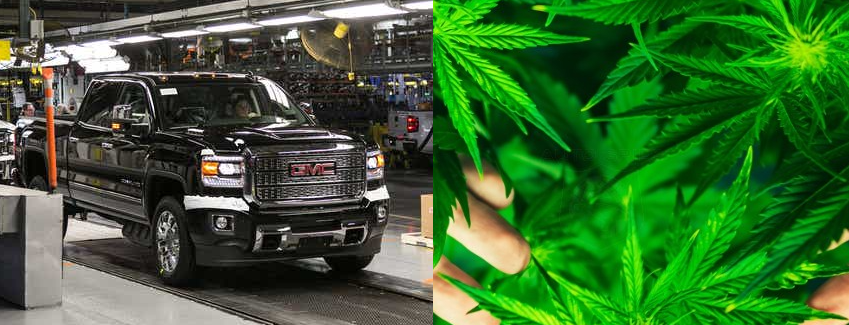
Such is the case at General Motors, where hiring has gone so poorly for the summer that the company is “considering dropping the requirement that potential employees be tested for marijuana use,” according to Motor 1

The company is reportedly having extreme difficulty finding temporary summer workers at the plant that produces the Chevy Silverado, the report says. GM is seeking to hire 450 temporary part time employees at Flint and 275 at Fort Wayne.

The UAW believes that “the company’s testing for marijuana use is limiting and deterring potential employees,” the report says. We wonder if they have looked closely at how much free money the government has been doling out over the last 18 months.

Regardless, medical and recreational use of marijuana is already legal in Michigan. But that hasn’t stopped GM from continuing to use marijuana testing that uses hair specimens and can “trace back for weeks”. 

“That could turn off younger job applicants who then don’t show up to the interview,” said UAW shop chairman Eric Welter. Adding to the hiring difficulty is a $16.67 per hour starting wage and a “temporary” status that employees are assigned. 

GM spokesperson Dan Flores alluded that the idea is something that’s being “discussed internally,” according to the report. 

The shortage of workers comes at a time when GM, like many other auto companies, is continuing to deal with the struggle of a global semiconductor shortage.

“Our supply chain organization is working closely with our supply base to find solutions for our suppliers’ semiconductor requirements and to mitigate impacts on GM. Despite our mitigation efforts, the semiconductor shortage will impact GM production in 2021,” Mary Barra said earlier this year. 

Tyler Durden
Wed, 06/16/2021 – 11:05

via ZeroHedge News https://ift.tt/2Twb0KZ Tyler Durden

“The Fed Has Lost Control” – Peter Schiff Warns Tucker Carlson About Skyrocketing Prices & The Inflation Tax

“The Fed Has Lost Control” – Peter Schiff Warns Tucker Carlson About Skyrocketing Prices & The Inflation Tax

Via SchiffGold.com,

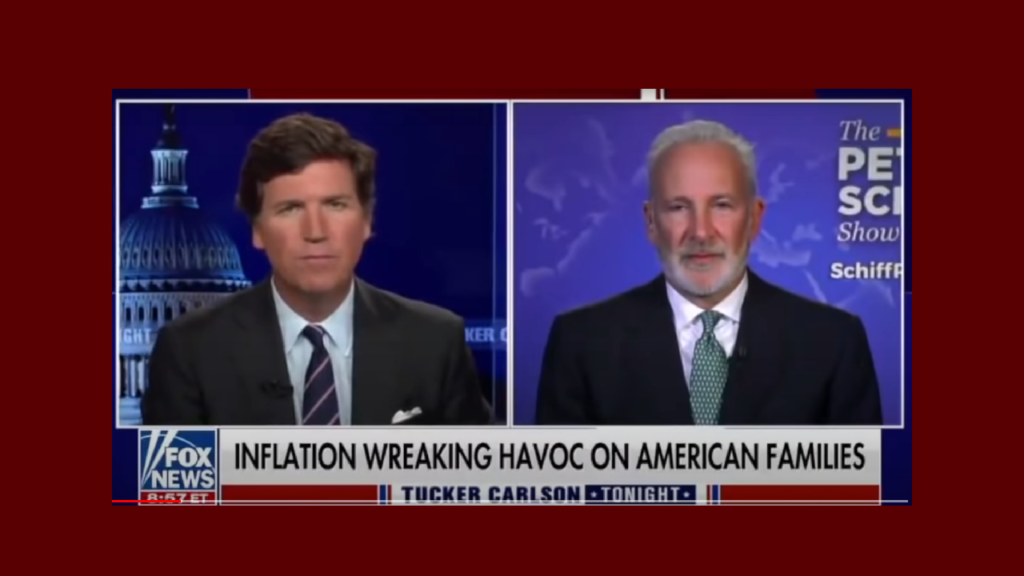
Inflation is running hot right now. The May CPI data came in hotter than expected, a trend we’ve seen every month this year. But the Federal Reserve and the mainstream financial media continue to insist inflation “transitory.” Peter Schiff recently appeared with Tucker Carlson on Fox News to talk about skyrocketing prices.

Peter started by pointing out that the year-over-year increase in CPI is 5%, and if you annualized the last three months, it will hit somewhere in the neighborhood of 8% by the end of the year.

But I think the back half of the year is going to be a lot worse than the front half because businesses have been somewhat reluctant to pass on their exploding costs to their customers. I think they’ve been hoping the Fed was right. But I think they’re going to give up hope later in the year and they’re really going to start increasing prices at a much greater rate.”

We’re already seeing some companies raise prices to cover rising labor and material costs. Chipotle recently announced a 4% increase in menu prices.

Tucker asked if there is a way out of this. Peter said, “Unfortunately, no.”

The Fed is pretending that it’s transitory because they really have no ability to control it because it’s the Fed that’s creating it.”

Peter pointed out that every dollar of government spending has to be paid for. And despite the pandemic winding down, US government spending doesn’t appear to be winding down at all. The Biden administration continues to run massive deficits and has announced multi-trillion spending plans for the future.

Right now, they’re not taxing and spending. They’re printing and spending. So, every time you’re paying higher prices, you’re really paying higher taxes. And taxes, unfortunately, are going way up, especially on the middle class.”

In a nutshell, the government is causing inflation and it’s creating an illusion of a recovering economy.

That’s where all the stimulus money is coming from. The reason the economy looks like it’s growing is because the government has created inflation, which creates the illusion of economic growth. But the reality is the economy is not growing.”

And Peter said the CPI doesn’t even come close to capturing the real extent of rising prices.

A lot of people point to the 1970s and all the inflation we had back then. But we had a totally different CPI in the 1970s. If we were using the 1970s CPI today, we would already be experiencing double-digit inflation.”

Tyler Durden
Wed, 06/16/2021 – 10:45

via ZeroHedge News https://ift.tt/3iNnjNI Tyler Durden

WTI Bounces On Big Crude Draw, Gasoline Demand Pick-Up

WTI Bounces On Big Crude Draw, Gasoline Demand Pick-Up

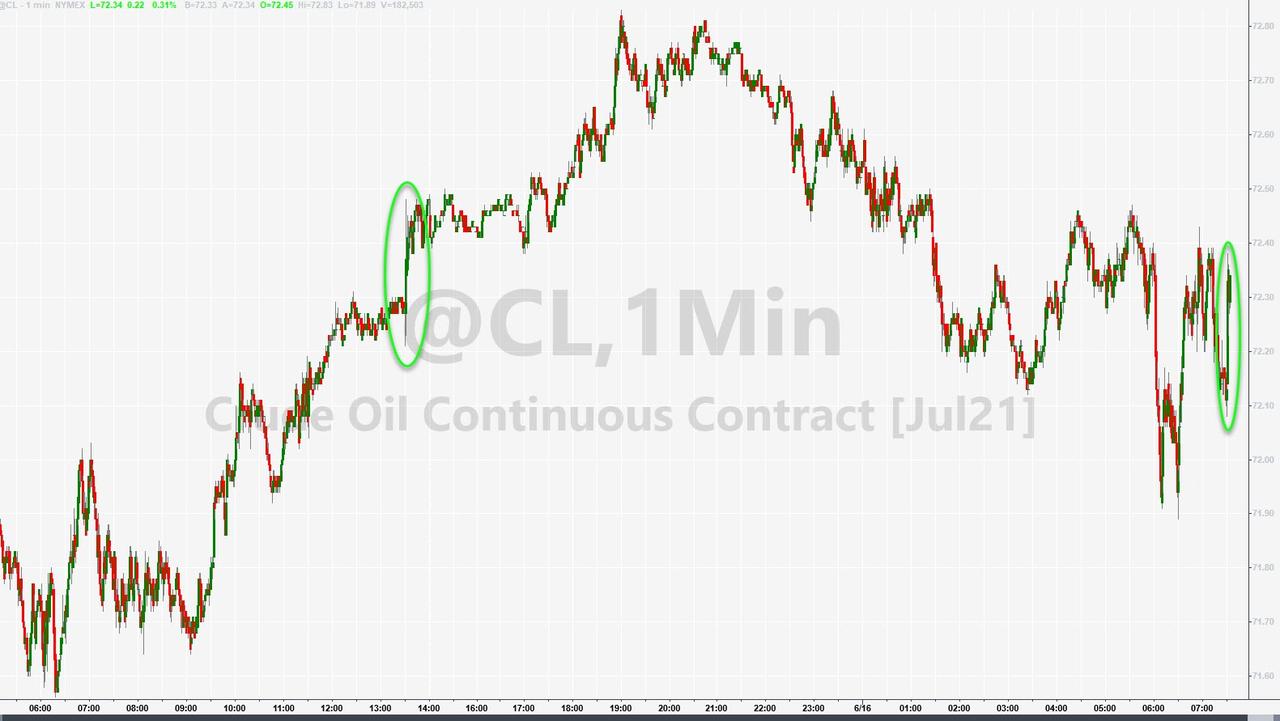
Oil prices round-tripped overnight after a big crude draw (reported by API), along with fuel sales in India showing signs of recovery, sparked a push for $73 for WTI.

“Demand growth is outpacing supply and will continue to do so over the coming months,” said Stephen Brennock of oil broker PVM, adding that “ongoing efforts to revive the Iranian nuclear deal have so far failed to bear any fruits.”

Global oil demand will get back to pre-pandemic levels late next year, according to the International Energy Agency.

If DOE confirms API’s data, this will be the biggest crude draw since January….

API

  • Crude -8.537mm (-4.2mm exp)

  • Cushing -1.526mm

  • Gasoline +2.852mm (unch exp)

  • Distillates +1.956mm (+200k exp)

DOE

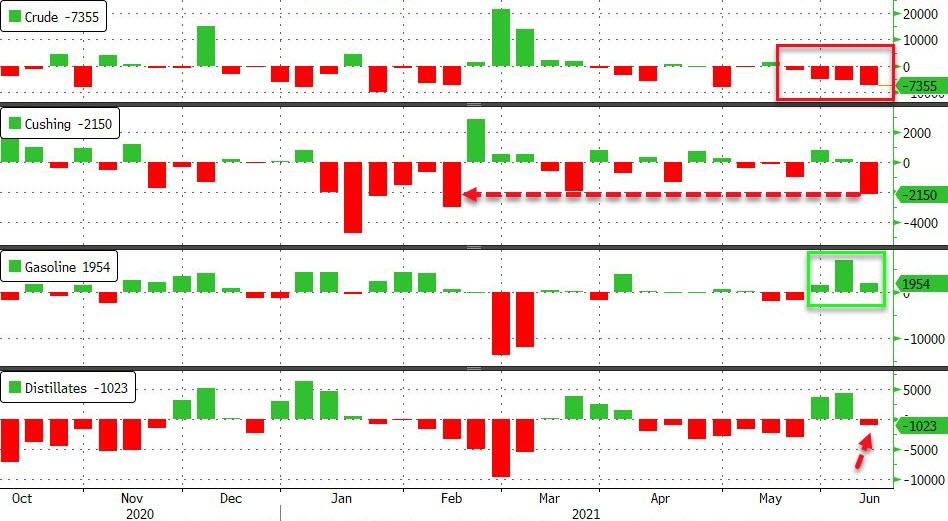
  • Crude -7.335mm (-4.2mm exp)

  • Cushing -2.15mm

  • Gasoline +1.954mm (unch exp)

  • Distillates -1.023mm (+200k exp)

US crude inventories fell for the 4th straight week – with the biggest draw since April.

Source: Bloomberg

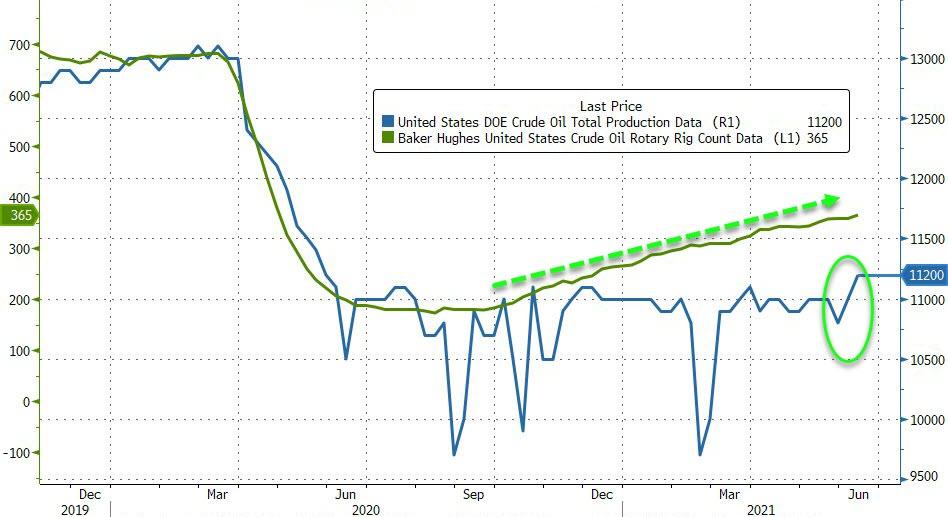
US crude output rose notably last week (+200k b/d) as firms perhaps finally take advantage of rising prices and rig counts…

Source: Bloomberg

All eyes were on U.S gasoline demand today (as they have been since the start of spring and during the oil comeback from the pandemic) as the recent tumble is definitely not in keeping with the recovery narrative. The good news is… gasoline demand rebounded nicely…

Source: Bloomberg

WTI hovered around $72.25 (right where it was before API) ahead of the official data and rebounded as DOE confirmed a notable crude draw…

“The fact that oil prices are still showing few signs of slowing means there has to be some concern that if we go too much higher, we could start to see some early signs of demand destruction,” said Michael Hewson, chief market analyst at CMC Markets UK.

“For now, that doesn’t appear to be happening, but we’ve still made another 24-month high on Brent, pushing us closer to $75 a barrel and the highs from 2019,” he said in a market update.

“If we go much above $80 that picture could change quite quickly.”

Finally we note that brent crude prices have been tracking – almost perfectly – the optimistic rebound in global macro data…

And as OilPrice.com’s Tsvetana Paraskova notes, although oil may not be headed to a new supercycle, prices still have room to rise from current levels because of a strong demand rebound and expected tightness in supply, some of the world’s largest commodity trading groups say.

There is a chance for $100 oil, Jeremy Weir, chief executive officer at commodity trader Trafigura, told the FT Commodities Global Summit on Tuesday.

“You need higher prices to incentivize… and also maybe to build on the cost of carbon in the future as well. You also need to attract capital in the business,” Weir told the online debate.

The largest commodity traders are bullish on oil in the near term, too.

Brent Crude traded at over $73.50 a barrel early on Tuesday, but the top executives of the trading houses see further upsides.

“Higher from here” for the next six months, Glencore’s Head of Oil Marketing, Alex Sanna, told the same event today. According to Sanna, better news about vaccination programs, inflation bringing in investor cash, and the demand recovery will all contribute to rising oil prices.

Tyler Durden
Wed, 06/16/2021 – 10:36

via ZeroHedge News https://ift.tt/2U5RdSN Tyler Durden

“They’re Missing Out On A Cash Cow” – Why The EU Is Finally Punishing Megabanks With Recovery Bond Freeze-Out

“They’re Missing Out On A Cash Cow” – Why The EU Is Finally Punishing Megabanks With Recovery Bond Freeze-Out

Just as 10 of the world’s biggest megabanks (primary dealers responsible for selling and making markets for European sovereign debt) were salivating at the opportunity to make easy revenue from hawking EU recovery bonds – inventory that carries a slight premium to German bunds with the same AAA rating – Brussels abruptly pulled the rug out from under them when they announced that 10 megabanks, including Barclays, JP Morgan, Citigroup and Bank of America, would be frozen out of the syndicated bond deals.

The reason? According to Bloomberg, the move was “punishment” for the bank’s past transgressions during the market-manipulation scandals that exploded in Europe a decade ago starting with the Libor-manipulation scandal that cost former Barclays CEO Bob Diamond his job. Regulators in the UK, EU and the US eventually pursued charges of manipulation against the banks and even individual bankers, which cost the banks billions of dollars in fines.

For years, scandal after financial scandal in Europe harmed the reputation of the continent’s regulators and enforcers, as scandals like the Danske Bank-led money laundering ring, the collapse of Greensill and other issues. Now, the Continent’s regulators are finally showing the banks they regulate that there will be consequences for bad behavior.

As Bloomberg reported on Wednesday, the banks might still be able to get out from under the ban, as long as they meet regulators’ demands. The ban will last at least until the bloc carries out an “assessment” to determine whether the banks have done enough to fix previous breaches of anti-trust rules.

Still, even if the 10 megabanks are let out of the dog house early enough to get a piece of the “cash cow” business, it’s virtually certain that Brussels’ decision to punish them for their past sins could dramatically rearrange the Continent’s league tables as smaller banks win the larger fees and mandates. Yesterday’s €20 billion issuance by the EU (the largest the bloc has raised in a single sitting) generated more than $20MM in fees for the banks involved. And there will be many more of those as the EU seeks to finance the European Commission’s €800 billion ($970 billion) “NextGenerationEU” program.

Syndications like these are “cash cows,” according to Liam O’Donnell, head of nominal rates at Aberdeen Standard Investments, who spoke with BBG. It “certainly would have been a profitable environment recently with multiple syndications.”

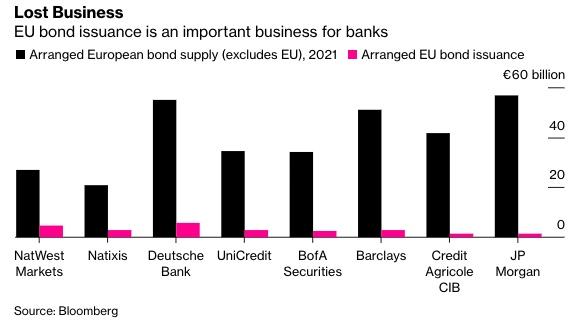
As a reminder, the banks that lost out include:

Source: Bloomberg

One EU bureaucrat said they couldn’t give an expected timeline for how long the EU Commission’s “review” of the recidivist might take, which would suggest that there’s still a possibility these banks could be shut out entirely.

“These banks have to demonstrate and to prove that they have taken all the necessary remedial actions which have been demanded by the Commission when deciding about these cases,” budget commissioner Johannes Hahn told reporters Tuesday. “We now expect the submission of the necessary information and then of course we have to analyze and assess it. I cannot predict how long it takes.”

Another two syndications are expected before the end of July, which would suggest that the scale of the missed fees could snowball. While missing out won’t kill the franchise, it will make it extremely difficult to show competitive growth, especially since the EU bonds sold so far this year are equivalent in value to 10% of the rest of the Continent’s sovereign bond market, according to Bloomberg data.

It is in the EU’s “interest to include all the key players and banks which have qualified themselves for the primary dealer network,” Hahn, the commissioner, said. “But of course the legal aspects have to be respected.”

Most of these banks are among the 39 or so “primary dealers” who have an obligation to bid for sovereign bonds during regular debt auctions. The EU is expected to start those in September. As for yesterday’s auction, the lead managers included BNP Paribas DZ Bank, HSBC, IMI-Intesa Sanpaolo and Morgan Stanley, with Danske Bank and Banco Santander hired as co-leads.

Considering the important role these banks play in financing the Continent’s governments, Europe can’t simply tell them to kick rocks. But the pressure is one way to compensate for a European financial regulatory framework that has been criticized for being wildly ineffective at deterring bad behavior.

Barring banks from participating in a bond deal is rare, but not unheard of: Morgan Stanley temporarily lost its status as a primary dealer of French government bonds in August as a result of some minor transgressions. The ban only lasted three months, but for what it’s worth, it may have proved effective at correcting MS’s behavior. After all, the bank was left off the last of black-balled banks (it was also notably absent from the market manipulation scandals that inspired the ban).

Tyler Durden
Wed, 06/16/2021 – 10:25

via ZeroHedge News https://ift.tt/3cL43wp Tyler Durden

Questions For The Fed: When Do Inflation & Financial Risks Force A Change In Policy

Questions For The Fed: When Do Inflation & Financial Risks Force A Change In Policy

by Joseph Carson, former chief economist at Alliance Bernstein

If I could attend the June 15-16 Federal Open Market Committee, I would ask the voting members what are they trying to accomplish? Based on efforts to help the economy recover and boost general inflation, aggressive monetary accommodation has resulted in more general inflation than any reasonable person would have expected. Is it still appropriate to call the uptick in consumer price inflation “transitory?” Also, easy money has helped fuel the record surge in the market valuations of tangible and financial assets. When does financial stability become paramount to everything else?

Inflation & Risks

General inflation measured by the consumer price index has increased 5%, the largest increase since 2008. And the core consumer price index, something policymakers focus on primarily, has jumped 3.8%, the most significant increase in 30 years.

Those policymakers who think the sharp uptick in consumer price inflation is “transitory” should look at the May producer price report. According to the Bureau of Labor Statistics, final demand prices rose 0.8% last month. The goods and services split were noteworthy; goods prices rose 1.5% and service prices 0.6%. In the past twelve months, final demand prices at the producer level have jumped 6.6%, goods 10.5%, and services 4.5%

Additional increases in final goods prices will flow from the sharp rise in intermediate prices. In May, core intermediate prices rose 2.3% and 17.4% in the past year. That’s the most significant increase since the early 1970s. Yet, it might be the service side with the biggest upside as that sector has the most pent-up demand.

In addition to general inflation, easy money has sparked a dramatic increase in house prices. In the past twelve months, house prices increased 20%, far more in any single year in the post-war period. Also, the gain was twice as much of any year during the housing bubble of the 2000s. At what price does housing pose the same risks as 2008?

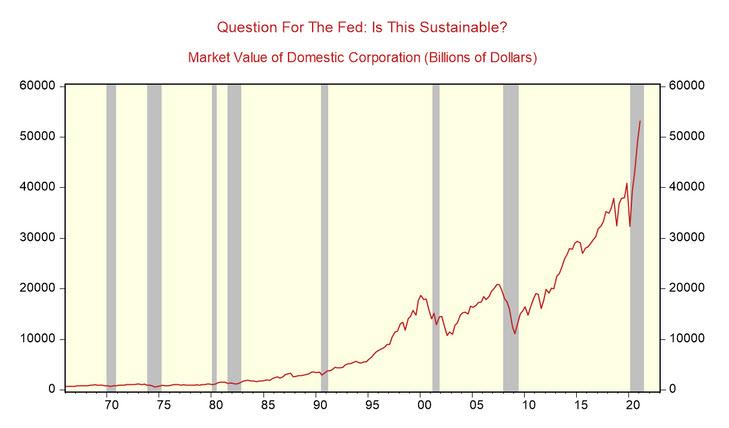
As striking as the increases are in general consumer and producer inflation, they pale compared to equity asset inflation. Since 2020, the nominal value of domestic equities has increased $12.4 trillion, the biggest gain over five quarters on record. That gain excludes the sharp drop in equity values during the short and sharp decline during the pandemic. Is this sustainable?

Equity values decline during a recession and usually take years to move back to the prior cycle peaks. The $8.5 trillion loss in equity values in Q1 2020 fell in the middle of equity value declines of the previous two recessions ($7.7 trillion loss following the tech bubble and the $9.7 after the housing bubble). Still, the rapid recovery to new highs is unprecedented, fueled by record asset purchases by the Federal Reserve and the promise to keep buying assets and maintain low rates for the foreseeable future.

A reasonable person would conclude the challenges the Fed faces are far greater than when they tried to normalize official rates in 2018, which triggered a quick and sharp 25% correction in equity prices. It’s difficult to predict what policymakers will decide to do at the June 15-16 FOMC meeting. It is even more challenging to predict how analysts will spin every word and change in the dot-plot and whether equity prices will be higher or lower when the market closes tomorrow.

But a reasonable person would conclude, “if something cannot go on forever, it won’t” (Herb Stein). Thus, this reasonable person (me) would bet equity prices will be lower in six months, perhaps even more so in twelve. And even though this reasonable person (me) still thinks inflation will prove to be more persistent than temporary, financial risks remain the biggest challenge to the Fed and the economy.

Tyler Durden
Wed, 06/16/2021 – 10:10

via ZeroHedge News https://ift.tt/2TFdvun Tyler Durden