Colin Powell Stuns MSNBC Host: Rips “Almost Hysterical” Coverage Of Fake Russia Bounty Story

Colin Powell Stuns MSNBC Host: Rips “Almost Hysterical” Coverage Of Fake Russia Bounty Story

Tyler Durden

Fri, 07/10/2020 – 17:25

When Colin Powell of all people has to appear on MSNBC to slam fake reporting you know mainstream media has lost the plot.

In a rare moment, the former Secretary of State under Bush slammed the wall-to-wall coverage of the Russian bounties in Afghanistan story as “almost hysterical”. It’s all the more awkard for MSNBC, which had him on the network Thursday to talk about it, given he’s one of those ‘never Trump’ Bush-era officials, who despite a legacy of having fed the world lie after lie to invade Iraq, has since been given “resistance hero” status among liberals.

Describing that military commanders on the ground didn’t give credence to The New York Times claim that Russia’s GRU was paying Taliban and other militants to kill American soldiers, Powell said the media “got kind of out of control” in the first days after the initial report weeks ago.

“I know that our military commanders on the ground did not think that it was as serious a problem as the newspapers were reporting and television was reporting,” Powell told MSNBC’s Andrea Mitchell. “It got kind of out of control before we really had an understanding of what had happened. I’m not sure we fully understand now.”

“It’s our commanders who are going to go deal with this kind of a threat, using intelligence given to them by the intelligence community,” Powell continued. “But that has to be analyzed. It has to be attested. And then you have to go find out who the enemy is. And I think we were on top of that one, but it just got almost hysterical in the first few days.”

He also deflated the ongoing manufactured atmosphere which seeks to maintain a perpetual Washington hawkish position vis-a-vis Moscow, based on perceived “Russian aggression”.

“I don’t think we’re in a position to go to war with the Russians,” Powell said. “I know Mr. Putin rather well. He’s just figuring out a way to stay in power until 2036. The last thing he’s looking for is a war, and the last thing he’s looking for is a war with the United States of America.”

via ZeroHedge News https://ift.tt/3fgKtY0 Tyler Durden

Humans Are Better But Tyson Turns To Robots

Humans Are Better But Tyson Turns To Robots

Tyler Durden
Fri, 07/10/2020 – 17:05

Authored by Mike Shedlock via MishTalk,

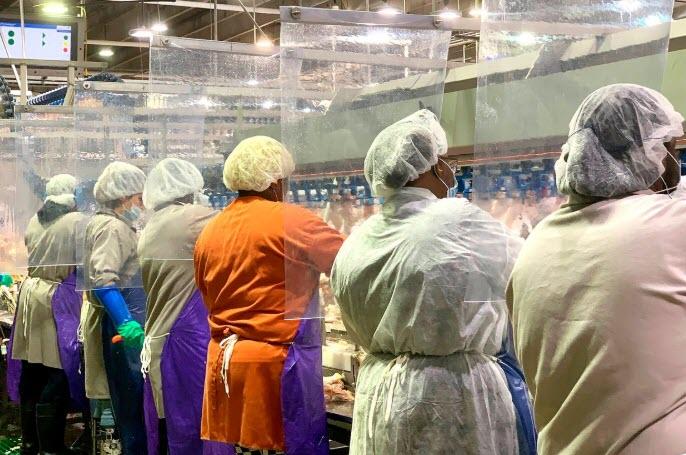
Machines cannot match human skills at processing meat but the coronavirus has forced Tyson’s hand.

Covid outbreaks at processing forced Tyson to turn to Robot Butchers.

In April and May, more than 17,300 meat and poultry processing workers in 29 states were infected and 91 died, according to the U.S. Centers for Disease Control and Prevention. Plant shutdowns reduced U.S. beef and pork production by more than one-third in late April.

The outbreak forced Tyson to try something new despite the fact that machines cannot  subtle differences in shape or color. 

Nor are sizes uniform as they are with a car.

A skilled loin boner can carve a cut of meat like filet mignon without leaving too many scraps on the bone, which have to be turned into lower-value products like finely textured beef, a low-cost trimming used in hamburger meat, or dog food, said Mark Lauritsen, an international vice president for the United Food and Commercial Workers International Union, which represents many meatpacking workers. For beef companies, that’s the difference between meat selling wholesale at $5 a pound and 19 cents a pound, he said. “Labor is still cheaper, and humans can do those skilled jobs much better than machines can,” he said.

Robot Skills

At a Tyson plant a team includes designers who once worked in the auto industry. They are now are developing an automated deboning system.

Tyson has 122,000 employees. When better robots are available, many of those workers will lose their jobs. 

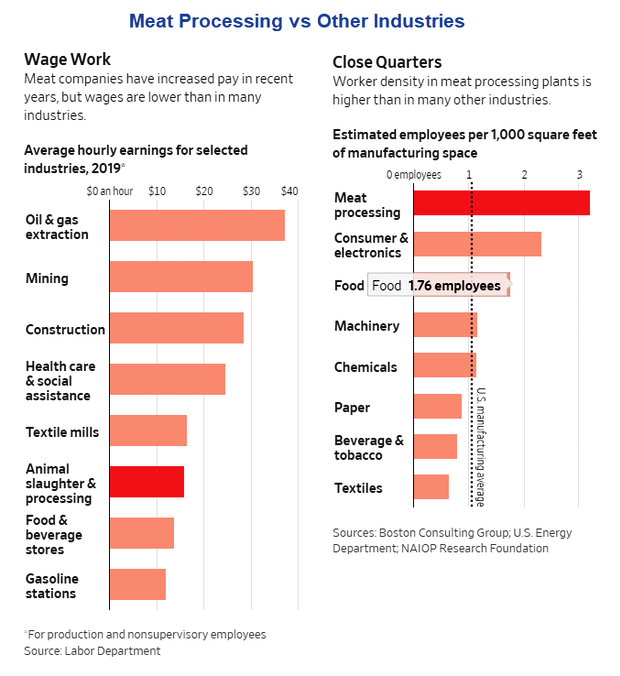
Meat Processing vs Other Industries

Automation has been slow because labor is cheap despite requiring a skill set that machines cannot do easily.

But eventually machines will get smarter and faster. The communities dependent on those jobs will get hammered.

This is an interesting story from many angles, but without a doubt Covid will speed up robotics in the meat processing industry.

via ZeroHedge News https://ift.tt/324qGaw Tyler Durden

Ghislaine Maxwell Hires Elite Legal Team To Face US Prosecutors

Ghislaine Maxwell Hires Elite Legal Team To Face US Prosecutors

Tyler Durden
Fri, 07/10/2020 – 16:45

Accused sex-trafficker Ghislaine Maxwell has hired a fleet of powerhouse attorneys to defend her against federal charges that she procured underage girls as young as 14 for sexual encounters with deceased pedophile Jeffrey Epstein.

According to Bloomberg Law, “Maxwell will confront federal prosecutors with years of experience in New York courts and deep knowledge of the child sex-trafficking allegations surrounding her and her former lover Jeffrey Epstein.”

For her own legal team, Maxwell has assembled the mirror image — attorneys with years of experience practicing in New York courts and also with deep knowledge of the allegations against her and Epstein.

Maxwell’s hired two pairs of law partners, one from New York, the other from Denver. The New Yorkers — Christopher Everdell and Mark Cohen — were once federal prosecutors while the Denver duo — Laura Menninger and Jeffrey Pagliuca — has defended Maxwell in civil lawsuits by Epstein’s victims.

Everdell spent more than a decade working for the government, focusing on complex frauds, cybercrime, terrorism and international narcotics cases. In 2014, the Federal Drug Agent Foundation cited Everdell and his team for their work in the investigation and apprehension of Mexican drug lord Joaquin “El Chapo” Guzman.

Cohen served in the federal prosecutors office in Brooklyn, New York, where he was part of a team that convicted Thomas Pitera, a Bonnano organized-crime family hit man known for dismembering his victims.

Both former public defenders with experience in sex-crimes cases, Menninger and Pagliuca have represented Maxwell in civil lawsuits by women who claim she helped Epstein recruit them for underage sex, with Maxwell participating in some of the sexual assaults. –Bloomberg Law

Former Manhattan federal prosecutor Jennifer Rodgers thinks Maxwell’s approach is ‘savvy,’ and that her attorneys Menninger and Pagliuca “know all the facts, so this seems like a smart strategy.”

Prosecutors say the 58-year-old Maxwell, Epstein’s longtime ‘madam’ according to accusers, spent years as a central figure in his criminal enterprise. Epstein died last August in a New York jail cell in what was officially ruled a suicide.

Maxwell’s lawyers will have to review millions of pages of evidence the U.S. has collected over the decades. While her lawyers haven’t yet disclosed their legal strategy, they’ll have to confront the allegations as well as the emotional testimony from women who’ve come forward and accused Maxwell of engaging in and enabling their abuse.

More than a dozen women accused Epstein of abusing them but according to prosecutors, three were victims of both Maxwell and the financier. –Bloomberg Law

It’s a very smart for the defense to hire and obtain local counsel who can guide them,” said New York criminal defense lawyer Marvyn Kornberg, adding that Everdell and Cohen “know their way around, they know people in the prosecutor’s office and they can, if they want, try to work out a deal. They can operate with knowledge about what’s going on with the other side, which can’t be done as well by lawyers who practice primarily in Colorado.”

Meanwhile, former Cohen colleague Jonathan Sack thinks Maxwell’s legal team will be in a good position to form a strategy to counter the DOJ.

“Mark is a thoughtful lawyer who will know his case, understand it and have a good sense of what the prosecution is doing and what the options are for the defense,” said Sack. “He’ll carefully assess the strengths and weaknesses in the government’s case and will have a good feeling for how a jury would view the facts as well as his client.”

via ZeroHedge News https://ift.tt/2ANtVI9 Tyler Durden

After Dems Exaggerate Impact, Panicked Kids Are Suing Over Betsy DeVos Title IX Changes

zumaamericastwentyseven005413

Seven students are joining a National Women’s Law Center (NWLC) lawsuit challenging new guidelines related to Title IX, the federal law that prohibits education discrimination on the basis of sex. Some of their stories suggest that Democrats’ distorted descriptions of the changes could be doing real damage.

U.S. Secretary of Education Betsy DeVos formally issued the new rules—set to take place August 14—in May 2020, following a massive influx of public comments since she first proposed them back in 2018. But her proposal also ushered in a wave of hyperbolic, misleading, and dishonest claims about what these proposed changes would mean.

Reality-challenged rhetoric about the rule changes has come from folks claiming to represent students’ best interests, like the NWLC. But it’s hard to see how letting young people think the federal government wants schools to stop punishing rapists benefits students—or anyone but Democrats looking to portray the Trump administration as soft on campus rape.

In the NWLC lawsuit, “plaintiffs include a fifth grader in Michigan who fears that her elementary school will not be required to formally investigate and punish her classmate for assaulting her four times over two months” and “a recent graduate of the University of California, Santa Barbara, who decided not to formally report her rape at an off-campus apartment because she believed that the final rule rendered her complaint futile,” according to The New York Times.

That’s incredibly sad, since of course there’s nothing in the new rules saying schools shouldn’t investigate and punish students for sexual assault. (Read more details about what the changes will do here.) Students are being misled by what’s turning out to be a damaging disinformation campaign.

Shiwali Patel, senior counsel at the National Women’s Law Center, told the Times “the fear these students are living with show how real the consequences are of DeVos’s rule.”

But much of this student fear isn’t rooted in what the DeVos rules actually say, it’s driven by Democratic politicians and groups like the NWLC fearmongering about them. When the new rules were first released, Sen. Mark Warner (D–Va.) said they would “undoubtedly make students less safe,” while Rep. Barbara Lee (D–Calif.) called them an attack on “student survivors’ rights.” And Fatima Goss Graves, president and CEO of the National Women’s Law Center, said they send “the message loud and clear that there is no point in reporting assault.”

The NWLC is far from alone in legally challenging the Department of Education’s new Title IX guidance. In May, the American Civil Liberties Union (ACLU) filed a lawsuit against DeVos and the Education Department, on behalf advocacy group Know Your IX.

And 18 state attorneys general (AGs) are challenging the new rules, in an action filed June 4 in the U.S. District Court for the District of Columbia and led by Democratic attorneys general Xavier Becerra of California, Josh Shapiro of Pennsylvania, and Gubir Grewal of New Jersey.

Attorneys general for Colorado, Delaware, Illinois, Massachusetts, Michigan, Minnesota, New Mexico, North Carolina, Oregon, Rhode Island, Vermont, Virginia, Washington, Wisconsin, and Washington, D.C.—all Democrats—are also part of the lawsuit.

New York is also (separately) challenging the rules, with state Attorney General Letitia James explicitly invoking Trump in her explanation.

“The president has repeatedly shown that he doesn’t think sexual harassment is a serious matter, but his callousness now threatens our youngest and most vulnerable and could increase the likelihood of sexual harassment and abuse of students in schools,” James said in an announcement about the suit. The announcement misleadingly describes DeVos’ rules as “undo[ing] protections required by Title IX,” as if prohibitions of gender and sex discrimination at schools will no longer exist.

Presumptive Democratic Party presidential candidate Joe Biden has already vowed to reverse the rule changes if elected.

It seems pretty clear that despite the seriousness of the issues involved, Title IX has become yet another set of partisan talking points to tussle over. But those using the DeVos changes to spread misinformation about campus assault might want to think about who is really being harmed by their rhetoric.

from Latest – Reason.com https://ift.tt/328rmvw
via IFTTT

COVID-19 Deaths Are Now Rising in the U.S., but Case Fatality Rate Continues To Fall

CoronavirusAbstract

Daily COVID-19 deaths in the United States, which have fallen dramatically since the spring and continued to drop even as newly identified cases surged, are now rising.  According to the Worldometers tally, COVID-19 deaths averaged 948 during the last three days, compared to 302 during the previous three days. That’s a pretty alarming increase in a short time, and it will have a significant impact on the total death toll if it proves to be more than a temporary spike.

The seven-day average of daily deaths, which is a better indicator of trends, has increased less dramatically. According to data scientist Youyang Gu’s calculations, that number fell from 1,122 on May 25 to a low of 510 on July 4 and has since risen to 641, which is still more than 70 percent lower than the peak average of 2,238 on April 18. “Health experts cautioned that it was too early to predict a continuing trend from only a few days of data,” notes The New York Times.

Gu, who has a good track record of predicting COVID-19 fatalities, is now projecting that daily deaths will rise to 774 in late August, then gradually fall to fewer than 500 by the end of October. He has increased his estimate of total deaths by October 1 from about 186,000—his projection at the beginning of this week—to about 192,000, rising above 200,000 by mid-October.

Because newly identified infections have more than tripled since Memorial Day, from fewer than 20,000 to more than 60,000 yesterday and the day before, daily deaths were bound to rise eventually. (According to the Centers for Disease Control and Prevention, the lag between laboratory confirmation and death is about two weeks.) Yet the nationwide crude case fatality rate—deaths as a share of confirmed cases—continues to fall. It is now 4.3 percent, down from more than 6 percent in mid-May. That trend likely reflects not only broader testing but also a younger mix of patients and improved treatment.

If the patient mix remains about the same, the case fatality rate could keep dropping even as daily deaths rise. But if the young and healthy people who seem to be driving the recent jump in cases pass the virus on to a lot of people who are more vulnerable to COVID-19, the case fatality rate could go up, as it did from late March to mid-May, when the patient mix was older and less healthy. Much will depend on precautions aimed at protecting people in high-risk groups.

The upward national trend in COVID-19 infections is largely due to dramatic increases in several Sunbelt states. On Wednesday, for example, California, Florida, and Texas, where a little more than a quarter of Americans live, accounted for more than two-fifths of newly confirmed cases.

“The current surge in coronavirus cases in the United States is being driven by states that were among the first to reopen their economies, decisions that epidemiologists warned could lead to a wave of infections,” the Times says. But California’s prominence in the recent wave of infections complicates that narrative.

California, which led the nation in imposing a lockdown and has been lifting it only gradually, nevertheless saw newly identified cases rise more than fivefold between Memorial Day and July 7, from 2,175 to 11,694. It recorded about 7,000 cases on Wednesday. “The state was once seen as a model for how to contain the virus,” the Times says, “but experts blame the current surge on an inconsistent adoption of prevention strategies and a haphazard reopening process that gave people a false sense that they were in the clear.”

Still, California does seem to be doing better in some respects than Texas and Florida, which have seen even bigger increases in newly identified cases and daily deaths since Memorial Day. The seven-day average of COVID-19 deaths in California rose from 70 on May 25 to 85 yesterday. During the same period, the average rose from 26 to 66 in Texas, and from 36 to 56 in Florida.

Then again, Texas and Florida have lower case fatality rates: 1.3 percent and 1.7 percent, respectively, compared to 2.3 percent in California. That suggests patients are doing somewhat worse in California, especially since it has tested a larger share of its population than Texas or Florida has, which would tend to reduce the apparent fatality rate. And according to Gu’s estimates, the COVID-19 reproductive number—the number of people infected by the average carrier—is slightly higher in California than in Texas or Florida.

What about states that never imposed stay-at-home orders? Since Memorial Day, daily new cases are up dramatically in Arkansas, Iowa, North Dakota, South Dakota, and Wyoming, but not in Nebraska. It sure looks like politicians’ decrees play a smaller role in this pandemic than The New York Times thinks.

from Latest – Reason.com https://ift.tt/2Clryg8
via IFTTT

As Long As Mass Media Propaganda Exists, Democracy Is A Sham

As Long As Mass Media Propaganda Exists, Democracy Is A Sham

Tyler Durden
Fri, 07/10/2020 – 16:25

Authored by Caitlin Johnstone via Medium.com,

A new Reuters/Ipsos poll has reportedly found that a majority of Americans believe the completely discredited narrative that the Russian government paid Taliban-linked fighters to kill the occupying forces of the US and its allies in Afghanistan.

“A majority of Americans believe that Russia paid the Taliban to kill U.S. soldiers in Afghanistan last year amid negotiations to end the war, and more than half want to respond with new economic sanctions against Moscow, according to a Reuters/Ipsos poll released on Wednesday,” Reuters reports.

Overall, 60% of Americans said they found reports of Russian bounties on American soldiers to be ‘very’ or ‘somewhat’ believable, while 21% said they were not credible and the rest were unsure,” says Reuters.

Those 21 percent are objectively correct: the story is not credible, and it’s not even close. Gareth Porter shows in The Grayzone how the “Bountygate” narrative is so utterly baseless that even US intelligence agencies have dismissed it, Joe Lauria of Consortium News explains how it doesn’t make any sense on its face, and FAIR’s Alan MacLeod breaks down the appalling journalistic malpractice that went into circulating this incredibly thinly sourced story to the mainstream public.

The story advances no solid facts or verified information. What it does advance is pre-existing imperialist agendas like remaining in Afghanistan, killing the last of the remaining nuclear deals with Moscow, and manufacturing public support for new Russia sanctions.

And yet a majority of people believed it, and still believe it.

The narrative that Russia paid Taliban fighters to kill occupying forces is now regarded as an established fact in many key circles, despite being backed by literally zero facts.

If people were as objective and adept at critical thinking as we tend to believe we are, the mass media’s unconscionable facilitation of a brazen cold war psyop would by itself have killed off all public trust in the institution of mass news reporting. But people are not as objective and adept at critical thinking as we tend to believe we are. People have many cognitive biases which distort our ability to objectively process information and understand events, including one which causes us to believe something is true just because they’ve heard it said multiple times. This makes us easily susceptible to mass media propaganda, where our encounters with daily news headlines can shape our perception of what’s going on in the world regardless of whether or not those headlines are backed by actual facts.

This latest poll is a perfect example of how the plutocrat-owned media manipulate public opinion in the interest of establishment agendas using brazen propaganda campaigns, but it is just the most recent example. Over and over and over again we see public perception of what’s going on distorted by lies inserted into their minds by the corporate news media, like when half a year after the invasion of Iraq seven in ten Americans believed Saddam Hussein was responsible for the 9/11 attacks. All it took to trick them into believing this and supporting the invasion was repeatedly mentioning 9/11 and Saddam in the same breath, despite there never being any evidence whatsoever for any such thing.

This kind of manipulation is not rare, it is ubiquitous and ongoing. Every single day the plutocratic media are putting ideas in people’s minds which favor the establishment upon which said plutocrats have built their kingdoms, normalizing the insane status quo and manufacturing support for agendas which bolster it. This is not some delusional conspiracy theory, it’s a well-documented fact to which many mainstream journalists have testified.

As long as this remains the case in our society, democracy cannot exist in any meaningful way. As long as a loose alliance of plutocrats and government operatives are able to consistently manipulate the way a critical mass of people think and vote, then you cannot rightly say that the people are in charge of the fate of their nation. If the majority is consistently in alignment with the plutocrats whose outsized media influence enables them to dominate the public narrative, then voting necessarily reflects the will of those plutocrats, not the people.

Even if you changed everything else that is wrong with the current system, nothing would change if the plutocratic class retained its ability to manipulate the way people think and vote. You can fix America’s garbage election integrity, end gerrymandering, even get money out of politics, but as long as the plutocratic class is still using its wealth to manipulate public thought in support of its interests, people would keep voting the way they’re manipulated to vote.

Manipulation is a key ingredient in any long-term abusive relationship, because people don’t tend to stay in abusive situations unless they are manipulated into doing so. This is true whether you’re talking about romantic partnerships, governments, or globe-spanning power structures. We don’t use the power of our numbers to end this abusive relationship where we are at the whim of crushing austerity, exploitative neoliberalism, endless war and rapacious ecocide, because we’re being manipulated into staying.

And, just like with any other abusive relationship, there comes a time to leave before it’s too late. That time is now. We can begin by expanding awareness of what’s really going on, both inwardly in ourselves and outwardly by sharing truthful information with others. In so doing, we stand a chance at making ourselves impossible to propagandize effectively and using our strength in numbers to force real change.

*  *  *

Thanks for reading! The best way to get around the internet censors and make sure you see the stuff I publish is to subscribe to the mailing list for my website, which will get you an email notification for everything I publish. My work is entirely reader-supported, so if you enjoyed this piece please consider sharing it around, liking me on Facebook, following my antics onTwitter, checking out my podcast on either YoutubesoundcloudApple podcasts or Spotify, following me on Steemit, throwing some money into my tip jar on Patreon or Paypal, purchasing some of my sweet merchandise, buying my books Rogue Nation: Psychonautical Adventures With Caitlin Johnstone and Woke: A Field Guide for Utopia Preppers. For more info on who I am, where I stand, and what I’m trying to do with this platform, click here. Everyone, racist platforms excluded, has my permission to republish, use or translate any part of this work (or anything else I’ve written) in any way they like free of charge.

Bitcoin donations:1Ac7PCQXoQoLA9Sh8fhAgiU3PHA2EX5Zm2

via ZeroHedge News https://ift.tt/2OfaUBC Tyler Durden
Big-Tech Bid, Small-Caps Skid As Gold Hits 9 Year Highs

Big-Tech Bid, Small-Caps Skid As Gold Hits 9 Year Highs

Tyler Durden
Fri, 07/10/2020 – 16:01

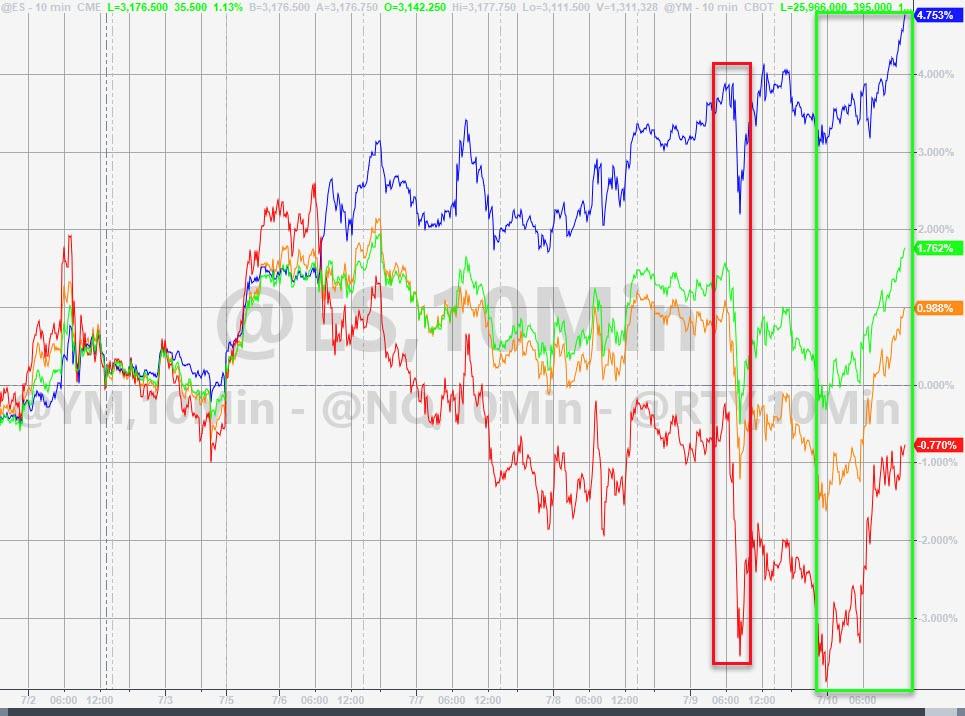
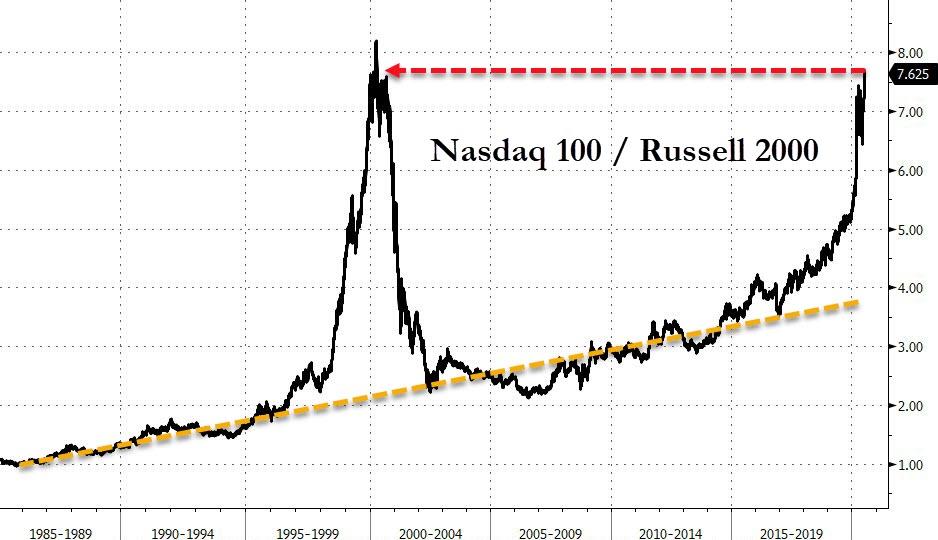
On the week, Nasdaq has soared higher once again, notably divergent from the rest of the markets with Small Caps actually down on the week…

Which has sent the ratio of Megacap-Tech to Small Caps back near a record high…

Source: Bloomberg

Nasdaq is up 8 of the last 9 days and 17 of the last 20 days – this is easy!!!

Interestingly, today saw the week’s performances flip with Small Caps surging as Nasdaq slipped. Markets were sold at the cash open then immediately ramped higher…

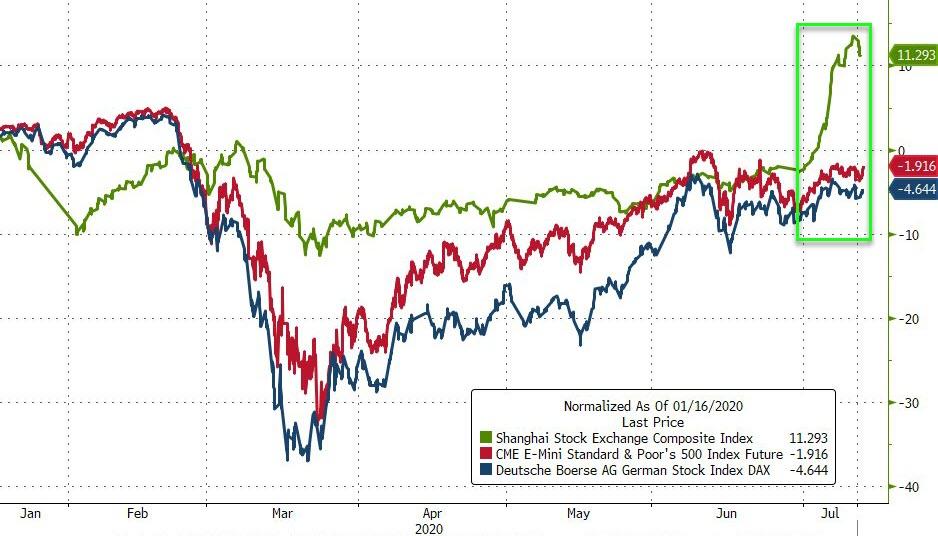
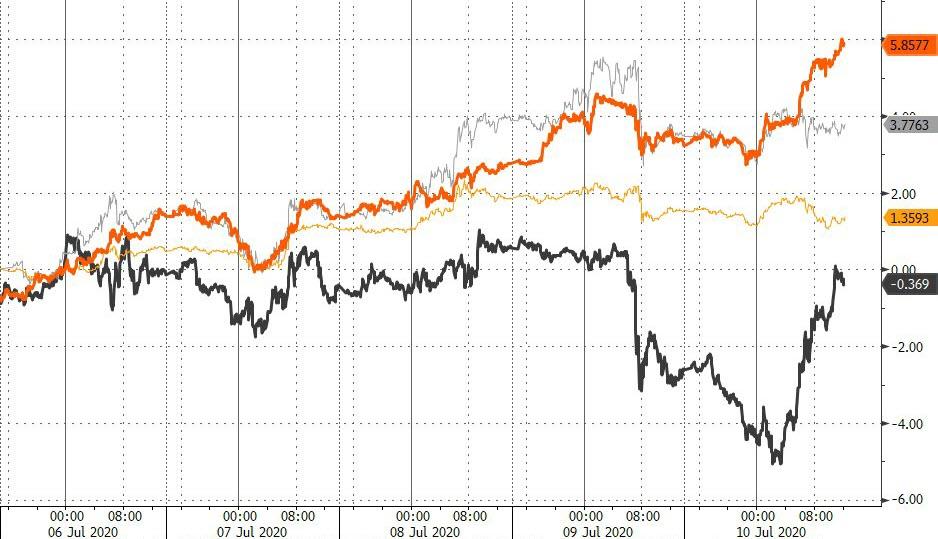
Spot the odd market out (Chinese stock speculation re-erupted this week)…

Source: Bloomberg

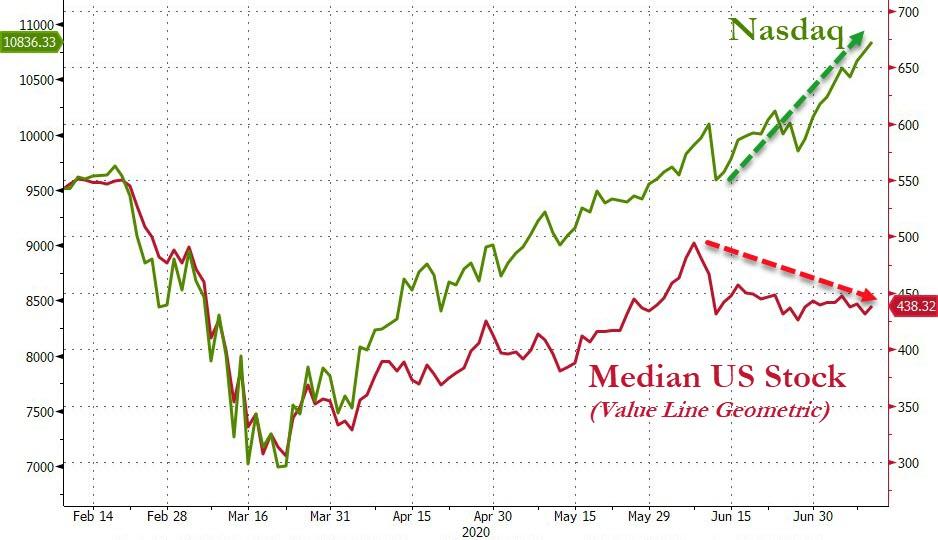
Median US stocks continue to diverge significantly from the handful of megatech stocks driving the Nasdaq ever higher…

Source: Bloomberg

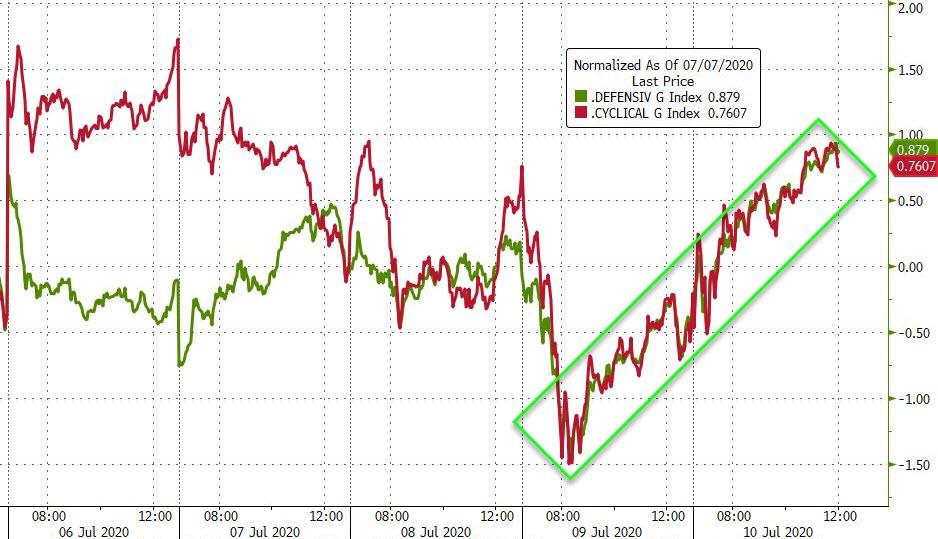
Notably Defensives and Cyclicals have rallied tick for tick higher since the European close yesterday – very unusual moving together…

Source: Bloomberg

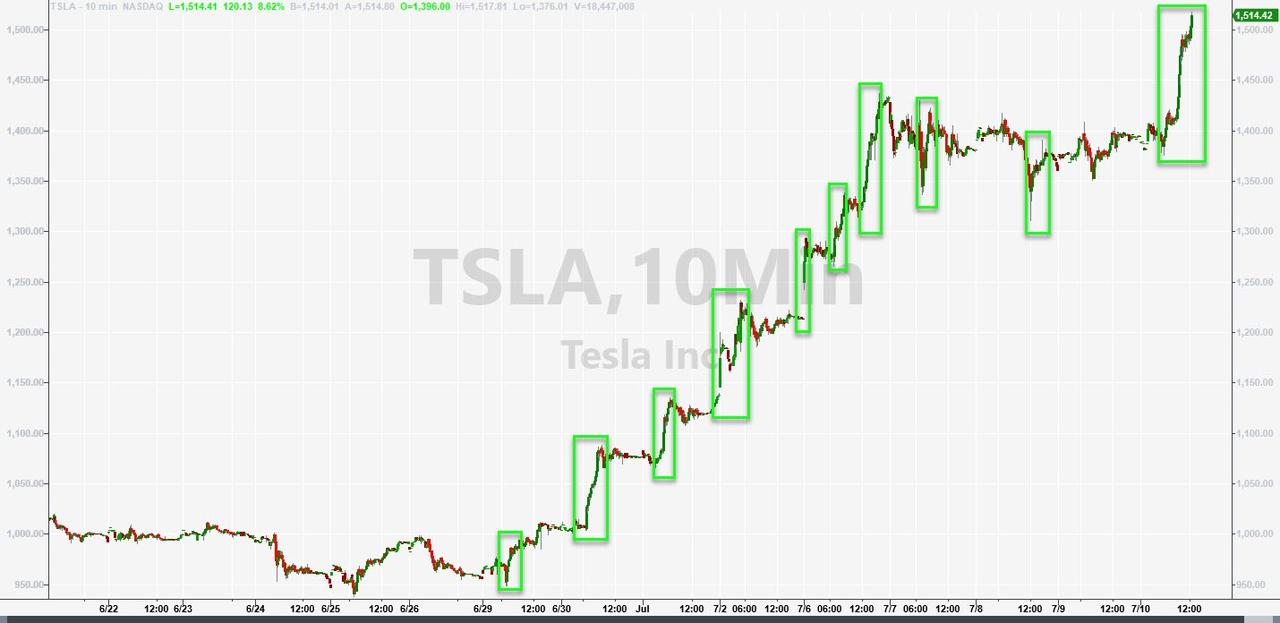
And then there’s TSLA – up from $1000 to $1500 in 7 days…

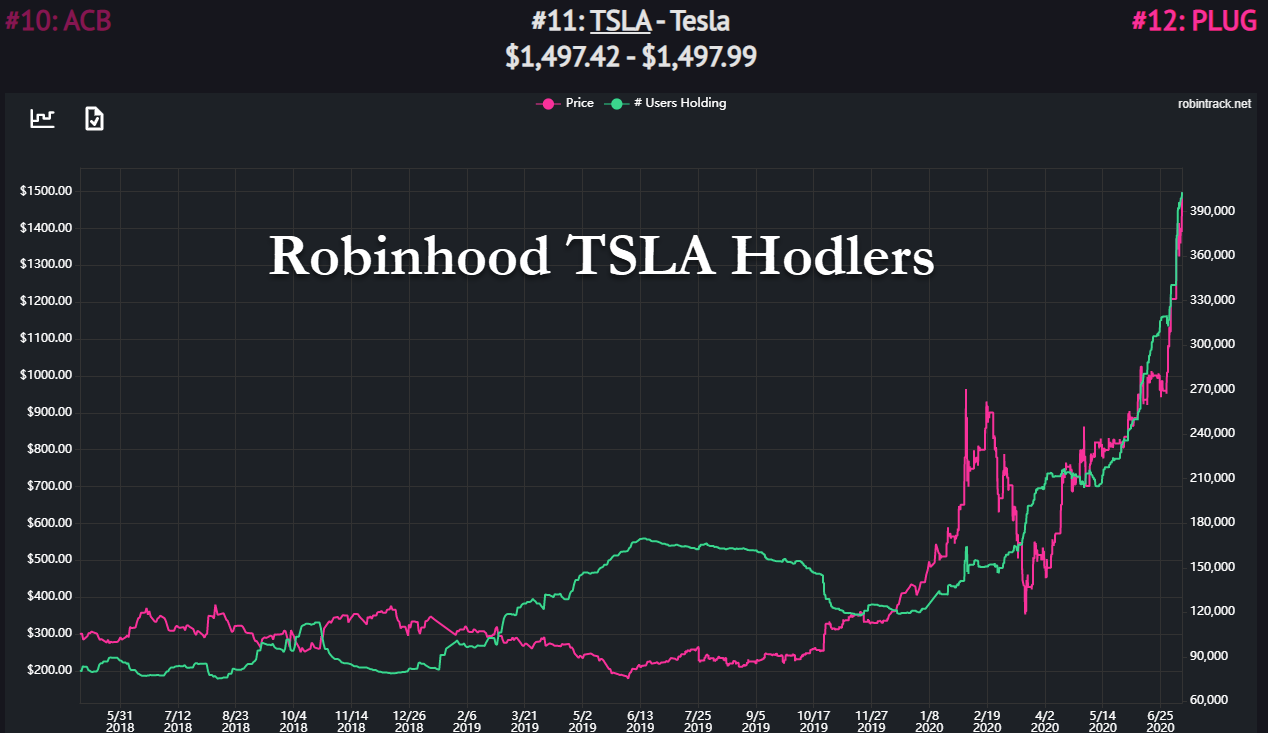
And who’s buying?

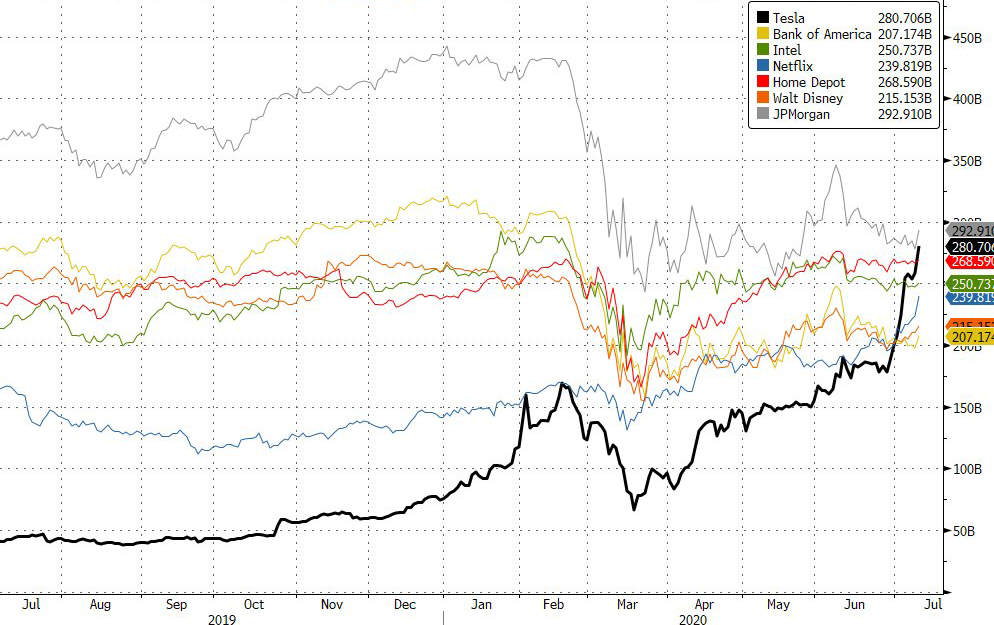
TSLA’s now as big as JPMorgan… and TSLA is now bigger than Ford + GM + BMW + Daimler + Volkswagen combined

Source: Bloomberg

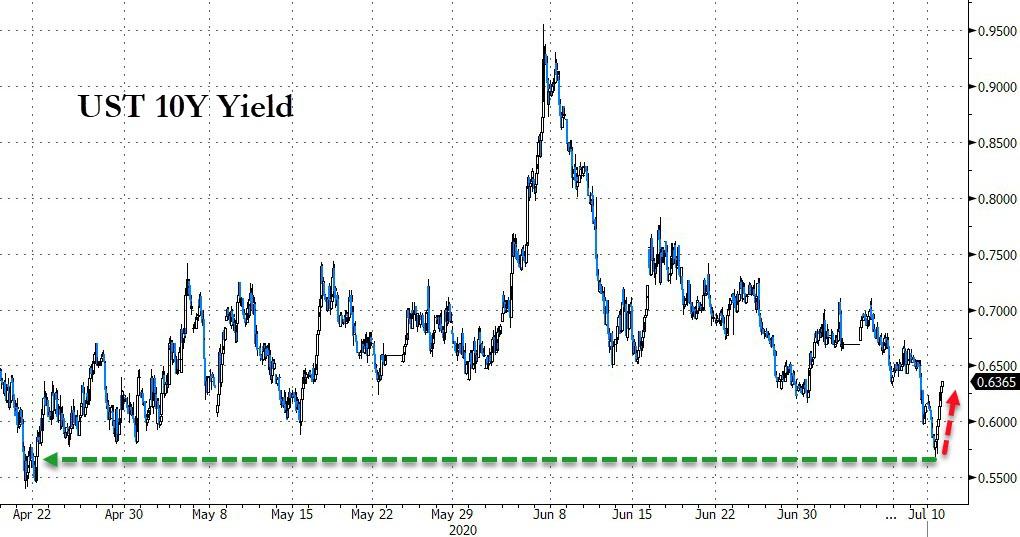
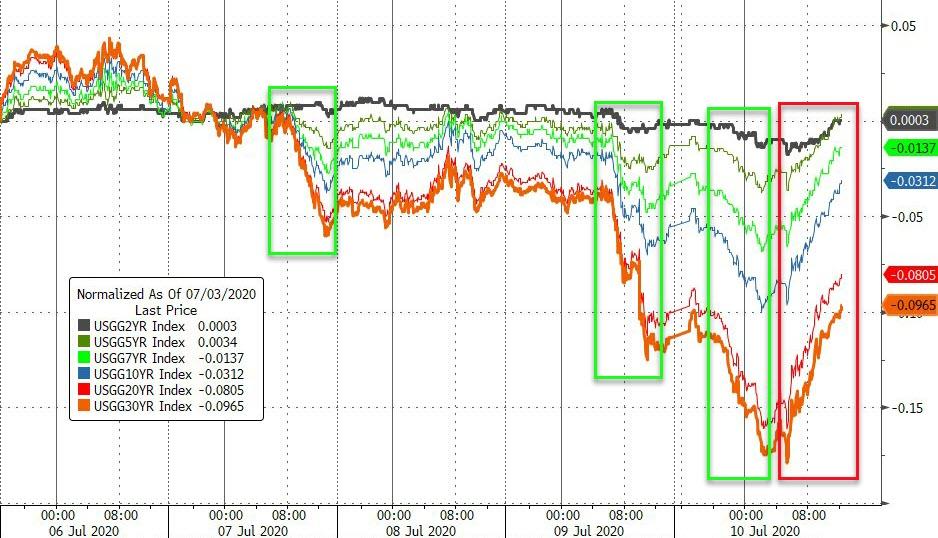
Treasury yields touched a two month lows today…

Source: Bloomberg

Then ripped back higher with 5Y and 2Y unch on the week, the long-end still notably lower (and the curve flatter)…

Source: Bloomberg

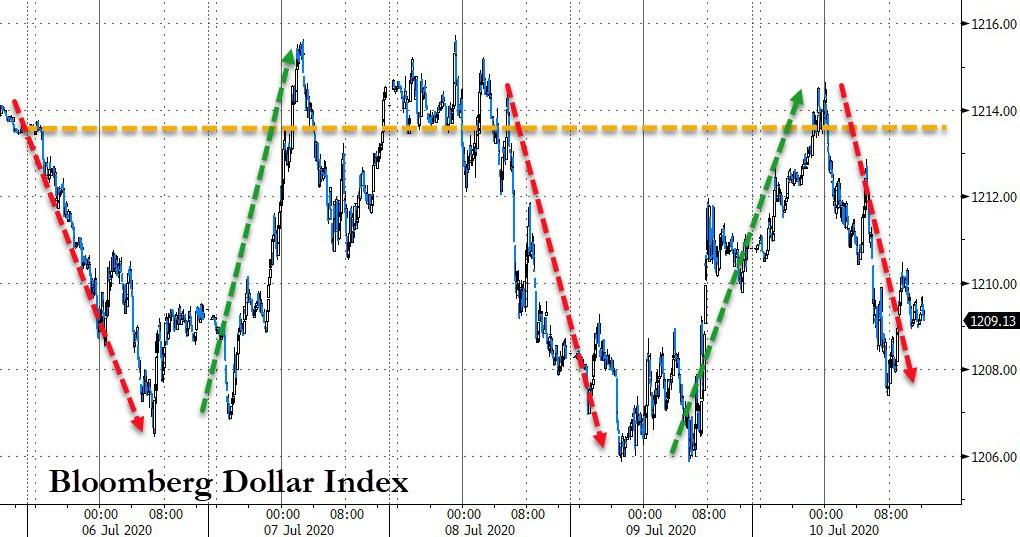
The Dollar ended lower on the week, chopping around in a tight range…

Source: Bloomberg

Cryptos were all higher on the week, led by Ripple…

Source: Bloomberg

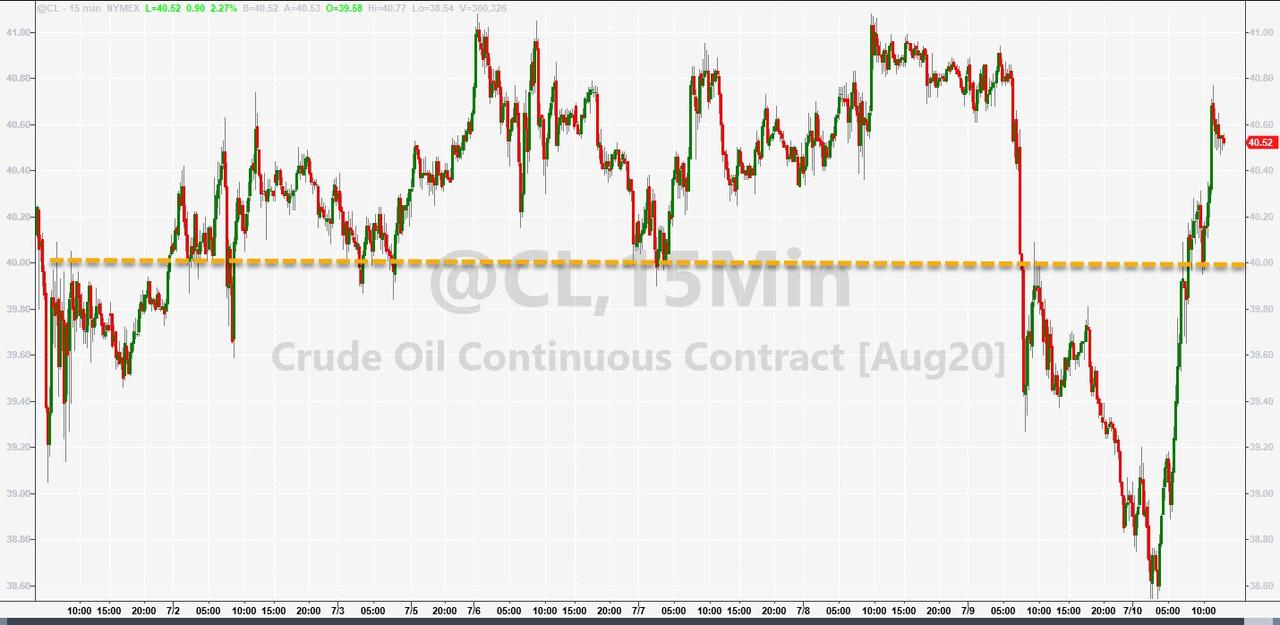
Copper was the week’s high-flier as China erupted in speculative excess. Oil was down…

Source: Bloomberg

Big intraweek drop in WTI was bid back above $40…

Silver held above $19…

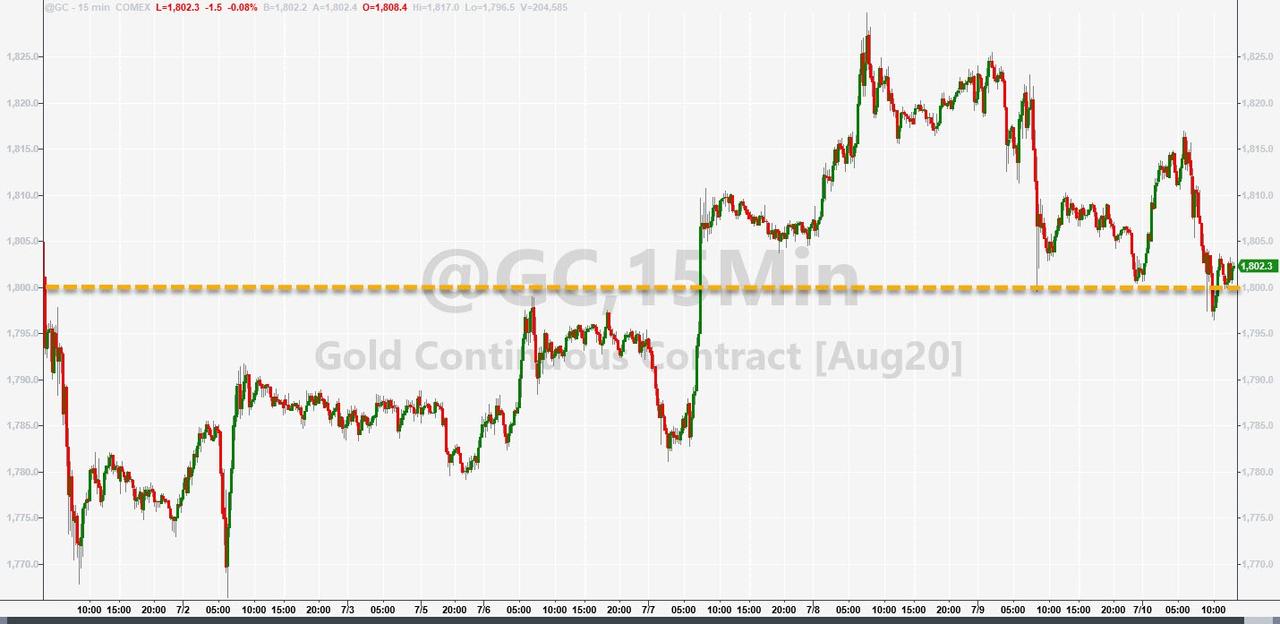
And gold clung to $1800…

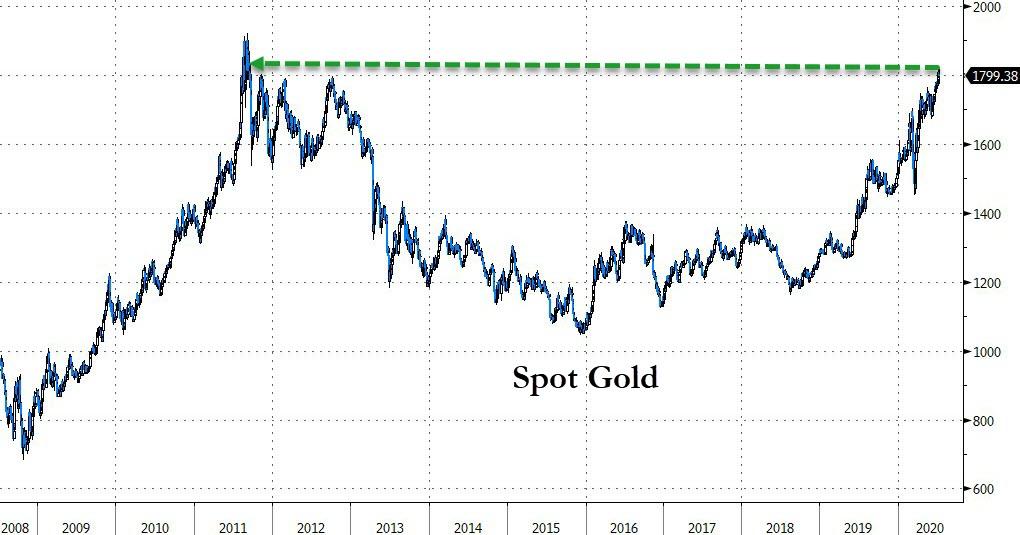
Spot Gold reached back to its highest since 2011…

Finally, you have to laugh right…

Bonds ain’t buying it…

Source: Bloomberg

Because fun-durr-mentals…

Source: Bloomberg

via ZeroHedge News https://ift.tt/2ZhlHBJ Tyler Durden
Rickards: Economy Won’t Recover Until At Best 2023

Rickards: Economy Won’t Recover Until At Best 2023

Tyler Durden
Fri, 07/10/2020 – 15:45

Authored by James Rickards via The Daily Reckoning,

I’ve argued that we’re in a new depression. The depth of the new depression is clear. What is unclear to most observers are the nature and timing of the recovery.

The answer is that high unemployment will persist for years, the U.S. will not regain 2019 output levels until 2022 and growth going forward will be even worse than the weakest-ever growth of the 2009–2020 recovery.

This may not be the end of the world, yet it is far worse than the most downbeat forecasts. Some sixth-grade math is a good place to begin the analysis.

Make 2019 economic output 100 (the actual figure is $21 trillion; “100” is 100% of that number, a convenient way to measure ups and downs).

Assume output drops 40% in the second and third quarters of 2020. (Many estimates project larger drops; 40% is a plausible if conservative estimate.)

A 40% drop for six months equals a 20% drop for the full year assuming the first and fourth quarters are flat on net.

A 20% drop from 100 = 80 (or $4.2 trillion of lost output).

Now let’s see what happens if we estimate back-to-back growth years of 10% in 2021 and 2022…

First, is 10% growth even a reality? Past history says no.

Since 1948, U.S. annual real growth in GDP has never exceeded 10%.

In fact, post-1980 recoveries averaged 3.2% growth. And since 1984, growth has never exceeded 5%. So 10% is a very optimistic forecast to begin with.

If our new base is 80 (compared with 100 in 2019) and we increase output by 10% in 2021, this brings total output to 88.

If we enter 2021 with a new base of 88 and add another 10% to that, we come to 96.8 in total output by the end of 2022.

Here’s the problem.

Using 100 as a yardstick for 2019 output and assuming an unrealistic back-to-back years of 10% real growth in 2021 and 2022, one still does not get back to 2019 output levels.

The hard truth is 96.8 is less than 100.

It would take the highest annual real growth in over 40 years, sustained for two consecutive years, to get close to 2019 output levels.

It’s far more realistic to assume real growth will be less than 10% per year. That puts the economy well into 2023 before reaching output levels last achieved in 2019.

This is the reality of this depression.

It’s not about continuously declining GDP. A depression is an initial collapse so large that even years of high growth won’t dig the economy out of its hole.

Analysts and talking heads debate the recovery’s strength using letters that mimic the shape of a growth curve as shown on a graph.

  • A V-shaped recovery goes down steeply and back up steeply to get output back where it started in a relatively brief time.

  • A U-shaped recovery goes down steeply, does not grow materially right away and then makes a sharp recovery.

  • An L-shaped recovery goes down steeply and is followed by low growth for an indefinite period of time.

  • Finally, the W-shaped recovery goes down steeply, bounces back quickly and then falters for a second time before finally recovering and getting back to earlier levels of output and growth.

The post-2009 recovery produced only 2.2% growth. It was an L-shaped recovery.

It was a real recovery, yet the output gap between the former trend and the new trend was never closed.

The U.S. economy suffered over $4 trillion of lost wealth based on the difference between the former strong trend and the new weaker trend.

That lost wealth was a serious problem for the U.S. before the New Great Depression.

Now the prospect is for even lower growth than the weak post-2009 recovery.

The new recovery, far from the 10% growth discussed in the example above, may only produce 1.8% growth, even worse than the 2.2% growth before the pandemic.

It’s another L-shaped recovery, the second in a row. Now the bottom of the L is even closer to a flat line and the output gap compared with the long-term trend is even greater.

There will be no V-shaped recovery. There are no green shoots despite what you hear on TV.

We’re in a new Great Depression and will remain so for years.

via ZeroHedge News https://ift.tt/38Id31Y Tyler Durden
One Bank Admits The Markets Have Never Been More Broken, So Here’s What Happens Next

One Bank Admits The Markets Have Never Been More Broken, So Here’s What Happens Next

Tyler Durden
Fri, 07/10/2020 – 15:25

With every passing day, the bizarre freakshow that was once known as the “market” gets even more bizarre.
And we use the term “market” only in its loosest, legacy sense, one where it represented more than just the centrally-planned intentions of a few central bankers and politicians. Why? Because as BofA’s CIO Michael Hartnett reminds us in his latest Flow Show report, the disconnect between macro and markets has never been greater – i.e., they have never been more broken – but that is to be expected for the following three reasons:
  1. Markets rationally being “irrational”: government and corporate bonds have been fixed (“nationalized”) by central banks, so why would anyone expect markets to connect with macro, why should credit & stocks price rationally.
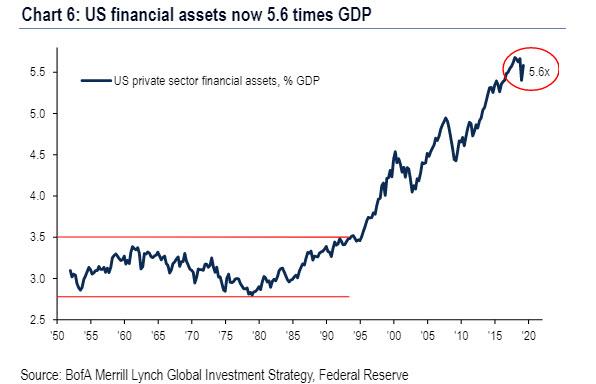
  2. Markets leading macro: policy makers (see China this week) know higher asset prices necessary condition for macro recovery (Wall St assets are 5.6x size of US GDP)…

    …V-shape recovery on Wall St leading V-shape recovery on Main St (see PMI’s & housing activity); gasoline demand good US mobility signal, up sharply to 9mn barrel/day from spring lows, watch to see if virus again negatively impacts economy.

  3. Markets rationally pricing-in Max Liquidity, Minimal Growth backdrop, as they have done for 10 years; of 3042 stocks in MSCI ACWI currently 2141 >20% below their all-time highs, i.e. in a bear market.

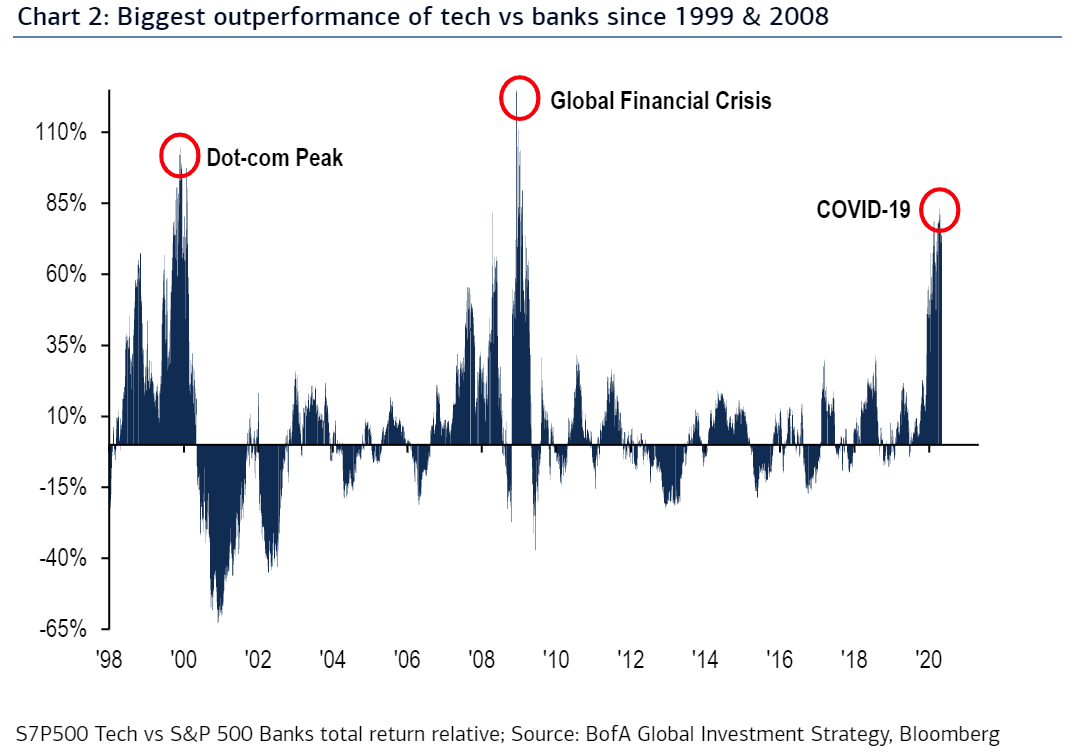
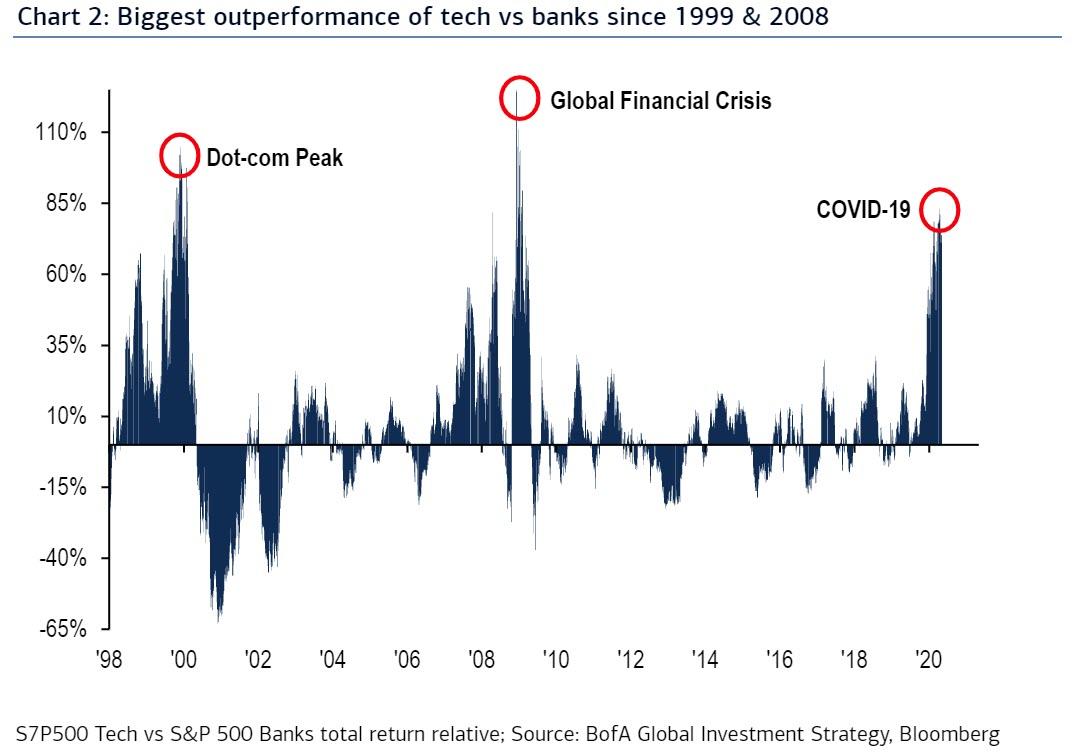
Also consider this: if the S&P500 (3230 on Jan 1st) was just “tech, health care, Amazon, Google” it would now be 4173 , and if the S&P were “everything else” it would be 2924. No secret here, but US tech outperformance over US banks past 6 months biggest since 1999 tech bubble & 2008 GFC.

So while markets may be broken – as one would expect in a world where central banks have taken over all price discovery – three key trends remain and are totally unchanged for 2020. Per BofA:

  • Central bank liquidity drives asset prices;
  • Credit prices drive equities;
  • Sellers’ strike in credit & tech mirrored by buyers’ strike in value stocks & banks.

Some other observations from BofA’s CIO on what was once a “market”:

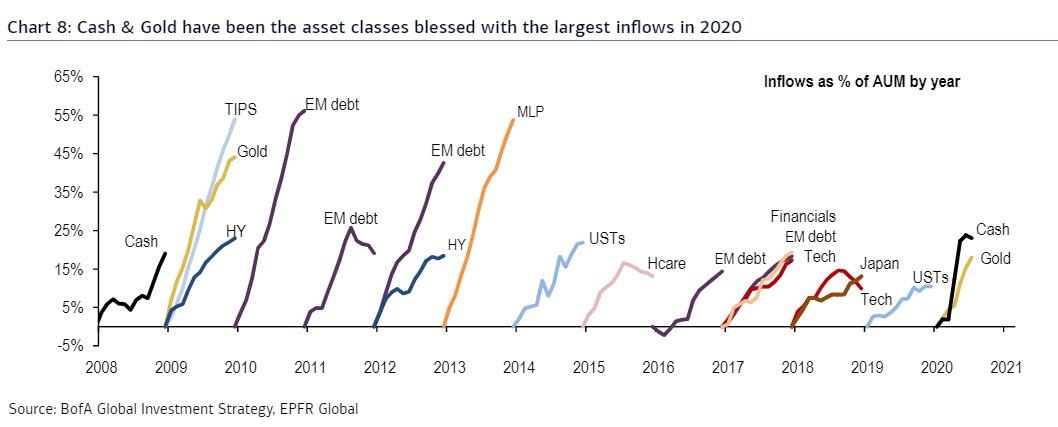
Cash & gold the big inflow winners in 2020;

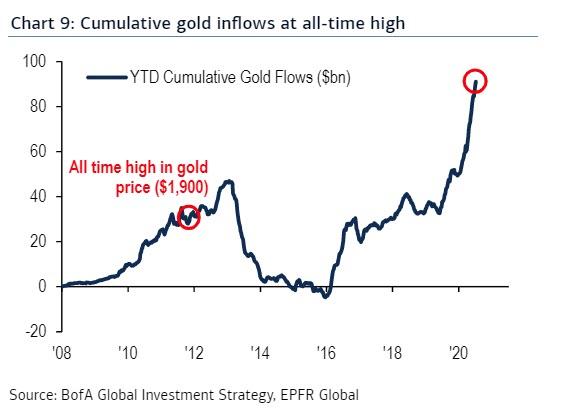
Gold inflows on cumulative basis at all-time high:

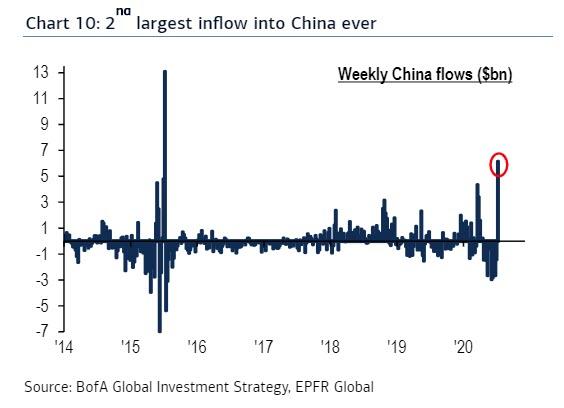
Discounting all-time high in price; largest inflow to China funds ($6.1bn) since Jul’15 (and 2nd inflow largest ever):

So with stocks now fully mandated and no longer discount the future or respond to fundamentals or news, does this mean that stocks will rise indefinitely until eventually the population burns down the Marriner Eccles building? According to Hartnett the answer is now, and while stocks see bullish drivers of Positioning & Policy into the summer, these will peak just as the autumn begins, at which point bulls will require profits to surprise to upside allowing rally in risk assets to broaden into HY, value stocks, small cap and so on; At the same time, bears will argue that big 2020 underperformance of banks a signal of no economic hope & sinister repeat of 1999 & 2008; According to Hartnett, these are the catalysts required to boost banks:

1. Vaccine: most likely catalyst for big GDP & EPS upward revisions H2 and flip from growth to value.

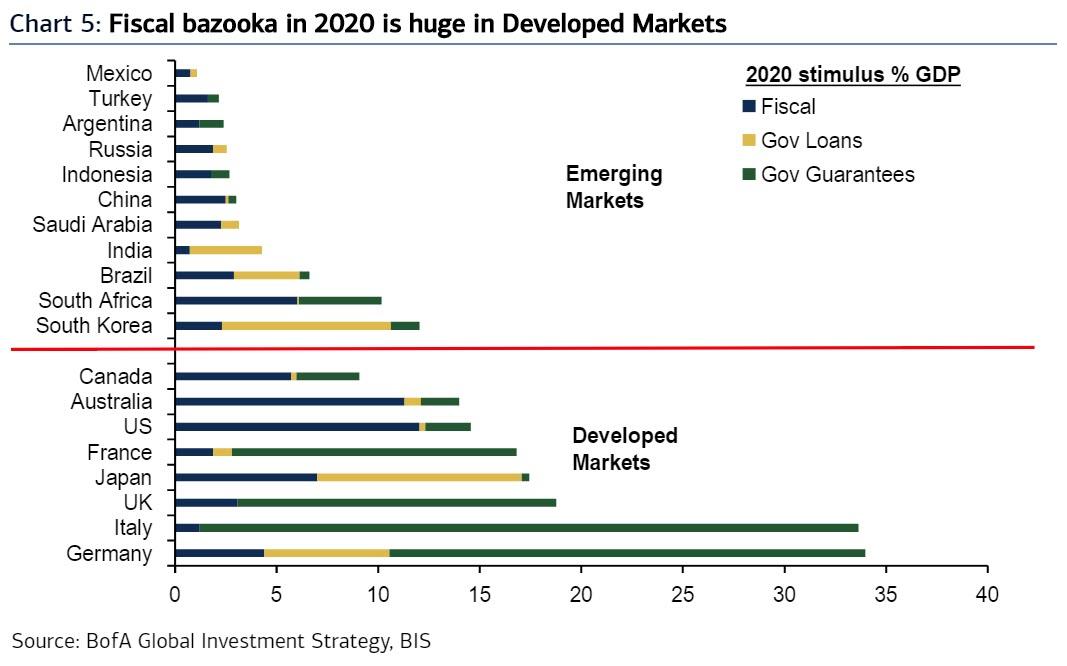
2. Fiscal: 2020 policy stimulus has been massive ($18.5tn of which $10.5tn in fiscal & $8.0tn in monetary = 21% global GDP) (Chart 5) and coordinated (1st time in years monetary & fiscal, like two wheels of a bicycle, moving quickly in same direction working together); banks the natural hedge for fiscal success (key barometer to watch = small business confidence surveys, e.g. NFIB) in stimulating animal spirits.

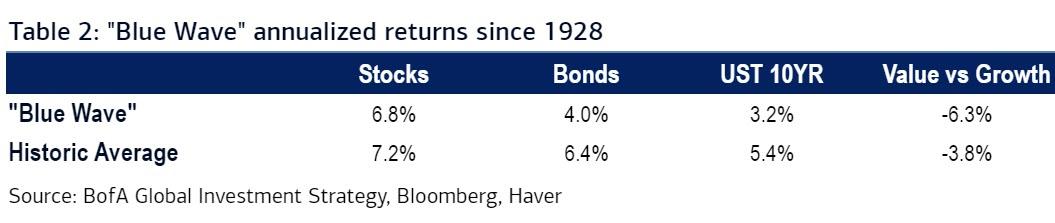
3. Politics: rising probability of political “blue wave” i.e. Democrats winning White House, Senate, Congress (latest Oddschecker.com probabilities…Biden win 57%, Real Clear Politics probability…Dem Senate 62%); Table 2 shows annualized returns following 7 out of 21 “blue waves” since 1928…returns, more obviously in bonds, below historic averages after Dem “clean sweep” but outperformance of value over growth more pronounced; “Blue Deal” fiscal stimulus in 2021 via infrastructure, student debt forgiveness, health care spending positive value & banks.

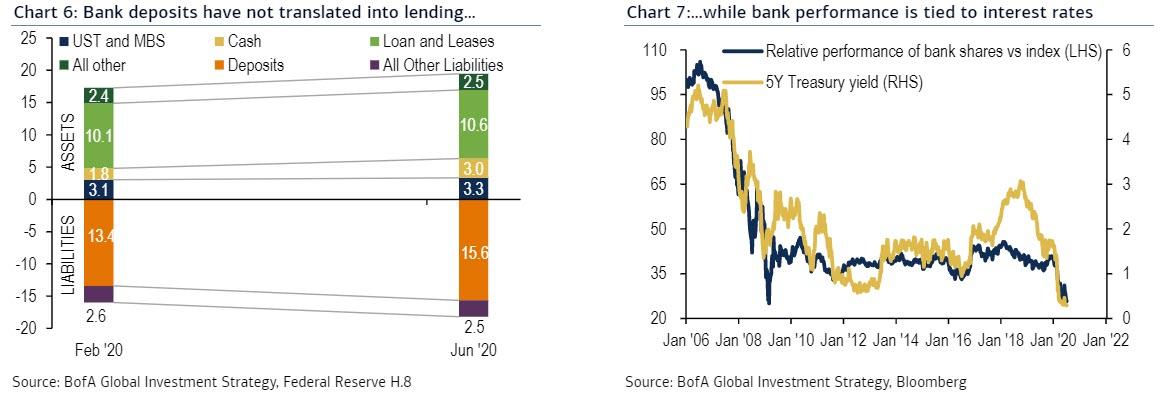
4. Risk-taking: bank deposits up $2.2tn since end-Feb but bank loans up only $0.5tn vs cash/reserves up $1.3tn and UST+MBS holdings up $0.3tn (Chart 6); bank stocks tied-at-the-hip to interest rates (Chart 7).

If and when Fed/ECB/BoJ can ever raise interest rates global banks will become the instant leadership; ironically introduction by Fed of Yield Curve Control in Sept may in typical contrarian fashion trigger a rally in banks; but the other irony is that sustained bank performance first requires risk-taking to boost economic growth & interest rate expectations in 2021 & 2022; until then bank stock bulls will focus on China (has led virus, market & macro recovery) & Europe (start of fiscal stimulus).

via ZeroHedge News https://ift.tt/324FDt3 Tyler Durden

Real-Time Data Shows That After Peaking In Late June, Consumer Spending Is Now Declining

Real-Time Data Shows That After Peaking In Late June, Consumer Spending Is Now Declining

Tyler Durden

Fri, 07/10/2020 – 14:49

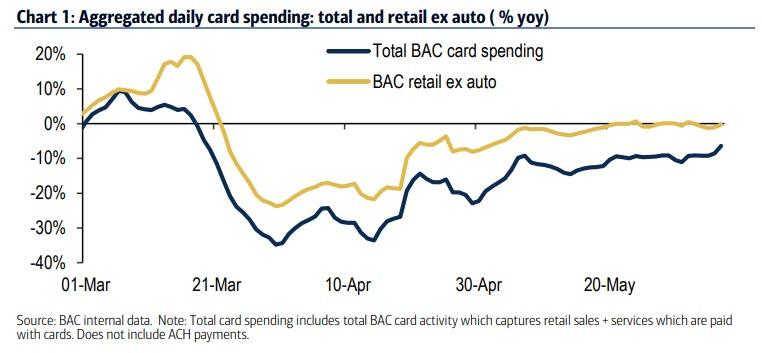
When we last looked at real-time consumer spending data one month ago, we saw a stunning rebound in Bank of America credit and debit card spending trends, with total card spending ex-autos essentially recovering pre-covid levels by early June.

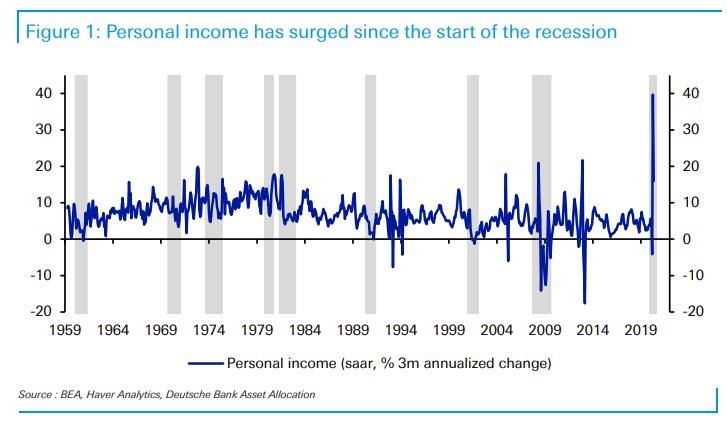
No doubt, a big part of this was due to the surge in Personal Income since the start of the current recession, which as we explained earlier was a function of the extremely generous fiscal stimulus which meant that on a per capita basis, claimants received roughly $788/week ($41k annualized) on average, well above the usual amount of roughly $300 in a normal labor environment ($15-$16k annualized).

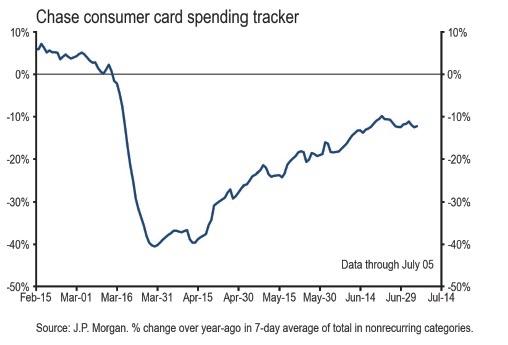
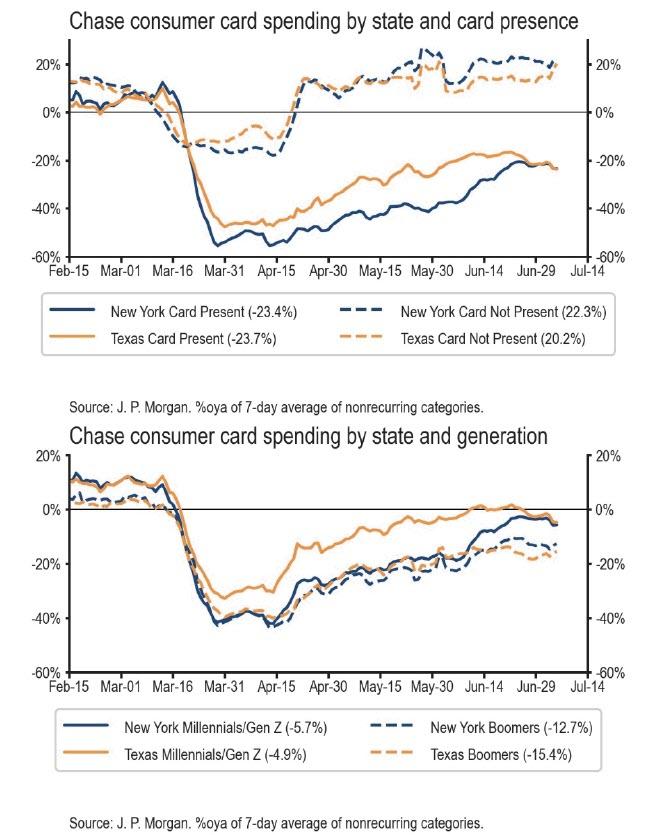
Unfortunately, both this massive government handout and this impressive spending spree are now is coming to an end, and as JPM writes, in data through Sunday, July 5, the bank’s tracker of spending by a panel of 30 million Chase credit and debit cardholders remains below its recent peak on June 22, and it appears to have flattened out at this lower level as COVID-19 spreads rapidly in some parts of the country.

What is notable, is that contrary to widespread anecdotes that sunbelt states have led the slowdown in spending, JPM notes that this modest pullback in nationwide spending has not been driven by a sharp pullback concentrated in states where the virus has spread rapidly, but instead by modest pullbacks that are widespread across states. On the other hand, this pattern raises the concern that behavior has not changed enough to stem the spread of the virus in the hardest-hit states.

To be sure, holidays like July 4 can make it difficult to distinguish signal from noise in high-frequency data, and some methods of calculating over-year-ago spending comparisons have naturally swung dramatically in recent days given the timing of the holiday. But even when looking through these swings, spending has begun to flatten out at a somewhat lower level than the peak seen on June 22.

JPM also points out that the pullback in spending since late June has been widespread across states. There is some correlation between the spread of the virus over the last two weeks and the pullback in spending, but the correlation has been modest so far. This pattern suggests that there are some cautious consumers in all states who have pulled back on spending as the virus has resumed its spread, but that the rapid spread of the virus in certain states has not produced a significant change in behavior by the entire population in these states.

To be fair, there are somewhat larger recent declines in spending in buckets likely to be most affected by the spread of the virus. For example, “card-present” (essentially in-person) spending has fallen more in Texas than in New York, and spending by Texas millennials—which had returned to year-ago levels by mid-June— has fallen more than by New York millennials. Still, the bank’s economists are most struck by the relatively small differences in changes in behavior across these groups in recent weeks.

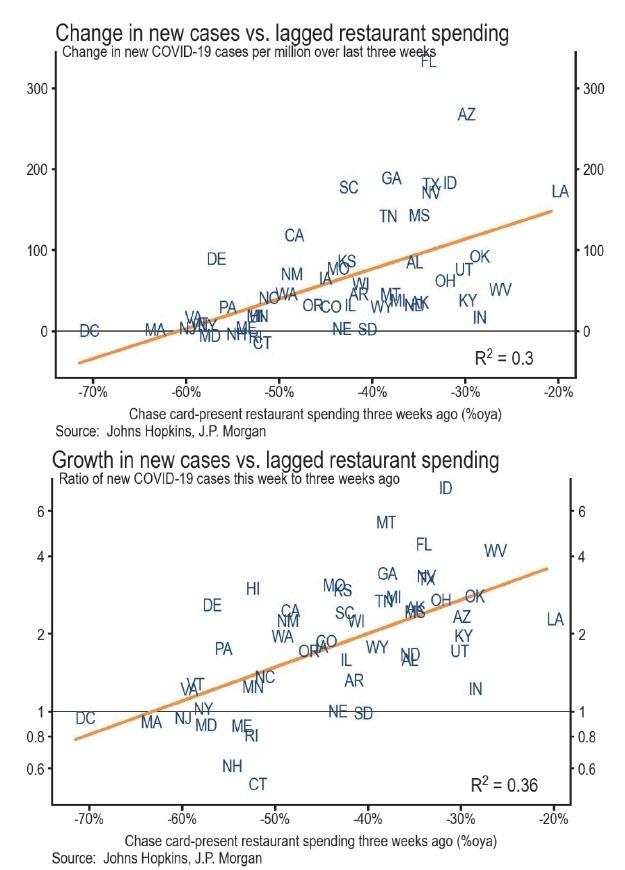
Meanwhile, and as we first pointed out last week, JPM has observed a correlation between spending levels and the subsequent spread of the virus three weeks ago, and it has remained strong over the last three weeks. Indeed, to date the bank finds that states with higher levels of spending—especially card-present restaurant spending—have seen more rapid growth of the virus in subsequent weeks.

To summarize, JPM has documented two important facts about the interaction between spending and the spread of the virus—higher spending levels have predicted the spread of the virus, but spending levels have not fallen much in the states where the virus has spread most rapidly recently.  These two facts raise the concern that behavior in the hardest-hit states has not changed enough to stem the spread of the virus going forward.

Still, it is possible that other behavioral changes that we cannot measure could stop the spread. As one example, it is possible that the relationship between restaurant spending and virus spread is just a correlation, and that it could possibly be driven by other behaviors like going to bars or parties which are correlated with restaurant spending. With bars now closed again in Texas, Florida, and southern California, it is possible that the spread of the virus will slow even as restaurant spending remains high. But the facts shown in JPM data do not present much reason for optimism.

via ZeroHedge News https://ift.tt/301fjO9 Tyler Durden