Bulls Regain The Narrative: “They Want To Believe”

Bulls Regain The Narrative: “They Want To Believe”

Authored by Lance Roberts via RealInvestmentAdvice.com,

Market Review & Update

Last week, we laid out 6-points about the market as the risk to the downside outweighed the potential reward. 

  1. Historically, September is one of the weakest months of the year, particularly when it follows a weak August.

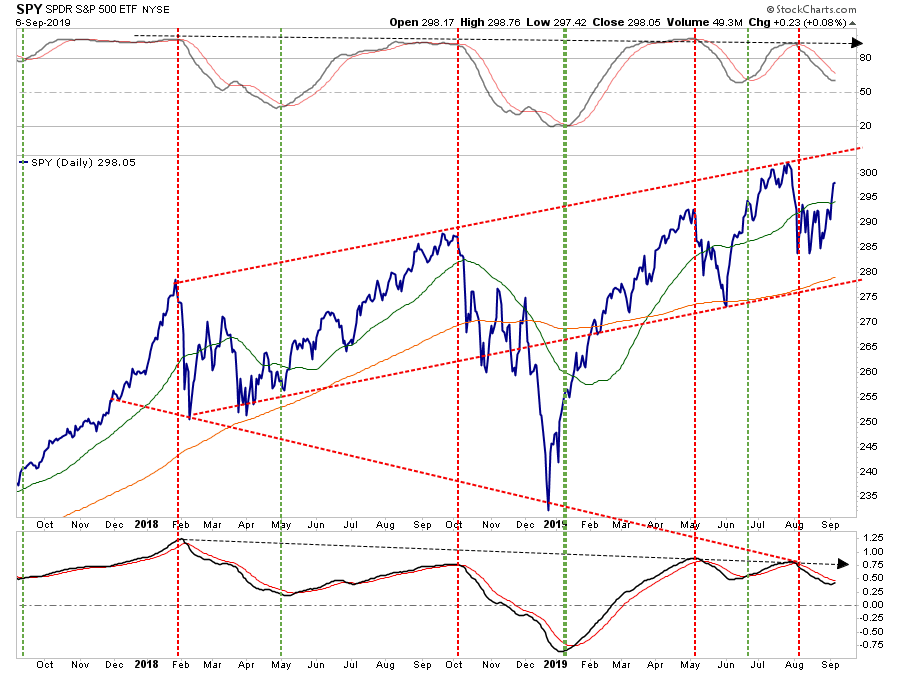
  2. The market remains range bound and failed at both the 50-dma and downtrend line on Friday

  3. The oversold condition has now reversed. (Top panel)

  4. Volatility is continuing to remain elevated.

  5. Important downside support moves up to 2875

  6. The bulls regain control of the narrative on a breakout above 2945. 
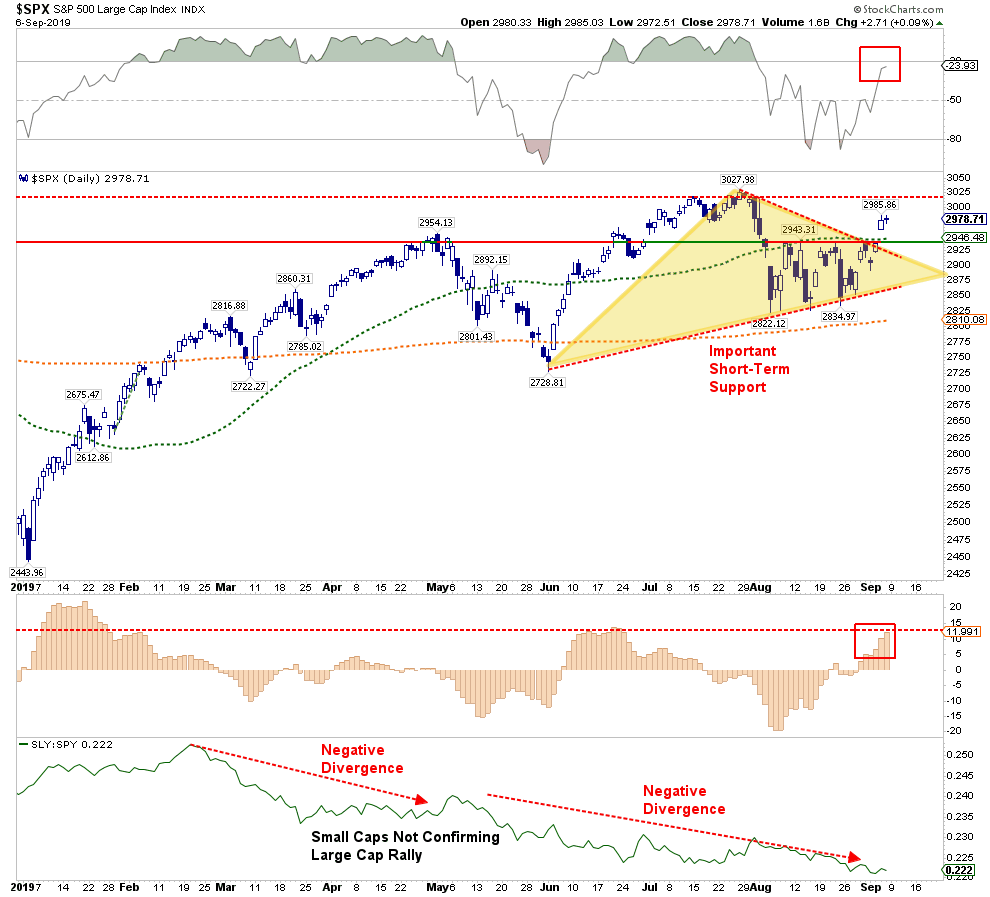
The chart above is updated through Friday’s close. As noted, the bulls did regain control of the narrative for now as the breakout above consolidation sets the market up to rally towards 3000 and the July highs. However, with the markets already pushing back into overbought conditions, in conjunction with an extended buy signal, there is not a lot of “upside” in the markets currently. 

As we have reiterated over the last several weeks, this continues to be an opportunity to reduce portfolio risk and raise cash levels.

I say this because it took a bevy of positive overtones to reverse the selloff early in the week. After a sloppy Monday and Tuesday, the rally started on Wednesday with numerous Fed speakers all suggesting the Fed was likely to move forward with cutting rates and increasing monetary accommodation. (H/T Zerohedge)

Williams (Dovish)“Ready to act as appropriate”, July cut was right move, economy mixed (admitted consumer spending not a leading indicator), international news matters, low inflation biggest problem.

Kaplan (Dovish): “Monetary policy a potent force”, worried about yield curve inversion, economy mixed (factories weak due to trade, consumer strong), watching for “psychological effects” on consumers, “if you wait for consumer weakness, it might be too late.”

Kashkari (Dovish): Tariffs, “trade war are really concerning business”, job market not overheating, slower global growth will impact US, most concerned about inverted yield curve. Fed’s policy is “moderately contractionary.”

Bullard/Bowman (Looked Dovish)Took part in “Fed Listens” conference but made no comment on policy but then again when has Jim Bullard ever not been dovish.

Beige Book (Mixed)Moderate expansion but trade fears are mounting, but optimism remains, despite what Kashkari says: “although concerns regarding tariffs and trade policy uncertainty continued, the majority of businesses remained optimistic about the near-term outlook”

Evans (Dovish)Trade policy increases uncertainty and immigration restrictions lower trend growth to 1.5%, Auto industry especially challenged
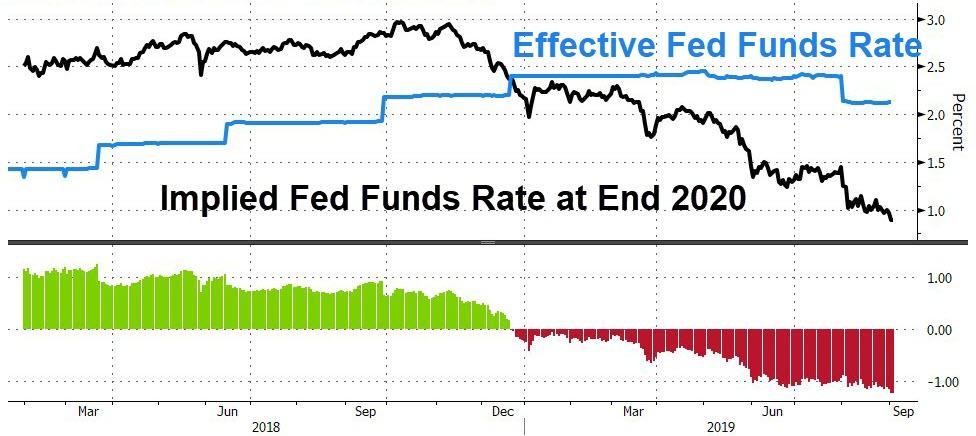
Furthermore, on Tuesday, we suggested it wouldn’t be long before the Trump Administration dropped an announcement for “trade deal negotiation.”

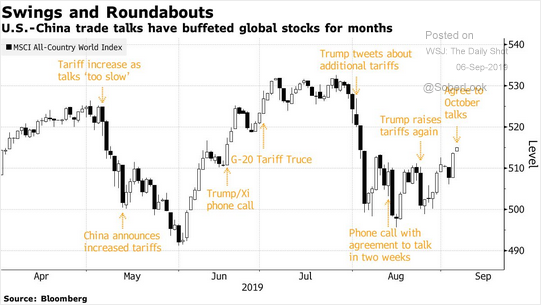
Of course, on Thursday, our wish was granted as the Administration announced that “trade talks” were back on for October. 

“China’s Ministry of Commerce said Thursday that the leaders of the U.S. and Chinese trade talks held a phone call in the morning and agreed to meet in early October for another round of negotiations. 

In a statement to CNBC, a U.S. Trade Representative spokesperson confirmed the phone call, but not the October meeting.

Beijing said the two sides agreed to hold another round of trade negotiations in Washington, D.C. — at the beginning of next month, and consultations will be made in mid-September in preparation for the meeting.”

While the markets once again rallied on the news, this is the same news we have repeatedly seen for the last 18-months. As @stockcats aptly noted:

The last few months has been this gyration of exuberance and disappointment as the market has lived from one “trade headline” to the next.
Then, of course, on Friday, Jerome Powell spoke suggesting there was “no recession” in sight but gave confidence to the markets the Fed would cut rates at the next meeting. To wit:

“As we move forward, we’re going to continue to watch all of these factors, and all the geopolitical things that are happening, and we’re going to continue to act as appropriate to sustain this expansion.”

This was all enough to spark investor’s “animal spirits” and force a rotation from “defense” back to “offense.” This is an outcome we discussed with our RIAPRO subscribers last week specifically as it related to adding to our Gold positions. To wit: (Chart updated through Friday)
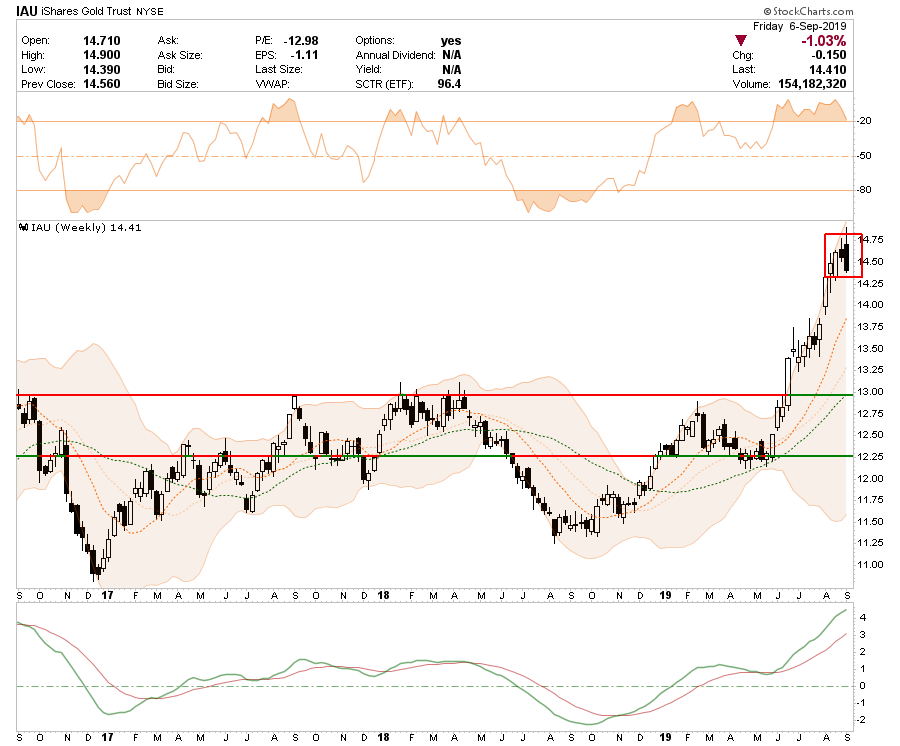
  • Both GDX and IAU look identical.
  • A near-vertical spike has taken these holdings to extreme overbought and extended conditions.
  • We need a decent pullback, or consolidation, to add to holdings at this juncture. A rally in the market should give us that opportunity as it will pull Gold and Rates back to support.
  • Looking for an entry point between $14-14.25 to add to holdings.

On Thursday, rates and gold both pulled back as the equity rally accelerated above the breakout level. This pulled the algo’s out of defensive holdings and back into equities confirming the breakout short-term. 

The next major hurdle is going to be the 3000-level initially, but our bullish target for 2019 could be challenged which resides at the top of the trend channel.
That is assuming that nothing disrupts the current bullish narrative. 

But, there are many issues from failed trade talks, to earnings, to economic disappointment which could do just that. 

This is why, despite the bullish overtone, we continue to hold an overweight position in cash (see 8-Reasons), have taken steps to improve the credit-quality in our bond portfolios, and shifted our equity portfolios to more defensive positioning. 

We did modestly add to our equity holdings with the breakout on Thursday from a trading perspective. However, we still maintain an overall defensive bias which continues to allow us to navigate market uncertainty until a better risk/reward opportunity presents itself.

The Last Hoorah?

September 11, 2018, I wrote “3000 or Bust” and almost precisely one-year later we are finally, for the second time, approaching that level. 

Here is the problem.

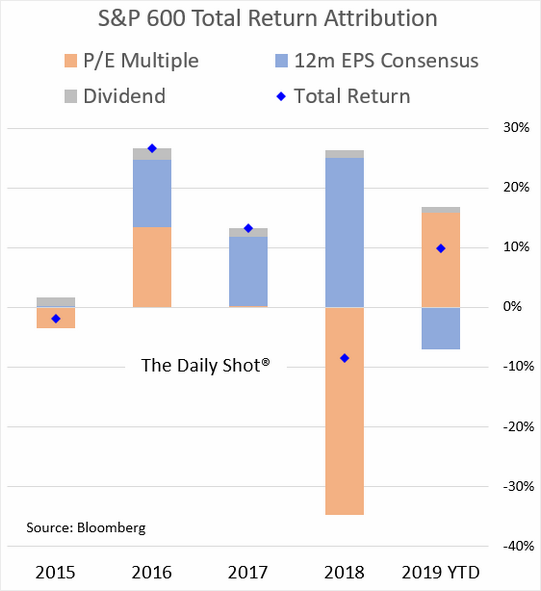
The rally has been driven almost entirely by multiple expansion rather than improving fundamentals. This was a point made in last Tuesday’s missive:

“Investing is ultimately about buying assets at a discounted price and selling them for a premium. However, so far in 2019, while asset prices have soared higher on ‘optimism,’ earnings and profits have deteriorated markedly. This is shown in the attribution chart below for the S&P 500.

In 2019, the bulk of the increase in asset prices is directly attributable to investors ‘paying more’ for earnings, even though they are ‘getting less’ in return.”

The discrepancy is even larger in small-capitalization stocks which don’t benefit from things like “share repurchases” and “repatriation.” 
Just remember, at the end of the day, valuations do matter. 

Here is another way to look at the data. Since the beginning of 2018, to support the bullish meme that companies are “beating expectations,” those expectations have been, and continue to be, dramatically lowered. 

This is particularly important given that “operating earnings” (which are fantasy earnings before any of the “bad sh**,”) are extremely elevated above reported profits.

Of course, this all shows up in how much investors are currently “over-paying” for equity ownership.
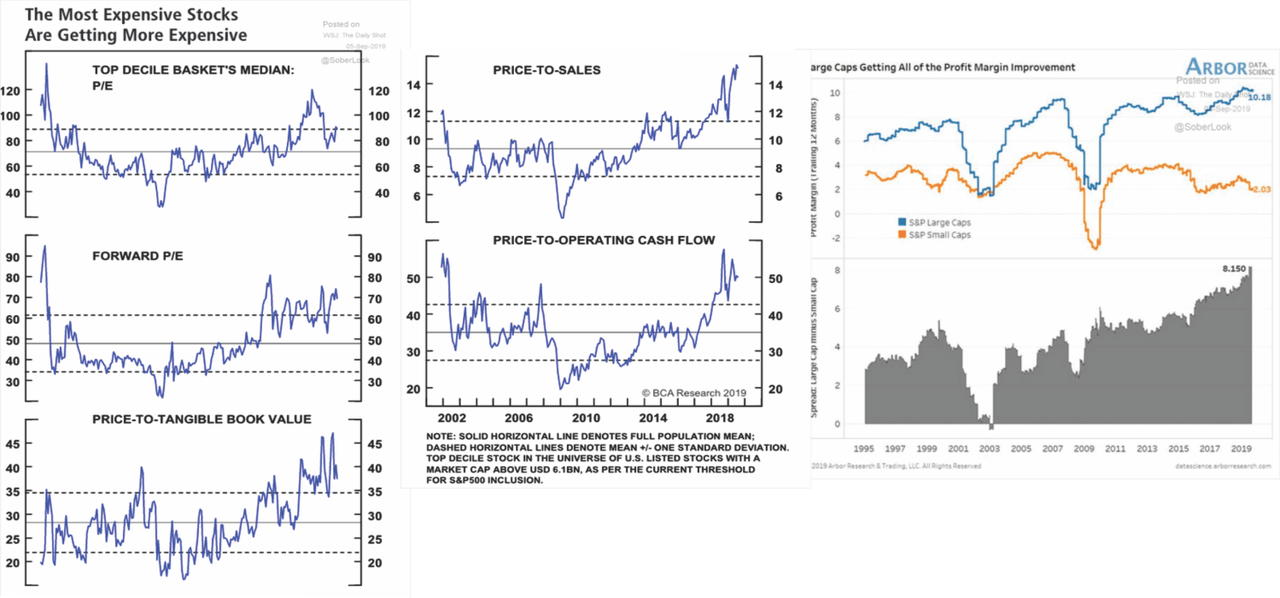
As is always the case, investors forget during their momentary bout of exuberance, that valuations are all that matter over the long-term. The greater that over-valuation, the great the reversion to mean will ultimately be. 

But Lance, the markets just keep going up because Central Banks have it all under control.” 

I know it certainly seems that way currently. However, this is a market driven by “financial engineering”rather than fundamental measures. As noted previously, stock buybacks have continued to be a major support for asset prices since the financial crisis accounting for the bulk of the advance in the S&P 500. 
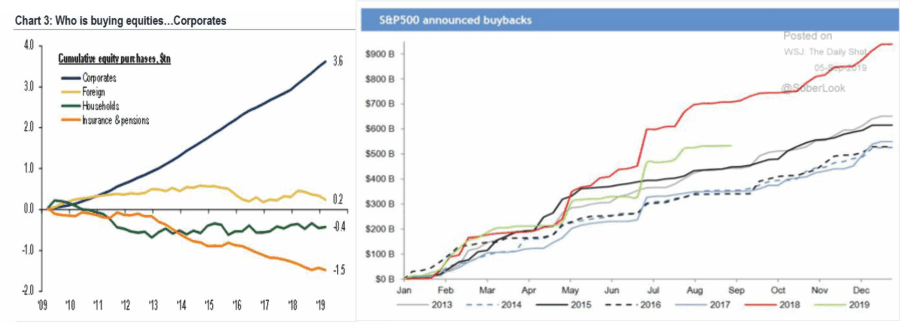
Not surprisingly, as rates of buybacks have slowed, so has the advance of the market. However, they have remained strong enough to offset the effects of negative economic news and trade wars. 

At least, so far. 

Importantly, as the benefit of “repatriation” from the tax reform legislation fades, it has been the rush to the corporate debt market to leverage up balance sheets to facilitate those repurchases. 

“On Wednesday new investment-grade issuance accelerated even more, rising to $28.8bn across 15 deals today, bringing the total for the two days of the week to a whopping $54.3 billion, as refinancing trades continued to dominate with $21.1bn of today’s issuance partially towards commercial paper, credit revolver, term loan, short and long-term debt repayments, according to BofA’s Hans Mikkelsen.” – Via Zerohedge
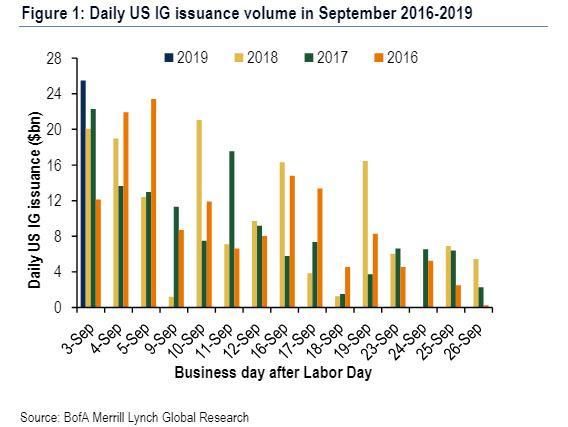
So, what was the reason for the rush to gobble up more debt at lower costs?

To refinance existing debt at lower rates for longer maturities, and, as Apple noted with their $5 Billion offering, to repurchase shares and issue dividends. 

At the same time, due to excessive confidence and complacency in the financial markets, investors are willing to take substantial credit risk without getting paid for it. Such previous periods of exuberance have also always ended badly.
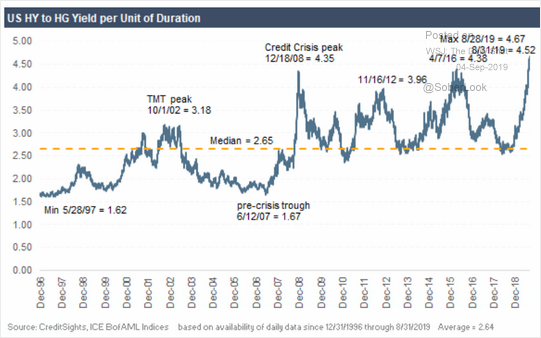
With corporate debt to GDP levels now at record levels, it is only a function of time until something breaks.
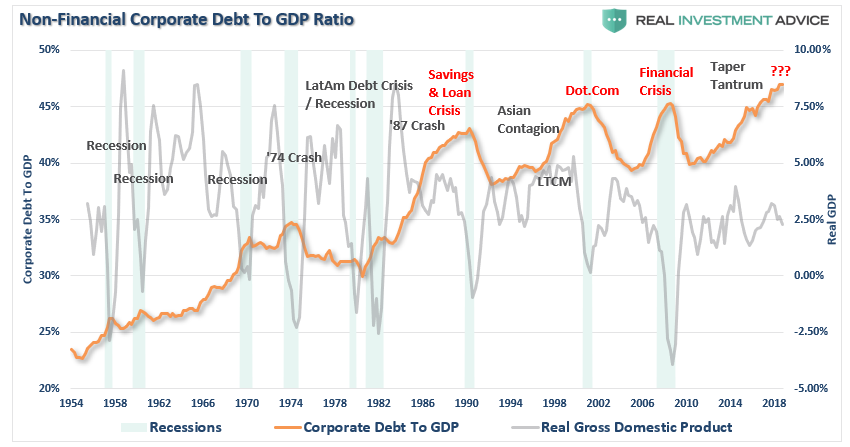
All this brings to mind a note from my friend Doug Kass this past week that summed up well what investors are currently doing.

They Want To Believe

“Price has a way of changing sentiment.” – The Divine Ms M

“It is remarkable to me that the many that hated stocks a large percentage ago (when some of us were buying in the face of a more favorable reward vs. risk) are now bullish and buying.

Investors and traders seem to want to believe.

  • They want to believe that the trade talks between the U.S. and China will be real this time.

  • They want to believe that there is no “earnings recession” even though S&P profits through the first half of 2019 are slightly negative (year over year) and that S&P EPS estimates have been regularly reduced as the year has progressed. (see above)

  • They want to believe that stocks are cheap relative to bonds even though there is little natural price discovery as central banks are artificially impacting global credit markets and passive investing is artificially buoying equities.

  • They want to believe that technicals and price are truth – even though the markets materially influenced by risk parity and other products and strategies that exaggerates daily and weekly price moves.

  • They want to believe that today’s economic data is an “all clear” – forgetting the weak ISM of a few days ago, the lackluster auto and housing markets, the U.S. manufacturing recession and the continued overseas economic weakness.

  • They want to believe that, given no U.S. corporate profit growth, that valuations can continue to expand (after rising by more than three PEs year to date).

  • They want to believe though that the EU broadly has negative interest rates and Germany is approaching recession (while the peripheral countries are in recession) – that the Fed will be able to catalyze domestic economic growth through more rate cuts.

  • They want to believe that the U.S. can be an oasis of growth even though the economic world is increasingly flat and interconnected and the S&P is nearly 50% dependent on non U.S. economies.

I don’t know with certainty where the markets will be three or six months from today.

But I do know that, given the recent rise in the stock market, the reward vs. risk is vastly diminished and less favorable compared to other opportunities that existed since December, 2018.”

When it comes to investing, believing in “fairy tales” and “We Work” uhm, I mean, “unicorns” has repeatedly led to terrible outcomes. 

The data continues to deteriorate as the late-stage economic cycle advances.

This is as it should be as we move into a late-stage economy.

It is not a bad thing; it is just part of a healthy cycle. It is when entities take action to “extend” the cycle beyond norms, and into extremes, which leads to extremely poor outcomes. 

While none of this means the markets will crash tomorrow, next month, or even next year, it also doesn’t mean that it can’t, or won’t. 

Complacency is an investor’s worst enemy.


Tyler Durden

Sun, 09/08/2019 – 10:45

via ZeroHedge News https://ift.tt/34twg54 Tyler Durden
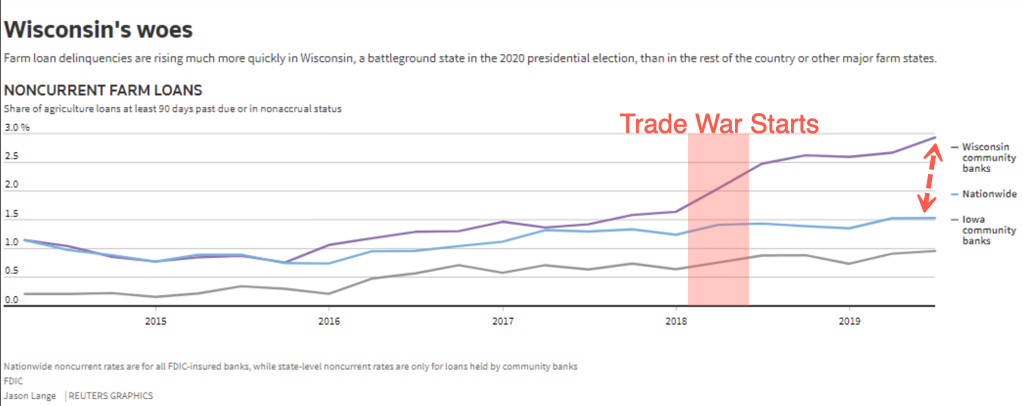
Wisconsin Farm Loan Delinquencies Jump To Levels Not Seen Since 2001 

Wisconsin Farm Loan Delinquencies Jump To Levels Not Seen Since 2001 

The Federal Deposit Insurance Corporation (FDIC) warned Thursday that farmers across the Central and Midwest US were quickly falling behind on agriculture loans held by community banks, according to Reuters.

In a quarterly report of loan delinquency data of US banks, published by the FDIC, there was no direct reference to President Trump’s trade war with China. But the report noted that credit deterioration in agriculture loans, specifically in Wisconsin, were alarming.

“We continue to monitor risks in the agriculture sector connected to low commodity prices and farm incomes,” the FDIC said in a statement.

The report showed the percentage of overdue farm loans rose to 2.9% at community banks across the state as of June 30, the highest rate since 2001.

The rate of delinquent farm loans nearly doubled in Wisconsin since President Trump took office and have accelerated since the trade war began early last year.

President Trump was the first Republican to win Wisconsin since Ronald Reagan in 1984, defeating Democrat Hillary Clinton in the 2016 election. His promise of “Making Farmers Great Again” and revitalizing manufacturing was why he won.

Wisconsinites might have a difficult time digesting the president’s message in 2020 because of the trade war’s damaging effects on the state’s agriculture complex. A farm crisis will likely materialize before the 2020 election.

New data on farm bailout payments through mid-May showed Wisconsin farmers received the short end of the stick. Their payments in the first government bailout were the smallest than any other state. This pushed many farmers into bankruptcies as incomes collapsed, some resorted to more leverage earlier this year, with hopes that the trade war would be resolved by late summer. As of September, there’s no end in sight, despite the meeting next month – but even then, a no-deal scenario will likely play out as the Chinese will wait until after the 2020 election to make a deal. To make matters worse, China has halted all purchases of agriculture products from the US, which has dramatically affected Wisconsin farmers and could lead to a jump in the rate of delinquent farm loans in 2020.

The farm crisis in the state could radiate outwards and trigger layoffs — that is because one in nine jobs are tied to the state’s $88 billion agriculture industry.

And with incomes collapsing and bankruptcies mounting, some farmers in Wisconsin are resorting to suicide.


Tyler Durden

Sun, 09/08/2019 – 10:18

via ZeroHedge News https://ift.tt/2ZWV3iJ Tyler Durden

A Brexit Trap? BoJo’s Nine Options

A Brexit Trap? BoJo’s Nine Options

Authored by Mike Shedlock via MishTalk,

Nearly every Brexit headline in recent tout the mistakes of Boris Johnson and how he now trapped into stopping no deal.

I strongly disagree with that synopsis.

Johnson has a number of options at his disposal, some of them truly bizarre. It’s the bizarre ones that have gathered the most attention.

Let’s discuss all of Johnson’s options along with Remainer options to circumvent them.

First let’s discuss the Benn Bill and how it allegedly ties Boris Johnson’s hands. That link shows the actual bill in Tweet form.

Benn’s Own Synopsis

What Benn Says his bill does is easier to understand.

The politician said:“The purpose of the Bill is to ensure that the UK does not leave the European Union on the 31 October without an agreement, unless Parliament consents.

“The Bill gives the Government time either to reach a new agreement with the European Union at the European Council meeting next month or to seek Parliament’s specific consent to leave the EU without a deal.

“If neither of these two conditions have been met, however, by 19th October – ie the day after the European Council meeting concludes – then the Prime Minister must send a letter to the president of the European Council requesting an Article 50 extension until 31 January 2020.”

Mr Benn added: “If the European Council agrees to an extension to the 31 January 2020, then the Prime Minister must immediately accept that extension.

“If the European Council proposes an extension to a different date then the Prime Minister must accept that extension within two days, unless the House of Commons rejects it.”

Date Discussion

The October 19 is a Saturday. Perhaps Commons agrees to meet Sunday the 20th.

If not, October 21.

Either way, the date is well within the 14-day window in which Parliament’s hands may be tied.

14 days pertains to the timeframe and options given to a prime minister losing a motion of no confidence.

Benn Bill is Illegal – Challenge on Monday?

The Benn Bill passed the House of Lords on Thursday and a Legal Challenge May Come Monday.

The bill is clearly illegal. I discussed the legal reasons above, in detail

In short, the Bill is illegal because it strips the government of its legal rights to conduct international negotiations.

The Bill passed the House of Commons because Speaker John Bercow ruled the Bill did not require “Queen’s Consent”.

Undoubtedly, the Bill does require Queen’s consent.

Thus, Johnson may pursue a legal challenge. But when?

Weird Turn of Events

On Thursday, September 5, I reported Another Weird Brexit Turn.

Out of the blue, after filibustering for hours, the government Whips not only halted their own filibuster but also instructed Tories to vote for the Benn Bill.

Johnson may have set a date trap.

“Never Request an Extension”

  • Boris Johnson has stated he will “never request an extension”.

  • He also stated “I’d rather be dead than ask for a delay”.

I suspect both statements are a lie especially the second.

Boris Johnson’s Nine Options

  1. Resign.

  2. Commit Suicide.

  3. Submit Legislation Requesting an Immediate Election.

  4. Hold a Motion of No Confidence Against Himself.

  5. Mount a Legal Challenge Against the Benn Bill.

  6. Allow Royal Assent but Refuse to Comply With the Law.

  7. Allow Royal Assent, Request an Extension but Somehow Block It

  8. Ask the Queen for a Delay to Study the Legality of Benn.

  9. Allow Royal Assent, Request an Extension

I believe that covers all the bases.

1-Resign: This is possible but only inside a 14-day window before the Brexit legal default day of October 31. However, it is extremely unlikely as it gives up all control.

2-Commit Suicide: No Realistic Chance.

3-Submit Legislation: No Chance. This would only require 50% of Parliament to agree. But any legislation Johnson submits would be amendable with likely dire consequences.

4-Hold a Motion of No Confidence Against Himself: This is possible but only inside a 14-day window before the Brexit legal default day of October 31.

5-Mount a Legal Challenge : A “Queen’s Consent” legal challenge is possible. But when? Note that “Queen’s Consent” and “Royal Assent” are not the same thing. For details and discussion, please see Legal Challenge May Come Monday.

6-Allow Royal Assent but Refuse to Comply: Under this scenario Johnson simply refuses to honor the Bill.

7-Allow Royal Assent, Request an Extension but Somehow Block It: Under this scenario Johnson provides “Royal Assent” and the bill become law. This is possible, and perhaps the most likely scenario as further discussed below.

8-Ask the Queen for a Delay to Study the Legality of Benn. The purpose of this move would be to kill time and add uncertainty. Johnson would have the leisure of going along on October 14 or perhaps then asking the Queen to let the courts decide.

9-Allow Royal Assent and Honor the Extension Request: No Chance

Five Primary Options

The primary options are 4-8. Option 4 would likely occur as a result of number 6. Option 8 would morph into something else, adding uncertainty.

Let’s discuss the five most likely options.

Discussion: 6-Allow Royal Assent but Refuse to Comply

Under this scenario Johnson allows the Benn Bill to become law. He could then perhaps make a legal after-the-fact claim that Commons violated procedure to get the law passed and thus passage of the law was illegal.

Option 5 (a legal challenge) within option 6 strikes me as odd because the law will already have passed. But perhaps Johnson could mount a claim he was illegally obliged to vote against the government and thus passage itself was illegal. Curiously, Johnson might select this path even knowing it is doomed, simply to buy needed time.

Alternatively, Johnson could refuse to comply then use that as the basis to file a motion of No Confidence against himself or resign. A motion of no confidence under these any refuse-to-comply scenario would surely pass. But it takes a day of debate and then a vote.

Resignation in a refuse-to-comply scenario would allow the opposition to immediately come up with an alternate candidate caretaker government. The caretaker would in turn immediately request an extension and perhaps do other damaging things. This is why I rule out resignation.

Assume the Commons outs Johnson. They vote for a caretaker government. The law is unclear as to what happens if Johnson refuses to resign.

Johnson’s options may be limited and circumvented but so might Parliamentary options once we get inside the 14-day window.

We do not know what other tricks or traps may be in place by either side.

Discussion: 4-Hold a Motion of No Confidence Against Himself

If Johnson selects this option, it would most likely be in conjunction with option 6 discussed above.

It’s possible, perhaps as a final act of desperation.

Discussion: 5-Mount a Legal Challenge Against the Benn Bill

This may happen Monday or after option 6 discussed above.

I strongly believe a legal challenge would win, but that could give Parliament a huge incentive to to oust Johnson sooner rather than later.

If Johnson does not mount a legal challenge on Monday, it will be on purpose, not because a challenge would lose.

Thus, Johnson may allow the bill to become law without challenge, knowing full well that it is illegal. I am unsure if that completely rules out a legal challenge later. Who really knows how the courts might decide?

Perhaps Johnson understands he could not realistically mount a legal challenge after the bill received Royal Assent, but goes ahead anyway. That tactic would kill some perhaps crucial days as the case proceeded through the courts, no doubt fast-tracked.

Issuing a legal challenge even at a late state is more likely than refusing to comply with the law without offering a reason.

Discussion: 7-Allow Royal Assent, Request an Extension but Somehow Block It

Sorting through the options, this could easily be Johnson’s best bet.

What might he do?

Get a commitment from France or Hungary to block the extension request. Yet, it’s risky because France and Hungary might lie.

Even if Johnson put in place a poison pill, the EU might all go along knowing full well that Parliament would then elect a caretaker government and pass emergency legislation.

Neither side one can be trusted here.

A trap may have been set for Johnson. But we do not know what other tricks may be up Johnson’s sleeve. There are potential traps both ways.

I have an idea but will not write it up here as I do not want it to be public. Instead, I will pass it on to Nigel Farage hoping he will listen.

Discussion: 8-Ask the Queen for a Delay to Study the Legality of Benn

A delay chews chews up time and adds uncertainty. Instead of asking the Queen to rule, Johnson asks for time.

Then on October 14, Johnson could grant assent, advise the Queen the bill is illegal, or ask the queen to allow the courts to decide.

Eventually, option 8 would morph into 4, 5, 6, or 7. It also kills a lot of time.

Who is the Trapee?

Parliament is suspended by order of the Queen from the end of the session on Monday, September 9 until October 14.

That suspension is iron-clad having already survived multiple court challenges.

Given the options discussed above, I caution against premature conclusions no matter what “apparently” happens on September 9.

Do not despair if Johnson fails to file a “Queen’s Consent” legal challenge. It will be for a reason.

This is a very complicated mess right now.


Tyler Durden

Sun, 09/08/2019 – 09:52

Tags

via ZeroHedge News https://ift.tt/34uCnpL Tyler Durden

Hundreds Of Russian Troops Deploy To Idlib In Case Ceasefire Collapses: Report

Hundreds Of Russian Troops Deploy To Idlib In Case Ceasefire Collapses: Report

Via AlmasdarNews.com,

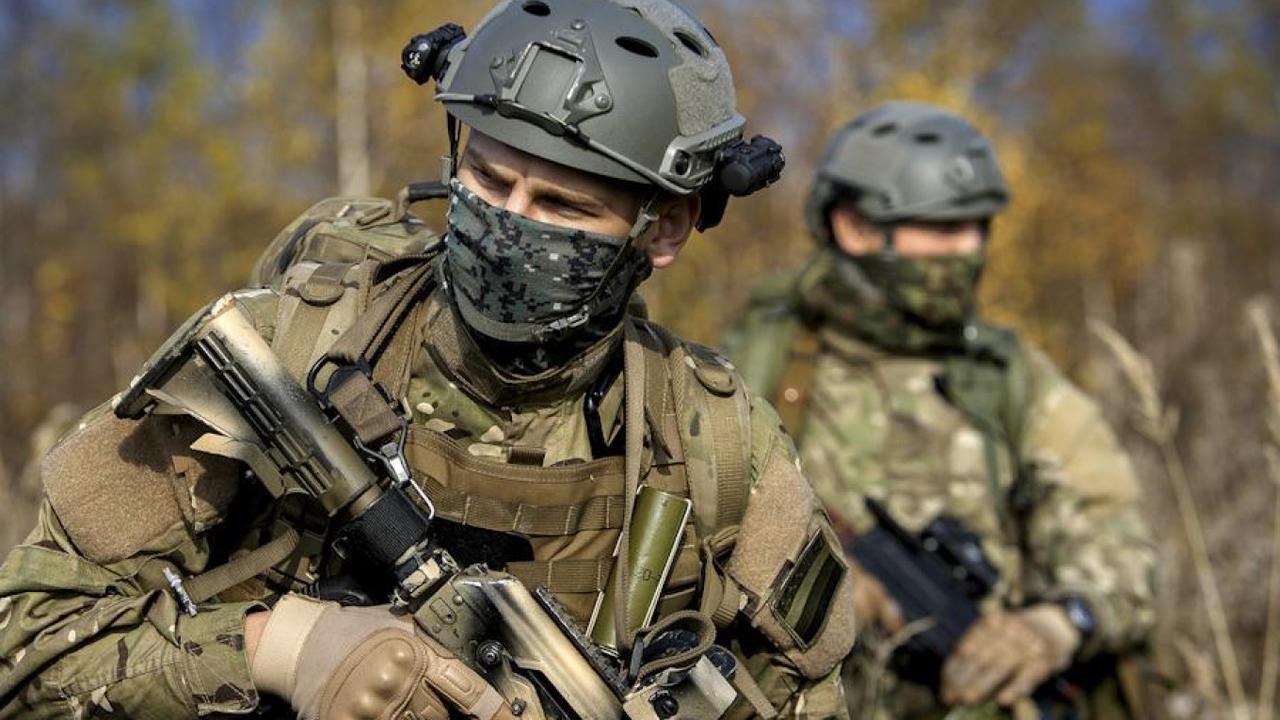
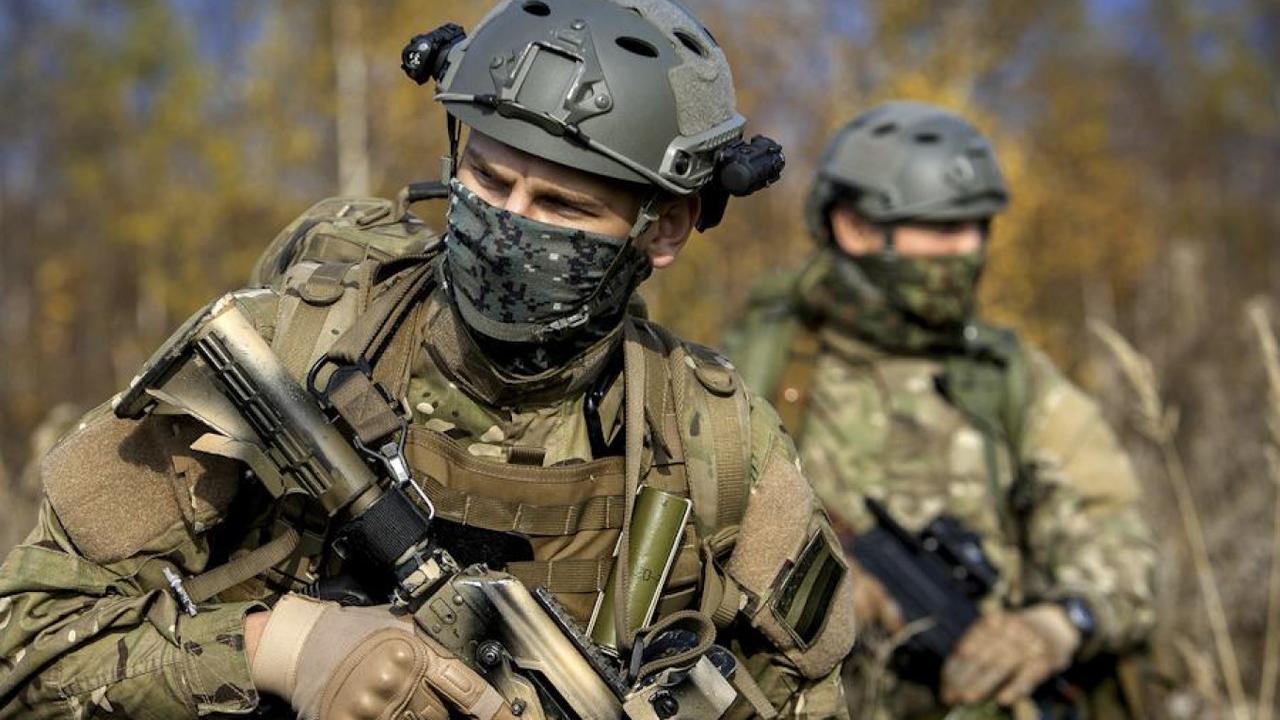
Hundreds of Russian troops are being sent to the Idlib Governorate in northern Syria, the Russian publication Lenta.Ru reported this weekend.

According to the publication, hundreds of Russian troops belonging to the Yevgeny Prigoshin private military contractors were deployed to the Idlib Governorate, despite a pause in offensive operations.

“The plan is for groups of 50 people each, with the support of Russian aviation, to take part in street battles necessary to clear the populated city from thousands of militants associated with Al-Qaeda (banned in Russia),” Lenta.Ru reported.

Russian special forces, via Defense Ministry/The Moscow Times

“Today, Idlib is being kept under control only by the presence in the region of hundreds of thousands of civilians. Having evacuated them, the military operation against the militants can be continued, and in a completely different way,” they added.

As of now, the Syrian Arab Army (SAA) has paused all offensive operations in the Idlib Governorate as they adhere to a ceasefire that was proposed by the Russian Armed Forces.

However, this new ceasefire in the Idlib Governorate is contingent on Turkey dissolving the jihadist group Hay’at Tahrir Al-Sham.

Alleged Russian contractors fighting in Syria as part of the “Slavonic Corps”. Via chartophylakeion.de/”War is Boring”

While the Syrian Army has paused their ground offensive, they have not let up their artillery strikes on Hay’at Tahrir Al-Sham’s positions in southern and western Idlib.

The Syrian Army is likely to resume their offensive if Hay’at Tahrir Al-Sham remains at the front-lines in the Idlib Governorate, as they have refused all previous ceasefire deals.


Tyler Durden

Sun, 09/08/2019 – 09:52

via ZeroHedge News https://ift.tt/2LyuAic Tyler Durden

Hong Kong Protesters Urge Trump To “Liberate” City In March On US Consulate

Hong Kong Protesters Urge Trump To “Liberate” City In March On US Consulate

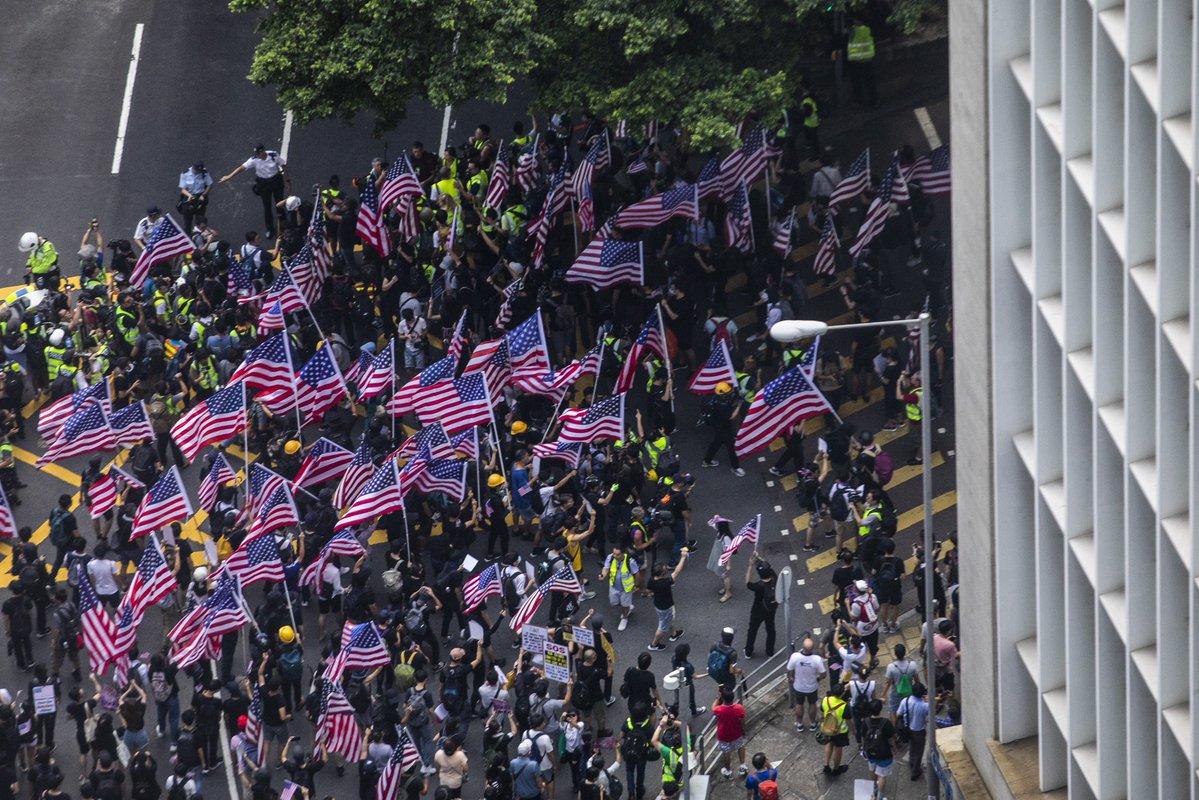
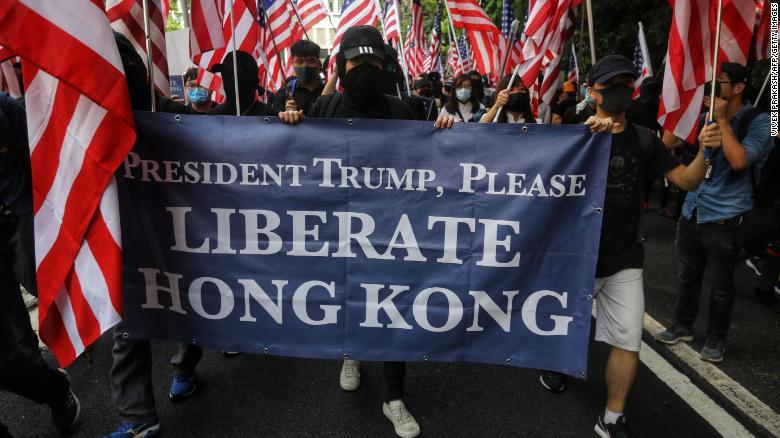
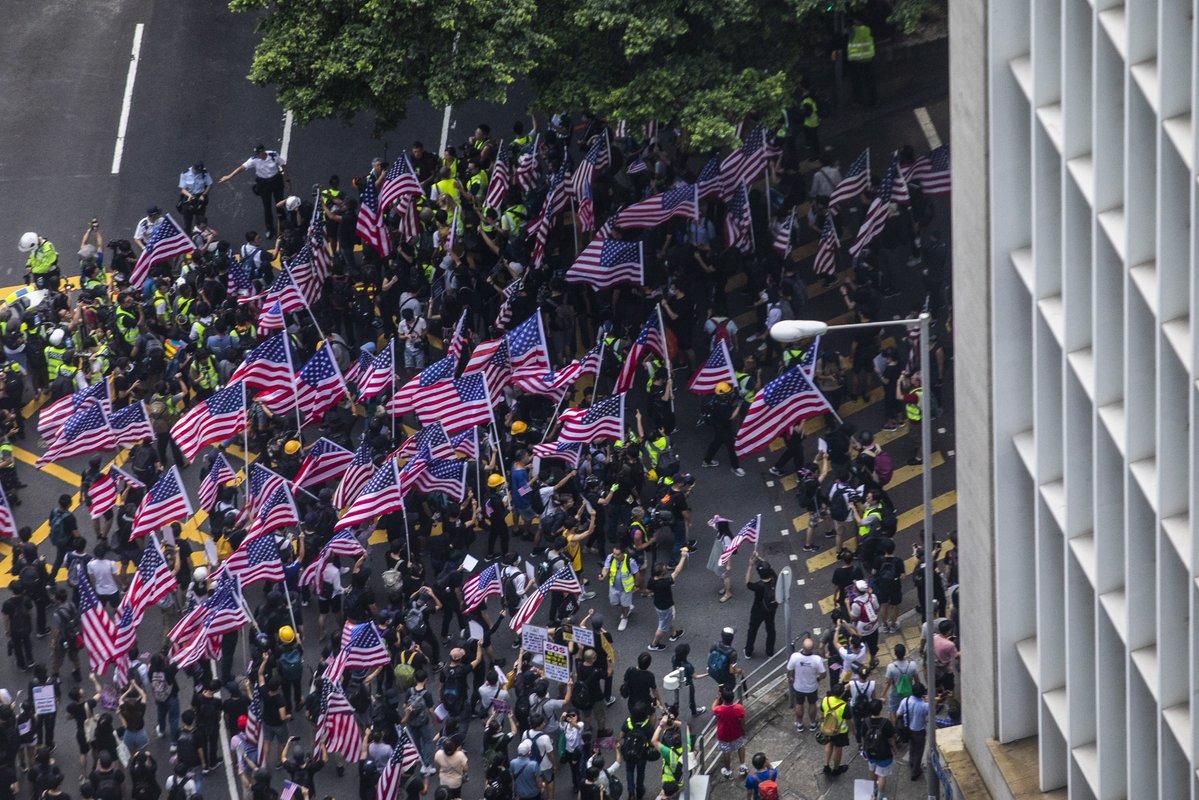
This certainly won’t help perceptions from the mainland after a summer that’s witnessed Beijing authorities repeatedly blame a US “hidden hand” for fueling the Hong Kong crisis: thousands of protesters Sunday were heard calling for President Trump to “liberate” the Chinese-controlled territory. Reuters reports the appeal for US intervention was made during a march in front of the US Consulate

Thousands of protesters earlier sang the Star Spangled Banner and called on U.S. President Donald Trump to “liberate” the city. They waved the Stars and Stripes and placards demanding democracy.

Sunday protests in Hong Kong near the US consulate. Image source: Getty/CNN

The demonstrators directly handed petitions to US consular officials reportedly while chanting “Fight for freedom, stand with Hong Kong,” and further others which said “Resist Beijing, liberate Hong Kong.”

The call for US “intervention” comes interestingly even after HK leader Carrie Lam publicly announced Wednesday she was formally withdrawing the controversial extradition bill, which sparked the protests earlier this summer in the first place. 

Sunday’s protesters called for the passing of the proposed “Hong Kong Human Rights and Democracy Act 2019” by US Congress and handed out flyers and petitions.

Reuters reported further that, “Protesters, in a petition handed to the U.S. Consulate, urged that it be passed in full.”

The proposed Act would require Washington each year to made a formal assessment of Hong Kong’s level of autonomy from Beijing and allow the US to take punitive trade measures if autonomy is compromised.

Sunday protest outside the US consulate, via AP.

Also interesting is that China a month ago formally complained to US diplomatic officials over viral photos showing a US official from HK consulate meeting with well-known anti-Beijing protest leaders and activists.

Mainland state media had featured the meeting and it was widely held up as ‘proof’ of the ‘black hand’ of US government involvement in the increasingly violent anti-Beijing demonstrations.

A common theme of mainland coverage of the protests have been to blame US covert action for “fomenting unrest”

Bloomberg reported at the time China sent a clear and firm message to US diplomats that “China firmly opposes any contacts with them and urges U.S. to stop sending wrong signals to violent law breakers in Hong Kong.”

Sunday’s PR move to gain the greater attention of both Trump and the US Congress certainly won’t help in dissuading Beijing that there isn’t a US-HK conspiracy afoot. 


Tyler Durden

Sun, 09/08/2019 – 09:15

Tags

via ZeroHedge News https://ift.tt/2ZXE0sL Tyler Durden

Former Prosecutor Says BoJo Could Wind Up In Prison If He Refuses Brexit Delay

Former Prosecutor Says BoJo Could Wind Up In Prison If He Refuses Brexit Delay

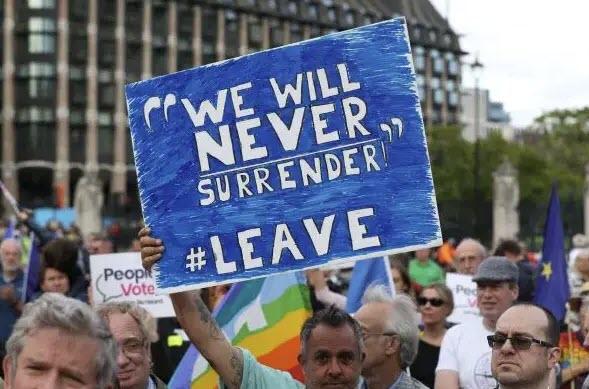
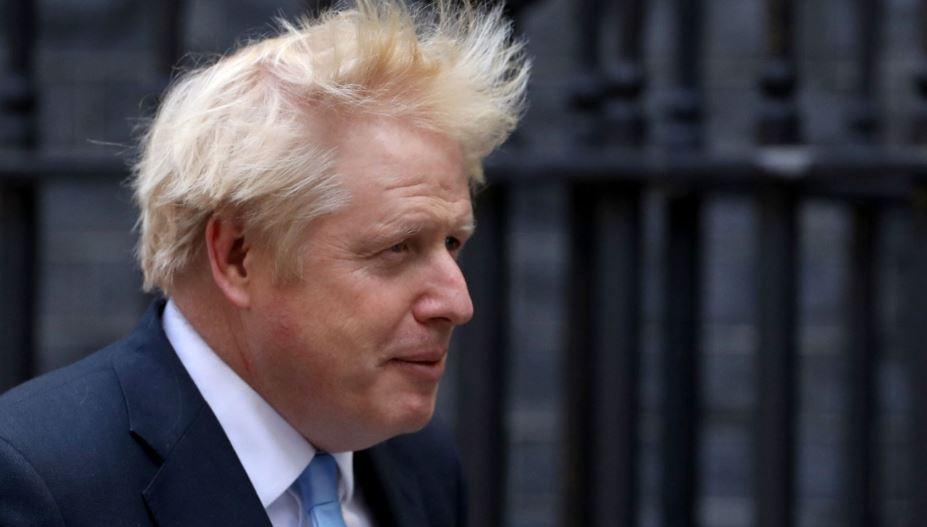
After a cross-party “rebel alliance” of opposition MPs and pro-remain Tories passed a law that will require PM Boris Johnson to ask the EU27 to once again delay Article 50 – this time until Jan. 31 – unless he can bring home a new withdrawal agreement by Oct. 19, Johnson made clear that he has no intention of asking Brussels for another extension.

In remarks earlier this week, Johnson said he would rather die than remain in the EU after Oct. 31.

But with the hysteria surrounding the UK’s seemingly never-ending Brexit negotiations once again on the rise, a former director of public prosecutions has told Sky News that Boris Johnson could go to prison if he refuses to delay Brexit in the face of court action or parliament passing the law.

Lord MacDonald, who held the senior prosecutor post between 2003 and 2008, said in this case, legal action would mean a court ordering that the law should be followed.

“A refusal in the face of that would amount to contempt of court which could find that person in prison,” he said.

The cross-bench peer said this was “not an extreme outcome” as it was “convention” that individuals who refuse to “purge their contempt” are sent to prison.

Then again, since the prospect of throwing a prime minister in prison doesn’t really bode well for social cohesion, it’s also possible that the government could authorize another figure to ask for the delay.

It’s also possible that Johnson has come up with a workaround of his own.

MacDonald added that Johnson and his senior advisor Dominic Cummings might have found a way to to have to delay Brexit, saying “I expect they have some ideas that they’re working on.”

Meanwhile, Dominic Grieve, who was expelled from the Conservative Party for joining the rebel alliance to vote against the government, told Sky News that Johnson was acting like a “spoilt child having a tantrum,” and that if he refuses to obey the law, he should be “sent to prison for contempt.”

One former Supreme Court judge said if Johnson refused, the government would designate another official to handle the sign off on an extension in place of the PM.

If the prime minister still refused to comply, a judge could make an order demanding that a government official sign off the extension “in place of the prime minister”.

“He’s not going to be marched off to Pentonville Prison… it’s much less dramatic than all that,” he added.

The cross-party bill demanding a Brexit delay if no agreement is reached is expected to become law on Monday, when it’s expected to pass the House of Lords.


Tyler Durden

Sun, 09/08/2019 – 08:45

via ZeroHedge News https://ift.tt/34u7wtq Tyler Durden

Students Prevented From Attending UK School Because They Refuse To Wear “Gender Neutral” Uniforms

Students Prevented From Attending UK School Because They Refuse To Wear “Gender Neutral” Uniforms

Authored by Paul Joseph Watson via Summit News,

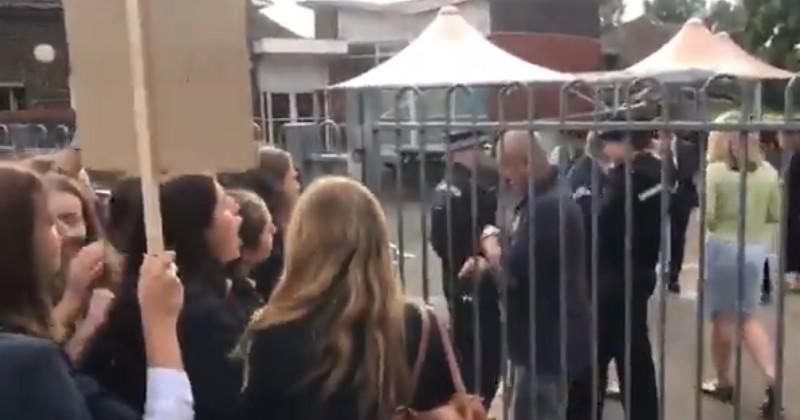
Female students at a school in the UK were prevented by officials and police from attending class because they refused to comply with a new “gender neutral” uniform policy.

Around 100 students protested outside the gates of Priory School in Lewes in response to a letter sent at the end of the summer advising they would be mandated to wear trousers at all times.

The school claimed that the policy change was put in place to “address inequality,” and be “inclusive,” but students and parents were outraged.

Students carrying signs that read “choice” were turned away at the gate, with police officers aiding school officials in the dispute.

“A gender neutral uniform would allow boys to wear skirts and girls to wear skirts and both to wear trousers,” said parent Sheila Cullen.

Others complained that they were being made to pay out over £100 for another uniform that would last just 9 months.

Maria Caulfield MP for Lewes asserted it was “ridiculous” to tells girls they couldn’t wear skirts.

“It is political correctness gone mad,” she said.

*  *  *

My voice is being silenced by free speech-hating Silicon Valley behemoths who want me disappeared forever. It is CRUCIAL that you support me. Please sign up for the free newsletter here. Donate to me on SubscribeStar here. Support my sponsor – Turbo Force – a supercharged boost of clean energy without the comedown.


Tyler Durden

Sun, 09/08/2019 – 08:10

Tags

via ZeroHedge News https://ift.tt/31bBAIs Tyler Durden

London Is Only The 6th Most-Surveilled City In The World

London Is Only The 6th Most-Surveilled City In The World

According to a study by research website Comparitech, eight out of the ten most surveilled cities in the world are in China, and as Statista’s Katharina Buchholz notes, the country that has been making headlines for its generous use of surveillance technology is featured heavily throughout the whole ranking that features 120 cities globally.

Central Chinese city Chongqing tops the list with 168 public CCTV cameras per 1,000 inhabitants.

Infographic: The Most Surveilled Cities in the World | Statista

You will find more infographics at Statista

The highest-ranked non-Chinese city is London, also notorious for its strict surveillance of public spaces, but at 68 cameras per 1,000 Londoners, the city is featuring far less CCTV cameras than its Chinese counterparts.

Atlanta is the highest-ranked U.S. city and comes in tenth with 15.6 cameras per 1,000 people.

CCTV technology is controversial in many places around the world, with proponents touting its benefits for fighting crime and opponents cautious about surveillance’s potential to be used as a tool of public control and to violate privacy rights. The makers of the survey said that they found no connection between lower crime rates or a heightened feeling of security and surveillance in the cities surveyed.


Tyler Durden

Sun, 09/08/2019 – 07:35

via ZeroHedge News https://ift.tt/2ZK1Fl8 Tyler Durden

The ECB’s Dangerous Deflation Obsession

The ECB’s Dangerous Deflation Obsession

Authored by Daniel Gros via Project Syndicate,

Central banks aim for price stability, and today, prices are largely stable across much of the developed world. Yet central bankers declare themselves unsatisfied. Some policymakers, most notably at the European Central Bank, are even preparing further stimulus measuresaimed at convincing financial markets of their resolve to fight deflation. But such policies overestimate the risk of falling prices.

For starters, prices are not falling now; they are just increasing more slowly than central bankers would like. In the eurozone, for example, core inflation (which excludes volatile energy and food prices) is running at about 1% per year, and markets expect it to remain at this level, on average, for the next decade.

The ECB regards such low inflation as totally unacceptable. It defines “price stability” not as stable – that is, unchanging – prices, but as year-on-year eurozone inflation of “below, but close to, 2% over the medium term.” Similarly, the United States Federal Reserve and the Bank of Japan have inflation targets of 2%.

Central banks are afraid of stable prices for two reasons.

The first is that the real value of debt automatically increases when prices fall. But fears of debt deflation seem overblown: because nominal interest rates are themselves close to zero, the real burden of debt would not increase even if prices remained stable. Moreover, the manageability of debt service depends mainly on whether incomes increase faster than the outstanding debt, not on whether the inflation rate exceeds the interest rate.

This is especially important for highly indebted governments (and households). But on that score, the picture is currently even more positive: nominal GDP growth in the eurozone remains around 3%, well above the interest rates on almost all member governments’ longer-term debt (the average refinancing cost across the eurozone is now close to zero).

As a result, eurozone governments are in a very comfortable position. Provided they run a primary budget balance of revenue and non-interest expenditure, their debt burden will slowly decline, relative to GDP. Households are also favorably placed: their incomes are growing by about 3%, while mortgage rates are heading toward zero. They can therefore just wait for their debt-service capacity to improve over time.

Central banks’ second reason for avoiding stable prices is that it might be difficult for prices to fall in absolute terms. In any economy, the relative prices of goods and services need to adjust in response to supply and demand shocks. So, for average prices to remain unchanged overall, some prices would still have to increase, and others would have to fall.

True, producers rarely face significant barriers to lowering the prices of most goods and services sold to consumers or other businesses. But firms generally find it much harder to reduce nominal wages to compensate for lower prices. It is better, therefore, for average wages to increase, so that those wages that need to fall do so in relative rather than absolute or nominal terms.

Yet the downward stickiness of wages is unlikely to become a concern anytime soon. Nominal wages are currently increasing by around 2.5% per year in the eurozone (and by over 3% in the US). These rates are among the highest this decade, which has been a period of strong employment growth overall.

Some may argue that average eurozone wage growth of 2.5% is not enough, and that the ECB’s expansionary monetary policy stance is thus justified. But the question remains: Should the ECB be preparing additional stimulus measures when the risk of harmful deflation is actually falling?

Moreover, downward wage stickiness can disappear, as the experience of Japan shows. In 2018, for example, Japanese wages increased by about 2%, the highest rate in over 20 years. But over the past 12 months, they have suddenly started to fall, even though labor-market conditions have not deteriorated. On the contrary: employment continues to increase and unemployment is still falling.

This is not the first time that wages have fallen in Japan, and previous episodes caused no noticeable problems. Some economists, in fact, have argued that downward wage flexibility does not seem to be a primary contributing factor to Japan’s prolonged deflation.

Central bankers today are thus facing a luxury problem: prices are increasing a bit more gently than they would like. Although inflation is below target, unemployment keeps falling to record lows, and debtors are happy. The need for occasional reductions in nominal wages seems remote in Europe and the US, and does not seem to cause trouble in Japan.

Given all this, it is hard to understand why the ECB in particular should be so anxious to find new ways to make its stance even more expansionary. Yes, economic activity has weakened over recent quarters, and survey-based indicators suggest that the global economy is poised for a slowdown. But as former US Secretary of the Treasury Lawrence H. Summers and Anna Stansbury have convincingly argued, by itself, further monetary-policy easing will do little to stimulate demand and drive inflation.

The ECB should tone down its rhetoric about the imminent risk of deflation and keep its course steady. Its hyper-vigilance about falling prices is misplaced, and its ability to increase the rate of inflation is dubious.


Tyler Durden

Sun, 09/08/2019 – 07:00

via ZeroHedge News https://ift.tt/34tbWki Tyler Durden

Hells Angels Meet Housewives on Harleys

On a rainy night in 1974, Charles Umbenhauer pulled his Yamaha motorcycle into the parking lot of a hotel in New Jersey so that he and his wife could wait out the storm before finishing their ride from his hometown of Harrisburg, Pennsylvania, to the Jersey shore. The front desk clerk would let them stay under one condition.

“If you push the motorcycle up the street there and it’s not in the parking lot, I’ll go ahead and rent you a room,” Umbenhauer recounted in 2008 to American Motorcyclist, the membership magazine of the American Motorcyclist Association (AMA).

The request stung Umbenhauer, who had served two years in the Army and considered himself an upstanding citizen. He and his wife, Carol, said no thanks. Instead they found a “really crappy” hotel that allowed them to keep their bike in the lot. A couple of years later, when a friend invited the couple to attend a new motorcycling group’s first rally for their rights at the Pennsylvania State Capitol, Charles and Carol hopped on the bike and went.

This was the ’70s, and bikers faced discrimination not just from fearful business owners but also from state and federal governments. A group called MAUL—Motorcyclists Against Unfair Legislation—wanted to broker a truce with lawmakers to oppose helmet laws and other restrictions. The coalition drew motorcyclists of all kinds. In particular, the wrong kind.

“We went to the rally, and I knew it wasn’t going to work,” Umbenhauer says. For starters, the group had shown up to the state legislature on a Sunday. “People were streaking, there were beer kegs, but there was no legislative session. I gave it a 10 on having a great time but a zero on doing something to benefit bikers.” The Associated Press reported the morning after that one motorcyclist rode around the rally naked “except for black socks” and that several riders had burned their helmets.

Umbenhauer voiced his concerns to other MAUL members, and they asked him to organize their next trip to the statehouse. His first act was to hold the event on a Monday. “I said we’re gonna do it when the legislature is in session, and someone said, ‘Half these people won’t come.’ And I said, ‘Good. We don’t need people drinking beer on the Capitol steps.'”

Over the next 40 years, Umbenhauer, now 74, and his fellow bikers organized, professionalized, and lobbied their way to legitimacy. But the victory has been bittersweet. Motorcyclists have more freedom than ever, but the gains they fought for are going to waste. Whether legitimacy has made motorcycling uncool or safety has simply become more of a priority, young people just aren’t becoming bikers. “My grandson,” Umbenhauer says, “doesn’t ride.”

Motorcycle interest groups are almost as old as motorcycles. Munich’s Hildebrand & Wolfmüller began mass-producing motorrads in 1894. During the next 10 years, engineers in the United Kingdom and the United States followed suit, launching such iconic motorcycle brands as Triumph, Indian Motorcycles, and Harley-Davidson. These new machines—not as big or as fast as cars, far more powerful than bicycles—drew fans and haters alike.

“The peculiar character of the motor bicycle has left its status open to various definitions, and as a result in many states…the laws applying to big motor cars are brought to bear on motorcycles with oppressive force,” reads a notice published in The New York Times on August 24, 1903. Authored by the leaders of the Alpha Motor Cycle Club and the New York Motor Cycle Club, the notice likely referred to the patchwork of road laws then governing gasoline-powered vehicles, which were considered a nuisance. Some cities required vehicles to have hand-operated noisemaking devices that drivers were supposed to honk and ring whenever they drew near pedestrians. Other cities weren’t sure whether to treat motorcycles like pedal-powered bicycles (which they closely resembled) or like cars.

New York riders wanted to protect themselves as cities and states figured out new rules for the era of gasoline. “One cannot freely pass from one state into another without fear of arrest because of such laws,” the notice continues. “To combat such measures, to insist that the highways are free to all alike, and that the right to use them is irrevocable, is one of the objects to be served by organization.” They would go on to name the new group the Federation of American Motorcyclists.

By 1910, motorcycles were coming into their own as a feature of daily American life. Motorcycle cops chased down baddies, adrenaline junkies broke speed records, and the U.S. military learned biker messengers were twice as fast as riders on horseback. After visiting the 1910 motorcycle trade show in Madison Square Garden, the Times‘ C.F. Wyckoff declared that these “little distance annihilators” had graduated from the “poor man’s automobile” to a “pleasure vehicle” and a “utility vehicle.”

Through the ’20s, ’30s, and ’40s, motorcycles made headlines for miraculous feats (“MOTORCYCLISTS ON WAY: Two Argentinians Reach Mexico City En Route to New York”), for upsetting the apple cart (“Town Hunts Motorcyclist; Broke 30-Year Sabbath Calm”), and for their role in daily life (“DOG TRAILS MOTORCYCLISTS; Hunts for Dead Owner, Killed in Crash”). Much ink was spilled on accidents, but the same was true for cars back then. All of which is to say that motorcycle culture was considered an anodyne subgenre of sporting and adventure.

That assessment began to change toward the end of World War II, when some American veterans started riding stateside for camaraderie and to escape the disorienting placidity of post-combat life. “Searching for relief from the residual effects of their wartime experiences, [veterans] started seeking out one another just to be around kindred spirits and perhaps relive some of the better, wilder social aspects of their times during the war,” William Dulaney wrote in a 2005 issue of the International Journal of Motorcycle Studies. Former American airmen even brought their wartime style to motorcycling: leather jackets to protect them from the elements, goggles to protect their vision.

The nonrider view of bikers changed permanently for the worse when the Pissed Off Bastards of Bloomington and the Booze Fighters Motorcycle Club showed up at a hill-climbing event in California hosted by the AMA in 1947. Other rowdies showed up as well, and together the interlopers supposedly shocked the small town of Hollister and their more straight-laced fellow riders by drinking to excess and brawling. At least, that’s how out-of-town media outlets portrayed the weekend. Aided by sensational coverage in the national media and The Wild One—Hollywood’s gussied-up retelling of the incident—the “Hollister riot” introduced Americans to a new type of biker.

It turned out to be a prelude to a full-on P.R. nightmare. In 1950, several members of the Pissed Off Bastards broke away to form a new group, which they named for the planes some of them had flown in the war. They called themselves Hells Angels.

After Hollister, the American Motorcyclist Association declared rowdy bikers personae non gratae and barred them from joining AMA chapters. The national press had dragged the organization into new and unfamiliar territory. Founded in 1924—a descendant of the Federation of American Motorcyclists, which folded during World War I—the AMA’s slogan at launch was “An organized minority can always defeat an unorganized majority.” The group spent most of its time organizing competitions and helping riders start local AMA clubs, similar to chapters. It also advocated for motorcyclists’ rights on the road. It was not prepared to take responsibility for supposedly traumatizing a small American town.

The troublemakers responded to their exclusion from the AMA by acting like an even smaller organized minority. They developed patches that mimicked those worn by AMA members, used military-style hierarchies to govern themselves, and set up clubs of their own. They took to calling themselves “one-percenters” and “outlaws,” labels apocryphally coined by the AMA itself in a statement after Hollister.

Newspapers still wrote light stories about speed records, but by the late 1960s, they were obsessed with the Hells Angels, Pagans, Warlocks, and Banditos. The Angels became arguably the most famous gang in America in 1965 when California Attorney General Thomas C. Lynch released a six-month study focused on the group’s activities in the state.

A new kind of headline began to appear in the same papers that had once celebrated the motorcycle: “Eight Are Arrested in the Torture of East Village Youth, 20, for Two Days”; “Hint of Summer Stirs Fears in Hells Angels’ Neighbors”; “California Takes Steps to Curb Terrorism of Ruffian Cyclists”; “New Hampshire Town Cleans Up After Quelling Cyclists Riot.”

Lawmakers and prosecutors went after the outlaw gangs, but that still left mainstream motorcyclists with the task of preserving their own reputation. The motorcycle industry and mainstream riders organized by the AMA collaborated to make a case for motorcycling as a wholesome American hobby, suitable for the whole family.

A magazine called Bike and Rider launched in 1971 with the motto “Motorcycle’s New Image.” An issue from August of that year features an ad discouraging bikers from cutting down their mufflers, a common practice that ratcheted up the decibel level of a motorcycle engine. “You see before you, death,” the ad copy reads. “You see, this rider kills. His instrument is noise, his weapon—a bike with muffler sawed away.” The ad, paid for by the Motorcycle Industry Council, concludes with the words “Noise kills.”

The very next page features an ad for the publication itself featuring a white man in a light-colored suit sitting side-saddle on a parked Honda. The copy reads, “The image portrayed by the new motorcycle enthusiast is no longer that of the outlaw, but that of the people: the dentist, the electrician, even the housewife.”

The motorcycle industry did its part as well. A Honda ad in a March 1973 issue of Sports Illustrated depicts a woman in corduroy pants atop a small-engine ST-90—the attitudinal antithesis of a big-engine Harley hog. She appears to be getting a riding lesson from her husband while her teenage children watch from the side. The ad copy: “At Honda, we want everyone to discover just how much fun motorcycling can be. Mom. Pop. Even the grandparents.” The family is standing in front of a suburban house with a green yard and a garage.

Speaking of Harley-Davidson: The company’s mass-market print ads from this era are not exactly family-friendly, but they’re not scandalous either. Spots featuring trim white men in stylish clothes, always wearing helmets when depicted in motion, conjure up Steve McQueen rather than Angels leader Sonny Barger or, well, a dentist. Harley sold craftsmanship, performance, and status to squares and the middle class. Bikers sold Harleys to each other in publications like Easyrider, the pioneering magazine by and for the bad boy set, which promised to publish “Entertainment for Adult Bikers.”

The AMA was helped on the P.R. front by its membership rolls. Issues of American Motorcyclist from the early 1970s featured a recurring column by Lois Gutzwiller called “Motor Maids,” featuring profiles of mild-mannered female AMA members. While the association began admitting people of color in the mid-1950s, the profile subjects are mostly middle-class white women with names like Norma and Mary Ann and Gerdi and Sue. The AMA’s entire October 1971 issue is dedicated to wholesome women riders. Mayra, a New Jersey librarian and grandmother, started riding after an introduction from her daughter; Jeanette, meanwhile, prefers being a passenger on her husband’s bike.

The public relations effort by motorcycling’s most upstanding citizens worked, at least a little bit. In between horrifying tales of biker gangs, The New York Times in 1971 found space for a story about the rise of white-collar motorcycle commuters. “The ‘cycle’ has grown in popularity in recent years for recreation and pleasure trips among some middle-class nonrebels,” the paper noted. “Motorcycle couriers delivering messages have been joined on the road by accountants, lawyers, stockbrokers, filmmakers, computer analysts, and letter carriers.”

Perhaps motorcycling would survive the Hells Angels. But winning the P.R. war wouldn’t matter if bikers couldn’t figure out how to win at politics as well. And by the end of the Summer of Love, it was clear to motorcycle groups that they were losing with legislators even if they were holding their own in the marketplace.

As the 1960s drew to a close, motorcycling groups and their members watched in frustration as the federal government made a small portion of highway funding contingent on states’ passing mandatory helmet and seat belt legislation. Pennsylvania’s 1968 helmet law was what drew Charles Umbenhauer to the statehouse in ’76. At the time, he didn’t like wearing a helmet and thought the choice should be left to individuals. In 1980, he joined ABATE—A Brotherhood Against Totalitarian Enactments, started by Easyriders magazine—to push for legislative changes. That’s when he saw how tough grassroots politics could be.

“We had to convince our members that ABATE needed to hire a lobbyist,” Umbenhauer says. “Then our first lobbyist told us we needed a political action committee. The bikers wanted to know why we needed a PAC, and the lobbyist said, ‘There’s only two things you can do for a legislator. You can vote for them, and you can give them money.’ The bikers were furious.”

Biker rage at the pay-for-play nature of politics makes sense. These men and women, many of whom had served in Vietnam, just wanted to choose whether or not to wear helmets. Hadn’t they and their loved ones paid enough for that right?

As it turns out, hiring a lobbyist and starting a PAC couldn’t get Pennsylvania motorcyclists what they wanted overnight. The state’s ABATE chapter reorganized in 1983 as the more mild-mannered Alliance of Bikers Aimed Toward Education, but it didn’t succeed at reforming Pennsylvania’s mandatory helmet law until 2003. Getting it done required Congress to drop the highway funding threat, and it required bikers to synthesize the P.R. efforts of the late ’60s and early ’70s with a keen understanding of state politics.

ABATE did more to improve its image than change the group’s name. In 1980, members began organizing an annual toy run for patients at the Children’s Hospital of Pennsylvania. Motorcycle clubs around the country had been doing that kind of community volunteer work for decades, and bikers in the Keystone State knew it would draw media attention and build goodwill with their neighbors. The volunteerism paid off in a more concrete way when Umbenhauer, who became ABATE’s lobbyist in 2000, ran into Philadelphia Mayor Ed Rendell at a toy run soon thereafter.

“Rendell said that if he ever became governor, he’d sign a helmet reform bill for us,” Umbenhauer says. “He knew who ABATE was and that we were organized and doing good things.” But first, Rendell needed bikers to vote for him in the statewide primary. Umbenhauer says he changed his registration from Republican to Democrat and encouraged his comrades to do the same.

“A lot of our people did that,” he says. “Ed won the primary and became the governor. The first two things he said he wanted to do after he was sworn in were bring gambling to Pennsylvania and change the helmet laws for bikers. And he did both of those things.”

Pennsylvania still has a helmet law, but it applies only to riders under 21. People over that age can forgo a helmet after they’ve been licensed for two years, or forgo it immediately by taking a state-approved motorcycle safety course. All riders of every age and experience level must wear eye protection, a concession that makes bikers less of a liability to other people on the road. Umbenhauer and ABATE call the new law “helmet choice,” which Umbenhauer sold with a nifty elevator pitch: “The only snappy one-liner I ever had was, ‘Hey man, we live in Pennsylvania, the cradle of liberty. Let those who ride decide.'”

Diehards like Umbenhauer are still lobbying to protect biker rights, but their constituency is dwindling. His son rides occasionally; his grandson has no interest. The lack of appeal is a little disheartening for a man who loves motorcycles so much that he asked his daughter to schedule her wedding around ABATE’s legislative calendar. Umbenhauer blames the internet and handheld devices, which provide young people with a different kind of thrill.

The reality is that the American motorcycle industry and the biker scene that supports it are both in a transition phase. Harley-Davidson, perhaps the most iconic motorcycle brand in the world, is relying on nostalgic boomers with deep pockets to keep it profitable while it tries to develop and market a bike that young Americans will buy and ride. And while outlaw biker gangs are still a thing here in the United States, Umbenhauer says, “they don’t have the biker wars anymore, burning down each other’s clubhouses and killing each other.” Umbenhauer is glad that those conflicts are (mostly) over. But he seems wistful that young Americans don’t see riding a motorcycle the way he did when he was their age.

In 1971, Easyriders columnist Don Pfeil wrote that “a chopper is just about the ultimate in ‘look at me—I’m different and I’m proud of it.'” Perhaps no symbol can claim that title in the internet age, when there are almost as many ways to be “different and proud of it” as there are people who want to say that about themselves.

American domestic motorcycle sales now make up roughly 2 percent of the global total, and the most popular bikes outside the U.S. are actually more akin to scooters. Small engines and light frames make them more nimble and thus better suited than American hogs for navigating congested streets in the densely populated cities of Europe and the developing world.

It might also be the case that bikers are victims of their own success. They worked hard for decades to raise the social standing of motorcyclists, and now any and every kind of person can commute to work on a motorcycle or cruise on the weekends. Young people might see boomer enthusiasm as a turnoff—the biker lifestyle can read as dated, like steakhouses and big Cadillacs. Maybe, to love a chromed hog and ape-hanger handlebars and the sound of a V-Twin hitting its sweet spot, you had to be alive and young when riding that kind of motorcycle was synonymous with opting out of polite society or bucking the generation that preceded you. Young people today have safer ways to opt out; meanwhile, their parents have matching helmets.

Umbenhauer made peace with that possibility earlier this year when he rode his Harley to a movie theater near Harrisburg to catch a 50th anniversary rerelease of Easy Rider. The 1969 film spoke to and for bikers in a way that no film has before or since. Peter Fonda’s character is neither a thug nor a square playing weekend warrior. He is instead the biker archetype—outside the system but also above it, neither itching for a fight nor scared of one. Umbenhauer was 24 when he first saw the movie. He worried the rerelease would sell out.

“I got there early,” he says. But he could’ve taken his time. There were no motorcycles in the parking lot and only about 20 people in the theater. “Everybody was either in a wheelchair or walking with a cane.”

from Latest – Reason.com https://ift.tt/2PYMLmo
via IFTTT