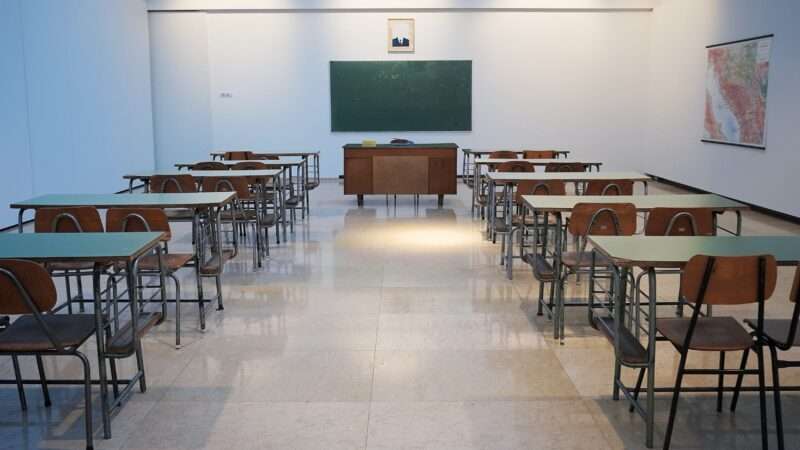
Public Schools Are Causing Irreparable Harm to Themselves


ivan-aleksic-PDRFeeDniCk-unsplash

Self-taught Fridays, extra days abruptly added to vacations, and random sudden closures proliferate in public schools across the country with the omicron variant of COVID-19 only accelerating an established trend. Parents have to hustle to make alternate plans for keeping kids occupied; with so little notice in most cases, actual education is often off the table as an option. Advocates of government-dominated schooling accuse proponents of education choice of wanting to kill government schools, but those public institutions don’t seem to need any help as they incrementally terminate their own participation in the teaching business.

“To help Portland Public Schools’ educators and students adjust to the stresses of resuming full-time in-person classes, the union representing the district’s teachers proposes cancelling in-person instruction for high schoolers one day every week after winter break,” The Oregonian reported last week. That is, classroom instruction time would be reduced by 20 percent because the union says it’s too hard to do what was promised and (sort of) delivered to students and families for years before a certain virus accustomed so many to lounging at home.

Portland is hardly alone in this regard. The four-day school week is “one of the fastest-increasing—and least-studied—phenomena shaping district operations” according to Education Week. But it’s only the latest of a series of disruptions to the way public schools operate.

“School districts across the nation are temporarily closing or switching back to remote learning as school administrators struggle with empty classrooms, driverless buses and understaffed cafeterias caused by widespread teacher exhaustion, coronavirus concerns and the Great Resignation,” USA Today noted on November 11. That was before the omicron variant started sending some people into a frenzy (even in the absence of firm data on the risks it may or may not pose). Closures have only picked up since its appearance.

“School closures continued to increase as we have identified 916 districts (versus 858 last week, an increase of 58) across 9,313 schools (from 8,692 last week, an increase of 621) cumulatively impacted so far this Fall,” according to Burbio (as of December 5), which tracks community events.

Notice to affected families ranges from as much as much as two weeks to as little as two days. Had school bureaucrats warned parents last summer that they would drop the ball yet again, parents could have considered the implications and, if so inclined, prepared for homeschooling, coordinated microschool arrangements with other parents, or enrolled their kids in private schools. Instead, they’re scrambling to arrange childcare or surrendering days of wages so they can watch kids stranded at home, far from lesson plans.

What’s ironic about the accelerating school closures is that public school advocates have raged against families who fled to education alternatives when government schools fumbled their pandemic response.

“I’m not the first to point out that [learning] pods are emblematic of educational inequity in the United States,” Tara Chklovski CEO and founder of Technovation, an education nonprofit group, complained in August 2020. “It’s a winner-take-all approach, with privileged, often mostly white students hoarding academic and social gains and further segregating our K-12 systems.”

Such social-justice-y pissiness was difficult to sustain when it turned out that the most enthusiastic converts to homeschooling were African-Americans, among whom DIY education went from 3.3 percent of students pre-COVID to 16.1 percent in the fall of 2020. Nevertheless, teachers unions, control-freak politicians, and their allies continue to insist that anybody who wants to let families guide their kids’ education instead of forcing them to subsidize government institutions is hell-bent on ending public schools.

That narrative also becomes difficult to sustain, or maybe just irrelevant, when public schools set about ending themselves. But instead of having the good grace to exit the scene in a planned way, they self-immolate in abrupt increments (one day here, a few days there, one-fifth of the school week elsewhere) with little provision made for transitioning to something else.

“I … and everybody in our community can no longer count on the public schools,” Jennifer Reesman, a Maryland mom, told NPR after a last-minute cancellation by her local district. “And I feel like after the last year and a half, there was a lot of that sentiment that this is just not something we can count on.”

It hardly matters if proponents of education choice want to kill public schools if those schools commit suicide in mid-argument. Choice advocates at least have alternatives to offer: anything families want that suits the needs of their children in achieving an education. That could include traditional public schools, but only if the staff of those institutions don’t first reduce them to hollow shells. It certainly allows for private schools, charter schools, homeschooling of all sorts, microschools, learning pods, and whatever else the human imagination might conceive.

Unsurprisingly, public support for school choice is rising. EdChoice, which tracks opinion on a monthly basis, reports: Support for education savings accounts is at 70 percent in October, up five points from September; for school vouchers at 64 percent, up six points; and for charter schools at 67 percent, up six points. All of these approaches allow families flexibility in choosing how resources for education are used, rather than being taxed to fund take-it-or-leave-it district schools that just might decide to close their doors one day out of five without offering so much as a discount.

Even before public schools began playing school-day roulette with parents and students, districts across the country reported declining enrollment as families looked elsewhere.

“In the wake of pandemic school closures, school districts in Washington state saw their enrollments decline by tens of thousands of students,” the Seattle Times reported November 26. “At the same time, the state’s home-schooled population has ballooned, nearly doubling in size during the first full school year of the pandemic, 2020-21. Many fled citing the uncertainty and logistical problems that public schools faced.”

Amid serious social disruptions, many families seem eager to embrace big changes in how their children are educated. That’s good, because public schools are pushing them out the door whether or not they’re ready to go.

The post Public Schools Are Causing Irreparable Harm to Themselves appeared first on Reason.com.

from Latest – Reason.com https://ift.tt/3orM44p
via IFTTT

More Law Review Editors Behaving Badly

The NYU Review of Law and Social Change has voted to endorse and enforce Boycott, Divestment, and Sanctions against Israel. This includes a stated refusal to publish even “balanced” articles about the Israeli-Palestinian conflict.

Think I’m exaggerating? The law review’s statement says that it will boycott “Academic activities, projects, or publications “based on the false premise of symmetry/parity between the oppressors and the oppressed or that claim that both colonizers and colonized are equally responsible for the ‘conflict’ . . . .’8 We find such efforts to be ‘intellectually dishonest and morally reprehensible forms of normalization’ that must be boycotted.”

Now, I believe that the bulk of the fault regarding the conflict lies with the Palestinian side, and its persistent refusal to acquiesce over many decades to an independent Jewish presence in the historic land of Israel, or even to a bi-national state. But apparently, and wildly inappropriately for a purportedly academic journal, the Review of Law and Social Change would not publish an article by me or anyone else that argued even that both sides were equally to blame.

NYU and its law school have strongly criticized the law review for its stance, but it’s not clear if there will be any consequences; I don’t know whether the law review’s announced policies violate any NYU regulations.

It would be easy at this point to get caught up in the question of whether BDS is antisemitic. To me, it’s irrelevant, because it’s worse than mere antisemitism; BDS is ok with genocide.

Here is how the law review itself describes BDS:

The N.Y.U. Review of Law & Social Change (“RLSC”) expresses our firm commitment to the Boycott, Divestment, Sanctions (“BDS”) movement and our solidarity with Palestinians collectively struggling towards liberation.

BDS is a Palestinian-led movement that urges action to pressure Israel to end its occupation and colonization of Palestinian land, discrimination against Palestinian citizens, and denial of the right of Palestinian refugees to return to their homes.

Anyone who knows the BDS movement knows that “Palestinian liberation” the “right of return,” and stopping Israel’s “occupation and colonization of Palestinian land” are code phrases for the destruction of Israel and its replacement with a Palestinian Muslim state. As things stand at the moment, the emergence of such a state would almost certainly result in most of the Jewish population of Israel being either killed or forced to become refugees. If there are any supporters of the destruction of Israel who include a caveat that they would withdraw such support if it became clear that these would be the consequences, I have yet to happen upon them. Even the late suave intellectual Edward Said could only muster the hope that the Jewish community would be safe in a future Palestine, but it was ultimately irrelevant to his commitment to a Palestinian state replacing Israel.

So the NYU students in question, whether are not they are complicit in antisemitism, are presumptively okay with my family in Israel, along with the rest of Israel’s seven million Jews, being murdered or expelled. Again, they are ok with genocide. And if they don’t realize that this is what their support for Palestinian “liberation” means in practice, then maybe they need to rethink it.

The student editors took a vote on BDS, and I don’t know how many dissented, and how vigorously. But for now, in the absence of any resignations or public statements of dissent, the staff members are presumptively okay with genocide. And they are also okay with boycotts. But they may not like the upshot of the combination.

In the absence of my knowing about any internal opposition or further efforts by internal opponents, I think it would be unfair at this point to memorialize all the members of the journal. But for now, I think it’s fair to hold the editors in chief, Amelie Daigle and Andrea Green, and the managing editors, Johari Menelik Frasier and Emily Truek, responsible for their law review endorsing genocidal Palestinian nationalist fantasy, though I would be happy to correct this post if they are publicly opposed to the law review’s policies.

The post More Law Review Editors Behaving Badly appeared first on Reason.com.

from Latest – Reason.com https://ift.tt/3ImZ82T
via IFTTT

More Law Review Editors Behaving Badly

The NYU Review of Law and Social Change has voted to endorse and enforce Boycott, Divestment, and Sanctions against Israel. This includes a stated refusal to publish even “balanced” articles about the Israeli-Palestinian conflict.

Think I’m exaggerating? The law review’s statement says that it will boycott “Academic activities, projects, or publications “based on the false premise of symmetry/parity between the oppressors and the oppressed or that claim that both colonizers and colonized are equally responsible for the ‘conflict’ . . . .’8 We find such efforts to be ‘intellectually dishonest and morally reprehensible forms of normalization’ that must be boycotted.”

Now, I believe that the bulk of the fault regarding the conflict lies with the Palestinian side, and its persistent refusal to acquiesce over many decades to an independent Jewish presence in the historic land of Israel, or even to a bi-national state. But apparently, and wildly inappropriately for a purportedly academic journal, the Review of Law and Social Change would not publish an article by me or anyone else that argued even that both sides were equally to blame.

NYU and its law school have strongly criticized the law review for its stance, but it’s not clear if there will be any consequences; I don’t know whether the law review’s announced policies violate any NYU regulations.

It would be easy at this point to get caught up in the question of whether BDS is antisemitic. To me, it’s irrelevant, because it’s worse than mere antisemitism; BDS is ok with genocide.

Here is how the law review itself describes BDS:

The N.Y.U. Review of Law & Social Change (“RLSC”) expresses our firm commitment to the Boycott, Divestment, Sanctions (“BDS”) movement and our solidarity with Palestinians collectively struggling towards liberation.

BDS is a Palestinian-led movement that urges action to pressure Israel to end its occupation and colonization of Palestinian land, discrimination against Palestinian citizens, and denial of the right of Palestinian refugees to return to their homes.

Anyone who knows the BDS movement knows that “Palestinian liberation” the “right of return,” and stopping Israel’s “occupation and colonization of Palestinian land” are code phrases for the destruction of Israel and its replacement with a Palestinian Muslim state. As things stand at the moment, the emergence of such a state would almost certainly result in most of the Jewish population of Israel being either killed or forced to become refugees. If there are any supporters of the destruction of Israel who include a caveat that they would withdraw such support if it became clear that these would be the consequences, I have yet to happen upon them. Even the late suave intellectual Edward Said could only muster the hope that the Jewish community would be safe in a future Palestine, but it was ultimately irrelevant to his commitment to a Palestinian state replacing Israel.

So the NYU students in question, whether are not they are complicit in antisemitism, are presumptively okay with my family in Israel, along with the rest of Israel’s seven million Jews, being murdered or expelled. Again, they are ok with genocide. And if they don’t realize that this is what their support for Palestinian “liberation” means in practice, then maybe they need to rethink it.

The student editors took a vote on BDS, and I don’t know how many dissented, and how vigorously. But for now, in the absence of any resignations or public statements of dissent, the staff members are presumptively okay with genocide. And they are also okay with boycotts. But they may not like the upshot of the combination.

In the absence of my knowing about any internal opposition or further efforts by internal opponents, I think it would be unfair at this point to memorialize all the members of the journal. But for now, I think it’s fair to hold the editors in chief, Amelie Daigle and Andrea Green, and the managing editors, Johari Menelik Frasier and Emily Truek, responsible for their law review endorsing genocidal Palestinian nationalist fantasy, though I would be happy to correct this post if they are publicly opposed to the law review’s policies.

The post More Law Review Editors Behaving Badly appeared first on Reason.com.

from Latest – Reason.com https://ift.tt/3ImZ82T
via IFTTT

San Diego Schools Need Not Allow Religious Exemptions from Vaccination Mandate

From Doe v. S.D. Unif. School Dist., decided yesterday by Judges Marsha Berzon and Mark Bennett (for the post about last week’s decision, see here):

Appellants, a 16-year-old high school student and her parents, filed an emergency motion for an injunction pending appeal, seeking to enjoin San Diego Unified School District … from requiring compliance with a student vaccination mandate. On November 28, 2021, we granted Appellants’ motion in part. We ordered that an injunction shall be in effect only while a “per se” deferral of vaccination is available to pregnant students under SDUSD’s student vaccination mandate, and that the injunction shall terminate upon removal of the “per se” deferral option for pregnant students.

On November 29, 2021, appellees filed a letter and supporting declaration from Interim Superintendent Lamont Jackson explaining that the deferral option for pregnant students has been removed from the mandate. Appellants’ responsive letter does not dispute that the pregnancy deferral option has been validly removed.

Given the removal of the “per se” deferral option for pregnant students, the injunction issued in the November 28, 2021 order has terminated under its own terms. This order provides our reasoning for why an injunction pending appeal is not warranted as to the now-modified student vaccination mandate….

SDUSD’s student vaccination mandate provides that students who are 16 years or older as of November 1, 2021, and who are not fully vaccinated against COVID-19, will not be permitted to participate after January 24, 2021 in on-site education or extracurricular activities without a qualified exemption or conditional enrollment.

SDUSD allows for medical exemptions to the mandate as well as conditional enrollment in on-site education for 30 days for certain categories of newly enrolling students (students who are homeless, in “migrant” status, in foster care, or in military families). {These categories were drawn from California state law provisions applicable to other immunizations required for students.} The mandate also provides certain procedural protections and accommodations to students with Individualized Education Programs (IEPs), to comply with statutory “stay put” requirements. Previously, the mandate provided for a “per se” pregnancy deferral, under which a pregnant student could defer vaccination until after pregnancy; as noted, the “per se” pregnancy deferral no longer exists. SDUSD does not allow for an exemption to the mandate on the basis of religious belief.

Appellants allege that the student vaccination mandate violates the Free Exercise Clause, both facially and as applied, by failing to exempt Jill Doe, the high school student plaintiff, in light of a religious belief that prohibits her from taking any of the available vaccines,3 and by treating “comparable secular activity more favorably than religious exercise” through the granting of medical exemptions, conditional enrollments for certain categories of students, and procedural protections for students with IEPs. See Tandon v. Newsom (2021).

{The complaint and emergency motion explain that Jill Doe’s reason for abstaining from vaccination is that “[a]ll three of the[ ] vaccines have been manufactured or tested using material derived from stem cell lines from aborted fetuses.” The one vaccine approved for use in 16-year-olds is the Pfizer-BioNTech vaccine. That vaccine is not manufactured using stem cells. Third parties tested the vaccine using fetal cell lines, which are laboratory-grown cells originally derived from two fetuses aborted in 1973 and 1985. Jill Doe explains that her Christian faith prevents her from using any vaccines that depend on use of fetal cell lines at any stage of their development. We may not and do not question the legitimacy of Jill Doe’s religious beliefs regarding COVID-19 vaccinations.}

Appellants have not demonstrated a sufficient likelihood of success in showing that the district court erred in applying rational basis review, as opposed to strict scrutiny, to the student vaccination mandate….

[T]he plaintiffs have not raised a serious question as to whether the mandate is generally applicable. The only currently enrolled students who are fully exempt from the requirement to be vaccinated for on-site learning and extracurricular activities are students who qualify for a medical exemption. The medical exemption is limited to students with contraindications or precautions recognized by the Centers for Disease Control and Prevention or the vaccine manufacturer, and the request must be certified by a physician. Limitation of the medical exemption in this way serves the primary interest for imposing the mandate—protecting student “health and safety”—and so does not undermine the District’s interests as a religious exemption would. See Fulton v. City of Philadelphia (2021) (“A law … lacks general applicability if it prohibits religious conduct while permitting secular conduct that undermines the government’s asserted interests in a similar way.”).

Additionally, although the record does not disclose the number of students who have sought or are likely to seek a medical exemption, if that number is very small and the number of students likely to seek a religious exemption is large, then the medical exemption would not qualify as “comparable” to the religious exemption in terms of the “risk” each exemption poses to the government’s asserted interests. Moreover, some of the medical exemptions are likely to be “limited in duration,” unlike a religious exemption. SDUSD’s medical exemption form expressly states that “[n]o medical exception is permanent” and that any such exemption is valid only until the earliest date out of a list of dates, such as “[t]he end date specified by the physician” who fills out the exemption form. Students with health issues justifying a longer-term medical exemption will need to reapply for an exemption each year. Accordingly, although “it may be feasible for [SDUSD] to manage the COVID-19 risks posed by a small set of objectively defined and largely time-limited medical exemptions,” “it could pose a significant barrier to effective disease prevention to permit a much greater number of permanent religious exemptions.”

The 30-day “conditional enrollment” period for the specified categories of newly enrolling students also does not raise a serious question concerning the mandate’s general applicability. As was the case with currently enrolled students like Jill Doe, conditionally enrolled students are simply given a grace period to provide documentation proving that they have been vaccinated before they may continue with on-site education; they are not exempted from the vaccination requirement itself. Thus, Appellants have not demonstrated that the mandate treats conditional enrollees more favorably than students who invoke religious beliefs as their ground for remaining unvaccinated. And, in line with the above analysis, the conditional enrollment period is both of temporary duration and of limited scope, and so does not undermine SDUSD’s asserted interests in student health and safety the way a religious exemption would….

Moreover, in light of the rigidity of the medical exemption and the limited time period for conditional enrollees to obtain records or vaccine doses—which does not appear to be subject to discretionary extension—there is no “mechanism for ‘individualized exemptions'” in this case….

[T]his case is meaningfully distinct from the recent cases involving COVID-19 restrictions on worship in churches and private homes. In those cases, the plaintiffs were literally prevented from exercising their religion in group settings. Here, in contrast, Jill Doe may exercise her religion by declining to receive the vaccination. Appellants argue that the student vaccination mandate nevertheless causes irreparable injury because it “burdens” their religion by making an “important benefit” contingent upon conduct that violates their faith. But the record is devoid of evidence indicating that SDUSD’s remote-learning “alternative education program” is inferior to in-person education.

And although Jill Doe states that, as she is a “preeminent athlete,” the mandate would cause her irreparable injury by “dooming” her otherwise promising chances of receiving a sports scholarship, she did not submit any details to support that claim. She also elected to proceed anonymously in this case—including remaining anonymous to the District and its lawyers—thereby preventing SDUSD from contesting the truth of that statement. Critical facts going to the “irreparable injury” inquiry are therefore unknowable in this case. Appellants thus have probably not carried their burden of showing that they are likely to suffer irreparable harm in the absence of preliminary relief.

Last, for completeness, we note that the public interest weighs strongly in favor of denying Appellants’ motion. The COVID-19 pandemic has claimed the lives of over three quarters of a million Americans. The record indicates that vaccines are safe and effective at preventing the spread of COVID-19, and that SDUSD’s vaccination mandate is therefore likely to promote the health and safety of SDUSD’s students and staff, as well as the broader community. And as the Supreme Court has long recognized, “the right to practice religion freely” is not “beyond regulation in the public interest,” including regulation aimed at reducing the risk of “expos[ing] the community or the child to communicable disease or the latter to ill health or death.” The public interest therefore favors SDUSD’s mandate….

Judge Sandra Ikuta dissented, arguing, among other things, that:

[T]he School District’s asserted interest justifying the vaccine mandate is to “ensure the highest-quality instruction in the safest environment possible for all students and employees” by preventing the transmission and spread of COVID-19. The two activities that Doe claims are comparable are in-person attendance by students who are unvaccinated for religious reasons and in-person attendance by students who are unvaccinated for medical or logistical reasons. These religious and secular activities pose identical risks to the government’s asserted interest in ensuring the “safest environment possible for all students and employees,” because both result in the presence of unvaccinated students in the classroom, who could spread COVID-19 to other students and employees.

But the School District’s mandate treats secular and religious activity differently. Specifically, the policy allows in-person attendance by students unvaccinated for medical reasons, and in-person attendance by unvaccinated new enrollees who meet certain criteria. By contrast, the policy does not allow any form of in-person attendance by students unvaccinated for religious reasons. Because in-person attendance by students who are unvaccinated for religious reasons poses “similar risks” to the school environment as in-person attendance by students who are unvaccinated for medical or logistical reasons, the mandate is not generally applicable.

In concluding otherwise, the majority fails to follow the legal framework for determining whether a law is generally applicable. First, the majority argues that the medical exemption does not undercut the mandate’s general applicability because it furthers the School District’s interest in “protecting student health and safety” by protecting the health of the particular student claiming the medical exemption. This argument incorrectly focuses on the reasons for the exemption rather than the asserted interest that justifies the mandate.

No doubt the School District has a good reason for providing an exemption for medically vulnerable students in order to protect their health, although the School District could further this interest by allowing such students to participate in the remote-learning option. But “the reasons why” the School District allows in-person attendance for some unvaccinated students are irrelevant. Instead, “[c]omparability is concerned with the risks” in-person attendance by an unvaccinated student poses to the “asserted government interest.” Here, the School District’s asserted interest for imposing the vaccine mandate in the first place is to ensure “the safest environment possible for all students and employees” by preventing the transmission and spread of COVID-19. Allowing students who are unvaccinated for medical reasons to attend school in person undermines this interest. Thus, the majority errs at the first step in the framework by focusing on the School District’s reasons for offering an exemption, rather than the interest that the School District actually asserts to justify the mandate.

Second, the majority claims that the risks posed by in-person attendance of students unvaccinated for medical reasons are not comparable to the risks posed by students unvaccinated for religious reasons because far fewer students will seek medical exemptions than religious exemptions. This rationale is entirely speculative. As the majority acknowledges, “the record does not disclose the number of students who have sought or are likely to seek a medical exemption.” Nor is there any evidence in the record about how many students would seek religious exemptions. A court may not base its rulings on such free-floating guesswork. Thus, there is no basis for the majority’s claim that the School District will be flooded with requests for religious exemptions if they were offered.

{This claim is undercut by testimony from the School District’s expert, who describes the medical exemption as having a potentially broad scope: “If a student’s own physician confirms, through the same process used for other vaccinations, that an underlying medical problem makes the vaccine unsafe for their patient, and that physician is made available to discuss this issue with the District’s physician, the student is eligible for a medical exemption.” This characterization of the mandate not only casts doubt on the majority’s view that the exemption covers only a small number of students, but also suggests that the medical exemption may be an example of the “individualized exemptions” that render government regulations not generally applicable.}

The majority further errs in arguing that because the mandate gives students claiming a medical or logistical exemption only temporary relief, the risk posed by their in-person attendance is not comparable to the risk posed by the in-person attendance of students claiming a religious exemption. But the majority identifies no authority suggesting that the School District can treat secular activity more favorably than religious activity simply because the disparate treatment is only temporary. Even a temporary deferral would provide a religious student with some relief.

{[And t]here is no basis for characterizing the medical exemption as temporary. According to the School District’s medical exemption form (as opposed to the testimony of its expert), students qualify for a medical exemption only if they have a “contraindication” or “precaution” recognized by the CDC or the vaccine manufacturer. The only such contraindication is a severe allergic reaction or known diagnosed allergy to the vaccine or its ingredients, and the only precaution is a history of immediate allergic reaction to other vaccines or injectable therapies.}

Finally, the majority argues that conditional enrollment deferrals are not comparable to a religious exemption because Doe had the same amount of time to comply with the mandate that new enrollees will have. This again confuses the reasons for the exemption with the asserted interest that justifies the mandate. While the School District may have a good reason to give new enrollees who meet certain criteria thirty days to comply with the mandate, the in-person attendance of such unvaccinated conditional enrollees poses an identical risk to the School District’s asserted interest in preventing the spread of COVID-19 as the in-person attendance of unvaccinated students seeking a religious exemption. Therefore, the mandate is not generally applicable. …

Because the School District’s mandate is not generally applicable, strict scrutiny applies. Strict scrutiny requires that the mandate be narrowly tailored to serve a compelling interest. The School District’s mandate does not satisfy this standard. “Stemming the spread of COVID–19 is unquestionably a compelling interest.” But if “the government permits other activities to proceed with precautions, it must show that the religious exercise at issue is more dangerous than those activities even when the same precautions are applied.” “Otherwise, precautions that suffice for other activities suffice for religious exercise too.”

Here, the School District has not met its burden of showing that the “non-pharmaceutical interventions (e.g., face coverings, regular asymptomatic testing)” that exempted students must follow do not “suffice for religious exercise too.” Additionally, the School District already accommodates teachers and staff who remain unvaccinated due to personal beliefs by allowing them access to the campus, which shows that the School District has determined that it can satisfy its safety interests while still allowing persons unvaccinated on religious grounds to access campus. Accordingly, the vaccine mandate is stricter than necessary to meet the School District’s asserted goals, and therefore is not narrowly tailored. Finally, California’s proposed mandate will allow a personal beliefs exemption, which further suggests that the School District’s mandate is stricter than necessary.

{The majority suggests that the School District’s remote-learning option is not inferior to in-person education. But if that were true, then all unvaccinated students should participate in remote learning. Otherwise, the School District’s mandate would be severely underinclusive.} …

The post San Diego Schools Need Not Allow Religious Exemptions from Vaccination Mandate appeared first on Reason.com.

from Latest – Reason.com https://ift.tt/2ZVeXfI
via IFTTT

San Diego Schools Need Not Allow Religious Exemptions from Vaccination Mandate

From Doe v. S.D. Unif. School Dist., decided yesterday by Judges Marsha Berzon and Mark Bennett (for the post about last week’s decision, see here):

Appellants, a 16-year-old high school student and her parents, filed an emergency motion for an injunction pending appeal, seeking to enjoin San Diego Unified School District … from requiring compliance with a student vaccination mandate. On November 28, 2021, we granted Appellants’ motion in part. We ordered that an injunction shall be in effect only while a “per se” deferral of vaccination is available to pregnant students under SDUSD’s student vaccination mandate, and that the injunction shall terminate upon removal of the “per se” deferral option for pregnant students.

On November 29, 2021, appellees filed a letter and supporting declaration from Interim Superintendent Lamont Jackson explaining that the deferral option for pregnant students has been removed from the mandate. Appellants’ responsive letter does not dispute that the pregnancy deferral option has been validly removed.

Given the removal of the “per se” deferral option for pregnant students, the injunction issued in the November 28, 2021 order has terminated under its own terms. This order provides our reasoning for why an injunction pending appeal is not warranted as to the now-modified student vaccination mandate….

SDUSD’s student vaccination mandate provides that students who are 16 years or older as of November 1, 2021, and who are not fully vaccinated against COVID-19, will not be permitted to participate after January 24, 2021 in on-site education or extracurricular activities without a qualified exemption or conditional enrollment.

SDUSD allows for medical exemptions to the mandate as well as conditional enrollment in on-site education for 30 days for certain categories of newly enrolling students (students who are homeless, in “migrant” status, in foster care, or in military families). {These categories were drawn from California state law provisions applicable to other immunizations required for students.} The mandate also provides certain procedural protections and accommodations to students with Individualized Education Programs (IEPs), to comply with statutory “stay put” requirements. Previously, the mandate provided for a “per se” pregnancy deferral, under which a pregnant student could defer vaccination until after pregnancy; as noted, the “per se” pregnancy deferral no longer exists. SDUSD does not allow for an exemption to the mandate on the basis of religious belief.

Appellants allege that the student vaccination mandate violates the Free Exercise Clause, both facially and as applied, by failing to exempt Jill Doe, the high school student plaintiff, in light of a religious belief that prohibits her from taking any of the available vaccines,3 and by treating “comparable secular activity more favorably than religious exercise” through the granting of medical exemptions, conditional enrollments for certain categories of students, and procedural protections for students with IEPs. See Tandon v. Newsom (2021).

{The complaint and emergency motion explain that Jill Doe’s reason for abstaining from vaccination is that “[a]ll three of the[ ] vaccines have been manufactured or tested using material derived from stem cell lines from aborted fetuses.” The one vaccine approved for use in 16-year-olds is the Pfizer-BioNTech vaccine. That vaccine is not manufactured using stem cells. Third parties tested the vaccine using fetal cell lines, which are laboratory-grown cells originally derived from two fetuses aborted in 1973 and 1985. Jill Doe explains that her Christian faith prevents her from using any vaccines that depend on use of fetal cell lines at any stage of their development. We may not and do not question the legitimacy of Jill Doe’s religious beliefs regarding COVID-19 vaccinations.}

Appellants have not demonstrated a sufficient likelihood of success in showing that the district court erred in applying rational basis review, as opposed to strict scrutiny, to the student vaccination mandate….

[T]he plaintiffs have not raised a serious question as to whether the mandate is generally applicable. The only currently enrolled students who are fully exempt from the requirement to be vaccinated for on-site learning and extracurricular activities are students who qualify for a medical exemption. The medical exemption is limited to students with contraindications or precautions recognized by the Centers for Disease Control and Prevention or the vaccine manufacturer, and the request must be certified by a physician. Limitation of the medical exemption in this way serves the primary interest for imposing the mandate—protecting student “health and safety”—and so does not undermine the District’s interests as a religious exemption would. See Fulton v. City of Philadelphia (2021) (“A law … lacks general applicability if it prohibits religious conduct while permitting secular conduct that undermines the government’s asserted interests in a similar way.”).

Additionally, although the record does not disclose the number of students who have sought or are likely to seek a medical exemption, if that number is very small and the number of students likely to seek a religious exemption is large, then the medical exemption would not qualify as “comparable” to the religious exemption in terms of the “risk” each exemption poses to the government’s asserted interests. Moreover, some of the medical exemptions are likely to be “limited in duration,” unlike a religious exemption. SDUSD’s medical exemption form expressly states that “[n]o medical exception is permanent” and that any such exemption is valid only until the earliest date out of a list of dates, such as “[t]he end date specified by the physician” who fills out the exemption form. Students with health issues justifying a longer-term medical exemption will need to reapply for an exemption each year. Accordingly, although “it may be feasible for [SDUSD] to manage the COVID-19 risks posed by a small set of objectively defined and largely time-limited medical exemptions,” “it could pose a significant barrier to effective disease prevention to permit a much greater number of permanent religious exemptions.”

The 30-day “conditional enrollment” period for the specified categories of newly enrolling students also does not raise a serious question concerning the mandate’s general applicability. As was the case with currently enrolled students like Jill Doe, conditionally enrolled students are simply given a grace period to provide documentation proving that they have been vaccinated before they may continue with on-site education; they are not exempted from the vaccination requirement itself. Thus, Appellants have not demonstrated that the mandate treats conditional enrollees more favorably than students who invoke religious beliefs as their ground for remaining unvaccinated. And, in line with the above analysis, the conditional enrollment period is both of temporary duration and of limited scope, and so does not undermine SDUSD’s asserted interests in student health and safety the way a religious exemption would….

Moreover, in light of the rigidity of the medical exemption and the limited time period for conditional enrollees to obtain records or vaccine doses—which does not appear to be subject to discretionary extension—there is no “mechanism for ‘individualized exemptions'” in this case….

[T]his case is meaningfully distinct from the recent cases involving COVID-19 restrictions on worship in churches and private homes. In those cases, the plaintiffs were literally prevented from exercising their religion in group settings. Here, in contrast, Jill Doe may exercise her religion by declining to receive the vaccination. Appellants argue that the student vaccination mandate nevertheless causes irreparable injury because it “burdens” their religion by making an “important benefit” contingent upon conduct that violates their faith. But the record is devoid of evidence indicating that SDUSD’s remote-learning “alternative education program” is inferior to in-person education.

And although Jill Doe states that, as she is a “preeminent athlete,” the mandate would cause her irreparable injury by “dooming” her otherwise promising chances of receiving a sports scholarship, she did not submit any details to support that claim. She also elected to proceed anonymously in this case—including remaining anonymous to the District and its lawyers—thereby preventing SDUSD from contesting the truth of that statement. Critical facts going to the “irreparable injury” inquiry are therefore unknowable in this case. Appellants thus have probably not carried their burden of showing that they are likely to suffer irreparable harm in the absence of preliminary relief.

Last, for completeness, we note that the public interest weighs strongly in favor of denying Appellants’ motion. The COVID-19 pandemic has claimed the lives of over three quarters of a million Americans. The record indicates that vaccines are safe and effective at preventing the spread of COVID-19, and that SDUSD’s vaccination mandate is therefore likely to promote the health and safety of SDUSD’s students and staff, as well as the broader community. And as the Supreme Court has long recognized, “the right to practice religion freely” is not “beyond regulation in the public interest,” including regulation aimed at reducing the risk of “expos[ing] the community or the child to communicable disease or the latter to ill health or death.” The public interest therefore favors SDUSD’s mandate….

Judge Sandra Ikuta dissented, arguing, among other things, that:

[T]he School District’s asserted interest justifying the vaccine mandate is to “ensure the highest-quality instruction in the safest environment possible for all students and employees” by preventing the transmission and spread of COVID-19. The two activities that Doe claims are comparable are in-person attendance by students who are unvaccinated for religious reasons and in-person attendance by students who are unvaccinated for medical or logistical reasons. These religious and secular activities pose identical risks to the government’s asserted interest in ensuring the “safest environment possible for all students and employees,” because both result in the presence of unvaccinated students in the classroom, who could spread COVID-19 to other students and employees.

But the School District’s mandate treats secular and religious activity differently. Specifically, the policy allows in-person attendance by students unvaccinated for medical reasons, and in-person attendance by unvaccinated new enrollees who meet certain criteria. By contrast, the policy does not allow any form of in-person attendance by students unvaccinated for religious reasons. Because in-person attendance by students who are unvaccinated for religious reasons poses “similar risks” to the school environment as in-person attendance by students who are unvaccinated for medical or logistical reasons, the mandate is not generally applicable.

In concluding otherwise, the majority fails to follow the legal framework for determining whether a law is generally applicable. First, the majority argues that the medical exemption does not undercut the mandate’s general applicability because it furthers the School District’s interest in “protecting student health and safety” by protecting the health of the particular student claiming the medical exemption. This argument incorrectly focuses on the reasons for the exemption rather than the asserted interest that justifies the mandate.

No doubt the School District has a good reason for providing an exemption for medically vulnerable students in order to protect their health, although the School District could further this interest by allowing such students to participate in the remote-learning option. But “the reasons why” the School District allows in-person attendance for some unvaccinated students are irrelevant. Instead, “[c]omparability is concerned with the risks” in-person attendance by an unvaccinated student poses to the “asserted government interest.” Here, the School District’s asserted interest for imposing the vaccine mandate in the first place is to ensure “the safest environment possible for all students and employees” by preventing the transmission and spread of COVID-19. Allowing students who are unvaccinated for medical reasons to attend school in person undermines this interest. Thus, the majority errs at the first step in the framework by focusing on the School District’s reasons for offering an exemption, rather than the interest that the School District actually asserts to justify the mandate.

Second, the majority claims that the risks posed by in-person attendance of students unvaccinated for medical reasons are not comparable to the risks posed by students unvaccinated for religious reasons because far fewer students will seek medical exemptions than religious exemptions. This rationale is entirely speculative. As the majority acknowledges, “the record does not disclose the number of students who have sought or are likely to seek a medical exemption.” Nor is there any evidence in the record about how many students would seek religious exemptions. A court may not base its rulings on such free-floating guesswork. Thus, there is no basis for the majority’s claim that the School District will be flooded with requests for religious exemptions if they were offered.

{This claim is undercut by testimony from the School District’s expert, who describes the medical exemption as having a potentially broad scope: “If a student’s own physician confirms, through the same process used for other vaccinations, that an underlying medical problem makes the vaccine unsafe for their patient, and that physician is made available to discuss this issue with the District’s physician, the student is eligible for a medical exemption.” This characterization of the mandate not only casts doubt on the majority’s view that the exemption covers only a small number of students, but also suggests that the medical exemption may be an example of the “individualized exemptions” that render government regulations not generally applicable.}

The majority further errs in arguing that because the mandate gives students claiming a medical or logistical exemption only temporary relief, the risk posed by their in-person attendance is not comparable to the risk posed by the in-person attendance of students claiming a religious exemption. But the majority identifies no authority suggesting that the School District can treat secular activity more favorably than religious activity simply because the disparate treatment is only temporary. Even a temporary deferral would provide a religious student with some relief.

{[And t]here is no basis for characterizing the medical exemption as temporary. According to the School District’s medical exemption form (as opposed to the testimony of its expert), students qualify for a medical exemption only if they have a “contraindication” or “precaution” recognized by the CDC or the vaccine manufacturer. The only such contraindication is a severe allergic reaction or known diagnosed allergy to the vaccine or its ingredients, and the only precaution is a history of immediate allergic reaction to other vaccines or injectable therapies.}

Finally, the majority argues that conditional enrollment deferrals are not comparable to a religious exemption because Doe had the same amount of time to comply with the mandate that new enrollees will have. This again confuses the reasons for the exemption with the asserted interest that justifies the mandate. While the School District may have a good reason to give new enrollees who meet certain criteria thirty days to comply with the mandate, the in-person attendance of such unvaccinated conditional enrollees poses an identical risk to the School District’s asserted interest in preventing the spread of COVID-19 as the in-person attendance of unvaccinated students seeking a religious exemption. Therefore, the mandate is not generally applicable. …

Because the School District’s mandate is not generally applicable, strict scrutiny applies. Strict scrutiny requires that the mandate be narrowly tailored to serve a compelling interest. The School District’s mandate does not satisfy this standard. “Stemming the spread of COVID–19 is unquestionably a compelling interest.” But if “the government permits other activities to proceed with precautions, it must show that the religious exercise at issue is more dangerous than those activities even when the same precautions are applied.” “Otherwise, precautions that suffice for other activities suffice for religious exercise too.”

Here, the School District has not met its burden of showing that the “non-pharmaceutical interventions (e.g., face coverings, regular asymptomatic testing)” that exempted students must follow do not “suffice for religious exercise too.” Additionally, the School District already accommodates teachers and staff who remain unvaccinated due to personal beliefs by allowing them access to the campus, which shows that the School District has determined that it can satisfy its safety interests while still allowing persons unvaccinated on religious grounds to access campus. Accordingly, the vaccine mandate is stricter than necessary to meet the School District’s asserted goals, and therefore is not narrowly tailored. Finally, California’s proposed mandate will allow a personal beliefs exemption, which further suggests that the School District’s mandate is stricter than necessary.

{The majority suggests that the School District’s remote-learning option is not inferior to in-person education. But if that were true, then all unvaccinated students should participate in remote learning. Otherwise, the School District’s mandate would be severely underinclusive.} …

The post San Diego Schools Need Not Allow Religious Exemptions from Vaccination Mandate appeared first on Reason.com.

from Latest – Reason.com https://ift.tt/2ZVeXfI
via IFTTT

Alicea: “Dobbs and the Fate of the Conservative Legal Movement”

Professor Joel Alice wrote a most-read piece in City Journal about Dobbs and the conservative legal movement. I share many of his concerns. Moreover, Joel addresses arguments raised by Steve Sachs and others about the relationship between originalism and the conservative legal movement.

Here is an excerpt:

With both Jackson Women’s Health Organization and the solicitor general likewise arguing that the Court must either reaffirm or overrule Roe and Casey, legal conservatives now expect that, after nearly 50 years of unceasing effort to overrule Roe, they will finally see the Court do it. If it does not, a sense of betrayal and disillusionment will likely follow.

That would place enormous strain on the intellectual fault lines within the movement. If a Supreme Court with a 6–3 conservative majority consisting of five committed originalists refuses to overrule Roe and Casey, it is unlikely that any originalist Court will ever do so—raising serious questions within the conservative legal movement about its attachment to originalism. Immediate recriminations and accusations of betrayal would ensue, likely tearing the movement apart. Those who offer a moral critique of originalism would point to Dobbs as proof positive that originalism lacks the moral foundation necessary to be a plausible constitutional methodology. Vermeule has openly predicted that if “Roe (not merely Casey) survives in any form without being overturned [in Dobbs], it will represent a shattering crisis for the conservative legal movement.” If the Court fails to overrule Roe and Casey, there is a very good chance that Vermeule would become the most important intellectual figure in whatever succeeds the current conservative legal movement.

Similarly, those advocating an instrumental view of originalism, especially in favor of judicial restraint, would have good reason to question whether originalism actually achieves the restrained judiciary they favor, since the failure to overrule Roe would keep the Court enmeshed in the most contentious social issue in America, without clear constitutional warrant. Some may argue that the more restrained position would be to uphold Roe, since that would be minimally disruptive to American constitutional law. But Chief Justice Roberts—the most committed judicial-restraint member of the Court—has shown himself willing to make great changes in constitutional law to keep the Court out of political and social policy if the Court’s intervention has no firm constitutional basis. For example, he wrote the Court’s opinion in Rucho v. Common Cause (2019), which held that the federal judiciary has no authority to adjudicate political-gerrymandering challenges to redistricting maps. That controversial decision ended several decades of gerrymandering jurisprudence, but its effect was to withdraw the Court from fraught political and social battles.

Those who believe that originalism is the only legitimate methodology of constitutional adjudication would have no logical reason to abandon their view, since it is not based on the results that originalism achieves. But their theoretical arguments would sound less convincing to an audience that had witnessed such a seismic failure of originalism to translate its arguments into reality, just as those arguments have already lost some of their purchase after Bostock. The conservative legal movement has always been an intensely intellectual but also intensely practical movement; a methodology right in theory but self-defeating in practice will not retain many adherents.

A forthright overruling of Roe, however, would significantly alleviate the tensions within the movement and bolster its long-term outlook. It would, in the eyes of instrumentalist and non-instrumentalist originalists alike, vindicate their half-century support for originalism. It would take much of the wind out of the sails of originalism’s moral critics, since originalism will have been the means of achieving the critics’ most earnestly sought moral goal. There is likely no avoiding the consequences, then, for the conservative legal movement in Dobbs: complete victory or crisis-inducing defeat.

Upholding Roe would not weaken originalism as a theory. Steve is right about that much. But for many instrumentalists, originalism would no longer be an attractive theory. And without that support, the academic theory would remain just that. In time, Judges and Supreme Court justices, who seek political support, would no longer be willing to subscribe to the once-prevailing academic theories. Maybe this prediction is right. Maybe this prediction is wrong. But the risk is real. And Vermeule is laughing all the way.

Mumblings in the Mayflower have now spilled into national discourse. You heard it here first.

The post Alicea: "Dobbs and the Fate of the Conservative Legal Movement" appeared first on Reason.com.

from Latest – Reason.com https://ift.tt/3rzzYbn
via IFTTT

Alicea: “Dobbs and the Fate of the Conservative Legal Movement”

Professor Joel Alice wrote a most-read piece in City Journal about Dobbs and the conservative legal movement. I share many of his concerns. Moreover, Joel addresses arguments raised by Steve Sachs and others about the relationship between originalism and the conservative legal movement.

Here is an excerpt:

With both Jackson Women’s Health Organization and the solicitor general likewise arguing that the Court must either reaffirm or overrule Roe and Casey, legal conservatives now expect that, after nearly 50 years of unceasing effort to overrule Roe, they will finally see the Court do it. If it does not, a sense of betrayal and disillusionment will likely follow.

That would place enormous strain on the intellectual fault lines within the movement. If a Supreme Court with a 6–3 conservative majority consisting of five committed originalists refuses to overrule Roe and Casey, it is unlikely that any originalist Court will ever do so—raising serious questions within the conservative legal movement about its attachment to originalism. Immediate recriminations and accusations of betrayal would ensue, likely tearing the movement apart. Those who offer a moral critique of originalism would point to Dobbs as proof positive that originalism lacks the moral foundation necessary to be a plausible constitutional methodology. Vermeule has openly predicted that if “Roe (not merely Casey) survives in any form without being overturned [in Dobbs], it will represent a shattering crisis for the conservative legal movement.” If the Court fails to overrule Roe and Casey, there is a very good chance that Vermeule would become the most important intellectual figure in whatever succeeds the current conservative legal movement.

Similarly, those advocating an instrumental view of originalism, especially in favor of judicial restraint, would have good reason to question whether originalism actually achieves the restrained judiciary they favor, since the failure to overrule Roe would keep the Court enmeshed in the most contentious social issue in America, without clear constitutional warrant. Some may argue that the more restrained position would be to uphold Roe, since that would be minimally disruptive to American constitutional law. But Chief Justice Roberts—the most committed judicial-restraint member of the Court—has shown himself willing to make great changes in constitutional law to keep the Court out of political and social policy if the Court’s intervention has no firm constitutional basis. For example, he wrote the Court’s opinion in Rucho v. Common Cause (2019), which held that the federal judiciary has no authority to adjudicate political-gerrymandering challenges to redistricting maps. That controversial decision ended several decades of gerrymandering jurisprudence, but its effect was to withdraw the Court from fraught political and social battles.

Those who believe that originalism is the only legitimate methodology of constitutional adjudication would have no logical reason to abandon their view, since it is not based on the results that originalism achieves. But their theoretical arguments would sound less convincing to an audience that had witnessed such a seismic failure of originalism to translate its arguments into reality, just as those arguments have already lost some of their purchase after Bostock. The conservative legal movement has always been an intensely intellectual but also intensely practical movement; a methodology right in theory but self-defeating in practice will not retain many adherents.

A forthright overruling of Roe, however, would significantly alleviate the tensions within the movement and bolster its long-term outlook. It would, in the eyes of instrumentalist and non-instrumentalist originalists alike, vindicate their half-century support for originalism. It would take much of the wind out of the sails of originalism’s moral critics, since originalism will have been the means of achieving the critics’ most earnestly sought moral goal. There is likely no avoiding the consequences, then, for the conservative legal movement in Dobbs: complete victory or crisis-inducing defeat.

Upholding Roe would not weaken originalism as a theory. Steve is right about that much. But for many instrumentalists, originalism would no longer be an attractive theory. And without that support, the academic theory would remain just that. In time, Judges and Supreme Court justices, who seek political support, would no longer be willing to subscribe to the once-prevailing academic theories. Maybe this prediction is right. Maybe this prediction is wrong. But the risk is real. And Vermeule is laughing all the way.

Mumblings in the Mayflower have now spilled into national discourse. You heard it here first.

The post Alicea: "Dobbs and the Fate of the Conservative Legal Movement" appeared first on Reason.com.

from Latest – Reason.com https://ift.tt/3rzzYbn
via IFTTT