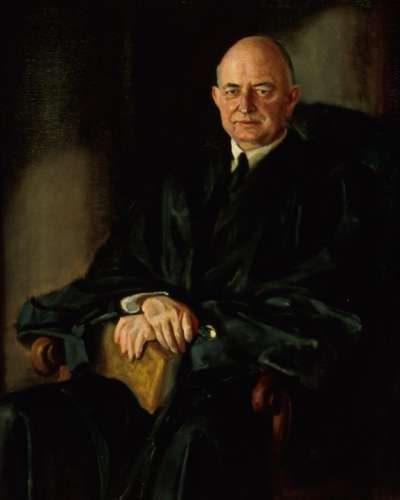
In October, the Harlan Institute and Ashbrook announced the Eighth Annual Virtual Supreme Court Competition. This competition offers teams of two high school students the opportunity to research cutting-edge constitutional law, write persuasive appellate briefs, argue against other students through video chats, and try to persuade a panel of esteemed attorneys during oral argument that their side is correct. This year the competition focuses on Torres v. Madrid.
We are proud to announce the top 12 petitioner teams that will advance to the next round. Here are their preliminary oral argument videos, and their briefs. We will announce the top 12 respondent teams in another post.
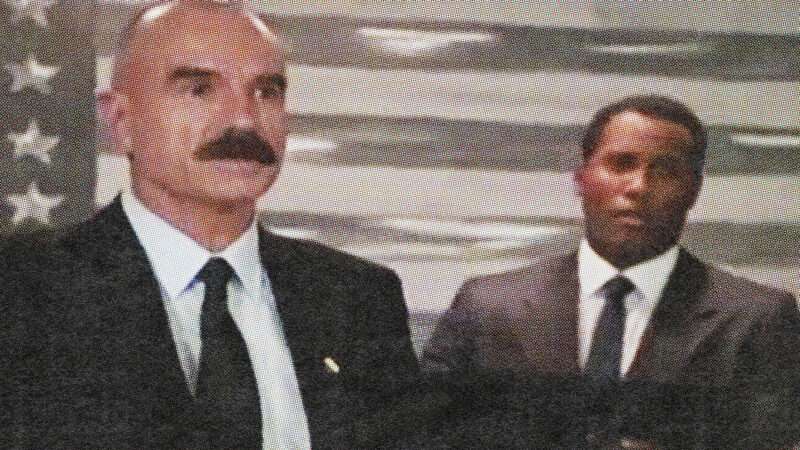
The most interesting parts of G. Gordon Liddy’s career came after he botched the Watergate burglary. With his old lines of work no longer available to him, the former Nixon henchman—who died earlier this week—had to find new ways to make a living. Like playing a recurring villain on the gauzy cop show Miami Vice. Or holding a series of debates with the psychedelic celebrity Timothy Leary.
We have a pretty good sense of what the first Leary-Liddy debate tour was like, because one of Robert Altman’s protégés made a weirdly compelling documentary about it. The important thing to understand here is that Leary and Liddy weren’t just a symbol of the counterculture and a symbol of Richard Nixon’s presidency: They had once been direct antagonists, with Liddy participating in a 1966 raid on an estate where Leary had been conducting psychedelic experiments. Later they landed in the same prison, Leary on drug charges and Liddy on Watergate charges. By the early ’80s, the two old jailbirds clearly had a degree of affection for each other. That mutual respect comes through in Alan Rudolph’s 1983 film Return Engagement, which mixes excerpts from the duo’s stage show with interviews and other footage. In the process, Rudolph captures a disorienting moment in American history: a time after the convulsions of the 1960s and ’70 had ended but while most of the giant figures of that fading age were still around, trying to find a place for themselves in a changed world.
Don’t go into this film expecting a conventional left-vs.-right matchup. By this point in his life, Timothy Leary was a full-fledged libertarian. This becomes obvious a little more than 40 minutes into the movie, when he stands onstage singing the praises of voluntary organizations—”I believe in bridge clubs, I believe in families, I believe in friends, I believe in stock groups, I believe in collectives, I believe in corporations”—and damning the “one form of organization which is involuntary, and that’s the modern state.” He goes on to declare that every state in the world is a mafia, charging “extortion fees called taxes,” but he allows that “I love America. America’s the greatest mafia of them all.” At another point, after Liddy offers a lengthy denunciation of gun control, Leary doesn’t reply with a liberal argument for restricting firearms; he simply suggests that Liddy’s arguments against gun laws work just as well as arguments against drug laws. In other moments, Leary avoids conventional political issues altogether, instead singing the praises of personal computers and the baby boom generation. (His comments on the first topic are somewhat prescient. His comments on the second are pretty vapid.)
With Leary waxing anti-authoritarian, Liddy takes the more collectivist stance, issuing proclamations like “the common good transcends the individual good.” But Liddy’s willingness to defend traditional hierarchies had its limits: He also delivers a funny routine about his contempt for prison guards. (“Now just ask yourself: What kind of person would put himself in prison for 30 years?”) Liddy, a man who got his fame by committing crimes on behalf of the state, spends the film in that hazy gray zone where the criminal life intersects with the world of law and order. In one scene he hangs out with outlaw bikers; in another he brags about an award he got from a police group.
The most interesting exchange comes just a few minutes before the final credits roll. By this time we’ve seen some uncomfortable moments between the film’s stars and the public, as when a disabled audience member confronts Leary with his condition, declaring that drug users influenced by Leary’s ideas had attacked him. Now, as the debaters enjoy a meal, Leary poses a question to his sparring partner. “Gordon,” he asks, “why do you think that two intelligent, well-educated, dedicated, idealistic, romantic all-out guys like you and I are so unpopular?”
Liddy denies that many people hate him, pointing to that police award. Leary won’t have it: “Between the two of us,” he says, “we’ve locked up about 80 percent of the American people in mutual dislike.”
It is Liddy’s least self-aware moment in the movie. Leary’s least self-aware moment comes much earlier, as he chats amiably with Liddy’s wife at a party. Someone shouts, “Tim! Where did Bob go?” Leary replies that he doesn’t know where Bob is but he sure would like to find him. Then he turns to Mrs. Liddy and guilelessly explains: “Bob’s got the cocaine.”
(The movie starts about 26 seconds into the video below.)
Liddy moved deeper into show biz after Return Engagement came out, playing a CIA operative turned heroin smuggler in a 1985 Miami Vice episode called “Back in the World.” The show brought him back a year later for “Stone’s War,” in which his character turns out to be funneling private aid to Nicaragua’s contra rebels.
If you think that sounds a lot like Oliver North’s covert operations in Central America, you’re right. You might even be grinning at the decision to cast a Watergate conspirator in an Iran-contra story, thus uniting the biggest political scandal of the ’70s with the biggest political scandal of the ’80s. But here’s the wild part: “Stone’s War” aired on October 3, 1986. That’s exactly one month before the Lebanese news outlet Ash-Shiraa exposed the Iran-contra story. Any old cop show can rip something from the headlines, but how many manage to air their version of the tale first?
I’ve never really been a Miami Vice fan, and I can’t say that “Stone’s War” is better than the other episodes I’ve seen. Not by ordinary aesthetic standards, anyway. But between the ghost of Watergate and the apparition of Iran-contra, it achieves an eerie resonance that transcends the mediocre script. That’s how G. Gordon Liddy spent the ’80s: He wrote books, he did corporate speaking gigs, he ran a counterterrorism academy, he debated Dr. LSD, and in one strange moment he gave a cop show a touch of the uncanny.
(For past editions of the Friday A/V Club, go here. For another installment involving Miami Vice, go here.)
from Latest – Reason.com https://ift.tt/3sKTtLD
via IFTTT
In October, the Harlan Institute and Ashbrook announced the Eighth Annual Virtual Supreme Court Competition. This competition offers teams of two high school students the opportunity to research cutting-edge constitutional law, write persuasive appellate briefs, argue against other students through video chats, and try to persuade a panel of esteemed attorneys during oral argument that their side is correct. This year the competition focuses on Torres v. Madrid.
We are proud to announce the top 12 respondent teams that will advance to the next round. Here are their preliminary oral argument videos, and their briefs. We announced the top 12 petitioner teams here.
In October, the Harlan Institute and Ashbrook announced the Eighth Annual Virtual Supreme Court Competition. This competition offers teams of two high school students the opportunity to research cutting-edge constitutional law, write persuasive appellate briefs, argue against other students through video chats, and try to persuade a panel of esteemed attorneys during oral argument that their side is correct. This year the competition focuses on Torres v. Madrid.
We are proud to announce the top 12 petitioner teams that will advance to the next round. Here are their preliminary oral argument videos, and their briefs. We will announce the top 12 respondent teams in another post.
The most interesting parts of G. Gordon Liddy’s career came after he botched the Watergate burglary. With his old lines of work no longer available to him, the former Nixon henchman—who died earlier this week—had to find new ways to make a living. Like playing a recurring villain on the gauzy cop show Miami Vice. Or holding a series of debates with the psychedelic celebrity Timothy Leary.
We have a pretty good sense of what the first Leary-Liddy debate tour was like, because one of Robert Altman’s protégés made a weirdly compelling documentary about it. The important thing to understand here is that Leary and Liddy weren’t just a symbol of the counterculture and a symbol of Richard Nixon’s presidency: They had once been direct antagonists, with Liddy participating in a 1966 raid on an estate where Leary had been conducting psychedelic experiments. Later they landed in the same prison, Leary on drug charges and Liddy on Watergate charges. By the early ’80s, the two old jailbirds clearly had a degree of affection for each other. That mutual respect comes through in Alan Rudolph’s 1983 film Return Engagement, which mixes excerpts from the duo’s stage show with interviews and other footage. In the process, Rudolph captures a disorienting moment in American history: a time after the convulsions of the 1960s and ’70 had ended but while most of the giant figures of that fading age were still around, trying to find a place for themselves in a changed world.
Don’t go into this film expecting a conventional left-vs.-right matchup. By this point in his life, Timothy Leary was a full-fledged libertarian. This becomes obvious a little more than 40 minutes into the movie, when he stands onstage singing the praises of voluntary organizations—”I believe in bridge clubs, I believe in families, I believe in friends, I believe in stock groups, I believe in collectives, I believe in corporations”—and damning the “one form of organization which is involuntary, and that’s the modern state.” He goes on to declare that every state in the world is a mafia, charging “extortion fees called taxes,” but he allows that “I love America. America’s the greatest mafia of them all.” At another point, after Liddy offers a lengthy denunciation of gun control, Leary doesn’t reply with a liberal argument for restricting firearms; he simply suggests that Liddy’s arguments against gun laws work just as well as arguments against drug laws. In other moments, Leary avoids conventional political issues altogether, instead singing the praises of personal computers and the baby boom generation. (His comments on the first topic are somewhat prescient. His comments on the second are pretty vapid.)
With Leary waxing anti-authoritarian, Liddy takes the more collectivist stance, issuing proclamations like “the common good transcends the individual good.” But Liddy’s willingness to defend traditional hierarchies had its limits: He also delivers a funny routine about his contempt for prison guards. (“Now just ask yourself: What kind of person would put himself in prison for 30 years?”) Liddy, a man who got his fame by committing crimes on behalf of the state, spends the film in that hazy gray zone where the criminal life intersects with the world of law and order. In one scene he hangs out with outlaw bikers; in another he brags about an award he got from a police group.
The most interesting exchange comes just a few minutes before the final credits roll. By this time we’ve seen some uncomfortable moments between the film’s stars and the public, as when a disabled audience member confronts Leary with his condition, declaring that drug users influenced by Leary’s ideas had attacked him. Now, as the debaters enjoy a meal, Leary poses a question to his sparring partner. “Gordon,” he asks, “why do you think that two intelligent, well-educated, dedicated, idealistic, romantic all-out guys like you and I are so unpopular?”
Liddy denies that many people hate him, pointing to that police award. Leary won’t have it: “Between the two of us,” he says, “we’ve locked up about 80 percent of the American people in mutual dislike.”
It is Liddy’s least self-aware moment in the movie. Leary’s least self-aware moment comes much earlier, as he chats amiably with Liddy’s wife at a party. Someone shouts, “Tim! Where did Bob go?” Leary replies that he doesn’t know where Bob is but he sure would like to find him. Then he turns to Mrs. Liddy and guilelessly explains: “Bob’s got the cocaine.”
(The movie starts about 26 seconds into the video below.)
Liddy moved deeper into show biz after Return Engagement came out, playing a CIA operative turned heroin smuggler in a 1985 Miami Vice episode called “Back in the World.” The show brought him back a year later for “Stone’s War,” in which his character turns out to be funneling private aid to Nicaragua’s contra rebels.
If you think that sounds a lot like Oliver North’s covert operations in Central America, you’re right. You might even be grinning at the decision to cast a Watergate conspirator in an Iran-contra story, thus uniting the biggest political scandal of the ’70s with the biggest political scandal of the ’80s. But here’s the wild part: “Stone’s War” aired on October 3, 1986. That’s exactly one month before the Lebanese news outlet Ash-Shiraa exposed the Iran-contra story. Any old cop show can rip something from the headlines, but how many manage to air their version of the tale first?
I’ve never really been a Miami Vice fan, and I can’t say that “Stone’s War” is better than the other episodes I’ve seen. Not by ordinary aesthetic standards, anyway. But between the ghost of Watergate and the apparition of Iran-contra, it achieves an eerie resonance that transcends the mediocre script. That’s how G. Gordon Liddy spent the ’80s: He wrote books, he did corporate speaking gigs, he ran a counterterrorism academy, he debated Dr. LSD, and in one strange moment he gave a cop show a touch of the uncanny.
(For past editions of the Friday A/V Club, go here. For another installment involving Miami Vice, go here.)
from Latest – Reason.com https://ift.tt/3sKTtLD
via IFTTT
Thomas Jefferson High School for Science and Technology in Fairfax County, Virginia, is one of the most elite public schools in the country. In 2019, U.S. News and World Report ranked it as America’s best overall high school.
It also educates a substantial racial minority population: 70 percent of TJ’s students are Asian-Americans—many of them children of immigrants.
You might think progressive education officials would celebrate this. Instead, they have decided to jettison the school’s famously tough admissions test in favor of a “holistic” (i.e., subjective and arbitrary) system that will permit officials to reject Asian-American students in favor of less-deserving students who belong to other racial categories.
Under the new rules, Fairfax will first identify all eighth-graders who meet certain academic criteria: those who achieve an unweighted GPA of at least 3.5 while taking Algebra I or a higher-level math class, in addition to math and science honors courses and either an English or social studies honors course.
Qualified eighth-graders will be invited to complete a math or science problem-solving essay, as well as a “Student Portrait Sheet.” Fairfax staffers will review these, taking into account “experience factors” including whether students are low-income, have special needs or come from households that do not speak English.
Ultimately, 550 middle-schoolers will receive offers each year to attend the prestigious STEM school, which is often ranked the No. 1 public high school in the nation. In a bid to ensure geographical diversity, a certain number of seats will be allotted to every middle school in Fairfax County, to be filled by eighth-graders at that school who meet criteria.
The cap on how many students can enter TJ from each middle school is arguably the most impactful: There are three middle schools with predominantly Asian-American student populations that typically account for a sizable proportion of TJ’s admissions. Limiting the number of admissions letters available to the students at these schools will in effect artificially limit the Asian-American applicant pool.
The new admissions policy has drawn a lawsuit from the Pacific Legal Foundation (PLF), which represents a coalition of parents. These plaintiffs include Harry Jackson, father of one of the six black students who was admitted to TJ in the previous cycle. Jackson understands that under the new policy, additional black and Hispanic students would likely be admitted, but doesn’t see how this is fair to the more qualified Asian-American students.
“As an African American father of a TJ student, I would also like to see more Black and Hispanic students at the school,” he told the Post. “But if those students are not making the grade, the problem isn’t the standards. It’s more likely that the elementary school pipeline is failing to prepare them for the rigors of an environment like TJ.”
In his own op-ed for The Washington Post, Jackson accused the school of treating Asian students as if they were “the wrong kind” of racial minority.
PLF’s lawsuit argues that the new admission plan was clearly adopted for the explicit purpose of curbing Asian enrollment, and is thus unconstitutional.
“The government cannot choose who receives the opportunity to attend public schools based on race or ethnicity,” said PLF attorney Erin Wilcox. “Such actions clearly violate the Fourteenth Amendment’s guarantee of equal protection.”
Fairfax County Public Schools have not yet commented on the lawsuit, expect to note that TJ is committed to maintaining its excellent standards while fostering racial diversity.
One of the most fascinating aspects of the new admissions plan is that the largest beneficiaries would not be racial minorities, but white students. According to PLF, the school district’s own projections showed that white enrollment would increase more substantially than Black or Hispanic enrollment. And if the school board succeeded at its stated goal of “proportional” racial representation among the student body, white enrollment would increase even more dramatically. As Ilya Somin noted in a post for the Volokh Conspiracy:
The student body at TJ is currently 73% Asian-American, 1% black, 3.3% Hispanic or Latino, 6% other, and 17.7% white. If, as County school officials indicated, the goal of the new policy is to get a student body that is “proportional” to Fairfax’s population demographics, the biggest change would be an increase in the percentage of non-Hispanic whites from the current 17.7% to somewhere between 50 and 60%, though the percentage of blacks and Latinos would also increase. The plaintiffs’ analysis estimates that the new admission system would, in fact, result in a student body that is roughly 31% Asian-American, 5% black, 8% Hispanic or Latino, 48% white, and 8% other.
In the name of helping racial minorities, officials are adopting a plan that would boost whites at the expense of Asian Americans.
This debate is unfolding at a time when anti-Asian animus has taken center stage, thanks mostly to a perception that anti-Asian hate crimes are rising. Any serious effort to confront systemic racism against Asian Americans must grapple with the fact that the admissions policies of elite educational institutions—not just TJ, but also Harvard and Yale—deliberately discriminate against Asians. Such policies should anger anyone who thinks anti-Asian bias is a pressing issue.
from Latest – Reason.com https://ift.tt/2PNMumI
via IFTTT
Thomas Jefferson High School for Science and Technology in Fairfax County, Virginia, is one of the most elite public schools in the country. In 2019, U.S. News and World Report ranked it as America’s best overall high school.
It also educates a substantial racial minority population: 70 percent of TJ’s students are Asian-Americans—many of them children of immigrants.
You might think progressive education officials would celebrate this. Instead, they have decided to jettison the school’s famously tough admissions test in favor of a “holistic” (i.e., subjective and arbitrary) system that will permit officials to reject Asian-American students in favor of less-deserving students who belong to other racial categories.
Under the new rules, Fairfax will first identify all eighth-graders who meet certain academic criteria: those who achieve an unweighted GPA of at least 3.5 while taking Algebra I or a higher-level math class, in addition to math and science honors courses and either an English or social studies honors course.
Qualified eighth-graders will be invited to complete a math or science problem-solving essay, as well as a “Student Portrait Sheet.” Fairfax staffers will review these, taking into account “experience factors” including whether students are low-income, have special needs or come from households that do not speak English.
Ultimately, 550 middle-schoolers will receive offers each year to attend the prestigious STEM school, which is often ranked the No. 1 public high school in the nation. In a bid to ensure geographical diversity, a certain number of seats will be allotted to every middle school in Fairfax County, to be filled by eighth-graders at that school who meet criteria.
The cap on how many students can enter TJ from each middle school is arguably the most impactful: There are three middle schools with predominantly Asian-American student populations that typically account for a sizable proportion of TJ’s admissions. Limiting the number of admissions letters available to the students at these schools will in effect artificially limit the Asian-American applicant pool.
The new admissions policy has drawn a lawsuit from the Pacific Legal Foundation (PLF), which represents a coalition of parents. These plaintiffs include Harry Jackson, father of one of the six black students who was admitted to TJ in the previous cycle. Jackson understands that under the new policy, additional black and Hispanic students would likely be admitted, but doesn’t see how this is fair to the more qualified Asian-American students.
“As an African American father of a TJ student, I would also like to see more Black and Hispanic students at the school,” he told the Post. “But if those students are not making the grade, the problem isn’t the standards. It’s more likely that the elementary school pipeline is failing to prepare them for the rigors of an environment like TJ.”
In his own op-ed for The Washington Post, Jackson accused the school of treating Asian students as if they were “the wrong kind” of racial minority.
PLF’s lawsuit argues that the new admission plan was clearly adopted for the explicit purpose of curbing Asian enrollment, and is thus unconstitutional.
“The government cannot choose who receives the opportunity to attend public schools based on race or ethnicity,” said PLF attorney Erin Wilcox. “Such actions clearly violate the Fourteenth Amendment’s guarantee of equal protection.”
Fairfax County Public Schools have not yet commented on the lawsuit, expect to note that TJ is committed to maintaining its excellent standards while fostering racial diversity.
One of the most fascinating aspects of the new admissions plan is that the largest beneficiaries would not be racial minorities, but white students. According to PLF, the school district’s own projections showed that white enrollment would increase more substantially than Black or Hispanic enrollment. And if the school board succeeded at its stated goal of “proportional” racial representation among the student body, white enrollment would increase even more dramatically. As Ilya Somin noted in a post for the Volokh Conspiracy:
The student body at TJ is currently 73% Asian-American, 1% black, 3.3% Hispanic or Latino, 6% other, and 17.7% white. If, as County school officials indicated, the goal of the new policy is to get a student body that is “proportional” to Fairfax’s population demographics, the biggest change would be an increase in the percentage of non-Hispanic whites from the current 17.7% to somewhere between 50 and 60%, though the percentage of blacks and Latinos would also increase. The plaintiffs’ analysis estimates that the new admission system would, in fact, result in a student body that is roughly 31% Asian-American, 5% black, 8% Hispanic or Latino, 48% white, and 8% other.
In the name of helping racial minorities, officials are adopting a plan that would boost whites at the expense of Asian Americans.
This debate is unfolding at a time when anti-Asian animus has taken center stage, thanks mostly to a perception that anti-Asian hate crimes are rising. Any serious effort to confront systemic racism against Asian Americans must grapple with the fact that the admissions policies of elite educational institutions—not just TJ, but also Harvard and Yale—deliberately discriminate against Asians. Such policies should anger anyone who thinks anti-Asian bias is a pressing issue.
from Latest – Reason.com https://ift.tt/2PNMumI
via IFTTT
During the seemingly endless run-up to the last election, my partisan friends would often say to me, “politics is binary.” Their point is that voters only have two serious choices in any election, the Democrats or the Republicans. We need to pick a side and then, apparently, serve as cheerleaders for whatever that side is doing.
As a libertarian who doesn’t like either choice, I often scream in frustration. Baltimore Journalist H.L. Mencken succinctly captures my view of the reigning Democrats and Republicans: “Under democracy one party always devotes its chief energies to prove that the other party is unfit to rule—and both commonly succeed, and are right.” He believed that our political history is “simply a record of vacillations between two gangs of frauds.”
Few issues capture the fraudulent nature of modern politics more than civil-asset forfeiture. If I had a dime for every time a national politician mentions the Constitution, I could retire tomorrow along the California coast. My pockets would be empty if I collected that dime every time those same politicians demanded the reform of that forfeiture system that wantonly violates the Constitution’s principles.
Civil forfeiture laws allow police agencies to seize Americans’ homes, cars, and cash upon the suspicion that someone used the property in criminal activity—and without due process afforded to its owner. The courts file cases with odd names such as, “The United States Government v. a 2017 Ford Explorer.” The government targets the property—then forces owners to prove their innocence to get it back (and it’s a long and costly process to do so).
One need only do a little Google research to find endless appalling examples. In one Anaheim case, city and federal officials attempted to seize a $1.5 million commercial building after cops accused one of the owner’s tenants of illegally selling $37 worth of marijuana. Prosecutors ultimately dropped that case amid bad publicity, but California officials grab $100 million a year in such takings.
Most comes from ordinary (and usually low-income) people, not drug kingpins. If, let’s say, someone steals your $40,000 SUV and uses it in a drug deal, police can keep the vehicle because it—and not you—was involved in a crime. If you’re pulled over for speeding and police find $10,000 in cash in the glove compartment, they can assume that the money came from illegal activity and take it—even if it came from a legitimate transaction.
Many states have passed asset-forfeiture reform on a bipartisan basis. Recently, Arizona’s House of Representatives passed, on a 57-2 vote, a bill that would require that police obtain a conviction for an underlying crime before depriving people of their property. California passed a similar law in 2016. The Legislative Analyst’s Office has struggled to monitor its results because police agencies haven’t fully complied with its reporting requirements.
Unfortunately, state reforms aren’t enough because police agencies have concocted a clever workaround. They take people’s assets, then “partner” with federal agencies, which operate under a much broader standard. Then they split the loot. The problem is that the system provides perverse financial incentives.
“In the federal system and most states, the property that is seized and forfeited is not delivered to the federal or state treasuries, but instead is kept by the law enforcement agencies themselves,” argued a variety of liberal and conservative groups (including my employer) in a recent letter to Congress. They called for simple reforms—sending proceeds to the general treasury, eliminating partnering programs, and adding judicial oversight.
Both parties have terrible records on the topic. Despite his support from progressives who champion criminal-justice reform, President Joe Biden is the architect of the key drug-war law that set asset forfeiture loose on the general public. The Trump administration’s last two attorney generals (William Barr and Jeff Sessions) argued for expanded use of it. Democrats and Republicans are frauds on this issue, so it’s time for public pressure.
Police agencies insist that civil forfeiture laws are an important tool in fighting against drug cartels, but they rely solely on conjecture rather than data to make that case. When California was debating its reform, its police opponents publicly opposed it mainly because of what it might do to their budgets. Cry me a river on that one.
“It may be the oldest question in politics: what makes government legitimate?” wrote Timothy Sandefur, in a new report about asset forfeiture for the Arizona-based Goldwater Institute. “Or as the Christian thinker St. Augustine put it some 1,500 years ago, what distinguishes a state from a gang of criminals?…A government serves justice, not the private advantage of those in charge.”
If partisans ever set aside their political grudge matches for a moment, they might find common ground on reforming this unconstitutional system. Our political system might be binary, but here’s a good chance for some singularity.
This column was first published in The Orange County Register.
from Latest – Reason.com https://ift.tt/3sK4EnT
via IFTTT
During the seemingly endless run-up to the last election, my partisan friends would often say to me, “politics is binary.” Their point is that voters only have two serious choices in any election, the Democrats or the Republicans. We need to pick a side and then, apparently, serve as cheerleaders for whatever that side is doing.
As a libertarian who doesn’t like either choice, I often scream in frustration. Baltimore Journalist H.L. Mencken succinctly captures my view of the reigning Democrats and Republicans: “Under democracy one party always devotes its chief energies to prove that the other party is unfit to rule—and both commonly succeed, and are right.” He believed that our political history is “simply a record of vacillations between two gangs of frauds.”
Few issues capture the fraudulent nature of modern politics more than civil-asset forfeiture. If I had a dime for every time a national politician mentions the Constitution, I could retire tomorrow along the California coast. My pockets would be empty if I collected that dime every time those same politicians demanded the reform of that forfeiture system that wantonly violates the Constitution’s principles.
Civil forfeiture laws allow police agencies to seize Americans’ homes, cars, and cash upon the suspicion that someone used the property in criminal activity—and without due process afforded to its owner. The courts file cases with odd names such as, “The United States Government v. a 2017 Ford Explorer.” The government targets the property—then forces owners to prove their innocence to get it back (and it’s a long and costly process to do so).
One need only do a little Google research to find endless appalling examples. In one Anaheim case, city and federal officials attempted to seize a $1.5 million commercial building after cops accused one of the owner’s tenants of illegally selling $37 worth of marijuana. Prosecutors ultimately dropped that case amid bad publicity, but California officials grab $100 million a year in such takings.
Most comes from ordinary (and usually low-income) people, not drug kingpins. If, let’s say, someone steals your $40,000 SUV and uses it in a drug deal, police can keep the vehicle because it—and not you—was involved in a crime. If you’re pulled over for speeding and police find $10,000 in cash in the glove compartment, they can assume that the money came from illegal activity and take it—even if it came from a legitimate transaction.
Many states have passed asset-forfeiture reform on a bipartisan basis. Recently, Arizona’s House of Representatives passed, on a 57-2 vote, a bill that would require that police obtain a conviction for an underlying crime before depriving people of their property. California passed a similar law in 2016. The Legislative Analyst’s Office has struggled to monitor its results because police agencies haven’t fully complied with its reporting requirements.
Unfortunately, state reforms aren’t enough because police agencies have concocted a clever workaround. They take people’s assets, then “partner” with federal agencies, which operate under a much broader standard. Then they split the loot. The problem is that the system provides perverse financial incentives.
“In the federal system and most states, the property that is seized and forfeited is not delivered to the federal or state treasuries, but instead is kept by the law enforcement agencies themselves,” argued a variety of liberal and conservative groups (including my employer) in a recent letter to Congress. They called for simple reforms—sending proceeds to the general treasury, eliminating partnering programs, and adding judicial oversight.
Both parties have terrible records on the topic. Despite his support from progressives who champion criminal-justice reform, President Joe Biden is the architect of the key drug-war law that set asset forfeiture loose on the general public. The Trump administration’s last two attorney generals (William Barr and Jeff Sessions) argued for expanded use of it. Democrats and Republicans are frauds on this issue, so it’s time for public pressure.
Police agencies insist that civil forfeiture laws are an important tool in fighting against drug cartels, but they rely solely on conjecture rather than data to make that case. When California was debating its reform, its police opponents publicly opposed it mainly because of what it might do to their budgets. Cry me a river on that one.
“It may be the oldest question in politics: what makes government legitimate?” wrote Timothy Sandefur, in a new report about asset forfeiture for the Arizona-based Goldwater Institute. “Or as the Christian thinker St. Augustine put it some 1,500 years ago, what distinguishes a state from a gang of criminals?…A government serves justice, not the private advantage of those in charge.”
If partisans ever set aside their political grudge matches for a moment, they might find common ground on reforming this unconstitutional system. Our political system might be binary, but here’s a good chance for some singularity.
This column was first published in The Orange County Register.
from Latest – Reason.com https://ift.tt/3sK4EnT
via IFTTT