Illinois Will Finally Stop Stripping People of Their Home Equity—3 Years After the Supreme Court Outlawed It


A hand reaches toward a house in front of a red backdrop | Illustration: Janceluch/Dreamstime/Midjourney

In May of this year, a federal judge ruled that Cook County, Illinois, is liable for constitutional violations when it seized people’s homes over property tax debts and left them with nothing. That scheme—sometimes referred to as home equity theft—sounds nightmarish. The reality is harsher, however, when you consider the U.S. Supreme Court unanimously ruled the practice unconstitutional nearly three years before this recent ruling.

Illinois Gov. J.B. Pritzker last week signed a bill into law that finally brings the state into the present. The legislation promises homeowners will receive the surplus proceeds when the government takes their home to satisfy a debt and paves the way for those with previous claims to receive compensation.

In May 2023, the high court said in Tyler v. Hennepin County that the government could not justify keeping the profit after seizing and selling an elderly Minneapolis woman’s condo to collect on a modest tax debt. The plaintiff, Geraldine Tyler, had relocated to a retirement community after various neighborhood incidents, including a shooting, left her feeling unsafe. But she struggled to pay both her new rent and the taxes on her property. A $2,300 tax debt became about $15,000 with penalties, interest, and fees—after which the government took possession of the home, sold it at auction, and kept the surplus.

“A taxpayer who loses her $40,000 house to the State to fulfill a $15,000 tax debt has made a far greater contribution to the public fisc than she owed,” wrote Chief Justice John Roberts for the Court. “The taxpayer must render unto Caesar what is Caesar’s, but no more.” The ruling was grounded in the Takings Clause of the Fifth Amendment, which promises “just compensation” when private property is taken for public use.

Yet Illinois was an example of how a state could cynically keep home equity theft on life support. Local governments there would sell tax liens to private investors. After a redemption period, if the debtor could satisfy what is owed—including steep interest and fees—then the investor would petition for the deed to the home, having effectively purchased the property for the value of the debt. With limited exceptions, the former owner was then left with nothing.

“Thousands of Illinois homeowners have lost an average of 85 percent of their equity due to unconstitutional property tax forfeiture laws — over unpaid tax bills that amounted to a fraction of their property’s value — together exceeding $303 million,” said Kileen Lindgren of the Pacific Legal Foundation, which represented Tyler, in a statement. “This new law recognizes that the government is entitled to collect what it is owed, and not a dollar more.”

The post Illinois Will Finally Stop Stripping People of Their Home Equity—3 Years After the Supreme Court Outlawed It appeared first on Reason.com.

from Latest – Reason.com https://ift.tt/iZSkDxE
via IFTTT

Congress Wants To Keep Funding a Pentagon That Won’t Account for Its Spending


Speaker of the House Mike Johnson | Photo: Tom Williams/CQ Roll Call/Newscom

President Donald Trump might soon be getting a cash infusion for his “new” war in Iran. 

On Wednesday, House Republicans shared the text of their budget reconciliation bill, which directs the House Armed Services Committee—which oversees the Department of Defense (DOD)—to “submit changes in laws within its jurisdiction that increase the deficit by not more than” $60 billion. This money will presumably go toward replenishing the Pentagon’s spent accounts and financing the administration’s campaign in Iran.

In recent months, the Trump administration has asked Congress for varying sums to fund its war in Iran. After Defense Secretary Pete Hegseth’s $200 billion request in March, the White House asked for $1.5 trillion as part of its FY 2027 budget in April. The $60 billion proposed by House Republicans is close to the administration’s most recent request of $67 billion for the DOD, made in June by Office of Management and Budget Director Russell Vought.

Thanks to its notoriously poor accounting records, it’s unclear how much the department has spent on the war in Iran. The Pentagon has failed eight straight financial audits. It remains the only major federal agency that has never received a passing grade, according to the Government Accountability Office (GAO). 

In May, as Hegseth and Jules Hurst, the assistant secretary for the Army and the Pentagon’s former comptroller, argued for the $1.5 trillion request before the House Appropriations Subcommittee on Defense, Hurst told lawmakers that the war had cost about $29 billion. But a month earlier, U.S. officials “familiar with internal assessments” placed the cost at about $50 billion, according to CBS News.

During that May hearing, Hurst also characterized the $1.5 trillion requested this year as a “one-time plus-up for catch-up,” even though the department intends to ask for $1.23 trillion next year. These are worryingly large sums of money for an agency the government’s watchdog admits has “pervasive deficiencies” and “long-standing financial management problems.” Despite its track record, the agency has shown no signs of changing. 

While House Republicans were preparing to send the department an additional $60 billion, the DOD was working to hide the latest report critical of its spending practices. On Wednesday, the Pentagon “barred the release” of a GAO report on the F-35 fighter plane. This program has dealt with spiraling costs and critical deficiencies since its inception, according to The Hill

The current fleet is only capable of performing “all of its missions” 25 percent of the time, according to a June GAO report. With a price tag of $62.2 million to $77.2 million per plane—and the cost to sustain “the fleet of aircraft through 2088” estimated at $1.6 trillion—it seems the program may be more trouble than it’s worth. 

Somehow, a depleted budget hasn’t stopped the Pentagon from frivolously spending cash on overseas intervention and buying equity stakes in private companies. 

In April, the agency closed on a $1 billion investment in defense contractor L3Harris Technologies that converts into equity when the company goes public. The department also owns $400 million in preferred stock of the critical-mineral company MP Materials and a 10 percent stake in another critical-mineral company, Trilogy Metals—alongside stakes in several other companies. 

The Senate, in its FY 2027 National Defense Authorization Act, which passed out of the Armed Services Committee in June, seemingly approved the administration’s socialist policies. Rather than banning the DOD from purchasing shares in private companies, the Senate set guardrails on this spending: equity stakes can’t exceed 40 percent of a company’s valuation, and the Pentagon must cap investments in private companies at $500 million.

The Pentagon’s leash could soon be shortened thanks to the FY 2024 National Defense Authorization Act, which requires the DOD to receive a clean audit opinion on its financial statements by no later than December 31, 2028. 

Still, even if the agency fails to meet this requirement, it’s unlikely to change anything, given Congress’ propensity for writing blank checks whenever the department utters the phrase “national security.”

The post Congress Wants To Keep Funding a Pentagon That Won't Account for Its Spending appeared first on Reason.com.

from Latest – Reason.com https://ift.tt/3rxdC21
via IFTTT

Journal of Free Speech Law: “Policing Expressive Governance: A Framework for Judicial Review of Executive Viewpoint Retaliation,” by Simona Grossi

The article is here; here’s the Introduction:

The gravest contemporary threats to expressive freedom do not always take the form of statutes or criminal sanctions. Increasingly, they take the form of procurement decisions, grant terminations, security-clearance revocations, and regulatory designations—the discretionary instruments of executive administration. When the executive deploys these instruments to penalize disfavored viewpoints while preserving the appearance of ordinary governance, it engages in what I have elsewhere called expressive governance. This phenomenon is doctrinally elusive precisely because it operates in domains where courts have long, and for sound institutional reasons, extended substantial deference to executive judgment.

A recent dispute crystallizes the problem. After a leading artificial intelligence company publicly maintained that its models could not be deployed for use in autonomous lethal weapons or the mass surveillance of citizens, and declined contract terms that would have required otherwise, the government designated the company a “supply-chain risk to national security”—a classification historically reserved for foreign adversaries—and moved to foreclose its commercial relationships across the federal defense ecosystem. The designation was framed as a national security judgment. But the sequence of events, the named targeting, and the disproportion of the response suggest a different object: retaliation for protected expression, accomplished through an administrative label. One might resist this inference, reading the episode as the disciplining of a difficult counterparty rather than retaliation for a viewpoint. The framework developed here does not foreclose that reading — it is designed to test it. Part IV takes up the objection directly.

Building on work I have developed elsewhere, this essay shows how the existing First Amendment doctrine supplies the governing principles to address expressive governance but lacks an administrable method calibrated to the low-visibility, discretion-cloaked form the problem now assumes. It then proposes such a method: a framework of three interlocking tools—a clear-statement requirement, a burden-shifting rule, and an evidentiary presumption of systemic distortion where the executive targets expressive intermediaries. The framework neither invents a new tier of scrutiny nor relaxes the deference that executive administration ordinarily warrants. Rather, it allocates proof and construes authority so that genuine managerial decisions remain insulated while viewpoint retaliation cloaked in discretionary form becomes detectable.

The post Journal of Free Speech Law: "Policing Expressive Governance: A Framework for Judicial Review of Executive Viewpoint Retaliation," by Simona Grossi appeared first on Reason.com.

from Latest – Reason.com https://ift.tt/gofZrxA
via IFTTT

Trump Media’s Lawsuit Against Wash. Post Over “Trust Linked to Porn-Friendly Bank Could Gain a Stake in Trump’s Truth Social” Thrown Out

From Trump Media & Tech. Group Corp. v. WP Co. LLC, decided today by Judge Tom Barber (M.D. Fla.):

In 2023, Defendant WP Company LLC (the “Post”) published an article titled “Trust linked to porn-friendly bank could gain a stake in Trump’s Truth Social,” which reported on the finances of Trump Media Technology Group (“TMTG”). After almost three years of litigation, the Post has now admitted that portions of the article included false information. Specifically, the Post admits its story incorrectly stated that TMTG paid a $240,000 referral fee in connection with an $8 million loan from an entity known as ES Family Trust. The Post now admits that no such payment was made and recently chose to publish a “Correction” to that effect {“Discovery in the ongoing litigation has established that Trump Media didn’t pay a loan referral fee of $240,000, as was stated in the article and was based on The Post’s reporting at the time of publication.”}. TMTG contends in this defamation lawsuit that the statements about the referral fee were false and defamatory and seeks almost $2 billion in damages resulting from the publication.

However, under controlling United States Supreme Court and Eleventh Circuit precedent following New York Times Co. v. Sullivan (1964), a jury will not have the opportunity to decide this case. To survive summary judgment, TMTG must show more than just that the Post’s statements were false and defamatory.

Current law requires that TMTG also establish that the Post acted with “actual malice,” that is, TMTG must prove that, at the time the Post published the statements, the Post either actually knew the statements were false or had serious doubt as to whether they were true or false. Further, to prevail under current law, TMTG must establish actual malice by evidence that goes beyond the “preponderance of the evidence” necessary in the usual civil case and adduce evidence on this issue that is clear and convincing.

These standards are exceedingly difficult for any plaintiff to meet, and TMTG has not met them here. TMTG’s evidence establishes beyond any doubt whatsoever that the Post published false information—the Post has admitted that. Under the facts presented here, reasonable minds could certainly conclude the Post acted unreasonably and should have conducted a better investigation before making the challenged statements. But under controlling precedent, such a showing is not sufficient to establish actual malice by clear and convincing evidence. Accordingly, the Court is required to grant summary judgment for the Post….

The circumstantial evidence adduced by TMTG certainly supports a jury finding that the Post acted unreasonably and should have done a more thorough investigation into the alleged payment of the finder’s fee. But it falls short of providing a basis for a jury finding that the evidence clearly and convincingly shows that the Post knew the story was false or published it with reckless disregard of whether it was false, that is, with serious doubt as to whether the story was true or false or with a high degree of awareness that the story was probably false.

First, there is no evidence that the Post fabricated the story that TMTG paid a finder’s fee, nor is there anything inherently implausible or even extraordinary about the story itself.

Second, the Post did not rely on anonymous tips, rumors, or other manifestly unreliable sources as is sometimes the case. It relied on information received from Wilkerson, an insider in position to know the truth, who was willing to go on the record, and who was providing information not only to the Post but also to other newspapers and government officials. The Post also relied on information from Wilkerson’s lawyers, whom the Post understood to be providing information on behalf of Wilkerson. See id. (affirming dismissal of defamation complaint where the story was not based on an unverified anonymous phone call).

[Reporter Drew] Harwell’s declaration asserts that Wilkerson’s lawyers told him that TMTG paid the fee. His contemporaneous notes confirm that assertion, as does a recording of an interview session involving not only the lawyers but Wilkerson himself. TMTG does not dispute Harwell’s assertions. Although Wilkerson’s deposition testimony might be slightly inconsistent with Harwell’s declaration and raise an issue of fact as to whether Wilkerson himself actually told Harwell that TMTG paid the fee, Wilkerson does not deny that his lawyers did so.

TMTG argues that Wilkerson was an unreliable source because TMTG suspended and then fired Wilkerson, giving him a motive to fabricate the story in retaliation. As the Court has previously observed, an employee’s termination does not necessarily cast doubt on negative information the employee provides about an employer.

Further, it is undisputed that Wilkerson did not “blow the whistle” after he had been fired. He was fired for “blowing the whistle,” i.e., for providing information to the press. Harwell’s declaration explains that he assessed Wilkerson’s credibility and concluded based on past experience with Wilkerson that Wilkerson was reliable. No record evidence casts doubt on that assertion.

Third, the Post investigated the story by reviewing documents provided by Wilkerson and his lawyers, including a draft fee agreement and an invoice for the fee apparently from Entoro Securities. These documents are fully consistent with the assertion by Wilkerson’s lawyers that TMTG paid the fee although they do not directly confirm it. They certainly do not contradict it. Harwell can be faulted for not pressing to obtain final documents or additional confirmation, but there is no evidence that

anyone or any document told Harwell the fee had not been paid. In the absence of an obvious reason to doubt the story, Harwell’s failure to seek additional confirmation does not suggest that he actually doubted the fee had been paid and purposefully sought to avoid the truth.

Fourth, prior to publishing, and consistent with his usual practice, Harwell sent to TMTG and others what the Post refers to as “no surprises” emails. These are sent to provide the subjects of an article an overview of information that may be included in the article, to give the subjects notice and a chance to comment or provide additional information. Harwell reached out to a number of different sources that included TMTG itself, TMTG CEO Devin Nunes, TMTG co-founders Wes Moss and Andy Litinsky, DWAC CEO Patrick Orlando, Entoro partner James Row, and the SEC. None responded with any information.

TMTG criticizes Harwell’s “no surprises” email on the ground that it referred only to the fee agreement rather than to payment of the fee, but the email’s express reference to the fee agreement and to “Entoro’s referral fee” is not what one would expect if the Post were trying to avoid the truth about the fee. If, as TMTG claims, the payment, not the agreement, is the critical fact, the Post’s “no surprises” email could be expected to elicit an explanation from TMTG that, regardless of any agreement, the fee had not been paid. The notion that the reference to the fee agreement in the “no surprises” emails was intended to distract attention from the subject of payment of the fee is speculative and insufficient to create a genuine issue of fact.

TMTG also argues that the Post sought confirmation from sources that it expected would not respond. While government agencies might be expected to decline comment on ongoing cases or investigations, that is not true of the many other sources noted above to whom the Post reached out.

TMTG argues that actual malice is demonstrated by the fact that the Post learned within a few days after publication that its own sources lacked proof of payment but did not issue a correction. But the crucial inquiry for actual malice is the Post’s state of mind at the time of publication. Assuming the Post’s failure to correct the story immediately upon learning that Wilkerson had no knowledge that payment had been made is relevant at all to the Post’s knowledge and state of mind at the time of publication, any inference from these post-publication facts to actual malice at the time of publication is speculative at best.

TMTG further argues that actual malice can be inferred from Harwell telling Professor Ohlrogge, an expert at New York University Law School that he consulted while developing the story, about an agreement to pay the fee but failing to inform him that the document the Post relied on as evidence of the agreement was an unsigned draft. However, Harwell stated in his declaration that he sent a copy of the draft agreement to Ohlrogge, and in any event, telling Ohlrogge there was an agreement or payment is perfectly consistent with Harwell’s belief that there was an agreement and payment; it is hardly evidence that Harwell knew or doubted those things were true.

In short, a source who was in a position to know the truth and was not obviously unreliable told the Post that TMTG paid a finder’s fee for the ES Family Trust loan. The idea that TMTG would pay such a fee is not inherently implausible. The source provided the Post with documents consistent with the assertion of payment although not directly confirming it. No person or document contradicted what the Post had been told. The Post reached out prior to publication to numerous sources, but none provided contrary information….

Although it is rooted in the First Amendment, which was adopted in 1791, the law applicable here was essentially invented by the U.S. Supreme Court in 1964 when it decided New York Times v. Sullivan. “Since 1964, however, our Nation’s media landscape has shifted in ways few could have foreseen.” Numerous justices, judges, and commentators have suggested that the law in this area needs to be revisited….

This Court shares many of [these] concerns, and if it were deciding this case on a clean slate, the result might be different. If the law did not require “clear and convincing evidence” of actual malice, it is likely the Post’s motion for summary judgment would have been denied, and a jury would have had the opportunity to weigh in on this matter. However, “until the Supreme Court reconsiders Sullivan, we are bound by it[.]” As explained above, under controlling law, TMTG’s evidence is insufficient to support a finding of actual malice under the clear and convincing standard, and summary judgment for the Post is therefore required….

Last year, Judge Barber had allowed the case to go forward based on the allegations in the Complaint, denying the Post defendants’ motion to dismiss. But now that there has been discovery, the judge concluded that Trump Media hadn’t introduced enough evidence to withstand a motion for summary judgment.

The post Trump Media's Lawsuit Against Wash. Post Over "Trust Linked to Porn-Friendly Bank Could Gain a Stake in Trump's Truth Social" Thrown Out appeared first on Reason.com.

from Latest – Reason.com https://ift.tt/ekC1jQv
via IFTTT

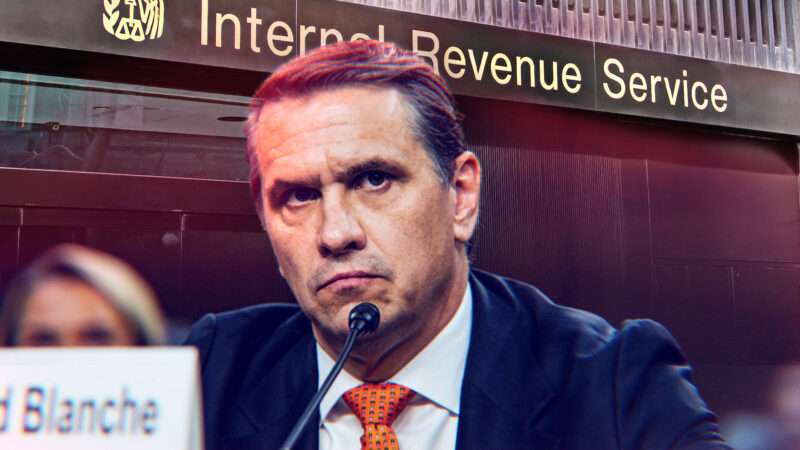
Todd Blanche Describes the Huge, Unprecedented Favors Granted by Trump’s IRS ‘Settlement’ as ‘Typical’


Acting Attorney General Todd Blanche | Illustration: Adani Samat | Photo: Mira Agron/Andrew Thomas /CNP/Picture Alliance/Consolidated News Photos/Newscom

President Donald Trump’s brazenly corrupt “settlement” of his lawsuit against the IRS included a jaw-dropping order in which Acting Attorney General Todd Blanche purported to shield him and his family from liability for tax violations and any other federal offenses they may have committed prior to May 19. During his confirmation hearing on Wednesday, Blanche, who is seeking Senate approval of his nomination as attorney general, repeatedly misrepresented the scope and nature of that sweeping immunity deal.

In response to questions from Sen. Richard Durbin (D–Ill.), Blanche preposterously claimed his promise of protection was “typical” of settlements between the IRS and taxpayers. “This type of settlement is done regularly,” he said. “When we enter into settlements like that, we do it with all kinds of people. It’s not just President Trump. It doesn’t make any of those individuals above the law.”

Blanche was referring to settlements of tax disputes. That comparison is inapt for several reasons.

First, Trump’s lawsuit, which was joined by two of his sons and the Trump Organization, did not involve a dispute about tax liability. It alleged damages caused by an IRS contractor’s illegal disclosure of the plaintiffs’ tax returns, an issue that has nothing to do with the question of whether they owe the IRS money.

Second, even in cases that do involve alleged tax violations, it is not “typical” for settlements to include a promise that the IRS will never pursue any other claims based on past returns. After Blanche revealed his order, former IRS Commissioner Daniel Werfel told the Associated Press he was not aware of any previous cases in which the IRS had agreed to “permanently forgo examination of previously filed tax returns for a specific person or business.”

Third, the IRS immunity in this case, which could save Trump more than $100 million in back taxes, interest, and penalties, not only covers the plaintiffs who filed the lawsuit. It also encompasses all “related or affiliated individuals…or parties.”

Fourth, Blanche’s order extends far beyond the IRS. It says “the United States” is “FOREVER BARRED and PRECLUDED” from pursuing “any and all claims” against Trump or his family regarding “any matters currently pending or that could be pending” before the IRS, the Treasury Department, or “other agencies or departments.” In other words, the order purports to shield Trump and his relatives from the penalties that ordinary Americans face when they run afoul of federal law.

That unprecedented relief resembles a preemptive self-pardon, except that it extends further, covering civil as well as criminal offenses. But according to Blanche, his order does not mean Trump and his family are “above the law.” In support of that conclusion, he noted that they are still liable for any future offenses they may commit (which is also true of pardon recipients). And despite the broad language of his order, Blanche flat-out denied that it goes beyond the IRS.

Sen. John Cornyn (R–Texas) noted that Blanche’s order “purports to apply” to “other agencies or departments.” He wondered whether it would bar “investigation by the Securities and Exchange Commission or some other federal agency.”

“No,” Blanche said. “It binds only the IRS and, by extension, the Treasury.”

Cornyn disagreed. “I hear what you’re saying,” he replied, “but I certainly don’t read that in the agreement.”

Cornyn, whose résumé includes stints as a state judge, a justice on the Texas Supreme Court, and his state’s attorney general, probably knows a thing or two about parsing legal language. So do the 35 retired federal judges, including former 4th Circuit Judge Michael Luttig and several other Republican appointees, who objected to Trump’s “settlement agreement” and urged U.S. District Judge Kathleen Williams to reopen the case.

“The plain language of this extremely broad provision sweeps in [IRS] audits of Plaintiffs’ tax returns and all other claims the United States might have against Plaintiffs,” Luttig et al. noted in their May 27 motion (emphasis added). These are “extraordinary benefits for which no consideration was provided to the government,” they added. The former judges reiterated that point in a June 19 brief, saying Blanche’s order provides “monumental relief,” granting “a capacious and extraordinary general release that purports to forfeit claims for substantial sums in unpaid taxes and other potential damages and fines.”

According to Blanche, however, that “monumental relief” is business as usual at the Justice Department. “That’s the standard language that we use when we enter into settlements between plaintiffs and the IRS,” he told Cornyn. Blanche, in other words, wants us to believe that such settlements routinely include blanket immunity from investigations of past conduct by the IRS and all “other agencies or departments.”

Why would Blanche ask us to believe that? Because he is keen to show that the president did not receive special treatment in this case by virtue of his position. But he obviously did.

Trump and the other plaintiffs absurdly claimed that the unauthorized disclosure of their tax returns had caused “at least” $10 billion in damages. In addition to offering an unlikely estimate of the injury he had suffered, Trump missed the statutory deadline for filing such claims, meaning his lawsuit was legally doomed right out of the gate. Even if Trump had filed his lawsuit on time, he would have faced the challenge of arguing that an IRS contractor qualifies as an “officer or employee of the United States”—a point that the Justice Department has disputed in other cases involving similar claims.

Despite those legal weaknesses, the Justice Department never bothered to contest Trump’s claims, in sharp contrast with the way it usually handles such cases. That is not surprising, since the government’s lawyers answer to Trump. And in case there was any chance that they would nevertheless do their jobs, Trump foreclosed that possibility by decreeing that they could not take any legal positions at odds with his.

In a scathing decision on Monday, Williams concluded that the case was a sham from the beginning, since both sides were controlled by Trump. The plaintiffs and the defendants “worked in tandem and were never actually adverse,” she wrote. Trump’s lawsuit, she said, was nothing more than a pretext for “a ‘settlement’ that had no viable basis in law or fact.”

Not so, Blanche told Sen. Mike Lee (R–Utah) on Wednesday. “Was there any improper coordination of any kind between the Department of Justice and the Trump team as to this settlement?” Lee asked. “No, not at all,” Blanche replied.

That assurance is hard to square with Trump’s own description of this cozy arrangement, which he called “a settlement with myself.” It is also inconsistent with Blanche’s unilateral decision to nix the $1.8 billion “Anti-Weaponization Fund” that was a central feature of the original “settlement agreement.” If that arrangement were actually an agreement between adverse parties, Blanche would have had to obtain the plaintiffs’ written consent to the modification, which he did not do.

Blanche provided further evidence of collusion when he unilaterally issued his promise of immunity, which he presented as an addendum to the main agreement even though he was the only person who signed it. His conduct made it clear that he was simultaneously acting as the head of the Justice Department and Trump’s personal lawyer.

After eliciting Blanche’s improbable denial of collusion, Lee averred that the case was settled “based on an apology without any compensation being awarded, without the president receiving a penny.” Although that is obviously not true, since the IRS immunity is worth a lot of money to Trump, Blanche agreed with Lee’s characterization.

The “settlement” was “completely consistent with the Federal Rule of Civil Procedure 41, which absolutely allows what happened here to happen,” Blanche said. “It happens in hundreds, if not thousands, of cases around the country every year.”

In reality, nothing like this has ever happened before. No other similarly situated plaintiff has ever received benefits remotely like those that Blanche approved for his boss, which initially included $1.8 billion in taxpayer money for Trump’s allies and supporters as well as potential personal savings in the neighborhood of $100 million.

How does that compare to the settlements obtained by other plaintiffs who have sued the IRS under the same law that Trump invoked? Unlike Trump, billionaire hedge fund manager Kenneth Griffin, whose tax returns were leaked by the same IRS contractor, filed his lawsuit on time. Also unlike Trump, Griffin had to contend with Justice Department lawyers who were keen to pick apart his claims. After a year and a half of litigation, Griffin dropped his case in exchange for an apology from the IRS.

As Lee noted, Trump also got an apology. But he got a lot more than that: huge favors for himself, his family, and his supporters, all at taxpayers’ expense. According to Blanche, that was “typical,” and Trump’s status as president had nothing to do with it. If you can believe that, you can also believe that Blanche as attorney general would have the integrity required to pursue justice rather than the president’s personal interests.

The post Todd Blanche Describes the Huge, Unprecedented Favors Granted by Trump's IRS 'Settlement' as 'Typical' appeared first on Reason.com.

from Latest – Reason.com https://ift.tt/lB1rDPV
via IFTTT

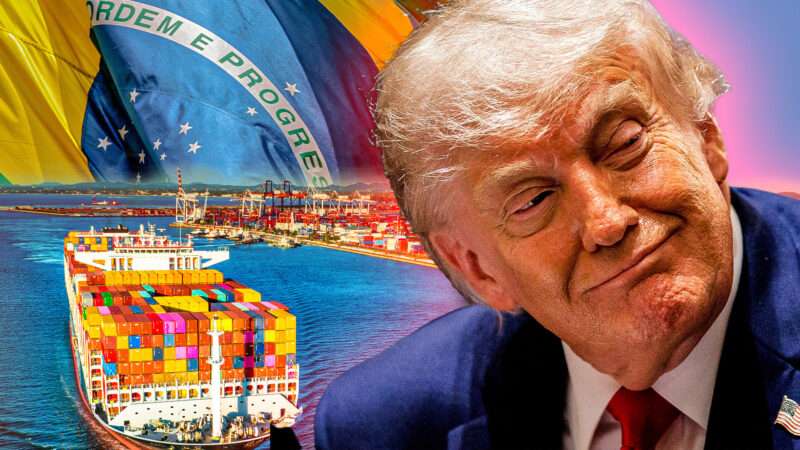
America Has a Huge Trade Surplus With Brazil. Trump Just Put 25 Percent Tariffs on Brazilian Goods Anyway.


Photo collage of Donald Trump, the Brazilian flag, and a container ship | AdMedia / MEGA / Newscom/JGLIT/Newscom/Envato

The Trump administration’s trade war with the world has been a haphazard, often chaotic affair, but if you had to identify a single, guiding principle for the administration’s actions, it would be balancing America’s trade deficits.

President Donald Trump has been talking about the trade deficit for years (even though he sometimes seems to confuse it with the federal budget deficit, which is a very different thing). During his second term, the president’s top trade officials have also stressed the trade deficit as a key metric by which to measure the effectiveness of Trump’s tariffs.

For example, when pressed by Rep. Brendan Boyle (D–Pa.) during a hearing last year on what results a successful tariff policy would produce, U.S. Trade Representative Jamieson Greer said “the [trade] deficit needs to go in the right direction”—meaning that it needs to fall. More recently, Greer has talked about how “overproduction” in other countries “displaces existing U.S. domestic production” as a justification for Trump’s tariffs.

The short version of all this: Hiking taxes on imports is supposed to spur domestic production of all sorts of goods, and help America export more than it imports. Many economists might say the trade deficit isn’t really something worth worrying about, but the Trump administration’s view is quite clear. The White House wants America to export more, import less, and run trade surpluses rather than deficits.

But Trump’s latest tariff maneuver seemingly defies that logic.

On Wednesday, the White House announced a new 25 percent tariff on thousands of products imported from Brazil. The new tariffs are being imposed under Section 301 of the Trade Act of 1974, and are effectively meant to replace the previous “emergency” tariffs on Brazilian goods that were struck down by the Supreme Court in February. In a statement, Greer said the tariffs were meant to counter “unfair trade practices.”

But if the guiding principle is reducing trade deficits, here’s an uncomfortable fact: America exports way more to Brazil than it imports from there.

“The U.S. goods trade surplus with Brazil was $14.4 billion in 2025, a 112.8 percent increase ($7.7 billion) over 2024,” according to Greer’s office. When services are included in the calculation, the trade surplus with Brazil grows by another $23 billion.

Last year was no aberration. Over the past 15 years, the U.S. has run a cumulative trade surplus with Brazil that totals more than $424 billion, according to a statement from Brazilian President Luiz Inácio Lula da Silva.

Trump administration officials have offered a variety of overlapping and competing justifications for the new tariffs in comments to The New York Times, including “inadequate policing of deforestation” and the fact that Brazilian courts had tried to order “U.S. social media companies to take down certain political content.”

Those might be real problems, but how will tariffs address them? Forcing American businesses and consumers to pay higher prices on imports from Brazil seems like an odd way to combat deforestation or stand up for free speech.

“These tariffs are a blunt tool with a weak connection between the practices at issue and the American companies that will bear the costs,” Dan Anthony, executive director of We Pay the Tariffs, a nonprofit coalition representing more than 1,200 American small businesses, said in a statement. “Businesses buying everyday products from Brazil will now pay new tariffs because of disputes over digital payment rules and other policies they have nothing to do with.”

For all the talk about trade deficits, the new tariffs once again reveal that there are no principles underpinning the Trump administration’s trade policies. The president will use any and every justification to slap new tariffs on foreign imports and leave Americans with the bill.

The post America Has a Huge Trade Surplus With Brazil. Trump Just Put 25 Percent Tariffs on Brazilian Goods Anyway. appeared first on Reason.com.

from Latest – Reason.com https://ift.tt/hDXHKwn
via IFTTT

Trump Media’s Lawsuit Against Wash. Post Over “Trust Linked to Porn-Friendly Bank Could Gain a Stake in Trump’s Truth Social” Thrown Out

From Trump Media & Tech. Group Corp. v. WP Co. LLC, decided today by Judge Tom Barber (M.D. Fla.):

In 2023, Defendant WP Company LLC (the “Post”) published an article titled “Trust linked to porn-friendly bank could gain a stake in Trump’s Truth Social,” which reported on the finances of Trump Media Technology Group (“TMTG”). After almost three years of litigation, the Post has now admitted that portions of the article included false information. Specifically, the Post admits its story incorrectly stated that TMTG paid a $240,000 referral fee in connection with an $8 million loan from an entity known as ES Family Trust. The Post now admits that no such payment was made and recently chose to publish a “Correction” to that effect {“Discovery in the ongoing litigation has established that Trump Media didn’t pay a loan referral fee of $240,000, as was stated in the article and was based on The Post’s reporting at the time of publication.”}. TMTG contends in this defamation lawsuit that the statements about the referral fee were false and defamatory and seeks almost $2 billion in damages resulting from the publication.

However, under controlling United States Supreme Court and Eleventh Circuit precedent following New York Times Co. v. Sullivan (1964), a jury will not have the opportunity to decide this case. To survive summary judgment, TMTG must show more than just that the Post’s statements were false and defamatory.

Current law requires that TMTG also establish that the Post acted with “actual malice,” that is, TMTG must prove that, at the time the Post published the statements, the Post either actually knew the statements were false or had serious doubt as to whether they were true or false. Further, to prevail under current law, TMTG must establish actual malice by evidence that goes beyond the “preponderance of the evidence” necessary in the usual civil case and adduce evidence on this issue that is clear and convincing.

These standards are exceedingly difficult for any plaintiff to meet, and TMTG has not met them here. TMTG’s evidence establishes beyond any doubt whatsoever that the Post published false information—the Post has admitted that. Under the facts presented here, reasonable minds could certainly conclude the Post acted unreasonably and should have conducted a better investigation before making the challenged statements. But under controlling precedent, such a showing is not sufficient to establish actual malice by clear and convincing evidence. Accordingly, the Court is required to grant summary judgment for the Post….

The circumstantial evidence adduced by TMTG certainly supports a jury finding that the Post acted unreasonably and should have done a more thorough investigation into the alleged payment of the finder’s fee. But it falls short of providing a basis for a jury finding that the evidence clearly and convincingly shows that the Post knew the story was false or published it with reckless disregard of whether it was false, that is, with serious doubt as to whether the story was true or false or with a high degree of awareness that the story was probably false.

First, there is no evidence that the Post fabricated the story that TMTG paid a finder’s fee, nor is there anything inherently implausible or even extraordinary about the story itself.

Second, the Post did not rely on anonymous tips, rumors, or other manifestly unreliable sources as is sometimes the case. It relied on information received from Wilkerson, an insider in position to know the truth, who was willing to go on the record, and who was providing information not only to the Post but also to other newspapers and government officials. The Post also relied on information from Wilkerson’s lawyers, whom the Post understood to be providing information on behalf of Wilkerson. See id. (affirming dismissal of defamation complaint where the story was not based on an unverified anonymous phone call).

[Reporter Drew] Harwell’s declaration asserts that Wilkerson’s lawyers told him that TMTG paid the fee. His contemporaneous notes confirm that assertion, as does a recording of an interview session involving not only the lawyers but Wilkerson himself. TMTG does not dispute Harwell’s assertions. Although Wilkerson’s deposition testimony might be slightly inconsistent with Harwell’s declaration and raise an issue of fact as to whether Wilkerson himself actually told Harwell that TMTG paid the fee, Wilkerson does not deny that his lawyers did so.

TMTG argues that Wilkerson was an unreliable source because TMTG suspended and then fired Wilkerson, giving him a motive to fabricate the story in retaliation. As the Court has previously observed, an employee’s termination does not necessarily cast doubt on negative information the employee provides about an employer.

Further, it is undisputed that Wilkerson did not “blow the whistle” after he had been fired. He was fired for “blowing the whistle,” i.e., for providing information to the press. Harwell’s declaration explains that he assessed Wilkerson’s credibility and concluded based on past experience with Wilkerson that Wilkerson was reliable. No record evidence casts doubt on that assertion.

Third, the Post investigated the story by reviewing documents provided by Wilkerson and his lawyers, including a draft fee agreement and an invoice for the fee apparently from Entoro Securities. These documents are fully consistent with the assertion by Wilkerson’s lawyers that TMTG paid the fee although they do not directly confirm it. They certainly do not contradict it. Harwell can be faulted for not pressing to obtain final documents or additional confirmation, but there is no evidence that

anyone or any document told Harwell the fee had not been paid. In the absence of an obvious reason to doubt the story, Harwell’s failure to seek additional confirmation does not suggest that he actually doubted the fee had been paid and purposefully sought to avoid the truth.

Fourth, prior to publishing, and consistent with his usual practice, Harwell sent to TMTG and others what the Post refers to as “no surprises” emails. These are sent to provide the subjects of an article an overview of information that may be included in the article, to give the subjects notice and a chance to comment or provide additional information. Harwell reached out to a number of different sources that included TMTG itself, TMTG CEO Devin Nunes, TMTG co-founders Wes Moss and Andy Litinsky, DWAC CEO Patrick Orlando, Entoro partner James Row, and the SEC. None responded with any information.

TMTG criticizes Harwell’s “no surprises” email on the ground that it referred only to the fee agreement rather than to payment of the fee, but the email’s express reference to the fee agreement and to “Entoro’s referral fee” is not what one would expect if the Post were trying to avoid the truth about the fee. If, as TMTG claims, the payment, not the agreement, is the critical fact, the Post’s “no surprises” email could be expected to elicit an explanation from TMTG that, regardless of any agreement, the fee had not been paid. The notion that the reference to the fee agreement in the “no surprises” emails was intended to distract attention from the subject of payment of the fee is speculative and insufficient to create a genuine issue of fact.

TMTG also argues that the Post sought confirmation from sources that it expected would not respond. While government agencies might be expected to decline comment on ongoing cases or investigations, that is not true of the many other sources noted above to whom the Post reached out.

TMTG argues that actual malice is demonstrated by the fact that the Post learned within a few days after publication that its own sources lacked proof of payment but did not issue a correction. But the crucial inquiry for actual malice is the Post’s state of mind at the time of publication. Assuming the Post’s failure to correct the story immediately upon learning that Wilkerson had no knowledge that payment had been made is relevant at all to the Post’s knowledge and state of mind at the time of publication, any inference from these post-publication facts to actual malice at the time of publication is speculative at best.

TMTG further argues that actual malice can be inferred from Harwell telling Professor Ohlrogge, an expert at New York University Law School that he consulted while developing the story, about an agreement to pay the fee but failing to inform him that the document the Post relied on as evidence of the agreement was an unsigned draft. However, Harwell stated in his declaration that he sent a copy of the draft agreement to Ohlrogge, and in any event, telling Ohlrogge there was an agreement or payment is perfectly consistent with Harwell’s belief that there was an agreement and payment; it is hardly evidence that Harwell knew or doubted those things were true.

In short, a source who was in a position to know the truth and was not obviously unreliable told the Post that TMTG paid a finder’s fee for the ES Family Trust loan. The idea that TMTG would pay such a fee is not inherently implausible. The source provided the Post with documents consistent with the assertion of payment although not directly confirming it. No person or document contradicted what the Post had been told. The Post reached out prior to publication to numerous sources, but none provided contrary information….

Although it is rooted in the First Amendment, which was adopted in 1791, the law applicable here was essentially invented by the U.S. Supreme Court in 1964 when it decided New York Times v. Sullivan. “Since 1964, however, our Nation’s media landscape has shifted in ways few could have foreseen.” Numerous justices, judges, and commentators have suggested that the law in this area needs to be revisited….

This Court shares many of [these] concerns, and if it were deciding this case on a clean slate, the result might be different. If the law did not require “clear and convincing evidence” of actual malice, it is likely the Post’s motion for summary judgment would have been denied, and a jury would have had the opportunity to weigh in on this matter. However, “until the Supreme Court reconsiders Sullivan, we are bound by it[.]” As explained above, under controlling law, TMTG’s evidence is insufficient to support a finding of actual malice under the clear and convincing standard, and summary judgment for the Post is therefore required….

Last year, Judge Barber had allowed the case to go forward based on the allegations in the Complaint, denying the Post defendants’ motion to dismiss. But now that there has been discovery, the judge concluded that Trump Media hadn’t introduced enough evidence to withstand a motion for summary judgment.

The post Trump Media's Lawsuit Against Wash. Post Over "Trust Linked to Porn-Friendly Bank Could Gain a Stake in Trump's Truth Social" Thrown Out appeared first on Reason.com.

from Latest – Reason.com https://ift.tt/ekC1jQv
via IFTTT

Todd Blanche Describes the Huge, Unprecedented Favors Granted by Trump’s IRS ‘Settlement’ as ‘Typical’


Acting Attorney General Todd Blanche | Illustration: Adani Samat | Photo: Mira Agron/Andrew Thomas /CNP/Picture Alliance/Consolidated News Photos/Newscom

President Donald Trump’s brazenly corrupt “settlement” of his lawsuit against the IRS included a jaw-dropping order in which Acting Attorney General Todd Blanche purported to shield him and his family from liability for tax violations and any other federal offenses they may have committed prior to May 19. During his confirmation hearing on Wednesday, Blanche, who is seeking Senate approval of his nomination as attorney general, repeatedly misrepresented the scope and nature of that sweeping immunity deal.

In response to questions from Sen. Richard Durbin (D–Ill.), Blanche preposterously claimed his promise of protection was “typical” of settlements between the IRS and taxpayers. “This type of settlement is done regularly,” he said. “When we enter into settlements like that, we do it with all kinds of people. It’s not just President Trump. It doesn’t make any of those individuals above the law.”

Blanche was referring to settlements of tax disputes. That comparison is inapt for several reasons.

First, Trump’s lawsuit, which was joined by two of his sons and the Trump Organization, did not involve a dispute about tax liability. It alleged damages caused by an IRS contractor’s illegal disclosure of the plaintiffs’ tax returns, an issue that has nothing to do with the question of whether they owe the IRS money.

Second, even in cases that do involve alleged tax violations, it is not “typical” for settlements to include a promise that the IRS will never pursue any other claims based on past returns. After Blanche revealed his order, former IRS Commissioner Daniel Werfel told the Associated Press he was not aware of any previous cases in which the IRS had agreed to “permanently forgo examination of previously filed tax returns for a specific person or business.”

Third, the IRS immunity in this case, which could save Trump more than $100 million in back taxes, interest, and penalties, not only covers the plaintiffs who filed the lawsuit. It also encompasses all “related or affiliated individuals…or parties.”

Fourth, Blanche’s order extends far beyond the IRS. It says “the United States” is “FOREVER BARRED and PRECLUDED” from pursuing “any and all claims” against Trump or his family regarding “any matters currently pending or that could be pending” before the IRS, the Treasury Department, or “other agencies or departments.” In other words, the order purports to shield Trump and his relatives from the penalties that ordinary Americans face when they run afoul of federal law.

That unprecedented relief resembles a preemptive self-pardon, except that it extends further, covering civil as well as criminal offenses. But according to Blanche, his order does not mean Trump and his family are “above the law.” In support of that conclusion, he noted that they are still liable for any future offenses they may commit (which is also true of pardon recipients). And despite the broad language of his order, Blanche flat-out denied that it goes beyond the IRS.

Sen. John Cornyn (R–Texas) noted that Blanche’s order “purports to apply” to “other agencies or departments.” He wondered whether it would bar “investigation by the Securities and Exchange Commission or some other federal agency.”

“No,” Blanche said. “It binds only the IRS and, by extension, the Treasury.”

Cornyn disagreed. “I hear what you’re saying,” he replied, “but I certainly don’t read that in the agreement.”

Cornyn, whose résumé includes stints as a state judge, a justice on the Texas Supreme Court, and his state’s attorney general, probably knows a thing or two about parsing legal language. So do the 35 retired federal judges, including former 4th Circuit Judge Michael Luttig and several other Republican appointees, who objected to Trump’s “settlement agreement” and urged U.S. District Judge Kathleen Williams to reopen the case.

“The plain language of this extremely broad provision sweeps in [IRS] audits of Plaintiffs’ tax returns and all other claims the United States might have against Plaintiffs,” Luttig et al. noted in their May 27 motion (emphasis added). These are “extraordinary benefits for which no consideration was provided to the government,” they added. The former judges reiterated that point in a June 19 brief, saying Blanche’s order provides “monumental relief,” granting “a capacious and extraordinary general release that purports to forfeit claims for substantial sums in unpaid taxes and other potential damages and fines.”

According to Blanche, however, that “monumental relief” is business as usual at the Justice Department. “That’s the standard language that we use when we enter into settlements between plaintiffs and the IRS,” he told Cornyn. Blanche, in other words, wants us to believe that such settlements routinely include blanket immunity from investigations of past conduct by the IRS and all “other agencies or departments.”

Why would Blanche ask us to believe that? Because he is keen to show that the president did not receive special treatment in this case by virtue of his position. But he obviously did.

Trump and the other plaintiffs absurdly claimed that the unauthorized disclosure of their tax returns had caused “at least” $10 billion in damages. In addition to offering an unlikely estimate of the injury he had suffered, Trump missed the statutory deadline for filing such claims, meaning his lawsuit was legally doomed right out of the gate. Even if Trump had filed his lawsuit on time, he would have faced the challenge of arguing that an IRS contractor qualifies as an “officer or employee of the United States”—a point that the Justice Department has disputed in other cases involving similar claims.

Despite those legal weaknesses, the Justice Department never bothered to contest Trump’s claims, in sharp contrast with the way it usually handles such cases. That is not surprising, since the government’s lawyers answer to Trump. And in case there was any chance that they would nevertheless do their jobs, Trump foreclosed that possibility by decreeing that they could not take any legal positions at odds with his.

In a scathing decision on Monday, Williams concluded that the case was a sham from the beginning, since both sides were controlled by Trump. The plaintiffs and the defendants “worked in tandem and were never actually adverse,” she wrote. Trump’s lawsuit, she said, was nothing more than a pretext for “a ‘settlement’ that had no viable basis in law or fact.”

Not so, Blanche told Sen. Mike Lee (R–Utah) on Wednesday. “Was there any improper coordination of any kind between the Department of Justice and the Trump team as to this settlement?” Lee asked. “No, not at all,” Blanche replied.

That assurance is hard to square with Trump’s own description of this cozy arrangement, which he called “a settlement with myself.” It is also inconsistent with Blanche’s unilateral decision to nix the $1.8 billion “Anti-Weaponization Fund” that was a central feature of the original “settlement agreement.” If that arrangement were actually an agreement between adverse parties, Blanche would have had to obtain the plaintiffs’ written consent to the modification, which he did not do.

Blanche provided further evidence of collusion when he unilaterally issued his promise of immunity, which he presented as an addendum to the main agreement even though he was the only person who signed it. His conduct made it clear that he was simultaneously acting as the head of the Justice Department and Trump’s personal lawyer.

After eliciting Blanche’s improbable denial of collusion, Lee averred that the case was settled “based on an apology without any compensation being awarded, without the president receiving a penny.” Although that is obviously not true, since the IRS immunity is worth a lot of money to Trump, Blanche agreed with Lee’s characterization.

The “settlement” was “completely consistent with the Federal Rule of Civil Procedure 41, which absolutely allows what happened here to happen,” Blanche said. “It happens in hundreds, if not thousands, of cases around the country every year.”

In reality, nothing like this has ever happened before. No other similarly situated plaintiff has ever received benefits remotely like those that Blanche approved for his boss, which initially included $1.8 billion in taxpayer money for Trump’s allies and supporters as well as potential personal savings in the neighborhood of $100 million.

How does that compare to the settlements obtained by other plaintiffs who have sued the IRS under the same law that Trump invoked? Unlike Trump, billionaire hedge fund manager Kenneth Griffin, whose tax returns were leaked by the same IRS contractor, filed his lawsuit on time. Also unlike Trump, Griffin had to contend with Justice Department lawyers who were keen to pick apart his claims. After a year and a half of litigation, Griffin dropped his case in exchange for an apology from the IRS.

As Lee noted, Trump also got an apology. But he got a lot more than that: huge favors for himself, his family, and his supporters, all at taxpayers’ expense. According to Blanche, that was “typical,” and Trump’s status as president had nothing to do with it. If you can believe that, you can also believe that Blanche as attorney general would have the integrity required to pursue justice rather than the president’s personal interests.

The post Todd Blanche Describes the Huge, Unprecedented Favors Granted by Trump's IRS 'Settlement' as 'Typical' appeared first on Reason.com.

from Latest – Reason.com https://ift.tt/lB1rDPV
via IFTTT
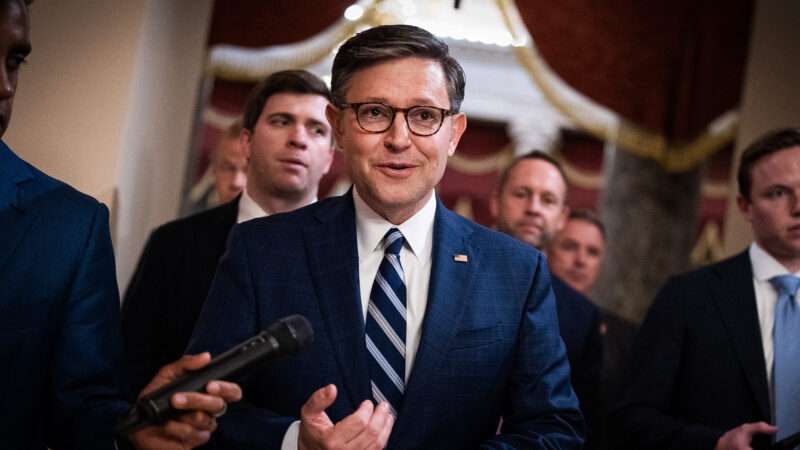
America Has a Huge Trade Surplus With Brazil. Trump Just Put 25 Percent Tariffs on Brazilian Goods Anyway.


Photo collage of Donald Trump, the Brazilian flag, and a container ship | AdMedia / MEGA / Newscom/JGLIT/Newscom/Envato

The Trump administration’s trade war with the world has been a haphazard, often chaotic affair, but if you had to identify a single, guiding principle for the administration’s actions, it would be balancing America’s trade deficits.

President Donald Trump has been talking about the trade deficit for years (even though he sometimes seems to confuse it with the federal budget deficit, which is a very different thing). During his second term, the president’s top trade officials have also stressed the trade deficit as a key metric by which to measure the effectiveness of Trump’s tariffs.

For example, when pressed by Rep. Brendan Boyle (D–Pa.) during a hearing last year on what results a successful tariff policy would produce, U.S. Trade Representative Jamieson Greer said “the [trade] deficit needs to go in the right direction”—meaning that it needs to fall. More recently, Greer has talked about how “overproduction” in other countries “displaces existing U.S. domestic production” as a justification for Trump’s tariffs.

The short version of all this: Hiking taxes on imports is supposed to spur domestic production of all sorts of goods, and help America export more than it imports. Many economists might say the trade deficit isn’t really something worth worrying about, but the Trump administration’s view is quite clear. The White House wants America to export more, import less, and run trade surpluses rather than deficits.

But Trump’s latest tariff maneuver seemingly defies that logic.

On Wednesday, the White House announced a new 25 percent tariff on thousands of products imported from Brazil. The new tariffs are being imposed under Section 301 of the Trade Act of 1974, and are effectively meant to replace the previous “emergency” tariffs on Brazilian goods that were struck down by the Supreme Court in February. In a statement, Greer said the tariffs were meant to counter “unfair trade practices.”

But if the guiding principle is reducing trade deficits, here’s an uncomfortable fact: America exports way more to Brazil than it imports from there.

“The U.S. goods trade surplus with Brazil was $14.4 billion in 2025, a 112.8 percent increase ($7.7 billion) over 2024,” according to Greer’s office. When services are included in the calculation, the trade surplus with Brazil grows by another $23 billion.

Last year was no aberration. Over the past 15 years, the U.S. has run a cumulative trade surplus with Brazil that totals more than $424 billion, according to a statement from Brazilian President Luiz Inácio Lula da Silva.

Trump administration officials have offered a variety of overlapping and competing justifications for the new tariffs in comments to The New York Times, including “inadequate policing of deforestation” and the fact that Brazilian courts had tried to order “U.S. social media companies to take down certain political content.”

Those might be real problems, but how will tariffs address them? Forcing American businesses and consumers to pay higher prices on imports from Brazil seems like an odd way to combat deforestation or stand up for free speech.

“These tariffs are a blunt tool with a weak connection between the practices at issue and the American companies that will bear the costs,” Dan Anthony, executive director of We Pay the Tariffs, a nonprofit coalition representing more than 1,200 American small businesses, said in a statement. “Businesses buying everyday products from Brazil will now pay new tariffs because of disputes over digital payment rules and other policies they have nothing to do with.”

For all the talk about trade deficits, the new tariffs once again reveal that there are no principles underpinning the Trump administration’s trade policies. The president will use any and every justification to slap new tariffs on foreign imports and leave Americans with the bill.

The post America Has a Huge Trade Surplus With Brazil. Trump Just Put 25 Percent Tariffs on Brazilian Goods Anyway. appeared first on Reason.com.

from Latest – Reason.com https://ift.tt/hDXHKwn
via IFTTT

Drugs Keep Winning in the Global War on Drugs


A collage image of several drug-related images and photographs, including the United Nations logo and words that say "WORLD DRUG REPORT." | Illustration: Adani Samat. Photo: Martin Alipaz/EFE/Newscom/Rolf Vennenbernd/dpa/picture-alliance/Sebastian Barros Salamanca

Late last month, the United Nations published its annual World Drug Report, chronicling the latest developments in the global war on drugs. Not only are the drugs winning that war, but there are greater quantities and more varieties of recreational chemicals available than ever before.

In June, Colombia elected a hard-line new president who vowed to wage “all-out war, without truce or negotiation” on the narcos and guerrillas, while Bolivia’s embattled government has declared a state of emergency against “narco-terrorism.” It will be an uphill battle: According to the U.N. report, an estimated 4,100 tons of cocaine were produced in South America in 2024—more than at any point in history. Even after decades of government-run initiatives and even military campaigns involving ripping up coca fields and spraying them with herbicide, farmers in the Andes have adopted innovative cultivation techniques making their humble patches more productive than ever before.

There is so much cocaine in circulation now that wholesale prices are dropping, indicating a surplus. In other words, as the U.N. put it, supply may soon overtake demand, if it hasn’t already. Europe is now at least as important a market as North America, and while there are fewer big coke busts than there were several years ago—when the Belgian port city of Antwerp confiscated so many white bricks that there was no space left in its incinerators—that’s because smugglers have switched to smaller shipments to minimize risk.

There are early signs, however, of a looming heroin shortage. After the Taliban banned poppy cultivation in Afghanistan in 2022, the total area of land used to grow opium poppies—which can be refined into morphine and heroin—shrank by 95 percent. While dealers have managed to stretch out existing stockpiles of opiates, those may begin to run dry later this year, the U.N. warned. Some jurisdictions are already reporting price increases, indicating scarcity. At first glance, this may appear to be a rare victory in the war on drugs in the landlocked, mountainous country that once produced 93 percent of the world’s illicit opiates. But some poppy farming has simply been displaced to nearby Pakistan and India, and traffickers are searching for substitutes.

Among these are nitazenes—synthetic opioids largely manufactured in China that can be even more potent than fentanyl and have claimed hundreds of lives in the United Kingdom alone. While nitazene deaths are still dwarfed by America’s fentanyl crisis, this may be an early warning of a deadly new trend. Nitazenes have appeared in the United States as well. Unlike the “classic” drugs such as heroin, cocaine, and shrooms, synthetics don’t need vast acres of land for farming and can be quietly cooked in a basement lab, bypassing border controls or local mafias, which lowers the barriers to entry in a business where clandestine connections are everything.

Nitazenes are among the many new, largely synthetic narcotics—referred to as new psychoactive substances—highlighted in the report. There are now 755 known new psychoactive substances in circulation, and 118 of them were first identified in 2024. Today, there are more designer drugs than formally designated illicit drugs (although their total number of consumers is still small). These drugs evade detection and restrictions by being chemically different from more established substances, but they create similar sensations. In some cases, those effects can be far, far worse.

Kush, for example, is a smokable blend that first appeared in West Africa in the late 2010s and was rumored to contain bone fragments and other human remains. It is actually a cocktail of synthetic cannabinoids (artificial chemicals that mimic the effects of cannabis) and nitazenes. The combination has caused a whirlwind of addiction, sedation, severe bodily damage, and mental illness, prompting Liberia and Sierra Leone to declare a public health emergency. West Africa now accounts for 70 percent of synthetic cannabinoid busts, mostly involving kush.

Meanwhile, meth is going global, appearing in dealers’ repertoires from the Pacific Islands to Africa to the Middle East. Captagon—originally the brand name for a moderate stimulant known as fenethylline, but now consisting of amphetamines—is a popular stimulant in the Middle East, made famous by Syrian combatants. The pills were manufactured in Syria and Lebanon under the watch of the Islamist militia Hezbollah, powerful tribal clans, and the despotic government of former Syrian President Bashar Assad. In late 2024, the fall of the Assad regime disrupted production as the new authorities began dismantling Captagon labs. They have since relocated to the Israel-backed Druze enclave of Sweida, away from the central government in Damascus. While this smaller-scale production persists, the U.N. found that the void left by Captagon has increasingly been filled by meth. Iraq in particular—and its Iran-backed drug-dealing militias—has become a major manufacturing and transportation hub.

“We need to recognize that criminalization and prohibition doesn’t actually do what it promises to do,” says Kojo Koram, a law professor at Loughborough University and author of The Next Fix: The Winners and Losers in the Future of Drugs. Rather than leading “to less drug use” and fewer drug deaths, “what we’ve seen is actually the increase of drug use, the increase of drug deaths, and in fact the increase of the potency of drugs.”

Prohibition has encouraged “the mutation of drugs into more dangerous and more addictive forms” and pushed “suppliers to try [to] maximize the amount of money they can make for the risks they undertake through smuggling,” Koram explains. “The same process with alcohol prohibition led to the transition from largely a beer-drinking society into a liquor-drinking society in the USA.”

“That’s why we’ve seen what’s known as the iron law of prohibition emerge, concentrating the coca leaf plant into these modern manifestations such as crack cocaine,” he continues. “This misunderstanding, I think, results in authorities being surprised when they engage in these expensive and expansive counternarcotics programs.”

There is a little good news in the report, however. Marijuana is now legal for some forms of nonmedical use in Canada, Uruguay, the Czech Republic, Germany, Luxembourg, Mexico, Malta, and South Africa, as well as in parts of Australia, Switzerland, and the United States. The Swiss model, in which a small number of dispensaries cater to registered customers in specific cities, has proven so successful that the trial has been extended to 2028, with the ultimate goal of rolling out the model nationwide.

“It was in 1986 that the very first Overdose Prevention Center was established in Bern, Switzerland, no less,” says Koram. “Hardly a radical, kooky, left-wing city, but a city that recognizes that so often the impact of these substances aren’t just in the substances themselves….And so that’s why Overdose Prevention Centers, heroin prescription treatment services, and all these other forms of harm reduction initiatives make a much more significant difference than trying to criminalize and prohibit [drugs] out of existence.”

The post Drugs Keep Winning in the Global War on Drugs appeared first on Reason.com.

from Latest – Reason.com https://ift.tt/e3QaZPS
via IFTTT