As H20 “Bank Run” Accelerates, Its Assets Plummet By $3 BIllion

Yesterday when describing the latest developments surrounding the Natixis-owned, ill-named H20 Asset Management, which has found itself in a toxic spiral of holding illiquid assets yet facing growing redemptions following Morningstar’s questioning of the “liquidity and appropriateness” of some of H2O’s corporate-bond holdings as well as potential conflicts of interest, and suspended its recommendation on Wednesday, we reported that the fund unveiled an “ingenious”
way to halt redemptions without actually imposing gates: it marked down the balance of its holdings “to remove incentives for investors to pull even more.”

We also asked, rhetorically, whether this plan work?

That’s the question as fund managers hope to reverse outflows from a group of H2O funds that saw their assets drop by 1.1 billion euros on Thursday as analysts questioned their holdings.

Less than 24 hours later we have the question: it did not, because on Monday H20 saw its assets decline even more as a group of its largest funds seeing their biggest ever single-day drop. In the fourth consecutive day of accelerating redemptions, the money manager paradoxically named for liquidity – of which it has none as it scrambles to offload its most illiquid holdings – saw six of H20’s biggest funds fall by 2.6 billion euros, or about $3 billion, on Monday.
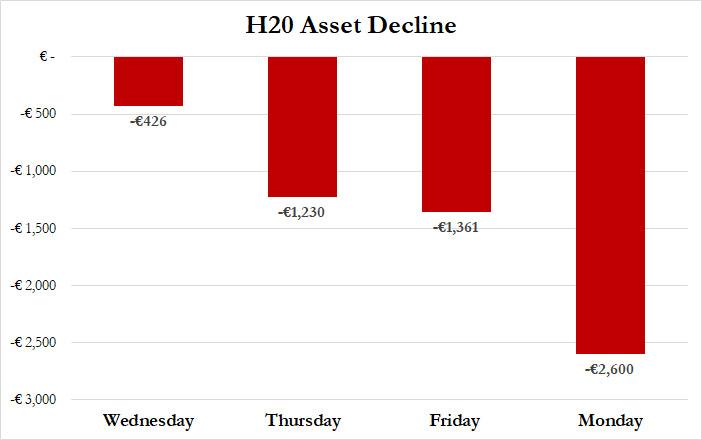
Yet while to most funds the redemption of nearly €6 billion in funds would prove terminal, perhaps H2O will manage to turn the tide – the fund said it received “material” inflows after a slowdown in net outflows since Monday:

H2O AM hereby confirms that the net outflows have slowed significantly since Monday June 24th. In addition, H2O funds received some material inflows on Tuesday June 25th.

On the other hand, it won’t be the first time that a fund facing liquidation says pretty much anything to restore confidence.

As Bloomberg notes, the fall in assets comes one day after as H2O said it had sold 300 million euros of the Windhorst-linked holdings on Monday. The sale and a marking down of the non-rated corporate bond holdings across H2O’s range reduced the value of the non-rated corporate bonds to 500 million euros, a spokeswoman said on Monday.

Morningstar raised concerns about the “liquidity and appropriateness” of some corporate-bond holdings as well as potential conflicts of interest last week. The funds, which allow clients to make daily withdrawals, hold rarely traded bonds issued by companies linked to controversial German financier Lars Windhorst investment vehicle Tennor.

So where do we stand: the good news for the fund that may soon join the unhappy procession of investors such as Third Avenue, UK property funds following Brexit, GAM and Woodford which all threw in the towel after their bond holdings were exposed as especially illiquid, is that it had a lot of assets to start the year: H2O’s assets were €32.5 billion at the start of the year. The bad news is that if management is non-GAAPing the truth and redemptions continue, the fund probably has a bout a week of life left if redemptions continue to grow at this rate. And until there is some confirmation that the fund has managed to turn the tide of outflows, there is no reason to expect that H20 will have finally found the oh so critical market substance that it was named for.

via ZeroHedge News http://bit.ly/2RBYmVz Tyler Durden
Buchanan: Will Joe Repudiate His Segregationist Friends?

Authored by Patrick Buchanan via Buchanan.org,

“Apologize for what? Cory should apologize. He knows better. There’s not a racist bone in my body.”

Thus did a stung Joe Biden answer rival Cory Booker’s demand he apologize for telling contributors, in a southern drawl, “I was in a caucus with James O. Eastland, He never called me ‘boy.’ He always called me ‘son.”

Joe was recalling fondly a time in the 1970s when he came into the Senate at 30, having lost his wife and child in an accident, and “Jim” Eastland, the arch-segregationist from Mississippi, took him under his wing and became a patron, mentor and friend.

“You don’t joke about calling black men ‘boy’,” Booker had said. “Biden’s relationships with proud segregationists are not the model for how we make America a safer and more inclusive place for black people.”

Kamala Harris piled on: If Biden’s segregationist friends “had their way … I wouldn’t be in the United States Senate.”

New York Mayor Bill de Blasio tweeted a photo of his black wife and two children, saying, “Eastland thought my multiracial family should be illegal & that whites were entitled to ‘the pursuit of dead n——-s.’”

Said The Washington Post, “(Biden’s) history of collegiality with racists is being seen by many in his party as a reason to question his judgment — and not, as Biden says, a sign of his civility.”

This portends a coming clash over race inside the Democratic Party in 2019 and perhaps 2020. For Joe is bleeding and his rivals can see in his segregationist friends of yesterday a way to peel off the black support crucial to his nomination.

Biden is about to have his nose rubbed in friendships formed almost half a century ago.

Like reparations for slavery, on which hearings have opened in the House, this issue seems certain to arise in the debates next week, where taking down Biden will be an objective of every other candidate.

And Jim Eastland is not the only segregationist friend Joe had.

Joe called Strom Thurmond of South Carolina, who conducted the longest filibuster in history against the 1957 Civil Rights Act, “one of my closest friends,” and delivered a eulogy at Strom’s funeral.

When Joe backed an anti-busing amendment in the 1970s, Sen. Jesse Helms, on the Senate floor, welcomed him to the “ranks of the enlightened.” On leaving the Senate for the vice presidency in 2009, Biden spoke of his “close personal relationships” with “Eastland, Stennis, Thurmond … all these men became my friends.”

Those three Senators all signed the Southern Manifesto pledging “massive resistance” to desegregation of the public schools mandated by the Brown decision of 1954. All three opposed the Civil Rights Act of 1964 and the Voting Rights Act of 1965, enacted after bloody Sunday at Selma Bridge.

Asked her views on Biden’s remarks, Elizabeth Warren joined the attack: “It’s never OK to celebrate segregationists. Never.”

But if that is the new Warren Rule in Democratic politics, it may be hard to maintain.

For the Democratic Party, the oldest party on earth, was from its founding to the final third of the 20th century, the bastion of slavery, secession and segregation.

Jim Crow voted a straight Democratic ticket.

Thomas Jefferson and Andrew Jackson, founding fathers of the party, were slave owners, as were James Madison and James Monroe, who succeeded Jefferson in the White House. And so were John Tyler and James K. Polk, who succeeded them.

Washington, a slave owner, was the Father of our Country and gave us our independence and a new nation from the Atlantic to the Mississippi. Jefferson executed the Louisiana Purchase. Jackson seized Florida. Tyler annexed Texas. Polk got us the Southwest, California and clear title to Washington and Oregon. All were slave owners — and also the Democrats who gave America almost all of her land and frontiers.

The first Democratic president of the 20th century, Woodrow Wilson, restored segregation to the U.S. government. The second, FDR, chose a segregationist vice president, “Cactus Jack” Garner, put a Klansman, Hugo Black, on the Supreme Court, and, with Wilson, carried all 11 segregated states of the Old Confederacy, all six times they ran.

To hold a segregated South against Eisenhower in 1952, liberal Adlai Stevenson continued the Southern strategy by putting on his ticket John Sparkman of Alabama. Returning to the Senate after Adlai’s defeat, Sparkman signed the Dixie Manifesto and opposed the civil rights acts of both 1964 and 1965.

On his second run for the presidency over a decade ago, Joe Biden joked of his home state: “Delaware … was a slave state that fought beside the North. That’s only because we couldn’t figure out how to get to the South. There were a couple of states in the way.”

The Warren Rule notwithstanding, Southern segregationists remain honored today. The Old Senate Office Building was renamed in 1972 for Sen. Richard Russell of Georgia and John C. Stennis of Mississippi.

via ZeroHedge News http://bit.ly/2LncvF0 Tyler Durden

Is This Why The Media Is Pushing For A War?

Following President Trump’s upset election in 2016 followed by more than two years of constant ‘Russiagate’ coverage, there now appears to be a “Trump slump” across all forms of media as we wait for what promises to be popcorn-worthy debates between Trump and his Democratic challenger in 2020. 

Top news executives have told Axios‘s Sara Fischer and Neal Rothschild that “Trump fatigue is very real,” and that “Interest in political coverage overall is down,” causing newsrooms to redirect their efforts on other beats such as technology and the global economy.”

Democrats don’t appear to be the lifeline media companies are hoping can fill the gap for diminished Trump interest. Executives say they expect this week’s debate ratings to be nothing like the ratings for the 2016 Trump debates.

Part of the problem is that 2020 Democrats don’t have a knock-out media star to drive interest in the election. To date, the Democrats’ biggest media attraction has been Rep. Alexandria Ocasio-Cortez, who isn’t running for president.

Other candidates split the spotlight in the crowded Democratic primary field. –Axios

What do the numbers indicate?

According to traffic analytics company Parse.ly, digital demand for all things Trump dropped 29% between the first six months of Trump’s presidency and the most recent six months. Axois, meanwhile, provides more evidence of the “Trump slump.” 

  • In March, New York Times COO Meredith Kopit Levien told Axios during a panel at SXSW that the paper’s subscription “Trump Bump” ended in mid-2018.
  • In December, media research firm MoffettNathanson found that live news network ratings were down “in the -10% to -20% range” for the better part of 2018. Overall, the firm found that ratings around TV news coverage overall began to decline after the 2016 election.
  • Cable TV networks, which still reach a majority of Americans with political news coverage, began pulling back on Trump campaign rallies late last year because they weren’t driving ratings, according to Politico. –Axios

Is this why the MSM has been featuring war hawk ‘analysts’ such as Raytheon board member and former Navy Admiral James Winnefeld? 

As The American Conservative‘s Barbara Boland pointed out last week, the mainstream press jumped all over President Trump for not bombing Iran in response to the Islamic Republic shooting down a US drone that may or may not have been in Iranian airspace. 

… several war agitators were quick to respond.

Trump bizarrely chickens out of responding to a direct attack from Iran, a piece for Business Insider charged

The piece approvingly cites Mark Dubowitz, chief executive of the hawkish Foundation of Defense for Democracies, who told The New York Times that Iran had likely mined oil tankers in the region in order “to demonstrate that Trump is a Twitter Tiger.”

Meanwhile, invoking Ronald Reagan, David Adesnik at the National Review ladles all the praise on Trump’s hawkish secretary of state. “Mike Pompeo brought a Reagan-esque flourish to the Trump administration’s foreign policy, demanding nothing short of Iranian surrender. While insisting that President Trump is prepared to negotiate a new deal with Tehran, Pompeo listed no fewer than twelve preconditions for an end to American pressure.”

In the Wall Street Journal Thursday, Reuel Marc Gerecht and Ray Takeyh wrote a piece headlined “America Can Face Down a Fragile Iran.”  –The American Conservative

According to New York-based Fairness & Accuracy In Reporting, the MSM has been painting US escalations against Iran as “defensive countermeasures” – an angle they’ve used for more than a decade. 

ABC used the headline (5/24/19) “1,500 More Troops and Defensive Capabilities Headed to Middle East to Deter Iran.” How the US sending soldiers to the doorstep of a country that has not attacked it is “defensive,” or the evidence of the need to “deter” Iran, goes unexplained, an egregious omission when one considers that there is every reason to doubt US claims that Iran is about to attack the US.

CNBC headline (5/24/19) told readers that the “Pentagon Will Send 1,500 Troops, Along With Drones and Fighter Jets, to the Middle East to Counter Iran Threat.” CNBC presents US officials’ justifications for their military maneuvers as though they were facts:

Currently, the USS Arlington, USS Abraham Lincoln carrier strike group, a Patriot missile defense battery and a US Air Force bomber task force have been sent to the region in order to deter Iranian and proxy threats.

Both the ABC and CNBC articles note that Vice Adm. Michael Gilday, the director of the Joint Chiefs of Staff, blamed Iran for attacks on Saudi Arabia’s oil infrastructure and for a rocket that landed near the US embassy in Baghdad. Neither piece notes that US officials have said they have no evidence that Iran was behind either drone attacks on the pumping stations or the sabotage of four oil tankers, two of which were Saudi, in the Persian Gulf. Nor did either report inform their readers that the US produced no evidence that Iran was responsible for the rocket in Iraq. (Yemeni Houthis, falsely depicted as pawns of Tehran, said they carried out attacks of Saudi oil pumping stations in retaliation for the Saudi/US/UAE/UK/Canadian invasion and immiseration of Yemen.) –Fair.org

Also notable is a survey of opinion journalism released last month by FAIR which found that when it came to violent regime change in Venezuela, there were “no voices in elite corporate media that opposed regime change in that country.” (h/t Mintpress)

The media watchdog’s study, Zero Percent of Elite Commentators Oppose Regime Change in Venezuela, reviewed three months of commentary in the New York Times and the Washington Post, as well as on three major Sunday morning talk shows — ABC’s This Week, CBS’ Face the Nation, and NBC’s Meet the Press — and the PBS NewsHour.

Over a three-month period (1/15/19 – 4/15/19), zero opinion pieces in the New York Times and the Washington Post took an anti–regime change or pro-Maduro/Chavista position,” the survey’s author, Teddy Ostrow, wrote. “Not a single commentator on the big three Sunday morning talk shows or PBS NewsHour came out against President Nicolás Maduro stepping down from the Venezuelan government.” –MPN

In short, the MSM really needs some fireworks to improve their slumping bottom line – and are happy to report one side of the story in order to help light the fuse. 

via ZeroHedge News http://bit.ly/2KD09cl Tyler Durden

There Are Now More Than 5,000 Bitcoin ATMs Around The World

Authored by William Suberg via CoinTelegraph.com,

The total number of bitcoin ATMs (BTMs) worldwide reached 5,000 for the first time, monitoring resource CoinATMRadar confirmed on June 24.

image courtesy of CoinTelegraph

According to the latest statistics, there are now 5,006 standalone BTMs in around 90 countries, where cryptocurrency users can buy or sell bitcoin (BTC). Some machines offer both services simultaneously. 

The data caps a protracted period of growth in the BTM sector, with the U.S. leading the trend as more and more locations and formats appear. 

June has seen a total of 150 installations, around 6 per day. General Bytes recently overtook Genesis Coin as the manufacturer with the largest number of BTMs installed.

As Cointelegraph reported, in 2019, it is not just the ‘classic’ BTM model which is expanding, but other methods of procuring BTC. A deal earlier in the year involving coin counting kiosk operator Coinstar brought bitcoin functionality to over 2,200 U.S. locations. 

The U.S. currently has more than half of the world’s BTMs at 3,229, with a new pilot scheme this month bringing the machines to Circle K convenience stores in Arizona and Nevada.

“We are thrilled to be partnering with a respected organization like Circle K,” Marc Grens, president and co-founder of cryptocurrency provider DigitalMint said in a press release issued June 20. 

“This partnership opens the door for massive expansion of Bitcoin access to new markets around the globe.”

Increasing competition in the BTM market is likely to reduce the fees charged to users, which tend to be noticeably higher than online alternatives. 

Other in-person options, such as buying vouchers, are also gaining popularity with users keen on avoiding burdensome identity requirements.

via ZeroHedge News http://bit.ly/2NbPKqk Tyler Durden

No F-35 For Turkey If Russia Arms Deal Goes Forward: US Envoy

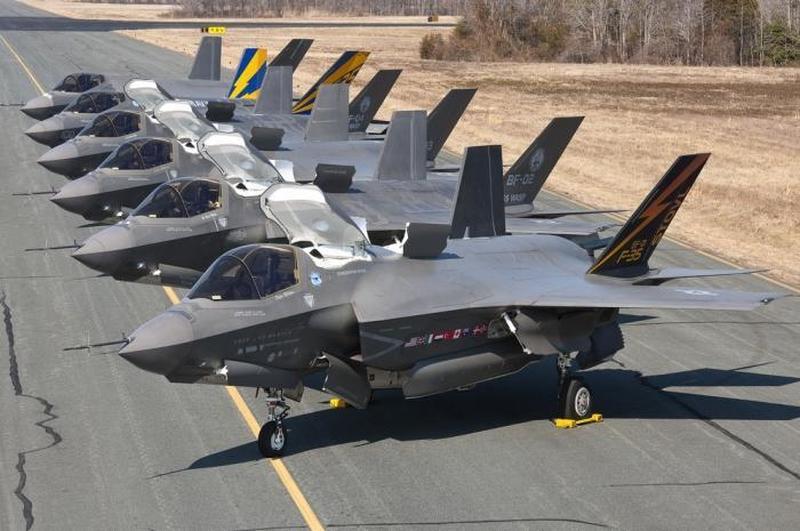
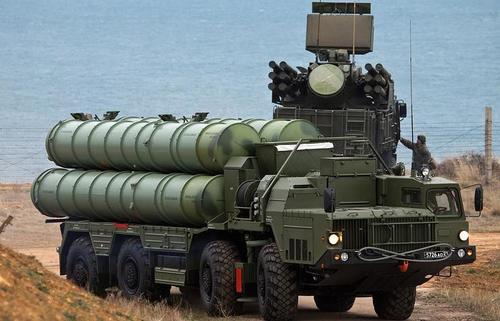
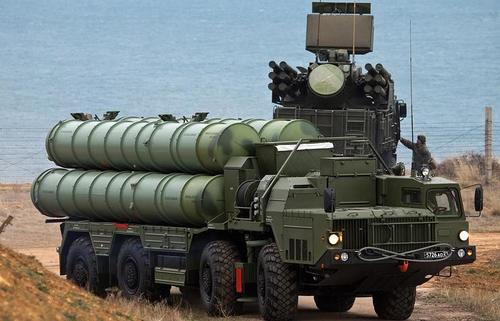
The United States will stop Turkey from flying and developing the F-35 stealth jet if Ankara moves forward with their purchase of Russia’s S-400 missile system, according to Kay Bailey Hutchison, the US envoy to NATO. 

“There will be a disassociation with the F-35 system, we cannot have the F-35 affected or destabilized by having this Russian system in the alliance,” Hutchison told reporters in Brussels. “Everything indicates that Russia is going to deliver the system to Turkey and that will have consequences,” she added. 

“There will be a disassociation with the F-35 system, we cannot have the F-35 affected or destabilized by having this Russian system in the alliance.” 

Turkish President Tayyip Erdogan, however, vowed on Tuesday to push forward with their purchase of the Russian system, according to Reuters

“We will hopefully start to receive the S-400 systems we purchased from Russia next month, Erdogan told his AK Party in parliament, adding: “Turkey is not a country that needs to seek permission or bow to pressures. The S-400s are directly linked to our sovereignty and we will not take a step back.” 

S-400 missile system

The United States says the jets, made by Lockheed Martin Corp., give NATO forces a number of technological advantages in the air, including the ability to disrupt enemy communications networks and navigation signals.

Turkey produces parts of the F-35s fuselage, landing gear and cockpit displays. Hutchison said Ankara was an important partner in that production but that security concerns about Russia were paramount.

So many of us have tried to dissuade Turkey,” she said. –Reuters

The United States has offered Turkey its more expensive Patriot missile system – first at full price, and then at a steep discount – however, issues arose over a timely delivery of the Raytheon-made systems

Turkey has also complained that NATO allies have abandoned it during periods of uncertainty, causing them to seek alternatives elsewhere. 

Germany and the United States stationed Patriot surface-to-air missile batteries in Turkey on a temporary basis in 2013 but moved them out in 2015, citing demands on assets elsewhere.

Washington also warned Ankara that it will face U.S. sanctions over the agreement with Moscow, a move that could deal a significant blow to Turkey’s ailing economy and its defense industry.

Turkey has dismissed the U.S. warnings, saying it would take the necessary measures to avoid complications, and proposed to form a joint working group with Washington to assess concerns. It has said U.S. officials have yet to respond to the offer. –Reuters

The US military, meanwhile, has stopped training Turkish pilots on the F-35. 

Later this week, Erdogan and Trump will sit down at the G20 summit in Japan, where they are expected to discuss the issue. According to one senior NATO diplomat cited by Reuters, it will likely be the last opportunity for the two nations to reach an agreement. 

“It’s not over until its over, but so far Turkey has not appeared to retract from the sale,” said Hutchison. “The consequences will occur, we don’t feel there’s a choice in that.”

via ZeroHedge News http://bit.ly/2WZpTSd Tyler Durden

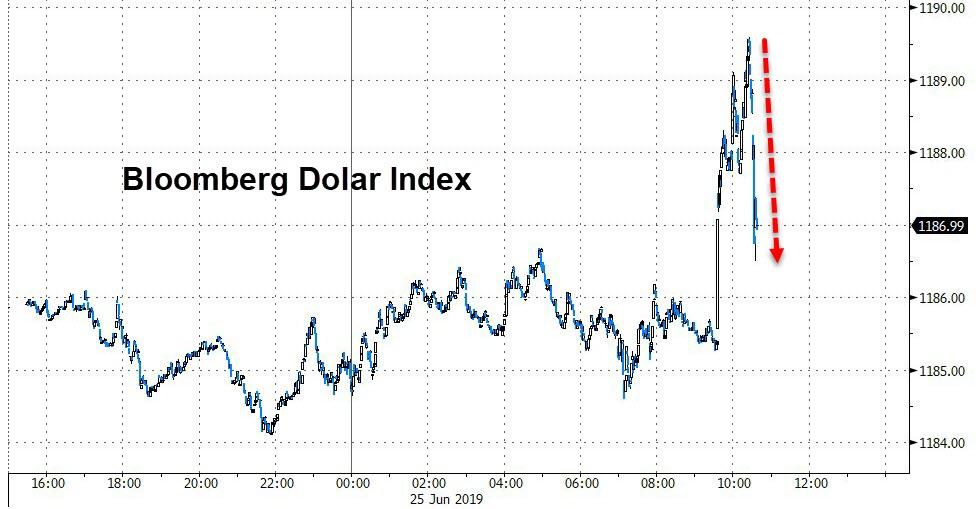
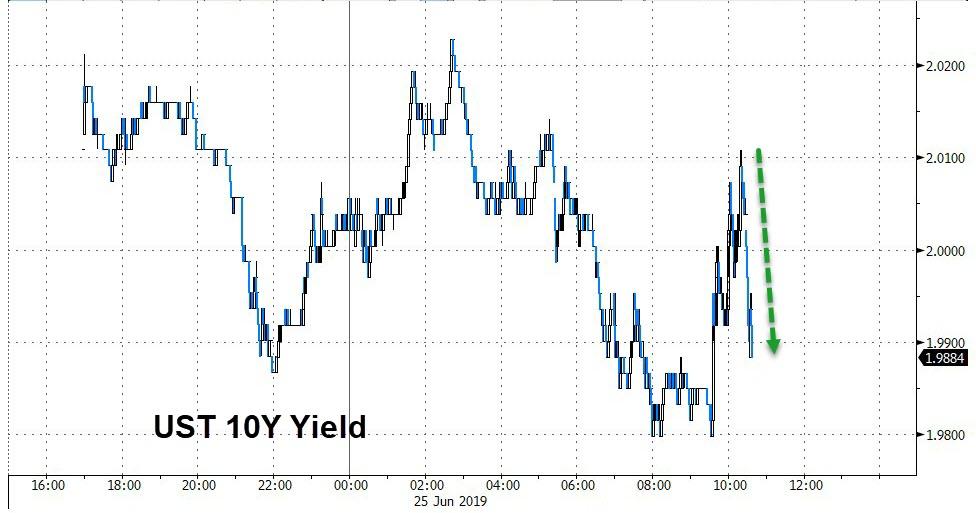
Dollar & Bond Yields Tumble On Reports “No Deal” Expected At G-20

In what appears to be an exercise in expectations management, White House officials are talking to Reuters to set the table for this weekend’s meeting between Trump and Xi at the G-20.

  • *TRUMP, XI WILL MEET SATURDAY IN JAPAN, OFFICIAL TELLS REUTERS

  • *U.S. GOAL FOR G-20 MEETING TO REOPEN CHINA TRADE TALKS: REUTERS

Officials set the tone:

  • *SENIOR ADMIN. OFFICIAL SAYS U.S. WON’T ACCEPT TARIFF CONDITIONS

  • *U.S.-CHINA MAY AGREE ON NO NEW TARIFFS AS GOODWILL: REUTERS

Finally, and most notably, Reuters notes:

  • *NO DEAL EXPECTED AT G-20, SENIOR ADMIN. OFFICIAL SAYS

  • *U.S. DOESN’T EXPECT BROAD TRADE DEAL AFTER G20 MEETING: REUTERS

  • *CHINA TALKS MAY PERSIST FOR MONTHS, YRS, OFFICIAL TELLS REUTERS

Stocks shook off the news but bonds and the dollar did not…


via ZeroHedge News http://bit.ly/2X7RzsX Tyler Durden

Why Interest Rates Don’t Need To Rise Much To Cause Recessions Now

Authored by Jesse Colombo via RealInvestmentAdvice.com,

As the probability of a U.S. recession in the next year grows rapidly (it may be as high as 64%), many bullish economists and financial commentators are unsurprisingly downplaying this risk. One of their main arguments is that interest rates have not been hiked aggressively enough to tip the economy over into a recession. While it is true that U.S. interest rates are still very low by historic standards, the reality is that rates do not have to rise anywhere near as high as they did in the past to cause recessions due to America’s debt load that has grown dramatically over the past several decades.

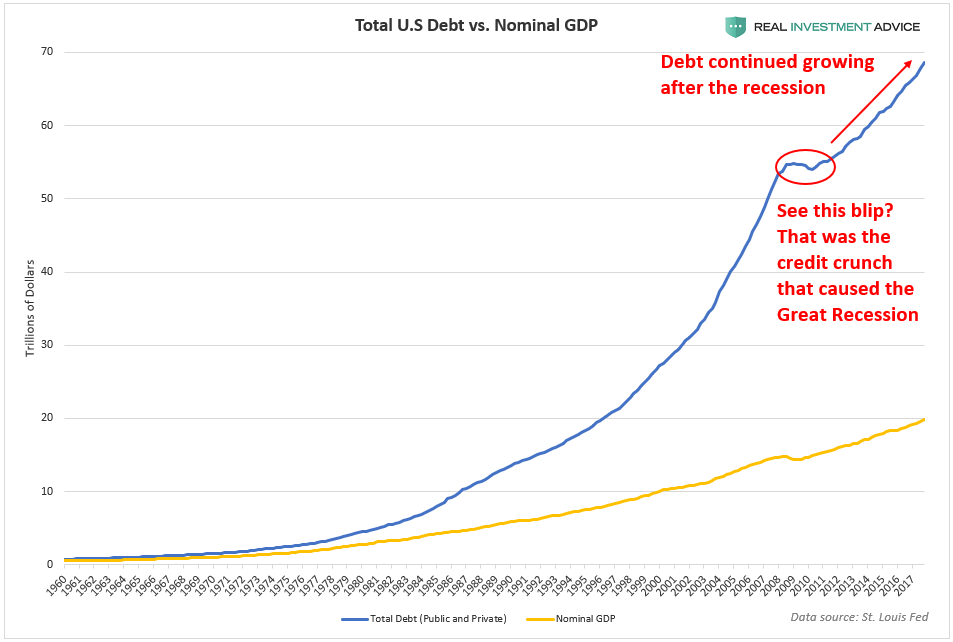
Since the early-1980s, total U.S. debt – both public and private – has been growing at a faster rate than the underlying economy, as measured by the nominal GDP:

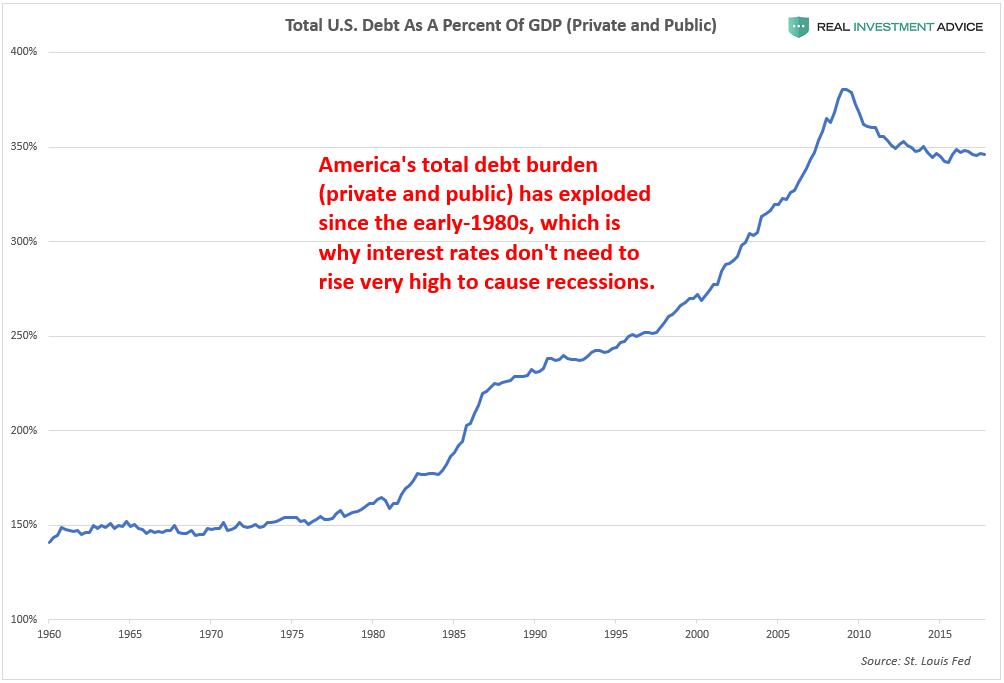
As a result of debt growing faster than our underlying economy, America’s debt as a percent of GDP soared from just over 150% in the early-1980s to approximately 350% in recent years. This higher debt burden is the reason why our economy simply cannot handle interest rates as high as they were before 2008.

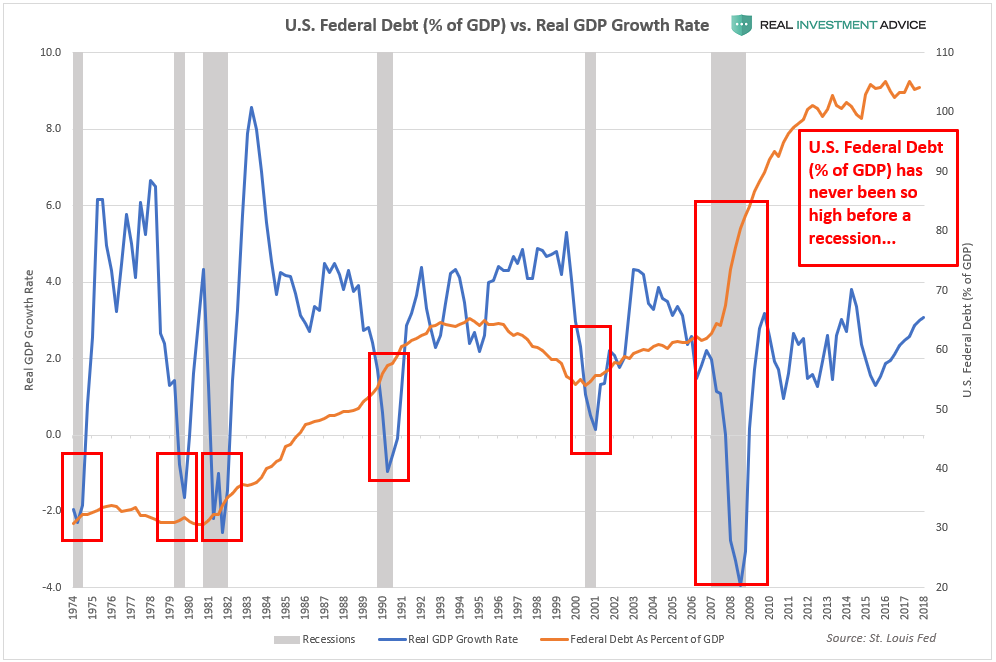
Particularly worrisome is the fact that U.S. federal debt is at a record of over 100% of the GDP (vs. 62% before the Great Recession), which will make it a much greater challenge to keep the economy afloat in the coming recession:

Market strategist Sven Henrich described our conundrum quite well:

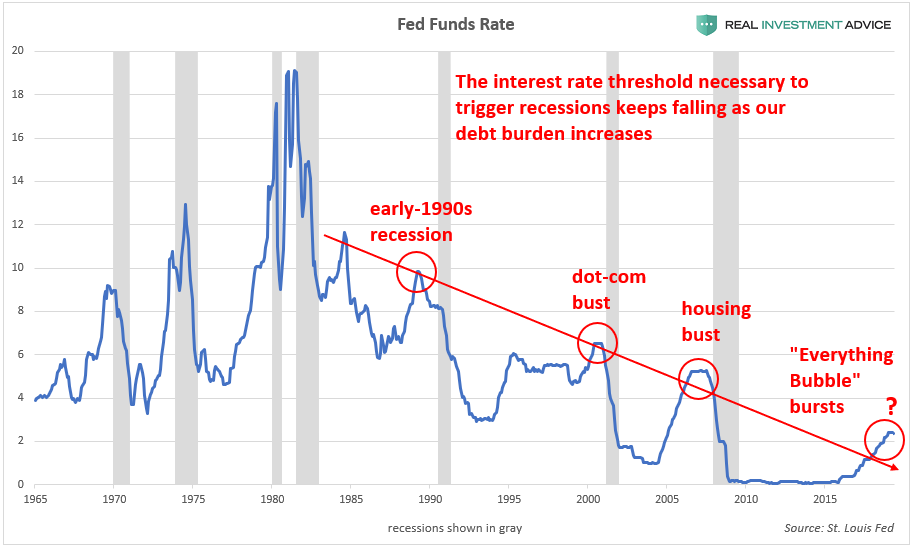
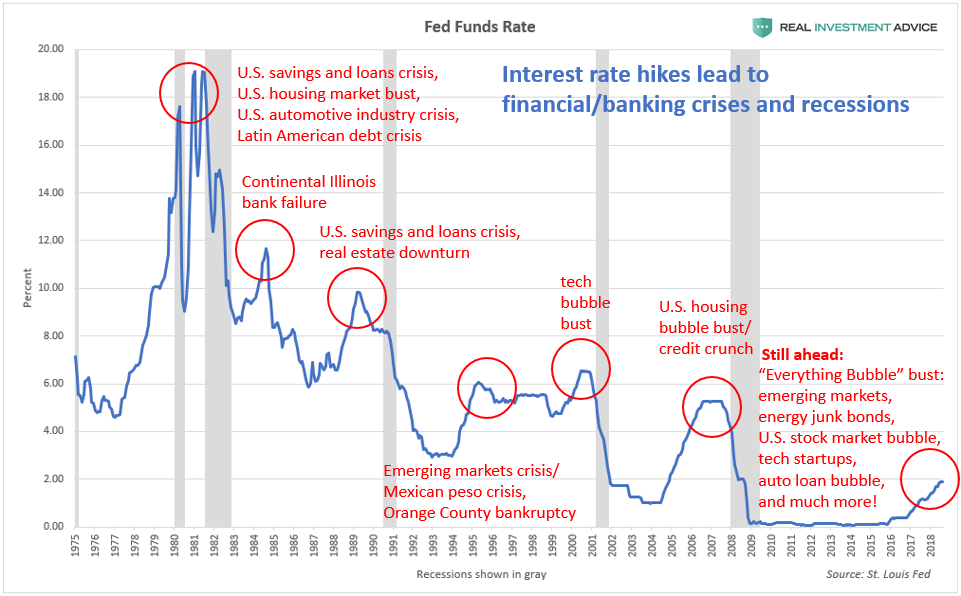
As the Fed Funds rate chart below shows, the interest rate threshold necessary to trigger recessions (recessions are designated by the gray bars) keeps falling as our debt burden increases:

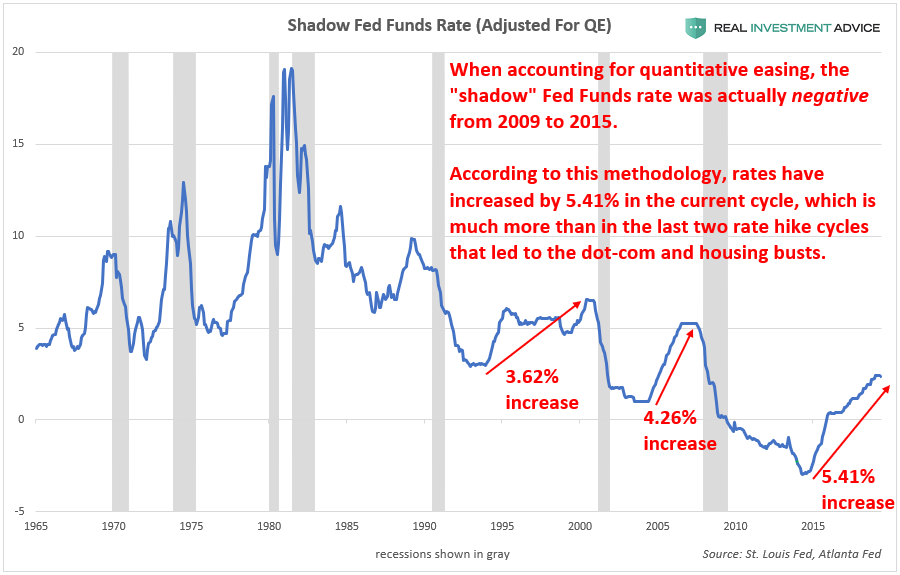
Though many optimists are quick to point out that the benchmark Fed Funds rate was only increased from 0% to 2.5% during the current tightening cycle, the reality is that the current tightening cycle is even more aggressive than the past several cycles when the Fed Funds rate is adjusted for quantitative easing(this is known as the shadow Fed Funds rate – learn more). According to this methodology, interest rates have increased by the equivalent of 5.41% in the current cycle versus just 3.62% before the 2001 recession and 4.26% before the Great Recession of 2007 to 2009:

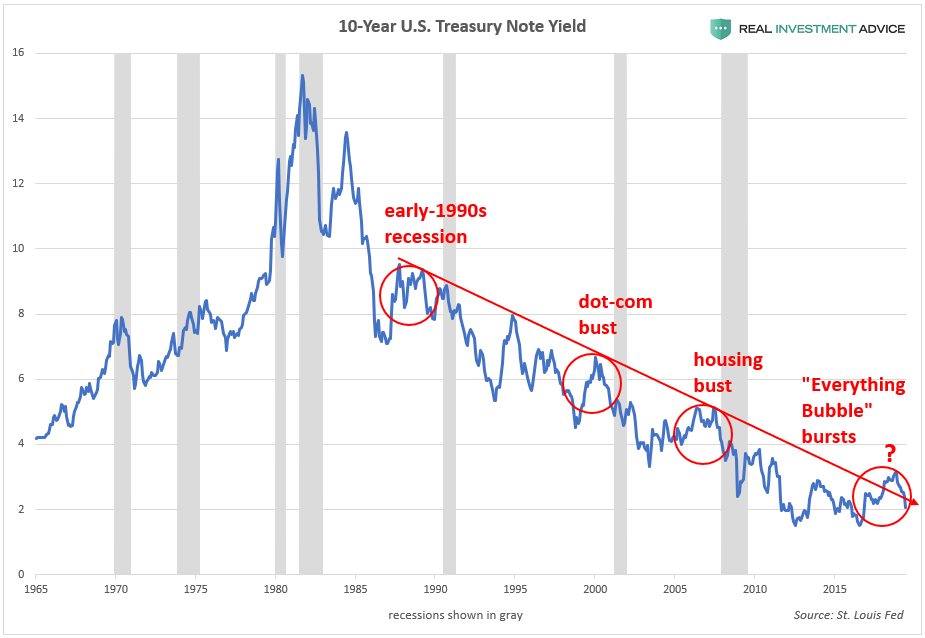
The 10-year U.S. Treasury note yield also confirms the message given by the Fed Funds rate: the U.S. economy has become increasingly sensitive to higher interest rates:

Dangerous economic bubbles form during periods of low interest rates and burst when rates are increased – that’s what typically causes recessions. During the low interest rate period of the past decade (not just in the U.S., but globally), bubbles have formed in global debtChinaHong KongSingaporeemerging marketsCanadaAustraliaNew ZealandEuropean real estatethe art marketU.S. stocksU.S. household wealthcorporate debtleveraged loansU.S. student loansU.S. auto loanstech startupsshale energyglobal skyscraper constructionU.S. commercial real estatethe U.S. restaurant industryU.S. healthcare, and U.S. housing once again. Those bubbles are going to burst in the coming recession, which is extremely worrisome.

As I explained last week, the probability of a U.S. recession in the next twelve months may be as high as 64%:

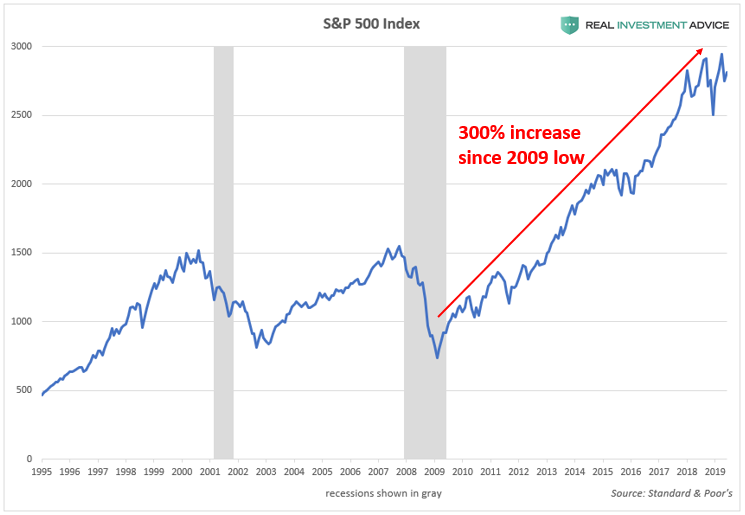
The rapidly-approaching recession poses a serious risk to the extremely inflated U.S. stock market, which is up 300% since its 2009 low. The U.S. stock market is experiencing an unsustainable bubble due to the aggressive actions of the Fed (see my detailed explanation).

To summarize, interest rates do not need to rise much to throw the heavily-indebted U.S. economy into a recession now; furthermore, interest rates have likely already risen to the levels that are necessary to tip our feeble economy over into a recession, as evidenced by rapidly weakening economic data. At this stage of the game, everyone needs to be realistic – we can’t expect to have a full decade of unprecedented central bank stimulus without a tremendous bust. Central banks can only create temporary economic booms by borrowing from the future rather than sustainable, organic economic booms. Anyone who does not believe in that truth right now, or is not aware of it, will inevitably become a firm believer in the coming bust.

via ZeroHedge News http://bit.ly/2ZGmLMw Tyler Durden

2 Year Auction Unexpectedly Strong Just As Powell Pours Cold Water On Treasuries

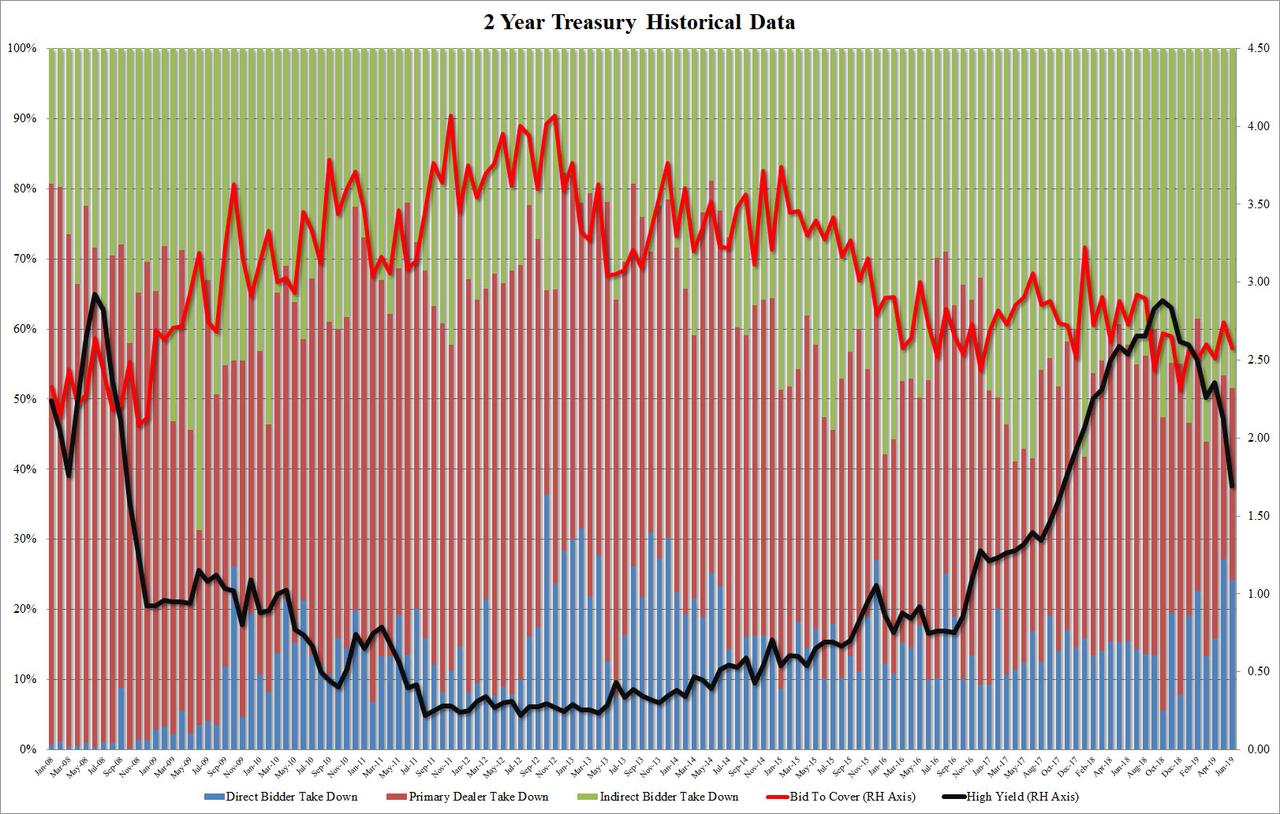
In the chaos over Powell’s unexpectedly less dovish comments which hit the tape at exactly 1pm, when sent stocks lower, and the dollar and bond yields sharply higher, the primary market had no time to react as it had already submitted its indications for today’s $40 billion 2 Year auction when Powell suddenly pulled the rug from under the bond market, sending 2Y yields higher and yet since there was solid demand for the auction before Powell’s commentary, the sale of 2Y bonds was a smashing success, stopping at a high yield of 1.695%, 1bp inside the 1.705% When Issued, the 6th consecutive 2Y auction that did not tail. This was the lowest 2Y yield since October 2017, and 43bps below May’s 2.2125%.

The bid to cover came in at 2.576, modestly lower than May’s 2.745, if just above the 2.54 six auction average.

Finally, the internals were unremarkable with foreign buyers, i.e. Indirects taking 48.5% up from 46.6% last month, and on top of the 47.9% average. And with Directs taking down 24.2%, well above the 17.7% average, Dealers were tstuck with 27.3%, modestly above May’s 26.2 but only the second lowest print of 2019.

Overall, a very strong auction which could have had a far different outcome if Powell’s prepared remarks had hit just an hour earlier.

via ZeroHedge News http://bit.ly/2FAi8MG Tyler Durden

Silence From White House As Russia Again Parks A Military Plane In Venezuela

Though US external pressures on the Maduro regime in Caracas appear to have calmed for the moment, with President Trump reportedly “bored” with pursuing regime change in a complicated political climate that’s “low-hanging fruit” for American foreign policy goals, continued Russian military involvement there could again spark ratcheting tensions. 

On Monday a large Russian air force transport plane touched down in Caracas (specifically an Ilyushin IL-62), as first noticed by the monitoring website Flight Radar 24, and now confirmed by Russia’s Deputy Foreign Minister Sergei Ryabkov on Tuesday, according to the Interfax news agency. Ryabkov described the deployment’s purpose as to service Russian military equipment already in the country, as reported by Reuters

Russian military transport plane in Caracas. Image source: Manaure Quintero/Reuters

Just three months ago a similar Russian air force plane arrival resulted in condemnations out of the White House. At that time Trump said that “Russia has to get out” amid US efforts to back opposition leader Juan Guaido. And John Bolton went further in essentially invoking the 19th century Monroe doctrine, saying at the time: “We strongly caution actors external to the Western Hemisphere against deploying military assets to Venezuela, or elsewhere in the Hemisphere, with the intent of establishing or expanding military operations” comments which came in late March .

Given Trump’s latest expressed desire to get out of the regime change business in Venezuela, will Monday’s Russian jet landing in Caracas be met with silence from the White House? 

Likely sensing Trump’s preference for deescalation, Moscow appears to be taking pains to reassure Washington there’s nothing at all to worry about. “From all points of view this cooperation is transparent,” Deputy FM Ryabkov said. “It does not have any elements of detribalization of the region or any other situation.”

This further comes amid reports that Russia has canceled major military contracts with the Maduro government, fearing the extreme debt-laden country will never be able to pay back its commitments. 

But more crucial is the interesting timing, given that also on Monday the Russian warship Admiral Gorshkov, armed with Kalibr missiles, entered the port of Havana in an official Russian Navy visit to Cuba. In statements that coincided with the ship’s arrival, Deputy FM Ryabkov went so far as to invoke the Cuban Missile Crisis while condemning US weapons systems build-up in Europe. 

“We could find ourselves in a situation where we have a rocket crisis close not just to the crisis of the 1980s but close to the Caribbean crisis,” Ryabkov said while using the standard Russian term for the Cuban missile crisis.

Apparently Moscow wanted to provide Washington with a nice easy-to-understand visual of its warnings of a potential future escalating crisis in the form of its warship entering Cuban waters, which international reporters and cameras were on hand to capture. 

So now, a Russian frigate and accompanying naval vessels in Cuba, and a Russian military jet in Caracas… John Bolton must be having a conniption fit.

via ZeroHedge News http://bit.ly/2Lhybmi Tyler Durden

Can AI Save The Nuclear Industry?

Authored by Haley Zaremba via OilPrice.com,

Attitudes about nuclear energy are changing, with pundits on both sides of the aisle touting its benefits for extremely efficient and relatively clean energy. Despite an ever more positive public opinion, the nuclear industry in the United States, the largest in the world, is currently experiencing a downturn, even going so far as to need government subsidies to keep afloat.

In fact, at present the fastest growing sector of the nuclear industry is profiting not off of growth, but off of the nuclear sector’s slow death in the United States. According to reporting by Bloomberg, “the fastest growing part of the nuclear industry in the U.S. involves a small but expanding group of companies that specialize in tearing reactors down faster and cheaper than ever before.” this statement begins the article appropriately entitled “Fastest-Growing Nuclear Business Is Tearing Down U.S. Plants“.

Tearing down old nuclear reactors is no easy feat, however. Not only is it historically extremely expensive, it’s also highly hazardous. Even in nuclear plants in good condition, it’s a job that requires the utmost level of care and a ton of specialized gear in order to protect workers from radioactive materials.

“Those who do handle radioactive material must first don protective suits that are inherently cumbersome and are further encumbered by the air hoses needed to allow the wearer to breathe,” a report from the Economist details. “Even then their working hours are strictly limited, in order to avoid prolonged exposure to radiation and because operating in the suits is exhausting. Moreover, some sorts of waste are too hazardous for even the besuited to approach safely.”

And then there are reactors that have experienced a recent accident or meltdown–they need cleanup more than any other, but who should be the workers who have to risk their own health for the health of the masses? According to some forward-thinking scientists and other experts in the field, there is a clear and humanitarian answer to this question. Robots.

Some may remember that this idea is not a totally new one, and a robot was sent into the Fukushima nuclear power plant in Japan shortly after an earthquake-related nuclear disaster took place there in 2011. Some remotely operated robots have already become a standard fixture in the decommissioning of nuclear facilities, but the machines widely in use are not yet sophisticated enough to easily and efficiently do the complex tasks necessary to clean up a nuclear reactor. One team at Lancaster University has been working on a new, semi-autonomous robot that would be able to perform the kind of actions that the current robots can’t, making nuclear cleanup an even easier and less dangerous job.

Some discerning readers may find the idea of leaving such a hazardous task in non-human hands disturbing. And as well they should.

“It’s very unlikely that a truly autonomous robot will be trusted with nuclear decommissioning tasks any time soon,” reassures a report from ExtremeTech.

“After all, AI is still far from perfect, and the stakes are as high as they get when you’re dealing with highly radioactive materials in large enough quantities to cause runaway nuclear reactions.”

The semi-autonomous robot developed by the Lancaster University group “splits the difference” by giving the robot some AI capabilities but ultimately leaving a human operator in charge.

According to ExtremeTech, “the team created imaging software that lets the robot “see” the world around it and identify objects like pipes, handles, and other materials common inside nuclear decommissioning sites.” The robot is still in a development phase and has yet to be tested in a scenario with real radioactive materials, but it is likely a pioneer in what will become an industry-wide standard of operation.

With the nuclear power industry set for major growth in Asia, and studies showing that the United States has enough Uranium to stay powered for hundreds more years, nuclear waste cleanup will not only continue to be a growing sector, and an extremely costly one at that, but it will be more important than ever.

via ZeroHedge News http://bit.ly/2LpknpV Tyler Durden