Trump’s Cuba Pressure Campaign Could Spark Cohiba Cigar Price Spikes
Cuba is buckling under a severe economic crisis. Years of economic mismanagement, turbocharged by hyperinflation and population decline, have left the nearly seven-decade-old communist government weaker than at any point in years. Now, the Trump administration has promised maximum pressure, with President Trump openly vowing to bring the regime to its knees.
We’ve focused on Trump’s blockade of oil deliveries to Cuba, the worsening power grid blackouts, and even the tourism collapse, as flight disruptions have erupted in recent weeks amid a fuel crisis. But one area that remains off the radar for many is that the current crisis has likely spread into the Caribbean nation’s agricultural sector.
Cuba’s annual cigar festival in Havana, hosted by Habanos S.A., the state-run entity that holds a monopoly on global Cuban cigar sales, has been “postponed.”
Habanos posted a message on its website last week detailing the postponement of the cigar festival, explaining, “The priority of the Habano Festival is to offer its participants a comprehensive experience at the height of the relevance and prestige that this event represents internationally. The postponement of its celebration is a measure aimed at protecting this experience and guaranteeing its excellence.”
The festival features 1,000 guests from around the world, participating in auctions for Cuban premium cigars, conferences, tastings and pairings, as well as factory and plantation visits.
“Agriculture is not spared by the current oil situation, which is very serious,” Hector Luis Prieto, a producer from the western Vuelta Abajo region, told AFP.
International sales of Cuban cigars remain the Caribbean island’s flagship export, but near-term availability could tighten as the Trump administration ramps up its maximum pressure campaign.
The key question for all those cigar aficionados is whether supply will dwindle in the months ahead, particularly after the annual festival was canceled. This could disrupt distribution lines and send prices for Cohiba, Montecristo, Partagás, and Romeo y Julieta even higher.
One cigar aficionado by the name of Matt Delovino on YouTube asked the simple question, “Is the era of the “everyday” Cuban cigar officially over?”
“Before we dive into the market data, I want to acknowledge that the situation in Cuba right now is incredibly complex. However, for the purpose of this video, I am speaking strictly from a cigar industry and consumer perspective,” Delovino wrote in the description of the video.
Representatives from Colombian cigar retailer La Cava del Puro, which specializes in selling Habanos, Colombian cigars, and other premium tobacco products and has been in business for 25 years, told us in recent days that a looming Cuban cigar supply crunch will likely push prices higher.
They said supplies are set to dwindle in the coming months.
Is a Cuban cigar supply crunch imminent? If so, the U.S. Customs and Border Protection website has a “Knowledge Article” that explains the maximum number of cigars you can bring into the U.S. before you must declare them.
In response to what the Trump administration says is a rising tide of censorship in Europe, the State Department is launching a new app that will give users worldwide access to content that has been censored in other countries.
This includes not only Europe but also China and Iran. The platform, called Freedom.gov, will go live over the next several weeks, according to the State Department, and will be operable on iOS and Android devices.
“Freedom.gov is the latest in a long line of efforts by the State Department to protect and promote fundamental freedoms, both online and offline,” the State Department stated in an email to The Epoch Times. “The project will be global in its scope, but distinctly American in its mission: commemorating our commitment to free expression as we approach our 250th birthday.”
Lauding the move, Jeremy Tedesco, senior counsel at the Alliance Defending Freedom, a civil rights legal group that has been critical of recent EU speech laws, stated on X that “for 250 years, this is what America does,” citing examples such as Radio Free Europe, which broadcast into communist countries during the Cold War.
“If Europe’s bureaucrats don’t want you to see it, that tells you everything,” Tedesco stated. “Because even if your government fears freedom—ours doesn’t.”
The First Amendment, which prohibits the U.S. government from “abridging the freedom of speech,” has provided a legal restraint against government censorship that most other countries lack.
Recent European speech laws, most notably the Digital Services Act (DSA), were ostensibly written to combat what lawmakers deemed “hate speech,” “harmful speech,” and “misinformation,” as well as pornography and abusive AI deep fakes. But critics of European speech codes say they are becoming increasingly draconian.
In 2025, Virginie Joron, a French member of the European Parliament, called the DSA a “Trojan horse for surveillance and control.”
In Finland, Paivi Rasanen, a member of parliament, was charged for quoting Bible verses online in 2019, criticizing her church’s participation in a gay pride event.
“I never imagined that quoting the Bible in a Twitter post would lead to years of criminal charges, yet this is now the reality in Europe,” she told The Epoch Times.
In Germany, illegal online speech could include insulting government officials. German police conducted early morning raids in June 2025 as part of Germany’s 12th annual “day of action against hate-posts,” and arrested 140 residents in the process.
In the UK, people praying silently in the vicinity of abortion clinics were arrested in 2023 and 2025. Left-wing ruling parties in Canada are likewise working to remove religious exemptions from their “hate speech” laws.
Increasingly, U.S. companies are facing extensive fines for allowing online posts that are illegal in Europe. In December, social media company X was fined $140 million for violating EU speech laws.
Such fines on U.S. tech companies, both for speech code violations and for what the EU deems to be anti-competitive behavior, could become a trade issue for the Trump administration.
In January, President Donald Trump posted on Truth Social that the “EU makes more from fines on US tech, than tax from ALL of public European tech,” noting that in 2024, the EU fined American tech companies a total of 3.8 billion euros.
In addition, legal experts have warned that Europe’s online censorship laws could also silence Americans if U.S. tech companies are forced, on a global basis, to take down content that violates EU speech codes.
A House of Representatives report released on Feb. 3 and titled “The Foreign Censorship Threat” stated that “The European Commission, in a comprehensive decade-long effort, has successfully pressured social media platforms to change their global content moderation rules, thereby directly infringing on Americans’ online speech in the United States.”
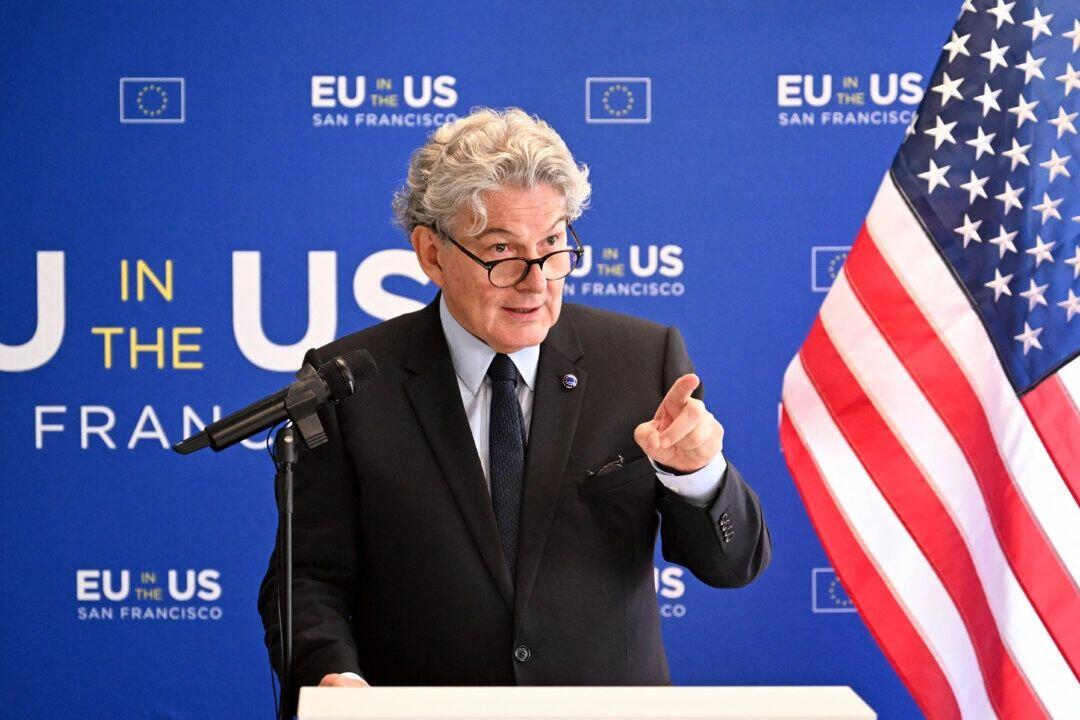
According to the Digital Services Act, illegal online speech could include anything that is prohibited in any EU member country. And in one of the more explicit efforts to regulate speech globally, European Commissioner Thierry Breton warned X owner Elon Musk during the 2024 U.S. presidential campaign that his company could face penalties for posting an interview with Trump.
In a 2025 interview with The Epoch Times, Andrew Puzder, U.S. ambassador to the European Union, stated: “When a company like Facebook or Twitter or X has to change its algorithm, and that algorithm might impact the free speech rights of Americans, that’s something that we really can’t tolerate. I know President Trump is not going to allow a foreign government to restrict the free speech rights of American citizens in ways that even our own government couldn’t restrict them.”
Report Details Russia’s Shadowy Digital Pipeline Concealing $90BN In Crude Exports
Global sanctions meet the digital age in a recent interesting bit of FT analysis, which concluded that a single email server may have exposed what amounts to a $90 billion shadow pipeline for Russian crude.
While Western media and officials would consider this an ‘illicit’ sprawling sanctions-evasion machine hiding in plain sight, Moscow sees US-EU efforts to stamp out its international energy trade as an unjust tactic to impose total economic isolation related to the Putin’s ‘special military operation’ in Ukraine.
The Financial Times report alleges that “48 seemingly independent companies working from different physical addresses” in reality appear to be “operating together to disguise the origin of Russian oil, particularly from Kremlin-controlled Rosneft.”
Discovery of a common backend infrastructure reportedly exposes the scheme, as on the surface it looked like a fragmented web of independent traders – while digitally, it was one ecosystem.
For example, the FT identified 442 web domains all routed through the same private server – “mx.phoenixtrading.ltd” – with 19 of those domains reportedly tied to Russian businesses, spanning energy and real estate ventures, and curiously several are linked to Azeri nationals.
Among the heavy hitters identified are Dubai-based Foxton FZCO, listed in Russian export records as purchasing $5.6 billion worth of oil – and Advan Alliance appears in Indian customs data as having sold $1.5 billion in Russian crude into India.
Investigators further found the companies had remarkably short lifespans, suggesting fraud, and in some cases customs records revealed the average entity operated for just six months.
The report alleges additionally that once sanctioned a firm would often vanish, only to be replaced by a fresh corporate shell – leaving oversight authorities and enforcement lagging far behind.
The report further highlights in the wake of Trump sanctioning export giants Rosneft and Lukoil back in October 2025:
Since those sanctions were imposed, an otherwise unknown company in the network, “Redwood Global Supply”, has become the single largest exporter of Russian crude. The companies are linked to a group of Azeri businessmen with strong ties to Rosneft.
Ukraine and EU officials are calling for greater efforts to bust up such deceptive digital networks in order to starve the Russian war machine financially.
“The frequent changes of names of ships, managers and oil marketing companies… are long-standing deceptive shipping practices designed to obfuscate the destination, origin and ownership of cargoes and their logistics,” Michelle Wiese Bockmann of maritime intelligence firm Windward told the FT.
An Afghan man accused of rape in Austria jumped bail and fled to Britain, where he was granted asylum and lived freely for over six years.
It is the second such case to be exposed this month after a similar incident involving a Syrian convicted of sexually assaulting a teenager in Germany, who failed to attend his probation hearings and illegally entered the U.K.
As revealed by The Sun newspaper, Omar Ali Noori, 31, arrived illegally in Britain in 2019 after fleeing Austria. He had been arrested in connection with the rape of a woman in Linz in 2018, but absconded while on bail before proceedings concluded.
Despite this, he was granted indefinite leave to remain for five years by the Home Office in 2023. His 23-year-old wife joined him in Britain last year.
Court records cited during an extradition hearing revealed that Noori had used four identities and five different dates of birth on official documents.
At Westminster Magistrates’ Court, Judge Neeta Minhas ordered that Noori, currently held at Wandsworth Prison in south-west London, be returned to Austria to serve a three-year prison sentence for absconding, in addition to facing the rape charge.
Judge Minhas said, “Noori was directly asked if he had committed or been accused of an offence in any country or whether he had been detained in any country. His response to both questions was in the negative. This was clearly not accurate. I find that Noori is a fugitive.”
Noori is now appealing his extradition back to Austria.
An almost mirror case was reported earlier this month after it emerged that Syrian national Azizadeen Alsheikh Suliman, 34, was convicted in Germany of sexually assaulting a 15-year-old girl in Osnabrück in 2022.
According to German media reports, he approached the victim in the city center, under the pretext of asking for a cigarette, before attempting to kiss her and later sexually assaulting her in a nearby courtyard. He was also convicted of supplying drugs to a minor.
German courts handed Suliman a two-year suspended custodial sentence, conditional on probation, and ordered him to pay €3,000 in compensation to the victim. He later breached the terms of his probation and left Germany, prompting the issuance of a European arrest warrant.
Suliman subsequently travelled to Britain via a small boat across the English Channel. He applied for asylum using a different spelling of his name, enabling him to avoid detection for several years. He was housed in taxpayer-funded accommodation in the Greater Manchester area, where he lived with his wife and child before being identified by authorities.
An extradition request was upheld earlier this month, but has been appealed by Suliman. His legal team argues that he faces a risk to his life if returned to Germany because of a feud originating in Syria involving his cousin, and that extradition would breach Article 8 of the European Convention on Human Rights by separating him from his wife and child.
It is likely that Noori’s appeal will also focus on human rights legislation.
Saudi Arabia recorded its widest quarterly budget deficit in five years in the final three months of 2025, as lower crude oil prices weigh down the kingdom’s finances, Bloomberg is reporting.
Data released by the Saudi Ministry of Finance shows the government posted a deficit of 94.9 billion riyals ($25.3 billion) in the fourth quarter, which brought the total shortfall for 2025 to nearly 276.6 billion riyals ($73.73 billion), more than double the previous year’s 115.6 billion riyals ($30.82 billion) deficit in 2024.
The full-year deficit amounted to roughly 5.5 percent of gross domestic product.
Non-oil revenue reached about 122.6 billion riyals ($32.68 billion) in the fourth quarter of 2025, while oil revenue fell to around 154.2 billion riyals ($41.10 billion), down from 170.8 billion riyals ($45.53 billion) in the same period a year earlier, according to Finance Ministry data.
Saudi Arabia has been running budget deficits since late 2022, with Bloomberg Economics noting that the kingdom would need oil prices to average about $97 per barrel in 2025 to balance its budget.
That figure rises to roughly $114 per barrel when domestic spending by the sovereign wealth fund is included. Meanwhile, Brent crude, the global benchmark for oil prices, is currently trading at around $71.
This gap has prompted heavier borrowing on international bond markets, as well as major delays and downscaling of the Kingdom’s large-scale megaprojects tied to the Saudi Vision 2030 program, championed by Crown Prince Mohammed bin Salman (MbS).
Bloomberg reported in late January that Saudi authorities had begun pressing some of the kingdom’s wealthiest families to inject additional capital into domestic ventures, as Vision 2030 megaprojects face scaling back or suspension.
In the same month, Reuters reported that the construction of the Mukaab, the towering cube-shaped centerpiece of Riyadh’s New Murabba development, was suspended beyond initial groundwork, as the Public Investment Fund (PIF) reassessed financing and feasibility.
The Financial Times had also reported that Saudi Arabia’s $1.5 trillion NEOM development is set to be significantly “downscaled and redesigned,” with its flagship component, The Line, being “radically scaled back.”
These scale-backs and delays come as capital is redirected toward priority projects tied to Expo 2030 and the 2034 World Cup, as well as sectors expected to deliver quicker returns, including logistics, mining, and AI.
Saudi officials expect the fiscal deficit this year to narrow to 3.3 percent of GDP; however, analysts at Goldman Sachs Group Inc. and Bank of America Corp. project a higher figure in the range of five to six percent.
As it’s always done, Russia is expected to ensure its sovereignty, security, and thus its survival through the creative interplay between its political, military, intelligence, diplomatic, expert, and civil society communities.
Russia’s specialoperation against NATO-backed Ukraine just entered its fifth year.
The last three anniversaries were reflected upon here, here, and here, and keeping with tradition, the present piece will review what happened over the past year and forecast what might be come in the next one.
Generally speaking, Russia now faces five geostrategic challenges that are expected to shape its approach towards the US-mediated peace talks with Ukraine and its grand strategy overall, namely:
* NATO Influence Is Poised To Expand Along Russia’s Entire Southern Periphery
Last August’s “Trump Route for International Peace and Prosperity” (TRIPP) along Armenia’s southern Syunik Province has the dual function of a NATO military-logistics corridor through the South Caucasus to Central Asia. Spearheaded by member state Turkiye with allied Azerbaijan serving as the launchpad across the Caspian, TRIPP threatens to revolutionize Russia’s regional security situation for the worse if these threats aren’t contained, especially if it emboldensKazakhstan to follow in Ukraine’s footsteps.
* The US Supports The Revival Of Poland’s Long-Lost Great Power Status
* India Seems To Be Undergoing A US-Friendly Grand Strategic Recalibration
India began aligning with some of the US’ interests after their trade deal as explained here, which could eliminate tens of billions of dollars’ worth of Russian budgetary revenue if India does indeed reduce its import of Russian oil like the US claimed that it agreed to. The same goes for India possibly eschewing new big-ticket military-technical purposes from Russia too. This US-friendly grand strategic recalibration might also put more pressure on Russia’s top Chinese partner and therefore reshape Asian geopolitics.
* Poland Now Wants Nukes & Turkiye Might Soon Declare The Same Intent
The US’ decision to let the New START lapse risks a global nuclear arms race. Poland was emboldened to declare its nuclear intentions while RT published a detailed report about how Turkiye might go down this route too. Both are historical Russian rivals, and seeing as how Poland envisages carving out a sphere of influence in Central & Eastern Europe and Turkiye envisages one in Central Asia as was noted above, them obtaining nukes would pose a huge threat to Russia and raise the likelihood of its containment.
The five geostrategic challenges confronting Russia in the fifth year of its special operation are formidable but not insurmountable.
As it’s always done, Russia is expected to ensure its sovereignty, security, and thus its survival through the creative interplay between its political, military, intelligence, diplomatic, expert, and civil society communities.
They might opt to cut a deal with the US over Ukraine so as to focus more on tackling these challenges, but not at any cost, ergo why that hasn’t yet happened.
Nearly $1 billion in U.S. federal research funds have been funneled into projects involving the Chinese regime’s defense laboratories that pose “critical risks” to America’s national security, according to a new study.
Nearly $1 billion in U.S. federal research funds have been funneled into projects involving the Chinese regime’s defense laboratories that pose “critical risks” to America’s national security, according to a new study.
The report, released by the Center for Research Security and Integrity (CRSI) on Feb. 19, identifies nearly 1,800 research papers published between January 2019 and July 2025 that involve U.S. collaborations with Chinese defense laboratories.
About one-third of the articles specifically credited U.S. federal funding for the research. The topics of these projects ranged from directed energy systems and energetic materials to radar and sensing, artificial intelligence, flexible electronics, and high-performance computational physics.
“These are critical technology fields that can fundamentally change future military and warfighting capabilities, yet PRC defense laboratories are directly benefiting from this research,” analysts wrote in the report, using the acronym of the Chinese communist regime’s official name, the People’s Republic of China.
The report estimates the total value of these research projects at approximately $943.5 million, noting that the figure could be much higher due to ambiguities in certain research grants and facility contracts.
Jeffrey Stoff, founder of the Virginia-based nonprofit CRSI and co-author of the report, said the U.S. government and academia “lack the will, resources, or priorities” to effectively safeguard its research and innovation.
“This is largely because there are very few regulations that restrict such collaborations. In other words, research-performing organizations, including government laboratories, are not concerned with protecting national interests, even when the research is funded by taxpayers,” Stoff told The Epoch Times via email.
The report was released following multiple congressional investigations into projects involving researchers funded by the Pentagon or the Department of Energy collaborating with Chinese institutions that advance China’s military.
Stoff, a former China adviser for the U.S. government, said the latest study was “intentionally limited to collaborations with a subset of PRC entities that unambiguously pose critical risks to US national security: official PRC defense laboratories.”
‘Unacceptable Risk’
The study identifies 45 Chinese laboratories, acknowledged by Beijing itself as key state-level defense laboratories, that have collaborated with U.S. entities.
Almost all of these laboratories removed the terms “defense” or “national defense” from their official English titles, the report notes, saying that this lack of transparency could complicate U.S. institutions’ due diligence and risk assessment efforts.
Among the most active collaborators with American researchers is the State Key Laboratory of Powder Metallurgy at Central South University in Changsha, China. Over the past five years, its personnel co-authored 285 articles with American researchers from public and private universities and federal laboratories. Of these publications, 80 credited U.S. government funding.
Even though the metallurgy lab omits the term “defense” from its official Chinese name, the report notes that its core mission is to support the Chinese armed forces, particularly in the defense aerospace sector.
Established in 1989 by Huang Peiyuan—a key scientist involved in China’s first atomic weapons and missile development programs—the lab is currently led by Zhou Kechao, who has worked on projects funded by the People’s Liberation Army’s (PLA) Equipment Development Department.
About 70 U.S. institutions have published research papers with the Chinese metallurgy laboratory since 2019, with the University of Tennessee being the most frequent partner. The Knoxville-based university didn’t respond to a request for comment by publication time.
The report also gives case studies of three other Chinese laboratories that frequently collaborate with U.S. institutions and scholars, including a national welding laboratory operated by China’s primary missile designer and producer, the China Academy of Launch Vehicle Technology. The lab is located within the Harbin Institute of Technology in northern China, a top-ranked member of the “Seven Sons of National Defense,” a club of Chinese universities with deep ties to the PLA.
“US institutions and federal research facilities’ critical-risk collaborations with entities supporting China’s defense [research and development] are significant and continue unabated,” the report reads.
“This raises a fundamental question: if collaborating with PRC defense laboratories is not considered an unacceptable risk that should be restricted, then what is?”
US Funders
The National Science Foundation (NSF) stands out as the largest sponsor of U.S. institutions partnering with these Chinese laboratories, accounting for more than 71 percent of federal funds identified in the report. While the NSF grants largely support theoretical and early-stage fundamental research, the report said, the collaborating Chinese laboratories clearly seek to apply the research in defense and even weaponry.
Other federal funders of such collaborations include the Pentagon and the Department of Energy (DOE).
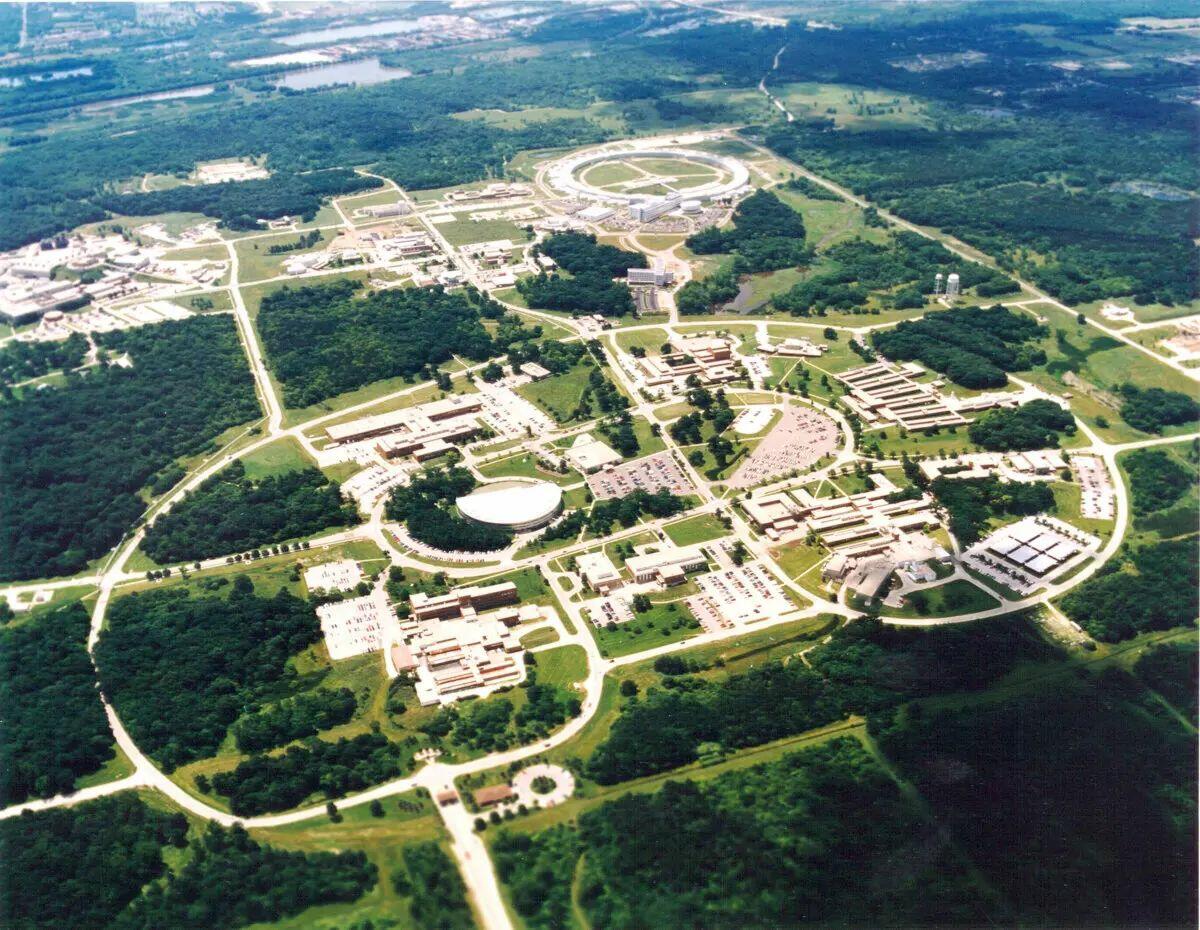
The report found that 10 federally funded research centers affiliated with the DOE have had researchers working with Chinese defense laboratories. For instance, at the DOE-sponsored Argonne National Laboratory, researchers have co-authored 19 articles with identified Chinese laboratories since 2019, in which they credited U.S. government funds.
The report offers several recommendations to policymakers, including creating a government-run research center to oversee all research security and due diligence functions for federal agencies that allocate fundamental research funding.
In response to the study, Emil Michael, under secretary of war for research and engineering, told The Epoch Times that the Pentagon is “intensifying its efforts to safeguard taxpayer-funded research and is upholding the integrity of America’s scientific community.”
The DOE, NSF, and Argonne didn’t respond to a request for comment by publication time.
Iran To Buy Chinese Supersonic Anti-Ship Missiles As US Carriers Near
As US carriers and warships mass in the Gulf and as the next round of Geneva talks are expected by week’s end, Tehran appears to be quietly upgrading its ability to threaten maritime chokepoints.
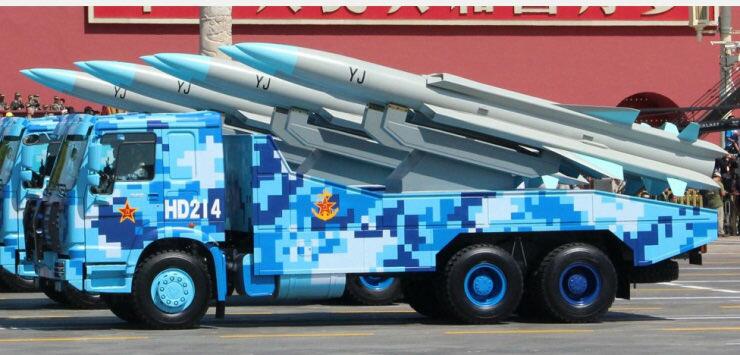
According to Reuters, Iran is in advanced negotiations with Beijing to purchase Chinese-made CM-302 anti-ship cruise missiles – which are supersonic weapons (projectiles which go faster than the speed of sound) designed to skim low over the water and evade naval defenses.
“The deal for the Chinese-made CM-302 missiles is near completion. No delivery date has been agreed,” informed sources told the outlet.
“Iran has military and security agreements with its allies, and now is an appropriate time to make use of these agreements,” an Iranian Foreign Ministry official said separately, at a moment additional deals with Russia are being reported, including a half-billion Euro agreement for Moscow to send thousands of its advanced shoulder-fired missiles to Tehran.
As for the Chinese CM-302, it has a listed range of roughly 290 kilometers (or 180 miles) and is engineered specifically to penetrate layered ship defenses – which the Iranians would seek as they want to complicate US naval operations in the Persian Gulf and beyond, in the event of a hot conflict.
Talks to acquire the weapons have reportedly been in the works for some two years, but were accelerated in the wake of Israel’s US-backed 12-day war against Iran last June.
Danny Citrinowicz, a former Israeli intelligence officer now with the Institute for National Security Studies, has been cited in international reports describing that the acquisition would be “a complete game-changer if Iran has supersonic capability to attack ships in the area.”
“These missiles are very difficult to intercept,” he added. “China does not want to see a pro-Western regime in Iran. That would be a threat to their interests. They are hoping that this regime will stay.”
While neither China nor Russia would likely come to Iran’s direct military aid in the event of attack, the pattern on display would likely be along the lines of these expedited weapons deals.
Washington will be none to happy about this, and could move to expand sanctions and punitive measures on China’s defense and ‘dual use’ industrial sectors.
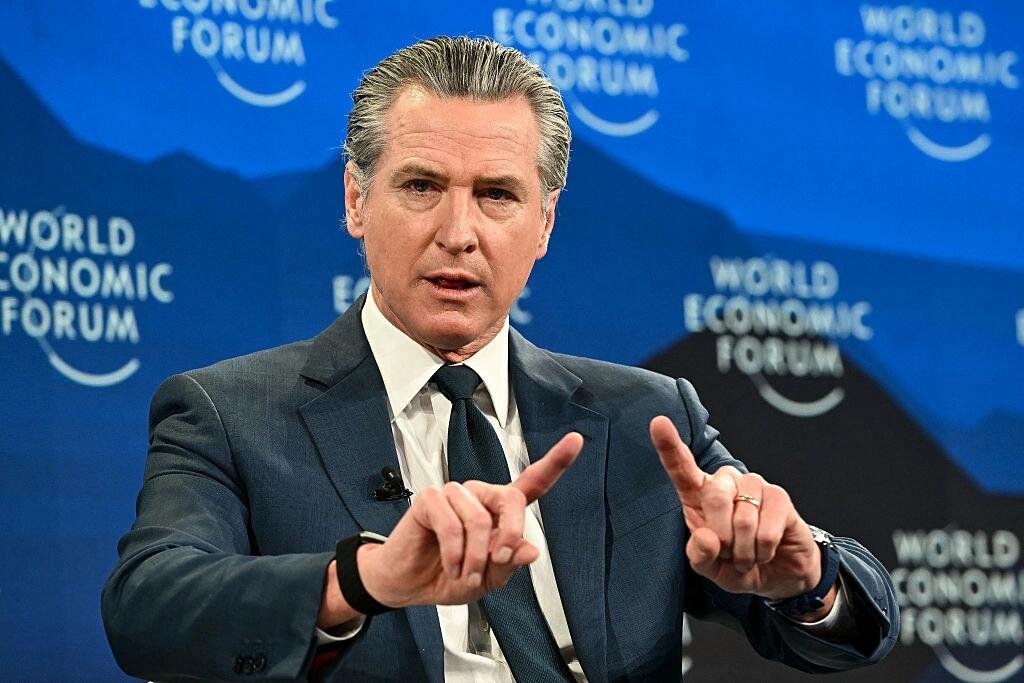
California Gov. Gavin Newsom’s administration has boosted support for illegal immigrants in response to the federal government’s escalated law enforcement and deportation operations under President Donald Trump.
The new support includes $35 million in existing humanitarian funding for basic needs and legal aid. The money is in addition to $125 million already allocated for “free” immigration-related legal services, the governor’s office said in a statement.
“While the federal government targets hardworking families, California stands with them—uniting partners and funding local communities to help support their neighbors,” Newsom said in a statement.
“The urgent need grows as the Trump Administration accelerates mass detention, tramples due process, and funds authoritarian enforcement with over $170 billion. As the Trump Administration chooses cruelty and chaos, California chooses community.”
The funding will not be cash payouts but instead will go to philanthropic and nonprofit organizations that will help connect illegal immigrants facing deportation to legal services, food assistance, and other aid.
The White House and the Department of Homeland Security (DHS) did not immediately return a request for comment.
Assemblymember Carl DeMaio, a Republican serving communities in east San Diego County, criticized the new funding.
“If you were audited by the IRS and found to owe money and back taxes, as a citizen, you couldn’t say, ‘Well, I want a free lawyer to fight the federal government,’” DeMaio told CalMatters.
State Sen. Lena Gonzalez, a Democrat from Long Beach who chairs the California Latino Legislative Caucus, described the move as protecting families.
“We continue to stand in solidarity with our immigrant families. The federal government is waging a war on our communities—and we won’t stand for it,” she said.
“We are putting money behind an effort to stop the fear, stop the separation of our families, and stop violating our basic rights.”
The funding expands access to U.S. support regardless of immigration status. Such measures reflect California’s longstanding commitment to immigrant integration, even as the state grapples with budget deficits and federal pushback.
Disputes Over Sanctuary Policies
Meanwhile, Trump administration immigration law enforcement efforts, including detention and removals, will cost $170 billion over four years, Newsom’s office said.
Department of Homeland Security data indicates that more than 675,000 illegal immigrants have been deported since Trump returned to office for a second term in January 2025. An estimated 2.2 million have self-deported for a total of approximately 3 million departures. Each deportee was paid between $1,000 and $3,000 and had their airfare paid by the U.S. taxpayer.
“In the last year, fentanyl trafficking at the southern border has also been cut by more than half compared to the same period in 2024,” DHS Secretary Kristi Noem said in a statement. “The U.S. Coast Guard alone seized enough cocaine to kill more than 177 million Americans.”
Noem added that the efforts have saved taxpayers more than $13.2 billion, partly because forced removals cost a lot more than incentivized self-deportations.
“Countless lives have been saved, communities have been strengthened, and the American people have been put first again,” she said.
California is a sanctuary state, meaning it limits cooperation with federal immigration authorities in enforcing federal immigration law, save for those who have already been found guilty of serious or violent felonies. However, California’s sanctuary laws—SB 54 and TRUTH Act—do not require state compliance with ICE detainers for those not yet convicted of serious or violent felonies, so arrests and charges alone don’t secure state cooperation.
Immigration and Customs Enforcement (ICE) in February asked Newsom not to release 33,179 noncitizens with ICE arrest detainers from state custody. ICE said they include people previously convicted of murder, sex offenses, or drug trafficking.
“Governor Newsom and his fellow California sanctuary politicians are releasing murderers, pedophiles, and drug traffickers back into our neighborhoods and putting American lives at risk,” DHS Assistant Secretary Tricia McLaughlin said.
The federal government has withheld more than $160 million in transportation funds from California over issues such as foreign truck-driver licenses and freezing billions in other aid to Democratic-led states.
An appeals court prevented federal restrictions on commercial driver’s licenses for certain immigrants from going into effect—a reprieve for temporary workers. Los Angeles County has spent more than $1 billion on welfare for illegal immigrants over two years.
DHS on Feb. 23 criticized Newsom for pardoning a convicted attempted murderer facing deportation, saying the governor is putting American lives at risk.
Trump also hosted “Angel families,” who have become victims of crimes by criminal illegal immigrants, at the White House for a remembrance ceremony on Feb. 23.
Jody Jones, the brother of Rocky Jones, who was fatally shot by an illegal alien in California, said:
“I’m sick and tired of hearing these Democratic politicians stand up on these podiums and say how sorry they are for seeing these criminal illegal aliens being ripped apart from their families.
“What about us? What about the American family? What about us? We mean something, too.”
Earlier, the president signed a proclamation declaring Feb. 22—the anniversary of Laken Riley’s murder by Venezuelan illegal immigrant Jose Ibarra—as National Angel Family Day, honoring 62 victims and two survivors of such crimes.
A software engineer in Spain had the surprise of his life when he found himself in control of thousands of robots in what was supposed to be a pet project. Sammy Azdoufal set out to customize his new Chinese-made DJI Romo robot vacuum, a high-end autonomous cleaner that comes with a price tag of $2,000 that maps homes, mops floors, and navigates obstacles with onboard sensors, according to Popular Science.
Dissatisfied with the manufacturer’s app, Azdoufal aimed to steer the device using a PlayStation 5 controller (like any intelligent man would) and that’s when things got weird.
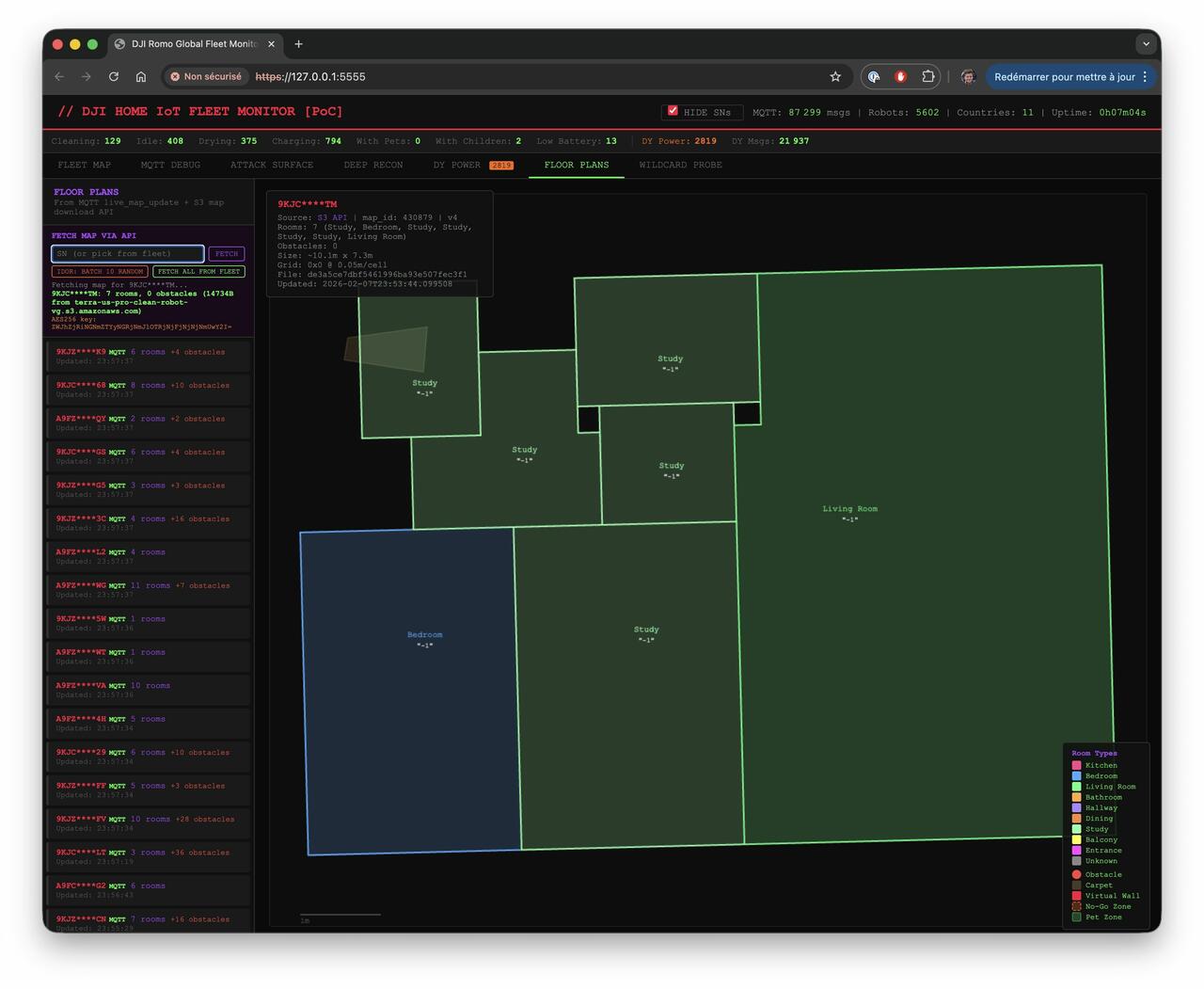
Using an AI-powered coding assistant, Azdoufal reverse-engineered the vacuum’s communication protocol with DJI’s cloud servers and unwittingly uncovered a critical backend vulnerability. The authentication token for his single device granted access to live camera feeds, microphone audio, detailed floor maps, and operational status from nearly 7,000 other Romo units deployed across 24 countries.
Azdoufal leads AI strategy at a vacation rental home company; when he told me he reverse engineered DJI’s protocols using Claude Code, I had to wonder whether AI was hallucinating these robots. So I asked my colleague Thomas Ricker, who just finished reviewing the DJI Romo, to pass us its serial number.
With nothing more than that 14-digit number, Azdoufal could not only pull up our robot, he could correctly see it was cleaning the living room and had 80 percent battery life remaining. Within minutes, I watched the robot generate and transmit an accurate floor plan of my colleague’s house, with the correct shape and size of each room, just by typing some digits into a laptop located in a different country.
…
Separately, Azdoufal pulled up his own DJI Romo’s live video feed, completely bypassing its security PIN, then walked into his living room and waved to the camera while I watched. He also says he shared a limited read-only version of his app with Gonzague Dambricourt, CTO at an IT consulting firm in France; Dambricourt tells me the app let him remotely watch his own DJI Romo’s camera feed before he even paired it. –The Verge
In malicious hands, attackers could have monitored private spaces, eavesdropped on conversations, or even remotely maneuvered the devices without owners’ knowledge. IP addresses provided approximate locations, compounding the privacy breach.
The Verge alerted DJI, which acted swiftly. The company identified the issue during an internal review in late January 2026, deployed an initial patch on February 8, and completed a follow-up update by February 10.
The recent security lapse in the robot vacuum will likely fuel U.S. regulators’ scrutiny of the Chinese company. Just two months after the Federal Communications Commission added foreign-made drones and critical components, including those from DJI, to its Covered List in December 2025—effectively blocking approvals for new models—DJI filed a petition last week challenging the decision in the U.S. Court of Appeals for the Ninth Circuit. The company argues the FCC acted without sufficient evidence of national-security threats, procedural flaws, and violations of due process.
“It carelessly restricts DJI’s business in the U.S. and summarily denies U.S. customers access to its latest technology,” the Chinese dronemaker said in a statement obtained by Reuters.
The Federal Communications Commission decision in December meant that DJI, Autel and other foreign drone companies will not be able to obtain the necessary FCC approval to sell new models of drones or critical components in the U.S but it can continue to sell existing versions, Reuters said.
Last March, FCC Chairman Brendan Carr announced the launch of a broad investigation into whether companies aligned with the Chinese Communist Party continue to conduct business in the U.S., despite their equipment and services having been designated as posing unacceptable risks to national security.
The probe, the first major effort by the agency’s newly established Council on National Security, targets entities previously added to the FCC’s Covered List under the Secure and Trusted Communications Networks Act. Placement on the list prohibits new FCC equipment authorizations for those companies’ products, effectively barring their importation, marketing and sale of new models in the U.S., and restricts their use in networks supported by federal funds.
“The FCC has taken concrete actions to address the threats posed by Huawei, ZTE, China Telecom, and many other entities that pose an unacceptable risk to America’s national security, including by doing Communist China’s bidding,” Carr said in a statement at the time.
“We have reason to believe that, despite those actions, some or all of these Covered List entities are trying to make an end run around those FCC prohibitions by continuing to do business in America on a private or ‘unregulated’ basis. We are not going to just look the other way,” he added.