FAA Issues Expanded Safety Warning About 5G Rollout Over “Numerous” Safety Concerns

FAA Issues Expanded Safety Warning About 5G Rollout Over “Numerous” Safety Concerns

Here’s a headline that’s sure to get the conspiracy theorists going: the FAA has just issued an expanded safety warning about the possibility that Verzion and AT&T’s imminent decision to turn on more 5G wireless spectrum could interfere with airplane communications as the battle to slow the rollout intensifies.

It comes as the transition to 5G spectrum for smartphone users, who have become ubiquitous, continues. Verizon and AT&T have already delayed the rollout of new C-band spectrum after being asked by the FAA, but they’re growing impatient and worried about falling behind Europe and (more importantly) China. The FCC has approved of turning on the spectrum, but some within the FAA still feel it could potentially interfere with plane’s altimeters, a prospect that should terrify anybody who flies.

Unfortunately, it doesn’t look like there’s an easy answer here. Because in its latest statement, the FAA said  the 5G rollout currently being planned could threaten “numerous” safety systems used by planes, not just the altimeters.

The announcement from the FAA comes just one day after Boeing and Airbus joined the government agency (which is still recuperating from the embarrassment of regulatory capture it suffered in the scandals over Boeing’s botched rollout of the Boeing 787 MAX 8) in pushing the Obama Administration for supporting more delays, even as the FCC and CTIA, a wireless industry group, insist C-band spectrum has already proven to be safe because other countries have rolled it out without causing a surge in airplane incidents.

If Verizon and AT&T go ahead with their plans to turn on more spectrum, it could potentially lead to more delays if cell towers near airports aren’t tuned to different frequencies, according to Twitter’s Mark Spiegel.

The FAA added that it’s working diligently to allow aviation to “peaceably coexist” with 5G C-band usage.

Tyler Durden
Thu, 12/23/2021 – 13:45

via ZeroHedge News https://ift.tt/3popfPv Tyler Durden

130 Groups Ask CFTC To Shut Down “Dystopian” Water Futures Market

130 Groups Ask CFTC To Shut Down “Dystopian” Water Futures Market

About 70% of the world’s surface is covered in water. Only 2.5% of it is fresh water and suitable for human consumption. By 2050, two-thirds of the world’s population will be affected by water scarcity. Last year, Wall Street recognized this trend by commodifying water on the Chicago Mercantile Exchange (CME). Now, more than 100 organizations have demanded that the Commodity Futures Trading Commission (CFTC) shut down water trading. 

National advocacy organization Food & Water Watch and 138 other organizations penned a letter to CFTC on Dec. 20, requesting CME to halt all trading of the Nasdaq Veles California Water Index Futures, the world’s first water futures contracts, based on water rights in severely drought-plagued California.

“Water index futures trades are contrary to the public interest as they involve the trade of an essential resource,” wrote Food & Water Watch. 

The letter argued that water is essential for life and not a commodity. It said the contracts undermine California’s state law and “beneficial use” doctrine that prohibits entitlements from being used for speculative trading. 

Zach Corrigan, senior attorney for Food & Water Watch, said, “the commission should reject this shoe-horn attempt to drive investor profit under a federal law never meant to apply to a common public resource managed by the state for the public welfare.”

Since the water contracts began trading last December, market participants have traded approximately $1.1 billion worth of spot water, each contract equivalent to 10 acre-feet of water.

The letter also warns large institutional firms could corner the market and implement strategies to hoard water, thus raising water prices which would be devastating for households and farmers on the ground. 

“Free market advocates claim that markets create efficiency, but the outcome is usually dystopian and horrifying,” said John Aspray, an organizer with Food & Water Watch.

Therefore, the commodification of water seems like a good idea as it could benefit businesses that need to hedge their bets. Still, the futures market is open to manipulation by big banks, as we all know in the precious metals space. 

Tyler Durden
Thu, 12/23/2021 – 13:25

via ZeroHedge News https://ift.tt/3qoun5h Tyler Durden

MMT’s Fatal Flaw: Political Willpower

MMT’s Fatal Flaw: Political Willpower

Authored by Michael Lebowitz via RealInvestmentAdvice.com,

MMT, or Modern Monetary Theory, offers a new monetary “logic” that allows the government to spend without concern for debts and deficits. Does MMT seem too good to be true or does MMT’s fatal flaws render it troublesome?
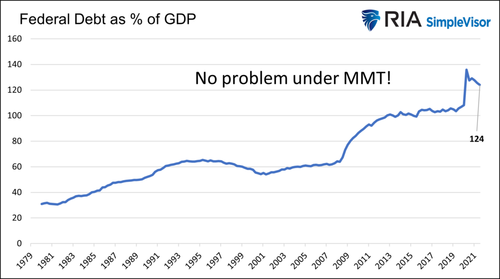
On the heels of unprecedented spending and unmanageable deficits, MMT is gaining popularity. Its acceptance is not surprising as its principles justify reckless fiscal behavior. MMT advocates are loud in their support for unlimited spending and mock the thought of “too much debt.” We often fail to hear them highlight the critical governor in their theory designed to limit inflation.

The current bout of inflation exposes MMT’s fatal flaw. 

What is MMT

“Free healthcare and higher education, jobs for everyone, living wages and all sorts of other promises are just a few of the benefits that MMT can provide.” –MMT and its Fictional Discipline

Before discussing two inherent flaws with MMT, it’s worth briefly summarizing what the theory entails.

At its core, MMT states government can create money via fiscal policy. Currently, all “new” money is lent into existence by the banks. Under MMT, Congress and the President would get a new printing press and print to their heart’s content. Debt would no longer be needed to fund government shortfalls. The current deficits become irrelevant because the government can print money to satisfy its debt requirements. Accordingly, without debt and deficits, MMT is a dream for politicians.

The only flaw with the theory is inflation. If the economy reaches full employment and inflation becomes a risk, the discipline of MMT says taxes should be imposed on individuals and corporations to limit spending and reduce inflationary pressures. Measuring and managing inflation is where MMT will fail.

MMT’s Fatal Flaw #1 – Measuring Inflation

The first flaw is in the measurement of inflation. In the article mentioned above, we state:

“Inflation is impossible to calculate. Inflation is impossible to calculate. No, that is not a typo. For emphasis, let us put it another way. Inflation is impossible to calculate.

The point that inflation is impossible to calculate cannot be overstated.”

Inflation is not measurable in any uniform matter. We can compute general gauges of inflation, but the degree of accuracy is highly questionable. Just consider the difference between inflation for a 45-year-old couple with three kids living in New York City and a retired couple living in New Mexico. MMT requires precision that is not possible.

Making the task even trickier is the conflict of interest between the users and reporters of inflation data. Government agencies report on inflation. Congress and the President control these agencies. As such, those in power manipulate inflation data and have a strong interest in reporting low inflation numbers. MMT increases the need to underreport inflation.

For more, read up on the Boskin Commission in MMT and its Fictional Discipline.

MMT’s Fatal Flaw #2 – Political Willpower

The second and more vexing problem with inflation is politicians’ willpower and vested interests. Should we expect elected officials to reduce spending and raise taxes when inflation is problematic? One needs only to consider the current environment when answering the question.

Current Political Willpower

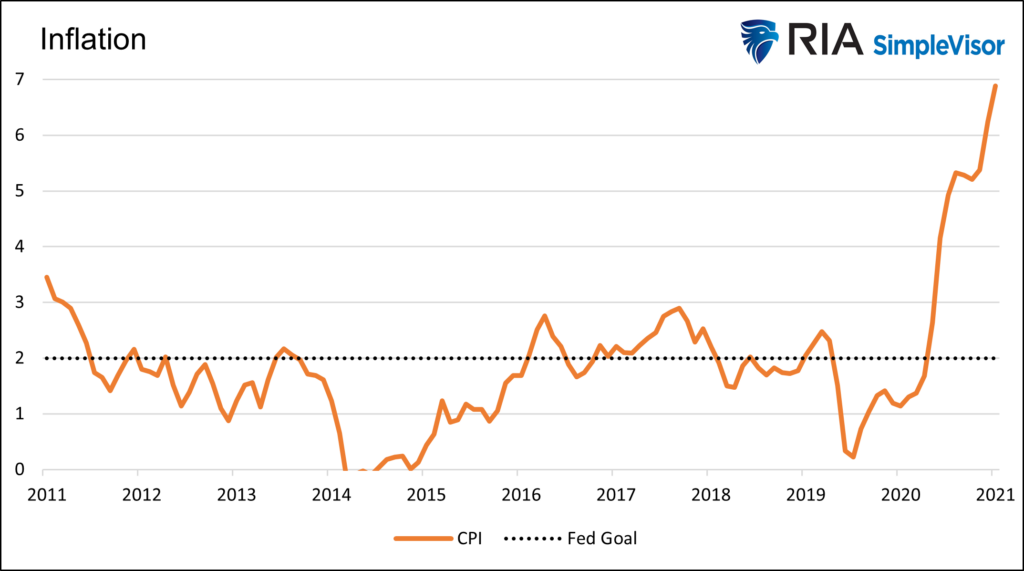
Inflation is running at 6.8%, over three times higher than the Fed’s stated 2% objective. The media and populace are steadily increasing pressure on the administration and Congress to combat inflation. At the same time, wages are growing but at a lesser rate than inflation. Average hourly earnings are up 4.8%. While historically strong, real wages, factoring in inflation, are down 2%.

With stimulus largely spent, consumers are reducing savings, increasing credit card debt, and withdrawing equity from their houses. These are signs that lower- and middle-income classes are falling behind.

Under MMT, the government should be raising taxes to reduce consumption to fight inflation. Furthermore, they would need to raise taxes on all income classes to be effective. Raising taxes on just the wealthy would barely dent the spending habits of the rich and does not affect a large percentage of total consumption. Demand would not be meaningfully affected unless lower and middle incomes are taxed.  

Do you think Joe Biden and the Democrat-controlled Congress would entertain raising taxes on the middle class and poor today? Absolutely not! They know they will lose control of Congress next year if they try.

Our opinion is not biased. There are very few politicians on either side of the aisle willing to raise taxes and lose their power.

As politicians constantly remind us, retaining control tends to trump doing the right thing in Washington. Such a mindset bodes poorly for managing inflation under MMT.

Proof in the Fed

If you seek more evidence of Washington’s lack of willpower to tackle inflation, look at the Fed. Despite red hot inflation and maximum employment, this “politically independent body” runs crisis-level monetary policy. They have dragged their feet for the last nine months as inflation soared well above their objective. The Fed is finally concluding inflation might be a problem as inflation hits 40-year highs.
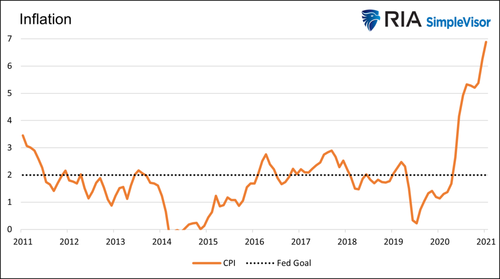
The Fed can curtail inflation by halting QE and quickly raising rates. Doing so would likely harm the financial markets and slow economic activity. While they appear to be willing to take steps to reduce their stimulus slowly, it will not be at the pace warranted by inflation. The Fed cares more about markets than their mandate. Like politicians, Fed members are fearful of losing their power.

Summary

Inflation is MMT’s fatal flaw. Inflation is the fly in MMT’s ointment.

The current high inflation episode exposes MMT’s fatal flaw. Despite the flaw, we suspect the push for MMT will continue, and the rules around inflation will change, allowing for more inflation. Without stringent inflation guidelines and willpower, MMT is nothing more than a printing press for the government.

Historically, MMT-like schemes have always resulted in default. We do not doubt that the adaption of MMT leads us on that same path. 

Tyler Durden
Thu, 12/23/2021 – 13:06

via ZeroHedge News https://ift.tt/3elNJCI Tyler Durden

Steve Bannon: “War On The Unvaxx’d Is About To Commence”

Steve Bannon: “War On The Unvaxx’d Is About To Commence”

“Get Boosted or Die!” is the message from The White House that is repeated ad nauseum by every talking head virtue-signaler.

“This is a pandemic of the unvaccinated”“it’s patriotic to get the jab”… and on and on…

And, despite the fact that breakthroughs are common, vaccine efficacy has collapsed, and Omicron is basically a common cold, don’t expect this ‘blame it on the unvaxx’d’ propaganda to stop anytime soon.

In fact, as former Trump White House Chef Strategist Steve Bannon said on his ‘War Room’ show this week, the ‘war on the unvaccinated’ is only just beginning:

“Herd immunity can be upon us if you don’t get in the way of it with a redonkulous, blunt force instrument, which is mass vaccinations,” Bannon said on Tuesday during his War Room Pandemic podcast.

“It’s really the war on the unvaccinated is about to commence and I mean war.”

Watch here:

And judging by the viral spread of mandates for triple, quadruple jabs and masking across blue states nationwide, Bannon is being proved right… and will likely be right up until the midterms (and the need for mail-in ballots for everyone, alive or dead).

Tyler Durden
Thu, 12/23/2021 – 12:54

via ZeroHedge News https://ift.tt/3yTFib6 Tyler Durden

Peter Schiff: “Powell Is Still Way Behind The Inflation Curve”

Peter Schiff: “Powell Is Still Way Behind The Inflation Curve”

Via SchiffGold.com,

Peter Schiff appeared on Judging Freedom with Judge Napolitano to talk about inflation.

Why are we suffering from it? Who’s to blame? And where is this leading?

There’s only one reason that anybody suffers from inflation and that’s because of the government.”

As Peter put it, inflation is a creature of government.

It’s simply a stealth way that the government taxes us.”

More Highlights from the Interview

“The government doesn’t want the public to know that inflation is created by government because then they might oppose it, obviously, because it’s a tax. They want to blame inflation on the public — on greedy corporations gouging their customers, on OPEC for raising the price of oil, speculators for trading in commodities, sometimes maybe even greedy unions demanding higher wages. The government wants to point their finger at everybody but itself.”

“Inflation, sometimes, instead of causing prices to go up, it prevents them from falling. And so we don’t see the harmful effects of inflation because you don’t realize how much lower your cost of living otherwise would have been.”

“When the government takes my money, I know who to blame. You raised my taxes. But when they steal my money through inflation, I’m confused. Especially when the government is lying to the public about why prices are going up. Or, they’re pretending they’re not going up by using the CPI which doesn’t even capture the real extent that prices are going up.”

“If they steal their purchasing power through inflation, the voters don’t know they’re getting robbed and they may still continue to reelect the people who are robbing them.”

“How are you going to do anything about 7% inflation when your interest rates are lower than 2%? You’ve got negative real interest rates greater than 5%. You’re not going to make any headway fighting inflation unless you have a positive real interest rate.”

“Powell is still way behind the inflation curve.”

“Unfortunately, the Fed does Congress’s bidding and whatever deficits Congress runs, the Fed is happy to monetize them.”

“The government can only succeed in artificially suppressing interest rates for so long.”

“If interest rates go to 5%, given the current size of the national debt, we would be spending more in interest payments than we would do on any other line-item in the budget, which would include Social Security.”

Tyler Durden
Thu, 12/23/2021 – 12:26

via ZeroHedge News https://ift.tt/3elTb8I Tyler Durden

More Than $100 Billion Was Stolen From Pandemic Relief Funds, Secret Service Says

More Than $100 Billion Was Stolen From Pandemic Relief Funds, Secret Service Says

When it comes to government waste, we’ve seen some pretty big numbers of recent – including $80 billion worth of military equipment that was left behind in Afghanistan just months ago.

But trumping that number, according to the Secret Service, is more than $100 billion that was stolen from pandemic relief funds. The $100 billion figure is “at a minimum,” a new report from AP says.

The estimate is based on “Secret Service cases and data from the Labor Department and the Small Business Administration,” the report says. 

“The sheer size of the [$3.4 trillion dispersed] is enticing to the criminals”, said Roy Dotson, the agency’s national pandemic fraud recovery coordinator.

A majority of the figure comes from unemployment fraud, the report notes. About $87 billion in benefits may have been paid out improperly, The Labor Department says. 

So far, the Secret Service has seized over $1.2 billion while investigating unemployment insurance and loan fraud. It has returned more than $2.3 billion in fraudulently obtained funds and has more than 900 active criminal investigations into pandemic fraud. 

100 people have been arrested as a result of their investigations so far, the report notes. 

Meanwhile the DOJ has seized more than $75 million in cash from improper PPP loans, it continues. 

Dotson concluded, telling AP: “Can we stop fraud? Will we? No, but I think we can definitely prosecute those that need to be prosecuted and we can do our best to recover as much fraudulent pandemic funds that we can.”

Tyler Durden
Thu, 12/23/2021 – 12:10

via ZeroHedge News https://ift.tt/3FsfyVL Tyler Durden

Rabobank: This Will Be The Biggest Challenge For Businesses, Households And Policymakers In 2022

Rabobank: This Will Be The Biggest Challenge For Businesses, Households And Policymakers In 2022

By Elwin de Groot and Bas van Geffen, strategists at Rabobank

List the season

‘Tis the (most wonderful?) time of the year to make up our lists, a tradition that probably chimes with many of our clients. For markets, 2021 certainly was a special year. Government bond yields, on balance, moved higher on both sides of the Atlantic, with 10y UST yields up more than 50bps and Bunds up 28bps. But in inflation-adjusted terms we saw new record lows, which attests to the impact of central bank purchasing programmes. The 10-y German inflation-linked bond is still trading at -2.22%, within a whisker of its record-low yield set on 17 November. The dollar was a winner in 2021 (+4% YTD in trade weighted terms), but there were many losers. In fact, most currencies fell against the dollar, such as TRY (-40%), ARS and CLP (-17%) to name a few. RUB and CNY were among the happy few that gained. For equity investors, the Mongolian stock index made a smash, turning in 119% in local currency terms (same when USD hedged), followed at considerable distance by a 74% gain (60% USD hedged) in the Sri Lanka Colombo All Share index.

The European STOXX 600 index can boast almost 20% gains in EUR, although half of that melts away when measured in USD. Staying with Europe, as we are in the final weeks of the year the European Commission seems to have embarked on a last minute dash to issue proposals and plant some seeds for next year. On Tuesday, EU Commissioner Dombrovskis added his weight to the debate on Stability and Growth Pact reform, which is expected to gather steam next year, as the current ‘freeze’ of its most pinching rules will come to an end in 2023. According to the FT, Dombrovskis said that EU member states will need to make “credible plans” to cut their debts although he also confirmed that Brussels is contemplating to keep ‘green investments’ out of the deficit metrics. So ‘green’ appears to be a way out for many of us!

Yesterday the EU executive also launched legal action against Poland over rulings by the Country’s Constitutional Court, incompatible with the supremacy of EU law. The EU have sought diplomatic solutions but its patience has run out. Earlier this year it already froze the 35.6bn of funds from the Recovery Fund available to Poland. Yesterday it took a next step towards fines. The Polish government has two months to respond but given that it sees the Commission’s injunction as an attack on its sovereignty, this battle should cast a shadow over European relations in 2022.

Last but not least, the Commission also took steps towards implementing the Global Minimum Tax deal that was reached in October, despite the stalemate in US Congress on overhauling the tax code. Clearly the EU are in a hurry to get this global tax initiative up and running given that a part of the financing of its 800bn Recovery Fund depends on developing a steady flow of alternative revenue streams, also called ‘own resources’. This gels with Dombrovskis’ earlier comments on the Stability and Growth Pact, which, clearly, will be a European theme next year.

Day Year ahead

This year will go down in the history books as a year of strong economic recovery. The GDP of a growing number of countries has returned to pre-pandemic levels, although the gaps between countries remain significant, with developing countries often drawing the short straw. This is partly due to the sectoral composition of the economy, the scope to support the economy through fiscal policy, and the capacity of medical care and access to vaccines. This is something to keep in mind as we unpack our presents under the Christmas tree.

Higher inflation, on the other hand, has clearly proved to be a global phenomenon. As such there seems to be little correlation between the ‘state of the economy’ and inflation rates, when we look at a cross comparison of economies. This underlines that much of that inflation is probably not the result of overheated “demand” in the economy, but rather the result of shortages of raw materials (and thus a sharp rise in commodity prices), other key inputs and, in part, labor.

The rise in global inflation is now one of the steepest in the past thirty years. The obvious explanation for the high inflation to some observers is a decade of quantitative easing by central banks. However, that does not explain why consumer prices have increased so much less over the previous twelve years. In our view the current inflation surge is largely the result of mismatches and whiplash effects. Structural problems, such as the limited competition in the container sector, the reliance on hyper-efficient yet fragile just-in-time production processes and the emphasis on outsourcing, were all exposed by the Covid-19 shock when the global economy rebooted. This also means that we should not underestimate further boosts to inflation in the coming year.

So will growth continue in 2022 or is a supply-shock induced recession on its way? After almost two years of the pandemic, the corona virus, and particularly the new Omicron variant, still casts its shadow over the economy, even though the latest reports support the notion that, whilst being much more transmittable, its health impact is considerably less. The past year has also shown that businesses and households can and do adapt to the new circumstances. Ongoing support measures by governments and central banks have obviously played a supporting role here as well.

Geopolitical risks, unfortunately, also remain a clear theme for next year. Through the coming winter months, the relationship between the West and Russia will be mostly in focus. Italian PM Draghi underscored this one-sided relationship once more yesterday, noting that Europe does not have the tools to deter Russia from an invasion of Ukraine: “Do we have missiles, ships, cannons, armies? At the moment we don’t and at the moment NATO has different strategic priorities.” That leaves sanctions as an option, but considering Europe’s dependence on Russian gas, Europe may feel just as much pain – both in terms of energy prices, and production capacity. NATO’s other priorities, as Draghi referred to Asia-Pacific, are geopolitical risks that should of course not be overlooked either. In recent history we have already seen that trade relationships are under pressure, and Covid has shown us how much the West currently relies on Chinese-made goods.

So the outlook for next year is very ‘bifurcated’, a theme we have regularly underscored in this Global Daily over the past year. We could enter a period of slow growth as the supply shocks and current high inflation rates sap demand (with the extent and speed of the slowdown in inflation that follows depending on whether there will be significant second-round effects of inflation on wages – here Europe and the US already seem to diverge). On the other hand, even though supply shocks keep pushing inflation higher, structural changes such as ongoing government support and investments (‘build back better’), and a (geopolitics or pandemic-inspired) break-up of global supply chains could mean that demand stays strong as well, pushing wages higher. Unless central banks intervene strongly that second scenario would imply structurally higher inflation for years to come. Navigating between these two extremes is going to be one of the biggest challenges for businesses, households and policy makers in the coming years. Tallying the latest shifts in global monetary policy, it seems that central banks are mostly starting to worry about the latter scenario, with the risks that a policy error could exacerbate the former – if an economic slowdown does indeed materialize.

In any case, there will be no ‘normal’ economic development in the coming year, in which most economic indicators have reasonably predictable dynamics. This means that we again have to take into account a very erratic course, in which supply and demand do not always get along, and adjustments in economic prospects according to the evolution of the corona virus.

On behalf of RaboResearch, Seasons Greetings!

Tyler Durden
Thu, 12/23/2021 – 11:46

via ZeroHedge News https://ift.tt/3yRe2tX Tyler Durden

This Christmas, If You Can’t Be Good, Buy The BAD ETF

This Christmas, If You Can’t Be Good, Buy The BAD ETF

We know, we know…the launch of yet another ETF. You can hardly contain your excitement, right?

After all, Goldman Sachs Group, BNY Mellon, JPMorgan Chase and Cathie Wood’s Ark Investment Management have all launched ETFs in December, at least one of which claims to be focused on ESG investments and “transparency”. 

But the latest ETF offering – the BAD ETF – is actually a breath of fresh air in a market environment where everyone is pushing and shoving to be the most ESG compliant while using the most green energy buzzwords.

The new ETF “tracks companies that make most of their cash from selling alcohol or cannabis, casinos or gaming, and developing pharmaceutical products,” according to Yahoo! News.

Tommy Mancuso, president and founder of the BAD Investment Company, which owns the EQM BAD Index that BAD will track, told Yahoo: “We don’t think social stigma should be a primary factor when it comes to deciding what’s a good investment.”

He continued: “It’s kind of almost up to someone’s discretion on what’s considered ESG and what’s not. We’re not trying to hide anything here.”

The ETF has an expense ratio of 0.75%.

And the best part? The ticker was readily available. “Somehow we were able to get that with no issues, which I found fairly surprising,” Mancuso concluded. 

We’ll drink to that…

Tyler Durden
Thu, 12/23/2021 – 11:27

via ZeroHedge News https://ift.tt/3sqPx5D Tyler Durden

Biden Declares Victory Over The Christmas Supply-Chain Crisis From The White House

Biden Declares Victory Over The Christmas Supply-Chain Crisis From The White House

Authored by Bryan Jung via The Epoch Times,

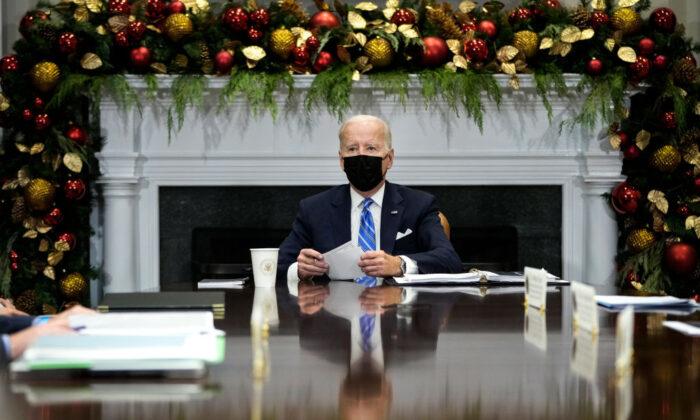
President Joe Biden declared ahead of a White House task force meeting on Dec. 22, that his administration’s efforts to eliminate supply-chain bottlenecks ahead of the holiday season had succeeded.

Biden met with his Supply Chain Disruptions Task Force, which consisted of administration officials and the CEOs of large private-sector companies.

The task force was established in June of this year to address the pandemic-induced global supply and inflation crisis.

The White House said that the task force had made “significant progress to alleviate bottlenecks that are rooted in the global pandemic,” and that shipping container wait time has been cut in half.

Among those attending the meeting were the CEO of FedEx, Fred Smith, Gap CEO Sonia Syngal, and American Association of Port Authorities CEO Christopher Connor, as well as Transportation Secretary Pete Buttigieg, Labor Secretary Marty Walsh, and Commerce Secretary Gina Raimondo.

“The much-predicted crisis didn’t occur,” Biden said. 

“Packages are moving, gifts are being delivered, shelves are not empty.”

He said that shelves at grocery and drug stores were stocked at 90 percent of their full capacity, compared with 91 percent before the pandemic, and that deliveries were happening at a faster rate.

Biden pointed to the administration’s progress after pushing for round-the-clock port operations and new transport rules at some of the nation’s biggest ports, including the Ports of Los Angeles and Long Beach.

The president said he had spoken with the CEOs of Wal-Mart, Target, UPS, and FedEx on how to relieve the supply-chain backlog, as container ships and their cargo wait offshore at the two Southern Californian ports.

The two seaports handle about 40 percent of the nation’s imports, processing more than 765,000 containers in November, and over 9.3 million so far in 2021, a 15 percent increase from the record in 2018.

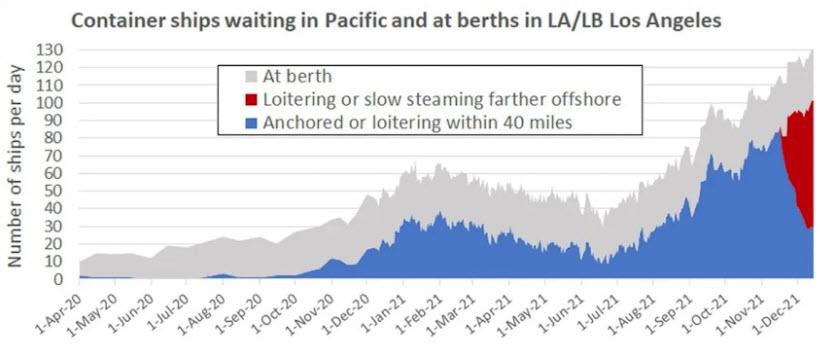
While thousands of loaded import containers have been cleared from the docks since the creation of the presidential task force, about 90 container ships still remain offshore waiting to unload.

[ZH: Sadly, the facts show that there are still an increasing number of container ships in line – notice the red area fake-out]

At the conference, FedEx chair, Smith, said supply-chain issues are “not all solved” but that “most of Santa Claus’ products will be delivered to the consumers.”

Smith believes that inflation pressures should ease as soon as labor shortages in logistics and transport are filled, and said that “we think the peak season is going to be a good one.”

The supply-chain problems are largely due to the pandemic, which has led to high commodity prices, along with shortages in energy, labor, and essential parts.

It has been said that new environmental regulations in California have worsened the transportation slowdown as the logistics industry is readapting to the rules.

A recovering economy combined with a rebounding consumer market has caused a surge in demand which has caught many suppliers around the world unprepared.

Retailers have taken action to ease pressure on the overburdened supply chain by launching early holiday sales promotions and pulling holiday imports forward by a couple of months.

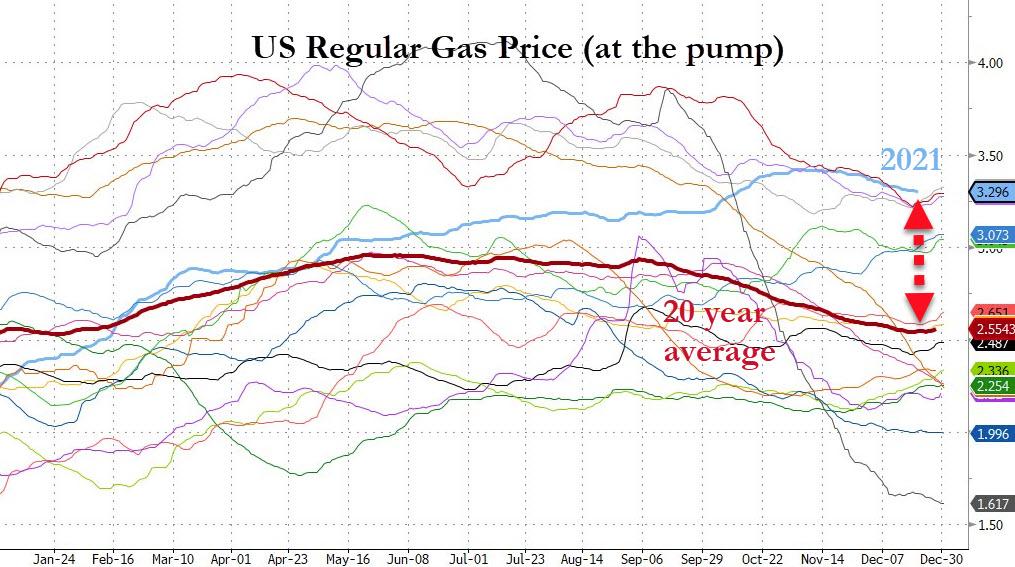
The White House said that fuel prices had dropped 12 cents a gallon on average to $3.30 since last month, but added that the president “believes that they are too high, especially given that we are emerging from a once-in-a-century pandemic.”

[ZH: Except gas has NEVER been more expensive for this time of year…]

Biden had also called for the Federal Trade Commission to investigate excessive shipping fees and possible illegal conduct in oil and gas markets.

Tyler Durden
Thu, 12/23/2021 – 11:11

via ZeroHedge News https://ift.tt/32xRBO7 Tyler Durden

As Used Car Prices Hit Another Record High, Here’s What Goldman Thinks Happens Next

As Used Car Prices Hit Another Record High, Here’s What Goldman Thinks Happens Next

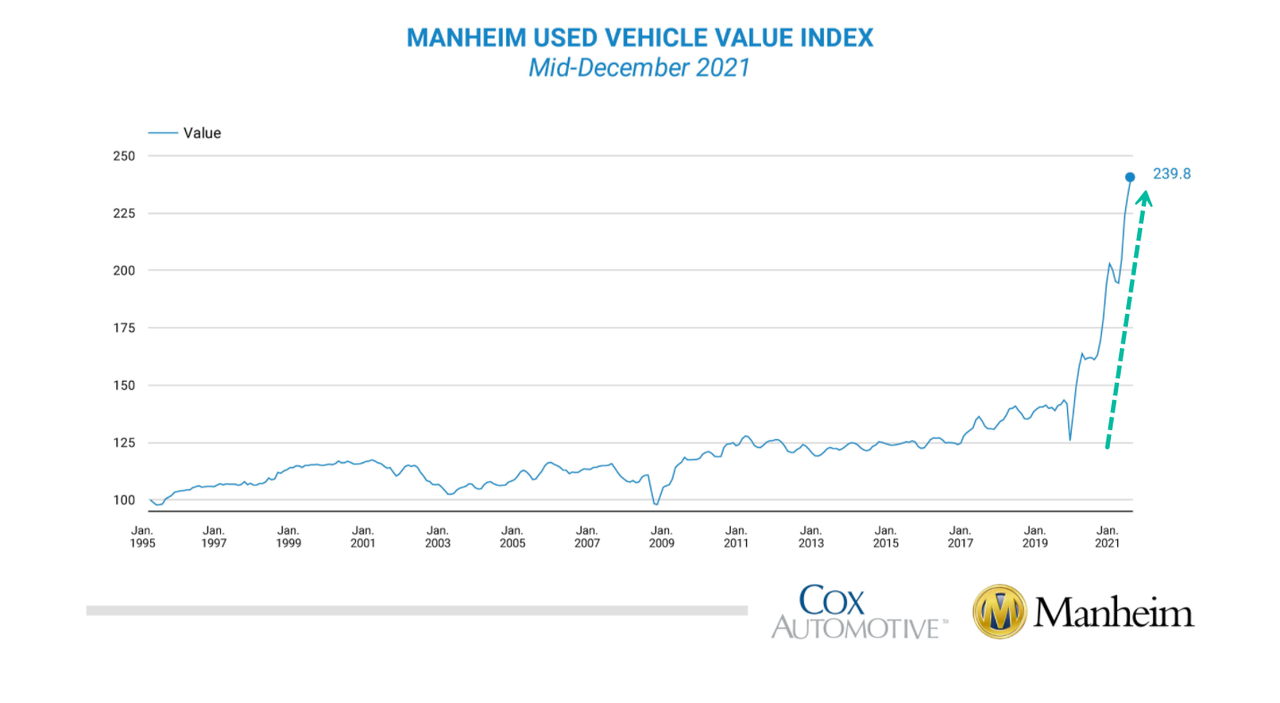
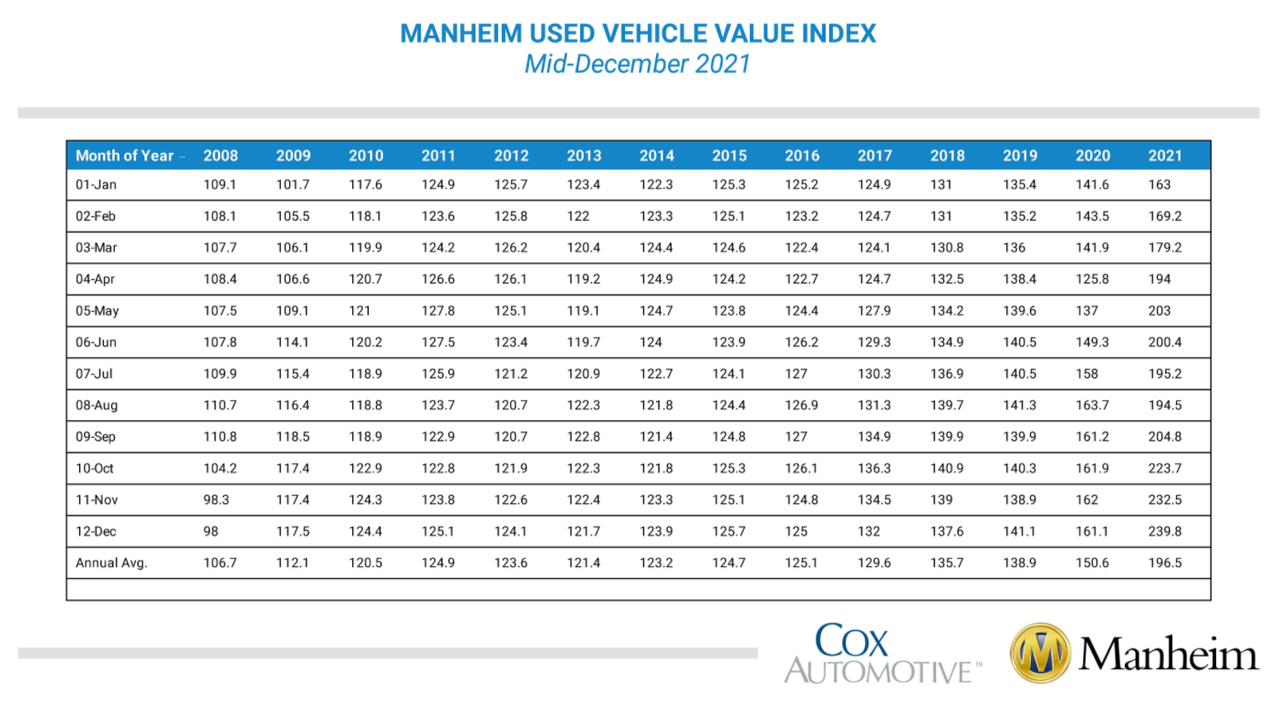
Another month, another record (see prior records: here & here). New data shows used car prices continued to soar in the first half of December, suggesting inflation has been anything but transitory. 

The Manheim Index, the most recognized wholesale used-vehicle price index by financial and economic analysts, reported that the wholesale used car index rose 3.1% in the first 15 days of December compared to November. The overall index has jumped a mindboggling 48.9% from December 2020. 

“On a year-over-year basis, all major market segments saw seasonally adjusted price gains through the first 15 days of December. Pickups had the smallest year-over-year gains, vans had the largest at 63.3%, and both non-luxury car segments outpaced the overall industry in seasonally adjusted price growth. Compared to November, SUVs and vans had the smallest growth in the first half of December, while compact cars had the largest gain,” the report said. 

Heading into the new year, Goldman Sachs chief economist Jan Hatzius provided clients with an outlook on the automobile market. He expects “further increases in new and used car prices during the first quarter of 2022, but outlines “new car prices peak in Q2 (vs. Q1 previously) and used car prices peak in Q1 (vs. December 2021 previously).”  

Hatzius said cooling down auto markets will be a challenging task. Port congestion remains a significant problem and has only marginally improved in recent months. He said new outbreaks of the Omicron variant is a major risk to foreign automotive and semiconductor factories could derail the rebound in car production.  

KPMG global head of automotive Gary Silberg is in similar agreeance with Hatzius and believes a turning point in vehicle prices is nearing. He told Automotive News that vehicle supply and demand would achieve equilibrium sometime between October 2022 and 2023, but used-vehicle prices would begin to fall before that point.

“In every scenario, we expect the market to anticipate the turnaround in the new-car supply situation ahead of time and begin repricing used cars before new-car lots are full and used-car demand returns to normal.

“In other words, a 20 to 30 percent plunge in used-vehicle prices is in the cards,” KPMG wrote in a note. 

Relief for car shoppers is coming, but it might be in the second half of 2022, and don’t expect prices to return to pre-2019 levels

Tyler Durden
Thu, 12/23/2021 – 10:45

via ZeroHedge News https://ift.tt/3qjVDlI Tyler Durden