Fourth Case Of Contaminated Moderna Vaccine Reported In Japan

Fourth Case Of Contaminated Moderna Vaccine Reported In Japan

Yet another contaminated Moderna Covid-19 vaccine has been reported in Japan – the fourth in less than a week, according to Reuters, which reports that ‘several black particles’ were found in a Moderna vaccine vial in Kanagawa prefecture.

The remainder of the lot has been placed on hold.

Last week Japan suspended the use of 1.63 million Moderna doses after being notified of a contaminant which ‘could be metal’ and reacts to magnets.

Moderna and Spanish pharma company Rovi, which bottles the vaccines, says the cause could be a manufacturing issue.

Kanagawa prefecture said the vaccine’s domestic distributor, Takeda Pharmaceutical Co Ltd, had collected the vial with the suspected contaminant and that about 3,790 people had already received shots from the same lot.

More Moderna shots were temporarily halted in two other regions this week. In some cases, foreign substances have been found in unused vials, whereas others appear to be caused when bits of the vials’ rubber stopper break off when needles are incorrectly inserted. –Reuters

On Wednesday, Japan’s health ministry said that the vial sent to Kanagawa was from a different lot than the previous contamination reports, but has said that ‘rubber stopper material’ appears to have gone into it during the manufacturing process (which would contradict last week’s report that the material ‘reacts to magnets’).

Medical staff are being encouraged to perform visual inspections of vials for foreign materials or discoloration before use.

Tyler Durden
Wed, 09/01/2021 – 09:50

via ZeroHedge News https://ift.tt/2WLEAy7 Tyler Durden

Fidelity Set To Hire 9,000 More Employees After Already Adding 4,000 Employees This Year

Fidelity Set To Hire 9,000 More Employees After Already Adding 4,000 Employees This Year

The “work from home” model isn’t stopping Fidelity from hiring up to 9,000 new employees before the end of 2021.

The company is in the midst of seeing record growth thanks to stock trading, despite the fact that SEC Chair Gary Gensler commented this week that the agency was potentially looking to crack down on quickly growing brokerages that benefit from payment for order flow.

The company is going to be hiring focused on client interactions and technology, Bloomberg noted this week. New hires will also be tasked with helping “with the company’s new products, including Fidelity’s Youth Account,” the report says. This new account provides investing and savings accounts to kids aged 13 to 17. 

Fidelity had already hired about 4,000 workers over the last 6 months. This hiring push puts the bank on track to add more than twice as many people as it added in 2020. 

The company’s stock trading took off during the pandemic, alongside of more publicized coverage about names like Robinhood. The retail surge hasn’t let up, despite the fact that the worst of the pandemic lockdowns are likely behind us.

Abigail Johnson, the company’s chief executive officer, commented: “Fidelity continues to achieve strong growth and results. Our financial strength and stability allow us to make significant investments in our businesses and create value for the people we are privileged to serve.”

Fidelity currently has about 38 million customers and added 1.7 million new accounts in the second quarter. This is up 39% from the same period last year. Almost 700,000 of the new accounts were from investors aged 35 or younger. 

The company also plans on expanding geographically, to places like Seattle, Houston, Minneapolis, Miami, Detroit and Baltimore. 

Tyler Durden
Wed, 09/01/2021 – 09:30

via ZeroHedge News https://ift.tt/3kLrskj Tyler Durden

“We Are F**king Abandoning American Citizens” Says Livid Army Colonel In Leaked Afghanistan Texts

“We Are F**king Abandoning American Citizens” Says Livid Army Colonel In Leaked Afghanistan Texts

Encrypted text messages between an Army colonel and a former Special Forces soldier working on a private effort to extricate stranded Americans from Afghanistan reveal that the US evacuation was anything but the ‘extraordinary success’ President Biden declared on Tuesday.

“We are fucking abandoning American citizens,” said an Army colonel assigned to the 82nd Airborne Division in an encrypted Sunday text message to Michael Yon, who revealed the message to Just the News.

Yon told Just the News that a group of Americans were abandoned at the Kabul airport, pleading for help as military officials told them they were finished with evacuations.

We had them out there waving their passport screaming, ‘I’m American,'” Yon said Tuesday while appearing on the John Solomon Reports podcast. -Just The News

People were turned away from the gate by our own Army,” said Yon, the former Special Forces soldier and war correspondent.

Text messages between Michael Yon and an Army Colonel. “AMCITS” is shorthand for American Citizens.

Yon’s account, which he shared with JTN’s John Solomon, is backed by three dozen text and email exchanges with frontline Army officials in Afghanistan.

The stranded Americans eventually scattered to safe houses to avoid capture by the Taliban, after which Yon wrote a ‘stinging email’ to an Army major whose team abandoned the rescue effort.

“You guys left American citizens at the gate of the Kabul airport,” wrote Yon on Tuesday. “Three empty jets paid for by volunteers were waiting for them. You and I talked on the phone. I told you where they were. Gave you their passport images. And my email and phone number. And you left them behind.”

“Great job saving yourselves. Probably get a lot of medals,” he added.

While the helper group worked frantically to get the Americans through the gate, members texted one another to say they had seen National Security Advisor Jake Sullivan on CNN saying that neither he nor U.S. Central Command chief Gen. Kenneth McKenzie were told that Americans were abandoned.

“Hey did they end up just taking off?” one correspondent texted the helper group. “Because the National Security Advisor just told Tapper that neither he nor McKenzie had heard anything about Americans being left at the gates.” 

The correspondent noted that the private group heard differently from a lieutenant colonel (O-5): “Given we had comms with an O-5 on the ground, that means CENTCOM C3 is s–t, or someone is lying.”

According to the private rescue effort, the US Army was told by the State Department not to rescue the Americans.

“We get them to the gate, and the U.S. Army completely fails this saying, ‘Oh, we can’t do it, because the Department of the State tells us we can’t do it,” Yon told Just the News.

Read the rest of the report here.

Tyler Durden
Wed, 09/01/2021 – 09:10

via ZeroHedge News https://ift.tt/3gMtAY7 Tyler Durden

OPEC+ Meeting Preview: Another 400kbpd Production Increase

OPEC+ Meeting Preview: Another 400kbpd Production Increase

In today’s online meeting, OPEC+ is expected to agree to another production increase of 400,000 barrels per day, a move which is a continuation of the process of rolling back production cuts introduced in the depths of the Covid-19 crisis. The organization expects supplies to remain tight through the rest of the year, before flipping to a surplus in 2022. Oil is trading slightly higher this morning ahead of the decision.

Below, courtesy of Newsquawk, is a detail summary of what to expect in today’s meeting

SUMMARY

  • The JTC will meet on Tuesday at 12:00BST/07:00EDT; JMMC and OPEC+ will meet on Wednesday at 15:00BST/10:00EDT and 16:00BST/11:00EDT respectively – subject to further delays
  • Sources have suggested that the planned 400k BPD hike output will likely go ahead, although surprises cannot be ruled out

RECENT COMMENTARY 

  • Kazakhstan considers the existing OPEC+ decisions as sufficient to stabilise the market, TASS reported
  • The Kuwati oil minister, over the weekend, suggested OPEC+ could reconsider output increase due to COVID

RECENT SOURCES

  • OPEC+ is likely to roll over its output policies this week, with a planned 400k BPD hike from September, according to sources
  • An informed source has intimated that considering the outcome of the JTC meeting yesterday, it appears that the OPEC plus meeting today will continue its previous policy; i.e. an increase of 400k BPD, via Energy Journalist Zandi
  • OPEC+ focus remains on an increase of 400k BPD despite the upward revision to demand forecast, according to four sources
  • Sources have said “current oil prices around $70 are okay.”

JTC FORECASTS 

  • OPEC+ forecasts oil stocks falling in 2021 even as it raises production, according to reports – If output is fully restored, the group forecasts a new oil surplus next year
  • OPEC+ JTC revises figures and now sees OECD stocks below 2015-2019 average until May 2022 (prev. Jan 2022)
  • OPEC+ JTC now sees 2022 market in 1.6mln BPD surplus – after revising figures down from earlier forecast of a surplus of 2.5mln BPD.

OVERVIEW: The OPEC+ decision-making meeting will be taking place against potential supply threats from a rampant Delta variant and the US’ desire for lower oil prices. The group have several options on the table for September production: 1) stick with the planned +400k BPD monthly hike, 2) defer the hike and maintain current production for at least September, or 3) increase output by a smaller volume. OPEC+ ministers have been relatively quiet since the mid-July meeting, but sources have suggested that the planned 400k BPD hike will likely go ahead. The Kuwaiti oil minister, however, has indicated that producers could mull halting the planned hike, citing COVID as the main factor, although he added that nothing had yet been discussed among participants.

SCHEDULE: The Joint Technical Committee (JTC) will meet on Tuesday at 12:00BST/07:00EDT to assess oil market conditions and examine its developments and trends. The Joint Ministerial Monitoring Committee (JMMC) will then review this data on Wednesday at 15:00BST/10:00EDT and make a recommendation to OPEC+, with a meeting slated for 16:00BST/11:00EDT. As always with OPEC, timings are indicative and subject to delays.

PRIOR MEETING: Ministers at the last meeting agreed to hike total group production by 400k BPD per month from August (subject to market conditions), through to the end of 2022 (it moved this from April 2022). For the extended period (from May 2022 through the end of the year), production baselines, which the OPEC+ pact is premised on, have been revised higher for the UAE (3.5mln vs prev. 3.168mln), Iraq (4.803mln vs prev. 4.653mln), Kuwait (2.959mln vs prev. 2.809mln), Saudi and Russia (both to 11.5mln vs prev. 11mln). Russian Deputy PM Novak at the time stated that Russia would raise its oil output monthly by 100k BPD beginning in August and expects to return to pre-crisis levels of production in May next year. However, since then, some desks’ notes have suggested that OPEC’s exports for August were running at around 500k BPD higher than the average seen in July, which would represent an outpacing the corresponding relaxation in OPEC+ supply curbs.

DELTA VARIANT: The surge and dominance of the Delta variant across many economies have triggered fears of peak global growth and softer jet fuel demand. Nations, particularly in the East with low vaccine uptakes, have resorted to various lockdown measures to stem outbreaks. Furthermore, a recent Oxford study showed the AstraZeneca, and Pfizer/BioNTech vaccines’ efficacies dropped in 90 days compared to two weeks after the 2nd dose – with the AstraZeneca vaccine efficacy at 61% and Pfizer vaccine at 75% at 90 days after the 2nd dose. There has also been growing noise surrounding a booster jab to reinforce against the Delta variant. The figure below shows the growth of dominance of the Delta variant across several regions over the past months. OPEC+ will likely reinforce caution surrounding COVID and express progress with regards to vaccinations.

US PRESSURE: The US has asked OPEC+ to ramp up output in a bid to stem the follow-through to US consumers. “We are engaging with relevant OPEC+ members on the importance of competitive markets in setting prices,” the statement said. A Senior White House official also noted that President Biden would “like his administration to use whatever tools that it has to help address the cost of gas, to help bring those prices down.” Subsequently, the US Department of Energy announced the sale of up to 20mln barrels of crude from the Strategic Petroleum Reserve (SPR). OPEC sources believe oil markets do not need more oil than they plan to release in the coming month. Texas Governor Abbott noted in a tweet that Texas can “can easily produce” the oil the White House desires – Texas produced some 4.74mln BPD in May 2021, according to EIA data, with pre-pandemic production (Jan 2020) just under 5.50mln BPD. Elsewhere, some have suggested that the US production taken offline by Hurricane Ida provides OPEC+ members with some room to manoeuvre – with the resumption of US production expected to be gradual, whilst damage assessments are underway.

IRANIAN OIL: Iranian supply may also gain some attention after Javad Owji was appointed Iran’s new oil minister – who is seeking to expand in new oil markets. Furthermore, JCPOA talks have hit a snag, with the prospect of a Nuclear Deal dimmer than it was at the previous OPEC+ confab. Iran is currently exempt from OPEC+ quotas amid the overarching US sanctions, although a return of Iranian barrels is widely expected – but contingent on JCPOA talks. That being said, reports have flagged illicit Iranian oil exports, albeit at a fraction of market price and to the detriment of Iran’s current account. Further, Hezbollah Secretary-General Nasrallah also announced that a ship carrying Iranian fuel will set sail for Lebanon, with Tehran warning against US intervention in what they called a “legitimate trade”. Iran’s Foreign Ministry spokesperson on Monday suggested a decision will be taken “in the coming days” on which Iranian body will manage the JCPOA talks, and hence it is safe to assume progress on a Nuclear Deal will be minimal ahead of the OPEC+ meeting.

OTHER POTENTIAL STICKING POINTS: Members can also complicate matters by seeking higher baseline, as did the UAE, Kuwait and Iraq in July talks, although there has been very little (so far) to indicate that this may be the case. OPEC+ needs unanimity to pass the next set of production quotas.

Tyler Durden
Wed, 09/01/2021 – 09:06

via ZeroHedge News https://ift.tt/3gNqCT6 Tyler Durden

ARK Launches Yet Another ETF, World Collectively Sighs And Braces For More Cathie Wood TV Appearances

ARK Launches Yet Another ETF, World Collectively Sighs And Braces For More Cathie Wood TV Appearances

In what is quickly becoming an example of “how to start a brand new actively managed ETF about some new buzzword term every single day”, Cathie Wood is launching yet another ETF.

Adding to her flagship “Innovation” ARKK ETF, alongside of her Genomics and Self-Driving ETFs, Cathie Wood is now starting an ETF focused on transparency.

What does that mean? We didn’t really have any idea, either.

But according to Bloomberg the ETF will “closely follow an index that excludes industries including alcohol, banking, gambling and oil and gas”. Doesn’t sound like tons of fun, if you ask us.

Yet despite the supposed focus on virtue signaling (we’re guessing that’s why Wood is excluding gambling and oil and gas), Wood still has massive exposure to names like DraftKings elsewhere and will be including companies like Apple and Nike – notorious for their labor practices – in the latest ETF offering.

The inclusion of these names hasn’t stopped Wood from trying to position this ETF as some type of pious pathway into the world of investing.

Friend of Zero Hedge and Bloomberg ETF expert Eric Balchunas said: “This is kind of Ark’s version of ESG. It’s intriguing because it doesn’t have a moralizing vibe to it, it’s like they’re saying if you go after transparency, you’re probably going to buy good companies.”

The question of Wood is spreading herself too thin could start to come up if her funds can’t continue to perform. This ETF marks the second ETF launch for ARK this year, despite the firm’s “flagship” ARKK fund down 2% and underperforming the S&P this year. 

“An index-based ESG ETF doesn’t necessarily scream ‘disruptive innovation,’ which ARK has branded themselves around,” Nate Geraci, president of the ETF Store, concluded.

And of course, what would the launch of a new ETF be without the TV appearances to go with it? Expect to see Wood taking every opportunity to shill her latest “actively managed” product on Bloomberg and CNBC in coming weeks. We’ll have the “mute” button ready…

Tyler Durden
Wed, 09/01/2021 – 08:50

via ZeroHedge News https://ift.tt/2WIiQ6c Tyler Durden

Texas ‘Heartbeat Bill’ Becomes Most Restrictive Abortion Law In US As SCOTUS Stays Silent

Texas ‘Heartbeat Bill’ Becomes Most Restrictive Abortion Law In US As SCOTUS Stays Silent

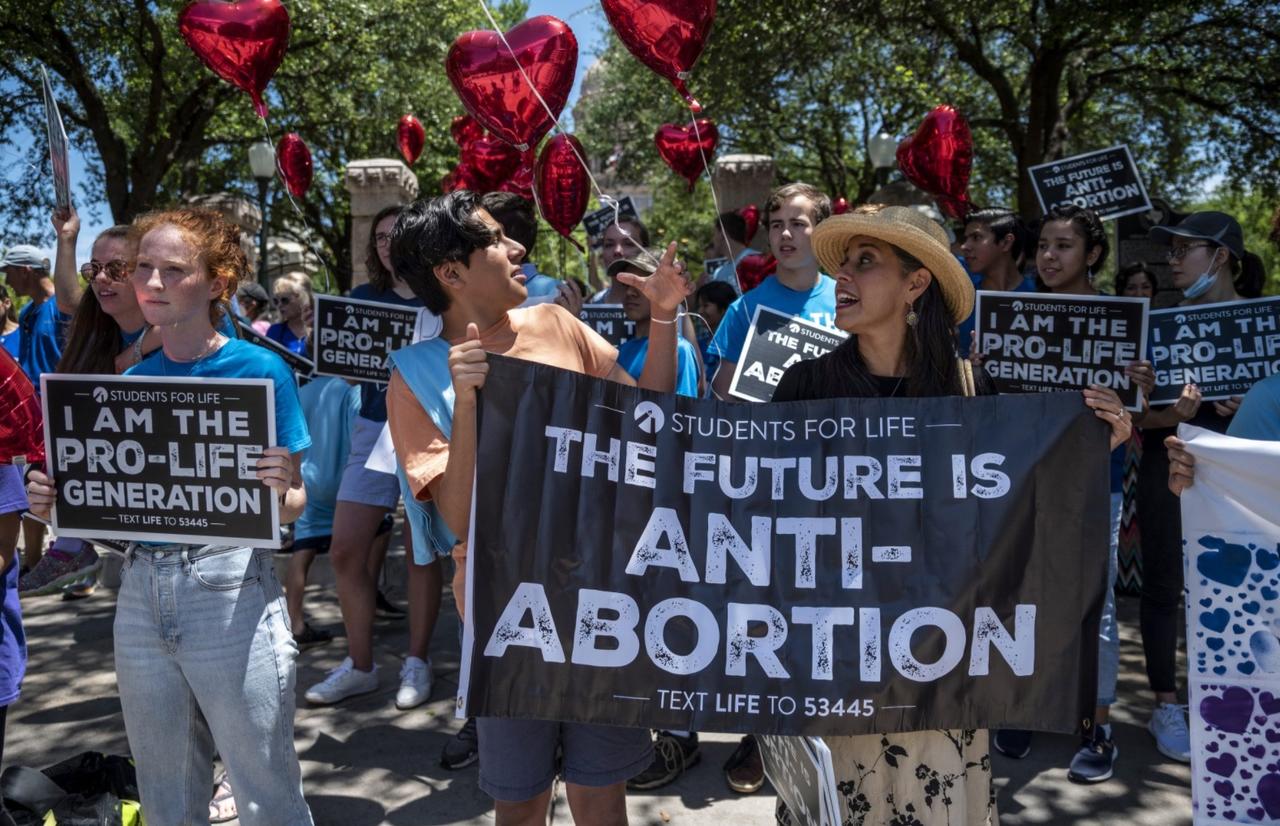
The Supreme Court made millions of pro-choice advocates extremely nervous on Wednesday when it decided not to intervene as a new Texas abortion law took effect. If it remains intact, the Texas heartbeat bill will be the most restrictive abortion law in the country, preventing 85% of women in Texas, the country’s second-most-populous state, from getting an abortion. In other words, it’s the biggest victory for pro-life advocates since the dawn of the Roe v. Wade era.

The bill outlaws abortion after a fetal heartbeat can be detected, which typically occurs around 6 weeks into a pregnancy, before many women even know they are pregnant.

A group of abortion providers are asking the Supreme Court to step in and overturn the law. At least 12 other states have enacted bans on abortion early in pregnancy, but all have been blocked from going into effect.

The Supreme Court could act on Wednesday, though the justices don’t have any firm deadline. The providers are challenging a federal appeals court decision that effectively blocked any pre-enforcement challenge.

One provision that makes the law unique is the fact that private citizens will be allowed to sue providers and anyone involved in “facilitating coverage”, which could mean people who drive others to the abortion clinic could be found liable in court to losses of at least $10,000. The ACLU says this provision “actively encourages private citizens to act as bounty hunters”.

Unsurprisingly, the law taking effect elicited outraged cries from the blue-check commentariat, including CNN legal analyst Jeffrey Toobin.

Fortunately for Toobin, masturbation doesn’t lead to pregnancy.

One doctor accused the Texas legislature of practicing “eugenics”, although we’re not certain that word means what the good doctor thinks it means.

Unsurprisingly, pro-choice groups seized on the occasion as a fundraising opportunity.

In the coming months, SCOTUS will hear a Mississippi appeal that seeks to overturn Roe v Wade. But even before then, a decision to protect the Texas law could signal that SCOTUS is leaning toward “toppling precedents that protect abortion until much later in pregnancy,” according to Bloomberg.

Tyler Durden
Wed, 09/01/2021 – 08:30

via ZeroHedge News https://ift.tt/3jwKn39 Tyler Durden

“The Job Market Recovery Is Dented” – ADP Private Payrolls Miss Huge, Only 374K Jobs Added In August

“The Job Market Recovery Is Dented” – ADP Private Payrolls Miss Huge, Only 374K Jobs Added In August

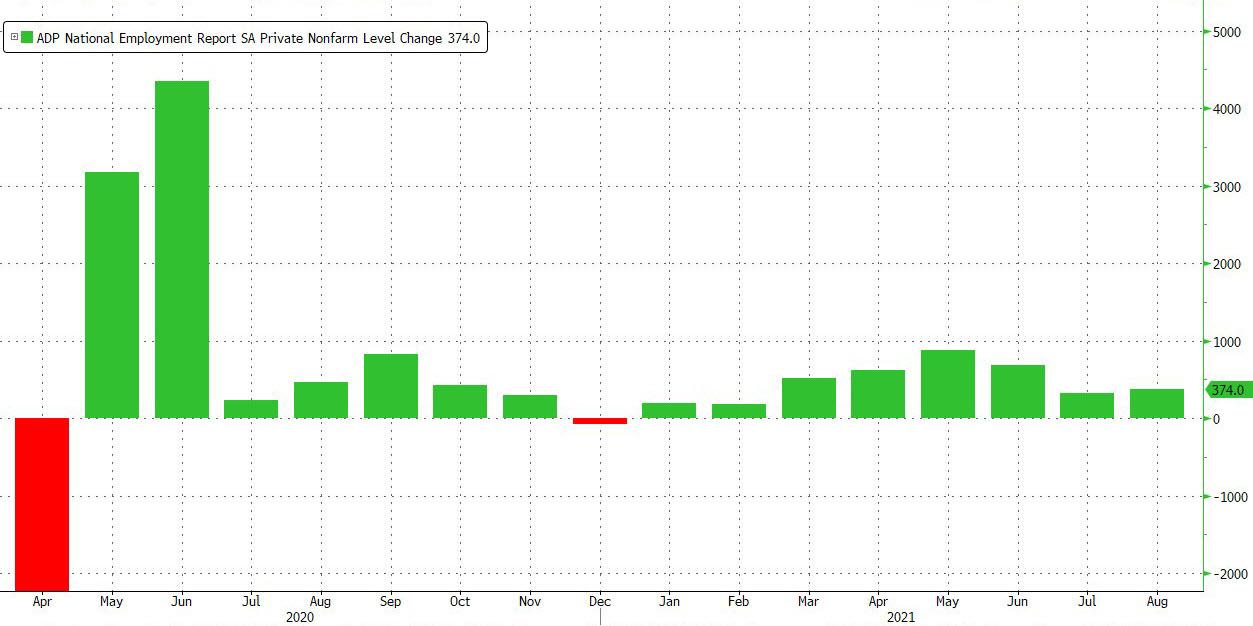
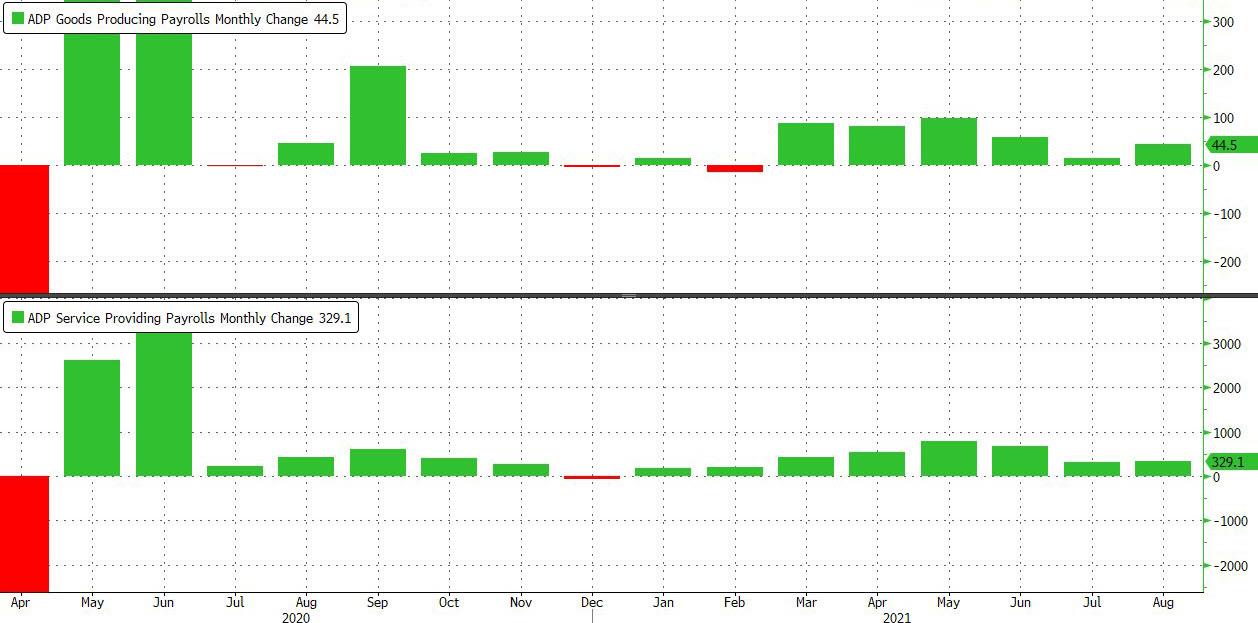
For the second month in a row, the ADP Private Payroll employment report has been a complete disaster, and one month after the the ADP missed by almost half printing at 330K in June (missing expectations of 683K), moments ago ADP reported that private payrolls in August rose just 374K, which while a modest improvement from July’s downward revised 326K (which was the lowest since February), was again a huge miss to the 638K expected.

“Our data, which represents all workers on a company’s payroll, has highlighted a downshift in the labor market recovery. We have seen a decline in new hires, following significant job growth from the first half of the year,” said Nela Richardson, chief economist, ADP.

“Despite the slowdown, job gains are approaching 4 million this year, yet still 7 million jobs short of pre-COVID-19 levels. Service providers continue to lead growth, although the Delta variant creates uncertainty for this sector. Job gains across company sizes grew in lockstep, with small businesses trailing a bit more than usual.”

Mark Zandi, chief economist of Moody’s Analytics, said, “The Delta variant of COVID-19 appears to have dented the job market recovery. Job growth remains strong, but well off the pace of recent months. Job growth remains inextricably tied to the path of the pandemic.”

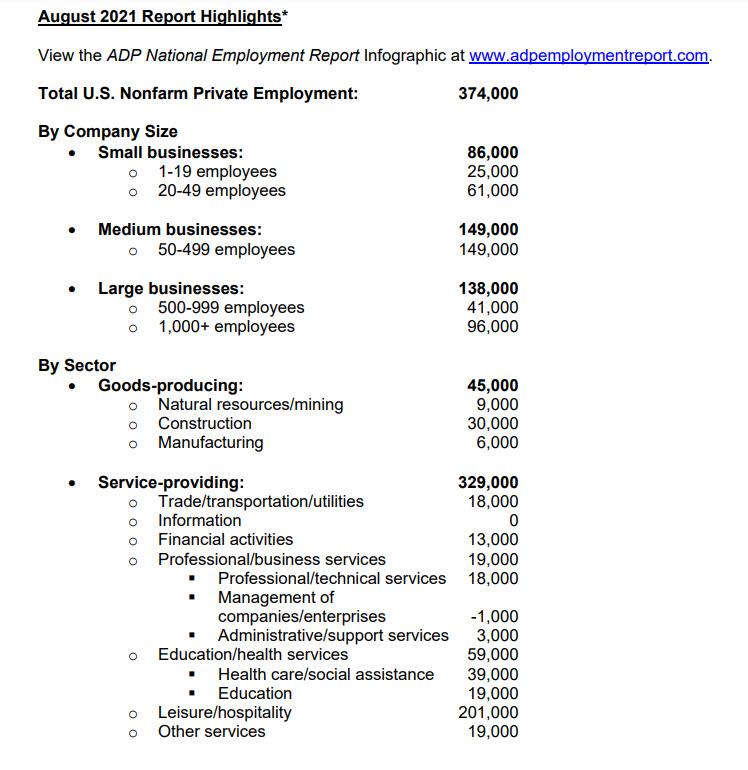
For the second month in a row, medium-sized businesses added the most jobs:

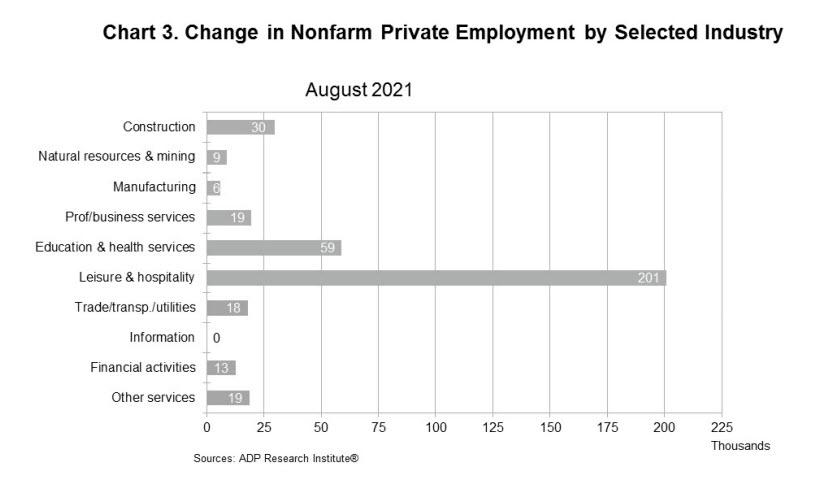
The Services economy continues to dominate the recovered jobs in June, with only 12k manufacturing jobs added.

More ominously, the only jobs added were waiters and bartenders (i.e., leisure and hospitality).

Finally, it is worth noting that ADP has under-guessed Nonfarm Payrolls in 5 of the last 7 months, and remember that Fed Governor Christopher Waller recently said the U.S. central bank could start to reduce its support for the economy by October if the next two monthly jobs reports show employment rising by 800,000 to 1 million, as he expects, adding that there’s “no reason” to go slow on tapering the Fed’s bond purchase program.

So if today’s ADP print is anything to go by, and if for once the ADP is predictive of what this Friday’s payrolls will reveal, then we may have a major taper problem, as inflation soars yet as the job market suddenly crumbles leading to the dreaded stagflation.

Tyler Durden
Wed, 09/01/2021 – 08:27

via ZeroHedge News https://ift.tt/3t2i0gq Tyler Durden

Futures Rise Toward Fresh Record High As PMIs Confirm Global Economy Slowing

Futures Rise Toward Fresh Record High As PMIs Confirm Global Economy Slowing

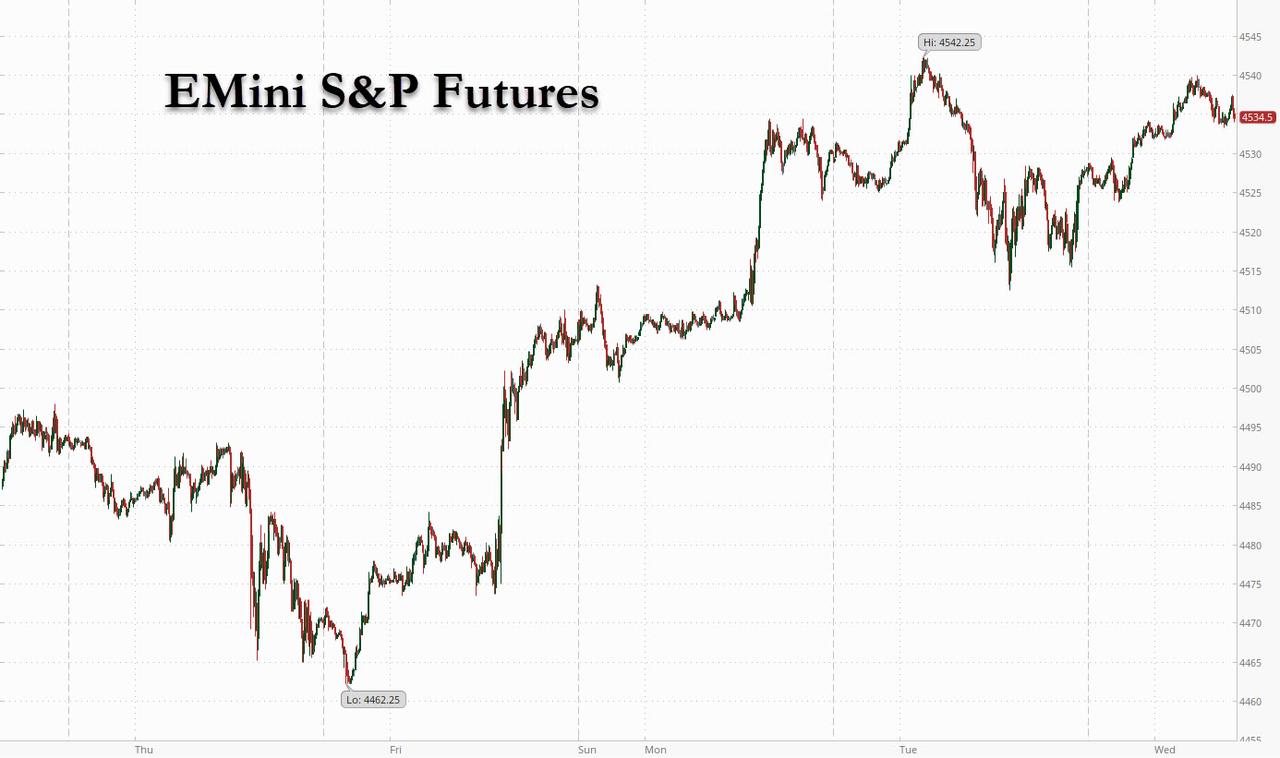
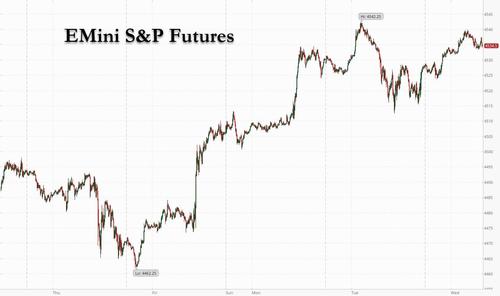
After a somewhat soggy end to the otherwise spectacular month of August which saw 12 new all time highs in the S&P500, global stocks and US futures are solidly green to start the month of September despite another round of dismal global PMIs confirming the global economy is slowing, and especially China where the Caixin China manufacturing PMI came in at 49.2, missing expectations of 50.3, and the first contraction since April 2020. Of course, the coming global slowdown is great news for stocks as it means more stimmies in China, and a potential taper delay in the West (where hyperinflation is “transitory” after all) meanwhile the Fed’s QE cannon continues to blast billions in daily liquidity and naturally futures were solidly in the green, higher by 15 points to 0.34% to 4,536, Dow e-minis were up 106 points, while Nasdaq 100 e-minis were up 33.75 points, or 0.22%.ahead of U.S. ISM manufacturing data and ADP employment change.
Energy stocks led Wednesday’s gains, with oil majors Chevron Corp, Exxon Mobil and Schlumberger NV rising between 0.5% and 1.1% in premarket trading as crude prices rose ahead of today’s OPEC+ meeting. Rate-sensitive banks also rose with J.P.Morgan, Goldman Sachs and Citigroup up about 0.6% on support from higher bond yields.  U.S-listed shares of the world’s biggest miner BHP Group dropped 1.7%, while those in China-focused mining giant Rio Tinto fell 1.2% after tepid China factory data dented copper and iron ore prices. Shares of Calvin Klein and Tommy Hilfiger owner PVH Corp surged 7.8% after it raised its full-year earnings forecast. Here are some other notable movers:

  • Baudax Bio (BXRX) surges 19% after a director of the company bought 100,000 of the pharmaceutical company’s shares.
  • Crowdstrike (CRWD) shares fall 3.2% in premarket trading with analysts suggesting its 2Q results didn’t meet the most bullish expectations, but that the stock remains a top pick in the cybersecurity sector.
  • Focus Universal (FCUV) shares surge 38% following a share offering and the company’s listing on the Nasdaq Capital Market.
  • Luxury EV startup Lucid Group (LCID) drops 8% on the lock-up expiry date that allows some shareholders to sell stock for the first time since the SPAC deal closed.
  • Riot Blockchain (RIOT) is down 0.2% after filing for an at-the-market offering via Cantor Fitzgerald, B. Riley, BTIG, Roth.
  • Skillz (SKLZ) and AMC Entertainment (AMC) are among meme stocks gaining in premarket trading, rising 6.8% and 1.9% respectively, extending rallies fueled by retail investors in chatrooms like StockTwits, and on Reddit.
  • XPeng (XPEV) and Li Auto (LI) shares fall 1.7% and 0.1% respectively in U.S. premarket trading after Chinese EV peer Nio cut its delivery outlook. Nio drops 4.9%.
  • Wells Fargo (WFC) shares edge 0.7% higher in premarket trading after a 5.6% decline on Tuesday following a report that the bank could face regulatory action over the pace at which it is compensating victims of past scandals and shoring up its controls.

Still, while corporate results are strong, concerns about the delta variant, inflation spikes, supply bottlenecks and stimulus tapering could easily trigger a 10%-20% drop in stock prices, said Ipek Ozkardeskaya, senior analyst at Swissquote. “The markets are on path for more gains,” she wrote in a report. “Nobody can tell how healthy the trend is, where it will end, or how it will end.”

The ADP report, published ahead of the government’s more comprehensive and closely watched employment report on Friday, is expected to show private payrolls rose by 613,000 in August after 330,000 gain in July. The number is due at 8:15 a.m. ET. Separately, the Institute for Supply Management’s gauge of manufacturing sector activity is expected to have moderated to 58.6 in August from 59.5 in the previous month.

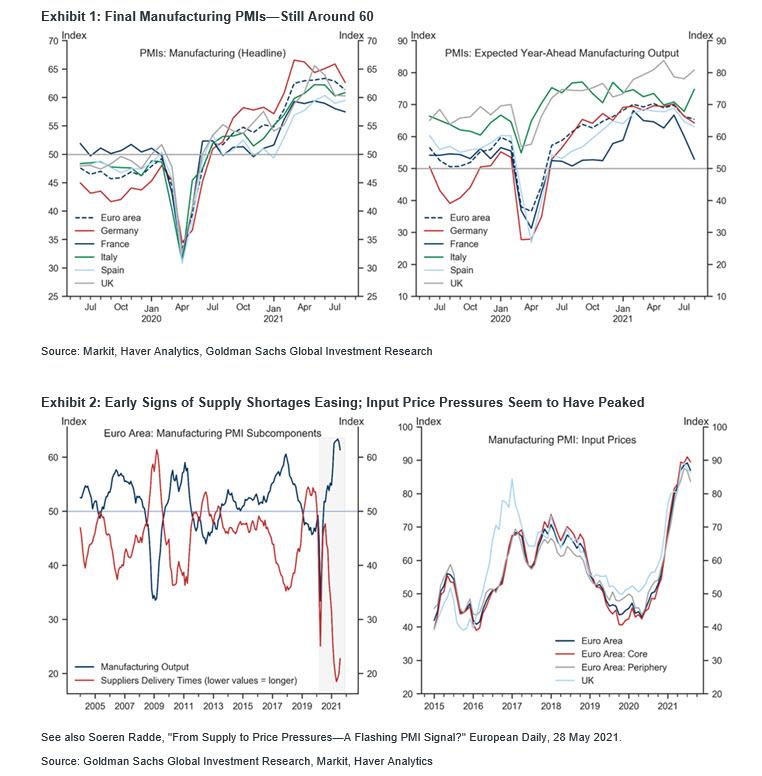
Earlier, surveys showed Asian and European factory activity lost momentum in August as the ongoing coronavirus pandemic-disrupted supply chains. Many firms reported logistical troubles, product shortages and a labor crunch which have made it a sellers’ market of the goods factories need, driving up prices.  Here is a snapshot of the overnight PMIs:

  • China Caixin Mfg PMI (August): 49.2, Exp. 50.2, previous 50.3
  • Euro Area Manufacturing PMI (Final, August): 61.4, flash 61.5, previous 62.8
  • Germany Manufacturing PMI (Final, August): 62.6, flash 62.7, previous 65.9
  • France Manufacturing PMI (Final, August): 57.5, flash 57.3, previous 58.0
  • Italy Manufacturing PMI (August): 60.9, GS 60.0, consensus 60.1, previous 60.3
  • Spain Manufacturing PMI (August): 59.5, GS 58.8, consensus 59.0, previous 59.0
  • UK Manufacturing PMI (Final, August): 60.3 flash 60.1, previous 60.4
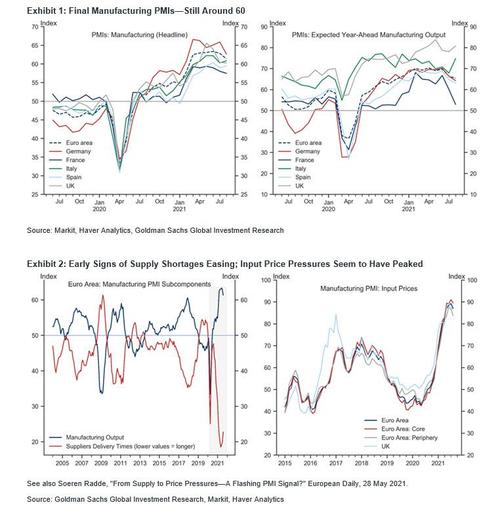
While factory activity remained strong in the euro zone, IHS Markit’s final manufacturing Purchasing Managers’ Index (PMI) fell to 61.4 in August from July’s 62.8, below an initial 61.5 “flash” estimate. “Despite the strong PMI figures, we think that lingering supply-side issues and related producer price pressures might take longer to resolve than previously expected, increasing the downside risk to our forecast,” said Mateusz Urban at Oxford Economics. In Britain, where factories also faced disruptions, manufacturing output grew in August at the weakest rate for six months. The United States likely suffered a similar slowdown, data is expected to show later on Wednesday.

“We’re moving past the point of peak growth. The strongest period of the recovery now looks to be behind us, we’re seeing that in the economic data,” said Hugh Gimber, global market strategist at JP Morgan Asset Management. “The recovery is slowing, but it remains on track. And so that I think is what’s underpinning markets.”

Nothing like new all time highs to celebrate the slowdown.

European stocks also rose in the first trading session of September (because like the Fed, the ECB will be injecting billions in liquidity for a long, long time) after seven straight months of gains. The Stoxx 600 is up ~0.5%, led higher by travel, retail and banking industries. DAX took back some earlier gains, but was still up 0.1% on the day, while the FTSE 100 is up 0.6%.  French spirits maker Pernod Ricard gained 3.3% after reporting better-than-expected results. Carrefour slumped 4.4% in Paris as billionaire Bernard Arnault sold his remaining holding in the supermarket chain. European luxury shares rose after Bernstein says stock market movements in August have priced in the risk of potentially higher taxation in China, “at least in its milder form.” Among the gainers were Richemont +2.2%, LVMH +2.2%, Kering +2%, Burberry +1.8%, Hermes +1.3%, and Swatch +0.9%. While new taxation would prompt rich consumers to momentarily rein in their discretionary spending, it’s unlikely that there will be “highly disruptive action” from the Chinese authorities, analyst Luca Solca writes in a note. Here are some of the biggest European movers today:

  • Pernod Ricard shares rise as much as 3.9% after the French distiller’s FY results, which analysts say show a strong recovery with positive medium-term guidance.
  • Fluidra shares jump as much as 4.1%, after it acquired U.S. pool deck equipment manufacturer S.R. Smith in a deal valued at $240m.
  • EDP shares rise as much 4.3% as Berenberg raises its PT and says it remains a buy on upside from renewables growth and carbon prices.
  • BioMerieux’s shares gain as much as 7.7% after 1H earnings, which Jefferies analyst Peter Welford says beat consensus as costs declined.
  • WH Smith shares fall by as much as 7.2% after its FY results, with RBC saying that its outlook for a further recovery in its travel retail business seems “relatively cautious”
  • Carrefour shares drop by as much as 5.3% after billionaire Bernard Arnault, the world’s third-richest person, sold his remaining holding in the company, ending a 14- year largely unsuccessful investment in the French supermarket chain.

Earlier in the session, Asian stocks climbed for a fourth straight day as Chinese technology heavyweights extended their rebound from the massive rout seen earlier this year.  The MSCI Asia Pacific Index rose as much as 0.5%, with Tencent and Meituan the biggest individual contributors to the gauge’s advance. The financials sector gave the biggest boost, helped by Ping An Insurance’s bounce back from Tuesday’s losses. Equity benchmarks in China, Singapore and Japan were among the region’s biggest gainers. The Hang Seng Tech Index rallied for a third day as more investors grow confident that a bottom may have been reached following the selloff sparked by Beijing’s regulatory crackdown on private industry. A gauge of Asia’s software technology firms including Tencent also rose after capping its first monthly advance since April.  Asia’s stock benchmark is extending gains after rising 2.3% in August in what was its best monthly performance since December. Still, the rout in China and Hong Kong has meant that regional shares continue to underperform peers in the U.S. and Europe so far this year. “Many are starting to realize that the regulatory crackdown on large Internet platforms is becoming quite targeted in nature and isn’t creating existential threats to their business,” said Bloomberg Intelligence analyst Matthew Kanterman. “Coupled with relatively strong sector results the last few weeks and what appears to be a slowing cadence of bad regulatory developments vs July, sentiment may be starting to turn the corner for the sector.” Japan’s Topix closed at its highest level since April, while China’s CSI 300 Index climbed more than 1%.

Australian stocks pared declines after GDP beat expectations; the country’s S&P/ASX 200 index fell 0.1% to close at 7,527.10, trimming a loss of as much as 1% after Australia’s GDP report. The economy grew faster than expected last quarter as household’s tapped their savings to boost spending, underscoring the central bank’s view that the nation entered a renewed lockdown with solid momentum. Mesoblast was among the worst performers after Jefferies lowered its rating on the stock to “hold.” Alumina was among the top performers, extending its winning streak to a fourth day. In New Zealand, the S&P/NZX 50 index rose 0.2% to 13,243.49

In FX, the Euro trades around session high after the ECB’s Yannis Stournaras said inflation jump is temporary and the central bank should be cautious. Dollar was little changed for a third day. Commodity-linked currencies led gains while havens slipped; the euro and the pound were steady. The Aussie rallied amid short covering of AUD/USD and AUD/JPY positions after a strong close in Japanese stocks; bond yields in Australia and New Zealand jumped after hawkish comments from ECB officials spurred losses in global debt markets. The yen weakened a third day amid risk-positive sentiment and higher Treasury yields as traders positioned before the U.S. data.

In rates, 10-year Treasury yields are little changed at 1.31%. Treasuries were steady, off session lows, after facing slight pressure following block sale in Ultra 10-year note futures shortly after 6am ET. In Europe, bunds continue to underperform amid heavy debt sales in Germany. U.S. stock futures advance, still inside Tuesday’s range. Yields were cheaper across belly, remain broadly within a basis point of Tuesday’s close; in 10-year sector bunds lag by 1bp vs Treasuries while gilts trade broadly in line.

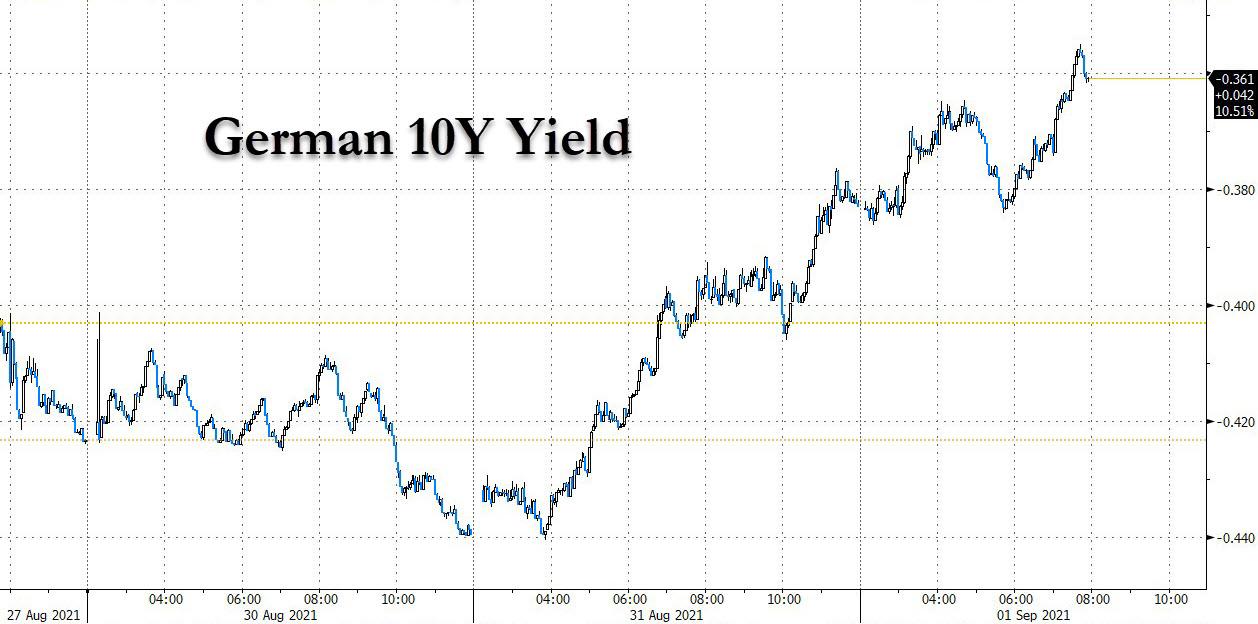
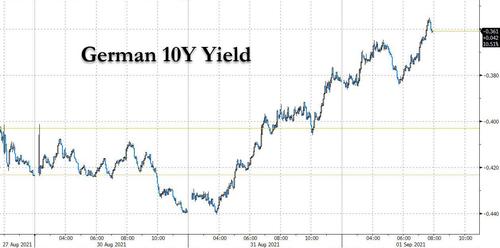
Government bond yields across the euro area touched their highest levels in around six weeks, pushed up by unease over the future pace of European Central Bank bond purchase after two ECB officials said the central bank needs to begin tapering soon. Germany’s 10-year Bund yield touched its highest level in just over six weeks, briefly rising above -0.36%.
In commodities, crude maintained a zigzag-trading pattern ahead of the upcoming OPEC ministers and allies meeting later Wednesday. Brent and WTI are little changed, with the global crude benchmark holding above $71/bbl. LME copper extends decline, down 2% after China released its third batch of metals from state reserves, vowing to sell more based on the market. The rest of the base metals complex is in red. In fixed income, bund yields gives back some gains, trading at the -0.38-handle, while peripheral spreads move wider to the core, the steepest at the longest end of the curve. 

Market Snapshot

  • S&P 500 futures up 0.4% to 4,537.50
  • STOXX Europe 600 up 0.8% to 474.73
  • MXAP up 0.3% to 202.44
  • MXAPJ up 0.2% to 666.43
  • Nikkei up 1.3% to 28,451.02
  • Topix up 1.0% to 1,980.79
  • Hang Seng Index up 0.6% to 26,028.29
  • Shanghai Composite up 0.7% to 3,567.10
  • Sensex little changed at 57,564.08
  • Australia S&P/ASX 200 down 0.1% to 7,527.13
  • Kospi up 0.2% to 3,207.02
  • Brent Futures up 0.5% to $72.01/bbl
  • Gold spot down 0.1% to $1,811.06
  • U.S. Dollar Index little changed at 92.68
  • German 10Y yield rose 0.5 bps to -0.377%
  • Euro little changed at $1.1810

Top Overnight News from Bloomberg

  • Short-term funding costs in the U.K are diverging from those in Europe as traders grow increasingly confident the Bank of England will deliver an interest-rate hike within the next year.
  • European factories saw unfilled orders rise to an unprecedented level in August as companies struggled to meet demand amid widespread bottlenecks in the global supply chain.There were “clear signs of strong capacity constraints,” according to an IHS Markit survey of purchasing managers
  • Manufacturing managers across Southeast Asia reported a heavy blow in August from one of the world’s worst Covid-19 outbreaks, while producers in North Asia continued to enjoy robust output, PMIs showed
  • Australia’s economy grew faster than expected last quarter as household’s tapped their savings to boost spending, underscoring the central bank’s view that the nation entered a renewed lockdown with solid momentum  

A more detailed look at global markets courtesy of Newsquawk

Asian stocks traded somewhat cautiously after further disappointing Chinese PMI data and following a soft handover from the US where sentiment was mired by disappointing Chicago PMI and US Consumer Confidence data, although the losses on Wall Street were only marginal and all major indices registered a seventh consecutive monthly gain for August. ASX 200 (-0.1%) was pressured as daily COVID-19 infections continued to ramp up in Australia’s most-populous states and with better-than-expected GDP doing little to brighten the mood, given that the strong economic growth for Q2 was made somewhat stale by the lockdowns throughout the entirety of Q3 so far. Nikkei 225 (+1.3%) outperformed amid reports PM Suga is to order the compiling of an economic package and additional budget within the week, while data also showed Japanese companies’ recurring profits nearly doubled Y/Y during the prior quarter. Hang Seng (+0.6%) and Shanghai Comp. (+0.7%) eventually weathered the miss on Chinese Caixin PMI data which slipped into contraction territory for the first time since April last year and effectively supported the argument for PBoC easing. However, price action was choppy as crackdown concerns also lingered amid the continued tightening of Beijing’s regulatory grip with China to curb overly fast growth in medicine expenses and the PBoC is to implement new disclosure measures for Chinese non-bank payment apps when they make new products or conduct foreign stock market listings. Finally, 10yr JGBs declined amid spillover selling from global counterparts including the bear steepening stateside and pressure in European bonds following the firm Eurozone inflation data, while the outperformance in Japanese stocks and lack of BoJ purchases in the market today also contributed to the headwinds for JGBs.

Top Asian News

  • India to Offer Indemnity to Flag Carrier Bidder Over Cairn Claim
  • China Bonds Shrug Off PBOC Cash Drainage to Jump on Weak PMI
  • Stocks, U.S. Futures Gain on Reopening Optimism: Markets Wrap
  • China Quants Pay $300,000 to Beat Wall Street to Graduates

Stocks in Europe trade with respectable gains across the board (Euro Stoxx 50 +1.2%; Stoxx 600 +0.9%), despite a somewhat mixed APAC lead and with little in terms of fresh fundamentals to sour risk appetite. US equity futures see gains of a lesser magnitude and have been waning off best levels, with the RTY (+0.6%) outpacing the ES (+0.3%), YM (+0.3%) and NQ (+0.2%), ahead of the ADP and ISM Manufacturing PMI later today before Friday’s pivotal jobs report. Back to Europe and sticking with PMIs where we have had the manufacturing finals across Europe – with the resonating theme being ongoing supply chain issues. The DAX (+0.7%) narrowly underperforms the region after the German manufacturing metric was slightly revised lower, deviating from the revision higher seen in France and the forecast beats printed in Italy and Spain – with the IBEX (+2.2%) the clear European outperformer at the time of writing, although more-so on the back of solid sectorial performances seen in Retail, Travel & Leisure and Banks. Sectors across Europe are predominantly in the green, with the only laggards the Basic Resources and Chemicals sectors. Sectors do not portray a clear theme nor bias. In terms of individual movers, Pernod Ricard (+3.5%) is firmer post-earnings where it announced the resumption of its EUR 500mln share buyback programme. Carrefour meanwhile trades at the foot of the Stoxx 600 after Billionaire Bernard Arnault’s Agache group announced the sale of its 5.7% stake in the Co. via accelerated bookbuilding. Meanwhile, Stoxx will announce the results of its annual review of the Euro Stoxx 50 Index at the close of business on 1 September, to be effective Friday, 17 September – JPM expects BBVA (+2.2%) and Stellantis (+0.3%) to replace Engie (+2.0%) and Amadeus (+2.6%).

Top European News

  • Billionaire Arnault Sells Carrefour Stake for $854 Million
  • KPMG Accused of Giving Regulator ‘False and Misleading’ Data
  • U.K. House Prices Surge in August Despite Ending of Tax Cut
  • EDF Slips as Path to Fresh France-EU Reform Talks Still Unclear

In FX, a marked change in fortunes for the Yen following its fleeting breach of 100 DMA resistance vs the Dollar yesterday, as Usd/Jpy rebounds sharply through 110.00 and the 50 DMA (110.10) towards 110.50 alongside US Treasury yields amidst further bear-steepening and renewed risk appetite. The Yen may also be factoring in reports that Japanese PM Suga is preparing an economic package and supplementary budget, plus pretty dovish/downbeat from BoJ’s Wakatabe, and the same could be said for the Franc in wake of SNB’s Zurbruegg saying that he expects low global interest rates will remain unchanged for some time to come, while noting vulnerabilities on the Swiss mortgage and real estate markets currently at a high level. Furthermore, the Bank sees clear signs of unsustainable mortgage lending on the one hand and heightened risks of a price correction on the other. Usd/Chf is back in the high 0.9100 area following its flirt with the round number on Monday, and with little downside reaction to a firmer Swiss manufacturing PMI. Conversely, Gold is coping relatively well with the rise in UST yields and risk-on environment on the Usd 1800/oz handle, albeit back below 100 and 200 DMAs after hurdling both and closing above yesterday, as the Greenback grinds higher and DXY attempts to form a base beyond 92.500 having bounced from a 92.395 low on Tuesday. The index is now hovering within a 92.790-640 band awaiting ADP, Markit’s final US manufacturing PMI, ISM and comments from Fed’s Bostic.

  • AUD/NZD/CAD – All firmer against their US counterpart, with the Aussie establishing a firmer platform over 0.7300 to stage another assault on 0.7350. Better than expected Q2 GDP did not really boost Aud/Usd overnight as COVID lockdowns have subsequently scuppered the economic recovery and China’s Caixin manufacturing PMI fell below the 50.0 growth/contraction threshold. However, the technical backdrop looks more constructive above a Fib retracement level at 0.7319 and Aud/Nzd crosswinds have turned in the run up to NZ terms of trade, import and export prices on a further bounce from 1.0350 to top 1.0400 again. Nevertheless, the Kiwi has reclaimed 0.7050+ status vs its US peer and the Loonie is paring more post-Canadian GDP declines with some traction from crude in advance of Markit’s manufacturing PMI, JMMC and OPEC+ meetings, with Usd/Cad probing 1.2600 compared to peaks just above 1.2650 yesterday.
  • EUR/GBP – Both narrowly mixed against the Greenback, but the Euro marginally outpacing the Pound as Eur/Gbp eyes 0.8600 irrespective of final Eurozone and UK manufacturing PMIs that were somewhat contrasting, but probably all too close to consensus or preliminary prints to prompt much reaction. Eur/Usd has regained 1.1800+ status, while Cable is straddling 1.3750.

In commodities, Crude futures have largely retraced their overnight gains, with WTI and Brent both back towards the bottom end of today’s ranges. The choppiness comes in the run-up to the JMMC meeting at 15:00BST/10:00EDT and the decision-making OPEC+ confab at 16:00BST/11:00EDT – subject to delays. Expectations have solidified around a 400k BPD hike, i.e., a continuation of the current plan, with all sources thus far pointing in that direction. That being said, it’s worth keeping in mind that OPEC+ has a tendency to massage expectations and then surprise markets. The full Newsquawk preview can be accessed here, and the exclusive Twitterdeck is available here. Elsewhere, spot gold and silver are uneventful and contained to recent ranges awaiting Tier 1 US data. Industrial metals are slightly more interesting following later-confirmed reports that China is releasing a third batch of metals totalling 150k tonnes, comprised of 30k tonnes of copper (prev. 30k), 70k tonnes of aluminium (prev. 90k) and 50k tonnes of zinc (prev. 50k). LME copper slumped back under USD 9,500/t and resides near session lows at the time of writing – with the disappointing Chinese Caixin manufacturing PMI also weighing on the red metal.

US Event Calendar

  • 7am: Aug. MBA Mortgage Applications, prior 1.6%
  • 8:15am: Aug. ADP Employment Change, est. 638,000, prior 330,000
  • 9:45am: Aug. Markit US Manufacturing PMI, est. 61.2, prior 61.2
  • 10am: July Construction Spending MoM, est. 0.2%, prior 0.1%
  • 10am: Aug. ISM Manufacturing, est. 58.5, prior 59.5
    • 10am: Aug. ISM Employment, prior 52.9
    • 10am: Aug. ISM New Orders, est. 61.0, prior 64.9
    • 10am: Aug. ISM Prices Paid, est. 84.0, prior 85.7

DB’s Jim Reid concludes the overnight wrap

So I now have 16 weeks holiday from looking after the kids which is a nice relief. After 2 weeks non stop with them that’s the bare minimum required. They are all lovely individually but together they are awful, especially the twins. A graph of the amount of fights I had to break up over the last couple of weeks would require a log scale. The biggest problem is they don’t bear grudges so this increases the number of fights. The pattern is a major bust up, five minutes of hysteria, move on, forget about it, play for a few minutes until the next conflict and then the loop starts up again.

So holidays are coming to an end and dark September mornings writing the EMR are well and truly here. Given it’s the start of the month today, Henry will shortly be releasing our monthly performance review for August. Normally the summer holidays are a relatively quiet period for markets, and last month very much fit into that pattern, but that didn’t stop equities powering ahead to fresh all-time highs as they advanced for a 7th successive month. In fact, both the S&P 500 and the STOXX 600 are now up by over +20% YTD on a total returns basis, with a third of the year still remaining. At the other end of the leaderboard however, oil prices saw their biggest decline so far this year in August, as fears of weakening economic demand and concerns about the delta variant of Covid took their toll. More details in the report out shortly.

It might be the start of September today, but investors will be grappling with a number of familiar themes this morning. The tapering and inflation debate was a hot topic yesterday but more from Europe for once rather than the US. This coupled with weak data served to dampen sentiment and spark a selloff across various asset classes. The most significant data yesterday came from the Euro Area, where the flash CPI estimate for August came in at a far stronger-than-expected +3.0% (vs. +2.7% expected), which is the highest since November 2011, and was also above every economists’ estimate on Bloomberg. Then we had some weak consumer confidence data from the US Conference Board, which backed up the weak reading from the University of Michigan earlier in the month.And both the European inflation reading and US consumer sentiment data came against the backdrop of weak PMIs out of China heading into yesterday’s session.

Looking at yesterday’s developments, that strong Euro Area inflation print was by some way the most impactful on markets, and gave further ammunition to the ECB’s hawks who’ve been calling for a withdrawal of emergency support. Although core inflation only exceeded expectations by 0.1%, the +1.6% reading marked the highest core inflation since July 2012, which was the month that former ECB President (and now Italian PM) Mario Draghi made his “whatever it takes” pledge. At a similar time to the inflation release, Dutch central bank governor Knot said that he believes in an immediate slowdown in ECB purchases and supports ending their pandemic emergency purchase programme in March. Furthermore, Austrian governor Holzmann said that he was in favour of reducing the pace of purchases in Q4. With both the strong inflation reading and the hawkish comments, European sovereign bonds witnessed a significant selloff, with yields on 10yr bunds climbing +5.6bps to -0.38%, which is their biggest one-day move since March, whilst those on 10yr BTPs (+9.9bps) saw their biggest one-day move higher since February.

With sovereign bond yields moving sharply higher in Europe, equities indices lost ground with the STOXX 600 closing the session -0.38% lower. In the US the S&P 500 similarly fell back, with the index down -0.13% from the previous day’s record highs after drifting lower in the US afternoon. This occurred as macroeconomic data continues to surprise to the downside as the Conference Board’s consumer confidence reading came in at a 6-month low of 113.8 in August (vs. 123.0 expected). Looking at the sectoral breakdowns, the FANG+ index of megacap tech stocks was an outperformer, managing to close +0.36% higher to just about achieve a new all-time closing high, its first since mid-February. Meanwhile, yields on 10yr US Treasuries were up +3.0bps to 1.309%, however US banks (-0.58%) reversed earlier gains as cyclicals largely lagged.

Asian markets are generally trading higher this morning with the Nikkei (+1.17%), Hang Seng (+0.62%), Shanghai Comp (+0.86%) and Kospi (+0.25%) all advancing. Meanwhile, yields on 10y USTs are up +2.2 bps to 1.332% and those on Australia and New Zealand’s 10y sovereign bonds are up +9.2bps and +9.3bps respectively after the global sell-off yesterday. Futures on the S&P 500 are up +0.29% and those on the Stoxx 50 are +0.65%. Elsewhere, oil prices are up c.+0.70% ahead of today’s OPEC+ meeting.

Overnight China’s Caixin manufacturing PMI came in at 49.2 (vs. 50.1 expected and 50.2 last month). This was in contrast to yesterday’s official manufacturing PMI reading of 50.1 which was relatively stable. The Caixin PMI is more representative of smaller and private companies while the official PMI covers larger, state owned enterprises. Given the weakness in the PMIs, our China economist Yi Xiong is of the view that the PBoC should soon cut the MLF rate to support growth (to read more click the link here). Looking at other Asian manufacturing PMIs, Japan’s final manufacturing reading got revised up +0.3pts from the flash to 52.7 while Australia’s final manufacturing PMI also saw a similar upward revision of 0.3pts to 52.0. Taiwan’s continued to remain well in expansionary territory with a reading of 58.5 (vs. 59.7 last month). Meanwhile, Vietnam’s dropped substantially to 40.2 from 45.1 last month and South Korea’s reading softened to 51.2 from 53.0 but Indonesia’s improved to 43.7 (vs. 40. 1 last month). These readings generally point to a slightly softer manufacturing activity in the region during the month as most countries imposed restrictions to curb the spread of the delta variant.

In other overnight news, the BoJ Deputy Governor Masazumi Wakatabe indicated in a speech that the central bank may revise down its economic assessment at this month’s policy meeting as the spread of the delta variant has caused the expansion and extension of the state of emergency.

With September having arrived, we’re now finally in the month of the German election, for which yet more polls yesterday showed the centre-left SPD in the lead. The first from Ipsos had them at 25%, ahead of the CDU/CSU on 21% and the Greens at 19%. And then another from Forsa had a slightly tighter race at the top, with the SPD on 23%, the CDU/CSU on 21%, and the Greens on 18%. The SPD’s candidate for chancellor, German finance minister and Vice-Chancellor Olaf Scholz, has sought to project himself as the heir to Chancellor Merkel, with whom he’s currently serving in the grand coalition with. But yesterday Chancellor Merkel herself took aim at this portrayal, saying that a major difference between the two is that she would never go into coalition with Die Linke, whereas she said it “remains an open question” whether Scholz was of this view.

Turning to the pandemic, there was some positive news as European Commission President von der Leyen confirmed that 70% of adults in the EU were now fully vaccinated. Meanwhile vaccine “passports” are becoming more widespread with Italy requiring travellers on planes, ferries and long-haul trains show proof of vaccinations or a negative Covid-19 test.

Looking at yesterday’s other data, inflation in France came in at a stronger-than-expected +2.4% (vs. +2.1% expected) in August, using the EU harmonised measure, whilst the Italian reading also surprised to the upside at +2.6% (vs. +2.1% expected). Over in the US, the MNI Chicago PMI for August fell to 66.8 (vs. 68.0 expected), though the S&P CoreLogic Case-Shiller national home price index was up +18.6% year-on-year in June, which is the fastest since that series begins in 1988.

To the day ahead now, and the main data highlight will be the release of the global manufacturing PMIs and the ISM manufacturing reading from the US, but there’s also the Euro Area unemployment rate for July, along with the ADP’s report of private payrolls from the US for August. Otherwise, central bank speakers include the ECB’s Weidmann and the Fed’s Bostic.
Tyler Durden
Wed, 09/01/2021 – 07:58

via ZeroHedge News https://ift.tt/3Dxngxv Tyler Durden

Ohio Judge Orders Hospital To Treat Ventilated COVID-19 Patient With Ivermectin

Ohio Judge Orders Hospital To Treat Ventilated COVID-19 Patient With Ivermectin

By Lil Hai of Epoch Times

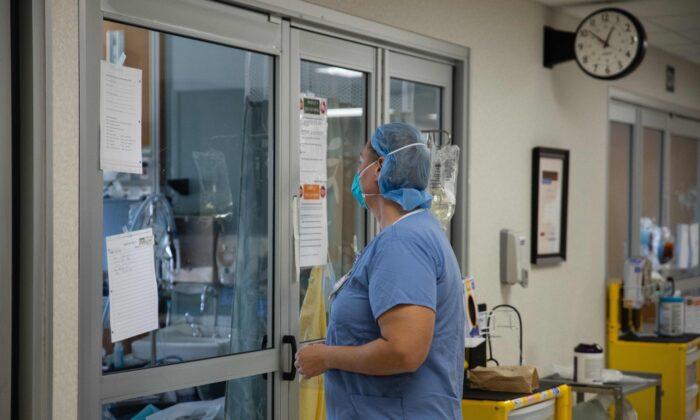
A healthcare professional prepares to enter a Covid-19 patient’s room in the ICU at Van Wert County Hospital in Van Wert, Ohio on November 20, 2020. (Megan Jelinger/AFP via Getty Images)

A Butler County judge in Ohio has ordered a hospital to administer Ivermectin to a ventilated COVID-19 patient, granting an emergency relief filed by the patient’s wife.

Butler County Common Pleas Judge Gregory Howard ruled last week that West Chester Hospital, part of the University of Cincinnati’s health network UC Health, must “immediately administer Ivermectin” to patient Jeffrey Smith following his doctor’s prescription of 30 mg of Ivermectin for 21 days, the Ohio Capital Journal reported.

Smith, 51, is a Verizon Wireless engineer in Butler County. According to the lawsuit (pdf) filed by his wife Julie Smith, Smith tested positive for COVID-19 on July 9, and he was admitted to West Chester Hospital on July 15. On the same day, he was moved to an intensive care unit (ICU).

Smith’s condition continued to decline, and he was placed on a ventilator on Aug. 1. By Aug. 19, the ventilator was operating at 80 percent volume, with Smith’s chances of survival dropping to less than 30 percent, court documents read. At that time, the hospital claimed to have exhausted all options in its COVID-19 treatment protocol.

“At this point, there is nothing more the defendant can do, or will do, for my husband,” Julie wrote in an affidavit included in her complaint.

“However, I cannot give up on him, even if the defendant has,” Julie continued. “There is no reason why the defendant cannot approve or authorize other forms of treatments so long as the benefits outweigh the risks.”

Julie had read about some lawsuits reported by Chicago Tribune and The Buffalo News where patients in severe condition from COVID-19 later recovered after being given Ivermectin.

These patients had won lawsuits forcing their hospitals to treat them with Ivermectin. The plaintiffs in these cases were all represented by attorney Ralph Lorigo, chairman of New York’s Erie County Conservative Party, who later became one of Julie’s attorneys.

According to court documents, Julie requested that the hospital treat her husband with Ivermectin, but the hospital refused to even though she offered to release them from “any and all” responsibility.

Julie then sought medical advice from Dr. Fred Wagshul, who later prescribed Ivermectin to her husband. But the hospital still refused to do so, prompting her to file a lawsuit against the hospital.

“With absolutely nothing to lose, with little to no risk, and with the defendant likely to begin palliative care, there is no basis for it to refuse Dr. Wagshul’s order and prescription to administer Ivermectin,” Julie said in the affidavit.

Wagshul is a founding member of the Frontline COVID-19 Critical Care Alliance (FLCCC), a nonprofit organization that is working during the pandemic to develop effective treatment protocols to prevent COVID-19 infection as well as treat patients with COVID-19.

In October of 2020, FLCCC adopted Ivermectin as a core medication in its protocols for preventing and treating COVID-19. Its website references many recent studies reporting Ivermectin to be a safe, effective, and inexpensive drug against COVID-19, the disease caused by CCP (Chinese Communist Party) virus.

“Ivermectin is so safe,” Wagshul told Dayton247Now. “It essentially has no drug interactions and no side effects.”

The UC Health hasn’t responded to a request from The Epoch Times for comment. According to the Ohio Capital Journal, it hasn’t challenged the judge’s ruling.

Federal Agencies Oppose Ivermectin For COVID-19

Ivermectin is a drug that has been approved by the Food and Drug Administration (FDA) to treat certain infections caused by internal and external parasites. A Japanese scientist and an Irish-American scientist were awarded the Nobel Prize in 2015 for their discovery of Ivermectin, given the drug’s success at improving the health and wellbeing of millions of individuals infected with river parasites in the poorest regions of the world.

President Joe Biden’s top medical adviser, Dr. Anthony Fauci, has advised people against using Ivermectin to treat COVID-19.

“Don’t do it. There’s no evidence whatsoever that it works, and it could potentially have toxicity,” Fauci told CNN on Sunday. “There’s no clinical evidence that indicates that this works.”

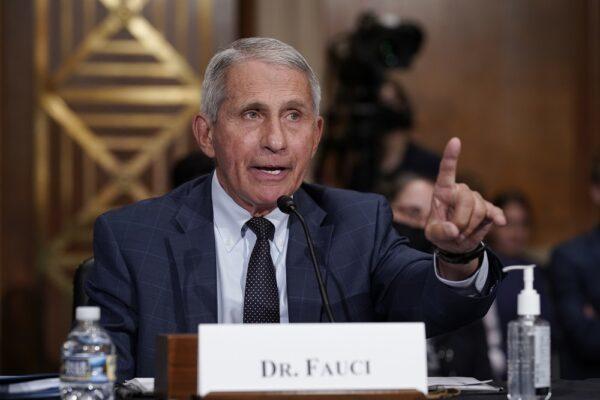
Dr. Anthony Fauci responds to accusations by Sen. Rand Paul (R-Ky.) as he testifies before the Senate Health, Education, Labor, and Pensions Committee, on Capitol Hill in Washington on July 20, 2021. (J. Scott Applewhite-Pool/Getty Images)

Last Thursday, the Centers for Disease Control and Prevention (CDC) issued an official health advisory (pdf), reiterating its opposition to the use of Ivermectin for COVID-19 treatment.

“Ivermectin is not authorized or approved by FDA for prevention or treatment of COVID-19,” the advisory reads. “The National Institutes of Health’s (NIH) COVID-19 Treatment Guidelines Panel has also determined that there are currently insufficient data to recommend Ivermectin for treatment of COVID-19.”

“Adverse effects associated with Ivermectin misuse and overdose are increasing, as shown by a rise in calls to poison control centers reporting overdoses and more people experiencing adverse effects,” the advisory continued.

FDA warned on its website that taking large doses of Ivermectin is “dangerous and can cause serious harm.” The agency also stressed that Ivermectin products for animals are different from products for people because animal drugs are often highly concentrated.

“Such high doses can be highly toxic in humans,” FDA said.

Tyler Durden
Wed, 09/01/2021 – 07:46

via ZeroHedge News https://ift.tt/3t5YXSn Tyler Durden

Biden Told Afghan President To “Create Perception” Taliban Wasn’t Winning “Whether It Is True Or Not”

Biden Told Afghan President To “Create Perception” Taliban Wasn’t Winning “Whether It Is True Or Not”

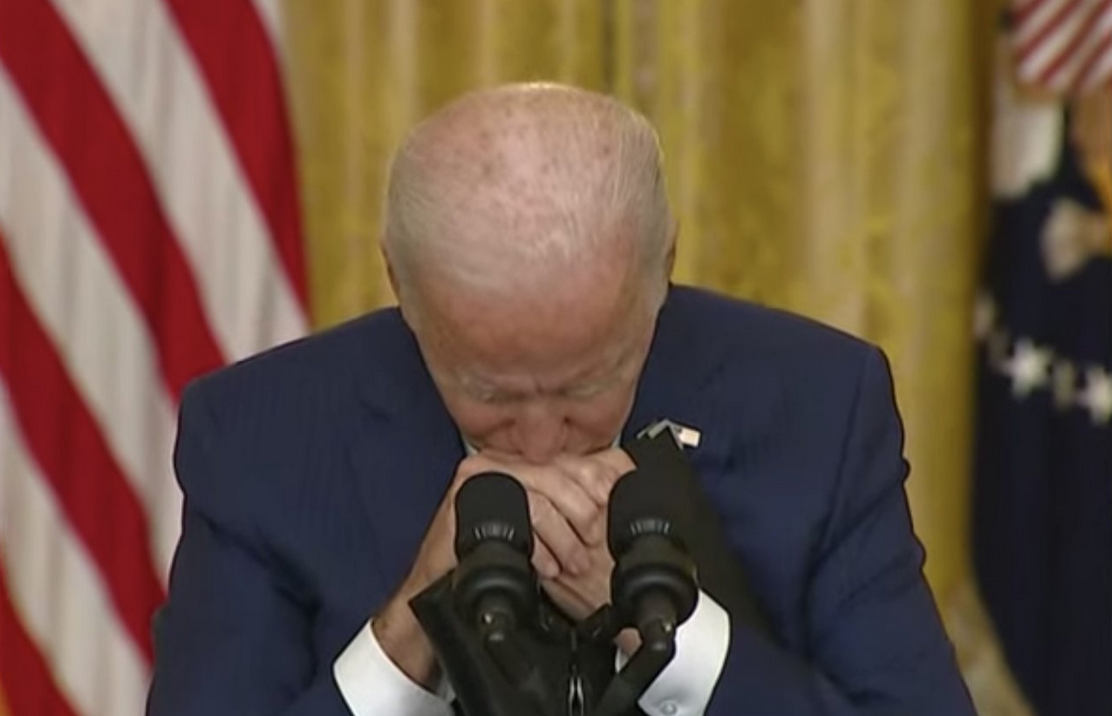
Despite all evidence to the contrary, President Biden appeared before the American people on Tuesday to try to sell his version of the American withdrawal from Afghanistan.

With a straight face, Biden half-shouted to the American people about the “extraordinary success” of the evacuation effort – an assessment that seemed completely at odds with the reality of the situation – before trotting out some equally specious stats: the US had successfully evacuated 90% of Americans who wanted to leave Kabul, and Biden committed to doing everything in his power to help those left behind.

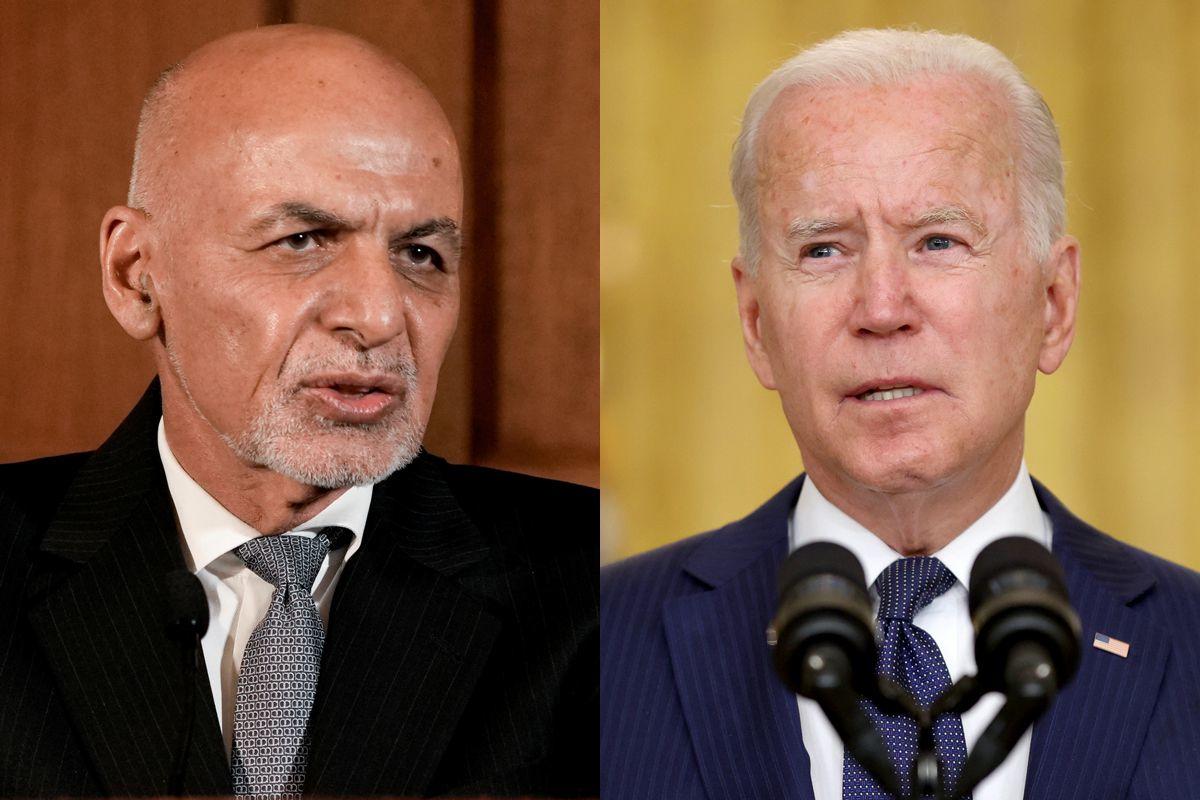
But just as President Biden was delivering his prepared remarks, Reuters was quietly publishing a leaked transcript from the president’s final call with Ashraf Ghani, which took place in late July. The call offers a more realistic picture of a Biden Administration obsessed with the optics of the pullout, who was still pushing the Afghans to focus on an irrelevant strategy shift to try and make it look like they were doing something in the face of Taliban defeat.

A few weeks later, the Afghan president fled Kabul with sacks full of plundered cash just before the Taliban surrounded the city. He’s now believed to be hiding in the UAE.

Although Biden seemed aware that the situation on the ground appeared grim, Biden demanded that Ghani project “a different picture” to the press and the international community “whether or not it was true”.

“I need not tell you the perception around the world and in parts of Afghanistan, I believe, is that things are not going well in terms of the fight against the Taliban,” Biden said. “And there is a need, whether it is true or not, there is a need to project a different picture.”

Biden told Ghani that if Afghanistan’s prominent political figures were to give a press conference together, backing a new military strategy, “that will change perception, and that will change an awful lot I think.”

It’s also clear that Biden knew it was only a matter of time before the Taliban completed its takeover of the country. His main goal was making sure Ghani did everything in his power to try and manage the Afghan Army’s defeat with as little embarrassment as possible.

Despite probably knowing that details from his final call with Ghani would surface, Biden repeated his claims that nobody could have anticipated the Taliban’s rapid advance.

During the call, the Afghan president pleaded with Biden for more air support and a raise for Afghan soldiers who hadn’t received one in a decade, Biden offered mostly platitudes.

“We are going to continue to fight hard, diplomatically, politically, economically, to make sure your government not only survives, but is sustained and grows,” said Biden.

By the time the two leaders spoke on July 23, roughly 23 days before the fall of Kabul, Taliban insurgents controlled roughly half of Afghanistan’s district centers as the situation in the country rapidly deteriorated. Around this time, Biden insisted that the fall of Afghanistan to the Taliban wasn’t inevitable.

Although the situation in Afghanistan was already dire, and the American forces were withdrawing their air support, Biden continued to push Ghani about holding a press conference to announce a new military “strategy” that was really just window dressing.

“But I really think, I don’t know whether you’re aware, just how much the perception around the world is that this is looking like a losing proposition, which it is not, not that it necessarily is that, but so the conclusion I’m asking you to consider is to bring together everyone from [Former Vice President Abdul Rashid] Dostum, to [Former President Hamid] Karzai and in between,” he said.

“If they stand there and say they back the strategy you put together, and put a warrior in charge, you know a military man, Khan in charge of executing that strategy, and that will change perception, and that will change an awful lot I think.”

Ghani responded by saying Afghanistan was facing not just the Taliban, but their foreign backers.

“We are facing a full-scale invasion, composed of Taliban, full Pakistani planning and logistical support, and at least 10-15,000 international terrorists, predominantly Pakistanis thrown into this.”

In other words, the problem of defeating the Taliban wasn’t going to be fixed by a press conference. And the new “strategy” of abandoning rural areas to protect population centers was really the last available course of action, since the Taliban dominated the rural districts.

The bottom line is this: President Biden clearly knew the dissolution of the Afghan government and swift triumph of the Taliban was inevitable, but he was so preoccupied with managing the optics of the pullout, that he neglected to focus on planning for the final stages of the US withdrawal, all while appearing to believe his own BS about changing the strategy on the ground.

Tyler Durden
Wed, 09/01/2021 – 07:01

via ZeroHedge News https://ift.tt/3juOc90 Tyler Durden