Futures Stall At All Time High As Focus Turns To Jobs Data

Futures Stall At All Time High As Focus Turns To Jobs Data

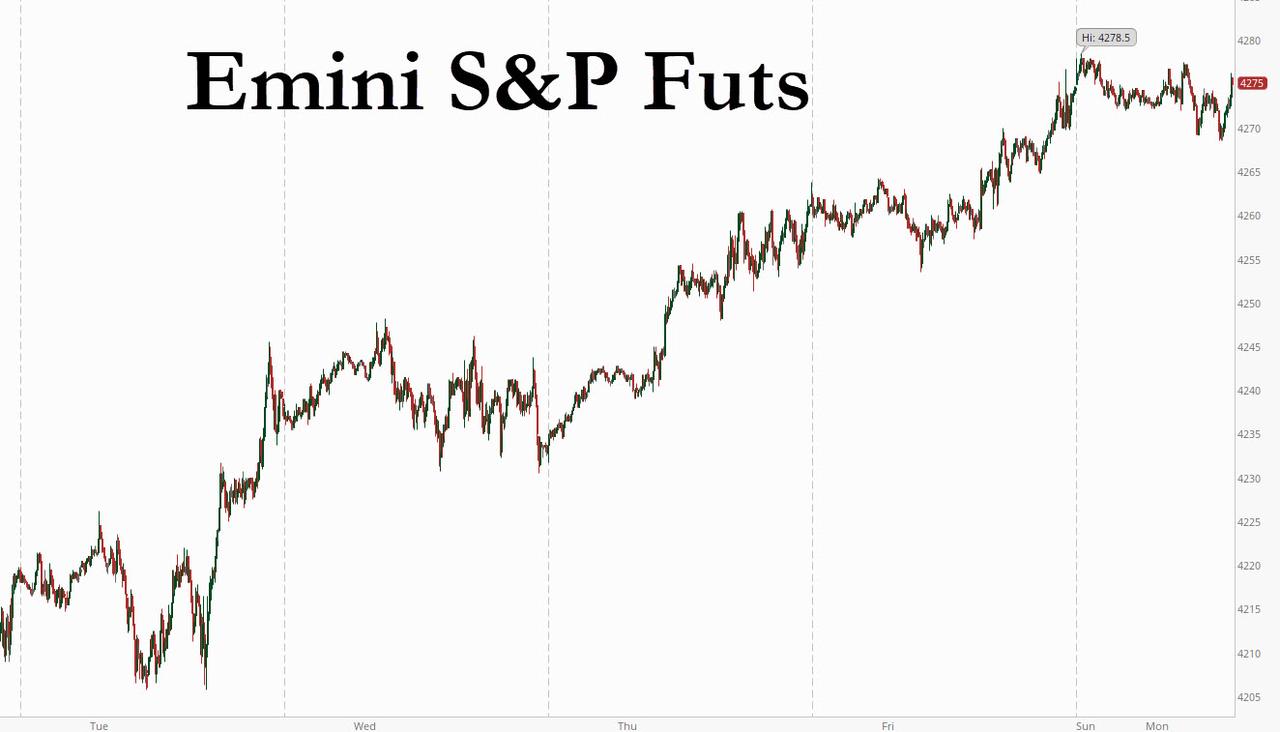
S&P500 futures paused at fresh all time highs in a subdued session as traders eyed central bank support and awaited the June jobs report due Friday. European stocks dipped as new travel restrictions prompted by the Covid-19 Delta strain spurred a re-think of the reflation trade. The dollar and oil posted modest gains.

Contracts on the Nasdaq 100 led gains while the S&P 500 fluctuated following the best week for the underlying gauge since February following an agreement on President Joe Biden’s $1.2 trillion infrastructure spending deal (which however may prove to be a total dud) and waning concerns about a sooner-than-expected policy tightening from the Federal Reserve. At 730 a.m. ET, Dow e-minis were down 17 points, or 0.05% S&P 500 e-minis were up 3 points, or 0.08% and Nasdaq futs were up 42.50 ot 0.29% as FAAMG megacaps edged higher in premarket trading despite higher bond yields.
Cryptocurrency-exposed stocks climbed in US premarket trading with Bitcoin and other digital currencies spiking overnight, pushing bitcoin to $35,000 and Ethereum back over $2,000. Boeing fell 1.4% after the FAA told the planemaker that its planned 777X is not yet ready for a significant certification step and warned it “realistically” will not certify the airplane until mid- to late-2023. Virgin Galactic extended gains amid continued Reddit chatter, and Intellia Therapeutics surged after reporting positive results on Saturday from a clinical trial. Here are some other notable U.S. movers today:

  • Arbutus Biopharma (ABUS) jumps 20% after it announced on Saturday the presentation of five abstracts during an international congress by the European Association for the Study of the Liver.
  • Atossa Therapeutics (ATOS), which is set to join the Russell 2000 and 3000 indexes Monday, drops 7.4% in premarket trading.
  • Cryptocurrency-exposed stocks climb in premarket trading with Bitcoin and other digital currencies higher as bulls in the market take encouragement in Bitcoin’s failure to breach the $30,000 support level over the weekend. Marathon Digital (MARA) gains 3.5%, while Riot Blockchain (RIOT) rises 3.7%.
  • GameStop Corp. (GME) slips 0.6% after its rating and price target are temporarily suspended at Baird, which notes the difficulty of making a “reasonable” recommendation to institutional investors in the near term given the share price volatility. It will also join the FTSE Russell 1000 Index, taking effect at the open Monday.
  • Intellia Therapeutics (NTLA) soars 29% after it reported positive results on Saturday from the first clinical trial using Nobel Prize-winning Crispr technology to treat disease inside the human body.
  • The miss in survival rates for liver cancer in Ipsen’s Cabometyx phase 3 study is disappointing and falls short of competitors, Jefferies said in a note. Shares of partner Exelixis (EXEL) decline 1.3% in premarket trading.
  • MediWound (MDWD) shares rise 13% after Japan’s Kaken Pharmaceutical said it has submitted a new drug application for manufacturing and marketing approval of KMW-1 for the removal of burn eschar.
  • Virgin Galactic (SPCE) climbs 5.9%, extending gains after receiving regulatory approval to fly customers into space.

Both the S&P 500 and the Nasdaq hit record levels last week. But the tech-heavy Nasdaq’s 4.4% gain is outpacing its peers in June as investors pile back into tech-oriented growth stocks on waning worries about runaway inflation. Still, tensions remain as Bloomberg notes, with highly-contagious strains of the virus threatening to derail the return to normal, while markets remain sensitive to more central banks debating the withdrawal of emergency stimulus.

“The fact central banks keep on providing considerable support to markets remains a solid bullish market driver and justifies the ‘risk-on’ approach,” said Pierre Veyret, technical analyst at ActivTrades. Traders “already have their eyes towards upcoming macro data” like the jobs report and the earnings season coming up soon.

“Liquidity is still everywhere and that, for now, will support stocks,” said Charles Diebel, head of fixed income at Mediolanum International Funds. “But I think the market is in an unstable equilibrium right now. The FOMC have signalled they will be more proactive but equally, dislocations in the supply chain will keep price pressures evident.”

Quarterly results from Micron Technology, ConocoPhillips and Walgreens are slated for this week. On the economic front, attention will be on consumer confidence data, a private jobs report and a crucial monthly nonfarm payrolls report.

Switching continents, European stocks were dragged lower by travel and leisure stocks, with the Stoxx 600 index trading down 0.2%, cutting it earlier losses in half. Travel stocks underperformed as Portugal and Malta, popular tourist destinations for U.K. travelers, provide updates on vaccine requirements: the Portuguese government said passengers arriving from U.K. must isolate for 14 days if not fully vaccinated, according to the official government gazette. Meanwhile, from June 30, only fully- vaccinated persons can travel to Malta from the U.K., Malta’s Department of Information says by email following report in Telegraph newspaper at weekend. Tour operator TUI fell 3.5%, other movers included airline EasyJet -2.6%, British Airways-owner IAG -2.2%, Ryanair -2.1%, Hotelier Accor -1.9%, peer IHG -2.2%.

Here are some of the other biggest European movers today:

  • Nokia shares jumped as much as 7.2%, their best day in two months, catching up from a market holiday after Goldman Sachs upgraded the telecom equipment maker to buy on Friday and raised price targets.
  • Dr. Martens gained as much as 3.7% after being upgraded to buy at HSBC, which says the bootmaker’s long-term prospects are intact.
  • Greggs rose as much as 4.9% after the U.K. bakery chain said its sales recovery is stronger than anticipated, with the potential for a “materially positive impact” on full-year results if trends continue.
  • Burberry fell as much as 10% after the British company said CEO Marco Gobbetti will leave by year-end.
  • Gobbetti will become CEO of Salvatore Ferragamo, whose shares climbed after the announcement.
  • Ipsen dropped as much as 6%, the most since December. The miss in survival rates for liver cancer in Ipsen’s Cabometyx phase 3 study is disappointing and falls short of competitors, Jefferies said in a note.

Earlier in the session, Asian equities fluctuated in a narrow range as investors awaited fresh signs on the health of the reflation trade while monitoring the latest moves around the region to contain the coronavirus; Southeast Asian markets underperformed, led by Malaysia, where a nationwide lockdown was extended.  The MSCI Asia Pacific Index swung between a loss of 0.2% and a gain of 0.1%, with volumes on most major gauges 20%-40% below 30-day averages. Hong Kong stocks dipped after morning trading was canceled due to a storm; later in the session Hong Kong said it will ban all passenger flights from Britain starting Thursday. Malaysia’s benchmark fell more than 1% as the nation moved to extend a nationwide lockdown that was originally due to end Monday. Indonesia’s main index fell by a similar amount, while Vietnam’s rose more than 1%.

The rotation since late last year into value stocks expected to benefit from economic reopenings has shown signs of strain recently after the Federal Reserve signaled it’s preparing to slow stimulus. MSCI’s gauge of Asia Pacific growth stocks has outperformed its value counterpart over the past six weeks. “Growth may continue to do well in the near term as value crowding unwinds somewhat further,” JPMorgan Chase & Co. strategists led by Mixo Das wrote in a report. “A mid-cycle transition, though, is not bad for markets overall.”

In rates, treasuries trade near session highs as US trading gets under way, with 5- to 30-year yields lower by 1bp-2bp inside Friday’s ranges.  Yields are lower by ~1.5bp from 10- to 30-year sectors, 10Y at 1.51%; last week’s 8.6bp increase in 10Y yield was its biggest since March. Futures volumes have been below average so far Monday with no major economic data and a few Federal Reserve speakers scheduled. Focal points include corporate new-issue calendar, where Qatar Petroleum has mandated banks for amulti-tranche offering. Treasury note and bond supply is on hiatus until mid-July, and Fed targets 10- to 22.5-year sector in daily purchase operation. Focal points for Treasuries later this week include month-index bond index rebalancing, projected to extend Treasury index duration by 0.08yr, and June employment report on July 2. Super- long Japanese bonds erased losses toward the end of the session after selling made them attractive.

In FX, the Bloomberg Dollar Spot Index jumped to session high as the euro stumbled to just above 1.19 while the relative premium to own exposure on the common currency over the next two months is at its lowest cost in more than a year and at levels rarely seen.  The pound jumped the most in a week amid speculation the U.K.’s new Health Secretary Sajid Javid could accelerate the country’s exit from pandemic restrictions. Javid, who replaces Matt Hancock, has said he wants to see the country return to normal “as soon and as quickly as possible”. The New Zealand dollar dipped as the government extended movement restrictions in the Wellington region for two days. Asset managers turned bearish on the kiwi for the week ended June 22, the first time since April, according to CFTC data, while leveraged longs surged to an almost four-month high for the same period. The yen edged higher, gaining for a third day.

In commodities, oil was steady near the highest since 2018 ahead of an OPEC+ meeting at which the alliance is forecast to announce supply increases that won’t be enough to keep pace with the global demand recovery.

There is little on the economic calendar with just the Dallas Fed Mfg index out at 1030am (exp. 32.5, down from 34.9). Fed speakers include Williams (9am), Barkin (12pm) and Quarles (1:10pm).

Market Snapshot

  • S&P 500 futures little changed at 4,270.75
  • STOXX Europe 600 down 0.3% to 456.27
  • MXAP little changed at 209.36
  • MXAPJ little changed at 703.50
  • Nikkei little changed at 29,048.02
  • Topix up 0.2% to 1,965.67
  • Hang Seng Index little changed at 29,268.30
  • Shanghai Composite little changed at 3,606.37
  • Sensex down 0.3% to 52,790.76
  • Australia S&P/ASX 200 little changed at 7,307.29
  • Kospi little changed at 3,301.89
  • Brent Futures down 0.3% to $75.94/bbl
  • Gold spot down 0.2% to $1,778.19
  • U.S. Dollar Index little changed at 91.79
  • German 10Y yield fell 0.8 bps to -0.163%
  • Euro little changed at $1.1933
  • Brent Futures down 0.3% to $75.95/bbl

Top Overnight News from Bloomberg

  • The race to top of the emerging-market currency pack will be determined by central banks that are taking no chances with inflation. The trick is singling out those ready to turn rhetoric into action.
  • The Fed’s decision this month to raise the rate on its reverse repurchase facility provided extra space for the never-ending barrage of cash hunting for somewhere to earn even a tiny return. But looming challenges around quarter end and, beyond that, the reinstatement of the federal debt ceiling at the end of July mean the mismatch between low supply of short-term securities and surging demand could get a lot worse
  • With Sydney two days into a business-crippling lockdown and the delta variant spreading nationwide, Prime Minister Scott Morrison’s balancing act of keeping Australians safe and the economy open is becoming increasingly precarious
  • The outcome of next year’s French presidential election looks increasingly uncertain after incumbent Emmanuel Macron and far-right leader Marine Le Pen, who lead national polls, registered dismal showings in a regional ballot on Sunday
  • South African President Cyril Ramaphosa banned alcohol, outlawed public gatherings and closed schools to curb surging coronavirus infections
  • Bitcoin pushed higher Monday as proponents took encouragement at its failure to breach the closely-watched $30,000 support level over the weekend
  • The U.S. Air Force struck Iran-backed militias in Iraq and Syria on Sunday, in a test of Iran’s incoming president, whose election this month has already complicated efforts to revive a 2015 deal on Iran’s nuclear program

Quick look at global markets courtesy of newsquawk

Asian equity markets were subdued following a light weekend in terms of macro drivers, with participants kept tentative heading closer towards HY-end and this week’s upcoming risk events culminating in the release of the latest US NFP jobs data on Friday, while US equity futures were uneventful with the Emini S&P fading an initial extension to fresh record highs. ASX 200 (Unch.) was constrained by underperformance in the tech sector and after Sydney entered into a two-week lockdown in an effort to curb the outbreak of the COVID-19 Delta variant. Nikkei 225 (-0.1%) struggled for direction amid a slightly firmer currency and briefly tested the 29k level to the downside where it then bounced off a nearby floor, with Seven & I the top gainer after it was ordered by US antitrust regulators to sell 293 stores that were acquired in the takeover of Speedway and its 3,900-strong outlets. Shanghai Comp. (-0.1%) was lacklustre and failed to find inspiration from the resilience in Shenzhen bourses, nor from the Chinese data over the weekend which showed Industrial Profits rose by 36.4% Y/Y in May which slowed from the prev. 57.0% growth in April, while Hong Kong participants were absent for the entire morning session due to the black rainstorm warning which has since been lifted to allow afternoon trade to commence. Finally, 10yr JGBs were lower after last Friday’s selling pressure in T-notes but with downside stemmed amid the BoJ presence for JPY 950bln of JGBs mostly in 3yr-10yr maturities, while Aussie bonds traded mixed with pressure in the long-end following a 30yr government auction.

Top Asian News

  • Hong Kong Arrests Writer at Airport as Media Delete Articles
  • Saudi Group Buys Mumzworld in Landmark Mideast Deal Led by Women
  • Abu Dhabi Starts Using Facial Covid Scanners at Malls, Airports
  • Singapore’s Daily Covid Cases Fall to Lowest in 2 Weeks

European equities (Eurostoxx 50 -0.4%) have kicked the week off on a softer footing in what has been a quiet start to the week. Stateside, price action in the futures markets is also relatively contained with some very minor outperformance in the e-mini Nasdaq (+0.2% vs. E-mini S&P U/C). From a macro perspective, infrastructure talks in the US continue to grab the headlines with US President Biden walking back his veto threat over the weekend. That said, the likes of Pelosi and Schumer could pose an obstacle to the legislation’s passage with the former of the view that the House will not vote on the bipartisan bill unless it is accompanied by a reconciliation bill. On the S&P 500, Goldman Sachs notes that its year-end 2021 target of 4300 is predicated on the US 10yr rising to 1.9% and P/E multiple remaining stable around 22x. GS notes that, all else equal, if interest rates remain roughly flat their model would imply a fair value of 4700, whereas if rates rose to 2.5% by year-end, fair value would be around 3550; 17% below current levels. Back to Europe, sectors are predominantly lower with Travel & Leisure a clear laggard as Tui (-3.1%), easyJet (-2.7%) and IAG (-4.1%) continuing to suffer at the hands of travel restrictions across the region with German Chancellor Merkel set to launch a bid to ban travellers from Britain to the EU regardless of whether they have been vaccinated or not. Other underperforming sectors included cyclically-exposed names such as Banks, Oil & Gas and Autos. In terms of stock specifics, Nokia (+6.00%) sit at the top of the Stoxx 600 after being upgraded to buy from neutral late last week (the Finnish market was closed on Friday) at Goldman Sachs; citing continued improvement in the wireless market driven by 5G. Burberry (-6.4%) is the region’s laggard after its CEO Gobbetti will leave the Co. at the end of the year and become CEO of Salvatore Ferragamo.

Top European News

  • Hancock Scandal Threatens to Hurt U.K.’s Johnson in Key Week
  • Burberry’s Gobbetti Stepping Down to Take Top Ferragamo Job; Burberry Shares Plunge on CEO Gobbetti’s Exit for Ferragamo
  • European Travel Shares Lag Amid Focus on Vaccine Requirements
  • NatWest to Sell $5 Billion Ulster Bank Ireland Loans to AIB

In FX, The Pound has rebounded quite firmly across the board to reclaim 1.3900+ status against the Dollar and fend off yet another assault on 0.8600 vs the Euro, with little sign of any real fallout from the latest scandal to hit Whitehall that has culminated in the UK’s Health Minister leaving his post. However, Cable remains top heavy into 1.3950 and Eur/Gbp underpinned ahead of 0.8550 as the Greenback retains an underlying bid in wake of the Fed’s recent hawkish shift and the index hovers just below 92.000 and above 91.500. Note, latest IMM data reveals that positioning is still net short even though more Bucks were bought back last week, and specs may want to reduce exposure further into month end on Wednesday plus NFP 2 days later.

  • JPY/EUR – Option expiry interest could well provide the Yen and Euro with some additional guidance amidst the ongoing post-FOMC Dollar retracement and focus on US Treasury yields in relation to EGBs and JGBs in light of policy divergence between the Fed and ECB/BoJ. Indeed, Eur/Usd has a hefty 1.13 bln to contend with very close to current levels (1.1945-50), and may also be hampered technically while unable to make a clean breach of the 100 HMA that comes in at 1.1931, but Usd/Jpy might be anchored given 1.38 bn rolling off at the 110.50 strike.
  • CAD/AUD/NZD – All choppy vs their US rival, with the Loonie still straddling 1.2300, Aussie capped around 0.7600 and Kiwi contained in the upper 0.7000 area, as latest outbreaks of COVID-19 down under weigh on Aud/Usd and Nzd/Usd, but the Aud/Nzd cross remaining sub-1.0750 against the backdrop of less dovish/more hawkish RBNZ policy vibes via the BNZ that reckons QE may be withdrawn in coming months as the Bank gets ready to tighten rates.
  • CHF – The Franc remains rangebound just above 0.9200 against the Greenback and either side of 1.0950 vs the Euro following latest weekly Swiss sight deposit balances showing a dip in domestic bank accounts before Wednesday’s official reserves data and KOF indicator.

In commodities, WTI and Brent are currently modestly firmer on the session but reside within a narrow range of circa USD 0.60/bbl so far and the few directional changes in performance this morning have follower broader risk sentiment, rather than specific fundamental updates. At present, the benchmarks are firmer by 0.10% as newsflow remains sparse and the situation is very much as-we-were from Friday looking out for IAEA updates, where Iran has placed the burden on the US to first remove sanctions and awaiting the week’s OPEC+ event. Elsewhere, China’s NDRC has announced it is increasing the domestic price of gasoline and diesel by CNY 225/T and CNY 215/T respectively from tomorrow. Moving to metals, spot gold and silver are contained and little changed overall on a session that has been somewhat choppy but given movements in the USD rather than any fresh macro driver. Finally, base metals are slightly softer but again relatively rangebound following a light APAC session and as industrial profit data for May out of China dipped from the prior reading.

US Event Calendar

  • 10:30am: June Dallas Fed Manf. Activity, est. 32.5, prior 34.9
  • 9 a.m.: Fed’s Williams Takes Part in BIS Panel Discussion
  • 12 p.m.: Fed’s Barkin Discusses Inflation Risks
  • 1:10 p.m.: Fed’s Quarles Discusses Central Bank Digital Currency

Tyler Durden
Mon, 06/28/2021 – 08:03

via ZeroHedge News https://ift.tt/3A4ncn5 Tyler Durden

UBS Allows 2/3rds Of Workforce To Adopt Permanent “Hybrid Work” Schedule

UBS Allows 2/3rds Of Workforce To Adopt Permanent “Hybrid Work” Schedule

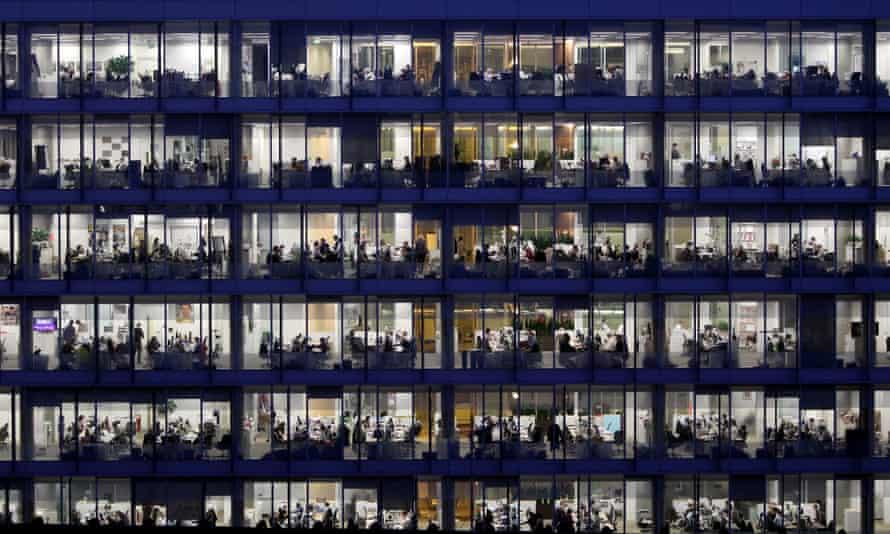
Bucking the trend among the world’s megabanks, UBS has decided to permanently allow as many as 2/3rds of its workforce to transition to a “hybrid” work model allowing them to spend time working from both home and the office.

That’s in stark contrast to JPM, Morgan Stanley and Goldman Sachs, which have all announced plans to recall bankers back to the office on a full-time basis, with no allowance for any kind of a hybrid model. While Morgan is allowing its bankers a little longer to transition back to the office, Morgan Stanley CEO James Gorman recently quipped that bankers who don’t want to report back should be ready to brook a pay cut because “if you want that NYC salary, you need to be in NYC offices.”

Morgan Stanley is also ordering all employees in the New York office to be vaccinated before returning to the office; even clients will need to be vaccinated (and provide proof thereof) before being allowed in Morgan’s offices.

JPM’s Jamie Dimon has emphatically insisted that working in the office sparks “creative intelligence” that comes from workers interacting with each other, along with other employees who aren’t necessarily directly involved with their team. But UBS’s “internal analysis” shows that 2/3rds of its workforce were in “positions suitable for hybrid working”. However, some roles, like traders and branch staff, will still be required to work on-site.

No date for a return to the office has been set for UBS, according to the FT, which broke the story.

As Bloomberg reminds us, UBS Chairman Axel Weber and former CEO Sergio Ermotti hinted earlier this year year that a flexible working model was under consideration and that at least 1/3rd of UBS’s workforce could work permanently from home. Citigroup is also reportedly considering a similar arrangement.

Deutsche Bank has also said it’s working on plans to allow some staff to work from home up to three days a week. But so far, no major players in financial services have announced a plan anywhere near as radical as UBS’s, which is more akin to the arrangements cropping up in the tech world.

Of course, now that international paranoia about the Delta variant has reached a fever pitch, and a handful of countries across Asia, Africa and Europe have either reimposed lockdown measures or delayed plans to lift them, simply allowing more employees to work from home permanently might be the simplest policy for a multinational institution.

Tyler Durden
Mon, 06/28/2021 – 07:04

via ZeroHedge News https://ift.tt/3qtZA6S Tyler Durden

Classified UK Defence Documents “Found By Member Of Public At Bus Stop”

Classified UK Defence Documents “Found By Member Of Public At Bus Stop”

Authored by ‘PA’ via The Epoch Times,

Sensitive defence documents containing details about HMS Defender and the military have been found by a member of the public at a bus stop, according to reports.

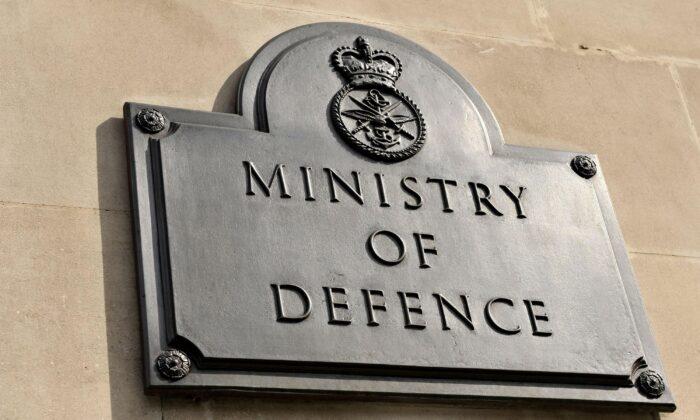
The Ministry of Defence (MoD) said the employee concerned with the loss of documents reported it last week, and the department has launched an investigation.

A member of the public, who wanted to remain anonymous, contacted the BBC when they found 50 pages of classified information in a soggy heap behind a bus stop in Kent early on Tuesday morning.

The papers included one set of documents which discussed the potential Russian reaction to HMS Defender’s travel through Ukrainian waters off the Crimea coast on Wednesday, according to the BBC, while another laid out plans for a possible UK military presence in Afghanistan.

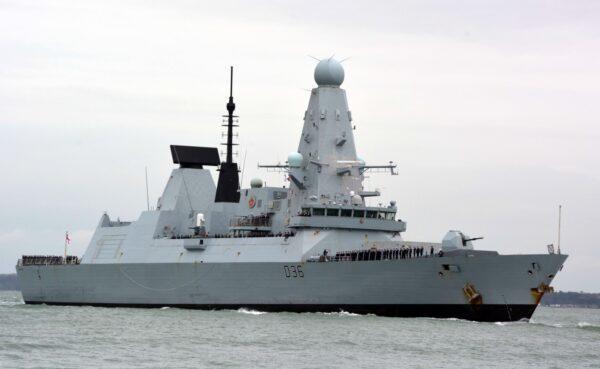
HMS Defender in an undated file photo. (Ben Mitchell/PA)

A spokesperson for the MoD said: “The Ministry of Defence was informed last week of an incident in which sensitive defence papers were recovered by a member of the public.

“The department takes the security of information extremely seriously and an investigation has been launched.

“The employee concerned reported the loss at the time.

“It would be inappropriate to comment further.”

Shadow defence secretary John Healey called the incident “as embarrassing as it is worrying for ministers”.

“It’s vital the internal inquiry launched by the Secretary of State establishes immediately how highly classified documents were taken out of the Ministry of Defence in the first place and then left in this manner,” he said.

“Ultimately ministers must be able to confirm to the public that national security has not been undermined, that no military or security operations have been affected and that the appropriate procedures are in place to ensure nothing like this happens again.”

HMS Defender is part of the UK Carrier Strike Group currently heading to the Indo-Pacific region.

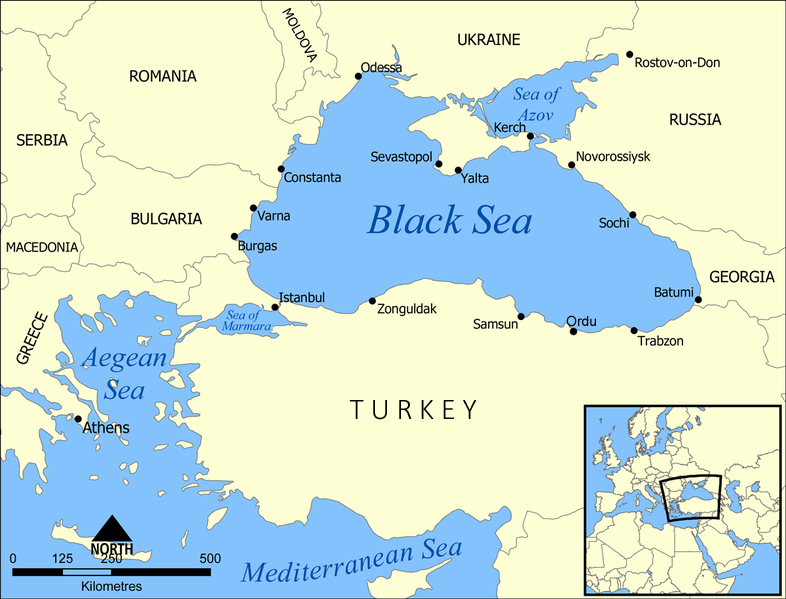
However, it was announced earlier this month that it would be temporarily breaking away from the group to carry out its “own set of missions” in the Black Sea.

The Type 45 destroyer caused a clash with Russian forces on Wednesday when it travelled through waters south of the Crimea peninsula, which Russia annexed from Ukraine in 2014, in a move which was not recognised by international powers.

Moscow responded by having several aircraft shadowing the ship at varying heights, the lowest being approximately 500 feet—which Defence Secretary Ben Wallace said was “neither safe nor professional”.

Russia also claimed that warning shots were fired by their vessels at the destroyer, but this assertion was dismissed by the UK government which said only that a routine “gunnery exercise” took place.

Moscow has threatened to retaliate if the incident is repeated, while Prime Minister Boris Johnson insisted the warship was “entirely right” to make the trip from Odessa in Ukraine to Georgia as an internationally-recognised transit route.

The MoD said that HMS Defender “conducted innocent passage through Ukrainian territorial waters in accordance with international law” and that “all potential factors” are considered when making “operational decisions”.

Tyler Durden
Mon, 06/28/2021 – 06:30

via ZeroHedge News https://ift.tt/2Tdaemm Tyler Durden

Two UK Commercial Real Estate Funds Shut Permanently, Investors Trapped, As Sector-Wide Exodus Intensifies

Two UK Commercial Real Estate Funds Shut Permanently, Investors Trapped, As Sector-Wide Exodus Intensifies

Authored by Nick Corbishley via WolfStreet.com,

Aegon Asset Management has closed its UK Property Income and Property Income feeder funds, after struggling to raise sufficient cash to meet redemption requests, it said on Wednesday. The Aegon Property Income fund had £380 million ($531 million) in assets under management and the feeder fund £150 million, according to Morningstar. The announcement follows a move last month by Aviva to wind up its property fund and two feeder funds due to the prevailing economic uncertainty and liquidity concerns.

Both the Aegon and Aviva funds were suspended in March 2020, alongside most other UK property mutual funds, due to the acute uncertainty over market valuations caused by the virus crisis as well as liquidity issues. Many of these funds are open-end, meaning they offer daily withdrawals to their (predominantly retail) investors, even though the funds’ core investment — offices, industrial property and retail parks — is extremely illiquid, often taking months to offload.

In times of financial stress and uncertainty, it’s not unusual for real estate to be plagued by acute liquidity issues. In June 2016, in the aftermath of the Brexit vote, six commercial real estate (CRE) funds suspended redemptions. But never before have so many real estate funds shut the doors on so many real estate investors. Since then most of the funds have reopened, although conditions remain tough. But neither Aegon or Aviva were among them. Their doors are staying shut.

“It has proved increasingly challenging to raise sufficient liquidity whilst also ensuring that continuing investors have a representative and well-balanced portfolio,” Aegon AM said in a statement.

“In order to ensure all investors are treated fairly, Aegon AM has decided to take steps to close the funds and return the proceeds to investors as quickly as possible, in a fair and orderly manner.”

Trapped investors will have to wait up to two years to be reunited with their funds. If the recent experience of other gated (and eventually wound down) funds is any indication, by that time the investors may find that the value of their investment has significantly shrunk.

Many of the property funds that did reopen are now suffering an exodus. The industry saw the second-worst month of outflows in May, according to data from funds network Calastone. UK investors redeemed £445 million of their investments in the funds during last month, the second worst month since Calastone began recording flows in 2015. The worst month was March this year when £589 million was withdrawn, compared with £314 million in February and £128 million in January.

The level of selling activity in May took the markets by surprise. April is normally a bad month for redemptions as investors book capital losses before the end of the tax year, as these can be used to limit capital gains tax liabilities. But normally May is better. But not this time.

“We cautioned that sharply lower outflows in April were likely to prove temporary, but we were surprised by the level of selling activity in May,” said Edward Glynn of Calastone, adding that rising fears about the seemingly more contagious delta variant of Covid may have hurt sentiment in a sector that has already been upended by endless lockdowns, travel restrictions, and work-from-home ordinances.

Brick-and-mortar retail tenants are not paying their rent, partly because a government moratorium on commercial rents means they don’t have to. And that moratorium was recently extended to next March. Many offices are still half empty and will stay that way until the government withdraws its guidelines urging people to work from home if they can.

“Anything that delays the return to offices and the removal of limits on capacity in hospitality, retail and leisure venues is bad for commercial property in the short term,” Glynn said.

“Recent survey data suggests the long term may also be gloomier as companies plan to cut floorspace in future. This seems to have spurred further selling of property funds from investors who seem to be looking for reasons to be negative on the asset class.”

The UK’s property fund industry has shed £5.6 billion of funds after 32 consecutive months of net outflows, according to Calastone. The hardest hit fund, M&G Property Portfolio Fund, saw investors pull out £800 million in May after it reopened for business following 17 months of suspended redemptions. The outflows equated to 40% of total assets, according to Morningstar, with the fund shrinking from £2.1 billion to £1.3 billion in the space of just one month.

M&G Property Portfolio invests in commercial properties across the UK including offices, industrial property and retail parks, a sector beleaguered by retailer failures and crushed values. M&G’s property funds have been suffering a customer exodus since Brexit. According to Morningstar, the portfolio had only one month of positive flows since Britain voted to leave the EU in June 2016 before closing its doors in December 2019, four months before the UK went into its first lockdown.

Those doors were reopened just two months ago and investors are piling out of them even faster than before.

The problems suffered by these funds are a feature, not a bug, of an industry whose structure has been under question for over two years. The fundamental issue is the glaring mismatch between the daily liquidity the funds offer investors and the illiquidity of most of the assets they hold. The Financial Conduct Authority has proposed replacing the typical daily redemption notice period with notice of up to six months to prevent funds seizing up as investors stampede for the exit in times of market turmoil. But as of yet no definitive action has been taken.

*  *  *

Enjoy reading WOLF STREET and want to support it? Using ad blockers – I totally get why – but want to support the site? You can donate. I appreciate it immensely. 

Tyler Durden
Mon, 06/28/2021 – 05:00

via ZeroHedge News https://ift.tt/35YGVqg Tyler Durden

Tour de France To Sue Fan Who Caused Horrific Crash During Selfie

Tour de France To Sue Fan Who Caused Horrific Crash During Selfie

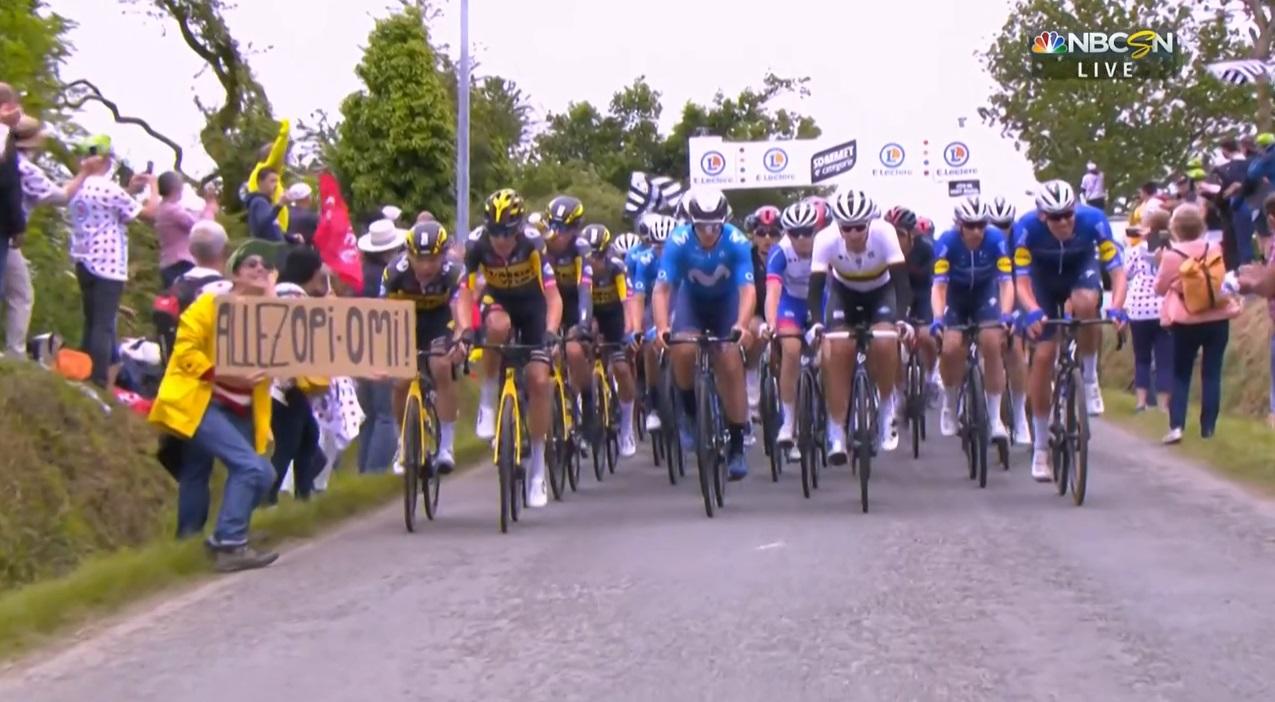
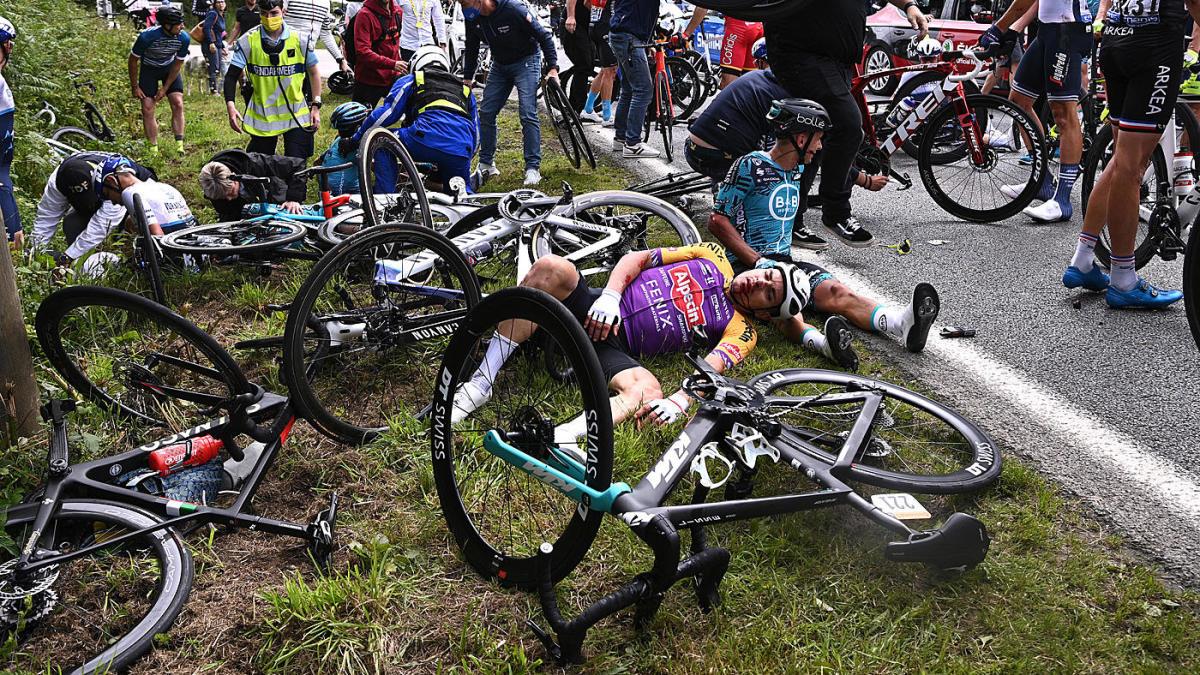
An oblivious and careless fan set off a horrific mass crash just as the famed annual multi-stage Tour de France was getting underway on Saturday. The fan was seen essentially posing for a selfie – trying to get on TV – in front of the pack of riders as they were coming up fast and tightly grouped. 

While holding a handwritten sign that said “Allez Opi+Omi” (a hello message to her Grandpa and Grandma, apparently) the spectator stayed in front of the peloton up to the very moment a rider with no way to avoid the obstruction collided with the person, causing a chain reaction of crashes.

Dozens of riders went down in a pile-up so large it blocked the road for the rest of the pack, which sent at least one athlete to the hospital.

“The crash, one of two on the stage, saw Jasha Sütterlin (DSM) transported to hospital with an injured hand,” Cycling News wrote. “He was cleared of any fractures. Eight other riders received treatment from the race doctor after the incident with more injured but not officially recorded in the medical bulletin.”

The fan, who appears to be a young woman, is being sought by authorities after she fled the scene and is believed to have flown back to her home country, likely Germany.

According to AFP, Tour de France organizers plan to take legal action against the woman:

The roadside fan who caused a giant crash in the first stage of the 2021 Tour de France on Saturday will be sued by the organizers.

A woman held up a banner while standing on the edge of the road and was looking straight at the television motorbike cameras, with her back turned on the speeding peloton.

“We are suing this woman who behaved so badly,” Tour deputy director Pierre-Yves Thouault was quoted as saying. “We are doing this so that the tiny minority of people who do this don’t spoil the show for everyone,” he added.

A number of cyclists could later be seen completing the stage with bloodied arms and scratched up legs while writhing in pain. Another cyclist reportedly suffered a dislocated shoulder.

The incident unleashed public fury and condemnation, as well as anger among the riders, especially after it was revealed the woman had quickly fled.

Getty Images

Race authorities released a statement later in the day saying “for the Tour to be a success, respect the safety of the riders! Don’t risk everything for a photo or to get on television!”

Recent years have seen more and more mishaps and injuries during the iconic 3-week long race across France given the presence of fans who attempt to get selfies, or who run along the racers – getting too close.

Tyler Durden
Mon, 06/28/2021 – 04:15

via ZeroHedge News https://ift.tt/3dnx9SV Tyler Durden

Green Party Implodes In Germany

Green Party Implodes In Germany

Authored by Mike Shedlock via MishTalk.com,

Talk of a Green government in Germany collapsed along with support for the party.

At the end of April and beginning of May, support for the Green Party surged, briefly putting them in first place. 

Talk of a Green government ensued. Take a look at the turn of events. 

Think Germans are Green?

There are polls, and there are polls that explain the polls. The latter are the interesting ones.

An Infratest dimap poll, published June 10, debunked one of the more persistent myths about Germany – that it is naturally a green country. Germany has a strong Green party, but there is a specific history to that, one that one should not be confused with general attitudes in society.

Here are some of the highlights. Should the state outlaw behaviour that is particularly damaging to the climate? 53% say No. Are you in favour of higher petrol prices? 75% say No. Should the government encourage a shift from fuel-driven to electrical cars? 57% say No.

The Greens are back to where they were at the beginning of the year, at around 20-22% – which we think is where the current core support lies. 

The above snips are courtesy of Eurointelligence

Next Election

The next German Federal election is September 26. 

It is difficult to envision any strong coalition based on the most recent polls. It is difficult to put together something that adds up to 50% that actually makes any sense. 

Recall the Yellow Vest Protests

Anyone recall the Yellow Vest Protests in France when French President emmanuel Macron tried to hike the gas tax to pay for clean energy. 

The protests (riots is a better word given the violence) began on November 17, 2018 and went on for a year. 

Switzerland Referendum

People may say they want Green policies but no one wants to pay for them.

That was the message just a week ago when Swiss Reject Climate Change With Zoomers and Millennials Leading the Way

Tyler Durden
Mon, 06/28/2021 – 03:30

via ZeroHedge News https://ift.tt/3xXKzga Tyler Durden

Thousands Of Asteroids Whizz Past Earth

Thousands Of Asteroids Whizz Past Earth

NASA’s Center for Near Earth Object Studies keeps an eye on the sky, surveying more than 26,000 asteroids and a much smaller number of comets that pass near Earth. Near Earth Asteroids, or NEAs, also include more than 2,000 potentially dangerous specimen, of which 158 have a diameter of more than one kilometer, making them 2.5 times as tall as the Empire State Building.

As Statista’s Katharina Buchholz points out, anyone who has dabbled in paleontology – even in the science fiction realm of Jurassic Park or The Land Before Time – knows that a giant asteroid hitting Earth is not good news for life on the planet. In fact, there is evidence that this may have been one of the main causes of the Cretaceous-Paleogene extinction.

But it does not take a massive asteroid to cause widespread damage. An asteroid that was only ten meters in diameter exploded 25 km above the Bering Sea in December 2019 with the force equivalent to ten Hiroshima atomic bombs. No international or national space organization had detected the small celestial object before it disintegrated above the unsuspecting Earth.

Infographic: Thousands of Asteroids Whizz Past Earth | Statista

You will find more infographics at Statista

As technology has advanced throughout the decades, people have become better at seeing what is floating around us in the sky.

According to Nasa’s CNEOS Center, only a handful of celestial objects had been detected by 1900.

The scale of that number did not change much until the end of the century. As of 1990, only 134 Near Earth Asteroids and 42 potentially dangerous objects were detected up above.

By comparison, 26,115 NEAs and 2,185 potentially dangerous asteroids had been identified as June 2021.

Tyler Durden
Mon, 06/28/2021 – 02:45

via ZeroHedge News https://ift.tt/3xZQhOF Tyler Durden

Georgia & Ukraine Agree To “Commitment” Seeking NATO Membership

Georgia & Ukraine Agree To “Commitment” Seeking NATO Membership

Authored by Rick Rozoff via AntiWar.com,

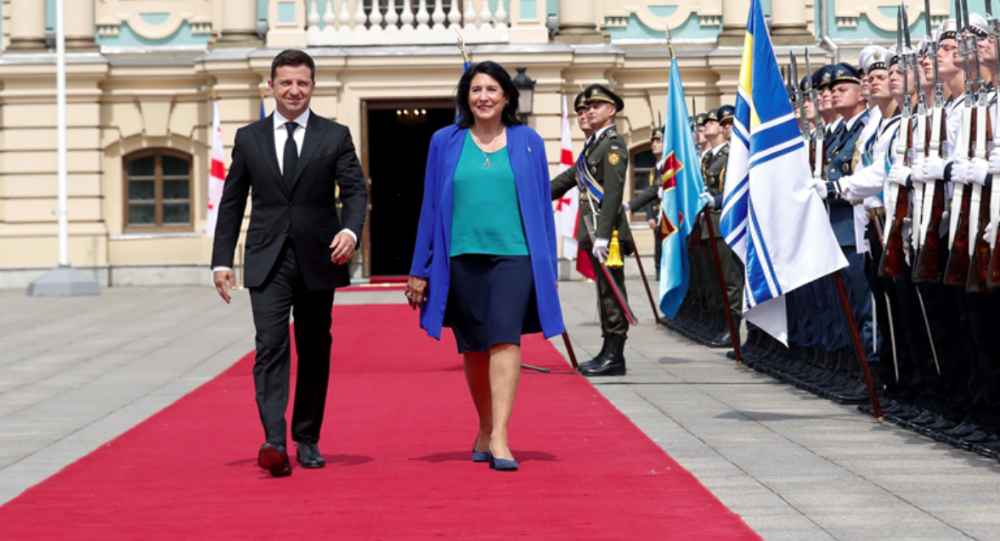
Georgian President Salome Zurabishvili paid a two-day visit to Ukraine earlier last week (her first) and met with her opposite number President Volodymyr Zelensky.

Zurabishvili first came to world notice when she emerged as part of the triumvirate that took over in Georgia following the so-called Rose Revolution in late 2003 that saw incumbent head of state Eduard Shevardnadze manhandled and divested of his powers. Her colleagues were Mikheil Saakashvili, who became president, and Zurab Zhvania, whose family claims he was assassinated in 2005. That event is the prototype of what have come to be called color revolutions; after Georgia the Orange Revolution in Ukraine in 2004, the Tulip Revolution in Kyrgyzstan and the Cedar Revolution in Lebanon in 2005, and a veritable host of others, successful and otherwise, in Belarus, Moldova, Armenia, the Maldives, Venezuela, Myanmar, Iran and elsewhere.

Deposed president Shevardnadze accused George Soros and his “philanthropies” of funding the coup in his nation. Shortly after Saakashvili and his allies came to power Soros’ Open Society Institute partnered with the United Nations Development Program to create a Capacity Building Fund for Georgia. The initiative was announced at a joint news conference with Saakashvili, the then-United Nations Development Program administrator and Soros at the World Economic Forum that year. Over 5,000 Georgian officials were paid out of the fund.

Later that same year the Orange Revolution occurred in Ukraine and a similar triumvirate, two men and a woman (it would be the same in Kyrgyzstan in 2005), took power.

The West, especially NATO, has always treated the two Black Sea nations as a pair. The military bloc created a NATO-Georgia Commission and a NATO-Ukraine Commission in 2008; each has been granted an Annual National Programme in those formats.

Last year they were among the first nations to become NATO Enhanced Opportunities Partners.

This week Ukraine’s Zelensky praised the strategic relations between the nations, affirming they shared a joint commitment to joining NATO and the European Union. He added they “agree regarding the future development of the Eastern Partnership,” whose association agreement demand on now deposed President Viktor Yanukovych led to the coup in 2014 and the resultant war in the Donbass. The Eastern Partnership, originally devised by Poland and Sweden, has as it mission the absorption of all remaining European and Caucasian former Soviet states into the European Union (and NATO) – except Russia.

Meanwhile, characteristically hawkish Western think tanks are clamoring for more confrontation…

The Ukrainian head of state also spoke of strengthening military integration in the Black Sea – against Russia, of course – particularly in regard to the Ukrainian and Georgian navies.

President Zurabishvili stated it was disappointing that the two nations “lost some time that should have been used to deepen relations,” in reference to a two-year freeze in relations after Zelensky appointed former Georgian President Saakashvili (on the run from his homeland) the chairperson of Ukraine’s Executive Reform Committee. As often occurs in such cases, Zurabishvili and Saakashvili, once coup co-plotters, soon became bitter enemies. (If she could have his head on a platter she would gleefully live up to her name.)

She, like her Ukrainian counterpart, hailed a common commitment to NATO, the EU and de-occupation, by which she evidently meant “liberating,” respectively, Abkhazia and South Ossetia and Crimea and the Donbass from Russia. The Georgian president also denounced “daily provocations” from Russia “along the occupation line.”

Zelensky expressed confidence that Georgia would assist his government’s de-occupation of Crimea by appointing a representative for this year’s Crimean Platform founding summit, whose purpose is to wrest Crimea from Russia.

It’s no wonder that some NATO members are less than enthusiastic about bringing Georgia and Ukraine into their fold and providing them with Article 5 protection. Doing so in the context of “de-occupying” territory in the Donbass, the Caucasus and especially in Crimea would almost certainly provoke a military confrontation with Russia that wouldn’t remain a conventional one for long.

Tyler Durden
Mon, 06/28/2021 – 02:00

via ZeroHedge News https://ift.tt/2T4wezX Tyler Durden

Politics, Profit, & Poppies: How The CIA Turned Afghanistan Into A Failed Narco-State

Politics, Profit, & Poppies: How The CIA Turned Afghanistan Into A Failed Narco-State

Authored by Alan Macleod via MintPresNews.com,

The COVID-19 pandemic has been a death knell to so many industries in Afghanistan. Charities and aid agencies have even warned that the economic dislocation could spark widespread famine. But one sector is still booming: the illicit opium trade. Last year saw Afghan opium poppy cultivation grow by over a third while counter-narcotics operations dropped off a cliff. The country is said to be the source of over 90% of all the world’s illicit opium, from which heroin and other opioids are made. More land is under cultivation for opium in Afghanistan than is used for coca production across all of Latin America, with the creation of the drug said to directly employ around half a million people.

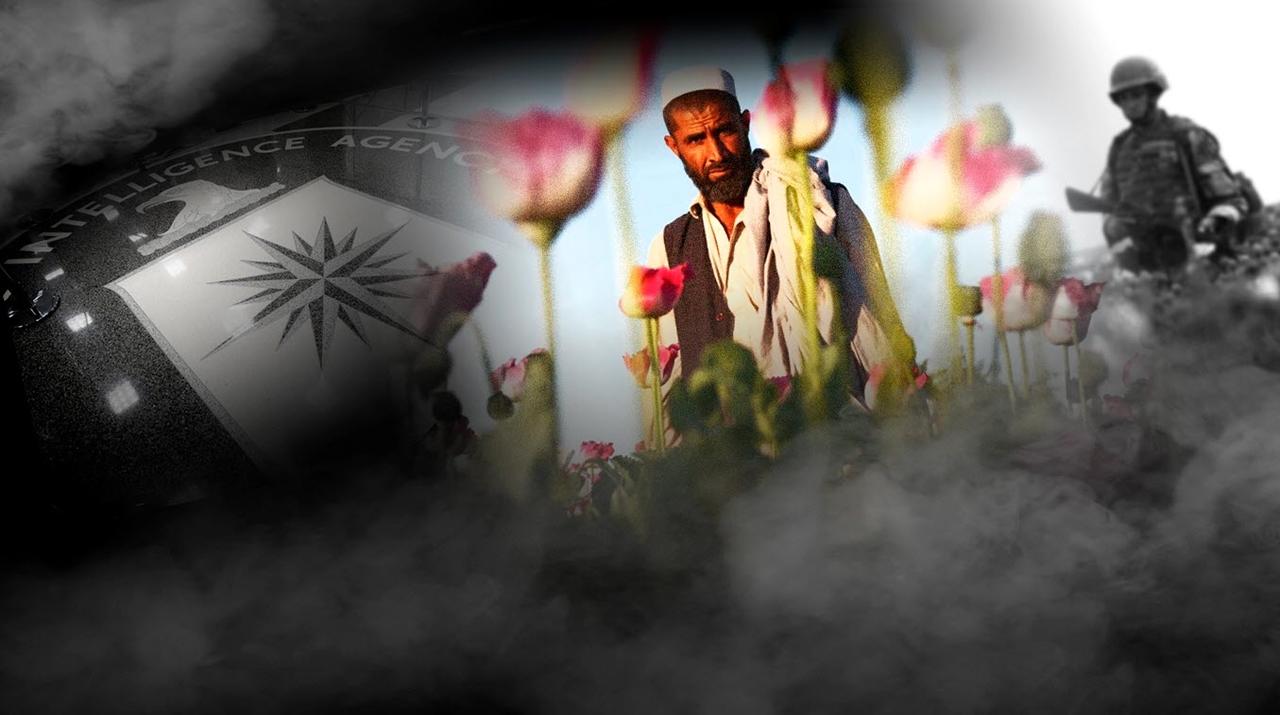
This is a far cry from the 1970s, when poppy production was minimal, and largely for domestic consumption. But this changed in 1979 when the CIA launched Operation Cyclone, the widespread funding of Afghan Mujahideen militias in an attempt to bleed dry the then-recent Soviet invasion. Over the next decade, the CIA worked closely with its Pakistani counterpart, the ISI, to funnel $2 billion worth of arms and assistance to these groups, including the now infamous Osama Bin Laden and other warlords known for such atrocities as throwing acid in the faces of unveiled women.

“From statements by U.S. Ambassador [to Iran] Richard Helms, there was little heroin production in Central Asia by the mid 1970s,” Professor Alfred McCoy, author of “The Politics of Heroin: CIA Complicity in the Global Drug Trade,” told MintPress. But with the start of the CIA secret war, opium production along the Afghanistan-Pakistan border surged and refineries soon dotted the landscape. Trucks loaded with U.S. taxpayer-funded weapons would travel from Pakistan into its neighbor to the west, returning filled to the brim with opium for the new refineries, their deadly product ending up on streets worldwide. With the influx of Afghan opium in the 1980s — Jeffrey St. Clair, co-author of “Whiteout: The CIA, Drugs and the Press,” alleges — heroin addiction more than doubled in the United States.

“In order to finance the resistance for a protracted period, the Mujahideen had to come up with a livelihood beyond the weapons that the CIA was providing,” McCoy said, noting that the weapons issued could not feed the fighters’ families, nor reimburse them for lost labor:

So what the resistance fighters did was they turned to opium. Afghanistan had about 100 tons of opium produced every year in the 1970s. By 1989-1990, at the end of that 10-year CIA operation, that minimal amount of opium — 100 tons per annum — had turned into a major amount, 2,000 tons a year, and was already about 75% of the world’s illicit opium trade.”

The CIA achieved its goal of giving the U.S.S.R. its Vietnam, the Soviets failing to quash the Mujahideen rebellion by the time they finally pulled out in 1989. But American money and weapons also turned Afghanistan into a dangerously unstable place full of warring factions that used opium to fund their battles for internal supremacy. By 1999, annual production had risen to 4,600 tons. The Taliban eventually emerged as the dominant force in the country and attempted to gain international legitimacy by stamping out the trade.

In this, they were remarkably successful. A 2000 ban on opium cultivation by the Taliban-led government led to an almost overnight drop to just 185 tons harvested the following year, as frightened farmers chose not to risk attracting their wrath.

The Taliban had hoped that the eradication program would win favor in Washington and entice the United States to provide humanitarian aid. But unfortunately, history had other ideas. On September 11, 2001, the U.S. experienced a massive case of blowback, as Bin Laden’s forces launched attacks on New York and Washington. The U.S. ignored the Taliban’s offer to hand him over to a third party, instead opting to invade the country. Less than a month after the planes hit the World Trade Center, U.S. troops were patrolling the fields of Afghanistan.

The world’s first true narco-state

The effect of the occupation was to expand drug production to unprecedented new proportions, Afghanistan becoming, in Professor McCoy’s estimation, the world’s first true narco-state. McCoy notes that by 2008, opium was responsible for well over half of the country’s gross domestic product. By comparison, even in Colombia’s darkest days, cocaine accounted for only 3% of its GDP.

Today, the United Nations estimates that around 6,300 tons of opium (and rising) is produced yearly, with 224,000 hectares — an area almost the size of Rhode Island — planted with poppy fields.

Source | Dyfed Loesche | Statista

But even while it was financing a widespread and deadly aerial spraying campaign in Colombia, the United States refused to countenance the same policy in Afghanistan. “We cannot be in a situation where we remove the only source of income of people who live in the second poorest country in the world without being able to provide them with an alternative,” said NATO spokesman James Appathurai.

Not everyone agreed, however, that a passionate commitment to defending the quality of life of the poorest was the actual reason for rejecting the policy. Matthew Hoh, a former captain in the U.S. Marine Corps is one skeptic. Hoh told MintPress that airborne fumigation was not carried out because it would be outside the control of Afghan government officials, who were deeply implicated in the drug trade, owning poppy fields and production plants themselves. “They were afraid that, if they went to aerial eradication, the U.S. pilots would just eradicate willy nilly and a lot of their own poppy fields would be hit.” In 2009, Hoh resigned in protest from his position at the State Department in Zabul Province over the government’s continued occupation of Afghanistan. He told MintPress:

NATO forces were more or less guarding poppy fields and poppy production, under the guise of counterinsurgency. The logic was ‘we don’t want to take away the livelihoods of the people.’ But really, what we were doing at that point was protecting the wealth of our friends in power in Afghanistan. “

According to Hoh, there was widespread disillusionment within the military among service members who had to risk their lives on a day to day basis. “What are we doing here? This is bullshit,” was a common sentiment among the rank and file.

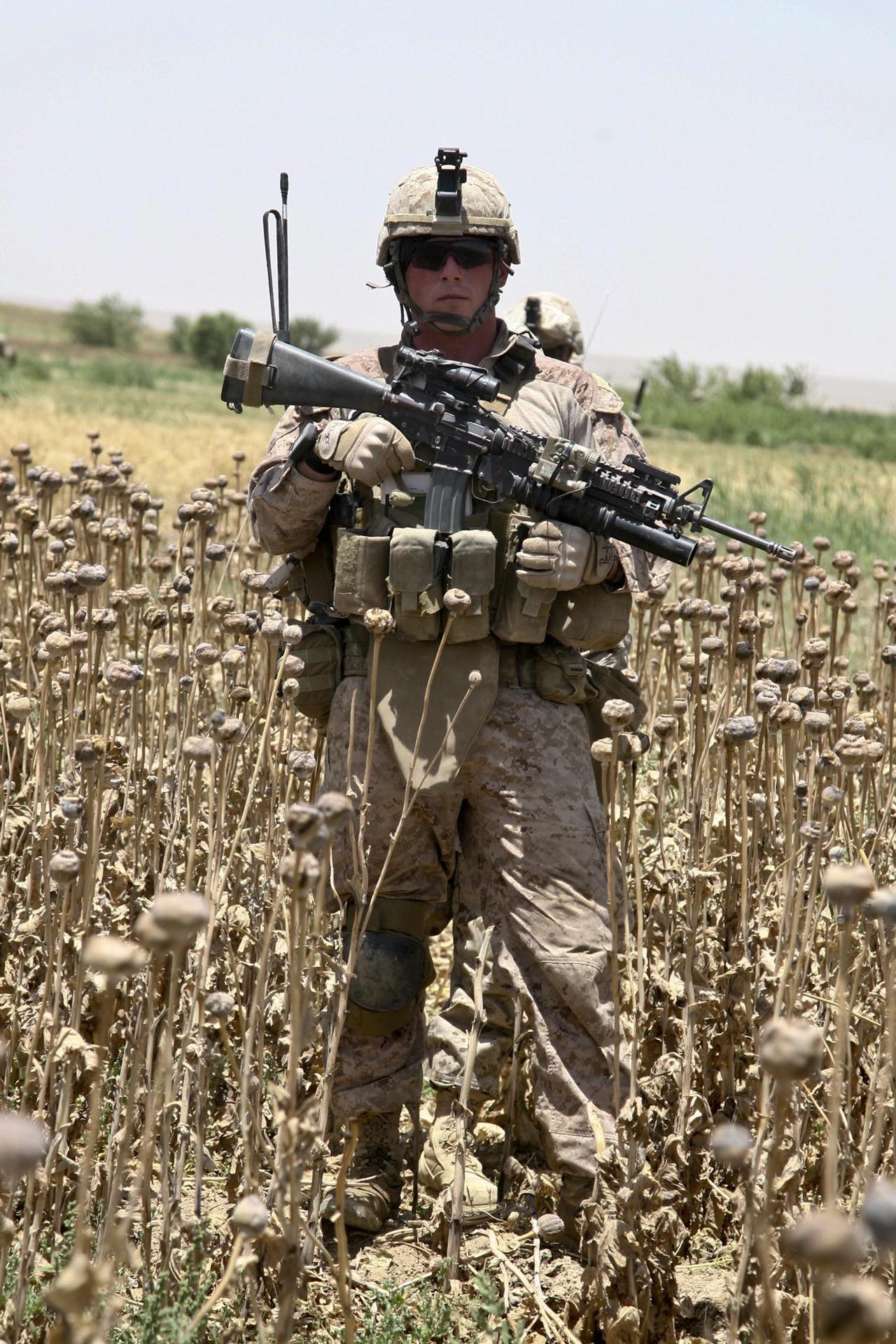
A US Marine stands in a poppy field during a foot patrol at Sangin, Afghanistan. Photo | DVIDS

The heroin trade implicated virtually everyone in power, including Afghan President Hamid Karzai’s brother Ahmed Wali, among the biggest and most notorious drug kingpins in the south of the country, a man widely understood to be in the pay of the CIA.

U.S. attempts to stymie the opium trade, such as the policy of paying domestic militias to destroy poppy fields, often backfired. Locals came up with ways of profiting, such as refraining from planting in one area, collecting large sums of money from occupying forces, and using that cash to plant elsewhere — effectively getting paid both to plant and not to plant. Even worse, local warlords and drug bosses would destroy their rivals’ crops and collect money from the U.S. for doing so, leaving themselves both enriched and in a stronger position than before, having gained NATO forces’ favor.

One notable example of this is local strongman Gul Agha Sherzai, who eradicated his competitors’ crops in Nangarhar Province (while quietly leaving his own in Kandahar Province untouched). But all the U.S. saw was a local politician seemingly committed to stamping out an illegal drug trade. They therefore showered him with money and other privileges. “We literally gave the guy $10 million in cash for rubbing out his competition,” Hoh said. “If you were going to write a movie about this, they’d say ‘This is too far fetched. No one is going to believe this. Nothing is this insane or stupid.’ But that is the way it is.”

McCoy noted that the Taliban was one of the prime beneficiaries of the drug trade, and used it to increase their power and vanquish the U.S.:

That booming opium production, and the U.S. failure to curb it, provided the bulk of the financing for Taliban, who captured a significant but unknown share of the local profits from the drug traffic, which they used to fund guerrilla operations over the past 20 years, becoming a determinative factor in the U.S. defeat in Afghanistan.”

‘The needle and the damage done’

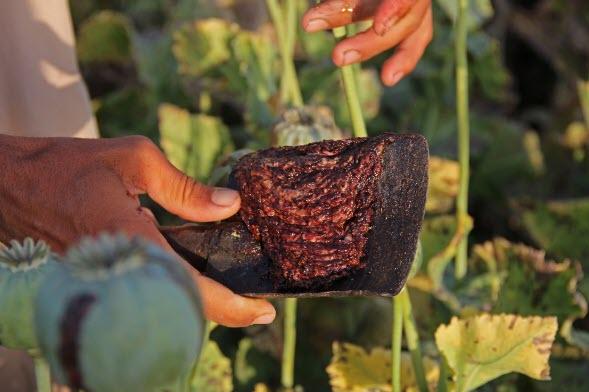
It is not particularly difficult to grow opium. Opium poppies flourish in warm and dry conditions, away from the damp and the wind. Consequently, they have found a fertile home across much of central and western Asia. The plant has flourished in Afghanistan, particularly in southern provinces like Helmand, close to the tripoint where Afghanistan meets Pakistan and Iran. Much of the irrigation system in Helmand was underwritten by USAID, an organization that acts as the CIA’s public-facing front. In full bloom, the poppy fields look spectacular, with beautiful flowers of vibrant pink, red or white. Underneath the flowers, one can find a large seed pod. Farmers harvest these, draining them of a sap which dries into a resin. This is often transported out of the country through the so-called “Southern Route” via Pakistan or Iran. But, as with any pipeline, much of the product is spilled along the way, causing an epidemic of addiction across the region.

The effect on the Afghan population has been nothing short of a disaster. Between 2005 and 2015, the number of adult drug users jumped from 900,000 to 2.4 million, according to the United Nations, which estimates that almost one in three households are directly affected by addiction. While Afghanistan also produces copious amounts of marijuana and methamphetamine, opioids are the drug of choice for most, with around 9% of the adult population (and a growing number of children) addicted to them. Added to this has been a spike in HIV cases, as users share needles, Professor Julien Mercille, author of “Cruel Harvest: U.S. Intervention in the Afghan Drug Trade,” told MintPress.

Only contributing further to the despair has been 20 years of war and U.S. occupation. The number of Afghans living in poverty rose from 9.1 million in 2007 to 19.3 million in 2016. A recent poll conducted by Gallup found that Afghans are the saddest people on Earth, with nearly nine in ten respondents “suffering” and zero percent of the population “thriving,” in their own words. When asked to rate their lives out of a score of ten, Afghans gave an average answer of 2.7, a record low for any country studied. Worse still, when asked to predict the quality of their life in five years, the mean answer was even lower: 2.3.

The effects of the CIA operation to bleed the Soviets dry in Afghanistan have also produced a humanitarian crisis in neighboring Pakistan. As McCoy noted, in the late 1970s, Pakistan had barely any heroin addicts. But by 1985, Pakistani government statistics reported over 1.2 million, turning the two nations into “the global epicenter of the drugs trade” almost overnight.

The problem has only grown since. A 2013 U.N. report estimated that almost 7 million Pakistanis use drugs, with 4.25 million requiring urgent treatment for dependency issues. Nearly 2.5 million of these people were abusing heroin or other opioids. Around 700 people die every day from overdoses. The highest rate of dependency is, unsurprisingly, in provinces on the Afghan border where heroin is manufactured. The same U.N. study notes that 11% of people in the northwestern province of Khyber Pakhtunkhwa use illicit substances — primarily heroin.

The drug crisis, of course, is also a medical crisis, with overstretched public hospitals filled with drugs-related maladies. The social stigma of addiction has ripped families apart while the money and power illicit drugs have brought has turned many towns into hotspots of violence.

Iran has a similar number of opioid users, generally estimated at between two and three million. In towns close to the Afghan/Pakistani border, a gram of opium can be bought with loose change — between a quarter and fifty cents. Thus, despite the extremely harsh penalties for drug possession and distribution on the official books, the country has the highest addiction rate in the world

On a micro level, addiction tears apart families and ruins lives. On an international scale, however, the opium boom has placed an entire region under significant strain. Therefore, one consequence of U.S. policy in the Middle East — from supporting jihadists to occupying nations — has been to unleash a worldwide opium addiction that has made a few people fantastically wealthy and destroyed the lives of tens of millions.

Domestic despair

The boom in production has also led to a worldwide disaster. In the past decade, opioid-related deaths increased by 71% globally, according to the United Nations. Much of the product grown by Afghan warlords ends up on Western streets. “I don’t see how it can be a coincidence that you have that explosive growth in poppy production in Afghanistan and then you have the worldwide opioid epidemic,” Hoh stated, a connection that raises the question of whether users in Berlin, Boston, or Brazil should be seen as victims of the war in Afghanistan as much as fallen soldiers are. If so, the numbers would be staggering. Nearly 841,000 Americans have died of a drug overdose since the war in Afghanistan began, including more than 70,000 in 2019 alone. The majority of these have involved opioids.

Officially, the DEA claims that essentially all illicit opioids entering the U.S. are grown in Latin America. Hoh, however, finds this unconvincing. “When you look at their own information and their reports on the illicit opioid production hectarage in Mexico and South America, it is clear that there is not enough production in the Western hemisphere to meet the demand for illicit opiates in the U.S.,” he told MintPress.

A dirty history

The U.S. government has a long history of directly involving itself with the worldwide narcotics trade. In Colombia, it worked with President Alvaro Uribe on a nationwide drug war, even as internal U.S. documents identified Uribe as one of the nation’s most important drug traffickers, an employee of the infamous Medellin Cartel and a “close personal friend” of drugs kingpin Pablo Escobar. Profits from drug-running funded Uribe’s election runs in 2002 and 2006.

General Manuel Noriega was also a key ally of the U.S. For many years, the Panamanian was on the CIA payroll — despite Washington knowing he was involved in drug trafficking since at least 1972. When he became de facto dictator of Panama in 1984, little changed. But the director of the Drug Enforcement Agency initially praised him for his “vigorous anti-drug trafficking policy.” Eventually, however, the U.S. decided to invade the country and capture Noriega, sentencing him to 40 years in federal prison for drug crimes largely committed while he was still in the CIA’s pay.

At the same time as this was going on, investigative journalist Gary Webb exposed how the CIA helped fund its dirty war against Nicaragua’s leftist government through sales of crack cocaine to black neighborhoods across the United States, linking far-right paramilitary armies with U.S. drug kingpins like Rick Ross.

An Afghan farmer collects raw opium from poppy plants in his field in Chaparhar, Afghanistan. Nisar Ahmad | AP

To this day, the U.S. government continues to support Honduran strongman Juan Orlando Hernandez, despite the president’s well-established connections to the cocaine trade. Earlier this year, a U.S. court sentenced Hernandez’s brother Tony to life in prison for international drug smuggling, while Juan himself was an unindicted co-conspirator in the case. Nevertheless, President Hernandez has proven himself effective at suppressing the anti-imperialist Left inside his country and cementing the U.S.-backed 2009 military coup, one reason he is unlikely to face charges in the near future.

Using the illegal drug trade and the profits from it to fund imperial objectives has been a constant of great empires going back centuries. For instance, in the 1940s and 1950s, the French Empire utilized opium crops in the so-called “Golden Triangle” region of Indochina in order to help beat back a growing Vietnamese independence movement. Going further back, the British used its opium machine to subdue and economically conquer much of China. Britain’s insatiable thirst for Chinese tea was beginning to bankrupt the country, as the Chinese would accept only gold or silver as payment. It therefore used the power of its navy to force China to cede Hong Kong, from which Britain began flooding China with opium it grew in its possessions in South Asia.

The humanitarian impact of the Opium War was staggering. By 1880, the British were inundating China with over 6,500 tons of opium every year — equivalent to many billions of doses, causing massive social and economic dislocation as China struggled to cope with a crippling, empire-wide addiction. Today, many Chinese still refer to the era as “the century of humiliation.” In India and Pakistan, too, the effect was no less dramatic, as colonists forced farmers into planting inedible poppy fields (and, later, tea) rather than subsistence crops, causing waves of huge famines, the frequency of which had never been seen before.

Millions of losers

The story is much more nuanced than some “CIA controls the world’s drugs” conspiracy theories make out. There are no U.S. soldiers loading up Afghan carts with opium. However, many commanders are knowingly enabling warlords who do. “The U.S. military and CIA bear a large responsibility for the opium production boom in Afghanistan,” Professor Mercille said, explaining:

Post-9/11, they basically allied themselves with a lot of Afghan strongmen and warlords who happened to be involved in some way in drug production and trafficking. Those individuals were acting as local allies for the U.S. and NATO, and therefore were largely protected from retribution or arrest for drug trafficking because they were U.S. allies.”

From the ground, the war in Afghanistan has looked a lot like the war on drugs in Latin America and previous colonial campaigns in Asia, with a rapid militarization of the area and the empowerment of pliant local elites, which immediately begin to embezzle the massive profits that quietly disappear into black holes. All the while, millions of people pay the price, suffering inside a militarized death zone and turning to drugs as a coping mechanism. In the story of the opium boom, there are few winners, but there are millions of losers.

Tyler Durden
Sun, 06/27/2021 – 23:45

via ZeroHedge News https://ift.tt/3jglWqZ Tyler Durden

Top Chinese Nuclear Expert Jumps To His Death After Power Plant Mishap

Top Chinese Nuclear Expert Jumps To His Death After Power Plant Mishap

On June 14, China’s Taishan Nuclear Power Plant near Hong Kong experienced damaged fuel rods that triggered a build-up of radioactive gases. French company Framatome, a part-owner of the plant, requested the US Department of Energy for assistance as an “imminent radiological threat” seemed inevitable.

Radioactive gasses were released, and US officials at the time said the situation at the nuclear plant did not “pose a severe safety threat to workers at the plant or Chinese public.” 

But three days later, Zhang Zhijian, one of China’s top nuclear scientists and the Vice-President of Harbin Engineering University, allegedly committed suicide after jumping off a build. 

Here’s the video in GIF format in case it’s deleted. 

South China Morning Post (SCMP) said police in the capital of Heilongjiang ruled out homicide as the cause of death. 

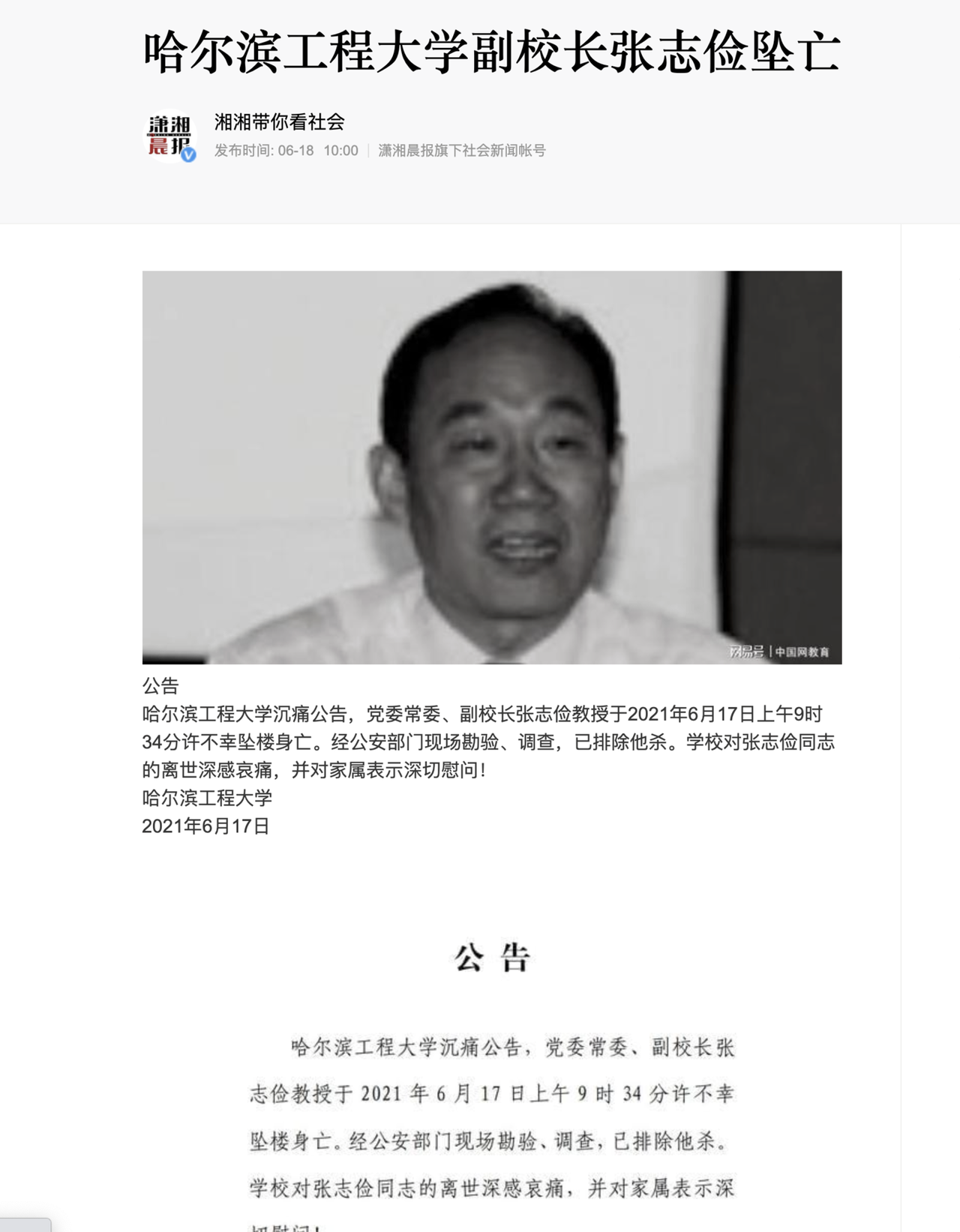
“Harbin Engineering University announces with deep grief that Professor Zhang Zhijian regrettably fell off a building and died at 9.34 am on June 17, 2021,” the university’s official account on Weibo wrote in a statement. “The university expresses deep sorrow over the passing of comrade Zhang Zhijian and deep condolences to his family.”

Zhang was a professor at the College of Nuclear Science and Technology at the Harbin Engineering University and was also the Vice President of the Chinese Nuclear Society. 

In China’s northern Heilongjiang province, Harbin Technical University is one of two Chinese universities that have close relations with the People’s Liberation Army. Last June, the university was banned from using a US-developed computer software amid souring relations with the West. 

What’s notable is that western media or most media outlets did not attempt to piece together the puzzle that days after a nuclear power plant mishap occurred, a top scientist in the country allegedly committed suicide. Seems odd right? 

Except for the blog “Jennifer’s World,” which explains the possible connection between Zhijian’s death and his relationships to the plant. 

Now, the question is, why did Zhang Zhijian kill himself?

Let’s show picture 6. This is a screenshot of the Harbin Engineering University’s announcement about his death. It only says that he “unfortunately dropped from the building and passed away at about 9:34 am on June 17.” And the police had ruled out the possibility of murder, and we feel very sorry about his death, etc.

So, there was no explanation about the cause of his death.

An interesting thing is, as early as 2005, Taishan Nuclear Power Plant’s Chinese owner, China Guangdong Nuclear Power Group, signed a cooperation agreement with Harbin Engineering University. According to the agreement, Harbin Engineering University would on the one hand train more talents in nuclear power for  China Guangdong Nuclear Power Group, and on the other hand, do more research. 

It was said that the cooperation would promote the transformation of scientific research results into productivity through the combination of industry, academia and research.

Several months after the agreement was signed, in December 2005, Harbin Engineering University established its College of Nuclear Science and Technology, and Zhang Zhijian was the head of this college. 

Then, two years later, in 2007, China and France signed an agreement to co-build Tashan Nuclear Power Plant. 

The construction of Unit 1 and Unit 2 of Tashan Nuclear Power Plant started in 2009, and Unit 1 entered commercial operation on December 13, 2018. 

Then, if you check Zhang Zhijian’s bio, you would find that he had been the head of the College of Nuclear Science and Technology for ten years, from 2005 to 2015. 

This overlapped with Tashan Nuclear Power Plant’s design and construction period. 

During this period of time, it is very likely that Zhang Zhijian had formed a huge network with China Guangdong Nuclear Power Group and maybe other companies, institutions and officials involved in nuclear energy.

So, Chinese commentator Zhou Xiaohui said in his article that he highly suspected that Zhang Zhijian’s suicide had something to do with the leak of Taishan Nuclear Power Plant, given he killed himself right after the CCP publicly responded to the leak, and given his close ties with China Guangdong Nuclear Power Group, as well as the entire nuclear power industry in China.

Zhou Xiaohui said, maybe Zhang Zhijian had already been questioned by the authorities, or maybe he was given some sort of pressure, or maybe he was too frightened by the incident, or maybe he was afraid that he would be held responsible, or maybe there was something he needed to cover up with his death, etc. 

While there’s nothing conclusive, the death of the top scientist coming days after the nuclear power plant mishap is certainly suspicious. A lot of questions remained unanswered. 

Tyler Durden
Sun, 06/27/2021 – 23:20

via ZeroHedge News https://ift.tt/3jiEruK Tyler Durden