Rabobank: “A Whole Bunch Of Hooey”

Rabobank: “A Whole Bunch Of Hooey”

By Michael Every of Rabobank

A Whole Bunch Of Hooey

Welcome to another day of “a whole bunch of hooey”:

  • US stocks are at new record highs, money-losing stocks are rising again, Treasury bond yields are lower, and the US dollar is higher. Once again we are in “Buy all of the things” mode, it seems, despite the fact we know how this ended up when we’ve tried it before.

  • Facebook has beaten an anti-trust lawsuit, but Google is seeing one start; so it’s a mixed bag for Big Tech under a more activist FTC for the first time in a very, very long time.

  • US banks are of course pumping up dividends and stock buybacks now that stress tests have been passed.

  • Former President Obama has stated: “What we saw was my successor, the former president, violate that core tenet that you count the votes and then declare a winner – and fabricate and make up a whole bunch of hooey.” The US remains deeply, worryingly split between those who agree with the above completely, and those who think if you remove the hyphen in the same sentence it describes the actual reality.

  • Indeed, the only area of bipartisan agreement in the US is China, where the US House of Representatives has passed its own version of an anti-China tech/industrial policy bill. The two bills will now need to be reconciled, with the only difference being how tough the final bill is (very, or very, very), and how much spending it allocates to US R&D (lots, or lots and lots). That’s both economic stimulus and New Cold War all in one – as large firms and funds, and many Western leaders, still refuse to admit the latter is happening. On which, see Michael Schuman in Bloomberg -“The West Can’t Call the Shots on China’s Agenda”- arguing we are *already* in a Cold War, and for the West, “the faster their leaders grasp this unfortunate reality, the better they’ll be able to contend with it.”

  • The Fed are still talking about a very gradual path towards normalization; the ECB very much isn’t; and the PBOC are now giving hints of moderate policy easing as they start to think about what will happen when the Fed moves in the other direction.

  • The Fed’s Rosengren also stated yesterday that the last thing the US needs is another housing “boom and bust”. Which part of that are we going to be skipping for the first time ever, and does that mean we are no longer allowed to have (crazy) market cycles? Indeed, has he seen house prices lately? They suggest one of his two horses has already bolted – so what can be done to keep the other one in the stable?

  • Relatedly, the US is still undecided on the scale of any more fiscal stimulus; yet Germany may want the EU to return to austerity from 2023, and perhaps the UK may yet join it(?);

  • The UK is opening up its economy on July 19 regardless of what the Covid Delta variant is doing – but Hong Kong is about to ban all flights arriving from the UK from Thursday.

  • Meanwhile, Niall Ferguson -the historian, not statistician- argues we haven’t won the war on the virus yet, as only 10% of the world is vaccinated, and only 0.3% of those shots have been in the world’s poorest countries. Largely unreported, the Indian Bar Association is suing the WHO Chief Scientist for tweeting against the anti-Covid use of Ivermectin – which still cannot be mentioned on some US social media even by leading scientists at all.

  • It’s 46C in the US Pacific Northwest; and Bloomberg reports on looming “water wars” in the US; so naturally everyone wants to go Green – especially Wall Street funds.

  • Yet in June 2019, the head of earth sciences at the Natural History Museum in London had already calculated that converting just the UK’s 31m vehicles to electric would require “two times the total annual world cobalt production, nearly the entire world production of neodymium, three-quarters of the world’s lithium production, and at least half of the world’s copper production during 2018.” – add the US, EU, Japan, and China to the mix and do the math. Or perhaps it’s better if you don’t.

  • Crypto is the inevitable future, as governments are soundly beaten by those pesky kids; or the infinite supply of finite objects is the latest mega-bubble; and/or CBDCs are coming to eat the crypto lunch – and maybe change global trade settlement patterns; and/or DeFi may do the same with traditional banking.

So, another day of so much hoo-ha. And of so much hoopla. And, yes, of so much hooey.

Tyler Durden
Tue, 06/29/2021 – 09:50

via ZeroHedge News https://ift.tt/3Ad5pKg Tyler Durden

More Tesla Owners Considering Switching To European Luxury EV Brands: Bernstein

More Tesla Owners Considering Switching To European Luxury EV Brands: Bernstein

Sound the alarm bells: it appears that some of the most fervent Tesla cultists could be beginning to stray from the path in what could be an ominous sign for an automaker that has relied heavily on its cult status to stay afloat. 

A new note from Bernstein this week suggests that enthusiasm could be waning for the Tesla brand, particularly in China. The note, which surveyed 457 owners, says that despite Tesla buyers remaining “fervent supporters” of the brand, more customers are likely to opt out of buying a Tesla in favor of buying a European luxury brand in future.

Bernstein says the data could support “initial buyer euphoria cooling off” in addition to reflecting the growing choice of EVs that consumers have. The note also said that “China’s results – while statistically not conclusive – are modestly worrisome.”

The note also pointed out what has been a half-decade-long ongoing problem for Tesla, service, which Bernstein called “Tesla’s Achilles heel”. It also wrote that lower-priced offerings from Tesla “aren’t necessarily attracting a more mass-market buyer, a departure from our last survey”.

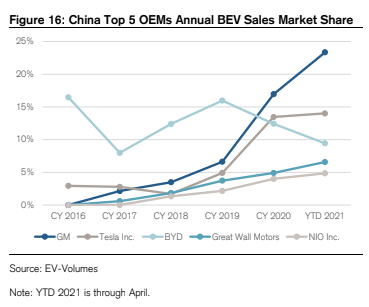
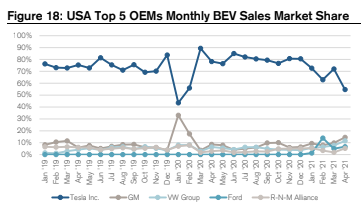
Recall, back in June we noted that Tesla’s global EV market share had collapsed to 11% in April, from 29% in March. 

It marked Tesla’s lowest monthly global market share since January 2019. The “greater than usual drop” came between the last month in Q1 and the end of the first month of Q2. 


In Europe, the company posted EV market share of just 2% compared to 22% in March. In the United States, market share fell to 55% versus 72% in March. 


While Tesla remains at the top of the heap in the U.S., there’s no telling how long that is going to last. The company is now facing stiff competition from legacy automakers and is dealing with backlash from both dropping features and raising prices on its models, as we noted in June.

How long the rest of the Tesla cult clings to Elon Musk and his brand remains to be seen. But for now, it certainly feels like the clock is ticking…

Tyler Durden
Tue, 06/29/2021 – 09:35

via ZeroHedge News https://ift.tt/3y8d6Q2 Tyler Durden

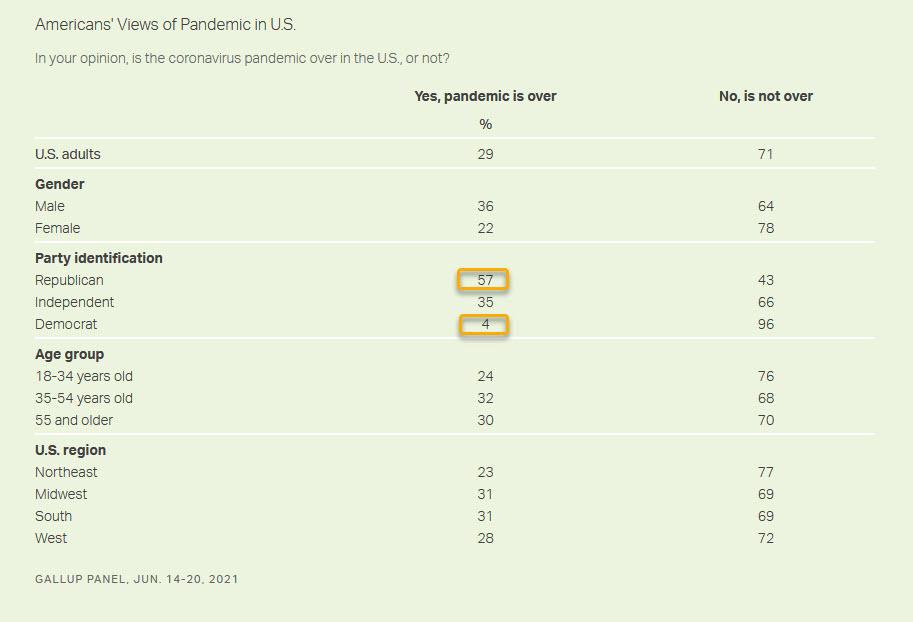
The Pandemic Is Over According To 57% Of Republicans… And 4% Of Democrats

The Pandemic Is Over According To 57% Of Republicans… And 4% Of Democrats

By Megan Brenan of Gallup,

Although a record-high 89% of Americans now say the coronavirus situation is improving, most are not yet ready to declare the pandemic over in the U.S. More than twice as many think the pandemic is not yet over (71%) than think it is over (29%).

Republicans are far more likely (57%) than Democrats (4%) to say the pandemic is over, but significant differences also exist by gender, age and region of the country.

These findings are from Gallup’s June 14-20 probability-based web panel survey, which was conducted as increased vaccinations in the U.S. resulted in declining COVID-19 cases, hospitalizations and deaths. These developments are likely instrumental in the public’s growing belief that the coronavirus situation is getting “a lot” (46%) or “a little” better (43%).

Americans Report Fewer Disruptions, Increased Return to Normalcy

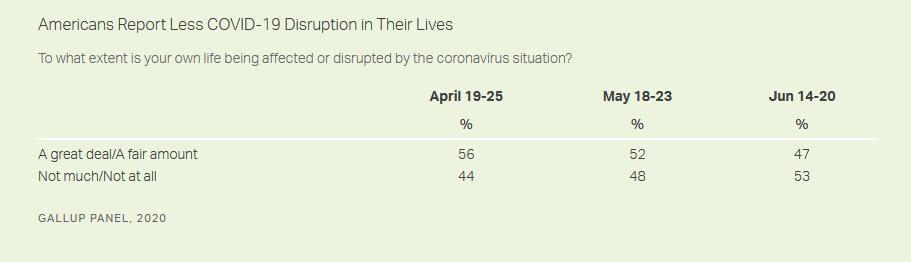
With pandemic-related restrictions in most states now lifted, the amount of disruption Americans see in their everyday lives continues to decline. Less than half of U.S. adults, 46%, currently say their lives are affected “a great deal” or “a fair amount,” but more, 54%, consider their lives to be “not much” or “not at all” disrupted.

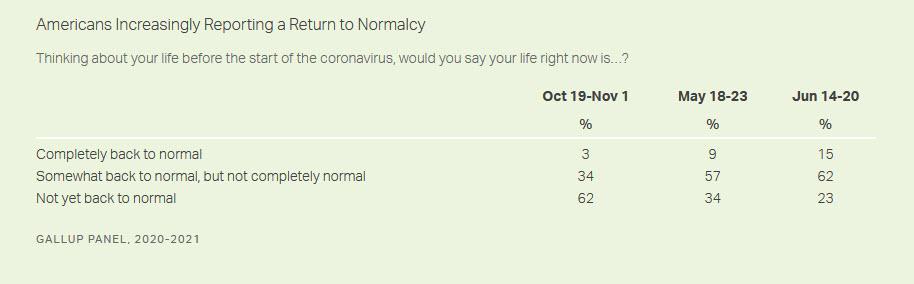
Likewise, Americans are increasingly reporting a return to some semblance of normalcy in their lives. While 15% of U.S. adults say their life is “completely back to normal,” 62% describe their life as “somewhat” but not completely normal, and 23% say it is “not yet back to normal.” Moreover, the percentage of U.S. adults who report that normalcy has not been restored in their lives has shrunk by 11 percentage points since May.

Mixed Expectations for Return to Pre-Pandemic Normalcy

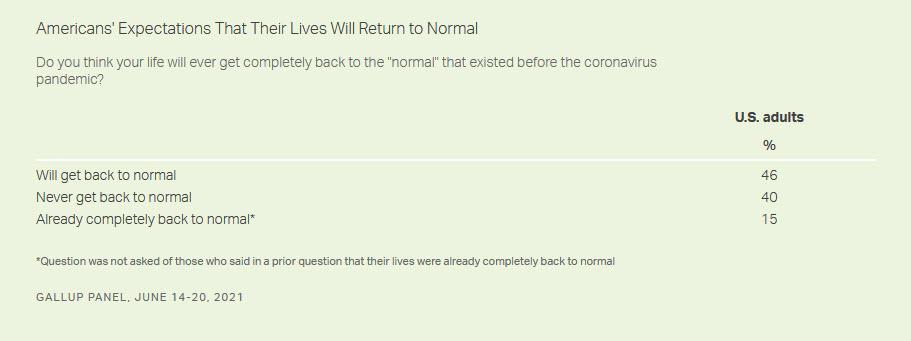
In addition to the 15% of U.S. adults who say their lives are already completely back to normal, 46% think their lives will eventually be. However, 40% of Americans do not expect that their lives will ever return entirely to the normal that existed prior to the pandemic.

Among those who expect their lives to return to normalcy, slightly more (53%) think it will not come until sometime in 2022 or after that, while 47% anticipate normalcy in the next few weeks or months.

At the same time, a diminished majority of Americans, 53%, expect the level of disruption occurring to travel, school, work and public events in the U.S. will continue through the end of 2021 or longer than that, marking a nine-point drop since mid-March. Fewer, 47%, now say they expect the degree of disturbance in society to last a few more weeks or months.

More Americans Think Return to Normalcy Is Best for Healthy People

In May, a majority of Americans said for the first time that the better advice for healthy people is to lead their normal lives as much as possible to avoid interruptions to work and business rather than staying home to avoid contracting or spreading COVID-19. That majority has grown from 56% to 65% in June. Currently, 35% of Americans think it is better to stay home, roughly half of what it was in late December/early January.

Bottom Line

Now that nearly two-thirds of U.S. adults have received at least one dose of the vaccine against COVID-19 and most facets of everyday life have reopened, Americans increasingly see less disruption in their lives and feel a sense of normalcy returning. However, for the most part, they think the pandemic is still ongoing. Given the quick-changing developments across the U.S., this judgment could soon change. Yet, like many aspects of the pandemic, views on this measure are sharply polarized politically.

Although President Joe Biden has acknowledged that his July 4 deadline for reaching 70% vaccination among U.S. adults will not be realized, once it is, Democrats and independents might finally join Republicans in thinking the pandemic is over.

Tyler Durden
Tue, 06/29/2021 – 09:18

via ZeroHedge News https://ift.tt/3vYUeSg Tyler Durden

US Home Prices Just Accelerated At Their Fastest Pace On Record

US Home Prices Just Accelerated At Their Fastest Pace On Record

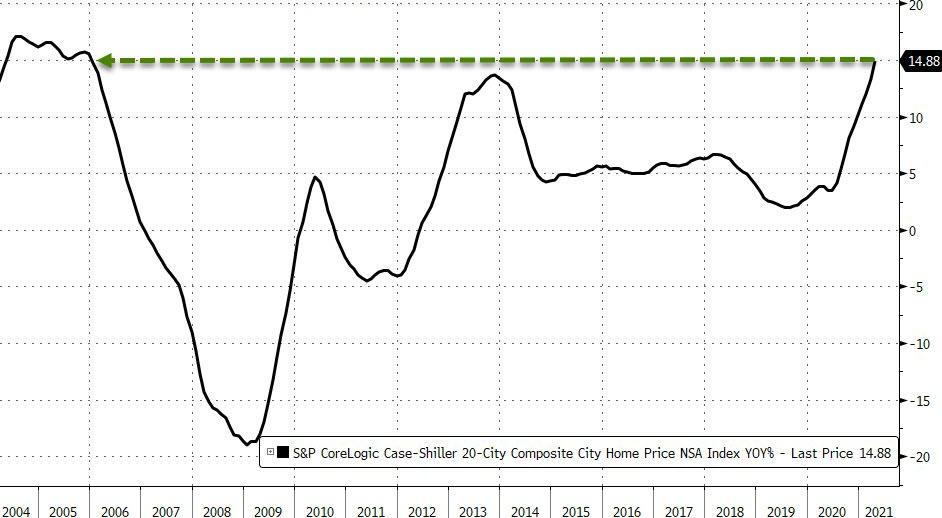
According to the Case-Shiller indices, home prices in America’s 20 largest cities have exploded at 14.88% YoY in April – the highest since Nov 2005…

Source: Bloomberg

But, on a national scale, it gets even worse. Case-Shiller’s National Home Price Index rose 14.59% YoY in April – that is the fastest pace of home price inflation on record (back to 1988)

Source: Bloomberg

That is faster than the prior peak acceleration in September 2005!

The question for Jay Powell is – explain how this is “transitory” if you’re never gonna taper or hike rates?

Tyler Durden
Tue, 06/29/2021 – 09:06

via ZeroHedge News https://ift.tt/3w5XVWr Tyler Durden

​​​​​​​Triple-Digit Heat Dome Bakes Pacific Northwest, Triggers First Blackout

​​​​​​​Triple-Digit Heat Dome Bakes Pacific Northwest, Triggers First Blackout

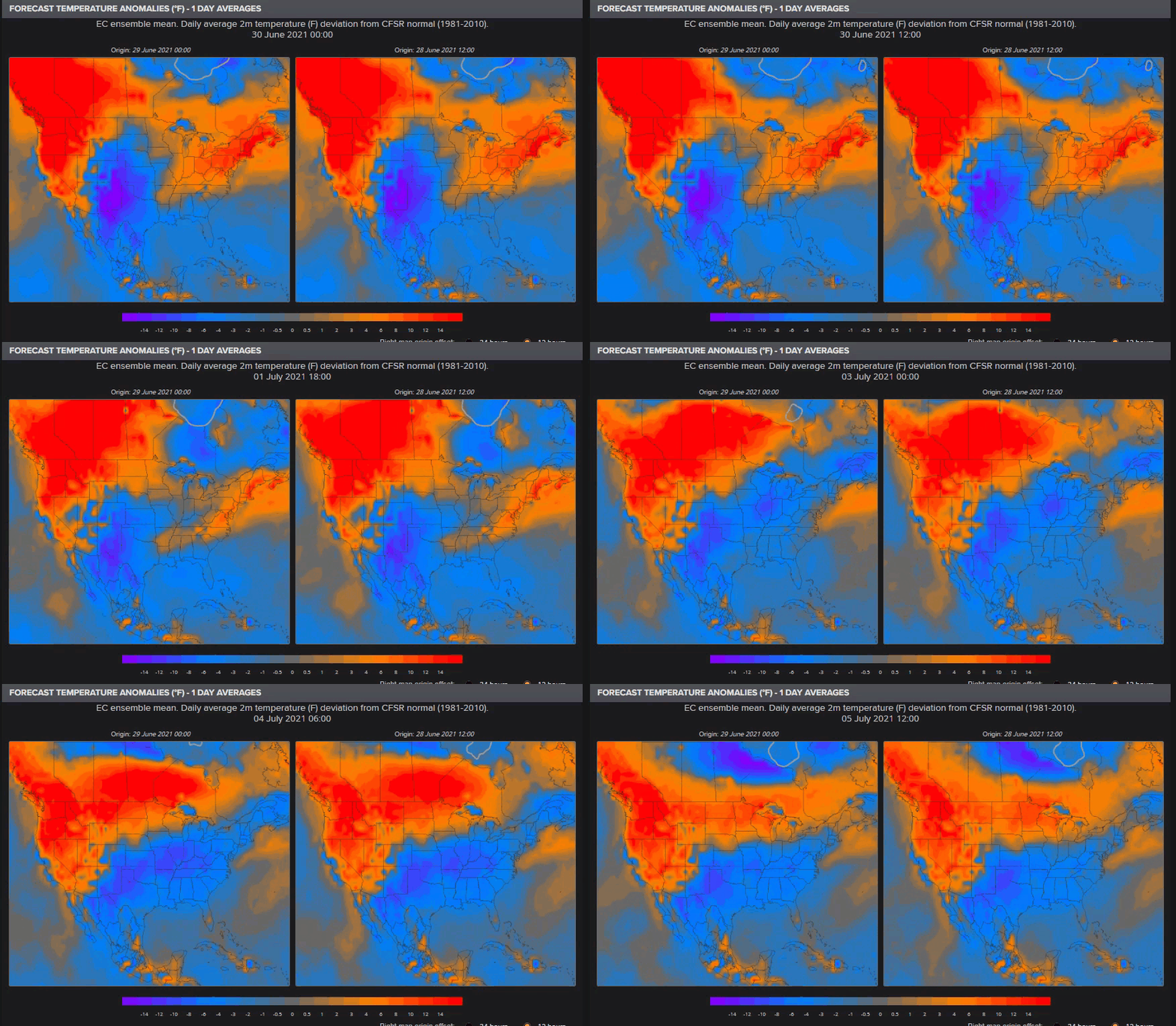
The Pacific Northwest is experiencing a multi-day heat wave that we said last week would be “historic.” The unrelenting triple-digit temperatures shattered records across the region and have stressed out power grids where rolling blackouts have been reported. 

Bloomberg reports Avista Corporation, which supplies electricity to 340,000 residential, commercial, and industrial customers, triggered its first rolling blackout across its grid after it became overloaded Monday evening. Rotating outages first hit 9,300 customers late Monday and could expand as temperatures remain well above average through July 4. 

Avista was the first major utility to report rolling blackouts in the Northwest region, and with positive temperature anomalies to linger through the week, it may not be the last. 

Avista has never “experienced this kind of demand on our system and this kind of impact to our system,” Heather Rosentrater, senior vice president of energy delivery at the utility company, told reporters during a press conference Monday. She called the weather event “very unprecedented.” 

As we noted last Friday, “a “historic” heat wave was set to transform the Pacific Northwest into a furnace this weekend. It has the potential to shatter long-standing temperature records.” And that is precisely what it did. 

Major metros, such as Portland and Seattle, broke record highs by huge margins as positive temperature anomalies reached between 30 to 40 degrees. 

Portland hit 116 degrees by Monday afternoon, the highest temperature in more than eight decades of record-keeping. It was the third day of triple-digit temps. 

Seattle recorded 108 degrees Monday afternoon, easily surpassing its previous 103-degree record from 2009. Positive temperature anomalies for the city yesterday were 34 degrees, usually temps average around 74 degrees. 

The Pacific Northwest is a region where many people lack central air conditioning and experiencing multiple days of triple-digit weather is hazardous for health. 

Bob Oravec, a senior branch forecaster with the U.S. Weather Prediction Center in College, said it’s unheard of to have temperatures in Portland and Seattle hovering in triple-digit territory. “That just doesn’t occur.”

“Tuesday will likely be the hottest day in recorded history for many sites across the Inland Northwest,” the National Weather Service in Spokane warned. 

… and, of course, higher temperatures always indicate increased power demand and skyrocketing prices. 

Electricity prices at a Pacific Northwest jumped 435% to $334.22 a megawatt-hour on Monday. 

So with sizzling temperatures forecasted for Tuesday, rolling blackouts might expand as power grids in the region are stretched. 

Tyler Durden
Tue, 06/29/2021 – 08:50

via ZeroHedge News https://ift.tt/3w4hyhw Tyler Durden

Fed Governor Compares Digital Currencies To Parachute Pants And Bitcoin To Gold

Fed Governor Compares Digital Currencies To Parachute Pants And Bitcoin To Gold

Authored by Mike Shedlock via MishTalk.com,

The Fed’s Vice Chair for Supervision comments on Central Bank Digital currencies. Let’s tune into the debate.

Parachute Pants and Central Bank Money

Speaking for himself and not the Fed, the Vice Chair for Supervision, Randal K. Quarles, comments on Parachute Pants and Central Bank Money.

I have been reflecting recently, and in connection with this speech, on America’s centuries-long enthusiasm for novelty.

Sometimes the consequences are in hindsight merely puzzling or embarrassing, like that year in the 1980s when millions of Americans suddenly started wearing parachute pants. But the consequences can also be more serious.

Which brings us to my topic today: central bank digital currencies, or CBDCs. In recent months, public interest in a “digital dollar” has reached fever pitch. A wide range of experts and commenters have suggested that the Federal Reserve should issue—and in fact may need to issue—a CBDC. But before we get carried away with the novelty, I think we need to subject the promises of a CBDC to a careful critical analysis.

Surprisingly Good Speech

Those snips are from the beginning of Quarles’ speech. I found it surprisingly good from beginning to end, quite unusual for most of the Fed speeches I read.

Let’s go over some key points.

What Do We Mean by “CBDC”?

The Bank for International Settlements has defined a CBDC as “a digital payment instrument, denominated in the national unit of account, that is a direct liability of the central bank.” 

Quarles notes that the “dollar is already highly digitized“. The public sends and receives electronic balances in commercial bank accounts. 

However, digital dollars currently are not a CBDC, because they are liabilities of commercial banks rather than the Federal Reserve. 

Commercial banks are federally insured up to $250,000. In contrast, balances at the Fed would be fully guaranteed. Quarles discusses two ways this could happen.

Two Possible CBDC Forms

  • One is an account-based model, in which the Federal Reserve would provide individual accounts directly to the general public. Like the accounts that the Federal Reserve currently provides to financial institutions, an accountholder would send and receive funds by debit or credit to their Federal Reserve account.

  • A different CBDC model could involve a CBDC that is not maintained in Federal Reserve accounts. This form of CBDC would be closer to a digital equivalent of cash. Like cash, it would represent a claim against the Federal Reserve, but it could potentially be transferred from person to person (like a banknote) or through intermediaries.

Quarles expresses skepticism that the Federal Reserve has legal authority to pursue either of these CBDC models without legislation.

I concur, but also suggest that if the Fed asked, Congress would likely go along. 

Three CBDC Benefits

The payment system is not perfect—some types of payments should move more quickly and efficiently. Payments across international borders, for example, remain a key area of concern because they often involve high costs, low speed, and insufficient transparency. The Financial Stability Board, an international group that I chair, produced a roadmap last year that is intended to address these concerns.

In addition, some types of payments have not fully digitized or are subject to ongoing contention between businesses with competing economic interests. For example, paper checks remain widely used for certain types of payments (although the interbank check collection process is now almost entirely electronic).

Finally, many more Americans could benefit from digital payments by increasing their use of banking services, which can be promoted by wider use of low-cost, basic bank accounts.

Four Alleged Policy Issues

  • A Federal Reserve CBDC may be necessary to defend the critical role the U.S. dollar plays in the global economy.

  • CBDC would overcome longstanding economic inequalities in American society.

  • The Federal Reserve needs to develop a CBDC to defend the U.S. dollar against threats that would be posed by foreign CBDCs.

  • The United States must develop a CBDC to compete with U.S. dollar stablecoins

Those four items are claims made by proponents of CBDCs not concerns of Quarles. Indeed Quarles knocks all four ideas. 

In my judgment, we do not need to fear stablecoins. The Federal Reserve has traditionally supported responsible private-sector innovation. Consistent with this tradition, I believe that we must take strong account of the potential benefits of stablecoins, including the possibility that a U.S. dollar stablecoin might support the role of the dollar in the global economy.

If use of the stablecoin became widespread enough—create stability risk if it is invested in multiple currency denominations; if it is a fractional rather than full reserve; if the stablecoin holder does not have a clear claim on the underlying asset; or if the pool is invested in instruments other than the most liquid possible, principally central bank reserves and short-term sovereign bonds. All of these factors create “run risk” —the possibility that some triggering event could cause a large number of stablecoin holders to exchange their coins all at once for other assets and that the stablecoin system would not be able to meet such demands while maintaining a reasonably stable value. 

Quarles Compares Bitcoin to Gold

Some commentators assert that the United States must develop a CBDC to counter the appeal of cryptocurrencies. This seems mistaken. The mechanisms used to create such cryptoassets’ value also ensure that this value will be highly volatile—rather similar to the fluctuating value of gold, which, like bitcoin, draws a significant part of its value from its scarcity, and like bitcoin, does not play a significant role in today’s payments or monetary system. 

Unlike gold, however, which has industrial uses and aesthetic attributes quite apart from its vestigial financial role, bitcoin’s principal additional attractions are its novelty and its anonymity. The anonymity will make it appropriately the target for increasingly comprehensive scrutiny from law enforcement and the novelty is a rapidly wasting asset.

Gold will always glitter, but novelty, by definition, fades. Bitcoin and its ilk will, accordingly, almost certainly remain a risky and speculative investment rather than a revolutionary means of payment, and they are therefore highly unlikely to affect the role of the U.S. dollar or require a response with a CBDC.

Quarles really shines with his statement “Gold will always glitter, but novelty, by definition, fades,” emphasis mine.

Economic Inequalities 

A second broad argument raised by proponents of CBDCs is that a Federal Reserve CBDC would improve access to digital payments for people who currently do not keep bank accounts because of their expense, a lack of trust in banks, or other reasons. This is a worthwhile goal. However, I believe we can promote financial inclusion more efficiently by taking steps to make cheap, basic commercial bank accounts more available to people for whom the current cost is burdensome, such as the Bank On accounts developed in collaboration between the Cities for Financial Empowerment Fund and many local coalitions.

Innovation

Last, some believe that a Federal Reserve CBDC would spur and facilitate private-sector innovation. This is an interesting issue that merits further study. I am puzzled, however, as to how a Federal Reserve CBDC could promote innovation in a way that a private-sector stablecoin or other new payment mechanism could not. It seems to me that there has been considerable private-sector innovation in the payments industry without a CBDC, and it is conceivable that a Fed CBDC, or even plans for one, might deter private-sector innovation by effectively “occupying the field.”

Quarles has other issues. Let’s go over them.

Other Issues 

  • A Federal Reserve CBDC could also present an appealing target for cyberattacks and other security threats. Bad actors might try to steal CBDC, compromise the CBDC network, or target non-public information about holders of CBDC. The architecture of a Federal Reserve CBDC would need to be extremely resistant to such threats—and would need to remain resistant as bad actors employ ever-more sophisticated methods and tactics.

  • Critically, we also would need to ensure that a CBDC does not facilitate illicit activity. The Bank Secrecy Act currently requires that commercial banks take steps to guard against money laundering. Policymakers will need to consider whether a similar anti-money-laundering regime would be feasible for a Federal Reserve CBDC, but it may be challenging to design a CBDC that respects individuals’ privacy while appropriately minimizing the risk of money laundering. 

  • At one extreme, we could design a CBDC that would require CBDC holders to provide the Federal Reserve detailed information about themselves and their transactions; this approach would minimize money-laundering risks but would raise significant privacy concerns. At the other extreme, we could design a CBDC that would allow parties to transact on a fully anonymized basis; this approach would address privacy concerns but would raise significant money-laundering risks.

  • A final risk is that developing a Federal Reserve CBDC could be expensive and difficult for the Federal Reserve to manage. A Federal Reserve CBDC could, in essence, set up the Federal Reserve as a retail bank to the general public. That would mean introducing large-scale, resource-intensive central bank infrastructure. We will need to consider whether the potential use cases for a CBDC justify such costs and expansion of the Federal Reserve’s responsibilities into unfamiliar activities, together with the risk of politicization of the Fed’s mandate that would come with such an expansion.

Quarles vs Elizabeth Warren

On June 20, I asked Elizabeth Warren Supports Central Bank Cryptos. Should You Be Worried?

Elizabeth Warren

“Legitimate digital public money could help drive out bogus digital private money, while improving financial inclusion, efficiency, and the safety of our financial system — if that digital public money is well-designed and efficiently executed,” she said at a hearing on Wednesday, which she convened as chair of the Senate Banking Committee’s economic policy subcommittee.

Other senators highlighted the potential for central bank digital wallets to be used to deliver government aid more directly to people who don’t have bank accounts. A digital dollar could also be designed to have more high-tech benefits of some cryptocurrencies, like facilitating “smart contracts” where a transaction is completed once certain conditions are met.

Quarles attacks the ideas presented by Elizabeth Warren. Indeed, it appears he wrote his speech in direct response to Warren. 

Warren’s Real Goal 

It is very refreshing to see a Fed Governor comment on privacy issues. 

I am fearful of Warren’s real goal: Wealth redistribution. 

If bank accounts go away, poof, Congress can tax the middle class and the wealthy, take money out of their accounts, and immediately redistribute the funds as the Progressives see fit.

Once in place, governments or central banks will have the ability to monitor every financial transaction. Cash will disappear.

I seldom side with the Fed, but when it is the Fed vs Elizabeth Warren, the Progressive redistribution goals of the Warren are more immediate and more to be feared.

Irony of the Day

Note the irony of Quarles’ concern on fractional reserve stablecoins when the US commercial banking system has no reserves at all. 

I discussed this on March 27, 2020 in Fictional Reserve Lending Is the New Official Policy

“Official policy finally caught up with reality. Reserves are fictional.” Click on the link for details.

*  *  *

Like these reports? I hope so, and if you do, please Subscribe to MishTalk Email Alerts.

Tyler Durden
Tue, 06/29/2021 – 08:33

via ZeroHedge News https://ift.tt/3hkOb56 Tyler Durden

White House Defends Olympians “Protesting” Anthem As GOP Leaders Urge Ban On “Activist Athletes”

White House Defends Olympians “Protesting” Anthem As GOP Leaders Urge Ban On “Activist Athletes”

Amid a growing list of examples of US Olympians using the spotlight for “activism” when it comes to respect or lack thereof shown toward the American flag or anthem, we earlier predicted there’s very likely more to come as the games soon kick off in Tokyo. This is especially likely now that the White House has weighed in to defend Gwen Berry, who will represent the US in the hammer throw at the summer games.

On Monday Fox News’ Peter Doocy raised the issue with the Biden White House of athletes using moments like the playing of the national anthem to “protest” before a global audience. “This weekend, Gwen Berry who is supposed to represent the United States as an Olympian on the hammer throwing events won a bronze medal at the Trials, and then she turned her back on the flag while the anthem played,” he questioned press secretary Jen Psaki. “Does President Biden think that is appropriate behavior for someone who is supposed to represent Team USA?”

Psaki began by saying that Biden is “incredibly proud to be an American and has great respect for the anthem.” She added that the present also respects “men and women serving in uniform all around the world.”

But then she defended Berry’s back-turning moment during the track and field trials in Eugene, Oregon days ago, which has since sparked immense controversy and anger…

“He would also say, of course, that part of that pride in our country means recognizing there are moments where we as a country haven’t lived up to our highest ideals, and it means respecting the right of people granted to them in the Constitution to peacefully protest,” she explained, defending the 31-year old Olympic athlete’s protest.

The Associated Press had earlier described of the Saturday incident: “While the music played, Berry placed her left hand on her hip and shuffled her feet. She took a quarter turn, so she was facing the stands, not the flag.”

She then put a black T-shirt over her face which said in large text “Activist Athlete”. 

A number of Congressional Republicans, also including Tom Cotton, demanded that Berry be banned from representing the USA in Tokyo this summer…

Though she was clearly ready with the T-shirt to bring out, she’s blaming Olympic trials event organizers at the stadium for setting her up, who she claims were trying to provoke a reaction in order to mire her in controversy. However, stadium officials in Eugene, Oregon – where it occurred – have said they played the anthem shortly after 5pm every evening of the track and field trials.

Tyler Durden
Tue, 06/29/2021 – 08:14

via ZeroHedge News https://ift.tt/2Ufgeva Tyler Durden

Futures Rise To Record Despite Rising Delta Strain Jitters

Futures Rise To Record Despite Rising Delta Strain Jitters

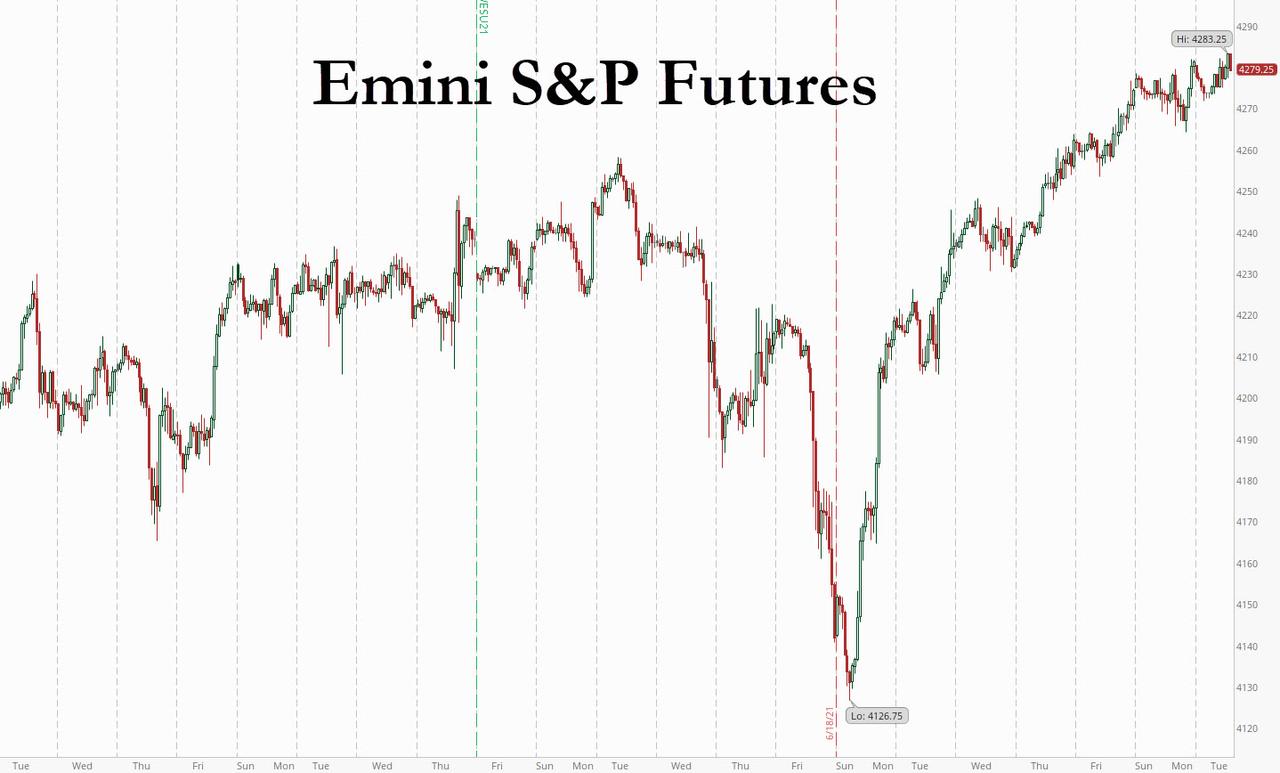
Global stocks were mixed and US futures edged to new all time highs as concerns over the Delta strain of Covid-19 spurred caution among investors. At 7:00 a.m. ET, Dow e-minis were up 46 points, or 0.13%, S&P 500 e-minis were down 1 points, or 0.02% after topping a new all time high of 4,283 earlier, and Nasdaq 100 e-minis were down 13 points, or 0.09%. The dollar strengthened and treasuries were steady while oil slipped and gold headed for the biggest monthly drop in more than four years.
While sentiment remains buoyant, investors are growing concerned by the latest evolution of the Delta variant, which is increasingly seen as a growing threat to the ongoing economic recovery in many areas, said Pierre Veyret, a technical analyst at ActivTrades. Even if the economic impact is “unlikely to be significant” in developed countries, “the inconsistency in vaccination campaigns in other parts of the world is likely to lead to an uneven recovery,” he said.

Others echoed this sentiment: “The Delta variant has also emerged in our client conversations as a potential threat to reflation/inflation,” JPMorgan Chase & Co. strategists led by Marko Kolanovic said. “The economic consequences are likely to be limited given progress on vaccinations across developed market economies. It could, however, pose some risk of a delay in the recovery in countries where vaccination rates remain lower.”

In premarket trading, Morgan Stanley jumped more than 3% in pre-market trading after it said it will double its quarterly dividend. JPMorgan and Goldman gained 0.2% and 1.1%, as they hiked their capital payouts after they passed the Fed’s latest stress test. Facebook edged up 0.2%, a day after crossing $1 trillion in market cap and joining the likes of Apple, Microsoft, Saudi Aramco, Amazon and Google-owner Alphabet that now make up 10% of world equities. Energy companies drifted lower, with Exxon, ConocoPhillips, Schlumberger Occidental and Marathon Petroleum all falling between 0.3% and 2.5% as oil prices dropped nearly 1% on concerns around fuel demand outlook. Cruise operator Carnival Corp’s shares fell 1.6% in U.S. pre-market session. Other notable premarket movers:

  • Hollysys Automation Technologies (HOLI) rises 13% after CPE Funds Management, Ace Lead Profits and the company’s former CEO started solicitation of consents from shareholders to acquire the company by offering $17.10 a share.
  • Marin Software (MRIN) and Exela Technologies (XELAU) surge 31% and 34% respectively in premarket trading amid touts for both on Reddit as potential short-squeeze candidates.

In Europe, the Stoxx 600 Index traded modestly higher,  with automakers leading the advance with a gain of 0.9%. New limits on travel from Britain prompted by the Delta variant of the virus dragged on cruise operators and airlines. The Eurostoxx 50 gained 0.5%, with the DAX outperforming peers as auto and chemical names led gains. Renewable-energy stocks top the Stoxx 600 Energy index after JPMorgan said it sees a “catalyst-rich” second half for the sector. The broker upgraded its rating on wind-turbine maker Vestas, which rose as much as 6.3%. Here are some of the biggest European movers today:

  • Norden shares rise as much as 10% after the Danish shipping company raised its guidance for the third time in two months.
  • IWG shares jump as much as 8.4% before paring those gains after private-equity firm CC Capital denied a report that it had approached the flexible office-space firm about a takeover.
  • Rexel shares climb as much as 5.8% after the electrical products supplier raised its profit forecast, with Goldman Sachs saying it expects consensus to rise by a mid- teens percentage and adding the updates reads across positive for peers.
  • TUI shares decline as much as 6.4% after the tour operator undertook a tap offering on its senior unsecured convertible bonds, with Jefferies saying the move does not alleviate its concerns.
  • Hunting shares drop as much as 9.2%, before sharply paring declines, after the oil-services firm cut its earnings expectations, despite anticipating an improvement in trading conditions in the second half.
  • Lamprell shares slump as much as 33% after the oil-services company said it faces “severe liquidity constraints” until new funding can be identified.

The MSCI index of Asia-Pacific shares fell for the first time in six days as countries in the region struggled to contain the highly transmissible strain and rising concerns it will hamper an economic recovery. Financials and consumer discretionary sectors were the biggest drags on the MSCI Asia Pacific Index. The gauge slipped as much as 0.7%, poised to snap a five-day winning streak. China and Hong Kong led losses in Asia, while investors sold value plays in Japan. Cyclicals led a selloff in Singapore stocks amid lagging reopening plans. “The current weak market sentiment in Asia seems to be caused by the fear of a further spread of the delta strain of Covid-19,” said Kelvin Wong, an analyst at CMC Markets (Singapore) Pte. It has “also put a damper on the reflation theme play that is particularly sensitive for most Asian stock markets that are heavily weighted to cyclicals stocks,” he said. The MSCI Asean Index dipped again, headed for a fresh seven-month low amid extended virus curbs. The gauge fell in 10 of the last 11 sessions. Movement restrictions have also dented the performance of Asean currencies. Since June 21, the Thai baht has been the worst performer against the U.S. dollar, sliding over 1%, while the Indonesian rupiah and Malaysian ringgit have also lagged.

In rates, Treasuries were slightly cheaper across the curve although yields remain within a basis point of Monday’s close following muted Asia and European morning sessions. Treasury 10-year yields around 1.48%, slightly cheaper on the day along with rest of the curve; bunds lag by 0.5bp and gilts by 1bp. Bunds lagged ahead of the EU’s sale of 5-, 30-year NGEU debt; gilts also underperform. Bloomberg notes little attempt to fade Monday’s rally with month-end remaining in focus. Key employment releases and activity data due later this week may also keep investors sidelined.Supply dynamics favor Treasuries with bond supply on hiatus until mid-July while month-end demand may also add support.

In FX, the Bloomberg dollar spot Index advanced as the greenback traded higher versus all of its Group-of-10 peers apart from the yen; the euro fell to a one-week low of $1.19. The pound fell to its lowest level in more than a week amid broad dollar strength as investors positioned for quarter- and month-end flows. Norway’s krone slumped with oil prices as the coronavirus resurgence raised concerns about demand ahead of an OPEC+ meeting this week that could see the alliance boost some halted output. The Australian dollar drops on risk-off price action spurred by lockdowns in Sydney and Darwin to contain outbreaks of the highly contagious delta strain; the New Zealand dollar also dropped. RBNZ Governor Adrian Orr says economic activity is returning to its pre-Covid levels, supported by the nation’s ability to keep the virus contained along with significant monetary and fiscal stimulus. USD/JPY little changed around 110.60 after declining for three consecutive sessions; super-long bonds in Japan were weighed by concern of potential increase in supply.

In commodities, oil fell again as a coronavirus resurgence raised concerns about demand ahead of an OPEC+ meeting this week that could see the alliance boost some halted output. While the crude market has tightened, the latest flare-up could play a part when OPEC+ gathers Thursday to decide on output levels in August. Crude futures dropped with WTI down more than 1%, through Thursday’s lows, before finding support near $72. Brent slips lower, supported near $74. Spot gold drops ~$7 to trade near $1,771/oz. Base metals are mixed: LME aluminum rises over 1.25%, nickel drops 0.75% to underperform peers.

Despite oil’s recent loss of momentum, prices are still up about 9% this month. Key regions including the U.S. and China are rebounding from the virus, while India’s biggest refiner is boosting fuel production. Futures and swaps in leading pricing locations are in a bullish backwardation structure, although the spread is narrowing in what could be early signs of some weakness.

Monday’s oil price drop, “if it continues for a few more days, could make the OPEC+ producer group extra cautious,” said Tamas Varga, an analyst at PVM Oil Associates. “The global economy and oil demand are recovering, oil supply is being effectively managed, therefore dips are probably viewed by ardent bulls as attractive buying opportunities.”

Going ahead, all eyes will be on a crucial monthly employment report on Friday and the second-quarter earnings season, beginning July, which could decide the path for the next leg of the equity markets. A reading of the Conference Board’s consumer confidence index, set to be release at 10 a.m. ET, is expected to rise to 119 this month after steadying in May.

Market Snapshot

  • S&P 500 futures little changed at 4,278.25
  • STOXX Europe 600 up 0.24% to 456.04
  • MXAP down 0.6% to 208.3
  • MXAPJ down 0.5% to 700.2
  • Nikkei down 0.8% to 28,812.6
  • Topix down 0.8% to 1,949.48
  • Hang Seng Index down 0.9% to 28,994.1
  • Shanghai Composite down 0.9% to 3,573.2
  • Sensex down 0.3% to 52,567.11
  • Australia S&P/ASX 200 little changed at 7,301.24
  • Kospi down 0.5% to 3,286.68
  • Brent Futures down 0.74% to $74.13/bbl
  • Gold spot down 0.5% to $1,769.29
  • U.S. Dollar Index up 0.17% to 92.04
  • German 10Y yield rose 0.7 bps to -0.183%
  • Euro down 0.16% to $1.1906

Top Overnight News from Bloomberg

  • Confidence in the euro-area economy improved to the highest level in more than two decades in June as a reopening of shops, restaurants and other services propelled the region’s recovery from the pandemic
  • U.K. house prices grew at their fastest annual pace for more than 17 years in June, adding to a growing wealth gap that’s worrying policy makers
  • The ECB’s approaching challenge is how to keep supporting Europe’s nascent economic rebound against a backdrop of shifting policy trajectories by counterparts such as the Federal Reserve, that could augur wild swings in financial markets and potentially push up borrowing costs throughout the region
  • HSBC Holdings Plc has lost about a third of its debt capital markets team covering Chinese state- owned enterprises, a sign the bank is still struggling to win back favor in Beijing three years after becoming embroiled in geopolitical spats between China and the West
  • The European Union notched up more than 130 billion euros ($155 billion) of orders for its second sale under its NextGenerationEU program, expanding efforts to build a curve of securities dedicated to funding its recovery from the coronavirus pandemic

A quick look at global markets courtesy of Newsquawk

Asian equity markets traded subdued with the regional bourses mostly lower after the mixed performance on Wall Street where cyclicals/value were pressured but tech outperformed amid a decline in yields to lift both the S&P 500 and Nasdaq to fresh all-time highs, although US index futures have since eased off their record levels during overnight trade. ASX 200 (-0.8%) was pressured as strength in tech was nullified by weakness in the commodity-related sectors and with risk appetite also subdued after further lockdown announcements concerning Queensland and its state capital of Brisbane, as well as Perth and Peel in Western Australia. Nikkei 225 (-0.8%) declined as exporters suffered from detrimental currency inflows, while the data from Japan has been mixed with better-than-expected Retail Sales data offset by a worse-than-feared increase in the Unemployment Rate. Hang Seng (-0.9%) and Shanghai Comp. (-0.9%) also conformed to the negative tone with the decline in Hong Kong led by China’s oil majors after the recent slump in crude prices and amid ongoing frictions with US where President Biden is said to work with Congress on the China competition bill. Finally, 10yr JGBs were higher following the recent bull flattening in the US but with gains only marginal for the Japanese benchmark amid mixed results at the latest 2yr JGB auction.

Top Asian News

  • Nomura Loses 20 Investment Bankers in Asia Amid Talent War
  • Evergrande Billionaire’s Empire of Debt Downsized by Beijing
  • Eye-Popping Returns Lure Hedge Funds to Japanese Startups

Bourses in Europe have adopted more of an upside bias (Euro Stoxx 50 +0.5%) following a relatively mixed cash open – which did coincide with a bout of upside volatility across European equity futures at the time. US equity futures meanwhile are contained with a mild downside bias, with the NQ (-0.2%) narrowly lagging its ES (Unch), RTY (Unch), and YM (+0.2%) counterparts following the recent tech outperformance and as yields clamber off recent lows. Back to Europe, it has been a quiet morning thus far in terms of news flow and commentary with a light calendar ahead for the day. Sectors are mostly in the green with defensives lagging and cyclicals outpacing. Chemicals, Autos & Parts, Oil & Gas, and Banks lead the gains, with the latter potentially experiencing a tailwind from US banks resuming and upping dividends after passing the Fed’s stress tests last week. The Basic Resources sector resides as one of the laggards amid losses in the base metals complex. In terms of individual movers, Rexel (+4.5%) tops the Stoxx 600 table amid upgraded guidance. Tui (-4.3%) resides at the other end of the spectrum after a convertible bond announcement. While IWG (Unch) pared gains of over 7% after CC Capital Partners refuted pre-market reports that it is mulling a takeover offer for the group.

Top European News

  • Robotics Firm AutoStore Said to Eye IPO at $10 Billion Value
  • Buyout Firm Bridgepoint Seeks London Listing Amid IPO Rush
  • CC Capital Doesn’t Intend to Make an Offer for IWG

In FX, the Buck is broadly firmer vs all major and most EM counterparts, with the index forming a more solid base around 92.000 and looking in a better position to retest recent highs even though rebalancing models are flashing red for Wednesday. It may well be that many have already completed the bulk of their business for month, quarter and half year end given that spot in the currency markets was yesterday, though one can never rule out final position tweaking that at least one bank believes could occur over the NY close today or tomorrow. Nevertheless, the Greenback is grinding higher in the meantime and taking advantage of weakness in other currencies for specific fundamental and technical reasons, as the DXY hovers towards the upper end of a 90.078-91.852 band. Ahead, US consumer confidence is probably the headline macro release following a speech from Fed’s Barkin.

  • NZD/AUD/CAD – Ongoing COVID-19 concerns and weakness in commodities that is now spilling over to crude, continue to weigh heavily and primarily on the high betas, with the Kiwi getting no respite from the latest RBNZ Statement of Intent overnight that underlined the Bank’s policy mandate and reaffirmed the commitment to provide monetary assistance as needed for the economic recovery. Indeed, Nzd/Usd is now dipping under 0.7000 and Aud/Nzd is eyeing 1.0770 even though the Aussie is also retreating further vs its US peer around a 0.7550 pivot. Elsewhere, the Loonie is currently nearer 1.2400 than 1.2300 having failed to arrest a reversal and contain declines through 1.2350 on Monday.
  • EUR/CHF/GBP – Also on the back foot and coming under a bit more intense pressure against the Dollar, but the Euro just about holding on to the 1.1900 handle with assistance from Eur/Gbp tailwinds as the cross peers over 0.8600 again. Perhaps the Euro is also gleaning some traction from better than expected Eurozone sentiment indicators rather softer German state inflation data, though Eur/Chf is contained either side of 1.0960 as the Franc straddles 0.9200 vs the Buck. Conversely, the Pound is lagging below 1.3850 in Cable terms irrespective of an acceleration in Nationwide UK house prices and stronger than forecast BoE consumer credit, mortgage lending and approvals.
  • JPY – The Yen is fending well relative to G10 rivals against the backdrop of a bouncing Greenback, but remains relatively rangebound after keeping its head afloat of 111.00 and briefly probing half round number resistance at 110.50. For the record, Japanese retail sales beat consensus, but the jobless rate ticked up more than anticipated to offer little clear direction, while today’s big option expiries look too far from the money to influence Usd/Jpy.

In commodities, WTI and Brent front-month futures are choppy after recently coming under some pressure (before trimming those losses) despite a distinct lack of news flow but heading into a turbulent week for the complex, with the Iranian nuclear situation brewing in the background (with no developments), whilst OPEC+ ministers are poised to assign production quotas at least for August. Sources suggested the group is mulling a further easing of curbs, although the specifics have not yet been ironed out – with analyst forecasts ranging from 100k BPD to 1mln BPD of oil returning to the market in August. ANZ, ING, and S&P Global Platts all expect August quotas to increase by 500k BPD, whilst RBC Capital Markets forecasts OPEC+ to boost output by 500k-1mln BPD at the July 1st meeting. On the other end of the forecast range, Rystad Energy calls on OPEC+ to take a more cautious approach and opt for a production increase of 100-200k BPD in August – citing a jagged path of recovery and fragile demand (full primer available on the Newsquawk headline feed). Note, the JTC meeting will start at 12:00BST/07:00EDT in which the technical committee will review supply/demand data. At the time of writing, WTI Aug and Brent Sep reside around USD 72.50/bbl (72-73/bbl range) and 74.00/bbl (73.40-74.20 range) marks respectively. Over to metals, spot gold and silver have declined in tandem with an uptick in the Buck, whilst some technical factors may have exacerbated losses – i.e. spot gold dipping under USD 1,775/oz and spot silver losing USD 26/oz-status. The precious metals complex remains on standby for macro developments whilst month-end factors are also to be eyed as June and Q2 draw to a close. Base metals have seen a leg lower in recent trade with 3M LME copper flirting with USD 9,250/t (vs high 9,392/t) at the time of writing – with some continuing to cite China’s crackdown in the complex – also reflected in the losses across Dalian iron ore and coke futures overnight.

US Event Calendar

  • 9am: April S&P/Case-Shiller US HPI YoY, prior 13.19%;
    • CS Composite-20 YoY, est. 14.70%, prior 13.27%
    • CS 20 City MoM SA, est. 1.80%, prior 1.60%
  • 9 am: April FHFA House Price Index MoM, est. 1.6%, prior 1.4%
  • 10am: June Conf. Board Consumer Confidenc, est. 119.0, prior 117.2;
    • Present Situation, prior 144.3
    • Expectations, prior 99.1

Tyler Durden
Tue, 06/29/2021 – 07:52

via ZeroHedge News https://ift.tt/2TlhVqx Tyler Durden

South African Court Sentences Former President Zuma To 15 Months For Snubbing Corruption Probe

South African Court Sentences Former President Zuma To 15 Months For Snubbing Corruption Probe

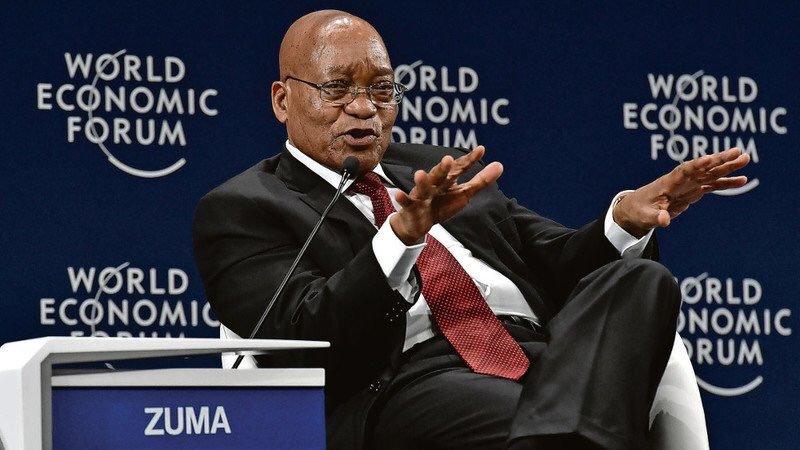
Five decades have passed since former South African President Jacob Zuma was last imprisoned – he served a 10-year-term at the notorious jail at Robben Island alongside the ANC’s revolutionary leader Nelson Mandela – but pretty soon, he’s likely to find himself inside a jail cell once again as South Africa’s Constitutional Court sentenced him to 15 months in prison for contempt of court.

Zuma must now turn himself in within five days. Should he refuse, South African police will be ordered to “take all steps necessary” within three days to ensure that he’s imprisoned – otherwise the former president will essentially be openly flouting the country’s courts, dealing a major blow to the government’s credibility.

Acting Chief Justice Sisi Khampepe issued a forceful ruling, ordering a prison term because it would be “the only appropriate sanction” after Zuma repeatedly refused to appear when summoned for hearings at South Africa’s Constitutional Court. The court was responsible for overseeing an investigation into corruption headed by Raymond Zondo, South Africa’s deputy chief justice, according to the BBC.

“I am left with no option but to commit Mr Zuma to imprisonment, with the hope that doing so sends an unequivocal message… the rule of law and the administration of justice prevails.”

The long-running investigation has been investigating allegations that Zuma helped the Guptas, a well-known business family of Indian origins, secure state contracts and determine policy in what has become known as the ‘state capture’ scandal. Both parties have denied wrongdoing, and it’s worth noting that Zuma’s prison sentence wasn’t ordered as a result of the scandal, but as a result of Zuma’s refusal to cooperate with the investigation.

Since Zuma was forced to step down in 2018 as a corruption scandal intensified, the investigation has become a symbol of his successor Cyril Ramaphosa’s efforts to clean up the federal government.

Ironically, Zuma himself ordered the inquiry following an order by South Africa’s public protector.

During the investigation, dozens of witnesses have implicated the former president in systematic corruption, including the manipulation of ministerial appointments and contracts to favour the business empire of the Indian-born family.

Zuma made one brief appearance before the inquiry in 2019 to deny any involvement in corruption and to insist that his accusers were part of a foreign effort to “drive me from the scene”. But at his next appearance, he refused to answer any questions. He staged a walkout and has not returned to the witness stand.

This isn’t the only corruption probe Zuma is facing: In a separate legal matter, the former president pleaded not guilty last month in a corruption trial involving a $5 billion arms deal from the 1990s.

Tyler Durden
Tue, 06/29/2021 – 07:07

via ZeroHedge News https://ift.tt/3xZD08A Tyler Durden

John Taylor: Is The Fed Getting Burned Again?

John Taylor: Is The Fed Getting Burned Again?

Authored by John Taylor via Project Syndicate,

As in the stagflationary 1970s, the US Federal Reserve is once again denying that its own policies are the reason for a recent surge of inflation, even though there is good reason to think that they are. It is not too late to learn from past mistakes and reverse course – but the clock is quickly ticking down.

Fifty years ago, on June 22, 1971, US Federal Reserve Chair Arthur Burns wrote a memorandum to President Richard Nixon that will long live in infamy.

Inflation was picking up, and Burns wanted the White House to understand that the price surge was not due to monetary policy or to any action that the Fed had taken under his leadership. The issue, rather, was that “the structure of the economy [had] changed profoundly.” Accordingly, Burns was writing to recommend “a strong wage and price policy”:

“I have already outlined to you a possible path for such a policy – emphatic and pointed jawboning, followed by a wage and price review board (preferably through the instrumentality of the Cabinet Committee on Economic Policy); and in the event of insufficient success (which is now more probable than it would have been a year or two ago), followed – perhaps no later than next January – by a six-month wage and price freeze.”

Perhaps owing to Burns’s reputation as a renowned scholar (he was Milton Friedman’s teacher) and his long experience as a policymaker, the memo convinced Nixon to proceed with a wage and price freeze, and to follow that up with a policy of wage and price controls and guidelines for the entire economy.

For a time after the freeze was implemented, the controls and guidelines seemed to be working. They were even politically popular for a brief period. Inflation inched down, and the freeze was followed by more compulsory controls requiring firms to get permission from a commission to change wages and prices.

But the intrusive nature of the system began to wear on people and the economy because every price increase had to be approved by a federal government bureaucracy.

Moreover, it soon became obvious that the government controls and interventions were making matters worse.

Ignoring its responsibility to keep inflation low, the Fed had started letting the money supply increase faster, with the annual growth rate of M2 (a measure of cash, deposits, and highly liquid assets) averaging 10% in the 1970s, up from 7% in the 1960s. This compounded the impact of the decade’s oil shocks on the price level, and the inflation rate shot into double digits – rising above 12% three times (first in 1974 and then again in 1979 and 1980) – while the unemployment rate rose from 5.9% in June 1971 to 9% in 1975.

As we know now, the US economy’s performance in the 1970s was very poor owing at least partly to that era’s monetary policies. This was when the word “stagflation” was coined to describe a strange mix of rising inflation and stagnant economic growth. As James A. Dorn of the Cato Institute recently recounted, Nixon’s “price controls went on to distort market prices” and are rightly remembered as a cautionary tale. “We should not forget that the loss of economic freedom is a high price to pay for a false promise to end inflation by suppressing market forces” (emphasis mine).

As it happens, Choose Economic Freedomis the title of a book that I published last year with George P. Shultz, who passed away in February at the age of 100. Schultz had gained decades of wisdom and experience as both a diplomat and economic policymaker, serving as the Nixon administration’s budget director when Burns wrote his audacious memo. In an appendix to our book, we included the full text of that document, because it had only recently been discovered in the Hoover Institution archives. It should now be recognized as required reading for anyone seeking to understand the recent history of US economic policymaking.

The Burns memo is a perfect example of how bad ideas lead to bad policies, which in turn lead to bad economic outcomes. Despite Burns’s extraordinary reputation, his memo conveyed a set of terrible policy recommendations. By blaming everything on putative structural defects supposedly afflicting the entire economy, the memo’s worst effect was to shun the Fed’s responsibility for controlling inflation, even though it was clearly responsible for the rising price level.

By the same token, good ideas lead to good policy and good economic performance. As Schultz and I showed, this was certainly the case in the 1980s. The Fed reasserted itself as part of a broader economic reform, and the economy duly boomed.

The message from this historical experience – and many other examples in the United States and elsewhere – should be abundantly clear. And while history never repeats itself, it often rhymes, so consider where we are midway through 2021: inflation is picking up, and the Fed is once again claiming that it is not responsible for that development. Instead, Fed officials argue that today’s surge in prices merely reflects the bounce back from the low inflation of the last year.

Worse, the Fed’s policy is even more interventionist now than it was in Burns’s day. Its balance sheet has exploded from massive purchases of Treasury bonds and mortgage-backed securities, and the growth rate of M2 has risen sharply over the past year. The federal funds interest rate is now lower than virtually any tested monetary policy rule or strategy suggests it should be, including those listed on page 48 of the Fed’s own February 2021 Monetary Policy Report.

It is not too late to learn from past mistakes and turn monetary policy into the handmaiden of a sustained recovery from the pandemic. But time is running out.

Tyler Durden
Tue, 06/29/2021 – 06:30

via ZeroHedge News https://ift.tt/3w4STtg Tyler Durden