Kroger Closes More Grocery Stores Over “Hazard Pay” Laws
The nation’s second-largest grocery chain has announced the closure of two stores in Seattle, after the city passed a $4-an-hour hazard pay mandate for grocery workers, according to the Washington Post.
“Unfortunately, Seattle City Council didn’t consider that grocery stores — even in a pandemic — operate on razor-thin profit margins in a very competitive landscape,” the company said in a statement. “When you factor in the increased costs of operating during covid-19, coupled with consistent financial losses at these two locations, and this new extra pay mandate, it becomes impossible to operate a financially sustainable business.”
The hazard pay mandates were instituted because grocery employees were deemed “front line workers” due to their interaction with the public during the pandemic.
Hazard pay and other pandemic-related bonuses became popular among corporate grocery and retail giants, amid wider public attention on the plight of essential workers during the early spread of the coronavirus last year. Companies including Kroger, Target, Walmart, Amazon, Rite Aid and Albertsons instituted the policy.
But many companies like Kroger ended hazard pay as the country reopened, declining to reinstate the practice, despite record caseloads around the country. Kroger replaced it with a $400 bonus. –Washington Post
The move comes two weeks after Kroger announced the closure of stores in Long Beach, California over similar hazard pay legislation, blaming local officials after they passed a law mandating that grocery stores with at least 300 workers nationwide or 15 employees within Long Beach to pay an additional $4 an hour for a 120-day period.
Kroger’s decision was denounced by the United Food and Commercial Workers International Union.
“Kroger has literally made billions in pandemic profits off the sacrifices of grocery workers in Seattle and across the country,” union president Marc Perrone said in a statement. “Kroger’s action today not only threatens these workers, but it also threatens the local food supply. Instead of doing what is right, protecting the community and providing the hazard pay for these essential grocery workers, Kroger is once again trying to intimidate local and national elected leaders.”
Seattle officials, meanwhile, called Kroger’s move an attempt to “bully” the city’s elected leaders, who apparently didn’t think their actions would have consequences.
“Kroger has posted record earnings during this pandemic,” said Council President M. Lorena González in a statement. “The city’s front line grocery workers, meanwhile, are exposed to covid-19 every day and many are still living paycheck to paycheck.”
Kroger posted an operating profit of $792 million in Q3 2020, up 300% from the same quarter a year prior – so perhaps they’re drawing a line in the sand before cities across the country institute similar “hazard pay” mandates.
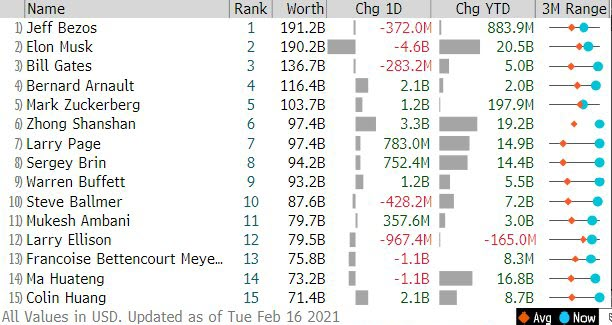
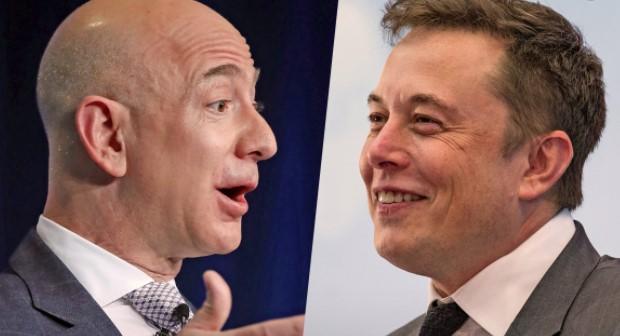
With shares of Tesla sputtering over the last couple of weeks – made even more interesting by strange put buys coming into the name over the last 2 weeks – Elon Musk has slipped out of the pole position for the title of world’s richest man.
Bezos, who was temporarily dethroned from the position last month after holding the title for more than three years, has reclaimed his spot at the top of the list with his net worth at $191.2 billion. Musk has slipped to second with a net worth of $190.2 billion.
Bill Gates, Bernard Arnault and Mark Zuckerberg make up the three hole, four hole and five hole, respectively.
Musk’s stint at the top lasted about six weeks, until Tesla’s recent pullback from over $850 to the high $700 range, which came after Musk’s decision to put $1.5 billion worth of Bitcoin on the company’s balance sheet. He also interjected himself in the middle of the GameStop fiasco and has commented online about companies like Etsy and Signal.
In fact, Musk has been doing so much Tweeting, it begs the question of what he actually spends his day doing. But that’s another story for another day.
Bezos has recouped his title despite announcing this month that he is going to be stepping down as CEO of Amazon and into a Chairman position. He is currently also involved in his own space exploration company, called Blue Origin, and the Washington Post. Amazon is up 53% in the last 12 months.
Musk could wind up passing Bezos again quickly. Musk’s SpaceX is looking to raise money at a “significantly higher” valuation than its last round.
But come on, Elon. Why put in all that pesky work to pass Bezos? What does it take to get someone to come in and buy a couple million bucks worth of OTM calls for a friend to prop you back up on top?
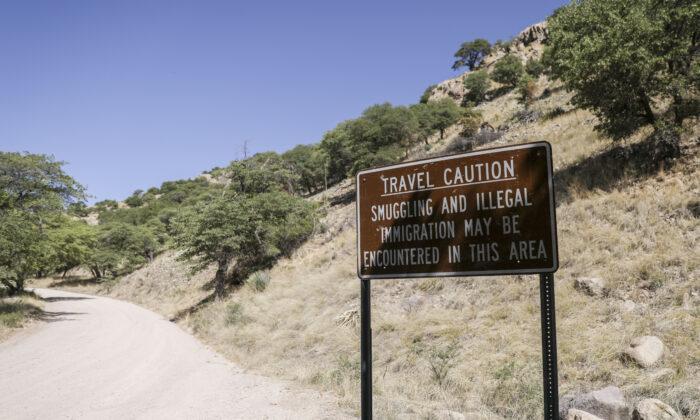
High-speed vehicle pursuits of suspected human smugglers and other illegal immigrant-related crimes are becoming more common in Cochise County, Arizona, according to Sheriff Mark Dannels.
Dannels tracks illegal border crossings through his extensive hidden trail camera operation along his county’s 83 miles of shared border with Mexico.
The cameras showed 1,200 illegal entries in August 2020, and by December, it had more than doubled to 2,500, he said. Before August, 500 was a busy month.
“That’s what scares me about this whole thing,” he told The Epoch Times on Feb. 15.
“Though I believe politics has no business in policing, it sure has an effect on the border.”
President Joe Biden has undone several border security measures that the Trump administration had put into effect, including temporarily suspending deportations of illegal aliens, reversing President Donald Trump’s ban on travel from terror-prone countries, halting border wall construction, and issuing a sweeping immigration package to Congress that includes amnesty for millions of illegal immigrants.
Cochise County Sheriff Mark Dannels in Sierra Vista, Arizona, on May 5, 2019. (Charlotte Cuthbertson/The Epoch Times)
Biden has also pledged to bring in 25,000 asylum-seekers who are waiting in Mexico for their immigration case to be adjudicated under the Migrant Protection Protocols (MPP) program.
“The president’s view is that the approach of the prior administration was immoral, but also ineffective in terms of addressing the challenge—the many challenges of an outdated immigration system,” said White House press secretary Jen Psaki on Feb. 16.
However, Dannels says the “best border efforts we’ve ever had in the last three decades in Cochise County was over the last couple of years.”
“We had a president that was very tough on the border, nobody would question that. And now we’ve got a president who’s going to do just the opposite,” he said.
“Are they rescinding them [executive orders] because it was Trump who was the author of it and it’s revengeful? Or are they rescinding it because it wasn’t working? I would question both those thoughts.”
Dannels said he’s concerned that border sheriffs are going to be sidelined during the Biden administration. He sits on the Homeland Security Advisory Council and was part of the Biden transition team for border issues. He was optimistic after the initial meeting about collaboration and other issues.
But he said he hasn’t been included in conversations about the impact of ending the MPP program, which he sees as one of the most effective policies.
On Feb. 19, the Department of Homeland Security will start to bring in 25,000 illegal immigrants who are part of the program.
“We’re going into Mexico during a health pandemic and bringing 25,000 over. It doesn’t make sense. It’s hypocritical,” Dannels said.
“Either we’re in the middle of a health pandemic, or we’re not. Somebody in Washington, D.C., needs to make that decision.”
U.S. Border Patrol agents apprehended two large groups of illegal aliens within an hour of each other near Mission, Texas, on Feb. 4, 2021. (Courtesy of U.S. Customs and Border Protection)
The message smugglers and cartels are receiving is that the border is “open for business,” and “that’s what’s scary to me,” Dannels said. Just last month, two illegal immigrants died when the vehicle they were in flipped as they tried to evade law enforcement. Another four people were in the vehicle.
“We need to have a secure border. The cartels are the only ones smiling right now, because they will benefit from this confusion,” he said.
He hopes the new administration’s measures won’t hamper the collaboration with local Border Patrol agents in Cochise County.
“We’re going to keep doing what’s right, what the oath of office has us to do—and that’s to protect our citizens,” he said.
But with the new policies, he said he’s “not optimistic” that a border crisis won’t emerge of similar proportions to what occurred in 2019. Almost 1 million illegal or inadmissible immigrants were apprehended by border agents along the southern border during fiscal 2019.
“We’re going to have our hands full [this year],” Dannels predicts.
“We’ve been down this road before. For 37 years, I’ve worked this southern border, and I’ve seen the different leadership come into Washington, D.C. They bring their own ideologies, their own policies, and unfortunately politics becomes the driving force of this.
“And what happens is, the local communities are the ones that take the impact.”
Top JPMorgan Banker Tells Clients Forget About Bubbles And Just Buy Everything
For those wondering, we are at that point in the bubble where Wall Street professionals are actively urging investors to buy everything they have to sell.
Take Bob Michele – the chief investment officer at JPMorgan Asset Management which manages $2.3 trillion – who had some bad news for everyone sounding alarms on asset bubbles: there’s much more credit euphoria to come. Speaking to Bloomberg, Michele said he was betting on an ever-more intensifying rally across junk bonds, emerging market debt and risky bank securities.
Why? Because “stimmy” checks of course, or as he put it, fresh stimulus beckons.
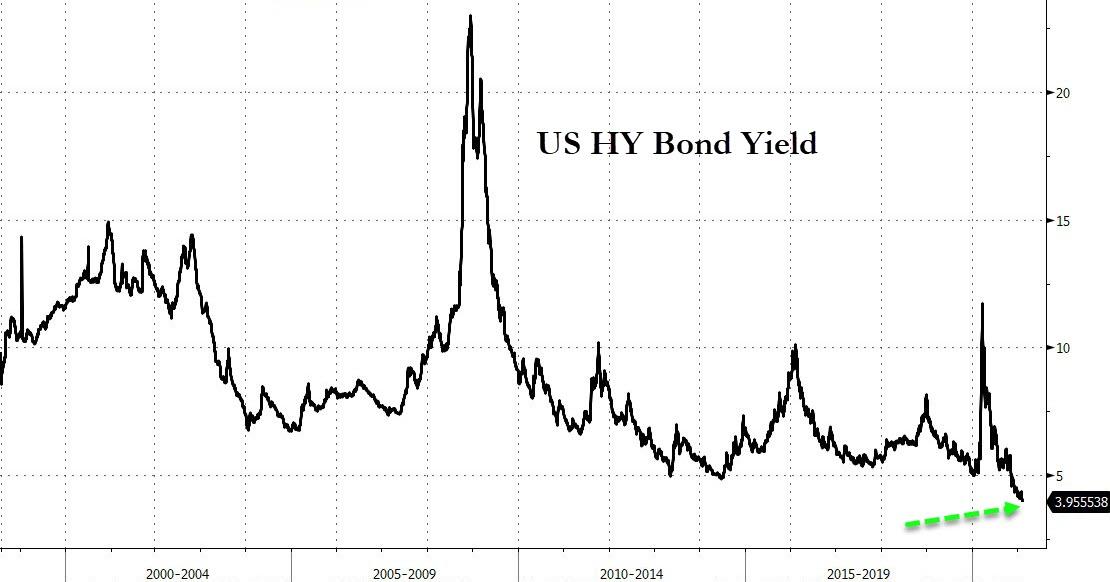
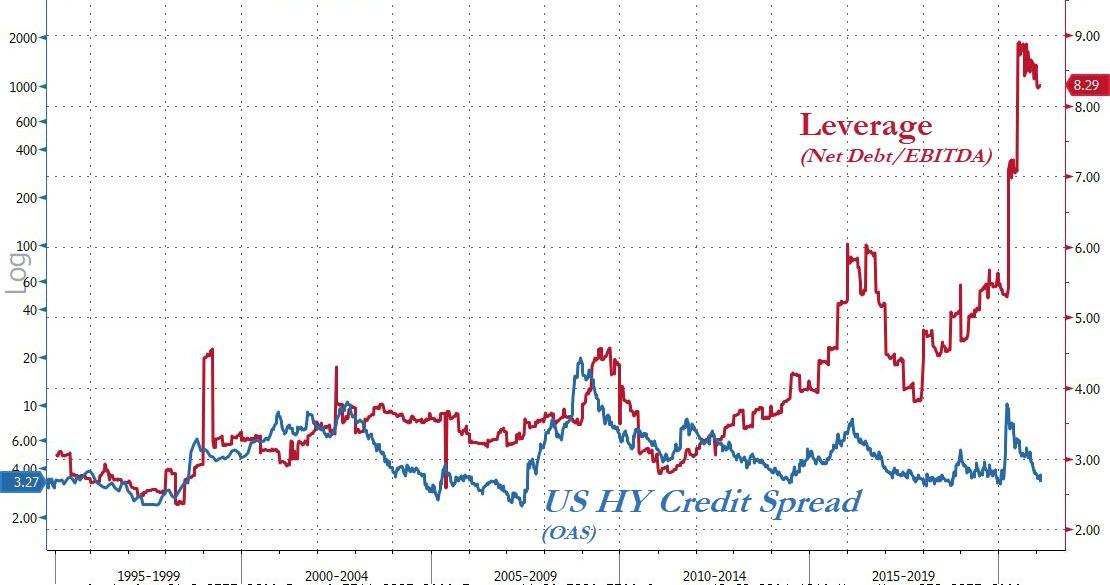
In his euphoric vision of the coming uber-bubble, Michele says average U.S. junk-bond spreads are set to drop to 300 basis points, and over the course of the next year could test pre-financial crisis lows of 250 basis points. As a reminder, last week we showed that the average “high yield” (lol) bond now has an average yield of less than 4%!
This, even as net leverage across the corporate sector has exploded to bananas levels.
But instead of worrying about something as boring as valuations, Michele told clients to “ride the rally and drown out warnings that the market has become overheated.”
“Some want to wait until there is a meaningful correction. I keep telling them that everyone on the planet is waiting for that to happen,” Michele said in an interview. “Valuations occupy everyone’s time and effort. Nobody likes them here. But that’s the reality.”
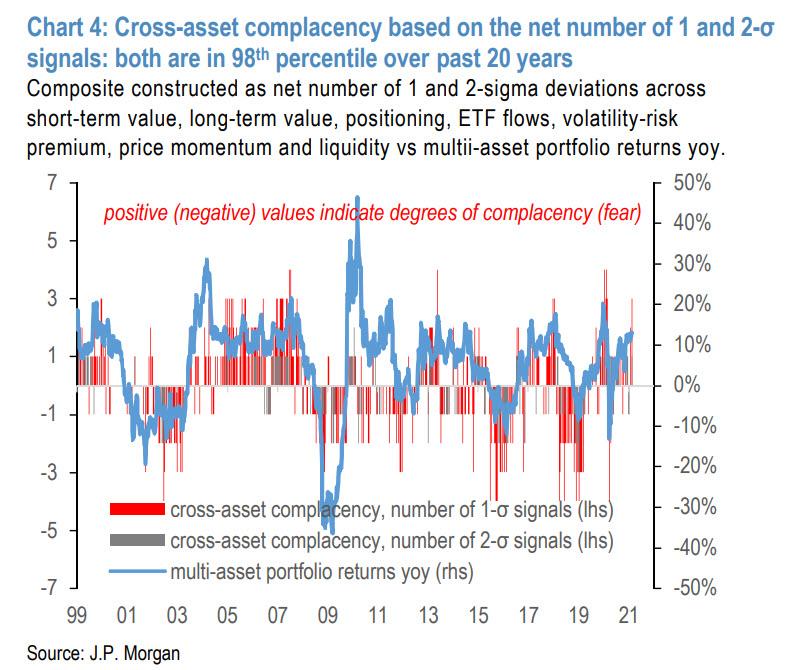
Ironically, none other than Michele’s own firm JPMorgan warned late last week that with its models showing near record complacency, the highest since the dot com bubble…
… a correction is imminent. But we are confident that Michele would say to ignore that and also ignore a bizarre warning from none other than the IMF last week warned that risk assets were over-valued with no cushion built in for negative surprises (and yet, the same IMF urges massive fiscal stimulus as if it doesn’t realize that most of this new money goes into markets).
None of this matters however to Michele, who correctly points out that with global central banks plowing trillions into market and fiscal stimulus stoking economic recoveries, there’s no reason to pull back now.
Michele jumped into the reflation trade early – which is a more politically correct name for “dash for trash” – pivoting into corporate bonds and emerging markets debt pegged to growth last year. Needless to say, this trade has done very well in recent months: Michele’s Global Opportunities Fund has outperformed 85% of peers in the past year, according to Bloomberg data.
Among his other observations in the interview:
10-year yields will continue their march higher to trade in a 1.5%-2% range, but inflation-adjusted yields will remain negative, fueling the rally
U.S. corporate default rate will fall to 3% from 6% this year
A basket of local-currency debt including from South Africa, India, Indonesia and Mexico could net 10% gains this year
So when will the party end? According to Michele, the next Fed hike will take place in 2023, when a pick-up in inflation and growth puts central banks back on the tightening path. Until then, relentless stimulus, which he dubbed “Modern Monetary Theory on steroids” (because deranged helicopter money was taken?) has set up a perfect backdrop for risk assets.
“The reflation trade still has a lot of room to go,” he said. “Central banks are printing more money every day and that money finds its way into the market. This is not going to stop anytime soon.”
Translation: it’s a bubble, and no central bank will ever again dare to pop it, so may as well go all in.
That revival has continued into 2021. Gold imports in January were up 72% year-on-year, and some shifts in government policy could give demand another shot in the arm.
India ranks as the second-largest gold consuming country in the world, second only behind China. But over the last couple of years, the gold market in India has languished. The pandemic crushed demand, particularly for gold jewelry, but record-high gold prices in rupee terms and government policy put a drag on the gold market even before COVID-19.
There were signs of a turnaround late last year and it continued through the first month of 2021.
India imported 62 tons of gold in January, according to an anonymous government source who spoke to Reuters. That was up from just 36.5 tons in January 2020. In dollar terms, January gold imports came in at $4.04 billion compared to $1.58 billion a year ago.
Indian gold imports should get another boost thanks to a cut in import duties announced last week by Finance Minister Nirmala Sitharaman. Beginning Feb. 1, the duty on gold bars will drop from 12.5% to 7.5%. Consumers will pay 14.07% tax for refined gold compared to 16.26% previously. Analysts at the World Gold Council project the cut in import taxes could boost demand by as much as 13 tons in 2021.
A further recovery in the Indian gold market would further boost global demand and would be supportive of gold prices.
Indians traditionally buy and hold gold. Collectively, Indian households own an estimated 25,000 tons of gold and that number may be higher given the large black market in the country. The yellow metal is interwoven into the country’s marriage ceremonies and cultural rites. Indians also value gold as a store of wealth, especially in poor rural regions. Two-thirds of India’s gold demand comes from these areas, where the vast majority of people live outside the official tax system.
Gold is not just a luxury in India. Even poor people buy gold in the Asian nation. According to an ICE 360 survey in 2018, one in every two households in India purchased gold within the last five years. Overall, 87% of households in the country own some amount of the yellow metal. Even households at the lowest income levels in India own some gold. According to the survey, more than 75% of families in the bottom 10% had managed to buy gold.
While consumer demand for gold was hit hard by the pandemic, gold has helped Indians weather the economic storm caused by the coronavirus. The government response to COVID-19 ravaged the Indian economy. As a result, many banks were reluctant to extend credit due to fear of defaults. In this tight lending environment, many Indians used their stashes of gold to secure loans.
For many Indians, gold is a lifesaver, providing liquidity that they otherwise wouldn’t have.
Indians understand that gold tends to store value, and that in the end, gold is money. If they have gold, they know they will be able to get the goods and services they need – even in the event of an economic meltdown. And while westerners may not embrace the cultural and religious aspects of the Indian love affair with gold, the economic reasons for their devotion to the yellow metal are every bit as applicable in places like the US.
WTI Extends Gains After Bigger Than Expected Crude Draw
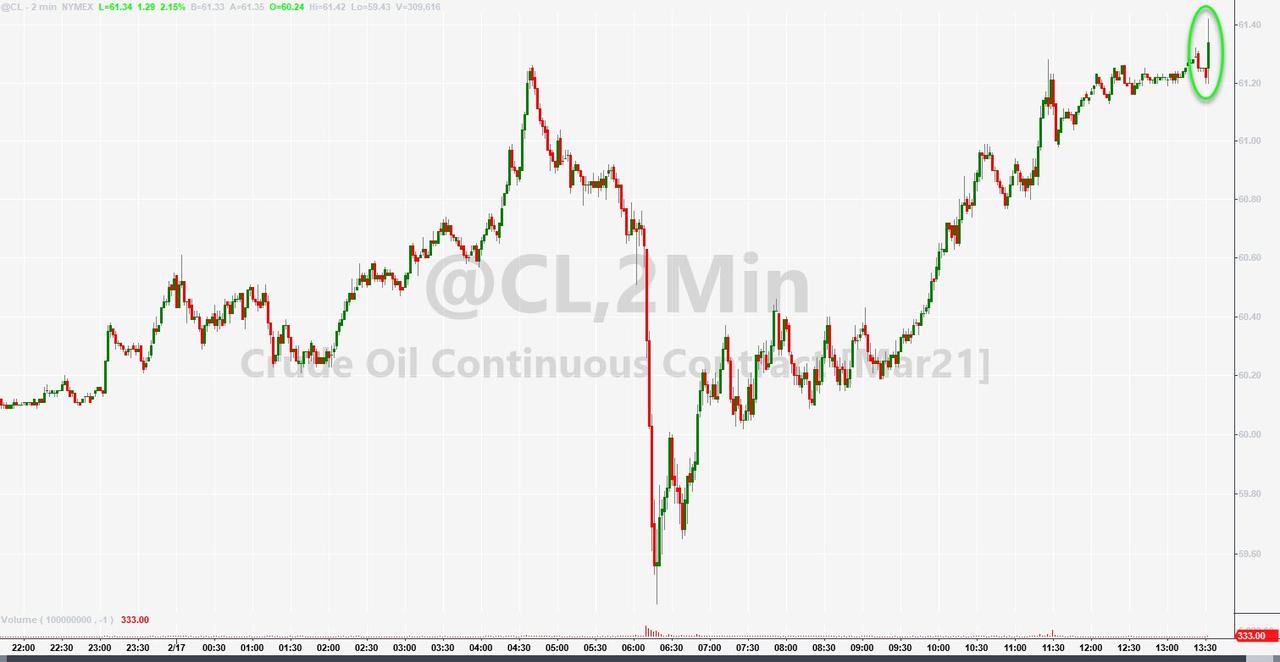
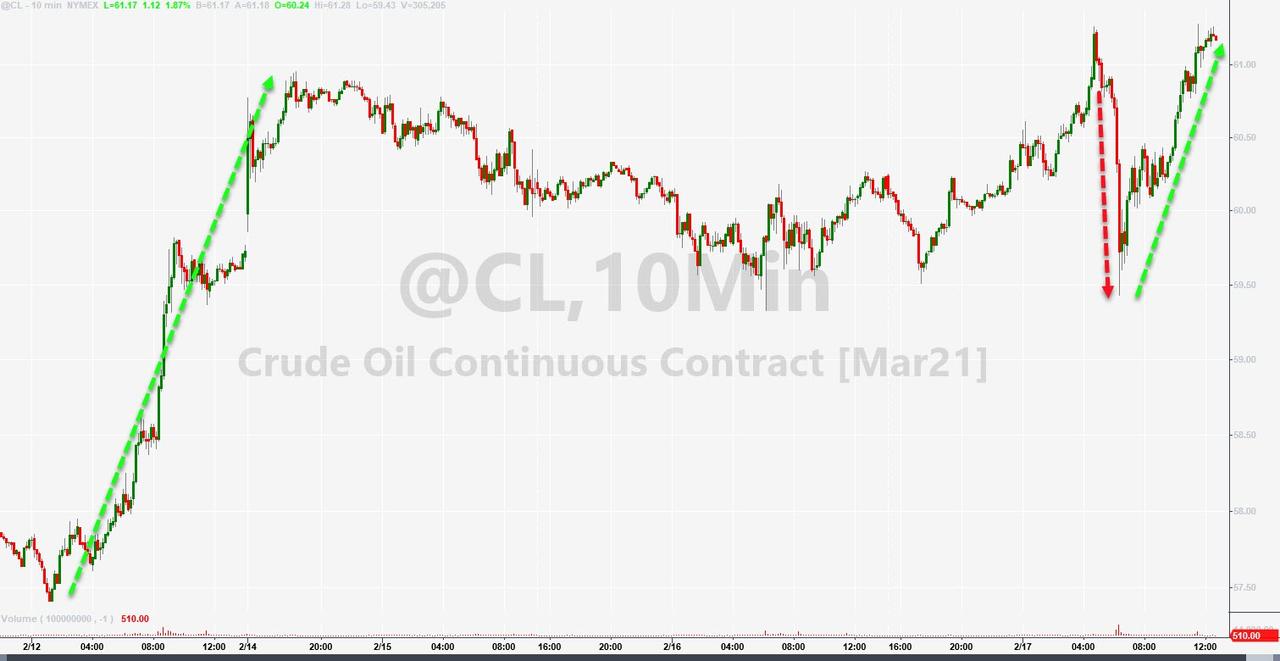
Oil prices ended a roller-coaster day higher (WTI above $61) after the deep freeze shut in a stunning 40% of US crude production (prices higher), headlines reported that the Saudis plan to boost production going forward (prices dived), and a late-day buying panic post-FOMC Minutes (ignoring transitory inflation factors).
“We’re at a very delicate point here,” said Bob Yawger, head of the futures division at Mizuho Securities. OPEC+ has “to make sure the associated demand is there before increasing the barrels and not kill the golden goose here, which is what they’ll do if they add everything at once.”
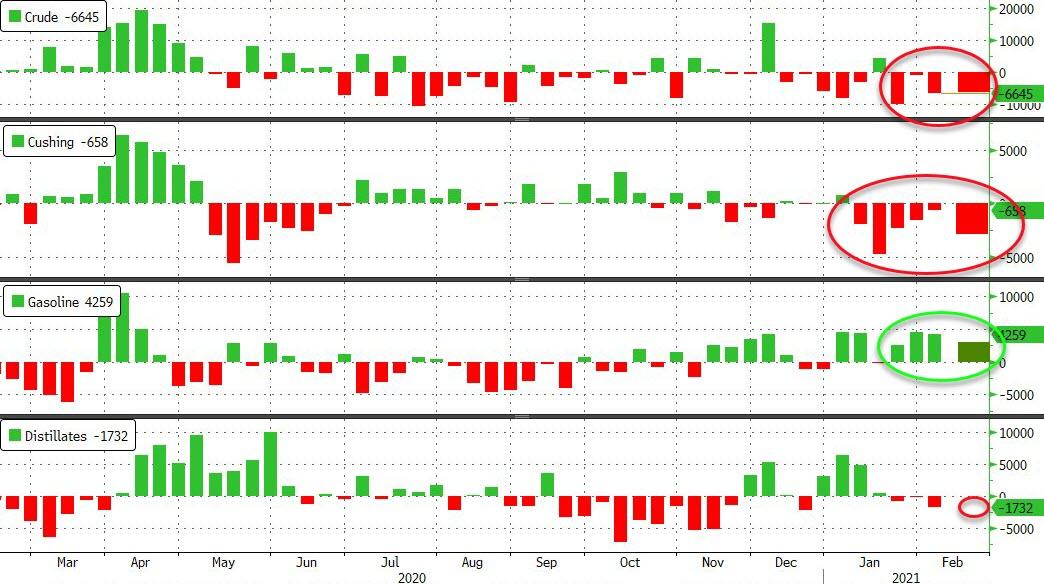
Today’s reported inventory data is unlikely to show any of the affects from the current storm (although potentially some stockpiling may have occurred)…
API
Crude -5.8mm (-2.15mm exp)
Cushing -3.00mm
Gasoline +3.90mm (+1.397mm exp)
Distillates -3.50mm (=1.57mm exp)
As analysts expected, crude stocks drew down for a 4th straight week (and more than expected). Gasoline stocks rose for the 6th week of the last 7…
Source: Bloomberg
WTI was hovering around $61.20 (highs of the day) ahead of the API print, and extended gains after the bigger than expected draw…
“This arctic blast is really delivering a key surprise that’s elevating prices,” said Edward Moya, senior market analyst at Oanda Corp. “The short-term disruption underlines the fragility of where we are with supplies, and we could see a number of different events that could provide us with another surge higher.”
What took place at the Capitol on January 6 was undoubtedly a politically motivated riot. As such, it should not be controversial to regard it as a dangerous episode. Any time force or violence is introduced into what ought to be the peaceful resolution of political conflicts, it should be lamented and condemned.
But none of that justifies lying about what happened that day, especially by the news media. Condemning that riot does not allow, let alone require, echoing false claims in order to render the event more menacing and serious than it actually was. There is no circumstance or motive that justifies the dissemination of false claims by journalists. The more consequential the event, the less justified, and more harmful, serial journalistic falsehoods are.
Yet this is exactly what has happened, and continues to happen, since that riot almost seven weeks ago. And anyone who tries to correct these falsehoods is instantly attacked with the cynical accusation that if you want only truthful reporting about what happened, then you’re trying to “minimize” what happened and are likely an apologist for if not a full-fledged supporter of the protesters themselves.
One of the most significant of these falsehoods was the tale — endorsed over and over without any caveats by the media for more than a month — that Capitol Police officer Brian Sicknick was murdered by the pro-Trump mob when they beat him to death with a fire extinguisher. That claim was first published by The New York Times on January 8 in an article headlined “Capitol Police Officer Dies From Injuries in Pro-Trump Rampage.” It cited “two [anonymous] law enforcement officials” to claim that Sicknick died “with the mob rampaging through the halls of Congress” and after he “was struck with a fire extinguisher.”
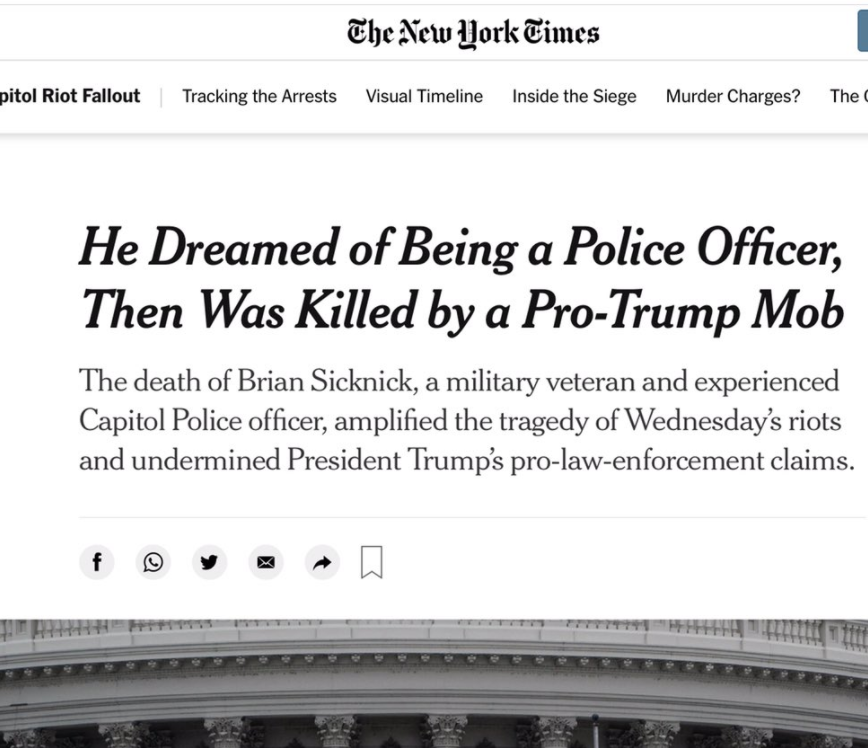
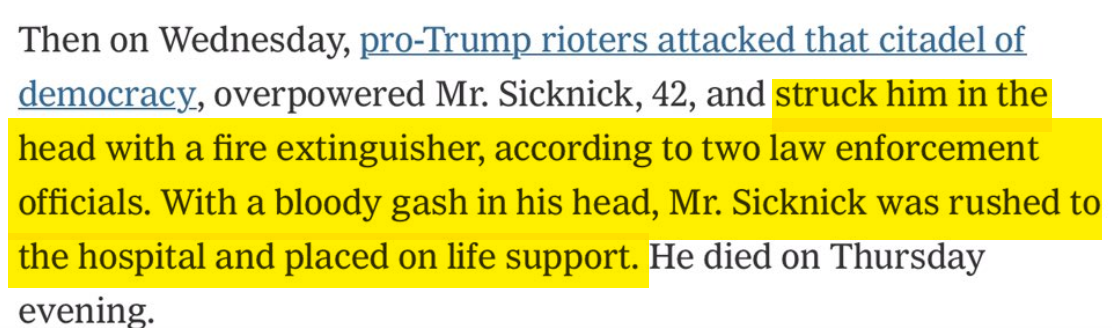
A second New York Timesarticle from later that day — bearing the more dramatic headline: “He Dreamed of Being a Police Officer, Then Was Killed by a Pro-Trump Mob” — elaborated on that story:
After publication of these two articles, this horrifying story about a pro-Trump mob beating a police officer to death with a fire extinguisher was repeated over and over, by multiple journalists on television, in print, and on social media. It became arguably the single most-emphasized and known story of this event, and understandably so — it was a savage and barbaric act that resulted in the harrowing killing by a pro-Trump mob of a young Capitol police officer.
It took on such importance for a clear reason: Sicknick’s death was the only example the media had of the pro-Trump mob deliberately killing anyone. In a January 11 article detailing the five people who died on the day of the Capitol protest, the New York Times again told the Sicknick story: “Law enforcement officials said he had been ‘physically engaging with protesters’ and was struck in the head with a fire extinguisher.”
But none of the other four deaths were at the hands of the protesters: the only other person killed with deliberate violence was a pro-Trump protester, Ashli Babbitt, unarmed when shot in the neck by a police officer at close range. The other three deaths were all pro-Trump protesters: Kevin Greeson, who died of a heart attack outside the Capitol; Benjamin Philips, 50, “the founder of a pro-Trump website called Trumparoo,” who died of a stroke that day; and Rosanne Boyland, a fanatical Trump supporter whom the Times says was inadvertently “killed in a crush of fellow rioters during their attempt to fight through a police line.”
This is why the fire extinguisher story became so vital to those intent on depicting these events in the most violent and menacing light possible. Without Sicknick having his skull bashed in with a fire extinguisher, there were no deaths that day that could be attributed to deliberate violence by pro-Trump protesters. Three weeks later, The Washington Postsaid dozens of officers (a total of 140) had various degrees of injuries, but none reported as life-threatening, and at least two police officers committed suicide after the riot. So Sicknick was the only person killed who was not a pro-Trump protester, and the only one deliberately killed by the mob itself.
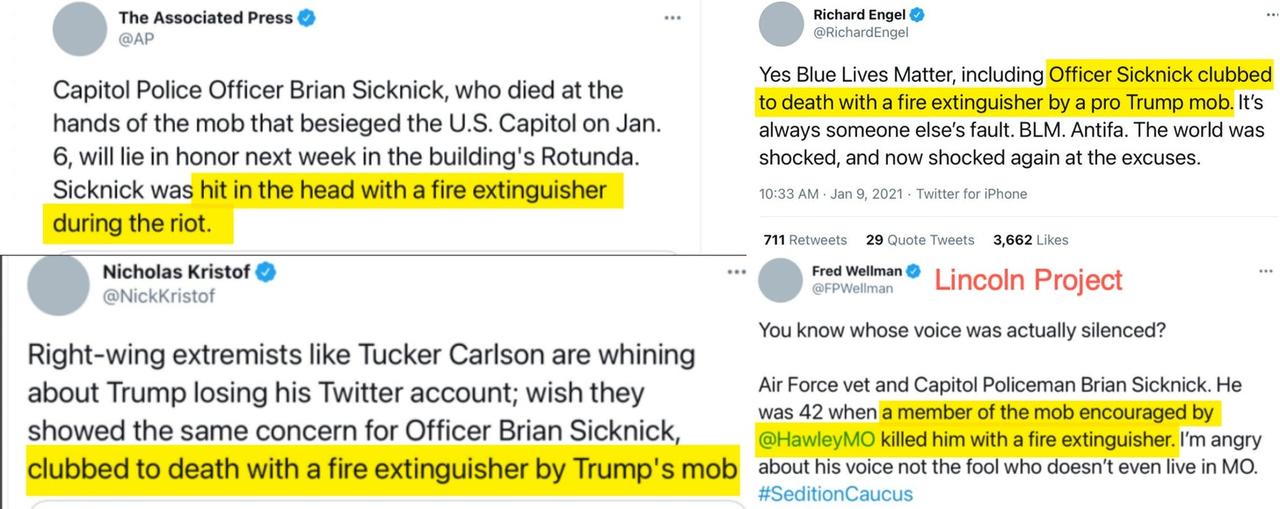
It is hard to overstate how pervasive this fire extinguisher story became. Over and over, major media outlets and mainstream journalists used this story to dramatize what happened:
Television hosts gravely intoned when telling this story, manipulating viewers’ emotions by making them believe the mob had done something unspeakably barbaric:
After the media bombarded Americans with this story for a full month without pause, it took center stage at Trump’s impeachment process. As former federal prosecutor Andrew McCarthy noted, the article of impeachment itself stated that “Trump supporters ‘injured and killed law enforcement personnel.’” The House impeachment managers explicitly claimed on page 28 of their pretrial memorandum that “the insurrectionists killed a Capitol Police officer by striking him in the head with a fire extinguisher.”
Once the impeachment trial ended in an acquittal, President Joe Biden issued a statement and referenced this claim in the very first paragraph. Sicknick, said the President, lost “his life while protecting the Capitol from a violent, riotous mob on January 6, 2021.”
The problem with this story is that it is false in all respects. From the start, there was almost no evidence to substantiate it. The only basis were the two original New York Times articles asserting that this happened based on the claim of anonymous law enforcement officials.
Despite this alleged brutal murder taking place in one of the most surveilled buildings on the planet, filled that day with hundreds of cellphones taping the events, nobody saw video of it. No photographs depicted it. To this day, no autopsy report has been released. No details from any official source have been provided.
Not only was there no reason to believe this happened from the start, the little that was known should have caused doubt. On the same day the Times published its two articles with the “fire extinguisher” story, ProPublica published one that should have raised serious doubts about it.
The outlet interviewed Sicknick’s brother, who said that “Sicknick had texted [the family] Wednesday night to say that while he had been pepper-sprayed, he was in good spirits.” That obviously conflicted with the Times’ story that the mob “overpowered Sicknick” and “struck him in the head with a fire extinguisher,” after which, “with a bloody gash in his head, Mr. Sicknick was rushed to the hospital and placed on life support.”
But no matter. The fire extinguisher story was now a matter of lore. Nobody could question it. And nobody did: until after a February 2 CNN article that asked why nobody has been arrested for what clearly was the most serious crime committed that day: the brutal murder of Officer Sicknick with a fire extinguisher. Though the headline gave no hint of this, the middle of the article provided evidence which essentially declared the original New York Times story false:
In Sicknick’s case, it’s still not known publicly what caused him to collapse the night of the insurrection. Findings from a medical examiner’s review have not yet been released and authorities have not made any announcements about that ongoing process.
According to one law enforcement official, medical examiners did not find signs that the officer sustained any blunt force trauma, so investigators believe that early reports that he was fatally struck by a fire extinguisher are not true.
The CNN story speculates that perhaps Sicknick inhaled “bear spray,” but like the ProPublica interview with his brother who said he inhaled pepper spray, does not say whether it came from the police or protesters. It is also just a theory. CNN noted that investigators are “vexed by a lack of evidence that could prove someone caused his death as he defended the Capitol during last month’s insurrection.” Beyond that, “to date, little information has been shared publicly about the circumstances of the death of the 13-year veteran of the police force, including any findings from an autopsy that was conducted by DC’s medical examiner.”
Few noticed this remarkable admission buried in this article. None of this was seriously questioned until a relatively new outlet called Revolver News on February 9 compiled and analyzed all the contradictions and lack of evidence in the prevailing story, after which Fox News’ Tucker Carlson, citing that article, devoted the first eight minutes of his February 10 program to examining these massive evidentiary holes.
That caused right-wing media outlets to begin questioning what happened, but mainstream liberal outlets — those who spread the story aggressively in the first place — largely and predictably ignored it all.
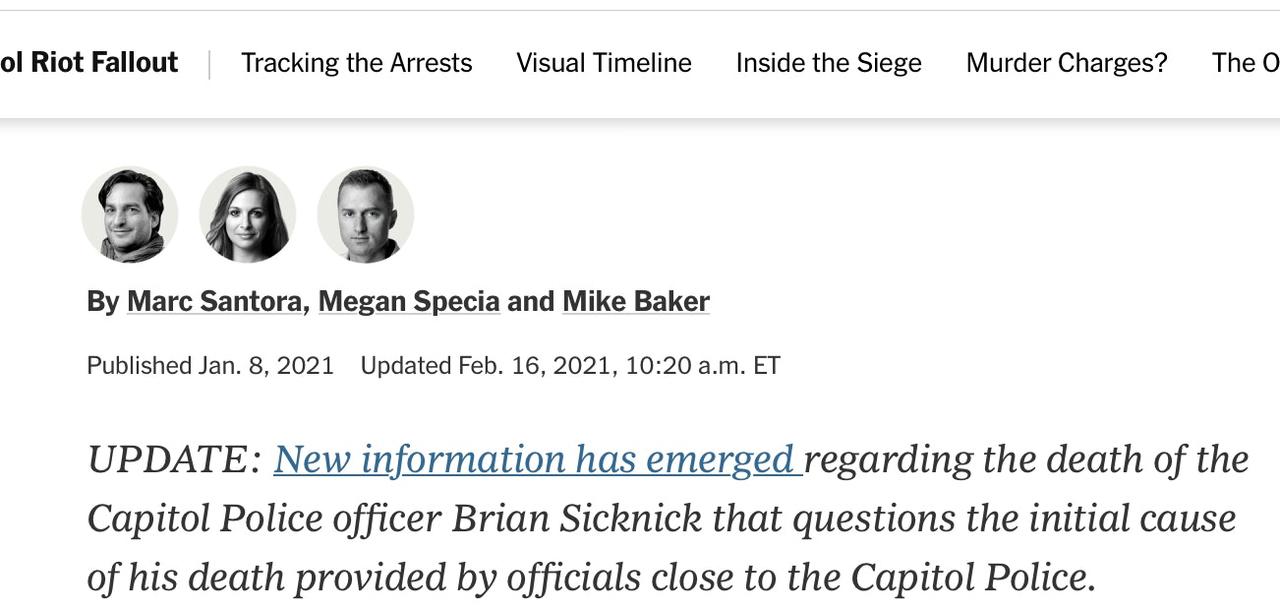
This week, the paper that first published the false story — in lieu of a retraction or an explanation of how and why it got the story wrong — simply went back to the first two articles, more than five weeks later, and quietly posted what it called an “update” at the top of both five-week-old articles:
With the impeachment trial now over, the articles are now rewritten to reflect that the original story was false. But there was nothing done by The New York Times to explain an error of this magnitude, let alone to try to undo the damage it did by misleading the public. They did not expressly retract or even “correct” the story. Worse, there is at least one article of theirs, the January 11 one that purports to describe how the five people died that day, which continues to include the false “fire extinguisher” story with no correction or update.
The fire extinguisher tale was far from the only false or dubious claim that the media caused to circulate about the events that day. In some cases, they continue to circulate them.
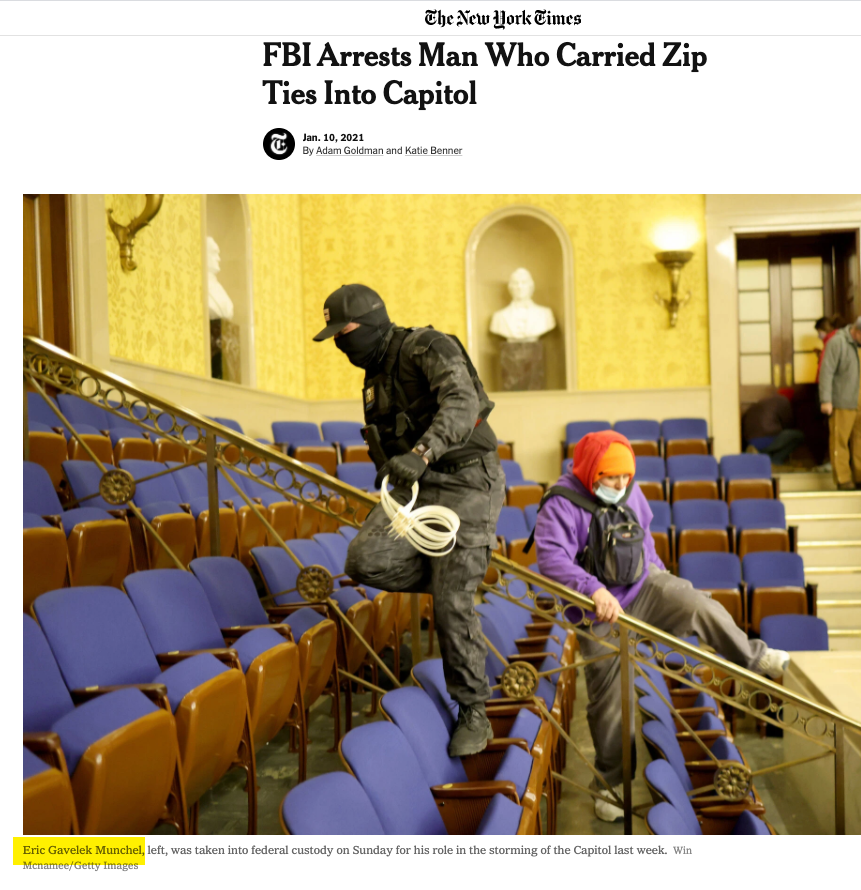
In the days after the protest, numerousviraltweets pointed to a photograph of Eric Munchel with zip-ties. The photo was used continually to suggest that he took those zip-ties into the Capitol because of a premeditated plot to detain lawmakers and hold them hostage. Politicodescribed Munchel as “the man who allegedly entered the Senate chamber during the Capitol riot while carrying a taser and zip-tie handcuffs.”
The Washington Post used the images to refer to “chatters in far-right forums explicitly discussing how to storm the building, handcuff lawmakers with zip ties.” That the zip-tie photo of Munchel made the Capitol riot far more than a mere riot carried out by a band of disorganized misfits, but rather a nefarious and well-coordinated plot to kidnap members of Congress, became almost as widespread as the fire extinguisher story. Yet again, it was The New York Times that led the way in consecrating maximalist claims. “FBI Arrests Man Who Carried Zip Ties Into Capitol,” blared the paper’s headline on January 10, featuring the now-iconic photo of Munchel at the top.
But on January 21, the “zip-tie man’s” own prosecutors admitted none of that was true. He did not take zip-ties with him from home or carry them into the Capitol. Instead, he found them on a table, and took them to prevent their use by the police:
Eric Munchel, a pro-Trump rioter who stormed the Capitol building while holding plastic handcuffs, took the restraints from a table inside the Capitol building, prosecutors said in a court filing Wednesday.
Munchel, who broke into the building with his mom, was labeled “zip-tie guy” after he was photographed barreling down the Senate chamber holding the restraints. His appearance raised questions about whether the insurrectionists who sought to stop Congress from counting Electoral College votes on January 6 also intended to take lawmakers hostage.
But according to the new filing, Munchel and his mother took the handcuffs from within the Capitol building – apparently to ensure the Capitol Police couldn’t use them on the insurrectionists – rather than bring them in when they initially breached the building.
(A second man whose photo with zip-ties later surfaced similarly told Ronan Farrow that he found them on the floor, and the FBI has acknowledged it has no evidence to the contrary).
Why does this matter? For the same reason media outlets so excitedly seized on this claim. If Munchel had brought zip-ties with him, that would be suggestive of a premeditated plot to detain people: quite terrorizing, as it suggests malicious and well-planned intent. But he instead just found them on a table by happenstance and, according to his own prosecutors, grabbed them with benign intent.
Then, perhaps most importantly, is the ongoing insistence on calling the Capitol riot an armed insurrection. Under the law, an insurrection is one of the most serious crises that can arise. It allows virtually unlimited presidential powers — which is why there was so much angst when Tom Cotton proposed it in his New York Times op-ed over the summer, publication of which resulted in the departure of two editors. Insurrection even allows for the suspension by the president of habeas corpus: the right to be heard in court if you are detained.
So it matters a great deal legally, but also politically, if the U.S. really did suffer an armed insurrection and continues to face one. Though there is no controlling, clear definition, that term usually connotes not a three-hour riot but an ongoing, serious plot by a faction of the citizenry to overthrow or otherwise subvert the government.
Just today, PolitiFactpurported to “fact-check” a statement from Sen. Ron Johnson (R-WI) made on Monday. Sen. Johnson told a local radio station:
“The fact of the matter is this didn’t seem like an armed insurrection to me. I mean armed, when you hear armed, don’t you think of firearms? Here’s the questions I would have liked to ask. How many firearms were confiscated? How many shots were fired? I’m only aware of one, and I’ll defend that law enforcement officer for taking that shot.
The fact-checking site assigned the Senator its “Pants on Fire” designation for that statement, calling it “ridiculous revisionist history.” But the “fact-checkers” cannot refute a single claim he made. At least from what is known publicly, there is no evidence of a single protester wielding let alone using a firearm inside the Capitol on that day. As indicated, the only person to have been shot was a pro-Trump protester killed by a Capitol police officer, and the only person said to have been killed by the protesters, Officer Sicknick, died under circumstances that are still completely unclear.
That protesters were found before and after the riot with weapons does not mean they intended to use them as part of the protest. For better or worse, the U.S. is a country where firearm possession is common and legal. And what we know for certain is that there is no evidence of anyone brandishing a gun in that building. That fact makes a pretty large dent in the attempt to characterize this as an “armed insurrection” rather than a riot.
Indeed, the most dramatic claims spread by the media to raise fear levels as high as possible and depict this as a violent insurrection have turned out to be unfounded or were affirmatively disproven.
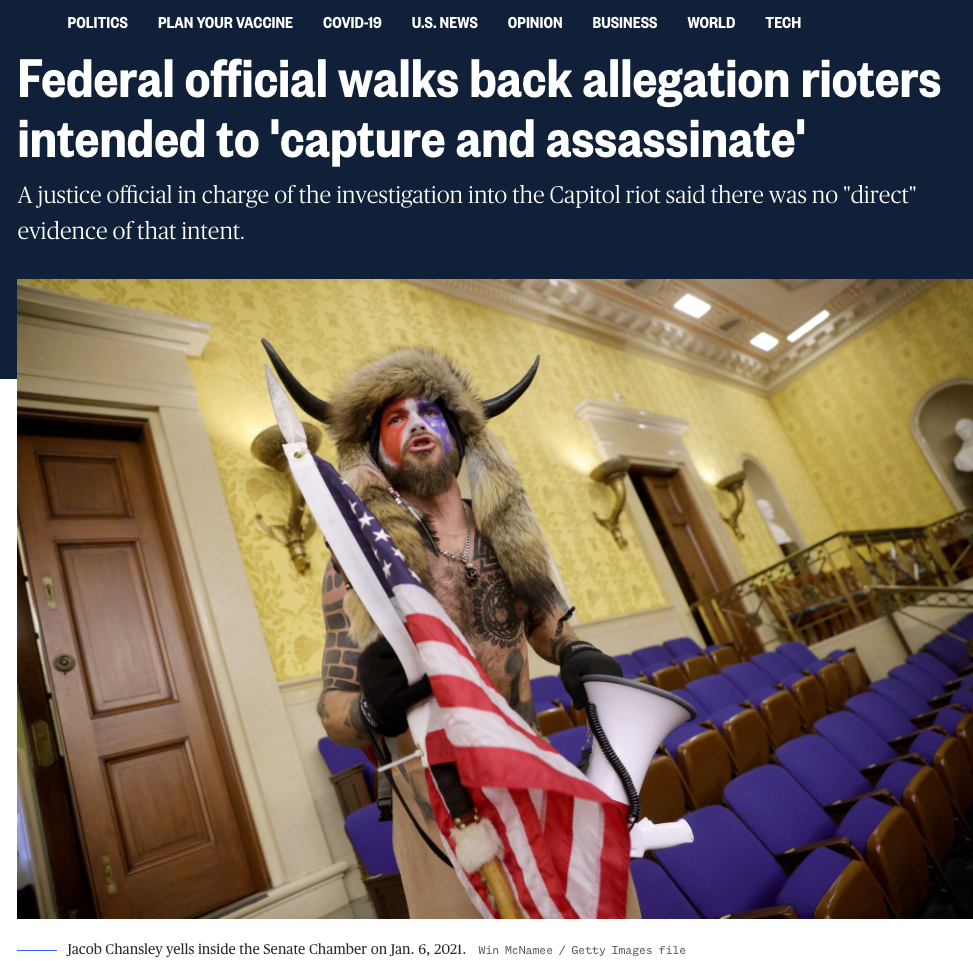
On January 15, Reuters published an article about the arrest of the “Q-Shaman,” Jacob Chansley, headlined “U.S. says Capitol rioters meant to ‘capture and assassinate’ officials.” It claimed that “federal prosecutors offered an ominous new assessment of last week’s siege of the U.S. Capitol by President Donald Trump’s supporters on Thursday, saying in a court filing that rioters intended ‘to capture and assassinate elected officials.’” Predictably, that caused viral social media postings from mainstream reporters and prominent pundits, such as Harvard Law’s Laurence Tribe, manifesting in the most ominous tones possible:
Some of the individuals who breached the Capitol intended to “capture and assassinate elected officials,” federal prosecutors wrote in this new court filing. This is part of what Trump must answer for in his Senate trial and in post-1/20/21 prosecutionshttps://t.co/GzsohIdqtG
Shortly thereafter, however, a DOJ “official walked back a federal claim that Capitol rioters ‘intended capture and assassinate elected officials.’” Specifically, “Washington’s acting U.S. Attorney, Michael Sherwin, said in a telephone briefing, ‘There is no direct evidence at this point of kill-capture teams and assassination.’”
Over and over, no evidence has emerged for the most melodramatic media claims — torn out Panic Buttons and plots to kill Vice President Mike Pence or Mitt Romney. What we know for certain, as The Washington Postnoted this week, is that “Despite warnings of violent plots around Inauguration Day, only a smattering of right-wing protesters appeared at the nation’s statehouses.” That does not sound like an ongoing insurrection, to put it mildly.
All this matters because it inherently matters if the media is recklessly circulating falsehoods about the most inflammatory and significant news stories. As was true for their series of Russiagate debacles, even if each “mistake” standing alone can be dismissed as relatively insignificant or understandable, when they pile up — always in the same narrative direction — people rightly conclude the propaganda is deliberate and trust in journalism erodes further.
But in this case, this matters for reasons far more significant than corporate media’s attempt to salvage the last vestiges of their credibility. Washington, D.C. remains indefinitely militarized. The establishment wings of both parties are still exploiting the emotions surrounding the Capitol breach to justify a new domestic War on Terror. The FBI is on the prowl for dissidents on the right and the left, and online censorship in the name of combatting domestic terrorism continues to rise.
One can — and should — condemn the January 6 riot without inflating the threat it posed. And one can — and should — insist on both factual accuracy and sober restraint without standing accused of sympathy for the rioters.
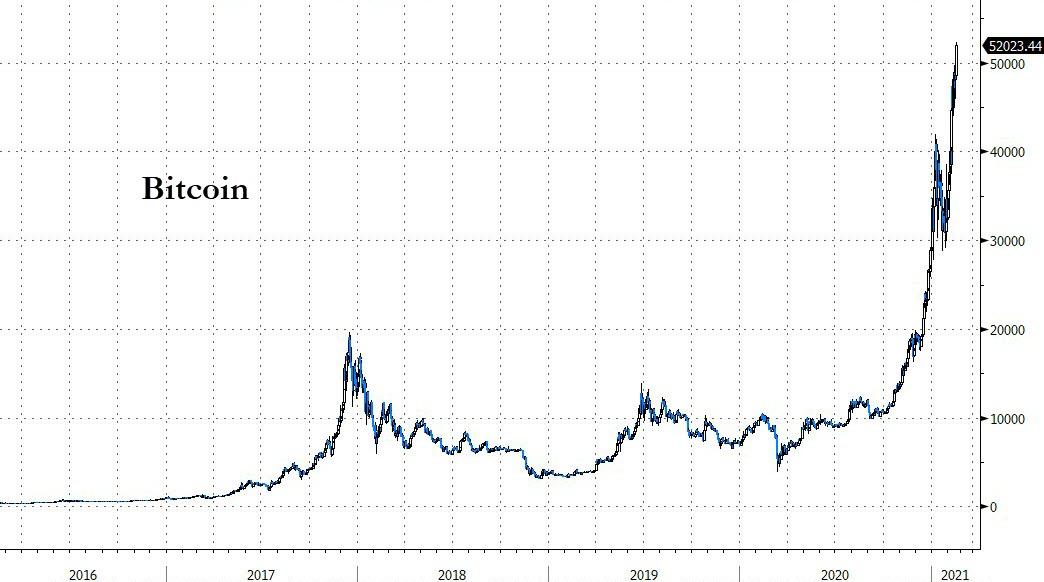
Bitcoin Roars To Record Highs As Inflation Soars, Bond ‘Rout’ Stalls
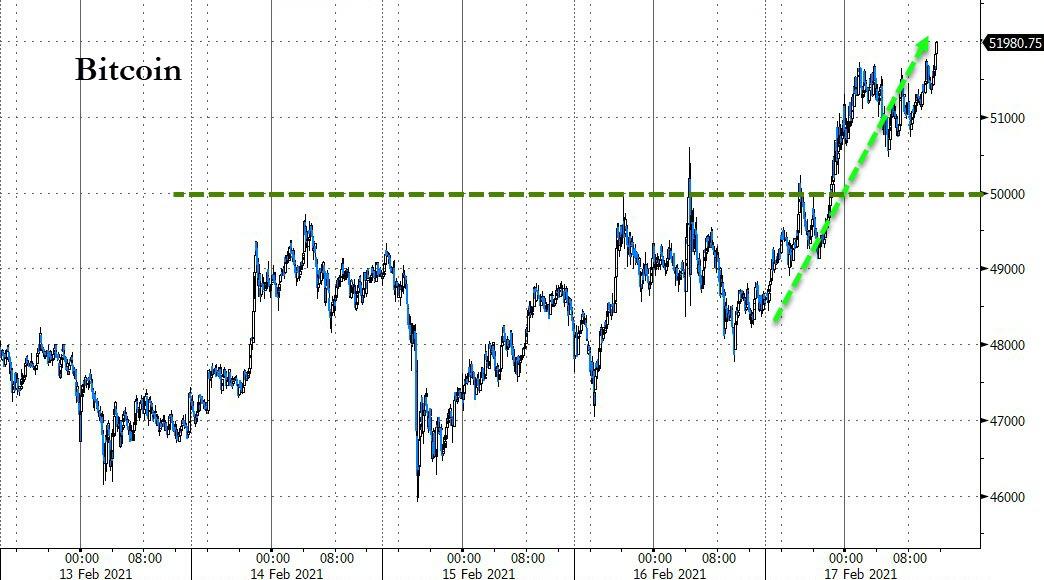
Crypto stole the headlines today as Bitcoin roared above $52,000…
Source: Bloomberg
Record-er and record-er!
Source: Bloomberg
…bang, zoom, to the moon, Alice!
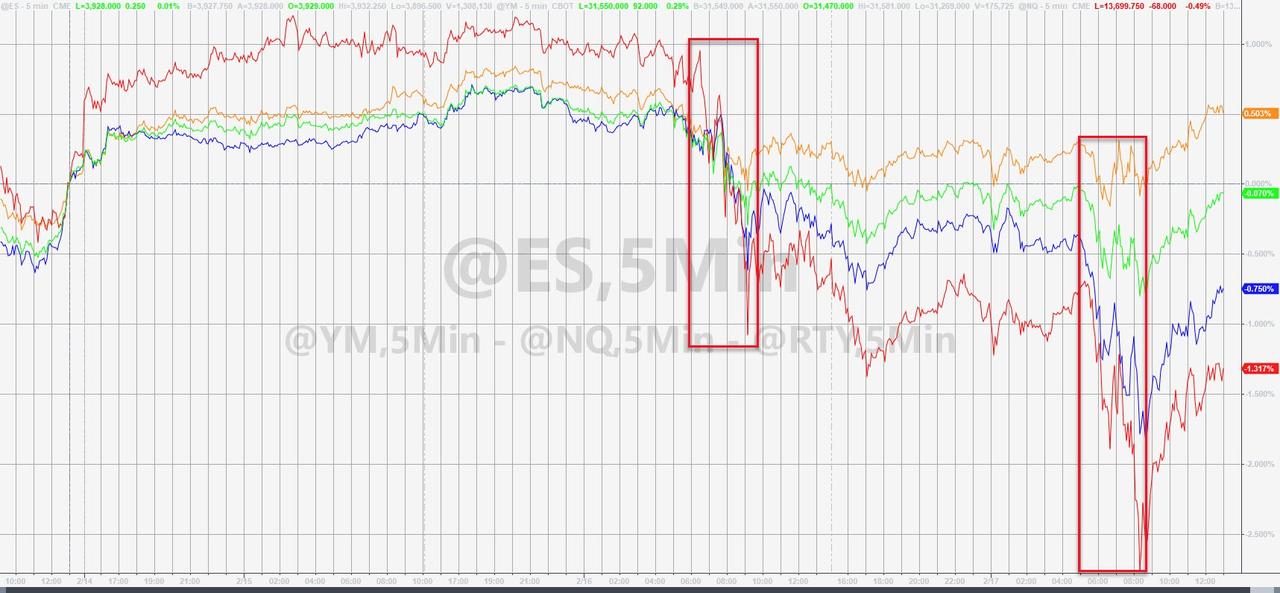
Stocks were ugly early on amid surging retail sales and inflation data, rebounded into the FOMC Minutes but rolled over after that as the minutes showed “The staff assessed asset valuation pressures as elevated.”
The Dow (orange) managed gains on the day to a new record high (and is the only major index higher from Friday). Small Caps (red) and Nasdaq (blue) are the laggards with the S&P (green) scrambling back to unch on the week…
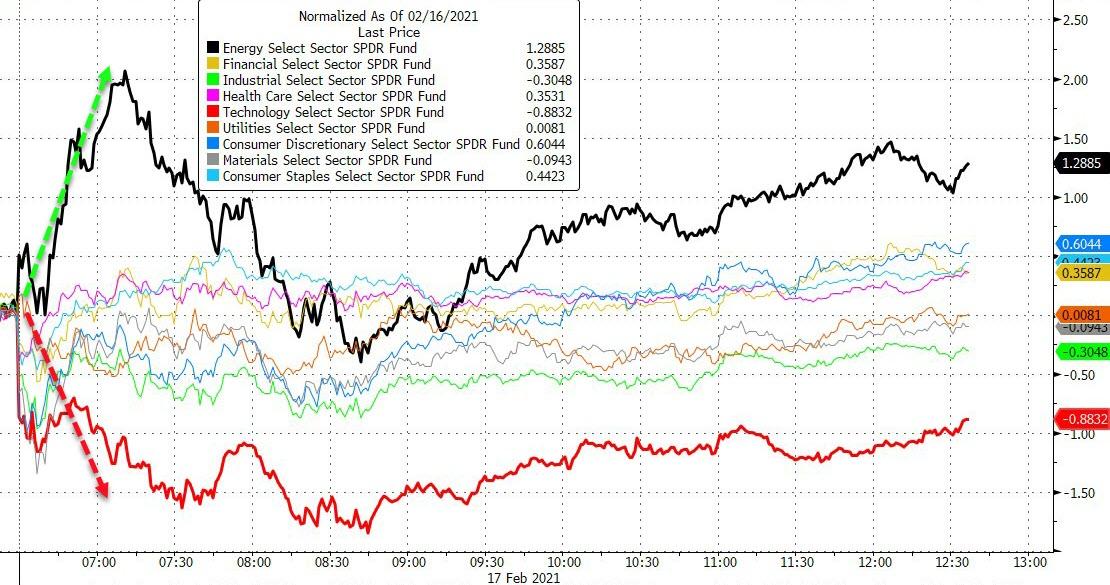
Energy stocks outperformed (again) as Tech lagged today…
Source: Bloomberg
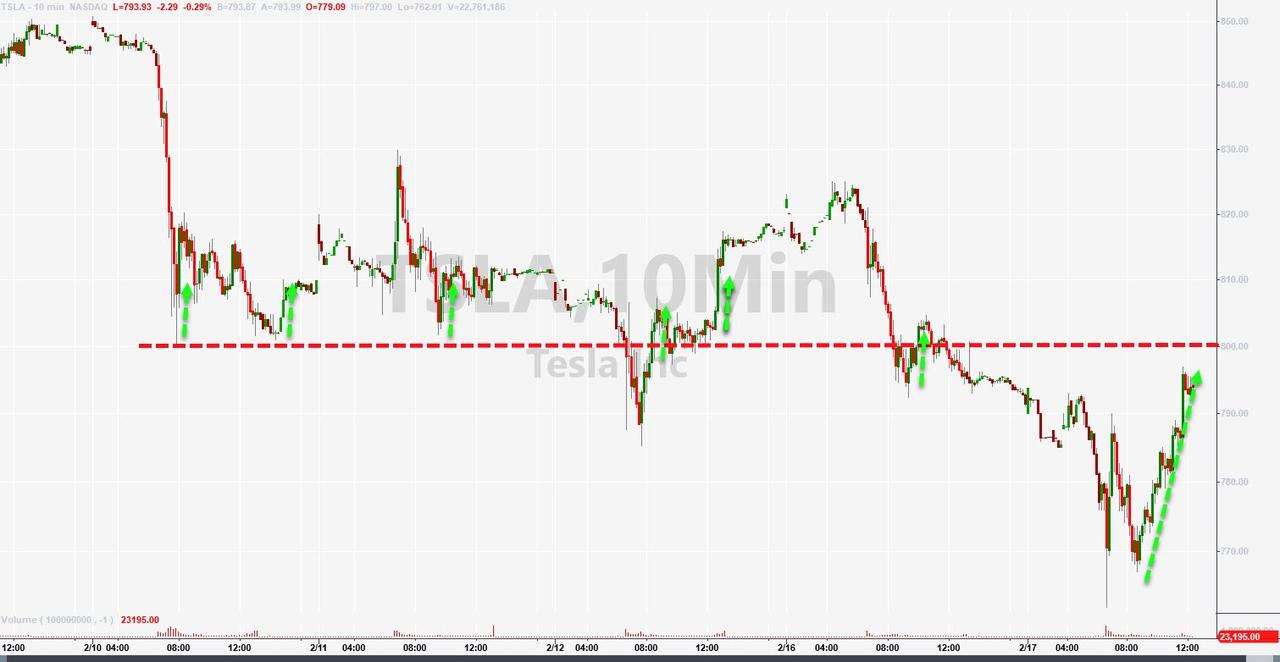
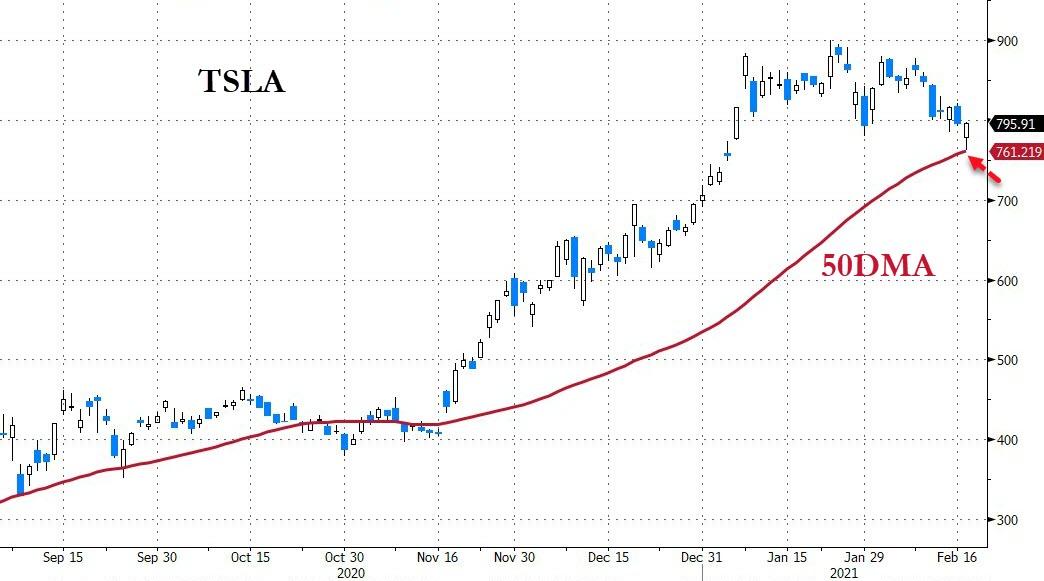
The $800 pin on TSLA remains (with a big rebound today after an early puke)…
The bounce in TSLA was perfectly off its 50DMA…
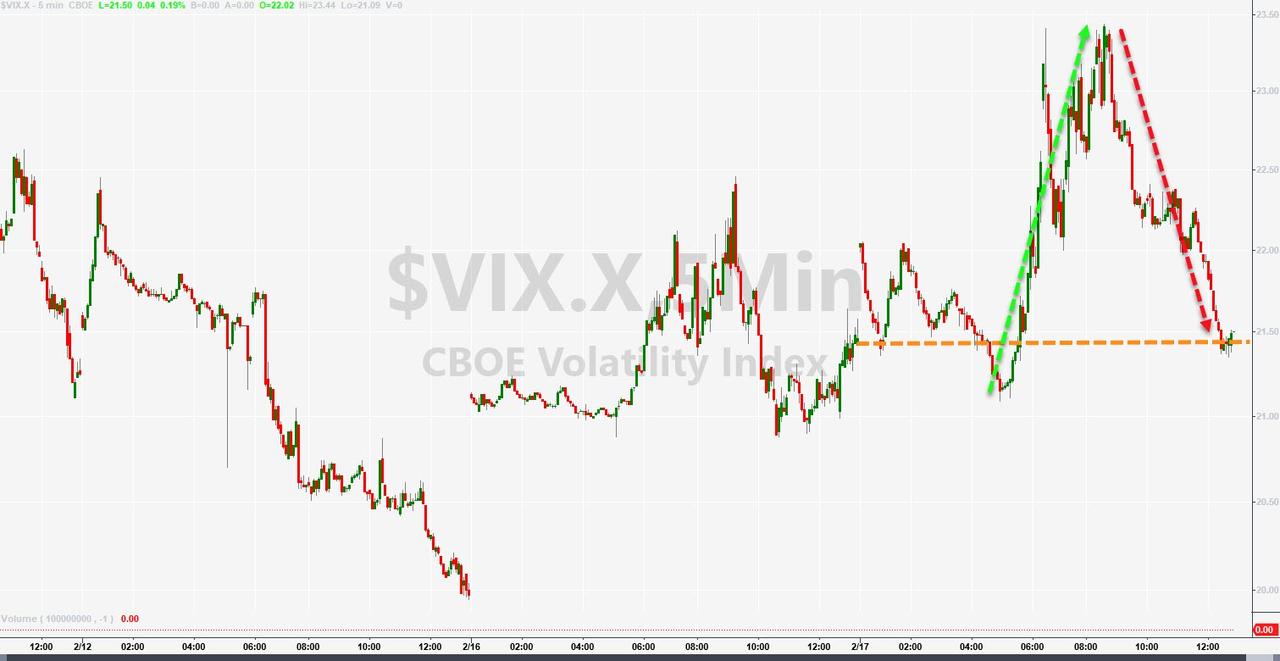
VIX chopped around and despite some ugliness in stocks ended almost unch…
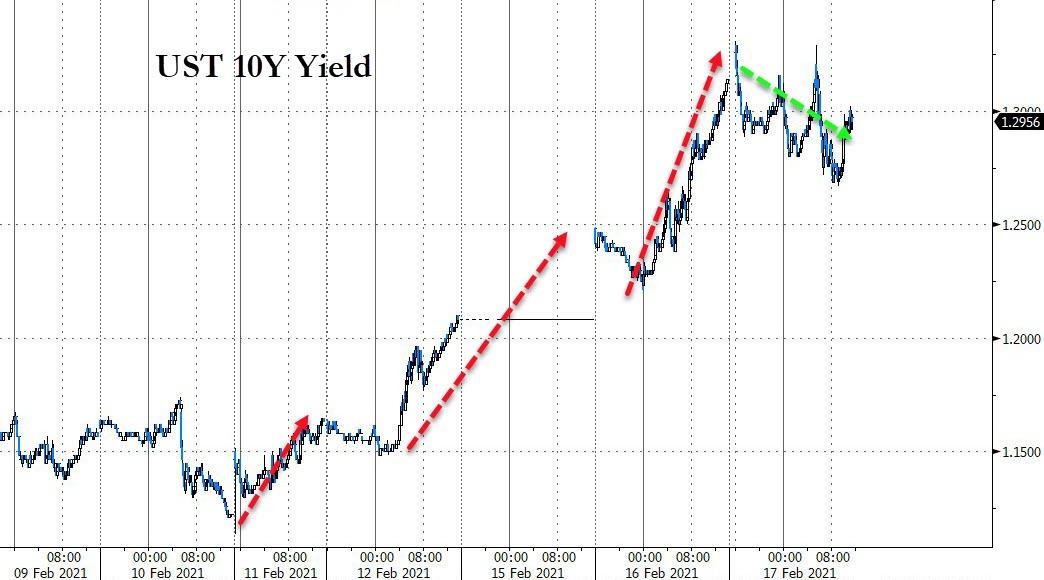
After three ugly days in bond land (and despite really ugly 20Y auction – with a 2.3bps tail!), the ‘rout’ ended (for now) today…
Source: Bloomberg
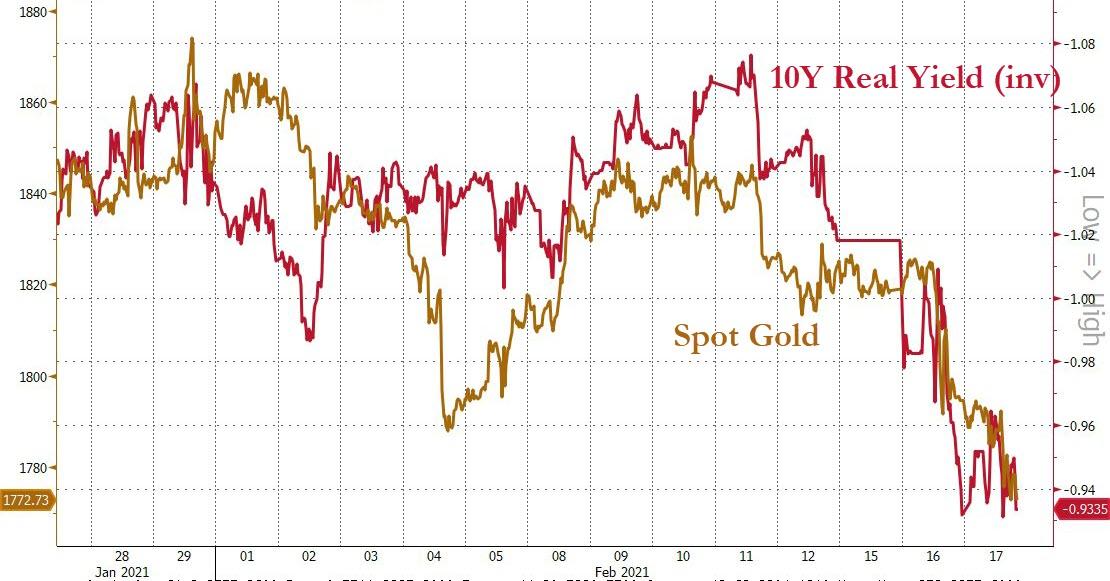
Real yields continue to surge (dragging down gold)…
“This means the economy is on the mend; so it’s not unhealthy that real yields are rising,” said Mark Holman, chief executive officer at TwentyFour Asset Management.
“But I caution that if real yields rise too quickly, then that’s a problem for all asset classes. It’s the speed of the change that could be a worry.”
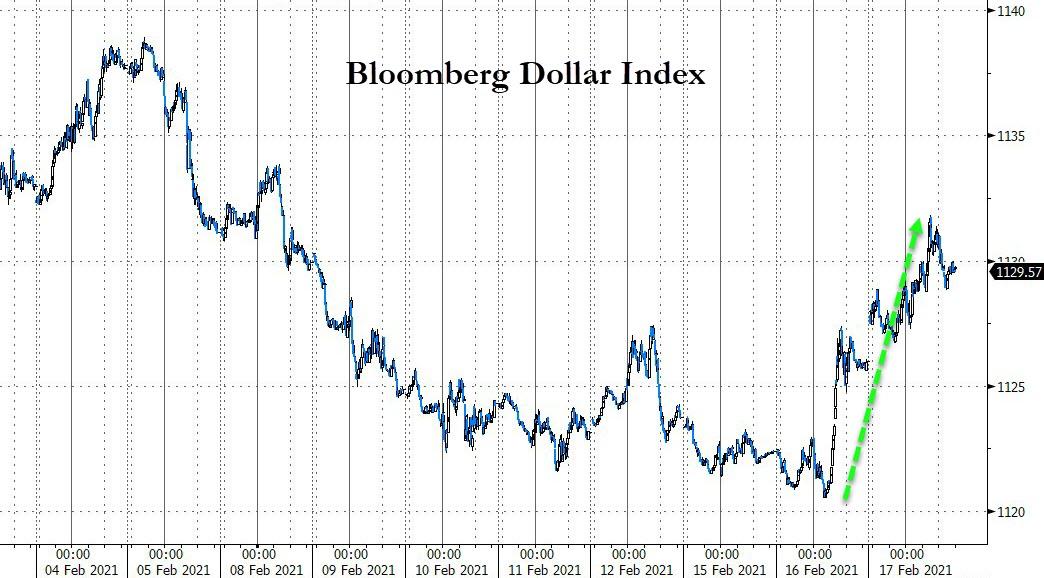
The dollar extended yesterday’s gains, back to one week highs…
Source: Bloomberg
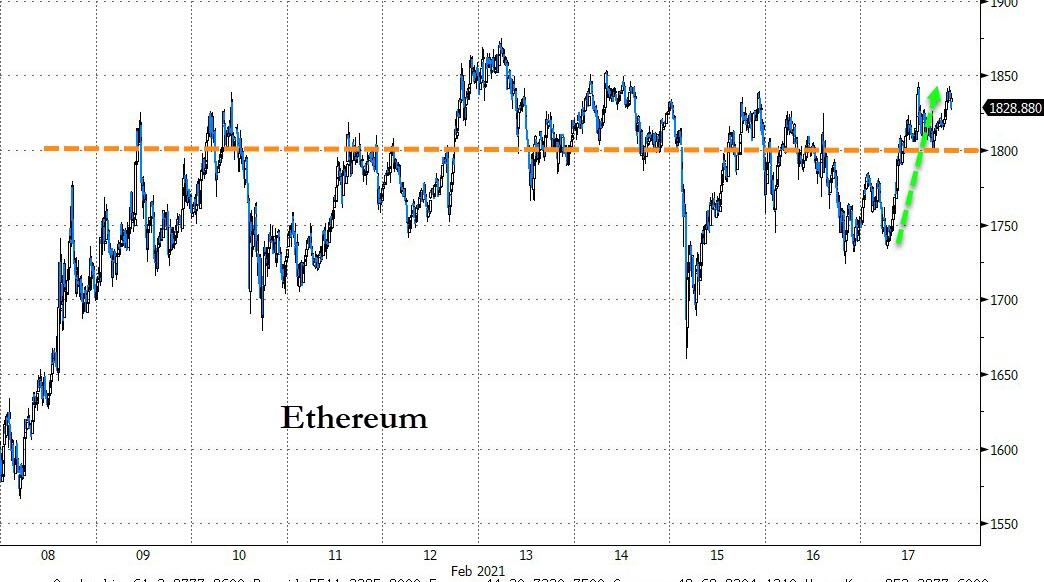
While Bitcoin was stealing the headlines, Ethereum push back up near record highs once again…
Source: Bloomberg
US crude production has crashed by 4 mm b/d, almost 40% of total production as Permian freezes but headlines that Saudi would increase production took the shine off a big day for oil prices, but that didn’t last long as the machines wanted to close WTI above $61 ahead of tonight’s delayed API inventory data…
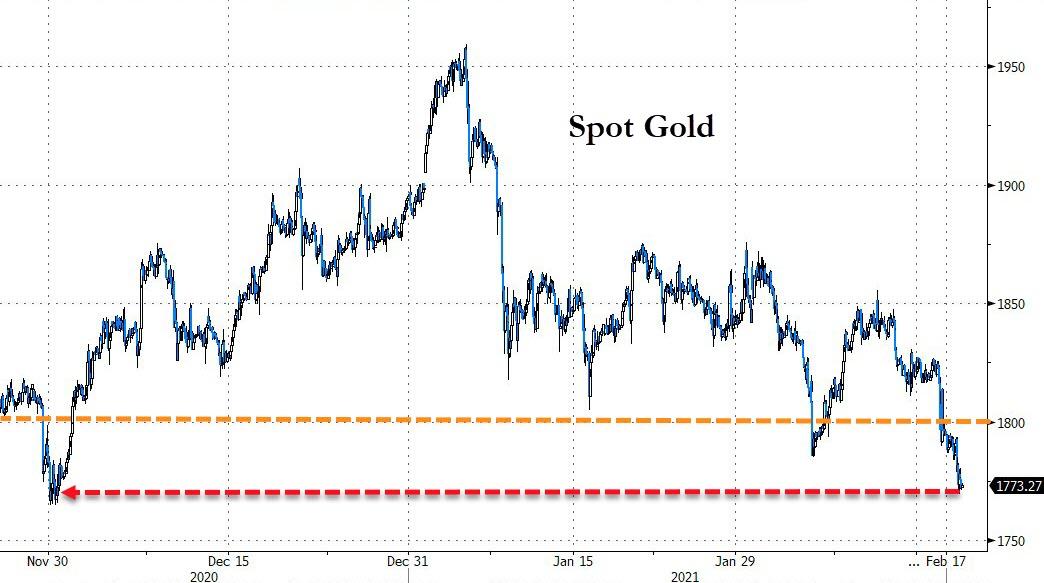
Gold was clubbed like a baby seal as the dollar and bitcoin ripped, with spot breaking back below $1800 to its lowest since Nov 2020…
Source: Bloomberg
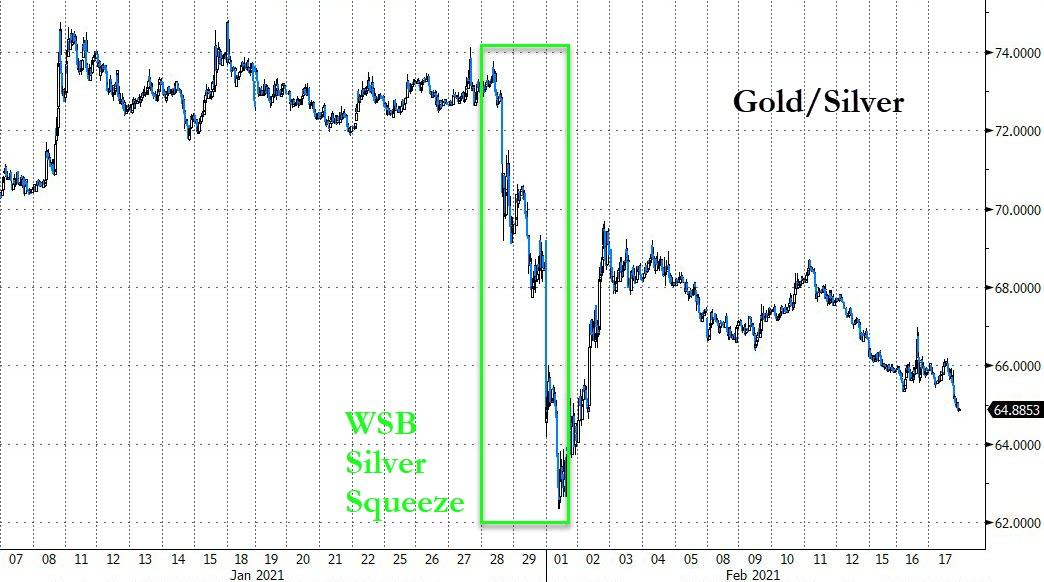
And while gold sank, silver managed gains – a very different picture to the gold chart over the same period…
Source: Bloomberg
Sending the Gold/Silver ratio back towards recent lows (lowest since 2014)…
Source: Bloomberg
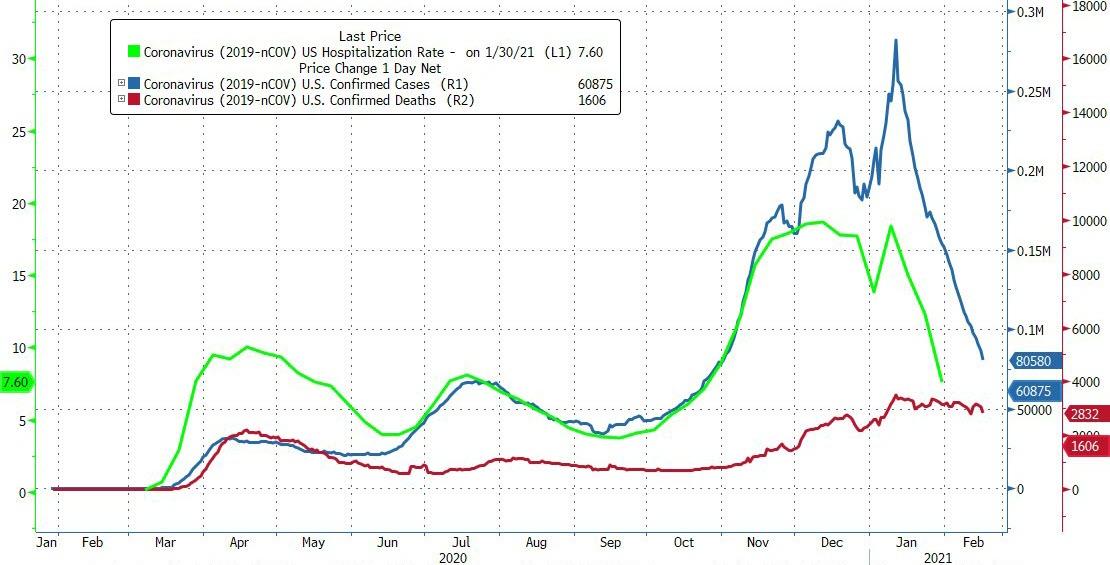
Finally, as stocks and bitcoin soar, the greatest news is that marginal COVID cases, hospitalizations, and deaths are all tumbling…
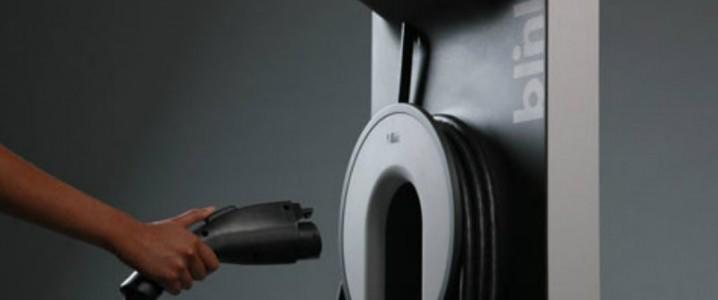
The electricity shortage in Texas amid the cold snap has sent spot electricity prices soaring so much that the surge in power prices equals a cost of $900 for charging a Tesla.
The typical full charge of a Tesla costs around $18 using a Level 1 or Level 2 charger at home, according to estimates from The Drive. This estimate is based on an average price of $0.14 per kWh of power.
However, the extreme winter weather this week has sent Texas spot electricity prices soaring, as the wind turbines froze in the ice storms and reduced the wind power generating capacity in the Lone Star State by half.
Spot electricity prices at the West hub have soared above the grid’s $9,000 per megawatt-hour cap, compared to a ‘normal’ price of $25 per megawatt-hour, FOX Business notes.
The Electric Reliability Council of Texas (ERCOT) called early on Monday for rotating outages across the state as extreme winter weather forced wind power generating units offline, while electricity demand set a new winter peak record.
At the same time, freezing cold and ice storms cut offline almost half of the wind power capacity in Texas.
“We are dealing with higher-than-normal generation outages due to frozen wind turbines and limited natural gas supplies available to generating units,” ERCOT said.
In Texas, wind power generation overtook coal-fired generation in 2020 for the first time ever, with wind power now accounting for 25 percent of the Texas electricity generation. Natural gas-fired power generation is the leading source of electricity in Texas, with more than 45 percent share.
While oil-and-gas rich Texas is the leading U.S. state for wind power installations, the frozen turbines in the Arctic weather have strained the grid so much that rolling outages in Texas continue for a second consecutive day.
“The wind-dependent Texas grid is experiencing rolling blackouts, prices the equivalent of $900 per Tesla charge, and an expected supply shortage of 10 GW–the amount of electricity needed to power 5 million homes,” Alex Epstein, Founder of Center for Industrial Progress, tweeted today.
Meanwhile, ERCOT’s Senior Director of System Operations, Dan Woodfin, said on Tuesday morning that “The number of controlled outages we have to do remains high. We are optimistic that we will be able to reduce the number throughout the day.”
Below, find remarks from Keith Gill, a Youtuber/Redditor best known as “RoaringKitty”. In his testimony, the trader insists that he still believes in his “fundamental case” for being long Gamestop, and insists he didn’t try and pump the shares purely for his own profit.
In his testimony, Gill recounts how his family had an “incredibly difficult” 2020 after losing his sister to COVID.
“I did not solicit anyone to buy or sell the stock for my own profit. I did not belong to any groups trying to create movements in the stock price. I never had a financial relationship with any hedge fund. I had no information about GameStop except what was public. I did not know any people inside the company, and I never spoke to any insider. As an individual investor, I use publicly available information to study the market and the value of specific companies.”
He added that sharing the news with his family about his newfound financial success – that “we were now millionaires” – gave him tremendous joy.
In remarks from Melvin Capital chief Gabriel Plotkin,the hedge funder insists his firm learned a painful lesson from its GameStop short position, though he insisted it wasn’t “bailed out”.
He starts by noting that his firm had nothing to do with Robinhood’s decision to pause trading in Gamestop, and that “it is very important to understand that absolutely none of Melvin’s short positions are part of any effort to artificially depress or manipulate downward the price of a stock.”
“When our research suggests a company will not live up to expectations and its stock price is over-valued, we might “short” a stock . Like with our long positions, our practice is to short a stock for the long term after extensive research. We also short stocks because when the markets go down, we have a duty to protect our investors’ capital. There are laws governing shorting stock, and of course we always follow them. In addition, it is very important to understand that absolutely none of Melvin’s short positions are part of any effort to artificially depress or manipulate downward the price of a stock. And nothing about our short position prevents a company from achieving its objectives.”
Read the rest of his full remarks below:
Finally, Robinhead co-founder and CEO Vlad Tenev claims that the events of that day, when the price of Gamestop shares soared above $300, were extraordinary, and that the firm did what it did to its clients – cutting off orders in certain “meme stocks” due to – as he has insisted many times before – clearing-related requirements.
“Robinhood has changed the investing world for the better”, Tenev insists:
“What we experienced last month was extraordinary, and the trading limits we put in place on GameStop and other stocks were necessary to allow us to continue to meet the clearinghouse deposit requirements that we pay to support customer trading on our platform. We have since taken steps to raise $3.4 billion in additional capital to allow our customers to resume normal trading across Robinhood’s platform, including trading in the stocks we restricted on January 28. We look forward to continuing to serve our customers”
Read his remarks below:
But as we noted earlier, the biggest star/target in tomorrow’s hearing is Citadel founder/billionaire Ken Griffin, whose testimony has not yet been released.