Goldman Board Slashes CEO Solomon’s Pay By 36% In 2020 Amidst 1MDB Scandal

Goldman Board Slashes CEO Solomon’s Pay By 36% In 2020 Amidst 1MDB Scandal

Goldman Sachs has slashed the pay of its CEO for 2020 amidst the investment bank’s involvement in the 1MDB scandal, which we covered in depth here. The scandal wound up costing the bank a total of $2.2 billion plus an additional $600 million in fines. 

And it cost CEO David Solomon a 36% pay cut. 

Goldman’s board reduced Solomon’s pay package to $17.5 million for 2020, which is down from $27.5 million a year earlier. Hilariously, his $17.5 million payday came after he made “amends for the firm’s criminal role in the looting of the Malaysian investment fund,” Bloomberg wrote. Ex the $10 million penalty, his salary was basically flat year over year.

Goldman also cut the pay of its COO by $6 million and its CFO by $7 million. They raked in $18.5 million and $15.5 million, respectively. 

As we’ve chronicled over the past few years, many of the bank’s top executives appeared to have been personally involved with the 1MDB scandal, which was initially brought in by Tim Leissner, formerly the bank’s top man in Southeast Asia, before he was suspended over the deal, before agreeing to cooperate with the Feds against his former employer (where he reportedly told authorities about the endemic “culture of corruption” at play within the bank).

Though we can’t be certain, we suspect that the timing of former Goldman chief Lloyd Blankfein’s departure was influenced by the unfurling scandal; he suddenly left the bank right around the time that Leissner flipped.

Solomon’s flat “adjusted” earnings for the year falls in line with other major bank CEOs so far. Days ago we noted that Morgan Stanley’s CEO James Gorman passed J.P. Morgan’s Jamie Dimon in total compensation for 2020, racking up $33 million in salary.

The 2020 take marked a 22% rise in Gorman’s pay from the year prior, where he had taken a pay cut to align himself with company layoffs. In 2020, Morgan Stanley posted its “third consecutive year of record earnings”, according to Bloomberg

Recall, we also noted late last week that competitor Jamie Dimon’s salary had held steady for 2020 at $31.5 million. 

J.P. Morgan noted that “amid the unprecedented health and economic consequences of Covid-19” it was also still able to post record revenue and hold a strong balance sheet, even while provisioning $12 billion for credit losses. Its shares wound up down 8% for the year, despite a weeks-long rally to end the year. 

Dimon’s pay package similarly included $1.5 million base pay, a $5 million bonus and $25 million in “performance share units” that vest over time.

Tyler Durden
Wed, 01/27/2021 – 09:32

via ZeroHedge News https://ift.tt/2NIkYWL Tyler Durden

Instability

Instability

Authored by Sven Henrich via NorthmanTrader.com,

In every century the same thing happens at one point or another. Society loses the plot and gets caught up in a mania, a grandiose exercise in self delusion. It can be political, it can be religious, and yes it can be economic. Sometimes these manias are confined to regions or small groups of people, sometimes they are vast in reach and impact and have global consequences. We can all think of examples. Religious? How about witch burnings? Politics? How about Nazism? Economics? How about all the manias that had fervent believers and adherents that with the hindsight of time were completely insane? The South Sea Bubble, the Tulip mania, the 1929 mania, etc. All of these bringing about vast social instability versus the previous status quo with often disastrous consequences.

And whatever we got going here is now approaching a similar frantic delusion that appears to infect everyone.

All of these manic periods have something in common: Believing in something absolutely even though it is either completely wrong or unrealistic. Seeing reality becoming untethered.

I’ve long argued that central banks aiming to be a stabilizing force are actually bringing about societal instability. Occupy Wall Street, Black Lives Matter, the storming of the Capitol, angry Trump voters, angry Democrat voters and yes even Gamestop reddit buyers may all have different causes and triggers and motivations, but they actually have one thing in common: They are angry, angry at a system that has screwed them over, a sense of deep pervasive injustice and inequality, a fissure that keeps widening with every central bank intervention program.

Think I’m kidding? Here’s John Authors via Bloomberg who sees anger as part of this picture: 

“The people investing today are driven by righteous anger, about generational injustice, about what they see as the corruption and unfairness of the way banks were bailed out in 2008 without having to pay legal penalties later, and about lacerating poverty and inequality. This makes it unlike any of the speculative rallies and crashes that have preceded it.”

Bitcoin? It too has positioned itself as rage against the establishment. See, it’s all part of the same thread, needle and trade.

Gamestop of course has the added benefit of seeing select billionaires enjoying fueling the flames:

The great gamification of the stock market. Anything goes:

Oh the hypocrisy of it all, if there was an organized effort to take down a stock price and aided by billionaires via their twitter feeds the SEC would be all over it & the outrage widespread, but because it’s just squeezing a short hedge fund it’s all glee & giggles.

We reach a point where nothing matters. Valuations, fundamentals, forward multiples who cares. Just create short squeezes in everything and it’s working. For now. After all the most shorted stocks are flying to the moon never mind that there are fundamental reasons as to why there are short positions in these stocks to begin with: They are shitty companies. Gamestop being one of them.

And the hallmark of any bubble: It’s infectious and it’s easy to get caught up in it. The prospect of massive wealth gains from nothing is causing millions to join the fray in the ultimate fomo trade: We can all become rich overnight.

And that’s how bubbles burst, everybody is long the same trade until it collapses. What about the systemic risks? One hedge fund blows up it’s a fun headline, multiple hedge funds blow up and it can cause a ripple of financial instability. May I remind everyone of 2008?

Yes it is temping to get caught up in a mania, but there is a fine line between responsible financial journalism and financial sensationalism and when you overtly endorse and justify such manias by throwing out the pretense of financial analysis and make everything about permanent multiple expansion based on imagined future money flows you cross that line and we see this everywhere now. That’s how manias feed on itself. The price action becomes impossible to rationalize with fundamentals and so new unrealistic narratives are invented to justify the price action.

Everybody was a genius in 2000 and the apologists will run people off the cliff counting on the fact that ultimately the Fed bails out bad calls.

These are dangerous times  both for longs and shorts as no one can know when the bubble pops and how quickly it’ll collapse on its own weight.

Every bubble has its moment of, ok maybe this is stupid, maybe this is getting too far, maybe now is the time to take some money off the table and then suddenly selling begets selling and the whole thing collapses.

I don’t know if this is the moment but it might as well be, indeed some are getting concerned at precisely this moment:

Perhaps a sign, perhaps not. We can only know in hindsight.

For now the mood is this:

Best of luck everyone.

For the latest public analysis please visit NorthmanTrader. To subscribe to our market products please visit Services.

Tyler Durden
Wed, 01/27/2021 – 09:10

via ZeroHedge News https://ift.tt/39kb6eb Tyler Durden

Boeing Plunges After Unexpected 777X Delay; Cash Inferno Continues

Boeing Plunges After Unexpected 777X Delay; Cash Inferno Continues

One quarter after Boeing announced it would fire 11,000 workers in hopes to stem its massive cash burn (which in Q3 hit $5 billion), moments ago Boeing gave an update on how its attempt to halt the melting of the ice-cube is going. Alas… not good.
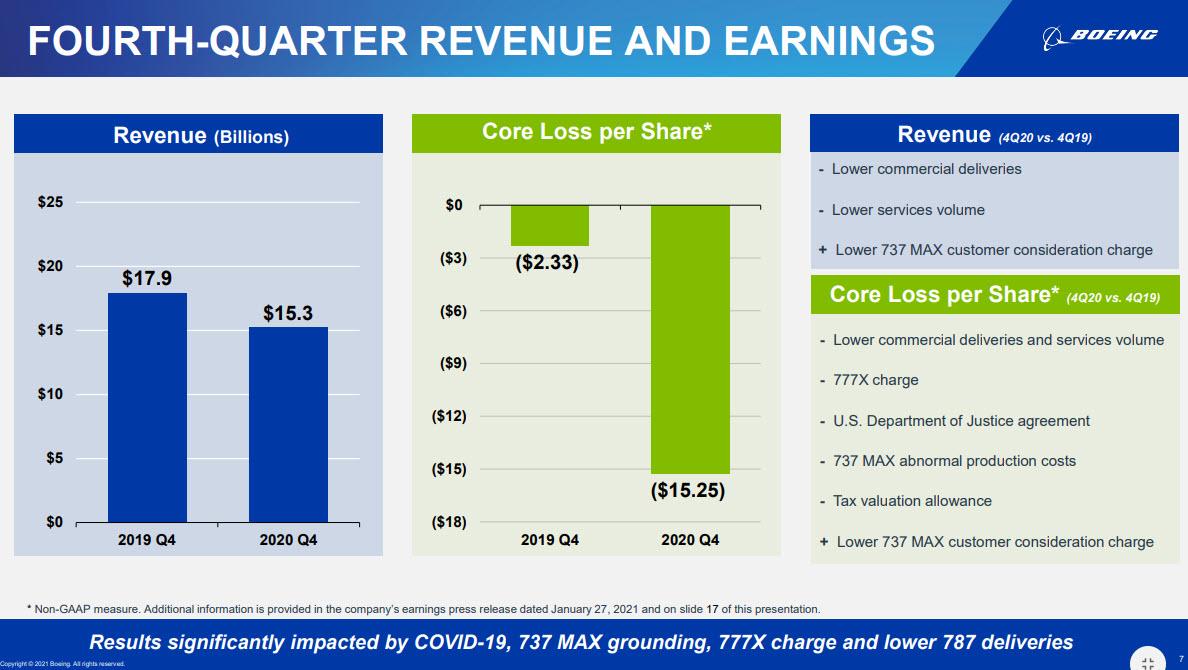
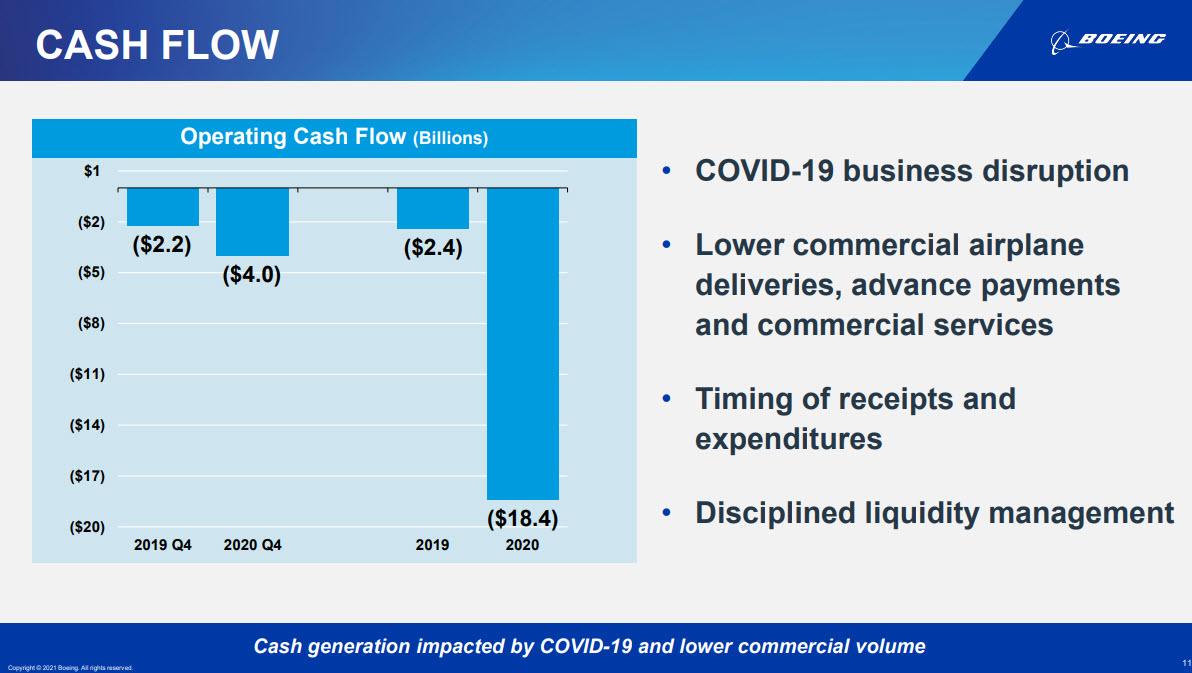
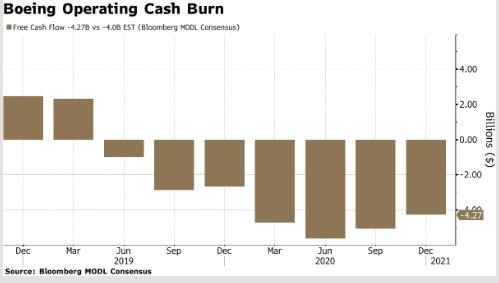
In Q4, the company reported revenue of $15.30BN, down from $17.9BN a year ago, if slightly ahead of est. of $15.09BN. The loss per share – which exploded – was meaningless, soaring to ($15.25) in Q4 up over 7x from the Loss of $2.33 a year ago, and clearly irrelevant in the context of the ($1.80 exp), largely as a result of another massive charge taken by the company due to delays on the 777X program.  Meanwhile Boeing’s attempts to stem its massive cash burn continue to fail, with the company’s free cash burn in Q4 at $4.27Bn, more than the $4BN estimate, and a record $18.4Bn for the full year.

And while everyone knows about the company’s struggles with the 737MAX and covid, the big surprise this quarter was the headline charge on one of the day’s big announcements: the delay of the 777X. The first delivery of the behemoth wide-body jet now won’t be made until late 2023. The program took a $6.5 billion charge, Boeing said.  Some other Highlights from the quarter:

  • Boeing Says 777X Program Recorded $6.5B Pretax Charge in 4Q
  • Boeing Says First 777X Delivery Expected in Late 2023
  • Boeing 4Q Neg Oper Cash Flow $4.01B, Est. Negative $3.98B
  • Boeing 4Q Adj Free Cash Burn $4.27B, Est. Burn $4B
  • Boeing 4Q Neg Adj Free Cash Flow $4.27B, Est. Negative $4B

This is what CEO Calhoun said about the quarter:

“The deep impact of the pandemic on commercial air travel, coupled with the 737 MAX grounding, challenged our results,” Calhoun said. “While the impact of COVID-19 presents continued challenges for commercial aerospace into 2021, we remain confident in our future, squarely-focused on safety, quality and transparency as we rebuild trust and transform our business.”

The company also reported that in Q4 total Commercial Planes Deliveries 59, slightly ahead of the estimated 58.60.

Some other highlights from the quarter:

  • Boeing:Will Continue With Actions in Yr to Preserve Liquidity
  • Boeing Sees Revenue, Operating Cash Flow Improving vs 2020

CEO Dave Calhoun gave some more color on the decision to delay the market debut of the company’s next new jet, the 777X, by about a year to late 2023.

“This schedule, and the associated financial impact, reflects a number of factors, including an updated assessment of global certification requirements, our latest assessment of COVID-19 impacts on market demand, and discussions with customers with respect to aircraft delivery timing. We remain confident in the 777X and the unmatched capabilities and value it will offer our customers,” he said in a message to employees.

Perhaps the delay should have been expected: Boeing cited the pandemic’s impact on market demand and “an updated assessment of global certification requirements” as reasons for the pushed-out launch. This will be the first plane scrutinized by the FAA since the Max debacle, and the regulator is going to carefully review every inch of the plane according to Bloomberg.

Just as troubling: there was no explanation from Calhoun why Boeing hasn’t delivered any of its 787 Dreamliners since mid-October. The company indicated in December that it had broadened inspections for tiny manufacturing defects in the jets’ carbon-composite frames, a process that involves ripping out interiors, in some cases.

“We also launched comprehensive production inspections of our 787 airplanes to ensure that each meets our rigorous engineering specifications prior to delivery, as we also drive stability in our production system to be better positioned for market recovery,” Calhoun told employees.

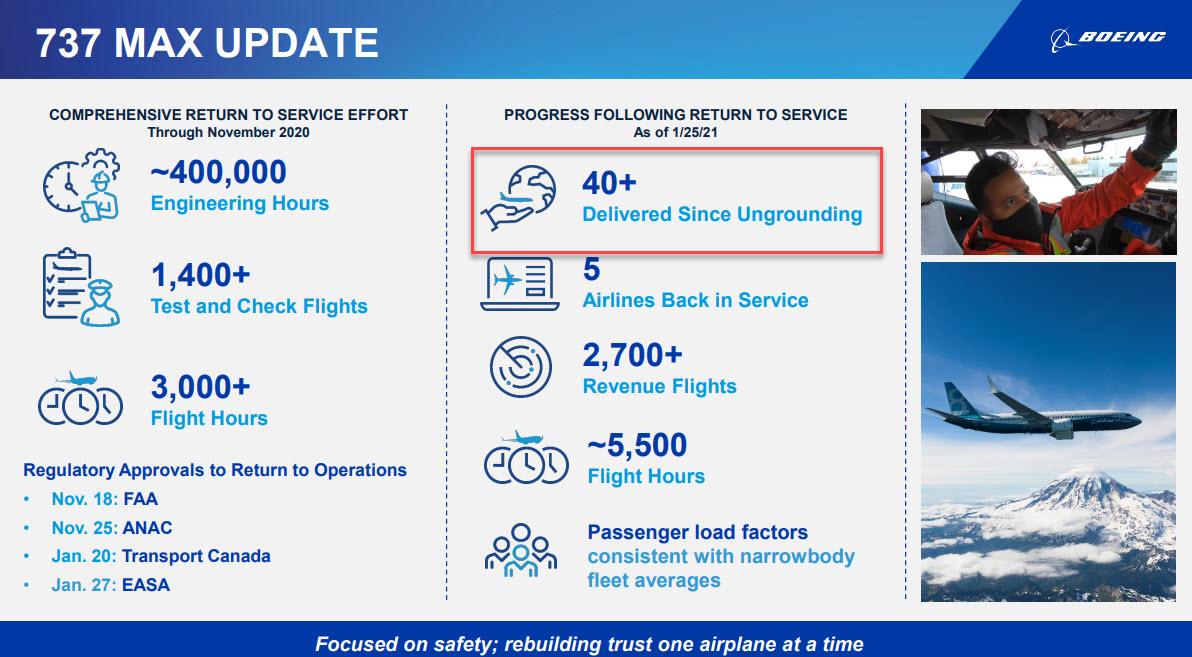
There was one encouraging sign in Boeing’s earnings report, that it has delivered 40 of its 737 Max planes since the U.S. grounding ended in November. Five airlines have returned the plane to service. Boeing has hundreds of Max jets that are built but undelivered. With the grounding ending, the company can start shipping them to customers and turning them into cash.

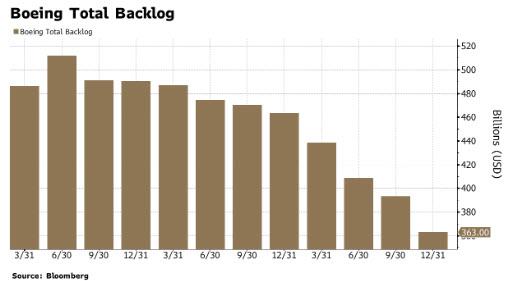
Unfortunately, that’s not nearly enough, and as Bloomberg notes, the company’s total backlog was about $363 billion at the end of 2020, down roughly $100 billion from a year earlier. The biggest decline was in the commercial aerospace division. This reflects a wave of cancellations for the Max jet as the prolonged grounding gave customers more room to negotiate when the pandemic hit.


And as the pandemic rages, commercial aircraft revenues continue to be smothered, and the result is lower wide-body volume because of Covid-19, 787 production issues and grounded Maxes sent jetliner deliveries to their worst level in decades. The tally? Commercial aircraft revenue dropped in half last year to $16.1 billion.

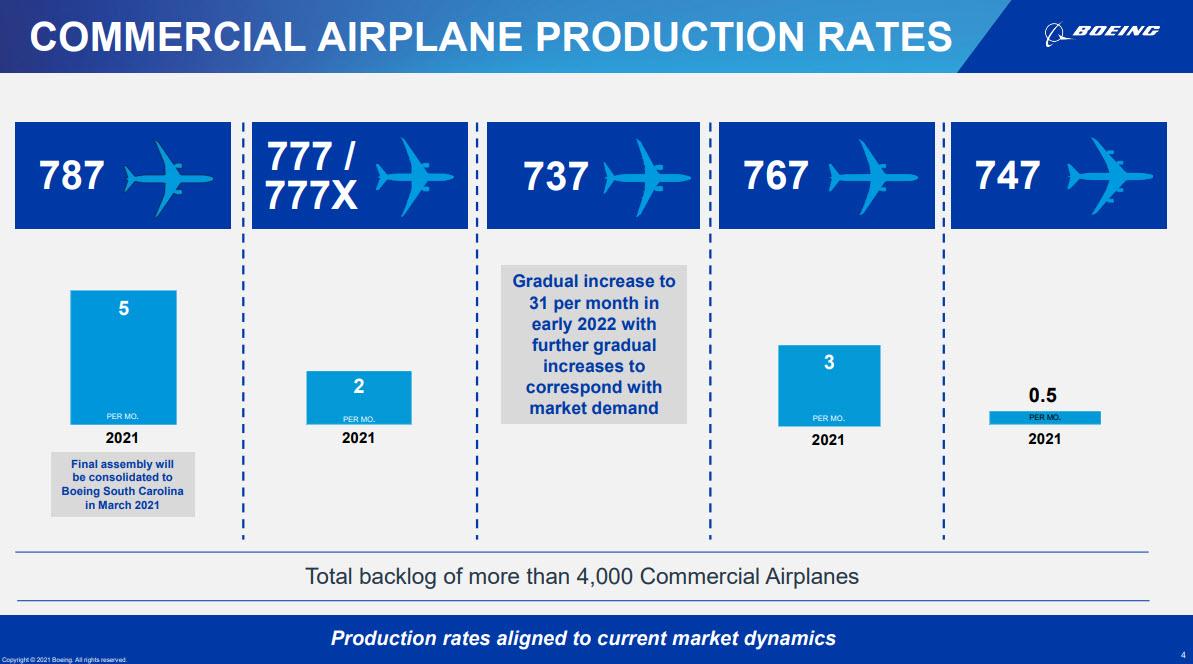
As an aside, Boeing has not changed its plans to speed production of the 737 to a 31-plane a month pace by early next year, “with further gradual increases to correspond with market demand.” That should a relief for investors after Airbus SE last week pared plans to increase output of the rival A320neo family.

As usual investor attention fell on the company cash flow, or rather cash burn, with Boeing burning another $4.3 billion in free cash in the fourth quarter, slightly more than the $4 billion cash use expected by analysts…

… bringing its full-year cash burn to $19.7 billion in 2020.

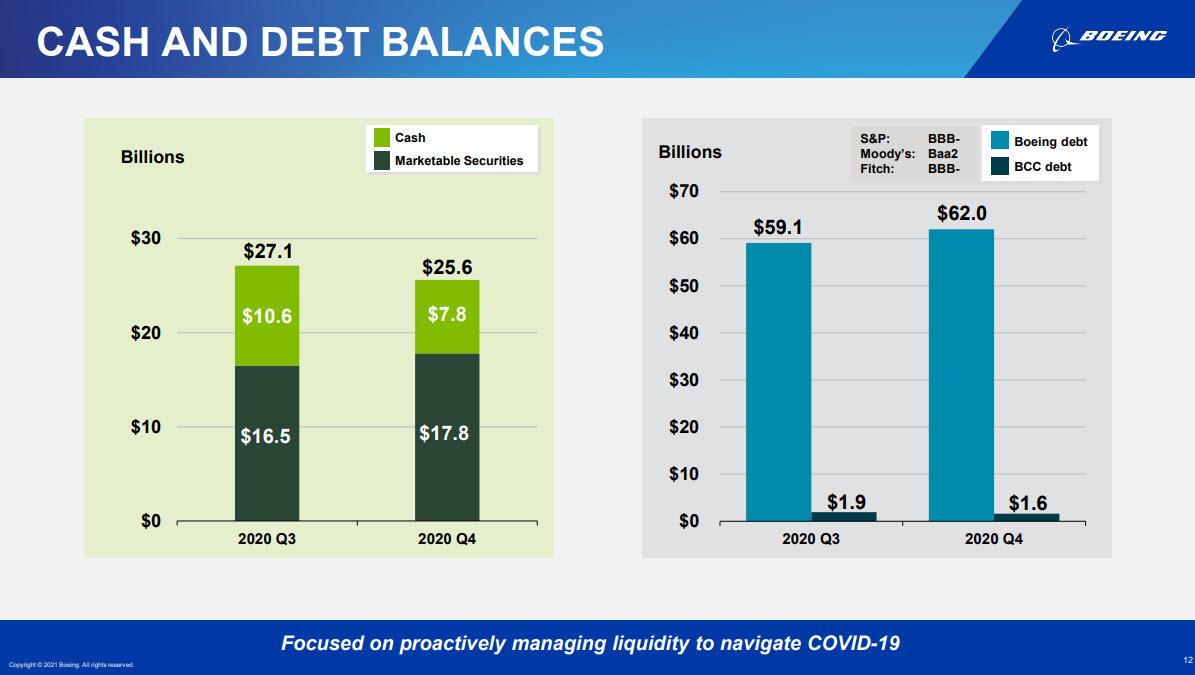
Amusingly, the company which two quarters ago was on the verge of collapse, still has an investment grade BBB-/Baa2 rating with a debt load which is now over $60 billion. Meanwhile, its cash declined by $2 billion in the quarter, from $27.1BN to $25.6BN.

Not boosting confidence was the continued lack of projections: once again Boeing failed to provide a detailed outlook for its 2021 results (for the simple reason that it can’t). That’s a contrast with two of its biggest suppliers, GE and Raytheon Technologies, which yesterday resumed providing financial guidance.

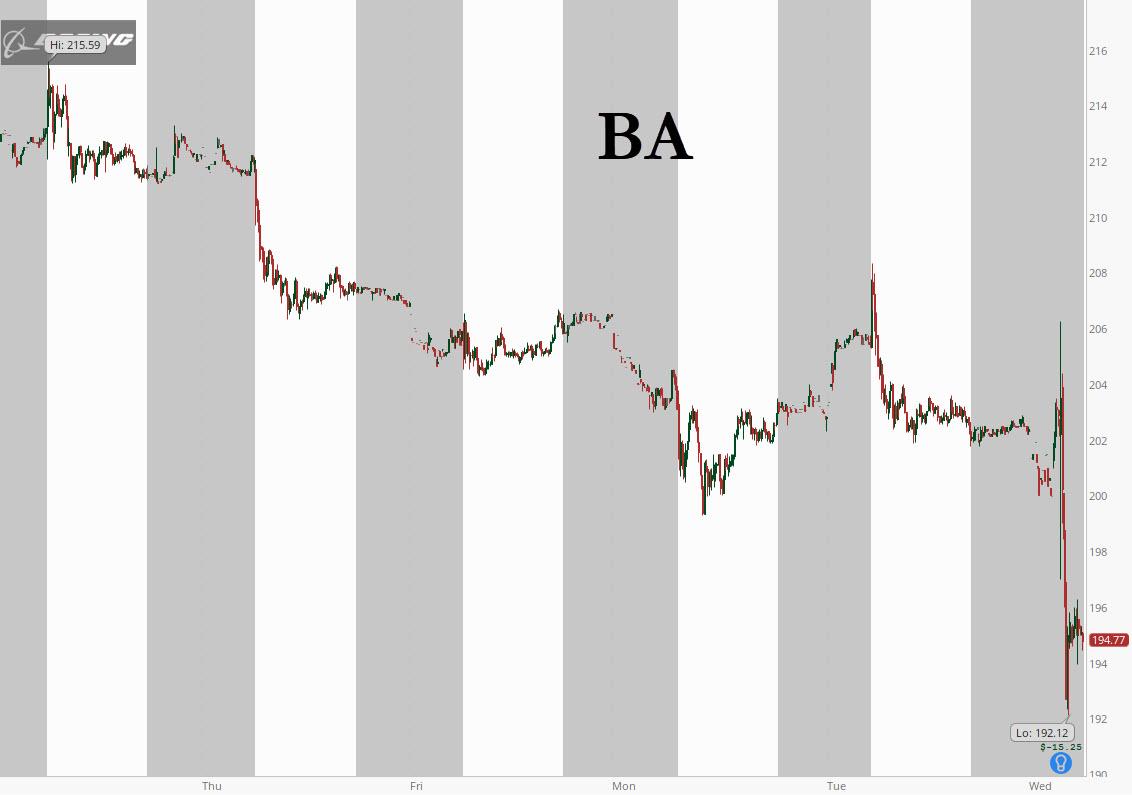
Bottom line: after surging higher in recent days, BA stock tumbled on yet another dismal quarter, and was last trading back under $200, at $194 after dropping as low as $192.

Tyler Durden
Wed, 01/27/2021 – 08:58

via ZeroHedge News https://ift.tt/3a7FVSy Tyler Durden

Bomb Squad Surrounds AstraZeneca Plant, Site Partiallly Evacuated

Bomb Squad Surrounds AstraZeneca Plant, Site Partiallly Evacuated

As if AstraZeneca’s squabbles with the EU and its pharma regulator weren’t bad enough, British police have dispatched a bomb squad to the the industrial estate where the AstraZeneca vaccine is made.

According to the BBC, police are dealing with an ongoing incident in North Wales where AZ’s Wrexham Industrial estate is located. The site now has a cordon that was reportedly placed near the Wrexhm Industrial estate.

Police said a cordon had been placed around the Wockhardt plant and the public have been asked to keep away. There are no reports of any injuries.

Doses of the vaccine, developed by Oxford-AstraZeneca, are produced and stored there.  North Wales Police said it was at Wrexham Industrial estate. The BBC reports that a bomb disposal unit has been called to deal with a suspicious package. There are no reports of any injuries.

The plant was reportedly evacuated after it received a suspicious package: “Upon expert advice we have partially evacuated the site pending a full investigation.”

The BBC understands that the bomb disposal unit is on site.

“All relevant authorities were immediately notified and engaged. Upon expert advice we have partially evacuated the site pending a full investigation,” he said. “The safety of our employees and business continuity remain of paramount importance.” The Wrexham plant has the capability to produce around 300MM doses of the vaccine a year.

Wockhardt UK entered an agreement in August to help prepare the vaccine for distribution, and the Welsh Government said there had been “no adverse effects” on the coronavirus vaccine roll-out.

Tyler Durden
Wed, 01/27/2021 – 08:37

via ZeroHedge News https://ift.tt/3t3UZZS Tyler Durden

Durable Goods Orders Disappoint In Preliminary January Data

Durable Goods Orders Disappoint In Preliminary January Data

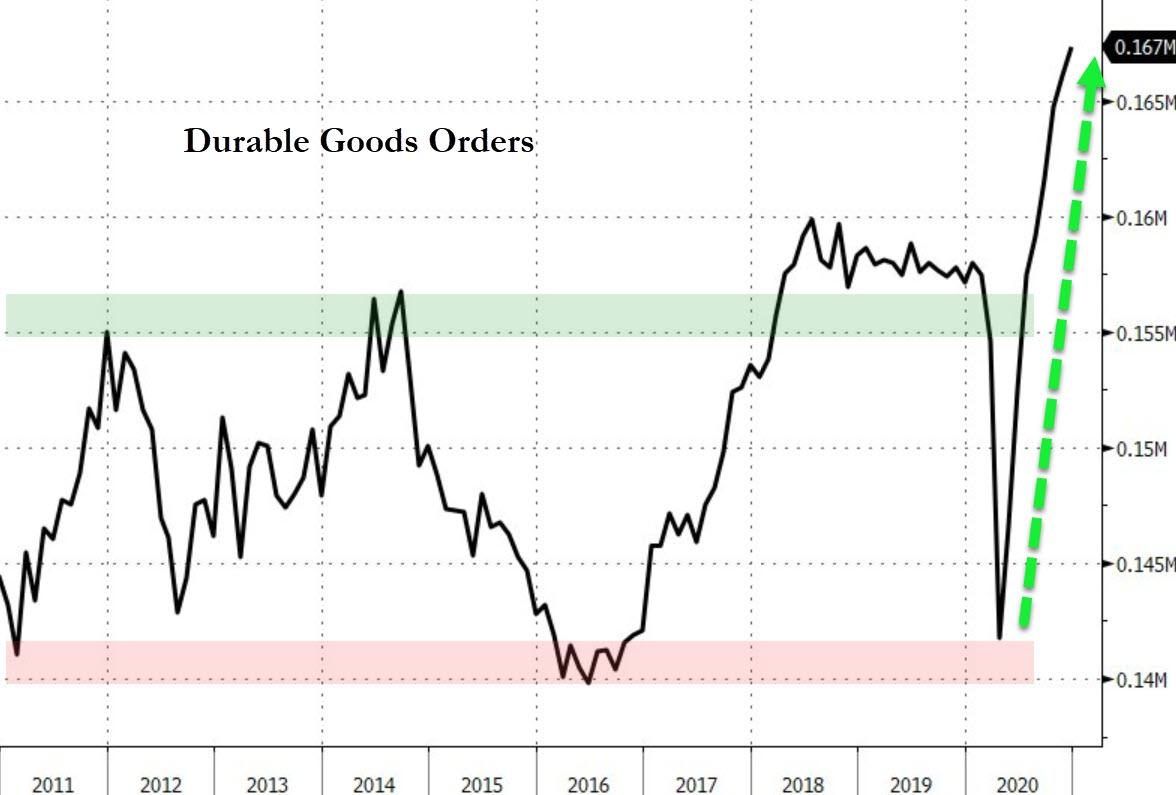
Durable Goods Orders were expected to rise (+1.0% MoM) for the 8th straight month in preliminary January data, but disappointed expectations for the first time since April by rising just 0.2% MoM.

Source: Bloomberg

Overall, durable goods orders have far surpassed the pre-COVID levels

Source: Bloomberg

While the headline disappointed, orders ex-Transports rose 0.7% MoM, beating expectations of a 0.5% MoM jump, and core capital goods orders, which exclude aircraft and military hardware, rose 0.6% after an upwardly revised 1% advance in November.

Tyler Durden
Wed, 01/27/2021 – 08:36

via ZeroHedge News https://ift.tt/3sUyCGi Tyler Durden

Blain: The Market’s Madness Will Continue, “We’re In A New World”

Blain: The Market’s Madness Will Continue, “We’re In A New World”

Authored by Bill Blain via MorningPorridge.com,

“Future’s made of virtual insanity now… for useless, twisting, our new technology”

Apologies for the lack of commentary on Tuesday – yet again it was due to business getting in the way of the story (and a bit too much Whisky and Haggis on Monday). However, it did give me time to develop a theme: What’s the big investment secret of this modern age? 

It’s simple: having the strength of will to remain Rationally Irrational when all around fear the return of common sense. 

There are an increasing number of shillyshallying waverers muttering about the dangers of insane P/E multiples, the explosion of SPACs looking to buy everything and anything at any price, worrying wobbles in the bond market, chronic illiquidity, the speculative retail explosion of insanity in stocks like Gamestop, and the incredible wealth made by the few from Covid handouts. 

Reading the markets at the moment is like the opening pages of an Agatha Christie “whodunit”: every character’s motive for murdering markets is in plain sight. But will it happen? What will trigger the dénouement ?

I’m pretty sure it’s not going to happen as soon as, or in the way, the market doomster’s expect. That’s the secret of a good murder-mystery… you can never be sure right till the end. The murder is coming.. but not when or where you are looking for it.

The market’s madness will continue. We are in a new world. 

One aspect is the very small number of financial-crats who have enormous power they have to wield. In the new US, Janet Yellen and Jerome Powell are tied at the hip and have given up any pretence the Fed and Treasury are independent of each other. The president of the ECB, Chrissy Legarde is regarded as the most significant politician in the EU because she’s the only one with recognisable credibility and a grasp of the problem – to be solved by pumping more money at it. Even the Old Lady of Threadneedle Street (The Bank of England) is likely to join the negative rates charade. (Which is why I’m holding onto a long Gilts position…)

The reality is simple. Global central banks will not, cannot, countenance a market crash. If bonds wobble and yields widen, the CBs will act, buyers will jump in, mopping up supply with the ersatz liquidity of QE and yield curve averaging. If a bond wobbles triggers a slide in stock prices, the sound of buy-the-dippers will quickly drown out any anguished concern.

Central Banks don’t even need to say anything anymore about stemming market tremblors, or supporting growth with handouts, or administering further recovery sticky plasters through helicopter cheques to citizens… because we already know they will do it. 

If it reads like a runaway train.. it’s because it is. The engineer can’t turn down the steam. At some stage a crash or a shoogling taper tantrum stop is inevitable – the question how do they slow the train with least damage…. A sharp dose of inflation? 

What if central bankers around the globe are thinking “Mein Gott.. Vot haf we done?” Or if Scotty in the Engine Room is watching the dilithium crystals shatter and crack… “The engine’s winae tak it Capt’n”

When the fortunes of the richest billionaires on the planet have doubled, tripled and trimtruppled through the crisis on the back of unlimited handouts? One comment I recent read figures the richest 1% of Americans have seen their worth rise by $3 trillion in financial assets as a result of Covid, while of the $5 trillion printed by the Fed and Govt, only $2 trillion has gone into the real economy and helicopter cheques. It’s pretty shocking – a great gift to the underserving rich. (Well worth reading John Authors on “Rage Against the Machine” this morning.)

So what’s the right market strategy in time like this? 

Follow the money. Even though you know its morally reprehensible, and that ESG has become little more than a tickbox, and corporates are throwing their social responsibility out the window as they boost bonuses, buy-back stocks and party like there is no tomorrow… The trick is to go with it… be Rationally Irrational and pick the stocks likely to go up most for longest, hoping (against history) you can bail before yu are caught.

I will shortly be offering a correspondence course in Advance Rational Irrationality focusing on why it makes sense to buy non ESG compliant stocks like oil, coal and gas.. and why bonds might be worst investment possibly so load up on them.. 

But… there is a problem… 

Having explained why RI is the only way to approach current markets, let’s just put the big issue in context. It’s the Covid – which is magnifying the whole basis of my IR strategy by forcing central banks to do even more.. What if we pass peak Covid and government start to scale back the handouts? 

That doesn’t feel likely this morning as the UK passes 100,000 Covid deaths. It is tragic. The calls for deeper lockdowns are mounting, there is talk of closing schools till September (a massive negative for productivity – and therefore a boost for further stimulus). The catastrophic economic damage to the UK economy isn’t just broken business, but increasingly crushed personal resilience as people panic about the future and their personal finances. 

Confidence is waning – which is hardly surprising if you listen to the never-ending maudlin woe on the BBC. (I really don’t need prime-time news devoting 5 mins to another story of a 95 year-old grandmother “in the prime of life” passing away. I am sure she was lovely and has a loving family, but there is a danger this strategy of keeping us all scared and fearful to enforce lockdown so the NHS isn’t overwhelmed is backfiring.) I was shocked listening to a shadow minister berate the government on Radio 4 this morning – he’d got a bad case of pandemic-panic; the man was scared, on the verge of breakdown, barely able to coherently answer the questions, trapping himself in the web of his own simplistic denials. 

It rather puts the political situation in context: strip away the blame game and Government probably did its best based on the data and information it had, and the bureaucracy it functions through. 

The Pandemic is tragic, but enough is enough. The degree of enforced economic damage is being buried in the maudlin, almost Victorian grief-fest we’re being bombarded with daily. Each early death of a care-home residents (40%), or an elderly relative suffering from a pre-existing condition (50%), is shocking and immediate, but let’s keep it in context and focus on the needs of the remaining 99% of the population who need jobs, futures and something to look forward to. 

Given all the factors about the age, health and diversity of the UK population, the fact London is the premier global hub, the climate, the UK being the 10th most densely populated country on Earth, and the fact we were the first nation to establish anything like a national health service (which is in much in need of reinvention), then we probably didn’t do so badly. Mistakes have been made everywhere. We just happen to have Boris, and past form means he’s an incredibly easy man to blame.    

The reality is some countries are doing well. Europe, the US and many others are struggling, having been hit hard. 

Finally, we do need to think about Yoorp now that Italy is being Italy again. The EU’s travails in terms of the Vaccine clusterfeth would be hilarious if they we’re so serious for member countries. Meanwhile, the US expects to see its deliveries speed up: Pfizer to deliver US Vaccine faster than expected.

While the EU blusters about closing further vaccine exports, and spreads unwarranted fake-news about the virus, the facts are simple: The EU took responsibility for vaccines away from nations. It forced European nations that had coat-tailed the UK and were set to agree broadly the same terms with Astra-Zenaca to step back while they took over. It then took the EU’s bureaucracy 3 months longer to agree terms, and they didn’t like the price. The reason AZ is being forced to delay deliveries is due to the EU’s insistence the virus is made on partner sites in the EU. 

One hope’s global corporates considering setting up in the EU will take note. 

Tyler Durden
Wed, 01/27/2021 – 08:19

via ZeroHedge News https://ift.tt/2MxKFZl Tyler Durden

Euro Slides After ECB Signals Potential For Currency Wars

Euro Slides After ECB Signals Potential For Currency Wars

As the Biden administration shows no signs of slowing the money-printing (in fact quiet the opposite), it would appear, as we noted previously, that the rest of the world is not enjoying the concomitant dollar depreciation and is starting to fight back (with words for now).

With the euro recently soaring back near 6 year highs, ECB Governing Council member Klaas Knot told Bloomberg this morning that the Central Bank has the necessary tools, including interest-rate cuts, to prevent any further strengthening of the euro undermining inflation.

“That is something we of course monitor very, very carefully,” Knot, who heads the Dutch central bank, said in a Bloomberg TV interview on Wednesday.

“It’s one of the factors, not the exclusive factor, but one of the factors we take into account when arriving at our assessment of where inflation is going to go.”

And in what sounds like fighting talk, The ECB has agreed to look deeper into whether the euro’s gain versus the dollar since the start of the pandemic is driven by differences in stimulus policies compared with the U.S. Federal Reserve, according to officials familiar with the matter.

There is still room to cut rates, but of course that would also have to be seen in conjunction to our overall monetary stance, which is determined by a multiplicity of tools — asset purchases, TLTROs, forward guidance — they all come into play.”

The reaction was swift as the euro fell…

Source: Bloomberg

As Daniel Lacalle noted just yesterday, devaluing is not a tool to export, it is a tool to disguise structural imbalances and always harms much more than it benefits.

Unfortunately, in the United States, there are voices that want to “weaponize the dollar” (politically intervene the currency) defending the obsolete and pointless policy of devaluation,  which would be the biggest mistake in history and put the US economy and its status as a reserve currency at risk.

If the world gets into a currency war, with the assault on wages and savings that devaluation entails, no one wins.

A currency war is a war against citizens, their salaries and their savings, to benefit inefficient and indebted sectors.

A currency war would devastate the purchasing power of salaries and suppress investment and consumption decisions. When governments attack the currency, the economic agents’ reaction is not to invest and consume more, but a generalized slump in spending and capital allocation.

If a country enters a currency war, it disproportionately hurts its own citizens. If China, the Eurozone, Russia and the US do it, it will likely lead to a severe global crisis.

A currency war is not about who wins, but who loses the most. And if countries embark on an assault on their citizens’ wealth via devaluation the message to the world is only one: buy true reserve of value assets, like gold or silver, and hide.

Tyler Durden
Wed, 01/27/2021 – 08:08

via ZeroHedge News https://ift.tt/3pmJU48 Tyler Durden

Futures Tumble Ahead Of The Fed Amid Growing Hedge Fund Forced Liquidation Fears

Futures Tumble Ahead Of The Fed Amid Growing Hedge Fund Forced Liquidation Fears

US equity futures tumbled and European share indexes fell on Wednesday as investors once again turned “cautious” about COVID-19 and bubble valuations, with the Fed meeting and tech giants’ earnings also due later. At the same time, some of the most widely held hedge fund stocks were hammered amid growing concerns that hedge funds short the soaring “most-shorted” will have to dump their longs in forced liquidations to provide interim capital as described earlier.
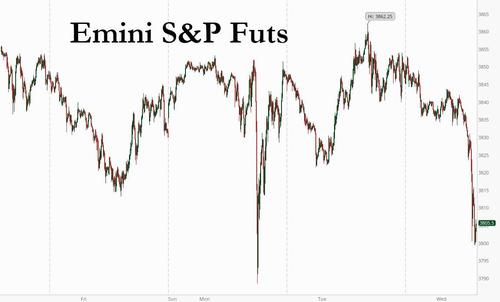
S&P 500 contracts sank 1%, with the deepest losses in the small-cap futures. Nasdaq 100 Index futures outperformed following a strong sales report from Microsoft while other giga- tech companies including Apple, Facebook and Tesla are all due to report after the close today. Meanwhile, GameStop continued its meteoric rise after Elon Musk tweeted about the company, and even following reports that Citron and Melvin had closed their shorts, the stock was still up a whopping 65% from Tuesday’s close.
“There’s been a bit of a shift of tone in markets in the last few days,” said Catherine Doyle, investment specialist at Newton Investment Management. “Markets are starting to worry about COVID again,” she added, highlighting in particular the Brazilian and South African variants of the virus.

The MSCI world equity index having fallen around 1% since it hit a new all-time high on Jan. 21. Following a weak Asian session in which shares were hurt by profit-taking, European indexes also retreated, with the STOXX 600 down 0.8%, London’s FTSE 100 was down 0.7% while Germany’s DAX was down 1%. The Stoxx Europe 600 Index declined as the European Union and AstraZeneca disagreed over whether a planned call to resolve vaccine delivery delays would take place. The euro fell after a European Central Bank official said it has the necessary tools to avoid any further strengthening of the currency.

Earlier in the session, Asian stocks fell for a second day as investors took a breather following the regional benchmark’s ascent to another record high on Monday. The MSCI Asia Pacific Index headed for its biggest two-day decline in more than a month as traders evaluated a series of earnings reports while also seeking more clarity on the timeline for U.S. stimulus. Equity benchmarks in India, Vietnam and the Philippines were among the biggest losers. The Philippine Stock Exchange Index capped its eighth drop in nine sessions amid concern fourth quarter GDP data due Thursday may be weaker than estimated. Stocks rose in Japan and Singapore. Stocks were also lower in South Korea, which reported its most new virus cases in almost two weeks. Global cases surpassed 100 million. Materials was the worst performing sector on the regional benchmark followed by communication services as heavyweights Tencent Holdings and SoftBank declined. A gauge of industrials climbed as Nidec extended gains to hit another record. The Federal Reserve is expected to maintain its aggressive support for the U.S. economy when it concludes a two-day meeting on Wednesday

In rates, Treasuries erased declines in early U.S. trading as stock futures fell, pushing 10-year note’s yield below 1.03% to weekly low. Focus is on FOMC statement at 2pm ET and corporate new-issue calendar headed bymulti-tranche 7-Eleven deal. Treasury yields remain within a basis point of Tuesday’s closing levels, outperforming gilts while keeping pace with bunds. With Euro Stoxx 50 down 1.3% amid vaccine delivery delays, S&P 500 E- mini futures are lower by more than 1% at session lows.

In FX, the dollar rose against most Group-of-10 peers ahead of the Fed meeting while risk-sensitive currencies headed by the Swedish krona led declines along with the euro. The common currency fell to a day low of $1.2119 after ECB policy maker Klaas Knot said the institution had tools to counter its recent appreciation. The pound erased gains after touching the highest since May 2018; hedge funds and real money names keep adding pound topside in both the cash and options markets. Australia’s dollar fell to a session low in European trading after slipping from a session high following a report that showed headline inflation remained below the central bank’s target.

There is a busy slate today, with expected data include mortgage applications and durable goods orders. Abbott, Boeing, AT&T, Facebook, Tesla and Apple are reporting earnings. The FOMC decision and briefing by Chair Jerome Powell are scheduled for 2pm

Market Snapshot

  • S&P 500 futures down 0.2% to 3,835.50
  • STOXX Europe 600 up 0.1% to 408.15
  • MXAP down 0.3% to 211.93
  • MXAPJ down 0.6% to 712.08
  • Nikkei up 0.3% to 28,635.21
  • Topix up 0.7% to 1,860.07
  • Hang Seng Index down 0.3% to 29,297.53
  • Shanghai Composite up 0.1% to 3,573.34
  • Sensex down 1.9% to 47,427.63
  • Australia S&P/ASX 200 down 0.7% to 6,780.57
  • Kospi down 0.6% to 3,122.56
  • German 10Y yield fell 0.3 bps to -0.536%
  • Euro down 0.3% to $1.2127
  • Italian 10Y yield fell 3.1 bps to 0.536%
  • Spanish 10Y yield fell 0.9 bps to 0.064%
  • Brent futures up 0.8% to $56.35/bbl
  • Gold spot down 0.2% to $1,847.12
  • U.S. Dollar Index up 0.2% to 90.37

Top Overnight News from Bloomberg

  • The resignation of Italian Prime Minister Giuseppe Conte has sparked a fresh round of back-room plotting and negotiating as the pandemic rages and the economy tanks. Conte is a survivor, but he has no political party of his own as he tries to recruit a new, broader coalition anchored around himself. He offers investors stability, and that’s an outcome that bond traders have craved
  • Sanofi agreed to produce more than 125 million doses of BioNTech SE and Pfizer Inc.’s coronavirus vaccine for the European Union in an unusual collaboration to speed vaccination efforts
  • Senate Majority Leader Chuck Schumer said he’s ready to start moving on a Democrat-only Covid-19 relief plan as soon as next week if Republicans continue to reject President Joe Biden’s $1.9 trillion proposal
  • European Central Bank policy makers have agreed to look deeper into the euro’s appreciation against the dollar since the start of the pandemic, focusing on whether it’s driven by differences in stimulus policies compared with the U.S., according to officials familiar with the matter
  • Australia’s consumer prices rose faster than forecast in the final three months of last year as the government amended funding to various stimulus programs amid an economy regaining momentum
  • The U.S. must take “aggressive” steps to combat China’s “unfair” trade practices while also investing to bring manufacturing back to the country, said Gina Raimondo, President Joe Biden’s nominee for Commerce secretary
  • Global coronavirus cases surpassed 100 million, according to data compiled by Johns Hopkins University. U.S. President Joe Biden announced a push to purchase more doses of vaccines and get them more quickly to the states. Pfizer Inc. will be able to supply the U.S. with 200 million doses two months sooner than previously forecast, according to its top executive
  • The resignation of Italian Prime Minister Giuseppe Conte has sparked a fresh round of back-room plotting and negotiating as the pandemic rages and the economy tanks

A quick look at global markets courtesy of Newsquawk

Asian equities traded mixed and attempted to shrug off the weak handover from the US where there was a slight negative bias amid pre-FOMC caution and ongoing doubts regarding President Biden’s USD 1.9tln stimulus proposal, although participants also reflected on earnings and a late boost was seen in Nasdaq 100 futures after-hours due to strong results from Microsoft which beat on both its top and bottom lines. ASX 200 (-0.7%) was led lower by weakness across the mining-related sectors and as yesterday’s regional losses caught up with the index on return from its holiday closure, while Nikkei 225 (+0.3%) was kept afloat by recent conducive currency moves but with upside capped amid expectations for an extension to the state of emergency in areas still seeing a high number of infections. KOSPI (-0.2%) swung between gains and losses as early strength in the local tech giants petered out including Samsung Electronics which is planning to increase FY21 chip capex by 20% Y/Y to KRW 35tln and with LG Display turning south despite posting a profit of KRW 620.9bln vs prev. loss KRW 1.8tln Y/Y. Hang Seng (-0.3%) and Shanghai Comp. (+0.1%) were indecisive after another substantial liquidity drain by the PBoC, as well as continued US-China tensions with President Biden’s Commerce Secretary nominee vowing to use the full tool kit to protect US networks from companies such as Huawei and ZTE, while FTSE Russell is mulling whether to eject more Chinese firms from key index listings. However, there were some encouraging developments including a jump in Chinese Industrial Profits for December which grew by 20.1% Y/Y and with Alibaba lifted by recent comments from the PBoC Governor who suggested Ant Group’s mammoth IPO could be revived after its issues are resolved. Finally, 10yr JGBs were lacklustre with price action stalling beneath the psychological 152.00 level as Japanese stocks remained in the green and following similar indecisive trade in T-notes, but with downside cushioned by the BoJ’s presence in the JGB market today for a relatively reserved JPY 600bln total.

Top Asian News

  • Retail Army Helps Sri Lanka Stocks Skyrocket to World’s Best
  • Cathay Pacific Proposes Issue of HKD Convertible Bonds Due 2026
  • Turkey’s Long-Unloved Debt Is Starting to Win Over Investors

European stocks kicked off the mid-week session in an indecisive mid-week manner before extending on losses (Euro Stoxx 50 -1.4%) as the region initially picked the tentative APAC tone in the run-up to the FOMC policy announcement and presser (full preview available in the Newsquawk Research Suite). US equity futures also remain on standby with the NQ (U/C) initially outperforming on the back of Microsoft’s numbers (+2.5%, pre-market) amid a number of COVID-related tailwinds including a surge in PC sales and increased cloud services revenue. Back to Europe, sectors are mixed with a slight defensive bias, with Real Estate outperforming as Unibail-Rodamco (+13%) and Klepierre (+12%) gain with some citing easing fears of a third national lockdown in France. Meanwhile, Telecoms are propped up alongside reports that Vodafone (+2%), Telefonica (+3%) and Three are partnering to build and share mobile masts to boost 4G coverage in rural areas, whilst sources stated Vodafone is reportedly looking into different options for their Ghanaian business with a view to reorganise the unit and reduce its debt. The broader IT sector meanwhile is softer on the day with pre-market losses in AMD (-2%) also weighing on chip names. In terms of individual movers, LVMH (+0.7%) holds onto opening gains after reported robust COVID-influenced numbers whilst topping revenue forecasts. Evotec meanwhile (+2%) opened higher by some 30% following reports that Reddit-stricken Melvin Capital is closing its short positions amid the suffering caused by Gamestop (+85% pre-market), although GME trimmed pre-market gains after CNBC reported that Melvin Capital has closed their Gamestop positions. Elsewhere, the quarterly production update by Fresnillo (-8%) was not well received despite an improve in gold production as guidance underwhelmed.

Top European News

  • European Economy Lags Peers as Vaccine Mess Deepens Slump
  • Astra Pushes Back as EU Warnings Over Vaccine Delay Escalate
  • ECB’s Knot Says Tools Are Available to Counter Euro Strength
  • EDF’s Hinkley Nuclear Plant Hits Delays, Cost Overruns

In FX, The Dollar is flat to a tad firmer across the board in the run up to the FOMC amidst little expectation of anything major in terms of policy moves or fresh guidance beyond the inevitable updated assessment of the economic situation and outlook since the prior meeting, plus anything Fed chair Powell reveals in the press conference via text or during the Q&A (full preview of the event available in the Research Suite). However, durable goods in the interim often has the potential to surprise and could provide the Buck and index with another test of resilience after the latter extended its run of consecutive closes above 90.000 on Tuesday to 9 trading sessions, and just carved out a firmer 90.432 intraday high vs 90.119 at one stage, albeit with a big helping hand from the Euro.

  • EUR/CAD/NZD/AUD – Latest reports regarding the ECB expressing consternation about Greenback weakness in relation to the Euro given relative US-Eurozone and Fed-ECB economic conditions and policy stances, were largely taken in stride, but comments direct from the GC’s mouth via Knot have been taken seriously as said the Bank has the means to counter Euro strength, including further easing – see 9.13GMT post on the Headline Feed for more. In response, Eur/Usd retreated further from circa 1.2170 peaks to trough around 1.2119, while Eur/Gbp recoiled to a fresh January low under the previous 0.8830 base from last Thursday. Elsewhere, the Loonie is also languishing near the bottom of the G10 ranks along with the Aussie and Kiwi that have failed to glean any lasting traction from firmer than forecast CPI or the fact that the Aud/Nzd cross remains top heavy above 1.0700. Usd/Cad is back on the 1.2700 handle, Aud/Usd under 0.7750 and Nzd/Usd sub-0.7250 all awaiting the FOMC, though the latter also has NZ trade data to digest.
  • GBP/CHF/JPY – Cable marginally extended post-Brexit transition highs before fading when the Dollar got its indirect ECB boost and held then retained grip of the 1.3700 handle due to supportive Eur/Gbp moves as noted above rather than anything UK specific. Similarly, the Franc and Yen are mainly taking cues from elsewhere, and the Buck more so than risk sentiment that is souring again, with Usd/Chf continuing to meet resistance/offers into 0.8900 and Usd/Jpy keeping further distance from 104.00 in advance of key Japanese data to end the month starting with retail sales after the Fed.

In commodities, WTI and Brent front month futures eked modest gains initially in early European hours but prices remain contained within ranges seen since mid-Jan. Despite the disparities across stocks and a downside bias to sentiment, crude prices remain underpinned by last night’s Private Inventory data which showed headline crude posting a sizeable surprise draw of 5.3mln bbl vs forecasts for a modest 0.4mln bbl build; however, as the selling pressure has intensified WTI and Brent are now marginally lower on the session. Participants will now be looking to the more widely-followed EIA release whereby headline crude is expected at a 0.4mln bbl build. More broadly, the crude market will be eyeing the COVID-related developments in light of the new variants and logistical hurdles. Desks are flagging potential demand implications from the localised lockdowns in China, with the government also poised to discourage travel over the upcoming Lunar New Year holiday – “passenger trips during the holiday period to be down 40% from 2019 levels”, according to ING citing the Chinese transport ministry. WTI trades on either side of USD 53/bbl and Brent sees itself just north of USD 56/bbl, with both contracts within USD 0.30-0.40/bbl parameters at the time of writing. Elsewhere spot gold and silver remain within relatively narrow bands ahead of the FOMC policy announcement, with the former on either side of USD 1845/oz and the latter back below USD 25.5/oz. LME copper prices meanwhile are modestly softer amid the indecision seen across markets coupled with Dollar strength, whilst Goldman Sachs raised their 3-,6-and 12-month copper price forecasts to USD 8,500/t, USD 9,000/t and USD 10,000/t respectively. Finally, zinc prices overnight hit over 2-month lows amid higher inventories.

US Event calendar

  • 8:30am: Durable Goods Orders, est. 1.0%, prior 1.0%; Durables Ex Transportation, est. 0.5%, prior 0.4%
  • 8:30am: Cap Goods Orders Nondef Ex Air, est. 0.5%, prior 0.5%; Cap Goods Ship Nondef Ex Air, est. 0.6%, prior 0.5%
  • 2pm: FOMC Rate Decision (Upper Bound), est. 0.25%, prior 0.25%

DB’s Jim Reid concludes the overnight wrap

Today is the busiest on this week’s calendar, with a raft of important tech earnings as well as the Federal Reserve decision later on. And with some financial assets currently trading at what many are describing as bubble territory, there’ll be heightened attention on these releases to see whether these current valuations are justified. Indeed, in our latest monthly survey, the most popular area for where people thought there was a bubble (apart from Bitcoin) was in US tech equities, with a mean score of 7.9 on a scale from 0-10.

Tonight after the close, we’ll hear from Apple, Tesla and Facebook, all of which have surged to new highs since the pandemic, with Tesla up by more than 12-fold since its recent lows back in March. They come on the back of Microsoft yesterday, who reported fiscal Q2 sales rose 17%, above consensus estimates. The stock rose just under +4% after hours, as the cloud-computing division rose over 50% as the firm reported more corporate clients shifting to online productivity tools and teleconferencing software. Meanwhile GameStop, which has been propelled by Reddit users seeking to take on Wall Street shorts, rose a further +90.1% yesterday, with the stock having risen more than 5-fold in the space of just 2 weeks. Why can’t the stocks I own do that! After hours Elon Musk tweeted a link to a r/wallstreetbets thread on the company and typed “Gamestonk”. In response the shares went up another +68.2% at one point after hours before settling +41.4%. In effect that tweet from Musk added c.$7bn to the market cap in around 30mins. These are not normal times and while the r/wallstreetbets thing is fascinating to watch, I can’t help but think that this is unlikely to end well for someone. As I’ve been saying in recent weeks, this isn’t likely to be a low vol dull year. There’s enough bubbling up, if you pardon the pun, to create a lot of market noise down the line.

Today’s other big highlight will be the first Federal Reserve meeting of 2021, as well as Chair Powell’s subsequent press conference, though whether there’ll be much to report is another matter. According to our US economists (link here), there shouldn’t be any material changes to the policy settings and message from the Fed, following their move to adopt outcome-based forward guidance for asset purchases in December. Furthermore, they expect the statement to be untouched, aside from acknowledging a recent softening in the data. The big question will be over any timetable for tapering asset purchases, but Powell is likely to adopt a dovish tone on this, and reiterate that it’s premature to contemplate this given the challenging near-term outlook and remaining uncertainties.

Ahead of all this, US equities dropped slightly from their record highs, with the S&P 500 (-0.15%), the NASDAQ (-0.07%) and the small-cap Russell 2000 (-0.68%) all dipping. The topline moves were pretty subdued on the whole however, as investors awaited the events mentioned above and with stimulus talks treading water. There continues to be a good deal of dispersion under the surfacewith Energy (-2.12%) and Transportation (-1.50%) weighing on the S&P, as more defensive industry groups like Food & Staples (+1.45%) tried to pull the broad index back into positive territory. Europe saw a stronger performance, though that can be explained by them missing out on the previous day’s rebound after the close. The STOXX 600 (+0.63%), the DAX (+1.66%) and the CAC 40 (+0.93%) all saw sizeable moves upward.

Staying on Europe, Italian Prime Minister Conte resigned yesterday as expected, meaning that President Mattarella will now start consultations with the leaders of the parliamentary groups so as to put together a new government. Reports have suggested that Conte is seeking to put together a new coalition, with Bloomberg reporting officials saying this could be a broader alliance that includes pro-European centrists and unaffiliated lawmakers. Whether Conte is reappointed will depend upon his ability to forge a new majority, since Mattarella is unlikely to give the green light to a minority government. As a reminder, our European economists continue to see the risks of an early election as limited, since a number of the governing parties would stand to lose out from fresh polls.

Markets have taken the Italian instability in their stride, with the spread of yields between 10yr Italian BTPs and German bunds falling a further -4.7bps yesterday to 1.18%. And although this spread is above the 4-year low of 1.05% reached at the beginning of the month, it’s still below the levels seen through much of 2020, so it’s worth keeping these moves in context. Sovereign bond yields rose in most other countries however, with yields on 10yr Treasuries rising +0.5bps to 1.035%, as those on 10yr bunds (+1.7bps), OATs (+1.3bps) and gilts (+0.3bps) also moved higher.

Going back to politics, the US Senate swore in its members into former President Trump’s impeachment trial, which will begin the week of February 8. A vote to declare the impeachment trial as unconstitutional, on the basis that Mr Trump is no longer in office, was voted down 55-45. While five Republicans joined the 50 Democrats on this process vote, it looks unlikely that 67 senators vote for conviction in the end. The most market-relevant thing to keep an eye on in all of this is if any ill-will from this process spills over into the Senate’s stimulus negotiations and derails the pandemic relief. Possibly anticipating this, Senate Majority Leader Schumer yesterday said that Democrats should be prepared to start moving on President Biden’s Covid-19 relief bill in a unilateral way through budget reconciliation if Republicans continue to reject working on the $1.9 trillion plan. Not all of the plan would be able to get through the budget process, including any minimum wage changes and the additional $160bn funding to the states for vaccine rollout efforts. Bipartisanship may not be totally out of the question as 16 Senators from both parties are readying a counterproposal to the Biden plan, which lawmakers expect to be able to unveil by the end of the week.

Overnight in Asia markets are mostly trading higher with the Nikkei (+0.25%), Hang Seng (+0.15%) and Shanghai Comp (+0.32%) all up. An exception to this pattern is the Kospi (-0.16%). Futures on the S&P 500 are down -0.17% while those on the Nasdaq are up +0.49% ahead of today’s big tech earnings and aided by Microsoft’s strong earnings report mentioned above. In other Asia related news, the PBoC governor Yi Gang said at the virtual WEF yesterday that the country’s monetary policy will continue to “prop up the economy,” with officials remaining mindful of risks, such as a rising macro leverage ratio and higher non-performing loans. The PBoC has withdrawn c. $27bn in liquidity from market this week with $15bn of it being withdrawn today. So in light of this, these comments were a relief to some worried by this recent action.

On the coronavirus, matters escalated in the ongoing row between the EU and AstraZeneca following the news that vaccine deliveries would be delayed, amidst calls for export controls on vaccines from a number of senior figures. Indeed, in a speech yesterday, Commission Preisdent von der Leyen said “Europe invested billions to help develop the world’s first Covid-19 vaccines. … And now, the companies must deliver. They must honour their obligations.” On top of this, the German health ministry pushed back against reports that the AstraZeneca vaccine only had an efficacy of 8% among the over-65s, something reported in the Handelsblatt newspaper, and which AstraZeneca themselves have called “completely incorrect”. There was lots of talk about it being a misread on the % of participants in the trail from this age group rather than efficacy. Given how widely this story has been distributed it shows how potential misinformation can spread quickly in this digital world. Read an incredibly interesting interview with the AstraZeneca CEO here for more background.

On the more positive side, the European Medicines Agency ED Cooke signaled that Pfizer is expected to increase vaccine deliveries to EU countries in April, with production at more sites coming online over the next two months. Elsewhere the US government has also said that it intends order 100mn more doses each of Pfizer Inc. and Moderna Inc.’s coronavirus vaccines, and at least temporarily speed up shipments to states to about 10mn doses a week ( a +16% increase from the current weekly pace). This comes as an executive from Pfizer said that it will be able to supply the US with 200mn doses two months sooner than previously forecast. Meanwhile, overnight news is suggesting that the UK government will introduce a limited hotel quarantine system for passengers arriving from the highest-risk countries, and is likely to apply to arrivals from countries with new forms of the virus, such as South Africa and Brazil. So a watered down version of what was expected to be a mandatory requirement for all international travelers. On the other side of the world, Kyodo has reported that Japan is considering extending its state of emergency beyond Feb 7 to until the end of February.

In terms of yesterday’s data, the US Conference Board’s consumer confidence reading came in roughly in line with expectations in January, with a rise to 89.3 (vs. 89.0 expected). However, there was a divergence between the present situation and the expectations readings, with the present situation number falling to an 8-month low of 84.4, while the expectations number rose to a 3-month high of 92.5. Meanwhile in the UK, the unemployment rate for the three months to November rose to 5.0% (vs. 5.1% expected), its highest level in over 4 years. While the total number of hours worked continued to rise, now standing at around 7% below pre-pandemic levels, the redundancy rate also moved higher, still standing above its peak around the global financial crisis. Finally, the IMF revised up their global growth forecast for 2021 to +5.5% (vs. 5.2% back in October), and left their 2022 forecast unchanged at +4.2%.

To the day ahead now, and the aforementioned Federal Reserve decision will likely be the main highlight. We’ll also hear from the ECB’s Lane and Villeroy. Otherwise, data releases include French consumer confidence for January, as well as preliminary US data for December on durable goods orders and nondefence capital goods orders ex air. Earnings releases include Apple, Tesla, Facebook, AT&T, Abbott Laboratories and Boeing.

Tyler Durden
Wed, 01/27/2021 – 08:05

via ZeroHedge News https://ift.tt/2YgMg8L Tyler Durden

Astra Shares Slide On EU Delivery Delays

Astra Shares Slide On EU Delivery Delays

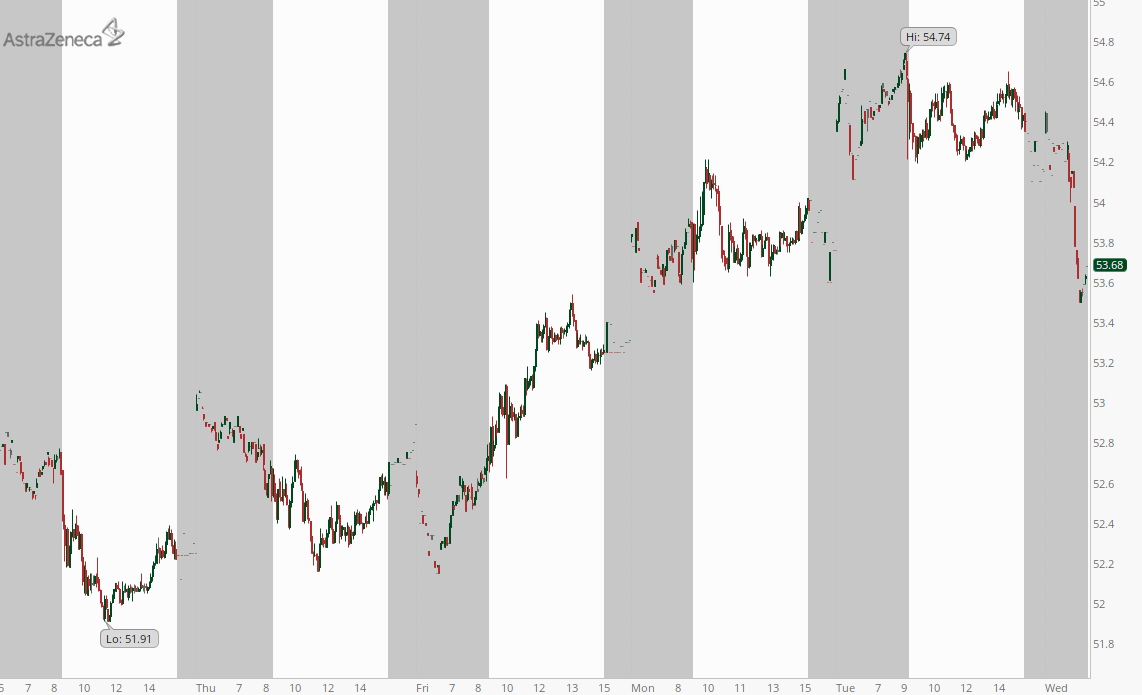
AstraZeneca shares dropped to their lowest levels of the session in Europe on Wednesday, falling as much as 1.8%, after the company pulled out of a call with European regulators intended to resolve a delay in vaccine deliveries.

EU regulators are pressuring AZ to reconsider its decision to withhold these details because the company wants more information on what’s happening  to the planned deliveries of shots, one of the officials told Bloomberg. AZ refused to share any additional details.

The discussions were intended to resolve the stand-off between the company and EU governments over various contract terms, accusations, and even threats made against Astra’s business. But since the company warned late last week about delays at a production plant in Belgium, the EU has reacted furiously, saying it will start monitoring exports of shots. Germany even signaled support for imposing limits on sales outside the bloc.

As the two sides continue to bicker, Astra refused to confirm whether the call is canceled.

The EU desperately wants AZ to provide more details about what’s going on, but in the meantime, the drop in AZ shares is helping weigh on the broader Euro Stoxx 600, while the euro weakened on comments that the central bank has tools to avoid any further strengthening of the currency.

Tyler Durden
Wed, 01/27/2021 – 08:01

via ZeroHedge News https://ift.tt/2Mpb1ge Tyler Durden

Gamespot Chaos: Stock Hits $365, Then Dips After Report Melvin, Citron Cover Shorts

Gamespot Chaos: Stock Hits $365, Then Dips After Report Melvin, Citron Cover Shorts

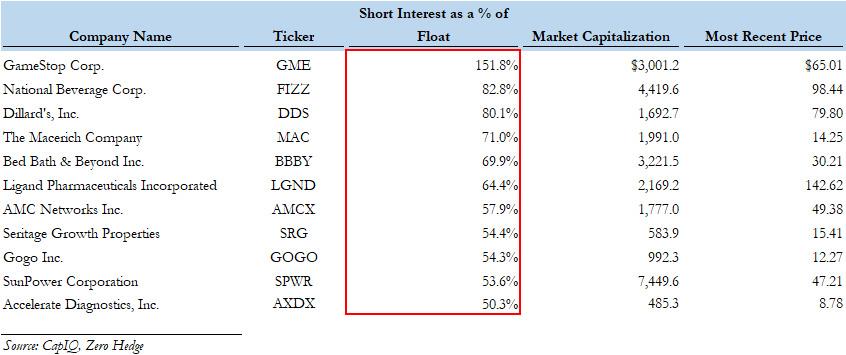
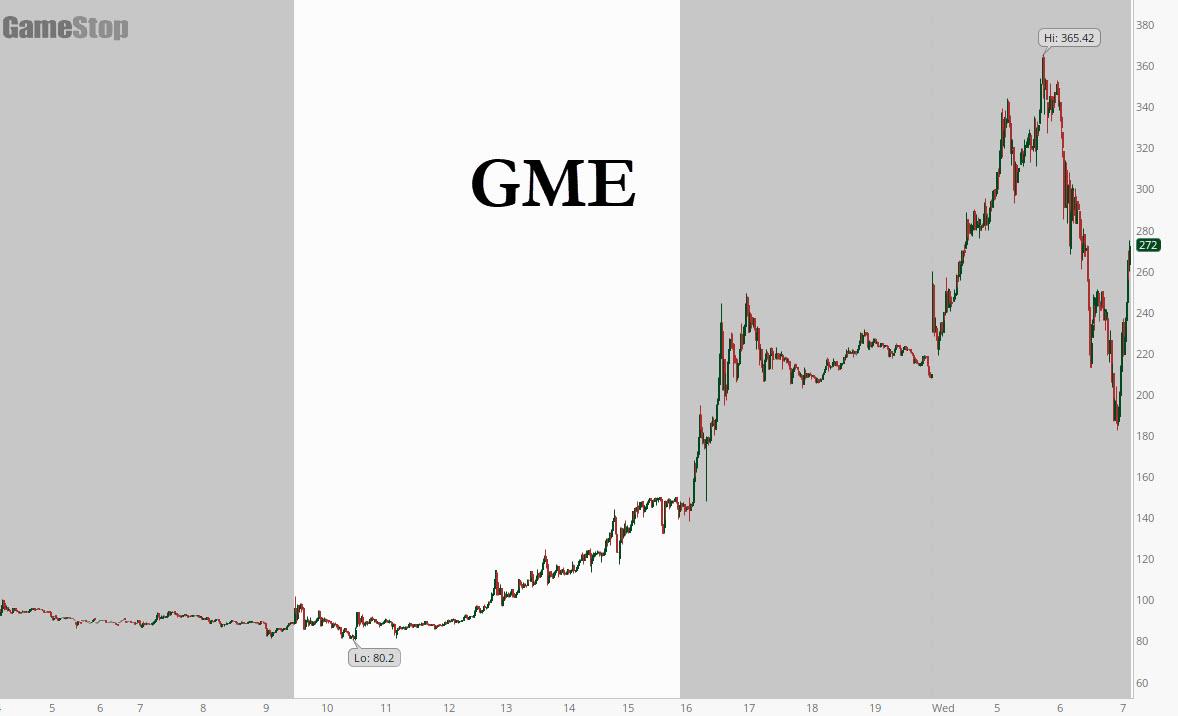
The “most-shorted” short squeeze, led by the infamous GammaStop Gamestop, continued overnight with our basket of most shorted names…

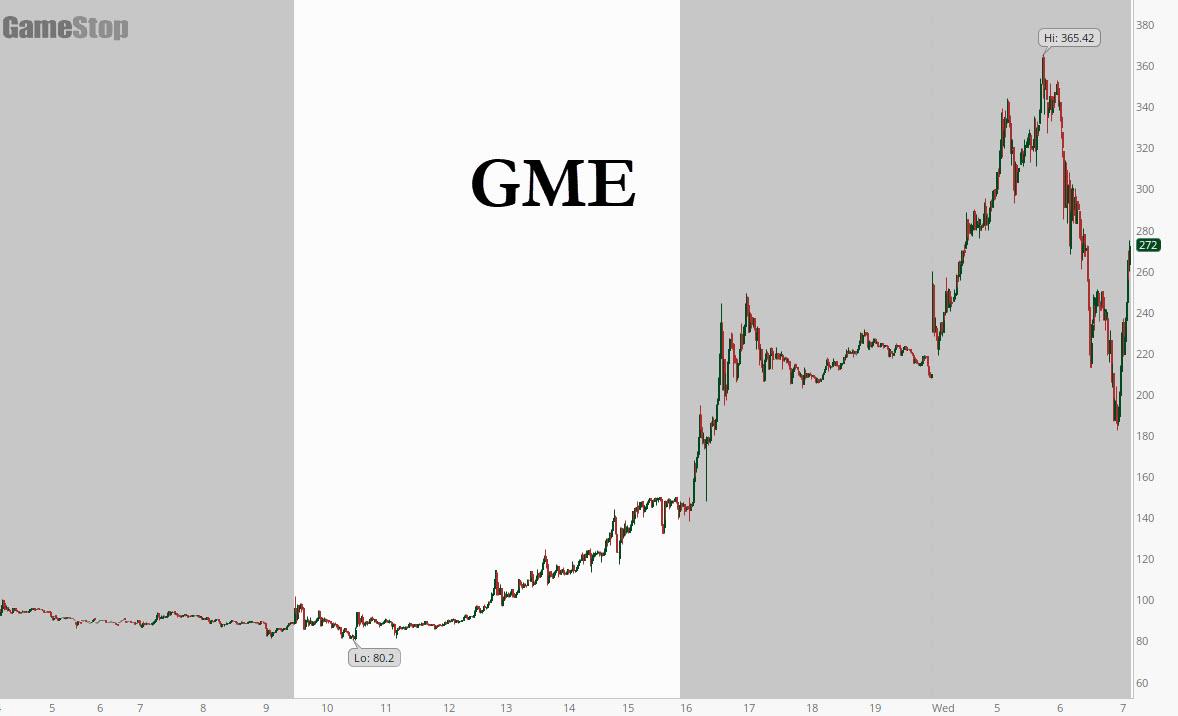
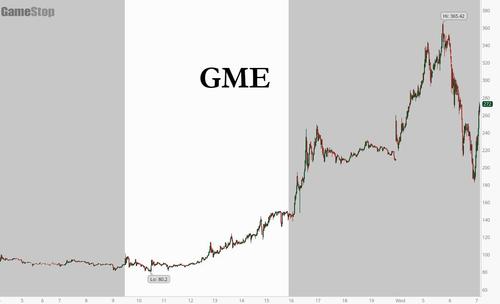
… exploding in the early hours and pushing GME as high as a record $365…

…. before the stock slumped following a report from CNBC that Melvin Capital, the nemesis of r/wallstreetbets, had “closed out its short position in GameStop on Tuesday afternoon after taking a huge loss” the fund’s manager Gabe Plotkin told CNBC’s Andrew Ross Sorkin. It was unclear what exactly this meant: did Melvin merely sell its now worthless puts, or did it also have associated GME shorts on the underlying stock. We assume both.

Additionally, moments after the CNBC report, short-seller Andrew Leff’s Citron Research fund also announced in a twitter clip that it had covered most of its GME short yesterday around $90.

In the clip, Left admits his call last week for GME dropping from $40 to $20 was a mistake even though Citron Capital “is just fine”, and was cautiously deferential to the meme/WallStreetBets crowd. Some of his key quotes:

“I’m doing this video because I cannot answer one more phone call…”

“I’m just fine. Citron Capital is just fine. Covered a majority of the short in the $90’s…”

“I learned from Tilray, it was a killer. It went all the way back to $6. I expect the same thing from GameStop, but I have respect for the market. I also have respect for the people at the WallStreetBets Reddit message boards. Before there was WSB, there was Citron Research. We were the voice of the individual investor against the institutions.”

“I never got personal, I never got nasty, I never threatened a corporate executive or their shareholders. It was always business.”

“We’ll become more judicious when shorting stocks. It doesn’t meant the industry is dead, it means you have to be more specific.”

“When you make your profits, make sure you put some away for the IRS. That money is not all your money. But at the end of the year you do owe tax money.”

Left’s confession comes one day after telling Reuters that he usually he “does not usually smoke. But on Monday he had a cigarette to calm his nerves as shares of GameStop Corp, the stock he had shorted, continued to rocket higher.”

“If I had never been involved in GameStop and came to this right now, would I still be short this stock? 100 percent,” Left, who runs Citron Research and a hedge fund, told Reuters on Tuesday. “This is an old school, failing mall-based video retailer and investors can’t change the perception of that.”

Finally, it is worth noting that late on Tuesday, investor Michael Burry – who years ago went long Gamespot precisely on the basis that he expected a massive squeeze said in a now-deleted tweet Tuesday that trading in GameStop is “unnatural, insane, and dangerous” and there should be “legal and regulatory repercussions.”

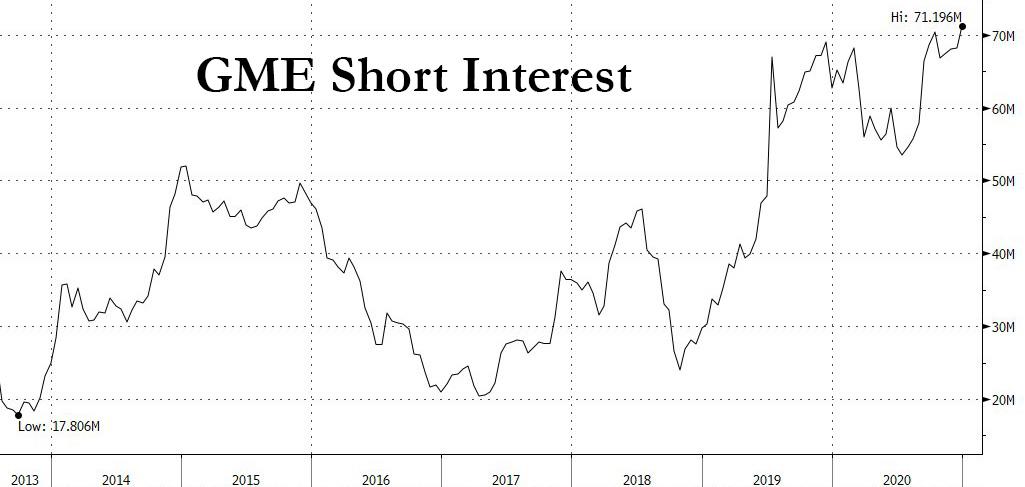
Assuming that both of these entities are indeed out of the picture, the question now is how much of the massive short overhang remains. As a reminder, just two days ago we noted that “after all the chaos”, GME shorts were still a whopping 139% of the float, as new shorts came in to replace existing shorts who had covered.

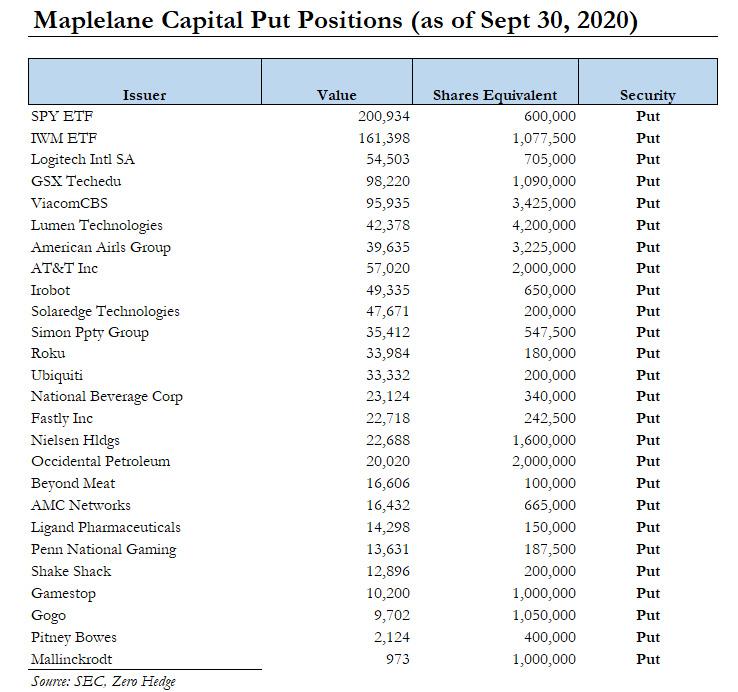
In other words, while two big shorts may be out, countless others remain, among which of course is Maplelane Capital which as we exclusively showed last night, may well be the “next Melvin”, needing either a bailout or will be forced to sell its existing longs to cover margin calls.

In any case, after dropping as low as $180, it appears that the wallstreetbets crowd has renewed its effort and GME was last trading at $246, a level which could easily go much higher once today’s gamma vortex in deep OTM calls kicks in and dealers resume their delta-hedged chasing of the stock higher.

Tyler Durden
Wed, 01/27/2021 – 07:24

via ZeroHedge News https://ift.tt/3iRmYY8 Tyler Durden