Guan Heng Exposed China’s Uyghur Camps. ICE Wants To Deport Him.


Guan Heng pictured on a background with images about immigration and detainment camps | Illustration: Adani Samat Photo: guanguanofficial/Youtube

Guan Heng is a former resident of China who did something amazing: He defied the country’s authoritarian government and documented the abuses of Uyghur Muslims.

The 37-year-old citizen-journalist entered Xinjiang after downloading the satellite coordinates of alleged Uyghur detention facilities. He took pictures of the camps—camps that the Chinese Communist Party has claimed do not exist. He shared these images with BuzzFeed News, which then published an eye-opening series of articles about the internment of ethnic and religious minorities in China.

It was incredibly brave of Guan Heng to do this. Documenting the atrocities of tyrants is important work—and extremely dangerous. Heng knew that if the Chinese authorities got a chance, they would arrest him, question him, and possibly torture and even kill him. And so he fled China in 2021, traveling to Ecuador and  eventually by boat to the U.S. He applied for asylum and obtained a work permit. He has been living quietly in New York ever since, working as an Uber driver and food deliverer.

A few months ago, in August, ICE detained him after he admitted he had initially entered the country illegally. Immigration authorities would now like to deport him, either to Uganda—where he would likely be taken back to China—or to China directly.

That would be a travesty. The feds should certainly not deport Guan Heng, no matter how he came to this country. On the contrary, he should be commended and welcomed. As The Wall Street Journal says:”It’s hard to imagine a stronger case for asylum.” There is no good reason for ICE to work as a communist government’s enforcer.

It’s true that many Americans want the federal government to vet asylum claims with greater care. But Guan Heng should easily pass any such test. If anything, the government should incentivize anti-communist whistleblowers and citizen-journalists to cooperate with the U.S. We want Chinese scientists, for instance, who have information about the possible lab origins of COVID-19 to document and disseminate any such evidence, and to seek refuge as far from Beijing’s reach as possible.

Democrats on the U.S. House of Representative’s Foreign Affairs committee appear to be taking up Guan Heng’s case. That’s good, but there is absolutely no reason for this to become a partisan issue. Any Republicans who care about China’s authoritarian ways should concede that this is obviously a case where other considerations should overrule the Trump administration’s deportation agenda.

The post Guan Heng Exposed China's Uyghur Camps. ICE Wants To Deport Him. appeared first on Reason.com.

from Latest – Reason.com https://ift.tt/r2ksx0F
via IFTTT

Jewish Plaintiffs in Establishment Clause Cases

I was doing some research on Establishment Clause cases, and noticed the plaintiffs in several leading cases were Jewish. I’m sure I’m missing others.

In Braunfeld v. Brown (1961), Abraham Braunfeld and the other plaintiffs were “member[s] of the Orthodox Jewish faith, which requires the closing of their places of business and a total abstention from all manner of work from nightfall each Friday until nightfall each Saturday.”

In Engel v. Vitale (1962), Steven Engel was described as a “devout Reform Jew.”

In Flast v. Cohen (1968), the lead plaintiff was Florence Flast. Several sources indicated he was Jewish, but nothing definitive. The other plaintiffs were Albert Shanker, Helen D. Henkin, Frank Abrams, C. Irving Dwork, Florine Levin. I would surmise that at least some of these plaintiffs were Jewish as well. Cohen, the Secretary of Health, Education, and Welfare, was Jewish.

In Lee v. Weisman (1992), student Deborah Weisman was Jewish, and objected to a graduation message delivered by Rabbi Leslie Gutterman, of Temple Beth El in Providence.

In Elk Grove Unified School District v. Newdow (2004), Michael Newdow’s mother was “Jewish but secular.”

In Town of Greece v. Galloway (2014), Susan Galloway was Jewish.

In Lemon v. Kurtzman (1971), Alton Lemon, the lead plaintiff was not Jewish, but the respondent, David Kurtzman, the Superintendent of Public Instruction, was Jewish.

The post Jewish Plaintiffs in Establishment Clause Cases appeared first on Reason.com.

from Latest – Reason.com https://ift.tt/pgjUSkl
via IFTTT

Hegseth Won’t Let Us See a Video That Might Undermine Support for Trump’s Bloodthirsty Anti-Drug Strategy


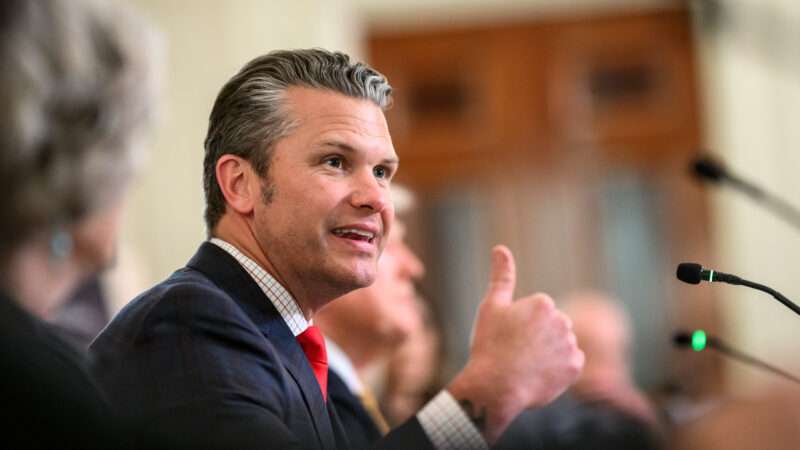
Defense Secretary Pete Hegseth at the White House |  Molly Riley/White House/Newscom

Two weeks ago, President Donald Trump said he saw “no problem” with releasing the full video of the newly controversial September 2 operation that inaugurated his deadly military campaign against alleged drug boats in the Caribbean and the eastern Pacific. But on Tuesday, Defense Secretary Pete Hegseth said no one aside from a select group of lawmakers would be allowed to see the video, which shows a second missile strike that blew apart two survivors of the initial attack as they clung to the smoldering wreckage.

“In keeping with long-standing…Department of Defense policy, of course, we’re not going to release a top secret, full, unedited video of that to the general public,” Hegseth said after he and Secretary of State Marco Rubio briefed senators on the boat attacks, which so far have killed 95 people in 25 operations. But the fact that the video currently is deemed “top secret” should not be decisive, since Hegseth has the power to declassify it. He is using vague national security concerns as an excuse to conceal footage that might undermine public support for Trump’s murderous anti-drug strategy by vividly showing what it looks like in practice.

“Will you release video of that strike so that the American people can see for themselves?” ABC’s Selina Wang asked Trump on December 3. “I don’t know what they have,” Trump replied, “but whatever they have, we’d certainly release, no problem.”

Hegseth contradicted that commitment three days later. “President Trump said he would have no problem if the full video of the strike is released,” Fox News reporter Lucas Tomlinson noted during a Q&A session on December 6. “When can we see that video? When will you release it?”

Hegseth implied that Tomlinson was mistaken in taking the president at his word. “We’re reviewing it right now to make sure sources [and] methods” are not compromised, Hegseth said. “I mean, it’s an ongoing operation….We’ve got operators out there doing this right now. So whatever we were to decide to release, we’d have to be very responsible about it. We’re reviewing that right now.”

Two days later, Trump himself retreated from his promise of transparency. “Mr. President, you said you would have no problem with releasing the full video of that strike on September 2nd off the coast of Venezuela,” ABC’s Rachel Scott reminded him. Trump denied that he had said what he said: “I didn’t say that. You said that. I didn’t say that. This is ABC fake news.” Then he announced a new position: “Whatever Hegseth wants to do is OK with me.”

When Scott pressed Trump on whether he would order Hegseth to release the video, he unloaded on her: “You’re the most obnoxious reporter in the whole place. Let me just tell you, you are an obnoxious—a terrible, actually, a terrible reporter. And it’s always the same thing with you. I told you, whatever Pete Hegseth wants to do is OK with me.”

Given that green light, Hegseth evidently decided he did not need to offer any specific rationale for refusing to release the video. Like Trump’s promise that “we’d certainly release” it, Hegseth’s talk of “reviewing” the footage with an eye toward redacting clues about “sources [and] methods” has gone down the memory hole.

Sen. Markwayne Mullin (R–Okla.), a member of the Senate Armed Services Committee and an enthusiastic supporter of summarily executing suspected cocaine couriers, told reporters on Tuesday the issue with the video is “the sensitivity” of “the assets used” in the boat strike. “It is a classification issue,” said Mullin, who had not seen the video. “I don’t make the classification….If you don’t like the classification, talk to the White House about it.”

Rep. Adam Smith (D–Wash.), who as the ranking Democrat on the House Armed Services Committee was allowed to see the video during a closed-door briefing on December 4, thinks the claim that releasing it would compromise “sources and methods” is “ridiculous.” The Pentagon could easily “make sure that nothing in that video…shows anything [sensitive],” Smith said during a December 7 interview on ABC’s This Week. “If they showed…just the portion that we saw, those two on the boat, it’s no different [from] any of the dozen-plus videos they’ve already released.”

While the military rationale for concealing the video is dubious, the political rationale is pretty clear. “They don’t want to release this video because they don’t want people to see it,” Smith said. “If they release the video, then everything that the Republicans are saying will clearly be [seen] to be completely false.”

Like the Trump administration’s position on releasing the video, its justification for the second strike is a moving target. Rep. Jim Himes (D–Conn.), the ranking Democrat on the House Intelligence Committee, has noted the Pentagon’s “shifting explanations.”

Immediately after the attack, Himes recalled during a December 7 interview on the CBS show Face the Nation, members of Congress were told U.S. forces “needed to clear the wreckage so that there wasn’t a danger to navigation.” Then “right before we watched the video,” Himes said, the explanation was that the unarmed survivors “might have had a radio,” “might have been radioing a boat,” and “might have been trying to recover the cocaine.” But “when you actually watch the video,” he noted, “you realize they don’t have a radio” and are “barely hanging on” to what remains of the boat. Then the claim became that they were “trying to right the boat,” even though “the conflagration” from the first missile strike “probably destroyed everything in that boat.”

The latest explanation illustrates the alarming implications of conflating drug smuggling with violent aggression. Adm. Frank Frank M. Bradley, who commanded the operation, reportedly told lawmakers he ordered the second strike because he worried that the two floundering survivors could have salvaged whatever cocaine might have remained in the capsized bow of the boat, which was all that was left after the first strike.

Trump, who last month said he “wouldn’t have wanted” a second strike, alluded to Bradley’s rationale for it during his vituperative December 8 exchange with Scott, the ABC reporter. “I saw the video,” he said. “They were trying to turn the boat back to where it could float. And we didn’t want to see that, because that boat was loaded up with drugs.”

Trump was echoing Sen. Tom Cotton (R–Ark.), chairman of the Senate Intelligence Committee, who after watching the video on December 4 claimed the helpless survivors were “trying to flip the boat” so they “could stay in the fight”—a “fight” that did not actually exist, since neither those two men nor the nine others killed in the attack were engaged in combat with U.S. forces. Cotton later qualified his claim on NBC’s Meet the Press, saying “they looked at one point like they were trying to flip the boat back over, presumably to rescue its cargo and continue their mission.” It is at least as plausible, of course, that “they were trying to flip the boat back over” in an effort to avoid drowning.

In any event, Cotton said, “it doesn’t really matter what they were trying to do.” Since part of the boat was still afloat, he averred, “that boat, its cargo, and those drug traffickers remained valid targets….It was entirely appropriate to strike the boat again to make sure that its cargo was destroyed. It is in no way a violation of the law of war.”

Himes disagrees. “Any American who sees the video that I saw will see the United States military attacking shipwrecked sailors,” he told reporters. According to the Defense Department’s Law of War Manual, “orders to fire upon the shipwrecked would be clearly illegal.” The manual says individuals are deemed “shipwrecked” when they are “in distress at sea,” “helpless,” and “in need of care and assistance,” provided they “refrain from any hostile act.”

Beyond the issue of whether Bradley violated that rule, Cotton’s claim that the two survivors “remained valid targets” raises the question of whether they were ever valid targets. The answer depends on whether you accept Trump’s preposterous premise that supplying Americans with cocaine amounts to “an armed attack on the United States.” If you don’t, you will see a problem not only with this particular attack but with Trump’s general policy of treating criminal suspects as “combatants” in a nonexistent “armed conflict,” which he thinks justifies killing them from a distance without legal authorization or any semblance of due process.

The video that Hegseth refuses to release would dramatically illustrate the consequences of that logic. Cotton, who told reporters he did not see “anything disturbing” in the video and said “I personally don’t have any problem with” releasing it, is confident that Americans will share his morally and legally bankrupt take on the cold-blooded murder of defenseless people. Hegseth seems less sure.

The post Hegseth Won't Let Us See a Video That Might Undermine Support for Trump's Bloodthirsty Anti-Drug Strategy appeared first on Reason.com.

from Latest – Reason.com https://ift.tt/83qxtSO
via IFTTT

It’s Affordability, Stupid?

It’s Affordability, Stupid?

Authored by Victor Davis Hanson via American Greatness,

The recent Democratic cry of “affordability” is ironic in many ways.

The left-wing narrative of Trump hyperinflation was one of desperation and came only after previous memes had failed to resonate.

The 2025 generic “dictator,” “fascist,” and “Nazi” smear points never helped the left much.

Nor did the nihilist government shutdown over the “Obamacare crisis” work other than perhaps to depress fourth-quarter GDP.

Nor did the earlier spring 2025 melodramatic predictions of an impending “Trade War,” “Recession,” and stock-market “Meltdown resonate.”

Nor did the “Gestapo,” “SS,” and “Nazi” ICE smears become effective talking points.

The “illegal orders” and “unconstitutional use of force” in destroying narcotraffickers’ shipments in transit of lethal drugs were mostly empty rhetoric.

Then the Democrats got smart and remembered how Trump had won in 2024.
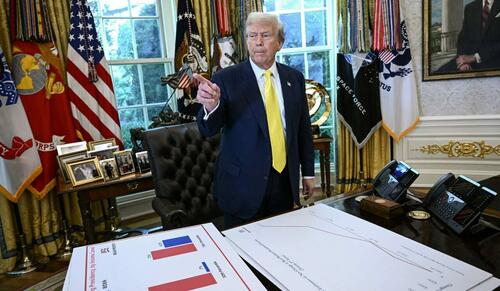
He ran and triumphed on pointing out that gasoline had gone sky-high under Biden, who drained the Strategic Petroleum Reserve, put federal oil and gas lands off-limits, and wasted hundreds of billions on green subsidies.

Biden entered office with Trump’s national gas average of $2.39 a gallon and promptly doubled it to $5—until it settled down to a four-year average of $3.35-40 a gallon. That was roughly 35-40 cents higher than the present $3.00 Trump national average.

Biden’s four-year inflation had cumulatively hit 21.5% and it climbed much higher when staples like key foods, insurance, housing, energy, cars, etc., were tabulated separately.

Trump thundered that he had left Biden with a 2020 near-historically low 1.2-4% inflation rate—and then Biden’s four years had more than quadrupled it to an average of 5.2% per year.

In any case, in the 2024 campaign, the case was made that Biden had added $8 trillion to the national debt while making staples unaffordable to the middle class. Trump easily won on that economics/affordability issue.

The affordability case was seemingly closed, given that the Democrats never had an answer for Biden’s misery indices and thus turned to the other smears mentioned above.

But then a funny thing happened.

Trump had entered office with a monthly inflation rate of 3%, but did not somehow immediately lower it.

And the rate remains. After ten months of Trump’s tenure, it was still at the same 3%.

Yet suddenly, the left cried, “Affordability!”

Apparently, Trump was culpable because in months he had yet to undo all the damage Biden had inflicted over four years, despite the fact that Trump’s inflation was already 2.2 points less than the Biden four-year yearly average—and headed downward.

But the public was exhausted by high prices and wanted Trump not just to lower dramatically the average Biden inflation rate but also to reduce the Biden 21.5 aggregate inflation and to do so immediately.

The Trump team did not believe anyone would believe this yarn for a number of reasons.

One, no one could credibly believe that the party responsible for hyperinflation could dare to blame its successor for not immediately, in ten months, cleaning up the mess that Democrats had wrought over four years.

Two, Trump had enacted a series of dramatic initiatives that may soon not only lower inflation but could create a veritable boom from some $10 trillion in promised foreign investment. More deregulation, extended tax cuts, and additional reductions are in the big beautiful bill.

The administration has been fast-tracking new federal fossil fuel leasing, pipeline construction, and incentives for greater production of oil and gas, and massive natural gas exports. The borders are closed. Two million illegal aliens have left the U.S., lessening social welfare costs and increasing labor opportunities for U.S. citizens.

By year’s end, some $200-300 billion in 2025 tariff revenue will be collected, coupled with increased domestic opportunities for U.S. business expansion.

So, apparently, the Trump administration thought that the public was aware that mid- to long-term remedies were underway that would fuel the economy in mid-2025.

Thus, did they assume “affordability” was not yet really an issue and needed little explanation, given the good news to come was already self-evident?

Or, they were so consumed with foreign affairs—and indeed, dramatic successes abroad—that they thought such good news would naturally become force multipliers of the implicitly bright economic forecasts.

Indeed, efforts to end the Ukraine war, the elimination of the immediate threat of an Iranian nuclear bomb, and a ceasefire in the Middle East were in sharp contrast to the prior four years, when two theater wars broke out on Biden’s watch after the disastrous misadventure in Kabul.

Finally, all Israeli hostages who were still alive returned. Hamas, Hezbollah, the Houthis, and Iran’s military have all suffered terrible damage.

Each month, there seems to be a new announcement of more favorable trade agreements with major commercial partners.

Once dismal military recruitment is now at a historic high. There is not a reduction but a veritable end of all illegal immigration.

Trump tried to fashion cease-fires in wars all over the world: the Congo-Rwanda, India-Pakistan, Cambodia-Thailand, Azerbaijan-Armenia, and Ethiopia-Egypt.

So why did Trump people not see the left gaining some traction on the affordability issue?

The administration has so far not fully absorbed three realities.

  • One, their likely successful economic stimuli and reforms will not kick in fully until mid-2026. So they needed to argue for a little more patience or to explain in detail exactly how, why, and when the economy will correct the Biden catastrophe.

  • Two, they did not pound home enough the difference between Trump’s economic legacy in 2020, the ensuing Biden four-year failure, and now his own ten-month new efforts to build upon what he had once accomplished.

  • Third, even foreign successes, ironically, can detract from the economy. True, good coverage of a Trump ascendant abroad helped him at home. But when the economy is demagogued as “unaffordable,” Trump’s attention overseas is used as proof that he doesn’t care about those at home.

In other words, in an election cycle, a presidential Nobel Peace Prize is worth less than a one percent inflation rate.

There is a year left before the midterms. If the Democrats win the House, they will stall the entire Trump agenda. They will impeach him in their first month. And they will subpoena and wage lawfare against all major Trump appointees in hopes of either bankrupting them or putting them in jail.

Obviously, to continue the MAGA counter-revolution, all emphasis should be on the economy. Every policy initiative should be discussed in terms of its economic utility, from ending illegal immigration to recording oil pumping to foreign investment.

Detail matters.

Trashing Biden is far less effective than comparing the actual data of his four-year averages with Trump’s own first-term stats so far: gas prices, the inflation rate, illegal entries, deportations, foreign investment, and other economic indicators.

Foreign policy must be presented in domestic and preferably economic terms: blowing up a narco-trafficking boat saves thousands of lives.

Providing NATO leadership offers leverage with the far more hostile EU—as in “decide whether as Europe-NATO you wish for an American presence, or as Europe-EU you do not like us and wish us gone—but not both.”

What is the dollar effect of deportation on job growth and higher wages for Americans, or on vastly reduced entitlement costs?

In sum, the economy is already better than Biden’s yearly averages. Events are in play that will create substantial national wealth soon, which will make the middle class better off. And successes abroad translate to an enhanced economy at home.

But all that in a unified fashion has to be hammered home rather than assumed.

Tyler Durden
Wed, 12/17/2025 – 16:20

via ZeroHedge News https://ift.tt/wsEyzgD Tyler Durden

Wall Street’s $4 Quadrillion Backbone To Roll-Out Tokenized US Treasuries

Wall Street’s $4 Quadrillion Backbone To Roll-Out Tokenized US Treasuries

Authored by Jesse Coghlan via CoinTelegraph.com,

The Depository Trust and Clearing Corporation said it is set to bring tokenized US Treasurys onchain, and plans to expand to a “broad spectrum” of assets in the future.

The DTCC said on Wednesday that it plans to “enable a subset of US Treasury securities” custodied at its subsidiary, the Depository Trust Company, to be minted on the Canton Network, a permissioned blockchain created by the fintech company Digital Asset.

“This collaboration creates a roadmap to bring real-world, high-value tokenization use cases to market, starting with US Treasury securities and eventually expanding to a broad spectrum of DTC-eligible assets across network providers,” said DTCC CEO Frank LaSalla.

The DTCC runs crucial market infrastructure for clearing, settlement and trading of US securities and reported that its subsidiaries processed $3.7 quadrillion in securities transactions last year.

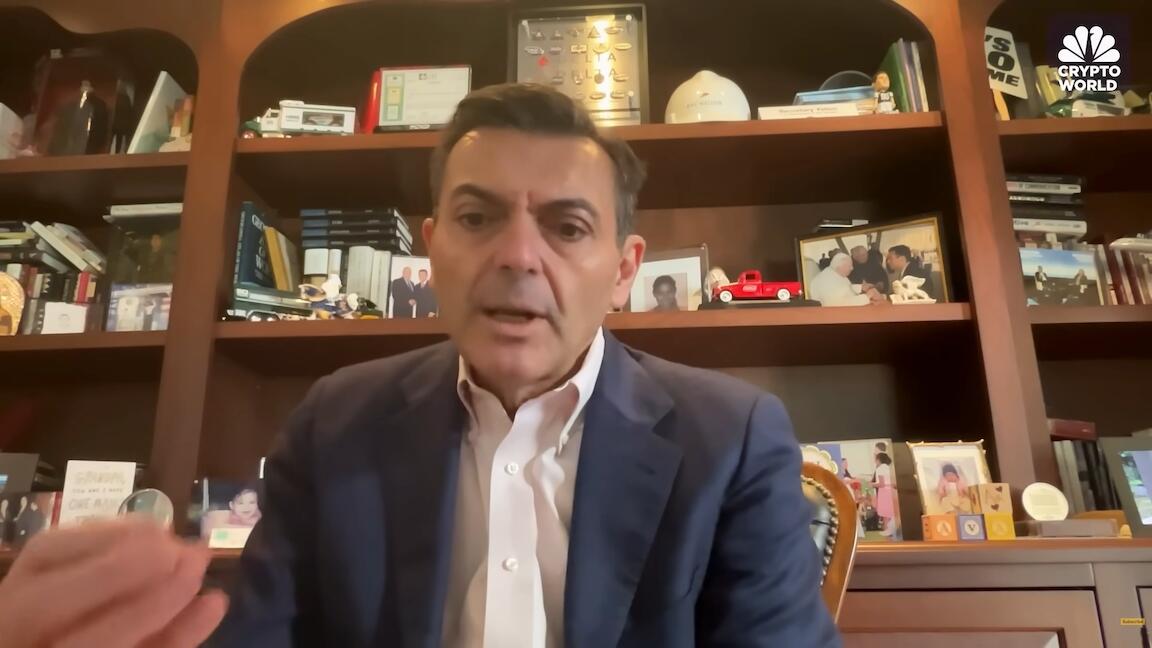
Frank LaSalla speaking with CNBC’s “Crypto World” on Friday after receiving the SEC’s no-action letter. Source: YouTube

The company received a rare “no-action” letter from the Securities and Exchange Commission on Thursday that greenlit a securities tokenization service “on pre-approved blockchains for three years,” and confirmed that the agency won’t take enforcement action against DTCC if its product operates as described.

More securities to be tokenized

The trio is working to launch a minimum viable product in a controlled environment by the first half of 2026, and the DTCC stated that it will “increase the size and scope of the project in the months that follow based upon client interest.”

It added that the whole partnership roadmap between the three companies would “unfold over multiple years,” but for now it aims to provide access to “digitized financial instruments in a secure and regulated environment.”

The DTCC said last week that the SEC’s letter “applies to a defined set of highly liquid assets,” including US Treasury bills, bonds and notes, exchange-traded funds (ETF) tracking major indexes and the Russell 1000, which tracks the 1,000 largest public US companies.

The company added that it would also join the Canton Network’s governance and would take up the position of co-chair alongside Euroclear on the blockchain’s backing organization, the Canton Foundation.

Markets are moving onchain, but analyst expects a slow burn

SEC chair Paul Atkins said on Friday after his agency gave DTCC a no-action letter that the company’s initiative “marks an important step towards onchain capital markets.”

“US financial markets are poised to move onchain,” he said, adding the SEC “is prioritizing innovation and embracing new technologies to enable this onchain future.”

The same day, NYDIG global head of research Greg Cipolaro said that the tokenization of securities won’t immediately be a major boon to the crypto market, but that could change if tokenized assets are allowed to better integrate on blockchains.

Cipolaro said that traditional finance structures are still required on tokenized assets; their designs can “differ greatly,” and most are hosted on private blockchains like Canton, meaning not all can work with the wider decentralized financial system.

“In the future, one could see these RWAs being part of DeFi (composability), either as collateral for borrowing, an asset to be lent out, or for trading,” he added. “This will take time as technology develops, infrastructure is built out, and rules and regulations evolve.”

Tyler Durden
Wed, 12/17/2025 – 15:40

via ZeroHedge News https://ift.tt/qA7LrRx Tyler Durden

DOD Flirting With Aviation Disaster: 2nd Near-Collision With USAF Tanker Off Venezuela

DOD Flirting With Aviation Disaster: 2nd Near-Collision With USAF Tanker Off Venezuela

Just one day after almost killing everyone aboard a passenger jet, the US Air Force narrowly dodged another near-disaster off the coast of Venezuela — this time with a business jet. For many, the two frightening incidents intensify a perception that the administration’s militarism against Venezuela is as reckless as it is unwarranted and unconstitutional.

Within a day of each other, two midair disasters nearly unfolded off Venezuela involving USAF refueling tankers, like this KC-45 Pegasus (USAF Photo)

For those who missed our reporting on the first near-disaster, on Saturday, a JetBlue Airbus A320 heading to New York’s JFK Airport from the Caribbean island of Curaçao was forced to take evasive action when the pilots suddenly found themselves staring down an approaching USAF refueling tanker at the same altitude and only two or three miles away.

“It was an air-to-air refueler from the United States Air Force…We had to stop our climb and actually descend to avoid hitting them,” the JetBlue pilot told air traffic controllers. “They don’t have their transponder turned on. It’s outrageous.” (A transponder is a device that helps make aircraft appear on the radars of controllers and other aircraft.) The controller replied, “I don’t have anything on my scope.” Here’s a reconstruction of that incident, overlaying radar and audio: 

Now comes news that, on Saturday, the passengers and pilots on a Dassault Falcon 900EX business jet heading to Miami from Aruba had their own brush with death via an Air Force tanker. In this case, an air traffic controller alerted the Falcon pilot and directed him to a new course: “Turn right heading 020. An unidentified traffic, 12 o’clock, closing 10 miles, level not known.”  

After spotting the aircraft, the rattled Falcon pilot informed the controller. “We just got that traffic. I don’t know how we didn’t get an RA for that,” he said, referring to a Resolution Advisory, a command generated by an on-board Traffic Alert and Collision Avoidance System (TCAS). “They were really close — and you turned us into them.” The controller explained that the unidentified craft “keep[s] turning irregular.” 

As it climbed out of Aruba, a Dassault 900EX like this one was almost destroyed by a KC-46 tanker operating off Venezuela

Trying to gather as much information as possible about the unidentified craft, the controller asked the Falcon pilot if he could discern its altitude or type. “Somewhere around 26 [thousand feet]. We were climbing right into him.. It was big, maybe like a triple-7, [767], something like that. It was a wide-body.” It’s not clear how CNN confirmed it was an Air Force tanker, but Russ Niles at AvBrief.com similarly concluded that it appeared to be a KC-46 tanker. While there’s no indication of how many were aboard the Falcon 900EX, it’s typically configured to carry 10 to 14 passengers.  

In November, the Federal Aviation Administration warned US carriers about potential dangers from “heightened military activity” at “all altitudes” in and around Venezuela. “Threats could pose a potential risk to aircraft at all altitudes, including during overflight, the arrival and departure phases of flight, and/or airports and aircraft on the ground,” the FAA said in a Notice to Airmen (NOTAM). In response, several airlines cancelled flights in and out of Venezuela. 

Seeking to rein in the administration’s widening military activity around Venezuela, resolutions are advancing in both the House and Senate that would bar the Pentagon from engaging in hostilities there without congressional approval. The House version, may be voted on as early as Thursday, counts Republicans Thomas Massie, Marjorie Taylor Greene and Don Bacon among its cosponsors. Republican Rand Paul helped introduce a similar measure in the Senate, saying, “The American people do not want to be dragged into endless war with Venezuela without public debate or a vote. We ought to defend what the Constitution demands: deliberation before war.”

At the urging of long-hawkish Secretary of State Marco Rubio, Trump has ordered many aggressive moves in and around Venezuela: 

  • Attacking boats purported to be carrying illicit drugs, killing at least 95 people. Compounding the controversy over using the military to summarily execute alleged drug offenders who likely weren’t even heading to the United States, at least one of the strikes included subsequent fire on survivors clinging to the wreckage. 
  • Ordering a “total and complete blockade” of all sanctioned oil tankers going into and out of Venezuela. That order on Tuesday came after last week’s interception and seizure of a tanker near the country’s coast, which prompted supertankers bound for Venezuela to make U-turns.  
  • Repeatedly threatening land warfare, recently telling reporters that, following on the boat attacks, “very soon we’re going to start doing it on land too.” 
  • Flying B-52 bombers near the coastline and F-18 fighters deep inside the Gulf of Venezuela. 
  • Reportedly authorizing covert operations to overthrow President Nicolas Maduro, seemingly betraying his campaign promises to be a “peace president” and to resist the Deep State’s long-running obsession with regime change.   

Tyler Durden
Wed, 12/17/2025 – 15:20

via ZeroHedge News https://ift.tt/SXe0nOR Tyler Durden

Trump Said His Tariffs Would Reduce the Trade Deficit and Bring Back Manufacturing. Here’s What the Data Show.


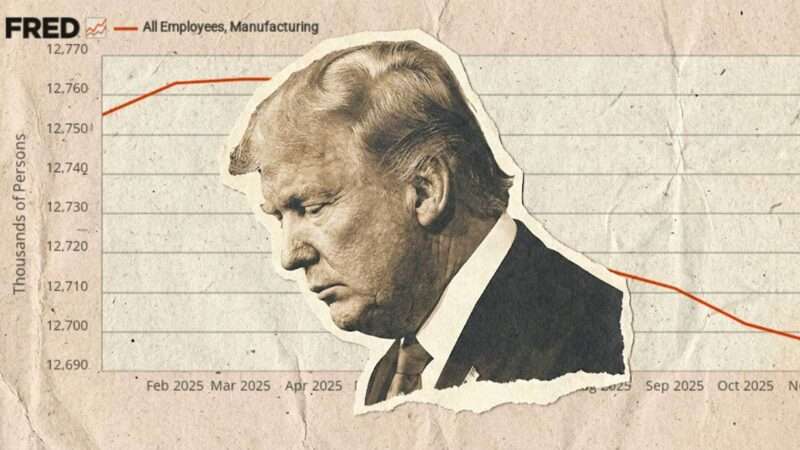
Illustration of President Donald Trump looking disappointed in front of a graph of declining manufacturing employment | Illustration: Eddie Marshall | Nano Banana

President Donald Trump has pledged that his tariffs will bring manufacturing jobs back to America and make America a net exporter again. So far, the exact opposite has happened: Manufacturing jobs have decreased, and the trade in goods deficit has increased.

From January through September, the most recent month for which U.S. Census Bureau trade data are available, the U.S. imported $1 trillion more in goods than it exported. This is a $118 billion jump compared to the goods trade deficit that the U.S. ran from January to September 2024. (Likewise, the overall trade deficit, which includes services, increased by $113 billion.)

Perhaps, one might argue, shooting ourselves in the foot (by Trump’s lights) is worth it if it causes our greatest geopolitical adversary—China—to amputate a limb. But that isn’t what happened either.

Recently published data from China’s General Administration of Customs show the Chinese goods trade surplus has increased since Trump took office. From January to September, China exported $875 billion more goods than it imported—a $185 billion jump vs. the same time period in 2024.

Chinese data must be taken with a grain of salt; they’re provided by one of the most repressive governments on Earth. That said, there’s reason to believe these statistics reflect reality. As The Economist explains, China’s $1 trillion trade in goods surplus from January through November is accounted for by “its enterprising manufacturers [expanding] into alternative markets and [discovering] roundabout routes past America’s trade barriers.” (This surplus also excludes trade in services, for which China imports $180 billion more than it exports.)

Supporters of Trump’s protectionist policies might argue that these are growing pains that must be accepted as the U.S. reshores manufacturing jobs and rebuilds the American industrial base. Who cares about the small businesses harmed by tariffs or consumers shouldering higher prices, they might say, if the trade barriers increase blue collar manufacturing employment by a single job?

But even under this rationale, Trump’s policies fall short.

Since Trump assumed office, manufacturing employment has decreased by 58,000 jobs, according to the Bureau of Labor Statistics’ November Employment Situation. Over the same period last year, the manufacturing sector lost 96,000 jobs; so the best Trump can tendentiously tout is a slower rate of manufacturing job loss. (As a share of total nonfarm employment, manufacturing employment decreased steadily from around 40 percent in 1943 to about 8 percent in 2010. It has hovered around there ever since.)

Fortunately for consumers, these macroeconomic statistics are meaningless. You run a trade deficit with your grocery store, I run a trade deficit with McDonald’s, good little boys and girls run a trade deficit with Santa Claus, and we’re all better off for it. As as the economists Daniel Klein and Donald Boudreaux have put it, a trade deficit is equivalent to running a surplus on current stuff.

Likewise, as countries get richer, their labor markets transition from agriculture to industry and then to the service sector. Declining manufacturing employment as a share of overall employment is a sign that Americans are richer, not poorer, than our ancestors.

Trump’s targeted metrics are meaningless as proxies of prosperity. But the fact that his protectionist policies are failing to achieve their stated goals shows just how flawed they—and their justifications—always were.

The post Trump Said His Tariffs Would Reduce the Trade Deficit and Bring Back Manufacturing. Here's What the Data Show. appeared first on Reason.com.

from Latest – Reason.com https://ift.tt/7rgA5BV
via IFTTT

Guan Heng Exposed China’s Uyghur Camps. ICE Wants To Deport Him.


Guan Heng | Illustration : Adani Samat Photo: Luo Yun

Guan Heng is a former resident of China who did something amazing: He defied the country’s authoritarian government and documented the abuses of Uyghur Muslims.

The 37-year-old citizen-journalist entered Xinjiang after downloading the satellite coordinates of alleged Uyghur detention facilities. He took pictures of the camps—camps that the Chinese Communist Party has claimed do not exist. He shared these images with BuzzFeed News, which then published an eye-opening series of articles about the internment of ethnic and religious minorities in China.

It was incredibly brave of Guan Heng to do this. Documenting the atrocities of tyrants is important work—and extremely dangerous. Heng knew that if the Chinese authorities got a chance, they would arrest him, question him, and possibly torture and even kill him. And so he fled China in 2021, traveling to Ecuador and  eventually by boat to the U.S. He applied for asylum and obtained a work permit. He has been living quietly in New York ever since, working as an Uber driver and food deliverer.

A few months ago, in August, ICE detained him after he admitted he had initially entered the country illegally. Immigration authorities would now like to deport him, either to Uganda—where he would likely be taken back to China—or to China directly.

That would be a travesty. The feds should certainly not deport Guan Heng, no matter how he came to this country. On the contrary, he should be commended and welcomed. As The Wall Street Journal says:”It’s hard to imagine a stronger case for asylum.” There is no good reason for ICE to work as a communist government’s enforcer.

It’s true that many Americans want the federal government to vet asylum claims with greater care. But Guan Heng should easily pass any such test. If anything, the government should incentivize anti-communist whistleblowers and citizen-journalists to cooperate with the U.S. We want Chinese scientists, for instance, who have information about the possible lab origins of COVID-19 to document and disseminate any such evidence, and to seek refuge as far from Beijing’s reach as possible.

Democrats on the U.S. House of Representative’s Foreign Affairs committee appear to be taking up Guan Heng’s case. That’s good, but there is absolutely no reason for this to become a partisan issue. Any Republicans who care about China’s authoritarian ways should concede that this is obviously a case where other considerations should overrule the Trump administration’s deportation agenda.

The post Guan Heng Exposed China's Uyghur Camps. ICE Wants To Deport Him. appeared first on Reason.com.

from Latest – Reason.com https://ift.tt/r2ksx0F
via IFTTT

Jewish Plaintiffs in Establishment Clause Cases

I was doing some research on Establishment Clause cases, and noticed the plaintiffs in several leading cases were Jewish. I’m sure I’m missing others.

In Braunfeld v. Brown (1961), Abraham Braunfeld and the other plaintiffs were “member[s] of the Orthodox Jewish faith, which requires the closing of their places of business and a total abstention from all manner of work from nightfall each Friday until nightfall each Saturday.”

In Engel v. Vitale (1962), Steven Engel was described as a “devout Reform Jew.”

In Flast v. Cohen (1968), the lead plaintiff was Florence Flast. Several sources indicated he was Jewish, but nothing definitive. The other plaintiffs were Albert Shanker, Helen D. Henkin, Frank Abrams, C. Irving Dwork, Florine Levin. I would surmise that at least some of these plaintiffs were Jewish as well. Cohen, the Secretary of Health, Education, and Welfare, was Jewish.

In Lee v. Weisman (1992), student Deborah Weisman was Jewish, and objected to a graduation message delivered by Rabbi Leslie Gutterman, of Temple Beth El in Providence.

In Elk Grove Unified School District v. Newdow (2004), Michael Newdow’s mother was “Jewish but secular.”

In Town of Greece v. Galloway (2014), Susan Galloway was Jewish.

In Lemon v. Kurtzman (1971), Alton Lemon, the lead plaintiff was not Jewish, but the respondent, David Kurtzman, the Superintendent of Public Instruction, was Jewish.

The post Jewish Plaintiffs in Establishment Clause Cases appeared first on Reason.com.

from Latest – Reason.com https://ift.tt/pgjUSkl
via IFTTT

Hegseth Won’t Let Us See a Video That Might Undermine Support for Trump’s Bloodthirsty Anti-Drug Strategy


Defense Secretary Pete Hegseth at the White House |  Molly Riley/White House/Newscom

Two weeks ago, President Donald Trump said he saw “no problem” with releasing the full video of the newly controversial September 2 operation that inaugurated his deadly military campaign against alleged drug boats in the Caribbean and the eastern Pacific. But on Tuesday, Defense Secretary Pete Hegseth said no one aside from a select group of lawmakers would be allowed to see the video, which shows a second missile strike that blew apart two survivors of the initial attack as they clung to the smoldering wreckage.

“In keeping with long-standing…Department of Defense policy, of course, we’re not going to release a top secret, full, unedited video of that to the general public,” Hegseth said after he and Secretary of State Marco Rubio briefed senators on the boat attacks, which so far have killed 95 people in 25 operations. But the fact that the video currently is deemed “top secret” should not be decisive, since Hegseth has the power to declassify it. He is using vague national security concerns as an excuse to conceal footage that might undermine public support for Trump’s murderous anti-drug strategy by vividly showing what it looks like in practice.

“Will you release video of that strike so that the American people can see for themselves?” ABC’s Selina Wang asked Trump on December 3. “I don’t know what they have,” Trump replied, “but whatever they have, we’d certainly release, no problem.”

Hegseth contradicted that commitment three days later. “President Trump said he would have no problem if the full video of the strike is released,” Fox News reporter Lucas Tomlinson noted during a Q&A session on December 6. “When can we see that video? When will you release it?”

Hegseth implied that Tomlinson was mistaken in taking the president at his word. “We’re reviewing it right now to make sure sources [and] methods” are not compromised, Hegseth said. “I mean, it’s an ongoing operation….We’ve got operators out there doing this right now. So whatever we were to decide to release, we’d have to be very responsible about it. We’re reviewing that right now.”

Two days later, Trump himself retreated from his promise of transparency. “Mr. President, you said you would have no problem with releasing the full video of that strike on September 2nd off the coast of Venezuela,” ABC’s Rachel Scott reminded him. Trump denied that he had said what he said: “I didn’t say that. You said that. I didn’t say that. This is ABC fake news.” Then he announced a new position: “Whatever Hegseth wants to do is OK with me.”

When Scott pressed Trump on whether he would order Hegseth to release the video, he unloaded on her: “You’re the most obnoxious reporter in the whole place. Let me just tell you, you are an obnoxious—a terrible, actually, a terrible reporter. And it’s always the same thing with you. I told you, whatever Pete Hegseth wants to do is OK with me.”

Given that green light, Hegseth evidently decided he did not need to offer any specific rationale for refusing to release the video. Like Trump’s promise that “we’d certainly release” it, Hegseth’s talk of “reviewing” the footage with an eye toward redacting clues about “sources [and] methods” has gone down the memory hole.

Sen. Markwayne Mullin (R–Okla.), a member of the Senate Armed Services Committee and an enthusiastic supporter of summarily executing suspected cocaine couriers, told reporters on Tuesday the issue with the video is “the sensitivity” of “the assets used” in the boat strike. “It is a classification issue,” said Mullin, who has not seen the video. “I don’t make the classification….If you don’t like the classification, talk to the White House about it.”

Rep. Adam Smith (D–Wash.), who as the ranking Democrat on the House Armed Services Committee was allowed to see the video during a closed-door briefing on December 4, thinks the claim that releasing it would compromise “sources and methods” is “ridiculous.” The Pentagon could easily “make sure that nothing in that video…shows anything [sensitive],” Smith said during a December 7 interview on ABC’s This Week. “If they showed…just the portion that we saw, those two on the boat, it’s no different [from] any of the dozen-plus videos they’ve already released.”

While the military rationale for concealing the video is dubious, the political rationale is pretty clear. “They don’t want to release this video because they don’t want people to see it,” Smith said. “If they release the video, then everything that the Republicans are saying will clearly be [seen] to be completely false.”

Like the Trump administration’s position on releasing the video, its justification for the second strike is a moving target. Rep. Jim Himes (D–Conn.), the ranking Democrat on the House Intelligence Committee, has noted the Pentagon’s “shifting explanations.”

Immediately after the attack, Himes recalled during a December 7 interview on the CBS show Face the Nation, members of Congress were told U.S. forces “needed to clear the wreckage so that there wasn’t a danger to navigation.” Then “right before we watched the video,” Himes said, the explanation was that the unarmed survivors “might have had a radio,” “might have been radioing a boat,” and “might have been trying to recover the cocaine.” But “when you actually watch the video,” he noted, “you realize they don’t have a radio” and are “barely hanging on” to what remains of the boat. Then the claim became that they were “trying to right the boat,” even though “the conflagration” from the first missile strike “probably destroyed everything in that boat.”

The latest explanation illustrates the alarming implications of conflating drug smuggling with violent aggression. Adm. Frank Frank M. Bradley, who commanded the operation, reportedly told lawmakers he ordered the second strike because he worried that the two floundering survivors could have salvaged whatever cocaine might have remained in the capsized bow of the boat, which was all that was left after the first strike.

Trump, who last month said he “wouldn’t have wanted” a second strike, alluded to Bradley’s rationale for it during his vituperative December 8 exchange with Scott, the ABC reporter. “I saw the video,” he said. “They were trying to turn the boat back to where it could float. And we didn’t want to see that, because that boat was loaded up with drugs.”

Trump was echoing Sen. Tom Cotton (R–Ark.), chairman of the Senate Intelligence Committee, who after watching the video on December 4 claimed the helpless survivors were “trying to flip the boat” so they “could stay in the fight”—a “fight” that did not actually exist, since neither those two men nor the nine others killed in the attack were engaged in combat with U.S. forces. Cotton later qualified his claim on NBC’s Meet the Press, saying “they looked at one point like they were trying to flip the boat back over, presumably to rescue its cargo and continue their mission.” It is at least as plausible, of course, that “they were trying to flip the boat back over” in an effort to avoid drowning.

In any event, Cotton said, “it doesn’t really matter what they were trying to do.” Since part of the boat was still afloat, he averred, “that boat, its cargo, and those drug traffickers remained valid targets….It was entirely appropriate to strike the boat again to make sure that its cargo was destroyed. It is in no way a violation of the law of war.”

According to the Defense Department’s Law of War Manual, “orders to fire upon the shipwrecked would be clearly illegal.” The manual says individuals are deemed “shipwrecked” when they are “in distress at sea,” “helpless,” and “in need of care and assistance,” provided they “refrain from any hostile act.”

Beyond the issue of whether Bradley violated that rule, Cotton’s claim that the two survivors “remained valid targets” raises the question of whether they were ever valid targets. The answer depends on whether you accept Trump’s preposterous premise that supplying Americans with cocaine amounts to “an armed attack on the United States.” If you don’t, you will see a problem not only with this particular attack but with Trump’s general policy of treating criminal suspects as “combatants” in a nonexistent “armed conflict,” which he thinks justifies killing them from a distance without legal authorization or any semblance of due process.

The video that Hegseth refuses to release would dramatically illustrate the consequences of that logic. Cotton, who told reporters he did not see “anything disturbing” in the video and said “I personally don’t have any problem with” releasing it, is confident that Americans will share his morally and legally bankrupt take on the cold-blooded murder of defenseless people. Hegseth seems less sure.

The post Hegseth Won't Let Us See a Video That Might Undermine Support for Trump's Bloodthirsty Anti-Drug Strategy appeared first on Reason.com.

from Latest – Reason.com https://ift.tt/83qxtSO
via IFTTT