Nearly Half Of All ICOs Last Year Have Already Failed… And That’s A Good Thing

Authored by Simon Black via SovereignMan.com,

The Securities and Exchange Commission clamped down on cryptocurrency firms last week in a major way.

The regulatory body issued dozens of subpoenas (some groups estimate more than one hundred) to companies that conducted or advised on initial coin offerings (ICOs).

Notes readers aren’t surprised, as I’ve long warned that the scammy ICO market is one of the biggest bubbles I’ve ever seen.

Before discussing the fraudulent nature of the space, a bit of background on ICOs…

A lot of people view ICOs as an asset class like stocks, bonds or real estate. But that couldn’t be further from the truth.

Initial coin offerings are simply a funding scheme. Companies looking to raise money will post a white paper on a website, post some pictures of their “C-suite executives,” and set up a Twitter account… that’s basically it.

The goal is to raise funds by issuing “tokens.” These tokens typically serve as pre-paid credits that can be used within the ecosystem of the company raising the funds. In other words, you’re not actually getting equity in the company… you’re buying a gift card.

Think of it like the in-game credits you would buy (with real money) to get ahead in the old Facebook game, Farmville. Outside of Farmville, those credits are worthless.

With almost no information, and the obvious, inherent risks to buying a prepaid service, investors are supposed to evaluate if there’s a valid, secondary market for these tokens.

In the face of these many flaws, prices of these ICOs would soar. Not for any fundamental reasons… simply because we were experiencing a massive bubble fueled by hype.

And the prevalence of outright fraud caught the attention of the SEC.

One company called Prodeum was allegedly developing a blockchain for agricultural commodities.

Prodeum raised $11 million through an ICO. Then the founders (who were likely made up in the first place) disappeared without a trace. And the only thing left on the company’s website was a single word – “penis.”

Despite the many warning signs, companies have still raised nearly $9 billion to date through ICOs. And a lot of that money has simply disappeared.

Bitcoin.com recently completed a study of the 902 ICOs that took place last year.

Of those, 142 failed at the funding stage.

Another 276 failed after either taking the money and running or simply failing as a business.

So a full 46% of all ICOs last year have already failed.

But it gets even worse…

An additional 113 ICOs, according to Bitcoin.com, are “semi-failed” because the founders have ceased communications with the public or because the community of users is so small there’s zero chance of success.

Once you add in these “semi-failed” firms, 59% of last year’s ICOs are goners.

Think about that failure rate… it’s astounding. And that’s in one year’s time.

I’m certain that percentage will only increase.

The vast majority (90+%) of cryptocurrencies and ICOs will fail for one simple reason… they have ZERO utility.

People forget, but when you participate in an ICO, you’re actually investing in a business. And that business has to provide value in order to justify its existence.

Let’s look at a couple of the more useless offerings of the past…

Skincoin allows you to get new “skins” for guns in video games. It raised $3.3 million.

There’s also a TrumpCoin meant to “support President Trump and his vision of making America great again.” I have no idea how that’s even a token, but TrumpCoin was worth $3.38 million at its peak.

I seriously doubt there will be much demand for Skincoin or TrumpCoin over the long term. And the fact that these types of coins are on their way to extinction means the market is working.

And while I’m no fan of government regulation, operators in the crypto space are welcoming more regulation… because it gives them clear rules and guidelines to follow as a business. Some lawyers have said the SEC’s recent round of subpoenas was meant as an invitation to have a more open dialogue with these firms.

Of course, I could think of a better way to start a conversation.

But once there’s a clear delineation of what’s legal and what’s not when it comes to crypto and ICOs, more mainstream players and investors will get involved. And that will lead to a larger, less volatile marketplace.

But ultimately, the value of these tokens is driven by demand.

And in the long-run, demand has to be driven by some sort of utility. The coin must present some special benefit that other coins and tokens don’t have… and that people will actually NEED.

I’ve been talking a lot this year about avoiding big mistakes. Luckily, the ICO market is an easy one to avoid.

*  *  *

If you are interested in speculating in Cryptocurrencies, I encourage you to download our free Crypto Currency Report – A Different Perspective on Crypto. More and more people want to dive into crypto currencies and everyone’s focus is on Bitcoin’s price. But, the price is not what matters… I see so many people make the same wrong assumptions and mistakes that could be fatal to their capital. That’s why my team and I have written this special report where I share a different perspective on cryptocurrencies.


via RSS http://ift.tt/2HcSufm Tyler Durden

Trump To Sign Tariffs Proclamation Tomorrow, No Carve-Outs

It’s on like donkey kong.

After a day of uncertainty, The Wall Street Journal confirms that President Trump is expected to sign a new proclamation Thursday afternoon (at 330ET) outlining his plan to impose new tariffs on steel and aluminum, according to a White House official familiar with the planning.

Critically, the US equity market ramped exuberantly this afternoon after White House press secretary Sarah Huckabee Sanders said Wednesday there may be “potential carveouts” for Mexico, Canada and possibly other countries.

However, WSJ reports that officials said it was unclear whether that would be addressed on Thursday; Mr. Trump may take additional action later to give national-security exemptions on a country-by-country basis.

Invitations were issued Wednesday afternoon for the Thursday event, which will include industry executives and workers. There is no sunset provision for the tariffs or review period stipulated in the proposal, the White House official said.

Divisions also remain within Mr. Trump’s cabinet.

Critics have said the tariffs, issued under the guise of national-security considerations, will damage relationships with Canadian and European allies, slow economic growth and harm American metal-consuming industries.

But President Trump seems undeterred.

And furthermore, this news comes after House Ways & Means Chair Brady managed to gather 107 House Republicans’ signatures to urge Trump to target tariffs to just “bad actors” like China.

House Ways and Means Committee Chairman Kevin Brady (R-TX), Trade Subcommittee Chairman Dave Reichert (R-WA), and 105 additional House Republicans today reinforced the need to take action against China and other unfair trading partners while expressing concerns that broad tariffs could harm America’s jobs, manufacturers, and consumers.

Upon sending a letter to President Trump, Chairman Brady said:

“We applaud President Trump for standing up against bad actors who trade unfairly and hurt America. We’re writing today to say: we stand with you in taking tough action to keep America safe and our economy strong. At the same time, we’re urging the President to tailor these tariffs so American businesses can continue to trade fairly with our partners, sell American-made products to customers all over the world, and hire more workers here at home.”

In the letter, the lawmakers wrote:

We support your resolve to address distortions caused by China’s unfair practices, and we are committed to acting with you and our trading partners on meaningful and effective action.  But we urge you to reconsider the idea of broad tariffs to avoid unintended negative consequences to the U.S. economy and its workers.  We are eager to work with you in pursuing a workable, targeted approach that achieves our shared goal.”

Further, the lawmakers wrote:

We are writing to express deep concern about the prospect of broad, global tariffs on aluminum and steel imports.  Because tariffs are taxes that make U.S. businesses less competitive and U.S. consumers poorer, any tariffs that are imposed should be designed to address specific distortions caused by unfair trade practices in a targeted way while minimizing negative consequences on American businesses and consumers. 

“We were privileged to partner closely with you and your administration to develop and pass the Tax Cuts and Jobs Act.  Your leadership on these tax cuts, in combination with your regulatory reforms, have done so much to increase the competitiveness of U.S. companies and restore the United States’ position as the best place in the world to do business.  We are convinced that the benefits of these tax cuts are only beginning, and we look forward to building on this great success as the benefits continue to spread to U.S. workers and job creators.  But adding new taxes in the form of broad tariffs would undermine this remarkable progress.”

The lawmakers outlined several recommendations to hold countries accountable without disrupting the flow of fairly traded products that American manufacturers rely on:

First, any relief should be narrow, excluding all fairly traded products and all products that do not pose a national security threat.  Second, a robust exclusion process should be announced at the outset that allows U.S. companies to petition for and promptly obtain duty-free access for imports that are unavailable from U.S. sources or otherwise present extenuating circumstances.  Third, existing contracts to purchase aluminum or steel should be grandfathered to allow duty-free imports and avoid disrupting the operation and finances of projects that are already budgeted and underway.  Fourth, the effects of this remedy on our economy should be reviewed and reconsidered on a short-term basis to determine if a different approach would better serve the interests of our American workers, job creators, and consumers.”

CLICK HERE to read the full letter.

via RSS http://ift.tt/2G44h07 Tyler Durden

The Death Of Buy-And-Hold: We’re All Traders Now

Authored by Charles Hugh Smith via OfTwoMinds blog,

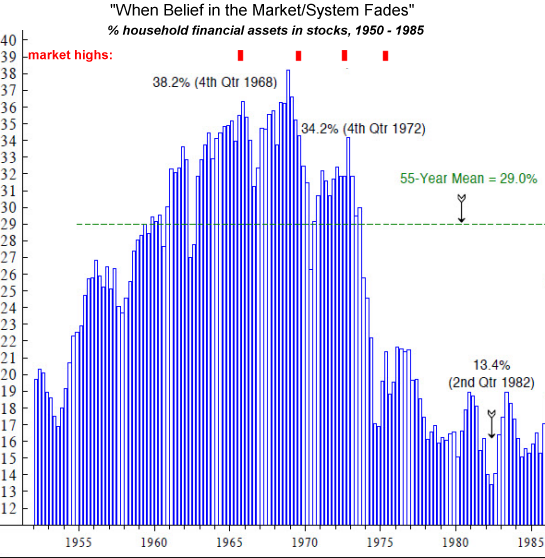
The percentage of household assets invested in stocks fell from almost 40% in 1969 to a mere 13% in 1982, after thirteen years of grinding losses.

The conventional wisdom of financial advisors–to save money and invest it in stocks and bonds “for the long haul”–a “buy and hold” strategy that has functioned as the default setting of financial planning for the past 60 years–may well be disastrously wrong for the next decade.

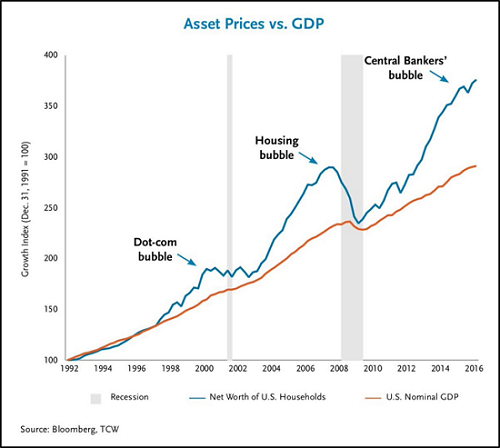
This “buy and hold” strategy is based on a very large and unspoken assumption: that every asset bubble that pops will be replaced by an even bigger (and therefore more profitable) bubble if we just wait a few years.

The last time this conventional wisdom came into serious question was in the stagflationary 1970s, when stocks and bonds, when adjusted for inflation, lost over 40% of their value. The decade was punctuated by numerous rallies, but each one petered out.

The only way to profit in this sort of market is to trade, i.e. buy the lows and sells the highs. Buy and hold is a disastrously wrongheaded strategy when the underpinnings of the status quo are eroding.

The 36-year bull market in bonds is drawing to a close, as yields are rising even if official inflation is moribund. Buying and holding bonds will guarantee steadily increasing losses as existing bonds lose value as rates rise.

Stocks have risen solely on the back of central bank stimulus, which is now being reduced/ended. In my view, the political blowback of soaring income inequality due to central banks rewarding capital at the expense of labor will place limits on future central bank largesse.

These long-term reversals of trend make everyone a trader, whether they like it or not: buying and holding might work for real-world assets if inflation really gathers steam, but if markets gyrate in the winds of uncertainty, every asset might rise and fall or simply stagnate.

Being a trader simply means selling an asset when it has topped out relative to other asset classes, and shifting the proceeds into assets that have been crushed and are beginning an up-cycle. It sounds so absurdly simple: buy low, sell high. But it’s not that easy to accomplish in the real world.

It takes discipline to buy when others are selling (the low point of any asset cycle) and to sell when when everyone else is confident (and greedy for even more gains).

As a general rule, letting others take the risks required to skim the last 10% of gains is a prudent strategy: take profits when they arise, and don’t assume uptrends of the sort we’ve enjoyed for the past 9 years will last.

As a trader as well as an investor, I’ve learned the hard way that the barriers to successful trading are largely psychological/emotional: we are all too easily swayed by the emotions of greed, fear and group-think.

Buying and holding is a relatively painless strategy in a rising tide that raises all boats. But when markets gyrate up and down, only those able and willing to trade–to take a modest profit and then buy another asset and then sell that when profits arise–will actually prosper in terms of increasing the purchasing power of their holdings.

The final and perhaps most difficult piece of trading is to gain the ability to recognize a decision to buy an asset isn’t working as planned, and to sell the asset for a loss. Nothing is more difficult for humans than admitting to ourselves that we were wrong and a decision isn’t playing out as planned.

Taking a loss is remarkably difficult as well. Modern psychology informs us that the sting of losses is far more potent than the euphoria of reaping gains, and mastery of trading requires the trader to “make all things equal,” to use the Taoist phrase: losses and gains are treated equally.

Like the football quarterback, we can’t dwell on the interception we just threw; we must clear our minds for the next successful throw/completion.

This discipline takes much practice, and most participants in the markets are ill-prepared to acquire the necessary discipline.

Here’s another metaphor: sailing in calm seas and light, steady breezes makes sailing seem easy to the beginner. But when the seas roughen and the wind gusts unpredictably, it doesn’t seem so easy any more.

Everyone who buys or owns any asset from now on –currency, cash, real estate, cryptocurrency tokens, stocks, bonds, options, farmland, copper futures, oil wells, everything–is a trader. Those who don’t understand this may suffer potentially catastrophic losses.

From now on, everything is a trade that might have to be sold to avoid losses.

“Buy and hold” is based on the belief that each popped bubble will be replaced by an even bigger bubble. As I’ve discussed before, there are solid reasons to suspect that there won’t be a fourth bubble after this one finally pops: three bubbles and you’re out.

It’s instructive to refer to a chart of the percentage of household assets invested in the stock market. Buy the dip and buy and hold worked consistently from 1950 until 1969, when the wheels fell off the stock market. (The wheels fell off the bond market a few years later.)

Households kept putting more and more of their assets into the “can’t lose” stock market until the stagflationary losses of the 1970s destroyed their stock portfolios and their belief in buy and hold.

The percentage of household assets invested in stocks fell from almost 40% in 1969 to a mere 13% in 1982, after thirteen years of grinding losses–a process punctuated by numerous sharp rallies, each of which faded.

President Richard Nixon famously observed, “We’re all Keynesians now,” indicating the triumph of Keynesian policies within the political system. Perhaps in a few years someone will mutter “we’re all traders now,” and that utterance will mark the passing of buy and hold as the status quo’s “can’t fail” strategy.

*  *  *

My new book Money and Work Unchained is $9.95 for the Kindle ebook and $20 for the print edition. Read the first section for free in PDF format. If you found value in this content, please join me in seeking solutions by becoming a $1/month patron of my work via patreon.com.

via RSS http://ift.tt/2FpjxTU Tyler Durden

Dow Jones Drops 200+ Points on Gary Cohn Resignation, CIA Wants to Keep Official Leaks Classified, Tommy Lee Fights Son: P.M. Links

  • The Dow Jones Industrial Average dropped nearly 300 points after news broke that White House economic advisor Gary Cohn had resigned, although it recovered partially.
  • The CIA argues that its official leaks to journalists should not be subject to Freedom of Information Act requests.
  • Nikolas Cruz was indicted on 17 counts of murder in relation to the Parkland school shooting.
  • The U.S. Holocaust Museum is rescinding a human rights award it gave to Aung San Suu Kyi.
  • Police in the United Kingdom say a former Russian spy and his daughter, who are living in England now, were deliberately poisoned with nerve gas.
  • A tweet by Tommy Lee trashing ex-wife Pamela Anderson reportedly sparked a brawl between Lee and his 21-year-old son.

from Hit & Run http://ift.tt/2FjekBb
via IFTTT

“I Loved The Attention”: Nunberg Recovers From Drunken Media Tour

Mueller-defying Trump associate Sam Nunberg – having collected his thoughts after a series of inebriated media interviews on Monday – said he “loved all the attention” from his controversial junket, but that he now plans to comply with Special Counsel Robert Mueller’s subpoena as quickly as possible.

Nunberg also cleared up his on-air speculation over whether Trump had engaged in misconduct during the campaign. After admitting to host Katy Tur on Monday that he’d been interviewed by Mueller’s investigators, Nunberg was then asked if he believes the special counsel “has anything” on Trump. “I think they may,” the ex-aide responded. “I think he may have done something during the election. But I don’t know that for sure.”

The former Trump associate cleared that up, telling Bloomberg News on Wednesday that the president “never did anything illegal or wrong around me,” though he did say “It’s my impression that they may have something on him. But perhaps they don’t.

Nunberg is now planning to show up for a scheduled grand jury testimony on Friday, and he will hand over email communications with Trump and nine other associates demanded by Mueller “as quickly as possible,” adding that compiling the emails turned out to be easier than he thought. 

The 48-hour about-face is in stark contrast to Monday’s bombastic rhetoric, when Nunberg told Bloomberg News “They want me in there for grand jury on Friday. I’m not paying the money to go down there,” Nunberg said. “What’s he going to do? He’s so tough – let’s see what they do. I’m not going to spend 40 hours going over emails. I have a life.” 

After admitting to Fox Business Network host that he’d been drinking, Gasparino gave a heads up to the other journalists on Nunberg’s schedule to let them know he was sauced up. 

“When he told me this stuff, that he wanted to go public with it, that he wanted me to break it, I asked him three times whether he was sure and is he of sound mind to do this, because I didn’t think he was,” Gasparino related to Fox Business colleague Liz Claman. “He told me he was drinking. … I just watched him on MSNBC and CNN, and the man needs help.”

Gasparino’s concerns were ignored by his colleagues at other networks, culminating in an interview with CNN’s Erin Burnett. “We talked earlier about what people in the White House were saying about you ― talking about whether you were drinking or on drugs or whatever had happened today,” said Burnett. “Talking to you, I have smelled alcohol on your breath.

Nunberg now says it’s all good…

“I don’t feel exploited,” Nunberg tells Bloomberg. “I was playing everywhere,” he said. “I was trending No. 1 on Twitter from a couch in my office.”

Nunberg acknowledged to Bloomberg that he had strategized how to reverse damage to his reputation from his phoned-in cable news appearances. On Tuesday and Wednesday, he reached out to friends and reporters to argue that there was a strategy behind the TV spree — and that it wasn’t a drug- or alcohol-fueled meltdown.

“This is my personality,” he said.

via Zero Hedge http://ift.tt/2oRzNqy Tyler Durden

‘Carve-Outs’ Rescue Stocks From Cohn Carnage

Cohn’s out… but all is well…


Overnight saw stocks plunge on Gary Cohn resignation headlines, stagger some more on weak macro data, bounce on “good” news that Navarro was not ‘on the list’, only to be rescued by Sarah Sanders telling reporters that ‘carve-outs’ were possible from Trump’s tariffs… But as soon as The Dow filled its gap and S&P inched green, sellers re-appeared…


Dow managed to fill its gap before tumbling into the close…


Bank stocks were initially disappointed by Cohn’s departure but soon got over it (though Goldman underperformed)…


VIX was pushed lower again as all major US equity vols were systemically sold after Europe closed…


Treasury yields ended marginally lower on the day but traded in a narrow range once again…


And overall, 10Y yields managed to almost get back to unch this afternoon…


Notably Breakevens lagged yields today but snapped higher (along with stocks) after Sander’s “carve out” comment…


The Dollar Index limped back to unchanged after some modest gains early on…


At around 11ET, cryptos carnaged lower today…

with Bitcoin battered back below $10k on massive volume…


Commodities were all lower today (despite the dollar ending unch) and we note the jump in PMs on the Cohn headlines soon after the close…


Interestingly, the dollar and gold fell together in the afternoon as stocks were ramped…


WTI/RBOB sank on inventory and production data…


Gold continues to lead post-Trump-Tariff-Tantrum but stocks were ramping hard today…

via Zero Hedge http://ift.tt/2oXPhsr Tyler Durden

Connecticut Governor: NRA Is A “Terrorist Organization”

Connecticut’s governor called the National Rifle Association (NRA) a terrorist organization in an interview Tuesday.

As The Daily Caller’s Henry Rodgers reports, Gov. Dannel Malloy, a Democrat, also said his state would “boycott” the NRA and said the organization has been acting like a “terrorist organization,” in an interview with Fox61.

He also believes the NRA has changed throughout the past 20 years.

“They act, quite frankly, in some cases as a terrorist organization,” Malloy said.

 “You want to make safer guns? We will boycott your company. That’s who they are. That’s what they do.”

The comments directed at the NRA come weeks after the Feb. 14 school shooting in Parkland, Fla., that left 17 people dead. The NRA has continued to receive criticism after the shooting, causing massive companies such as FedEx, Delta and United and many others to cut ties with the association.

The NRA has completely changed since the 1990s, the governor also said, noting the group previously opposed teachers carrying firearms in schools and that they had been in favor of universal background checks. Malloy believes changes to their beliefs have transformed the organization into a “terrorist organization.”

Malloy’s criticism also comes after reports surfaced of a billboard, located in Pensacola, Fla., calling the NRA a “terrorist organization.”

The billboard was funded by Mad Dog PAC, which reportedly funds billboards across the U.S. in opposition to President Donald Trump and other Republicans running for office.

via Zero Hedge http://ift.tt/2D91vU0 Tyler Durden

Free Yourself From the Soft Tyranny of Nutrition Studies

“Fish oil or omega-3 supplements won’t help people with heart disease,” writes nutritionist Alice Callahan in Lifehacker. Her source is a recent JAMA Cardiology meta-study that looked at 10 trials with a total of 77, 917 participants and found that “supplementation with marine-derived omega-3 fatty acids for a mean of 4.4 years had no significant association with reductions in fatal or nonfatal coronary heart disease or any major vascular events.”

American consumers were told to supplement with omega-3 (and to eat more fish) based on studies of Inuit people in Greenland who eat a lot of omega-3-rich animals and have exceptionally healthy hearts. You should read Callahan’s piece at Lifehacker for the full story (turns out, Inuit genes may be different than yours and mine), then check out the JAMA Cardiology paper if you want more.

The post you’re reading right now, however, is about nutrition studies and why you shouldn’t think about them too much.

Nutrition studies are confusing and mostly useless for regular people. I do not say that just because a leading nutrition researcher has been exposed for manipulating data for years and years. I say it because most nutrition studies test the validity of small claims that just don’t matter in the larger scheme of living a life you love, and because the problems that ail us at the population level cannot be fixed with a bandolier of colloidal silver bullets. There is no “supplement” that can cure heart disease, or melt away obesity, or reverse the effects of inhaling a carcinogen all day, every day, for decades.

Take curcumin. For years and years, people have sworn by the yellowing agent in turmeric as an exceptionally potent natural remedy for almost everything. But as Derek Lowe noted last year, “no curcumin trial has ever reported any convincing positive results.” Turmeric is a great ingredient. Put it on everything if you like—but because it tastes good, not because it’ll change your genetic predisposition to disease or undo the decades you spent treating yourself like garbage. And if you live up north or are worried about bone health, there’s no harm in taking the daily recommended amount of vitamin D in supplement form. Just don’t expect it to cure your cancer.

Our desire for incontestable and universally true claims about nutrition reflects our fear of death and our inability to navigate the Age of Abundance, which I posit began in 1863 with the publication of William Banting’s Letter on Corpulence, Addressed to the Public, and extends through today, when you can choose from 13 different types of Cheerios.

A wealth of options and of competing health claims, coupled with our ability to consume media everywhere, all the time, seems to have given many of us the impression that living a good life requires reviewing all of that information, deciding whether to believe it, and integrating new products into our lives on a revolving basis. Never mind that most of us aren’t capable of critically reviewing the studies that produce these claims (nor are most journalists), or, that many such products are forgettable fads. Remember the pomegranate craze? How about the insanity over echinacea in the late 1990s and early 2000s? We’ll probably be talking about coconut oil the same way a few years from now.

There is a simpler method for stocking your medicine cabinet and your fridge, and that is to opt out of the micro-efficacy debate entirely. Enjoy things you like in moderation, eat more things you generally resisted as a child (broccoli; I’m talking about broccoli), and don’t throw money at the next big thing. Even if it is mildly carcinogenic, bacon alone probably will not kill you, any more than curcumin alone will allow you to live forever, even if is revealed to be mildly anti-inflammatory. For most Americans, there are bigger and more important questions to tackle: Am I getting enough sleep? How can I eat more perishable (read: fresh) foods? Should I be drinking less alcohol? What’s a good way to quit smoking cigarettes? How do I work regular exercise into my schedule?

If you’re in the 90th percentile, go nuts on the nootropics and BCAAs; maybe you’ll get some marginal improvement. But if you live a sedentary life, sleep four hours a night, chain smoke, and/or eat garbage at every meal, it does not matter what vitamins you take or whether you eat garbage in small quantities five times a day or in larger quantities three times a day. Pursuing optimization strategies as a means to achieving a baseline level of health is like hanging a Kandinsky in a crackhouse.

None of this is to insult nutrition researchers or the general assignment journalist who cover their work. I think they sow confusion mostly by accident, and that many researchers of all stripes wish people read less into their (generally) narrow findings. But you don’t need ever to read another nutrition paper or health trend story to live a relatively healthy life. Just sleep and exercise more; consume less alcohol and processed sugar; and for God’s sake, quit smoking cigarettes.

You won’t live forever, but you’ll probably save a few bucks.

from Hit & Run http://ift.tt/2FpIXks
via IFTTT

After Record Debt-Fuelled Splurge, US Credit Card Usage Post Sharp Slowdown

After a massive surge in consumer credit in the last three months of 2017, when October thru December saw a massive increase in revolving and non-revolving credit, amounting to a total $73 billion, the Fed reported that 2018 started off with a whimper, with a modest $701 million increase in credit card debt, coupled with a $13.2 billion increase in non-revolving, or auto and student loan, credit in the first month of the year.

Revolving credit was the clear outlier, with the monthly increase of $0.7BN far below December’s $6.1BN and last January’s $934 million, and the smallest increase since February 2015 (excluding the December 2015 series revision). Still, the increase pushed the latest revolving credit total to $1.0298 trillion, a new all time high.

Meanwhile, non-revolving credit, which with the exception of one definition change month, has not gone down since 2011, also hit a new all time high of $2.825 trillion, following the latest monthly increase of $13.2 billion, fractionally higher than last month’s downward revised $13.1 billion.

What about its components? Well, with everything else going for record highs, we doubt it will be a surprise to anyone that both student debt and auto loans hit a new all time high in the quarter ending December 2017, with $1.491 trillion for the former, and $1.12 trillion for the latter (the next monthly update will take place in two months, when the Q1 data is released).

The sharp slowdown in consumer credit growth may be the latest red flag for the US economy, which as a reminder ended 2017 with a record surge in credit-funded spending; and now that credit card companies demand payment, US consumers – whose personal saving rate is already near record lows – appear to have retrenched, and have substantially slowed down their credit card usage, which for an economy in which 70% of GDP is consumer spending suggests more negative surprises for Q1 GDP.

via Zero Hedge http://ift.tt/2Fn8X44 Tyler Durden

Investors Get The Rug Pulled Again

Via Dana Lyons’ Tumblr,

Based on one survey, consumers’ expectations for stock market gains were never higher, or more assured, than they were in January — just prior to the stock market plunge.

“Don’t get your hopes up”, the saying goes. Of course, it is a warning in the event that the “hopes” don’t come true. While the adage does not always follow perfectly or immediately, one arena with a fair amount of historical evidence to support its notion is the stock market. And the last few months provide a perfect example.

In the monthly University of Michigan Survey of Consumers, one of the questions asked of respondents is their estimation of the “probability of an increase in the stock market in the next year”. Among the various ways that the UM breaks down the data is by taking the mean response to that question. Due to the persistent stock rally, that mean response has quite elevated for the past several months. However, the January reading took things to another level as the reading soared by more than 4 percentage points to 66.7%.  That is easily the highest reading in the survey’s 16-year history.

Of course, that was right before the recent correction.

Also preceding the market’s “rug pull” was another data point from the survey which provides the level of “extreme” responses in addition to the mean. When tallying the survey numbers, the UM breaks the responses down by quartiles (i.e., the % of respondents expressing a probability of a stock market increase between 1%-24%, 25%-49%, etc.). They also provide the percentage of respondents who say there is a 0% chance of a stock market rally over the following year as well as the percentage of respondents saying there is a 100% chance.

As the bottom pane in the chart reveals, in January, the percentage of respondents stating there was a 100% chance the stock market would be higher in 12 months came in at 13%. Along with this past October, that was also the highest reading on record. So, it appears as though, along with the aggregate respondent group becoming too bullish collectively, perhaps too many individuals had adopted unequivocal expectations of a market rally.

Putting the 2 series together, readings for both the mean and the percentage in the “100% camp” were unprecedented in January. If we loosen the parameters a bit, though, we can look for others junctures that saw extremes in both figures. For example, if we search for all months with mean readings above 62% and “100%” readings above 10%, we come up with the following 3 periods, as shown on the chart:

  • July 2007
  • June 2015
  • August 2017 – January 2018

Obviously, the first 2 incidents occurred right near a cyclical top (2007) and a serious intermediate-term top (2015). So beyond the recent relatively brief, though sharp, correction, longer-term implications of unreasonably high expectations certainly remain a concern.

Lastly, the fact that we saw such a large jump (4.3%) in the survey’s mean response while the series was already elevated was a cause for concern, and may still be. Consider that the only other months that saw more than a 4% jump to at least 60% were the following:

  • February 2005
  • July 2007
  • June 2015

We already know about the latter 2 periods. The 2005 event wasn’t such a hot time to invest either, however. While the market did avoid suffering too serious of a drawdown, the S&P 500 was unable to make any upside progress for about 9 months.

While some might dismiss these developments as coincidence, we don’t buy it. Extremes in market sentiment, and plenty of other walks of life, have a consistent tendency to experience sharp mean reversion, which serves to restore balance to the forces in question.

Has the past month’s correction re-set market sentiment enough to put bulls’ minds at ease? That remains to be seen. However, the UM Survey data does potentially present a warning on a longer time frame.

*  *  *

If you’re interested in the “all-access” version of our charts and research, please check out our new site, The Lyons Share. You can follow our investment process and posture every day — including insights into what we’re looking to buy and sell and when. Thanks for reading!

via Zero Hedge http://ift.tt/2G4rFum Tyler Durden