Israeli Airstrike Destroys Gaza Media HQ Building That Housed AP & Al Jazeera

Israeli Airstrike Destroys Gaza Media HQ Building That Housed AP & Al Jazeera

Israel has targeted yet another large office and residential tower in the Gaza Strip, but this time its warplanes have destroyed the 12-story building housing the media offices of the U.S.-based Associated Press and Qatar-based broadcaster Al Jazeera, the AP itself as well as Reuters eyewitnesses confirm.

The outlets have said that Israel issued advanced warning of the airstrikes of up to one hour before the attack. Representatives with the AP had reportedly pleaded with IDF officials to give more time to enable a safe evacuation and also to take out crucial media equipment. 

However, eyewitnesses say they were not given extra time, but merely made it out with whatever they had in hand and with their own lives.

The building can be seen essentially collapsing in its own footprint, the same way that three prior residential apartment buildings did during days past. 

“The strike on the high-rise came nearly an hour after the military ordered people to evacuate the 12-story building, which also housed Al-Jazeera, other offices and residential apartments. The strike brought down the entire structure, which collapsed in a gigantic cloud of dust,” AP writes

“There was no immediate explanation for why it was attacked,” AP adds.

The IDF in a later follow-up statement alleged the media offices contained Hamas military intelligence units:

The devastating attack brought swift condemnation by various international media organizations and advocates, with a number of prominent journalists expressing their shock, saying they “can’t believe” the media building was so blatantly targeted by Israel’s military.

“Journalists who worked there had been reporting on the Israeli attacks on Gaza,” Al Jazeera said in a social media statement. “Targeting journalists is a war crime.”

developing…

Tyler Durden
Sat, 05/15/2021 – 11:10

via ZeroHedge News https://ift.tt/3ydRYJm Tyler Durden

Still Time To Get On The Trade Of The Decade

Still Time To Get On The Trade Of The Decade

Alongside some observations we made earlier on tech stocks vs commodities, Deutsche Bank credit strategist Jim Reid writes that while inflation and commodities have dominated the financial airways this week, “although commodities prices have been a big part of the current inflation scare, they have actually dipped since the mid-week US CPI shock which has helped markets adjust to the high print”, something else we pointed out earlier.

So is the commodities run now over, asks Reid rhetorically?

To answer, he updates a chart which he first showed in January (and which he called “Trade of the Decade”) showing the long-term relationship between the S&P 500 (price only) and a long-term commodity series. At the start of 2021 this relationship was the most stretched in history. Four and a half months later and the ratio has moved in favor of commodities but in the context of long-term history there’s not been too much change as the S&P 500 has seen a solid c.10% YTD gain itself.

As Reid concludes, “if you think we’re at a secular turning point for hard assets versus financial assets there is still plenty of time to get on board on a relative basis. Note though that history tells us that commodities tend to under-perform inflation over the long-run and equities out-perform. So commodities have never been a great buy and hold investment. However the one major criteria that flips this relationship is inflation. In these periods commodities dramatically out-perform.

Tyler Durden
Sat, 05/15/2021 – 10:45

via ZeroHedge News https://ift.tt/3uKKjQt Tyler Durden

Taibbi: On The Hypocrites At Apple Who Fired ‘Chaos Monkeys’ Author

Taibbi: On The Hypocrites At Apple Who Fired ‘Chaos Monkeys’ Author

Authored by Matt Taibbi via TK News,

I’m biased, because I know Antonio Garcia-Martinez and something like the same thing once happened to me, but the decision by Apple to bend to a posse of internal complainers and fire him over a passage in a five-year-old book is ridiculous hypocrisy. Hypocrisy by the complainers, and defamatory cowardice by the bosses — about right for the Invasion of the Body Snatchers-style era of timorous conformity and duncecap monoculture the woke mobs at these places are trying to build as their new Jerusalem.

Anti-tax-avoidance protesters in France.


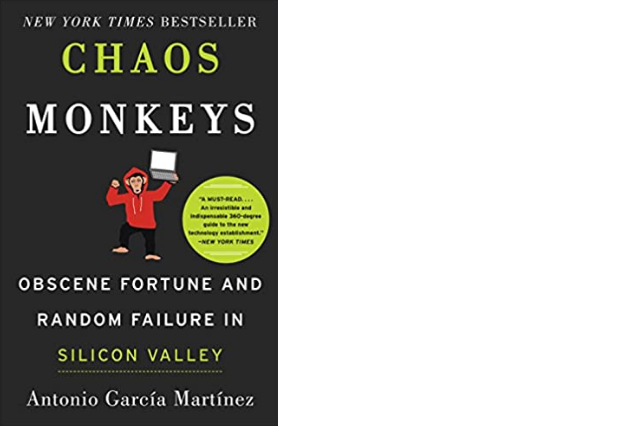
Garcia-Martinez is a brilliant, funny, multi-talented Cuban-American whose confessional memoir Chaos Monkeys is to big tech what Michael Lewis’s Liar’s Poker was to finance. A onetime high-level Facebook executive — he ran Facebook Ads — Antonio’s book shows the House of Zuckerberg to be a cult full of on-the-spectrum zealots who talked like justice activists while possessing the business ethics of Vlad the Impaler:

Facebook is full of true believers who really, really, really are not doing it for the money, and really, really will not stop until every man, woman, and child on earth is staring into a blue-framed window with a Facebook logo.

When I read Chaos Monkeys the first time I was annoyed, because this was Antonio’s third career at least — he’d also worked at Goldman, Sachs — and he tossed off a memorable bestseller like it was nothing. Nearly all autobiographies fail because the genre requires total honesty, and not only do few writers have the stomach for turning the razor on themselves, most still have one eye on future job offers or circles of friends, and so keep the bulk of their interesting thoughts sidelined — you’re usually reading a résumé, not a book.

Chaos Monkeys is not that. Garcia-Martinez is an immediately relatable narrator because in one breath he tells you exactly what he thinks of former colleagues (“A week before my last day, I had lunch with the only senior person at Goldman Sachs who was not an inveterate asshole”) and in the next explains, but does not excuse, the psychic quirks that have him chasing rings in some of the world’s most rapacious corporations. “Whenever membership in some exclusive club is up for grabs, I viciously fight to win it, even if only to reject membership when offered,” he wrote. “After all, echoing the eminent philosopher G. Marx: How good can a club be if it’s willing to have lowly me as a member?”

The irony is that if Garcia-Martinez has a failing as a writer, it’s that he’s too nice. Universally, the best writers are insane egomaniacs obsessed with staring at the great mirror that is the page. Garcia-Martinez, on the whole, would rather be sailing. I believe the reason he decided to go back to tech is that he preferred a quiet life of flying a desk to make mortgage payments to the never-ending regimen of self-salesmanship that the literary life requires (and which, again, is the easy part for most egocentric writers).

Anyway: Chaos Monkeys contains scenes from Antonio’s private travails. Characteristically, they’re painted as comedies, where his personal life is depicted as an unpredictable third party over which he has little control — only occasionally, it seems, does it even listen to his suggestions. He meets a woman via Match.com whom he calls British Trader, “an imposing, broad-shouldered presence, six feet tall in bare feet, and towering over me in heels.”

He’s enthralled, but everything about her is a surprise that keeps him off balance, from the fact that her “strapping and strutting” South African ex-boyfriend docks a boat next to his not long after their first date, or that she sleeps on “a cheap foam mattress about the width of an extra-jumbo-sized menstrual pad” above a floor covered from detritus from a recent renovation. She dis such work herself because, Antonio explains, “she made Bob Vila of This Old House look like a fucking pussy.” Even this side of her life has him tiptoeing. “Postcoitally it was all I could do to balance myself on the edge of the pad and off the drywall dust,” he noted.

At one point, as a means of comparing the broad-shouldered British DIY expert favorably to other women he’d known, he wrote this:

Most women in the Bay Area are soft and weak, cosseted and naive despite their claims of worldliness, and generally full of shit. They have their self-regarding entitlement feminism, and ceaselessly vaunt their independence, but the reality is, come the epidemic plague or foreign invasion, they’d become precisely the sort of useless baggage you’d trade for a box of shotgun shells or a jerry can of diesel.

Out of context, you could, I guess, read this as bloviating from a would-be macho man beating his chest about how modern “entitlement feminism” would be unmasked as a chattering fraud in a Mad Max scenario. In context, he’s obviously not much of a shotgun-wielder himself and is actually explaining why he fell for a strong woman, as the next passage reveals:

British Trader, on the other hand, was the sort of woman who would end up a useful ally in that postapocalypse, doing whatever work—be it carpentry, animal husbandry, or a shotgun blast to someone’s back—required doing.

Again, this is not a passage about women working in tech. It’s a throwaway line in a comedic recount of a romance that juxtaposes the woman he loves with the inadequate set of all others, a literary convention as old as writing itself. The only way to turn this into a commentary on the ability of women to work in Silicon Valley is if you do what Twitter naturally does and did, i.e. isolate the quote and surround it with mounds of James Damore references. More on this in a moment.

After trying the writer’s life, Antonio went back to work for Apple. When he entered the change on his LinkedIn page, Business Insider did a short, uncontroversial writeup. Then a little site called 9to5Mac picked up on the story and did the kind of thing that passes for journalism these days, poring through someone’s life in search of objectionable passages and calling for immediate disappearance of said person down a cultural salt mine. Writer Zac Hall quoted from Apple’s Inclusion and Diversity page:

Across Apple, we’ve strengthened our long-standing commitment to making our company more inclusive and the world more just. Where every great idea can be heard. And everybody belongs.

Hall then added, plaintively, “This isn’t just PR speak for Apple. The company releases annual updates on its efforts to hire diversely, and it puts its money where its mouth is with programs intended to give voice to women and people of color in technology. So why is Apple giving Garcia Martinez a great big pass?”

From there the usual press pile-on took place, with heroes at places like The Verge sticking to the playbook. “Silicon Valley has consistently had a white, male workforce,” they wrote, apparently not bothered by Antonio’s not-whiteness. “There are some in the Valley, such as notorious ex-Googler James Damore, who suggest this is because women and people of color lack the innate qualities needed to succeed in tech.”

Needless to say, Antonio never wrote anything like that, but the next step in the drama was similarly predictable: a group letter by Apple employees claiming, in seriousness, to fear for their safety. “Given Mr. García Martínez’s history of publishing overtly racist and sexist remarks,” the letter read, “we are concerned that his presence at Apple will contribute to an unsafe working environment for our colleagues who are at risk of public harassment and private bullying.” All of this without even a hint that there’s ever been anything like such a problem at any of his workplaces.

Within about a nanosecond, the same people at Apple who hired Antonio, clearly having read his book, now fired him, issuing the following statement:

At Apple, we have always strived to create an inclusive, welcoming workplace where everyone is respected and accepted. Behavior that demeans or discriminates against people for who they are has no place here.

The Verge triumphantly reported on Apple’s move using the headline, “‘Misogynistic’ Apple hire is out hours after employees call for investigation.” Other companies followed suit with the same formulation. CNN: “Apple parts ways with newly hired ex-Facebook employee after workers cite ‘misogynistic’ writing.” CNET: “Apple reportedly cuts ties with employee amid uproar over misogynistic writing.”

Apple by this point not only issued a statement declaring that Antonio’s “behavior” was demeaning and discriminatory, but by essentially endorsing the complaints of their letter-writing employees, poured jet fuel on headline descriptions of him as a misogynist. It’s cowardly, defamatory, and probably renders him unhirable in the industry, but this is far from the most absurd aspect of the story.

I’m a fan of Dr. Dre’s music and have been since the N.W.A. days. It’s not any of my business if he wants to make $3 billion selling Beats by Dre to Apple, earning himself a place on the board in the process. But if 2,000 Apple employees are going to insist that they feel literally unsafe working alongside a man who wrote a love letter to a woman who towers over him in heels, I’d like to hear their take on serving under, and massively profiting from, partnership with the author of such classics as “Bitches Ain’t Shit” and “Lyrical Gangbang,” who is also the subject of such articles as “Here’s What’s Missing from Straight Outta Compton: Me and the Other Women Dr. Dre Beat Up.”

It’s easy to get someone like Antonio Garcia Martinez fired. Going after a board member who’s reportedly sitting on hundreds of millions in Apple stock is a different matter. A letter making such a demand is likely to be returned to sender, and the writer of it will likely spend every evaluation period looking over his or her shoulder. Why? Because going after Dre would mean forcing the company to denounce one of its more profitable investments — Beats and Beats Music were big factors in helping Apple turn music streaming into a major profit center. The firm made $4.1 billion in that area last year alone.

Speaking of profits: selling iPhones is a pretty good business. It made Apple $47.9 billion last year, good for 53% of the company’s total revenue. Part of what makes the iPhone such a delightfully profitable product is its low production cost, which reportedly comes from Apple’s use of a smorgasbord of suppliers with a penchant for forced labor — Uighurs said to be shipped in by the thousand to help make iPhone glass (Apple denies this), temporary “dispatch workers” sent in above legal limits, workers in “iPhone city” clocking excessive overtime to meet launch dates, etc. Apple also has a storied history of tax avoidance, offshoring over a hundred billion in revenues, using Ireland as a corporate address despite no physical presence there, and so on.

Maybe the signatories to the Apple letter can have a Chaos Monkeys book-burning outside the Chinese facility where iPhone glass is made — keep those Uighur workers warm! Or they can have one in Dublin, to celebrate the €13bn tax bill a court recently ruled Apple didn’t have to pay.

It’s all a sham. The would-be progressives denouncing Garcia-Martinez don’t seem to mind working for a company that a Democrat-led congressional committee ripped for using “monopoly power” to extract rents via a host of atrocious anti-competitive practices. Whacking an author is just a form of performative “activism” that doesn’t hurt their bottom lines or their careers.

Meanwhile, the bosses who give in to their demands are all too happy to look like they’re steeped in social concern, especially if they can con some virtue-signaling dink at a trade website into saying Apple’s mechanically platitudinous “Shared Values” page “isn’t just PR speak.” You’d fire a couple of valuable employees to get that sort of P.R.

When I was caught up in my own cancelation episode, I was devastated, above all to see the effect it had on my family. Unlike Garcia-Martinez, I had past writings genuinely worth being embarrassed by, and I felt that it was important, morally and for my own mental health, to apologize in public. I didn’t fight for my career and reputation, and threw myself on the mercy of the court of public opinion.

I now know this is a mistake. The people who launch campaigns like this don’t believe in concepts like redemption or growth. An apology is just another thing they’d like to get, like the removal of competition for advancement. These people aren’t idealists. They’re just ordinary greedy Americans trying to get ahead, using the tactics available to them, and it’s time to stop thinking of stories like this through any other lens.


Tyler Durden
Sat, 05/15/2021 – 10:20

via ZeroHedge News https://ift.tt/3eOECLT Tyler Durden

JPMorgan Already Has 30 To 40 Investment Bankers Traveling Daily Again

JPMorgan Already Has 30 To 40 Investment Bankers Traveling Daily Again

Investment bankers at J.P. Morgan are back to flying the friendly skies.

Amid debate as to whether or not business travel would eventually pick back up to pre-Covid levels, it appears as though the largest lender in the U.S. is doing its part to help steady the air travel industry. The company already has about 30 to 40 investment bankers traveling daily, according to a new report from Bloomberg

In-person meetings help banks win lucrative mandates and show their interest to potential clients. 

Jim Casey, J.P. Morgan’s co-head of global investment banking, said: “Business travel has picked up as people become more comfortable. You’re not winning new business without in-person connectivity.”

CEO Jamie Dimon said last week: “There are a bunch of clients who gave business to somebody else because the bankers from the other guys visited and ours didn’t. OK, well, that’s a lesson. It’s got to work for the clients — it’s not about whether it works for me. And I have to compete.”

Recall, about a week ago we noted that business travel likely wouldn’t improve back to pre-Covid levels as investment banks mulled the idea of more dealingmaking via video chat for convenience and in order to save money.

Nordea Bank Chief Executive Officer Frank Vang-Jensen said last week that there “will definitely be much less traveling.”

His sentiments were echoed by the likes of other major investment banks HSBC and Standard Chartered. Andy Halford of Standard Chartered said: “We see a step change down in the level of travel once we normalize out of this.”

HSBC Holdings Chief Financial Officer Ewen Stevenson also said the same this week, noting that the bank will increase reliance on “video technology and having people go on fewer, longer trips when they do travel.”


And for banks, less travel is actually a good thing. HSBC saw its travel costs down $300 million in 2020, which could amount to annual savings of $150 million if the bank keeps reining in travel. 

But, recall, J.P. Morgan’s Jamie Dimon said at the time that he hadn’t quite given up on air travel: “If I’m the gung-ho person, I want to get the business, taking that trip may be much different than saying I’ll meet you in a Zoom. I think people like me will travel as much and Zoom more.”

Tyler Durden
Sat, 05/15/2021 – 09:55

via ZeroHedge News https://ift.tt/3htoIIo Tyler Durden

Train Company Apologises For Using Phrase “Ladies And Gentlemen” During Announcement

Train Company Apologises For Using Phrase “Ladies And Gentlemen” During Announcement

Authored by Steve Watson via Summit News,

A government-run British train company has issued an apology after one of its conductors used the phrase ‘ladies and gentlemen, boys and girls’ during an announcement, causing a passenger identifying as ‘non-binary’ to take offence and make a complaint.

The passenger, who happens to be a ‘LGBT rep’ for the Rail, Maritime and Transport Union, immediately took to Twitter to whine about the ‘incident’.

The company, London North Eastern Railway, immediately apologised and said “Train Managers should not be using language like this.”

Good lord, the horror of the language that was used:

Perhaps LNER should decide who its core customer base is before going full woke:

And while LNER appears desperate to extend ‘inclusivity’ to the ‘non-binary’, not so much when it comes to the disabled or simply ‘ladies’:

Perhaps the Department For Transport and the train company should be focusing more on getting its trains running again after massive disruption caused by severe safety issues, rather than pandering to woke Twitter trolls.

*  *  *

Brand new merch now available! Get it at https://www.pjwshop.com/

*  *  *

In the age of mass Silicon Valley censorship It is crucial that we stay in touch. We need you to sign up for our free newsletter here. Support our sponsor – Turbo Force – a supercharged boost of clean energy without the comedown. Also, we urgently need your financial support here.

Tyler Durden
Sat, 05/15/2021 – 09:20

via ZeroHedge News https://ift.tt/3htlzIM Tyler Durden

“Go Back To England” – Prince Harry Elicits Backlash After Criticizing “Bonkers” First Amendment

“Go Back To England” – Prince Harry Elicits Backlash After Criticizing “Bonkers” First Amendment

Prince Harry is still new to North America, and perhaps is still adjusting to some of its customs. For example, the First Amendment, which he dismissed as “bonkers” during a recent interview.

The comments inspired backlash online, with some critics calling for the young prince (who will almost certainly never be king) to “go back to England” in a series of hostile tweets.

During a Thursday appearance on Hollywood actor Dax Shepard’s “Armchair Expert” podcast, Prince Harry (who lives in California with wife Meghan Markle and his young son Archie after stepping down from his royal duties) declared: “I’ve got so much I want to say about the First Amendment. I still don’t understand it, but it is bonkers.”

He also lamented the “genetic pain” of growing up a royal, implying that he was “mistreated” by his family, the latest in an unceasing string of criticism that has sparked talk about Harry becoming estranged from the family (he renounced his royal duties before leaving England after his wife engaged in a controversial lawsuit against British tabloids).

The comment elicited a stream of angry tweets.

Texas Rep. Dan Crenshaw even weighed in, joking that he “just doubled the size of my Independence Day party.”

Moving on, the prince criticized self-made podcast host Joe Rogan for entertaining the notion that young health people don’t need to get the vaccine – something Rogan has apologized for doing, even calling himself “a moron” for sharing the ideas on his podcast.

Harry mused that “in today’s world, with misinformation just endemic,” people have “got to be careful about what comes out of your mouth.” Celebrities like Rogan (who Harry mentioned by name) should just “stay out of it” and “not say anything at all if they don’t have anything useful to say.”

The Duke and Duchess of Sussex have mostly occupied their time in the US with making pointed criticisms of the royal family in interviews like their blockbuster sit down with Oprah.

Given the reaction his comments inspired, Maybe Harry can pitch Netflix on a series where he breaks down and criticizes the Bill of Rights?

Tyler Durden
Sat, 05/15/2021 – 08:45

via ZeroHedge News https://ift.tt/3yeT5rV Tyler Durden

78% Of UK Businesses Have No Plan To Require Vaccine Certificates, Survey

78% Of UK Businesses Have No Plan To Require Vaccine Certificates, Survey

Authored by Lily Zhou via The Epoch Times,

Seventy-eight percent of businesses in the UK have no plans to check evidence of vaccination, a new study indicates.

The British Chambers of Commerce (BCC) Thursday published the results of its survey of more than 1,000 businesses across a variety of sectors and in the UK.

When asked whether their business had any plans to require proof of vaccination from customers, suppliers, or employees, 78 percent of respondents said they had no plans to do so. Among larger firms with more than 50 staff, the number dropped to 69 percent.

Only 5 percent of the respondents said they had already implemented their own requirements for proof of vaccination, and 6 percent said they were likely to do so in the future. These were more likely to be firms with more than 50 staff. The other 11 percent said they needed more information.

Asked about what safety measures businesses expect to implement or keep in place during the next 12 months, 76 percent of the respondents chose social distancing, while 61 percent of the businesses expected to have hand sanitiser in place, and 54 percent expected to require face coverings.

Almost half (46 percent) of the firms expected continued changes to their workspace, such as screens or socially distanced desk arrangements, and 45 percent said they intended to limit access to their offices/premises.

Only 9 percent of firms expected to have no measures at all in place over the next 12 months.

The study comes as the UK approaches its final steps of the government’s roadmap to reopen the country.

Easing the lockdown in England. (PA Graphics)

Prime Minister Boris Johnson has said this week that the government will be “saying more later this month about exactly what the world will look like and what role there could be—if any—for certification and social distancing,” so businesses could have more clarification.

Hannah Essex, co-executive director of the BCC, said its study indicated that the government needs to hurry up.

“This research shows that government must quickly clarify what measures will be required for businesses to maintain safety standards after we reach the final stage of the road map on June 21,” Essex said in a statement.

“In particular, they must resolve the ongoing debate around the use of vaccine certification, providing clear and decisive guidance to [businesses],” she said.

“There has been a great deal of mixed signals on the issue of businesses being required to demand proof of vaccination from customers, suppliers, or employees.

“Our figures show that as it stands the vast majority of firms have no plans in place for such a scenario. So, if [the] government is indeed planning to make this a requirement in any sector, then it must act rapidly to inform businesses so that they can adjust and prepare,” she said.

“Many businesses are working on the assumption that they will be continuing with a variety of COVID-secure measures over the next 12 months including social distancing, mask-wearing, and various other interventions,”  she added.

After initially ruling out the introduction of a vaccine passport, the UK government started reviewing the idea in late February and trialing a COVID-Status Certification last month.

People walking during the morning rush hour in the Canary Wharf amid the outbreak of the CCP virus in London on Oct. 15, 2020. (Hannah McKay/Reuters)

Some businesses are concerned that such a measure, if introduced, would be “challenging” to implement.

“It could be challenging for us to implement a requirement for proof of vaccination. Safety is paramount to us, but the administrative processes involved would be laborious. We would also have major HR concerns over where this would place individuals not wishing to have the vaccine due to their personal beliefs,” Gareth Jones, Managing Director of In-Comm, a training services provider, said in a statement.

“When it comes to other measures the main issue for us is that numbers are key to our sustainability and growth as a business. Actions that we have to take which reduce our number of learners take a real toll on us, so we would hope to return to our original cohort sizes as soon as it is safe to do so. Measures have to be fit for purpose as well as practicable to implement,” he added.

Phil Calcutt, Director of A&M EDM, an engineering solutions company, said: “We’re concerned that ‘vaccine passports’ would be problematic to implement. We would have no legal sanction to ensure compliance and we’d expect a test case to drag on in the courts. If the NHS and care homes haven’t been able to implement this kind of stuff, then how can businesses be expected to?

Tyler Durden
Sat, 05/15/2021 – 08:10

via ZeroHedge News https://ift.tt/3eTF23L Tyler Durden

Armenia Requests Russian Military Help Over Renewed Azerbaijan ‘Land Grab’

Armenia Requests Russian Military Help Over Renewed Azerbaijan ‘Land Grab’

Following the 2020 Nagorno-Karabakh war which started six months ago, the border region is again on the brink of conflict, with Armenia charging Azerbaijan with illegally sending its army deep into territory from their prior post-war settlement positions in what’s being viewed as a big land grab and ethnic cleansing campaign targeting ethnic Armenian communities.

Yerevan sees the threat as imminent and dire enough that it’s urging its ally and treaty partner Russia to send military assistance to push back Azeri forces. Currently Russia has a limited peacekeeping force that includes 2,000 troops as part the ceasefire agreement that ended the prior border war. Russia also has a military base in Armenia, but has previously expressed a desire to keep its friendly relations with Baku.

Last year Armenians in and around Nagorno-Karabakh set fire to their own houses ahead of handing over territory to Azerbaijan, via AFP

“Armenia said on Friday Azerbaijan had failed to fulfil a promise in full to withdraw troops that had crossed the border in a disputed incident, and it had sought Russia’s military help,” Reuters details.

Armenia is seeking to make the case to Putin that Azerbaijan’s actions are a severe violation of the ceasefire agreement and of Armenia’s sovereign land. 

But so far Moscow’s response has appeared muted, even after Armenia’s interim prime minister penned an urgent letter to President Putin requesting the military aid:

“The Russian president said that he himself believes that the Azerbaijani armed forces should leave Armenia, and there is a more important part that was stated last night: an agreement was reached that today the Azerbaijani armed forces had to carry out these actions, that is, leave the territory of Armenia,” Pashinyan announced during an extraordinary session of parliament Friday.

He explained before the parliamentary session why he didn’t make an initial request for troops during a phone call the day prior: 

“The reason that I did not appeal yesterday [to Putin for help] Is that the day before it was stated at the highest level that today the troops were to be withdrawn. But since the course of the negotiations showed that, in any case today, the agreement will not be fully implemented, I turned to the Russian president so that Russia would provide assistance to Armenia in this situation, including military assistance,” Pashinyan said.

The Armenian Defense Ministry has accused Azeri forces of attempting “to clean the borders” in the Syunik region – or essentially ethnic cleansing

Whether or not Armenia and Azerbaijan will renew their fierce fighting, which last year killed thousands of troops and civilians, with Armenia bearing the bulk of the casualties, remains another question. It’s unclear whether Yerevan would commit without a signal of Russia’s backing, which so far it doesn’t appear Putin is ready to give. 

Tyler Durden
Sat, 05/15/2021 – 07:35

via ZeroHedge News https://ift.tt/3hnwnYS Tyler Durden

Macleod: The End Of The LBMA Is Nigh

Macleod: The End Of The LBMA Is Nigh

Authored by Alasdair Macleod via GoldMoney.com,

Basel 3 is on course to regulate the LBMA out of existence. And with it will go all the associated arbitrage business and position-taking on Comex, because most bullion bank trading desks will cease to exist. The only supply to buy-side speculators of gold and silver contracts will be producer hedging.

In recent months there has been some limited commentary concerning the introduction of Basel 3 regulations and the implications for precious metals trading. These new regulations are scheduled to be introduced for European banks at the end of June — only seven weeks’ time — and in the UK from 1 January next, affecting all LBMA member banks.

This article explains the new regulations and concludes that the recent joint LBMA/WGC consultation paper addressed to the British regulator is unlikely to save London’s unallocated gold trading market. And because Basel 3 regulations are scheduled to be introduced into the UK at the year-end all banks in the London gold market can be expected to wind down their exposure well ahead of the deadline.

The unallocated forward settlement market will effectively be shut down.

Hedging into Comex futures from this source will also cease.

As it is unwound, the withdrawal of synthetic supply has enormous implications for future precious metals prices by transferring pricing power to physical markets, now dominated by China.

Abbreviations in this article

  • PRA      Prudential Regulation Authority, the UK financial sector and banking regulator.

  • EBA      European Banking Authority, the EU banking regulator.

  • LBMA  London Bullion Market Association, the trade body for forward dealings in unregulated, unallocated precious metals in London.

  • WGC    The World Gold Council, a trade body based in London which researches and quantifies global gold supply and demand.

  • CME    Chicago Metal Exchange, the US-based regulated futures market used by bullion banks around the world.

  • BIS       Bank for International Settlements, a sub-committee of which devises the Basel series of rule-based banking regulations. In the wake of the financial crisis of 2007—2009, Basel 3 is being implemented to ensure that banks are adequately capitalised globally to undertake their various lines of business without imparting systemic risk to other banks.

  • RSF      Required stable funding, introduced by Basel 3 and is applied to banking assets.

  • ASF      Available stable funding, introduced by Basel 3 and is applied to banking liabilities.

  • NSFR    Net stable funding ratio, the ratio between ASF and RSF, introduced by Basel 3 and never to fall below 100%.

Introduction

On 4 May, the London Bullion Market Association in conjunction with the World Gold Council submitted a paper to the Prudential Regulation Authority making the case for unallocated gold to be spared a required stable funding factor (RSF) of 85% under new Basel 3 regulations. The new regulations are due to be implemented in Europe by the European Banking Authority at the end of June, to be followed in the UK on 1 January 2022. The paper claims that if the proposed RSF of 85% is imposed on gold and other precious metals it would undermine clearing and settlement, drain liquidity, dramatically increase financing costs and curtail central bank operations.

These are very serious statements to the effect that unless the London bullion market gets a waiver on the net stable funding ratio calculation (NSFR), it may as well shut up shop. And with the LBMA severely curtailed, the CME’s gold and silver futures contracts would lose out badly on both volumes and liquidity as well, with the number of active bullion bank trading desks (the Swaps) reduced to very few at the least.

At first sight it seems crazy that the impact of Basel 3 regulations will be permitted to radically undermine forwards and futures markets, which have been so instrumental to deflecting hoarding demand from physical bullion. It is through paper derivatives that the gold price in particular has been kept suppressed in conjunction with central bank leasing, and therefore prevented from challenging the US dollar’s credibility, following gold’s replacement as the world’s reserve currency fifty years ago.

The disruption to forwards and futures markets from Basel 3 will be a major shock, yet wider markets appear to be blithely ignoring the problem. When it goes ahead, Basel 3 will mean that banks will be forced to wind down their positions in unallocated precious metals, almost certainly causing massive disruption to physical bullion markets as well. If the expansion of paper markets has suppressed the prices of gold and silver for the last fifty years, then a severe contraction of paper equivalents at a time of escalating fiat money inflation could send prices to the moon.

In order to understand the proposed regulations, we need to look at them while taking into account the standard accounting practice of double entry bookkeeping as it is applied to bank balance sheets. There are three new Basel 3 definitions that matter in this regard:

  • The Available Stable Funding factor (ASF) is applied to the sources of a bank’s funding on the liability side of its balance sheet. Depending on the liability (shareholders’ equity, customer deposits, interbank loans etc.) they are multiplied by a factor, from 100% for the most stable forms of funding, such as Tier 1 bank equity, to 0% for the least stable. Being on their balance sheets, unallocated gold owed to a bank’s depositing customers is to be given a Basel III ASF of 0%, which means it will not be permitted to be a source of funding for any balance sheet assets, which must therefore be funded from other liabilities.

  • The Required stable funding (RSF) is to be applied to a bank’s assets. Unallocated gold positions are to be valued at 85% of their market value. Note that allocated gold, being held in custody, is not on bank balance sheets (except where the bank actually owns physical gold in its own right) and is therefore not involved in the calculation.

  • The Net stable funding requirement (NSFR) is the ASF divided by the RSF and must be at least 100% at all times.

The LBMA’s problem with Basel III becomes obvious. Unallocated gold liabilities cannot be used for funding the bank’s assets, and unallocated gold assets take a valuation haircut of 15% of market value as well. In future, the former cannot be simply offset against the latter, but bullion banks in London naturally run unallocated positions on both sides of their balance sheets. Whether the bank owns vaulted allocated gold to offset some of the price risk is immaterial. If this Basel 3 proposal goes through without modification, it will effectively be the end of the LBMA’s forward settlement business, and the end of arbitrage and hedging between LBMA members and the CME’s Comex futures contracts. And the Swaps on Comex, which are the bullion bank trading desks, could be regulated out of existence.

We cannot be sure yet that this will definitely happen, because it was put out for consultation in the UK by the PRA until 3 May. The end-June deadline after which Basel III applies in Europe might be extended again — which seems increasingly unlikely. In a patched-up compromise, unallocated gold could be rescheduled for a higher ASF and/or RSF, though again, that seems unlikely. Furthermore, the LBMA’s plea to the PRA, if successful, would only apply to UK regulated banks, not those in other jurisdictions, unless they set up full-blown London subsidiaries. And even that is unlikely to be acceptable to European and other regulators regulating their parents, because it is normal practice for regulators to look through such arrangements.

The LBMA paper suggests a compromise, that London could follow Switzerland which intends to rely on a clause in the European Banking Authority’s rule book allowing banks to make returns to the regulator instead, and for the regulator to decide stable funding matters. For this to work, the PRA would have to obtain agreement on a common approach with banking regulators in Europe and elsewhere. If that is to be the case, time is running out rapidly.

But the Swiss option only works on the basis that unallocated positions on both sides of the balance sheet are classified as interdependent. Any mismatch between unallocated gold liabilities and assets would not be covered. One assumes that hedging through Comex futures could resolve this issue partially, but that is only an assumption. And even if this get-out is adopted, liquidity will still dry up, because bullion bank trading desks will be given minimal trading discretion, limited to maintaining even books across the markets because of the NSFR issue.

The Swaps category on Comex (the bullion bank trading desks) is currently net short of about $24bn in the GC gold futures contract and $1.6bn in silver futures. Pressure to pare back ownership of these positions to a few genuine market makers and American bank trading desks is bound to increase, because the short positions held by European bullion banks would have to be covered in the next six weeks. And in London, all LBMA banking members will similarly reduce their unallocated activities because unbalanced books would be heavily penalised by the rule changes when they come in for the UK as well. That would make Comex gold and silver contracts entirely dependent on producer hedging.

The Bank of England will almost certainly express a view to the PRA as well as has the LBMA/WGC, not least because through swaps and leases for earmarked central bank gold in its custody it has been instrumental over the years in arranging for physical liquidity to be provided to the market in London. But it behoves the PRA to look more closely at the whole question of trading in unallocated gold, and specifically at the risks to the UK and European banking systems of a daily settlement average of 20 million ounces, or 620 unallocated equivalent tonnes between LBMA members. This does not appear to include additional unallocated tonnages between members and non-members, nor does it include intraday turnover.

The London shell game

In the interests of understanding the London bullion market, it will be helpful to start with definitions of unallocated and allocated gold accounts. According to the LBMA’s own website,

Unallocated accounts

Most bullion in London is traded and settled on an unallocated account basis, where the customer does not own specific bars but has a general entitlement to an amount of metal. It is the most convenient, cheapest and most commonly used method of holding metal. It works very much like a bank currency account.

Note that instead of owning gold, the customer only has a general entitlement. Note also that it works like a normal bank currency account. And bear in mind that not only does a customer with an unallocated account not own gold but is just a creditor of the bank. All unallocated gold obligations appear on the bank’s balance sheet.

Allocated accounts

Allocated accounts are opened when a customer requires title or ownership of specific bars, with the dealer holding them on the client’s behalf. Clients’ holdings are identified in a weight list of bars, showing the unique bar number, gross weight, the assay or fineness of each bar and its fine weight. Credits or debits to the holding are linked to the physical movements of bars to or from the client’s physical holding. In this respect, it is like a safe deposit box with the account operator acting simply as custodian.

This is a completely different type of account, where the bank is a custodian, and holdings do not appear on the bank’s balance sheet. Allocated gold is not at the disposal of the bank and cannot be used for its trading. In practice, banks discourage customers from holding allocated gold through high charges for storage and account maintenance fees. By way of contrast, a customer who maintains an unallocated account is often freed from bank charges entirely. Consequently, the large majority of customer accounts are unallocated.

The LBMA/WGC letter leads its readers to assume the only difference between allocated and unallocated gold is the convenience unallocated gold provides for an efficient market. Nowhere is there any mention of the lack of physical gold backing unallocated accounts. And by ignoring the process of bank credit creation, it panders to the naïve assumption that banks are simply pass-through intermediaries with depositors on one side and loans on the other.

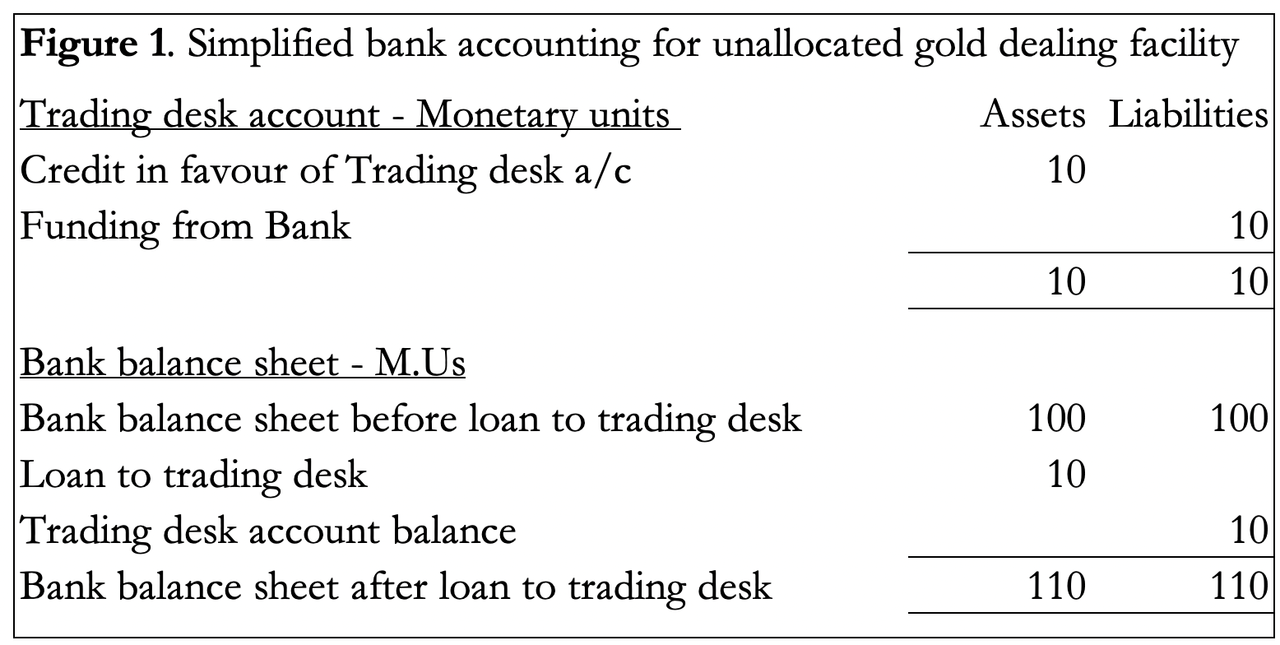
In common with banking regulators, the LBMA and WBC apparently fail to understand that unallocated accounts on bank balance sheets are only created by the process of bank credit expansion and have nothing to do with physical gold. The origin of all unallocated accounts is not the depositing of gold, but credit creation. Figure 1 shows how unallocated gold accounts are created in this way.
Let us say the trading desk has a facility granted to it by the bank to trade unallocated gold, and its account is credited with this facility by its bank to the extent of 10 monetary units. On its books, the bank records an asset in Monetary Units (normally dollars, or sterling, euros etc. depending on the bank’s accounting currency), reflecting the loan created in favour of its trading desk. At the same time, the bank records an equal liability matching the credit to its trading desk to allow the latter to fund its dealing book. It can now deal with other banks in unallocated gold, all of which will have created the facility to deal in unallocated gold by the same process of credit expansion ever since facilities to trade in unallocated gold evolved into existence.

What’s happened is that the dealing desk’s facility has been funded by the expansion of bank credit out of thin air, in the same way that bank credit is expanded by any bank in any other line of banking business. This is standard accounting practice long established by banking law. From it, we derive two important points: the funding of unallocated positions in London is simply through the expansion of credit denominated not in gold, but currency; and with all banks using the same methods no gold is involved at all.

Customers of the bank can, of course, request physical delivery, or delivery into an allocated account at the bank, in which case the trading desk acts as a broker, sourcing physical metal. But this function must not be confused with unallocated dealing by banks acting as principals, or on behalf of their customers with unallocated accounts.

The LBMA/WGC submission claims that gold is vital collateral for central counterparties, which rely on the LBMA system to manage both it “and the physical delivery of precious metals derivative contracts” (page 3). The wording is misleading, because the delivery of a derivate contract is not the same as delivering the precious metal. The only other reference to collateral is in Annex 1, where the WGC trots out the usual stuff about gold having no counterparty risk and is widely accepted as collateral. That is true of physical gold, but is not relevant to unallocated gold, where counterparty risk is the only consideration and is the exclusive business between LBMA member banks.

Unallocated gold is no more than book entries tied to the price of gold, and its origin and continued existence is entirely funded by the creation of bank credit. It is this that Basel 3 recognises.

By introducing the net stable funding ratio, Basle III effectively makes standard banking practice unworkable in the case of unallocated precious metals by not permitting a trading book to net off its long and short positions. The regulators at the Basel Committee will not have jumped down on unallocated gold trading unless, in their opinion, they viewed it as a risk to the global banking system which must be offset by proper funding. Plainly, they understand the unallocated shell game for what it is, and that a failure in this market would be a threat to the entire banking system. Almost certainly, Basel III’s banking experts will have examined the risks in considerable detail before making their decision about the rates of both the ASF and RSF to be applied. And when it comes to cooperation from the European Banking Authority, there is also the additional risk that the UK’s PRA could find itself mired in post-Brexit non-cooperation.

The impact on physical precious metals

Asked to estimate the chances that the LBMA will succeed in stopping the imposition of the NSFR in Europe in six weeks’ time, the answer is it will be as likely as a cat in hell’s chance. While the Swiss proposal would provide some easement, it would effectively shut down their trading desks because of the penalties on uneven books. European and Swiss bank memberships of the LBMA are ten out of a total of forty-three, and most of those are UK incorporated subsidiaries. But it is unlikely that the EBA will accept that by sheltering the banking risks in a wholly owned UK subsidiary they can be simply ignored.

A bare quarter of member banks being cut out of unallocated trading may not seem a major disaster for the LBMA. But it is the thin edge of the wedge. From this analysis it seems extremely unlikely that the PRA has any choice but to impose the NSFR calculation method on the London gold market when it adopts the rule, scheduled for 1 January 2022. This means that all UK subsidiaries and branches of foreign and domestic LBMA member banks must comply by then. In practice, all the non-European member banks are bound to cease running unallocated positions as principals and on behalf of customers in advance of the rule change.

The last recorded level of LBMA-member unallocated gold positions was contained in the Bank for International Settlements over the counter derivative statistics for end-June 2020 at $572bn, while at the same time Comex Swap longs and shorts totalled $63bn. Rather like an iceberg, the visible regulated portion on Comex is one ninth of the total hidden derivative mass. If London adopts the Swiss proposal (we don’t yet even know if the EBA will accept it) then banks might be able to continue to run unallocated positions on an even book basis, but without trading income there is little point. Some of the market makers will cease trading and the balance are likely to run smaller books. For all intents, one half of that $500bn+ figure (representing one side of unallocated gold positions at the end of day settlement) will have to close out or be replaced with allocated physical.

The regulatory impact on Comex’s futures contracts differs in that the Basel III treatment of regulated markets with central counterparties is a separate topic, beyond the scope of this article. Nevertheless, the end of furious daily trading activity in gold settling at over 600 tonnes a day in London will eliminate hedging activity into Comex futures.

It would be too much to assume that such a severe contraction of paper market trading will lead to an automatic shift from paper into physical. But undoubtedly, some bank customers holding unallocated gold deposits at bullion banks will find their accounts closed and seek to replace them with physical gold. The full impact can only be guessed. But in the short-term it would appear that the Swaps category on Comex (bullion bank trading desks) have a separate problem closing their short positions. The most recent position derived from the CFTC’s Commitment of Traders Report is shown in Figure 2.
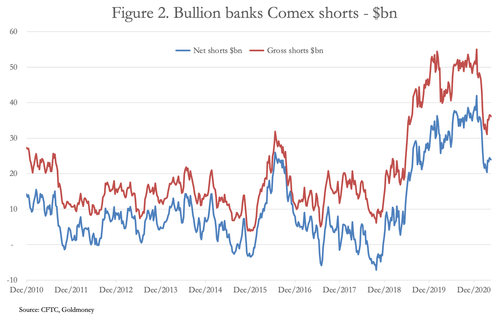
We don’t know how many of the European banks are short on Comex, which is the immediate problem, but the others with London trading desks (nearly all of them) will shortly find themselves in a similar position, if as expected the PRA follows the EBA by introducing the NSFR calculation from 1 January.

Central bank involvement

Central banks may find themselves in a difficult position, because of the unknown quantities of gold leased and swapped into the market. While bullion banks have been playing pass-the-parcel in the unallocated market, over the years they have been forced to deliver physical gold to bar hoarders, ETFs, jewellery fabricators and others. In recent decades these demands have exceeded mine and scrap supply by a fair margin, particularly driven by Asian demand. And while the LBMA has been triumphantly proclaiming 9,461 tonnes of gold are stored in LBMA member vaults, 5,616 of that is held at the Bank of England, almost entirely the earmarked property of central banks or their governments. That leaves 3,845 tonnes, of which about 2,500 tonnes are ETF gold, leaving 1,345 tonnes. Of that, an unknown amount is physical bars held by family offices, high net worth individuals and aggregated pooled accounts, probably leaving a balance of physical liquidity of as little as 500 tonnes. We were reminded recently that much of this physical has been supplied by central bank leasing when the GLD ETF briefly showed the Bank of England as a sub-custodian last year.

We know this leasing of gold to supply the market has been a major factor since the LBMA got going in its current form. A respected analyst, Frank Veneroso, estimated leasing and lending of official reserves to be at least 10,000 tonnes as far back as 2002.[iv] In those days, gold leasing secured a carry trade as the funding basis for US Treasury bills, so much of it was a rolling total. One suspects some of it was delivered into markets and subsequently had to be replaced out of private sector sales. But clearly, if the derivative trade in unallocated dries up, significant quantities of physical gold leased to the bullion banks might have to be found.

Additionally, while Western central banks have been leasing gold into the London market, the central banks and governments which have been adding to their gold reserves are predominently in Asia. In particular, we can be certain that China has substantial physical holdings of gold bullion not declared as gold included in its monetary reserves. The enabling legislation appointing The Peoples Bank sole responsibility for the state’s management of gold and silver bullion dates from June 1983, since when driven by government policy China has become the largest source of mine supply and rigidly controls refining and exports. Between 1983 and 2002, before it was legal for Chinese citizens to own and buy gold, inward capital flows and subsequent export surpluses coupled with a regime of strict exchange controls managed by the PBOC would have permitted the Chinese state to accumulate substantial quantities of bullion at contemporary prices, mostly between $200—$400 per ounce. Only after the state achieved its ownership objectives were citizens then permitted in 2002 to own gold — indeed, encouraged to do so. It is likely that Russia too has undeclared reserves and it is public knowledge she has been replacing US dollar reserves with gold, giving us important evidence of her monetary and strategic approach.

China’s gold policy has extended to the wider control of global trade in physical gold, in cooperation with other Asian centres. So far, China’s control over physical markets has been dwarfed by London’s unallocated trading and the Comex futures market. That will change, handing China and Russia ultimate power over fiat currencies as the dollar’s hegemony is undermined and the gold price rises due to ending of paper market price suppression.

Conclusion

Changes proposed in Basel 3 mark the end of an era for derivative trading, when almost all gold and silver trading has been in unallocated form. The consequences for precious metals markets and prices should not be ignored or underestimated. The implications are understood by the LBMA, and their response to the UK regulator reflects their helplessness in the face of these changes.

The joint submission by the LBMA and the WGC is economical with the facts by avoiding an admission that unallocated and allocated gold accounts are completely separate businesses. The origin of the former is through the creation of bank credit. And with all banks operating through credit expansion no physical gold is involved. Dealings are entirely in unallocated notional bullion, with the gold price serving as a valuation reference point. While the creation of unallocated gold through bank credit is one thing, customer demands for settlement in the physical are another, and generally discouraged. But over the years demand for physical has absorbed physical bullion supply and additional leasing of central bank gold, adding a second but entirely different problem for bullion banks.

The remaining pool of available physical gold is relatively small when central bank, ETF and privately owned bars are allowed for in vaulting totals. True liquidity is not the headline 9,461 tonnes in London vaults, trumpeted by the LBMA, but is minimal — probably just a few hundred tonnes. It is from this small pool that daily imbalances in unallocated settlements which arise from delivery demands are satisfied.

There is never a good time to introduce such radical changes into long-established market practices. But with issuers of fiat currencies debasing them at an accelerating rate, bullion banks face considerable difficulties unwinding their unallocated positions at a time when public demand for physical bullion is increasingly responding to fiat money inflation, spinning out of control.


Tyler Durden
Sat, 05/15/2021 – 07:00

via ZeroHedge News https://ift.tt/3fm4ayS Tyler Durden

Vaccine Virtue Signaling And The Cult Of Woke

Vaccine Virtue Signaling And The Cult Of Woke

Authored by Brandon Smith via Alt-Market.us,

All tyrannical systems need a large contingent of cheerleaders in order to survive and thrive; a group of exploitable and devout acolytes that will carry the torch and evangelize the masses with the ideology of control. Without this aggressive percentage of the population, totalitarians cannot remain in power. In the US and most of the west, leftist ideologues have filled this role nicely. They claim they are fighting for the rights of the downtrodden but their actions speak much louder than their words.

They have supported and viciously defended nearly every draconian measure that governments and corporate elites have enacted in the past few years. They supported mass censorship of conservatives and moderates by Big Tech companies. They supported national lockdowns which destroyed hundreds of thousands of small businesses and violated the constitutional rights of millions of Americans. They continue to support unscientific mask rules which have been proven to achieve nothing tangible in terms of preventing viral spread. They support the use of “vaccine passports” which would effectively cut non-vaccinated people out of the normal economy and normal society and drive them into poverty. And, now they are all over the web trying to propagandize for the jab.

We know these unhinged creatures by many names, including social justice warriors, snowflakes, puritans, leftists, Marxists, communists, globalists, collectivists, narcissists, etc. Basically, they are some of the worst people on the planet, and while they usually drone on about “institutional racism” that doesn’t exist, or a rape culture that doesn’t exist, or a patriarchy that doesn’t exist (though I’m starting to wonder if maybe we should start one), they have now found a new love in the covid “crisis”.

But before I address the Woke Cult and and their perverse relationship with the establishment, I have to ask a basic question about the “vaccine” which no one in the mainstream seems to be asking:

Why should we take an experimental mRNA vaccine for a virus that 99.7% of people outside of nursing homes will easily survive?

This question alone usually explodes the heads of vaccine cultists. Most of them for some reason still believe the death rate of covid is “3% or more”. Why do they peddle this nonsense? Well, I would note that the mainstream media NEVER discusses the death rate of covid; they instead let people make assumptions based on things they have heard in the past from entities like the World Health Organization or the CDC.

The 3% stat appears to have come from PREDICTIONS made by the WHO in January of 2020 before the virus had fully hit the US, as well as a preliminary study by Lancet. These predictions were pushed forward by the Imperial College of London, a globalist institution which created the complex mandate and lockdown models that nations across the world are now using to control the public. Their models were so utterly wrong that it is bewildering to anyone familiar with statistical theory or medical management.

As it turns out, the death rate for covid is a mere 0.26% of those infected (it was never 3%) and we have known this for quite some time. Nursing home patients with preexisting conditions make up around 40% of all deaths. Over 80% of all deaths were people over the age of 65. And, according to the CDC, at least 30% of all covid hospitalizations were due to complications associated with severe obesity.

So, if you are not over 65 and you are not a disgusting fat-body, then you have very little to worry about from covid statistically. If you are over 65 and you are fat, then you have around a 0.26% chance of dying if you become infected. If you are over 65, fat, and live in a nursing home, then maybe you should be worried.

The bottom line is, covid is a non-threat to the vast majority of people, but there is a large group of obsessives out there that seem to want to be afraid of it anyway, or, they just want us to be afraid.

The virtue signaling around the vaccines is growing increasingly bizarre. There are numerous YouTube videos, TikTok videos, articles, and social media posts by people smugly proclaiming their jab status as if they have just been touched by the hand of God as the chosen ones. Furthermore, the idolization of medical frauds like Dr. Anthony Fauci is cringeworthy. If you don’t believe me you can see some examples below:

It appears that the SJWs are trying real hard to normalize covid vaccines by manufacturing a consensus. If everyone is doing it, then you might get left out and isolated from the crowd, and that’s a scary thought, right?

Maybe I’m reading too much into this, but I’m detecting some serious desperation behind this astro-turf movement against “anti-vaxers”. No one listens to the cult of woke, no one likes them and no one trusts them to be informed or honest in their agenda. Yet, they wield considerable power in our society because they are being backed by governments and corporations. Their relationship to the establishment is symbiotic.

This is not to say any of these people are aware of the underlying agenda. The mindset behind vaccine virtue signaling could be attributed to some base frailties the average leftist suffers from:

First, they have a habit of relying on the government and the system in general to provide for their feelings of normalcy. That is to say, they worship the covid vaccine partly because they see it as their ticket to appeasing the government and being given access to certain comforts. Sadly, they don’t realize that those comforts can be taken back anytime they want if they were not so cowardly.

In my county residents here have been ignoring the covid mandates for most of the past year. No one wears the masks. No one is using social distancing. And over 70% of the population is not vaccinated. The consequence? Only 17 deaths in the past year, most of which were people with preexisting conditions, and we have been free the whole damn time because we chose to be.

Second, leftists always argue from a position of “the majority”, even when they are not the majority. Covid is a tool, like a psychological crowbar used to leverage compliance, because the presumption is that it is a threat to everyone. And, if everyone is threatened by the same bogeyman, then everyone is part of the same monolith, the same collective. And if everyone is part of the same collective, then everyone must fight that bogeyman together in unity. If you do not work with the collective, that means you are working against the collective.

“We live in a society”, the leftists arrogantly spit and sneer, “which means you must do what WE say is best for everyone”.

As I already thoroughly outlined above, covid is not a threat to everyone. It’s not even a threat to more than 0.26% of people. We do NOT “live in a society”, at least, we don’t live in their society or under their rules. They don’t care about saving lives, this is just the excuse they need to exert control. Control is what they most desire.

How do I know this? Look at the mania surrounding the very existence of anti-lockdown activists and “anti-vaxers”. Look at how much they talk about us. They can’t stop themselves. Why do these people care so much whether or not we take the vaccine? If it actually works, then they are perfectly safe from us, and when we all die horrible deaths from covid they can say “we told you so”.

What they really fear is that we are right and they are wrong. The science is certainly on our side and has been for the duration of the pandemic. The WHO was wrong, the CDC was wrong, the Imperial College of London was wrong. The anti-lockdown activists were closer to the mark than all of them combined. The masks have been proven to be uselessThe lockdowns have been proven to be useless. The death rate predictions were proven to be highly exaggerated. And, now the very need for the vaccines is in question.

In terms of the recent mainstream media narrative, we can draw a couple of conclusions: For one, the vaccine rollout is not going according to plan. Everyday the media is awash in stories about “vaccine hesitancy” and what the government needs to do about it. This tells me that far too many Americans are refusing the shot, so, the propaganda is being turned up to eleven.

I suspect the vaccine virtue signaling is a part of that campaign, or it is at least being encouraged by the establishment. Don’t you want to be on the right side of history? Don’t you want to be on the “side that cares about people”? Or do you want to be on the “selfish side”, the side that wants to kill grandma, the side that is racist and sexist and nasty and icky?

Another easy conclusion we can draw from the media is that this is not going away and the establishment intends to press the issue if we continue to defy them. I have seen the suggestion of “force” only gingerly broached in the past, but recently the narrative is becoming more aggressive. The word “force” is appearing more often. The media seeks to remind us that under that law, the establishment could make us take the vaccine. The message? We might as well get the vaccine now so that we can avoid any unpleasantness later.

We all know this is eventually going to end in war, but the elites need a huge ratio of pro-mandate people to effectively subjugate liberty minded individuals. They don’t have it and it shows.

Woke adherents see all of this same propaganda everyday; they hear the message loud and clear: The system is indicating that the vaccines will be mandatory whether by government declaration or by corporate requirement. So, leftists are scrambling to show their allegiance to their god (the state), and they act as good little foot-soldiers to gain extra virtue points.

There are many reasons not to accept an experimental vaccine, some of them scientific and some of them based on principle. I would simply point out that many virologists have spoken out on the safety of these vaccines including a former VP of Pfizer, Dr. Michael Yeadon, who along with his peers concluded that NO ONE should take the mRNA vaccines until further testing is done, otherwise there is considerable danger of long term health effects including autoimmune disorders and infertility.

The mRNA gene therapy push is at its core a giant experimental trial using the masses as unwitting test subjects. We really have no idea what the consequences will ultimately be, but I have a feeling that within a couple of years we will see the results and it will not be pretty. There is a reason why governments are making it legally impossible to sue vaccine producers for vaccine side effects.

Beyond the many health concerns, there is the problem of incrementalism. One vaccination alone might not be a big threat. Maybe it’s a gamble that doesn’t end in snake eyes for most people. But what about the next one? And the next one? What about the next 20 jabs? There are now half a dozen different mutations of covid being mentioned by the government and the media as being potentially resistant to current vaccines and more dangerous than the first iteration of the virus.

This is surely a lie, but it drives home the reality that the mandates are meant to go on forever. If we accept them now, they will never end. Just because you are vaccinated today does not mean you will be free tomorrow.

And, with each new vaccine there arises the specter of vaccine passports. And with vaccine passports there arises the specter of complete government micro-management of people’s lives. Sure, you can choose to not get vaccinated, but the system is going to make certain you suffer for it until you can’t survive without the jab. The vaccine is a stepping stone to tyranny disguised as empathy and duty to your community.

The woke cult adores this kind of environment, however. This is the type of dark slimy cave they like to nest in. The need to control others is an aberration, a mental deficiency common to psychopaths, but in the new world the control freaks are given justification and free rein. The striking irony here is that these people like to control, but they also like to BE controlled. They find comfort and safety in their chains. The world is a scary place, and being independent within it takes courage, mental fortitude and a willingness to learn from our mistakes so that we gain wisdom and experience in the process.

The platitudes and pontificating of the leftist mob are an attempt to avoid the tribulations of real life; their submission to the state no matter how dubious or evil is an attempt to feel safe from their own irrational fears, their weaknesses and their inadequacies.

As the author Robert Anton Wilson once said:

The obedient always think of themselves as virtuous rather than cowardly.”

*  *  *

If you would like to support the work that Alt-Market does while also receiving content on advanced tactics for defeating the globalist agenda, subscribe to our exclusive newsletter The Wild Bunch Dispatch.  Learn more about it HERE.

Tyler Durden
Fri, 05/14/2021 – 23:40

via ZeroHedge News https://ift.tt/3fja8R7 Tyler Durden