Say that paying for sex is legal, and a sexual transaction is made with the expectation of payment but no prearranged fee. Then there might be a lawsuit on a sexual quantum meruit theory, which might also be called (click “READ MORE” for a possible answer) …
quantum meretrix.
from Latest – Reason.com http://bit.ly/2PiwV1X
via IFTTT
Special Counsel Robert Mueller’s report on Russian meddling in the 2016 election details 10 episodes involving possible attempts by President Donald Trump to obstruct justice, Attorney General William Barr said at a press conference this morning. Barr also said that Mueller “did not find any conspiracy to violate U.S. law involving Russia-linked persons and any persons associated with the Trump campaign.”
“So that is the bottom line. After nearly two years of investigation, thousands of subpoenas, and hundreds of warrants and witness interviews, the special counsel confirmed that the Russian government sponsored efforts to illegally interfere with the 2016 presidential election but did not find that the Trump campaign or other Americans colluded in those schemes,” the attorney general added.
And here’s the relevant portion of Barr’s remarks about the “10 episodes” that Mueller investigated, which are likely to drive the news cycle as a redacted version of Mueller’s report was released later today:
The report recounts ten episodes involving the president and discusses potential legal theories for connecting these actions to elements of an obstruction offense.
After carefully reviewing the facts and legal theories outlined in the report, and in consultation with the Office of Legal Counsel and other department lawyers, the deputy attorney general and I concluded that the evidence developed by the special counsel is not sufficient to establish that the president committed an obstruction-of-justice offense.
Although the deputy attorney general and I disagreed with some of the special counsel’s legal theories and felt that some of the episodes examined did not amount to obstruction as a matter of law, we did not rely solely on that in making our decision. Instead, we accepted the special counsel’s legal framework for purposes of our analysis and evaluated the evidence as presented by the special counsel in reaching our conclusion.
So why did Barr decide not to pursue obstruction of charges? It’s all about Trump’s “intent,” he said. “The president took no act that in fact deprived the Special Counsel of the documents and witnesses necessary to complete his investigation,” Barr explained. “Apart from whether the acts were obstructive, this evidence of non-corrupt motives weighs heavily against any allegation that the president had a corrupt intent to obstruct the investigation.”
The attorney general also claimed that “Trump faced an unprecedented situation,” with “relentless speculation in the news media” regarding his “personal culpability.”
“There is substantial evidence to show that the president was frustrated and angered by a sincere belief that the investigation was undermining his presidency, propelled by his political opponents, and fueled by illegal leaks,” Barr said.
As Reason‘s Scott Shackford explained Wednesday, federal prosecutors often use obstruction of justice to get convictions. If they can’t find evidence of an underlying crime, they look to prove process crimes (such as lying to FBI) instead. This is what happened to Martha Stewart. Back when he was a federal prosecutor, former FBI Director James Comey indicted her for obstructing justice during an insider trading investigation. Stewart was not actually charged with insider trading, though she went to prison anyway.
So if Trump did indeed not collude with Russia, it’s a good thing that he won’t face charges for any possible process crimes. As Shackford noted: “Some people really, really want to believe that Trump must have done something to have kept Mueller from finding evidence of coordination with the Russians. So they are invested in trying to use obstruction to accomplish what the primary investigation could not: unseat Trump.”
One other noteworthy part of Mueller’s press conference had to do with the Russian GRU intelligence agency’s efforts to hack the Democratic National Committee’s servers and publish the stolen information. “The special counsel also investigated whether any member or affiliate of the Trump campaign encouraged or otherwise played a role in these dissemination efforts,” Barr said. “Under applicable law, publication of these types of materials would not be criminal unless the publisher also participated in the underlying hacking conspiracy.”
This, as it happens, is what federal prosecutors are charging WikiLeaks founder Julian Assange with doing in an unrelated case. They say he helped Chelsea Manning hack government computers. Publishing the resulting information, as Barr pointed, is not in itself a crime.
The Mueller report was released to the public today. Reason‘s Shackford will be analyzing its contents and writing about them, so stay tuned.
from Latest – Reason.com http://bit.ly/2PgRYlC
via IFTTT
It’s Mueller Report Day, which for many media and politics types is apparently like Christmas, Election Night, Rex Manning Day, and Free Burrito Day all wrapped in one. People are professing excitement! Vindication! That either certain things will happen or other things will! (That last bit is the expert observation of venerable MSNBC host Chris Matthews.)
This morning, Attorney General William Barr is holding a press conference before the highly anticipated, lightly redacted document gets released to the internet and Congress. Though Barr has summarized Special Counsel Robert Muller’s findings, there are still heretofore unknown facts that could come out. But there’s zero mystery about the ways the warring factions are going to frame this, no matter what the report actually says or doesn’t say.
House Speaker Nancy Pelosi and Senate Minority Leader Chuck Schumer are demanding that Mueller himself come give them the CliffsNotes, since Barr’s testimony before Congress last week was “irresponsible.” What was irresponsible about it the two Democratic leaders do not say, leaving the impression the only “responsible” outcome in their book would be for Barr, or Mueller, to have delivered the results of an entirely different report (preferably one that provides grounds for impeaching the president).
“The American people deserve to hear the truth,” state Pelosi and Schumer—right after calling it “indefensible” that Barr plans to hold a press conference to talk directly about the report. Apparently the people only deserve to hear “the truth” once that truth has been filtered through Democratic leadership.
Other Democrats have also been asking Barr to cancel the “inappropriate” press conference and “let the report speak for itself.” But speaking for itself might be hard over all the spin both the left and the right are already putting up.
For instance, here’s the president tweeting this morning:
The Greatest Political Hoax of all time! Crimes were committed by Crooked, Dirty Cops and DNC/The Democrats.
Those without an ideological stake in the game are still finding ways to milk this moment. The bookstore chain Barnes and Noble has already started selling pre-order ebooks of the not-yet-released report.
FREE MINDS
European regulators terrorize the internet again. The European Union just voted again to require companies to take down “terrorist content” within one hour of it being posted or face sanctions. There are two different versions of this bad plan that must now be reconciled, but “either way, this whole concept is a very poorly thought out knee-jerk moral panic from people scared of the internet and who don’t understand how it works,” writes Mike Masnick. More here.
FREE MARKETS
Meme Employees International Union? A group of Instagram users thinks they should somehow be paid for using the free platform to promote themselves. To this end, they have started union-style organizing. “Solidarity actions with memers,” says the IG Meme Union Local 69-420 Instagram page. “Memers of the world unite.”
The union “will probably never be recognized by the National Labor Relations Board, but organizers say it can still act as a union for all intents and purposes,” writes Taylor Lorenz at The Atlantic.
“We’re calling it a union and doing union-organizing tactics,” organizer Paul Praindo told Lorenz. “We stand in firm support of others who are working to organize anti-labor industries. We think these movements mark the beginning of a labor renaissance.”
QUICK HITS
Since March 24, when Barr’s summary of the Mueller report Changed Everything, the president’s approval rating has moved from 42.1 percent to 42.0 percent. https://t.co/qVZ3cKi6S1
In a book released just last year, Sen. Kamala Harris stands by her former attempts to jail the parents of truant schoolchildren, going so far as to state that one of the prime reasons she ran for attorney general of California was to take this truancy-initiative statewide. But after taking heat from pretty much all sides over that position, she claims that she now regrets her truancy initiatives.
Bill Weld has picked a mascot:
from Latest – Reason.com http://bit.ly/2UIUcA1
via IFTTT
Tyreese Copper was convicted of murder and sentenced to life in prison. (This comes from Commonwealth v. Copper, which was decided in September 2018, but I just learned about it from a follow-up federal opinion filed early this month.) At trial, eyewitness Davina Sparks was called to testify; but she was a veil-wearing Muslim woman, and (to quote the government’s brief),
[C]ounsel objected to Ms. Sparks testifying while wearing her Muslim garb that covered her face. Ms. Sparks refused to remove the garb, citing her religion as the reason for her refusal. Out of deference to Ms. Sparks’s religious beliefs, the court decided to clear the courtroom for Ms. Sparks to testify without her face garb “so I can at least have her taking off her covering only in the presence of the people who are absolutely essential to being here,” i.e. the jury, court staff, defense counsel, and defendant. Trial counsel did not object to the court’s proposal. Ms. Sparks agreed to remove her face garb in a courtroom cleared of spectators.
Eventually, Copper sought to overturn his conviction on the grounds that his lawyer was ineffective for failing to object to a violation of Copper’s Public Trial Clause rights. But a three-judge panel of the Pennsylvania Superior Court said no, concluding that the judge’s decision didn’t violate those rights:
“[T]he right to a public trial is not absolute; rather, it must be considered in relationship to other important interests….” Commonwealth v. Conde (Pa. Super. 2003). We have permitted exclusion orders for “the protection of a witness from embarrassment or emotional disturbance.” Moreover, “an exclusion order which is designed to protect a witness from emotional trauma will not necessarily be constitutionally infirm if it excludes the entire public for a limited time.”
Based upon the foregoing, we discern no abuse of discretion in excluding spectators from the courtroom while Ms. Sparks testified…. [I]n striking a balance between Appellant’s right to a public trial and the need to respect the witness’ religious beliefs, the trial court cleared the courtroom, but only for the duration of Ms. Sparks’ testimony. The exclusion was limited in duration to protect the witness from emotional disturbance, as well as to protect Appellant’s right to confront her and to allow the jury to make effective credibility determinations….
Note also that the First Amendment has been read as securing the public’s right of access to court hearings (and court records), to much the same degree as the Public Trial Clause secures a criminal defendant’s right to have the trial be public. The court’s reasoning would thus suggest that the witness’s felt religious obligation to have as few men as possible see her unveiled trumps this First Amendment right of access as well as the Public Trial Clause.
Is this right? The seemingly unlimited command of the Public Trial Clause suggests that it isn’t, but there are indeed lower court cases that do allow that command to be trumped in some instances. Thus, for instance, Rovinsky v. McKaskle (5th Cir. 1984), stated,
The right to a public trial is not absolute: limitations on public attendance may be imposed so long as they are no more exclusive than necessary to protect a state interest that outweighs the defendant’s interest in public scrutiny of the proceedings. Indeed, the protection of witnesses from embarrassment or intimidation so extreme that it would traumatize them or render them unable to testify is a state interest sufficiently weighty to justify partial or complete exclusion of the press and public.
Classic examples are (to borrow from a list in another case), “to protect dignity of witness in rape trial,” “to protect witness with fear of testifying in public,” “to protect witness afraid of testifying,” “to protect witnesses from intimidation,” to protect child witnesses in rape trial from embarrassment,” “to protect witness and his family where safety threatened,” “to preserve confidentiality of undercover agents in narcotics case,” and
“to protect from disclosure of trade secrets.”
So the question, under these cases, is whether a witness’s reluctance to testify in public for religious reasons should be treated analogously to a witness’s reluctance to testify for more commonly felt secular reasons (such as fear of retaliation or embarrassment related to testifying about sex crimes). Perhaps the closest analogy is the “fear of testifying in public” case (U.S. v. Eisner (6th Cir. 1976)), where the court approved of an exclusion based on the witness’s relatively idiosyncratic apparent psychological condition (the judge “had apparently determined that the witness was afraid of any spectator being present in the courtroom”); but perhaps that case, too, went too far.
Since I’m not a Public Trial Clause expert, I asked a couple of people who were, and they graciously responded and allowed me to quote them. From Prof. Stephen Smith (Santa Clara Univ.):
In fact, this is not a run-of-the-mill closure case, because it’s in Pennsylvania. What does that mean? It appears that Pennsylvania is alone in ignoring the Supreme Court’s public trial jurisprudence. As the Third Circuit recently said, in an unpublished case, “[w]e are deeply concerned that Pennsylvania courts, including the Superior Court in Tucker’s case, are not applying Waller when analyzing defendants’ Sixth Amendment public-trial claims.” Tucker v. Superintendent Graterford SCI, 677 F. App’x 768, 776 (3d Cir.).
The Supreme Court’s Waller case created a strict scrutiny regime for Sixth Amendment public trial claims (borrowed from the First Amendment right of access to courts cases), but it’s an odd one in application. Cases applying Waller often uphold closure orders, so it’s an area where “fatal in fact” is not true. Nonetheless, it is, at least nominally, strict scrutiny. Pennsylvania’s “abuse of discretion” standard can’t really be reconciled with that.
There is some disagreement in lower courts about whether Waller‘s test must be applied in cases of “partial” or “trivial” closures—excluding only some spectators, or all for a short time, or what have you. I think it’s a nice bright-line to apply it in all cases, especially since closures will often survive passing through its not-terribly-hot crucible. In any event, closure of the entire testimony of a witness seems like it should trigger any standard for whether a closure has occurred.
Finally, I should note that while Pennsylvania is a linguistic or formal rogue here, the sort of analysis your excerpt engages in is very similar in kind to that mandated by Waller. It looks at the strength of the interest (religious reservations), it looks at how broad the closure has to be (duration of one witness’s testimony), it considers alternatives (remove veil or not, with populated courtroom or not), and it seems to make specific findings. But if words matter, reviewing this for abuse of discretion rather than satisfying strict scrutiny should have some effect on result—one should be more forgiving than the other.
In terms of these facts and comparisons to other cases, the classic “overriding interest” is witness intimidation. You can exclude someone from the courtroom (“close it” to them) if he is looking at a witness and running his finger across his throat. But it’s not that limited. Someone’s personal discomfort *may* be sufficient, but the discomfort cases have been pretty extreme—closing courtrooms for child victims testifying in sexual abuse cases. The question is how solicitous a court should be of discomfort arising from religious compunctions.
And here’s the reaction of Prof. Jocelyn Simonson (Brooklyn):
[T]he court has an ongoing obligation to ensure open courtrooms, to consider alternatives to closure, and to make findings on the record before closing the courtroom. It’s hard to tell from this case whether that happened …. If there were no findings and no explicit consideration of alternatives, then this should not fly (and the attorney should have asked asked for them). If there were, though, then perhaps the court acted within constitutional boundaries.
As for alternatives, why not have the witness face the jury with her back to the audience (and move the defendant’s chair for confrontation purposes)? Of course it all depends on specific courtrooms, but full closure is a last resort.
The first time I heard about cannabis products for dogs was when a video of Permit Patty, the CEO of a pet cannabusiness, went viral after she called the cops on a young girl selling water. Since then, I’ve been intrigued by the idea of pets using drugs. So I decided to volunteer my own dog for a Weed Week assignment: I was going to see how he responded to cannabidiol (CBD).
I adopted Bishop from Davidson County Animal Control last August when he was about a year old. Someone found him running around the Nashville streets and sent him off to the shelter. No one claimed him for a month, so I decided to make him a Davis after falling in love with his face online. Shortly after the adoption, I signed him up for basic training. We had some rough patches along the way, but he’s been a different dog since his graduation and I worry a lot less when we leave the apartment together.
Bishop Davis after graduating the first level of behavior school.
It’s when I leave him in the apartment that the problems begin.
Bishop is crate-trained, so I put him in his nook with some toys, treats, and calming music if I have to leave the apartment for a short period. If I anticipate a longer time away from home, I let him roam the apartment with toys, treats, and calming music. (I’ve read that crating a dog for too long can have detrimental effects on its mental state.) But each time I leave Bishop to roam free, I almost always hear clawing at the door and crying moments after I shut it.
When I come back, it always looks as though a tornado flew around the room. Bishop knocks down furniture and tears through books and papers. One time I returned to find that Bishop had managed to unlock the front door. While some of this could be chalked up to him being a puppy in need of some more training, I wondered if CBD could help him. CBD has only been approved by the Food and Drug Administration as a therapy for two types of treatment-resistant epilepsy in children, but a growing body of research suggests it can treat anxiety as well.
Perhaps it could even treat anxiety in a dog.
The prep:I reached out to Bishop’s trainer and to Jason Amatucci of VA Hemp for some thoughts on my assignment.
“We have found that many pet owners that use CBD for their cats and dogs really love it and say it works for tackling problem behavior or just giving their pet a better sense of overall calm,” Amatucci told me. This is comparable, he explained, to the way CBD can reduce anxiety in humans.
Amatucci noted that unlike CBD, THC is actually quite bad for pets. Should a pet mistakenly consume a product with THC in it, a vet can administer activated charcoal to the animal. He added that while CBD products have a trace of THC, it’s “not at a level which would cause toxicity.”
I also asked Bishop’s trainer about using CBD products for pet anxiety since he knows my dog’s temperament the best. Essentially, he told me that he’s heard of other pet owners using it with success. And since he didn’t say anything bad about using it, I decided to continue with the project.
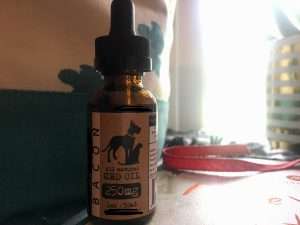
I looked up local CBD shops in Nashville and found no shortage of retailers that carried pet-specific products. I decided to use an oil since it had more potency and could be delivered on a treat, and chose a formulation that apparently tastes like bacon.
Mmmm, bacon.
Day 1: I decided to take Bishop to the Nashville Cherry Blossom Festival. I woke up early to go to Mass and came back just in time for Bishop’s morning feeding. We had a few hours until we had to meet some friends at the festival.
I grabbed a hard treat and poured a dropper-full of CBD oil on top (the recommended dose was one dropper-full twice a day). I put the treat up to his nose. He sniffed it and turned away.
Lacing his treats.
Oh fudge, I thought.
Bishop will eat anything and everything, except medicine. Bishop is so anti-medicine that his vet once wished me luck when I said I didn’t have anyone to help me pour his eye drops. This was after it took three of us to hold him down in her office so she could administer the first dose.
I mentally kicked myself for not considering this possibility and wondered what to do. Then it hit me that I still hadn’t fed Bishop.
I had him sit and wait while I poured his food in a bowl. Then I placed the laced treat in the middle, hoping he would accidentally eat it.
The sucker ate it.
Later, I filled a backpack with water, a collapsible water bowl, and some training treats, and we made our way downtown to the festival.
On the drive, I wondered what I could expect for the day. Bishop doesn’t bark often, but he can get pretty rowdy if the wrong type of dog passes by. Would the CBD reduce his tendency to lose his mind?
As I wondered this, Bishop was running across the backseat of the car to hang his head out of both windows. Apparently, the oil hadn’t kicked in.
And honestly, it never really seemed like it did.
Bishop did well with the training treats, socialized with the other humans, and didn’t make any attempts to eat food that didn’t belong to him. He even let some of the bigger dogs (his favorite kind) sniff his butt.
The butt-sniffing was about to commence.
But none of this stopped him from freaking out when the wrong sort of dog passed by. He was so crazy that he started to jump on the girls we were hanging out with at the festival. I had to apologize several times and use some basic training tricks to get him to calm down.
The other girls eventually wanted to go up to the observation deck, so I said Bishop and I would take the stairs and meet him there. Halfway up, Bishop’s back legs began to shake.
Oh no, I thought. I’ve poisoned him.
I didn’t actually think that he was having a reaction to the CBD oil, but I always briefly entertain the craziest possibilities when it comes to animals (or babies) doing things that I don’t understand. Following a water break and a quick trip to the bathroom, Bishop felt better. Then we tried to rejoin the girls, and Bishop’s legs started to shake again.
And that’s how I learned that despite our hikes at Percy Warner Park, one of the highest points in Nashville, my dog is actually quite terrified of heights.
After Bishop and I got home, I made some dinner, fed him once again, and crocheted while we watched some movies. I chose not to give Bishop the second dose since he was pretty calm for the rest of the evening.
Day 2: Remembering what happened yesterday, I poured Bishop’s food and placed another laced treat in the very middle. He ate it, but not before taking it out of the bowl to inspect it first. Then my own anxiety began to build up.
Just eat it already.
Today was Sunday Mass, which runs a whole heck of a lot longer than daily Mass. It was time to let Bishop roam the apartment alone with my poor, vulnerable books and furniture.
I got dressed for Mass and positioned the gates of his playpen in such a way that he’d have to grow human legs in order to reach the front door handle. I left some treats around the apartment, put on some calming nature sounds, and sweated bullets while I begged St. Francis and St. Roch to intercede on my behalf while I was gone.
Then I left. I didn’t hear any scratching at the door or crying.
The Palm Sunday Mass was longer than usual. There was the distribution of the palm fronds, a long procession into the church, and the interactive Gospel reading was several pages long instead of several paragraphs. The homily also lasted a bit longer. While everything was beautiful and I left feeling assured about my spiritual life, it didn’t stop me from worrying about my apartment as I drove home.
Once inside, I was thoroughly surprised that other than the barrier having been moved, the floor was clear of paper bits. I mentally prepared myself for the worst of it as I walked towards the main part of my apartment.
Where, it turns out, Bishop was relaxing in his crate.
He raised his head and his ears fell while he looked at me. He only does that when he knows he did something wrong.
I checked the rest of the living room, the dining area, the kitchen, my bedroom, and even the bathroom. I couldn’t believe that everything was untouched. I secretly thanked the oil and the saints while continuing to look for whatever made Bishop’s ears go droopy.
Then I noticed that the blanket I put over my Lovesac was knocked to the floor and there were remnants from Bishop’s toy on top. Considering he is well aware that he’s not supposed to be on there, I concluded that this was the worst of the offenses.
We spent the rest of the day doing some work and getting prepared for the Game of Thrones premiere. I opted against the second dose again because Bishop was otherwise calm.
What did I learn? At the end of the day, I don’t know that the oil had much of an effect on Bishop.
He clearly suffers from some separation anxiety, and he can be aggressive with other dogs. As with humans, drugs can only fix so much of an animal’s psychology. I’m also not sure what I can tell from just a couple of doses. I will admit to hoping that the CBD drops would essentially be a miracle cure. That, after just a dose or two, he wouldn’t be a bad dog ever.
Clearly, CBD is not a miracle cure for rowdy boys.
Still, I’m open to using it again the next time I leave him home alone. After all, with the exception of the playpen and the beanbag, this was the first time Bishop didn’t completely destroy the apartment.
So Bishop can go ahead and enjoy his CBD treats for several Sunday masses to come. As for his behavior when we go out, it looks like I’ll be calling his trainer soon.
from Latest – Reason.com http://bit.ly/2Gjqdoj
via IFTTT
“Harry Anslinger might have been a racist jerk,” Alex Berenson writes in his anti-pot polemic Tell Your Children, but “he was right about marijuana.” It’s a bold thesis given some of the things Anslinger said about marijuana while he was running the Federal Bureau of Narcotics.
In a 1934 report to a League of Nations committee, Anslinger wrote that “fifty percent of the violent crimes committed in districts occupied by Mexicans, Turks, Filipinos, Greeks, Spaniards, Latin-Americans and Negroes may be traced to the abuse of marihuana.” He quoted a California police official who said the weed “gives men the lust to kill, unreasonably, without motive—for the sheer sake of murder itself.”
In a 1937, Anslinger warned in The American Magazine that marijuana users “may often develop a delirious rage during which they are temporarily and violently insane,” resulting in “a desire for self-destruction or a persecution complex to be satisfied only by the commission of some heinous crime.” He blamed marijuana for armed robberies, “degenerate sex attacks,” the random killing of an elderly bootblack, cold-blooded murders of police officers, and a rampage in which a young man hacked his entire family to death with an ax.
“How many murders, suicides, robberies, criminal assaults, holdups, burglaries, and deeds of maniacal insanity it causes each year,” Anslinger wrote, “can be only conjectured.” But it was clear, he said, that “there must be constant enforcement and equally constant education against this enemy, which has a record of murder and terror running through the centuries.”
That same year, as Congress was considering a marijuana ban in the guise of a tax bill, Anslinger’s agency told legislators the drug “frequently leads to insanity,” resulting in “revolting crimes.” Anslinger testified that “in some cases one [marijuana] cigarette might develop a homicidal mania” and “all the experts agree that continued use leads to insanity.”
Berenson, a novelist and former New York Times reporter, agrees with Anslinger about pretty much all of that, although he is less inclined to emphasize the ethnicity of reefer-crazed rapists and murderers. In a January Times piece, he complained that he has been “mocked as a modern-day believer in ‘Reefer Madness,’ the notorious 1936 movie that portrays young people descending into insanity and violence after smoking marijuana.” Berenson may protest the association of his name with that piece of propaganda, but he borrowed the original title of the film, Tell Your Children, and slapped it on a book that conveys essentially the same message.
“Marijuana causes psychosis,” Berenson writes. “Psychosis causes violence. The obvious implication is that marijuana causes violence.…The black tide of psychosis and the red tide of violence are rising together on a green wave, slow and steady and certain.” You can start to see why Berenson titled his introduction “Everything You Are About to Read Is True” and felt a need to announce, “This book is a work of nonfiction.”
It is also a work of logical leaps, self-contradiction, misleading glosses, selective quotation, biased evidence gathering, and tendentious interpretation. Yet it has received a credulous reception not just from Fox News but from The New Yorker and Mother Jones. Now that most Americans support marijuana legalization, it seems, Berenson’s rehash of Anslinger’s hoary horror stories counts as a provocative, contrarian take.
Tell Your Children has no end notes or bibliography, which makes it harder than it should be to check Berenson’s claims against his sources. But the way he uses The Health Effects of Cannabis and Cannabinoids, a 2017 report from the National Academies of Sciences, Engineering, and Medicine (NASEM), does not inspire confidence. Regarding the relationship between marijuana and schizophrenia, he says, NASEM “declared the issue settled.” He quotes one of the “highlights” at the top of the relevant chapter in the report: “Cannabis use is likely to increase the risk of developing schizophrenia and other psychoses; the higher the use, the greater the risk.”
Although Berenson says that’s what “the scientists concluded,” their official conclusion on this point is decidedly more ambiguous: “There is substantial evidence of a statistical association between cannabis use and the development of schizophrenia or other psychoses, with the highest risk among the most frequent users.” Contrary to the impression left by Berenson, the nature of that relationship remains unclear.
“There are a number of proposed explanations for why the comorbidity of substance abuse and mental health disorders exists,” the report notes. “Substance use may be a potential risk factor for developing mental health disorders,” “mental illness may be a potential risk factor for developing a substance abuse disorder,” or “an overlap in predisposing risk factors (e.g., genetic vulnerability, environment) may contribute to the development of both substance abuse and a mental health disorder.”
One, two, or all three of these hypotheses might be true to some extent. As NASEM puts it, the relationship between cannabis use and psychoses “may be multidirectional and complex.” The report also notes that “in certain societies, the incidence of schizophrenia has remained stable over the past 50 years despite the introduction of cannabis into those settings”—a puzzling fact if you believe marijuana use makes schizophrenia more common.
Ziva Cooper, a cannabis expert at the University of California, Los Angeles, and a member of the committee that produced the NASEM report, faulted Berenson for misrepresenting its findings. “We did NOT conclude that cannabis causes schizophrenia,” Cooper said on Twitter. “We found 1) an association between cannabis use and schizophrenia and 2) an association between cannabis use and IMPROVED cognitive outcomes in individuals with psychotic disorder.…We now know that genetic risk for schizophrenia predicts cannabis use, shedding some light on the potential direction of the association.” But according to Berenson, “That debate is over.”
Berenson also conflates correlation with causation while discussing the purported connection between marijuana and violent crime. If criminals use marijuana more than law-abiding people—a fact Berenson considers “striking”—it does not necessarily mean marijuana turned them into criminals.
The first four states to allow recreational use of cannabis, Berenson says, “have seen sharp increases in murders and aggravated assaults since legalization.” Yet University of Oregon economist Benjamin Hansen reported on the Incidental Economist blog that “the homicide rates in Colorado and Washington were actually below what the data predicted they would have been given the trends in homicides from 2000–2012.”
How plausible is it that legalizing marijuana would immediately cause sharp increases in murders and aggravated assaults? “Even though marijuana is commonly used by individuals arrested for crimes, there is little support for a contemporaneous, causal relationship between its use and either violent or property crime,” a 2013 report commissioned by the Office of National Drug Control Policy concluded. The authors, who are affiliated with the RAND Drug Policy Research Center, flatly stated that “marijuana use does not induce violent crime.”
Two authors of that report also co-wrote Marijuana Legalization: What Everyone Needs to Know, a 2012 book that Berenson praises. He does not quote this part: “Marijuana use by itself does not produce violent crime; in fact, some studies suggest the opposite effect.”
Trying to explain why the supposedly obvious causal connection between marijuana and psychotic violence has escaped the notice of experts for so long, Berenson says marijuana was so weak until the 1990s that it did not have a perceptible impact on crime. But if that’s true, how did pot prohibitionists like Anslinger manage to document a wave of cannabis-induced violence?
That is not the only puzzle. Cannabis consumption has increased substantially in the United States since the early 1990s, and during that period the violent crime rate has been cut in half—not what you would expect if more marijuana means more murder.
Berenson ignores several studies that found no association between relaxed legal restrictions on marijuana and increases in violent crime. If letting people use marijuana for recreational purposes triggers a surge in homicides and aggravated assaults, you would expect to see something similar in jurisdictions that allow medical use, especially when the rules are loose, as they were in California for two decades before general legalization.
Instead of even-handedly reviewing the evidence, Berenson, like Anslinger, offers a litany of violent crimes—”each more terrible than the rest,” according to his sensational but logically impossible description—that he attributes to marijuana, even when the evidence is equivocal or people close to the perpetrator disagree. If a murderer has talked about marijuana online, as far as Berenson is concerned, that shows marijuana made him do it.
“Finding violence and homicides connected to marijuana is all too easy,” says Berenson. And it’s true: If you’re determined to prove that link, you can find lots of examples that seem to fit your theory. Explaining why police have not noticed the “red tide of violence” caused by the “green wave” of rising marijuana use, Berenson blames “confirmation bias.” As he explains, “That term is a fancy way of saying that we look for evidence that supports what we think we already know.”
from Latest – Reason.com http://bit.ly/2Va1egK
via IFTTT
“Crooked Hillary,” Donald Trump tweeted in November 2017, “bought the DNC & then stole the Democratic Primary from Crazy Bernie!” The unusually tight relationship during the 2016 primary between the Democratic National Committee and its presidential front-runner, the president suggested, might be worthy of a Justice Department investigation.
If that were true, then the FBI should have a new case on its hands: the unprecedentedcollusion between the Republican National Committee and Trump himself.
Clinton, in August 2015, signed a secretive and controversial joint fundraising agreementwith the DNC that gave her the vast bulk of money raised and eventually placed some of the party machinery under her financial control. Trump, on the other hand, hasn’t just influenced and benefited from the RNC; he’s inhaled it like a cheeseburger.
In December, nearly two years before the 2020 election, the Republican Party and the president’s re-election campaign literally merged into a single unit, called Trump Victory, which RNC Chair Ronna McDaniel clucked would be “the biggest, most efficient and unified campaign operation in American history.” In January, the party passed a resolution giving the president its “undivided support.”
Political party apparatuses are supposed to be impartial arbiters of primary contests, not corner men for the reigning champions. Yet McDaniel at the Conservative Political Action Conference in February boasted that any Republican foolish enough to challenge Trump in the 2020 primaries would “lose horribly,” adding this taunt to the Bill Welds of the world: “So have at it, go ahead, waste your money, waste your time and go ahead and lose.”
Weld, who officially launched his campaign Monday, called McDaniel’s comments at the time “a stunning reversal of past party practice of honoring neutrality in primaries,” asking: “What is it they are so afraid of?”
That may be the most puzzling question of all. Trump is clobbering Weld in the polls — 85% to 15%, according to a national Emerson survey released this week. Even in Weld’s home state of Massachusetts, where he was a popular two-term governor in the 1990s, the president has a gargantuan 82-18 lead.
Approval of Trump among Republicans has stabilized at around 90%, according to Gallup polling, and Robert S. Mueller III’s special investigation — which would-be candidates John Kasich and Maryland Gov. Larry Hogan had been waiting for to help inform their decisions on whether to run – has failed thus far to land a serious blow. Sure, Republican voters may say they want more competition, but when presented with actual names, they tend to jump back into the arms of the party’s standard-bearer.
And yet the Trump machine is taking a bazooka to this thumb-wrestling match, inserting Trumpist yes men in regional party leadership positions — including in the crucial early states of Iowa, New Hampshire and South Carolina. Some of those apparatchiks have wondered out loud whether the party even should hold primaries next year.
“I’ve never seen anything like it and I’ve been involved in the Republican Party for most of my life,” Hogan told Politico in February. “It’s unprecedented.”
Such a cartoonish show of force is clearly designed to scare off potential competitors before they even get in the ring. But like many exaggerated projections of strength, it’s giving off the unseemly whiff of flop sweat.
There is a parallel here. Once upon a time, a Republican incumbent president popular within his own party faced minor competition both in early-state GOP primaries and among a rowdy Democratic field. There was some scandal and gross arm-twisting emanating from the White House, though not yet in a seriously prosecutable way; meanwhile the left was flirting more openly with socialism than it had in a generation.
In the end, Richard Nixon would squash the antiwar Californian Pete McCloskey like a bugin New Hampshire, before romping to the kind of general-election landslide that Donald Trump can only dream about. But along the way the president’s paranoia, crude habits and questionable taste in personnel — Roger Stone, anyone? — sowed the seeds of his administration’s destruction.
It is a time-wasting folly for Democrats to expect some mythical Watergate 2.0 to solve their biggest political problem with a single bang of the gavel. If anything, the analogy is more teachable for Trump himself. It’s the smallest men who require the biggest parades, and the organizations they corrupt will be staffed by compromised opportunists.
The president should welcome a political fight — he’s certainly better at it right now than any national Republican. But by stacking the deck so grossly in his favor, Trump is making the tacit admission that he just doesn’t believe in himself. Be very afraid when the president is scared.
from Latest – Reason.com http://bit.ly/2vbPA6A
via IFTTT
Jonathan Kotler is suing the California Department of Motor Vehicles for denying his request for a personalized license plate that would read “COY-W.” Kotler is a fan of the British Fulham soccer club. The club wears white jerseys, and fans chant “Come on you whites,” which is often abbreviated COYW. The DMV says the slogan could be perceived as racist. But Kotler notes that the team’s owner Shahid Khan uses the phrase and that at least half the team is non-white.
from Latest – Reason.com http://bit.ly/2DjgGgq
via IFTTT
It is certainly possible that the Mueller Report to be released on Thursday will constitute a blueprint for impeaching President Trump on obstruction of justice charges. My speculation is based mostly on the aggressiveness with which the lawyers on the Mueller team did their investigation and their keeping the Russia-Trump investigation open long after they had to know there was no collusion between the Trump campaign and Russia.
The collusion probe came to Mueller primarily as an obstruction case. Since it was obvious from a very early point that there had been no collusion, the question of whether there was a prosecutable obstruction case was really the only one Mueller had to answer. In the end, he defaulted.
It is almost certain that Mueller knew by autumn 2017 that there was no Trump–Russia conspiracy. Trump railed about the investigation for public consumption, but the White House and his lawyers (especially the first team, led by John Dowd) provided sweeping cooperation, including hours of interviews with White House counsel Don McGahn and well over a million documents (among them, contemporaneous notes of McGahn’s meetings with the president). Though he could easily have claimed executive privilege to withhold this information from prosecutors, Trump never did. . . .
A nagging question persists: Why did Mueller allow the investigation to continue for well over a year after it must have been patent that there was no collusion case? . . . Why did neither Mueller nor Rosenstein issue an interim report? That would have enabled Trump to govern without a cloud of suspicion that he might be a clandestine agent of Russia, yet permitted the overarching inquiry into Russia’s operations and even the obstruction probe to continue. The country deserves an answer.
McCarthy gives some background about the likely reason that Mueller failed to decide whether to prosecute, ultimately punting the decision to Barr:
As for the obstruction inquiry, after 22 months of investigation, Mueller finally declined to make a prosecutorial judgment, dumping the matter in Barr’s lap. . . .
There is no doubt that a president may be cited for obstruction based on corrupt acts that tamper with witnesses and evidence (recall the Clinton and Nixon precedents). But no patently illegal acts were alleged against Trump. In their absence, Mueller’s team pursued a novel theory: An obstruction charge might be premised on lawful exercises of the president’s Article II prerogatives (e.g., firing subordinate officials, weighing in on the merits of investigations, considering pardons) if a prosecutor — the president’s subordinate — later deduced that the acts had been improperly motivated. . . .
As is not uncommon for former top officials, [Barr] had weighed in on important policy matters from time to time over the years.
So it was on obstruction.
In June 2018, Barr had submitted an unsolicited 20-page memo to Rosenstein. Citing the legislative history of the obstruction statutes, leading case law, and longstanding Justice Department policy, he contended that Mueller’s apparent theory of obstruction was legally untenable and practically unworkable. Putting the president aside, the theory would subject to possible prosecution any Justice Department supervisor who made a routine personnel decision during a case (say, reassigning a lawyer from one investigation to another) if some prosecutor later suspected an improper motive. Barr further made what should be an incontestable point: Given the damage such a prosecution can do to the nation’s governance, a president should not be prosecuted in the absence of something all reasonable people can agree is a clear, serious violation of law.
Once Barr was confirmed, Mueller had to see the handwriting on the wall: The new AG was not going to approve a dubious obstruction charge. The special counsel thus had a choice: concede that Barr was right on the law, or fight for the controversial theory his staff had pursued — i.e., recommend an obstruction charge and dare the AG to nix it. But Mueller shrank from making the decision, choosing merely to summarize the evidence and leave the prosecutorial judgment to Barr.
In consultation with Rosenstein, Barr found no prosecutable case. . . .
In the meantime, [Mueller] let the president chafe under the yoke of suspicion long after it was manifest that there was no collusion case. All the while, the special counsel’s staff considered an unsound reinterpretation of obstruction law in order to nail Trump — after the Justice Department had bent over backwards in order to avoid charging Hillary Clinton with mishandling classified information, a concrete criminal allegation that was supported by weighty evidence.
Although political predictions are wrong nearly as often as they are right, I would expect that the Mueller Report released on Thursday will give plenty of ammunition for Congressional Democrats who might want to impeach Trump for obstruction under a theory that the Mueller team thought plausible enough to have spent nearly two years pursuing.
I hope that the report will also reveal when the investigation of the Trump campaign began and on what basis, as well as which current and former foreign agents or governments were used by the Clinton campaign, the FBI, or the CIA to surveil or gather information on members of the Trump campaign, the transition team, or the administration.
from Latest – Reason.com http://bit.ly/2UEN0VE
via IFTTT
Excessive partisanship and endless acrimony are common complaints lodged against the political class. There’s a lot to be said in favor of this narrative, but bipartisanship isn’t always what it’s cracked up to be, either. As evidence, consider the latest attempt to extend corporate handouts for electric vehicle (EV) manufacturers.
The Driving America Forward Act was recently introduced to extend the existing EV tax credit well beyond its current limits. Unsurprisingly, its sponsors include both Michigan Senators, Democrats Debbie Stabenow and Gary Peters, as well as Republican Senators Lamar Alexander of Tennessee and Susan Collins of Maine. A companion version was introduced in the House of Representatives by Rep. Dan Kildee, also a Democrat from a district in Michigan.
Under current law, a federal tax credit of up to $7,500 is available to consumers of the first 200,000 vehicles sold by each manufacturer, after which the credit is phased out. Both Tesla and General Motors have exceeded the cap, a fact that has driven a lobbying frenzy to extend the benefit. This wouldn’t be the first time the credit was expanded, as the original incarnation of the credit applied only to the first 250,000 electric vehicles sold across all manufacturers.
This new legislation will allow for the purchase of an additional 400,000 vehicles to be eligible for a $7,000 credit, but it might as well be permanent. If Congress passes the bill and it’s signed into law, Washington will be sending a clear signal to manufacturers that the gravy train may never end. All the EV makers must then do is flood Washington with lobbying and campaign donations once the next deadline approaches and the cycle could no doubt continue.
The current credit is expected to cost $7.5 billion in federal revenue from last year through 2022, according to the Congressional Research Service and the Joint Committee on Taxation. The costs of the newly expanded credit are not yet available but would be considerably higher.
Almost 80 percent of those utilizing the EV tax credit have incomes over $100,000, making it not just a corporate handout but also a transfer from all workers to wealthier Americans. And despite its advocates’ claims, the EV tax credit fails to reduce the alleged threat of climate change.
Because all personal vehicles in the United States account for only a small fraction of global greenhouse gas emissions, even an unrealistic influx of electric vehicles would prove to be negligible. Besides, standard internal combustion engines emit far less pollution today than they have in the past. Simply replacing older cars can do as much or more to benefit the environment than even entirely switching over to electric vehicles.
This is at least the third major push to extend EV tax credits over the last year. The persistence of the issue is indicative of a political reality less obvious than the typical Republican versus Democrat framework. In economic parlance, it’s called concentrated benefits and diffuse costs. The benefits are conveyed to EV manufacturers and those few consumers (most of whom make over $100,000), but the costs are spread out across the larger population.
While the manufacturers and relatively wealthier consumers of electric vehicles have a strong incentive to support the tax credits, the average cost per taxpayer is low and thus of little political concern. Yet, when all the crony handouts that come about because of this same dynamic are added up, it represents a more significant sum and is a more obvious problem. But translating that burden into a political force that’s capable of resisting the well-funded pleading of special interests is extremely difficult.
In this case, the fact that the handouts are already set to end if Congress just does nothing should benefit the taxpayers. That’s often not the case, and it explains why the special interests have failed several times already in their attempts to preserve their benefit. Unfortunately, it’s readily apparent that they’re going to keep trying again and again to enrich themselves at the expense of the taxpaying public.
from Latest – Reason.com http://bit.ly/2UL9Nzl
via IFTTT





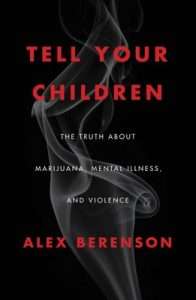 Berenson, a novelist and former New York Times reporter, agrees with Anslinger about pretty much all of that, although he is less inclined to emphasize the ethnicity of reefer-crazed rapists and murderers. In a January Times piece, he complained that he has been “mocked as a modern-day believer in ‘Reefer Madness,’ the notorious 1936 movie that portrays young people descending into insanity and violence after smoking marijuana.” Berenson may protest the association of his name with that piece of propaganda, but he borrowed the original title of the film, Tell Your Children, and slapped it on a book that conveys essentially the same message.