Saudi Crown Prince Flies To Washington To Meet With Donald Trump

Saudi Deputy Crown Prince, Mohammed bin Salman, responsible for the kingdom’s reforms, left on Monday for Washington to meet President Donald Trump on a visit expected to pitch the world’s top oil exporter as an attractive investment destination. It will be the first meeting since Trump took office in January between the U.S. President and the prince who is next in line to lead Saudi Arabia, and is in charge of the kingdom’s efforts to revive state finances by diversifying away from falling crude oil revenues, of which the upcoming Aramco IPO will be a critical component.


Saudi Deputy Crown Prince Mohammed bin Salman

Under the Saudi plan, which seeks to promote the private sector and make state-owned companies more efficient, Riyadh plans to sell up to 5 percent of state oil giant Saudi Aramco in what is expected to be the world’s biggest initial public offering. Last year, facing a surging budget deficit due to slumping oil prices, the kingdom announced an austerity drive to reduce state spending, although industry sources say it has also promised major development projects later this year to soften the economic impact of those cuts.

According to Reuters, a royal court statement said that in his talks with Trump and other U.S. officials, Prince Mohammed, who heads a supercommittee driving economic reform and is also Saudi defense minister, was expected to “discuss reinforcing bilateral relations and review regional issues of mutual interest”. It said that the working visit would start on Thursday but gave no further details.

John Sfakianakis, director of economic research a the Gulf Research Center, said the focus of the visit would be “to showcase Saudi investment opportunities… the Saudi Aramco IPO as well as the reforms undertaken in the wider economic space.”

The trip takes place less than a year after the prince, son of Saudi King Salman bin Abdulaziz and the second in line to the throne, visited Silicon Valley to sell his vision of market-oriented reforms and a transformation of the kingdom’s society.


By freeing the kingdom from the statist model of its past, he hopes ultimately to create new private sector jobs for younger people in a country where half the population of 21 million Saudis — there are also 10 million expatriates — are estimated to be under 25.


Younger Saudis face entrenched unemployment, a skills shortage, a lack of housing and growing pressure on living standards as the kingdom’s oil income grows ever less able to finance the needs of a rising population.

Meanwhile, with the crown prince headed to Washington, Saudi king Salman is similarly probing the ground for investment in Asia, and is currently in Japan on a month-long Asia tour to build ties with the world’s fastest growing importers of Saudi crude and promote investment opportunities, including the sale of a stake in its giant state firm Saudi Aramco. He is headed to China soon after.

Trump spoke by telephone with Salman soon after he took office in January and agreed to support safe zones in Syria, according to a White House statement. Salman invited Trump “to lead a Middle East effort to defeat terrorism and to help build a new future, economically and socially,” for Saudi Arabia and the region, Saudi media reported. Before his departure for the United States, Prince Mohammed met Citigroup’s CEO Michael Corbat in Riyadh on Sunday for a similar discussion on investment opportunities in the kingdom and globally, SPA reported.

As a reminder, Saudi Arabia was one of the most aggressive financial backers of the Hillary Clinton presidential campaign, which could prove problematic for the upcoming trip seeking US generosity. Furthermore, with the US itself desperate for Trump’s economic proposals to lead to renewed spending domestically, the Saudis may have to get in line.

via http://ift.tt/2mRPGNE Tyler Durden

Mobileye Shares Soar On Intel Acquisition Report, Citron Shorts Crushed

Intel has agreed to buy Israeli technology firm Mobileye for $14-$15 billion according to a report in Israeli financial newspaper TheMarker, sending MBLY shares soaring over 30% higher premarket. An official announcement of the acquisition, the largest ever for an Israeli high-tech company, is expected later on Monday, TheMarker reported on its website. Mobileye, which has been a rumored acquisition target in the past, is a leading supplier of collision-avoidance car sensor systems.

Founded in 1999 with a mission to reduce vehicle injuries and fatalities, Mobileye listed in 2014 on the New York Stock Exchange, where its market cap is $10.6 billion. In 2007, Goldman Sachs invested $130 million in the company.

Intel and Mobileye already collaborate with BMW on a project to put a fleet of around 40 self-driving test vehicles on the road in the second half of this year. BMW announced its partnership with the two firms in July, with the goal of developing the capability of introducing fully autonomous vehicles to the market by 2021.

Intel is betting on Mobileye due to its strategic vision that automotive is a big part of its future, and bring the Israeli car company in-house to help it catch up to rival chipmakers like Qualcomm and Nvidia. It also could aid Intel in the drone space, given Mobileye’s focus on collision avoidance. For Mobileye, the acquisition price represents a huge premium to its $10.6 billion market close.

Of note: Intel is expected to use much of its billions in “stuck” offshore cash to finance the acquisition.

The surge in MBLY stock may prove catastrophic for noted short seller Citron Research which on February 24 started shorting the company, saying that it was “a one-trick pony” that was overvalued.

“They’re really a one-trick pony,” Left told CNBC’s “Fast Money: Halftime Report” in February. “With autonomous driving, you could even buy Google and get this whole area for free… right now Mobileye is bringing a knife to a gunfight.” That’s after betting against rival chipmaker Nvidia a few months ago. Citron, which was already short on Mobileye, the profits from Nvidia and rolled them into a short of Mobileye. “If you want exposure in the area as a short, it’s not Nvidia anymore, but rather more of a focus on Mobileye,” Left said. “When I initially discussed the Mobileye short, I’ve always compared it against Nvidia.” Needless to say, anyone who followed Citron’s advice on this one has had a miserable start to the week.

via http://ift.tt/2nvzlLN Tyler Durden

Global Stocks Rise, S&P Futs Flat As Dollar Rebounds Ahead Of Critical Week For Markets

European bourses advance and Asian share rose led by a surge in Hong Kong stocks which rose the most in three months as Japan hit 15 month highs. U.S. futures are little changed along while the dollar rebounded from session lows after Friday’s selloff. Crude oil has continued its retreat, down 0.2% and sliding for a 6th straight day after breifly dropping below $48 in overnight trading.

The Hang Seng China Enterprises Index jumped the most since November amid easing concern that U.S.-China political tensions will weigh on the yuan after BlackStone’s Steve Schwarzman, one of Trump’s top economic advisers, said Sunday on CNN that Trump will likely temper his criticisms of China, including his campaign claim that the country manipulates its currency. South Korean equities rose to the highest since May 2015 following last Friday’s impeachment of president Kim, while European shares headed for a fourth straight gain. The dollar fell against most major currencies, with the euro climbing for a third day. Oil kept sliding below $50 as U.S. drillers continued to boost activity, countering OPEC’s efforts to drain a global glut. Industrial metals advanced for a second day.

Traders are tentative out of the gate ahead of a pivotal week for global markets with the focus falling on Wednesday when there is a trifecta of catalysts between the Fed’s upcoming rate hike, the debt ceiling expiration and the Dutch general elections which comes amid a growing diplomatic spat with Turkey. In addition to the Fed, we will also get announcements by the BoJ, BoE and SNB all of which are expected to keep rates on hold. It’s also possible that the UK could invoke Article 50 this week so another story to watch. President Trump may also dish out his first budget outline for fiscal year 2018 on Thursday while G-20 finance ministers gather in Germany for a series of meetings so there’s plenty to keep markets busy.

Following last week’s impressive payrolls reports, global equities are trading near a record high as indications of firming growth in the U.S. and Europe coincide with China’s economy showing signs of improvement. U.S. jobs data at the end of last week cleared the way for the Fed to raise interest rates without forcing it to accelerate the pace for future tightening. The euro built on gains from Friday, when European Central Bank policy makers were said to have considered their ability to raise rates before a bond-buying program comes to an end, although the common currency has erased all losses after the European open, and was back near session lows at publication time.

By now it is no secret that traders view a quarter-point Fed hike this week as a virtual certainty after Friday’s data showed U.S. employers added more jobs than forecast in February. They’ll be watching the central bank’s policy decision for signals on what will come next. Futures indicate the market is moving toward policy makers’ December projection of three rate increases in 2017. It would be the first year with multiple Fed hikes since 2006. Fed fund futures prices showed investors pricing in more than a 90 percent chance of an increase in U.S. overnight interest rates and the market’s attention is now firmly on the scale of tightening further out.

“Improved growth and inflation prospects are allowing developed market central banks to sketch their exits from extreme accommodation at varying speeds,” David Folkerts-Landau, group chief economist at Deutsche Bank wrote in a note to clients.

Overnight Goldman flip-flopped on its long-standing bearish position over Chinese stocks, and joined the rush on Chinese shares, becoming the latest major brokerage to upgrade the market. China’s macroeconomy stabilized in the beginning of 2017, Ning Jizhe, head of the National Bureau of Statistics, said at the sidelines of the annual legislature meeting in Beijing on Sunday.

Sterling rose 0.4% against the dollar ahead of a vote in Britain’s lower house of parliament on legislation that will give the government permission to trigger Britain’s exit from the European Union. “The push and pull between solid growth momentum and political risks look set to continue in the near-term,” Folkerts-Landau said.

The world’s most powerful finance ministers and central bankers convene in the German spa town of Baden-Baden on March 17-18, their first meeting since Donald Trump’s U.S. election victory in November where his protectionist stance on international trade is likely to be a key issue.

The MSCI Asia Pacific Index advanced 0.7 percent as of 8:17 a.m. in London. The Hang Seng China Enterprises Index surged 1.9 percent, the biggest jump since Nov. 22. Japan’s Topix rose 0.2 percent, after the gauge rallied 1.2 percent on Friday to the highest level since December 2015.  The Kospi index jumped 1 percent, led by a 1.1 percent gain in Samsung Electronics Co. Korean shares extended gains from last week, climbing as President Park Geun-hye’s ouster removes some uncertainty from politics in the nation. The Stoxx Europe 600 added less than 0.1 percent, after similar gains in each of the previous three sessions.

Gains in mining stocks and continued corporate deal-making activity helped European shares offset weakness in oil-related shares, with the benchmark STOXX 600 up 0.2 percent in early trades. The FTSE 100 was up slightly where along with mining blue chips a 1 percent gain for shares of HSBC supported the index. HSBC shares rose after Europe’s biggest bank tapped an outsider, Mark Tucker, for its top job.

In bond markets, euro zone government bond yields pulled back from multi-week highs, as nervous investors turned their focus to this week’s Dutch parliamentary elections, the next key gauge of populism in Europe.  Although the risk of a eurosceptic party coming to power in the Netherlands is small, a strong election performance could renew concerns about the popularity of the far-right in French presidential elections in April and May, said Erin Browne, head of macro investments at UBS O’Connor, a hedge fund manager within UBS Asset Management.

“If you see a eurosceptic party gains a significantly larger share of the vote than current polls suggest that could spill over into concern about the French elections and the National Front doing better in the second round of voting than is currently being predicted,” she said. “That’s the risk for markets with a view to the Dutch elections.”

The yield on 10-year Treasuries fell one basis point to 2.56 percent, after falling three basis points in the previous session. The yield on 10-year Australian government bonds slid four basis points to 2.94 percent, tracking Friday’s Treasury rally.

A sharp pullback in oil prices which fell to their lowest in three months and are on track for a fifth day of losses also kept investor confidence in check.  The slump in prices has occurred as more rigs are deployed to look for oil in the United States and as crude inventories in the United States, the world’s biggest oil consumer, have surged to a record.

Market Snapshot

  • S&P 500 futures down 0.01% to 2,371.50
  • STOXX Europe 600 up 0.1% to 373.59
  • MXAP up 0.7% to 145.41
  • MXAPJ up 0.9% to 467.01
  • Nikkei up 0.2% to 19,633.75
  • Topix up 0.2% to 1,577.40
  • Hang Seng Index up 1.1% to 23,829.67
  • Shanghai Composite up 0.8% to 3,237.02
  • Sensex up 0.06% to 28,946.23
  • Australia S&P/ASX 200 down 0.3% to 5,757.35
  • Kospi up 1% to 2,117.59
  • German 10Y yield fell 2.4 bps to 0.461%
  • Euro up 0.05% to 1.0678 per US$
  • Brent Futures up 0.08% to $51.41/bbl
  • Italian 10Y yield rose 5.5 bps to 2.367%
  • Spanish 10Y yield fell 0.4 bps to 1.885%
  • Brent Futures up 0.08% to $51.41/bbl
  • Gold spot up 0.3% to $1,208.62
  • U.S. Dollar Index up 0.02% to 101.27

Top Overnight News via BBG

  • ECB Said to Have Discussed Whether Rates Can Rise Before QE Ends
  • Oil Extends Decline as U.S. Drilling Accelerates Amid OPEC Cuts
  • Libya Crude Oil Output Said to Fall 11% on Field, Port Closings
  • Schwarzman Sees Donald Trump Dialing Back Criticisms of China
  • BlackRock May Bid for U.K. Student-Loan Portfolio: Sunday Times
  • Johnson Controls Said to Explore Sale of Scott Safety: Reuters
  • Boeing Wins 5-Year Contract to Sustain South Korea’s F-15k Fleet
  • Shuaa Capital to Buy Integrated Capital, Integrated Securities
  • AES Plans $750m Solar Power Project in Vietnam
  • EPAM Systems, Innophos Postpone Investor Days Due to Weather

Asia equity markets trade mostly higher after the positive US close last Friday, although gains have been modest ahead of the looming FOMC. Conversely, ASX 200 (-0.3%) was weighed by a struggling energy sector after WTI crude futures extended on last week’s 9.0% losses to briefly slip below USD 48/bbl, while Nikkei 225 (+0.2%) was initially subdued after poor Machine Orders data, but then recovered amid upside in JPY-crosses. Shanghai Comp. (+0.8%) and Hang Seng (+1.1%) traded higher after the PBoC resumed liquidity injections, while the KOSPI (+1.0%) continued the strength seen from last week’s impeachment ruling as participants welcomed a fresh start. 10yr JGBs were uneventful with prices flat after the mildly positive sentiment in Japan was counterbalanced by the BoJ’s presence in the market for JPY 520b1n of government debt. PBoC injected CNY 10bIn 7-day reverse repos, CNY 10bIn in 14-day reverse repos and CNY 10bIn in 28-day reverse repos.

Top Asian News

  • China H-Shares Advance the Most in Three Months; ChiNext Climbs
  • Gulf Central Banks Want to Lower Visa, Mastercard Fees: Alrai
  • Posco CEO Meets GE CEO Immelt to Discuss Ways to Strengthen Ties
  • Indonesia Human Rights Agency to Review Freeport’s Record: Post
  • China Moves to Make $9 Trillion Domestic Bond Market Global
  • China Huarong’s Lai Expects Annual Profit Growth of 20%-30%
  • Rupee Climbs on Modi’s Victory in State Election: Asia NDFs
  • Singapore Bans Ex-Goldman Banker Leissner, Seeks Bar on Others
  • Yingde Off-Exchange Trade of 79.67m Shares Crosses at HK$6 Each
  • Hong Kong Regulator Said to Probe CCB International’s IPO Work

European equities are modestly higher although with no clear direction in a quiet start to the week. Materials lead the way higher this morning while financials kicked off on the back foot, although have pared some of the early softness by mid-morning. The initial downside came in the wake of Friday’s ECB source reports suggesting the central bank discussed hiking rates before the end of the QE program. Amec Foster Wheeler and John Wood Group are the two best performers in the Stoxx 600 after pre market reports of their tie up for GBP 2.23Nn. Away from equities, fixed income markets continue to rise across the board, with Bunds and Gilts both higher by almost 50 ticks this morning after some of the significant downside seen last week. Focus will continue to fall on central banks with ECB’s Draghi Lautenschlaeger, Praet and Constancio all scheduled to speak today, ahead of several rate decisions later this week, including the FOMC, BoE, SNB and BoJ.

Top European News

  • Bayer CEO Sees EU6b Sales From 6 Pipeline Drugs: Welt am Sonntag
  • HSBC Shares Gain After Bank Names AIA’s Tucker as Chairman
  • Bovis Shares Jump After Amid Takeover Talks With Galliford Try
  • Wood Group Acquires Amec in 2.2 Billion-Pound All-Share Deal
  • Europe ‘Political Circus’ Has SNB Bracing for Stronger Franc
  • U.K. House Prices Rise Fastest in a Year as London Rebounds
  • Bund Futures Erasing Loss After ECB Report as Smets Pushes Back
  • Le Pen Says Falling Currency Would Help More Than It Hurts
  • Aryzta Sweeps Management Out Early After First-Half Loss
  • Scotland Braced for ‘Important’ Speech as Brexit Process Looms

In currencies, the Bloomberg Dollar Spot Index fell 0.1 percent, after dropping 0.6
percent on Friday. The yen rose 0.2 percent to 114.63 per dollar. The euro was unchanged 0.1 percent to $1.0685, extending its 0.9 percent surge on Friday. The British pound climbed 0.4 percent to $1.2221. The South Korean won jumped 1.1 percent. The Australian dollar advanced 0.5 percent, following Friday’s 0.5 percent gain. Monday morning action in the FX markets are largely a function of some repositioning ahead of the multitude of event risk this week. The FOMC meeting takes centre stage, as the Fed is expected to hike rates by 25bps, but the market is looking past this now and considering the impact on the future rate path from the accompanying statement. The USD has been reined in a little since, losing ground across the board, but less so against the JPY. The EUR has also been pulled back a touch, with the 1.0700+ push in EUR/USD running into offers to pull the lead rate back into the mid 1.0600’s. The retracement has followed through in the crosses also, and perhaps more notably so against GBP, where exposure remains significantly skewed to the downside as we head closer to triggering Article 50. The amendments to the Brexit bill voted on by the House of Lords continue to cause headwinds for PM May and her government, who remain adamant that A50 will be triggered by the end of the month. Even so, EUR/GBP has found some resistance ahead of 0.8800, while Cable buyers from the mid 1.2100’s stood resolute through last week’s USD advance.

In commodities, WTI crude dropped 0.2 percent to $48.39 a barrel. Crude has lost almost 10 percent over the past six days, breaking below the $50 a barrel level it had held above since OPEC and 11 other nations started trimming supply on Jan. 1. Gold climbed 0.5 percent to $1,210.18, adding to Friday’s 0.3 percent gain. Some say that the pull-back in Oil prices was to be anticipated, but with OPEC signalling near full compliance with the output agreement, the lack of upside may have inspired some profit taking given some of the heavy long positioning among the Hedge Fund community. Concerns over shale production has reared its head also, along with timing issues having a marginal impact in current inventory. WTI dipped below USD48.00 today, but remains heavy alongside Brent, which dipped below USD51.00. Fresh upside pressure for Copper as the striker union at Escondida rejects BHP Billiton. Peru’s top copper mine Cerro Verde is also ground to a halt on strikes initiated on Friday so the combination of the above has seen prices recover through USD2.60. Gold has recovered through USD1200 on broad based USD trimming, with Silver reclaiming USD17.00.

It’s a fairly quiet start to the week data wise, with little of interest in Europe this morning and just the labour market conditions index in the US this afternoon.

US Event Calendar

  • 10am: Labor Market Conditions Index Change, est. 2.5

DB’s Jim Reid concludes the overnight wrap

Maybe someone forgetting the keys to the padlock at the Fed Reserve building in DC might be the only thing stopping the Fed from hiking rates this Wednesday evening in what is a busy week ahead of data, BoJ/BoE meetings and the Dutch elections which comes amid a growing diplomatic spat with Turkey. It’s also possible that the UK could invoke Article 50 this week so another story to watch. President Trump may also dish out his first budget outline for fiscal year 2018 on Thursday so there’s plenty to keep markets busy.

Over the weekend it’s actually been relatively quiet for newsflow aside from a few smaller stories that are doing the rounds. In Japan there’s been some focus on a Bloomberg article suggesting that the BoJ’s bond-purchase plan for March is putting the Bank on track to miss the annual target (by about 18% if sustained) which in turn is throwing up questions about whether or not the BoJ is starting a ‘stealth tapering’. Meanwhile, in India PM Narendra Modi’s BJP has registered a sweeping victory in the state elections in Uttar Pradesh – the largest and most populous state of India. The victory should cement Modi’s stature within the BJP and may also be seen as a vote of support of Modi’s demonetisation exercise and his anti-corruption credentials which in turn should give a boost to pushing through domestic reforms. Finally there is one interesting piece of news to report in Europe and that comes from Iceland where, almost 9 years on from being imposed in 2008 following the collapse of its banks, the government has announced that all capital controls on its citizens, businesses and pension funds will be lifted from this Tuesday.

In terms of markets for the most part it’s been a fairly positive start to the week in Asia. The Nikkei (+0.23%), Hang Seng (+0.92%) and Shanghai Comp (+0.42%) are all higher while South Korea’s Kospi (+1.15%) and the Won (+0.92%) are both stronger post the news that Park Geun-hye has officially left the presidential palace after judges backed the impeachment. This morning’s gains are also coming despite WTI Oil trading down another -0.85% to around $48/bbl. That’s after Oil tumbled over 9% last week for the biggest decline since November. That appears to be weighing more on the ASX (-0.41%) while US equity index futures are also slightly in the red.

Before we look at the week ahead, a quick recap now of how markets ended on Friday. Unsurprisingly the big focus was the release of the February employment report in the US which, for those who missed it, saw nonfarm payrolls come in at a slightly stronger than expected 235k gain (vs. 200k expected) with 9k of cumulative upward revisions to prior months. We’d argue though that given the strong ADP reading earlier in the week, the print was probably in and around where the whisper number was sitting. Private payrolls also came in a little better than expected (227k vs. 215k expected) while the unemployment rate dipped one-tenth to 4.7% and the U-6 rate dipped two tenths to 9.2% and equalling the cyclical low made in December. The participation rate ticked up from 62.9% to 63.0% However if there was one soft element of the report it was the slight miss on wages growth with average hourly earnings reported as rising +0.2% mom versus expectations for +0.3%. Still, at +2.8% yoy the annual rate was up two-tenths from the prior month and only a shade below the recent +2.9% high of December.

Taken together the data all but confirmed a more than likely Fed hike this week barring any unexpected surprises. Treasuries actually ended up a little firmer on Friday with 2y and 10y yields down 1.9bps and 3.1bps respectively – the latter bringing to an end 9 consecutive days of higher yields. That said we still saw 2y yields end the week 4.8bps higher and 10y yields 9.7bps higher. Meanwhile the Greenback also eased back a little on Friday with the Dollar index -0.59% while US equities nudged a little higher. The S&P 500 was +0.33% but still suffered the first negative week (-0.44%) since January.

In Europe equity markets were for the most part higher again, albeit very modestly, with the Stoxx 600 finishing +0.09%. The more interesting price action however came in bonds where selling pressure was evident once again. Indeed 10y Bund yields finished another 5.8bps higher on Friday and so putting them 12.9bps higher over the course of the week while yields in France and the periphery were also 3bps to 5bps higher on Friday. That largely seemed to reflect some of the ECB reports which emerged suggesting that the Bank could look to lift rates while still in the process of tapering QE, or before the QE programme ends. A Bloomberg report on Friday quoting ‘people familiar with the matter’ said that Governing Council members were said to have considered the matter at last week’s meeting although as we know Draghi did confirm last week that the forward guidance remains such that the ECB expects rates to remain at present or lower levels for an extended period of time and also past the horizon of net asset purchases. These sorts of articles always throw up the usual credibility questions but generally speaking there is no smoke without fire so worth keeping an eye on.

In terms of the remaining data in Europe, the latest trade numbers in Germany showed a narrowing of the surplus in January led by a bigger than expected rise in imports (+3.0% mom vs. +0.5% expected) which overshadowed a +2.7% mom rise in exports. In France industrial production was soft in January (-0.3% mom vs. +0.5% expected) while the same could also be said for the UK (-0.4% mom vs. +0.5% expected). The other data in the US was the February monthly budget statement which revealed a budget deficit about the same size as 12 months earlier.

With regards to the week ahead, it’s a fairly quiet start to proceedings this week with little of interest in Europe this morning and just the labour market conditions index in the US this afternoon. Tuesday kicks off in China where we’ll get the February retail sales, fixed asset investment and industrial production data. In Europe we’ll get the final February CPI revisions in Germany as well as the March ZEW  survey and January IP for the Euro area. Over in the US tomorrow we’ve got February PPI and the NFIB small business optimism reading. Wednesday starts in Japan where the final January IP revisions are due. Over in Europe we’ll get the final CPI revisions for France in February along with the January/February employment numbers in the UK. Wednesday is a huge day in the US with February CPI, March empire manufacturing, February retail sales, January business inventories and the March NAHB housing market index all coming before the FOMC meeting outcome in the evening. Thursday’s early focus will then be on the BoJ policy meeting outcome before the BoE outcome is then due around lunchtime. Data on Thursday includes Euro area CPI and US housing starts, building permits, initial jobless claims, JOLTS job openings and Philly Fed manufacturing index. We end the week on Friday with Euro area trade data, US IP and the University of Michigan consumer sentiment index for March.

Away from the data the only notable central bank speak this week comes from Draghi this afternoon when he delivers the opening remarks at a conference. The draft Brexit law also returns to the House of Commons today following the House of Lords amendments so that is worth watching. President Trump is also due to meet German Chancellor Merkel at the White House on Tuesday. The other notable event is of course the Dutch election this Wednesday. China’s NPC also concludes on Wednesday while the US debt ceiling limit expires on Wednesday and is due to be reinstated on Thursday. The G20 finance  ministers meeting also kicks off on Friday. So plenty to keep us busy.

via http://ift.tt/2mCNmJY Tyler Durden

Brickbat: Thrown for a Loop

Jiu JitsuFor almost a decade, Montreal has hosted the Canadian championship in Brazilian jiu jitsu. But organizers had to cancel this year’s tournament at the last minute after cops told them it would violate a Canadian law that says that only combat sports recognized by the International Olympic Committee are legal. The police threatened to arrest every athlete who took part in the event. Making things even more confusing, the law cops cited defines combats sports as those involving striking with the hands or feet. Brazilian jiu jitsu is a grappling sport that doesn’t allow strikes.

from Hit & Run http://ift.tt/2mhYCbe
via IFTTT

British Foreign Secretary Admits “No Evidence” Found Of Russian Disruption Of UK Democracy

Echoing the numerous initial comments from various US intelligence probes, UK Foreign Secretary Boris Johnson told British ITV that "we have no evidence the Russians are actually involved in trying to undermine our democratic processes…"

However, careful to toe the propaganda line, Johnson quickly retorted…"But what we do have is plenty of evidence that the Russians are capable of doing that,” he insisted adding that Russians “have been up to all sorts of dirty tricks."

Remarkably, Johnson made these statements just weeks before his visit to Russia, during which he will meet with his Russian counterpart, Sergey Lavrov. His visit would be the first made to Moscow by a British Foreign Minister in five years. When asked what the UK’s approach to Russia should be now, he said that Britain needs to take “a twin-track approach” towards Russia. “As the prime minister has said, we’ve got to engage but we have to beware,” Johnson stated.

As RT reports, despite constantly saying there was solid proof that Russia had meddled in the affairs of other countries, such as by bringing down French TV stations and interfering in US elections, he failed to provide any concrete evidence to back his accusations.

Johnson also implicated that Russia was involved in the situation in Montenegro, where a group of Serbian nationalists was arrested in October of 2016 suspected of planning to carry out armed attacks on the day of the country’s parliamentary elections.


The British Telegraph newspaper later reported that the group was sponsored and controlled by the Russian intelligence officers and had actually tried to stage a coup targeting its Prime Minister Milo Djukanovic with “the support and blessing” of Moscow.


However, the paper’s report turned out to be based mostly on the assumptions of unidentified sources and Montenegrin Special Prosecutor for Organized Crime, Milivoje Katnic, confirmed that, despite the participation of several suspected “nationalists from Russia,” there was no “evidence that the state of Russia is involved in any sense.”

In the meantime, Russia’s ambassador to the UK, Alexander Yakovenko, expressed hope that Johnson’s visit will contribute to the resumption of a pragmatic dialogue between the two countries based on mutual respect, the Sunday Express reported. While the ambassador admitted that the British foreign secretary’s visit would come “at a time when our official bilateral relationship is at the lowest point after the Cold War,” he said that Russia hopes “it [the visit] means that our British partners are interested in resumption of political dialogue.” At the same time, Yakovenko also said Russia does not “need a cozy relationship with Britain, just one based on mutual respect and national interest.”

“The rhetoric does matter, but without a positive agenda, it becomes an end in itself,” he added. The ambassador also reiterated that “Russia poses a threat to no one, including the Baltic States” and has no intention of influencing the political processes of any foreign countries. “It sounds ridiculous that Russia could influence the Western nations’ domestic affairs. Certainly, we have our views to air on various issues of public interest,” he said.

The ambassador also criticized Johnson’s most recent statements, saying that the anti-Russian campaign in the UK “should be toned down, and whatever evidence there is to support accusations against Russia, it should be made public.”

via http://ift.tt/2neNMI3 Tyler Durden

“Fake” Friends – Up To 15% Of Twitter Accounts Are Bots (Not Humans), Study Finds

In January, when we exposed that up to 350,000 Twitter accounts could be fake, the social media world started to question its own reality. Now, a study from USC and Indiana University, that Twitter has roughly 48 million active bot accounts. That's 15% of reported active users that are not human at all…

Earlier this year, a computer scientist in London has stumbled upon massive networks of fake Twitter accounts – with the largest consisting of over 350,000 profiles – which may have been used to 'fake' numbers of followers, send spam, and boost interest in trending topics. On Twitter, bots are accounts that are run remotely by someone who automates the messages they send and activities they carry out.

Some people pay to get bots to follow their account or to dilute chatter about controversial subjects.

As The BBC reported, UK researchers accidentally uncovered the lurking networks while probing Twitter to see how people use it.

But now, as CNBC reports, a much bigger big chunk of those "likes," "retweets," and "followers" lighting up your Twitter account may not be coming from human hands.

Researchers at USC used more than one thousand features to identify bot accounts on Twitter, in categories including friends, tweet content and sentiment, and time between tweets. Using that framework, researchers wrote that "our estimates suggest that between 9% and 15% of active Twitter accounts are bots."

Since Twitter currently has 319 million monthly active users, that translates to nearly 48 million bot accounts, using USC's high-end estimate. The report goes on to say that complex bots could have shown up as humans in their model, "making even the 15% figure a conservative estimate." At 15 percent, the evaluation is far greater than Twitter's own estimates.

In a filing with the SEC last month, Twitter said that up to 8.5 percent of all active accounts contacted Twitter's servers "…without any discernable additional user-initiated action."

Since that equates to roughly 20 million more bot accounts than Twitter's own assessment, that could be an issue in light of analyst concerns about user growth. In a recent research report, Nomura Instinet analysts wrote that "Twitter's revenue growth has slowed to the mid-single digits, as the platform has struggled to attract new users over the past year…"

The research could be troubling news for Twitter, which has struggled to grow its user base in the face of growing competition from Facebook, Instagram, Snapchat and others. But, of course, Twitter itself tried to spin this as a positive?

A Twitter spokesperson said that while bots often have negative connotations, "many bot accounts are extremely beneficial, like those that automatically alert people of natural disasters…or from customer service points of view."

The real concern, as Axios notes, is whether audience measurement companies should take bots into consideration as part of user traffic numbers, which affect advertising potential, if their behaviors mimic that of real human users.

via http://ift.tt/2mAH248 Tyler Durden

The Empire Should Be Placed On Suicide Watch

Via The Saker,

In all the political drama taking place in the USA as a result of the attempted color revolution against Trump, the bigger picture sometimes gets forgotten. And yet, this bigger picture is quite amazing, because if we look at it we will see irrefutable signs that the Empire in engaged in some bizarre slow motion of seppuku and the only mystery left is who, or what, will serve as the Empire’s kaishakunin (assuming there will be one).

I would even argue that the Empire is pursuing a full-spectrum policy of self-destruction on several distinct levels, with each level contributing the overall sum total suicide. And when I refer to self-destructive behavior I don’t mean long-term issues such as the non-sustainability of the capitalist economic model or the social consequences of a society which not only is unable to differentiate right from wrong, but which now decrees that deviant behavior is healthy and normal. These are what I call “long term walls” into which we will, inevitably, crash, but which are comparatively further away than some “immediate walls”. Let me list a few of these:

Political suicide: the Neocons’ refusal to accept the election of Donald Trump has resulted in a massive campaign to de-legitimize him. What the Neocons clearly fail to see, or don’t care about, is that by de-legitimizing Trump they are also de-legitimizing the entire political process which brought Trump to power and upon which the United States are built as a society. As a direct result from this campaign, not only are millions of Americans becoming disgusted with the political system they were indoctrinated to believe in, but internationally the notion of “American democracy” is becoming a sad joke.

And just to make things worse, the US corporate media is finally showing its true face and now unapologetically shows the entire world that not only is it not in any way “fair” or “objective”, but that it is a 100% prostituted propaganda machine which faithfully serves the interests of the US “deep state”.

A key element of the quasi constant brainwashing of the average American has always been the regular holding of elections. Nevermind that, at least until now, the outcome of these elections made very little difference inside the USA and non at all outside, the goal was never to consult the people – the goal has always been to give the illusion of democracy and people power. Now that the Democrats say that the Russians rigged the elections and the Republicans say that it was the Democrats and their millions of dead voters who tried stealing it, it become rather obvious that these elections were always a joke, a pseudo-democratic “liturgy”, a brainwashing ritual – you name it – but never about anything real.

The emergence of the concept of 1% can be “credited” to the Obama Administration, since it was during Obama that the entire “Occupy Wall Street” movement took off, but the ultimate unmasking of the viciously evil true face of that 1% must be credited to Hillary with her truly historical confession in which she openly declared that those who oppose her are a “basket of deplorables”. We already knew, thanks to Victoria Nuland, what the AngloZionist leaders thought of the people of Europe, now we know what they think of the people of the USA: exactly the same thing.

The bottom line is this: I don’t think that the moral authority and political credibility of the USA have ever been lower than today. Decades of propaganda by Hollywood and the official US propaganda machine have now collapsed and nobody buys that counter-factual nonsense anymore.

Foreign policy suicide: let’s see what options there are to choose from. The Neocons want a war with Russia which the Trump people don’t. The Trump people, however, want, well maybe not a war, although that option is very much on the table, but at least a very serious confrontation with China, North Korea or Iran, and about half of them would also like some kind of confrontation with Russia. There is absolutely nobody, at least at the top, who would dare to suggest that a confrontation or, even worse, a war with China, Iran, North Korea or Russia would be a disaster, a calamity for the USA. In fact, serious people with impressive credentials and a lot of gravitas are discussing these possibilities as if they were real, as it the USA could in some sense prevail. This is laughable. Well, no, it it not. But it would be if it wasn’t so frightening and depressing. The truth is very, very different.

[Sidebar: While it is probably not impossible for the United States to prevail, in purely military terms, against the DPRK in a war, the potential risks are nothing short of immense. And I don’t mean the risk posed by the North Korean nukes which, apparently, is also quite real. I mean the risk of starting a war against a country which has Seoul within conventional artillery range, an active duty army of well over one million people and 180’000 special forces operators. Let us assume for a second that the DPRK has no air force and no navy and an army composed of only 1M+ soldiers, 21k+ artillery pieces and 180k special forces. How do you propose to deal with that threat? If you have an easy, obvious solution, you have watched too many Hollywood movies. You probably also don’t understand the terrain.]

But yes, the DPRK also has major wseaknesses and I cannot exclude that the North Korean armed forces would rapidly collapse under a sustained attack by the US and the ROK. I did not say that I believe that this would happen, only that I don’t exclude it. Should that happen, the US might well prevail relatively rapidly, at least in purely military terms. However, please keep in mind that any military operation has to serve a political goal and, in that sense, I cannot imagine any scenario under which the USA would walk away from a war against the DPRK with anything remotely resembling a real “victory”. There is a paraphrase of something Ho Chi Minh allegedly told to the French in the 1940s which I really like. It goes like this:” we kill some of you, you kill a lot of us, and then we win”. That is how a war with the DPRK would probably play out. I call this the “American curse”: Americans are very good at killing people, but they are not good at winning wars. Still, in the case of the DPRK there is at least a possibility of a military victory, even if at a potentially huge cost. With Iran, Russia or China there is no such possibility at all: a war with any of them would be a guaranteed disaster (I wrote about a war in Iran here and about a war with Russia too many times to count). So why is it that even though out of the 4 possible wars, one is a potential disaster and the 3 others are a guaranteed disaster, why is it that these are discussed as if they were potential options?!

The reason for that can be found in the unique mix of crass ignorance and political cowardice of the entire US political class. First, a lot (most?) of US politicians believe in their own silly propaganda about the US armed forces being “the best” in “the world” (no evidence needed!). But even those who are smart enough to realize that this is a load of baloney which nobody outside the USA still takes seriously, they know that saying that publicly is political suicide. So they pretend, go along, and keep on repetitively spewing the patriotic mantra about “rah, rah, USA, USA, ‘Merica number one, we are the best” etc. Some figure that since the USA spends more on aggression that the rest of the planet combined, that must mean that the US armed forces must be “better” (whatever that means). To the birthplace of “bigger is better” the answer is self-evident. It is also completely wrong.

Eventually, something crazy inevitably happens. Like in Syria were the State Department had one policy, the Pentagon another and the CIA yet another one. The resulting cognitive dissonance is removed by engaging in classical doublethink: “yes, we screwed up over and over, but we are still the best”. Ironically, that kind of mindset is at the core of the American inability to learn from past mistakes. If the choice is between an honest evaluation of past operations and political expediency, the latter always prevails (at least amongst civilians, US servicemen are often far more capable of self-critical evaluation, especially in ranks up to Colonel and below, the problem here is that civilians and generals rarely listen to them).

The result is total chaos: the US foreign policy is wholly dependent on the US ability to threaten the use of military force, but the harsh reality is that every country out there which dared to defy Uncle Sam did that only after coming to the conclusion that the US did not have the means to crush it militarily. In other words, only the weak, which are already de-facto US colonies, fear the USA. Or, put differently, the only countries who dare to defy Uncle Sam are the strong ones (that was all quite predictable, but US politicians don’t know about Hegel or dialectics). And just to make it worse, there is no real US foreign policy. What there is is only the sum vector of the different foreign policies desired by various more or less covert “deep state” actors, agencies and individuals. That resulting “sum vector” is inevitably short-term, focuses on a quickfix approach, and unable to take into account any complexity.

As for the US “diplomacy” it simply doesn’t exist. You don’t need diplomats to deliver demands, bribes, ultimatums and threats. You don’t need educated people. Nor do you need people with any understanding of the “other”. All you need is one arrogant self-enamored bully and one interpreter (since US diplomats don’t speak the local languages either. And why would they?). We saw the most compelling evidence of the total rigor mortis of the US diplomatic corps when 51 US “diplomats” demanded that Obama bomb Syria. The rest of the world could just observe in amazement, sadness, bewilderment and total disgust.

The bottom line is this: there is no “US diplomacy”. The USA have simply let that entire field atrophy to the point were it ceased to exist. When so many baffled observers try to understand what the US policy in the Ukraine or Syria is, they are making a mistaken assumption – that there is a US foreign policy to being with. I would argue that the US diplomacy slowly and quietly passed away, sometime after James Baker (the last real US diplomat, and a brilliant one at that).

Military suicide: the US military was never a very impressive one, certainly not when compared to the British, Russian or German ones. But it did have a couple of very strong points including the ability to produce a lot of technical innovations which made it possible to produce new, sometimes quite revolutionary, weapons. And if the US track record on ground operations was rather modest, the US did prove to be a most capable adversary in naval and aerial warfare. I don’t think that it can be denied that for most of the years following WWII the USA had the most powerful and sophisticated navy and airforce in the world. Then, gradually, things started getting worse and worse as the costs of the very expensive ships and aircraft shot through the roof while the quality of the produced systems appeared to be gradually degrading. Weapons systems which looked nothing short of awesome in the lab and test grounds proved to be almost useless once they to to their end user on the battlefield. What happened? How did a country which produced the UH-1 Huey or the F-16 suddenly start producing Apaches and F-35s?! The explanation is painfully simple: corruption.

Not only did the US military industrial complex bloat beyond any reasonable size, it also cloaked itself in so many layers of secrecy that massive corruption became inevitable. And when I speak of “massive corruption” I am not talking about millions but billions or even trillions. How? Simple – the Pentagon claimed did not have the accounting tools needed to properly account for the missing money and that the money was therefore not really “missing”. Another trick – no bid contracts. Or contracts which cover all the private contractor’s costs, no matter how high or ridiculous. Desert Storm was a bonanza for the MIC, as was 9/11 and the GWOT. Billions of dollars got printed out of thin air, distributed (mostly under the cover of national security), hidden (secrecy) and stolen (by everybody in this entire food chain). The feeding frenzy was so extreme that one of my teachers as SAIS admitted, off the record of course, that he had never seen a weapons system he did not like or which he did not want to purchase. This man, whom I shall not name, was a former director of the US Arms Control and Disarmament Agency. Yes, you read that right. He was in charge of DIS-armament. You can imagine what the folks in charge of armament (no “dis) were thinking…

With the stratospheric rise of corruption, the kind of US general which had to be promoted went from fighting men who remembered Vietnam (where they often lost family members, relatives and friends) to ass-kissing little chickenshits” like David Petraeus. In less than half a century US generals went from combat men, to managers, to politicians. And it is against this lackluster background that a rather unimpressive personality like General James Mattis can appear, at least to some, like a good candidate for Secretary of Defense.

Bottom line: the US armed forces are fantastically expensive and yet not particularly well-trained, well-equipped or well-commanded. And while they still are much more capable than the many European militaries (which are a joke), they are most definitely not the kind of armed forces needed to impose and maintain a world hegemony. The good news for the USA is that the US armed forces are more than adequate to defend the USA against any hypothetical attack. But as the backbone of the Empire – they are close to useless.

I could list many more types of suicides including an economic suicide, a social suicide, an educational suicide, a cultural suicide and, of course, a moral suicide. But others have already done that elsewhere, and much better than I could ever do myself. So all I will add here is one form of suicide which I believe the AngloZionist Empire has in common with the EU: a

Suicide by reality denial”: this is the mother and father of all the other forms of suicide – the stubborn refusal to look at reality and accept the fact that “the party is over”. When I see the grim determination of US politicians (very much including the people supporting Trump) to continue to pretend as if the US hegemony was here to stay forever, when I see how they see themselves as the leaders of the world and how they sincerely believe that they need to get involved in every conflict on the planet, I can only come to the conclusion that the inevitable collapse will be painful. To be fair, Trump himself clearly has moments of lucidity about this, for example when he recently declared to Congress

Free nations are the best vehicle for expressing the will of the people — and America respects the right of all nations to chart their own path. My job is not to represent the world. My job is to represent the United States of America. But we know that America is better off, when there is less conflict — not more.

These are remarkable words for which Trump truly deserves a standing ovation as they are the closest thing to a formal admission that the United States have given up on the dream of being the World Hegemon and that from now on the US President will no longer represent the interest of trans-national plutocracies but he will represent the interests of the American people. This sort of language is nothing short of revolutionary, whether Trump truly delivers on that or not. Unlike everybody else, Trump does not appear to suffer from “suicide by reality denial” syndrome, but when I look at the people around him (nevermind the prostitutes in Congress) I wonder if he will ever get to act on his personal instincts.

Trump is clearly the best man in the Trump administration, he seems to have his heart in the right place and, unlike Hillary, he is clearly aware of the fact that the US armed forces are in a terrible shape. But a good heart and common sense are not enough to deal with the Neocons and the US deep state. You also need an iron will and a total determination to crush the opposition. Alas, so far Trump has failed to show either quality. Instead, Trump is trying to show how “tough” a guy he is by declaring that he will wipe out Daesh and by giving the Pentagon 30 days to come up with a plan to do this. Alas (for Trump), there is no way to crush Daesh without working with those who already have boots on the ground: the Iranians, the Russians and the Syrians. It is really that simple. And every American general knows that. Yet everybody is merrily plowing ahead is if there was some kind of possibility for the USA to crush Daesh without establishing a partnership with Russia, Iran and Syria first (Erdogan tried that. It did him no good. Now he is working with Russia and Iran). Will the good folks at the Pentagon find the courage to tell Trump that “no, Mr President, we cannot do that alone, we need the Russians, the Iranians and the Syrians”? I very much doubt it. So, yet again, we are probably going to see a case of reality denial, maybe not a suicidal one, but a significant one nonetheless. Not good.

Who will be the Empire’s kaishakunin?

Alexander Solzhenitsyn used to say that all states can be placed on a continuum which ranges from states whose authority is based on their power to states whose power is based on their authority. I think that we can agree that the authority of the USA is pretty close to zero. As for their power, it is still very substantial, but not sufficient to maintain the Empire. It is, however, more than adequate to protect the interests of the United States as a country provided the United States accept that they simply don’t have the means to remain a world hegemon.

If the Neocons succeed in their attempt to overthrow or, failing that, at paralyzing Trump, then the Empire will have the choice between an endless horror or a horrible end. Since the Neocons don’t really need a war with the DPRK, which they don’t like, but which does not elicit the kind of blind hatred Iran does, my guess is that Iran will be their number one target. Should the AngloZionists succeed in triggering a war between Iran and the Empire, then Iran will end up being the Empire’s kaishakunin. If the crazies fail in their manic attempts at triggering a major war, then the Empire will probably collapse under the pressure of the internal contradictions of the US society. Finally, if Trump and the American patriots who do not want to sacrifice their country for the sake of the Empire succeed in “draining the DC swamp” and finally crack-down hard on the Neocons then a gradual transition from Empire to major power is still possible. But the clock is running out fast.

via http://ift.tt/2mh8gfa Tyler Durden
Apple Store Troll Attacks Sean Spicer: “ARE YOU A CRIMINAL AS WELL?”

A young girl named Shree chimped out on the White House Press Secretary, Sean Spicer, the other day for merely existing. Lacking all of the basic rules of decorum set forth by thousands of years of evolution, this young lady tossed barbarous questions at dead Sean — asking him how it felt to work for a treasonous Russian racist fascist bastard, replete with orange tones and idiotic red hats.

It wasn’t long before Sean tucked tail and ran out of the store — likely to cower underneath his silk sheets for having to meet face to face with such barbarity.

BEHOLD THE Troglodyte!

Shree penned an explanation of sorts for her trespasses — accusing Mr. Spicer of threatening her with his racist ways.

“Such a great country that allows you to be here.”

Indeud.

 “Have you helped with the Russia stuff?” “Have you committed treason, too?” “You know you work for a fascist, right?” And, “Do you feel good about lying to the American people.”

America! Enjoy.
Content originally generated at iBankCoin.com

via http://ift.tt/2nujWvg The_Real_Fly

1,000% Returns? Sure, When PIIGS Fly! – by Michael Carino – Greenwich Endeavors

The world is filled with intelligent people in finance.  Unfortunately, being intelligent doesn’t
always mean you are smart.  To make sound
investments, you need to be looking forward and constantly coming to rational
conclusions.  One has to avoid sheltering
oneself in a herd of backward focused investors taking comfort in performing in
line with the masses.  Patting yourself
on the back as all markets are trending higher and wallowing in ignorant pity
as markets drop lower saying “who would have saw that coming” is shamefully
common and accepted.  I bring this up
because mainstream financial news constantly encourages the belief that markets
are void of opportunity. Investors must accept 5% expected returns on equities
in the long-run, right?  Start thinking
for yourself and you can see some broadly diversified country specific equity
markets still hold astronomical return potential.  You just have to look where most have been
conditioned to avoid.

Markets move with asymmetric skews.  Markets seem to slowly grind higher for a
protracted cycle as investors begrudgingly invest at higher highs hoping for
pullbacks that do not materialize.  This
is due to hyperactive central banks doing all they can to keep economic cycles
extending longer and high-volume traders and others front running longer
focused investors.  This is a short-sited
byproduct of political pressure to keep the good times rolling on for current
politicians.  What this means is that
when there is a downturn or recession, it will be a dozy.  Shorter economic cycles ensure the upswing and
downswing are mild as excesses have difficulty building up.  But these long protracted economic cycles lead
to many excesses being subsidized.  When
the downswing comes, the market is in for a protracted difficult period.  Therein you can find significant upside
potential when a market leaves this protracted down cycle and turns for a long
ascent higher.

When these asymmetric down cycles hit, they can be
devastating and take a long time to form a bottom.  But when those markets do find footing, the
upside is enticing.  Most developed
markets hit their downside in 2009 and stayed near those levels for a while.  But as money from central banks started to flow
and percolate in the system and the wounds from the downturn turned to scars
and finally forgotten, many of these markets have gone on to reach new highs.  If you invested in these markets at the lows,
such as the Dow Jones Industrial Average in 2009, you would have made a 300%
return.  If you talk about making a 300%
return today, you’ll be dismissed as a traveling snake oil salesman.

Now I ask you to think of a market that had a similar
downside to the Dow Jones in 2009 but has not recovered.  The conclusion is obvious: PIIGS!  Yes, that lovely acronym that so negatively
and recklessly contributed to such a deep correction represents none other than
Portugal, Italy, Ireland, Greece and Spain.  Lambasting such negativity with a cheeky acronym
encouraged limited liquidity and deep recessions.  Traders and investors had to evacuate those
markets or pay the price of public humiliation when simply making a value
trade.  When negative media lasts for so
long, investors figure it will last forever, forgetting the potential upside
embedded in these markets.

This is where you have to think for yourself.  Instead of avoiding a market because other
investors have no interest or being influenced by the onslaught of negative
media constantly singing the same tune of dire conditions, take a deep look.  This comes back to my point of intelligent
people.  Intelligent people can make a
deeply analytical and compelling argument why to invest in or avoid a market.  Careers have been made with articles and
speeches about the problems of these countries.  For over a decade, there has been a plethora
of negative news and a dearth of positive news.  But as these markets finally turn and overcome
the last of their economic hurdles, first a few, then many intelligent people
will come out of the woodwork expounding the positive virtues of these markets.
 And taking a deep dive into these
markets reveals abundant reasons to be ecstatic.  One glaringly compelling reason is that many
companies trade at deep discounts to book value – some as low as 20% of book
value!

Taking a look at these countries, the potential returns if
the main benchmark equity indices revert to their prior high water mark are:

Portugal 160%

Italy 250%

Ireland 160%

Greece 1,000%

Spain 160%

These countries have overcome their deepest economic hurdles
and are now positioned to begin their ascension to a long and protracted
upswing.  Even Greece seems to be less
than a month or so away from finalizing their debt financing from the Eurozone
and IMF and having their debt included in the ECB’s quantitative easing program.
 Greece is starting to experience and
expected to continue to experience what is considered robust GDP growth. The
latest Industrial production for January 2017 showed growth of 7.2%! This is
hardly the dire conditions priced into the market. Yes, the proverbial punching
bag that everyone likes to beat has turned the corner.  I’m not sure what negative news the media will
focus on next, but soon these countries will be out of vogue.  Just remember: when nurtured and cured for a
prolonged period, like making prosciutto from a pig, great price appreciation
can occur.  After curing for almost a decade
and as these indices recover and show some stellar returns that we have been
relentlessly told don’t exist, just hang in there.  Those stellar returns are just the beginning.  So keep being intelligent, smart and invest
looking forward with a PrOGRessive SPIRIT (my positive, cheeky acronym – hope
it catches on!).


by Michael Carino, 3/1/17

Michael Carino is the CEO of Greenwich Endeavors, a
financial service firm, and has been a fund manager and owner for more than 20
years. If you are smart, you have surmised correctly he is invested in Greek
equities.


Investment veteran and
published author, Michael Carino, prophetically called the timing and amplitude
of the recent move in global bond markets publishing “Global Bond Markets –
Skydiving Without a Parachute.”  Michael
has spent the last 25 years managing fixed-income hedge funds and trading of
over a trillion dollars of investments.  He
is the CEO of Greenwich Endeavors, a financial service firm.  He feels compelled to get his unique and
under-reported views on the markets out to the public.  He hopes to assist your readers’ creation of
wealth and limit your readers’ destruction of wealth.  It’s time a voice contrarian
to other self-interested, behemoth Investment Managers’ voices are heard.

via http://ift.tt/2nem9yQ Greenwich Endeavors

Why Did Silver Fall, Report 12 Mar, 2017

The question on the lips of everyone who plans to exchange his metal for dollars—widely thought to be money—is why did silver go down? The price of silver in dollar terms dropped from about 18 bucks to about 17, or about 5 percent.

The facile answer is manipulation. With no need of evidence—indeed with no evidence—one can assert this and not be questioned in the gold and silver communities. We have recently come across a term normally used to describe Leftists and Social Justice Warriors, virtue signaling. One piously declares that one supports the cause, one speaks truth to power, one sticks it to The Man, well you get the idea. The concept of virtue signaling seems equally appropriate to those who sing the chorus on every price drop, “manipulation.”

Besides, we have peeps in high places in London and New York and Beijing, and they tell us silver is manipulated…

Actually, we rather prefer to look at data than listen to whispers. What would the data show if demand for physical silver metal was robust and rising while someone sold so many futures contracts that the price of the metal was forced down just about a dollar?

The basis and cobasis are spreads between physical silver metal and futures. The scenario we just described would collapse the basis and skyrocket the cobasis.

Is that what happened this week?

Before we get that, we want to note that crude oil fell from $53.33 last week to $48.49, or -9%. Copper fell from $2.70 to $2.60, or -3.7%. Wheat fell from $4.53 to $4.40, or -2.9%. People miscall this deflation.

We don’t know whether this will affect the Fed’s seeming commitment to damn the economy, full rate hikes ahead. However, we do know that sentiment bleeds from one speculative asset to another (and in a near-zero interest rate environment, all assets are used by speculators). “If energy, industrial metal, and food are going down, then surely silver should go down too,” seems to be the logic.

At least this week.

We are much more interested in the supply and demand fundamentals. We acknowledge that speculators can temporarily move prices—sometimes a lot—but we firmly insist that eventually the market price reverts to the level called for by supply and demand.

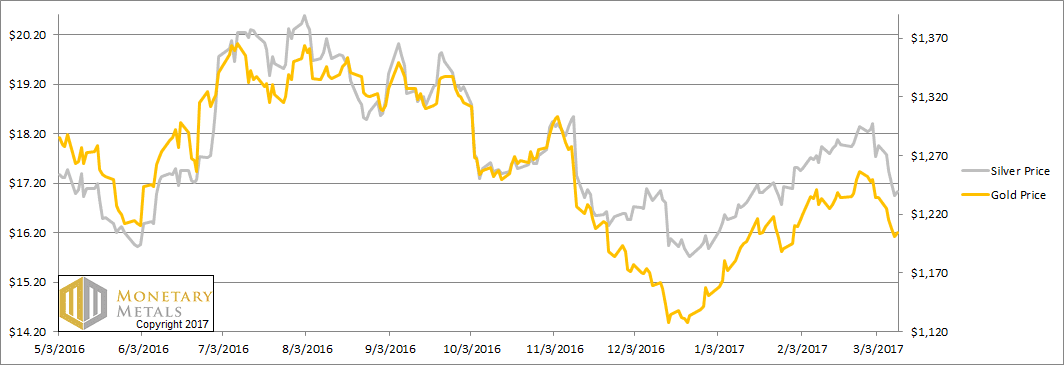
So what happened to those fundamentals? Below, we will show the only true picture of the gold and silver supply and demand. But first, the price and ratio charts.

The Prices of Gold and Silver

Next, this is a graph of the gold price measured in silver, otherwise known as the gold to silver ratio. It moved up sharply this week.  If we were chartists, we might note that the ratio seems to be making a series of higher lows since mid-July.

The Ratio of the Gold Price to the Silver Price

For each metal, we will look at a graph of the basis and cobasis overlaid with the price of the dollar in terms of the respective metal. It will make it easier to provide brief commentary. The dollar will be represented in green, the basis in blue and cobasis in red.

Here is the gold graph.

The Gold Basis and Cobasis and the Dollar Price

As the price of the dollar rose through the week, so did the cobasis. The price of the dollar is the inverse of the price of gold in dollar terms, and allows us to see a clearer picture. It is not gold going anywhere, but the dollar going up and down. The cobasis is our indicator of scarcity.

While the dollar went up 0.5mg gold, the cobasis went up 24bps. This is the old pattern, rising gold scarcity as the dollar rises. The same happened in farther contracts, to a smaller degree.

While the market price of gold fell $24, our calculated fundamental price went down only $15. It’s more than $150 over the market price.

Now let’s look at silver.

The Silver Basis and Cobasis and the Dollar Price

The cobasis in silver actually fell. It didn’t fall a lot, but this drop came in a week when the price fell substantially. This puts the lie to the allegation of manipulation. Selling of futures would push the cobasis up.

Silver fell because owners of metal decided to sell and/or buyers of physical metal slowed their purchases. We can debate why they did that, but not the meaning of the data.

Note also the much lower absolute level of the silver cobasis. Silver is -86bps compared to gold at +8bps (a slight temporary backwardation).

The silver fundamental price also fell, about half as much as the market price. It is now $1.03 over market.

This means that, while those who need to unload their silver are unhappy, those planning to load up can now exchange the same quantity of Federal Reserve Notes for more silver than last week. With (slightly) better fundamentals too, as last week the fundamental was only $0.87 over market.

The only question on that front is the trend. For two weeks, the fundamental has become weaker.

© 2017 Monetary Metals

via http://ift.tt/2mhlIyw Monetary Metals