3 Big Differences – and 1 Awful Similarity – Between Obamacare and Medicare Part D

Keith Speights at The Motley Fool outlines
3
Huge Differences Between the Medicare Part D and Obamacare
Launches
.” As most of us have been lectured by admin officials
and supporters of the president’s health plan, don’t you know that
the prescription drug plan rolled out by the Bush administration in
the mid-Aughts also had a terrible launch? And now, would you
believe it, the seniors who get nearly free drugs from Part D
love the program!

It sure did, but Speights stresses that the sheer magnitude of
the technical difficulties, the centrality of the website to the
program’s success, and the incentives for the targeted audience to
sign up are very different this time around.
Read the whole article for details
, but on that last point:

Medicare Part D launched with several incentives for seniors to
enroll: new benefits they didn’t have before, low premiums, and
subsidies for individuals with low incomes. There was even a
penalty for enrolling late — although none for declining to
enroll.

Similar incentives are also present with Obamacare. A big
difference, though, is that many individuals could find
it more
financially attractive to forgo insurance
 — especially in
the first year or two. And because the health-reform
legislation didn’t
give the IRS any real teeth
 to go after those who don’t
want to pay the penalties, the “stick” of Obamacare probably won’t
look too threatening to some Americans not enticed by the “carrot”
of health insurance.

Let me add one striking – and awful -similarity to the two
programs: They are both unnecessary and expensive. 

There’s no question that recipients of drugs under Medicare Part
D love the program.
Something like nine out of 10 seniors say so
. Why wouldn’t
they? They got $62
billion
of free and/or reduced-price drugs under the program in
2010 and that number will bounce up to $150 billion by 2019!
Billion! None of which was paid for by any sort of dedicated
revenue stream at the time of the legislation’s passage. You, me,
and our great-grandkids are the stream! No one it feels like it’s
raining!

And before anyone starts yammering on about seniors choosing
between Purina Cat Chow and a generic statin (as folks such as Al
Gore did back in
the 2000 campaign
), remember that when the plan was being
discussed, retirees paid on average a total of 3.2 percent of their
annual income on drugs. That was less than they shelled out on
entertainment.

Rather than, I don’t know, creating a
smaller, targeted plan that might cover low-income/low-wealth
seniors and other poor people regardless of age, Republicans and
Democrats came up with a sop to one of the most powerful and
wealthy voting blocs in the country. Many Democrats voted against
the prescription drug plan because it wasn’t paid for, which at
least was to their credit
at the time
. But it’s appalling spectacle to see both parties
now touting a giveaway that wasn’t necessary in the first place and
whose cost will more than double in less than a decade as some sort
of model of anything except stupidity and wastefulness in
action.

Which brings us to Obamacare, whose cost estimate for its first
full decade had doubled even before this awful Healtcare.gov
apparition appeared. As Peter Suderman
noted in 2012
, the Congressional Budget Office figures that
instead of boasting a gross operating cost of just (!) $938 billion
for its first decade, the tab for the first decade of actual
coverage is looking closer to $1.76 trillion. Who would have
thought that a government health care plan might have been more
expensive than originally claimed?
Only anyone who actually tracks what past reforms ended up
costing
.

Then there’s Obamacare’s great failure when it comes to insuring
the uninsured (let’s leave aside the question of whether insurance,
spending on health care, and actual health outcomes are clearly
related,
which they are not
). Of the 50 million folks that don’t have
insurance, Obamacare will, under its most optimistic projections
cover an additional 25 million over the next decade. And it will
leave
31 million uninsured
over the same time frame.

When it comes to universal coverage, then, Obamacare is
an-out-of-the-box failure that needs to go back into the box and
stay there. Then we might start a conversation about
what insurance is actually to supposed to do
and build a
consensus around how best to design a law that might actually work
and doesn’t just massively increase government’s power and spending
to no clear end.

15-second video, starring Barack Obama, Kathleen
Sebelius, and Mr. T: Time to bring in the A-Team? It’s
always time to bring in The A-Team.


from Hit & Run http://reason.com/blog/2013/11/04/3-big-differences-and-1-awful-similarity
via IFTTT

Google's Schmidt Blasts "Outrageous", "Illegal" Domestic NSA Spying

Google Executive Chairman Eric Schmidt is the latest to admit he is shocked, shocked, to learn there was spying going on in here. In an interview with the WSJ  “bristled” at the recent report that the U.S. government has spied on the company’s data centers, describing such an act as “outrageous” and potentially illegal if proven. Then again, since the NSA’s domestic espionage is effectively unchecked expect by a secret FISA court which approves virtually every spying request, the legality of the NSA’s activity has little relevance but merely confirms what Snowden wrote in his “manifesto”, in which he correctely noted that he has opened a long overdue debate over the meaning of civil liberties and lack thereof in the age of the authoritarian superspying big brother state.

From the WSJ:

“It’s really outrageous that the National Security Agency was looking between the Google data centers, if that’s true. The steps that the organization was willing to do without good judgment to pursue its mission and potentially violate people’s privacy, it’s not OK,” Mr. Schmidt told The Wall Street Journal in an interview on Sunday. “The Snowden revelations have assisted us in understanding that it’s perfectly possible that there are more revelations to come.”


The National Security Agency allegedly collected the phone records of every phone call of 320 million people in order to identify roughly 300 people who might be a risk. That’s just bad public policy…and perhaps illegal,” he said.

The NSA, as usual, played so dumb one would think instead of math and code breaking geniuses it employed economists:

When contacted Monday, the NSA referred to its statement last week that said recent press articles about the NSA’s collection had misstated facts and mischaracterized the NSA’s activities.


“NSA conducts all of its activities in accordance with applicable laws, regulations, and policies—and assertions to the contrary do a grave disservice to the nation, its allies and partners, and the men and women who make up the National Security Agency,” it said in a statement last week.

As for Google, while it may be disgusted, it was in no hurry to change operating practices:

Mr. Schmidt said in the interview that the right balance of security and privacy starts with finding the appropriate level of oversight.


There clearly are cases where evil people exist, but you don’t have to violate the privacy of every single citizen of America to find them,” he said.

Sadly, finding the “evil people” is the least of the NSA’s motives in a time when even the vaguest thoughts against the “greater good” have to be preemptively crushed in their embryonic stage with Kafkaesque laser guided pre-crime precision.

Full Schmidt interview below.


via Zero Hedge http://feedproxy.google.com/~r/zerohedge/feed/~3/rVRIQnB9yfY/story01.htm Tyler Durden

Google’s Schmidt Blasts “Outrageous”, “Illegal” Domestic NSA Spying

Google Executive Chairman Eric Schmidt is the latest to admit he is shocked, shocked, to learn there was spying going on in here. In an interview with the WSJ  “bristled” at the recent report that the U.S. government has spied on the company’s data centers, describing such an act as “outrageous” and potentially illegal if proven. Then again, since the NSA’s domestic espionage is effectively unchecked expect by a secret FISA court which approves virtually every spying request, the legality of the NSA’s activity has little relevance but merely confirms what Snowden wrote in his “manifesto”, in which he correctely noted that he has opened a long overdue debate over the meaning of civil liberties and lack thereof in the age of the authoritarian superspying big brother state.

From the WSJ:

“It’s really outrageous that the National Security Agency was looking between the Google data centers, if that’s true. The steps that the organization was willing to do without good judgment to pursue its mission and potentially violate people’s privacy, it’s not OK,” Mr. Schmidt told The Wall Street Journal in an interview on Sunday. “The Snowden revelations have assisted us in understanding that it’s perfectly possible that there are more revelations to come.”


The National Security Agency allegedly collected the phone records of every phone call of 320 million people in order to identify roughly 300 people who might be a risk. That’s just bad public policy…and perhaps illegal,” he said.

The NSA, as usual, played so dumb one would think instead of math and code breaking geniuses it employed economists:

When contacted Monday, the NSA referred to its statement last week that said recent press articles about the NSA’s collection had misstated facts and mischaracterized the NSA’s activities.


“NSA conducts all of its activities in accordance with applicable laws, regulations, and policies—and assertions to the contrary do a grave disservice to the nation, its allies and partners, and the men and women who make up the National Security Agency,” it said in a statement last week.

As for Google, while it may be disgusted, it was in no hurry to change operating practices:

Mr. Schmidt said in the interview that the right balance of security and privacy starts with finding the appropriate level of oversight.


There clearly are cases where evil people exist, but you don’t have to violate the privacy of every single citizen of America to find them,” he said.

Sadly, finding the “evil people” is the least of the NSA’s motives in a time when even the vaguest thoughts against the “greater good” have to be preemptively crushed in their embryonic stage with Kafkaesque laser guided pre-crime precision.

Full Schmidt interview below.


via Zero Hedge http://feedproxy.google.com/~r/zerohedge/feed/~3/rVRIQnB9yfY/story01.htm Tyler Durden

Frontrunning: November 4

  • Investors are stampeding into initial public offerings at the fastest clip since the financial crisis (WSJ)
  • Kerry hails disgruntled Saudi Arabia as important U.S. ally (Reuters)
  • SAC Capital prepares for a second life (FT)
  • BlackBerry’s Fate Goes Down to the Wire (WSJ)
  • Dutch Gamble on U.S. Housing Debt After Patience Wins (BBG)
  • Tensions with allies rise, but U.S. sees improved China ties (Reuters)
  • China berates foreign media for Tiananmen attack doubts (Reuters)
  • China manufacturers squeezed as costs rise (FT)
  • European Borders Tested as Money Is Moved to Shield Wealth (NYT)
  • Zurich Probe Finds No ‘Undue Pressure’ Put on Late CFO (BBG)
  • Johnnie Walker One Shot at a Time Boosts Diageo in Africa (BBG)
  • Obamacare Birth Control Mandate Ruled Unconstitutional (BBG)
  • NQ Mobile Sales Search Leads to Suburban Beijing Office (BBG)


Overnight Media Digest

WSJ

* BlackBerry’s future may become clearer as soon as Monday when a tentative agreement from Fairfax Financial to take the company private for $4.7 billion is scheduled to be firmed up. Other bids are possible.

* Investors are stampeding into initial public offerings at the fastest clip since the financial crisis, fueling a frenzy in the shares of newly listed companies that echoes the technology-stock craze of the late 1990s.

* SAC and federal prosecutors in Manhattan are expected to announce a record insider-trading settlement Monday. Under the deal, the firm run by Steven Cohen is expected to agree to pay about $1.2 billion in criminal penalties, plead guilty to an indictment obtained in July by prosecutors alleging the firm encouraged rampant insider trading, and stop managing outside money.

* The Obama administration ruled that drugmakers can help pay prescription-drug costs for patients on health-care exchanges. Pharmacy-benefit managers object, preferring generic drugs.

* Years of low interest rates are taking their toll on universal life insurance policies, affecting the policy holders as well as the charities and institutions that would benefit from the policies.

* Federal approval to use electronic devices throughout flights has revived a related debate over whether airline passengers should also be able to make voice calls while airborne.

* Suntech Power agreed to sell its core assets in China for $492 million to a smaller rival, attempting to pay back creditors after defaulting on billions of dollars in debt.

* Cooper Tire’s lawsuit against Apollo Tyre of India, to force it to close on a previously agreed-upon acquisition, heads to court on Tuesday.

* The Federal Trade Commission cleared the way for Office Depot Inc and OfficeMax Inc to complete their $1.2 billion merger after concluding the corporate marriage wouldn’t harm competition.

* U.S car shoppers brushed off Washington’s fiscal battles last month and, emboldened by steady gas prices, bought more trucks and sport-utility vehicles and boosted the Detroit Three auto makers over their rivals.


FT

Steve Cohen’s $15-billion hedge fund SAC Capital Advisors, currently fighting criminal insider trading charges, will plead guilty to securities fraud and pay over $1 billion in fines, a person familiar with the matter said. The announcement on the plea and fine is expected as soon as Monday, the source said.

Twitter , which is expected to list with a valuation of as much as $13.9 billion this week, is set to make a “substantial investment” after the initial public offering, to expand research and development including buying other companies for their products, technologies and staff.

The number of new jobs in London’s financial district dropped slightly in October despite renewed optimism in the financial services sector, according to specialist recruiter Astbury Marsden.

Europe’s largest banks have increased their risk exposure to sovereign debt by more than a quarter in 2011 and 2012, while reducing corporate lending as they prepare for stricter global capital rules, according to findings by Fitch Ratings.

Private equity group Blackstone will offer investors a novel security this week, backed by cash flow from more than 3,000 foreclosed homes across the United States that it bought and converted into rental properties.


NYT

* Federal subsidies will pay the entire monthly cost of some plans being offered in the online marketplaces, a surprising figure that has not gotten much attention, in part because the zero-premium plans come with serious trade-offs.

* A plea deal for SAC Capital Advisors would resolve a criminal case involving insider trading charges, but the firm’s owner, Steven Cohen, would still face a civil lawsuit.

* Hard as it may be to believe, the price per square foot for luxury apartments in New York City is considerably less than it is for luxury elsewhere in the world.

* Though three-quarters of Twitter users are outside the United States, only a modest portion of its ad revenue is generated there. But it’s growing fast.

* Backed by the billionaire Koch brothers, Americans for Prosperity has campaigned against taxes and spending in Coralville, Iowa, but some voters are skeptical of its motives.

* With the pace of delayed television viewing increasing, networks want advertisers to pay for seven days of commercial viewing to cover computer screens and tablets as well as TV sets.

* Technology giant Samsung, known for playing its cards close to the vest, is holding only its second meeting of management with analysts.

* Zola Books is trying to persuade book buyers to flock to its website, a hybrid that is designed to be a bookseller, curator and social-networking site all in one.

* A sweeping distribution deal between television giants, the Walt Disney Co and Dish Network, expired more than a month ago, and there is still no new deal in sight.


Canada

THE GLOBE AND MAIL

* Montrealers turned to a veteran federal politician with a populist touch to lead Montreal into a critical era of rebuilding, sending Denis Coderre to city hall as mayor but ensuring he faces strong opposition on city council.

* Quebec
voters are hoping to turn the page on an era of scandal-ridden leadership as they cast their ballots in municipal elections across the province on Sunday.

Reports in the business section:

* It’s decision week for BlackBerry Ltd, the battered former champion of Canada’s technology industry. Monday is the day by which Fairfax Financial Holdings Ltd is expected to finalize a deal to buy the smartphone maker for $4.7 billion.

* Canada’s jobless rate has ebbed to a five-year low, reflecting solid job creation in some sectors and – in the case of September – fewer young people looking for work.

NATIONAL POST

* Toronto Mayor Rob Ford said on Sunday that he has to ‘slow down on his drinking.’ He promised to ‘make changes in my life,’ but did not admit to drug use.

* Canadian Prime Minister Stephen Harper has been given his marching orders from a Conservative party not frightened to embrace social conservatism and a hard-core shift to the right.

FINANCIAL POST

* Despite all the challenges Canada’s oil patch has faced, it’s been a pretty good year for Canadian energy stocks – and some ‘are very cheap and very strong on earnings.’


China

CHINA SECURITIES JOURNAL

– In the first nine months of the year, 10 A-share listed Chinese companies invested a total of $1.2 billion in overseas mining projects, accounting for 36.8 percent of their aggregate investments, according to information gathered at a mining conference.

CHINA DAILY

– Police have detained 17 people in four Chinese provinces on suspicion of making and selling $3.28 million worth of counterfeit drugs and vaccines, the Ministry of Public Security said on Saturday.

– Western media, in particular those from the U.S., have employed double standards in their reporting of the Tiananmen crash on Oct. 28, said an editorial. There is no confrontation between the Chinese government and the Uighurs in the Xinjiang Uighur autonomous region, it said.

PEOPLE’S DAILY

– China’s development strategy should not be fixated only on GDP growth, said an editorial in the paper that acts as the government’s mouthpiece. Attention also needs to be paid to the by-products of growth, such as pollution and development efficiency, it said.

SHANGHAI DAILY

– Shanghai will see a 73 percent on-month increase in land supply in November, according to Soufun.com, operator of China’s largest real estate website. A site area of 818,000 square meters of land will be released for auction this month, it said.


Fly On The Wall 7:00 AM Market Snapshot

ANALYST RESEARCH

Upgrades

AK Steel (AKS) upgraded to Buy from Sell at Goldman
Abaxis (ABAX) upgraded to Neutral from Underperform at BofA/Merrill
Abercrombie & Fitch (ANF) upgraded to Buy from Neutral at SunTrust
Alcatel-Lucent (ALU) upgraded to Buy from Neutral at UBS
Alcatel-Lucent (ALU) upgraded to Neutral from Underperform at Exane BNP Paribas
BP (BP) upgraded to Equal Weight from Underweight at Morgan Stanley
BT Group (BT) upgraded to Overweight from Neutral at HSBC
Boston Beer (SAM) upgraded to Outperform from Perform at Williams Capital
Dril-Quip (DRQ) upgraded to Buy from Accumulate at Global Hunter
GrafTech (GTI) upgraded to Buy from Hold at Jefferies
Kohl’s (KSS) upgraded to Buy from Neutral at UBS
Occidental Petroleum (OXY) upgraded to Overweight from Equal Weight at Barclays
Omnicom (OMC) upgraded to Outperform from Market Perform at BMO Capital
Ruth’s Hospitality (RUTH) upgraded to Market Perform at Raymond James
STAG Industrial (STAG) upgraded to Overweight from Equal Weight at Evercore
Salesforce.com (CRM) upgraded to Overweight from Neutral at Atlantic Equities
Steel Dynamics (STLD) upgraded to Buy from Neutral at Goldman
Time Warner Cable (TWC) upgraded to Buy from Hold at Deutsche Bank
U.S. Steel (X) upgraded to Buy from Sell at Goldman

Downgrades

AXIS Capital (AXS) downgraded to Market Perform from Outperform at BMO Capital
Accuride (ACW) downgraded to Neutral from Buy at B. Riley
Aflac (AFL) downgraded to Neutral from Buy at Citigroup
AstraZeneca (AZN) downgraded to Neutral from Buy at UBS
Bridgepoint Education (BPI) downgraded to Sell from Hold at Deutsche Bank
Calpine (CPN) downgraded to Hold from Buy at Jefferies
Calumet Specialty Products (CLMT) downgraded to Sector Perform at RBC Capital
Computer Programs (CPSI) downgraded to Outperform from Strong Buy at Raymond James
Digital Realty (DLR) downgraded to Neutral from Outperform at RW Baird
Eni SpA (E) downgraded to Equal Weight from Overweight at Morgan Stanley
Gap (GPS) downgraded to Neutral from Buy at Goldman
Marathon Petroleum (MPC) downgraded to In-Line from Outperform at Imperial Capital
NetApp (NTAP) downgraded to Neutral from Overweight at Piper Jaffray
Piedmont Office Realty (PDM) downgraded to Underperform at Wells Fargo
Range Resources (RRC) downgraded to Underweight from Equal Weight at Barclays
Reliance Steel (RS) downgraded to Neutral from Buy at Goldman
Teva (TEVA) downgraded to Underweight from Neutral at JPMorgan

Initiations

Antero Resources (AR) initiated with an Overweight at Barclays
Cell Therapeutics (CTIC) initiated with a Buy at H.C. Wainwright
Evoke Pharma (EVOK) initiated with a Buy at Cantor
Gaming and Leisure Properties (GLPI) initiated with a Buy at Deutsche Bank
LDR Holding (LDRH) initiated with an Overweight at Piper Jaffray
MacroGenics (MGNX) initiated with a Neutral at BofA/Merrill
MacroGenics (MGNX) initiated with an Outperform at Leerink
QTS Realty Trust (QTS) initiated with a Buy at Goldman
QTS Realty Trust (QTS) initiated with a Buy at Jefferies
SFX Entertainment (SFXE) initiated with a Buy at UBS
Western Refining Logistics (WNRL) initiated with a Neutral at Goldman
Western Refining Logistics (WNRL) initiated with an Outperform at Credit Suisse
Western Refining Logistics (WNRL) initiated with an Outperform at Wells Fargo

HOT STOCKS

HSBC (HBC) said being investigated for foreign exchange trading
TRI Pointe Homes (TPH) to combine with WRECO (WY) in transaction valued at $2.7B
Caterpillar (CAT) disclosed probe into railroad unit from U.S. District Court for the Central District of California
Morgans Hotel (MHGC) confirmed $8.00 per share offer from Yucaipa Cos.
Honda (HMC) recalled 344,000 Odyssey vehicles for braking issue
Samsung (SSNLF) extended patent license agreement with Nokia (NOK) for five years
Hyatt Hotels (H) in deal for Hyatt-branded hotel in Iraq

EARNINGS

Companies that beat consensus earnings expectations last night and today include:
Spectra Energy (SE), Realogy (RLGY)

Companies that missed consensus earnings expectations include:
Synta Pharmaceuticals (SNTA), Zogenix (ZGNX)

NEWSPAPERS/WEBSITES

  • Investors are stampeding into IPOs at the fastest clip since the financial crisis, fueling a frenzy in the shares of newly listed companies that echoes the technology-stock craze of the late 1990s, the Wall Street Journal reports
  • BlackBerry’s (BBRY) future may become clearer as soon as today when a tentative agreement from Fairfax Financial Holdings (FRFHF) to take BlackBerry private for $4.7B is scheduled to be firmed up. Bids from any others are due then too, and it is possible the deadline could be extended, the Wall Street Journal reports
  • Anadarko Petroleum (APC) is considering the sale of its holdings in oil and gas projects in China, in a deal that could be valued at about $1B, sources say, Reuters reports
  • Chinese police investigating allegations of widespread corrupt practices at GlaxoSmithKline (GSK) are likely to charge some of its Chinese executives b
    ut not the British drugmaker itself, sources say, Reuters reports
  • Mitsubishi Corp. (MSBHY), Asia’s largest trading company by market value, is expanding into property development in Southeast Asia as the slowdown in China shrinks profits from its commodity businesses, Bloomberg reports

BARRON’S

Twitter (TWTR) looks promising at $20 IPO price, not at $30
Discover (DFS) could gain over 20% next year
Boeing (BA) could rise 30% by 2015
Covanta (CVA) could rise 40% or more
Coke (KO) a good play for low-volatility, income seeking investors
T-Mobile (TMUS) looks to ‘unseat’ Verizon (VZ), AT&T (T)

SYNDICATE

Seadrill (SDRL) files to sell 10M common units for holders
Spherix (SPEX) raises $2M in a private placement
Tetraphase (TTPH) files to sell 3.3M shares of common stock
Xinyuan Real Estate (XIN) files to sell 18.63M American Depositary Shares
Zogenix (ZGNX) files to sell $60M in common stock


via Zero Hedge http://feedproxy.google.com/~r/zerohedge/feed/~3/sBzgwbhsuVU/story01.htm Tyler Durden

Steve Chapman on Obamacare and the Limits of Coerced "Solutions"

Obamacare ExchangeWhen it was enacted in 2010, Obamacare was
supposed to be the final culmination of 60 years of effort by
Democrats to realize the dream of universal health insurance. It
was a complicated scheme, designed in such a way as to bridge the
gap among Americans of different ideologies on how to address an
alleged evil. But dreams are rarely easy to bring into reality,
especially when one person’s dream is another’s nightmare. As Steve
Chapman points out, Republicans have advocated their own costly and
burdensome programs in the past, but Obamacare has generated no
national consensus. As a result, the battle over the scheme is
unlikely to end anytime soon.

View this article.

from Hit & Run http://reason.com/blog/2013/11/04/steve-chapman-on-obamacare-and-the-limit
via IFTTT

Steve Chapman on Obamacare and the Limits of Coerced “Solutions”

Obamacare ExchangeWhen it was enacted in 2010, Obamacare was
supposed to be the final culmination of 60 years of effort by
Democrats to realize the dream of universal health insurance. It
was a complicated scheme, designed in such a way as to bridge the
gap among Americans of different ideologies on how to address an
alleged evil. But dreams are rarely easy to bring into reality,
especially when one person’s dream is another’s nightmare. As Steve
Chapman points out, Republicans have advocated their own costly and
burdensome programs in the past, but Obamacare has generated no
national consensus. As a result, the battle over the scheme is
unlikely to end anytime soon.

View this article.

from Hit & Run http://reason.com/blog/2013/11/04/steve-chapman-on-obamacare-and-the-limit
via IFTTT

Goldilocks PMIs Mean Another Overnight Meltup To Start The Week

Just as Friday ended with a last minute meltup, there continues to be nothing that can stop Bernanke’s runaway liquidity train, and the overnight trading session has been one of a continuing slow melt up in risk assets, which as expected merely ape the Fed’s balance sheet to their implied fair year end target of roughly 1900. The data in the past 48 hours was hot but not too hot, with China Non-mfg PMI rising from 55.4 to 56.3 a 14 month high (and entirely made up as all other China data) – hot but not too hot to concern the PBOC additionally over cutting additional liquidity –  while the Eurozone Mfg PMI came as expected at 51.3 up from 51.1 prior driven by rising German PMI (up from 51.1 to 51.7 on 51.5 expected), declining French PMI (from 49.8 to 49.1, exp. 49.4), declining Italian PMI (from 50.8 to 50.7, exp. 51.0), Spain up (from 50.7 to 50.9, vs 51.0 expected), and finally the UK construction PMI up from 58.9 to 59.4.

Also the all important European confidence got another reflexive boost when the Sentix Investor Confidence printed at 9.3, up from 6.1, and above the 6.3 expected.

Looking ahead, Thursday will be a busy day with the ECB (plus Draghi’s press conference) and BoE meetings. Some are expecting the ECB to cut rates as early at this week although most believe the rate cut will not happen until December. Draghi will likely deflect the exchange rate’s relevance via its  impact on inflation forecasts. This could strengthen the credibility of the forward guidance message, but this is just rhetoric — a rate cut would require a rejection of the current recovery hypothesis. They expect more focus on low inflation at this press conference, albeit without pre-empting the ECB staff new macroeconomic forecasts that will be published in December.

Elsewhere on Thursday, the advanced Q3 GDP report for the US is scheduled, which may have some bearing on market expectations for tapering. Consensus is calling for 2% QoQ ann growth. We’ll be interested in the nominal growth numbers as ever to see whether the recent global inflation downdraft continues to keep YoY US nominal GDP depressed. The first two quarters of the years have seen this number at only 3.1% – the lowest since 2010. Other data releases on Thursday include German industrial production and US initial jobless claims.


Market Re-Cap

European equities have started the week on a firmer footing as Wall Street’s positive close on Friday coupled with a 14-month high in China’s non-manufacturing PMI allowed stocks to hold opening gains. HSBC’s earnings release has been received favourably, allowing the firm’s 2.0% gain today to press the FTSE-100 to be the best performer. Switzerland’s SMI has been tempered by weakness in Credit Suisse and UBS, as the WSJ writes that Swiss politicians are mounting an effort to curb the country’s banking giants with new restrictions that could be more severe than those in place elsewhere.

In the currency markets, GBP shines once again as Construction PMI data showed the sector started Q4 on a strong note, with talk of offers at 1.5970 countering the post-data rally. The greenback has traded slightly softer, as Japan’s market holiday and key risk events later in the week keeps liquidity thin.

Today’s session brings earnings from CME Group and Anadarko Petroleum, as well as Factory Orders data for both August and September but the bulk of the session looks to be pre-setting ahead of the ECB rate decision on Thursday, followed by Nonfarm Payrolls this Friday.


Overnight News Bulletin from RanSquawk and Bloomberg :

  • European equities begin the week positively, with the FTSE-100 lifted by strong HSBC earnings.
  • Chinese Non-Manufacturing PMI hits a 14 month high, however slowing new orders temper sentiment.
  • Monday sees a quiet calendar ahead of BoE, ECB and RBA rate decisions, US GDP and Nonfarm Payrolls later this week.


Asian Headlines

Chinese Non-Manufacturing PMI (Oct) M/M 56.3 (Prev. 55.4) – highest in 14 months.
– New Orders 53.7 (Prev. 55.7)
– Construction 62.0 (Prev. 61.5)

With Japanese markets shut for Culture day, Asia-Pacific trade was muted, with China’s Non-Manufacturing PMI failing to lifted sentiment as the Shanghai Composite closed flat, with the Hang Seng Index falling 0.25% at the close.

EU & UK Headlines

Germany’s Social Democratic Party will poll its members by December 15 on whether to enter a coalition pact to form a government with Chancellor Merkel’s union parties. (Die Welt) Separately, The German finance minister Schaeuble said there is to be no ESM money for ailing banks in the Eurozone, and the opposition SPD party agreed with this decision. (Tagesspiegel)

German Manufacturing PMI (Oct) M/M 51.7 vs. Exp. 51.5 (Prev. 51.1)

French Manufacturing PMI (Oct) M/M 49.1 vs. Exp. 49.4 (Prev. 49.8)

Italian Manufacturing PMI (Oct) M/M 50.7 vs. Exp. 51.0 (Prev. 50.8)

UK Construction PMI (Sep) M/M 59.4 vs. Exp. 58.9 (Prev. 58.9) UK construction output continued to rise with housing, commercial and civil engineering activity all seeing strong rates of expansion at the start of Q4.

The UK CBI have lifted their UK growth forecasts, seeing 1.4% growth this year (1.2% previously), 2.4% in 2014 and 2.6% in 2015. (Newswires)

US Headlines

Fed’s Fisher said he does not see that Fed balance sheet rising to USD 6trl or more and does not see the purchase program going on indefinitely or getting larger. Fisher added that he doesn’t see prospects for QE expansion and that he expects low rates for a long time if inflation permits. (Newswires)

Goldman Sachs COO has said tapering is unlikely until next summer as US economy remains sluggish. (Business TImes)

Equities

Europe’s gains are led by the FTSE-100, as HSBC’s Q3 pretax rose to USD 4.53bln from USD 3.48bln, resulting in a gain for HSBC of over 2.0%. However, Swiss banks underperform, with Credit Suisse and UBS falling after the WSJ writes that Swiss politicians are mounting an effort to curb the country’s banking giants with new restrictions that could be more severe than those in place elsewhere.

The banks’ shares failed to be supported by comments from the Swiss finance ministry says no changes planned before 2015 Too Big Too Fail review.

European airliners have been under pressure from the open, prompted by Ryanair’s profit warning premarket. The company have lowered their FY profit goal to EUR 500mln from EUR 520mln, driven by weakness in the pricing environment.

FX

The EUR remains above the 1.35 figure as the USD starts the week on a negative tone. Trading has been relatively muted in the EUR/USD pair as participants sit on the sidelines ahead of the ECB’s rate decision on Thursday and the Change in Nonfarm Payrolls on Friday. A slew of bids under 1.3450, with pressure above 1.3550 looks to dictate range in the upcoming trading session. Options expiries at 1.35 and 1.3465 remain the closest to market ahead of the 10am NY cut. A firmer than expected UK Construction PMI lifted GBP/USD to test tou
ted offers at 1.5970, with Asian names said to assisting upside. Elsewhere, the AUD has been lifted by stronger than expected retail sales data from the country, as well as the Chinese services sector hitting a 14-month high rate of growth.

Commodities

Silver has extended last week’s heavy decline today, falling 0.75% ahead of COMEX trade, dragging gold lower in tandem. Support for the yellow metal is seen at the USD 1,300 handle, with the 100DMA at USD 1321.89 also helping to dictate range. In the energy complex, WTI and Brent crude futures have seen thin trade, managing to ebb into positive territory amid modest USD-weakness.

Workers from South Africa’s National Union of Mineworkers began a strike over wages at mid-tier producer Northam Platinum on Sunday evening.

China’s gold output is seen at 430 tonnes in 2013, while consumption is seen to top 1,000 tonnes according to China Gold Group.


Finally, we round off this recap as usual with Jim Reid’s view on things from the perspective of Deutsche Bank.

I’m writing this with a full blown dust allergy this morning after clearing out clothes yesterday ahead of builders demolishing our bedroom later this week. I’ve been forced to throw out clothes I haven’t seen for over a decade (including some very funky outfits!) and in the process have caused a dust storm. We’ve now got builders in for 4 months so I think I’m going to have to conveniently stop being involved in the rest of the clear out. Cats, pollen and dust set me off in long sneezing fits and stop me from being able to breathe properly so they are all my kryptonite.

The market’s kryptonite is early taper talk at the moment and this first full week of November has the potential for it to be hurled at it from all directions with no shortage of US economic data on the agenda including the all-important October payrolls report and the advanced estimate of Q3 GDP. We’ll preview more of the week ahead below, but first we’ll take a quick look at how overnight markets are trading this morning.

Risk has started the week on a softer footing led by underperformance in EM equities, fixed income and currencies. EM sentiment is being weighed by the 7bp rise in UST yields on Friday (to a two week high of 2.62%) and the recent US dollar strength. Indeed, the USD index has gained for six straight days including a sharp 0.65% gain in the USD index on Friday (largest % increase since August 1st) on the back of some hawkish-sounding comments from the Fed’s Bullard and stronger than expected ISM manufacturing data. This morning Indonesian sovereign bonds have been hit by moderate selling with bonds across the curve down by more than 1pt and Indonesian 5yr CDS gapping up by 25bp. Philippines and Malaysia CDS are quoted around 5-6bp higher as well. EM equities in Thailand (-2.5%) and Indonesia (-0.4%) are down and we’re also seeing some softness in currencies such as the Korean Won (- 0.1%), the Thai Baht (-0.3%) and the Indonesia Rupiah (-0.4%). Comments from the ever-hawkish Dallas Fed’s Fisher, who spoke in Sydney this morning, are adding to the weakness across Asian EM. Thailand is underperforming due to reports of civil unrest. While Japanese markets are closed for public holidays, other DM equity indices such as the Hang Seng (-0.1%) are faring a touch better, but are still lower on the day. Chinese A-shares (-0.1%) are outperforming on a relative basis, partly helped by the weekend’s official Chinese services PMI (56.3 vs 55.4 previous) which printed at 14 month highs. AUDUSD (+0.5%) is being supported by better than expected Australian retail sales data (0.8% vs 0.4% expected). Crude oil is steady this morning, following a sharp drop (-2.7%) on Friday.

So EM and Asia is being influenced by the re-pricing of taper risk and this week will see plenty of opportunity to further adjust the probability of when the Fed will remove stimulus. As we mentioned at the top it’s a very big week for data everywhere and also for central bank meetings and speeches. Europe will be getting the final Eurozone manufacturing PMIs today including the first October PMI readings for Spain and Italy (forecast is 51.0 for both countries).

Later today, the US gets factory orders for the months of August and September (which were delayed due to the shutdown) and there are also speeches from the Fed’s Powell and Rosengren. Speaking of the Fed, Yellen has scheduled further meetings this week with key Republican members of Congress, ahead of her formal confirmation hearing next week. Yellen is expected to meet with Senators Mike Crapo, David Vitter and Bob Corker over the next few days, who were among six Republicans on the Senate banking committee who opposed Ms Yellen’s vice-chair nomination in 2010 (Financial Times).

Tomorrow the Reserve Bank of Australia meets with the general expectation being for the bank to remain on hold. The European Commission also releases its latest economic growth forecasts. Stateside, the ISM non-manufacturing index will be important to watch out for and the Fed’s Williams and Lacker will be speaking at separate events on the same day. Moving onto Wednesday, final Eurozone services PMIs and German factory orders are the key data releases in Europe; with UK industrial production also due.

Getting to the business end of the week, Thursday will be a busy day with the ECB (plus Draghi’s press conference) and BoE meetings. DB’s Wall  and Moec expect the ECB easing bias to be reiterated but are not expecting a rate cut. Draghi will likely deflect the exchange rate’s relevance via its  impact on inflation forecasts. This could strengthen the credibility of the forward guidance message, but this is just rhetoric — a rate cut would require a rejection of the current recovery hypothesis. They expect more focus on low inflation at this press conference, albeit without pre-empting the ECB staff new macroeconomic forecasts that will be published in December. With M3, the Bank Lending Survey and issuance data pointing to tentative improvements in market sources of bank funding, they also expect the ECB to bide its time on the vLTRO decision. No change in policy is also expected from the BoE.

Elsewhere on Thursday, the advanced Q3 GDP report for the US is scheduled, which may have some bearing on market expectations for tapering. Consensus is calling for 2% QoQ ann growth while DB is at the top-end of estimates at 3%. We’ll be interested in the nominal growth numbers as ever to see whether the recent global inflation downdraft continues to keep YoY US nominal GDP depressed. The first two quarters of the years have seen this number at only 3.1% – the lowest since 2010. Other data releases on Thursday include German industrial production and US initial jobless claims.

This brings us to Friday where the highlight of the week will be the shutdowndelayed October payrolls report. Expectations for this report have generally been lowered following the recent ADP employment report. DB expects a modest +130k gain (Bloomberg consensus 125k) on the headline and for the unemployment rate to tick up 0.1ppt to 7.3% (in line with consensus). The shutdown makes this even more of a random number than normal but that won’t stop us all from eagerly anticipating it. Friday also sees the latest trade numbers for China, as well as for France, Germany and the UK. In the US, the latest UofMichigan consumer confidence survey will be of some interest to assess whether there has been a recovery in sentiment following the short-term resolution of the US budget impasse. The latest US personal income and spending data are also scheduled. Ben Bernanke and Larry Summers will be speaking at the IMF on the topic of Policy Responses to Crises. The panel will be moderated by IMF Chief Economist Blanchard. The Fed’s Williams and Lockhart will also be speaking at a separate event during the day.

Capping off a blockbuster week on the economic calendar, China’s central committee will open its Thir
d Plenum meeting of the 18th Party Congress on Saturday. Expectations are for wide ranging and aggressive reforms to be announced across a number of industrial and financial sectors. China’s latest inflation, fixed asset investment and retail sales data will also be released on Saturday.


via Zero Hedge http://feedproxy.google.com/~r/zerohedge/feed/~3/xiIB5uetOdI/story01.htm Tyler Durden

Gold Very Strong In November – Returned 4.93% On Average In Last 10 Years

Government data in the U.S. showed that the pace of business activity in the U.S. Midwest jumped in October, exceeding expectations and U.S. jobless claims declined somewhat last week.

Other real world facts regarding the very poor state of the U.S. economy are being ignored for now. One such important indicator regarding the health of the U.S. economy continues to flash red.

There are a record 47.6 million Americans, representing 23.1 million households, on food stamps today. The cost of the program will hit $63.4 billion in 2013 – less than what the Federal Reserve is printing every single month today. Yet, very tough benefit cuts to food stamp recipients kick in today. The move by Congress will siphon $5 billion from a program that helps one in seven Americans put breakfast, lunch and dinner on the table.

“If you look across the world, riots always begin typically the same way: when people cannot afford to eat food,” Margarette Purvis, the president and CEO of the Food Bank for New York said.

More ‘irrationally exuberant’ market participants are ignoring the poor fundamentals of the U.S. economy. Most market participants fear an improving economy could prompt the U.S. central bank to cut back its, very bullion friendly, money printing measures. This remains highly unlikely and far more likely is a double dip recession – potentially a very sharp one which will lead to even more quantitative easing and currency debasement.

The head of the eurozone finance ministers Jeroen Dijsselbloem said yesterday that governments need to prepare legislation for bail-ins. His important comments were not widely picked up, but they are important as they are another sign that bail-ins and deposit confiscation will be seen when banks get into difficulty. 
 

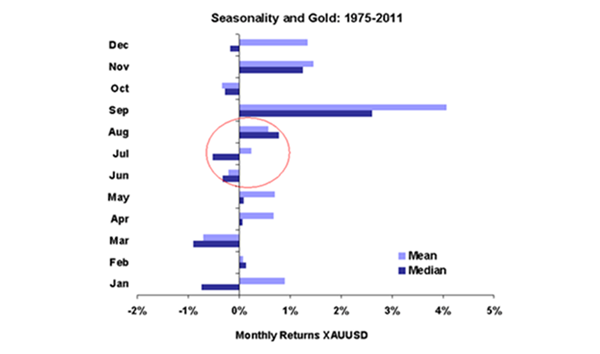
Gold Seasonal – Monthly Performance and Average (10 Years)

China bought more than 100 tonnes of gold from Hong Kong for a fifth straight month in September as demand for bullion bars and jewellery stayed strong. Chinese demand appears to have fallen marginally in recent days but remains on track to overtake India as the world’s biggest store of wealth gold buyer this year.

Other News
* Barrick Gold Corp said it would stop development of its Pascua-Lama mine in South America indefinitely, a surprise reversal on a project that has already cost the world’s largest gold producer more than $5 billion. (Reuters)

* The volume of gold transferred between accounts held by bullion clearers fell 16.3 percent in September to an average 18.5 million ounces a day, its lowest since August 2012, the London Bullion Market Association said. (Reuters)

* South Africa’s AMCU union declared a wage dispute on Thursday with platinum producer Lonmin . The union also said its members in the gold sector were voting on whether or not to strike over wages and could do so from next week. (Reuters)

* American Eagle gold coin sales climbed from 13,000 oz in September, and they fell from 59,000 oz a year earlier, according to data today on the U.S. Mint website.

  -July sales were 50,500 oz

  -In the 10 months ended today, sales rose to 752,500 oz, compared with 753,000 oz for   all of 2012

  -American Eagle silver-coin sales were 3.087m oz in Oct., up from 3.01m oz last month and 3.153m a year earlier

  -In the 10 months ended today, sales were 39.175m oz, compared with 33.743m for all of 2012. (Bloomberg)

* Dow Jones-UBS Commodity Index Boosts 2014 Weighting for Gold.

Gold will be the heaviest-weighted component next yr, making up 11.5% of the index, up from 10.8% in 2013, S&P Dow Jones Indices and UBS Investment Bank said in a statement today.
  
   -Silver 2014 weighting 4.1% vs 3.9%
   -WTI crude weighting cut to 8.5% vs 9.2%
   -Natural gas weighting cut to 9.4% vs 10.4%
   -Brent oil weighting raised to 6.5% vs 5.8%. (Bloomberg)

* World Gold Council Says Private Gold Stock Worth $1.8 Trillion

That compares with $90 trillion for debt markets, and $51 trillion for equity markets, World Gold Council says in report on website today.

   -Debt markets grew threefold from 2000 to 2012 and equities increased from $20 trillion (Bloomberg)

* Global Gold Hedge Book Was 96 Tons by June, Lowest Since 2002
Net dehedging totaled 16t in 2Q, Societe Generale SA and Thomson Reuters GFMS say in report e-mailed today.
   -Gold hedge book lowest since quarterly records began in 2002
   -“Evidence of new hedging activity subsequent to the end of Q2 has been limited so     far; producers have instead been seeking to protect margins through cost-containment measures”
   -Says dehedging may persist through the rest of this year (Bloomberg)

Gold Is Seasonally Very Strong In November, Strong In January and February

Gold is range bound between $1,250/oz and $1,450/oz. The fundamentals including the current macroeconomic, systemic, geo-political and monetary conditions are positive for gold. These fundamentals in conjunction with the strong seasonals suggest higher gold prices are likely in the coming months.

Seasonally, the months of November, December and January are positive months for gold and October is seasonally a weak month for gold. October often sees declines in the gold price followed by strong gains in November, December, January and February (see tables).

Yesterday saw the end of October trading.  November is, after September, one of the strongest months to own gold. This is seen in the charts showing gold’s monthly performance over different time frames – 1975 to 2011, 2000 to 2011 and our Bloomberg Gold Seasonality table  from 2003 to 2013 (10 years is the maximum that can be used).

November is gold’s strongest month in the last ten years and it has returned 4.93% on average since 2003. Since 1975, gold has returned nearly 1.5% on average in November.

December is a mixed month for gold in the last 10 years but since 1975, December has returned more than 1% on average. 
January and February have also been gold for gold. Gold has returned 3.14% and 1.15% on average in January and in February respectively, in the last 10 years.

Over the longer time frame, since 1975, gold also shows seasonal strength in November, December and January.  

Autumn and winter is the seasonally strong period for the precious metals. This is believed to be due to robust physical demand internationally and especially in Asia for weddings and festivals and into year end for Chinese New Year stocking up.

It may also be related to traders being aware of the seasonals and therefore contributing to price gains or price falls in certain months.

Given the bullish fundamentals and the fact that gold already looks oversold with very poor sentiment today, any further weakness is likely to be short term.

Ultra loose monetary policies are set to continue for the foreseeable future which is highly supportive of gold and should lead to new real record highs over $2,400/oz in the coming years.


Download GoldCore’s Essential Guide To Silver Eagles here

Like Our Facebook Page For Interesting Breaking News, Insights, Blogs, Prizes and Special Offers


via Zero Hedge http://feedproxy.google.com/~r/zerohedge/feed/~3/LiQxxcbaeZQ/story01.htm GoldCore

Figuring Out The Fed

Since 2008, the Federal Reserve has been trying one program after the other in order to kick-start the US economy. It culminated in currently buying around $1 trillion of bonds a year. But economic growth remains weak. Why does the Fed continue its ultra-lax monetary policy despite evidence it doesn’t help much? The people at the Fed are not stupid, so there must be a rational explanation. This is an attempt to figure out their ‘game plan’.


Via Lighthouse Investment Management’s Alex Gloy,

In a debt-based economy (like ours), GDP grows only if the overall pile of debt is growing. As long debt doesn’t grow faster than GDP, the system is stable. You may grow debt faster than GDP for a while (depending on your starting point), but eventually you reach a point where the whole thing becomes unstable. There is no magic number, but anything north of 100% debt-to-GDP probably makes you prone to mayhem. The US is at 100%.

Here’s how debt and GDP have been growing over past periods.

From 1950-2000, GDP grew slightly faster than debt, so smooth sailing. In the 13 years since the millennium, debt grew more than twice as fast than nominal GDP. And over the past six years, the fork opened even wider. It doesn’t take a genius to see the problem with the current situation.

Two elements make up nominal GDP growth: real growth (volume, green bars) and inflation (price, red bars).

For debt purposes it doesn’t matter how the growth is achieved. If real growth is insufficient, you could, theoretically, make up the difference via inflation. We would currently ‘need’ around 10% inflation. Of course, in that case, yields on 10-year bonds wouldn’t remain at under 3%. Unless the Fed declares a ‘yield cap’. It could, for example, promise to buy any bonds yielding more than 3% (they have done so in the past). But that would imply a negative real return of 7% for holders of those bonds, and the Chinese and Japanese probably wouldn’t keep their trillions of bonds in that case. The Fed would simply have to purchase all outstanding Treasury bonds. So this plan would probably not work.

So…

The Fed tries and tries. It might seem as if it ran out of tricks, but there are a few cards up the sleeve…

Full Lighthouse letter below…

Lighthouse – Letter to investors – 2013-11.pdf by Alexander Gloy


via Zero Hedge http://feedproxy.google.com/~r/zerohedge/feed/~3/oJAKOC50p48/story01.htm Tyler Durden