America Is Going To Vote by Mail. We’re Not Ready.

dreamstime_xl_181205244

On Tuesday, March 10, voters in five states went to the polls to cast primary election ballots, making former Vice President Joe Biden the Democratic Party’s all-but-certain presidential nominee in the process. It was probably the last approximately “normal” election night America will have this year.

That same day, the 1,000th positive test for COVID-19 was recorded in the United States. Over the next few days, professional and college sports leagues abruptly halted their seasons, and governors across the country were ordering schools, bars, and theaters to close, telling people to stay home whenever possible. A week later, on March 17, three other states held primaries in what was now anything but an ordinary environment. The 100th American to die of the disease passed away that night.

But on March 10, in that last moment of seeming normalcy, there was a sixth state which also had its primary votes tallied. In Washington state, more than 1.5 million people voted in the Democratic primary, and Biden squeaked out ahead by about 21,000 votes.

Nearly every vote was cast by mail.

In the middle of March, Washington conducting an election almost entirely by mail made it something of an oddity in American politics. By November, it will probably seem much more normal. The coronavirus has killed tens of thousands of Americans, ended the longest economic expansion in U.S. history, and forced us to reconsider every form of human interaction. Among them is the foundation of democratic society: voting.

Not all votes will be cast by mail or by absentee ballot in November. But the volume of what could be called “socially distanced voting” is going to be far higher than in any previous election. States, voters, media, and the election’s combatants may not be prepared for what that means.

As mail-in voting expands, it’s going to face political pressure from a president who is adamantly opposed to the practice, and logistical challenges from states attempting to build mail-in voting systems on the fly amid an already challenging environment. When Election Day finally arrives in November, it’s going to mean longer waits before all votes are counted—and possibly a longer period of uncertainty about who won—than ever before. Perhaps more worryingly, it could escalate distrust in a political system polarized to its breaking point.

President Donald Trump is already stoking fears about those uncertainties. “With Universal Mail-In Voting (not Absentee Voting, which is good), 2020 will be the most INACCURATE & FRAUDULENT Election in history. It will be a great embarrassment to the USA,” he tweeted in July. “Delay the Election until people can properly, securely and safely vote???” Republicans, however, were quick to reject Trump’s suggestion of delay. But the underlying issues remain. Like it or not, mail-in voting is coming—and we’re not ready.

“We are in times of high polarization, high distrust in elections, and we have a president who is fanning those flames,” says Richard Hasen, a professor of law and political science at the University of California, Irvine. “COVID[-19] has put incredible stresses on the election system—and would have even in the best of times, but we are not in the best of times.”

Voting by Mail Is Nothing New

The pandemic hasn’t really caused mail-in voting to pop up out of nowhere so much as it has accelerated a trend that was already occurring. In much the same way that the pandemic has sped up the already ongoing shift towards more working from home, it is likely to nudge states to encourage more people to vote from home, too.

But voting by mail is “not a newfangled idea,” says Wendy Weiser, director of the Democracy Program at the Brennan Center for Justice. “It was already deeply embedded in the American electoral system before the coronavirus hit.”

In fact, the practice dates back to at least the Civil War, when soldiers on both sides of the conflict were allowed to vote in their home states, by mail, from wherever they happened to be camped at the time. According to the Massachusetts Institute of Technology’s (MIT) Election Data and Science Lab, the first absentee voting laws for civilians were passed in the 1880s to accommodate voters who were incapacitated or away from home on Election Day. It wasn’t until the 1980s that states began to pass laws allowing residents to vote by mail without giving an excuse. Think of that approach as a de facto vote-by-mail-if-you-want-to system—a way of simply giving voters a choice about how to cast their ballots.

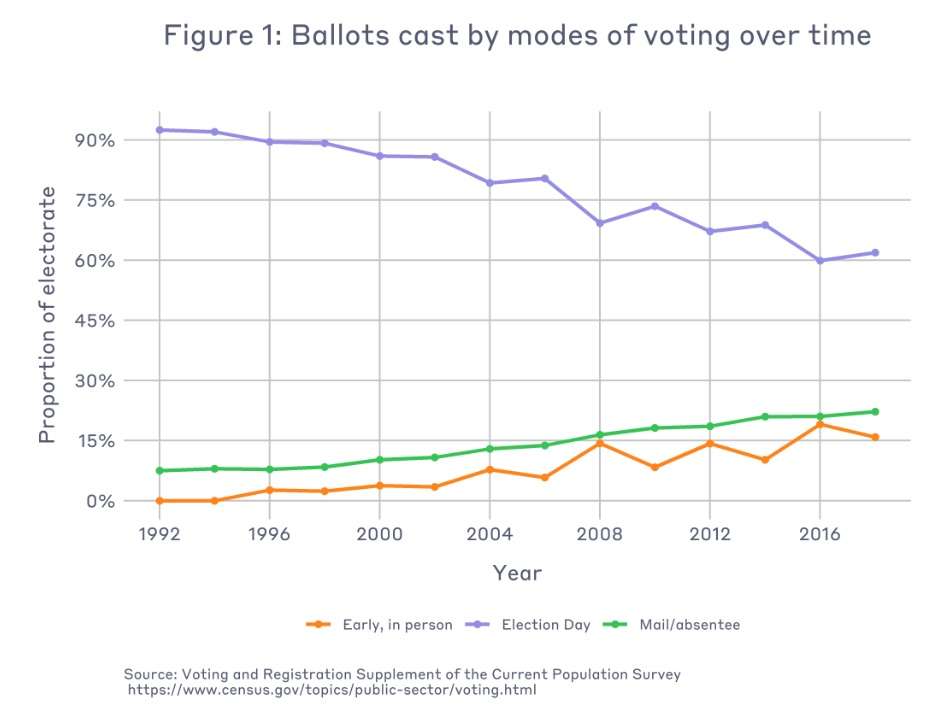
A lot of voters took that option even before the pandemic came along. In the 27 states and Washington, D.C., that had such laws on the books in 2018, more than a quarter of voters chose to vote by mail, compared to just 9 percent in the states where getting an absentee ballot requires explaining to the government why you need one, according to MIT’s data.

In a smaller set of states, the government simply mails a ballot to all residents prior to the election, no request necessary. Oregon pioneered that system, thanks to a ballot measure passed in 1998. Since then, Colorado, Hawaii, Utah, and Washington state have also moved to mail-based elections—that is, all voters receive a ballot in the mail, though they are free to vote in-person if they choose to do so instead. In California, state law allows county election offices to send ballots directly to all voters and have them returned via mail, but not all counties have made the switch. Several other places, including Arizona, Minnesota, and D.C., have policies that allow voters to request absentee ballots for all future elections, effectively letting individual voters opt into a permanent mail-in voting status.

In all, about 250 million votes have been cast by mail since 2000 according to the Vote At Home Institute, a nonprofit that advocates for expanding access to mail-in balloting. Along with the rise of in-person early voting, mail-in voting has contributed to a marked decline in the number of votes cast the traditional way: behind a curtain in your local elementary school on the first Tuesday after the first Monday in November.
“If the actions of public officials are any guide, the truth is that by-mail voting has broad bipartisan support at the state level,” writes Edward Perez, global director of technology development for the Open Source Election Technology Institute, a California-based nonprofit that advocates for the use of tech to make America’s elections more secure. “The practice is well-established, increasingly popular, reliable, and neutral in its partisan effects.”

Still, the few states that did try to hold primary elections after mid-March provided a preview of what could happen in November if most Americans have to go to the polls. In Wisconsin, the Republican-controlled state legislature blocked an attempt by Democratic Gov. Tony Evers to postpone the state’s April 7 primary. More than 50 people who voted in person or worked the polls later tested positive for COVID-19. Georgia’s June 9 primary election broke turnout records despite the pandemic, but poll workers calling in sick and polling places that had to be relocated at the last minute to accommodate social distancing requirements were blamed for long lines and confusion among voters.

A swift move toward more mail-in voting could alleviate some of those risks. Unfortunately, states aren’t only facing practical, logistical, and public health challenges as they prepare for the election; they’re up against a big political hurdle, too. And time is running out. 

Trump vs. Mail-in Ballots

“I think a lot of people cheat with mail-in voting,” Trump said in early April during one of the White House’s short-lived daily coronavirus briefings. He’d been asked about whether he thought Wisconsin should go ahead with its primary election and whether Americans should be prepared to vote by mail in November.

The president was adamant. “It shouldn’t be mail-in voting. It should be you go to a booth and you proudly display yourself. You don’t send it in the mail where people pick up—all sorts of bad things can happen by the time they sign that, if they sign that, by the time it gets in and is tabulated. No. It shouldn’t be mailed in.”

In the days and weeks that followed, Trump launched a full assault on the idea that Americans might embrace alternatives to queuing up at the polls on Election Day. More mail-in voting would produce fraud, he wrote in one particularly hyperbolic tweet on May 27, adding that “mail boxes will be robbed, ballots will be forged & even illegally printed out & fraudulently signed.”

It also might result in “levels of voting” that were disadvantageous to Republicans, he said during an appearance on Fox & Friends. 

Since then, the Republican National Committee and the Trump campaign have launched a legal effort aimed at stopping mail-in balloting in states that are trying to expand it. In August, just days after raising the possibility of delaying the election in order to prevent what he argued would be “fraudulent” results, Trump even floated the possibility of an executive order aimed at curbing mail-in voting, though he has so far provided few specifics. 

If mail-in voting is a Democratic plot to undermine Republicans’ chances at winning in 2020, that would come as news to many Republicans. When Colorado, for example, switched to providing ballots by mail in 2013, the process was overseen by Secretary of State Wayne Williams—a Republican.  

A Reuters/Ipsos poll in April found that 79 percent of Democrats and 65 percent of Republican voters favored expanding mail-in voting for the general election. But Trump’s campaign against the alternative to in-person voting may have already had an impact. A July survey from the Pew Research Center found that 65 percent of Americans believed voters should be allowed to vote by mail without giving an excuse, but Democrats (83 percent) were far more likely than Republicans (44 percent) to say so.

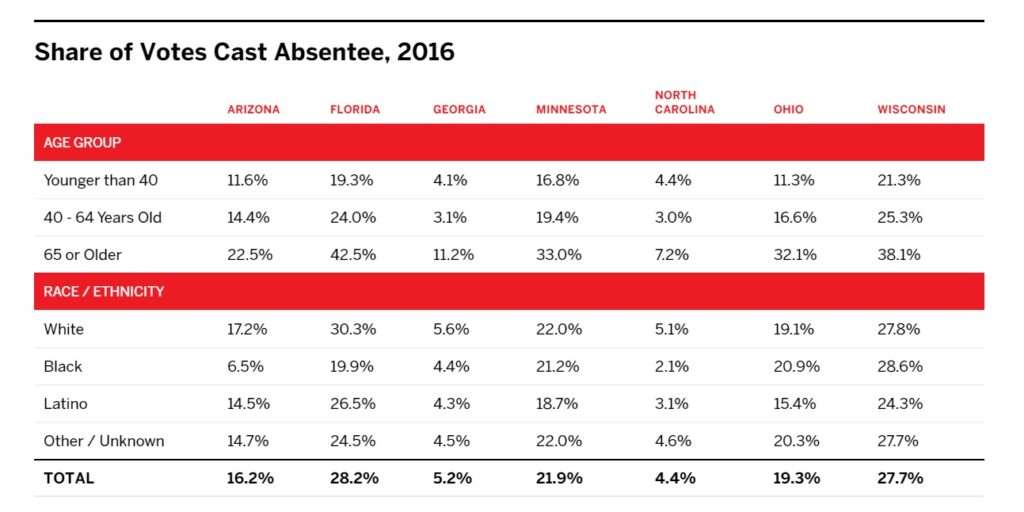
It’s true that studies have found an increase in turnout in states that have shifted to vote-by-mail policies, but absentee balloting doesn’t seem to favor either party. A Stanford University study released earlier this year that looked at absentee balloting since 1996 in California, Utah, and Washington concluded that “claims that vote by mail fundamentally advantages one party over the other appear overblown.” And a Brennan Center analysis of voting patterns in seven swing states that offered no-excuse absentee balloting in 2016 found that the people most likely to vote by mail were white voters over the age of 65—a key Trump demographic.
The idea that Republicans are disadvantaged by higher turnout is “nonsense,” says Tom Ridge, the former Republican governor of Pennsylvania and former Secretary of Homeland Security under President George W. Bush. Ridge, who now serves as chairman of the National Organization on Disability, says there is no reason for states to force voters to choose between “your health or your vote” and stresses that political parties should feel an obligation to support policies that make it easier for Americans to participate in the electoral process, regardless of whether there is a pandemic.

When it comes to the gamesmanship of politics, Ridge wonders if Trump’s repeated questioning of the legitimacy of mail-in voting could even end up hurting Republicans in the fall. If COVID-19 is raging in November, older voters that haven’t requested an absentee ballot (or who weren’t allowed to get one) might just stay home.

“Absentee voting gives neither party a political advantage, but the political party or the candidate that has a concerted, focused effort on encouraging absentee voting does have an advantage,” he says. “It seems counterintuitive and counterproductive for the president to be opposed to it when, frankly, Republicans are going to have to use it.”

Indeed, in a close election the marginal cost of Trump’s denouncements of voting by mail could haunt Republicans. As of mid-June, registered Democrats in Florida had requested roughly 300,000 more absentee ballots than registered Republicans—a gap that the state’s Democratic Party chairman attributed, in comments to Politico, to Trump’s success at tamping down Republican enthusiasm for voting by mail.

In North Carolina, the number of absentee ballot requests received by the state’s election board through July 27 was running nearly five times ahead of 2016’s pace, according to data collected by Old North State Politics, a North Carolina political blog. But while Republicans and Democrats were equally likely to request absentee ballots in 2016, 54 percent of requests this year have come from Democrats versus just 11 percent from Republicans (the rest came from registered independents).

The president’s hostility towards voting by mail—and what seems to be hardening partisan views about the process—is built atop a long-running conservative campaign against the perceived threat of voter fraud. The Heritage Foundation, a conservative think tank, maintains a Voter Fraud database containing more than 1,200 cases of voter fraud over the past four years. The list includes “impersonation fraud at the polls; false voter registrations; duplicate voting; fraudulent absentee ballots; vote buying; illegal assistance and intimidation of voters; ineligible voting, such as by aliens; altering vote counts; and ballot petition fraud.”

Clearly, then, in-person voting is no guarantee that fraud will not take place. Still, conservatives like Hans von Spakovsky, a senior legal fellow at The Heritage Foundation and head of the think tank’s election fraud initiative, worry that an increase in mail-in balloting will create more opportunities for fraud. “Mail-in ballots are completed and voted outside the supervision and control of election officials and outside the purview of election observers, destroying the transparency that is a vital hallmark of the democratic process,” he wrote in a report released on July 16 which warned that “encouraging even more mail-in voting and relaxing security protocols, such as witness or notarization requirements, is a dangerous policy.”

Widespread voter fraud would undermine the legitimacy of elections, and therefore must be taken seriously. But the evidence shows that voter fraud rates are “infinitesimally small,” says Weiser, and that’s true for mail-in balloting too. One analysis of absentee balloting from 2000 through 2012 found 491 cases of fraud—about 0.0000001 percent of all votes cast that way.

The main reason why voter fraud is so rare is that individual votes are worth very little, but the punishments for getting caught voting fraudulently are serious. That’s true for both in-person voter fraud and the mail-in variety. In Oregon, for example, mailing a fraudulent ballot can land you in prison for five years.

On top of the deterrent value of harsh penalties, the states that have adopted mail-in balloting use a variety of methods to prevent and detect fraud—and to provide voters with the assurance that their ballots are counted.

Those strategies mostly fall into three categories: technology, tracing, and transparency.

In Colorado and Oregon, unique bar codes attached to each ballot mailed ensures that voters aren’t duplicating their ballots and returning more than one. Additionally, all absentee ballots must be signed by the voter, and those signatures are compared to voter rolls—or, in some states, lists maintained by the Department of Motor Vehicles—by signature-matching software.

Tracing takes place after the election is over, and experts say it’s one of the ways mail-in balloting can be more secure than the electronic voting machines used in some states. Voting by mail leaves a literal paper trail for post-election audits to follow. In 2018, for example, a canvass of absentee ballots in North Carolina caught one of the few recorded incidents of large-scale voter fraud in recent history—orchestrated by a Republican political operative—and the election was re-run.

By comparison, the Senate Intelligence Committee’s investigation into potential Russian interference in the 2016 election found that 13 states use voting machines that don’t provide paper records for post-election checking. There’s no indication that foreign governments hacked the vote in 2016, but the lack of a paper trail means it can be harder for election officials to detect more mundane problems too. Mail-in voting solves that.

Finally, the whole process is transparent. Don’t trust the post office to deliver your ballot to the county election office? Even states that have converted to full vote-by-mail elections give voters the option of dropping off their ballots in the weeks leading up to an election. A Harvard University study of the 2016 election found that 73 percent of voters in Colorado and 59 percent in Oregon returned their ballots via those drop boxes at local election offices.

“Trump’s claims are wrong,” says Weiser. “Mail ballot fraud is incredibly rare, and legitimate security concerns can easily be addressed.”

Indeed, Trump’s worries about mail-in voting seem somewhat hypocritical: Less than two weeks before his tirade against mail-in voting in April, Trump had voted with an absentee ballot in the Florida primary. His campaign’s official Twitter account blasted out a message in mid-May encouraging Wisconsin voters to apply for absentee ballots so they could vote in a special congressional election.

Get Ready for Chaos Anyway

The bigger problem facing states as they prepare for the 2020 general election is not the president’s tweeting or the spectral fears of voter fraud. It’s that there is no time to build out the infrastructure necessary for a full-scale vote-by-mail operation like the ones in Colorado, Oregon and elsewhere.

So far, Congress has authorized $400 million in new spending to help states get prepared for what’s likely to be the weirdest election in recent history, but the Brennan Center says it will take $4 billion in additional election spending to cover the cost of ballot printing, postage, security measures like drop boxes and bar codes, and hiring additional staff to count votes. Hasen estimates that, despite spending more than $3 trillion on coronavirus aid, Congress has provided to states only about 20 percent of what would be necessary to run an election in the middle of a pandemic—meaning not only expanded absentee balloting, but also funding for things like protective equipment for poll workers.

But money can’t buy time, which is what states really need right now. “We’ve been at it for a decade. It’s not an easy lift to make that transition,” Julie Wise, the director of elections for King County, Washington, which includes Seattle, told Cascade Public Media in April.

The Vote At Home Institute provides state officials with an 18-step process for making the transition—it involves not only designing, printing, and mailing ballots, but informing voters of the changes as well as creating the necessary infrastructure to receive and count all those votes in a timely manner. And, of course, implementing measures to detect and prevent fraud.

States that have taken action in the interim have mostly moved to do away with restrictions on who can get absentee ballots. In New Hampshire, for instance, all voters will be allowed to request absentee ballots and list “COVID-19” as a valid excuse for not showing up at the polls.

 A few others, like Illinois and Massachusetts, have decided to automatically send absentee ballots to all eligible voters at their last registered address. Wisconsin will send absentee ballot request forms to all voters, and make absentee ballots available to anyone who fills out and returns the paperwork.

Expanding no-excuse absentee balloting is probably the best that many states will be able to do before November, but even that relies on overcoming political opposition. “Fear of contracting COVID-19 does not amount to a sickness or physical condition as required by state law,” Texas Attorney General Ken Paxton said in a statement last month announcing that the state would not expand access to mail-in voting. His office promised to prosecute individuals who use absentee ballots in an “improper manner.”

Even in the vast majority of states that have moved to ease restrictions on absentee balloting in light of the pandemic, a full-scale vote-by-mail system is virtually impossible to implement before November. Weiser advises that “accessible in-person voting sites” should be maintained even as counties and states try to encourage more voting from home. That’s “for those who cannot or will not vote by mail and as a fail-safe to the inevitable problems that may arise.”

Depending on the status of the pandemic in early November, that might be what most voters choose to do. Even though polls consistently show support for expanding mail-in voting, a July poll by ABC News and The Washington Post found that 59 percent of Americans would prefer to vote in person.

Problems will almost certainly arise, as they have in the past. The 2000 presidential election dragged on for weeks after Election Day as a Florida recount became fixated on questions about “hanging chads” and other unusual ballots; ultimately the outcome was decided by the state Supreme Court. Smaller ballot-counting glitches plagued this election season, even before COVID-19.

On February 3, the Iowa caucuses descended into pandemonium when a glitchy computer program made it impossible for the state Democratic Party to get accurate results from caucus sites. It took three days for the final results to be reported. That’s three days to count votes in one small state’s primary election—an election that everyone knew wasn’t going to settle anything. Two different candidates gave victory speeches—or speeches that seemed a lot like victory speeches, at least—and cable news was aflutter with speculation about what it all meant.

Now imagine if the outcome of the presidential election—or control of Congress—had been hanging in the balance. “Florida in 2000 might look like a picnic compared to this,” says Hasen.

As it happened, Hasen’s book Election Meltdown was released on the same day as this year’s Iowa caucuses. “It was good product placement,” he jokes. Timely as it might have been, that night was also a wake-up call for election officials and academics. Three weeks after the meltdown in Iowa, Hasen hosted a hastily organized conference at University of California, Irvine, with the goal of making suggestions for how states could better secure the legitimacy of the 2020 general election. In mid-April, the group released a report with 14 suggestions ranging from expanding mail-in and early voting options to informing the public about the potential delays in reporting results.

The goal of expanded voting-by-mail is not to abolish voting booths and the traditional democratic process it represents. It’s to give voters more options, allow more people to participate, and—particularly this year—to cut down on long lines and crowded polling places. Every ballot cast through the mail is one fewer person who will have to stand in line on Election Day.

The trade-off is that absentee ballots typically take days, sometimes weeks, to be counted. Georgia, New York, and other big states that relied heavily on voting-by-mail for primary elections during the late spring and early summer experienced long delays in reporting official results. It took New York more than a month to finish counting all its absentee ballots.

“The U.S. has never had to shift its system of election administration so massively and so swiftly,” wrote Nathaniel Persily, a law professor at Stanford University and co-director of the Stanford-MIT Healthy Elections project in a June op-ed for The Wall Street Journal.

He cautions that patience will be necessary. The number of absentee ballots cast in several primary elections during the spring and early summer overwhelmed local election offices and led to delays in posting official tallies. That’s likely to happen again in November. Tens of millions of ballots might remain uncounted on election night, and a “winner may not be known for days.”

Compounding the logistical problems is simple voter ineptitude. In-person voting limits common mistakes—like voting for too many candidates or failing to sign a ballot—that are more likely to happen with absentee ballots. Research by Charles Stewart, a professor of political science and founder of the MIT Election Lab, an estimated 800,000 absentee ballots were rejected in 2008 by local election authorities, mostly due to mismatched signatures or because they arrived too late. Counting absentee ballots requires reviewing them one-by-one, and even though computers help, much of the work is still done by hand (and that’s especially true in states without a true vote-by-mail infrastructure in place). 

In 12 states—including the key presidential swing states of Pennsylvania and Michigan—officials are forbidden by state law from counting absentee ballots until Election Day, even if they arrive days or weeks in advance. That means those states won’t be able to get a head start on what’s sure to be a dayslong or weekslong process. 

Mail-in balloting will make Election Day effectively last days or even weeks after voting as concluded, but it will also stretch it forward in time too. In late July, a viral meme circulating on social media advised mailing ballots back to election offices no later than October 20. It’s probably not necessary to put your vote in the mail quite that early, election officials say, but allowing enough time for delivery is important.

What it all means is that, in every regard, the mechanisms of this year’s election are going to take more time than usual.

Election Night(s) in America

Elections accomplish many different things. They are the only poll in politics that really matters, the one that signals what the public wants or what it wishes to stop. They confer legitimacy on the government’s power to tax, regulate, and police us. They make careers and end them—not just for politicians, but for everyone who helps get them elected or defeated.

But they can only accomplish those tasks if they are viewed as being more or less legitimate exercises conducted with impartial rules and producing accurate results. Every American election is a bit of a mishmash due to overlapping local, state, and federal districts and varying rules across 50 states and more than 100,000 precincts. But regardless of how exactly it works where you live, the important thing is that it does.  

This year, that patchwork of policies will be even more complex. The 2020 election has huge stakes, but it will also be a giant, and potentially messy, experiment. An increase in mail-in voting should not undermine the legitimacy of the 2020 general election. An estimated 33 million Americans voted by mail in 2016, and even if that total doubles or triples this year, it should not change how the results are viewed. But, legitimacy is in the eye of the beholder.

Patience is not a guiding principle in American politics. This year, it might have to be.

“We all need to be prepared to expect and explain a long vote count in the days and perhaps weeks following Election Day,” says Kyle Kondik, managing editor at the University of Virginia’s Center for Politics. Election Day could end up being “a mess,” he says, if polling places have to be closed at the last minute due to outbreaks and if it isn’t feasible for states to expand early voting or vote-by-mail options.

“I fear it’s going to be difficult,” he adds, “and that conspiracy-mongering will fill the void of an uncalled election.”

Hasen worries that some results might change in the days or weeks after Election Day as absentee ballots are processed and counted. That happened in 2018, when two congressional districts in southern California were ultimately won by Democrats despite the fact that Republicans had initially appeared to prevail. “There was nothing nefarious going on,” says Hasen, there were simply more Democrats who voted by absentee ballot, as allowed under California law. But, he adds, “I think we can certainly expect to see a similar pattern that is now exacerbated by the president discouraging his supporters from voting by mail.”

And if there are major results—especially in the presidential race—how will Trump respond if a flood of absentee votes tip the election days later? His recent tweets suggests he’s prepared to use the delays created by mail-in voting to raise questions about the legitimacy of the election’s outcome. “Must know Election results on the night of the Election, not days, months, or even years later!” the president tweeted on July 30. That’s a standard that would be nearly impossible to meet during normal times—even in years without Bush-Gore levels of controversy, close elections can remain uncalled for days. Federal law allows 35 days for election officials to certify results.

What should election officials do? Look at those same congressional races in California in 2018. Orange County was transparent about how many absentee ballots had been received and about how long it would take to tally them. Everyone involved knew the race wasn’t going to be settled by the end of the night, and that helped prevent the appearance of a major scandal.

“Transparency is important. Competence is obviously important,” says Hasan. “And that stuff needs to happen now. You can’t do it on the fly. The rules and procedures have to be announced now, so it doesn’t look like you’re changing things at the last minute to help one candidate or another.” 

The current level of political polarization does not inspire confidence in America’s ability to navigate a high stakes election under the best of circumstances. Barring some unexpected medical breakthrough, it seems like the 2020 general election will be conducted in far from the best of circumstances.

On August 4, the president added another twist to his weeks long campaign of griping about potential fraud and unnecessary delays associated with mail-in ballots. “Whether you call it Vote by Mail or Absentee Voting, in Florida the election system is Safe and Secure, Tried and True,” Trump tweeted. “Florida’s Voting system has been cleaned up (we defeated Democrats attempts at change), so in Florida I encourage all to request a Ballot & Vote by Mail!” At the same time, the Trump administration sued the state of Nevada over plans to mail ballots to every voter, following an accusation that the state’s governor had “made it impossible for Republicans to win the state.”

It is obviously not the role of the president to pick and choose which methods states can use to run elections—but it appears that Trump may have realized that his attempt to delegitimize mail-in balloting was backfiring.

Regardless of what Trump may between now and Election Day, voting by mail should not be subject to a partisan campaign of scare tactics designed to undermine the legitimacy of the election. The practice is already widespread, safe, and accurate.

Allowing more people to vote by mail if they choose is a good way to alleviate the public health risks presented by having an election in the middle of a pandemic. It is not, however, a guarantee of a controversy-free election. Indeed, nothing is. That’s why voters, candidates, and political junkies should be prepared for an election night that spills over into the next day, or even the following weeks.

But that’s all right—there won’t be any parties anyway.

from Latest – Reason.com https://ift.tt/3a8qXez
via IFTTT
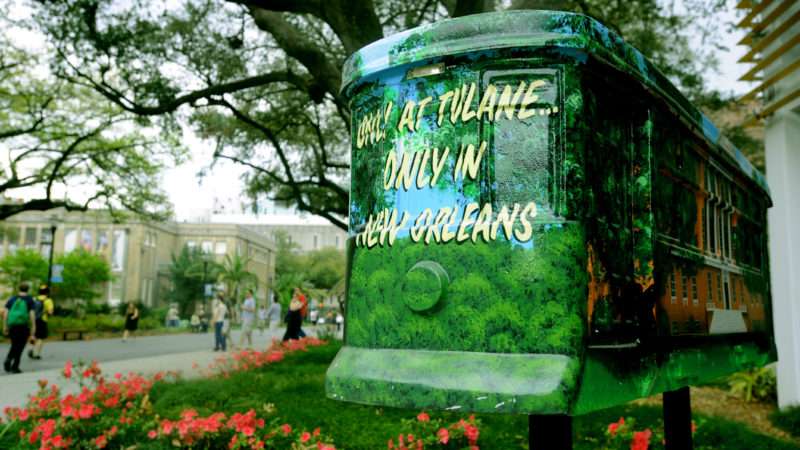
Tulane Canceled a Talk by the Author of an Acclaimed Anti-Racism Book After Students Said the Event Was ‘Violent’

Streetcar_on_campus_(5569417982)

Life of a Klansman: A Family History of White Supremacy is the latest book by Edward Ball, whose award-winning 1998 book Slaves in the Family traces the histories of people enslaved by Ball’s own ancestors. In Klansman, Ball tells the story of a racist great-grandfather who joined the Ku Klux Klan.

The New York Times hailed it as “a haunting tapestry of interwoven stories that inform us not just about our past but about the resentment-bred demons that are all too present in our society today,” and the anti-racism scholar Ibram X. Kendi participated in a virtual discussion about it with Ball. Tulane University was slated to host another such event, featuring Ball and Lydia Pelot-Hobbs, an assistant professor of geography and African American studies.

That event was supposed to take place tonight, but the university opted to postpone it following blinkered outrage from students who insisted that the event was “not only inappropriate but violent towards the experience of Black people in the Tulane community and our country.” Other members of the Tulane community called it “harmful and offensive,” and demanded its cancelation. Still others said the university should apologize and take action against whoever approved the event. (I verified that the people who made these kinds of comments were Tulane students, graduates, and employees. I chose not to name most of them in order to prevent individual harassment, though I did identify two student government officials who affixed their names to an appalling demand for censorship.)

The feedback was so unhinged that a casual observer might wonder whether they mistakenly thought the book was written by a Klansman, or endorsed the Klan. The comments on the event’s announcement page—as well as statements by student government officials—make it abundantly clear this is not the case. They know exactly what the book’s point of view is.

“The last thing we need to do is allow someone who is even reflecting on the hatred of their ancestors to speak about white supremacy, even if their efforts come from a place of accountability,” one student wrote on Instagram.

“There is nothing that a book on white supremacy written by the descendant of a Klansman can do to promote or influence an anti-racism atmosphere,” wrote another.

But this wasn’t just random students leaving comments; Tulane’s student government weighed in as well. In a letter to the administration “on behalf of the entire student body,” Undergraduate Student Government Vice President Ingeborg Hyde and Liberal Arts Student Government President Amanda Krantz demanded the event’s cancelation. And they did not mince words.

“An apology is the first step in undoing the harm you have caused many members of the community, but is in no way the last,” they wrote. “In the current political atmosphere, it is imperative that we are all actively anti-racist, and endorsing speakers like these is antithetical to the anti-racist work being done by students, faculty, and staff on our campus.”

Again, this is a book that NPR called “resonant and important.” The New Republic—currently one of the woke-est of the progressive magazines—wrote that Ball “builds a psychological portrait of white supremacy, which then radiates outward and across time, to explain the motives and historical background behind racist violence.” Yet leaders of Tulane’s student body think it is their solemn duty to prevent anyone from learning about this history.

In the face of such apoplexy, Tulane agreed to postpone the event. It has not yet been rescheduled, and given that the students are still furious, it’s unclear whether it will be. Tulane did not respond to a request for comment, nor did Ball or Pelot-Hobbs.

One Tulane graduate commented on the Instagram post about the event’s postponement that he was disappointed with this decision. An associate director in Tulane’s admissions office responded: “Go cry about it.”

This controversy has unfolded at a time of increasing public focus on racism; In July, Tulane University’s Black Student Union released a list of poorly-thought-out demands that included the enactment of a zero-tolerance policy for offensive language, as well as reparations for students who suffered emotional trauma.

It would be one thing if the students were merely demanding additional speakers of color, but their comments make clear that they do not believe someone like Ball should speak under any circumstances—and that they consider the very suggestion that he be allowed to speak (in a virtual space) an act of violence against marginalized students. They are possessed of a smug certainty that he has nothing of value to say to anyone at Tulane. This view is ridiculous and should be anathema at a university.

from Latest – Reason.com https://ift.tt/3kfAVPY
via IFTTT

‘Cancel Culture’ at U.S. Colleges Not Getting Worse, Say Liberal Professors. Conservative Colleagues Disagree.

depphotos033353

Political science professors polled on academic freedom and campus censorship. How bad is “cancel culture” in academia? Not too big of a problem, say more liberal-leaning professors in a survey analysis published by Harvard’s Pippa Norris, a professor of political science and director of the Electoral Integrity Project. Their conservative colleagues, however, disagree—at least in the U.S. and other affluent, post-industrial countries. Results skewed just the opposite in less wealthy and developed countries.

Media coverage and commentary suggest that academic freedom is diminishing, notes Norris. She wanted to know if “systematic empirical evidence” supported the narrative of “a pervasive ‘cancel culture’ taking hold of academic life in many countries.”

To find out, Norris looked at data from the World of Political Science, 2019, whose respondents included 2,446 academics in 102 countries. This included 1,245 responses “from political scientists studying or working in 23 affluent post-industrial societies (including the U.S., Europe, and Australasia).”

Norris first delved into the political identities of these professors. “Survey data confirmed the left-wing skew in the discipline of political science,” states the study, which also stressed that “the extent of the imbalance should not be exaggerated,” since most people were closer to the center than the poles.

Worldwide, a majority of political scientists surveyed—58 percent—described themselves as moderately left and 27 percent called themselves moderately right. Fourteen percent claimed the far left mantle, while just two percent called themselves far right.

Things skewed more strongly left when confined to respondents studying or working in the United States:

Two-thirds of American political scientists (65%) saw themselves as moderate left on the ideological scale, which an additional small group (15%) located themselves as far left. By contrast, overall one fifth (20%) saw themselves as moderate right, but almost no respondents saw themselves as ‘far right’.

Of course, an “ideological skew in higher education … does not necessarily imply growing intolerance for alternative values and beliefs, limiting intellectual debate and pluralism,” as Norris points out. The next phase of the study was to examine “on the basis of their personal experiences, do many political scientists feel that restrictions on academic freedom of speech, pressures for ideological conformity, and politically correct speech have worsened in recent years?”

To answer this second question, Norris constructed a “Cancel Culture Index.” Whether a respondent identified as left or right significantly and consistently “predicted scores on this index,” she found—though “the effects varied in direction by the type of society under comparison.”

In the U.S. and 23 comparable societies, “self-identified right-wing political scientists were most likely to report personal experience of a worsening cancel culture. By contrast, among those studying and working in universities and colleges in the 78 developing societies, it was the self-identified left-wing scholars who reported a worsening cancel culture.”

Read the whole paper here, or check out Norris’ highlights on Twitter.


FREE MARKETS

“Let’s not mince words: This is the Mafia’s business model,” writes Julian Sanchez, senior fellow at the Cato Institute, of Trump’s recent actions toward the app TikTok and its parent company ByteDance. More here.

Now, the Trump administration is signaling an escalation in its war on Chinese apps. Secretary of State Mike Pompeo spoke Wednesday of wanting to get not just TikTok but also “WeChat and others” off of U.S. phones.


FREE MINDS

Does “diversity training” work? New research suggests no. Tel Aviv University sociologist Alexandra Kalev—who “used to think that diversity training was effective, that it felt like common sense”—and her research team analyzed findings on diversity training programs at 800 companies over 30 years.

“The effect of bias training is very weak if you look at the long run. A company is better off doing nothing than mandatory diversity training,” Kalev told the BBC World Service program The Inquiry. Here’s how it sums up Kalev and her team’s findings:

Firstly, they found that this training normalises the message that implicit bias is everywhere and so we are all biased. “If I am interviewing black and white candidates it can be normal that I will feel more attracted or have a better gut feeling regarding the white candidates.”

They also found that people react negatively to efforts to control them, and often they perceive diversity training as such. Kalev points out that they hear from trainers that people often respond to diversity training with anger and resistance.

“So basically force-feeding anti-bias breeds more bias,” Kalev said.


COVID-19 BEHIND BARS

SCOTUS denies relief to prisoners trapped in dens of COVID-19. “The Supreme Court on Wednesday night said a California sheriff does not have to comply with a lower-court order requiring accommodations at a county jail experiencing a coronavirus outbreak,” The Washington Post reports:

The court’s vote was 5 to 4, with the court’s liberals in dissent. It follows a pattern of the court staying out of the way of local and state officials who are dealing with the pandemic, and most often Chief Justice John G. Roberts Jr. holds the controlling vote.

As is the custom in such emergency requests, the majority did not explain the reasoning for allowing Orange County Sheriff Don Barnes out from a district court judge’s order.


COVID-19 IN SCHOOLS

Several states where schools are starting to re-open for in-person classes are already seeing COVID-19 cases among students, though it’s not clear if these infections were acquired in school. “Several students in the Corinth School District in Mississippi have been infected with COVID-19 a little over a week after in-person classes resumed,” leading to more than 100 students being told to quarantine, reports CNN.

In Tennessee, where “nearly 50 school districts have started the school year as of Wednesday—the majority of them in-person,” there have been “at least 14 confirmed COVID-19 cases connected to schools.”

And at Thales Academy in Wake Forest, North Carolina, a system of eight private schools that Vice President Mike Pence applauded last week, some students and teachers are now being told to stay home after a fourth-grader came down with a case of COVID-19 (not thought to be caught at school).


PROTECTING & SERVING

Georgia makes it a hate crime to damage police property. Georgia is raising criminal penalties for people who intimidate or harm a police officer or damage any police property. “House Bill 838 creates a new crime: bias-motivated intimidation, which would apply to the death or serious bodily injury of a police officer, firefighter or emergency medical technician” as well as “any time someone causes more than $500 in damage to property owned by police, firefighters, or emergency medical technicians because of ‘actual or perceived employment as a first responder,'” reports the Associated Press. “The crime is punishable by one to five years in prison and a fine of up to $5,000. The measure says the sentence must be stacked atop any other criminal conviction and can’t be served at the same time and that each violation must be a separate crime.”


QUICK HITS

• Denying people access to basic sanitation measures… you know, for public health:

• What’s going on with New York City’s “traveler registration checkpoints“?

• Twitter, Facebook, and YouTube have all pulled a video posted by President Donald Trump or his re-election campaign. The video “includes false claims that a group of people is immune from COVID-19, which is a violation of our policies around harmful COVID misinformation,” a Facebook spokesperson said.

• A new study looks at COVID-19 transmission on commercial flights and offers some relatively reassuring statistics. Passengers “have about a 1/4300 chance of getting Covid-19 on a full 2-hour flight—that is, about 1 in 4,300 passengers will pick up the virus, on average,” Bloomberg News writes. “The odds of getting the virus are about half that, 1/7,700, if airlines leave the middle seat empty. [The author] has posted his results as a not-yet-peer-reviewed preprint.”

• New York City saw three straight days with no reported coronavirus deaths.

• COVID-19 testing is going down in the U.S. “An Associated Press analysis found that the number of tests per day slid 3.6% over the past two weeks to 750,000, with the count falling in 22 states.”

• What happens when we can’t socialize outside anymore?

• It’s time to change the way we talk about and address domestic violence, The Atlantic suggests.

• U.S. Rep. Rashida Tlaib (D-Mich.) won Tuesday’s Democratic primary election (as of yesterday morning, the race had not yet been called).

• The FBI raided YouTube star Jake Paul’s California home yesterday.

• An Ohio county prosecutor admitted in federal court to trading legal services for meth.

from Latest – Reason.com https://ift.tt/3a5qbiC
via IFTTT

‘Cancel Culture’ at U.S. Colleges Not Getting Worse, Say Liberal Professors. Conservative Colleagues Disagree.

depphotos033353

Political science professors polled on academic freedom and campus censorship. How bad is “cancel culture” in academia? Not too big of a problem, say more liberal-leaning professors in a survey analysis published by Harvard’s Pippa Norris, a professor of political science and director of the Electoral Integrity Project. Their conservative colleagues, however, disagree—at least in the U.S. and other affluent, post-industrial countries. Results skewed just the opposite in less wealthy and developed countries.

Media coverage and commentary suggest that academic freedom is diminishing, notes Norris. She wanted to know if “systematic empirical evidence” supported the narrative of “a pervasive ‘cancel culture’ taking hold of academic life in many countries.”

To find out, Norris looked at data from the World of Political Science, 2019, whose respondents included 2,446 academics in 102 countries. This included 1,245 responses “from political scientists studying or working in 23 affluent post-industrial societies (including the U.S., Europe, and Australasia).”

Norris first delved into the political identities of these professors. “Survey data confirmed the left-wing skew in the discipline of political science,” states the study, which also stressed that “the extent of the imbalance should not be exaggerated,” since most people were closer to the center than the poles.

Worldwide, a majority of political scientists surveyed—58 percent—described themselves as moderately left and 27 percent called themselves moderately right. Fourteen percent claimed the far left mantle, while just two percent called themselves far right.

Things skewed more strongly left when confined to respondents studying or working in the United States:

Two-thirds of American political scientists (65%) saw themselves as moderate left on the ideological scale, which an additional small group (15%) located themselves as far left. By contrast, overall one fifth (20%) saw themselves as moderate right, but almost no respondents saw themselves as ‘far right’.

Of course, an “ideological skew in higher education … does not necessarily imply growing intolerance for alternative values and beliefs, limiting intellectual debate and pluralism,” as Norris points out. The next phase of the study was to examine “on the basis of their personal experiences, do many political scientists feel that restrictions on academic freedom of speech, pressures for ideological conformity, and politically correct speech have worsened in recent years?”

To answer this second question, Norris constructed a “Cancel Culture Index.” Whether a respondent identified as left or right significantly and consistently “predicted scores on this index,” she found—though “the effects varied in direction by the type of society under comparison.”

In the U.S. and 23 comparable societies, “self-identified right-wing political scientists were most likely to report personal experience of a worsening cancel culture. By contrast, among those studying and working in universities and colleges in the 78 developing societies, it was the self-identified left-wing scholars who reported a worsening cancel culture.”

Read the whole paper here, or check out Norris’ highlights on Twitter.


FREE MARKETS

“Let’s not mince words: This is the Mafia’s business model,” writes Julian Sanchez, senior fellow at the Cato Institute, of Trump’s recent actions toward the app TikTok and its parent company ByteDance. More here.

Now, the Trump administration is signaling an escalation in its war on Chinese apps. Secretary of State Mike Pompeo spoke Wednesday of wanting to get not just TikTok but also “WeChat and others” off of U.S. phones.


FREE MINDS

Does “diversity training” work? New research suggests no. Tel Aviv University sociologist Alexandra Kalev—who “used to think that diversity training was effective, that it felt like common sense”—and her research team analyzed findings on diversity training programs at 800 companies over 30 years.

“The effect of bias training is very weak if you look at the long run. A company is better off doing nothing than mandatory diversity training,” Kalev told the BBC World Service program The Inquiry. Here’s how it sums up Kalev and her team’s findings:

Firstly, they found that this training normalises the message that implicit bias is everywhere and so we are all biased. “If I am interviewing black and white candidates it can be normal that I will feel more attracted or have a better gut feeling regarding the white candidates.”

They also found that people react negatively to efforts to control them, and often they perceive diversity training as such. Kalev points out that they hear from trainers that people often respond to diversity training with anger and resistance.

“So basically force-feeding anti-bias breeds more bias,” Kalev said.


COVID-19 BEHIND BARS

SCOTUS denies relief to prisoners trapped in dens of COVID-19. “The Supreme Court on Wednesday night said a California sheriff does not have to comply with a lower-court order requiring accommodations at a county jail experiencing a coronavirus outbreak,” The Washington Post reports:

The court’s vote was 5 to 4, with the court’s liberals in dissent. It follows a pattern of the court staying out of the way of local and state officials who are dealing with the pandemic, and most often Chief Justice John G. Roberts Jr. holds the controlling vote.

As is the custom in such emergency requests, the majority did not explain the reasoning for allowing Orange County Sheriff Don Barnes out from a district court judge’s order.


COVID-19 IN SCHOOLS

Several states where schools are starting to re-open for in-person classes are already seeing COVID-19 cases among students, though it’s not clear if these infections were acquired in school. “Several students in the Corinth School District in Mississippi have been infected with COVID-19 a little over a week after in-person classes resumed,” leading to more than 100 students being told to quarantine, reports CNN.

In Tennessee, where “nearly 50 school districts have started the school year as of Wednesday—the majority of them in-person,” there have been “at least 14 confirmed COVID-19 cases connected to schools.”

And at Thales Academy in Wake Forest, North Carolina, a system of eight private schools that Vice President Mike Pence applauded last week, some students and teachers are now being told to stay home after a fourth-grader came down with a case of COVID-19 (not thought to be caught at school).


PROTECTING & SERVING

Georgia makes it a hate crime to damage police property. Georgia is raising criminal penalties for people who intimidate or harm a police officer or damage any police property. “House Bill 838 creates a new crime: bias-motivated intimidation, which would apply to the death or serious bodily injury of a police officer, firefighter or emergency medical technician” as well as “any time someone causes more than $500 in damage to property owned by police, firefighters, or emergency medical technicians because of ‘actual or perceived employment as a first responder,'” reports the Associated Press. “The crime is punishable by one to five years in prison and a fine of up to $5,000. The measure says the sentence must be stacked atop any other criminal conviction and can’t be served at the same time and that each violation must be a separate crime.”


QUICK HITS

• Denying people access to basic sanitation measures… you know, for public health:

• What’s going on with New York City’s “traveler registration checkpoints“?

• Twitter, Facebook, and YouTube have all pulled a video posted by President Donald Trump or his re-election campaign. The video “includes false claims that a group of people is immune from COVID-19, which is a violation of our policies around harmful COVID misinformation,” a Facebook spokesperson said.

• A new study looks at COVID-19 transmission on commercial flights and offers some relatively reassuring statistics. Passengers “have about a 1/4300 chance of getting Covid-19 on a full 2-hour flight—that is, about 1 in 4,300 passengers will pick up the virus, on average,” Bloomberg News writes. “The odds of getting the virus are about half that, 1/7,700, if airlines leave the middle seat empty. [The author] has posted his results as a not-yet-peer-reviewed preprint.”

• New York City saw three straight days with no reported coronavirus deaths.

• COVID-19 testing is going down in the U.S. “An Associated Press analysis found that the number of tests per day slid 3.6% over the past two weeks to 750,000, with the count falling in 22 states.”

• What happens when we can’t socialize outside anymore?

• It’s time to change the way we talk about and address domestic violence, The Atlantic suggests.

• U.S. Rep. Rashida Tlaib (D-Mich.) won Tuesday’s Democratic primary election (as of yesterday morning, the race had not yet been called).

• The FBI raided YouTube star Jake Paul’s California home yesterday.

• An Ohio county prosecutor admitted in federal court to trading legal services for meth.

from Latest – Reason.com https://ift.tt/3a5qbiC
via IFTTT

Did Judge Reeves Reach the Correct Result in Jamison v. McClendon?

As many readers know, District Judge Carlton Reeves recently published a blistering opinion about the injustice of qualified immunity law in Jamison v. McClendon.  In the case, Judge Reeves argues that its facts—involving a Black driver allegedly badgered, lied to, and searched by a white police officer—shine a light on why justice demands that qualified immunity must be overturned.  The officer violated the Constitution, Judge Reeves concludes, but he cannot be held liable thanks to the “unsustainable” doctrine of qualified immunity that  in”real life . . . operates like absolute immunity.”  Judge Reeves writes: “Just as the Supreme Court swept away the mistaken doctrine of separate but equal, so too should it eliminate the doctrine of qualified immunity.”  He concludes: “Let us waste no time in righting this wrong.”

There’s a lot going on in the Jamison case, and there are many aspects of the case that are very interesting and very much worth reading.  As most readers know, there’s an ongoing national conversation about whether qualified immunity should be abolished. I gather Jamison was designed to be (and already is) part of that public conversation. That’s a hugely important debate that has often been discussed here at the blog, in particular with respect to Will Baude’s important scholarship.

As a Fourth Amendment nerd, though, I wanted to focus on a doctrinal part of the case that has not been discussed: Was Judge Reeves correct that the officer was entitled to qualified immunity under current law?

I’m skeptical.  It seems to me that that Judge Reeves likely was wrong, and that the officer was not entitled to qualified immunity.  In particular, I worry that Judge Reeves may have misunderstood the relevant Fourth Amendment doctrine.  That misunderstanding may have led Judge Reeves to treat the constitutional violation as a close call that required ruling in favor of the officer on qualified immunity grounds.  It seems to me, though, that the officer’s constitutional violation was obvious.  It therefore violated clearly established law, and the officer should not be entitled to qualified immunity.

Let me be the first to add:  Yes, I realize that, if it turns out I’m right, it doesn’t  undermine the case against qualified immunity.  Most of Judge Reeves’s opinion is addressed to a public debate about whether the Supreme Court should overturn its qualified immunity cases.  My post is on a really small scale issue: I’m only talking about how current law should apply to this one case.  And to the extent it’s relevant to some readers, I oppose qualified immunity, too,  I would like to see it overturned. (At least as long as that change wouldn’t lead to eliminating the exclusionary rule or create other systematic changes in Fourth Amendment law, which is entirely possible. But that’s a complicated question for another day. )

Nonetheless, given that this opinion is already getting a lot of attention, I thought it might be interesting to explain why I think the result in this particular case was likely incorrect.  It shouldn’t change the national debate, but it does lead me to wonder if Judge Reeves picked the wrong case to demonstrate qualified immunity’s problems.  It’s a small point, I concede, but perhaps of interest to the fellow Fourth Amendment nerds reading.

I’ll start with the facts; turn to the Fourth Amendment analysis; next turn to the qualified immunity question; and conclude with my own take.

I.  The Basic Facts

The plaintiff, Jamison, was stopped for a license plate tag violation.  The defendant, Officer McClendon, pulled him over.  Jamison is Black. McClendon is white. McClendon became suspicious that Jamison had something illegal in the car.  However, McClendon had zero actual legal suspicion to think Jamison had anything illegal in the car.  It was purely a hunch—and one, we can assume, was based in part on Jamison’s race.

Eventually, Jamison expressed consent to search the car .  An extremely thorough search of the car followed.  After almost two hours, absolutely zero evidence was found.  McClendon then allowed Jamison to leave, although Jamison’s car was damaged as a result of the search.

Jamison later sued McClendon.  The Jamison opinion is focused on the first of Jamison’s claims, brought under the Fourth Amendment. In particular, the new decision focuses on a specific part of the traffic stop.   In their depositions, Jamison and McClendon gave starkly different recollections of what happened in this part of the stop.  But because Jamison involves a motion for summary judgment filed by McClendon, we have to accept Jamison’s version of the facts as true.

According to Jamison’s deposition,  McClendon repeatedly badgered him into consenting.  McClendon pleaded with Jamison to consent five times before Jamison finally gave up and permitted the search. To pressure Jamison to consent, McClenson lied multiple times to him about a report that there were massive amounts of cocaine in the car.

And this next part is particularly important.  According to Jamison, while McClendon was trying to get Jamison’s consent, McClendon “placed his hand into the car, and patted the inside of the passenger door,” and then “moved his arm further into the car .  . while patting it with his hand.”

For what it’s worth, McClendon denies all of this happened.  His story is just that he asked Jamison for consent and Jamison simply consented.  But McClendon’s conflicting version of events is not relevant at this stage because McClendon is the moving party. Where the facts conflict, we have to accept Jamison’s version of events as true.

II.  The Intrusion Into the Car

Now let’s turn to the Fourth Amendment claim.  Just to make this super-long post more manageable, I want to focus specifically on Jamison’s claim that McClendon violated the Fourth Amendment by placing his hands inside the car and patting the inside of the passenger door.

Was that an unconstitutional search?   Judge Reeves reasons that it was.   First, it was obviously a search.  McClendon’s body physically intruded into the car.  The next question is whether it was an unreasonable search.

And here Judge Reeves makes a critical assumption.  Judge Reeves assumes that whether an officer’s physical intrusion into a car is reasonable is governed by a Fifth Circuit case, United States v. Pierre, 958 F.2d 1304, 1309 (5th Cir. 1992), that involved a border check point.

In Pierre, a border patrol agent stuck his head inside a car at a border check point to speak with a passenger about his citizenship.  Upon poking his head in the car, he smelled marijuana.  The Fifth Circuit analyzed the constitutionality of the officer sticking his head into the car using a totality of the circumstances analysis that looked to the extent of the privacy right, how much the border agent needed to see the passenger, and officer safety concerns.

Pierre in turn relied on New York v. Class, 475 U.S. 106 (1986), a case in which an officer, during a traffic stop, reached into the passenger compartment of the car to move papers that had obscured the car’s VIN. The Court subjected that search to a general reasonableness analysis, holding that the search “was sufficiently unintrusive to be constitutionally permissible in light of the lack of a reasonable expectation of privacy in the VIN and the fact that the officers observed respondent commit two traffic violations.”

In Jamison, Judge Reeves applies the totality of the circumstances inquiry from Pierre and Class to McClendon’s search into the car.  Applying the Pierre factors, Judge Reeves concludes that Officer McClendon’s search of the car was on balance unreasonable and therefore unconstitutional.

III.  The Qualified Immunity Analysis

Judge Reeves then concludes that McClendon is nonetheless entitled to qualified immunity.  Because the reasonableness of searching the car is based on a totality of the circumstances, he reasons, we need factually similar caselaw telling us how the totality of the circumstances test should apply before the violation is clear.  Here’s how Judge Reeves frames the question:

The question in this case is whether it was clearly established that an officer who has made five sequential requests for consent to search a car, lied, promised leniency, and placed his arm inside of a person’s car during a traffic stop while awaiting background check results has violated the Fourth Amendment. It is not.

It was not clearly established, Judge Reeves reasons, because there was no factually similar caselaw that could establish how the totality of the circumstances test applied.  In particular, neither Pierre nor Class clearly established that the search here was unreasonable:

While it has been clearly established since at least 1986 that an officer may be held liable for an unreasonable “intrusion into the interior of a car,” this is merely a “general statement of the law.” Clearly established law must be particularized to the facts of the case.

In Pierre, the officer could not see into the suspect’s back seat and had to put his head inside to speak to the suspect. In Class, the suspect had been removed from his car and the officer put his hand inside to move papers so that he could see the car’s VIN. Neither case considered a police officer putting his arm inside a car while trying to get the driver to consent to a search. Both cases also found the officer’s conduct to be reasonable, thus not providing “fair and clear warning” of what constitutes an unreasonable intrusion into a car.

“Given the lack of precedent that places the Constitutional question beyond debate,” Judge Reeves concludes,  “Jamison’s claim cannot proceed.”  Officer McClendon is entitled to qualified immunity.

IV.  Why I Think Judge Reeves Likely Was Mistaken

That brings me, finally, to why I think Judge Reeves was likely wrong.  By focusing on Pierre (the check point case), and Class (the VIN case), Judge Reeves concluded that the constitutionality of an officer reaching into a car must be analyzed in the Jamison case using a totality-of-the-circumstances test.  That created lots of room for qualified immunity because vague standards can’t provide the clear notice to the police of a bright-line rule. You need similar cases before the vague standard becomes clear.

But I think that framing was problematic.  Pierre and Class were specific kinds of Fourth Amendment cases that fit into a specific doctrinal box.  Pierre was a border check point case.  Class was a case about finding a VIN to check for traffic violations.  Both are examples of non-law-enforcement so-called “special needs”-type searches.  In that doctrinal box of Fourth Amendment law, the doctrine relaxes the usual probable cause requirement and instead applies a more relaxed reasonableness test given the non-law-enforcement interests (such as border inspections or traffic safety) advanced by the search.

But Jamison is not a special needs case. McClendon does not claim that he physically intruded into the car and patted the inside of the door for reasons of officer safety.  He doesn’t claim he did that to inspect Jamison’s car for safety violations.  There was no border checkpoint. McClendon’s claim, as I understand it, is just that it didn’t happen at all.  Once we accept Jamison’s claim that it did happen, as I believe we must at this stage of the case, we have a clear search (McClendon placing his hands in the car and patting down the inside of the door) that has absolutely zero legal justification and that is not subject to a general reasonableness test.

Outside the special-needs context, the Fourth Amendment law of searching a car is a clearly established bright-line rule. Because it’s a bright-line rule, the violation becomes obvious even if there is no factually identical or closely similar case.

Consider how the Fifth Circuit stated the rule, citing cases, in Emesowum v. Cruz, 756 Fed.Appx. 374 (5th Cir. 2018): “It has long been clearly established that police may not search a car for evidence absent probable cause or consent.”  There’s considerable Fifth Circuit caselaw not just establishing that rule, but also saying the rule is clearly established.  See, e.g., Mack v. City of Abilene,  461 F.3d 547 (5th Cir. 2006) (“Appellees’ search of a car in an open parking lot without a search warrant, without probable cause, without a concern for officer safety, and without consent violates clearly established law. A reasonable officer would not think the Constitution allows a random search of a vehicle where none of the above justifications apply.”).

To be sure, qualified immunity can still apply if there are fair questions about how that clearly-established rule applies. For example, imagine an officer searched a car but was just slightly short of probable cause.  Qualified immunity will apply because how the clearly established doctrine applies is tricky: the officer might reasonably believe that there was probable cause even if a court later disagrees.  But when it’s clear that the clearly established rule was violated, then qualified immunity can’t apply.

My sense, then, is that McClendon did violate clearly established law. Sticking his arm inside the car and patting down the inside of the door was obviously a search. It was governed by the rule, long recognized in the Fifth Circuit as clearly-established law, that the officer needed some justification for that search—probable cause, or a warrant, or a safety concern, or a special needs concern.  But there’s no plausible argument I am aware of that any of those justifications could apply.  To use the Fifth Circuit’s language in Mack, this was “a random search of a vehicle where none of the above justifications apply.”

V. Conclusion

For these reasons, I tend to think Judge Reeves was mistaken to confer qualified immunity on McClendon as to that particular part of the case.

As always, I have posted my best sense of things, but I may be wrong.  If you think I’m mistaken, I’d appreciate it if you could explain why so I can consider the argument and post a correction if I’ve erred.  And there are lots of other fascinating doctrinal parts of the opinion to talk about, as well as of course the underlying policy debate over whether the Supreme Court should overturn qualified immunity.

from Latest – Reason.com https://ift.tt/2Dq5Ubv
via IFTTT

Did Judge Reeves Reach the Correct Result in Jamison v. McClendon?

As many readers know, District Judge Carlton Reeves recently published a blistering opinion about the injustice of qualified immunity law in Jamison v. McClendon.  In the case, Judge Reeves argues that its facts—involving a Black driver allegedly badgered, lied to, and searched by a white police officer—shine a light on why justice demands that qualified immunity must be overturned.  The officer violated the Constitution, Judge Reeves concludes, but he cannot be held liable thanks to the “unsustainable” doctrine of qualified immunity that  in”real life . . . operates like absolute immunity.”  Judge Reeves writes: “Just as the Supreme Court swept away the mistaken doctrine of separate but equal, so too should it eliminate the doctrine of qualified immunity.”  He concludes: “Let us waste no time in righting this wrong.”

There’s a lot going on in the Jamison case, and there are many aspects of the case that are very interesting and very much worth reading.  As most readers know, there’s an ongoing national conversation about whether qualified immunity should be abolished. I gather Jamison was designed to be (and already is) part of that public conversation. That’s a hugely important debate that has often been discussed here at the blog, in particular with respect to Will Baude’s important scholarship.

As a Fourth Amendment nerd, though, I wanted to focus on a doctrinal part of the case that has not been discussed: Was Judge Reeves correct that the officer was entitled to qualified immunity under current law?

I’m skeptical.  It seems to me that that Judge Reeves likely was wrong, and that the officer was not entitled to qualified immunity.  In particular, I worry that Judge Reeves may have misunderstood the relevant Fourth Amendment doctrine.  That misunderstanding may have led Judge Reeves to treat the constitutional violation as a close call that required ruling in favor of the officer on qualified immunity grounds.  It seems to me, though, that the officer’s constitutional violation was obvious.  It therefore violated clearly established law, and the officer should not be entitled to qualified immunity.

Let me be the first to add:  Yes, I realize that, if it turns out I’m right, it doesn’t  undermine the case against qualified immunity.  Most of Judge Reeves’s opinion is addressed to a public debate about whether the Supreme Court should overturn its qualified immunity cases.  My post is on a really small scale issue: I’m only talking about how current law should apply to this one case.  And to the extent it’s relevant to some readers, I oppose qualified immunity, too,  I would like to see it overturned. (At least as long as that change wouldn’t lead to eliminating the exclusionary rule or create other systematic changes in Fourth Amendment law, which is entirely possible. But that’s a complicated question for another day. )

Nonetheless, given that this opinion is already getting a lot of attention, I thought it might be interesting to explain why I think the result in this particular case was likely incorrect.  It shouldn’t change the national debate, but it does lead me to wonder if Judge Reeves picked the wrong case to demonstrate qualified immunity’s problems.  It’s a small point, I concede, but perhaps of interest to the fellow Fourth Amendment nerds reading.

I’ll start with the facts; turn to the Fourth Amendment analysis; next turn to the qualified immunity question; and conclude with my own take.

I.  The Basic Facts

The plaintiff, Jamison, was stopped for a license plate tag violation.  The defendant, Officer McClendon, pulled him over.  Jamison is Black. McClendon is white. McClendon became suspicious that Jamison had something illegal in the car.  However, McClendon had zero actual legal suspicion to think Jamison had anything illegal in the car.  It was purely a hunch—and one, we can assume, was based in part on Jamison’s race.

Eventually, Jamison expressed consent to search the car .  An extremely thorough search of the car followed.  After almost two hours, absolutely zero evidence was found.  McClendon then allowed Jamison to leave, although Jamison’s car was damaged as a result of the search.

Jamison later sued McClendon.  The Jamison opinion is focused on the first of Jamison’s claims, brought under the Fourth Amendment. In particular, the new decision focuses on a specific part of the traffic stop.   In their depositions, Jamison and McClendon gave starkly different recollections of what happened in this part of the stop.  But because Jamison involves a motion for summary judgment filed by McClendon, we have to accept Jamison’s version of the facts as true.

According to Jamison’s deposition,  McClendon repeatedly badgered him into consenting.  McClendon pleaded with Jamison to consent five times before Jamison finally gave up and permitted the search. To pressure Jamison to consent, McClenson lied multiple times to him about a report that there were massive amounts of cocaine in the car.

And this next part is particularly important.  According to Jamison, while McClendon was trying to get Jamison’s consent, McClendon “placed his hand into the car, and patted the inside of the passenger door,” and then “moved his arm further into the car .  . while patting it with his hand.”

For what it’s worth, McClendon denies all of this happened.  His story is just that he asked Jamison for consent and Jamison simply consented.  But McClendon’s conflicting version of events is not relevant at this stage because McClendon is the moving party. Where the facts conflict, we have to accept Jamison’s version of events as true.

II.  The Intrusion Into the Car

Now let’s turn to the Fourth Amendment claim.  Just to make this super-long post more manageable, I want to focus specifically on Jamison’s claim that McClendon violated the Fourth Amendment by placing his hands inside the car and patting the inside of the passenger door.

Was that an unconstitutional search?   Judge Reeves reasons that it was.   First, it was obviously a search.  McClendon’s body physically intruded into the car.  The next question is whether it was an unreasonable search.

And here Judge Reeves makes a critical assumption.  Judge Reeves assumes that whether an officer’s physical intrusion into a car is reasonable is governed by a Fifth Circuit case, United States v. Pierre, 958 F.2d 1304, 1309 (5th Cir. 1992), that involved a border check point.

In Pierre, a border patrol agent stuck his head inside a car at a border check point to speak with a passenger about his citizenship.  Upon poking his head in the car, he smelled marijuana.  The Fifth Circuit analyzed the constitutionality of the officer sticking his head into the car using a totality of the circumstances analysis that looked to the extent of the privacy right, how much the border agent needed to see the passenger, and officer safety concerns.

Pierre in turn relied on New York v. Class, 475 U.S. 106 (1986), a case in which an officer, during a traffic stop, reached into the passenger compartment of the car to move papers that had obscured the car’s VIN. The Court subjected that search to a general reasonableness analysis, holding that the search “was sufficiently unintrusive to be constitutionally permissible in light of the lack of a reasonable expectation of privacy in the VIN and the fact that the officers observed respondent commit two traffic violations.”

In Jamison, Judge Reeves applies the totality of the circumstances inquiry from Pierre and Class to McClendon’s search into the car.  Applying the Pierre factors, Judge Reeves concludes that Officer McClendon’s search of the car was on balance unreasonable and therefore unconstitutional.

III.  The Qualified Immunity Analysis

Judge Reeves then concludes that McClendon is nonetheless entitled to qualified immunity.  Because the reasonableness of searching the car is based on a totality of the circumstances, he reasons, we need factually similar caselaw telling us how the totality of the circumstances test should apply before the violation is clear.  Here’s how Judge Reeves frames the question:

The question in this case is whether it was clearly established that an officer who has made five sequential requests for consent to search a car, lied, promised leniency, and placed his arm inside of a person’s car during a traffic stop while awaiting background check results has violated the Fourth Amendment. It is not.

It was not clearly established, Judge Reeves reasons, because there was no factually similar caselaw that could establish how the totality of the circumstances test applied.  In particular, neither Pierre nor Class clearly established that the search here was unreasonable:

While it has been clearly established since at least 1986 that an officer may be held liable for an unreasonable “intrusion into the interior of a car,” this is merely a “general statement of the law.” Clearly established law must be particularized to the facts of the case.

In Pierre, the officer could not see into the suspect’s back seat and had to put his head inside to speak to the suspect. In Class, the suspect had been removed from his car and the officer put his hand inside to move papers so that he could see the car’s VIN. Neither case considered a police officer putting his arm inside a car while trying to get the driver to consent to a search. Both cases also found the officer’s conduct to be reasonable, thus not providing “fair and clear warning” of what constitutes an unreasonable intrusion into a car.

“Given the lack of precedent that places the Constitutional question beyond debate,” Judge Reeves concludes,  “Jamison’s claim cannot proceed.”  Officer McClendon is entitled to qualified immunity.

IV.  Why I Think Judge Reeves Likely Was Mistaken

That brings me, finally, to why I think Judge Reeves was likely wrong.  By focusing on Pierre (the check point case), and Class (the VIN case), Judge Reeves concluded that the constitutionality of an officer reaching into a car must be analyzed in the Jamison case using a totality-of-the-circumstances test.  That created lots of room for qualified immunity because vague standards can’t provide the clear notice to the police of a bright-line rule. You need similar cases before the vague standard becomes clear.

But I think that framing was problematic.  Pierre and Class were specific kinds of Fourth Amendment cases that fit into a specific doctrinal box.  Pierre was a border check point case.  Class was a case about finding a VIN to check for traffic violations.  Both are examples of non-law-enforcement so-called “special needs”-type searches.  In that doctrinal box of Fourth Amendment law, the doctrine relaxes the usual probable cause requirement and instead applies a more relaxed reasonableness test given the non-law-enforcement interests (such as border inspections or traffic safety) advanced by the search.

But Jamison is not a special needs case. McClendon does not claim that he physically intruded into the car and patted the inside of the door for reasons of officer safety.  He doesn’t claim he did that to inspect Jamison’s car for safety violations.  There was no border checkpoint. McClendon’s claim, as I understand it, is just that it didn’t happen at all.  Once we accept Jamison’s claim that it did happen, as I believe we must at this stage of the case, we have a clear search (McClendon placing his hands in the car and patting down the inside of the door) that has absolutely zero legal justification and that is not subject to a general reasonableness test.

Outside the special-needs context, the Fourth Amendment law of searching a car is a clearly established bright-line rule. Because it’s a bright-line rule, the violation becomes obvious even if there is no factually identical or closely similar case.

Consider how the Fifth Circuit stated the rule, citing cases, in Emesowum v. Cruz, 756 Fed.Appx. 374 (5th Cir. 2018): “It has long been clearly established that police may not search a car for evidence absent probable cause or consent.”  There’s considerable Fifth Circuit caselaw not just establishing that rule, but also saying the rule is clearly established.  See, e.g., Mack v. City of Abilene,  461 F.3d 547 (5th Cir. 2006) (“Appellees’ search of a car in an open parking lot without a search warrant, without probable cause, without a concern for officer safety, and without consent violates clearly established law. A reasonable officer would not think the Constitution allows a random search of a vehicle where none of the above justifications apply.”).

To be sure, qualified immunity can still apply if there are fair questions about how that clearly-established rule applies. For example, imagine an officer searched a car but was just slightly short of probable cause.  Qualified immunity will apply because how the clearly established doctrine applies is tricky: the officer might reasonably believe that there was probable cause even if a court later disagrees.  But when it’s clear that the clearly established rule was violated, then qualified immunity can’t apply.

My sense, then, is that McClendon did violate clearly established law. Sticking his arm inside the car and patting down the inside of the door was obviously a search. It was governed by the rule, long recognized in the Fifth Circuit as clearly-established law, that the officer needed some justification for that search—probable cause, or a warrant, or a safety concern, or a special needs concern.  But there’s no plausible argument I am aware of that any of those justifications could apply.  To use the Fifth Circuit’s language in Mack, this was “a random search of a vehicle where none of the above justifications apply.”

V. Conclusion

For these reasons, I tend to think Judge Reeves was mistaken to confer qualified immunity on McClendon as to that particular part of the case.

As always, I have posted my best sense of things, but I may be wrong.  If you think I’m mistaken, I’d appreciate it if you could explain why so I can consider the argument and post a correction if I’ve erred.  And there are lots of other fascinating doctrinal parts of the opinion to talk about, as well as of course the underlying policy debate over whether the Supreme Court should overturn qualified immunity.

from Latest – Reason.com https://ift.tt/2Dq5Ubv
via IFTTT

Brickbat: Come at Me, Bro

SDsign_1161x653

The city of San Diego has been paying about $18,000 a day for the past three years to lease the former Sempra Energy headquarters. But asbestos issues have prevented the city from occupying the building. It has been empty for all but one month since January 2017. When a local TV station obtained documents that showed, among other things, the city did not seek an independent assessment of the building, City Attorney Mara Elliott opened a criminal investigation of how reporters got the material. The station posted to social media a copy of a letter from Elliott warning it of the investigation. Hours later, after numerous complaints from the public, the city announced it was dropping that investigation.

from Latest – Reason.com https://ift.tt/33yCX86
via IFTTT