French Sports Retailer Pulls “Running Hijab” After Public Outrage

French retailer Decathalon has quickly backpedaled on a heavily promoted “sports hijab” which allowed Muslim women to work out while still remaining in compliance with Sharia law, after the garment faced immediate pushback from outraged politicians and members of the public. 

My choice as a woman and a citizen will be to no longer trust a brand that breaks with our values,” tweeted Health Minister Agnes Buzyn. 

Photo via sbs.com.au

Decathalon initially doubled down – arguing over social media that they were offering women “a suitable sports product, without judgement.” 

Less than 24 hours later, however, the sports hijab was pulled following “many internal debates, and to guarantee the safety of our employees in France,” and a “violent controversy” surrounding the hijab 

“Our mission is to create … products at the fairest prices, anywhere in the world,” said the company. 

Islam is the second-most widely practiced religion in France after Catholicism, at around 12.5% of the population. The country has banned Muslim women from wearing veils in public, including the controversial “burkini” in coastal cities. 

France was the first European country to blatantly ban the burka and niqab in public places when, in 2011, it was made illegal for women to leave their homes wearing a face covering.

Not only are there fines for wearing the veil, but anyone who forces a woman to wear one can be fined about $43,000 or be jailed.

In 2016, coastal French towns banned the body-covering burkini swimwear — a move that was defended by the French Government.

Sisco on the island of Corsica, and the Rivera towns of Cannes and Villeneuve-Loubet implemented the ban in the aim to “protect the population” after several clashes between Muslims and non-Muslims.

However, France’s highest administrative court suspended the bans, saying they constituted a “serious and clearly illegal violation of fundamental freedoms”. –ABC.net.au

Following the 2016 truck attack in Nice, France, which killed 84 people, the city implemented its own ban on face coverings despite a higher court ruling that the ban was a “serious” violation of freedoms. Nice eventually relented and lifted the ban. 

via ZeroHedge News https://ift.tt/2Nx9aCn Tyler Durden

Brickbat: The Birds and the Bees

MidwifeIn New York, Elizabeth Catlin faces felony charges, including working as a midwife without a license. Catlin is certified professional midwife and has successfully delivered hundreds of babies over the past three decades. But New York has some of the most severe restrictions on midwives in the nation, only allowing certified nurse midwives (CNMs) and certified midwives to practice in the state. Both CNMs and certified midwives require extensive training, including graduate degrees. And CNMs tend to practice in hospitals and not do home births like Catlin does.

from Hit & Run https://ift.tt/2GOEc8l
via IFTTT

Must We Really Be Careful What We Do Lest We Offend Extremists?

Authored by Douglas Murray via The Gatestone Institute,

  • What is striking and controversial are the repeated interventions into the debate made by the government’s own ‘extremism commissioner’, Sara Khan. Over recent years Khan has been a hugely admirable figure. The founder and leader of the women’s group ‘Inspire’, Khan has shown a generation of British people – including, most importantly, young Muslim women – that it is possible to be resilient against the fanatics in their faith and also to argue for the rights of women. She has been an unarguable force for good, and has had to withstand appalling pressure from Islamist groups in the UK.

  • “It is, I think, completely misconceived to suggest that we should change our foreign policy because it might cause some people to take up arms against us. That’s a form of blackmail….” — Michael Howard, former Conservative party leader

  • In 2006 a small group of peers, MPs and Islamist groups sent an open letter to the then-Labour government. The signatories included the subsequently jailed Lord Ahmed of Rotherham, the subsequently disgraced (over expenses fraud) Baroness Uddin and the then-MP, now Mayor of London, Sadiq Khan. This letter suggested to the UK government of the day that British foreign policy “risks putting civilians at increased risk both in the UK and abroad.” This is a commonly heard argument of course, and is especially commonly heard from various extremist groups.

In the case of Shamima Begum, one of a number of girls who left London in 2015 to go and join ISIS, British politicians have — unusually — responded to the public mood. Home Secretary Sajid Javid (pictured) has announced that he is stripping Begum of her British citizenship. (Photo by Chris J Ratcliffe/Getty Images)

Britain, in recent days, has had a rare distraction from its seemingly endless Brexit debate. The distraction, however, has not been an altogether welcome one. It involves the case of Shamima Begum, one of a number of girls who left their school in Bethnal Green in London in 2015 to go and join ISIS.

Back then, in 2015, the story of the Bethnal Green schoolgirls was headline news. Many British people were genuinely shocked that anyone — let alone young women at the start of their lives — would find ISIS’s promise of a Caliphate so alluring that they would leave the comforts of their friends, family and country in the UK to go to join the group. There was much national debate about this. Various people, including some of the girls’ family members, blamed the British police and security services for not stopping the girls from leaving the UK. Ironically, the people who blamed the police — including the lawyer representing the girls’ families — were often precisely the same people as those who had spent previous years urging Muslims in Britain not to cooperate with the British police. How exactly the British police were either to blame, or to find any way to ‘win’ in such a situation, was never explained. It was just one of many paradoxes thrown up in these circumstances.

Now, members of the British media have caught up with Shamima Begum, who is living in a Syrian refugee camp. The interviews she has given, in which she has expressed no remorse for her actions and has described life in the Caliphate — which included seeing severed heads in trash cans — as not especially troubling, have not helped her in her request to return home to Britain. The general public has reacted badly to her self-pity and lack of remorse; and British politicians have — unusually — responded to the public mood. Specifically, the Home Secretary Sajid Javid has announced that he is stripping Begum of her British citizenship. It is a move which is not just unprecedented but certain to bog him down in legal action for a while to come.

What is most interesting is the debate about whether Begum should be allowed to return and whether the Home Secretary was right in this unprecedented action. It is at times such as this that we are able to measure any change in the public and political debate.

What is striking and controversial are the repeated interventions into the debate made by the government’s own ‘extremism commissioner’, Sara Khan. Over recent years, Khan has been a hugely admirable figure. The founder and leader of the women’s group ‘Inspire’, Khan has shown a generation of British people — including, most importantly, young Muslim women — that it is possible to be resilient against the fanatics in their faith and also to argue for the rights of women. She has been an unarguable force for good, and has had to withstand appalling pressure from Islamist groups in the UK.

When Khan was appointed to her present official position last year (after the three terrorist attacks in Britain in 2017) the announcement annoyed all of the right people. Only the length of time the commission had taken to be appointed and that Khan promised to spend at least a year scoping out the nature of extremism in the UK were causes for concern. If the problem was so urgent — as the Prime Minister had intimated after the London Bridge terror attack — why did it take over half a year to appoint a commissioner to look into extremism, and why would that commissioner then announce at least another year of nothing happening in order to ‘scope out’ the problem? That is almost two years lost just there.

Khan’s relative silence since then has made her repeated interventions in the Begum story especially noteworthy. In a piece in the Sunday Times as well as a subsequent comment to The Times and other media, Khan has insisted that Begum must be allowed to come back to the UK. Not only, Khan has argued, does Begum have this right, but Britain would be ‘abandoning our values’ if we did not allow her back.

This is, it must be said, an exceptionally complex and fine legal — as well as moral — issue. Decent people from all sides can disagree over what to do with someone in Begum’s case. There is one element, though, of Khan’s argument that has gone particularly unnoticed and is particularly disturbing. In her Sunday Times piece Khan argued that, “Far-right and Islamist agitators alike will use the case of Shamima to create a wedge between and within communities.” And well they might. In making this argument, however, the UK government’s extremism commissioner perhaps unwittingly demonstrates a slippage that has occurred in Britain in just over a decade.

In 2006, a small group of peers, MPs and Islamist groups sent an open letter to the then-Labour government. The signatories included the subsequently jailed Lord Ahmed of Rotherham, the subsequently disgraced (over expenses fraud) Baroness Uddin and the then-MP, now Mayor of London, Sadiq Khan. This letter suggested to the UK government of the day that British foreign policy “risks putting civilians at increased risk both in the UK and abroad.” This is a commonly heard argument of course, and is especially commonly heard from various Islamist groups. What is noteworthy about this, and what makes it worth dredging up, is not the argument but rather the response to the argument.

Back in 2006, then-Home Secretary John Reid was having none of this. He described the letter as a “dreadful misjudgement.” No competent government would remain in power, he said, if its policies were “dictated by terrorists.” The former Conservative party leader, Michael Howard, backed John Reid, saying at the time that the letter had given “ammunition” to extremists. Howard went on:

“It is, I think, completely misconceived to suggest that we should change our foreign policy because it might cause some people to take up arms against us. That’s a form of blackmail and I think that letter was completely misconceived.”

So, it is only a few years since there was agreement from across the Conservative and Labour benches that such arguments should not merely be rejected but should be ignored. Sara Khan is certainly no Islamist, or any type of sympathiser with extremism. Far from it. In recent days, nonetheless, she has shown herself willing to deploy the argument that we must be careful what we do lest we offend extremists. Thirteen years ago, this argument was dismissed by Labour and Conservative MPs alike. Today, it would most certainly be deployed by the leadership of the present Labour party — even though that view is being pushed back against by the present Conservative Home Secretary. Yet, it is a sign of a wider slippage that, in 2019, such an argument would be deployed not by an Islamist, but by the government-appointed figure whose task is to tackle extremist Islam. It is in small slips such as this that a wider societal backsliding can be discerned.

via ZeroHedge News https://ift.tt/2XsS39G Tyler Durden

Russia To Receive First Su-57 Stealth Fighter In 2019

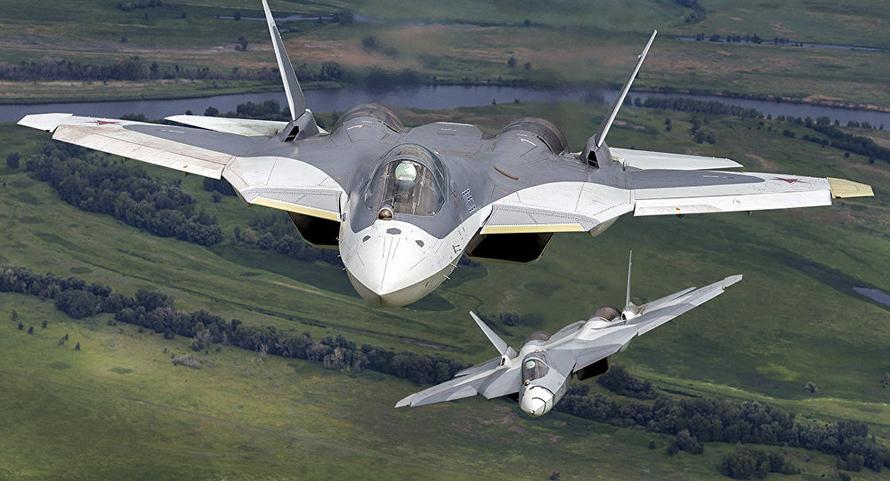
The first mass-produced Sukhoi Su-57 fifth-generation fighter jet will be delivered to Russian Aerospace Forces in 2019, Deputy CEO of the Sukhoi Aircraft Company Alexander Pekarsh said on Tuesday. The stealth jet has enormous potential to modernize the Russian military for at least the next five decades, as it has already proven its worth during combat missions in Syria.

“If we speak about the Su-57 program, we are today at the stage of manufacturing the first serial planes. In 2018, we completed the manufacture and the delivery of a batch of prototype planes that are now undergoing trials. Under the existing contract with the Defense Ministry, we have two planes in the production process, with the timeframe for the delivery of the first aircraft in 2019 and the second plane in 2020,” the Sukhoi deputy chief executive said.

“I am confident that we will cope with the task and the first serial-produced plane will be delivered this year,” he added.

Upon receiving the first Su-57 last August, the Ministry of Defence of the Russian Federation signed a contract to procure an additional 15 planes in the second half of 2019.

The plane features stealth technology with the broad use of composite materials, is capable of maintaining supersonic cruising speed and is equipped with advanced onboard radio-electronic equipment, including a powerful onboard computer, advanced radar system, and armament placed inside its fuselage. The plane can track 60 targets and open fire at 16 of them concurrently.

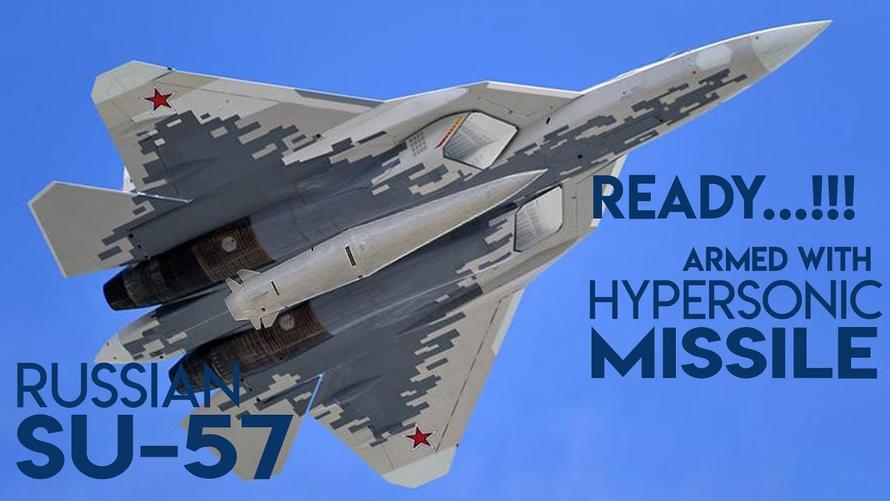
According to Russia’s Tactical Missiles Corporation, Su-57s will have the capability of air launching hypersonic missiles in the early 2020s.

With US-Russia relations deteriorating in the aftermath of the collapse of the INF nuclear arms treaty, which prompted Russia’s Vladimir Putin to slam the US for “demolishing” global security, Russian state television listed U.S. military facilities that Moscow would target in the event of a nuclear strike, in a report which Reuters said “was unusual even by its own bellicose standards” and said that a hypersonic missile Russia is developing would be able to hit them in less than five minutes.

It is entirely possible that Su-57s could air launch the hypersonic missiles and hit the Pentagon, Forth Ritchie and the presidential retreat in Camp David, Maryland. 

Currently, hypersonic missiles can penetrate American missile shields, so any surface-to-air missile system guarding these important assets would be powerless in the event of an attack. 

It is also possible that Moscow will deploy Su-57s to the Eurasia region to ensure a geopolitical power shift away from Washington to defend economic development projects currently underway.

In November 2018, the Russian Defense Ministry published footage demonstrating the combat performance of the Su-57s in Syria.

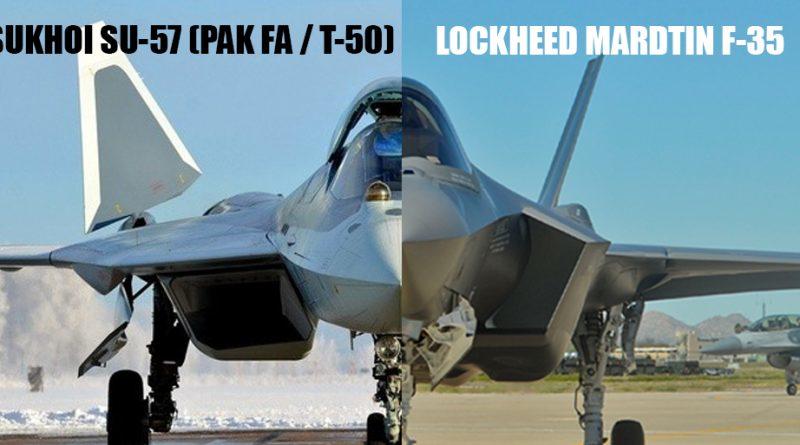
Russian lawmaker Vladimir Gutenev, a member of State Parliament’s expert panel on the aviation industry, recently told Sputnik that Su-57s would be half the cost of the American F-22 Raptor and F-35 Lightning II stealth jets. According to open sources, F-22 jets cost $146.2 million, while F-35s may cost between $83 million and $108 million.

With serial production underway, Russia is now fleeting its military with fifth-generation fighters, along with hypersonic missiles, two key weapons that will dominate the skies in the next global conflict.

via ZeroHedge News https://ift.tt/2T3lEIf Tyler Durden

The “Disintegration” Of Global Capitalism Could Unleash World War 3, Warns Top EU Economist

Authored by Nafeez Ahmed via Medium.com,

A senior European Commission economist has warned that a Third World War is an extremely “high probability” in coming years due to the disintegration of global capitalism.
In a working paper published last month, Professor Gerhard Hanappi argued that since the 2008 financial crash, the global economy has moved away from “integrated” capitalism into a “disintegrating” shift marked by the same sorts of trends which preceded previous world wars.

Professor Hanappi is Jean Monnet Chair for Political Economy of European Integration — an European Commission appointment — at the Institute for Mathematical Models in Economics at the Vienna University of Technology. He also sits on the management committee of the Systemic Risks expert groupin the EU-funded European Cooperation in Science and Technology research network.

In his new paper, Hanappi concludes that global conditions bear unnerving parallels with trends before the outbreak of the first and second world wars.

Key red flags that the world is on a slippery slope to a global war, he finds, include:

  • the inexorable growth of military spending;

  • democracies transitioning into increasingly authoritarian police states;

  • heightening geopolitical tensions between great powers;

  • the resurgence of populism across the left and right;

  • the breakdown and weakening of established global institutions that govern transnational capitalism;

  • and the relentless widening of global inequalities.

These trends, some of which were visible before the previous world wars, are reappearing in new forms. Hanappi argues that the defining feature of the current period is a transition from an older form of “integrating capitalism” to a new form of “disintegrating capitalism”, whose features most clearly emerged after the 2008 financial crisis.

For most of the twentieth century, he says, global capitalism was on an “integrating” pathway toward higher concentrations of transnational wealth. This was interrupted by the outbreaks of violent nationalism involving the two world wars. After that, a new form of “integrated capitalism” emerged based on an institutional framework that has allowed industrialised countries to avoid a world war for 70 years.

This system is now entering a period of disintegration. Previously, fractures within the system between rich and poor were overcome “by distributing a bit of the gains of the tremendous increase of the fruits of the global division of labour to the richer working classes in these nations.” Similarly, international tensions were diffused through transnational governance frameworks and agreements for the regulation of capitalism.

But since the 2008 financial crisis, wealth distribution has worsened, with purchasing power for the middle and working classes declining as wealth becomes even more greatly concentrated.

Growth in the Western centres of transnational capital has slowed, while formerly sacrosanct international trade agreements are being torn to shreds. This has fuelled a reversion to nationalism in which global and transnational structures have been rejected, and ‘foreigners’ have been demonised. As global capital thus continues to disintegrate, these pressures escalate, particularly as its internal justification depends increasingly on intensifying competition with external rivals.

While integrated capitalism depended on a transnational institutional framework that permitted “stable exploitation on a national level”, Hanappi argues that “disintegrating capitalism” sees this framework become disaggregated between the USA, Europe, Russia and China, each of which pursues new forms of hierarchical subordination of workers.

Disintegrating capitalism, he explains, will resort increasingly to “direct coercive powers supplemented by new information technologies” to suppress internal tensions, as well as a greater propensity for international hostilities: “The new authoritarian empires need confrontation with each other to justify their own internal, inflexible command structure.”

Great power conflict

Hanappi explores three potential scenarios for how a new global conflict could unfold. In his first scenario, he explores the prospect of a war between the three most prominent military powers: the US, Russia and China.

All three have experienced large increases in military spending since the collapse of the Soviet Union. Despite a dip for the US since 2011, President Trump has ushered in a new spike, while Russian spending has plateaued and Chinese expenditures are rapidly increasing. All three countries have also experienced an authoritarian turn.

Drawing on game theory, Hanappi argues that the calculus that none of these countries would be capable of ‘winning’ a world war may be changing in the perceptions of the leaderships of these countries. By one estimate, China has the highest probability of survival at 52 per cent, followed by the US at 30 per cent, and Russia at 18 per cent. This calculus suggests that of all the three powers, China might be the most inclined to escalate direct hostile military activities that challenge its rivals if it perceives a direct threat to what it sees as its legitimate interests.

The US and Russia in contrast might transfer the focus of their military activities on more covert, indirect and proxy mechanisms. In the US case, Hanappi points out:

“… the military strategy of Trump seems to include the possibility to delegate part of local operational responsibility to close vassals, which receive massive weapon support from the US, e.g. Saudi Arabia and Israel in the Middle East. Turkey, one of the strongest NATO branches in the area is a special case. It seems to have been allowed to destroy an emergent state of the Kurdish population, which would have been closer to the European style of governance.”

There are growing signs of heightened great power tensions which could erupt entirely by accident or unanticipated provocation into a global conflict that nobody wants.

The US-China trade war is escalating, while both powers tussle over technology secrets and argue over China’s growing military footprint in the South China Sea. Meanwhile Trump’s massive expansion of the US Navy and Air Force point to preparations for a major potential conflict with either China or Russsia.

Both the US and Russia have jettisoned a critical nuclear treaty established since the Cold War opening the way to a nuclear arms race. North Korea remains unrepentant about its ongoing nuclear weapons programme while Trump’s tearing up of the nuclear agreement with Iran disincentivises that country from complying with disarmament and reporting terms.

Early last year, a statistical study of the frequency of major wars in human history found that the so-called 70 years of ‘long peace’ is simply not an unusual phenomenon indicating an unprecedented period of peace. The study concluded that there was no reason to believe that the 70 year period so far would not give way to another major war.

Small wars, global contagion

Hanappi’s second scenario explores the prospect of a series of “small civil wars in many countries”. The ingredients for such a scenario are rooted in the resurgence of both right-wing and left-wing populism. “Both variants — sometimes implicitly, sometimes explicitly — refer to a past historical national state form that they propose to return to,” explains Hanappi.

While right-wing populism harks back to the authoritarian, racist regimes established in Germany and Italy in the 1930s, left-wing populism yearns to return to the model of “integrated capitalism” that was in place during the first three decades after the Second World War, and which reacted to the unequalising effects of capitalism through the ‘social net’ of the so-called ‘welfare state’ as well as various forms of state intervention in the economy alongside private industry.

But the challenge is that “integrated capitalism” is already engulfed with its own internal contradictions, propelling the shift toward disintegration.

This puts left-wing populism in a systematically weaker position, as right-wing populism can point to the multiple failures of “integrated capitalism”: the failure to “overcome class antagonisms”, and the failure to “fulfil the promise of a substantially better life for the majority of people.” According to Hanappi:

“The representatives of Integrated Capitalism are discredited and cannot act as leaders, the movement therefore is forced to experiment with new forms of national organization. More participatory forms of democratic organization take more time, and with multiple social groups involved this weakens this movements strength vis-à-vis right-wing populism. Furthermore, its vision of an improved national Integrated Capitalism is handicapped by the fact that many people still remember its failures, while the song of national glory that right-wing populism sings refers to an imagined far-away past that no one ever had seen.”

In this context, he argues, the potential exists for outbreaks of national civil war between emerging paramilitary branches of right-wing and left-wing populist movements, in the context of either movement adopting state power and coming into conflict with the opposition.

Hanappi warns of the possibility of a regional or global “contagion” effect, if these breakdowns occur within a similar time-scale. In that scenario:

“The fluid mobility of national ideological political entrepreneurs, the creators of populist movements, meets the rigidity of dire global economic constraints. This is the crash that provokes local wars.”

This scenario is also backed by statistical data. In 2016, a study by Lloyds Insurers found that since 1960 there has been an increasing frequency in “pandemics” of “political violence contagion” involving regional and transnational outbreaks of civil unrest within and among states.

The report said that social protest and dissent against government policies of militarism abroad and neoliberal austerity at home could act as potential precursors to “contagions” of violence, along with other risk factors, including “an increase in the share of internet users”, greater urban concentration, increases in infant mortality, and a growing young population.

Global insurgency of the poor

Hanappi’s third scenario parallels the Lloyds study’s finding that in coming years, the world is likely to face a series of “super strain pandemics” in the form of “anti-imperialist” and “independence movements”, “mass pro-reform protests against national government”, and “armed insurrection” or “insurgency” associated with two particular ideologies, “Marxism” and “Islamism.”

According to Hanappi, the plausibility of this scenario can be found in the “profoundly divergent trajectories of welfare of poor parts and rich parts of the world economy.”

While GDP has continued to grow overall, in the last three decades income and wealth inequalities within almost every country have widened, and look set to sharpen further. If this cycle continues, a coalescence of grievances among the poorest three billion, spurred on by the interconnectivity of communications in the smartphone era, is plausible.

Hanappi argues that in reality, global conditions make a combination of these three scenarios more likely than just one of them.

“Disintegrating capitalism is not a prediction. It already has arrived and shapes everyday life. The vanishing of integrated capitalism is not a forecast either. Disintegrating capitalism dissolves capitalism but to do so it first has to destroy integrated capitalism, its immediate predecessor.”

The distinguishing feature of disintegrating capitalism is its tendency to establish “nationalist and racist restrictions” designed to exclude “what its leaders define as an inferior minority” in order to protect capital accumulation for a parochially-defined narrow national identity. Old integrated capitalist institutions are abandoned, and new more coercive governance structures are introduced.

In this context, Hanappi concludes that a third world war will “not necessarily” take place, but carries “a frightening high probability.” To avert it, he suggests, requires the adoption of effective counter-strategies, such as a global peace movement.

Beyond disintegration: what comes next?

Hanappi’s diagnosis is insightful, but is ultimately limited due to his narrow focus on economics. Missing from his analysis is any acknowledgement of the biophysical crises driving the disintegration of global capitalism: the ecological and energy flows by which capitalist economies function — and thus the natural limits (or planetary boundaries) they are breaching.

However, his concept of “disintegrating capitalism” — bringing with it a heightened propensity for violent conflict — coheres well with a broader ecological concept of civilisational decline explored in a recent paper by American geographer Dr Stephanie Wakefield published in the peer-reviewed journal, Resilience.

Wakefield draws on the pioneering work of systems ecologist CS Holling, who argued that natural ecosystems tend to follow an “adaptive cycle” consisting of two phases, “a front loop of growth and stability and a back loop of release and reorganisation.”

She points out that while Holling’s work focused on the study of local and regional ecosystems, there remained the question of whether the idea of the “back loop” could be applied on a planetary scale to understand the dynamics of civilisational transition: “Are we in a ‘deep back loop’ that presents the same opportunities and crises as the regional back-loop studies that we have described?” he asked in 2004.

Wakefield explores the idea of the “back loop” of the Anthropocene, signalling a phase shift in which a particular order, structure and value system encompassing humanity’s relationship with the earth is experiencing a deep rupture and decline:

“The claims to human mastery over the world are being literally washed away by rising seas and unprecedentedly powerful storms, while terminal diagnoses of western civilisation proliferate as quickly as fantasies of the end.”

In this new phase, there is a parallel between the escalation of environmental crises and intensifying political disruption.

“The list of anthropogenic-induced tipping points crossed or neared grows: fisheries collapse; biodiversity loss; the melting of the ice caps and rising seas; 350 ppm and now 400 ppm CO2; anthropogenic nitrogen inputs; ocean acidification and coral reef bleaching; deforestation… But equally and together with these processes, since 2011 we are also in an era of riots, revolutions, local experiments and social movements from left to right that, to the front loop mind, may look insane, but that are very real.”

But the parallel between environmental and political disruption is no accident. Rather, it is a fundamental feature of what Wakefield calls the “Anthropocene back loop”, a phase of systemic decline which sees the old order unravelling — but which simultaneously opens up new possibilities for the emergence of a new system.

“In short one thing would seem clear: we are not in the front loop anymore,” writes Wakefield.

“If the front loop was the ‘safe operating space’ of the Anthropocene… this complex, nonlinear ‘post-truth’ world of fragmentation, fracture, dissolution, and transfiguration is what I propose we call the Anthropocene back loop.”

The front loop, then, is equivalent to the apex of Hanapper’s “integrated capitalism” that emerged after the Second World War and continued to evolve through a ‘golden age’ of neoliberal growth from the 1980s to the early 2000s.

Since then, we have increasingly witnessed the eruption of internal contradictions with this ‘front loop’ of integrated capitalism, in the form of a trajectory of disintegration which manifests the “back loop” of systemic-civilisational decline:

“The back loop is our present, the moment of the naming of the Anthropocene (as a failure), in which the past (front loop) has not disappeared, like points trailing behind on a line, but is erupting in unpredictable ways in the present.”

The phase of disintegrating capitalism, then, is part of a wider “adaptive cycle” of global capital which now finds itself on the cusp of protracted collapse. And yet, adopting this systems lens beyond econometric thinking in a deeper ecological framework allows us to see more than just the destruction of the old order at play, but within that very process, the real emergence of unprecedented possibilities for the emergence of a new ‘front loop’:

“Viewing the Anthropocene through the adaptive cycle lens, and in particular our threshold ‘now’ of scrambled grounds, discombobulated modes of knowing and being as a back loop, has a number of benefits,” suggests Wakefield. “Chief amongst these is the ability to see the Anthropocene not as a tragic End or world of ruins, but a scrambling where possibility is present and the future more open than typically imagined.”

Wakefield’s repositioning of the human condition within the framework of the ‘back loop’ opens up space to envisage this as part of a longer historical series of civilisational cycles of decline and renewal, in which the task before us is to embrace our role in activing and enhancing the possibilities for renewal.

This means moving far beyond conventional ‘front loop’ models of resilience — adapting stale, broken, extant political and economic structures to a world of intensifying crisis; into models of resilience aiming to reinvent and redesign ourselves and our structures from the ground up:

“Instead of accepting the end of human agency except that of managing crisis — and rather than imagining ourselves as victims or managers of the back loop — I argue that another possibility exists: deciding for ourselves, locally and in diverse ways, where and how to inhabit the back loop.”

Inhabiting requires more than “fighting against or living in fear” of the back loop. It requires a degree of acceptance of it, finding one’s own place in it: “to be familiar, comfortable, and involved with it… A habitual, everyday act of free creation and building.”

And that requires recognising that we are moving into fundamentally and literally unknown terrain, which can only be done by dispensing with the old “modes of thinking and acting from the fore loop.”

In the back loop, everything is up for grabs — not just old infrastructures, but also political ideologies and assumed philosophical realities. And so, to respond to the phase of disintegrating capitalism and the threat of a global war, more is required of us than old models like the idea of a ‘global peace movement’ — we need an entirely new ethos and practice committed to the ushering in of a new world:

“What the back loop suggests to us is that the Anthropocene is now a time to explore, to let go — of foundations for thinking and acting — and open ourselves to the possibilities offered to us here and now. This is an ‘unsafe’ operating space because we have passed thresholds already, but also because there are no blueprints, no transcendents, no guarantees, and no assurances: the only thing to do is become creators of new values and new answers.”

Wakefield’s work reminds us that while the dangers of a third world war are escalating in the Anthropocene back loop of disintegrating capitalism, the opportunities for renewal, reorganisation and revival are rapidly emerging.

These need to be grasped and activated whether or not war breaks out. Further, we need to work to sound the alarm, relentlessly, at all levels to raise awareness of the true nature of the phase shift we now find ourselves in as a species. Whatever ultimately emerges, the end is not nigh – rather, we stand at the unknown dawn of a new beginning.

*  *  *

Published by INSURGE INTELLIGENCE, a crowdfunded investigative journalism project for people and planet. Please support us to keep digging where others fear to tread.

via ZeroHedge News https://ift.tt/2ToVUoI Tyler Durden

Russia Slides Towards Internal Political Crisis

Submitted by SouthFront,

The Russia of 2019 is in a complicated economic and even political situation. Smoldering conflicts near its borders amid continued pressure from the US and NATO affect the situation in the country negatively. This is manifested in society and in national politics. The approval rating of the Russian government and personally of President Vladimir Putin has been decreasing.

According to VCIOM, a state pollster, in January 2019, Putin’s confidence rating was only 32.8%. This is 24% less than in January 2018 when it was 57.2%. At the same time, the confidence rating of Prime Minister Dmitry Medvedev was 7.8%. The approval rating of his cabinet is 37.7% while the disapproval rating is 38.7%. Opposition sources show data, which is far worse for the current Russian leadership.

This tendency is not linked to the foreign policy course of the Kremlin. Rather, it’s the result of the recent series of liberal-minded economic reforms, which look similar to the approaches exercised by the Russian government in the mid-1990s. The decision to increase Value Added Tax amid the slowing Russian economy, especially in the industrial sector, and a very unpopular pension reform increasing the retirement age were both factors contributing to the further growth of discontent in the population.

Russia’s GDP increased by 2.3% in 2018 compared to 1.6% in 2017. However, the Ministry of Economic Development, in its document entitled “Economic Picture” stated that this is linked to “one-time factors” and is not “stable”. The ministry maintained its earlier forecast stating that GDP growth in 2019 will be 1.3%. It confirmed increasing capital outflow. In this case, the repayment of funds to Western creditors by the Russian private sector is one of the causes.

The Ministry of Economic Development also pointed out that the expendable income of the population decreased by 0.2%. Statutory charges, including the increased taxes, are named as one of the reasons. The document says that statutory charges grew by 14.8% in 2018.

Additionally, the population is facing an increasingly restrictive administrative pressure: new fines and other penalties for minor violations in various fields and additional administrative restrictions limiting the freedom of actions of citizens. Restrictive traffic management of big cities, increasing fees for using federal highways as well as policies that are de-facto aimed at small business and self-employed persons are among its landmarks.

Meanwhile the general population has no effective levers of pressure to affect or correct government policy. The public political sphere has become a desert. United Russia (Edinaya Rossiya) is the only political party still de—facto existing in public politics. By now its ideological and organizational capabilities have become exhausted. Other “political parties and organizations” are just media constructs designed to defend the interests of a narrow group of their sponsors. It is hard to find a lawmaker in the State Duma or the Federation Council, who is not affiliated with the cliquish top political elite and oligarch clans.

In the media sphere, the government has failed to explain its current course to the population. A vast majority of the initiatives of Medvedev’s cabinet face a negative reaction from the population. A spate of scandals involving high and middle level government officials made the situation even worse. These cases revealed blatant hypocrisy and the neglectful attitude to duties of some Russian officials.

Some of the officials even became heroes of nationwide memes. Probably, the most prominent of these heroes are Minister of Labour and Employment of the Saratov region Natalia Sokolova and Head of Department for Youth Policy in the Sverdlov Region Olga Glatskikh.

Sokolova advised Russian pensioners to eat “makaroshki” [a derogatory term for maccheroni] to save money and to thus become able to survive on the subsistence minimum of 3,500 RUB [about 50 USD] per month.

“You will become younger, prettier and slimmer! Makaroshki cost is always the same!”, she said during a meeting of the regional parliamentary group on social policy in October 2018 adding that discounted products can be used to create a “balanced, but dietic” menu.

Glatskikh became a meme hero thank to her meeting with young volunteers during the same month. Commenting on the possible financing of youth projects, she told volunteers that the government did not ask their parents “to give birth” to them. So, they should expect nothing from the state.

In the period from 2018 to 2019, there were multiple arrests of officials caught exceeding the limits of their authority and being involved in corruption schemes. In comparison to previous periods, this number had increased by 1.5-2 times. The most recent detention took place right in the Parliament building on January 30. A 32-year-old senator, Rauf Arashukov, is suspected of being a member of a criminal group involved in the 2010 murders of two people and in pressuring a witness to one of the killings. On the same day, authorities detained his father, an adviser to the chief executive of a Gazprom subsidiary, Raul Arashukov. He is suspected of embezzling natural gas worth 30 billion rubles ($450 million).

However, these actions do not appear to be enough to change the established media situation. After a large-scale corruption scandal in the Ministry of Defense in 2012, which led to almost no consequences for key responsible persons including former Defense Minister Anatoly Serdyukov, who even continued his carrier in state-linked corporation Rostec. The general public has serious reservations about any real success of anti-corruption efforts.

The aforementioned factors fuel the negative perception of the Medvedev government and Vladimir Putin as the head of state among Russian citizens.

The 2014 events in Crimea showed to the Russian population that its state is ready to defend the interests of the nation and those who describe themselves as Russians even by force of arms. This was the first case when this approach was openly employed in the recent history of Russia. Therefore, the population was enthusiastic and national pride was on the rise. However, the Kremlin failed to exploit these gained opportunities and did not use them to strengthen the Russian state. In fact, up to February 2019, the policy towards eastern Ukraine has been inconsistent. At the same time, Moscow continues to lose its influence in post-Soviet states. This can be observed in both the Caucasus and Central Asia. Even, their close ally, Belarus, occasionally demonstrates unfriendly behavior and focuses its own efforts on the exploitation of economic preferences granted by Russia.

Evaluating the current internal political situation in Russia and its foreign policy course, it’s possible to say that the Russian leadership has lost its clear vision of national development and a firm and consistent policy, which are needed for any great power. Another explanation of this is that the Russian leadership is facing pressure from multiple agents of influence, which stand against vision of a powerful independent state seeking to act as one of the centers of power on the global stage. One more factor, often pointed out by experts, is the closed crony-caste system of elites. This system led to the creation of a leadership, which pursues its own narrow clannish interests. Apparently, all of these factors influence Russian foreign and domestic policies in one way or another.

The aforementioned large-scale anti-corruption campaign, regarding the people’s show-me attitude towards its result, could be a sign of a new emerging trend, which would lead to a purge of the corrupt elites and to strategic changes in Russian domestic policy.

It is highly likely that Russia will face hard times in the next two years (2019-2020) and face various threats and challenges to its economy, foreign policy course and even to its statehood.

via ZeroHedge News https://ift.tt/2Ucc9mt Tyler Durden

Venezuela Set For More False Flags… US Puppet Guaido Better Watch His Back

Authored by Finian Cunningham,

The much-hyped “aid weekend” involving a US Trojan Horse fell at the first hurdle. Venezuelan government forces averted the provocation intended by US aid convoys from Colombia and Brazil.

However, increasing frustration in Washington beckons more false flags.

Something shocking is “needed” in order to jolt world opinion into acquiescing to Washington’s criminal agenda of “all options.In the fiendish mind of American imperialism, it is also prudent to consider “all options” as meaning more than military aggression. The foulest moves.

The torching of trucks purportedly ferrying US food and medicines across the border from Colombia was patently a planned provocation. Credible video footage and witnesses attested to the arson being carried out by supporters of the US-backed opposition figure Juan Guaido.

The vehicles never even made it to the crossing point where Venezuelan national guards were deployed.

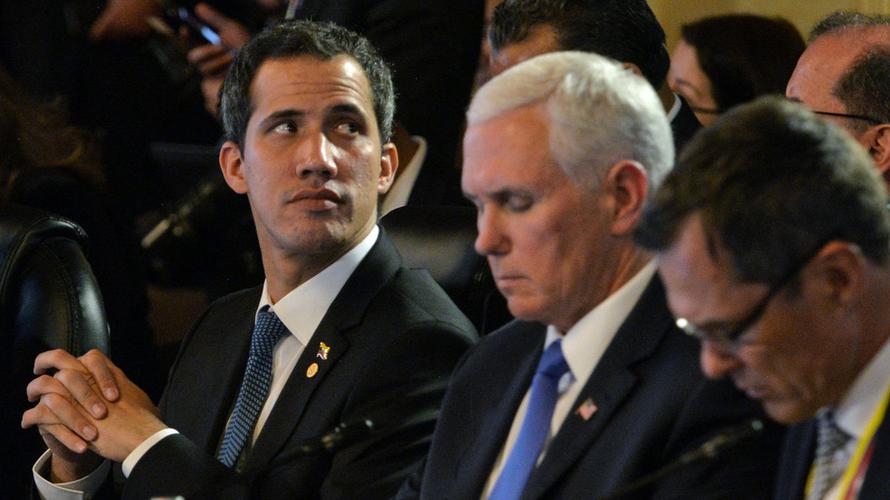
Yet, at the Lima Group summit held – no coincidence – in the Colombian capital, Bogota on Monday, Guaido and US Vice President Mike Pence brazenly spouted lies that the “sadistic” Venezuelan military under President Nicolas Maduro had caused the destruction of vital aid supplies intended for “suffering people.”

It seems obvious the whole scenario of delivering US aid into Venezuela from neighboring countries was really intended as a pretext for military intervention by Washington. The government in Caracas had warned of such a contingency in advance, as had Russia, which is allied to President Maduro’s administration. Moscow’s experience in Syria has no doubt given a lot of valuable insights into the American playbook of using false flags for justifying military aggression.

The timing of the Lima Group summit – 12 Latin American states along with the US and Canada – was meant to capitalize on the false-flag incident over aid, as well as other deadly clashes at the weekend that resulted in dozens of casualties.

However, the provocation did not go to plan, despite Pence and Guaido’s grandstanding assertions.

The other downside for the US regime-change objective in Venezuela is that the Lima Group has for the moment broken ranks over the military option. Pence and Guaido stepped up the rhetoric calling for “all options” on the table – meaning military intervention.

But the Lima Group, including US allies Colombia, Brazil, Argentina and Paraguay, issued a statement after the summit Monday rejecting any military action. They are still functioning as lackeys by calling for a “peaceful transition to democracy” and are in favor of the dubious US-anointed opposition figure Guaido, recognizing him as the “interim president” of Venezuela, in accordance with Washington’s desires.

Nevertheless, repudiation of the military option by Washington’s regional allies will be seen as a damper to the momentum for using American force to overthrow the Maduro government.

Brazil’s Vice President Hamilton Mourão repeatedly said in interviews that his government would not allow a US military incursion into Venezuela from its territory.

The European Union also said it was opposed to any military force being used by the US against Venezuela.

The emerging situation therefore puts the regime-change planners in Washington in a quandary. Their sanctions pressure for blackmailing defections in the Venezuelan political and military leadership has failed. So too has the much-vaunted spectacle of delivering US aid.

Growing frustration on the US side was evident from the obscene posting of “snuff movies” by Florida Senator Marco Rubio, comparing the bloody fate of former Libyan leader Muammar Gaddafi with what might happen to Maduro.

Rubio has become something of an unofficial envoy for regime change in Venezuela on behalf of the Trump administration, in the same way the late Senator John McCain performed his role in helping prompt a coup d’état in Ukraine back in 2014. As well as conveying death threats to Maduro concerning Gaddafi, who was brutally lynched by NATO-backed jihadists in October 2011, Rubio also posted images of former Panamanian leader Manuel Noriega. Noriega was captured by US forces after they bombed and invaded his country in 1989.

The criminality of Rubio and other senior US officials, including President Trump, openly calling for regime change against Maduro is a sign of how manic Washington has become in getting its hands on the country’s vast oil wealth. There isn’t even a hint of coyness about the criminality.

The desperation for regime change in Venezuela by Washington has only become more frenzied as its machinations appear to be coming unstuck.

Therefore, it can be anticipated, Washington needs a game-changing event – badly – in order to shift its lackey Lima Group, the EU and the United Nations to accepting its agenda for a military option.

UN Secretary-General Antonio Guterres has strongly appealed for no violence in the stand-off between the US and Venezuela. Significantly, the UN has declined to get involved in delivering US aid to the South American country, as such involvement would be viewed as taking sides.

Voice of America quotes Dany Bahar, a Venezuela expert at the DC think-tank the Brookings Institution, as saying that the next steps for Washington in its pressure campaign on the “Maduro regime” is “to try to get the United Nations on board, which has not happened yet.

Ominously, the Lima Group has issued a statement claiming to have credible evidence that Juan Guaido’s life is seriously threatened by Venezuelan state security. Pence also warned that Maduro would be held responsible for Guaido and his family’s safety. Last month, Guaido made claims that his wife’s family was menaced by state agents who allegedly visited their home. It was an unconfirmed claim, which the Venezuelan authorities denied.

Guaido defied a travel ban to attend the summit in Bogota earlier this week. It is not clear if he will return to Venezuela as he is liable to be arrested on charges of inciting sedition and civil unrest. 

Indeed, Washington’s game plan does not seem to be going well. Through a series of miscalculations and foolish over-reach, the gambit in Venezuela is at risk of becoming a debacle.

That very situation, however, could tempt a desperate throw of the dice by the Trump administration to salvage its losses so far.

A major, shocking event is needed, it may be calculated, in order to get the Latin American and European lackeys into line on regime-change policy, specifically the military option. As the Brookings Institute pundit said, “to get the United Nations on board.” Because so far, the majority of the UN members, including Russia and China, key UN Security Council veto powers, are not complying with Washington’s dictate of delegitimizing President Maduro and recognizing the US-backed puppet figure Guaido.

What could such a shocking event entail? Somebody is telling the Lima Group that Guaido and his family are in grave danger of being assassinated. Guaido’s Popular Will party is known to engage in violent subversion and allegedly has links to the American CIA, as reported by Abby Martin and others.

As easily as they are lionized, US puppets can be just as easily disposed of. Guaido playing the dirty game of regime change with the most criminal organization in the world – the US government – is a very dangerous game. He’d better watch his back.

via ZeroHedge News https://ift.tt/2tHnnE0 Tyler Durden

The California Dream Is In Nevada: Golden State Expats Flock To Las Vegas Suburb

It’s no secret that California residents, particularly people residing in the most expensive parts of the state (SoCal, the Bay Area) are fleeing in droves, displaced by expensive rents, sky-high home prices, unbearable traffic congestion and – oh yeah – increasingly deadly wildfires. As a result, California expat communities have sprung up in Texas, Arizona, Idaho and Nevada, sun-belt states where residents can enjoy many of the benefits of California living (namely, the agreeable climate and booming economy) without the downsides.

But in some of the most desirable communities, the influx of Californians has grown into a flood that is straining public resources – residents complain of crowded class sizes and home prices, while still lower on an absolute basis, are seeing some of the fastest increases in the country.

California

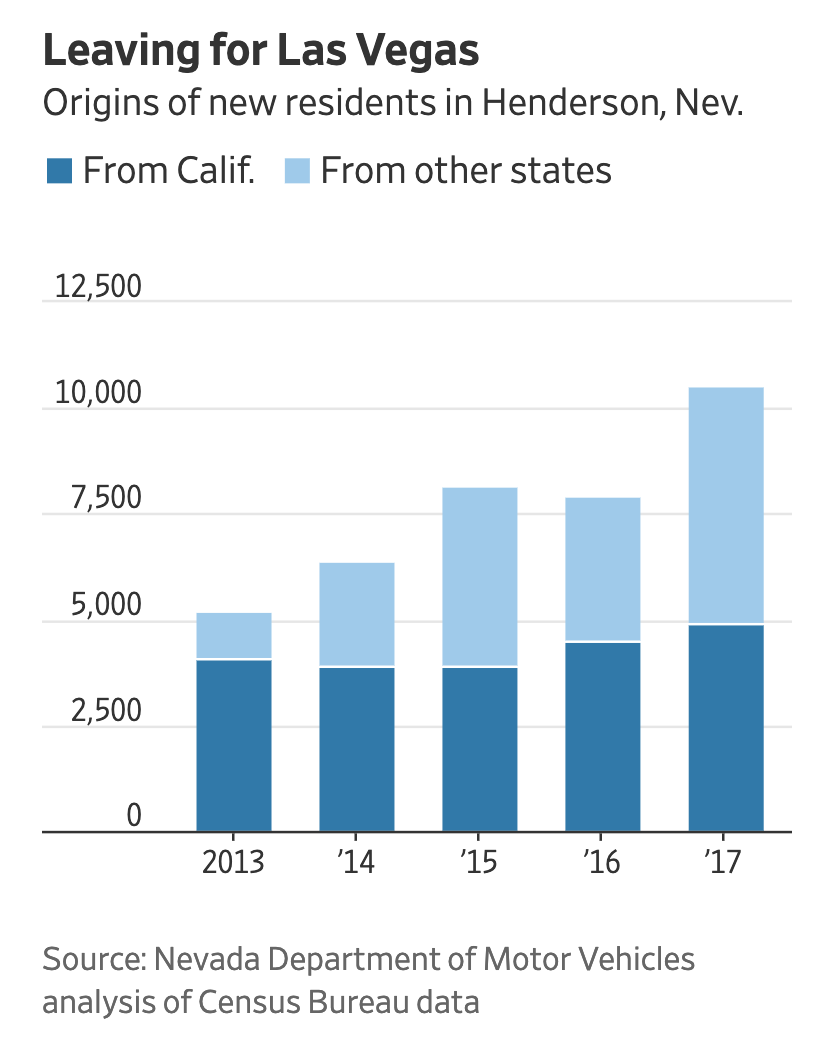
One such community is Henderson, Nev., a suburb of Las Vegas where the Oakland Raiders recently started construction on a new practice facility in preparation for their move to Las Vegas. As the Wall Street Journal reported, Henderson has become a place where California expats can enjoy a better standard of living (and even have some money left over after paying their mortgage) while spending less time sitting in SoCal’s notoriously brutal traffic. Just ask John Falkenthal, a software engineer from San Diego, who sold his home in SD and moved to Henderson a year ago.

“I never even considered leaving Southern California, but it took me every dime I had to buy a home there,” said the 54-year-old Mr. Falkenthal, a software engineer who moved to Henderson from San Diego last October.

[…]

Mr. Falkenthal initially looked for a house in San Diego after selling his former home following a divorce three years ago. But his half of the proceeds, about $250,000, would have paid for only a small townhouse or condo in the coastal area where he lived, he said.

Instead, he bought a three-bedroom, two-story house in Henderson in October for $416,000.

“My quality of life went up the day I moved here,” said Mr. Falkenthal pointing to his pool table and his musical equipment.

And that’s before taxes and insanely high utilities prices (which, thanks to PG&E’s bankruptcy, might climb for some residents). One Cali expat who spoke to WSJ says he saved $5,000 on his water bill alone in a year.

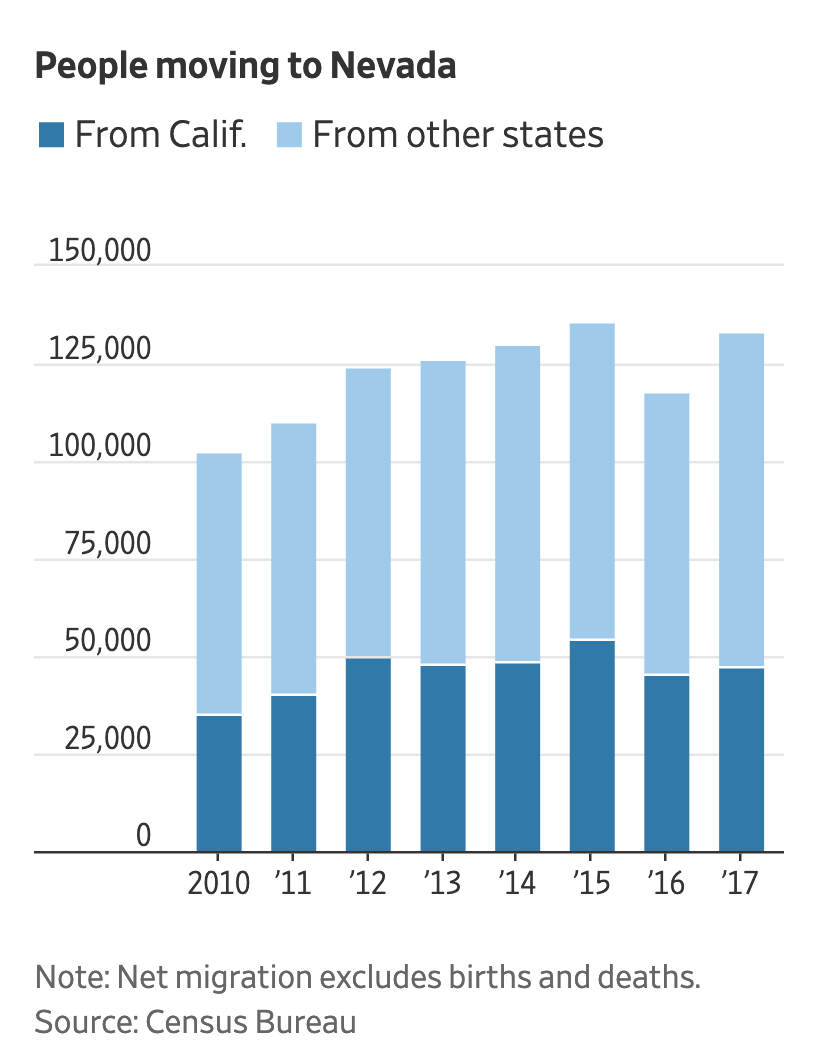
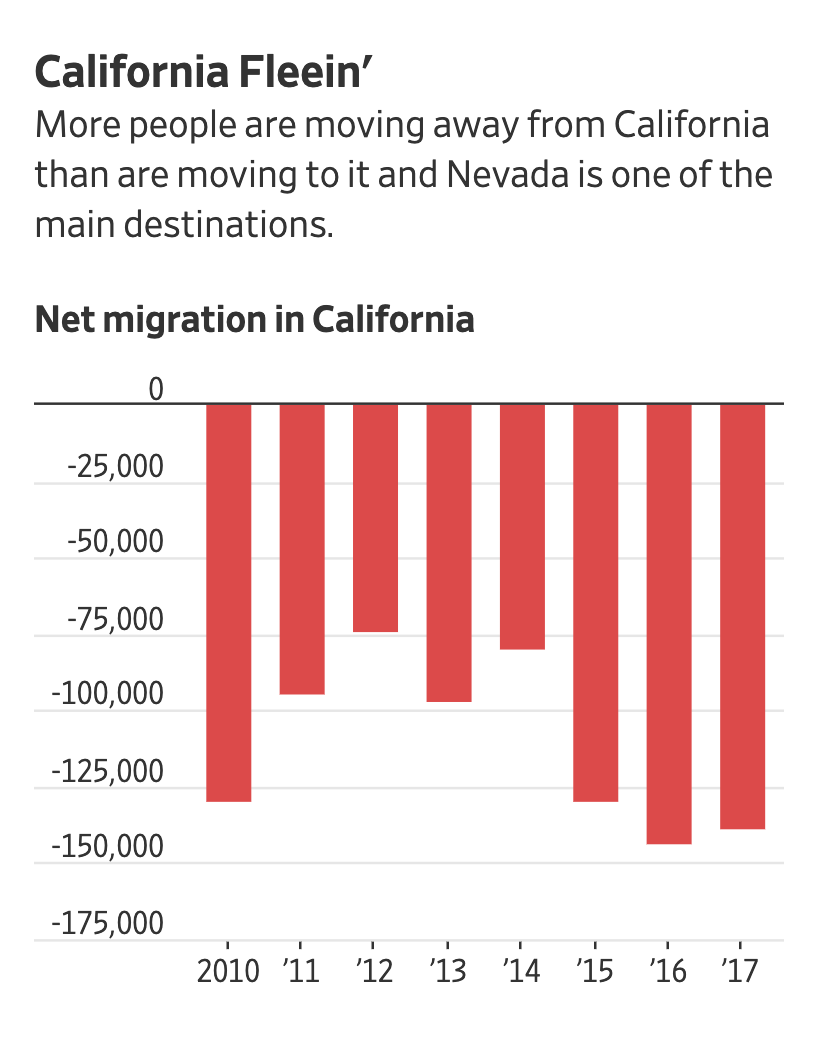
Net migration out of California topped 100,000 in 2015, 2016 and 2017, according to the Census Bureau. And between 2006 and 2017, a total of 1.24 million Californians left the state, never to return, the third highest total in the country, behind only New York and Illinois. That should hardly come as a surprise in a state where buying a home is only affordable for 28% of the population, as the median home prices nearly doubled between 2012 and 2018. As more residents struggle to get away, new births and immigrants from abroad (including plenty of illegal aliens) are the only reason California’s population has continued to expand.

Cali

Las Vegas, and the surrounding area, has emerged as one of the most popular destinations for these expats.

Las

More than half of new arrivals in Henderson – some 56% – between 2013 and 2017 were from California. In some of the ritzier areas, including new luxury developments, as many as 70% of the residents hailed from the Golden State.

Cali

Many retirees have chosen to settle down in Nevada, instead of California, where they also enjoy being relatively close to their grandchildren. Bill and Cindy Clune, told WSJ that financial considerations were a big part of their decision to move.

Mr. Clune, 62 years old, and his wife Cindy, 63, both retirees, persuaded their daughter and cousin, along with two other couples, to follow them to Henderson after they moved here three years ago. In addition to saving money, escaping the California traffic was a big draw. Mr. Clune said he used to spend as much as two hours each way commuting from his home in Temecula to his manufacturing business in North Hollywood.

“Here, they complain if you have to spend 30 minutes in traffic,” Mr. Clune said.

There are things he and his wife miss in California, though. “We have four grandkids there, and would love to see them more often,” he said. “And the beach is nice.”

Pretty soon, retirees like the Clune might find their family members coming to stay with them instead of the other way around. Because, according to one recent survey, more than half of California’s 40 million residents wish they could escape from their own personal California nightmare.

via ZeroHedge News https://ift.tt/2IHJ80N Tyler Durden

Regime Change is Urgently Needed… In Washington

Authored by Andre Vitchek via Off-Guardian.org,

I am surprised that no one else is saying it, writing it, shouting it at each and every corner: It is not Venezuela, Cuba, Nicaragua, and Iran that are in dire and crucial need of ‘regime change’. It is the United States of America, it is the entire European Union; in fact, the entire West.

And the situation is urgent.

The West has gone mad; it has gone so to speak, bananas; mental. And people there are too scared to even say it, to write about it.

One country after another is falling, being destroyed, antagonized, humiliated, impoverished. Entire continents are treated as if they were inhabited by irresponsible toddlers, who are being chased and disciplined by sadistic adults, with rulers and belts in their hands yelling with maniacal expressions on their faces: “Behave, do as we say, or else!”

It all would be truly comical, if it weren’t so depressing. But… nobody is laughing. People are shaking, sweating, crying, begging, puking, but they are not chuckling.

I see it everywhere where I work: in Asia, Latin America, Africa and the Middle East.

But why?

It is because North American and European countries are actually seriously delivering their ultimatum: you either obey us, and prostrate yourself in front of us, or we will break you, violate you, and if everything else fails, we will kill your leaders and all of those who are standing in our way.

This is not really funny, is it? Especially considering that it is being done to almost all the countries in what is called Latin America, to many African and Middle Eastern nations, and to various states on the Asian continent.

And it is all done ‘professionally’, with great sadistic craftsmanship and rituals. No one has yet withstood ‘regime change’ tactics, not even the once mighty Soviet Union, nor tremendous China, or proud and determined Afghanistan.

Cuba, Venezuela, DPRK and Syria may be the only countries that are still standing. They resisted and mobilized all their resources in order to survive; and they have survived, but at a tremendous price.

The victims keep crying. A few independent countries keep expressing their outrage. But so far, there is no grand coalition, which would be ready to fight and defend each other: “one for all, all for one”.

Until the recent ‘rebellion’ at the UN, no one has been openly and seriously suggesting that international law should apply to all nations of the world, equally.

People talk about ‘peace’. Many are begging the brigands to ‘to stop’, to ‘have mercy’, to show some compassion. But, neither Europe nor North America has ever shown any compassion, for long, terrible centuries. Look at the map of the beginning of the 20th century, for instance: the entire world was colonized, plundered and subjugated.

Now it is all moving in the same direction. If the West is not stopped, our planet may not survive at all. And let us be realistic: begging, logical arguments and goodwill will not stop Washington, Paris or London from plundering and enslaving.

Anyone who has at least some basic knowledge of world history knows that.

So why is the world still not forging some true resistance?

Is Venezuela going to be the last straw? And if not Venezuela, that is if Venezuela is allowed to fall, is it going to be Nicaragua, Cuba or Iran next? Is anything going to propel people into action?

Are we all just going to look passively how, the socialist Venezuela, a country which has already given so much to the world, Venezuela which managed to create beautiful visions and concepts for our humanity, is going to be burned to ashes, and then robbed of all of its dreams, its resources and of its freedom?

Are we all such cowards? Is this what we – human beings – have actually become; been reduced to? Cowards and cattle, selfish and submissive beings; slaves?

All this, simply because people are too scared to confront the empire? Because they prefer to hide and to pretend that what is so obvious, is actually not taking place?

Therefore, let me pronounce it, so at least my readers do not have that ‘luxury’ of claiming that they were not told:

This world is being brutalized and controlled by the fascist clique of Western nations. There is no ‘democracy’ left in this world, as there is near zero respect for international law in North American and European capitals. Colonialism has returned in full force. Western imperialism is now almost fully controlling the world.

And begging, trust me – begging and talking of peace is not going to help.

During WWII, fascism had to be stopped. If not, it was going to devour the entire planet. In the past, tens of millions have already died fighting for freedom and for our mankind. Yes, some nations tried to compromise and negotiate with Nazi Germany, but we all know where it all ended.

Now, the situation is the same. Or worse, perhaps much worse, because the West has nukes and a tremendous propaganda apparatus: it controls human brains all over the world with ‘mass media’, and ‘education’.

And because the citizens of the West are now much more brainwashed than the Germans and Italians were in the late 1930’s and early 1940’s; more brainwashed, more scared, submissive and more ‘disciplined’.

Look, seriously: are the people who are now writing those “peace essays”, in which they argue with the Western regime about who is right and who is wrong, seriously thinking that they are going to move people like Donald Trump, or Pompeo, or Abrams, or Rubio?

Do they believe that Washington is going to stop murdering millions of people all over the world? Or that the neo-colonialist plunder would stop, after the US Congress and Senate suddenly understands that it has been at the wrong side of history?

This is not some rhetorical question. I am serious: I demand answers!

Does ‘peace movement’ thinks that by amassing arguments it could stop Western expansionism? Yes or no?

Do they believe that Pompeo or Trump will suddenly hit their foreheads and exclaim: “You people are correct! We did not see this!” And call their troops, their thugs and mercenaries back?

If not, if this is not what peace movements believe would be done by North American and European leaders, then why all those thousands of wasted pages?

Would you go near a crocodile that is ready to devour an innocent child, and try to reason with it? Would you, seriously? Do you think it would stop, drop a few tears, wag its tail and leave?

Sometimes I tend to believe that ‘peace movements’ in the West are making things worse. They create false hopes, and they behave as if the empire is some entity that has a soul, and understands logic. They grossly underestimate the threat; the danger.

And they tend to analyze the Western threat from a Western perspective, using Western logic.

It somehow gets lost in interpretation that fascism, terror, and bestiality have to be confronted and fought.

One cannot negotiate with a group of countries which are already bathed in the blood of some 80% of the planet. If it was to happen, it would just be a mockery and it would simply humiliate everyone that is sincerely trying to stop the assassins.

Right now, Venezuela needs solidarity. It requires direct help, actions; not words. And so do many other countries.

Instead, it gets an endless avalanche of best wishes, as well as premature obituaries.

The Bolivarian Revolution has gotten plenty of colorful words. But what it urgently needs is volunteers, money, and internationalist brigades!

I know that billions of people all over the world are now cheering from their armchairs; in fact, doing absolutely nothing, while also spending zero. Their love for Venezuela is ‘platonic’.

I have just left Syria, where I was covering the Idlib war zone. There was not one single foreigner near me, during those days. Eva Bartlett and Vanessa Beeley usually work all over the toughest areas in Syria, but how many others do? And most of the time we work with near zero backing, just because we feel that it is our moral obligation to inform humanity.

I am wondering, how many foreigners are fighting for Venezuela, right now?

Who is going to face the Western spooks implanted into the Caracas and the Venezuelan borders with Colombia and Brazil? A few RT and TeleSur reporters, those true heroes, yes, but who else?

Only direct action can save Venezuela, and the world.

This is no time for debates.

This is worse, much worse than the late 1930’s.

The proverbial crocodile is here; its enormous ugly mouth open, ready to devour yet one more brilliant, proud country.

It is time to stick a big metal rod into its mouth. Now, immediately; before it gets too late.

Let us shout LONG LIVE VENEZUELA! But with our hands, muscles and purses, not just with our mouths.

And let us not be scared to declare: if anywhere, it is Washington where regime change is truly and urgently needed!

via ZeroHedge News https://ift.tt/2H5ZjlZ Tyler Durden

RaboBank: “At This Stage, Is Any Voter’s Opinion On Trump Going To Be Swung Either Way?”

Submitted by Michael Every of RaboBank

Another remarkable day of drama. Amazingly, the summit between US President Trump and North Korea’s Kim doesn’t get top billing anywhere in most media. Partly that’s the political equivalent of “the difficult second album” problem, and partly it’s what is going on elsewhere.

In the US Congress we had three sets of remarkably testy testimony. First was Trump’s ex-lawyer Michael Cohen, who delivered allegations that in another time would have been so politically devastating no president could be expected to survive them: that Trump is a racist conman who has committed crimes while in office, and that Cohen fears he won’t leave office if he loses the 2020 presidential election. However, these are not ordinary times, this is not an ordinary president, Cohen is not an ordinary lawyer given he is facing jail as a perjurer…and a dispassionate view does not suggest there was actually anything new in any of those sometimes very wild charges.

Crucially, even though we heard there are fresh investigations into Trump on-going in New York, there were no new smoking guns on Russia in particular, and perhaps the most explosive material was a cheque signed by Trump apparently used to reimburse Cohen for his pay-off to porn star Stormy Daniels – but even that appears to be a minor (USD35,000) campaign finance violation. In short, this was hardly a good day for Trump, but was it actually enough to say he will be impeached or fail to win again in 2020 due to it? That still looks very unlikely at this stage. At this stage, is any US voter’s opinion on Trump going to be swung either way? Really? And is there a genuine legal threat? Not until after 2020, apparently. In fact from a legal perspective this kind of backdrop deeply incentivises Trump to win again as he is in a far stronger position to face down various legal challenges while in office. Nonetheless, we can be assured that these kind of events are going to be a permanent fixture into 2020. Cohen is back tomorrow behind closed doors, for example.

Second was US Trade Representative Lighthizer, who shot down hopes for a US-China trade deal. Lighthizer noted that plans to hike tariffs on USD200bn of Chinese goods from 10% to 25% are now suspended, which the same Wall Street Journal trade journalists that are always telling us a deal is close seems to think is again a sign that a deal is close. However, Lighthizer also said more Chinese purchases of US agri and gas are not enough and that structural issues are key. Moreover, we heard that the proposed enforcement mechanism to make sure China is “subject to corrective action should it fall short of its commitments”. Apparently this would mean monthly, quarterly, and semi-annual meetings at various levels of government, and companies would have the chance to make complaints anonymously: failure of the Chinese to address these would then see the US take appropriate unilateral action. Seriously, does anyone think Beijing is going to allow itself to be held to outside standards like this? Consider that Beijing makes crystal clear that it does not allow independent judiciaries as the Communist Party remains supreme: is it going to let US trade bureaucrats tell it what to do? Markets are still in denial about this – or at least emerging markets are. Lighthizer also stressed the importance of Congress passing the USMCA, because out of sight out of mind that hasn’t happened yet.

Third was the Fed’s Powell, who was repeating his semi-annual testimony but didn’t generate the kind of fireworks one might have expected in Q&A from Democratic Representatives. Instead, Powell noted that QT won’t run too much further and will end this year, decried the rise in student debt, and underlined the US needs higher productivity. In short, nothing really exciting, but positive in as much as the threat of QT will end later in 2019.

Naturally, the backdrop of India and Pakistan moving close to the brink of war pushed Trump and Kim down the news agenda too – although CNN, etc., still felt that Michael Cohen’s testimony was vastly more important. While Pakistani Prime Minister Imran Khan has made a nudge-nudge wink-wink reference to the two countries’ nuclear weapons and has offered India a potential off-ramp from further escalation after his own military response to Indian airstrikes (and a video has shown a captured Indian pilot saying “The tea is fantastic”) it is still not assured this crisis is contained.

Meanwhile, apart from a laudatory tweet from Trump on Vietnam’s economic dynamism, and suggestions that this is the future that is apparently on offer from the US if Kim will become its friend, we have little concrete to trade off. Apparently there will be a joint agreement signing ceremony today: will that see something dramatic? Certainly Trump could do with the good press just as much as Kim.

And back in the UK

What an unbelievable world we live in: even more so given that Bohemian Rhapsody won several Oscars for what was basically a high-budget school play on my viewing of it. If you want to watch Queen’s Live Aid triumph just go to YouTube: why bother with a facsimile?

via ZeroHedge News https://ift.tt/2IHgvRl Tyler Durden