March Will Startle Wokesterdom Out Of Its Dark Raptures

Authored by James Howard Kunstler via Kunstler.com,

Marching To Gilead

I suppose Mr. Trump dangled visions of North Korea’s future as a Buick showroom and the mysterious Kim Jong Un detected some kind of trap there. A correspondent with military intel credentials writes:

[Eric] Hoffer’s observation that people only revolt when things are getting better seems applicable to DPRK. I can only assume that Kim and his cabal in NK know this or somehow instinctively understand it. In short, as I see it, he can’t afford to let things get really better for North Korean people. So, I believe Trump’s carrot of great economic success for DPRK’s people probably scares Kim badly.

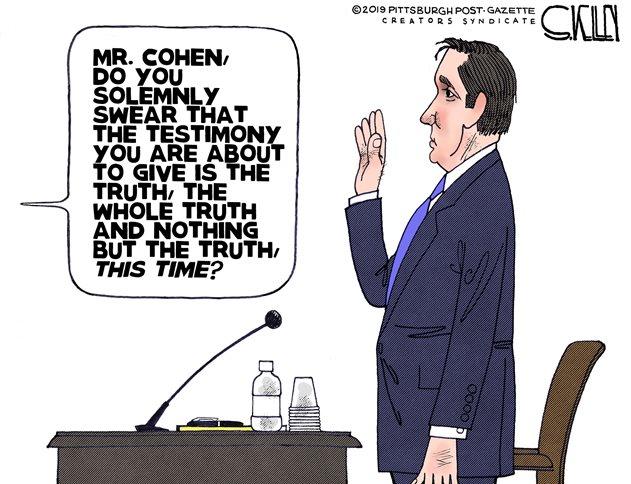
It was certainly hard to imagine the two leaders in conversation: The President with his larval vocabulary and Mr. Kim in his life-long solipsistic haze. Perhaps they compared hair-dos, both equally strange, would you not admit?  Something tells me that Mr. Kim is not a golfer, so that was out as an icebreaker, though it’s said he does enjoy firing artillery at human targets — one thing that Mr. Trump has not been accused of by former consiglieri-turned-pagliaccio Michael Cohen. Perhaps Mr. Trump let Mr. Kim in on the glorious beauty of an American Cheeseburger, a sure-nuff wonder of the world!

In any case, the US president trundled home without nailing that ole coonskin to the wall, as one of his predecessors put it, but the game isn’t over. For now, it’s back to war on the home front against the armies of Wokesterdom. That movement appears to be floundering a bit too now as Jussie Smollett whirls down the memory hole, and #MeToo sputters, and the various congressional committees scrape the bottom of every barrel for the always-elusive triumphal “gotcha” in their crusade to correct the 2016 election.

The fishy barrel that Michael Cohen came out of provided disappointingly thin sludge, so now The New York Times (official playbill of Wokesterdom) informs us that next up they’ll be hauling Mr. Trump’s financial officer, one Allen Weisselberg, into the star chamber for a ‘splainin’ session. Pretty soon, they’ll make the amazing discovery that the New York City construction scene is run by the mob. Won’t that be a revelation?

Let’s face it, March is a month that drips with fraughtness. Everybody is good and goddam sick of winter, yet it lingers sadistically, not unlike the Mueller investigation. Then, you get to the middle of the month and what’s there? The sinister Ides, an age-old ceremonial turning point of the year recognized by the ancients even before Julius Caesar got whacked in the Roman senate. I propose that mid-March this year will be the occasion of so many shoes dropping that Washington will look like a road show of Shuffle Along.

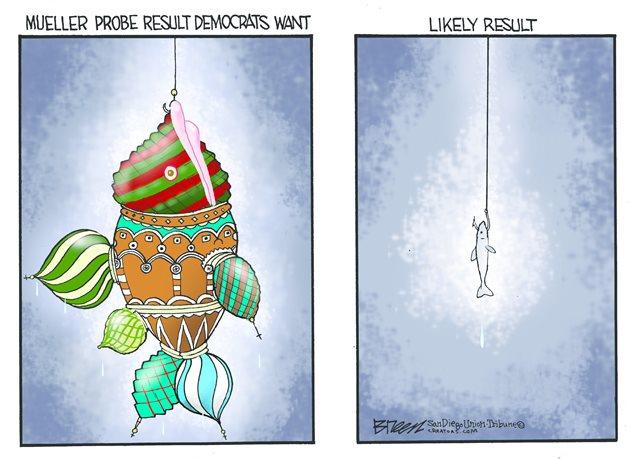
Everybody and his/her/zhe/they’s uncle expects Mr. Mueller to cast down his report from on high. In a non-Bizarro world it would be a catalog of indictments for most of the FBI executive leadership circa 2016-2018, and a few cherries-on-top from the DOJ, CIA, and the DNC. More likely, it will be a stuffed, roasted rump of innuendo drenched in Russian dressing garnished with rinky-dink “process” crime convictions. One way or another, it’s sure to disappoint the minions of Wokesterdom.

But once that’s out of the way, more interesting action may be in the offing. Mr. Trump, despite all the Twitter bluster, has at least patiently held back on declassifying reams of documents pertaining to official misconduct by many of the investigators themselves, perhaps even Mr. Mueller and some of his colleagues. I expect a steady and measured release of that classified material, and it will tell a tale that may even startle the Wokesters out of their dark raptures.

Nobody knows exactly what the new attorney general, Mr. Barr, might do. So far, he has not done anything. I will be surprised if that continues. He is probably also waiting for the Mueller report before he starts dispatching folks to grand juries, perhaps even a former president, and certainly some of his foot-servants and handmaidens. Upcoming too are actions by the DOJ inspector general, Mr. Horowitz, federal prosecutor John Huber’s forgotten commission, and the reappearance of General Flynn in Judge Sullivan’s DC courtroom.

March is also looking like the moment when the financial world starts rockin’ and rollin’ on the recognition that the global economy has stalled. The fantasy of economic triumph is the one float that the Golden Golem of Greatness has been able to parade around on. Both the real estate markets and the car business have gone south now, and the financial entanglements entailed by them, in the form of securitized mortgages and loans, are janky enough to start blowing up pension funds, insurance companies, and state treasuries just for starters. The complacency on Wall Street ought to be a prime signal for the sentient to duck-and-cover.

via ZeroHedge News https://ift.tt/2ILXBsx Tyler Durden

The Randy Sex of Now Apocalypse Is Balanced with Real Heart: New at Reason

'Now Apocalypse'Television critic Glenn Garvin takes a look at the sex-driven Gregg Araki Starz show, Now Apocalypse:

My parents used to say time passed at light speed between Sands of Iwo Jima and M*A*S*H. I don’t think I fully understood them until seeing Starz’ new comedy Now Apocalypse and recalling its putative ancestor Sex and the City. The moderate promiscuity of Carrie and Samantha seems like Cub Scout show-and-tell compared to what goes on among the randy millennial slackers of Now Apocalypse.

Anilingual sex! Robot sex! Reptilian space-alien sex! A polyamorous antifa warrior bows out of the middle of a three-way with the apologetic explanation that, “I’m meeting up with my boyfriends and we’re setting Bank of America on fire.” And an internet-assisted back-alley encounter is interrupted when one of the participants declares that “hook-ups make me feel gross and pagan,” and proposes an alternative: “Handjobs only?”

View this article.

from Hit & Run https://ift.tt/2tKGDQU
via IFTTT

Uber vs Lyft: Here Are The Highlights From Lyft’s IPO Filing

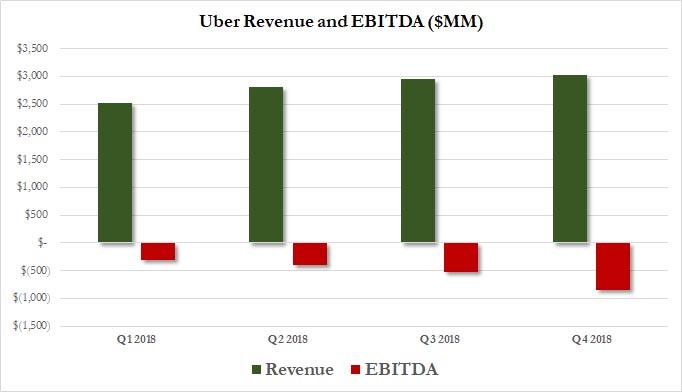
Shortly after Uber reported that even as the company continues to grow, generating record revenue in the latest quarter, yet burning ever more cash to preserve market share and grow it business as shown by its increasingly more negative EBITDA…

… on Friday, Uber’s biggest competitor Lyft finally filed its long-awaited IPO application (reserving the ticker “LYFT” once it start trading on the Nasdaq exchange) giving potential investors a first look at the company’s financial information as it hopes to become the first the ride-sharing giant to go public.

In the 220-page S-1 filing, underwritten by JPMorgan, Credit Suisse and Jefferies (and 17 other banks) the company laid out a proposed offering size of $100 million as a placeholder, however the amount is certain to increase in the coming weeks.

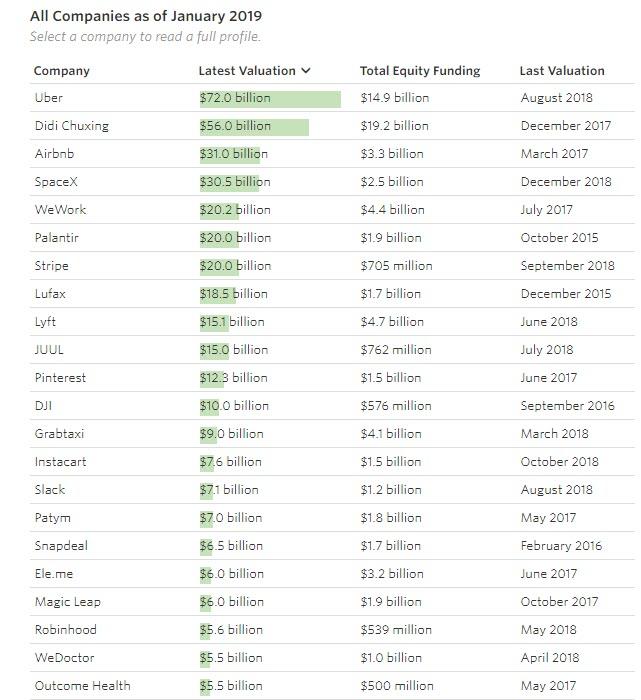
As Bloomberg writs, according to banks working with Lyft, the valuations pitched for the company ranged from $18 billion to $30 billion and by last week, that range had narrowed to $20 billion to $25 billion. That means that the company’s valuation will increase by $5-10 billion in just half a year: last June, Lyft raised $600 million in a round led by Fidelity Investments at a $15.1 billion valuation; investors include Alphabet’s private-equity arm CapitalG, KKR & Co. and Baillie Gifford.

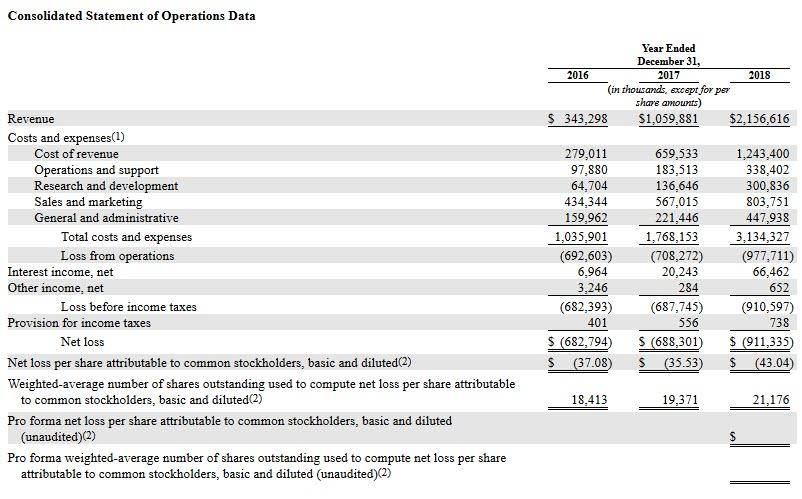
Going straight to the F-pages, the San Fran-based Lyft posted a net loss of $911 million on revenue of $2.2 billion for 2018, both a deterioration and an improvement to the $688.3 million loss on $1.1 billion revenue for 2017.

Somewhat concerningly, year-over-year growth slipped throughout 2018, falling from 130% in the first quarter to 94% in the fourth quarter, as the business is slowly approaching peak growth.

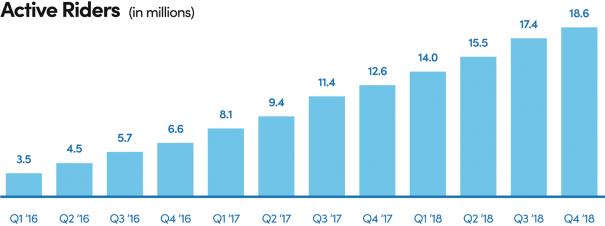
According to the IPO prospectus, Lyft had 30.7 million riders and 1.9 million drivers in 2018….

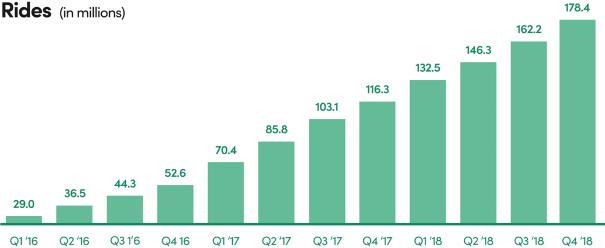
… racking up $8.1 billion in total bookings, thanks to 178.4 million rides in Q4 2018…

… and 18.6 million active riders.

Additionally, as reported previously, Lyft is offering some of its most dedicated drivers, who are contractors, a cash bonus that they can use to buy shares in the IPO, the company said in a statement. The bonuses will range from $1,000 to $10,000 for drivers in good standing.

As Bloomberg notes, Friday’s filing gives Lyft a leg up in its race with Uber to go public this year: the competing ride-sharing companies filed their draft statements to the Securities & Exchanges Commission in the same week in December, and had received initial feedback from the regulator as of Feb 11.

More importantly, the upcoming IPOs of these Unicorns will test investor appetite and whether increasingly money-losing businesses can withstand wider investor scrutiny, along with the prospects for the dozens of still-private Silicon Valley names pursuing listings, a group which includes Pinterest, which this week submitted a confidential IPO filing to the SEC, while food delivery company Postmates and Slack Technologies also filed confidentially with the SEC.

Even at a $25 billion valuation, Lyft’s listing will be dwarfed by Uber, which is backed by Softbank’s Vision Fund and venture capital fund Benchmark, and which was valued most recently at $76 billion in August, when Toyota invested $500 million in the company. And, as Bloomberg adds, despite burning $2 billion in 2018, Bloomberg writes that banks have laid out valuation scenarios for Uber as a public company that will stretch its valuation as high as $120 billion, which would make it more than twice as valuable as the world’s second biggest unicorn, China’s own ride-sharing leader, Didi Chuxing.


via ZeroHedge News https://ift.tt/2Xw19Cu Tyler Durden

MMT’s Chief Advocate Defends Against Krugman Criticism

Authored by Stephanie Kelton, op-ed via Bloomberg.com,

There is a doctrine among mainstream economists holding that:

(1) government deficits push interest rates higher and

(2) rising interest rates crowd out private investment.

The government can take more of the economy’s financial resources, but only at the expense of lost private investment. This means that running budget deficits has at least some downside.

Paul Krugman is a believer in this doctrine. I’m not, and he’s asked me to explain why. He is responding to a column I wrote critiquing his view of modern monetary theory.

I’m going to respond directly to the questions he raised

Are MMTers claiming, as Kelton seems to, that there is only one deficit level consistent with full employment, that there is no ability to substitute monetary for fiscal policy? Are they claiming that expansionary fiscal policy actually reduces interest rates? Yes or no answers, please, with explanations of how you got these answers and why the straightforward framework I laid out above is wrong.

Quick responses first, followed by explanations behind my thinking.

#1: Is there only one right deficit level?

Answer: No. The right deficit depends on private behavior, which changes. MMT would set public spending always to the level required to achieve full employment, and then accept whatever deficit may result.

#2: Is there no ability to substitute monetary for fiscal policy?

Answer: Little to none. In a slump, cutting interest rates is weak tea against depressed expectations of profits. In a boom, raising interest rates does little to quell new activity, and higher rates could even support the expansion via the interest income channel.

#3: Does expansionary fiscal policy reduce interest rates?

Answer: Yes. Pumping money into the economy increases bank reserves and reduces banks’ bids for federal funds. Any banker will tell you this.

#4: Does MMT accept Krugman’s “straightforward framework”?

No. We can come back to this at the end.

Is there only one right deficit level? No, because for one thing, MMT would establish a public option in the labor market — a federally funded job guarantee — thereby ensuring full employment across the business cycle. The deficit, then, would rise and fall with the cycle, as the job guarantee becomes a new stabilizer, automatically moving toward the “right size” in response to changes in the level of aggregate spending.

In the absence of a job guarantee, things get trickier. Leaving monetary (and exchange rate) policy aside, the government has to allow the deficit to go where it needs to go in order to accommodate the private sector’s net savings desires. If the private sector wants to spend less and save more, the public sector will need to accommodate that desire by running a bigger deficit or the economy will be pushed away from full employment. Krugman drew up the perfect schematic — based on the sector balance framework adopted by MMT — to explain all of this 10 years ago.

Is there no ability to substitute monetary for fiscal policy? Not much. Krugman sees MMT as saying that fiscal policy can always deliver the “right size” deficit to maintain full employment. He’s challenging that by asserting that you can have any size deficit and still have full employment because the central bank can always establish the “right size” interest rate to get you there. I disagree.

It is true that the Fed can pursue any rate policy it desires. It does not follow, however, that cutting interest rates will work to induce enough spending to maintain full employment. You can’t simply assume borrowers will always have the appetite for more private debt, even if you make it really cheap to borrow. Businesses borrow and invest when they’re swamped with customers (or expect to be). They don’t passively take on more debt simply because the central bank has dangled cheaper credit before them.

The evidence suggests that interest rates don’t matter much at all when it comes to private investment: J.P. Morgan (here and here), the Reserve Bank of Australia (here), the Federal Reserve (here) and the Bank of England (here). It is even possible, as MMT has shown, that cutting rates could further slow the economy because lowering rates cuts government expenditures (interest payments), thereby exacerbating contractionary fiscal policy.

This is in fact what modern monetary theory suggested when the European Central Bank went to negative rates, which MMT sees as a contractionary tax. But MMT recognizes that raising rates could offset contractionary fiscal policy, though in a highly regressive manner as the interest paid by the government tends to go to those with the highest incomes.

Does expansionary fiscal policy reduce interest rates? Yes, unequivocally. You won’t see it in Krugman’s stylized graphic (below), but it does happen in the real world, where the interbank market exists.

Imagine the government is running a trillion-dollar deficit, sending out checks for military weapons, contracting to do massive infrastructure projects, and so on. All of those checks get deposited into financial institutions across the country. And each time a check is deposited, the bank gets a credit to its reserve account at the Fed.

When you pay your taxes, your bank loses reserves, but with a trillion-dollar deficit, there is a huge net infusion of reserves into the banking system. If the central bank takes no action to prevent it from happening, the overnight lending rate — the federal funds rate — will fall to a zero bid.

Why? Because all banks are flush with non-interest-bearing reserves, and everyone is scrambling to lend them to another bank. When everyone’s a seller and no one’s a buyer, the price goes to zero. To prevent this, the central bank steps in.

Before the collapse of Lehman in 2008, the Fed conducted open-market operations (selling bonds to mop up enough reserves to get the interest rate up). This was all coordinated with the Treasury Department on a daily basis, as I explained here.

Today, the Fed simply pays interest on reserves to establish a positive rate. That doesn’t change the fact that deficits, in and of themselves, put downward pressure on the short-term interest rate.

Yes, the Fed has a reaction function, and it can vote to raise rates in response to perceived inflationary pressures associated with deficit spending. But that is a different matter. That is fighting against the “natural” gravitation.

Is there some reason the straightforward framework Krugman laid out is wrong? Yes, as even its creator went on to acknowledge. MMT rejects the IS-LM framework that Krugman uses to demonstrate the conclusion that widening budget deficits put upward pressure on interest rates and crowd out private investment.

The model remains the workhorse for many mainstream Keynesians. MMT considers it fundamentally flawed. It is incompatible with much of Keynes’s “The General Theory of Employment, Interest and Money.” It was designed for a fixed-exchange rate regime, and it is not stock-flow consistent.

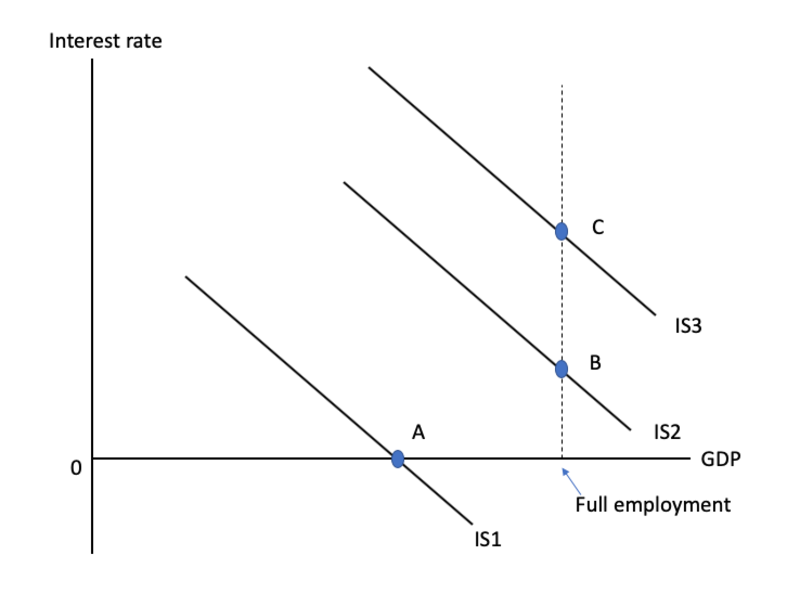
Here’s the framework Krugman presents as a challenge to MMT.
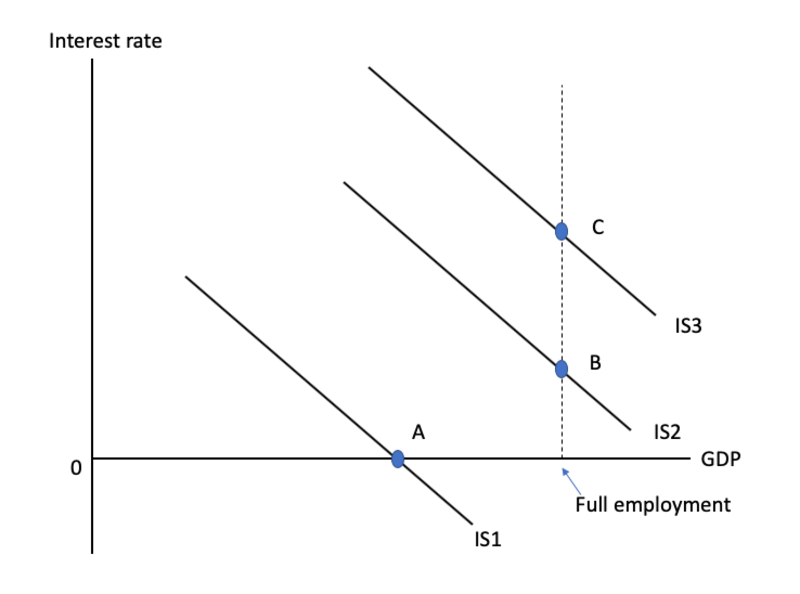
Each of the IS curves (1-3) represents a different fiscal stance. This framework shows that the government can expand its deficit and move the economy from a depressed condition at point A to full employment by shifting IS1 to IS2. The economy is now at full employment, but with higher interest rates and lower private investment.

Keep this in mind: Higher deficits give rise to higher interest rates, which give rise to lower investment. The last bit is referred to as “crowding out.” This is the inherent tradeoff that MMT denies and Krugman defends.

And it’s easy for him to defend it because his model assumes a fixed money supply, which paves the way for the crowding-out effect!

Krugman’s framework treats investment as a simple function of the interest rate. Higher rates mean lower investment, and vice versa. Central banks can juice (or slow) the economy simply by lowering (or raising) interest rates. It’s Pavlovian in its simplicity: stimulus-response.

Keynes’s analysis was more nuanced. Investment decisions were forward-looking, heavily influenced by “animal spirits,” and overwhelmingly dependent on the state of profit expectations. When the profit outlook is sufficiently grim, no amount of rate cutting will entice businesses to borrow and invest in new plant and equipment (think Great Recession).

Conversely, when the outlook is exuberant, businesses may borrow and invest even more, despite the central bank’s desire to slow an expansion by raising interest rates (think savings and loan crisis). The downward-sloping IS curve does not allow for either of these possibilities. Yet both outcomes can, and do, occur.

One final point. Krugman says there is an inherent tradeoff between fiscal and monetary policy. I agree, but not with the tradeoff he describes. Deficits don’t automatically drive interest rates higher, and higher interest rates don’t automatically translate into lower private spending.

That tradeoff is disputed, and not just by MMTers. The tradeoff that matters is the one that Hyman Minsky and James K. Galbraith have highlighted. Monetary policy “works” by driving people into debt. Fiscal policy works by driving income into people’s pockets. As Galbraith put it:

There are two ways to get the increase in total spending that we call ‘economic growth.’ One way is for government to [deficit] spend. The other is for banks to lend. For ordinary people, public budget deficits, despite their bad reputation, are much better than private loans. Deficits put money in private pockets…This is called an increase in ‘net financial wealth’… In contrast, when a bank makes a loan, the cash is not owned free and clear.

That’s the tradeoff that interests me. Should we lean more heavily on (monetary) policy that works by leveraging the private sector’s balance sheet or on (fiscal) policy that works by strengthening it?

So, there you have it. Two no’s, a not really and a yes in response to Krugman’s questions. (Un)fortunately, this will be the last response from me, since my editors have asked me to continue any further discussion offline. I thank Paul for engaging me and am more than happy to do this.

via ZeroHedge News https://ift.tt/2GQ4ib2 Tyler Durden

Can a Self-Described ‘Capitalist’ Win the 2020 Democratic Primary?

||| Carlo Allegri/REUTERS/NewscomWhen Sen. Bernie Sanders (I–Vt.) jumped into the 2020 presidential race last week, reporters sought comment about Bernie’s democratic socialism from the other would-be candidate who tends to make Democratic voters weak in the knees, former congressman and failed senatorial candidate Beto O’Rourke.

“I’m a capitalist,” O’Rourke replied. “I don’t see how we’re able to meet any of the fundamental challenges that we have as a country without, in part, harnessing the power of the market. Climate change is the most immediate example of that. If you’re going to bring the total innovation and ingenuity of this country to bear…our economy is going to have to be a part of that.” Asked at a town hall two months prior if he was a progressive, O’Rourke incurred the wrath of Team Bernie by saying, “I don’t know….I’m not big on labels. I don’t get all fired up about party or classifying or defining people based on a label or a group. I’m for everyone.”

O’Rourke this week announced that he has made a decision about whether he is going to run; he says he’s “excited to share it with everyone soon,” which pretty much everyone (including his sister) interprets as #He’sRunning. With President Donald Trump and his less-subtle surrogates clearly relishing a campaign fight against socialism, and with Rep. Alexandria Ocasio-Cortez (D–N.Y.) emerging as both the go-to conservative bogeyman and an influential driver of Democratic policy discussions, some on the left are catching the distinct whiff of triangulation from the toothsome Medium author.

“O’Rourke’s biggest presidential problem is he’s potentially positioned himself as too much of a centrist to win the backing of the Democratic Party’s increasingly large progressive wing in a nationwide Democratic primary,” writes Esquire‘s Gabrielle Bruney. “During his three terms in Congress, O’Rourke joined the centrist New Democrat Coalition rather than the Congressional Progressive Caucus and amassed a voting record more conservative than that of the average Democrat….Beto backed Medicare for All in 2017, but, as Politico notes, stopped publicly using both that term and ‘single payer’ as his Senate Campaign heated up last year.”

The progressive case against O’Rourke, as I pointed out in December, is almost entirely economic, since he has been far to the “left” of most Democrats on the drug war, criminal justice reform, immigration, and U.S. intervention abroad. (Though headlines like “Beto’s excellent adventure drips with white male privilege” also indicate that the identity-politics wars will inflict some wounds as well.) So how does his economic centrism translate into policy?

For one thing, like vanishingly few politicians from either major party, O’Rourke speaks as if there are budgetary constraints on the federal level. “We are $21 trillion in debt,” he lamented at a town hall in December, commenting further that “we are projected to add $1 trillion in deficit spending to that debt just in this next fiscal year.” He’s also a comparatively lonely pro-trade voice in the Democratic field.

On the other hand O’Rourke also recently called the Green New Deal “the best proposal that I’ve seen to ensure that this planet does not warm another two degrees Celsius,” despite the plan’s jaw-dropping cost and progressive grab-bagging. And he has said in the past that a “single-payer Medicare-for-all program is the best way to ensure all Americans get the healthcare they need,” despite the country’s inability to afford even the Medicare we already have.

It’s worth pointing out that the O’Rourkian thrill that went down Democrats’ legs during his unprecedentedly expensive race against Sen. Ted Cruz (R–Texas) had far less to do with policy or ideology and far more to do with the challenger’s charisma and inclusive uplift. This quality, otherwise elusive on the Democratic primary side so far (with the possible partial exception of California Sen. Kamala Harris), has drawn not just frequent comparisons to Barack Obama but some obvious enthusiasm from the former president’s inner circle. Trump would probably love to run against a democratic socialist. I might prove a thornier challenge for him to smite someone who excites Democrats without either promising too much or scaring half the country.

The flip side to the O’Rourke grassroots phenomenon—should it repeat itself in a presidential run, which is far from a sure thing—is that being the object of a political groundswell tends to change a person, including ideologically. Howard Dean started out as a pro-gun, largely pro-intervention centrist, but after catching the anti-Iraq War fire, “I noticed folks to the left of me…were saying stuff that turned out to be true.” Bernie Sanders has successfully jerked the whole party significantly to the economic left; it would take an act of will to resist being swept along.

from Hit & Run https://ift.tt/2UfA58k
via IFTTT

Extradition Of Huawei CFO To Move Forward

In a landmark – if widely expected – decision, the Department of Justice in Ottawa has ruled that the extradition proceedings against Huawei CFO Meng Wanzhou, who was arrested on the same day that President Trump and President Xi struck their trade truce in Buenos Aires, will proceed.

While Canadian courts will make the final decision, the case will move forward, in a process that could take months or even years. Meng is wanted in the US on charges of fraud and sanctions violations for her role in deceiving HSBC and other banks into processing transactions for Huawei that were linked to Iran. US prosecutors filed roughly a dozen charges against Meng and Huawei in January, as well as a formal request for her extradition, according to the BBC.

Meng

The ruling, which comes one day after court proceedings against Huawei and its US subsidiary began in a Seattle court room, could reignite tensions between Ottawa and Beijing, which have de-escalated somewhat since Beijing detained several Canadian nationals in what was widely seen as retaliation for Meng’s arrest. The decision could also complicate US-China trade talks as Trump and Xi prepare for a meeting later this month where they hope to strike a sweeping trade deal that would prevent further tariffs on exports from the world’s second-largest economy.

“An extradition hearing is not a trial nor does it render a verdict of guilt or innocence,” the justice department said in a statement on Friday.

“If a person is ultimately extradited from Canada to face prosecution in another country, the individual will have a trial in that country,” the department said in a statement on Friday.

While the decision is certainly a blow to Meng, who remains free on bail, a Canadian court will ultimately make the final decision, and could still halt her extradition. There will now be a court hearing on March 6 that will then schedule a date for the hearing.

via ZeroHedge News https://ift.tt/2XviKu6 Tyler Durden

L.A. Officials Use Olympics as Cover to Spend $26 Billion on Transit Projects That Have Little to Do With the Games

Los Angeles won’t host the Olympics until 2028, but the area’s transit agency, Metro, is already kicking things into high gear with an audacious “28 by 28” plan of building 28 major transit projects by the time international athletes and visitors start pouring into the city.

A lot of cities screw themselves over by building expensive infrastructure that will be used once for the Olympics and then left to rot (see Athens 2008 or Rio de Janiero in 2016). L.A.’s transit officials are studiously avoiding this mistake. Instead, they’re making a much different mistake: using the Olympic games as a pretext to accelerate projects that have little do with the games and will cost billions more to finish in time for the opening ceremonies.

“This is about building transportation projects, regardless of whether there is a link to the Olympics,” says Baruch Feigenbaum, a transportation expert with the Reason Foundation (which publishes this website). Framing these projects around the Olympics, he says, is a way of “selling the politicians and the voters on the need to get new funding.”

Metro’s “28 by 28” plan—first proposed in late 2017 and officially adopted by Metro last year—calls for $42 billion in new capital projects. It includes 13 rail transit extensions, five Bus Rapid Transit lines, seven road projects (including new highway capacity, tolled expressways, and interchange improvements), and a couple bike trails for good measure.

“Winning the 2028 Olympic Games gives us the chance to re-imagine Los Angeles, and ask ourselves what legacy we will create for generations to come,” said Los Angeles mayor and Metro Board chairman Eric Garcetti when the plan was first announced. “This initiative is our opportunity to harness the unifying power of the Olympic Movement to transform our transportation future.”

Notably missing from Garcetti’s flowery language is any mention of facilitating travel to and from the Olympic events themselves. The reason for that becomes clear when you compare where these 28 by 28 projects are intended to go with where the events will actually be held.

The Olympic Games themselves are largely supposed to be held in stadiums and sports facilities in downtown Los Angeles, save for a few aquatic and beach events in Santa Monica and Long Beach. These 28 by 28 projects \ are spread all across the vast Los Angeles County, with most coming nowhere near the planned Olympic venues. (See the map to the right.)


That’s particularly true of the eight projects that Metro wants to “accelerate” to make them ready for the beginning of the games. The majority of projects in the 28 by 28 plan were already slated to be completed by 2028, leaving four rail and four roadway projects whose delivery schedule needs to be stepped up.

Expediting these projects is expensive, however. Very expensive. To get them done in time for the games, Metro estimates that it will have to spend an additional $26.2 billion.

This, says Feigenbaum, is where the insidious nature of the 28 by 28 projects comes into play. The budget-busting schedule is hard to justify, given the tenuous link between these projects and the Olympics.

“You basically have a list of projects that don’t have anything to do for the Olympics, so the justification to pay extra to get them done early is pretty scant. It would be pretty challenging for the agency to manage these projects well,” Feigenbaum tells Reason.

Often when governments want a project done quickly, they’ll promise contractors and construction companies healthy bonuses to finish things by a target date. This isn’t a bad practice per se, and it can be quite handy when expediting repairs or renovations of crucial infrastructure projects. (See, for instance, the bonuses that Georgia’s Department of Transportation used as an incentive to rebuild a heavily trafficked Atlanta bridge destroyed by fire.) But paying out such bonuses for a project that isn’t time-sensitive can leave Metro—and by extension taxpayers—spending much more than necessary. And doing it for multiple projects at the same time strains Metro’s ability to manage the projects, making waste and abuse more likely.

On top of this, the additional $26 billion Metro has to spend to get these projects built in time all but necessitates a lot of new revenue sources. That’s because all eight projects were passed as part of Measure M, a countywide ballot initiative that hiked sales taxes in order to pay for a long list of transportation goodies. Measure M binds Metro to a tight delivery schedule—and prohibits it from speeding up some projects by delaying or scaling back other Measure M projects.

That has left Metro scrambling to find new things to tax.

In December 2018 Metro CEO Paul Washington released a report which offered a number of such taxing possibilities, including new “mobility fees” on everything from ridesharing companies to electric scooters and bikes.

“These private companies are in the business of profiting from public investments in roads and infrastructure that enable their success,” reads Metro’s report, which goes on to say that new mobility fees could “can serve as the beginning of a more comprehensive regulatory plan.”

Per-trip “mobility fees” ranging from 20 cents to $2.75 on ridesharing companies could generate anywhere from $25 to $552 million a year, Metro estimates. Slapping fees on dockless electric scooters could bring in another $58 million annually.

Another idea suggested by Metro is some form of congestion pricing. This is where drivers are charged a fee for the road space they take up that rises or falls depending on the level of traffic congestion. Depending on how it’s implemented, the agency estimates that congestion pricing could raise anywhere from $1.2 billion to $10.3 billion a year.

Other suggestions floated by Metro include using public-private partnerships to help cut costs, and pursuing more state and federal transit dollars.

As a policy, congestion pricing is a pretty good way of reducing traffic congestion. Metro already operates several congestion-priced expressways in Los Angeles County, and international cities like London, Stockholm, and Singapore have successfully deployed it to cut down on congestion in their central business districts.

But in order to ensure it doesn’t just become another tax, says Feigenbaum, the revenue generated from congestion pricing needs to spent on transportation improvements in the congested areas, which could include increased highway capacity or transit services along the congested routes where fees apply.

“When we want congestion pricing, we’re doing it in order to solve the congestion, and improve mobility. Not just take that money and spend it on projects that are not necessarily connected,” he says.

That’s exactly what Metro is proposing to do when it suggests that congestion pricing could pay for transit improvements across L.A.’s sprawling urban area—including a number of dubious light rail projects that will do little to improve mobility or boost ridership.

Rather than spend a huge chunk of money building these new rail lines, or even expediting highway projects, Feigenbaum suggests that money could do a lot more to improve mobility, particularly for lower-income commuters, by just improving regular ole bus service.

This is actually a point that even fierce transit advocates have made.

Joe Linton of Streetsblog is far more supportive of light rail and critical of highways than Feigenbaum is, but he makes essentially the same point. “When Metro marshals its might to build shiny new capital projects, it sucks the remaining air out of the room. In turn, buses get older, less reliable, less frequent,” writes Linton. “28 by 2028 should include system-wide all-door boarding, 28 new bus-only lane segments, more frequent buses—perhaps 28 more buses every day on 28 existing bus lines! Maybe 28 new bus lines! 28 more buses for municipal operators.”

At the end of the day, Metro is using the Olympics to create a false sense of urgency behind projects that are going to happen anyway, and that have a tenuous connection at best to the Olympics. And to get them done in time for the games—a herculean, likely impossible task—it is willing to grab new tax dollars with both hands.

from Hit & Run https://ift.tt/2NAcflc
via IFTTT

New York Stonewalls Over Accounting Issues At $850M Mental Health Program Run By Mayor’s Wife

An $850 million program to address mental health in New York City has operated with little to no transparency since its inception in 2015. Perhaps most troubling, the city has been evasive when asked for an accounting of the program, called ThriveNYC

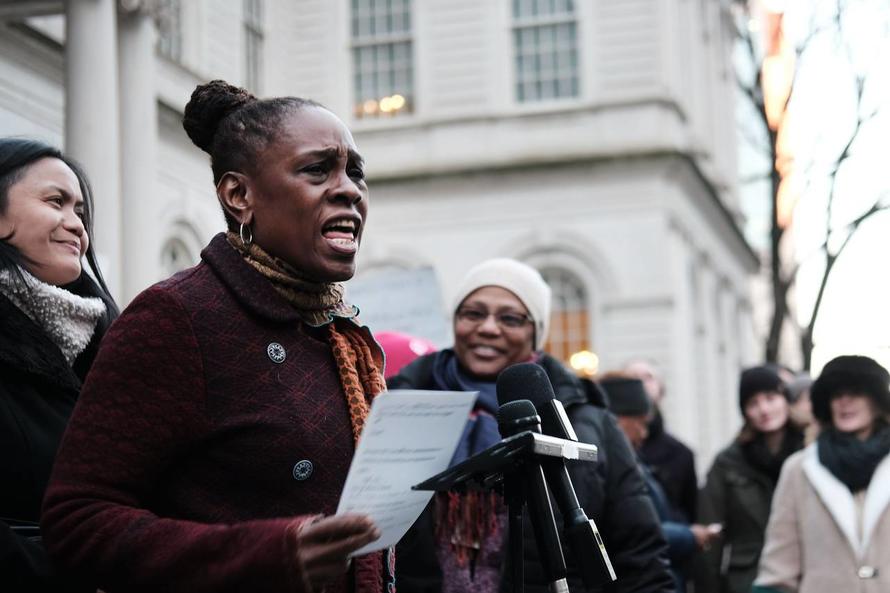
Chirlane McCray, shown at New York City Hall on Feb. 25, created ThriveNYC as a mental-health initiative. PHOTO: SPENCER PLATT/GETTY IMAGES

Spearheaded by Mayor Bill de Blasio’s wife, Chirlane McCray, ThriveNYC encompasses “a variety of initiatives,” according to Politico – making it difficult to pinpoint exactly how the city is spending taxpayer dollars on the program. Thrive is meant to help low-income minorities without access to mental health care deal with issues such as substance abuse, depression and suicide. 

POLITICO spoke to more than 16 people, including elected officials, advocates, representatives of community organizations, researchers and consultants who said that although it is crucial for the city to invest in mental health resources, they did not know whether Thrive was successful and said the city has an obligation to publicize its numbers and how it compares to the goals it set out to accomplish. Some requested anonymity for fear of retaliation while others were more vocal in their critiques. –Politico 

What’s worse, ThriveNYC has been evasive when asked by Politico for a line-item budget in October, asking twice for extensions. When Politico was finally able to obtain two budget breakdowns – one from the city’s Independent Budget Office, and another from City Hall – there were significant discrepancies in how money was spent under the initiative

While the City Hall budget shows $594 million spent since ThriveNYC was kicked off in 2015, the IBO budget shows $816 million. City Hall and IBO both suspect that the Office of Management and Budget included fewer programs in the City Hall accounting, however the discrepancies nonetheless illustrate the difficulties in tracking the program. 

The three-year-old program now has 21 employees and an office budget of $2 million, according to Susan Herman, who manages the office. 

According to the Wall Street Journal, “Councilman Chaim Deutsch, who represents parts of Brooklyn including Brighton Beach, said he hasn’t seen ThriveNYC public outreach efforts in his district, and he had a difficult time registering for a mental first-aid training, one of the signature efforts of ThriveNYC.”

“With a $250 million budget, I should already be sick of ThriveNYC,” said Deutsch. “I have not seen anything.

According to Herman, however, some 100,000 people have been trained to provide mental-health “first-aid” to people in crisis. Around half of those who have been trained are city workers. Meanwhile, the city’s crisis helpline – managed by ThriveNYC, has received over 250,000 calls, texts and chats in 2018. 

Unfortunately, this data isn’t enough to accurately gauge whether ThriveNYC is a corrupt slush fund which has also provided meaningful services, or a well-oiled machine that simply hasn’t found a way to account for its successes. 

While it plans to be more deliberate in the future, Thrive staff did not provide internal goals or benchmarks by which to judge its progress to this point.

For instance, Thrive’s metrics show that between July 2016 and October 2018, 189,070 Naloxone kits were distributed throughout hospitals, syringe exchange programs and other sites where opioid overdose is common. But there is no corresponding data on how many were used or how effective the outreach was.

Social media ads promoting Thrive have reached millions of people, according to the metrics, but the data doesn’t show how many people actually used the program after learning about it. 

In the case of diversion programs, which aim to keep individuals with mental health and substance use problems in treatment instead of jails, Thrive only tracks the number of people released under supervision and those screened during pre-arraignment — not if or how city-funded intervention worked. –Politico 

One metric in which ThriveNYC appears to have failed is screening new mothers for depression, after 29 hospitals responsible for more than 78,000 annual births committed to counseling, referred by Thrive. 

According to Politico, they haven’t come anywhere near their goal – screening just 28,560 new mothers between September 2016 and October 2018, according to data provided by Thrive. As a result, just 570 of the estimated 12,000 – 15,000 women suffering from postpartum depression were reached. 

“If we want to reach all these women, we need to start somewhere. We can’t turn on a switch one day and then screen 120,000 women a year,” said Gary Belkin, Thrive’s policy and strategy chief during an interview. 

“It’s a big city, there must be thousands of OB-GYN providers in communities, in isolated offices. We can’t have a universality in this from day one,” added Belkin – who maintains that the program has been an overall success. 

“We’ve actually built the first rational approach to the real scope and breadth of the need. And the depth issue, I don’t know of many city initiatives that have so quickly touched so many New Yorkers in such a short period of time.” 

That said, nobody really knows how well the program is doing given its massive transparency issues

via ZeroHedge News https://ift.tt/2IJ4rPm Tyler Durden

Shale Growth Is Nearing An Inflection Point

Authored by Nick Cunningham via Oilprice.com,

Drilling activity has plateaued in much of the U.S., with the rig count zig-zagging well below the peak from last November.

The rig count often rises and falls in response to oil prices, but on a several-month lag. It takes some time before oil companies make drilling decisions in response to major price movements. As such, the price meltdown in the fourth quarter of 2018 is still working its way through the system.

But the U.S. shale industry has already begun to tap the brakes. Total U.S. oil rigs are stood at 853 for the week ending on February 22, down from a peak of 888 in November. In particular, the Permian – often held up as the most profitable and prolific shale basin – has seen the rig count decline to a nine-month low.

Production continues to rise, to be sure, but the growth rate could soon flatten out.

“We estimate that the y/y change in US oil drilling will, for the first time since 2016, turn negative by late May, should the current trend of gentle declines continue,” Standard Chartered analysts led by Paul Horsnell wrote in a note.

(Click to enlarge)

At the same time, oil prices are rising again, and are up roughly 25 percent since the start of the year. If WTI tops $60, many shale drillers could find themselves feeling confident all over again, and could pour money and rigs back into the field.

That said, multiple drillers have laid out more conservative and restrained drilling programs, facing pressure from shareholders not to overspend. According to Bloomberg and RS Energy Group, U.S. E&Ps have trimmed their spending plans by 4 percent on average, while at the same time they still expect production to grow by 7 percent.

Noble Energy, for instance, posted a $824 million loss for the fourth quarter, and slashed 2019 spending plans in response. The company expects to spend between $2.4 billion and $2.6 billion this year, sharply down from the $3 billion spent in 2018. The loss was magnified because the company was forced to take an impairment charge due to lower oil prices, which pushed some of its assets out of reach.

“Recent market dynamics, including increased commodity price volatility, further highlight the need for our industry to prioritize capital discipline and corporate returns over top-line production growth,” said Noble Chief Executive David Stover, according to the Houston Chronicle.

Still, Noble’s President and CEO Brent Smolik told analysts and investors that the company’s productivity in the Permian continues to improve.

“Through drilling completion and facility design changes and lower service cost, we’ve already identified $1 million to $1.5 million of well cost reductions versus the second half of 2018,” Smolik said on an earnings call.

Pioneer Natural Resources, considered one of the stronger drillers in Texas, also pared back its spending and growth plans for this year. After seeing production rise by 20 percent in each of the past two years, Pioneer will see growth slow to 15 percent. Spending will fall by 11 percent. Meanwhile, drilling and completion costs will rise by between 4 and 5 percent by the end of the year, Pioneer said. The company’s share price fell sharply when it reported fourth quarter earnings that missed analyst expectations in mid-February, although it has made up ground since then.

Pioneer’s CEO Tim Dove abruptly retired, handing the reins back over to Scot Sheffield, the former CEO. A handful of other chief executives from shale companies also resigned recently, in a sign that shareholders are getting antsy about financial results.

“It’s a what-have-you-done-for-me-lately scenario,” Jason Wangler, analyst with Imperial Capital in Houston, told Reuters. “Not only are investors holding people accountable, they’re watching every move.”

It’s hard to reconcile the disappointing financial results and the promises to do better on the one hand, and the forecasts from the likes of the EIA for ongoing explosive production growth on the other. There are signs that the U.S. shale industry is slowing down – modest spending cuts and a flat or declining rig count – but also plenty of evidence to suggest production growth will remain on track.

The industry is entering a new era of heightened scrutiny from shareholders. The financials seem to be improving, with some (only some) companies cash flow positive or on the verge of it. But they still expect to spend large amounts to grow production. This year will be an important marker for the health of the industry, after lofty promises of lower breakevens, efficiency gains and a cash flow-centric strategy. Time will tell.

via ZeroHedge News https://ift.tt/2C3ad8J Tyler Durden

Why Parents Shouldn’t Flip Out Over Too Much Screen Time: Podcast

“How do I prepare my children for a future I can’t imagine?”

Adults project their fears onto children—our own or other people’s—and especially tend to view new technologies (the internet) and cultural products (video games) as mortal threats to the way things have always been and should always be. That leads to a lot of really bad policies and ridiculous urban legends (Momo Challenge, anyone?). And constantly being in a state of panic over change makes life pretty sucky for kids and grown-ups alike.

My guest today is Jordan Shapiro, author of The New Childhood: Raising Kids To Thrive in a Connected World. Unlike virtually any other book about kids and digital culture that I have read in recent years, The New Childhood doesn’t begin from the presumption that smartphones, tablets, and online gaming are making kids dumber, less focused, and unhappy. Shapiro, a psychologist who teaches at Temple University, has produced a thoughtful analysis of the benefits of new media for younger people. As important, he shows how adults need to understand the uniquely interconnected world in which their children now live. This deeply researched, historically conscious, and powerfully argued book blends academic rigor with personal experience and practical advice. In it, Shapiro takes free-range parenting into the cloud.

Subscribe, rate, and review our podcast at iTunes. Listen at SoundCloud below:

Don’t miss a single Reason Podcast! (Archive here.)

Subscribe at Apple Podcasts.

Follow us at SoundCloud.

Subscribe at YouTube.

Like us on Facebook.

Follow us on Twitter.

from Hit & Run https://ift.tt/2HakMdw
via IFTTT