The Buyer Strike Is Over: US Stocks See First Inflows After 12 Weeks Of Redemptions

The buyer strike in US stocks is finally over.

After 12 consecutive weeks of outflows, which saw $50.3BN of redemptions – the worst start since 2016 – with US equity funds suffering a $4.6 billion outflow last week even as stocks continued their relentless ascent higher, BofA reports that according to EPFR data, equities finally saw an inflow of $9.1BN in the latest week, the largest since September as the bears finally threw in the towel and joined the CTA, stock buyback and short covering frenzy.
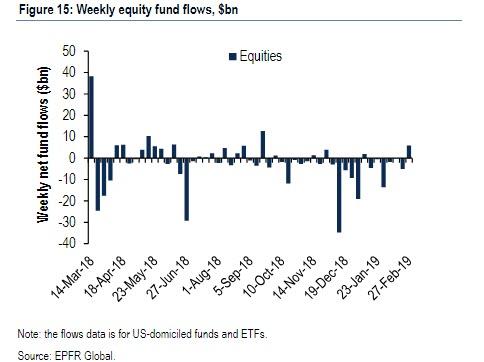
Even so, total global equity inflows were muted, and amounted to just $0.3 billion ($10.2BN in ETF inflows offsetting $9.9BN in mutual fund outflows), with all non-US regions seeing modest outflows:

  • Japan: 3rd week of outflows ($0.9bn)
  • Europe: chunky outflows again ($4.1n)
  • EM: 2nd week of small outflows ($0.1bn)

Broken down by style, equity buying was modest and exclusively in “growth” not “value”. Specifically, inflows were observed in US large cap ($4.6bn) and US small cap ($0.3bn). A breakdown by sector saw inflows in: consumer ($1.7bn), tech ($1.3bn), healthcare ($0.7bn), real estate ($0.4bn), utilities ($0.2bn), materials ($41mn), while outflows were focused on energy ($1mn), and financials ($0.5bn).

A curious tangent: while there was a reversal in EM flows, with 2 consecutive weeks of outflows after a record inflow streak, China has curiously been lagging inflows to EM.

Meanwhile, it is quite notable that the tepid reversal into US equity flows did not come at the expense of bond outflows, which saw another impressive $6.5BN in total inflows.

Some more details on the latest relentless fixed income inflow data:

  • 6th week of IG bond fund inflows ($2.9bn)
  • 5th week of HY bond inflows ($0.8bn)
  • EM debt inflows 7 of past 8 weeks ($1.1bn)
  • 8th week of Muni fund inflows ($1.2bn)
  • 8th week of MBS fund inflows ($0.6bn)
  • Small Govt/Tsy inflows ($0.3bn)

That said, even here there was some modest outflows, including the 5th consecutive week of TIPS outflows ($0.5bn) and the 15th week of bank loan fund outflows ($0.1n).

Commenting on the recent flows, BofA’s CIO Michael Hartnett writes that the “Fed has ignited credit”, and as shown in the chart below, inflows to IG/HY/EM debt for the past 8 weeks amounted to $43BN, a major reversal from $69BN of redemptions in these credit products in Nov/Dec.”

And speaking of the Fed, Hartnett also notes that the equity rally has not led to Fed tightening as was expected (on the contrary, Fed talking “inflation targeting” to head off MMT) while the PBoC/ECB/BoJ are now ready & willing to ease. As a result of this increasing dovishness, both US  & Euro HY corporate bond returns are already back to highs, while as discussed two days ago, the bond volatility MOVE index at lows as policy makers are urging trade to “stay long risk.”
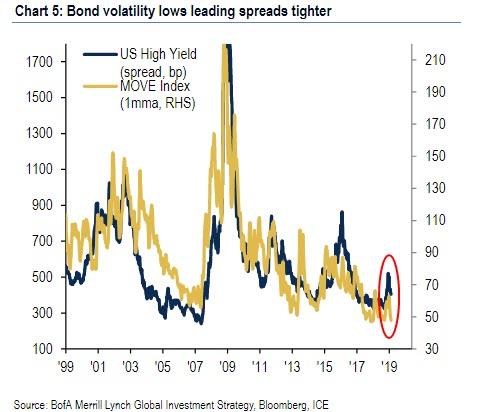
Ironically, while the global economy was sharply slowing, the read-through by markets was especially bullish as it assured even more dovish central bank responses. However, a recent risk has emerged to risk in the form of a new batch of “green shoots”: even as Japan/EU remain recessionary, China’s new orders rose for the 1st time in 9 months; Meanwhile in the US, claims data still low, while as a result of the “reflation” narrative, the 5s30s US yield curve has steepened 25bps past 3 months, as China bond yields inflecting higher.

To BofA, this suggests to position “for Q1 global EPS expectations trough”, in other after a brief earnings recession in Q1, BofA expects another sharp rebound in corporate earnings.

There is some more bad news however, and as Hartnett summarizes, these markets are for traders not investors, as  “green shoots” are most powerful in secular bear markets (Europe & China today). And as a case study, he notes that in Japan between 1990 and 2003 there were 13 equity trading rallies that exceeded 20%, and seven trading rallies that exceeded 33%.
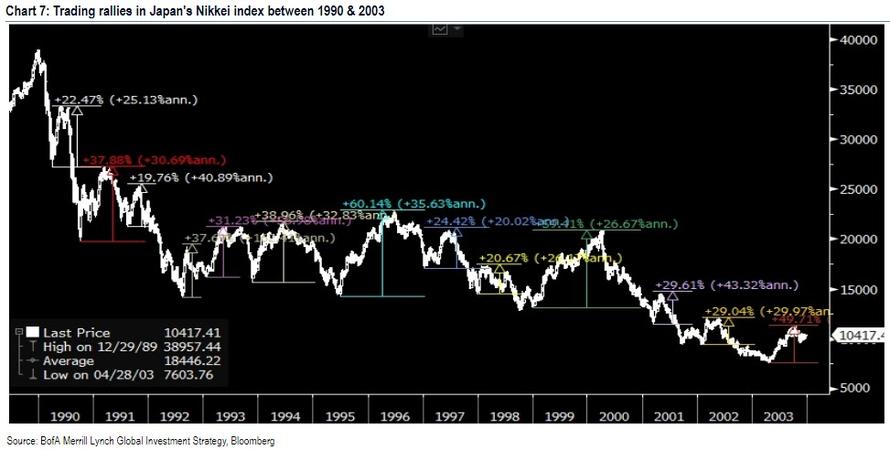
All of which begs the question: if this is indeed just another “green shoots” surge in a secular bear market, did investors – who had patiently stood on the sidelines for 3 months – once again top tick the inflection point in the market, and does this week’s US equity inflow mark the high point of the rally. For the answer check back in one week’s time.

via ZeroHedge News https://ift.tt/2Ta0nwc Tyler Durden
As Many As 5 Socialists Could Join Chicago’s City Council

Via Robert Wenzel,

It’s bad out there, really bad…

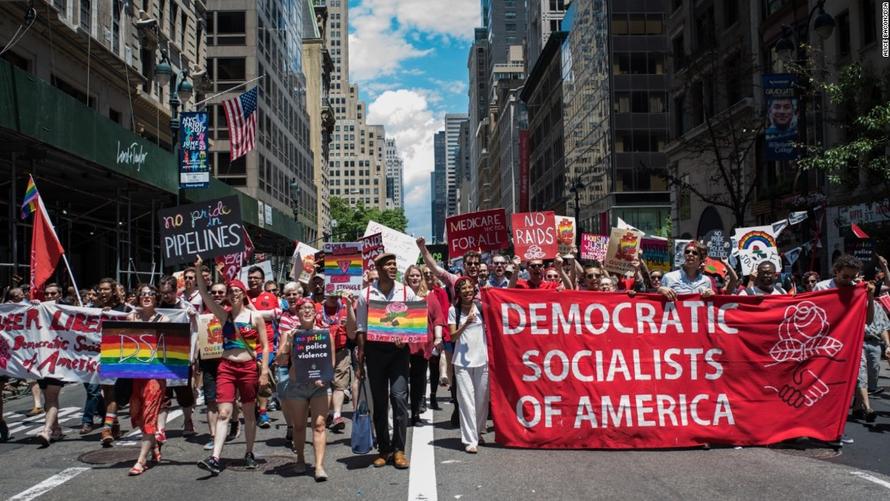
If their success on Tuesday carries over to the April runoff election, as many as five members of the Democratic Socialists of America could be on the Chicago City Council —  the most in more than a century, reports the Chicago Sun-Times.

Two won aldermanic seats outright.

Three others made the runoffs.

“This progressive insurgency is absolutely historic,” Rodriguez-Sanchez campaign volunteer Rachel Johnson said, according to the Sun-Times.

“We are poised to have three or four new socialists on the City Council and will be positioned to have a socialist [caucus] on the City Council. I’m absolutely elated.”

In 2015, the DSA, the most active socialists,  had roughly 5,000 members, since the election of Trump the organization says it has grown to about 60,000 card-carrying DSA members nationwide.

The most prominent socialist, Congresswoman Alexandria Ocasio-Cortez has over 3.3 million Twitter followers.

via ZeroHedge News https://ift.tt/2NA5YGa Tyler Durden

Kellyanne Conway Pushes Debunked Myth About Fentanyl-Laced Weed

Addressing the Conservative Political Action Conference (CPAC) today, White House counselor Kellyanne Conway pushed a debunked myth about marijuana laced with fentanyl.
“Fentanyl is an instant killer, and a tiny little grain of it can wipe us out,” Conway said during a panel discussion with Fox News contributor Sara Carter. “And it’s being laced into marijuana, heroin, meth, cocaine, and street drugs.”

Of course it’s possible to lace marijuana with fentanyl, just as it’s possible to, say, mix dog food with chocolate. And on rare occasions it happens: Police say dozens of people overdosed on fentanyl-laced pot at a park near Yale University in August. But that was an isolated and unusual incident; there’s no sign it happens with any sort of frequency.

People talk about it happening much more often. Several inaccurate stories about weed-laced fentanyl went viral in 2017, according to Snopes, as police departments across the company issued warnings about a “fentanyl-pot craze.” In March of that year, Sen. Rob Portman (R–Ohio) claimed Ohio police had told him drug dealers were putting fentanyl in marijuana. The police later said this wasn’t true. But that didn’t stop Portman from making an almost identical claim almost a year later.

In June 2017, a Drug Enforcement Administration spokesman told the Cincinnati Enquirer he hadn’t heard of any cases where marijuana had been mixed with fentanyl. That’s partly why in September of that year, Snopes rated the claim that fentanyl-laced marijuana is “a real and growing concern in the United States” as “false.” Meanwhile, the American Addiction Centers has said that weed is “probably less likely to be intentionally laced with other psychoactive substances than many other illicit drugs.”

But the scaremongering didn’t stop. In March 2018, Secretary of Health and Human Services Alex Azar tried to convince young people at a White House event that weed is part of the opioid crisis. “These are very sophisticated operators, and they are lacing other illegal drugs with fentanyl to get you hooked on opioids and bring you into their system,” he said. “Marijuana laced with fentanyl, all kinds of other products laced with fentanyl.”

As Salon noted at the time, one reason this myth is promulgated is that coroners find traces of both marijuana and fentanyl in the bodies of people who have died of drug overdoses. They later discover that the substances were consumed separately, and that the fentanyl, not the weed, was the cause of death.

This wasn’t the only, or even the worst, moment of scaremongering during the panel discussion. At one point Carter claimed that young people are having “‘Skittles parties,’ where they bring pills and put them into bowls and everybody picks a pill that they want and takes them. I mean, it’s kind of shocking when I heard about this, randomly taking pills.”

Sound ridiculous? That’s probably because it is.

from Hit & Run https://ift.tt/2H9rOPJ
via IFTTT

Competitors’ Shares Tumble On Report Amazon To Open New Grocery Chain

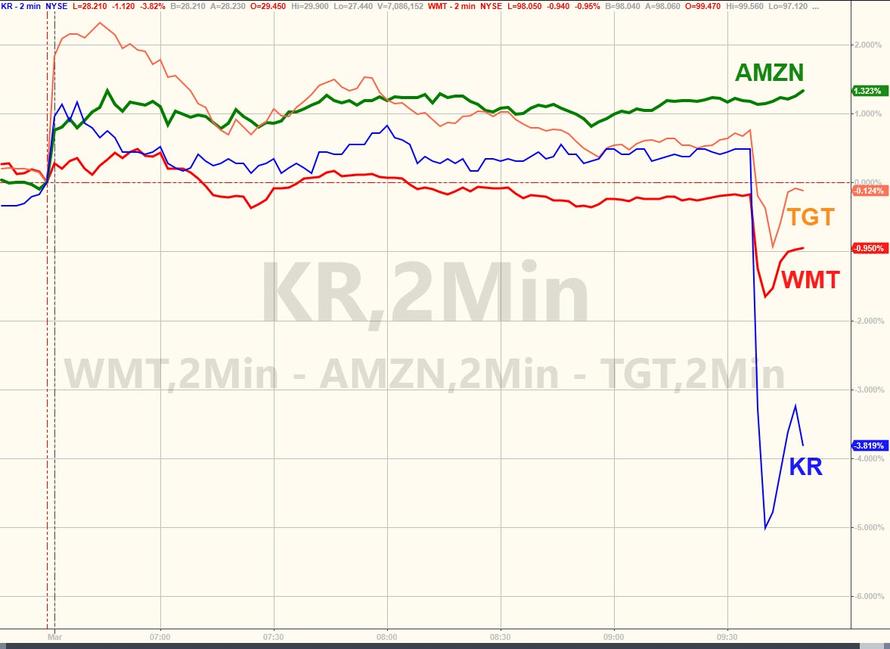
In the latest confirmation that Jeff Bezos will settle at nothing less than total domination of the grocery business, the Wall Street Journal reported on Friday that Amazon is planning to open a new chain of low-cost supermarkets in several major US cities. With dozens of new stores, the chain would co-exist with Amazon-owned Whole Foods by offering a broader assortment of products at a lower price point. while Amazon’s growing cashierless ‘Amazon Go’ chain, will focus on a smaller, more focused offerings similar to US convenience stores.

Signaling that the company is planning to continue its conquest of the space by growing organically (though it might acquire a few regional grocery chains along the way, per WSJ), shares of Wal-Mart, Kroger and Target all fell on the news.

AMZN

The first store in this new chain could open in LA by the end of the year, WSJ reported. Meanwhile, Amazon is also in talks to open grocery stores in shopping centers in San Francisco, Seattle, Chicago, Washington, DC, and Philadelphia, and has already signed leases in some locations.

Amazon’s growing focus on retail comes as the company has had mixed results with its grocery delivery business, and has decided that it would be better served by expanding its retail offerings. Meanwhile, Amazon is also planning to grow its Amazon Go offerings, with 10 stores already open.

In a sign these new stores could expand their offerings to include health and beauty products, Amazon has asked for flexibility in its leases.

Amazon has asked for more flexibility in lease negotiations, these people said. The company doesn’t want restrictions on the type of goods it may sell at its stores and wants the ability to change the store and sell health and beauty products for instance, said the people. Traditional leases in shopping centers often include limitations so that businesses complement rather than cannibalize each other.

It is unclear if these grocery stores will also be cashierless, but they will be heavily tilted to customer service and pick-up capabilities, according to the people familiar with the matter. Amazon is also looking to have some control over the attached parking lot, which would allow shoppers to get their groceries within a 10-to-15-minute time frame, the people said.

Analysts say that this new hybrid strategy where e-commerce is combined with physical stores to allow customers to shop wherever, whenever, could be the future of the retail industry.

“Customers want to be able to shop when it is most convenient for them, which could be in-store, online or a combination of the two,” said a spokeswoman from the International Council of Shopping Centers.

In the first analyst comments following the WSJ report, analysts at Spruce Point said Amazon’s move into the grocery business will be a ‘net long-term negative’ for its competitors.

via ZeroHedge News https://ift.tt/2BYcmmc Tyler Durden

Winter Storm: Northeast Braces For Next Round Of Harsh Weather This Weekend

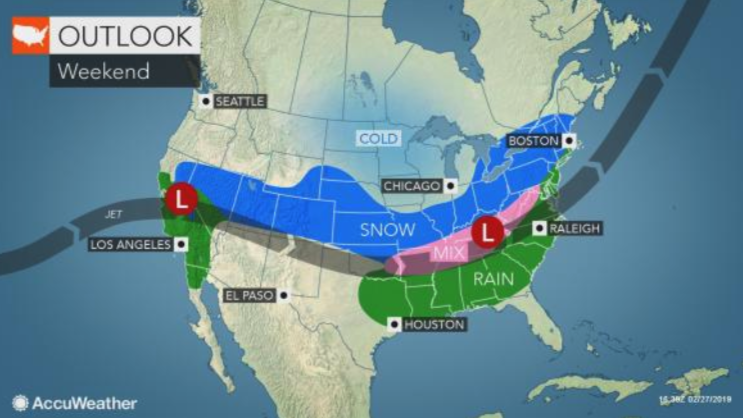
Just when Zerohedge readers thought it was time for spring, old man winter has a few more tricks up his sleeve. New weather models show several storms will affect the Northeast over the weekend.

The storm system that brought severe weather from California to the Midwest is beginning to shift and could threaten Mid-Alantic and Northeast cities with snow, ice, and rain by this weekend.

Winter Storm Ryan will begin along the West Coast by late Friday, then move across  Rockies, Plains, Ohio Valley and Northeast through the weekend.

Winter storm watches have been published for California’s Sierra, Central Midwest, Mid-Atlantic, and Northeast, where the weather is expected to deteriorate in the next 24 to 48 hours.

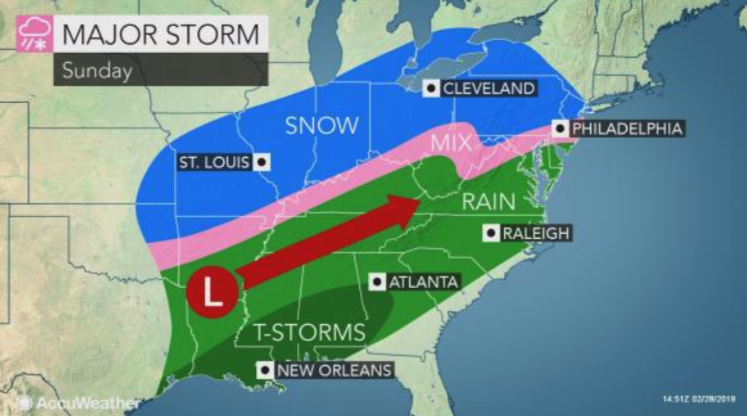
The storm is expected to impact the Northeast late Sunday into early Monday.

“The exact track of that storm and magnitude of the lingering cold air in its path will determine the extent and intensity of snow, ice and rain in the Eastern states from Sunday to early Monday,” according to AccuWeather Meteorologist Courtney Travis.

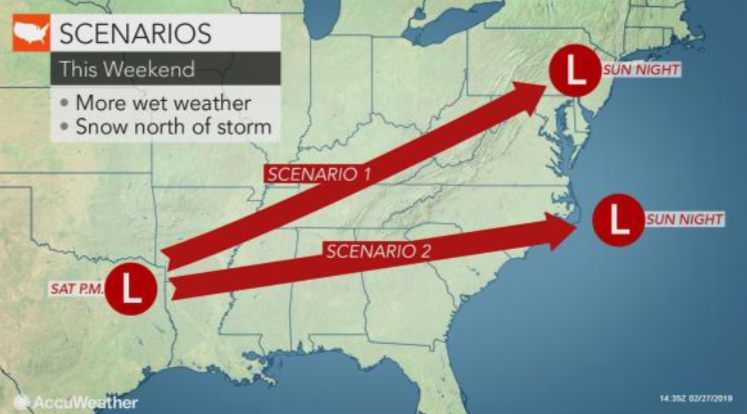
Here are the scenarios at play

If Winter Storm Ryan takes a northeastward route toward the central Appalachians and the mid-Atlantic coast as Travis believes (scenario 1), 4 to 8 inches of snow may fall from central Plains to the northern part of the Ohio Valley, the eastern Great Lakes, the Allegheny and Pocono mountains in Pennsylvania and northern New England.

This northeastward path would allow some cold air to penetrate the affected areas but bring mostly rain to Washington, D.C., to New York City and Boston.

Heavy snow is likely around Denver; Wichita, Kansas; St. Louis; Columbus, Ohio; Albany, New York; Bangor, Maine, and others. Pittsburgh may observe its most significant storm of the winter season if more than 4 inches of snow falls.

AccuWeather has an alternative model, a shift in the storm’s path to the east (scenario 2) might result in 1 to 2 inches of snow from the mountains of West Virginia to northern Virginia, northern Maryland, southeastern Pennsylvania, Delaware, much of New Jersey, southeastern New York state and southern New England.

This shift eastward would allow the bulk of the snow to fall in Washington, D.C., Baltimore, Philadelphia, New York City and perhaps Boston. Such a path could result in significant travel disruptions Monday.

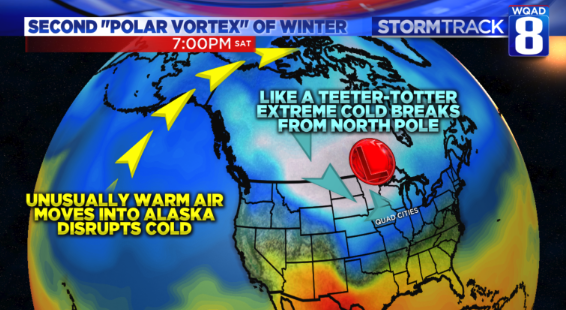
A new wave of Arctic air expected 

Despite Winter Storm Ryan’s track, a significant blast of Arctic air is inbound for Northeast and Midwest.

High winds will follow the leading edge of the Arctic air. 

Gusts between 40 and 55 mph are expected over the Upper Midwest and 30 and 45 mph in the Northeast.

AccuWeather said the blend of wind and falling temperatures would send RealFeel® Temperatures well below zero over the Upper Midwest, Mid-Alantic and Northeast.

via ZeroHedge News https://ift.tt/2IKcX0o Tyler Durden

Cory Booker Makes Federal Marijuana Legalization a Central Campaign Push

Cory BookerIf you need an example of how much public opinion has shifted on marijuana legalization, check out Sen. Cory Booker’s Twitter feed, where the Democratic presidential candidate has turned his federal pot decriminalization bill into a central plank of his platform.

He’s not alone: Several other declared Democratic candidates have signed on to Booker’s reintroduction yesterday of the Marijuana Justice Act. The bill would completely strike marijuana off of Schedule I of the Controlled Substance Act, ending its status as a prohibited drug on the federal level. The bill also ends federal bans on import and export of marijuana. It would order the expungement of the records of people with previous federal convictions for marijuana use or possession, and it would threaten to withhold Justice Department grant funding to states that have a “disproportionate” rate of marijuana arrests or jail sentences for minorities or poor people.

When Booker introduced this bill in 2017, it went nowhere. Now he’s introducing it again, and his six co-sponsors include fellow presidential candidates Kamala Harris (D–Calif.), Bernie Sanders (I–Vt.), Elizabeth Warren (D–Mass.), and Kirsten Gillibrand (D–N.Y.). (The other two co-sponsors are Ron Wyden and Jeff Merkley, both Democrats of Oregon.) Another presidential candidate, Rep. Tulsi Gabbard (D–Hawaii), previously co-sponsored the House version of the bill.

Booker is also using this bill to promote his presidential run, telling folks to text to a number to get more information, which is a typical tactic to harvest phone numbers for future campaign messages.

Compare this push to the Democratic Party’s official platform in 2016, which merely recommended downgrading marijuana so that it didn’t have the same classification on the drug schedule as heroin. Bernie Sanders’ supporters had to fight for just that. Striking it entirely from the Controlled Substances Act was not on the table, and the goal was to give states some space to experiment.

And that change, as Reason‘s Jacob Sullum noted back in 2015, was itself a huge deal. Hillary Clinton was ambivalent about full decriminalization, and Sanders’ pro-legalization position was almost unprecedented among major-party presidential candidates.

Now six Democratic candidates are looking to completely wipe marijuana out of the Controlled Substance Act, and Booker is actively using that push to draw attention to his campaign.

from Hit & Run https://ift.tt/2EH5U4J
via IFTTT

Military Intervention in Venezuela Would Be a Reckless, Dangerous Option: New at Reason

|||Johnny Louis/JL/Sipa USA/Newscom

Sen. Marco Rubio has seasoned his commentary on Venezuela’s chaos with a simple message: Maduro needs to go, and the United States should make it happen. This push for U.S.-orchestrated regime change should be given no quarter. This is a humanitarian crisis, not a security threat. American military might is not the solution to Venezuela’s woes, and even calling for this sort of intervention may exacerbate an already horrifying situation.

Unfortunately, Rubio has been an influential voice on Venezuela for the Trump administration. And despite Donald Trump’s campaign-trail invective against avoidable wars, his policy here may yet be swayed by Rubio’s bluster. The senator is right that Maduro is bad for Venezuela, but it would be folly and cruelty to wage war to force him out, writes Bonnie Kristian in Reason.

View this article.

from Hit & Run https://ift.tt/2HahhDZ
via IFTTT

Cali Student Busts Professor Who Said Cops “Need To Be Killed”

Authored by Jon Street via Campus Reform,

A professor at the University of California-Davis professor is facing renewed backlash over a 2014 tweet in which he reportedly said that police “need to be killed.” 

UC-Davis English Professor Joshua Clover, in tweets on his now private Twitter account, reportedly wrote, “I am thankful that every living cop will one day be dead, some by their own hand, some by others, too many of old age #letsnotmakemore.” A separate tweet from Clover just one month later reportedly read, “I mean, it’s easier to shoot cops when their backs are turned, no?”

During an interview in 2015 interview with SFWeekly.com, Clover said, “People think that cops need to be reformed. They need to be killed.”

Those comments had gone largely forgotten until the recent fatal shooting of Davis police officer Natalie Corona prompted one UC-Davis student to do a little digging on one particular professor who he had heard had a track record of making anti-law enforcement comments. Sure enough, the student’s research paid off. He wrote an op-ed in the student newspaper, The Aggie, explaining how he discovered the incendiary remarks and the actions he took once discovering them. 

“The shooting reminded me of the rumors about the cop-threatening professor last quarter. I wasn’t trying to connect the two — the shooting and the professor’s comments about killing cops — but the shooting provided the backdrop for my investigation,” student Nick Irvin wrote.

“In a community that’s just witnessed an ambush-style cop killing, the downsides were next to none; we ought to know what our professors think and say on the public record.”

Irvin later wrote that he emailed the professor to find out if he still held the same views. 

“I wanted to know whether his views had changed given the shooting of Natalie Corona, and if he’d walk them back or at least offer a smidgeon of context to them. This was the first step to uncovering the standards to which our university holds its professors,” Irvin explained. 

But Clover’s response indicated his views toward police have not changed. 

“I think we can all agree that the most effective way to end any violence against officers is the complete and immediate abolition of the police,” Clover responded, according to Irvin. The UC-Davis columnist said the professor referred further questions to the family of Michael Brown, who was fatally shot in 2014 by a Ferguson, Missouri police officer. That officer was charged but later acquitted. 

Reached for comment by KOVR-TV in Sacramento, Clover said, “On the day that police have as much to fear from literature professors as Black kids do from police, I will definitely have a statement.”

According to Irvin, as soon as he contacted the professor to comment on previous tweets, that’s when the account became private.

Irvin said one of his next steps was to contact the university for its reaction to Clover’s comments. 

“The UC Davis administration condemns the statement of Professor Clover to which you refer. It does not reflect our institutional values, and we find it unconscionable that anyone would condone much less appear to advocate murder. A young police officer has been killed serving the City of Davis,” university spokeswoman Dana Topousis said, referring to Corona.

“We mourn her loss and express our gratitude to all who risk their lives protecting us. We support law enforcement, and the UC Davis Police Department and Chief Joe Farrow have been and remain critical partners to our community,” Topousis added. 

The university’s response is similar to that of other universities that have been forced recently to respond to professors or other university employees advocating or condoning violence.

Just last week, UC-Berkeley responded to one of its employees, Yuvi Panda, who reacted to a conservative getting punched in the face, unprovoked, with a tweet that read, “OH MY GOD THE MAGA PEOPLE ON UC BERKELEY CAMPUS YESTERDAY GOT PUNCHED IN THE FACE BY SOMEONE THIS MAKES ME FEEL EMOTIONALLY SO MUCH BETTER.”

“This person does not speak for the university, does not represent the university, and does not share the university’s values,” UC-Berkeley assistant vice chancellor for communications Dan Mogulof told Campus Reform.

“The University has made clear through word and deed that violence and harassment are reprehensible and intolerable, no matter who the perpetrators and victims are, or what they believe in.”

Just last month, University of Georgia teaching assistant Irami Osei-Frimpong tweeted that “some white people may have to die for black communities to be made whole in this struggle to advance to freedom.” Osei-Frimpong has made several other racially charged comments on his personal Twitter account, as Campus Reform has reported. 

UGA, for its part, initially took no action, pointing out that Osei-Frimpong’s comments were made in his personal capacity on his personal account. However, the university later said it was “vigorously exploring all available legal options.”

“Racism has no place on our campus and we condemn the advocacy or suggestion of violence in any form,” UGA said in its statement. 

UGA did not immediately respond to Campus Reform when asked the current status of Osei-Frimpong’s employment with the school. 

via ZeroHedge News https://ift.tt/2TniFcL Tyler Durden

The Lingering Stench of Marijuana Prohibition: New at Reason

Franklin Roosevelt, who took office in the final year of Prohibition, issued some 1,300 pardons for alcohol-related offenses during his first three terms. As a 1939 report from the Justice Department explained, “pardon may be proper” in light of “changed public opinion after a period of severe penalties against certain conduct which is later looked upon as much less criminal, or as no crime at all.” The report cited Prohibition as “a recent example.”

That logic made sense to governors as well. When Indiana repealed its alcohol prohibition law in 1933, Gov. Paul McNutt (D) issued pardons or commutations to about 400 people who had been convicted of violating it. “If these men were kept in prison after the liquor law is repealed,” he said, “they would be political prisoners.”

Alcohol prohibition lasted 14 years. Marijuana prohibition has been with us almost six times as long. Police have arrested people for violating it about 20 million times in the last three decades alone. Many of those people were ultimately convicted of felonies that sent them to prison, although the vast majority were charged with simple possession and spent little or no time behind bars. Either way, marijuana offenders have had to contend with the lingering effects of a criminal record, which can shape people’s lives long after they complete their sentences, writes Jacob Sullum.

View this article.

from Hit & Run https://ift.tt/2tT9xyt
via IFTTT

Venezuela Orders PDVSA Offices Relocate To Moscow; Putin Affirms Support To “Friend” Maduro

A top Venezuelan official has announced that President Nicolas Maduro has ordered national oil and gas company PDVSA to close its current European headquarters in Lisbon, Portugal and move it to Moscow. The announcement came from Venezuelan Vice President Delcy Rodriguez during a press conference standing alongside Russian Foreign Minister Sergey Lavrov in Moscow on Friday. 

“President Nicolas Maduro instructed the Lisbon branch of PDVSA to close this office and relocate the office to Moscow,” Rodriguez said, according to Russia’s TASS news agency. It appears the relocation is already underway, and is part of the framework of “broadening cooperation” with Russian energy giants Rosneft and Gazprom, according to the statement.

Petróleos de Venezuela, S.A., PDVSA offices, via AFP

The Venezuelan vice president said, “This is done in line with our plans to expand technical cooperation in the oil production area with Rosneft, with Gazprom. The moment now is the most suitable to do so. We are changing the format of our relations.” And she added, “It’s the perfect time, as we are reshaping our relations.”

As part of the press briefing, Russian FM Lavrov conveyed President Putin’s words of support and solidarity to his “friend” President Maduro in a further clear sign that Moscow has dedicated itself to helping Venezuela’s state oil company weather the storm of US economic war and sanctions. 

Lavrov explained in the press conference, “Russia will further help the Venezuelan government to solve social and economic problems, which includes lending support via legitimate humanitarian aid.”

This after what’s been widely acknowledged as failed US-led coup efforts over the past weeks in support of opposition leader Juan Gaido, who has tried to rally support for greater external “pro-democracy” intervention against the Caracas government. As part of her remarks Rodriguez slammed what she called a US “operation” of “sabotage” against a “legal government” spearheaded by White House envoy to Venezuela Elliott Abrams.

The Venezuelan vice president said:

As far as operation against Venezuela is concerned, it’s headed by a person experienced in such kind of sabotage, person who repeatedly spoke against legal governments, Mr. Abrams. There are certain plans, certain steps aimed at creation of illegal armed groups according to the US tradition, creation of terror groups. The whole world knows it’s doing that, it’s not a secret. The US supports such extremist illegal terror groups to destabilize the world.

Lavrov backed her assessment as follows: “We are concerned about the US plans to arm militants to destabilize the situation in Venezuela and, strictly speaking, to invade this sovereign country, as the US does not hesitate to speak openly about them,” said the Russian foreign minister.  

Friday’s words vowing closer relations between Moscow and Caracas come after Maduro made an official visit to meet with Putin in December, where the two inked broad deals for increased trade and investment in various industries and finance.

via ZeroHedge News https://ift.tt/2Nzh7ar Tyler Durden