GDP Crash: Goldman, Atlanta & NY Feds See Q1 GDP Tumble Below 1%

While the market was delighted on Thursday to see a delayed Q4 GDP print of 2.6%, which came in well above the expected 2.2% consensus number, we warned that “while Q4 was clearly a stronger than expected print, the real question is what happens in Q1, when most banks and nowcasts expect GDP to print below 1%, in some cases concerningly so.”

Moments ago we got confirmation of precisely this, when following the latest dismal economic data including a 2 year low in the manufacturing ISM, a miss in UMich Consumer Sentiment, and a near record plunge in personal spending, Goldman launched its Q1 GDP tracking estimate at a paltry +0.9%. This forecast, as Goldman’s chief economist Hatzius said, “reflects an expected drag from inventories, sequentially slower consumption growth, a decline in residential investment, and a four-tenths drag from the government shutdown.”

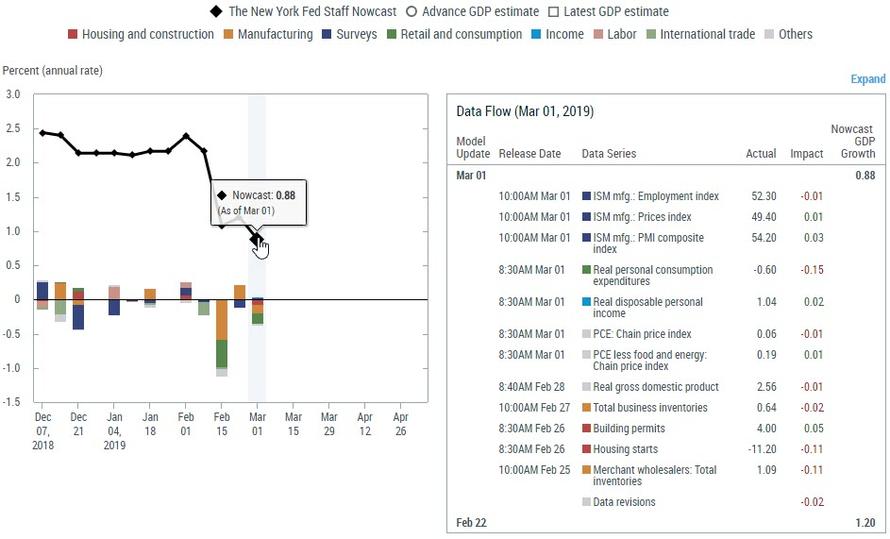
It wasn’t just Goldman, because at roughly the same time, the NY Fed’s GDP Nowcast, which was launched to counter the Atlanta Fed’s famous GDP tracker, crumbled from 1.22% last week (and 2.17% as recently as a month ago), to a stunning 0.88%, as a result of big declines in Personal Consumption, Housing Starts, Wholesale Inventories, and others.

And speaking of the Atlanta Fed, it also just released its latest Q1 GDP nowcast, and it’s a doozy, with the initial estimate coming just barely positive at only 0.3%, to wit:

The initial GDPNow model estimate for real GDP growth (seasonally adjusted annual rate) in the first quarter of 2019 is 0.3 percent on March 1. The initial estimate of fourth-quarter real GDP growth released by the U.S. Bureau of Economic Analysis on February 28 was 2.6 percent, 0.8 percentage points above the final GDPNow model nowcast released the previous day.

It appears that now assured Q1 earnings recession won’t be in isolation, with the broader US economy now on the verge of contracting, if only for just one quarter. The question then becomes whether China’s massive reflation attempts are successful, and lead to a rebound in US growth in the second quarter. If not, what was expected to become the longest US expansion in history in June 2019, will be prematurely terminated by a technical recession just as Donald Trump was set to make a new economic record.

via ZeroHedge News https://ift.tt/2tKKtcT Tyler Durden

Watch the CPAC Crowd Go Wild When Mike Pence Mentions ‘Space Force’

The packed crowd watching Vice President Mike Pence’s speech to the Conservative Political Action Conference (CPAC) today really seemed to like the idea of the Space Force.

The Space Force, of course, is President Donald Trump’s proposed sixth branch of the military. As the name suggests, it’s meant to project U.S. dominance into, well, space.

“We’re modernizing our nuclear arsenal, updating missile defense, and before the year is out, President Trump will launch the sixth branch of our armed forces: The United States Space Force,” Pence said. That statement got big cheers from the crowd, with many even giving it a standing ovation. It sounds like someone tried to start a “U.S.A.” chant, though that didn’t really catch on:

“Under this commander in chief, we’ll make sure that American is as dominant in space as it is on air and land and sea,” the vice president added.

Lest one think attendees only cared about the Space Force, there were also wild cheers when Pence called for a wall on the U.S.–Mexico border. (This time, a “Build the Wall” chant did catch on.) On the brighter side, the crowd also clapped when Pence said Trump was bringing American troops home, though the reaction to that statement was lukewarm compared to the other remarks.

Pence mentioned the Space Force one day after Acting Defense Secretary Patrick Shanahan sent the Penatgon’s official proposal for the new military branch to Congress. Under this plan, the Space Force will start as the U.S. Space Command, and it will technically be part of the Air Force, likely in a similar manner to how the Marine Corps is technically part of the Navy.

Despite the CPAC crowd’s enthusiasm, the Space Force is a bad idea for a host of reasons, not the least of which is that the U.S. military already has plenty of entities that deal with space, making you wonder if we really need to add to the alphabet soup of government agencies. But hey, at least we’re getting a Steve Carrell show out of it.

from Hit & Run https://ift.tt/2NCauEf
via IFTTT

Cuomo And Union Leaders Beg Bezos To Reconsider New York HQ2

Andrew Cuomo is begging Jeff Bezos to reconsider Amazon’s decision to pull out of its plans for a New York City HQ2, according to the New York Timeswhich reports the Governor is “working intensely behind the scenes” to make a personal pitch. 

The governor has had multiple phone conversations with Amazon executives, including Mr. Bezos, over the past two weeks, according to two people with knowledge of the efforts. In those calls, Mr. Cuomo said he would navigate the company through the byzantine governmental process. –New York Times

Cuomo has offered guarantees for support for the project, according to the WSJ, while Amazon executives have given no indication that the company would reconsider. 

“I’ve had many conversations with Amazon. I hope that they reconsider,” said Cuomo ad a Thursday event in Long Island. “It would be helpful if the State Senate said that they would approve it; that would be helpful. But in the meantime I haven’t heard any changes.”

Amazon abruptly abandoned plans for the Long Island expansion – instead focusing efforts on their “second” HQ2 in Northern Virginia. The New York location promised up to 40,000 jobs, and a much needed revival of run-down neighborhoods in and around Long Island City. In return, New York offered Amazon a cumulative $3 billion in tax breaks over 10 years, along with an agreement that the government would develop infrastructure in and around the site. 

Critics of the plan, such as Rep. Alexandria Ocasio-Cortez (D-NY) – an economics major, blasted the $3 billion being “given” to Amazon as a corporate charity, and said it would be better spent fixing the city’s subways and hiring more teachers. AOC’s opposition to the HQ2 is widely cited as a factor in Amazon’s decision to pull out of the plan. 

In response, New York Mayor Bill de Blasio explained to NBC News‘ Chuck Todd that AOC doesn’t understand what she’s talking about – and a tax credit isn’t the same thing as handing money to Amazon. 

During an appearance on NBC’s “Meet the Press,” de Blasio agreed when host Chuck Todd said that the tax breaks offered to Amazon weren’t “money you had over here. And it was going over there.”

“Correct,” de Blasio said.

He added: “And that $3 billion that would go back in tax incentives was only after we were getting the jobs and getting the revenue.”

To further drive home the point, Todd said, “There’s not $3 billion in money —”

“There’s no money — right,” de Blasio said. –NY Post

Nevertheless, Amazon pulled out of the deal, sparking anger and confusion among New York leadership. 

On Friday, an open letter in the New York Times signed by more than 70 supportive unions begged Bezos to reverse course and build the Long Island campus

The letter was signed by more than 70 supportive unions including the AFL-CIO, local businesses and business leaders, community groups and elected officials including Representatives Hakeem Jeffries of Brooklyn, a top Democrat, Max Rose, a first-term Democrat from Staten Island, and Carolyn Maloney, whose district encompasses the Amazon site, and the former mayor David N. Dinkins.

The letter said that Mr. Cuomo “will take personal responsibility for the project’s state approval,” and Mayor Bill de Blasio “will work together with the governor to manage the community development process.” –New York Times

“We know the public debate that followed the announcement of the Long Island City project was rough and not very welcoming,” reads the letter – which was paid for by the business group Partnership for New York City. “But when we commit to a project as important as this, we figure out how to get it done in a way that works for everyone.”

Kathryn S. Wylde, the president of the partnership, said the letter had been aimed not just at Amazon but at assuring technology companies generally that New York City welcomed their businesses: “Yes, it’s directed to Amazon in hopes they will reconsider. Equally, it is a message to the broader industry.” –New York Times

 “The governor’s office was working with the business community on how to send this message,” added Wylde. 

New York State Senate Democratic majority leader, Andrea Stewart-Cousins, said in a statement that he had indicated her “willingness to work” with Amazon, adding “I have always been clear that I support job creation and was disappointed with Amazon’s decision and hoped they would reconsider.”

Since Amazon decided to pull out, Cuomo has been arguing in public and private that support for the project is far more widespread than certain progressive politicians would lead one to believe

“I do believe Amazon should have stayed and fought the opposition,” said Cuomo in a Thursday radio interview. “It was a vocal minority opposition. Seventy percent of the people support Amazon,” which Cuomo reportedly stressed to Amazon executives during phone calls. 

Opponents of the NY HQ2, meanwhile, remained sour on the idea. 

The most vocal opponents, like Stuart Appelbaum, president of the Retail, Wholesale and Department Store Union, were not among the signatories.

“Our concerns remain the same,” Mr. Appelbaum said in response to Mr. Cuomo’s efforts. “If Amazon wants to come to New York, it must respect all workers and communities.” –New York Times

Amazon isn’t having it

The decision to pull out of the New York campus and “hyperfocus” on the Virginia expansion was due to a “confluence of factors, including the loud opposition and the lack of any sign it would abate,” reports the Times

“We think we could have gotten New York done, but you have to say, ‘At what cost?’” said Amazon director of global economic development, Holly Sullivan, during a Thursday event in Virginia. “We made a prudent decision that gives us the opportunity to hyperfocus on D.C.

via ZeroHedge News https://ift.tt/2SAOIBx Tyler Durden

First Seastead in International Waters Now Occupied, Thanks to Bitcoin Wealth

Seasteading was conceived more than a decade ago out of libertarian enthusiasm for the possibilities of improving governance through an explosive proliferation of new polities. Building modular floating “land” on the high seas, its advocates argue, would increase our ability to escape the depredations of existing governments.

In a short video documentary that debuted last night—part one of a four-part series that will be rolled out over the next week—Seasteading Institute president Joe Quirk (co-author of the book Seasteading: How Floating Nations Will Restore the Environment, Enrich the Poor, Cure the Sick, and Liberate Humanity from Politicians) tells the story of the first functional one-family seastead, which now exists 12 nautical miles off the coast of Phuket, Thailand.

Its inhabitants are Chad Elwartowski and Nadia Summergirl. In a chat-window interview before the video premiered on YouTube last night, Elwartowski told me that his “main motivation has been finding true liberty in this lifetime. I have participated in several other projects that promised that but never delivered,” including the “​Free State Project, Libertarian Party elections, Ron Paul campaign, other seastead projects.”

Now he’s living in a private seastead in international waters along with Thai native Summergirl, who says in the video that she was tired after 10 years of seeing seasteading remain just talk: “I just want to get seasteading happen for real. I want to make it happen here in Thailand.” The team surrounding the project were early adopters of bitcoin, and with wealth acquired that way it has spent around $150,000 on the project, Elwartowski says. That’s about $30,000 more than they anticipated—”as it is experimental we ended up adding and adding and adding,” he tells me. (I wrote speculatively about bitcoin wealth funding libertarian projects last year, before this project was public.)

The seastead has been floating since February 2. “We’ve been about a week on, week off as we take care of things on land,” Elwartowski tells me via email. “This past week we bought a sail boat and we’re having the bottom painted so we have a commuter boat. After that we should be there full time. Except for going to visit the many islands around us.”

Though the seastead is a mere 6-meter-square, two-story octagon, Elwartowski says: “Tightness has never been an issue for us. We lived in a small bungalow in Tahiti. I lived in a small box for 2 years in Afghanistan. There is plenty of room. Nadia likes to fish while I’m either working on the seastead down below or on the computer in the bedroom.”

Their octagon sits atop a floating spar ballasted with concrete and sand, 20 meters long, 2 meters in diameter, and 14mm thick. According to the website of the venture that builds and places it, going under the name Ocean Builders (which used mostly local Thai labor), “The seastead is able to withstand 5 meter waves but will be sitting in the Andaman Sea where the average wave height is half a meter.”

They have not bothered trying to make deals with the government of Thailand, Elwartowski says: “We have been keeping under the radar so far but we follow all the laws of Thailand so it’s as if we’re just living on a boat in the water as far as they’re concerned….All we expect from the Thai government is that they follow international law. We will be doing the same. But Nadia and I aren’t doing anything we can’t do on land.”

The Seasteading Institute is not directly involved in Elwartowski and Summergirl’s seastead, aside from Quirk documenting and spreading its story in his role as “seavangelist.” But Quirk tells me he’s more than thrilled to see an actual seastead in existence. The concept’s last big hurrah was an agreement with French Polynesia to build a seastead, a project that for now at least is dormant.

Elwartowski and Summergirl had been “living on the atoll” there where they hoped they’d built the first seastead. When that project halted, they moved to Thailand to do it themselves.

“It seems like the Seasteading global movement has become robust, anti-fragile,” Quirk says. “Every time [the concept] takes a hit, it goes faster! We felt we were being audacious” with their claim in the French Polynesia deal that “we’d get the first seastead built by 2020. But because of the setback in French Polynesia, which I hope is temporary, Chad and Nadia got a seastead in 2019.”

The world of people interesting in making seasteads is still small. When Quirk learned of Ocean Builders’ plans, mere months ago, and came out to Thailand to check it out with a camera crew, he found a dozen volunteers helping out who he already knew from his years of promoting the idea.

He’s wonderfully surprised to learn that seasteaders’ fears that going straight to international waters might be too expensive, or require something as built out as an oil rig, seem to have been wrong. He’s also impressed that an angle he pushed in his book—the idea that seasteads can be meaningful nexuses of oceatic environmental health—is being furthered by Elwartowski and his team, who are experimenting with growing edible seaweed and encouraging the growth of coral around their seastead spar.

“The idea of seasteading being environmentally restorative and increasing the amount of life in the world” will start with this very first seastead, Quirk believes. On Ocean Builders blog, Elwartowski writes that “fish have really taken to hanging out around the seastead. They love it. Previously we would visit the site to do some surveys of various things at that location and we hardly saw any fish out there. Now it like a fish sanctuary. We see dolphins and tuna around our seastead all the time. It is my theory that this small place is the only place the vast amount of Thai fishing boats cannot go to so they thrive here as opposed to in the open water where the fishing nets may sweep them up.”

The documentary’s first installment is mostly dedicated to some of the political ideas that animate the inhabitants and other seasteading-world volunteers, plus some hints of the physical challenges of setting their spar in place at sea, which will be explored further as the video series continues over the next week. More details can also be found on the website of Ocean Builders, which is trying to sell seasteads to others to form an active seasteader community around Chad and Nadia. Their ocean home wound up being cheaper than most houses in the United States.

Part one of Quirk’s video documentary, Facing the Storm, is embedded below. The next three parts, rolling out over the next week, will be titled Raising the Spar, Lifting the ‘Stead, and Living the Life. Chad and Nadia and their team will be running training courses in seasteading techniques in the spring.

from Hit & Run https://ift.tt/2H9y2yX
via IFTTT

Even Warren Buffett gets it: They’re coming for your money

By the year 1380, the Hundred Years’ War between England and France had already been raging for decades.

And the war wasn’t going very well for England.

France had managed to recapture most of the territories they had lost early in the war; meanwhile French naval fleets were ravaging the coastline of southern England and destroying English commercial vessels.

To make matters worse, England had recently been devastated by the Bubonic Plague, which killed nearly a third of the population.

Most of England’s military leadership was dead. And the country’s new King was just a 13-year old boy known as Richard II.

The costs of the war were mounting, and England was rapidly running out of money.

The government had previously borrowed enormous sums to finance the war effort, pledging the Crown’s jewelry as collateral. They were close to being forfeit.

Taxes had continually been raised in England throughout the previous decade to help pay for the war, including a poll tax in 1377, and a second poll tax in 1379.

That second poll tax was an early form of progressive taxation in that the wealthy paid a much higher amount.

As an example, archival English tax records from 1379 show that, in the town of Thuxton in Norfolk county, the wealthiest resident (Sir Roger de Wylasham) paid FAR more tax than everyone else COMBINED.

Elizabeth Warren, Bernie Sanders, and AOC would probably say this is still not enough…

And it wasn’t. Because England still needed money.

So in November 1380 they levied a THIRD poll tax on the population, to be collected from every English subject over the age of 15.

And this time enough was enough. Everyone– noblemen and peasants alike– were sick and tired of rising taxes.

Most people took steps to evade the tax altogether, while a great many others engaged in full-blown, armed insurrection.

In the city of Brentwood, townspeople stoned the tax collectors. In the town of Bury, one was relieved of his head.

In June of 1381, a mob swarmed into the city of London and burned down the tax assessor building.

Point is, people were pushed too far. And this is a familiar story in the history of our species.

Even in the very early history of the United States, the embryonic US government was facing insolvency due to debt payments from the Revolutionary War.

So Alexander Hamilton convinced Congress and George Washington to impose a tax on whiskey.

That pushed people over the edge, resulting in a bloody revolt that became known as the Whiskey Rebellion.

It’s the same formula: a financially desperate government resort to plundering their citizens, and eventually push them too far.

Our modern-day pantheon on Socialist nitwits consistently fails to understand this key lesson from history.

They think they can raise taxes without limitation. They have no understanding of basic human psychology… that they can, and will, push people too far.

Earlier this week an unlikely champion of common sense emerged in none other than Warren Buffett.

In a live interview with CNBC, Buffett spent several minutes on the dire public pension crisis in the United States, calling it “a disaster.”

Literally every single state in the US has an underfunded public pension; in other words, the amount of money owed to current and future pensioners is FAR GREATER than the amount of money they have to pay those obligations.

Buffett stated the obvious: those governments are sitting on enormous liabilities, and they’ll soon be under pressure to fix their broken pensions by radically raising taxes.

“If I were relocating into some state that had a huge unfunded pension liability, I’m walking into liabilities. . . And those are big numbers. Really big numbers. . . They will come after corporations. They will come after individuals. . . They’re going to have to raise a lot of money.”

Buffett further mused that it would be foolish for a business to invest heavily in a state with massive underfunded pension liabilities, knowing that the state would eventually resort to extreme taxation:

“Why [would] I want to build a plant there that has to sit for 30 or 40 years?”

Buffett’s business partner Charlie Munger was even more direct in an earlier interview with CNBC, saying that places like New York City and California have been “pretty dumb” for “driving the rich people out.”

Buffett agreed, saying that states like Texas and Florida (which have no state income tax) are very attractive to wealthy people.

And that’s precisely the point. It’s 2019. People don’t need to tar and feather their tax collectors (as they did during the Whiskey Rebellion in 1791), or pick up a cross bow to defend themselves as they did in 1381.

Wealth, capital, businesses and people are all mobile and are free to move where they are treated best.

That’s the reason I’ve spent the last decade of my life overseas, and why I established residency in Puerto Rico last year: the tax benefits are unparalleled.

US citizens living abroad can earn roughly $105,000 per year, tax-free, through the Foreign Earned Income Exclusion, plus another substantial tax deduction on housing costs.

And as we’ve discussed several times before, Puerto Rico’s tax incentives mean paying just 4% on business income, and absolutely nothing on investment income.

These tax rates apply to virtually unlimited amounts– it’s an unbelievable deal.

Buffett is absolutely right: the public pension situation is a complete disaster.

And by the way, the pension crisis is worldwide.

Every US state is underfunded. Social security at the federal level is underfunded by tens of trillions of dollars. Most European nations are underfunded. Japan is underfunded…

These governments are going to have to raise a lot of money. They’re going to raise it from you. And they WILL push too far. That much is inevitable.

So you can either recognize this simple reality and make an intelligent plan to minimize their destruction. Or learn how to use a crossbow. I strongly recommend Option 1.

Source

from Sovereign Man https://ift.tt/2NzRF4q
via IFTTT
Buchanan: Is The American Century Over For Good?

Authored by Patrick Buchanan via Buchanan.org,

Indulging its hatred of Trump is a preoccupation, an obsession of this capital city.

“Politics stops at the water’s edge” was a tradition that, not so long ago, was observed by both parties, particularly when a president was abroad, speaking for the nation.

The tradition was enunciated by Sen. Arthur Vandenberg of Michigan in 1947, as many of the Republicans in the 80th Congress moved to back Truman’s leadership in the Cold War against Stalin’s empire.

The tradition lasted until the mid-1960s, when the left wing of the Democratic Party turned viscerally, and even violently, against the war in Vietnam and President Lyndon Johnson.

Republican Presidents Nixon, Reagan and Bush I, with the support of conservative Democrats, led America to final victory in the Cold War

Yet except for brief intervals, like the rallying around George H. W. Bush after the triumphant Gulf War of 1991 and George W. Bush after 9/11, true national unity has never been restored.

Were proof needed, this week provided it.

President Trump flew to Hanoi, Vietnam, to meet North Korea’s dictator. Subject of negotiations: Kim Jong Un’s nuclear weapons, including his missiles that may be able to reach our homeland.

How did the Democratic Party wish the commander in chief well on his mission for America?

During Trump’s first full day in Hanoi, a committee of Nancy Pelosi’s House held a public hearing featuring ex-Trump lawyer and “fixer” Michael Cohen, a convicted perjurer and felon who cut a deal with the prosecution for a reduced sentence.

The city loved it. Cable and network TV coverage went gavel to gavel. Cohen’s testimony crowded out the Trump-Kim summit and even news of aerial clashes between India and Pakistan, two nuclear powers that have fought three wars since independence, 70 years ago.

What were the headlines Trump came home to after refusing to lift sanctions on North Korea, in return for meager concessions Kim offered?

“Cohen Paints Trump as Crooked” was the banner atop page one of The Washington Post. Cohen’s depiction of his old boss was boldly quoted above: “He is a racist. He is a con man. And he is a cheat.”

“Cohen Accuses Trump of Lies and Cover-ups” ran the page-one headline in The New York Times.

“Cohen Declares Trump a Racist, Cheat and Conman” read the huge headline in the Financial Times.

“Cohen Says Trump Guided Coverup” was at the top of page one in The Wall Street Journal.

Trump is denounced for calling media the “enemy of the people.” Yet that media, in news columns as well as editorials, routinely describes him as a racist, sexist, xenophobe, homophobe, Islamophobe and bigot.

Indulging its hatred of Trump is a preoccupation, an obsession of this capital city. Those headlines reveal not only the news judgment of the editors but the agenda of the elite who turn to them first every morning.

That agenda is the breaking of this president; his disgrace and fall; and, if impeachment proves not possible, his crushing defeat in 2020 and subsequent indictment. Our so-called Dreamers in Washington, D.C., look to the triumphal return to power of the establishment the American people threw out in 2016.

Yet the alliance that seeks to bring down Trump is formidable: deep-state leakers and media collaborators; the Democratic Party and House; most of America’s commentariat; and the cultural elites in the arts, academia and Hollywood.

How far beyond normal politics have the divisions in our society gone? As the Covington Catholic kids found out, wearing a MAGA hat is now seen as a racist provocation.

In the play unfolding, Cohen’s testimony to the House committee was scene one of act one.

Next comes the Mueller report, though it appears Robert Mueller and his team, after investigating for two years, have found no collusion between Trump and Vladimir Putin in the hacking of the Democratic National Committee or the Clinton campaign.

Hence, the hopes of Trump haters are being redirected to the U.S. Attorney’s Office for the Southern District of New York. Subjects of investigation: the Trump Organization, the Trump Inaugural Committee, the Trump Foundation, the Trump family and any entity with which Donald Trump has been associated in 40 years.

Again, as the president is chief of state and head of government, he cannot be indicted. He must first be removed from the presidency. But to remove him, Democrats have to impeach him in the House and convict him in a Republican Senate.

If they cannot, they will have to defeat him at the polls.

In 1968, George Wallace of Alabama tore the Southern populist right out of the Democratic Party. Liberals Gene McCarthy, Robert Kennedy and George McGovern then savaged Vice President Hubert Humphrey from the left. The Grant Park rioters did the rest.

Nixon, leading a minority Republican Party, had a compelling argument: “If the Democrats cannot unite their own party, how can they unite the nation?”

Today, a watching world is asking: If you Americans are at war with yourselves over race, religion, morality, culture and politics, if you cannot unite yourselves, how can you unite the world? And around what?

Maybe the American Century is really over.

via ZeroHedge News https://ift.tt/2INt39F Tyler Durden

Companies Should Avoid States With Huge Pension Debts, Warren Buffett Warns

Warren Buffett says he would shy away from making long-term investments in states that have rung up huge public pension liabilities, because sooner or later taxes will have to go up.
“If I were relocating into some state that had a huge unfunded pension plan I’m walking into liabilities,” Buffett told CNBC’s Becky Quick earlier this week. “I say to myself, ‘Why do I wanna build a plant there that has to sit there for 30 or 40 years?’ Because I’ll be here for the life of the pension plan, and they will come after corporations, they’ll come after individuals. They just—they’re gonna have to raise a lotta money.”

Buffett’s remarks paint a candid picture of how investors and corporations see the slowly unfolding pension crisis that threatens to swamp many states’ budgets for years to come. Unfunded pension debt across the 50 states totals a staggering $1.6 trillion, even by the plans’ own (often overly rosy) accounting. But the obligations vary widely from state to state.

As Buffett suggests, that means states that have kept their pension systems relatively healthy have a competitive edge when trying to land large corporate investments like the new Amazon HQ2. Just as a state with lower tax rates might have an edge in attracting businesses, states with high pension debt will drive them away—because investors correctly see those unfunded liabilities as future tax rates.

Here’s the rest of Buffett’s response when asked about how public pension obligations would factor into his own investment strategies:

In the public sector, you know, it’s a disaster. And, you know, some of the—it’s interesting to me when they talk about these relocation problems, you know, and New York and Amazon, all that sort of thing, you know—I—if I were relocating into some state that had a huge unfunded pension plan I’m walking into liabilities. ‘Cause I mean, who knows whether they’re gonna get it from the corporate income tax or my employees—you know, with personal income taxes or what. But that—that liability isn’t gonna—you can’t ship it offshore or anything like that. And those are big numbers, really big numbers. And they may come—you can delay a long time. I mean, they—you’re getting pushed maybe somewhat. But the politicians are the ones that really haven’t attacked it in a good many states. And when you see what they would have to do—I say to myself, “Why do I wanna build a plant there that has to sit there for 30 or 40 years?” Beause I’ll be here for the life of the pension plan—and they will come after corporations, they’ll come after individuals. They just—they’re gonna have to raise a lotta money.

Some states are already chasing pension revenue in increasingly convoluted ways. Illinois, which faces one of the nation’s most significant pension problems, is considering a tax on private retirement savings to fund public pension obligations. New Jersey, another state that’s deep in the red, is planning to use higher or new taxes on hotel rooms, e-cigarettes, marijuana, and ride-sharing to fund its pension debt.

Those measures are unlikely to be enough. Taxpayer contributions to public pension plans have increased dramatically since the Great Recession, yet “only 27 states contributed enough in 2016 to expect their funding gaps to decline if actuarial assumptions were met,” according to a report the Pew Charitable Trusts released last year. Broader tax increases are likely to be needed, particularly in states where cutting pension payments to current and retired workers is forbidden by law.

Another economic downturn would make a bad situation much worse. A recent report by three researchers at the Harvard Kennedy School found that “public pension systems may be more vulnerable to an economic downturn than they have ever been.” After subjecting state pension plans to a series of stress tests meant to simulate the consequences of a variety of adverse economic climates over the next two decades—including everything from another major recession to merely lower-than-expected investment growth—Greg Mennis, Susan Banta, and David Draine concluded that deeply indebted pension plans in places such as Kentucky and New Jersey face insolvency even if annual returns average 5 percent for the forseeable future.

Buffett’s comments to CNBC make clear that it won’t take another recession to keep major investments out of states already struggling with high levels of pension debt. States will have to raise “a lotta money”—and every dollar of it will be coming out of someone’s pocket.

from Hit & Run https://ift.tt/2tHq4Fx
via IFTTT

Ocasio-Cortez Cites Debunked Michael Cohen Testimony In Don Jr. “Gotcha” Fail

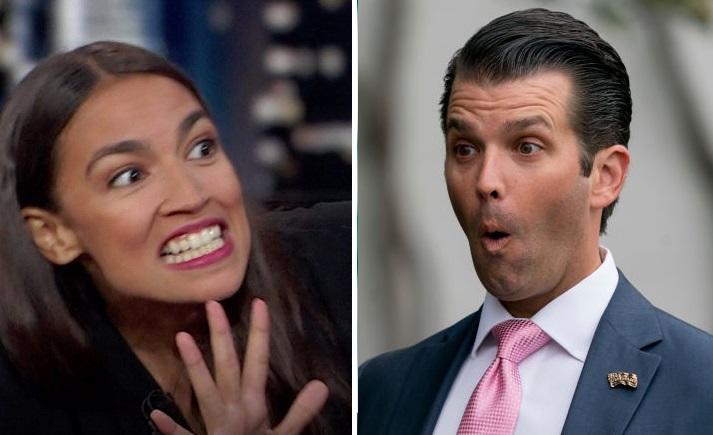
Rep. Alexandria Ocasio-Cortez is catching major heat after she tweeted fake news about Donald Trump Jr. being the “second executive involved in criminal conspiracy,” a misstatement by Michael Cohen that the Wall Street Journal corrected shortly after it happened.

Ocasio-Cortez tweeted: “In Case You Missed It: Rep. Khanna got Cohen to testify that Don Jr. is the “second executive involved in criminal conspiracy.”” 

Except as the Wall Street Journal reported hours after Cohen’s Wednesday testimony: “Cohen Erroneously Identifies Donald Trump Jr. as Executive Cited by Federal Prosecutors.

In the afternoon session, Mr. Cohen identified the president’s son, apparently incorrectly, as an unnamed Trump Organization executive referenced in the charging documents filed against him by federal prosecutors in New York.

The executives were referenced in connection with the plan to reimburse Mr. Cohen for the payment to Stormy Daniels. In the charging document, federal prosecutors said the first executive, Mr. Weisselberg, forwarded an invoice from Mr. Cohen to the second executive, and it was approved.

The Journal has previously identified “Executive-1” as Trump Organization CFO Allen Weisselberg. Mr. Cohen testified today that “Executive-2” in the charging document was Donald Trump Jr.

However, according to people familiar with the matter, the second executive was Trump Organization controller Jeffrey McConney, not the president’s son. Mr. McConney previously referred requests for comment by the Journal to a Trump organization representative, who declined to comment. –WSJ

It appears AOC owes Don Jr. an apology.

via ZeroHedge News https://ift.tt/2GTfzHS Tyler Durden

Dow Dumps Into Red For The Week After Dismal Data

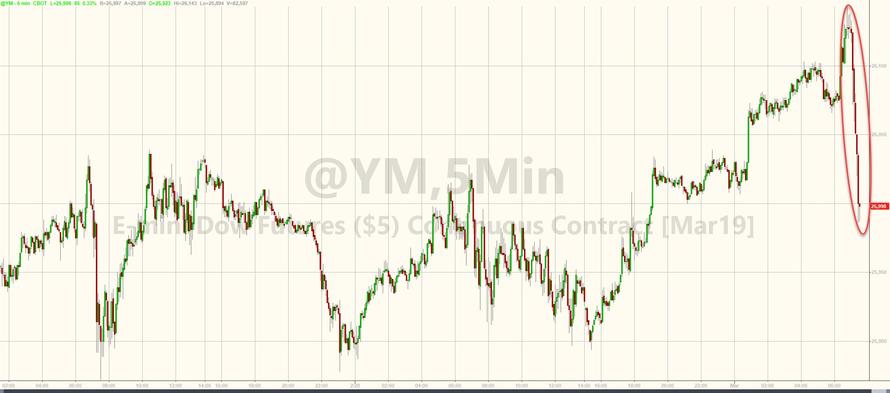
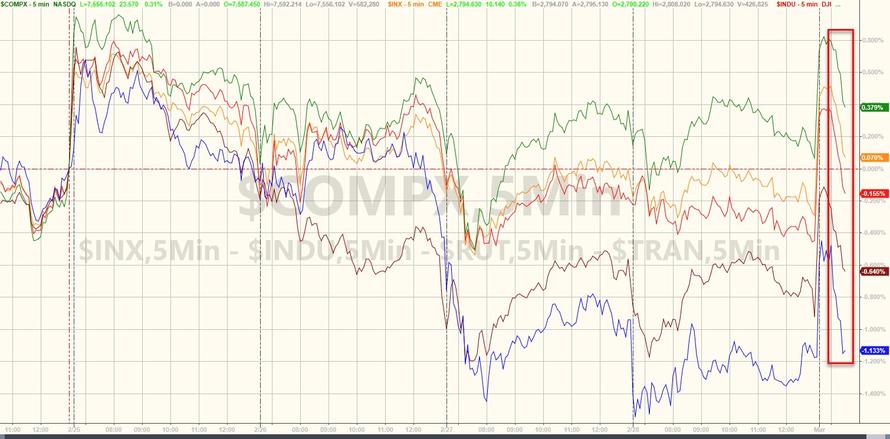
It appears one too many ‘bad news is good news’ straws just broke the “but Powell’s got our backs” narrative camel’s back as terrible income/spending, Manufacturing surveys, and consumer confidence data sent US stocks reeling…


Pushing The Dow red for the week…

Still plenty of time for some mani dip buying to keep the weekly win streak alive for the year.


via ZeroHedge News https://ift.tt/2TolASA Tyler Durden

Nomura Has Just One Word As Treasurys Tumble

After going almost nowhere for 2 months, bond yields are sharply higher again after decisively breaking out of the descending triangle two days ago, having jumped 12bps in just the past 2 days (for a variety of reasons discussed most recently last night)…

… and this is great news to Nomura’s Charlie McElligott who has been predicting the sharp curve steepening we are observing for the past 2 months, most recently two days ago when he doubled down his call for a resurgence in the “reflation trade“.

Commenting on the latest sharp move higher in yields which is taking place alongside the “risk-on” rally in stocks together with the ongoing bonds bear-steepening, McElligott attributes it to two key drivers:

  1. Bloomberg reported at 1:37am EST overnight that U.S. officials are preparing a final trade deal that President Trump and Chinese counterpart Xi Jinping could sign in weeks (with a summit as soon as mid-March);
  2. At 6:30am EST, MNI came out with an exclusive story from government advisor “sources” stating that “China is set to announce further fiscal stimulus to boost a slowing economy, with measures likely to include raising the budget deficit, increasing quotas for local government debt and further cutting taxes and fees”

Having emerged as a key driver of the “reflation” narrative largely thanks to its record credit injection in January, China next week could see the announcement of reduced tax burdens, with policymakers and politicians gathering for the annual “Two Sessions” meetings, with “lower employer social insurance payments, value-added tax rate cuts and even corporate income tax (cuts)” all as possibilities according to Nomura. Additionally, Charlie adds that according to reports, the targeted budget deficit ratio will increase this year from 2.6% of gross GDP seen in 2018—and that even though “above 3% remains taboo,” Jia Kang—the former head of a Finance Ministry research institute, told MNI that authorities should consider a budget deficit of 3% if not higher, noting the level was only a psychological threshold.

What does the reversal in inflation sentiment mean for bigger picture themes?

As McElligott explains, “with Bonds now “breaking-down” after having been pricing-in a significant global slowdown, higher Nominals and the ongoing / grinding CURVE-STEEPENING look like the TACTICAL path of least resistance once again, as the above actions are optically PRO-GROWTH and REFLATIONARY—thus the recent + “Cyclicals over Defensives” within Equities / + Commodities / + Breakevens dynamic should continue in the coming weeks.”

However, as he observed recently, the risk continues to be this sequencing of seemingly idiosyncratic events which could converge in a “March Surprise” risk off event, to create a supply/demand reversal within US Equities just as investors are “forced to chase” back-into the market at the local 4m highs and Retail seeing capitulation from bears, which can be seen in the latest AAII Bears chart, which has hit the lowest level since March 1st 2018:

While McElligott once again repeats his new argument why the market may hit turbulence heading into the March 15 quarterly op-ex, the focus is on what to expect from bonds, where he sees the “max long” bond deleveraging adjustment only just beginning, for the following reasons:

  • In Wednesday’s note “CONSENSUS “LONG” IN BONDS A NEAR-TERM ASYMMETRICAL RISK…” I spoke to “just how bullish” sentiment and positioning was within the Global DM Bond space across both Active- and Systematic- funds—and that this consensual positioning was then at risk “…IF we were to then see any global upside data surprise…”
  • What were the metrics I used to capture the “bullish bonds” consensus as of Wednesday morning?  Let’s revisit:
    • JPMorgan’s US Treasury Investor Sentiment Index this week made new highs since Sep16, a +2 Standard Deviation “bullishness” relative to the past 5 years
    • The Nomura QIS Risk Parity model $ notional allocation to USTs sits at highs last seen in May13, while the overall Global Bond $notional is at our series highs dating back to at least 2011
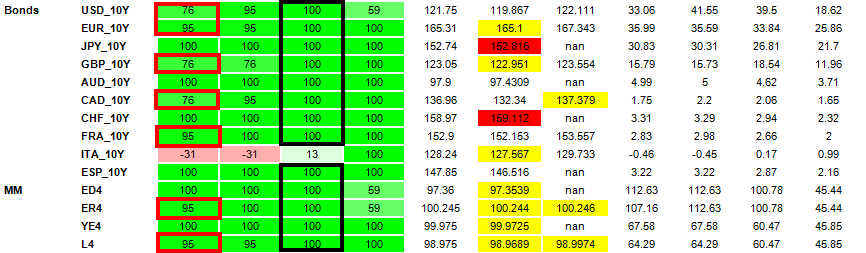
    • The Nomura QIS CTA model as of this morning shows an almost consensual “Max Long” across global DM Bonds:  “+100% Long” in USD 10Y, JPY 10Y, CAD 10Y, CHF 10Y, FRA 10Y and ESP 10Y, while EUR 10Y, GBP 10Y and AUD 10Y are all “+95% Long”

Since McElligott laid out why the market may be wrongfooted with its “bullish bond consensus”, we have since seen

  1. US Pending Home Sales big beat,
  2. a massive Chicago PMI beat,
  3. a surprisingly strong US Q4 GDP QoQ and
  4. Core PCE QoQ…while last night we saw on the global front, we saw
  5. China Caixin PMI Manufacturing surprise beat to the upside vs survey and prior result as well (48.5 survey, 49.9 actual, 48.3 prior)

Putting all this together, McElligott’s one-word assessment was summarized in just one word…

  • “BOOM”

… which can be seen as a victory lap of sorts as we have now seen the “global upside data surprise” catalyst – i.e., the reflation trade narrative – which has “sparked the flame” of what is now a pretty visceral stop-out/profit-take/signal-flip/range-break in Rates, with particularly massive volumes at the 3pm ‘marks’ yesterday (MUCH higher than a typical “month end” trade) incuding +33.5k TUM, +82k FVM, +110k TYM, +30.5k USM, +23k WNM, and as we observed on Wednesday, the descending triangle pattern is no more.

So what happens next? Well, as long as the “reflation narrative” is alive, and it appears that economic data may now be turning in both the US (strong GDP, just ignore the dismal spending data) and China (a rebound in the Caixin Mfg PMI), which will force more TSY longs to cover, but the real catalyst will be when the trend-following CTAs capitulate, and start shorting 10Y. What is the trigger levelto watch? According to Nomura, with 10Y TSY CTAs currently 76% long, they would be buying more above 122.05 to get to 86% , max long over 122.23, while selling would resume under 120.2 to get to 57% , more selling under 119.7 to get to -16% , flip to short under 119.7, max short under 119.36.

The full CTA trigger estimates by asset class are shown below.

via ZeroHedge News https://ift.tt/2Vxq2fo Tyler Durden