Does the Drop in Opioid-Related Deaths Mean the Crackdown on Pain Pills Is Finally Working?

Opioid-related deaths in the United States, which had been rising steadily since 1999, fell slightly in 2018, from 47,600 to 46,802, according to the latest data from the U.S. Centers for Disease Control and Prevention. That 1.7 percent drop was mostly due to a decline in deaths involving pain pills, which decreased by 13 percent, from 14,495 to 12,552.

Does that mean the government’s crackdown on prescription analgesics is finally having the desired effect? Probably not. The decline in opioid-related deaths is more plausibly attributed to harm reduction measures such as wider access to the overdose antidote naloxone and treatment programs involving methadone and buprenorphine. Ham-handed efforts to reduce the supply of pain pills, by contrast, have deprived bona fide patients of the medication they need while driving nonmedical users toward black-market substitutes, which are far more dangerous because their potency is highly variable and unpredictable.

That hazard has only been magnified by the increasing prevalence of illicit fentanyl, a cheaper and much more potent substitute for heroin. While heroin-related deaths fell by 3 percent in 2018, from 15,482 to 14,996, deaths involving “synthetic opioids other than methadone,” the category that includes fentanyl and its analogs (some of which are even more potent), rose by 10 percent, from 28,466 to 31,335. That category of drugs was involved in 67 percent of opioid-related deaths in 2018, up from 60 percent in 2017.

The share of all drug-related deaths that involved opioids rose from 48 percent in 1999 to 69 percent in 2018. But while the share of opioid-related deaths involving prescription analgesics (excluding methadone) rose from 34 percent in 1999 to 52 percent in 2010, it has been declining since then. In 2018, pain pills were involved in 27 percent of opioid-related deaths, many of which also involved heroin or fentanyl.

Heroin’s role in opioid-related deaths increased from 14 percent of cases in 2010 to 39 percent in 2015 but had fallen to 32 percent by 2018. Fentanyl’s share, meanwhile, increased more than five-fold between 2013 and 2018. You can start to see why the upward trend in opioid-related deaths not only continued but accelerated after the total volume of opioid prescriptions began to decline in 2011, which coincided with the rising prominence of heroin and fentanyl.

The increase in opioid-related deaths during the last two decades is part of a broader long-term trend. The total number of drug-related deaths fell by 4 percent between 2017 and 2018, from 70,237 to 67,367, a change that helped reverse recent declines in life expectancy. But the 2018 total was still 11 times the number in 1980. The death rate was 20.7 per 100,000 people in 2018, compared to just 2.7 in 1980. And even as opioid-related deaths fell by about 2 percent in 2018, deaths involving cocaine and “psychostimulants” such as methamphetamine rose by 5 percent and 23 percent, respectively.

The upward trend in drug-related deaths goes back further than the 1980s. A 2019 report on “deaths of despair” from the Joint Economic Committee (JEC) notes that drug-related deaths were falling by the early 1900s, before Congress banned nonmedical use of opiates and cocaine in 1914. But “drug-related deaths have been rising at an accelerating rate since the late 1950s,” notwithstanding the government’s increasingly expansive and aggressive efforts to suppress the illegal drug trade.

“The increase has been especially sharp over the past 20 years,” the JEC notes. And while “the proliferation of opioid deaths was initially a result of oversupply and abuse of legal prescription narcotics,” the report says, “the crisis…shifted toward illegal drugs—first heroin and then more lethal synthetic opioids like fentanyl”—after “policy changes restricted the supply and form of prescribed opioids.”

Humans have always been attracted to psychoactive substances, and that is unlikely to change anytime soon. While governments cannot stop people from using drugs, they can always make drug use more dangerous. Maybe it is time to consider a different approach.

from Latest – Reason.com https://ift.tt/2UbAPOE
via IFTTT
Amazon Soars After Blowout Q4 Earnings Smash Expectations, Joins $1 Trillion “Cuatro Comas” Club

Amazon Soars After Blowout Q4 Earnings Smash Expectations, Joins $1 Trillion “Cuatro Comas” Club

Last quarter, when Amazon reported otherwise respectable Q3 earnings, the market hammered the stock after margins unexpectedly shrank to a 6 quarter low, its AWS cloud segment disappointed, and Amazon guided to surprisingly disappointing operating income guidance. But it wasn’t just last quarter: AMZN shares closed lower the next day after four of the past five announcements. Such earnings disappointments were sufficient to create a material schism between the rest of the FAANG complex, which soared higher in the post-QE4 period, and Amazon which has failed to make much headway.

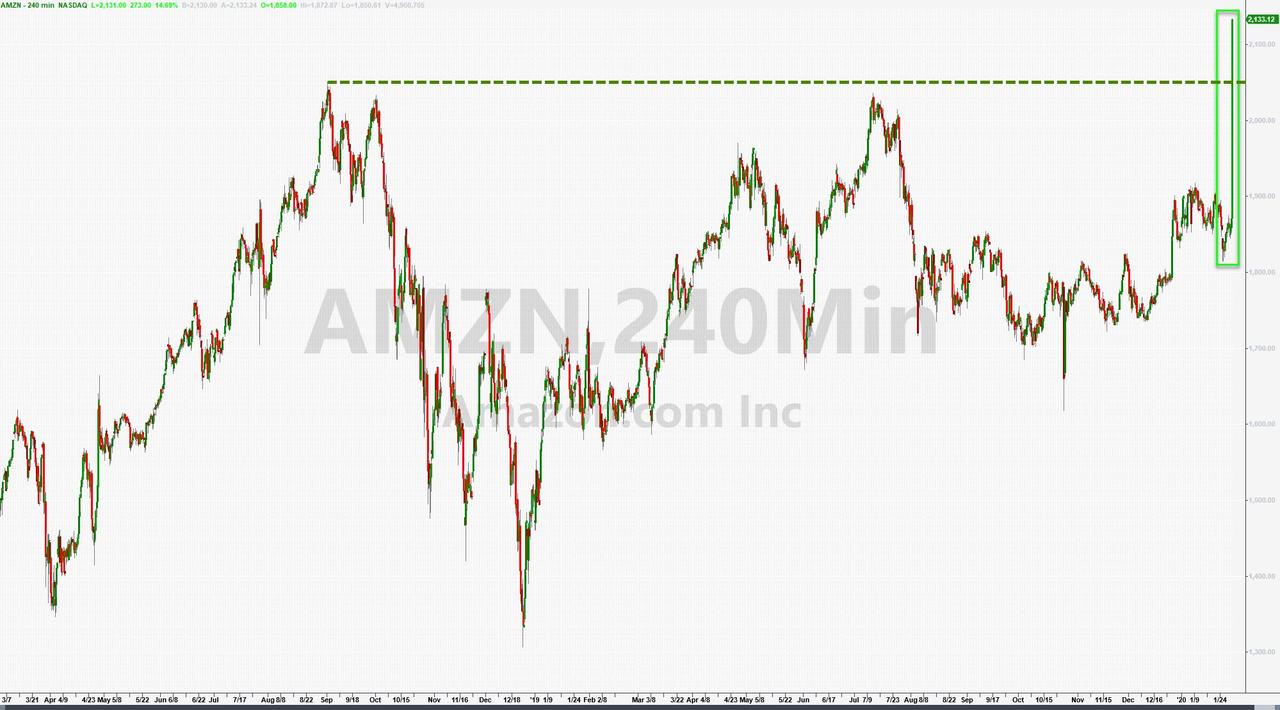
Well, Amazon’s period in the penalty box is finally over, with the stock soaring 15% after hours after it reported Q4 earnings, joining its FAANG peers in the quatro commas club with a market cap finally well over $1 trillion.

Here is a summary of the fourth quarter highlights:

  • Q4 Net Sales $87.4B, above the consensus estimate of $86.17B, and above the high end of the company’s own range of $80-$86.5BN
  • Q4 EPS $6.47, smashing expectations of $4.11
  • Q4 operating income $3.88 billion, up 2.5% y/y, and also smashing estimates of $2.75 billion
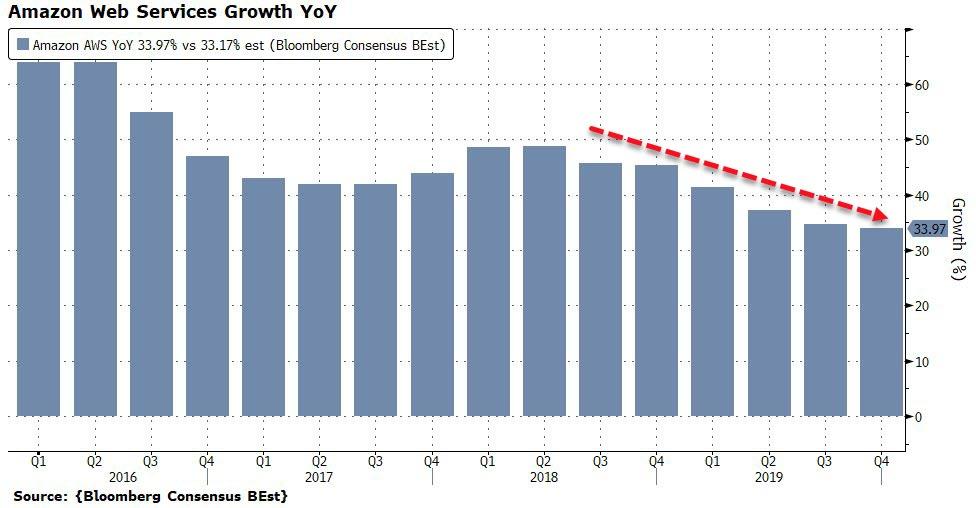
  • Q4 AWS Net Sales $9.95B, also modestly beating expectations of $9.89B, and up 34% Y/Y, a modestly slowdown from 45% a year earlier

In short, Amazon beat analyst expectations across the board during the holiday quarter: on revenue, operating income, and AWS sales (barely). Impressively, Jeff Bezos even defied predictions for a slump in net income, pulling in $3.26 billion, from $3.02 billion a year earlier.

Looking to Q1 2020, guidance was also solid:

  • Net sales are expected to be between $69.0 billion and $73.0 billion, or up between 16% and 22% Y/Y, vs Est. $71.56BN.
  • Operating income between $3.0 billion and $4.2 billion, compared with $4.4 billion in first quarter 2019.

It is worth noting that the guidance includes approximately $800 million lower depreciation expense due to an increase in the estimated useful life of our servers beginning on January 1, 2020.

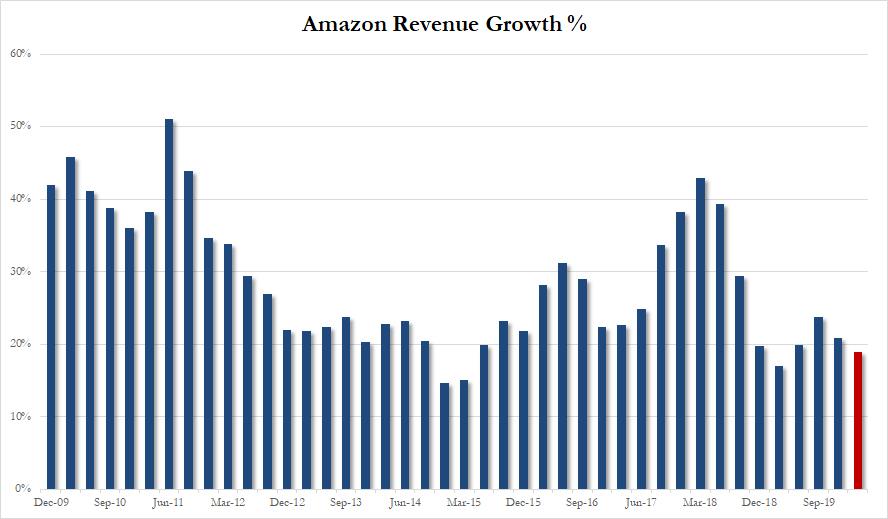
And yet, despite the otherwise impressive outlook, taking the midline of Amazon’s Q1 revenue guidance of $71BN would indicate another modest slowdown in total revenue, the lowest since March 2018.

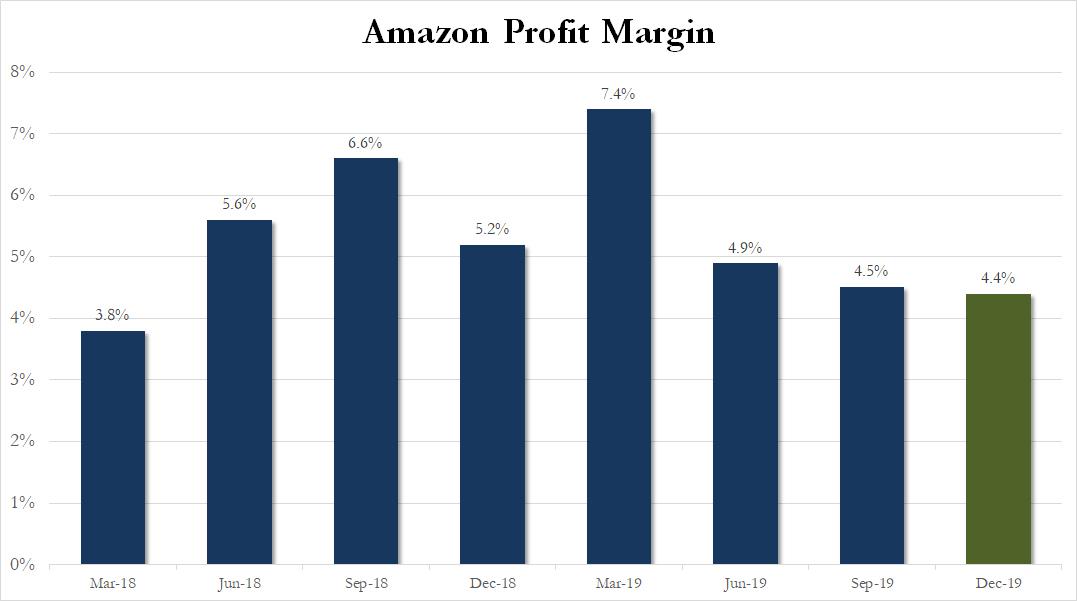
Another potential blemish: after the company’s profit margin nearly doubled to an impressive 7.4% in Q1 2019, largely thanks to the increasing contribution from AWS, in Q2, Q3 and then again in Q4, profit slumped again, and the profit margin of 4.4% was the lowest going back to Q1 2018.

Meanwhile, even though AWS beat revenue expectations of $9.89BN, reporting $9.95BN in sales, the growth rate continues to decline, and in Q4 dropped to 34%, the lowest on record.

As usual AWS was the primary source of profit, and with $2.6BN in operating income (up from $2.2BN a year ago) or 67% of the company’s total operating income of $3.879. Meanwhile, the international division continues to burn cash, and despite generating $23.8BN in sales, it resulted in yet another loss of $617MM in Q4.

To summarize, AWS revenue growth:

  • Q1 2018: 48%
  • Q2 2018: 49%
  • Q3 2018: 46%
  • Q4 2018: 46%
  • Q1 2019: 42%
  • Q2 2019: 37%
  • Q3 2019: 35%
  • Q4 2019: 34%

The good news however is that after declining for a year, AWS operating margin finally posted a modest rebound:

  • Q1 2018: 25.7%
  • Q2 2018: 26.9%
  • Q3 2018: 31.1%
  • Q4 2018: 29.3%
  • Q1 2019: 28.9%
  • Q2 2019: 25.3%
  • Q3 2019: 25.1%
  • Q4 2019: 26.1%

None of these potential red flags mattered to investors however, who focused on the solid beat and the impressive guidance, and pushed the stock as much as 15% higher, to a new all time high above $2,100 and a market cap over $1 trillion.


Tyler Durden

Thu, 01/30/2020 – 16:28

via ZeroHedge News https://ift.tt/2vBSfd9 Tyler Durden

Stocks Panic-Bid, Bonds Dumped After WHO Doublespeak Over “Global Pandemic”

Stocks Panic-Bid, Bonds Dumped After WHO Doublespeak Over “Global Pandemic”

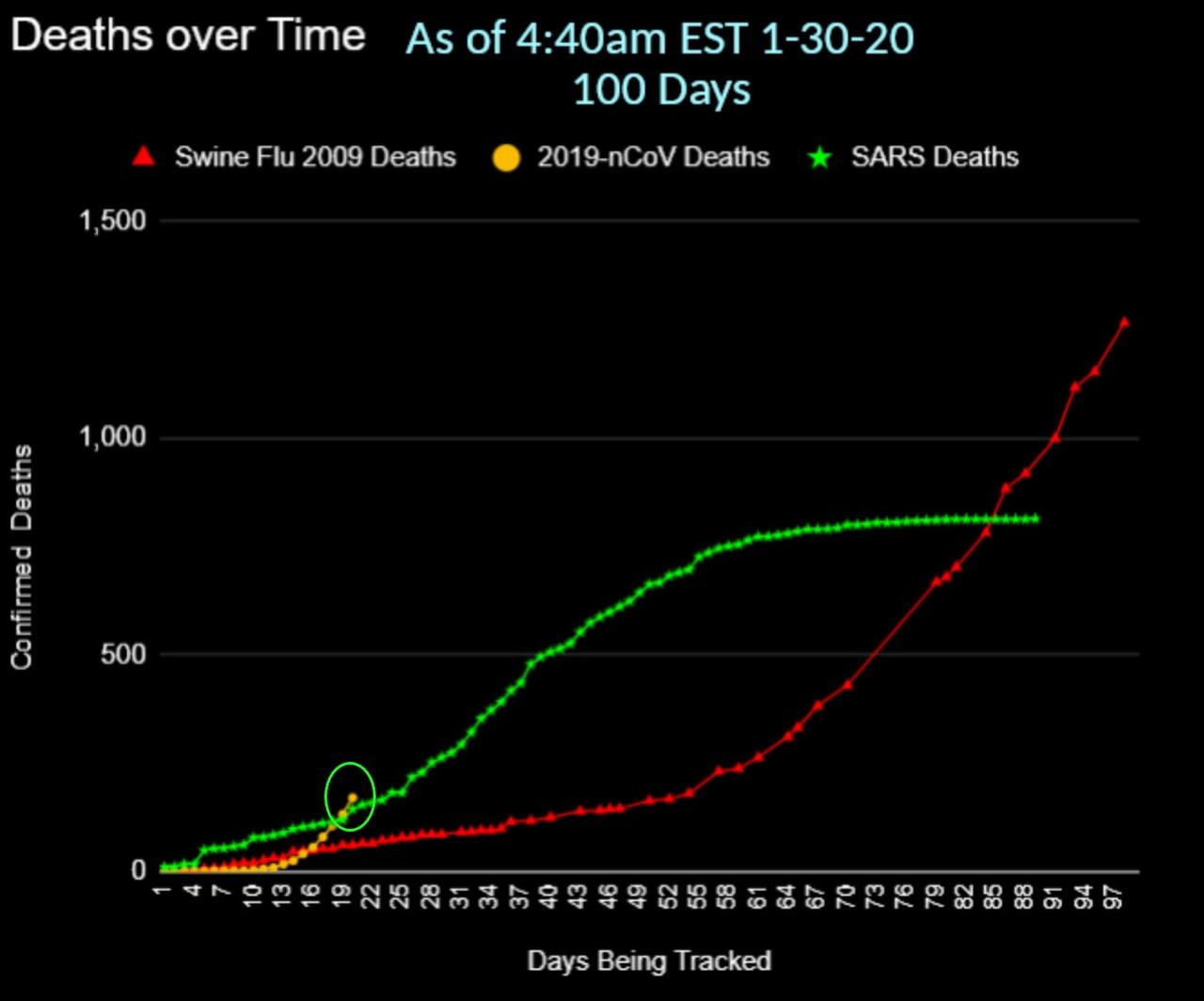
Deaths surge, Cases spike, Human-to-human transmission in US, WHO says “global pandemic”, and the death count is rising faster than SARS…

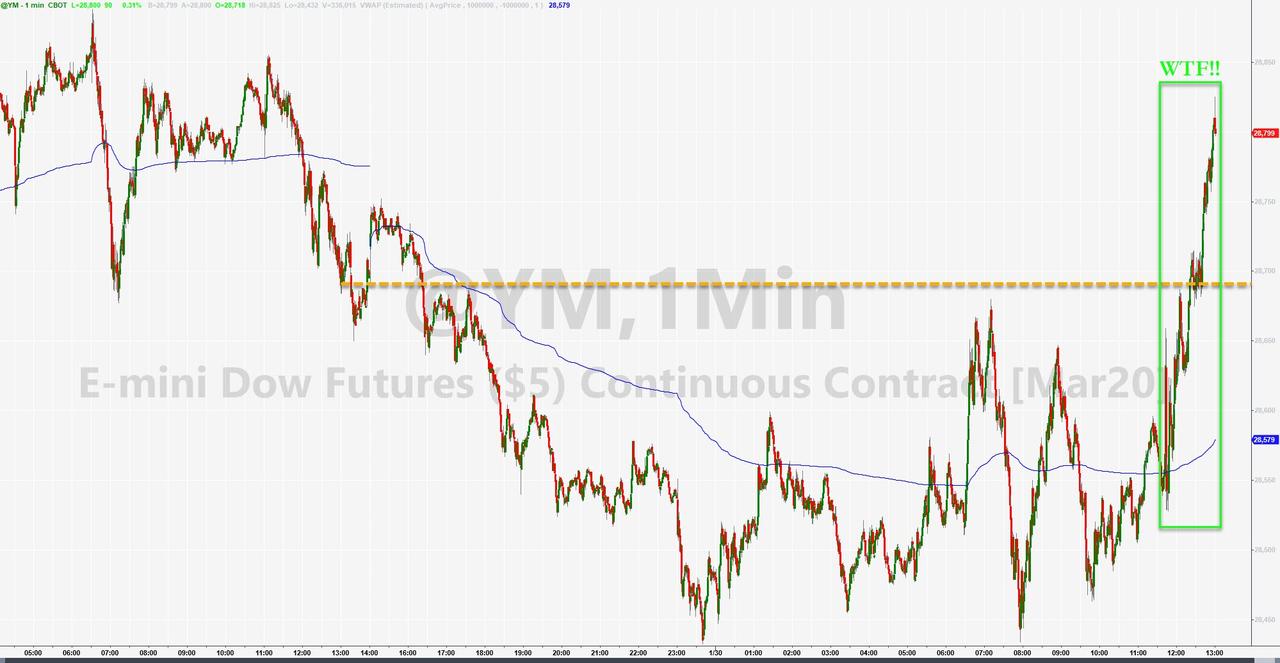
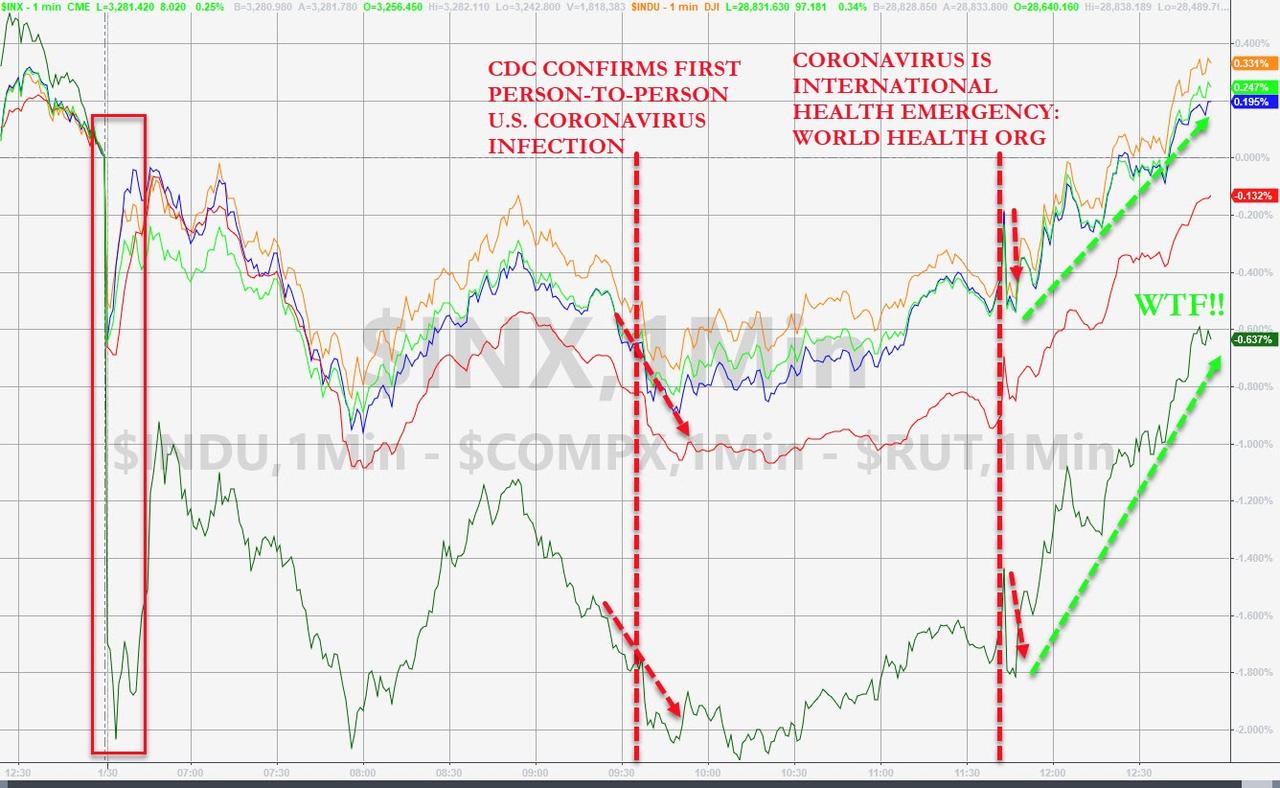
and the machines desperately keep trying to ignite momentum. in the immortal words of one veteran trader looking on as the so-called market exploded back to unchanged after WHO did what everyone had feared and declared this a GLOBAL PANDEMIC: “this entire market is a f**king joke!”

The message from the rest of the world…

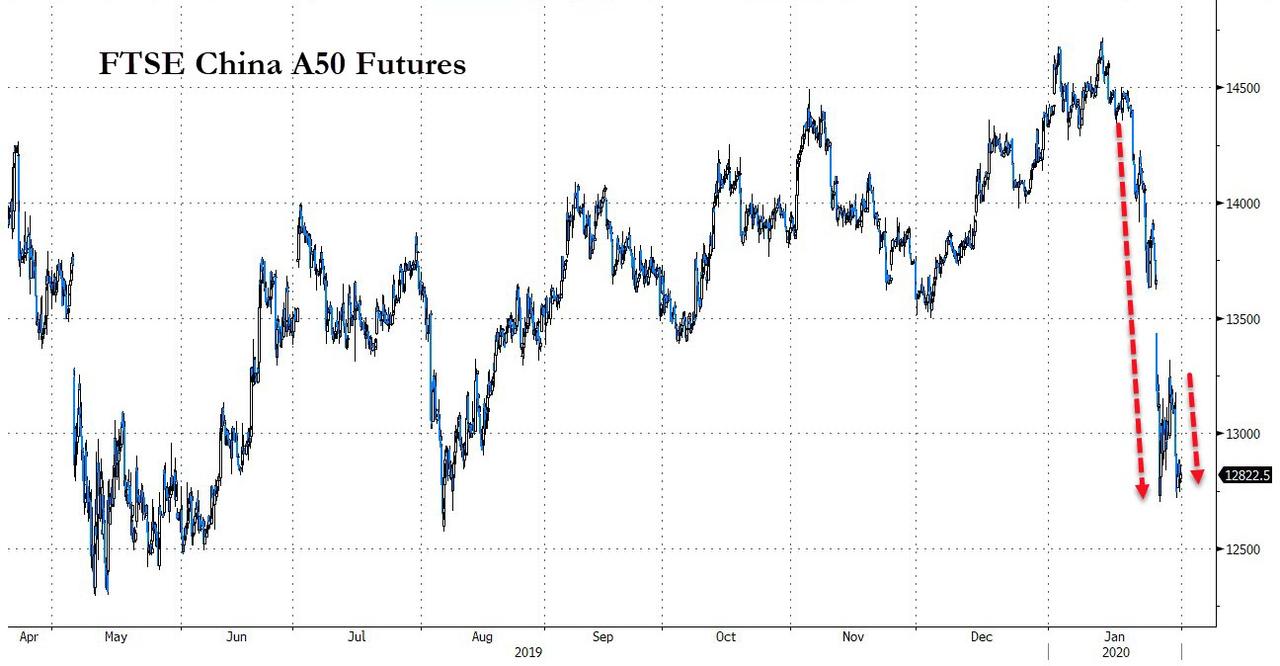
China continue to be closed, but A50 futures tumbled back to recent lows today – lowest close since June…

Source: Bloomberg

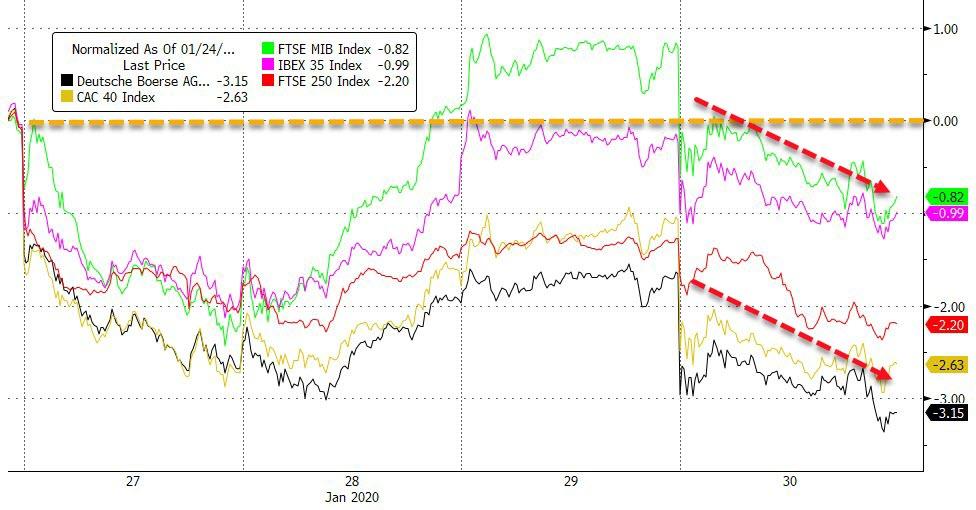
European stocks all slumped today…

Source: Bloomberg

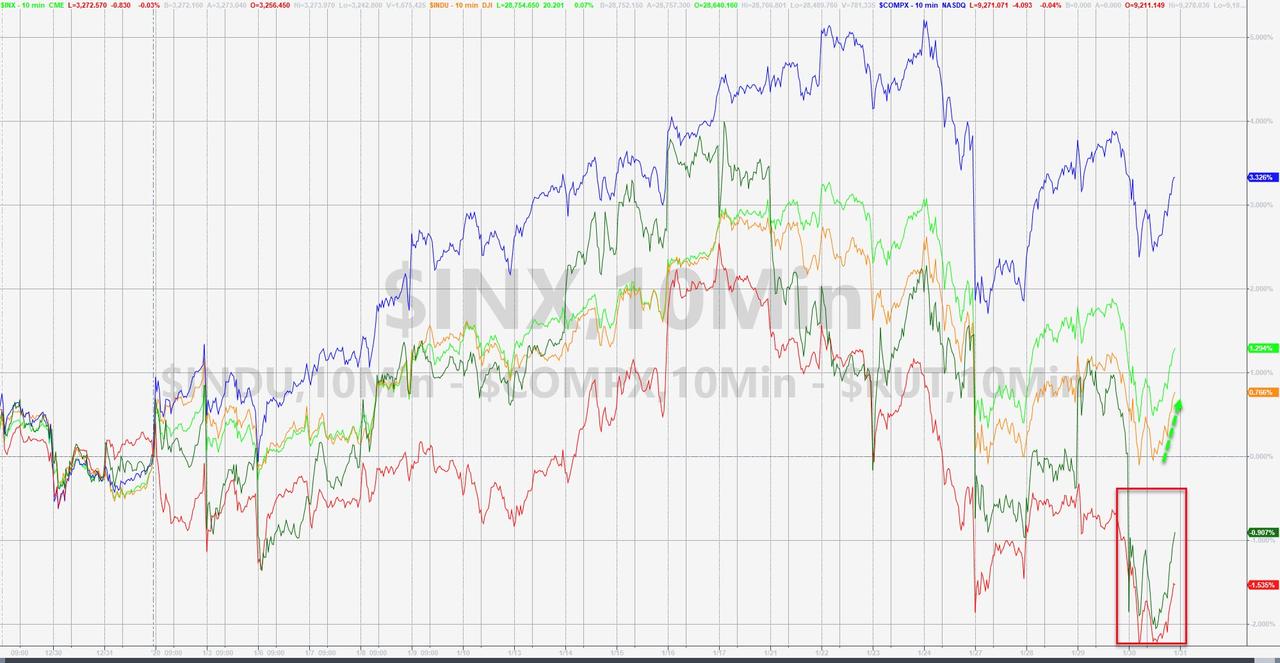
The Dow, S&P, and Nasdaq all managed to surge into positive territory – after the worst possible set of news headlines…

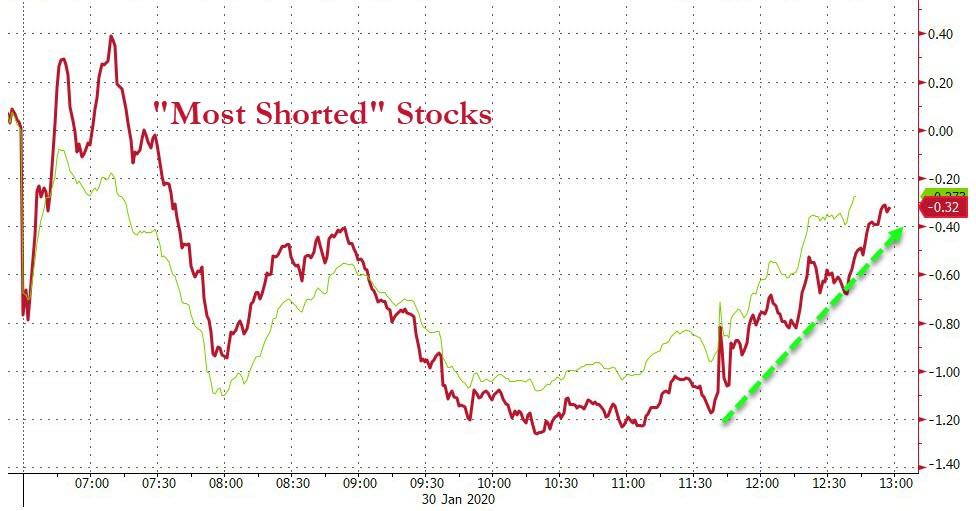
Well engineered short squeeze to keep The Dow green in 2020…

Source: Bloomberg

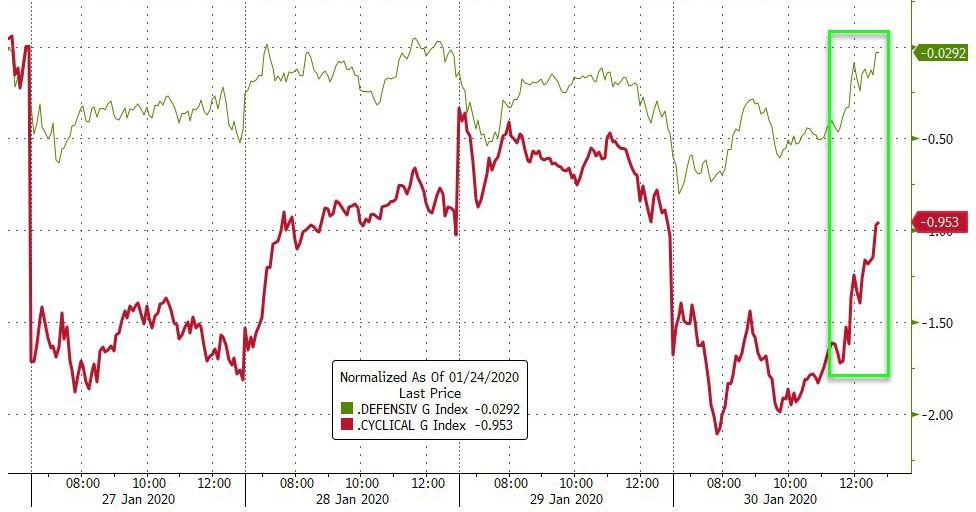
For some reason, cyclicals were suddenly panic-bid on the bad news…

Source: Bloomberg

Trannies and Small Caps are notably in the red year-to-date and The Dow is clinging to UNCH before the WHO Doublespeak sparked a rebound…

MUST KEEP DOW GREEN YEAR TO DATE

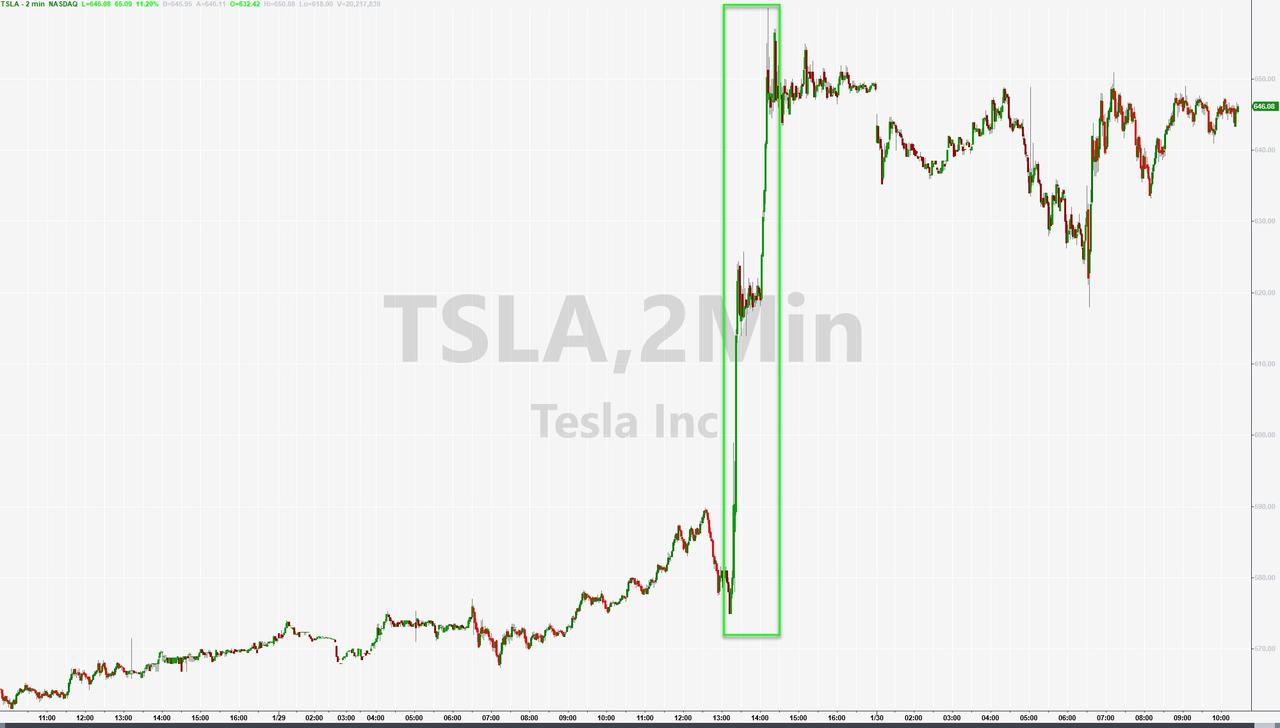
TSLA went full turbo overnight as someone got a huge tap on the shoulder and puked their shorts…

Source: Bloomberg

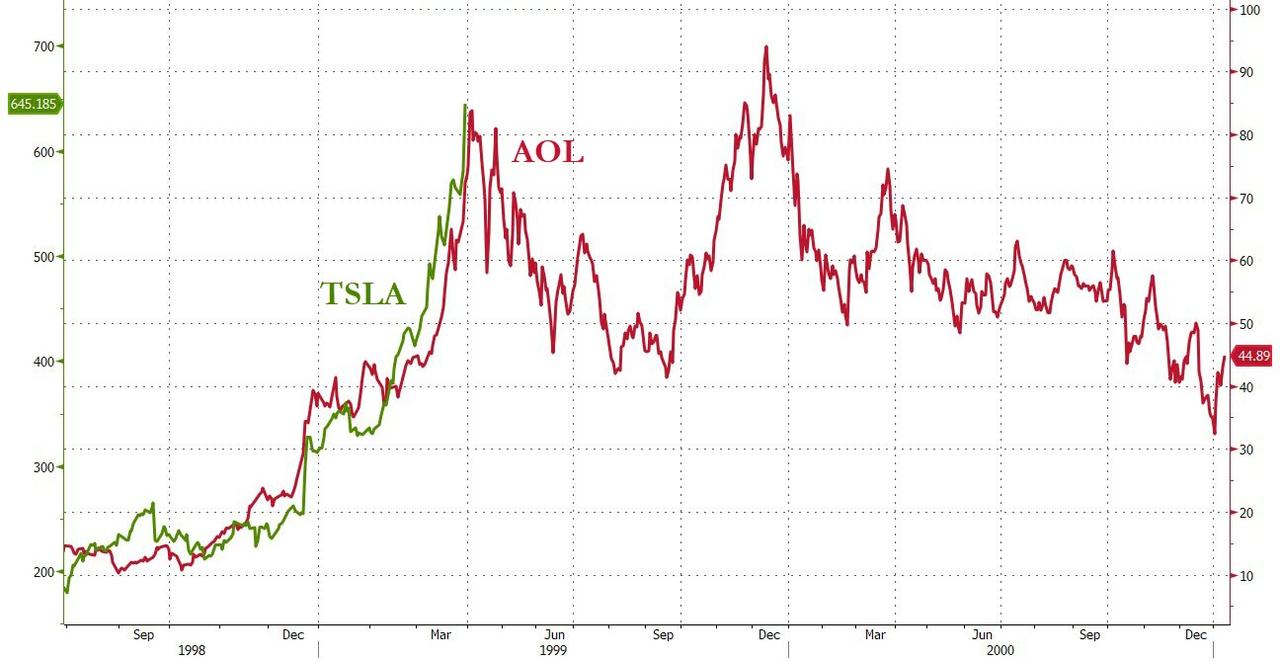
And reminded more than a few people of a certain DotCom stock…

Source: Bloomberg

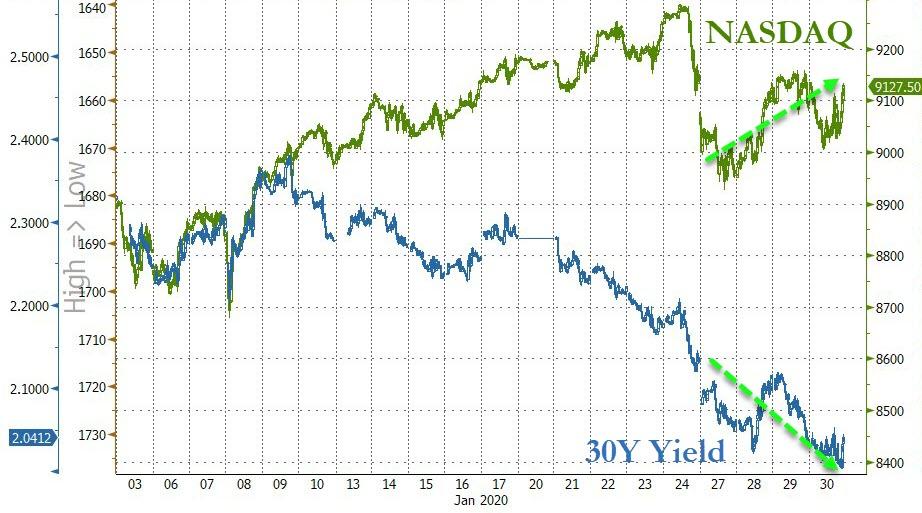
Bonds and stocks are ridiculously decoupled…

Source: Bloomberg

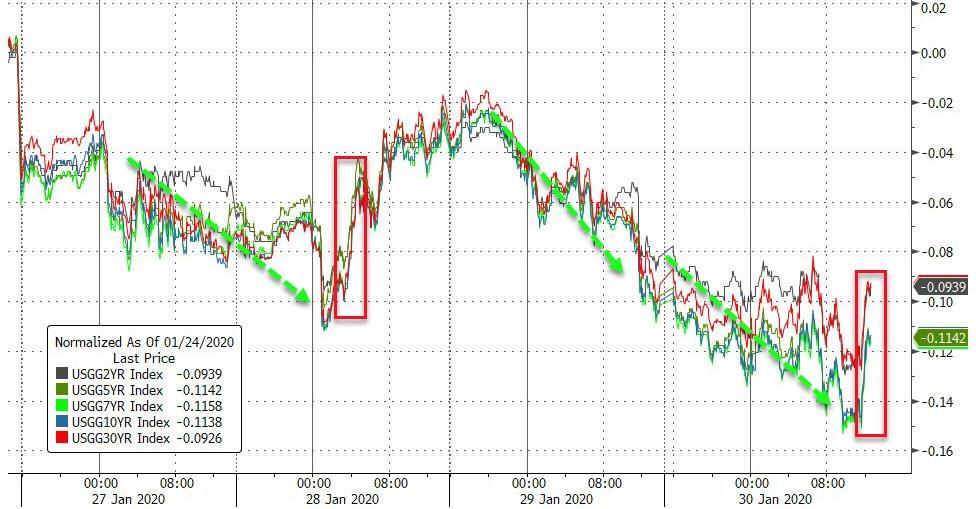
Treasury yields extended their decline on the week before a ridiculous spike after the WHO news…

Source: Bloomberg

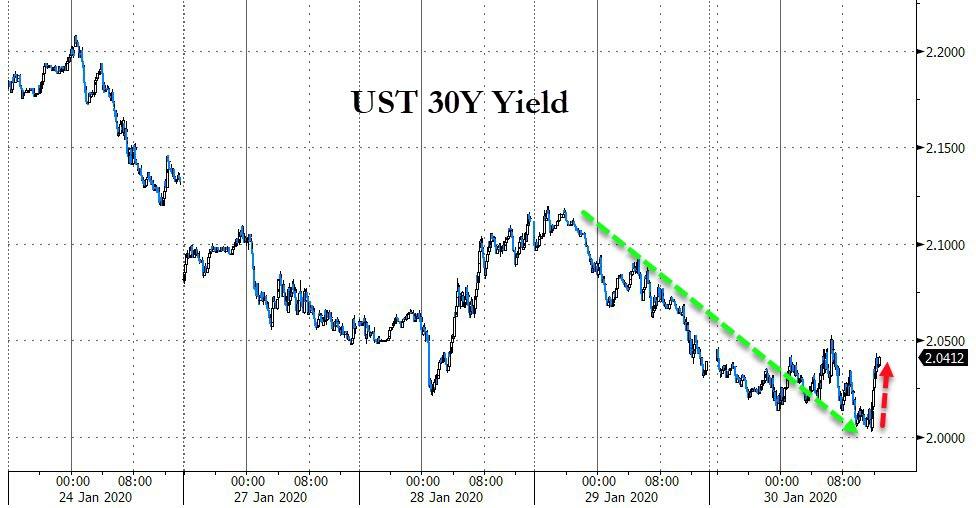
30Y tested down to a 1 handle… (and 10Y below 1.55%)

Source: Bloomberg

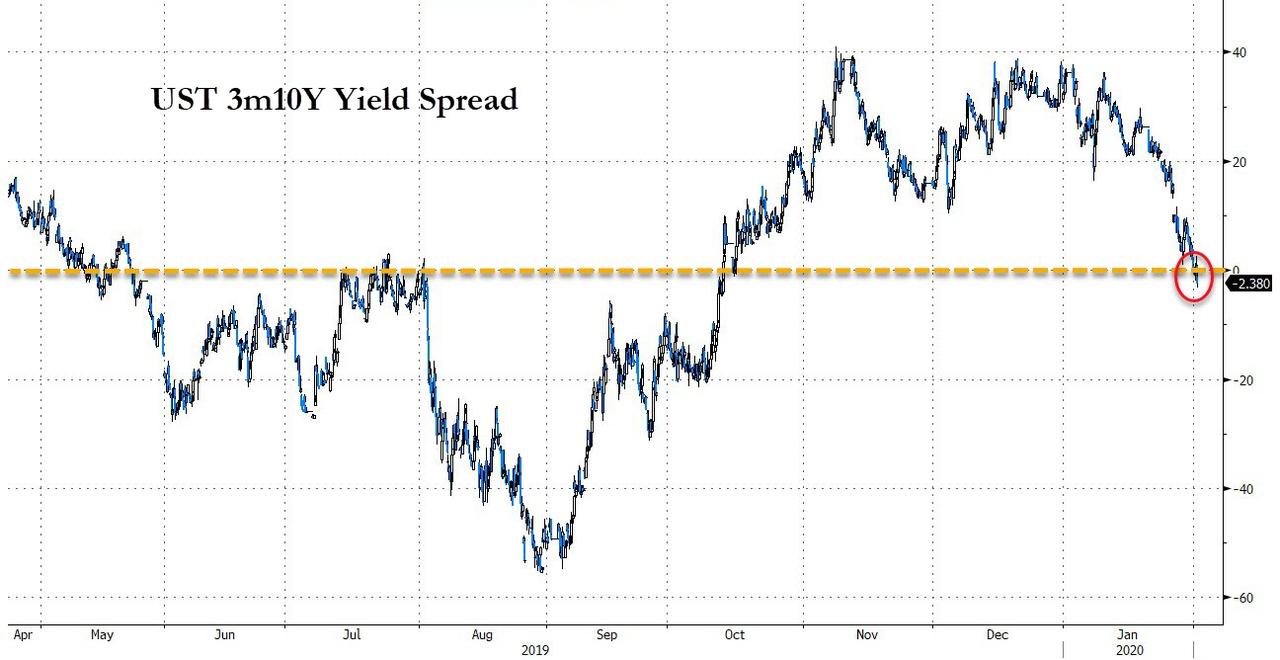
And perhaps most notably, the yield curve has re-inverted with 3m10Y now at -3bps…

Source: Bloomberg

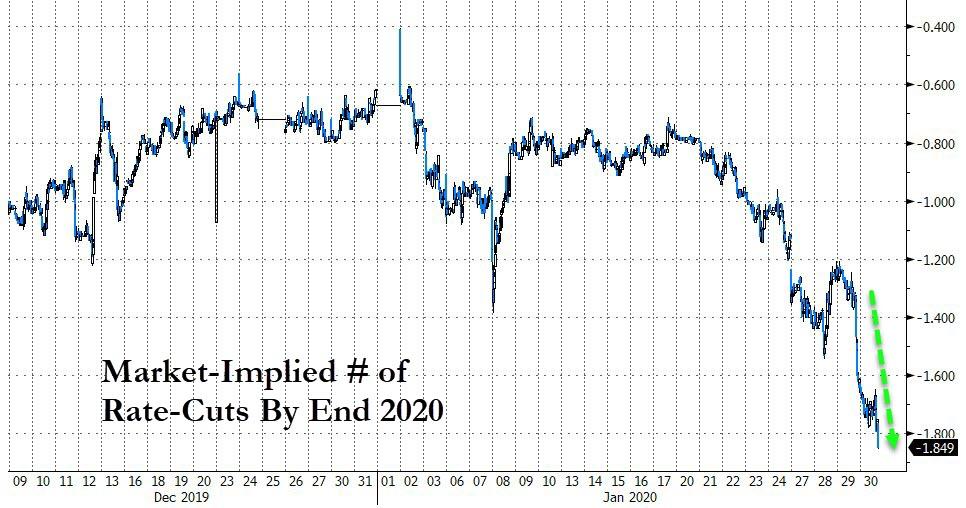
Before we leave rates-land, we also note that the market is panic-pricing in almost 2 rate-cuts now for 2020

Source: Bloomberg

The dollar trod water for a =4th day, roundtripping overnight strength with selling in the EU/US day…

Source: Bloomberg

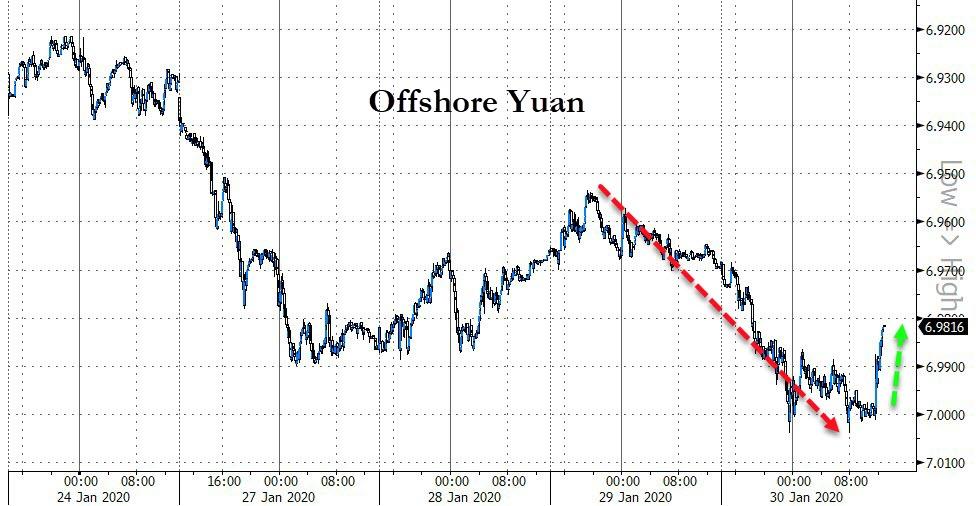
Yuan ended weaker but no thanks to panic-bid after WHO…

Source: Bloomberg

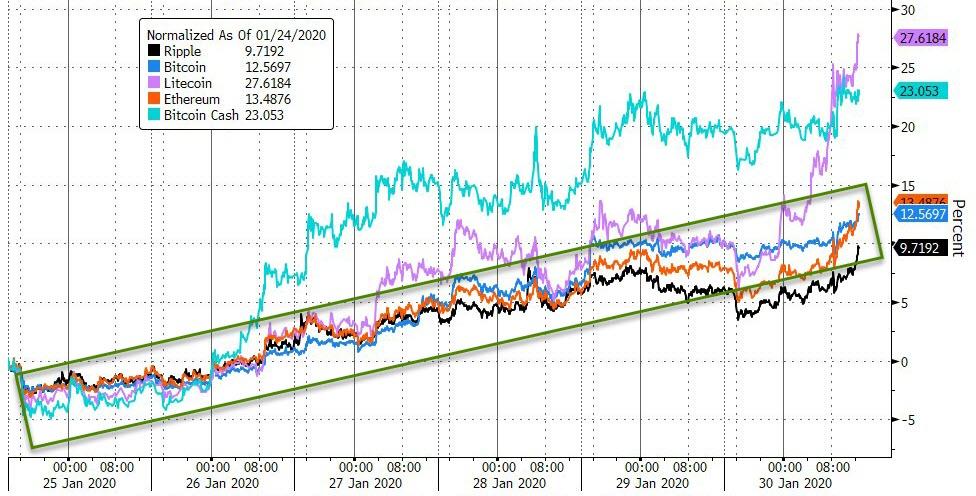
Cryptos continued to rise today in a very uniform manner…

Source: Bloomberg

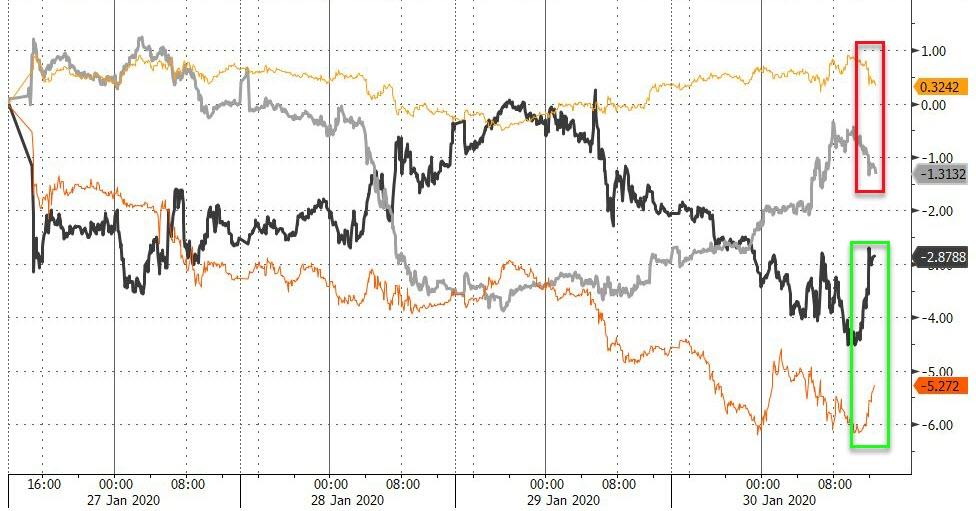
Commodities chopped around like everything else…

Source: Bloomberg

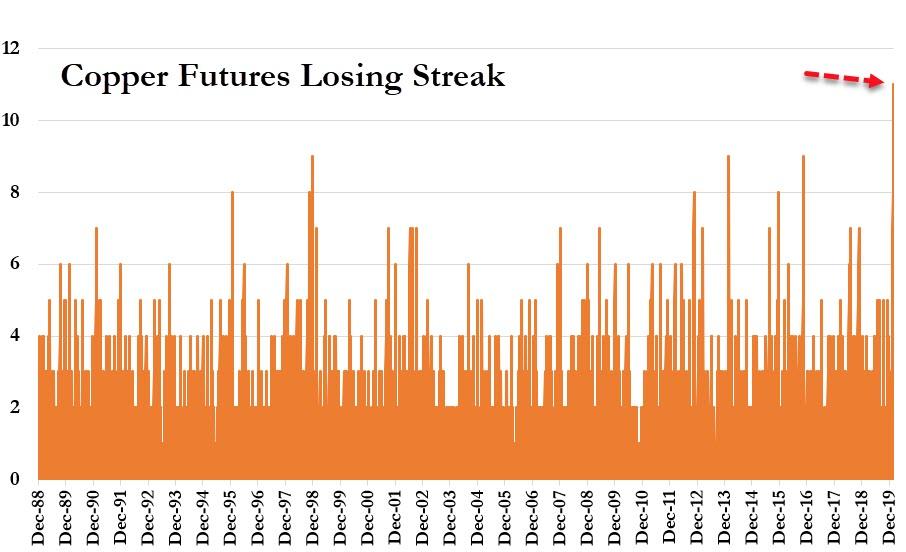
Copper futures fell for a record 11th day in a row today…

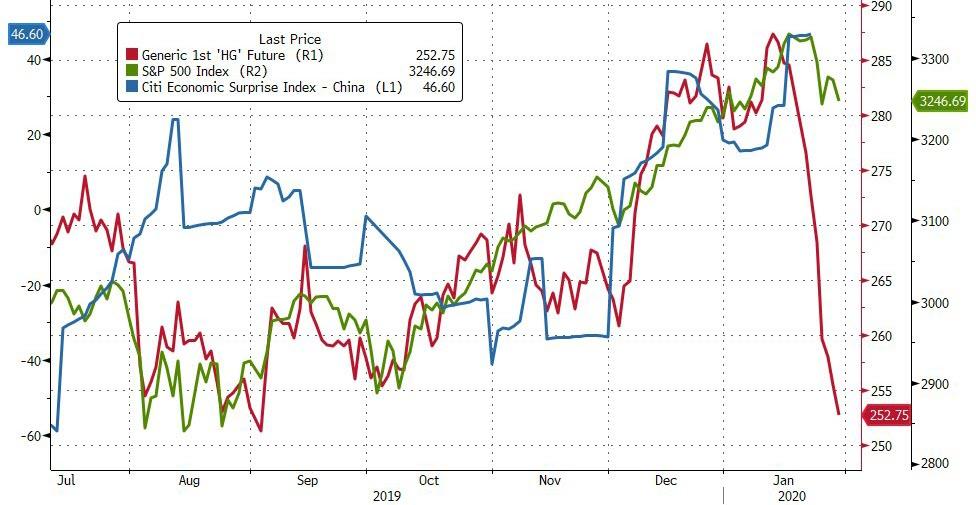
As Bloomberg noted, copper’s slump may be an indication that we’re due for a bigger pullback in the U.S stock market. The metal, which is viewed as an indicator of Chinese economic health, has fallen for 11 straight sessions. It’s now at its lowest level since September, when trade tensions with China dominated headlines and the S&P 500 slid more than 3% in three weeks.

Now, it’s the coronavirus that’s prompting concerns about the Chinese economy. With the country hitting pause on production, construction, and other economic activity, industrial demand concerns are pushing copper lower. And since American and Chinese manufacturing are highly correlated, this slowdown could translate over to U.S. equities.

Source: Bloomberg

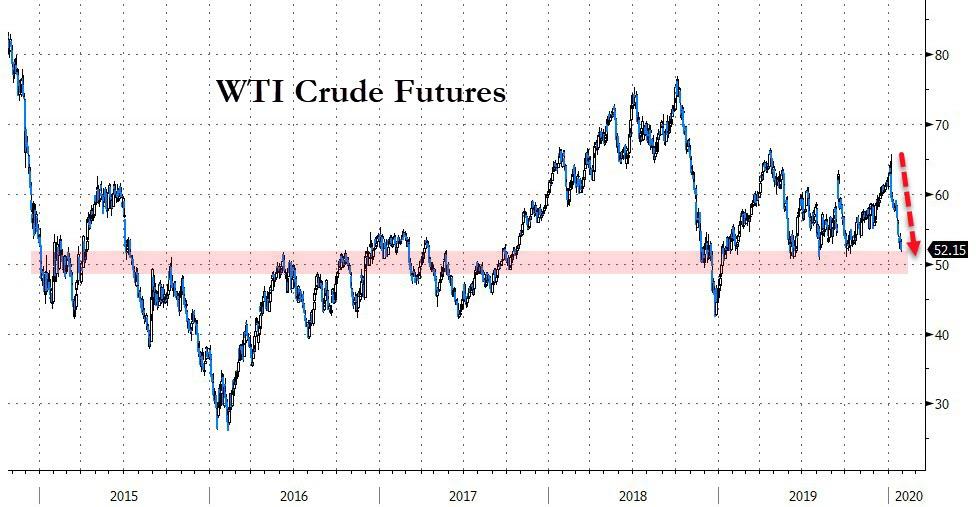
WTI traded down to a $51 handle to a critical support level…

Source: Bloomberg

But then again – traders panic-bid oil too…

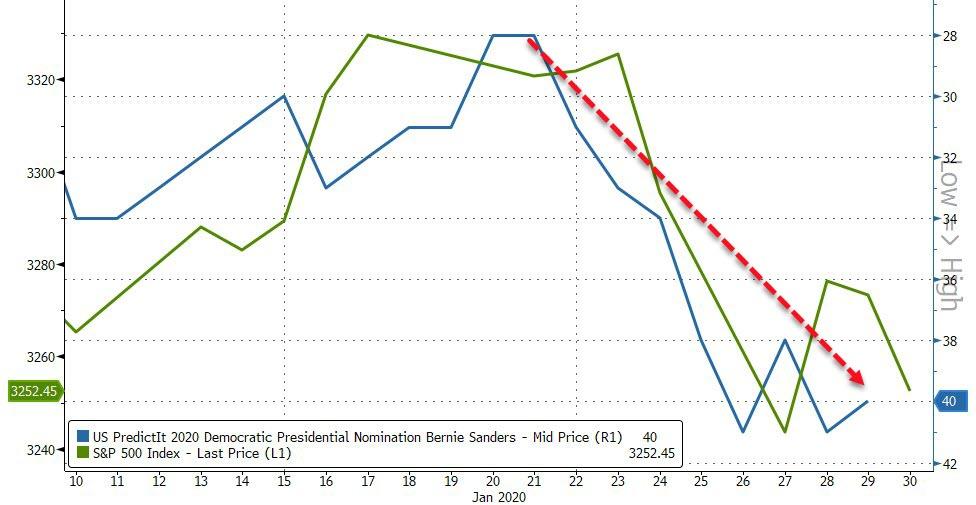
Finally, some have wondered if the surge in Bernie Sanders has also weighed on stock market sentiment…

Source: Bloomberg

And we’ll let Guggenheim’s Scott Minerd have the last word…

Deutsche Bank prophetically write this a month ago, reflecting on the market’s ability to entirtely ignore potentially terrible news in the short-term…

“When extreme events begin to saturate the info-sphere on daily basis (sometimes even intraday), reality unfolds too fast – we no longer remember (or don’t care about) the headlines from two or three weeks ago. Our perspective and assessment of the horizon (“cognitive eyeballing”) is distorted. We are blinkered by intensity of information we have to process – overwhelmed by both its quantity and speed of its arrival – and no longer seem to be unable to properly assess the risks ahead of us, and have become insensitive to them. The distorted perspective downplays the risk of “hitting the ground”. The informational intensity transcends our capacity for statistical approximation and this rarefication of control affects the temporal regime of our decision making. As a consequence, our horizons flatten and everything that resides beyond immediate future is bundled as “long-term” — we appear to be indifferent to its temporal distance — it is all equally remote and equally out of grasp and we capitulate on our efforts to forecast beyond short term horizons.”

It seems given the BTFD efforts in the last week in the face of increasingly scary data on the Wuhan virus, that DB nailed it. And now we are in the “longer-term” and reality is inescapable… even if we still believe The Fed can save us all from every- and any-thing.

“Fed has transformed from uninvolved player to an active convexity manager and its major supplier.”


Tyler Durden

Thu, 01/30/2020 – 16:01

via ZeroHedge News https://ift.tt/36LTCTD Tyler Durden

“Comedy Happens to You, Tragedy Happens to Me”

My colleague Kal Raustiala—who is writing a biography of Ralph Bunche, an American diplomat, Nobel Peace Prize winner, and UCLA valedictorian—found this in Bunche’s personal notes:

At a Finnish mission lunch Thursday 17 oct 68, Gunnar Jarring, Swedish diplomat working for UN, says to Romanian dep FM, talking about film, “The Russians Are Coming was quite funny”

Romanian says, “It isnt so funny in my country”

(I’ve seen the quote in the title of this post credited to Mel Brooks, though not in any definite way; English writer Angela Carter has a version of it, as I imagine others do, too.)

from Latest – Reason.com https://ift.tt/2vvOllT
via IFTTT

Does the Drop in Opioid-Related Deaths Mean the Crackdown on Pain Pills Is Finally Working?

Opioid-related deaths in the United States, which had been rising steadily since 1999, fell slightly in 2018, from 47,600 to 46,802, according to the latest data from the U.S. Centers for Disease Control and Prevention. That 1.7 percent drop was mostly due to a decline in deaths involving pain pills, which decreased by 13 percent, from 14,495 to 12,552.

Does that mean the government’s crackdown on prescription analgesics is finally having the desired effect? Probably not. The decline in opioid-related deaths is more plausibly attributed to harm reduction measures such as wider access to the overdose antidote naloxone and treatment programs involving methadone and buprenorphine. Ham-handed efforts to reduce the supply of pain pills, by contrast, have deprived bona fide patients of the medication they need while driving nonmedical users toward black-market substitutes, which are far more dangerous because their potency is highly variable and unpredictable.

That hazard has only been magnified by the increasing prevalence of illicit fentanyl, a cheaper and much more potent substitute for heroin. While heroin-related deaths fell by 3 percent in 2018, from 15,482 to 14,996, deaths involving “synthetic opioids other than methadone,” the category that includes fentanyl and its analogs (some of which are even more potent), rose by 10 percent, from 28,466 to 31,335. That category of drugs was involved in 67 percent of opioid-related deaths in 2018, up from 60 percent in 2017.

The share of all drug-related deaths that involved opioids rose from 48 percent in 1999 to 69 percent in 2018. But while the share of opioid-related deaths involving prescription analgesics (excluding methadone) rose from 34 percent in 1999 to 52 percent in 2010, it has been declining since then. In 2018, pain pills were involved in 27 percent of opioid-related deaths, many of which also involved heroin or fentanyl.

Heroin’s role in opioid-related deaths increased from 14 percent of cases in 2010 to 39 percent in 2015 but had fallen to 32 percent by 2018. Fentanyl’s share, meanwhile, increased more than five-fold between 2013 and 2018. You can start to see why the upward trend in opioid-related deaths not only continued but accelerated after the total volume of opioid prescriptions began to decline in 2011, which coincided with the rising prominence of heroin and fentanyl.

The increase in opioid-related deaths during the last two decades is part of a broader long-term trend. The total number of drug-related deaths fell by 4 percent between 2017 and 2018, from 70,237 to 67,367, a change that helped reverse recent declines in life expectancy. But the 2018 total was still 11 times the number in 1980. The death rate was 20.7 per 100,000 people in 2018, compared to just 2.7 in 1980. And even as opioid-related deaths fell by about 2 percent in 2018, deaths involving cocaine and “psychostimulants” such as methamphetamine rose by 5 percent and 23 percent, respectively.

The upward trend in drug-related deaths goes back further than the 1980s. A 2019 report on “deaths of despair” from the Joint Economic Committee (JEC) notes that drug-related deaths were falling by the early 1900s, before Congress banned nonmedical use of opiates and cocaine in 1914. But “drug-related deaths have been rising at an accelerating rate since the late 1950s,” notwithstanding the government’s increasingly expansive and aggressive efforts to suppress the illegal drug trade.

“The increase has been especially sharp over the past 20 years,” the JEC notes. And while “the proliferation of opioid deaths was initially a result of oversupply and abuse of legal prescription narcotics,” the report says, “the crisis…shifted toward illegal drugs—first heroin and then more lethal synthetic opioids like fentanyl”—after “policy changes restricted the supply and form of prescribed opioids.”

Humans have always been attracted to psychoactive substances, and that is unlikely to change anytime soon. While governments cannot stop people from using drugs, they can always make drug use more dangerous. Maybe it is time to consider a different approach.

from Latest – Reason.com https://ift.tt/2UbAPOE
via IFTTT
N.Y. Schools Chief Richard Carranza Can’t Quit Calling Parents ‘Racist’

In September 2019, I wrote a long Reason feature about how New York City politicians and education bureaucrats, particularly Department of Education (DOE) Chancellor Richard Carranza, were pushing through their preferred policy changes in part by weaponizing charges of “racism” against opponents, skeptics, and parents. So what’s Carranza been up to since then?

Weaponizing charges of “racism” against opponents, skeptics, and parents!

The kerfuffle currently making local headlines concerns a raucous Jan. 16 Community Education Council meeting in Queens that Carranza cut short after being booed and yelled at by parents of middle-schoolers who had been assaulted on campus. Critics contend that Carranza’s new “restorative justice” approach to discipline is leaving violent perpetrators unpunished.

“It was unproductive,” Carranza explained to CBS News the next morning. “People were yelling. People weren’t allowing anybody to answer. They weren’t allowing me to answer. And it was grandstanding.”

Italics mine, to emphasize the next phase of the controversy. “How can you say a parent is grandstanding when their child has been sexually harassed and assaulted?” NYC Parents Union President Mona Davids told the New York Post, which has been calling for the chancellor to be fired. “I empathize with the anger and frustration of parents and families when they’re not being heard,” added City Councilman Mark Treyger from Queens.

Nine City Council members last June called on Mayor Bill de Blasio to fire Carranza unless the chancellor cuts back on his “divisive rhetoric,” so you might think that the embattled educrat would choose his next words carefully. If so, his ensuing choice speaks volumes about Carranza’s judgment, or the tilt of the intended audience, or both.

At a press conference with Mayor de Blasio Tuesday, the chancellor called the Queens meeting a “setup,” claiming that protesters were “brought in vans to agitate” from outside the district, and then accused his critics of being “racist.”

“This is about some voices in the community that don’t like me,” he said. “Just look at the abject racist things that are said about me: ‘Go back where I came from,’ ‘taco-eating Carranza,’ ‘fire Carranza Ai Yi Yi,’ with the exclamation points in Spanish. Absolutely, they’re racist.”

Faced with pushback from Rep. Grace Meng (D–N.Y.)—”please don’t accuse [parents] of pretending or grandstanding,” Meng tweeted. “They are hurt and deserve to be treated with compassion”—Carranza clapped back: “No. Enough,” he tweeted. “No more politics.”

N.Y. State Senator John Liu (D), chair of the Senate’s New York City Education Committee, also was not impressed. “Chancellor Carranza’s comments today displayed at best lack of judgment and at worst woeful disregard for parent concerns,” Liu said in a statement. “It’s disturbing that he would marginalize the voices of hundreds of parents at an education town hall meeting by characterizing the meeting as a ‘set up’ and fixating on some participants as ‘outside agitators.'”

What about Bill de Blasio? “This is just unfair,” the mayor said in Carranza’s defense. “Some people have it out for the chancellor because he is ideologically different than them and because he is trying to shake things up.” Last June, de Blasio spokeswoman Freddi Goldstein called the lawmaker criticism of Carranza a “racially charged smear campaign.”

It’s worth noting, as CBS New York did this week, that six of the nine previous New York City school chancellors have been either Latino or African-American. Provided anonymity, those former chancellors have such advice for Carranza as “Put on your big boy pants,” and “Playing the race card is [expletive], a cop-out.”

As I argue in a video today, and in that September piece, the idiosyncratic politics of New York are sadly not contained within the boundaries of the five boroughs. Not only are gifted and talented programs being shuttered around the country in the name of addressing racial disparities, but those who object to policy changes that are adopted in the name of “desegregation” are also commonly accused of, at the very least, perpetuating an unjust system anchored in racism.

For those parents unaccustomed to being in the public eye, the prospect of getting labeled a racist even by random people on social media, let alone powerful government officials, is an effective deterrent to public participation. The provision of education is challenging enough—due in no small part to the very real history of racism both in the country as a whole and particularly within the development of the K-12 system—that discouraging entire categories of parental involvement is unlikely to produce either wise policy or widespread participation. By so freely denigrating his ostensible customers, Richard Carranza is sowing discord and planting the seeds for his own eventual failure.

from Latest – Reason.com https://ift.tt/2GEUNt7
via IFTTT
N.Y. Schools Chief Richard Carranza Can’t Quit Calling Parents ‘Racist’

In September 2019, I wrote a long Reason feature about how New York City politicians and education bureaucrats, particularly Department of Education (DOE) Chancellor Richard Carranza, were pushing through their preferred policy changes in part by weaponizing charges of “racism” against opponents, skeptics, and parents. So what’s Carranza been up to since then?

Weaponizing charges of “racism” against opponents, skeptics, and parents!

The kerfuffle currently making local headlines concerns a raucous Jan. 16 Community Education Council meeting in Queens that Carranza cut short after being booed and yelled at by parents of middle-schoolers who had been assaulted on campus. Critics contend that Carranza’s new “restorative justice” approach to discipline is leaving violent perpetrators unpunished.

“It was unproductive,” Carranza explained to CBS News the next morning. “People were yelling. People weren’t allowing anybody to answer. They weren’t allowing me to answer. And it was grandstanding.”

Italics mine, to emphasize the next phase of the controversy. “How can you say a parent is grandstanding when their child has been sexually harassed and assaulted?” NYC Parents Union President Mona Davids told the New York Post, which has been calling for the chancellor to be fired. “I empathize with the anger and frustration of parents and families when they’re not being heard,” added City Councilman Mark Treyger from Queens.

Nine City Council members last June called on Mayor Bill de Blasio to fire Carranza unless the chancellor cuts back on his “divisive rhetoric,” so you might think that the embattled educrat would choose his next words carefully. If so, his ensuing choice speaks volumes about Carranza’s judgment, or the tilt of the intended audience, or both.

At a press conference with Mayor de Blasio Tuesday, the chancellor called the Queens meeting a “setup,” claiming that protesters were “brought in vans to agitate” from outside the district, and then accused his critics of being “racist.”

“This is about some voices in the community that don’t like me,” he said. “Just look at the abject racist things that are said about me: ‘Go back where I came from,’ ‘taco-eating Carranza,’ ‘fire Carranza Ai Yi Yi,’ with the exclamation points in Spanish. Absolutely, they’re racist.”

Faced with pushback from Rep. Grace Meng (D–N.Y.)—”please don’t accuse [parents] of pretending or grandstanding,” Meng tweeted. “They are hurt and deserve to be treated with compassion”—Carranza clapped back: “No. Enough,” he tweeted. “No more politics.”

N.Y. State Senator John Liu (D), chair of the Senate’s New York City Education Committee, also was not impressed. “Chancellor Carranza’s comments today displayed at best lack of judgment and at worst woeful disregard for parent concerns,” Liu said in a statement. “It’s disturbing that he would marginalize the voices of hundreds of parents at an education town hall meeting by characterizing the meeting as a ‘set up’ and fixating on some participants as ‘outside agitators.'”

What about Bill de Blasio? “This is just unfair,” the mayor said in Carranza’s defense. “Some people have it out for the chancellor because he is ideologically different than them and because he is trying to shake things up.” Last June, de Blasio spokeswoman Freddi Goldstein called the lawmaker criticism of Carranza a “racially charged smear campaign.”

It’s worth noting, as CBS New York did this week, that six of the nine previous New York City school chancellors have been either Latino or African-American. Provided anonymity, those former chancellors have such advice for Carranza as “Put on your big boy pants,” and “Playing the race card is [expletive], a cop-out.”

As I argue in a video today, and in that September piece, the idiosyncratic politics of New York are sadly not contained within the boundaries of the five boroughs. Not only are gifted and talented programs being shuttered around the country in the name of addressing racial disparities, but those who object to policy changes that are adopted in the name of “desegregation” are also commonly accused of, at the very least, perpetuating an unjust system anchored in racism.

For those parents unaccustomed to being in the public eye, the prospect of getting labeled a racist even by random people on social media, let alone powerful government officials, is an effective deterrent to public participation. The provision of education is challenging enough—due in no small part to the very real history of racism both in the country as a whole and particularly within the development of the K-12 system—that discouraging entire categories of parental involvement is unlikely to produce either wise policy or widespread participation. By so freely denigrating his ostensible customers, Richard Carranza is sowing discord and planting the seeds for his own eventual failure.

from Latest – Reason.com https://ift.tt/2GEUNt7
via IFTTT
‘Taking Our Baby to the Hospital Was the Single Most Harmful Decision We Made’

Last May, John Cox was worried he had accidentally hurt his newly adopted infant by rolling into her when they both dozed off. Erring on the side of caution, he brought her to Children’s Wisconsin hospital—where he worked, coincidentally, as a pediatric emergency doctor—just to make absolutely sure she was fine. It turned out she had suffered a minor fracture that is common in babies and heals on its own.

Two weeks later, child protective services declared him a child abuser and took the baby from him and his wife.

The child has been in foster care now for eight months. She is only nine months old.

What happened? According to a remarkable investigative story by ABC’s Mike Hixenbaugh, it’s possible for the authorities to interpret almost any bump or bruise as evidence of evil intent:

What followed, according to more than 15 medical experts who later reviewed Cox’s case, was a series of medical mistakes and misstatements by hospital staff members that has devastated Cox’s family and derailed his career. A nurse practitioner on the hospital’s child abuse team confused the baby’s birthmarks for bruises, according to seven dermatologists who have reviewed the case. A child abuse pediatrician misinterpreted a crucial blood test, four hematologists later said. Then, two weeks after the incident, armed with those disputed medical reports, Child Protective Services took the child.

Those misjudgments—and a deep suspicion of all parents with injured kids—led to the child being taken.

“In hindsight,” Cox said in a recent interview, “taking her to our own hospital was the single most harmful decision that we made for our baby.”

Children’s Wisconsin, like many hospitals, has bought into the theory of “sentinel injuries”—the idea that minor bruises can be warning signs of future abuse, so each bruise must be treated as suspicious. But as Hixenbaugh writes:

Several emergency room doctors described an “out of control” child abuse team that is too quick to report minor injuries to authorities and that is too closely aligned with state child welfare investigators. …

Five doctors told a reporter they’re even afraid to bring their own children to their hospital after accidental injuries, fearing that a misdiagnosis or miscommunication might lead Child Protective Services to break their family apart.

“This is a disease in our hospital,” one physician said. “The way John’s case has been mishandled has opened all of our eyes to how big the problem is.”

In part, the problem can be traced to the advent of the child abuse pediatrician, who claims to be able to tell adult-inflicted injuries from innocent ones.

“Child abuse pediatricians very often operate under secret contracts with police, child protection, and prosecution offices—never disclosed to the parents bringing their children in for emergency treatment,” Diane Redleaf, the legal consultant at Let Grow, tells Reason. “These individuals have been billed as having special superhuman powers to tell abuse from accidents and rare diseases, superior to the powers of other doctors because they ‘know child abuse when they see it.'”

Added NBC, which joined The Houston Chronicle in an investigation of this new pediatric specialty:

Some of the doctors have at times overstated the certainty of their conclusions, the investigation found. Child welfare agencies and law enforcement officials often rely on their reports as the sole basis for removing children and filing criminal charges, sometimes in spite of contradictory opinions from other medical specialists.

In Cox’s case, the family could afford to get outside doctors to review the records, and many were shaken by what they saw. They pointed out not just several stone-cold mistakes, but how eager the authorities seemed to be to find abuse.

A police detective who grilled both Cox and his wife—Sadie Dobrozsi, also a pediatric doctor—said he didn’t understand how the hospital could have concluded they did something wrong. That didn’t stop child protective services, though: The authorities insisted on a safety plan for the baby, involving supervised visits monitored by grandparents.

Eventually, child services removed the baby from the home, anyway:

As the caseworker was leaving with the child, Dobrozsi asked what was making them so certain that she and her husband were abusive? The caseworker mentioned a new bruise on the baby’s foot.

Mom was completely baffled. She had no idea where that bruise came from, until she obtained her baby’s medical records. It turned out the hospital itself had pricked the child’s heel for a blood test. The mom didn’t know this because she had not been allowed in the room when it happened.

At this point, the baby is still in foster care. The couple’s other two kids are terrified that they may be taken, too. (One keeps his favorite toys in a backpack in case he’s suddenly taken away). Now the father faces a possible six years in jail on felony charges of child abuse.

The prosecutor is bolstering his case with a report prepared by a yet another child abuse pediatrician, this one in nearby Minnesota, whom he hired to look over the files. “In summary,” this child abuse pediatrician wrote, “there is no explanation for [the baby’s] injuries other than trauma.”

And yet the trauma of separating an infant baby from her loving parents for months does not seem to concern the authorities.

from Latest – Reason.com https://ift.tt/38WFZ59
via IFTTT
GnS: Coronavirus Has The Potential To Trigger A Global Depression

GnS: Coronavirus Has The Potential To Trigger A Global Depression

Submitted by Tuomas Malinen of GnS Economics

Coronavirus and the world economy

The outbreak of the coronavirus epidemic in China has shaken the global asset markets—and with good reason. The coronavirus has the potential of being the ‘trigger’ which will push the world into a global depression.

Here, we briefly explain why.

The outbreak

It looks that the virus spreads very easily, through droplet infection and with a “latency” period that allows infected people to spread the virus before they themselves exhibit symptoms. This implies that the virus has already spread much more widely  than original estimates indicate. The individual cases popping up across the globe are one confirmation of this.

Fortunately, the fatality rate is still relatively low:  under 2 percent. However, this can change, especially if the virus mutates, and there’s already speculation, whether the figures provided by China can be trusted.

China in trouble

As we have been warning through 2019 (see, e.g., this and this), China’s economy is ripe for a serious downturn. Beijing used most of its remaining firepower last year, when it desperately tried to postpone the inevitable recession, probably to appear strong in the trade negotiations.

Despite record-breaking stimulus enacted in 2019, the Chinese economy has grown at a sub-par rate of around six percent. And this is according to the official statistics!  In reality, the actual Chinese growth rate has probably been much lower.

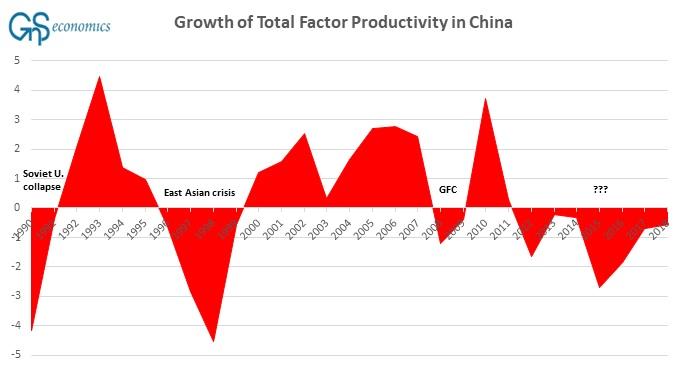
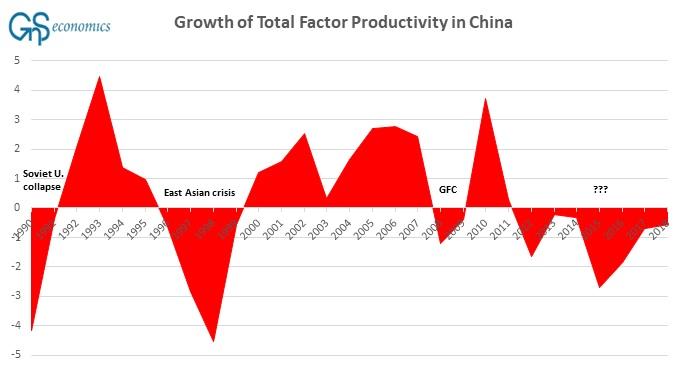
As China’s State-Owned Enterprises, or “SOEs”, have become riddled with debt, their ability to increase production has stagnated. This has also contributed to the broader stagnation of productivity growth in China (see Figure 1). After the growth of SOEs faltered in 2017, the Chinese consumer has become an important driver of the economy.

Figure 1. Growth (%) of total factor productivity in China. Source: GnS Economics, Conference Board

It’s clear that the current coronavirus scare is hitting the Chinese consumer and so affecting the economy as well. The massive plunge in the price of copper—the longest since 1986—implies that the Chinese economy has come to a near-standstill.

If the virus turns into a pandemic, which is definitely possible, the economic and human costs could become very dire not just for China, but for the whole world.

Virus and the world economy

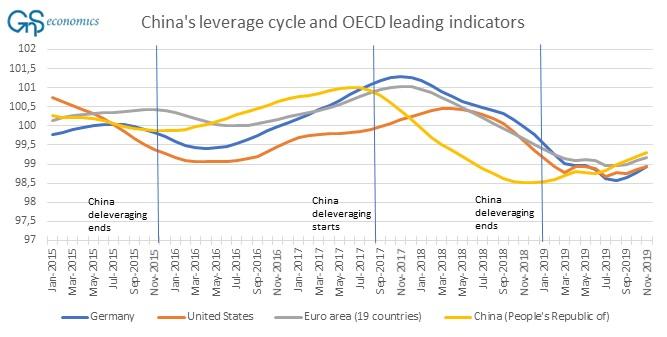
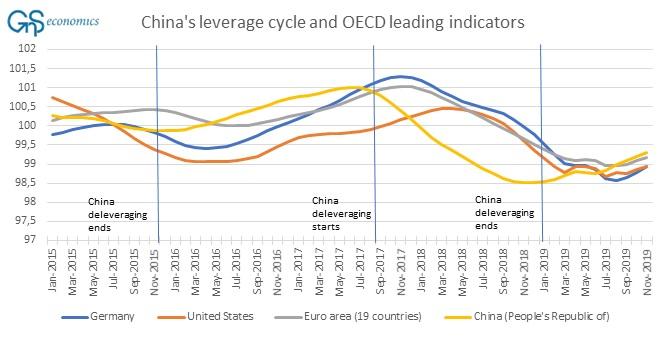
It is probable that the coronavirus will push Chinese economy into recession sometime this year. As China has led this global cycle (see Figure 2), the rest of the world will follow.

Figure 2. The leading economic indicators of the OECD and the deleveraging/leveraging policies enacted by China. Source: GnS Economics, OECD, PBoC

The first shoe to drop outside China is likely to be the export-and China-dependent Eurozone. And, as we have warned on several occasions, many European banks will be unable to withstand a recession (see also Q-Review 3/2019 and Q-Review 4/2019).

When the European banking crisis, driven by the ensuing recession, resumes it will “go-global” fast as Europe holds the biggest concentration of globally systemically important banks, or G-SIBs.

It is also unlikely that hyper-valued U.S. stock markets will be able to endure the impact of a global recession. This is even more the case if the Fed tapers its term repo-operations in February, as planned.

Global recession, a European banking crisis and a crash in the U.S. capital markets will produce a global economic collapse which will almost certainly overwhelm any attempts—massive and coordinated as they may be—to turn the tide by over-stretched central banks and over-indebted governments.

This is, why the coronavirus outbreak should be treated for what it is: a potential harbinger of human and economic calamity.


Tyler Durden

Thu, 01/30/2020 – 15:45

via ZeroHedge News https://ift.tt/2Gz69z3 Tyler Durden

‘Taking Our Baby to the Hospital Was the Single Most Harmful Decision We Made’

Last May, John Cox was worried he had accidentally hurt his newly adopted infant by rolling into her when they both dozed off. Erring on the side of caution, he brought her to Children’s Wisconsin hospital—where he worked, coincidentally, as a pediatric emergency doctor—just to make absolutely sure she was fine. It turned out she had suffered a minor fracture that is common in babies and heals on its own.

Two weeks later, child protective services declared him a child abuser and took the baby from him and his wife.

The child has been in foster care now for eight months. She is only nine months old.

What happened? According to a remarkable investigative story by ABC’s Mike Hixenbaugh, it’s possible for the authorities to interpret almost any bump or bruise as evidence of evil intent:

What followed, according to more than 15 medical experts who later reviewed Cox’s case, was a series of medical mistakes and misstatements by hospital staff members that has devastated Cox’s family and derailed his career. A nurse practitioner on the hospital’s child abuse team confused the baby’s birthmarks for bruises, according to seven dermatologists who have reviewed the case. A child abuse pediatrician misinterpreted a crucial blood test, four hematologists later said. Then, two weeks after the incident, armed with those disputed medical reports, Child Protective Services took the child.

Those misjudgments—and a deep suspicion of all parents with injured kids—led to the child being taken.

“In hindsight,” Cox said in a recent interview, “taking her to our own hospital was the single most harmful decision that we made for our baby.”

Children’s Wisconsin, like many hospitals, has bought into the theory of “sentinel injuries”—the idea that minor bruises can be warning signs of future abuse, so each bruise must be treated as suspicious. But as Hixenbaugh writes:

Several emergency room doctors described an “out of control” child abuse team that is too quick to report minor injuries to authorities and that is too closely aligned with state child welfare investigators. …

Five doctors told a reporter they’re even afraid to bring their own children to their hospital after accidental injuries, fearing that a misdiagnosis or miscommunication might lead Child Protective Services to break their family apart.

“This is a disease in our hospital,” one physician said. “The way John’s case has been mishandled has opened all of our eyes to how big the problem is.”

In part, the problem can be traced to the advent of the child abuse pediatrician, who claims to be able to tell adult-inflicted injuries from innocent ones.

“Child abuse pediatricians very often operate under secret contracts with police, child protection, and prosecution offices—never disclosed to the parents bringing their children in for emergency treatment,” Diane Redleaf, the legal consultant at Let Grow, tells Reason. “These individuals have been billed as having special superhuman powers to tell abuse from accidents and rare diseases, superior to the powers of other doctors because they ‘know child abuse when they see it.'”

Added NBC, which joined The Houston Chronicle in an investigation of this new pediatric specialty:

Some of the doctors have at times overstated the certainty of their conclusions, the investigation found. Child welfare agencies and law enforcement officials often rely on their reports as the sole basis for removing children and filing criminal charges, sometimes in spite of contradictory opinions from other medical specialists.

In Cox’s case, the family could afford to get outside doctors to review the records, and many were shaken by what they saw. They pointed out not just several stone-cold mistakes, but how eager the authorities seemed to be to find abuse.

A police detective who grilled both Cox and his wife—Sadie Dobrozsi, also a pediatric doctor—said he didn’t understand how the hospital could have concluded they did something wrong. That didn’t stop child protective services, though: The authorities insisted on a safety plan for the baby, involving supervised visits monitored by grandparents.

Eventually, child services removed the baby from the home, anyway:

As the caseworker was leaving with the child, Dobrozsi asked what was making them so certain that she and her husband were abusive? The caseworker mentioned a new bruise on the baby’s foot.

Mom was completely baffled. She had no idea where that bruise came from, until she obtained her baby’s medical records. It turned out the hospital itself had pricked the child’s heel for a blood test. The mom didn’t know this because she had not been allowed in the room when it happened.

At this point, the baby is still in foster care. The couple’s other two kids are terrified that they may be taken, too. (One keeps his favorite toys in a backpack in case he’s suddenly taken away). Now the father faces a possible six years in jail on felony charges of child abuse.

The prosecutor is bolstering his case with a report prepared by a yet another child abuse pediatrician, this one in nearby Minnesota, whom he hired to look over the files. “In summary,” this child abuse pediatrician wrote, “there is no explanation for [the baby’s] injuries other than trauma.”

And yet the trauma of separating an infant baby from her loving parents for months does not seem to concern the authorities.

from Latest – Reason.com https://ift.tt/38WFZ59
via IFTTT