Bankrupt Cities And States Get The National Disaster They’ve Been Hoping For

Bankrupt Cities And States Get The National Disaster They’ve Been Hoping For

Authored by John Rubino via DollarCollapse.com,

The people running states like New Jersey and cities like Chicago know they’re broke. Ridiculously generous public employee pensions – concocted by elected officials and union leaders who had to have understood that they were writing checks their taxpayers couldn’t cover – are bleeding them dry, with no political solution in sight.

They also know that they have only two possible outs: bankruptcy, or some form of federal bailout. Since the former means a disgraceful end to local political careers while the latter requires some kind of massive crisis to push Washington into a place where a multi-trillion dollar state/city bailout is the least bad option, it’s safe to assume that mayors and governors – along with public sector union leaders – have been hoping for such a crisis to save their bacon.

And this year they got their wish. The country is on lockdown, unemployment is skyrocketing and mayors and governors now have a plausible way to rebrand their criminal mismanagement as a “natural disaster” deserving of outside help.

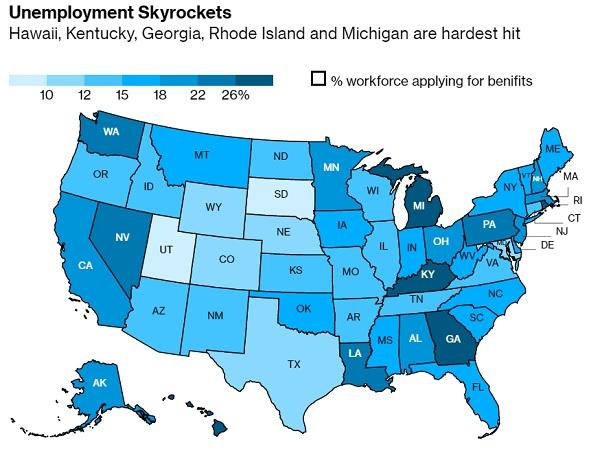
Here, for instance, is an estimate of how high unemployment will spike for various states. Note that overall it’s brutal, but the distribution isn’t what you might expect:
And here’s a table of state rainy day funds (i.e., cash on hand). To their credit, oil-producing states had the discipline to save against that commodity’s inevitable price fluctuations. Other states apparently didn’t see the need:

Illinois, which has the most underfunded pensions but, interestingly, a relatively healthy labor market, apparently had its natural disaster bailout plan prepped and printed before COVID-19 was invented and released. Because governor Gov. J.B. Pritzker almost instantly had his hand out for – get this – $41 billion, a sum equal to three times the state’s estimated pandemic-related revenue loss in the coming year. Overall, governors have asked for about $500 billion in aid.

And wait till California starts begging. See California Governor: Expect Budget Gap in ‘Tens of Billions’.

For President Trump, bailing out “badly run Democrat states”  seems politically pointless, since those states will never, ever vote Republican. Senate majority leader Mitch McConnell, meanwhile, trolled his Dem counterparts by suggesting that states just declare bankruptcy (thus freeing them to cut pension benefits).

But of course this is just partisan fantasy. Letting Illinois go bankrupt would send the muni bond market into a “who’s next?” seizure, which would quickly spread to corporate bonds, equities, and real estate, cratering the US and then the global economy. At least that’s the worst-case scenario economists will present to policymakers.

With no stomach for presiding over the end of the world during an election year, Washington will cave, agreeing to whatever governors demand. And so the grossest mismanagement in the history of US state and city government will be swept under the rug – or more accurately will be swept onto taxpayer balance sheets along with that of all the other sectors that are – surprise! – too big to fail.

This is a shame since one of the few things worth looking forward to in the deep recession the world was stumbling towards before the pandemic hit was the collapse of unconscionable public sector pensions, and the disgrace of the people who conned teachers, firefighters, and cops into thinking that those generous benefits were guaranteed. On the list of financial/political crimes of the modern era, theirs ranks near the top. And now they’ll go both unpublicized and unpunished.

Meanwhile, the resulting multi-trillion-dollar addition to the national debt will hasten the fiery end of the fiat currency/fractional reserve banking/unlimited-government-debt world. One can only hope that future historians will get the story right while the perps are still alive to answer for their sins.


Tyler Durden

Mon, 05/04/2020 – 13:35

via ZeroHedge News https://ift.tt/2L1eVYN Tyler Durden

NYT Publishes Grim CDC Projections Calling For Daily Coronavirus Deaths To Double By June

NYT Publishes Grim CDC Projections Calling For Daily Coronavirus Deaths To Double By June

Update (1320ET): Unsurprisingly, the White House has rebutted the NYT report – which claimed that these projections represented ‘current conditions on the ground, so to speak – saying it doesn’t reflect current projections.

*      *      *

Less than 12 hours after we predicted the news media would lose its mind over President Trump’s uttering a new “projected” death toll during a briefing with reporters Sunday evening. For the first time, Trump said he expects up to 100k deaths from the coronavirus outbreak, which is higher than figures he’s quoted in the past.

There’s no debate that the pace of deaths has slowed in the US in recent weeks.

Yet, as Florida allows some businesses to reopen (albeit with strictly limited capacity) on Monday, the NYT has published “internal projections” from the CDC calling for average daily US deaths to accelerate to 3,000 a day by June 1. However, most of the hardest hit states are seeing cases and deaths decline, while some states are seeing a slight acceleration. Overall US mortality has plateaued. According to the CDC’s own coronavirus weekly summary, “nationally, levels of influenza-like illness (ILI) declined again this week. They have been below the national baseline for two weeks but remain elevated in the northeastern and northwestern part of the country. Levels of laboratory confirmed SARS-CoV-2 activity remained similar or decreased compared to last week.”

The NYT reported that the White House continues to expect up to 3,000 deaths a day in June while Trump continues to ‘press’ for states to reopen.

The report also claimed the projections “confirm” public health experts “primary fear” that a premature reopening will instigate a rebound putting us right back where we were in March.

As President Trump presses for states to reopen their economies, his administration is privately projecting a steady rise in the number of cases and deaths from coronavirus over the next several weeks, reaching about 3,000 daily deaths on June 1, according to an internal document obtained by The New York Times, nearly double from the current level of about 1,750.

The projections, based on modeling by the Centers for Disease Control and Prevention and pulled together in chart form by the Federal Emergency Management Agency, forecast about 200,000 new cases each day by the end of the month, up from about 25,000 cases now.

The numbers underscore a sobering reality: While the United States has been hunkered down for the past seven weeks, not much has changed. And the reopening to the economy will make matters worse.

“There remains a large number of counties whose burden continues to grow,” the C.D.C. warned.

The projections confirm the primary fear of public health experts: that a reopening of the economy will put the nation right back where it was in mid-March, when cases were rising so rapidly in some parts of the country that patients were dying on gurneys in hospital hallways as the health care system grew overloaded.

Notice the language the NYT has used: Characterizing the situation in the US by saying “not much has changed” simply doesn’t jive with the data, or with the lived experience of millions of Americans who took to public spaces and parks over the weekend to enjoy the good weather and sunshine.

But even states that have pressed ahead with reopening aren’t seeing anywhere near the activity they saw as recently as mid-March, just as the stay-at-home orders and lockdowns were beginning.

Trump smartly stopped egging on protesters and pushing states to reopen before federal guidelines say it’s acceptable. But at this point, the notion that these projections represent anything more than a “worst case” scenario for the CDC seems far-fetched.


Tyler Durden

Mon, 05/04/2020 – 13:18

via ZeroHedge News https://ift.tt/35vE0o1 Tyler Durden

Q1 GDP To Be Revised Drastically Lower To -8%

Q1 GDP To Be Revised Drastically Lower To -8%

Last week’s -4.8% GDP which officially heralded the start of the recession, was panned as the worst economic print since the financial crisis, and one which is about to get far worse in Q2, when some expect a GDP drop as much as 40%.

But before we get to Q2 we have two more revisions of the first quarter GDP number, and according to Goldman, before all is said and done, the first quarter GDP drop may end up matching the collapse recorded in Q4 2008.

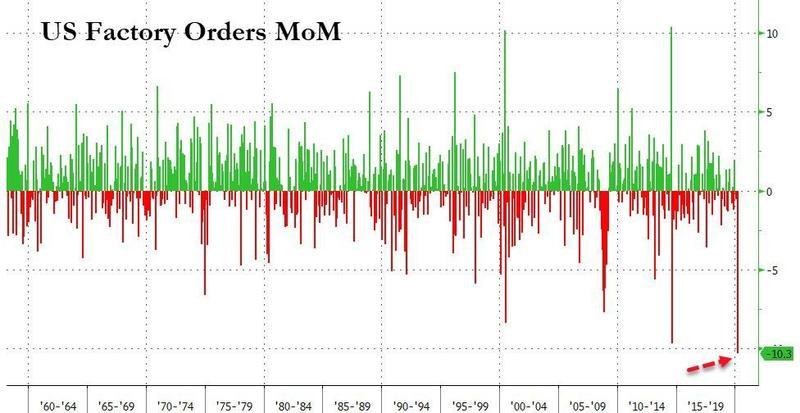
According to Goldman’s economists, today’s Factory orders – which declined 10.3% in March, missing expectations for a smaller decrease – will be the catalyst for further aggressive cuts to the Q1 GDP print. As the bank explains, “growth in core capital goods orders for February was revised up by 0.2pp to -0.7%, and growth in core capital goods shipments was revised down by 0.1pp to -0.9%. Growth in core capital goods orders and shipments were left unrevised in prior months.”

And so, reflecting the growing weakness in non-durable inventories and the net downward revisions to March durable goods data, Goldman further lowered its first quarter tracking estimate for the May 28th Q1 GDP revision by five tenths to -7.2%, roughly 50% lower than the -4.8% originally reported. Worse, as additional source data is incorporated and non-response biases are resolved, Goldman expects the final vintage of the data to show an even larger decline of -8.2% (-0.5pp relative to our previous estimate of -7.7%), which would match the Q4 2008 drop when the financial system was on the verge of collapse.

Of course, all of this only looks at Q1, when the US economy was only impaired for about 2 weeks in late March when widespread shutdowns were launched. One can only imaging what Q2 GDP will look like.


Tyler Durden

Mon, 05/04/2020 – 13:13

via ZeroHedge News https://ift.tt/2W3euUg Tyler Durden

American Power Grid ‘Vulnerable’ To Chinese Cyberattacks, Navarro Warns

American Power Grid ‘Vulnerable’ To Chinese Cyberattacks, Navarro Warns

A Reuters report claiming Beijing is already preparing for the prospect of “an armed conflict” with the US has seemingly driven the deteriorating relations between Washington and Beijing back into the limelight (at least as far as the market is concerned).

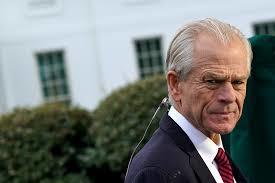
But for conservatives, who have been looking at China with a wary eye since the outbreak began, this latest ‘escalation’ is hardly a surprise. And when it comes to rebutting China’s aggression to an audience of mostly Trump supporters, nobody in the West Wing is as practiced as Pete Navarro. Which is probably why he was called to deliver a warning about the newest “threat” from China, a threat that could potentially be even more crippling to the US economy than the virus.

That threat? The vulnerability of the US power grid.

“I think that what’s important for the American people to understand very clearly is that “China lied, people died”. China spawned the virus and they hid the virus for 6 weeks, which allowed the virus to escape Wuhan and infect the rest of the world. And they spent that time going around the world, vacuuming up masks.”

Navarro explained how President Trump’s latest executive order protects America’s power grid by forcing the federal government to buy and use components made only in the US (the federal government administers roughly 20% of the US power grid). Under current rules, companies subject to the influence of foreign adversaries are still allowed to compete for government contracts to supply these components, Navarro argued in a Fox op-ed published shortly before his appearance.

Right now, Navarro said his primary responsibility in the administration is overseeing the reorientation of American supply chains away from China (though this will ultimately be decided by individual corporations, the White House can certainly take steps to sway their decisions, not that the crisis hasn’t been instructive enough on its own). He argued that this latest EO, along with another EO that will require federal agencies to use all-American components for medicines, are the first steps of the “decoupling” of the US economy away from China’s – something that, polls show, Americans mostly support.

Without these orders, Navarro said, China poses a direct threat to the US power grid so long as components made in China and other foreign markets are used.

Navarro also reiterated demands for an investigation into the early days of the outbreak and whether the virus did indeed originate from a lab: “Did they make scientists disappear?” Navarro asked.

He also insisted that “buy American is going to be the law of the land soon at HHS at DoD at the Veterans Administration…but we need to innovate…and we need to de-regulate…we need to have the whole chain here so it’s not all around the world, holding America hostage.”

Before the interview ended, Navarro urged viewers to read an article published last week by the Daily Telegraph that Navarro said gave “the entire timeline” of Beijing’s “complicity” in this.


Tyler Durden

Mon, 05/04/2020 – 12:55

via ZeroHedge News https://ift.tt/3c5C7AX Tyler Durden

Texas Regulator Says Efforts To Impose Oil Production Cuts Are Now “Dead”

Texas Regulator Says Efforts To Impose Oil Production Cuts Are Now “Dead”

So much for any Saudi hopes that the US would join OPEC+ in implementing production cuts.

Texas Railroad Commissioner Ryan Sitton, the Texas regulator who had proposed mandating oil production cuts in line with the historic April OPEC+ agreement to cut oil output by 9.7mmb/d, called those efforts “dead” a day before the state was set to vote on the measure.

In an interview on Bloomberg TV, Sitton predicted that curtailing production in a process known as “pro-rationing” would fail to get the support needed from the three-member agency, not to mention the state’s countless shale producers all of whom are scrambling to convert every drop of oil into precious cash flow.

“At this point we still are not ready to act, and so it’s too late, so there is no proposal to make,” Sitton said adding that “I think that proration is now dead.”

As Bloomberg notes, “Sitton had been the most outspoken member of the Texas Railroad Commission, the state’s chief energy regulator, when it came to advocating for production caps.” Chairman Wayne Christian recently stated his opposition to cuts in an opinion piece for the Houston Chronicle, and Commissioner Christi Craddick had expressed numerous concerns during the most recent meeting.

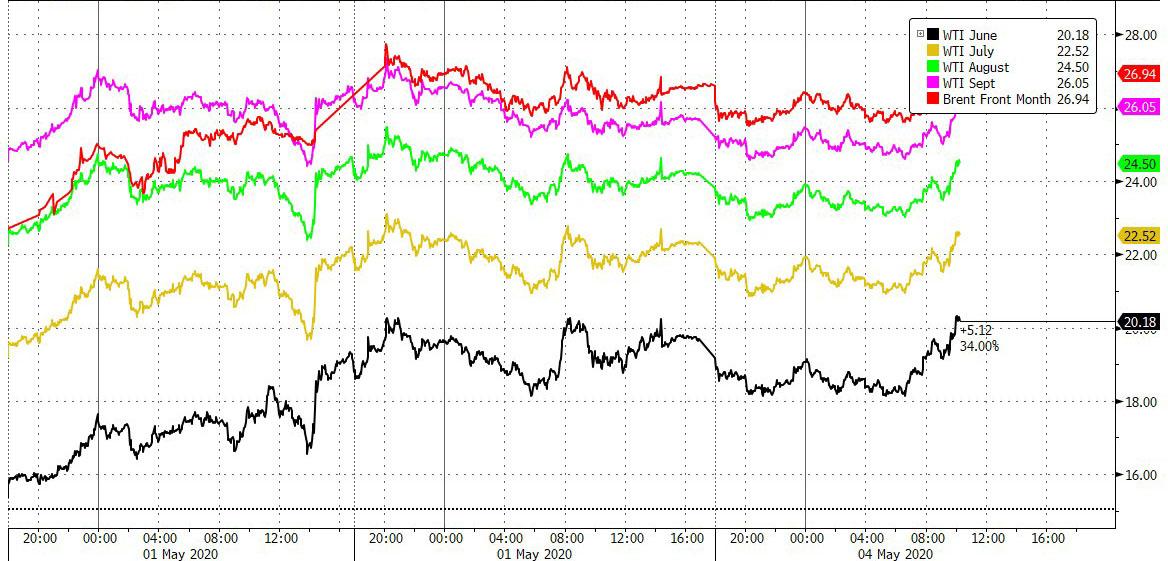
The question then becomes if the US will once again ramp up output following the recent rebound in the price of oil…

… even as OPEC+ continues to curtail production, while global oil and gasoline demand, which rising modestly remains far below levels where the market remains in balance. And a close follow up: will output see a renewed surge just as optimism was starting to emerge that global storage caps would not be hit in the next month, sending the price of oil sharply lower again?


Tyler Durden

Mon, 05/04/2020 – 12:51

via ZeroHedge News https://ift.tt/2VZnBoG Tyler Durden

Coronavirus Defeated By Experimental Antibody That Targets Spike Protein

Coronavirus Defeated By Experimental Antibody That Targets Spike Protein

An experimental antibody developed by researchers at Utrecht University in the Netherlands can defeat coronavirus in a laboratory setting, according to a new study published in Nature Communications Bloomberg, which notes that the antibody – known as 47D11 – neutralized the virus in cell cultures.

Monoclonal antibodies are proteins created in a lab which resemble naturally occurring versions used by the immune system to fight off viruses and bacteria. 47D11 was created by using genetically modified mice to produce antibodies which target a specific site on a virus – in this case the spike protein, which coronavirus uses to attach to and enter human cells.

After the mouse antibodies were proven effective in defeating coronavirus, the researchers ‘reformatted’ it to create a fully human version, according to the study.

The experimental antibody has neutralized the virus in cell cultures. While that’s early in the drug development process — before animal research and human trials — the antibody may help prevent or treat Covid-19 and related diseases in the future, either alone or in a drug combination, according to a study published Monday in the journal Nature Communications.

According to Berend-Jan Bosch of Utrecht University, more research is needed to confirm the findings in a clinical setting. According to the researchers, the antibody can also kill other viruses equipped with similar spike proteins such as Sudden Acute Respiratory Syndrome (SARS).

“Monoclonal antibodies targeting vulnerable sites on viral surface proteins are increasingly recognized as a promising class of drugs against infectious diseases and have shown therapeutic efficacy for a number of viruses,” wrote Bosch and colleagues.

They’re are already used in treatments for cancer, inflammation, ebola and other applications.


Tyler Durden

Mon, 05/04/2020 – 12:35

via ZeroHedge News https://ift.tt/2W34g6k Tyler Durden

Morgan Stanley Braces For “Overdue” 10% Correction In Stocks

Morgan Stanley Braces For “Overdue” 10% Correction In Stocks

Two weeks after Morgan Stanley’s former equity bear Michael Wilson, who led Wall Street strategists by first turning bullish in mid-March at the depths of the coronacrisis, turned “tactically” bearish warning that “stocks are now overbought”, Wilson is back with a repeat warning, expecting an overdue 10% correction which, however, is not the start of another crash, but rather a “necessary pause that refreshes.”

But to make sure he isn’t accused of flip-flopping back to being a bear, Wilson explains that his “bullish view has not changed, nor has the narrative – a severe recession acknowledged by all, the bottoming rate of change in economic data/earnings revisions, seemingly unlimited central bank support, unprecedented fiscal stimulus that we believe is likely to become structural in nature and that leads to rising inflation expectations sooner than the consensus expects.”

And so, with Wilson’s bullish reputation safe and sound, here’s why the Morgan Stanley strategist sees some pain in the immediate future:

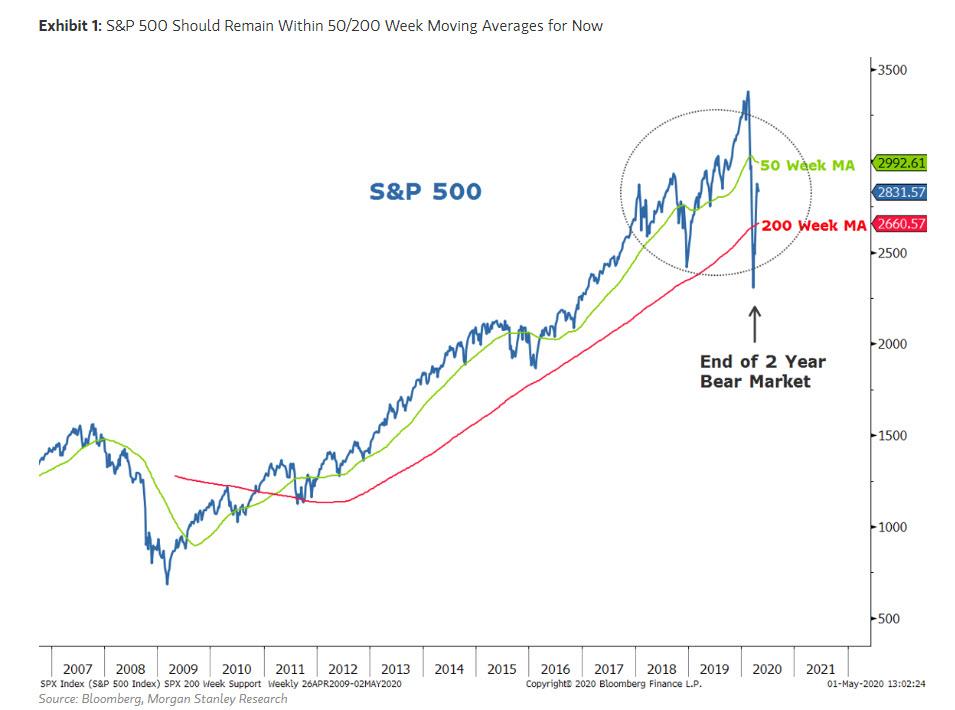
After a torrid 35% rally from the lows, equity markets appear to be taking their first real break. We continue to think 2650 (200-week moving average) on the S&P 500 will be vigorously defended, with the 2-year bear market having ending in March  while the 50-week moving average (currently 2992) provides resistance.

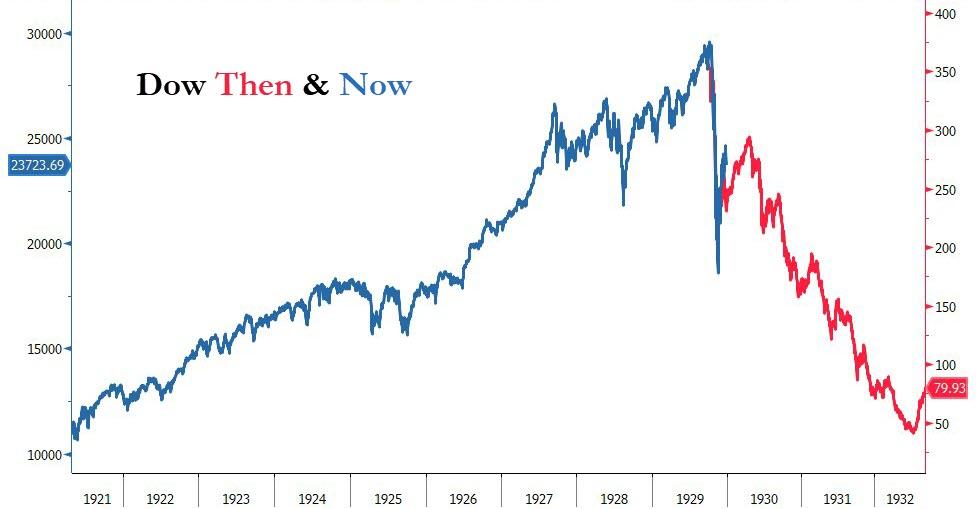
In the end, Wilson – unlike 13D’s Kiril Sokoloff who sees the stock market following the part of the Great Depression over the next 3 years…

… believes this correction will be a “pause that refreshes and necessary for the higher prices we expect later this year.”

In keeping with its cyclically bullish view, Morgan Stanley has tilted its recommendations toward higher beta, cyclical and smaller capitalization stocks. While this is a change in the bank’s strategy from the past few years to be more defensive, Wilson explains that “it is not an abandonment of high quality and/or growth stocks.”

For the past few years, we have recommended high quality/growth, large cap, and defensive factors. This strategy was reflected in our sector recommendations and Fresh Money Buy List and led to significant outperformance versus the S&P 500. Since March, we have downgraded Utilities, upgraded Health Care and added several smaller cap, lower-quality cyclical stocks to our Fresh Money Buy List.

Wilson then adds that he will look to do more of this into what we think could be a “2-3 week correction in the overall market.”

Bottom line, the bank strategist thinks “a barbell of high quality growth (best of the best) + lower-quality cyclicals (best of the worst) continues to be the right strategy as we begin the uncertain recovery from the worst economic downturn in our lifetimes.”

While such a rotation is difficult to trust while the data remain so weak and the outlook unclear, history suggests it’s exactly what one needs to do at this stage of the cycle.

Another thing that Wilson is bullish on is dividend futures, where he sees pricing as “too bearish”:

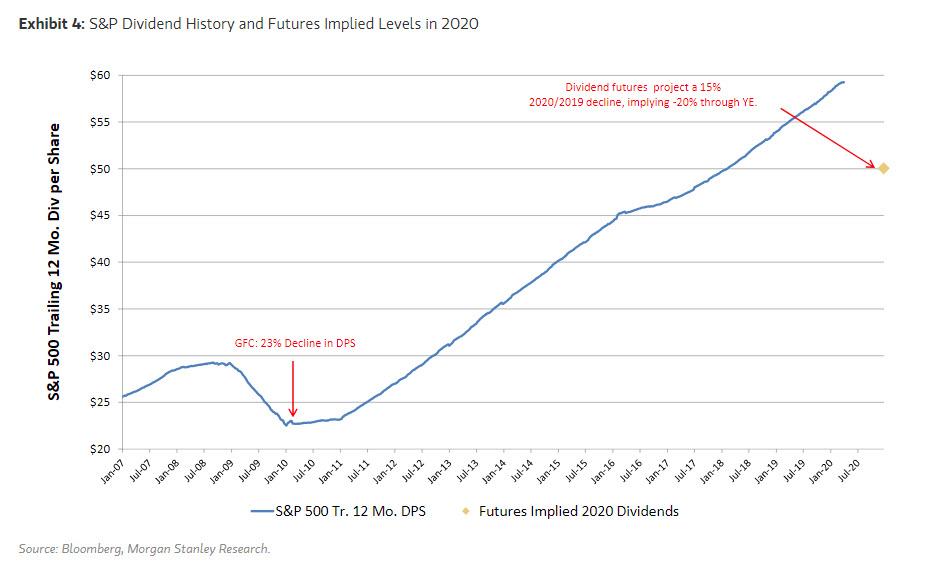
S&P dividend futures are pricing in a full year decline of ~15% compared to 2019 and 20% through the rest of 2020; we think that is too bearish. We appreciate that the current period of economic stress will weigh on cash flows, which will in turn create potential pressure on dividends. S&P dividend futures are currently pricing in about a 15% decline y/y, which implies about a 20% reduction through the remainder of 2020 (Exhibit 4).

Looking at the chart above, Wilson sees a number of reasons this forecast may be too bearish, and provides several reasons why he is more positive on index level dividends than futures markets:

Our detailed cash flow stress test model suggests lower cuts. An update on our cash flow and dividend stress test model suggests y/y dividend declines of 23%/14% in 2Q/3Q for the S&P 500. Importantly, these are bear case declines that are the result of highly stressed cash flows that give no credit to the willingness of companies to use their cash on hand to pay dividends. We suspect many management teams will be reluctant to cut dividends and be willing to use some cash on hand to support dividend payments.

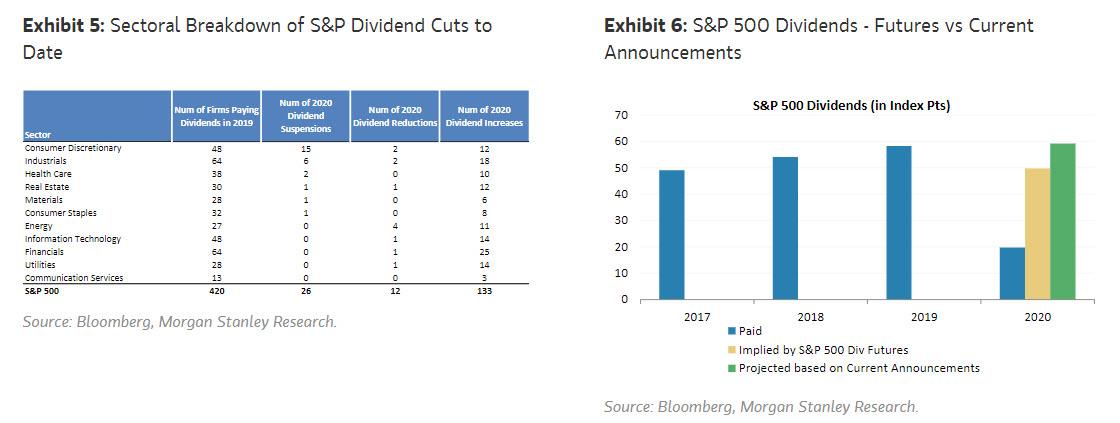
Cuts to date have been fairly limited and more companies have raised dividends than cut them. Year to date, 133 S&P 500 companies have increased dividends while only 38 have suspended or reduced dividends (Exhibit 5). Extrapolating cuts and increases to date suggests about a 2% increase in 2020 dividends relative to 2019 (Exhibit 6).

Dividends have been running ahead of last year. Dividend payouts to date are running about 4% above 2019 levels over the prior period. A 4% growth rate through the first 4 months of the year is only a modest cushion to further full year declines, but does provide some offset to the currently priced declines through the rest of the year.

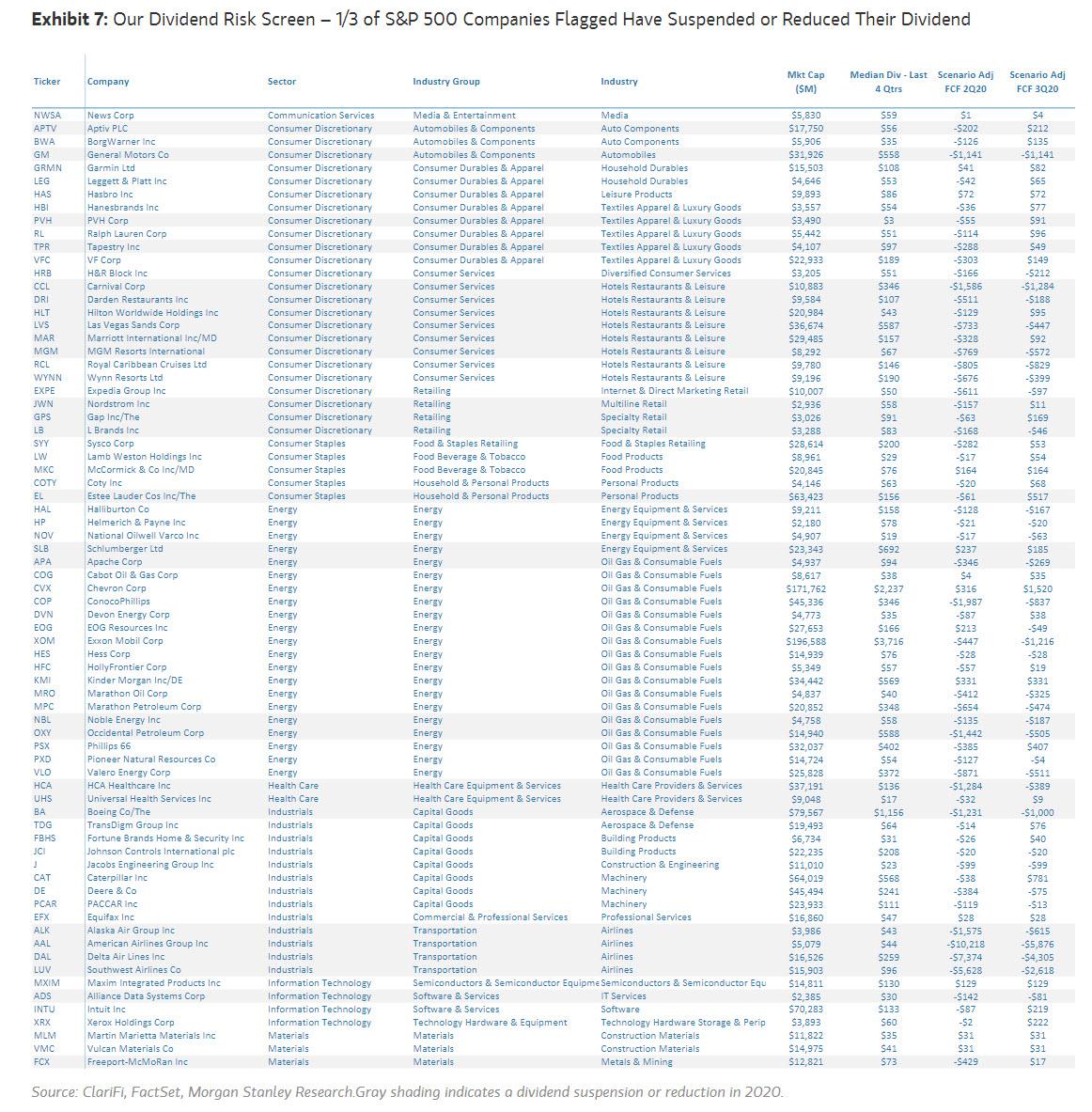
There is still risk of course, and as Wilson concludes, there is dividend cut risk is higher at the single stock level which of course is an understatement since a third of the S&P has suspended dividends. To the extent more S&P 500 firms do reduce or eliminate their dividend, there is negative alpha ahead for those stocks.

Finally, to avoid nasty surprises, Morgan Stanley concludes with a list of companies that make its dividend risk screen.


Tyler Durden

Mon, 05/04/2020 – 12:20

via ZeroHedge News https://ift.tt/2SzEDYF Tyler Durden

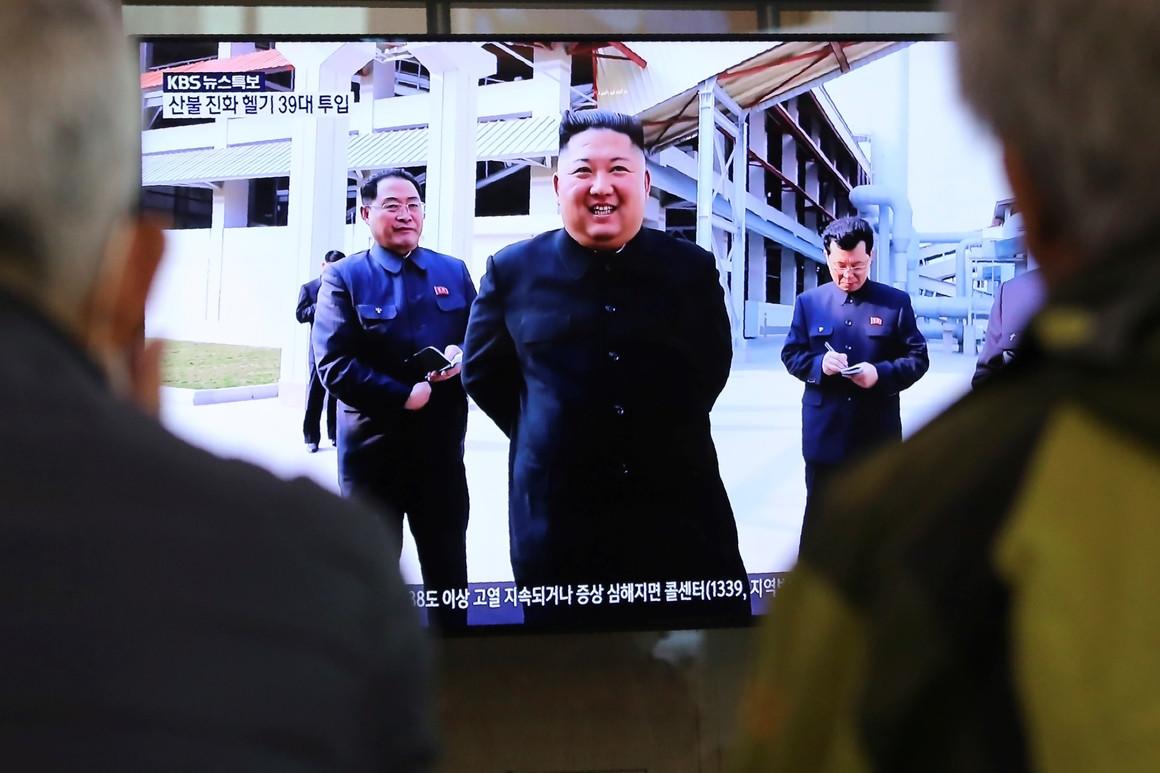
North Korean Defectors Apologize For Embarrassingly Wrong Kim Jong Un “Death” Info

North Korean Defectors Apologize For Embarrassingly Wrong Kim Jong Un “Death” Info

Some prominent North Korean defectors and dissidents are in the hot seat after giving embarrassingly wrong information just days before Kim Jong Un’s much-awaited public appearance last Friday after an uncharacteristic 3-week absence which had unleashed a torrent of rumors and reports of this death or that he was in a vegetative state after supposedly undergoing heart surgery. 

One former North Korean dissident and diplomat apologized for loudly claiming that North Korea’s Kim was so ill that he couldn’t even stand up, awkwardly issued shortly ahead of the leader contradicting such claims in appearing publicly at a Sunchon Phosphatic Fertilizer Factory on Saturday, attended by hundreds of officials.

He’s alive! Image via AP

The Guardian reports that “High-profile defectors from the country speculated that Kim was suffering from a grave illness or could even be dead.”

Notably among these is Thae Yong-ho, former deputy ambassador to Britain and one of two defectors elected to the South Korean parliament last month. He was forced to issue a public apology on Monday, saying “I am aware that one of the reasons why many of you voted for me as a lawmaker is with the expectations of an accurate analysis and projections on North Korean issues,” in a statement. “I feel the blame and heavy responsibility.”

“Whatever the reasons, I apologize to everyone,” he added.

And another prominent North Korean dissident who was so far off base that he’s since had to fast publicly back-track is Ji Seung-ho, also recently elected to the South’s parliament, who previously said in a media interview he’s 99% sure that Kim died after cardiovascular surgery.

Thae Yong-ho and Ji Seong-ho, defectors from North Korea who were recently elected into South Korea’s National Assembly, were key sources of information for false media reports claiming Kim Jong Un’s death, via Yonhap News.

Ji Seung-ho had even said Pyongyang was preparing to make the major announcement to the world of Kim’s “death” on Saturday — instead the world finally saw Kim in the flesh, ashy and bloated though it was. 

“I have pondered on myself for the past few days, and felt the weight of the position that I’m in,” Ji said in a statement. “As a public figure, I will behave carefully going forward.“

Ji had told Reuters on Friday he had received information about Kim’s death from a source he could not disclose.

The false predictions from what’s essentially the leadership of a ‘political opposition in exile’ community in South Korea set off a firestorm of criticism in Seoul.

The ruling Democratic Party of South Korea issued a statement condemning the prominent dissidents and newly elected lawmakers’ words, saying the “repercussions could have been more serious than merely misleading the public.”

And one of the party’s members went so far as to demand their removal from the Intelligence and Defense committees in Parliament.


Tyler Durden

Mon, 05/04/2020 – 11:55

via ZeroHedge News https://ift.tt/3c3ltSB Tyler Durden

SCOTUS grants cert to decide whether Ramos is retroactive

Two weeks ago, the Supreme Court decided Ramos v. Louisiana. This case decided that the Sixth Amendment requires a unanimous jury verdict for criminal convictions. Ramos did not decide whether that rule could be applied retroactively for collateral review.

I flagged that issue here. Justice Kavanaugh said it could not be applied retroactively. Justice Alito’s dissent faulted Justice Kavanaugh for reaching an issue that was not briefed. Justice Gorsuch’s plurality leaned towards it not being-retroactive, but it was non-committal.

Today, the Supreme Court granted review in Edwards v. Vannoy to decide this issue.

The motion of petitioner for leave to proceed in forma pauperis is granted, and the petition for a writ of certiorari is granted limited to the following question: Whether this Court’s decision in Ramos v. Louisiana, 590 U. S. ___ (2020), applies retroactively to cases on federal collateral review.

This Louisiana appeal came from the 5th Circuit. But the case was briefed well before Ramos was decided. The petition, with good reason, didn’t mention retroactivity. It merely raised the unanimity issue.

Now, the Supreme Court has granted review in a case, and added a question the parties did not raise! I can’t recall the last time the Court made such a move.

Here, the Court wanted to resolve the retroactivity question as soon as possible. It did’t want to wait for a circuit court to rule: that is, the Ninth Circuit would (likely) hold that Ramos was retroactive for an Oregon case, and the Fifth Circuit would (likely) hold that Ramos was not retroactive for a Louisiana case.

I suspect we will see a case next term, holding that the rule is not retroactive.

from Latest – Reason.com https://ift.tt/35uTbxF
via IFTTT

Lockdown Is Ending, Whether Governments Approve or Not

Some states have lifted their COVID-19 lockdowns or announced plans to let more businesses reopen soon; others have extended stay-at-home orders into late May or even early June. But regardless of what officials dictate, data from Apple and Foursquare suggest the lockdowns are gradually coming to an end on their own anyway, as more people venture out of their homes and resume various levels of economic activity.

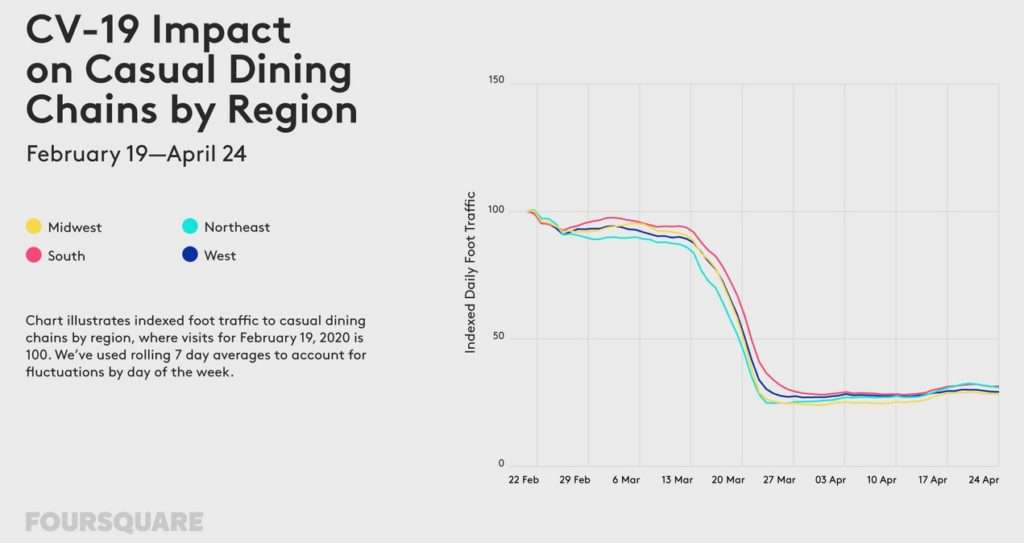
“As officials begin the process of relaxing some business restrictions, we’re starting to see upticks in foot traffic to various places,” Foursquare reported in an April 30 blog post. “This is true across regions, regardless of state-specific policies.”

Visits to fast food restaurants and gas stations have already returned to their pre-coronavirus baselines in rural regions, Foursquare reported. While suburban and urban areas are still below normal, those areas have seen 15 percent growth since the end of March.

Gas stations have seen a rebound too. According to Foursquare, gas station visits were down as much as 11 percent from their national averages in the early weeks of April but down only 6 percent for the week of April 24. In some parts of the country—mostly in the Midwest, where the COVID-19 outbreak has been less severe—the visits had returned to pre-coronavirus levels.

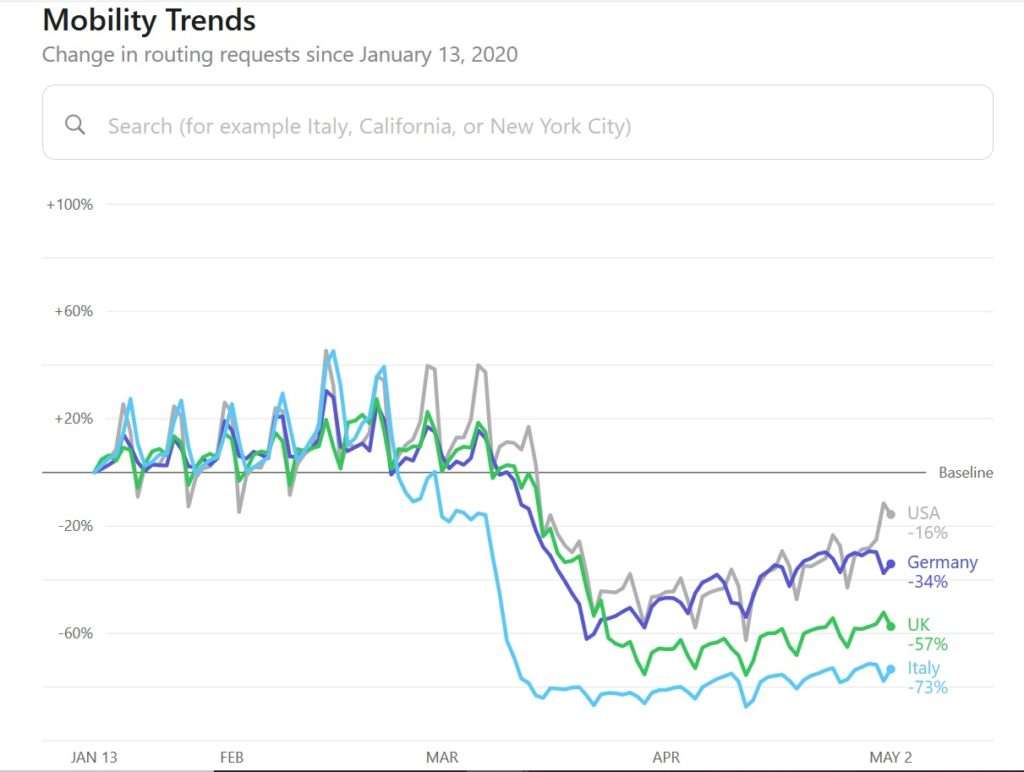
Apple’s Mobility Trends, which is aggregated from Apple Maps users, shows a similar uptick in the number of requests for directions—an indicator that people are doing more than just driving around their own neighborhoods. While travel in the United States was still down 16 percent from “normal” by the end of last week, there is an undeniable upward trend, one moving faster than in other countries hit hard by COVID-19.

Hardware stores and outdoor activities like hiking trails have seen a surge in activity during the lockdown—at least outside the few states that made bizarre efforts to shut them down—as Americans use the downtime to do some home improvements or reconnect with nature.

Needless to say, a great deal of economic activity is not back to normal. Bars, casual dining restaurants, gyms, and retail shops continue to be hammered by mandatory shutdowns in many states—and by consumer reluctance too. More than 30 million Americans have applied for unemployment benefits since mid-March, and while the uptick in economic activity in the past week or two offers a glimmer of hope, there is a long way to go.

But the Foursquare and Apple data provide policymakers with some critical insights, if they are willing to look. Clearly, individuals have been weighing the risks of the coronavirus against the difficulties of the ongoing lockdowns and deciding to venture out a bit more often. That’s good news for businesses that are still open, but it does nothing for those that the government has ordered to close. Those closures should be reversed as much as possible—though obviously with an eye toward social distancing and with limited capacity.

The data also show something about the nature of the shutdowns. They might have been encouraged by executive orders, but they were always ultimately driven by voluntary behavior. Well before states started issuing stay-at-home orders in the final week of March, many Americans were voluntarily self-quarantining.

Since officials had only limited influence over the beginning of the lockdown, they were always going to have limited influence over its ending. This was always unsustainable pver the long term, and coronavirus policies need to be reconsidered in light of that. On the other hand, declaring states to be “open” will be meaningless unless residents feel it is safe to venture out again.

Nor is this proof that anti-lockdown protests have worked. Dozens of Americans have descended on state capitals in displays of politicized rage, but the lockdowns are coming undone mostly because millions of other people have simply started going about their lives again, at least as much as they can. They’re voting with their feet—and their cars.

from Latest – Reason.com https://ift.tt/3aZsLW1
via IFTTT