“Passive Aggressive Flows”: The Oil Whale

“Passive Aggressive Flows”: The Oil Whale

Authored by Ryan Fitzmaurice of Rabobank

Passive aggressive flows

Summary

  • The recent and erratic moves in oil prices have highlighted the growing influence and significant impact passive funds can have on commodity and financial markets
  • The rise of commodity ETFs over the past decade has led to a surge in retail participation in what was once difficult to access commodity futures markets
  • The USO fund has attracted a great deal of regulatory scrutiny in the wake of the negative oil price settlement given its whale-like status in nearby Nymex WTI futures contracts
  • USO, the exchange traded fund was forced to restructure its holdings in an effort to reduce systemic risk to markets

The rise of commodity ETFs

This year is off to an unbelievable start on so many fronts and across all asset classes. While most of our time and effort is spent tracking and modelling the directionally dynamic money flows of CTA and managed futures strategies – the recent and erratic moves in oil prices – has shifted our attention back to the ever growing influence and significant impact passive funds are having on markets. This phenomenon has been long in the making and the last decade has witnessed the rise of more and more financial commodity products in the market place. In fact, the rise of commodity exchange traded funds (ETFs) and even exchange traded notes (ETNs) has led to a surge in retail participation in what was once difficult to access commodity futures markets. For clarity, these commodity products trade on various stock exchanges throughout the day and provide wide ranging access to underlying futures contracts but without the need for a futures trading account. Many of these passive funds simply go out and buy the equivalent notional amount of futures contracts per dollar that is invested and then roll those contracts on a predetermined schedule to avoid taking physical delivery. The futures contract roll is transacted in a very transparent manner but without any work on the investors’ part which is one of the huge benefits ETFs provide to institutional investors. On the flip side, this dynamic can also result in retail investors piling into a product they don’t fully understand the mechanics of. This issue is playing out in real time as a surge of investment dollars have poured into passive oil ETFs but without fully understanding key dynamics. This has led to significant losses and even unprecedented regulatory intervention in the wake of last month’s negative WTI oil settlement.

USO: Fund Details

The publicly traded USO fund has attracted a great deal of regulatory scrutiny in the wake of last month’s negative oil price settlement given its whale-like status in nearby Nymex WTI futures contracts. For readers unfamiliar with the fund, the USO oil ETF is traded on the New York Stock Exchange and available to pretty much anyone with a standard stock trading account. The exchange traded fund is a packaged up version of an underlying futures based index with key details listed here:

The oil whale

The speculative retail interest in USO, the supposedly passive oil fund, has shot up dramatically in recent weeks and months as crude prices have cratered to all-time lows and even unheard of negative spot prices. In fact, the fund currently has net assets north of 3.5 billion USD after starting the year with 1.2 billion USD. The exchange traded fund caught the ire of US regulators last week though due to its out-sized share of open interest in the Jun-20 WTI contract which was fast approaching 30% of open positions. This raised a lot of eyebrows given that the May-20 WTI contract had just settled in negative territory. For clarity, USO was not in the May-20 Nymex WTI contract when it settled in negative territory last week as it has already rolled to the Jun-20 contract but nonetheless the risk of negative prices occurring again in the Jun-20 contract was and is very real and apparent. This scenario posed a real threat to the market as potential losses on the ETF holdings could dwarf the net assets of the fund if prices were to fall deeply into negative territory again while USO was invested. Who would be on the hook in this case? Well, the regulators and exchanges did not want to wait to find out the hard way and instead took decisive action to greatly reduce ETF and investor products holdings of nearby crude oil contracts.

Too big to fail

While we all know there are plenty of fundamental drivers pressuring crude prices at the moment, it’s really been money flows that have been driving the price action in recent days. In fact, we learned that last Tuesday’s major collapse in the Jun-20 WTI contract was largely a result of the USO fund liquidating a large portion of its holdings in the Jun-20 contract and shifting further out the curve into the Jul-20 and Aug-20 contracts to avoid the risk of prices going negative again as expiration approaches. The publicly traded fund reported that is had sold roughly 90k contracts of Jun-20 Nymex WTI on Tuesday as a result of orders from the exchange and regulatory bodies to roll contracts away from spot. This forced liquidation had serious market implications and the overwhelming selling pressure was enough to send the Jun-20 WTI contract nearly $10/bbl lower, losing over half of its value in a single trading day. The move took the ETF share of open interest for the Jun-20 Nymex WTI from roughly 25% to just over 10%, a much more manageable level but the story doesn’t end there. The fund was forced to sell even more in subsequent days until its entire Jun-20 position was liquidated. The selling pressure clearly pushed the Jun-20 contract lower and we have even seen the Jun-20 rally in recent days as the forced liquidation ended. The same footprint can be seen when looking at the calendar spread price action. Ironically, the USO fund was only able to buy roughly half the equivalent exposure in Jul-20, Aug-20, and beyond given how steep the curve is at the moment and the fact that the fund invests on a dollar basis. While the situation is still fluid, the near-term risk to the system appears to have been sufficiently reduced as USO and others have taken action to reduce position sizes and stay out of nearby expiring futures contracts, at least for the foreseeable future. On top of that, USO can no longer issue new shares until otherwise notified which should prevent it from growing too big again.

Looking Forward

The recent oil price dynamics have certainly challenged conventional wisdom leading into this year which assumed oil prices had a zero floor bound. The move into negative commodity prices has also highlighted the systemic risk that ETFs and passive funds can pose to overall markets during periods of market stress. In this case, the risk of a worst case scenario occurring has been greatly reduced but not totally eliminated. Furthermore, the disorderly May-20 pre-expiry liquidation resulted in massive retail losses which has shined a light on the dangers of financial engineering derivative products for retail clients. It has been reported that retail clients at a Chinese bank lost over 1 billion USD in a product linked to WTI crude oil. There are also reports of significant losses for retail clients of a well-known US trading platform. Perhaps more than anything though, this recent liquidation driven price action in oil markets has highlighted the importance of understanding money flows and in this case what was supposed to be “passive” flows turning into “active” flows, at least temporarily.


Tyler Durden

Sun, 05/03/2020 – 19:00

via ZeroHedge News https://ift.tt/2z3VsDZ Tyler Durden

Watch: Park Ranger Thrown Into Lake In Texas Over ‘Social Distancing’ Enforcement

Watch: Park Ranger Thrown Into Lake In Texas Over ‘Social Distancing’ Enforcement

There’s been an increasing number of incidents between law enforcement and antsy Americans eager to get back outdoors after being sick of ‘stay at home’ and state-wide lockdown measures. But often individuals’ desire for a rapid return to normal is butting up against continuing social distance measures still in place in most states, even those already opening up their economies. 

A viral video showed one such recent tense encounter in Texas, when a park ranger attempted to break-up a large group of young partiers at a state park. It happened at the Commons Ford Metropolitan Park in Austin, Texas. A group on Lake Austin was reportedly unlawfully drinking and smoking on the grounds when a ranger approached and ordered them to “disperse” also due to people were not standing six feet apart.

That’s when things got physical, resulting in the officer being pushed or thrown into the water, according to widely circulating footage:

Though the laughing group of what appeared to be college students took it as a prank, police later apprehended and arrested a 25-year old man for assault on the ranger. The man initially tried to run away as the ranger struggled to get out of the water.

It illustrates a rising trend of frustrated citizens coming up against local law enforcement eager to see safe distancing between patrons. 

The Austin-American Statesman described the scene

“Keep that 6 feet of distance with each other,” the ranger says.

Some in the crowd are heard saying “will do” and “I got you, man” before the ranger is pushed into the water.

Hicks could have “caused the ranger to strike his head on the dock as he was falling,” the affidavit says.

Other onlookers came to the ranger’s aid even apologized for the young man’s behavior.

The culprit was later charged with a felony for assault on a law enforcement officer.

Likely there will be many more such encounters in various contexts across states in the coming days, as more and more Americans begin taking matters into their own hands and defying state and local distancing orders. 

Though we might also note that fiercely independent Texans typically lead the way when it comes to such drastic actions signaling anger and defiance. 


Tyler Durden
Sun, 05/03/2020 – 18:35

via ZeroHedge News https://ift.tt/2Wkatti Tyler Durden
David Stockman On The Three Nations Of COVID, & A Windbag Named Fauci

David Stockman On The Three Nations Of COVID, & A Windbag Named Fauci

Authored by David Stockman via Contra Corner blog,

If you don’t think our so-called mainstream rulers has gone off the deep end, just consider New York Mayor Bill de Blasio’s recent menacing tweets to the orthodox Jewish community in Brooklyn, which has insisted on holding funerals, including one Monday for a revered 73-year old Rabbi attended by upwards of 2,000 mourners:

“Something absolutely unacceptable happened in Williamsburg tonite: a large funeral gathering in the middle of this pandemic,” the mayor said in one post. “When I heard, I went there myself to ensure the crowd was dispersed. And what I saw WILL NOT be tolerated so long as we are fighting the Coronavirus.”

My message to the Jewish community, and all communities, is this simple: the time for warnings has passed. I have instructed the NYPD to proceed immediately to summons or even arrest those who gather in large groups. This is about stopping this disease and saving lives. Period.

Well, NYC is nearly a ghost town and now its idiotic ruling pols are suggesting that, apparently, only ghosts may attend funerals without governmental permission!

But actually, this photo from the offending funeral is another picture worth a thousand words.

That’s because by now, everyone, and we mean everyone, knows that the Covid-19 strikes the elderly, the frail and the already disease-afflicted; and that these vulnerable populations need to not only “social distance”, but actually stay home and keep out of harm’s way completely.

That appears to be exactly what happened at Rabbi Mertz’ funeral. If you can spot an octogenarian in this crowd, or even a grandfather, your eyesight is better than Clark Kent’s.

And besides being preponderantly way under 50-somethings, they congregated outdoors and virtually all were wearing masks. Yet claiming to speak for some latter day “Committee of Public Safety”, Mayor Robespierre actually threatened to bring in the gendarmes.

Hundreds of people gathered in Williamsburg, Brooklyn, for a massive funeral Tuesday evening

As to whether the above pictured citizens should be jailed or fined, let’s start with a tale of two Lockdown Nations – New York City and the semi-socialist Republic of California.

Both have imposed severe stay-at-home and business shutdown orders almost from the day the Donald issued his unfortunate March 16 guidelines. Yet here are the results 45 days later with respect to their mortality rates, which is ostensibly the reason officialdom issued these draconian “cease and desist” orders in the first place.

To wit, the mortality rate as of April 28 was 143 per 100,000 in New York City and 4.6 per 100,000 in the state of California. Essentially the same public health policy lockdown, but night and day differences in the outcome.

Yes, New York is more dense than California on average, but that doesn’t even remotely explain the difference. That’s because by now there is overwhelming evidence that the severity of the quarantine regime has essentially zero impact on the mortality metrics.

And folks, even the Virus Patrol hardliners don’t claim their lockdown orders are designed to prevent 3-day hospital stays by people who get an unusually stubborn case of the winter flu. This is about death prevention and that’s why they run the Chyron of Death across the CNN screen day and night.

But there is zero correlation:

  • California: Heavy lockdown, 4.6 deaths per 100,000;

  • Iowa: No lockdown, 4.3 deaths per 100,000;

  • Texas: Light lockdown, 2.4 deaths per 100,000;

  • Washington state: Heavy lockdown, 10.0 deaths per 100,000;

  • Colorado: Inconsistent lockdown, 12.2 deaths per 100,000;

  • Georgia: Late Lockdown now lifted, 10.0 deaths per 100,000;

  • Maine: Heavy Lockdown, 3.8 deaths per 100,000;

  • Massachusetts: Heavy Lockdown, 45.7 deaths per 100,000.

We call attention to Washington state, Maine and Massachusetts especially because even though they all have severe statewide lockdown regimes and their overall mortality rates very widely, from 3.8 per 100,000 in Maine to 45.7 per 100,000 in Massachusetts, they do share one thing in common. To wit, 40-60% of their Covid-fatalities have been in nursing homes.

In Maine, 53% of Covid deaths were in nursing homes, meaning that the actual Covid-mortality rate for the general population is just 1.8 per 100,000 and in Massachusetts 56% are nursing home fatalities, meaning the general rate is 21 per 100,000.

Ironically, Sweden has one of the least restrictive lockdown regimes in the world – schools, businesses, restaurants and retail remain open–yet its mortality rate of 22 per 100,000 is virtually the same as the lockdown state of Massachusetts.

Self-evidently, what matters is not how economically suicidal the lockdown regime is from one jurisdiction to the next, but the age, health status and general frailty/vulnerability of the populations at issue. In the case of Washington state where the first corona cases occurred, upwards of 40% of the 690 deaths to date have been in nursing homes, meaning that its general population mortality is just 6.0 per 100,000.

As we amplify below, these single-digit rates are rounding errors on the scheme of things, even as all deaths are both regrettable and inevitable. But by what rational calculation does Governor Inslee insist on keeping the state in Lockdown and its economy heading into the the drink?

Someone might dare inform him that the general mortality rate from all causes for his citizens is 900 per 100,000 annually, and that, therefore, he is imposing the economic mayhem evident in these charts below owing to a risk of Covid death for the general population of his state that so far has been 0.7% of the normal average.

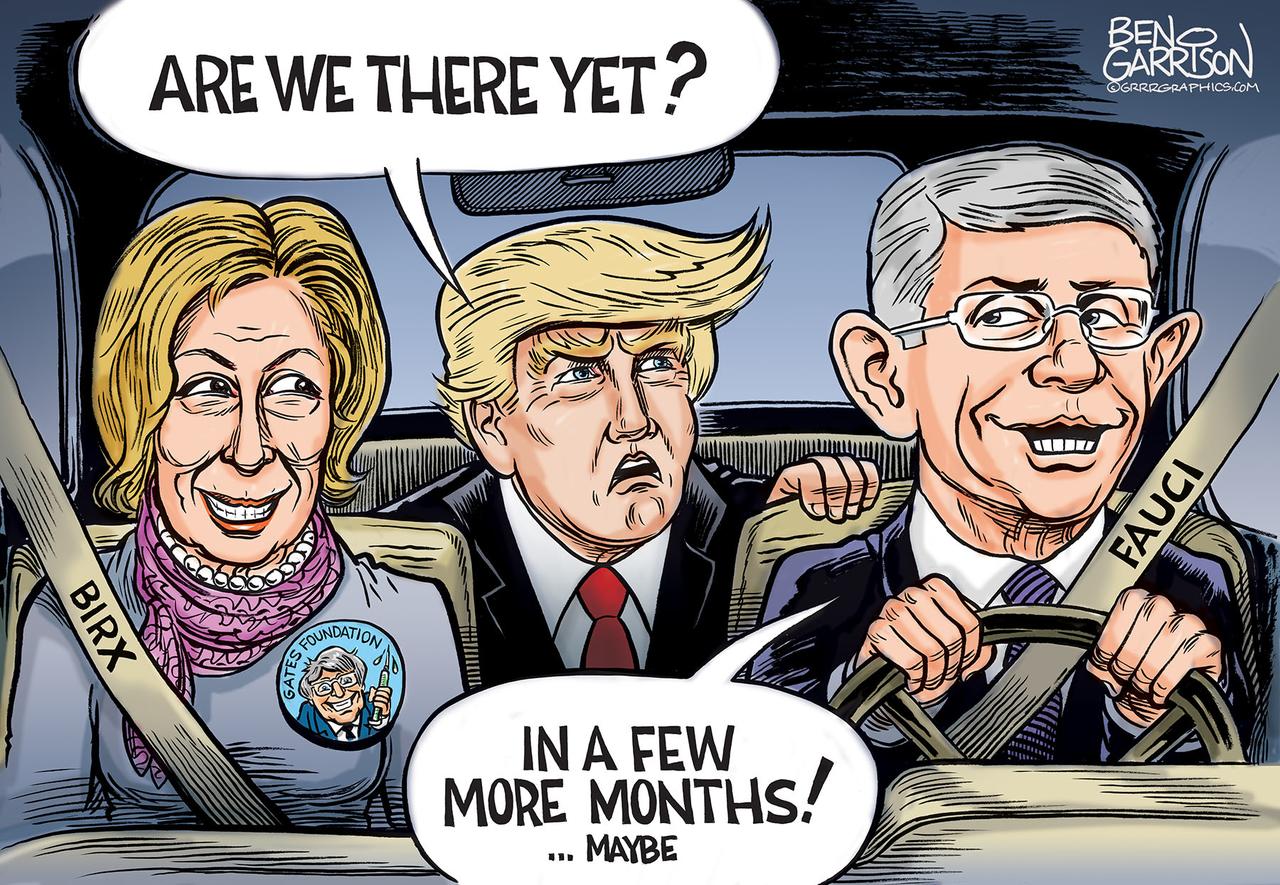
Stated differently, had Patient Zero (aka the Donald) not been the victim of malpractice by his doctors led by Fauci and the Scarf Lady, he might have been advised to dial in on day #1 to the heart of the Covid-threat. Namely, the 15,600 nursing homes in America, which domicile some 1.5 million residents, of which one-quarter (425,00) are over the age of 80 years.

In the case of Massachusetts, where the majority of deaths have occurred in nursing homes, the average age of Covid-deaths has been 82 years.

Needless to say, you did not need to be entombed in the infectious disease tunnel at the NIH for 52 years like Dr. Fauci, a pretentious 79-year old windbag who should have himself been put in a retirement home years ago, to realize that nursing homes are dense-packed with the frail, disease-afflicted elderly.

So rather than wipe out $4 trillion of GDP via Lockdown Nation they might have started with say $25 billion of incremental money for Medicare/Medicaid and the state public health agencies to zero-in on protecting, isolating and treating the nursing home residents.

After all, we find it easy to believe that spending $20,000 per nursing home resident might have saved or extended a lot more lives than the WHO/CDC/DR. Fauci blunderbuss assault on the entire US economy.

Indeed, with each passing update, the CDC data itself becomes an ever more dispositive indictment of the madness the Donald’s doctors have imposed on the nation. It is now strikingly clear, in fact, that when it comes to Covid-19 there are three nations in America, and that the attempt to shoe-horn them into a one-size fits all regime of state control is tantamount to insane.

There is first the Kids Nation of some 61 million persons under 15 years, where even by the CDCs elastic definitions there have been just 5 WITH Covid deaths thru April 28. You needn’t even bother with the zero-ridden fraction of 1 per 100,000 (its actually 0.008) to make the point.

That is to say, last year there were about 44,000 deaths among the Kids Nation – so corona-virus accounts for just 0.011% of the total, and in no sane world would it be a reason for shutting down the schools.

Of course, the Virus Patrol insists that the school closures are an unfortunate necessity because otherwise the Kids Nation would take the virus home to the Parents/Workers Nation. That is the 215 million citizens between 15 and 64, who account for the overwhelming share of commerce, jobholders and GDP.

Yet according to the CDC, there have been just 8,267 deaths WITH Covid in this massive expanse of the population, which figure represents a mortality rate of, well, 3.6 per 100,000.

But here’s the thing. The normal total mortality rate for the 15-64 years old population is 335 per 100,000. So we are talking about shutting down the entire economy owing to a death rate to date which amounts to 1.1% of normal mortality in the Parents/Workers nation.

Finally, we have Grandparents/Great Grandparents Nation, comprised of 52 million citizens. But they account for 32,000 or nearly 80% of the WITH Covid deaths as of April 28 – with 15,000 of these being among those 85 years and older.

By way of computation, that’s 61 deaths per 100,000 for the group as a whole and 230 per 100,000 for the 85 years and older.

Stated differently, the risk of death posed by Covid-19 is 7,600X greater for Grandparents/Great Grandparents Nation overall than for Kids Nation, and 29,000 times greater for the several million Great-Grandparents afflicted with severe comorbidity and likely as not to be in the care of a nursing home.

Needless to say, it did not take a catastrophic experiment with Lockdown Nation to figure this out. It was already known from China and the history of other coronaviruses.

If there were any reason or justice left in America, Dr. Fauci and the Scarf Lady and the whole CDC/WHO lobby that brought about this disaster would actually be headed for their own quarantine – the kind that doesn’t happen at home and which can’t be lifted by the whims of the Cuomo brothers or Mayor Robespierre.


Tyler Durden

Sun, 05/03/2020 – 18:10

via ZeroHedge News https://ift.tt/3fi6Dtc Tyler Durden

The FAAMGs Are Up 10% In 2020; The Remaining 495 S&P Stocks Are Down 13%

The FAAMGs Are Up 10% In 2020; The Remaining 495 S&P Stocks Are Down 13%

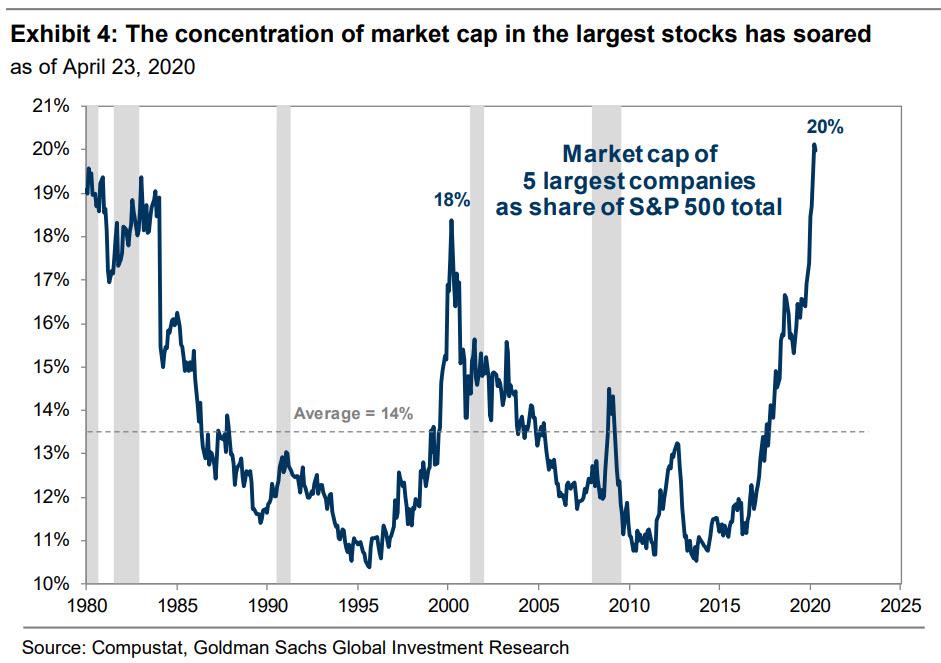
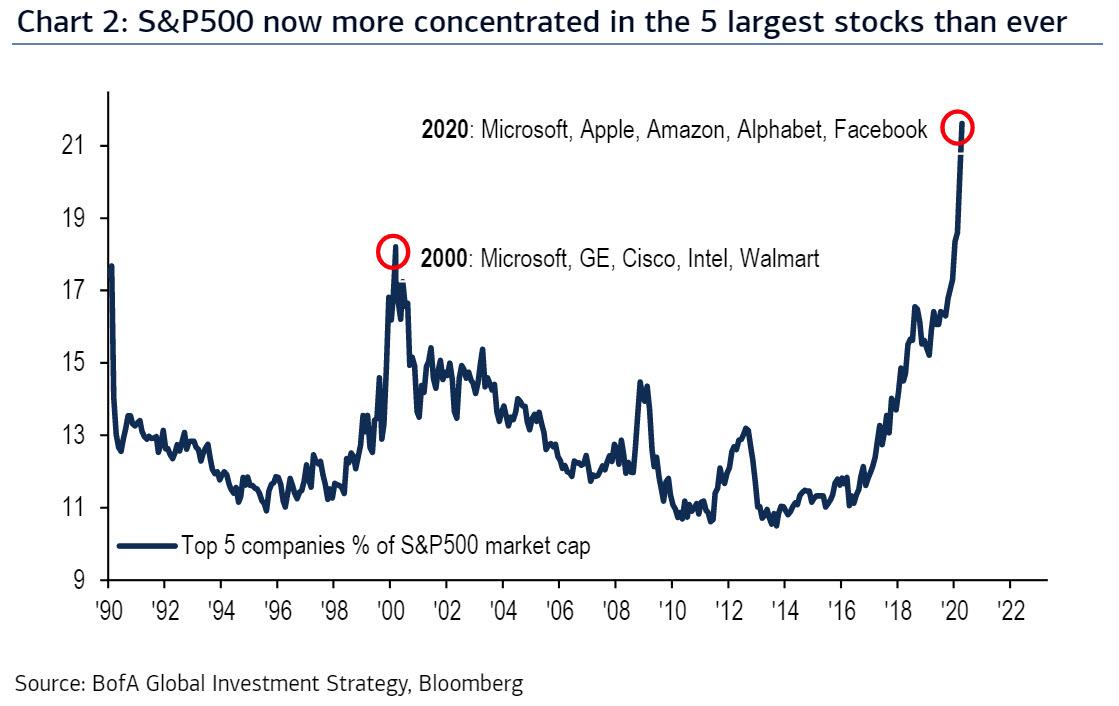
One week ago, Goldman triggered a selloff in growth and momentum stocks, when it pointed out that  the five largest S&P 500 stocks, the FAAMGS (or MSFT, AAPL, AMZN, GOOGL, FB) have risen to account for 20% of index market cap, representing the highest concentration on record…

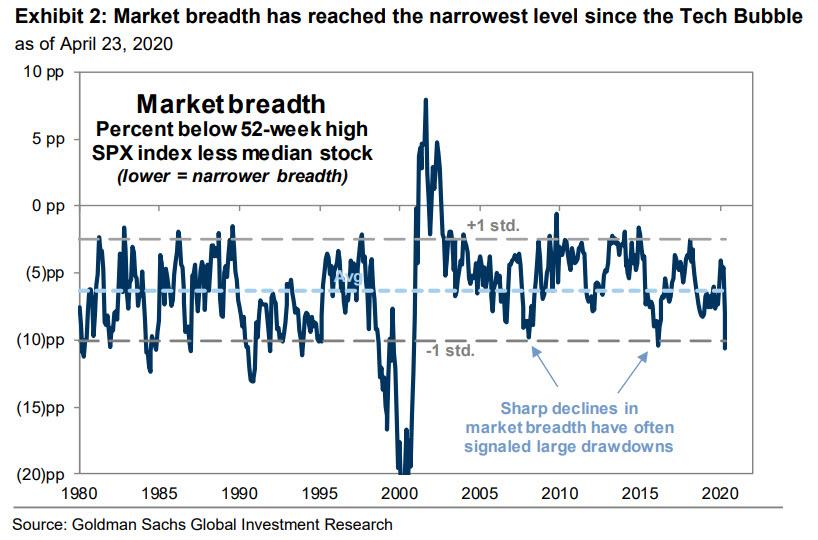
… resulting in the lowest market breadth since the tech bubble…

… and warning that “narrow market breadth is always resolved the same way” as “narrow rallies lead to large drawdowns as the handful of market leaders ultimately fail to generate enough fundamental earnings strength to justify elevated valuations and investor crowding. In these cases, the market leaders “catch down” to weaker peers.”

Fast forward to this weekend when Goldman’s David Kostin has published part two of his curious vendetta against the FAAMGs, although this time easing back somewhat, and while again warning that “the relative outperformance of market leaders eventually gives way to underperformance” he concedes that “timing the reconciliation is difficult” especially since “all five stocks reported earnings this week, and the strong results suggest a catch-down is unlikely to be imminent.” 

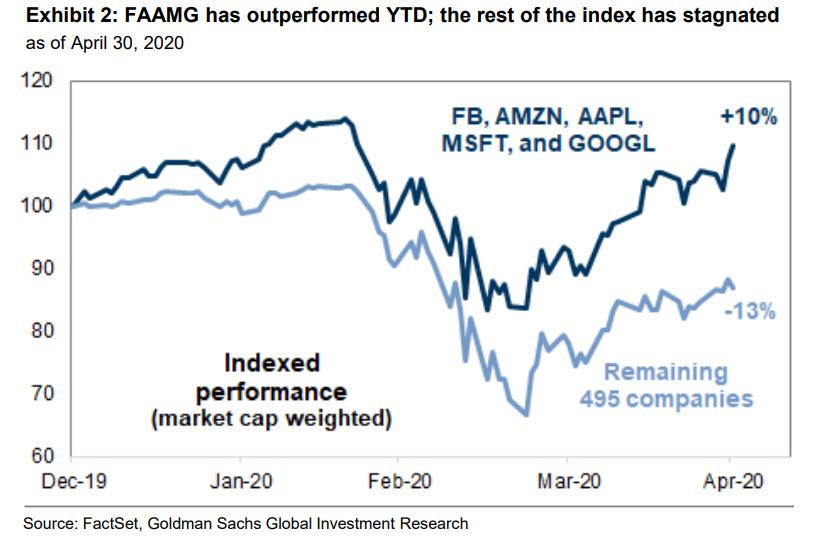
Yet while a momentum crash may not be imminent (even if Nomura’s quant disagrees), Kostin does not let go, and repeats that the “multi-year outperformance of Facebook, Apple, Amazon, Microsoft, and Google has led to record-high equity market concentration and narrow market breadth” with  AMZN (+24%) and MSFT (+12%) have even posted positive absolute YTD returns vs. -9% for S&P 500. Furthermore, demonstrating the record low breadth and surge in dispersion, Goldman points out that although the S&P500 trades just 14% below its all-time high, the median S&P 500 constituent still trades 23% below its record high. As a measure of breadth, this 9 percentage point gap ranks in the 15th percentile since 1980.

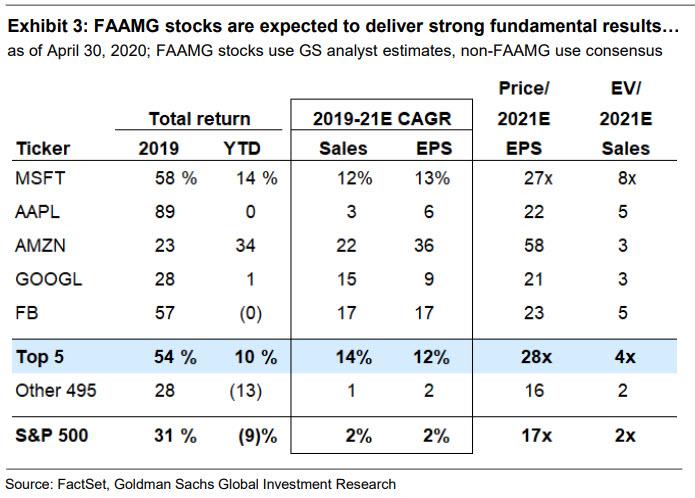
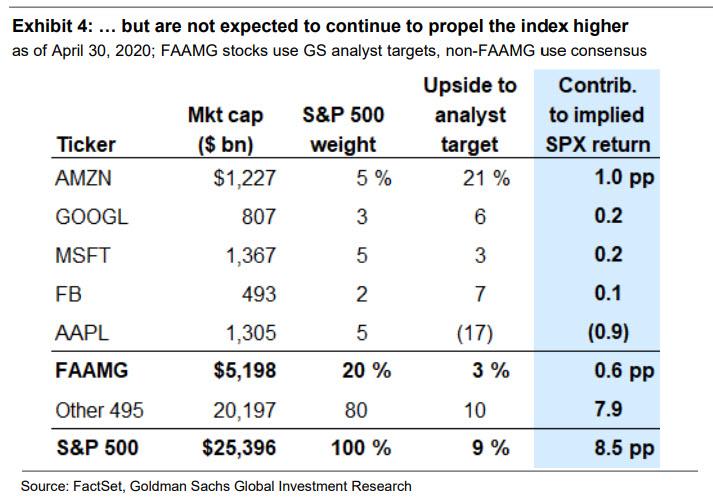
Further demonstrating the unprecedented divergence between the top 5 tech names, many of which are not only still employing buybacks and some, such as Apple, further adding to their buyback authorization, Goldman notes that its equity analysts forecast these 5 stocks alone collectively will post 2019-2021 CAGR sales and EPS growth of 14% and 12% vs. 1% and 2% for the other 495 constituents. But the group of five stocks has upside potential of just 3% to GS analyst price  targets vs. 10% for the other 495 firms based on consensus estimates.

In short, as we wrote – jokingly – two weeks ago, that “The Market Is Now Just 5 Stocks”, that’s precisely what has happened, with investors dumping everything but the top 5 names, and creating the biggest “hedge fund/mutual fund/retail/momentum hotel” ever assembled in the FAAMGs. And here another stunning statistic from Goldman: YTD the 5 biggest stocks are up 10% while the remaining 495 S&P500 companies are lower by a collective 13%.

But this is where the good news ends, because in renewing its feud with the “Big 5”, Kostin writes that while Goldman expects the FAAMGs to post CAGR sales and EPS growth of 14% and 12%, respectively, vs just 1% and 2% for the remaining 495 S&P companies, trading at a record 28x expected 2021 EPS, the FAAMGs have very limited upside potential of just 3% to the GS analyst price targets. The other 495 firms trade at 16x 2021 EPS and have 10% upside to targets.

In other words, while the priced to absolute perfection – and growth – FAAMGs are expected to deliver strong fundmanetla results…

… since almost every is long them, they are no longer expected to propel the index higher.

If Goldman is right, and the FAAMG’s loss of market leadership coupled with Buffett’s recent stock sales and warning that markets remain too high (and propped up by the Fed), it is not clear just why anyone would keep buying here, suggesting that the coming week may indeed be painful for the bulls, although they too have a backstop: should stocks suffer another 20% plunge in the next week or so, Powell – whose reputation is now “all in” stocks – will have no choice but to announce that the Fed will start buying equities in his Hail Mary attempt to prevent the final crash.

One final point: this being Goldman, it is virtually guaranteed that the bank is twisting the truth if not outright lying because at the same time as it warns – for the second week in a row – that there is just 3% of upside for the FANGs, the bank recaps its latest analyst actions on the FAAMGs which, it will come as no surprise to anyone, were all raises , to wit:

  • AMZN PT from $2,900 to $3,000
  • MSFT PT from $162 to $185
  • GOOGL PT from $1,250 to $1,425
  • FB PT from $170 to $220
  • AAPL PT from $236 to $243

So how does one make any sense of i) Goldman warning that the Big 5 are about to cause a sharp market “drawdown” due to their massive concentration while at the same time ii) Goldman analysts hike all the FAAMG price targets? Simple: it’s Goldman.


Tyler Durden

Sun, 05/03/2020 – 17:49

via ZeroHedge News https://ift.tt/2VWklKK Tyler Durden

Indifference To Illegality Of Illinois’ Stay-At-Home Order Is Frightening

Indifference To Illegality Of Illinois’ Stay-At-Home Order Is Frightening

Authored by Mark Glennon via Wirepoints.org,

Over two thousand years ago, Marcus Tullius Cicero devoted his life to a struggle to preserve the best of the Roman Republic – constitutional checks on power, the rule of law and, to a significant degree for the age, democracy and individual rights.

It’s all there in Cicero’s story – all of today’s battles for the same goals. Some of those battles were small and some large, some fought in court and some on the battlefield, but many were ultimately decided not by law or armies but by the power of public opinion.

And so it has been for the centuries since Cicero. A Star Wars sequel gave us a modern adage for the role of public opinion: Liberty dies with thunderous applause.

For those reasons, it’s particularly alarming to see the public’s opinion about the clear illegality of Governor JB Pritzker’s emergency stay-at-home orders, which is indifference.

That indifference is almost universal in Illinois’ press. Editorial condemnation of the order’s illegality has been almost nonexistent. A particularly sad example was an April 23 Chicago Tribune editorial. Flattening the curve is good, it said, so hurrah for extending the order. No mention of its illegality.

Same with the general public. Polling says 93% of Illinoisans approve Pritzker’s orders, including 75% who said they strongly approved. Illegality apparently is of no consequence.

Maybe the public thinks this is about some petty “technicality.” Maybe they think it doesn’t matter because the order is sensible.

But Pritzker’s orders are illegal, flagrantly so, and it matters. State authorization for the nearly unlimited power asserted under the orders limits them to 30 days. But Pritzker claims he can extend that to eternity simply by issuing successive 30-day orders forever, an arrogant, autocratic and untenable interpretation of the statute.

More importantly, the orders violate a range of of constitutional rights. No effort was made to confine the orders to legitimate public safety goals and tailor them to respect those rights. They reflect no rational basis for the lines between what is permissible and impermissible and, as they apply to many Illinoisans, the orders would not survive the strict scrutiny courts say the constitution demands insofar as they impair certain constitutional rights.

The arguments presented by the Illinois Attorney General in a memorandum defending the orders are cringeworthy:

  • We’ve broken the 30-day limit before so we can do it again, goes one of those arguments. If the AG were right that past illegalities render laws unenforceable, there would be little left of any law, this being Illinois.

  • Governors don’t need statutory authorization anyway, goes another argument, because they hold “supreme executive power.” Checks and balances mean nothing to the AG, apparently, nor do individual rights. President Donald Trump and Vice President Michael Pence were roundly ridiculed by the right and the left when they made the same claim regarding the presidency last month.

  • The General Assembly hasn’t convened to cut off Pritzker’s emergency powers, says the AG, so there’s no issue. Sorry, but inaction by the legislature does not extend time limits written in statutes or suspend basic rights. That’s particularly important when the legislature is controlled by the governor’s allies, as now.

  • The order will reduce infections and save lives – that basic argument runs throughout the AG’s memorandum. But that justification contradicts the initially stated justification for the order, which was not that it would save lives but merely spread infections out over a longer time frame to ensure hospitals were not overloaded. Illinois surpassed that goal weeks ago. More fundamentally, the AG’s office just doesn’t seem to get that Pritzker’s actions, whether wise or not, must be authorized by the General Assembly and reasonably tailored to fit the need. If the merits of Pritzker’s actions are so clear he could easily have reconvened the legislature to give him extended authority.

Pity us if those arguments are accepted and become precedent.

They were made in the appeal of a temporary restraining order issued on April 27 against extension of the first stay-at-home order. The lawsuit underlying the order is being refiled and probably will be appealed. We can only hope not only that the rule of law prevails but that the general public comes to understand what is at stake.

January will mark the 60th anniversary of John F. Kennedy’s inaugural address.

JFK’s Inaugural Address

The torch had passed, he said, to a new generation of Americans “unwilling to witness or permit the slow undoing of those human rights to which this nation has always been committed.”

The torch passed again since then. Will this generation permit what JFK’s would not?


Tyler Durden

Sun, 05/03/2020 – 17:20

via ZeroHedge News https://ift.tt/2z4to3u Tyler Durden

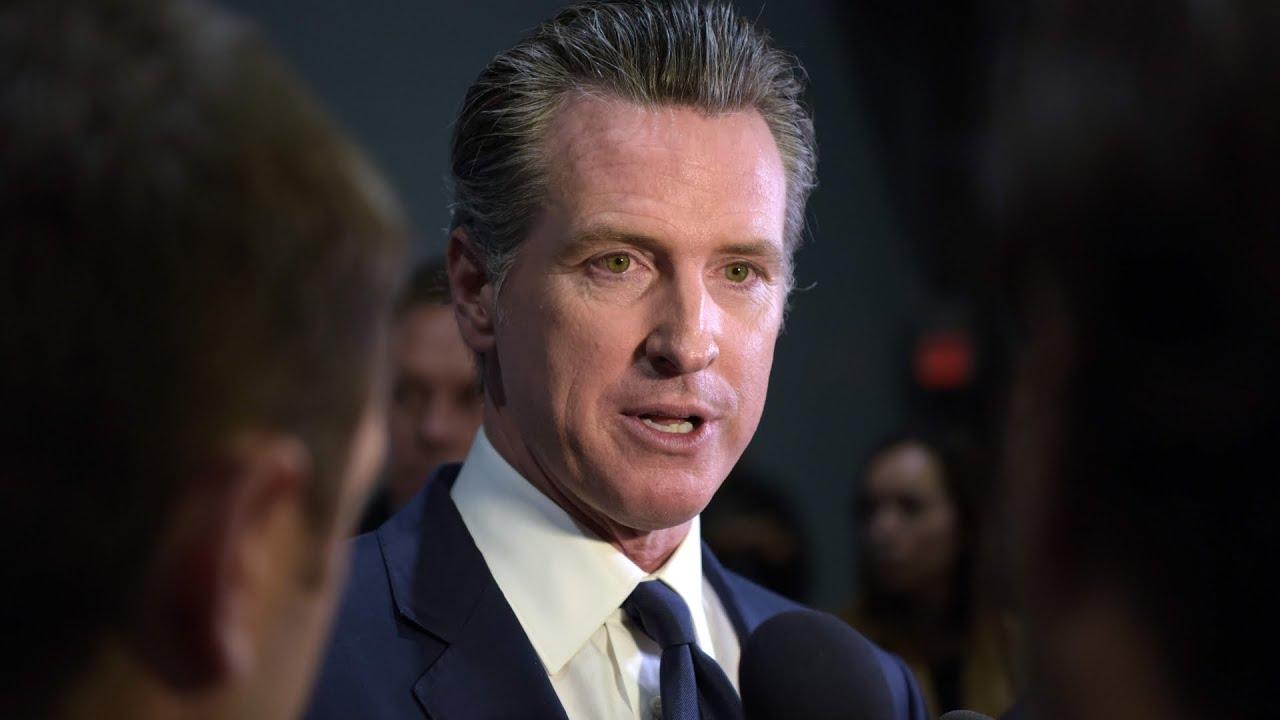
Newsom Says California Went From Surplus To ‘Tens Of Billions In Deficit’ In Weeks, Won’t Get By Without Federal Help

Newsom Says California Went From Surplus To ‘Tens Of Billions In Deficit’ In Weeks, Won’t Get By Without Federal Help

California Governor Gavin Newsom (D) says the nation’s most populous state has flipped from ‘tens of billions in surplus’ to deficits over the course of weeks.

“Last year I did a May revise with a $21.4 billion budget surplus,” Newsom said on Friday during his daily coronavirus briefing, according to Bloomberg. “This year I will be doing a May revise looking at tens of billions of dollars in deficit. We just went tens of billions in surplus in just weeks to deficits.

Newsom, a first-term Democrat, is scheduled to revise his budget proposal by May 14 with the latest estimates on revenue and spending. In January, he proposed a $153 billion general-fund budget that increased spending by about 2% from the current year that ends June 30 and socked away about $5 billion more into rainy day funds. –Bloomberg

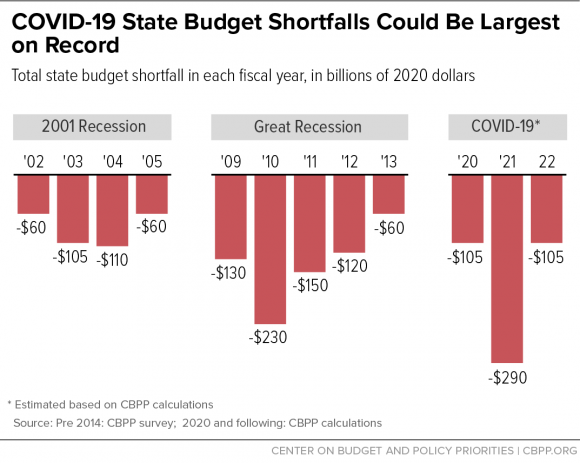
With 30 million unemployment claims filed since the coronavirus pandemic resulted in the shutdown of broad swaths of the economy, states are reporting that they’ll need at least $1 trillion in aid from the federal government – which has already doled out over $2.2 trillion in relief for business loans, stimulus checks, expanded unemployment benefits and small business assistance.

And with a lack of tax revenue, states with bloated budgets and massive entitlement programs are facing significant pain in the months ahead.

“I’m doing everything I can to work with cities and counties, but we are not going to be in a position, even as the nation’s fifth-largest economy, to provide for the needs of all the cities and the counties without federal support,” said Newsom.

Meanwhile, in a Thursday memo, Newsom’s finance director ordered departments to significantly slash spending immediately using strict measures, including bans on new goods and service contracts.


Tyler Durden

Sun, 05/03/2020 – 16:55

via ZeroHedge News https://ift.tt/2KRN7WC Tyler Durden

Of Tin-Foil Hats & Radical Uncertainty

Of Tin-Foil Hats & Radical Uncertainty

Authored by Mark Jeftovich via Guerilla-Capitalism.com,

This is part of the ongoing Jackpot Chronicles, looking at four possible Coronavirus scenarios or lenses…

The last instalment was “Force Majeure”, which posited a complete breakdown in seemingly permanent institutions. As it may turn out, these seemingly immovable edifices may not survive this economic collapse and may not be part of “the new normal” that emerges out the other end.

Given that the idea of Coronavirus being concocted in a Wuhan Lab has gone from being a conspiracy theory that could get you deplatformed, to being seriously looked into by Western intelligence agencies, now may be a good time to look at the “Tin Foil Hat” scenario, and try to discern where viewing this pandemic through the proverbial conspiracy theory lens actually gets us.

Conspiracy theories make for tricky subject matter for anybody who tries to look deeper than the veneer of conventional narratives. What we are expected to accept unquestioningly out of mainstream circles is sometimes less plausible than what we are expected to dismiss as conspiracy theories.

It gets even more distorted when inversions or backwardations occur between what is fringe and what is, ostensibly, “fact”.

Russiagate was a conspiracy theory, a batshit crazy one that was platformed as common knowledge by multiple mainstream media outlets for over two years. There are still people walking around believing that the current US president was installed as a Manchurian candidate by the Kremlin, and you’re the one in the tin-foil hat for pointing out how disconnected from reality that actually is.

This is typical of the hall of mirrors you enter when trying to understand the dynamics of conspiracy theories. Even the term “Conspiracy Theory” is itself the subject of conspiracy theories. The legend goes that the term was invented by the CIA to marginalize pesky truthers (another loaded word) that were finding all kinds of holes in the official explanation of the JFK assassination.

Whether it’s the implausibility of a “magic bullet” in Dealey Plaza or what many building engineers and pilots have to say about 9/11, the official explanatory cover for such world-changing events are so riddled with inconsistencies and flaws that they can only be believed by those who do not examine them.

The danger in admitting to oneself that at least some aspects of the most pivotal events of our era are not what they seem, is that it can pull you into a downward spiral where everything becomes a conspiracy and nothing is as it seems. We all know somebody who thinks every news story, every event that occurs is a direct outcome of some shadowy cabal that controlled the event, manipulated the circumstances that precipitated it, and selected the outcome to serve their own agenda.

This is not to say that people and groups don’t conspire, that societal elites don’t have a self-serving agenda and that moral hazard and pathological opportunism do not play a significant role in outcomes. In essence, that’s politics. But here’s the crucial duality of conspiracy theory:

To the degree that all major events being manipulated behind the scenes by hidden conspirators is actually impossible, so to is the degree to which  the mainstream media explanations of events are mostly inaccurate and at times infantile.

Into this milieu, enter the tin-foil-hats, and things become inordinately more precarious. What we get is a type of three-body-problem writ large where the three independent forces can be described by three age-old adages, ( all of which are possibly apocryphal quotes):

  1. “Never ascribe to conspiracy what can be explained by stupidity” (a.k.a Hanlon’s Razor, often attributed to Napoleon Bonaparte)

  2. “Never let a good crisis go to waste” (Winston Churchill)

  3. “Never believe anything until it is officially denied” (Bismarck)

What we experience as outcomes can be rendered in a Venn diagram between the above drivers: Overall stupidity, self-dealing and duplicity.

As I’ve been exploring a lot lately, we live increasingly in something that  resembles a cyberpunk bizarroverse. One where the explanatory powers of mainstream media is in secular decline and our institutions have largely discredited themselves. Two powerful coping mechanisms are

1) to pretend nothing is wrong and that business as usual can continue even thought the underlying scaffolding of the system is imploding (hypernormalisation)

2) subscribe to some non-sanctioned narrative that purports to reconcile the discrepancy between what we believe should be happening with what we are actually experiencing.

For my part, I find the most useful components of both conspiracies and consensus is that they are both known to provide an explanation of events that I can reliably assume as having near zero accuracy. A useful concept for this came out of Douglas Adams’s Hitchhikers Guide to the Galaxy. In it his concept of the recipriversexcluson describes a number whose value can be only be defined as anything but itself. Whatever the expert consensus is saying is happening or will happen, is the one thing you can you dismiss out of hand. Same goes for most conspiracies.

Introducing the Gell Mann Amnesia Effect

The last idea I’ll introduce is that mainstream media has itself, become a type of conspiracy theory. There is less reporting, less actual journalism and mostly punditry and editorializing. Ben Hunt gives us the concept he calls The Gell Mann Amnesia Effect (the phenomenon was originally described by Michael Crichton):

“Briefly stated, the Gell-Mann Amnesia effect is as follows. You open the newspaper to an article on some subject you know well. In Murray’s case, physics. In mine, show business. You read the article and see the journalist has absolutely no understanding of either the facts or the issues. Often, the article is so wrong it actually presents the story backward—reversing cause and effect. I call these the “wet streets cause rain” stories. Paper’s full of them.

In any case, you read with exasperation or amusement the multiple errors in a story, and then turn the page to national or international affairs, and read as if the rest of the newspaper was somehow more accurate about Palestine than the baloney you just read. You turn the page, and forget what you know.”

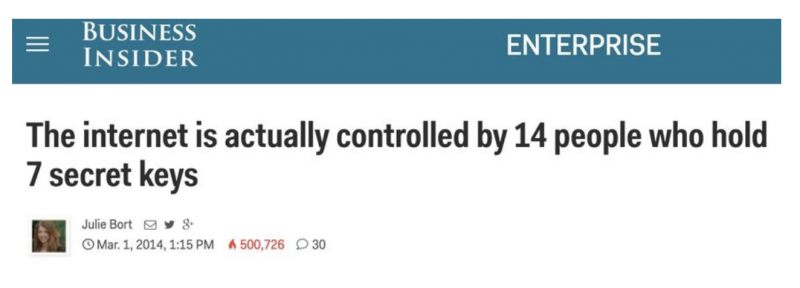
I noticed this phenomenon years ago, but didn’t have a name for it. In my case, most articles I read in the mainstream press about the domain name system, DNS, and naming in general are so bad as to be cringeworthy. This is one of my faves:

(Answer: No it isn’t. She’s talking about the people who hold pieces of a cryptographic key that signs the internet root zone. Although she doesn’t know that.)

Applying all this to Coronavirus narratives, we can look at what a specific narrative says is or will happen, what it probably preludes from happening.

So when a politician says we may have to be on lockdown for 2 years, I assume we won’t.

When some expert says we may stop shaking hands as a society, I don’t bank on it.

When people on Youtube say 5G causes Coronavirus, I’m pretty sure it doesn’t.

When they say the virus was engineered and released deliberately to bring about a totalitarian police state, I think that gives too much credit to the people who run governments (see Venn diagram).

When people say Bill Gates is the anti-christ, I’m pretty sure he isn’t. And when they say he’s a humanity saving genius who will solve this problem, I’m pretty sure he isn’t that either.

So where does all this get us?

Enter  Radical Uncertainty.

This is the title of Mervyn King and John Kay’s latest book. King was the Governor of the Bank of England from 2003 to 2013 and presided over the Global Financial Crisis, writing about his experience in his previous book The End of Alchemy.  Kay is an economist who held various positions in academia (former Dean, Oxford Business School, also London School of Economics) and author of Other People’s Money.

Their central theme is that many problems we face are inherently unknowable and that no amount of data or sophisticated modelling is going to get us anywhere near a reliable probability of what any of it means, or what will happen.

Radical uncertainty cannot be described in the probabilistic terms applicable to a game of chance. It is not just that we do not know what will happen. We often do not even know the kinds of things that might happen. When we describe radical uncertainty we are not talking about ‘long tails’ — imaginable and well-defined events whose low probability can be estimated, such as a long losing streak at roulette. And we are not only talking about the ‘black swans’ identified by Nassim Nicholas Taleb — surprising events which no one could have anticipated until they happen, although these ‘black swans’ are examples of radical uncertainty.‘?

We are emphasizing the vast range of possibilities that lie in between the world of unlikely events which can nevertheless be described with the aid of probability distributions, and the world of the unimaginable. This is a world of uncertain futures and unpredictable consequences, about which there is necessary speculation and inevitable disagreement — disagreement which often will never be resolved. And it is that world which we mostly encounter.

So the ramifications of radical uncertainty go well beyond financial markets; they extend to individual and collective decisions, as well as economic and political ones; and from decisions of global significance taken by statesmen to everyday decisions taken by the readers of this book.

Radical Uncertainty means gearing our efforts toward coherently responding to events as opposed to insisting on modelling them with an eye toward achieving optimal outcomes, be that “full employment”, a targeted inflation rate or the elimination of the business cycle.

“Governments choose policies to maximise social welfare. A moment’s introspection is enough to tell us that they don’t. They could not conceivably have the information required to do so. They do not know all the available options, and they are uncertain what the consequences of them will be. They do not even know whether what they wish for today will be what they still want if they achieve it tomorrow….the notion that a government could calculate what maximises social welfare is simply ridiculous. The consequences of policies and actions are far too uncertain….”

It is arguable that many of the problems we experience today, such as debt bubbles and brittle supply-chains are the result of trying to prevent bad outcomes of the past instead of facing them head on and taking the requisite pain when they happened (no bailouts, allowing the over-leveraged to fail). But they didn’t and this is a major reason why the pandemic, when it finally hit, is having such a disastrous effect for something that all else considered, isn’t as deadly as pandemics of the past.

Ironically, Radical Uncertainty was written just before the outbreak, it’s publication date was March 17, just as things were really coming unglued…

“The Black Death will not recur – plague is easily cured by antibiotics (although the effectiveness of antibiotics is under threat) – and a significant outbreak of cholera in a developed country is highly unlikely. But we must expect to be hit by an epidemic of an infectious disease resulting from a virus which does not yet exist. To describe catastrophic pandemics, or environmental disasters, or nuclear annihilation, or our subjection to robots, in terms of probabilities is to mislead ourselves and others. We can talk only in terms of stories. And when our world ends, it will likely be the result not of some ‘long tail’ event arising from a low-probability outcome from a known frequency distribution, nor even of one of the contingencies hypothesised by Martin Rees and colleagues, but as a result of some contingency we have failed even to imagine.”

So as I try to balance out these varying imperfect narratives from mainstream sources, official sources, and the tin foil hats, I try to use them more as filters than as having explanatory power.

  1. I eliminate what the prominent futurists say will happen

  2. I try to eliminate the reason why conspiracists say something is happening

  3. I severely discount what the MSM says is happening.

Then I  look at what’s left and try to make sense of it. To that end I think that all most of the hysterical outcomes, in terms of millions of deaths, mandatory implants, FEMA camps,  are outside the realm of possibility.

That said, am bracing for a mother of all economic depressions, rampant inflation, joblessness, war on cash and basically everything described in the second part of Graham Summers’ The Everything Bubble (tl/dr Inflation, NIRP, War on Cash, Bail Ins and wealth taxes).

While I don’t think of these anticipated events in terms of a coordinated global conspiracy to screw all the plebes (again, consult the Venn diagram), I do expect that the rationalizations of these events along with the narratives justifying them will be rife with conspiracy-sounding elements. This brings us back to the hall-of-mirrors aspect of what is conspiracy versus what is propaganda in such times as these.

For the next edition of The Jackpot Chronicles I decided to rename the “Mandatory Pollyanna” scenario. That’s the one where central planners and bureaucrats manage to “save” the economy yet again. However the cost of that would be to undertake an LBO of the entire economy and running it as a centrally planned utility. I’ve decided to rename that one “The Great Bifurcation”, after the the inevitable result of that would be emergence of an even more pronounced and starkly divided Two Tier Society.

*  *  *

To get alerted when the next edition comes out or to get on the list in general, sign up here, or follow me on Twitter here.


Tyler Durden

Sun, 05/03/2020 – 16:30

via ZeroHedge News https://ift.tt/2SqQeZV Tyler Durden

China Using Alleged BuzzFeed Pedo’s Wuhan Lab Article For Propaganda War Against United States

China Using Alleged BuzzFeed Pedo’s Wuhan Lab Article For Propaganda War Against United States

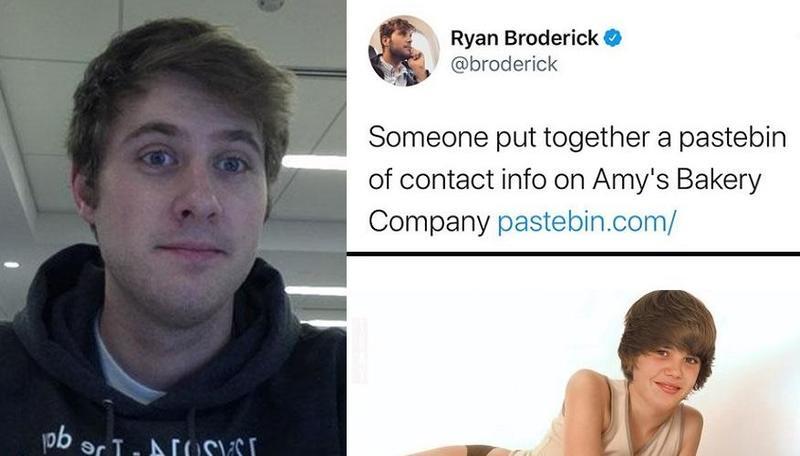
Remember BuzzFeed senior writer and boy band aficionado Ryan Broderick – who wrote in January that we ‘doxed’ a Chinese scientist who we ‘falsely accused of creating the coronavirus as a bioweapon’?

We didn’t – the information was publicly available, the word “bioweapon” wasn’t used in the article, and we suggested the scientist, Peng Zhou, may know “something” about the origins of the coronavirus. Peng, his mentor, and his lab are now the focus of a wide-ranging investigation by the so-called ‘Five Eyes’ western intelligence agencies – much to the chagrin of those  who seek to silence us.

This Ryan Broderick:

Indeed, Broderick wrote a BuzzFeed hit piece after we brought international attention to Zhou, head of the Bat Virus Infection and Immunization Group at the Wuhan Institute of Virology.

And while Zhou was researching “the molecular mechanism that allows Ebola and SARS-associated coronaviruses to lie dormant for a long time without causing diseases,” his mentor, Shi Zhengli, co-authored a controversial paper in 2015  which described the creation of a new virus by combining a coronavirus found in Chinese horseshoe bats with another that causes human-like severe acute respiratory syndrome (SARS) in mice. This research sparked a huge debate at the time over whether engineering lab variants of viruses with possible pandemic potential is worth the risks.

Now, Zhou and Zhengli’s experimentation with bat coronavirus is under official investigation.

Broderick, meanwhile, is at it again – authoring an April 22 BuzzFeed article titled “Scientists Haven’t Found Proof The Coronavirus Escaped From A Lab In Wuhan. Trump Supporters Are Spreading The Rumor Anyway,” in which Broderick conflates ‘originating in a Wuhan lab’ with ‘it was genetically engineered,’ when the current stance of the Trump administration is that a natural bat coronavirus escaped, or was released, from the Wuhan Institute of Virology.

The comments section of Broderick’s full-throated defense of Beijing caught the eye of China’s state-owned Xinhua News Agency, which used Broderick’s article for CCP propaganda, using the headline “”No scientific backing” for claims COVID-19 could have escaped from Wuhan lab: scientists.”

WASHINGTON, May 2 (Xinhua) — There is “no scientific backing” for the two claims floated recently by some U.S. politicians and media outlets that COVID-19 could be human-made and have escaped from a laboratory, scientists have said.

“The origin of the novel coronavirus is a legitimate area of scientific inquiry, in which there are still open questions,” said an article posted on April 22 on BuzzFeed News.

The piece, written by reporter Ryan Broderick and based on interviews with several scientists, is titled “Scientists Haven’t Found Proof The Coronavirus Escaped From A Lab In Wuhan. Trump Supporters Are Spreading The Rumor Anyway.” –Xinhua News Agency

Let’s review a few comments from Ryan’s original article, however. Seems even BuzzFeed readers aren’t buying his shit:

Not a Trump supporter, and this novel coronavirus could have certainly come from a lab. The Wuhan Virology lab was doing gain-of-function research on the bat coronavirus, and this style of research has been widely critisized by scientists for decades due to how unsafe it is: https://www.the-scientist.com/…/lab-made-coronavirus…. Iterations of SARS have escaped from labs before, so this is not an unprecedented occurance. https://www.the-scientist.com/…/sars-escaped-beijing… US diplomatic cables from 2018 warned of how unsafe this particular lab was: https://www.washingtonpost.com/…/state-department…/ China scrubbed a photo of the Wuhan Virology lab which appeared in a Chinese newspaper last year which showed a broken seal on one of their refridgerators:https://www.mirror.co.uk/…/photos-inside-wuhan-lab-show… the US is not the only country to investiage this claim: the UK, France and Australia have all followed suit. Screw you Buzzfeed for slandering a credible theory as coming from a populist demagogue.

And another:

The evidence strongly points to a Wuhan lab origin. There is no controversy here.
And another:
 
Broderick continues to conflate two separate issues
1. Natural vs manufactured
2. Transmission from leak in lab vs animal to human in Wuhan wet market

Even a three year old can identify the issues: why does Broderick continue to struggle with this?

Perhaps Ryan should revive his ‘Cool Fun Time Blog’ and try to resist publishing pedophilic material that can be archived for time immemorial. We’re guessing the CCP wouldn’t use it in a propaganda war against the United States, but who knows.


Tyler Durden

Sun, 05/03/2020 – 16:05

via ZeroHedge News https://ift.tt/2KUPd87 Tyler Durden

Tadawful: Saudi Stocks Crash After FinMin Warns Of “Biggest Crisis In Decades”

Tadawful: Saudi Stocks Crash After FinMin Warns Of “Biggest Crisis In Decades”

It looks like the dead bat bounce is over.

Yesterday we cautioned that “Selling in May” may be a good risk strategy for 2020, and for traders in Saudi Arabia that warning is already being validated with Saudi stocks crashing the most in almost two months following a Moody’s outlook cut and the kingdom’s finance minister saying that “painful” measures including deep spending cuts, are needed to respond to the coronavirus crisis and crash in oil prices, while Saudi officials said a whopping 70% of Mecca’s population is already likely infected with the coronavirus.

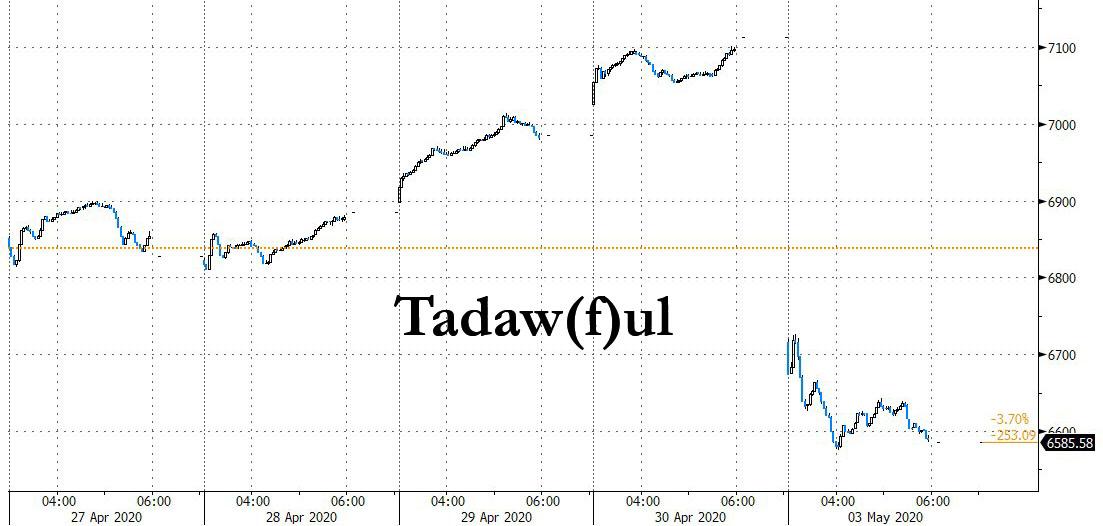
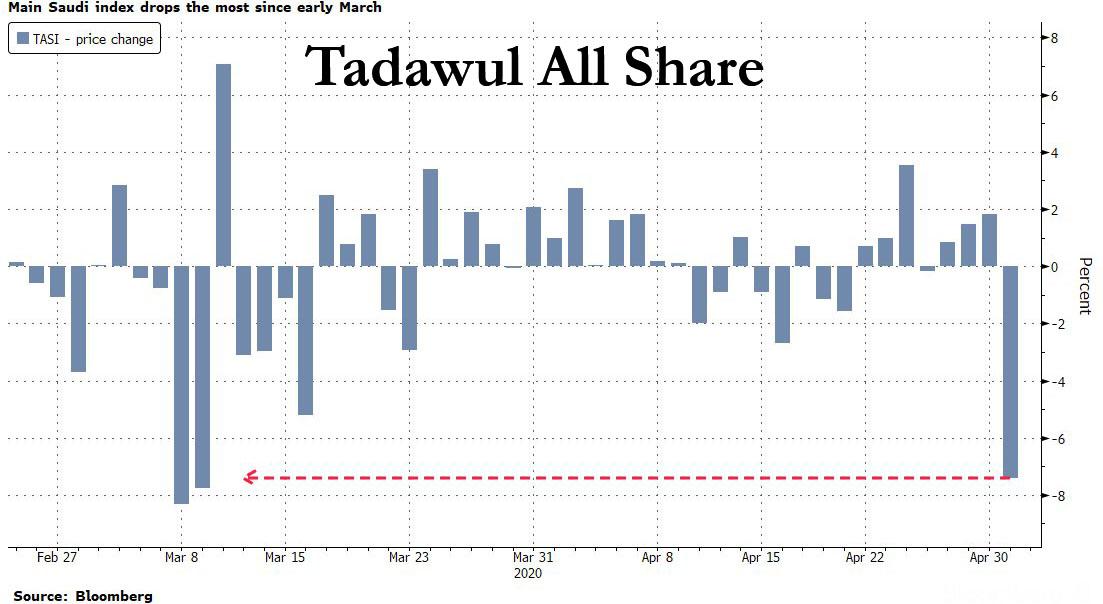
One day after Warren Buffett surprised the videoconferencing Omaha pilgrims when he said that he had dumped all his airlines holdings and was holding out for lower stock prices, the benchmark Saudi stock index, the Tadawul All Shares, closed down 7.4%… 

… the biggest one day drop since the whole coronavirus crash started on March 9.

Saudi Aramco dropped by 5.2% to 30 riyals per share, while major lenders including Al Rajhi Bank, National Commercial Bank and Saudi British Bank plunged at least 6.7%.

It wasn’t just Saudi Arabia – where more than 100 Saudi stocks retreated between 9.5% and 10% – saw violent selling. Stocks in Kuwait, the United Arab Emirates, Qatar, Egypt and Israel also declined. In Dubai, 10 stocks including Deyaar Development, Damac Properties and Dubai Investments fell between 4.8% and 5%, the maximum allowed limit.

The Saudi selling was triggered after Finance Minister Mohammed Al-Jadaan, who is seen as “the voice of the Saudi government and leadership”, said in an interview with Saudi television station Al-Arabiya that the world’s biggest oil exporter hasn’t witnessed “a crisis of this severity” in decades, adding that government spending will have to be cut “very deeply”, something we touched on earlier.  His comments, according to Bloomberg, were a sharp change in tone from more reassuring remarks he gave about the economy one week before.

Commenting on Al-Jadaan’s ominous warning, Yasin, from Al Dhabi Capital in Abu Dhabi said that Al-Jadaan “was a voice that brought back people to the reality that post-corona and the lower oil prices are here to stay for a while.”

“Investors also read that this is a signal that other Gulf governments will have to take a similar stance and therefore we saw negative reflection spreads to U.A.E. markets…. The question to many is: will the other economic activities recover substantially to help offset some of the drop in oil revenues in 2020, or will it stay muted in H2/2020 and therefore keep the pressure on spending this year and next at least?

As a result, investors “took it as a warning of much higher spending cuts to come than the original 20%-30% expected earlier in the crisis.”

There were more bad news earlier, when on Friday Moody’s cut the government’s outlook to negative from stable due to ““increased downside risks to Saudi Arabia’s fiscal strength”, even as the rating was kept at A1 for now.

In addition to concerns about the local economy, and Buffett’s tongue-in-cheek warning that a second wave of selling is coming, there is also the specter of a new war of words between the US and China to worry about: “The smokescreen of another bilateral issue ahead between the U.S. and China over the origins of the coronavirus pandemic will pick up steam,” Jameel Ahmad, a markets analyst at FXTM in London, told Bloomberg.

In addition to a fiscal crisis, the Kingdom may soon be dealing with a funding crisis as well: the collapse in crude prices and the government’s drop in foreign reserves, which plunged by a record $27BN in March…

… is putting more pressure on the Saudi riyal. For now, however, prices for 12-month dollar-riyal forward contracts are well short of their all-time high reached in 2016.

Commenting on the drop in reserves, Al Jazeera said that when the kingdom last stared down the crash in crude in 2014, it wielded reserves that peaked at over $735 billion. The stockpile was down by over a third just three years later, channeled almost entirely toward deficit spending.

And now, Saudi Arabia is blowing through its reserves at the fastest pace in at least two decades, even as the government is barely using the holdings to cover fiscal needs. Following its debut in international bond markets in 2016, borrowing covered most of the budget deficit in the first quarter.

With its buffers already fragile and the economy waylaid by the coronavirus, Saudi Arabia is looking to scale back spending and rely more on debt. Straining under lockdown to contain the spread of the pandemic, the kingdom is also bracing for a second impact from the oil rout and unprecedented production cuts negotiated by OPEC and its allies, after a damaging price war between Russia and Saudi Arabia.

Goldman Sachs predicted that the central bank’s reserves, down more than 100 billion riyals ($27 billion) in March alone, will stabilize soon. “Despite a further anticipated decline in oil revenues in the second quarter, we expect the rate of reserve burn to slow,” Farouk Soussa, a Goldman Sachs economist, said in a report.

That said, Goldman thinks that a currency devaluation would be too costly for Saudi Arabia and the better option is to adapt to the oil shock through fiscal changes, although it is very much unclear how much demand there is for Saudi debt which isn’t and probably never will be backstopped by the Fed. Well, remove that “never” – there will come a time when the Fed will own everything.


Tyler Durden

Sun, 05/03/2020 – 15:56

via ZeroHedge News https://ift.tt/35tAtGT Tyler Durden

Stock-To-Flow Creator Says Bitcoin Is “Not A Toy Anymore”

Stock-To-Flow Creator Says Bitcoin Is “Not A Toy Anymore”

Authored by Benjamin Pirus via CoinTelegraph.com,

PlanB, the pseudonymous creator of Bitcoin’s stock-to-flow model, explained Bitcoin’s journey from a proof-of-concept to a mainstream financial asset.

image courtesy of CoinTelegraph

Crypto analyst and Twitter personality, PlanB, recently said Bitcoin is serious business as he recapped the asset’s journey over the last decade. 

“This thing is not a toy anymore,” PlanB told Peter McCormack in a May 1 podcast episode.

“It’s maybe not an asset anymore as well,” he said, adding, “It is going to be much bigger than that.”

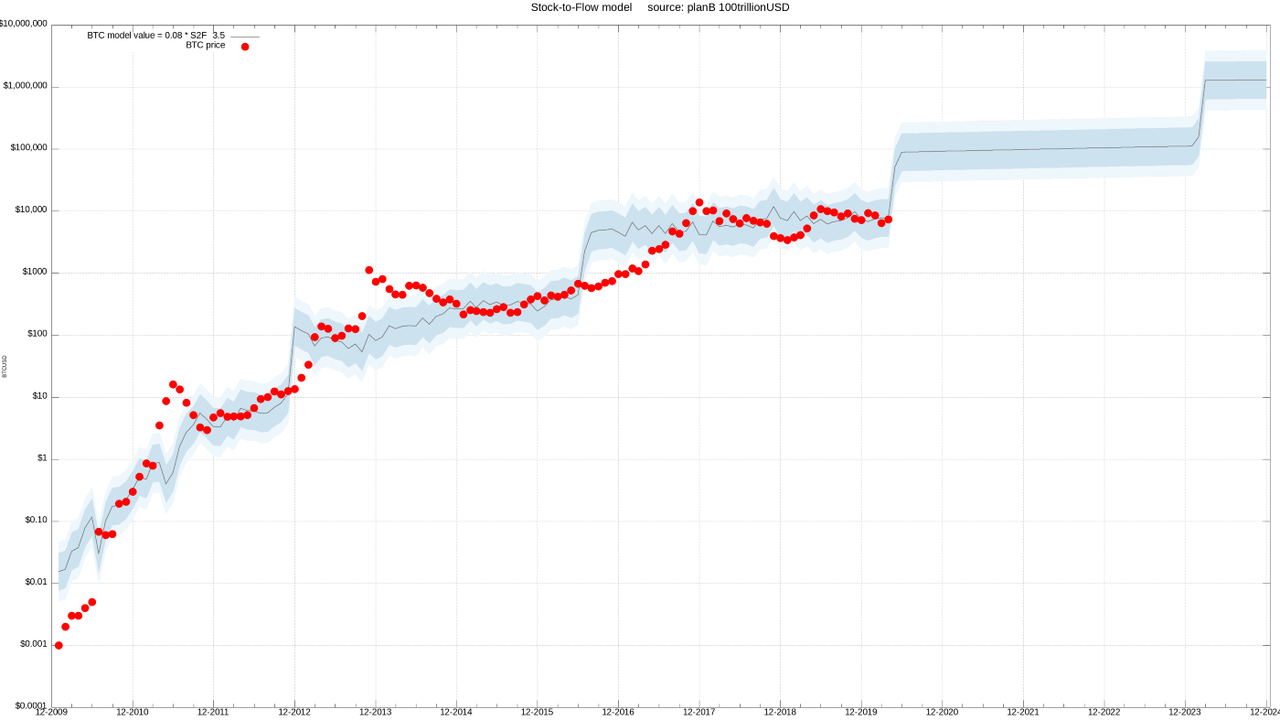
PlanB created a concept for Bitcoin’s growth compared with its supply

PlanB is known around the crypto space for his stock-to-flow model. The model takes into account Bitcoin’s block reward, or current inflation, and halving events, factoring those into the asset’s price. 

According to that data, PlanB plotted a few future price targets for Bitcoin, ultimately showing the asset’s potential for a $1 million price tag down the road. 

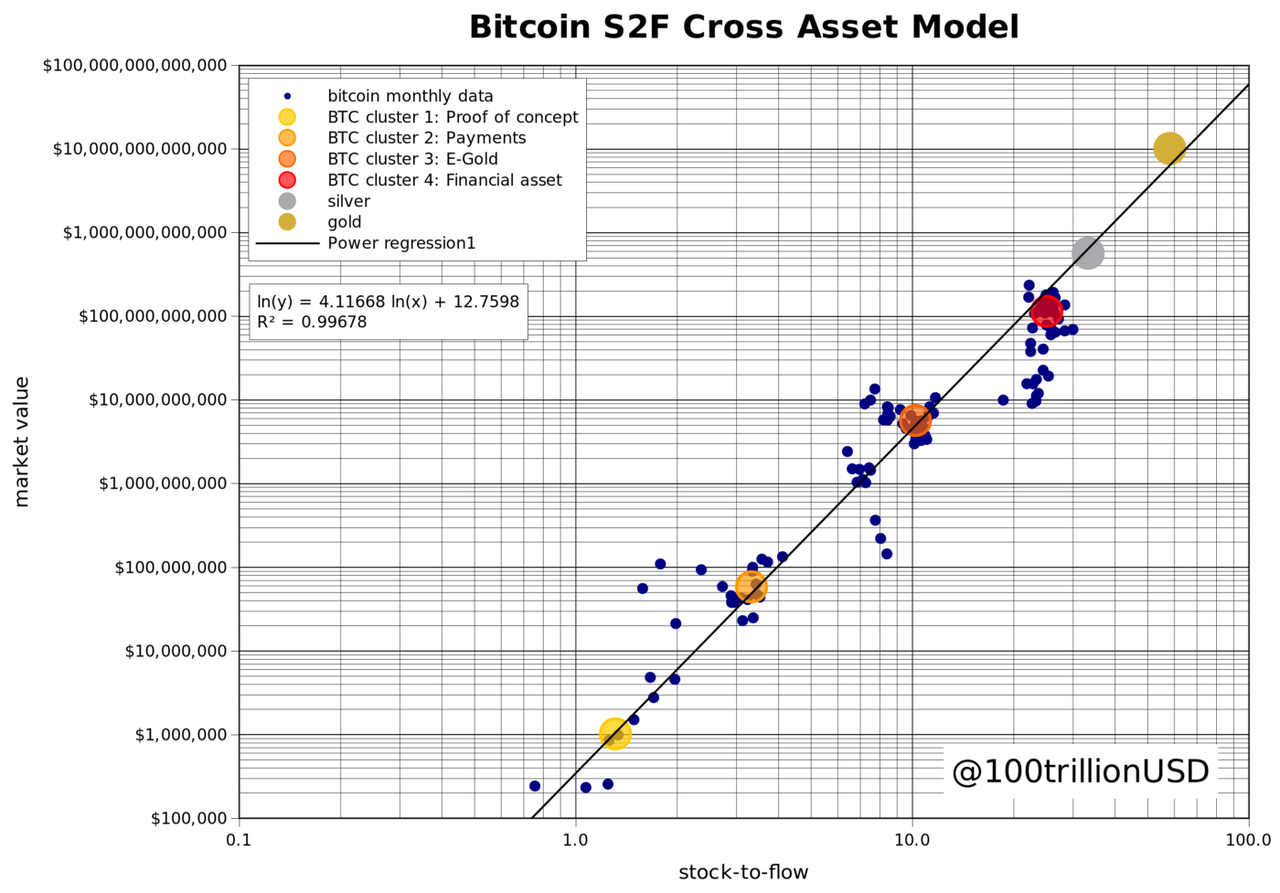
PlanB published an updated version of his model in an April 27 blog post, making gold and silver part of the equation, while taking the time component out. 

Bitcoin started out as a toy

Referencing its early beginnings roughly a 11 years ago, PlanB said Bitcoin began its journey as a proof-of-concept, or PoC, for a peer-to-peer digital cash system. “It was kind of a toy,” McCormack said — a description PlanB agreed with.

PlanB noted Bitcoin did not even hold a $1 million dollar market cap in its first two years, although the landscape subsequently changed.

“Then came the transition,” he said. “It went from a toy, magical internet money, to dollar parity,” he said, describing the credibility Bitcoin gained when it hit $1 per coin. 

The analyst explained Bitcoin’s price and usage journey over the years, as its identity transitioned from a payment avenue, to a status similar to gold, to its current position as a financial asset. 

PlanB did mention the possibility of another transition, although he chose not to provide any speculation on what that might include exactly. The analyst and podcast host also dove into a bevy of other points and concepts in the hour-long podcast episode. 

With Bitcoin’s halving quickly approaching, time will tell how the coin’s status will change in the upcoming days.


Tyler Durden

Sun, 05/03/2020 – 15:40

via ZeroHedge News https://ift.tt/3d3FmJk Tyler Durden