Leftists Fume As Michael Moore Turns On Fraudulent “Green” Movement In Latest Movie
Executive produced by activist and filmmaker Michael Moore, 21stCentureWire.com points out that the new documentary Planet of the Humans, dares to say what no one else will say on this Earth Day – the leading ‘green’ environmental activists, including Al Gore, have taken their followers down the wrong road – selling out the real environmental movement to some of wealthy corporate interests in America and he world.
This film is the wake-up call to the reality we are afraid to face: the mainstream environmental movement is pushing lies in the form of various techno-fixes and band-aids – all of which are reliant and use large quantities of fossil fuels and rare earth minerals. Have environmentalists fallen for a “green” illusion? More than any other documentary to date, this film exposes the wholesale fraud behind subsidized industries like biomass fuels, wind turbines, and even not-so ‘green’ electric car…
…and that is why Moore’s typical leftist cult following has turned on him so aggressively – facts don’t fit their narratives and cognitive dissonance is not a safe space.
In fact, as 21stCenturyWire.com reports, ever since Moore released the new documentary, leftwing green activists have leveled a furious attack against the filmmaker for daring to blow the whistle on the “green energy scam.” Moore, a hero of the political left, has now cast serious doubt over the efficacy of ‘renewables’, including solar and wind energy. Incredibly, many green groups and political operatives are now trying to get the film banned.
A recent report from Sky News in Australia talks about how the new film presents a number of inconvenient truths.
Watch:
As VoxDay notes, who would have expected Michael Moore would take on one of the biggest shibboleths of the Left, the so-called Green movement and its massive globo-corporate charade of “renewable energy”:
Examples include a zoo that claims to power itself on ‘renewable’ elephant dung but only produces enough to heat the elephant house.
They film a supposedly solar-powered music festival that quietly plugs into the grid and a similar arrangement at General Motors’ HQ at the launch of a hybrid, plug-in car, where the electricity grid powering the vehicle is ’95 per cent’ fed by coal.
The film also takes issue with solar panels, highlighting their limited shelf-life and that they are made from non-renewable quartz and coal.
In another sequence, joshua trees are chopped down in California so a huge solar facility can be built.
Moore’s documentary is particularly damning of ‘biomass’, the supposedly-renewable energy created by burning organic matter. The film shows huge piles of trees that have been chopped down to feed a power plant, its chimney belching out smoke that appears far from environmentally sound.
Viewers are told biomass is the biggest single source of renewable energy around the world, and – nonsensically given it is supposed to be about energy conservation – has involved wood chips being shipped to Europe from North America, Brazil and Indonesia.
‘Our anxiety over [global] warming has panicked us into embracing anything green or alternative without actually looking too closely at what is involved,’ the film states. With plans to turn animal fat into biomass fuel, the film asks: ‘Is there anything too terrible to qualify as green energy?’
The film suggests that mega-rich businessmen – including Sir Richard Branson and British timber investor Jeremy Grantham – and banks such as Goldman Sachs – are keen to invest in green energy because they want to make a quick buck rather than because they are worried for the planet. According to Moore, Toyota, Citibank and bulldozer giant Caterpillar becoming sponsors of Earth Day provided final confirmation that Big Business has taken over the green movement.
When they had picked their jaws off the floor, the first response from some of the climate scientists and environmental campaigners who have been enthusiasts for renewable energy delighted their opponents – they wanted to ban it.
Finally, while this documentary is groundbreaking in the sense that it is one of the first ever comprehensive exposures of the environmental fraud which underpins ‘sustainable energy’ and the much celebrated Green New Deal, we note 21stCenturyWire.com’s warns thattowards the end of the film director Jeff Gibbs veers into extremist ‘depopulation’ rhetoric, and infers that a radical social engineering agenda must be pursued in order to achieve population control – which he believes will somehow stop a ‘human-caused extinction event’ due to man-made CO2-induced ‘climate change.’
Putting aside that radical ideological segue by Gibbs, on balance, the film remains a powerful piece of investigative journalism which goes a long way towards challenging the green orthodoxy on widely held assumptions surrounding ‘green’ energy and sustainable development – which is crucial in advancing a fact-based discussion on how the world will realistically meet its energy needs in the future, as well as shining a light on the transnational profiteers who are pushing Wall Street’s ‘Green New Deal’ speculative energy market.
Because of the order, election officials for the first time tallied absentee ballots postmarked by Election Day, rather than just those received by then — underscoring the power of narrow court decisions to significantly shape which votes are counted.
Now, the Democratic Party is seeking to extend the Roberts Court’s latest ruling. (Yes, you read that right):
Democrats think they have secured a game-changing precedent from the Supreme Court’s 5-to-4 order. In the past week alone, lawsuits bankrolled by Democratic committees have been filed in four states seeking similar postmark rules and citing the Wisconsin opinion to bolster their argument. More cases are expected in the coming week….
Now, Democrats are citing the majority opinion in their latest round of litigation.
In addition to seeking postmarked-by standards, Democrats are aiming to secure free postage for ballots, ballot mailings to all registered voters and the right for third parties to collect ballots from voters, a controversial practice often called ballot harvesting.
“We’re saying, essentially, let’s take into account the pandemic. Let’s keep everybody safe,” said Eric H. Holder Jr., who served as attorney general in the Obama administration and heads a group that is financing new lawsuits in Texas and North Carolina.
May I speculate about another unanticipated consequences of RNC v. DNC? Interested parties will litigate to ensure the United States Postal Service postmarks more ballots. The Washington Post observed that some ballots were not postmarked at all:
Thousands of ballots were rejected because of postmark issues, The Post’s examination found. Hundreds were rejected because of a late postmark, but many hundreds more showed no postmark or an illegible one. In Milwaukee, that number was 390, and city election officials chose to count those ballots anyway. Most other localities discarded such ballots, even though many may have been posted on time.
Several election officials said that some post offices do not use postmarks with dates but that their hands were tied by the high court’s ruling.
In a statement, the U.S. Postal Service said its inspector general is conducting an investigation “regarding potential issues with absentee ballots in Wisconsin.”
Interested parties, I’m sure, will sue the USPS to ensure that ballots are postmarked properly. And what about illegible postmarks? Courts will have to decide how to assess the validity of various smeared postmarks. Say hello to the new hanging chads!
And what about election day? Interested parties routinely seek injunctions to keep polling locations open late. The usual rule: if you are in line, you can vote. Why not similar injunctions for post offices? Keep the postoffice, and the postmarks stamping till midnight, or later, to ensure late-delivered ballots are marked.
The Supreme Court may have unintentionally opened up a new frontier in election law.
And there are two unanswered questions in my mind. First, can a state court judge even issue an order to a federal postal official? McCulloch on the mind. Second, would a federal court have jurisdiction over state election law disputes?
Everyone, please think these issues through now, well before election day. You’re welcome.
from Latest – Reason.com https://ift.tt/2Stnuj6
via IFTTT
“We Had 2 Customers All Weekend” – Georgia’s Small Businesses Gripe About “Disastrous” Reopening
A few days back, we shared an interesting piece of “real time” data suggesting an increase in foot traffic to retail “hot spots” across Georgia last weekend, the first that certain businesses in the state were allowed to reopen.
But since the “anonymized” cellphone location data didn’t offer any indication of spending, we speculated that consumers desperate for freedom after being cooped up inside for weeks might simply be taking advantage of the excuse to ramble and roam the retail landscape and window-shop, even if most of the stores in any given strip mall remained closed. Since consumer spending drives 70% of the American economy – an oft-quoted stat – if nobody was buying, then no economically productive activity was occurring and the “green shoots” were really just a mirage.
Over the weekend, we learned Warren Buffett has jettisoned his airline stocks and decided to sit this crisis out (laying most of the blame for his decision at the Fed’s doorstep). A report in Bisnow looking back on the first week of Georgia’s reopening found that it was mostly “a disaster” for small businesses.
Bad Axe CEO Mario Zelaya expected business to be bad, maybe 10% of the hundreds of customers he would expect to see throw axes and drink beer on a typical weekend. “That was the worst-case scenario, especially with all the marketing we did,” Zelaya said. “The reopening weekend was a disaster. We had two customers all weekend.”
Despite the public health and political debate, one thing is clear: The longer retailers and restaurants stay closed, the harder it will be for them to survive. “I think every small-business owner is in the same position as we are where they’re nervous, and they’re worried, and they’re scared of public backlash,” Zelaya said. “Our only decision right now is to survive. We’ll take measures to ensure that.”
Commercial landlords mostly confirmed that about 50% of the rent from their retail tenants has been collected since the crisis began. And in states like Georgia and Texas, landlords have been mostly understanding with small businesses and even smaller chains, allowing them enough wiggle room to wait to reopen until they have a better shop at operating profitably.
Atlanta-based real estate firm Ackerman & Co. collected about 50% of its rents from its retailers in April. Retail President Leo Wiener said he doesn’t expect May to be much different. Wiener said Ackerman continues to be understanding with tenants who choose not to open despite Kemp’s decree that they can legally do so. “At this point, it just doesn’t make business sense to push a tenant open. I’ve got to trust that the restaurateur knows their customer,” he said. “I just think it’s too early for landlords to start pushing tenants.” Bob Prosen, the CEO of small to midsized business crisis consultant The Prosen Center for Business Advancement, said many mom-and-pops don’t have enough revenue to remain shuttered much longer. “It certainly is not their landlords that are driving this. I understand it’s a problem, but that’s not the primary driver,” Prosen said. “They are going to lose their businesses.” About a third of Atlanta-based Coro Realty Advisor’s retail tenants reopened over the past weekend, Coro President Robert Fransen said. Most others expect to reopen over the next two weeks, he said. But even with the lifting of the shelter-at-home order, Coro hasn’t demanded any of its tenants turn the lights back on. “We don’t want to treat our tenants that way. Our personal opinion from the company is [the reopen decree] was too soon,” Fransen said. “So we did feel it was unfair to box tenants in on a decision we didn’t agree with.”
Because otherwise, businesses – who aren’t getting the same relief that employees get when they’re laid off (employees collect unemployment whereas small businesses are getting zero-interest loans, though at least most of the ‘PPP’ loans should convert to grants) – are just adding to the “L” tab that they’re going to need to pay back later.
Zelaya said his Atlanta Bad Axe Throwing location is a “canary in a coal mine” to see how things may return for the chain once other locations open. This weekend, it plans to reopen in Oklahoma City and soon after, it plans to restart locations in Texas. His landlords have put little pressure on him to open before he is ready, let alone permitted by state law. Zelaya said he has been given rent concessions on many of his locations. “Our [Atlanta] landlord is an extremely phenomenal person. From the very beginning when it all went down, essentially his words were, ‘I feel for you man, we’ll figure it out. Just be safe,’” he said of Gartland Long, who owns Bad Axe’s location at 1257 Marietta Blvd. NW. “He’s been arguably the easiest landlord we have to work with.” But when Zelaya can, he is trying to reopen locations in hopes of just making some money again. Not only did Bad Axe lose revenue from walk-in customers, but it had to refund money from groups that booked events ahead of time. “When someone on staff gets laid off, they get unemployment insurance and they get relief from the government. When a small business is forced to shut down, we get offered loans. We don’t get the relief,” Zelaya said. “It’s not like we’re vicious, money-hungry large corporations. We have families to feed, too.”
Even the businesses that are allowed to reopen won’t be be running at full capacity for months. In other words, investors might want to wait for a few more weeks of spending data before making any conclusions about what letter this rebound will most closely resemble.
With the central banks going all in on debasement of money by all means of quantitative easing and money printing, the QE Defender Game is more relevant than ever. We have therefore updated the characters of the game which can be played for free without registration here.
“There’s an infinite amount of cash in the Federal Reserve” – Minneapolis Fed President Neel Kashkari, March 23
“When it comes to this lending, we’re not going to run out of ammunition, that doesn’t happen” – Federal Reserve Chairman Jerome Powell, March 26
QE COVID
Over the last two months, major central banks and governments across the globe have unleashed a series of monetary and fiscal interventions on markets and economies which are unprecedented in their magnitude and which are bordering on the destruction of the current financial system.
While the global spread of coronavirus COVID-19 provided the trigger and the pretext for the current full-spectrum quantitative easing, money printing, asset purchases and economic bailouts, the size and scope of the current assault on free markets makes all previous central bank and government interventions look insignificance in comparison.
Markets are now officially broken. In some cases, the US Federal Reserve and the European Central Bank have become the markets, such is the scale of their asset buying, and their actions are making the bailouts of 2008 and 1998’s Long Term Capital Management (LTCM) look like a walk in the park.
From quantitative easing to zero bound interest rate cuts and beyond, from helicopter money to economy wide bailouts, the combined monetary and fiscal interference in markets and economies over recent weeks has now distorted everything from market prices to risk preferences to the time value of money, while shattering the concept of freely trading markets and free enterprise.
All of this in an environment of locked down economies, minimal economic activity, huge job losses, shrinking tax revenue and economic stagnation, as well as the impending approach of an unprecedented global recession, that if long lasting, will become a depression.
On the monetary side, the renewed and limitless quantitative easing – with central banks creating money out of thin air to buy up financial assets across all risk categories – combined with interest rate distortions, is both prolonging the very asset bubbles that the same central banks themselves created, while also leading to explosive increases in money supply. This in turn is leading to the destruction of currency values, and most worryingly, setting the scene for the real possibility of hyperinflation.
On the fiscal side, government stimulus packages of direct payments and loan and tax write-offs across vast swathes of economic sectors is not only creating a future dependence on income support and a pretext for the introduction of direct transfers to individuals, but is burdening the very same workforces with future tax burdens and even more debt.
Helicopter Drops
In this scenario, helicopter money, analogous to a helicopter dropping cash directly to the population, comes into play. Essentially helicopter cash represents direct methods of boosting consumer demand by the distribution of currency directly to the public into their bank accounts and into their pockets. Like quantitative easing, direct cash drops pave the way for destruction of currencies and can be the touch-paper to trigger hyperinflation.
Importantly, on both the monetary and fiscal fronts, the sheer flood of official interventions across markets and economies is now creating the largest moral hazard problem the world has ever seen, with investors and economic actors being conditioned to the expectation that central banks and governments will always come to the rescue by propping up asset prices and bailing out entire sectors (think banks, airlines and real estate), thus creating an environment that encourages a lack of individual consequences for future risky behavior, but at the same time creating dire consequences for the collective financial and economic system.
While the scale of what is happening right is daunting and difficult to keep track of, a ballpark estimate suggests that the total size of interventions from just some of the world’s largest monetary and fiscal authorities is currently more than US $10 trillion and counting. For a taste for how uncharted and dangerous this QE is becoming, a quick look at the US and Europe is instructive.
Quantifying QE – USA: Whatever it takes
After cutting interest rates to zero via two emergency decisions during March (March 3 here and March 15 here), the US Federal Reserve then announced on 15 March that over the coming months it would ramp up QE by buying at least $500 billion of US Treasury securities and at least $200 billion of agency mortgage-backed securities.
That’s $700 billion of Fed debt buying from banks and the Treasury across a cross section of widening of risk categories. At the same time, the Fed begun flooding the Fed system with credit in an attempt to boost liquidity, including $1 trillion in repurchase operations per day.
When this didn’t placate markets, the Fed then went ‘all in’ on 23 March and announced the start of open-ended quantitative easing (QE) in unlimited amounts, to buy an even wider range of debt from low to much higher risk classes, promising to:
“purchase Treasury securities and agency mortgage-backed securities in the amounts needed…including purchases of corporate and municipal bonds.”
The Fed then also established swap lines with a whole range of major central banks around the world, providing these central banks with dollar funding in exchange for US Treasuries. This in essence expands the money supply of US dollars all over the world.
Then on 9 April the Fed was back, announcing another $2.3 trillion in QE, in the form of $600 billion purchases of bank loans of individuals and businesses, $500 billion buying of municipal bonds and loans (states, cities etc), and $850 billion in QE related to credit facilities of US corporates and asset-backed vehicles. Incredibly, this includes junk bonds and junk bond ETFs, with such market euphemisms as high yield, extended yield, and beyond investment grade. There is therefore, it seems, no limit to the depths the US Fed will go in its quest to prop up prices, bail out Wall St banks and hedge funds, and destroy financial markets.
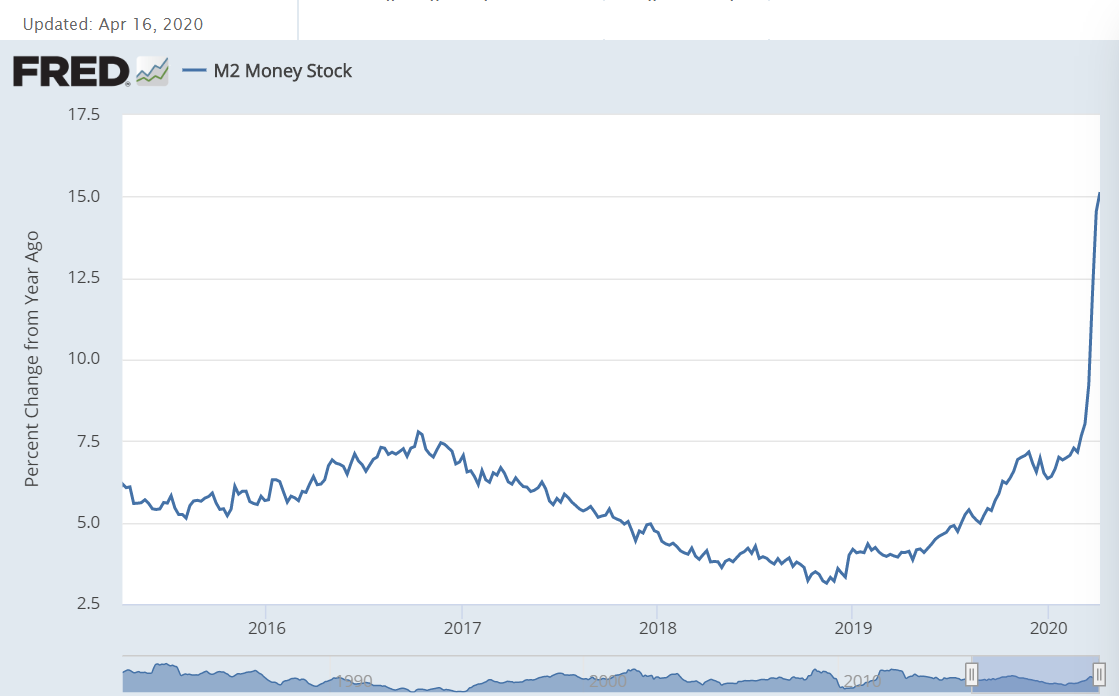
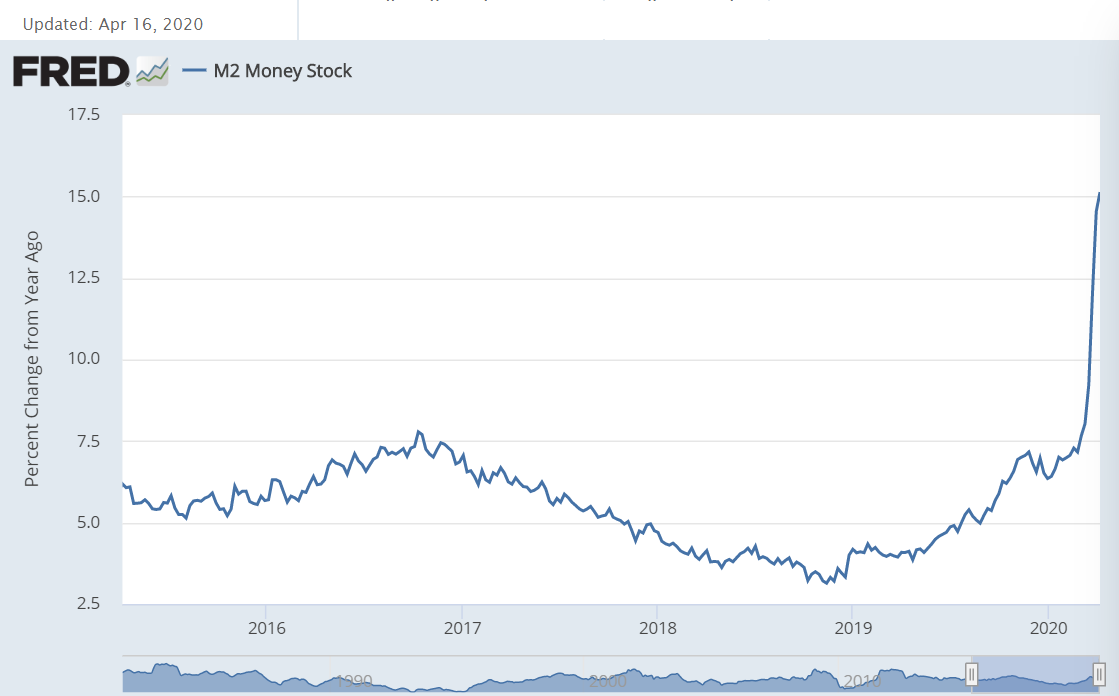
Not surprisingly, this new unprecedented and unlimited QE by the Fed over March and April can already be seen in the huge explosion in US money supply, where the monetary aggregate measure M2 (which includes cash, demand deposits, time deposits and money market mutual funds) has rocketed higher from the new money “out of thin air” that has no bearing on underlying economic growth. This can be seen in the below Federal Reserve chart. As a closely watched indicator in forecasting future inflation, this M2 chart speaks volumes.
M2 – A broad money supply measure – Date range 2016 -2020 – To infinity and beyond Q 1 2020. Source – Fed St Louis
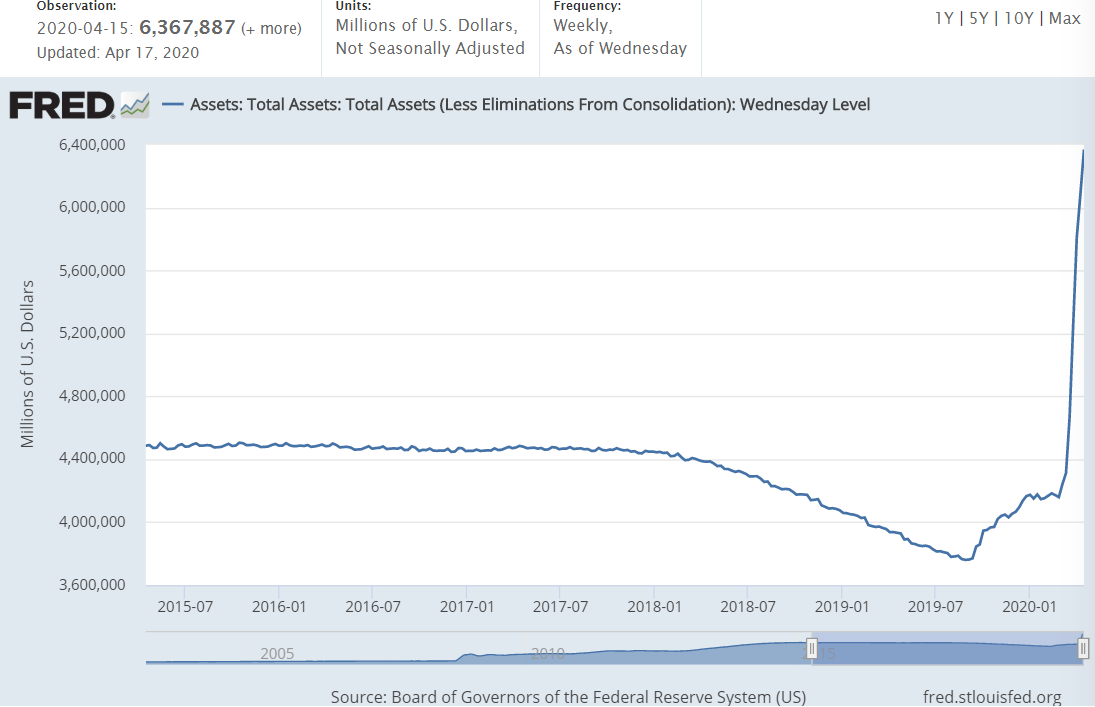
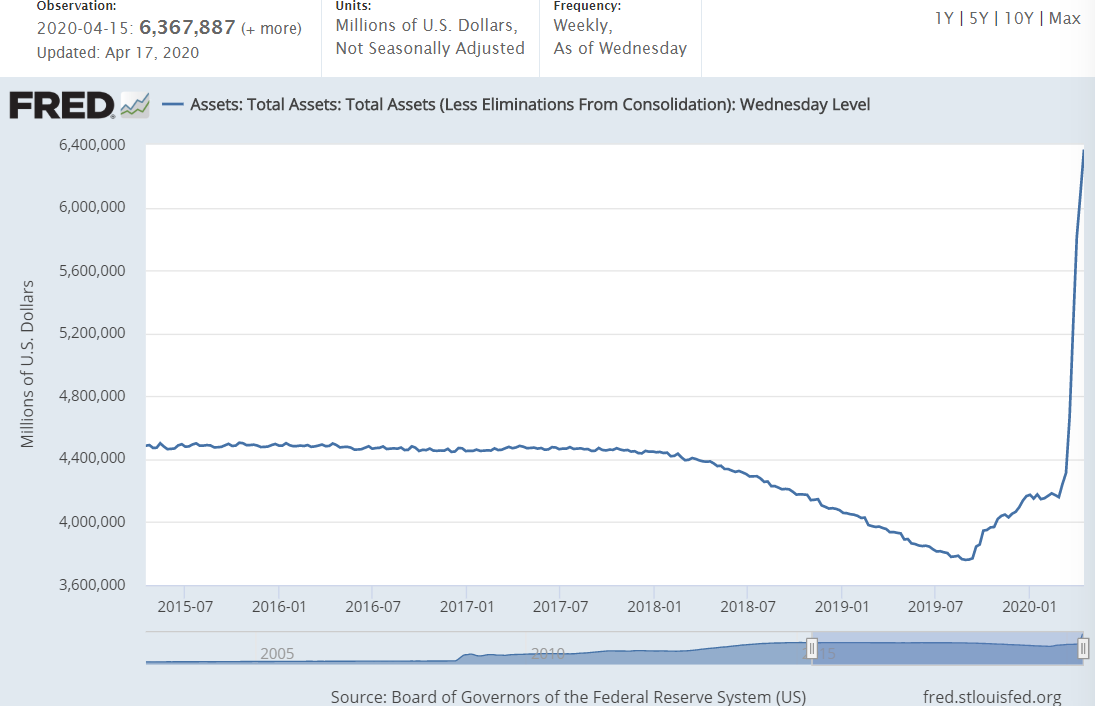
In the same vein, as architect of this rampant QE, the money out of thin air hits the Fed’s bottom line,showing up in the rapid expansion of the Fed’s balance sheet, which has ballooned from $ 4.17 trillion at the end of February to $6.4 trillion now. That’s an insane $2.2 trillion added since the start of March, or in other words, a 50% expansion in the Fed’s balance sheet since the end of February. This is neatly illustrated in the blow out of the Fed’s total assets since early March.
Balance sheet (total asset) of the US Federal Reserve – last 5 years. Source: Fed St Louis
Turning to US fiscal interventions, at the end of March the US federal government pushed through a staggering $2.2 trillion economic bailout package titled the Coronavirus Aid, Relief, and Economic Security Act (CARES Act), an intervention so large that it’s equivalent to 10% of US GDP. This CARES Act (which was ready and waiting in the wings) covers everything from loans to large and small corporations ($750 billion), the bailout of the US airline industry ($26 billion), loans to states and local governments ($340 billion), and most controversially, direct payments to individuals ($300 billion).
This last category is literally ‘helicopter money’, with every taxpayer in the US set to receive a $1200 payment, plus an additional $500 per child, with the transfers being made via stimulus checks (cheques) and direct deposits to bank accounts. The US IRS calls these Economic Impact Payments, but they are really direct cash injections, literally the long predicted helicopter cash drops. This money is printed out of thin air, directly distributed to the population, and most importantly raises the money supply while diluting the purchasing power of all existing currency.
An image from the original version of BullionStar’s “QE Defender’ video game launched in 2016 and featuring the Fed chairs Ben Bernanke and Janet Yellen
Quantifying QE: Europe – ECB
After cutting one of its key refinancing rates to -0.75% in early March, the European Central Bank (ECB) then announced new monetary QE interventions on 12 March in the form of €120 billion of bond buying (quantitative easing) to complement its existing bond buying programme. On the same day, the ECB also announced an intent to flood cheap liquidity to European banks using longer-term refinancing operations (LTROs).
A week later on 18 March, the ECB ramped up the QE and went practically unlimited, announcing an enormous €750 billion Pandemic Emergency Purchase Programme (PEPP), a fancy name for even more QE that aims to buy government and corporate bonds (debt), including non-financial commercial paper (short-term loans). In total, that’s €870 billion in monetary QE interventions from the ECB.
Extraordinary times require extraordinary action. There are no limits to our commitment to the euro. We are determined to use the full potential of our tools, within our mandate. https://t.co/RhxuVYPeVR
On the fiscal side, Europe is leading the way with the largest fiscal bailout by any economic bloc so far, totaling a massive €3.2 trillion in fiscal bailouts across the continent. This includes emergency packages of individual European countries such as Germany, Spain and France, but also an EU wide bailout fund of €540 billion to which the European Union has agreed, consisting of €240 billion in credit for Eurozone countries via the European Stability Mechanism (ESM), €200 billion in loans for small businesses via the European Investment bank, and €100 billion in loans for job support.
The sheer scale and unprecedented nature of these European union interventions motivated one of its countless bodies, the European Economic and Social Committee, to proudly comment on 16 April that:
“In less than 4 weeks, the EU has done more than in the four years following the 2008 crisis, with interventions already decided that are estimated at over EUR 3 trillions.”
As to how the EU will pay for all of these bailouts, the EU Commission claims to have the answer, saying that it will, surprise, surprise, “propose borrowing to finance the recovery plan“.
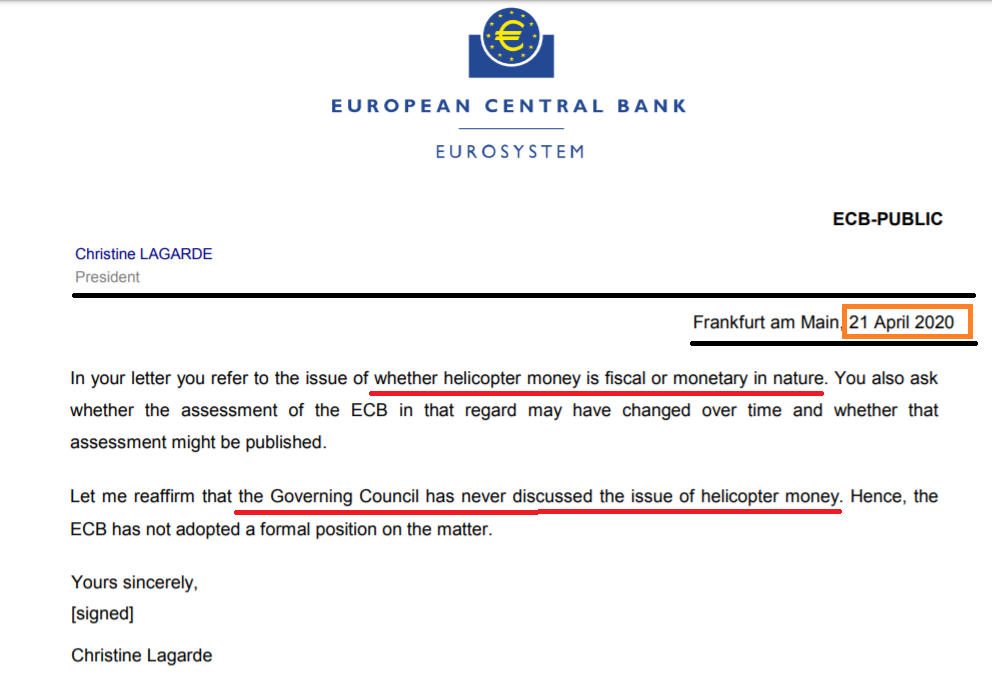
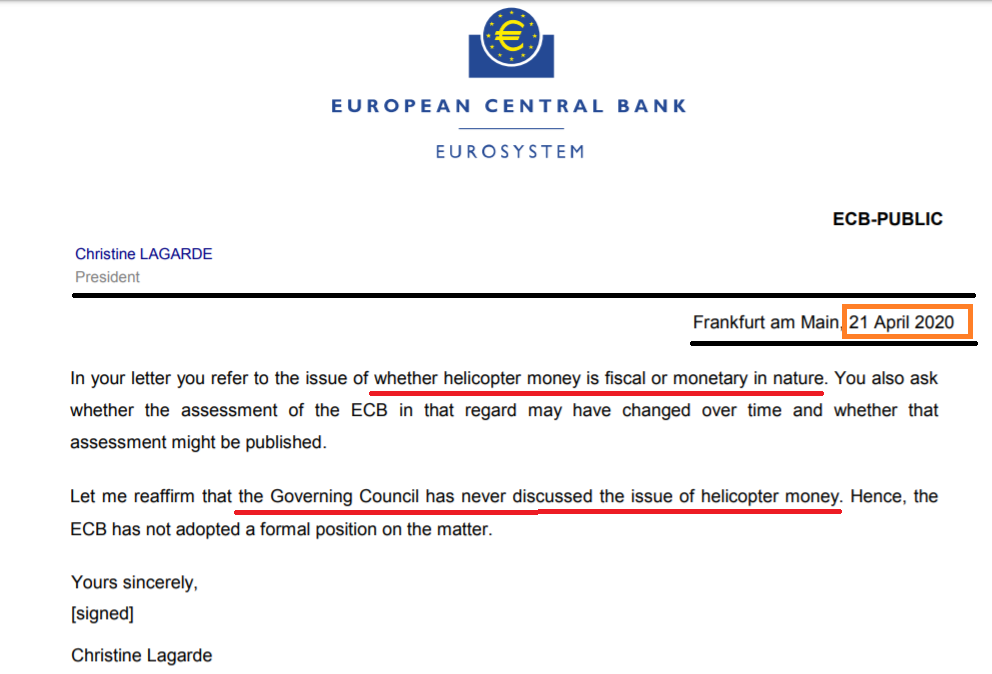
With the US government introducing helicopter money, can Europe be far behind? While the European Central Bank claims that helicopter money is not an option that’s being considered, would you believe them? In a recent letter responding to a member of the European Parliament (dated 21 April), the ECB’s Christine Lagarde avoids the question of whether helicopter money is a fiscal or monetary in nature, only saying that it has never been discussed by the ECB’s Governing Council. But in the infamous words of another fellow Europhile Jean-Claude Juncker, “When it becomes serious you have to lie.“
Helipad – Letter dated 21 April 2020 from Christine Lagarde, president of the European Central Bank, about helicopter money
Beyond the Fed and the ECB, all other major monetary authorities and governments around the globe are also engaging in massive QE and economic bailouts, from the Bank of Japan and Bank of England to the Chinese and the International Monetary Fund (IMF), from Australia to Brazil and from South Korea to Singapore. For example, the Bank of England has its own £645 billion QE programme buying UK government bonds and sterling corporate bonds, and has now moved to directly finance the spending the UK Treasury, a form of helicopter money.
Meanwhile, the Bank of Japan has just announced that it will now consider unlimited bond buying of government and corporate bonds – “Bank of Japan mulling unlimited bond buying at next meeting: Nikkei“. Everywhere one looks, the evidence is there, it’s QE to infinity, buying up all debt of all types and all risk categories at any price, in the process destroying the financial system and setting the scene for hyperinflation.
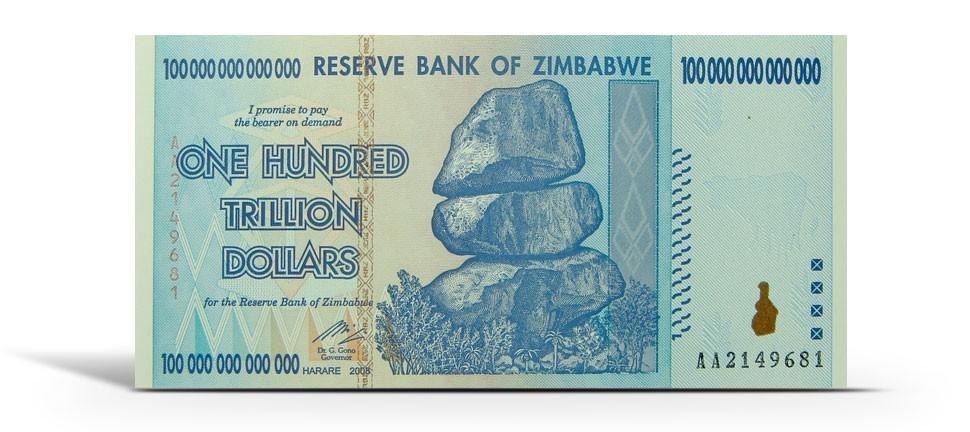
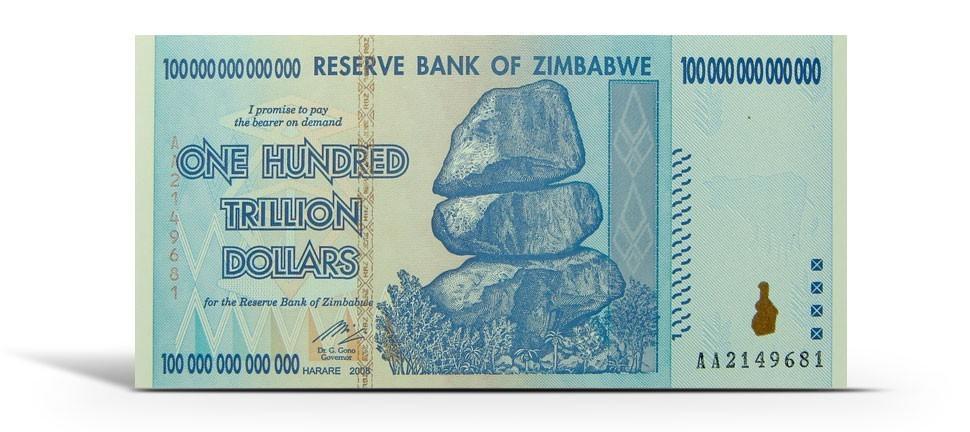
100 trillion Zimbabwean dollars
Hyperinflation
In an interview in 2010, then Fed chairman Ben Bernanke tried to dissuade concerns over Fed money printing, QE and market interventions, saying that:
“This fear of inflation I think is way overstated …What we’re doing is lowering interest rates by buying Treasury securities. And by lowering interest rates, we hope to stimulate the economy to grow faster.
The trick is to find the appropriate moment when to begin to unwind this policy.And that’s what we’re going to do.”
Fake words then from Bernanke, fake words now. There was no real unwind. Tapering was trick and a distraction. This is the same Bernanke who explained how the Fed’s lending is merely electronic printing, creating money out of thin air, and in so doing, inflating the money supply.
Fed’s Ben Bernanke in 2009: “To lend to a bank we simply use the computer to mark up the size of the account” https://t.co/pFLm5FxqM6#QE
Quantitative easing, despite the complicated name, is a simple case of massively expanding the money supply. Helicopter money ditto, is also a simple case of massively expanding the money supply.
By artificially boosting demand in a scenario of lower production and constrained supply using the printing press and its electronic equivalent (QE and helicopter money), more fiat currency is entering the existing system. This can lead to product shortages, hoarding, and higher consumer prices, i.e. rising inflation, which is the economic textbook situation of too much money chasing too few goods.
Rising inflation in turn leads to lower purchasing poor and eroding value for a paper currency, loss of confidence in that currency, and in a downward spiral, faster spending to get rid of the increasingly worthless currency, which in turn leads to even higher prices, hoarding and inflation. And all this in an environment of economic stagnation and recession. This then leads to higher inflation expectations, and ultimately hyperinflation.
And what are we seeing right now in the global economy, led by the large central banks and the largest economies? Explosions in money supply brought on by quantitative easing. Increasing experiments of directly transferred helicopter money to artificially boost consumer demand. Supply side shortages and hoarding. Economic turmoil and economies in stagnation due to covid-19 lock downs with massive unemployment and economies slipping into recession and possible depression.
Hyperinflation is essentially a rapid and accelerating inflation amid a collapsing currency value, and it can arrive rapidly in an environment where frequent price rises have already begun to take hold. In such scenarios, national cash becomes worthless and precious metals and reserve currencies become stores of values. For some of the more prominent hyperinflationary events in recent times just look at the hyper inflationary experiences of Argentina, Zimbabwe and Venezuela. See “The Power of Gold in Times of Crisis” for details.
For example, in 1989, prices in Argentina rose by an annualized 500 percent. In 2008, Zimbabwe’s annual inflation rate at one point reached 231 million percent. Annual inflation in Venezuela, which is still in the midst of hyperinflation, is currently over 2300%.
But what if hyperinflation hits major economics such as the US and Europe and their ‘strong’ fiat currencies in the form of the US dollar and Euro? In the current environment of full-scale quantitative easing and the emerging popularity of helicopter money, this is something which populations may soon be about to find out.
Under this possible scenario, physical gold will become one of the few trusted assets to remain a secure store of value and wealth preservation when paper currencies crash and burn. Universally trusted as a safe harbor in times of crisis and emergency, physical gold is both the proven last man standing and the go to asset in a world at risk of hyperinflation.
Watch: Video Of NYPD Officer Brutalizing Bystander During ‘Social Distancing’ Arrest Sparks Outrage
We’ve been covering the NYPD’s ‘War on Barbecuing’ since news first broke that the NYPD – presumably at the behest of Mayor de Blasio – was ordering 1,000 more cops to patrol the city’s parks and public space to crack down on any ‘social distancing’ violations with tickets, summonses and arrests.
The same mayor who once dismissed the threat posed by the virus is flexing his muscles after the ultra-orthodox Jewish community in Williamsburg openly defied him last week by gathering for the funeral of a Rabbi, prompting Hizzoner to threaten a crackdown (eliciting an immediate backlash and accusations of anti-semitism).
On Sunday, ABC 6 shared a video of a New York City cop arresting a man and violently taking him down over an alleged social distancing violation.
The video, filmed by a bystander, showed the plainclothes officer, who was not wearing a protective face mask, slapping 33-year-old Donni Wright in the face, punching him in the shoulder and dragging him to a sidewalk after leveling him in a crosswalk in Manhattan’s East Village.
Wright was allegedly filming the officer making an arrest for a social-distancing violation before he turned on the bystander instead and threatened to taze him then attacked him, while another bystander filmed the incident.
De Blasio called the video “unacceptable” and said the officer involved has been placed on “modified duty” while internal affairs investigates
Saw the video from the Lower East Side and was really disturbed by it. The officer involved has been placed on modified duty and an investigation has begun. The behavior I saw in that video is simply not acceptable.
NYC is of course the hardest hit area in the entire US, with as many as 20% of the city’s population suspected of having been infected with the virus. We suspect the mayor will announce tomorrow that he plans to “ease up” on ticketing and arrests for these types of violations.
Sex offender Jeffrey Epstein had extensive ties with Harvard University, which admitted him as a Visiting Fellow and later gave him his own office, according to a review conducted by Harvard attorneys and an outside law firm.
Epstein was awarded the title of Visiting Fellow, which goes to independent researchers, in 2005 despite the fact he “lacked the academic qualifications Visiting Fellows typically possess and his application proposed a course of study Epstein was unqualified to pursue,” according to the review (pdf).
Dr. Stephen Kosslyn, the chair of the Psychology Department at the time, recommended Epstein’s admission. Epstein donated $200,000 to support Kosslyn’s work between 1998 and 2002.
Epstein told the university in his application that he wanted to “study the reasons behind group behavior, such as ‘social prosthetic systems,’ and their relationship to a changing environment,” using a term invented by Kosslyn.
“That is, other people can act as ‘prosthetics’ insofar as they augment our cognitive abilities and help us to regulate our emotions—and thereby essentially serve as extensions of ourselves. I wish to understand how the brain both allows such relationships to develop and how those relationships in turn take advantage of key properties of the brain,” Epstein wrote.
Jeffrey Epstein appears in court in West Palm Beach, Fla., on July 30, 2008. (Uma Sanghvi/Palm Beach Post via AP)
Epstein paid tuition and fees to become a Visiting Fellow but “did very little to pursue his course of study,” according to the review. He was readmitted for a second year after saying in an application he wished to “find a derivation of ‘power’ (Why does everybody want it?) in an ecological social system” but withdrew following his arrest in 2006.
Epstein was accused of molesting dozens of underage girls that year. He ended up pleading guilty to one count of soliciting minors for prostitution in 2008.
Kosslyn admitted to the attorneys conducting the review that Epstein wasn’t qualified to conduct the research outlined in the application. Epstein’s educational background, lacking a college degree, was highly unusual for a Visiting Fellow.
Kosslyn in his recommendation for Epstein called the financier “extraordinarily intelligent, broadly read, and very curious.”
“Jeffrey has been a spectacular success in business, and it is clear why: He’s not just intelligent and well-informed, he’s creative, deep, extraordinarily analytic, and capable of working extremely hard,” he added.
Harvard University in Cambridge, Massachusetts, on April 22, 2020. (Maddie Meyer/Getty Images)
Had His Own Office
Epstein’s involvement with Harvard didn’t stop with his criminal conviction.
The sex offender was given an office with his own telephone line in Harvard’s Program for Evolutionary Dynamics (PED), which he helped establish in 2003 with a $6.5 million donation. He also received a keycard and passcode access to the program’s offices.
Epstein is believed to have visited Harvard offices dozens of times between 2010 and 2018 after being released from jail.
“Epstein was routinely accompanied on these visits by young women, described as being in their 20s, who acted as his assistants,” the review states. According to prosecutors, many women who spent time with Epstein were underage.
Epstein would give Martin Andreas Nowak, a professor of biology and mathematics, the name of professors he wanted to meet with. Either Epstein or Nowak would invite the academics to meet with Epstein at the PED offices.
The meetings usually took place on weekends.
“Taken as a whole, the documents suggest that Epstein viewed the PED offices as available for his use whenever he wished to gather academics together to hear scholars talk about subjects Epstein found interesting,” lawyers wrote in the review.
Nowak, who lawyers said took no steps to conceal Epstein’s activities, was placed on paid administrative leave on May 1 after the review was published. Officials are probing whether Nowak violated university rules.
The visits came to an end only after a number of PED researchers objected to the situation.
Not only Epstein, but his “assistants” received cards and keypad codes that let them access PED buildings whenever they wanted. When Harvard tightened security in 2017 by installing a different card reader system, several cards designated for temporary visitors were mailed to an assistant of Epstein.
Nowak’s chief administrative officer (CAO) informed the professor of the arrangement, calling it “easier” because Epstein “would have go go get photo [sic] taken” if he instead was given different, more specific type of card.
“Epstein’s permanent possession of a visitor keycard; his knowledge of the passcode to the PED offices; and his possession of a key to an individual Harvard office all gave him unlimited access to PED. It appears that this circumvented rules designed to limit access to Harvard space to individuals with legitimate reasons to be there,” the review stated.
“In effect, Professor Nowak and his CAO permitted Epstein to use PED’s offices as his own whenever he came to campus. Moreover, they did so without due regard for Harvard’s security rules.”
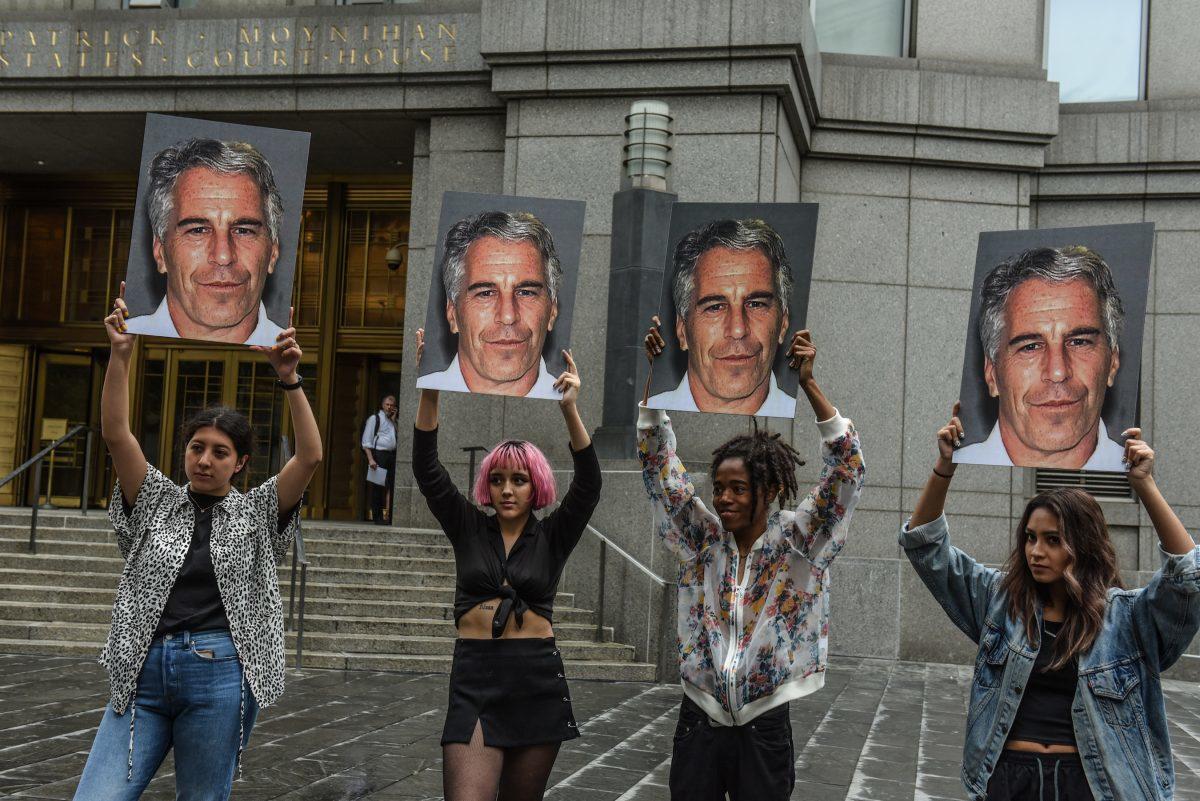
A protest group called “Hot Mess” hold up signs of Jeffrey Epstein in front of the federal courthouse in New York City on July 8, 2019. (Stephanie Keith/Getty Images)
Gifts, Links
Harvard accepted four gifts after Epstein’s arrest but no further donations were accepted after his conviction, under a decision by President Drew Faust. Several faculty members, including Nowak, tried to convince Faust to revise the order.
Epstein bypassed the order by getting others to donate to the university. Those donations included $7.5 million to support the work of Nowak. Leon Black, who donated millions with his wife or through their foundation, told lawyers he was introduced to the professor through Epstein.
Nowak also allowed links to the websites of Epstein’s foundations on PED’s website at the request of Epstein’s publicist. A full page featuring Epstein was also published on PED’s website. It was removed in 2014 after complaints from a sexual assault survivor’s group.
Epstein also regularly received communications from Harvard’s development offices, including an invitation to attend the start of the university’s Capital Campaign in 2013.
The review of Epstein’s ties with Harvard was conducted by Diane Lopez, the university’s general counsel, Ara Gershengorn, a Harvard attorney, and Martin Murphy of Foley Hoag LLP.
They recommended to Harvard President Lawrence Bacow that Harvard develop clearer procedures for reviewing potentially controversial donations, revise its procedures for appointing Visiting Fellows, and consider whether any further actions should be taken based on Epstein’s unfettered access to PED.
Bacow said in a letter to the Harvard community that he’s instructed members of his team to begin implementing the recommendations “as soon as possible.”
“The report issued today describes principled decision-making but also reveals institutional and individual shortcomings that must be addressed—not only for the sake of the University but also in recognition of the courageous individuals who sought to bring Epstein to justice,” he concluded.
Data Shows World Rejecting Governments’ Shelter-In-Place Tyranny
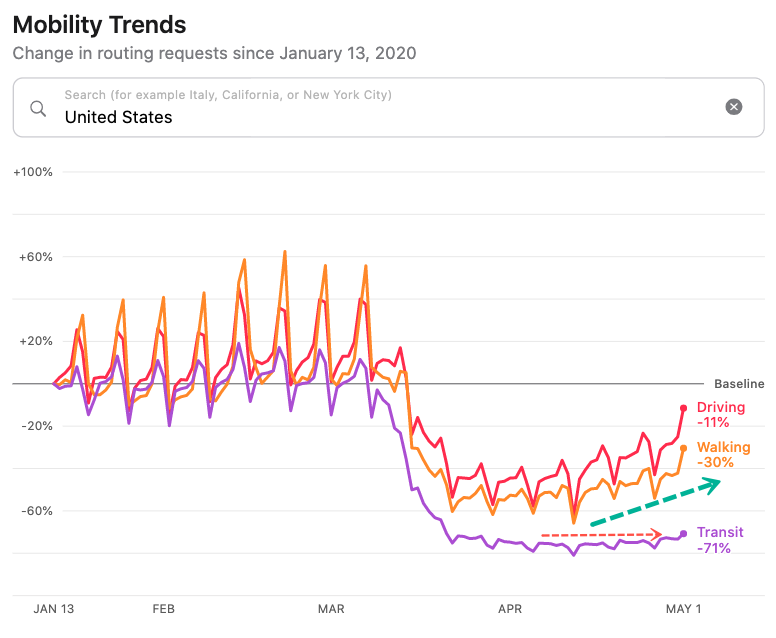
People across the Western world have already started to revolt against government-enforced lockdowns that have now continued for at least the seventh week in some places. Apple’s Mobility Trends and Foursquare payments data illustrates how shelter-in-place is becoming a distant memory for some as they try to restore their lives to what it was in pre-corona times.
The latest data from Apple’s Mobility Trends shows iPhone users in the US, Germany, UK, and Italy began to ignore stay-at-home orders around mid-April. While activity is still well below average trends from January 13, the recent rebound suggests more people are violating the orders
Apple’s Mobility data shows driving and walking in the US has surged since mid-April but still below average. Public transportation use remains troughed and has yet to rebound.
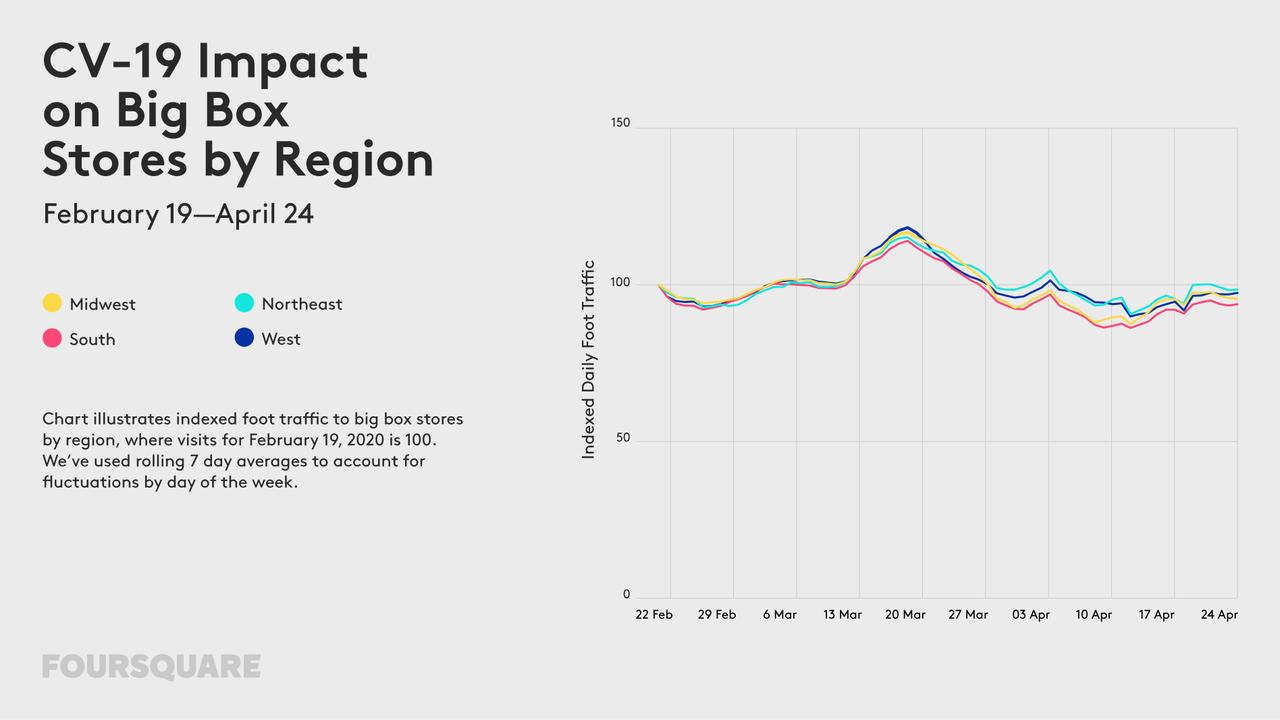
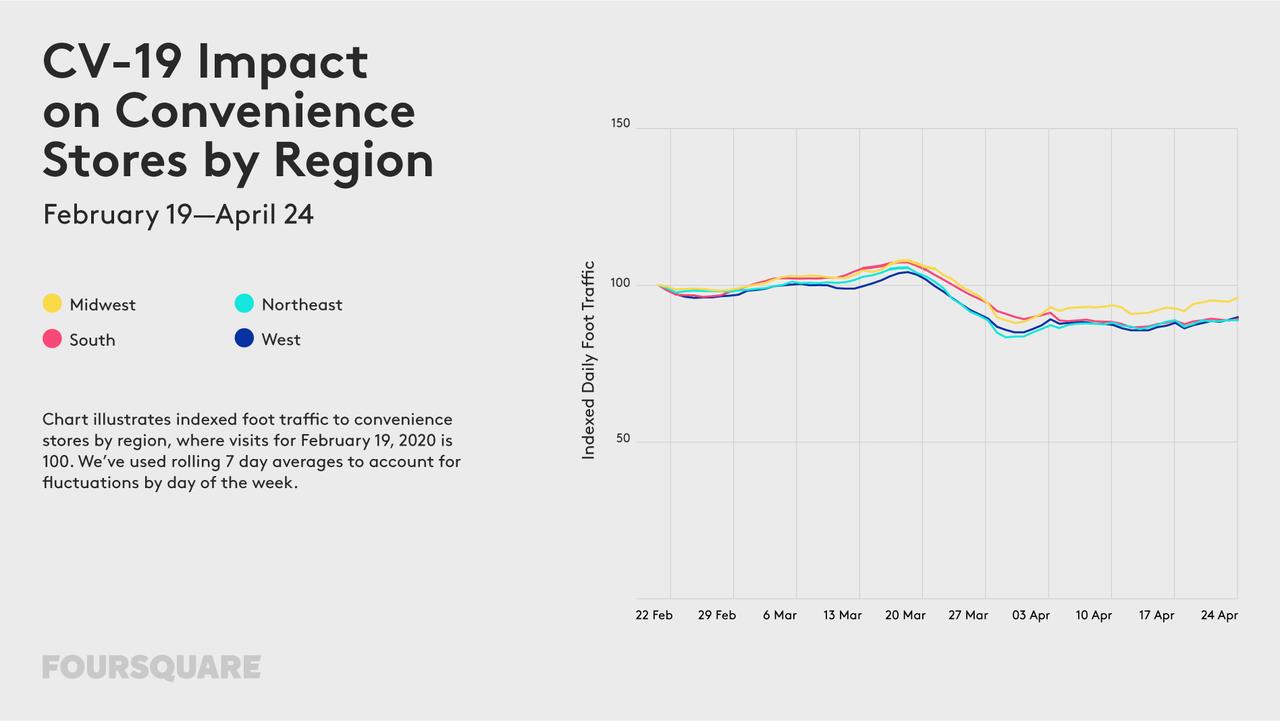
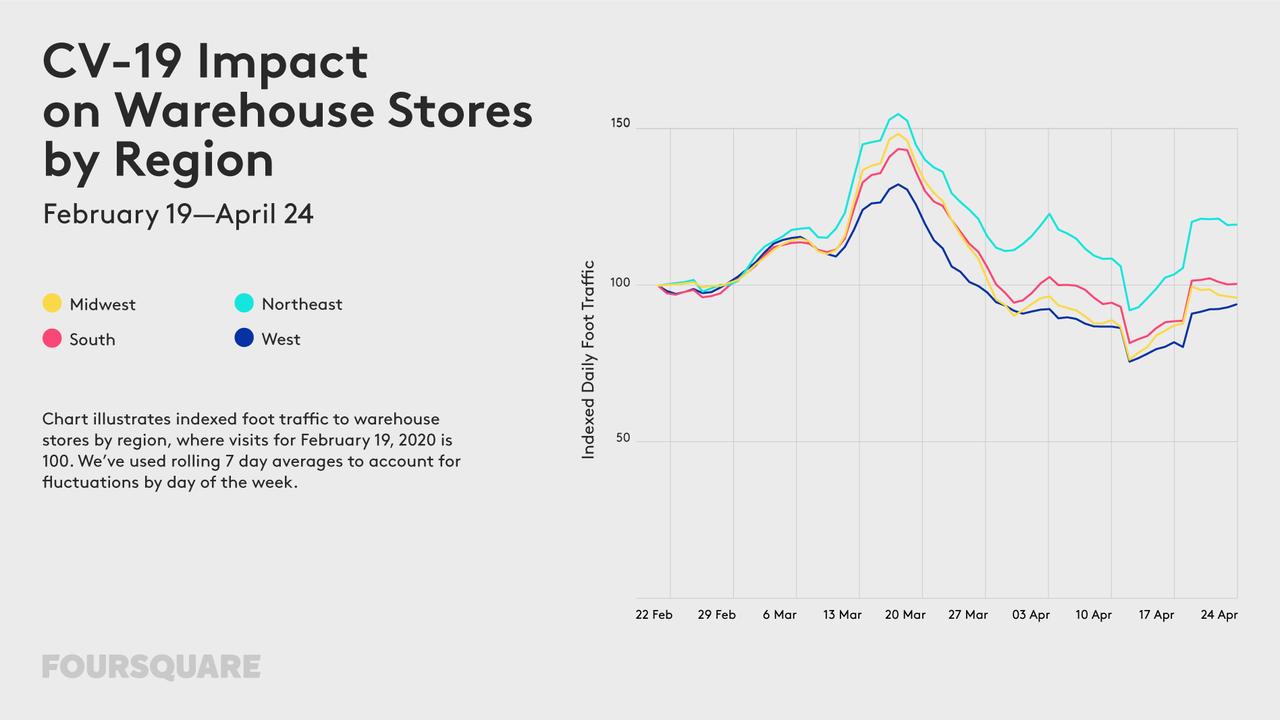
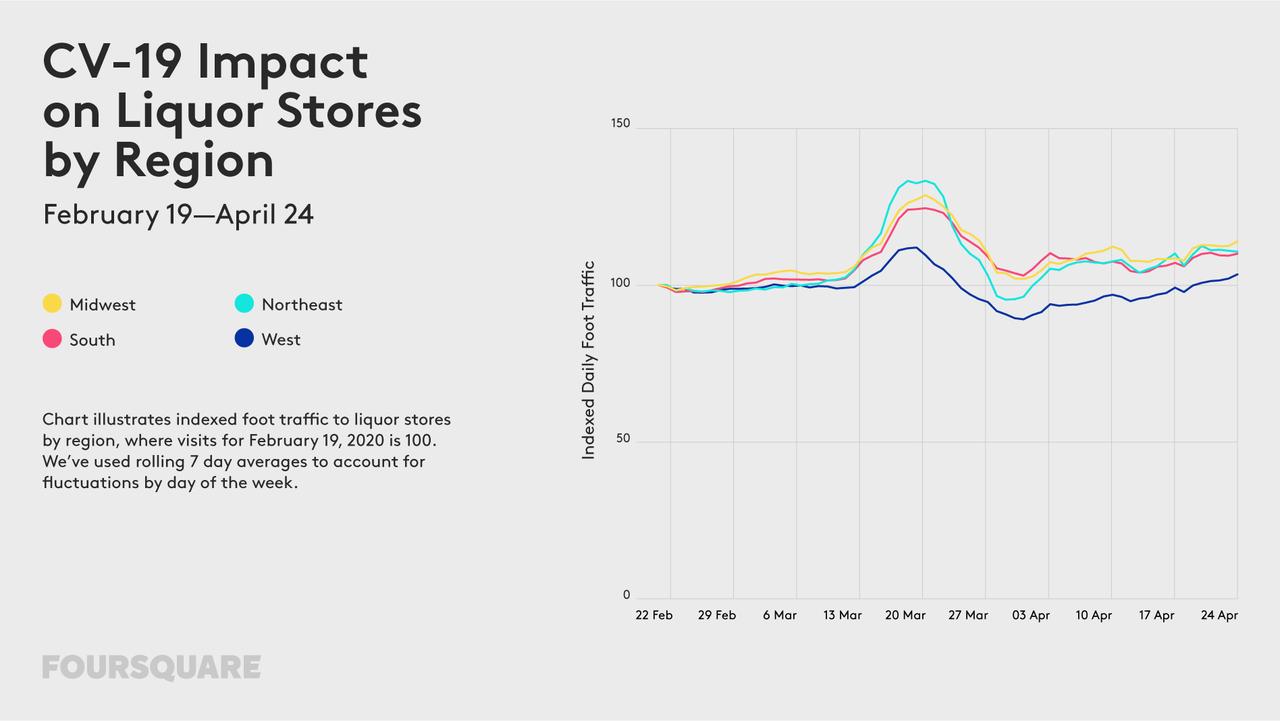
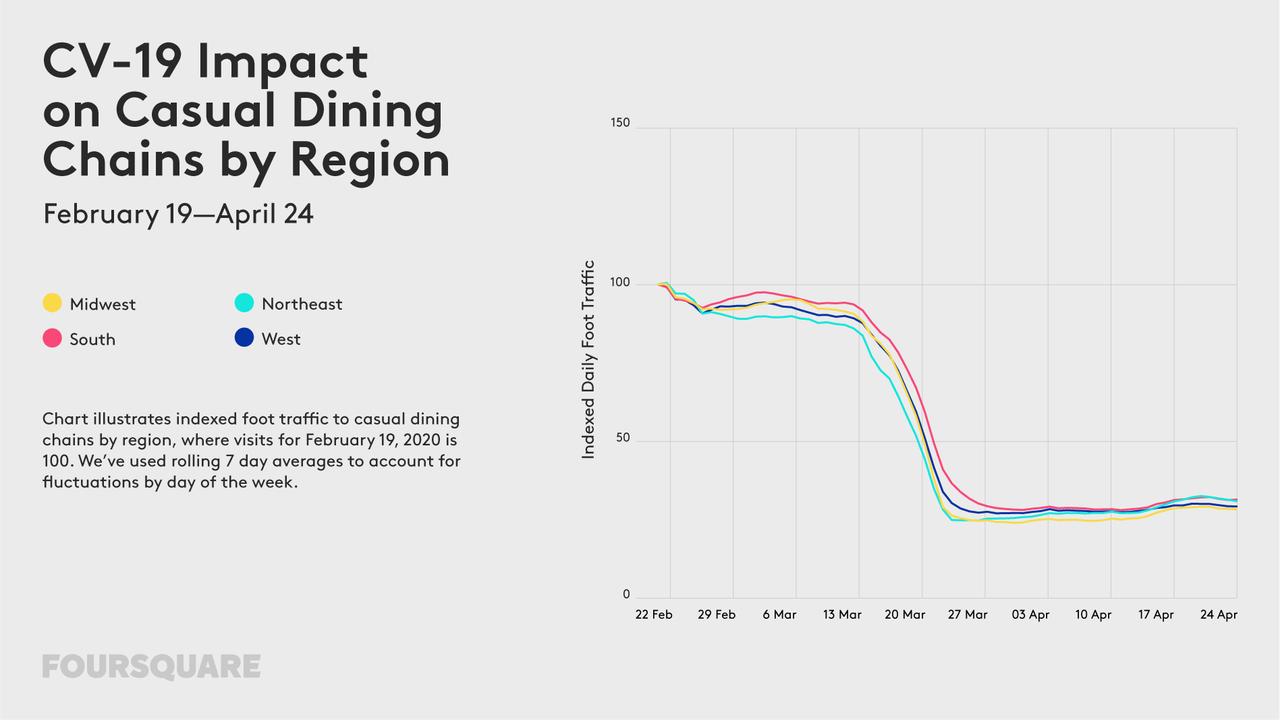
While mobility tracking data shows an uptick, payments company Foursquare is also showing increased visitations at stores.
“People are feeling the itch to get back to the real world. As officials begin the process of relaxing some business restrictions, we’re starting to see upticks in foot traffic to various places. This is true across regions, regardless of state-specific policies,” Foursquare said in a blog post.
In the second half of April, Foursquare notes that foot traffic at various types of stores started to move higher. Here’s what they found:
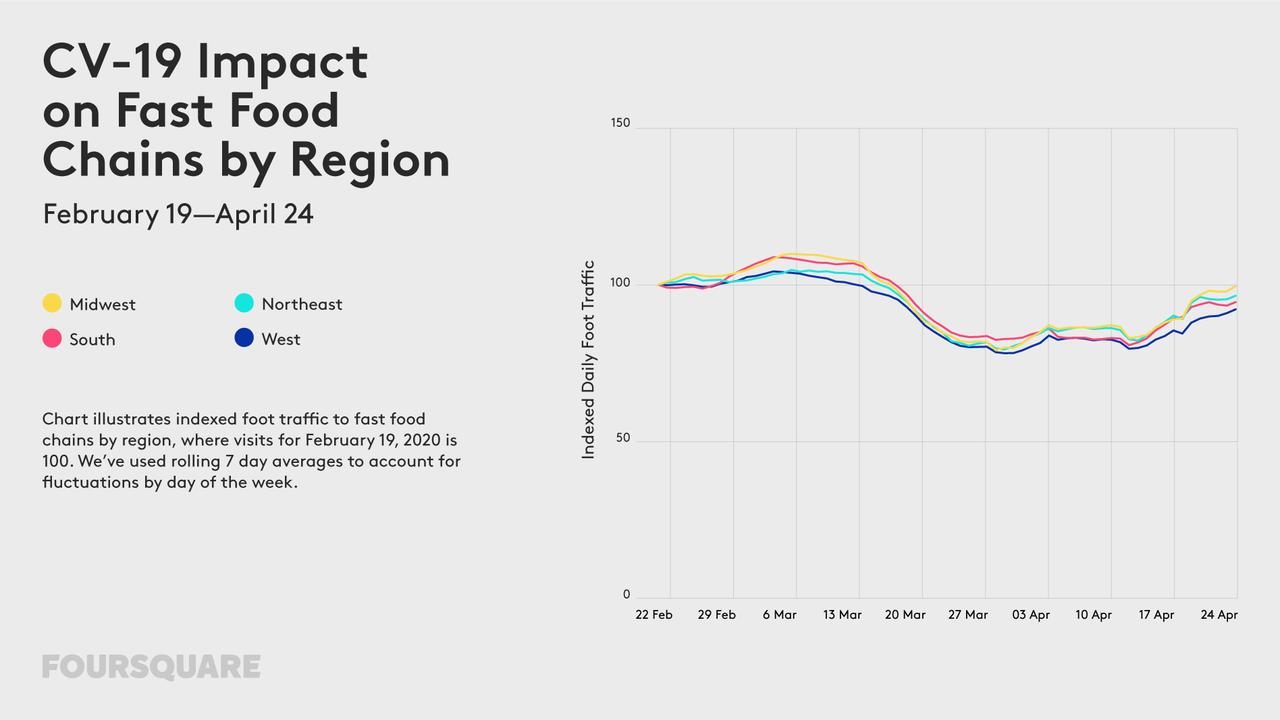
Fast food and gas station visits have returned to pre-COVID-19 levels in the Midwest, and in rural areas across the nation. Though still below ‘normal’, visits in suburban and urban areas have shown substantial growth (>15%) since their end of March lows. Even casual dining restaurants are starting to show recent upticks, likely driven by new delivery and curbside options.
Men — and generally people between the ages of 35-64 — have shown more moderate declines across different types of places, and are also showing greater propensity to return
Visits to trails and home improvement stores — both allowable destinations in most states — are up substantially versus our February benchmark (31% and 56% respectively). While some portion of this is certainly seasonality, the growth in the last two weeks has been particularly notable; home improvement store visits, for instance, are up nearly ~20% in the last two weeks versus just ~6% in the period prior.
The midwest and rural areas across the country have shown more moderate declines across different types of places, and are also showing a stronger inclination to get back to normal.
Foursquare shows foot traffic at fast-food chains across all major US regions have bounced back to around baseline.
Gas station visits have also reverted in all regions to near baseline, slightly higher in the Midwest.
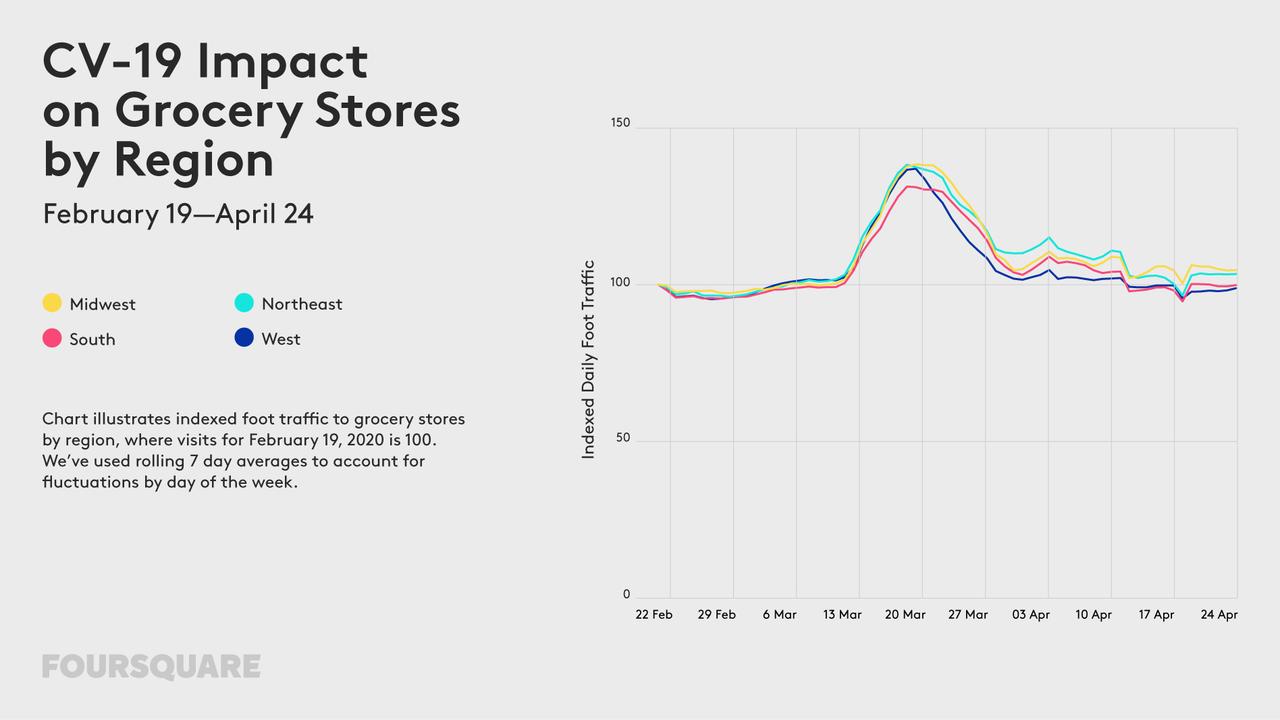
Note the mid-March surge in traffic at grocery stores was the panic hoarding period.
Apple and Foursquare data suggests many Americans are fed up with stay-at-home orders as they now venture out into a post-corona world. Such activity could be enough to spark a second coronavirus wave, and with a record amount of deaths seen on Friday, the virus crisis could be worsening.
The Fed’s Balance Sheet Will Expand By 38% Of GDP, More Than Double QE1, 2 And 3 Combined
Authored by Chetan Ahya, chief Morgan Stanley economist and global head of economics
The 1Q GDP data releases for the US and euro area this week provide official confirmation of what we have known for some time – the recession has started. However, we remain of the view that this downturn will be sharper but shorter than the GFC.
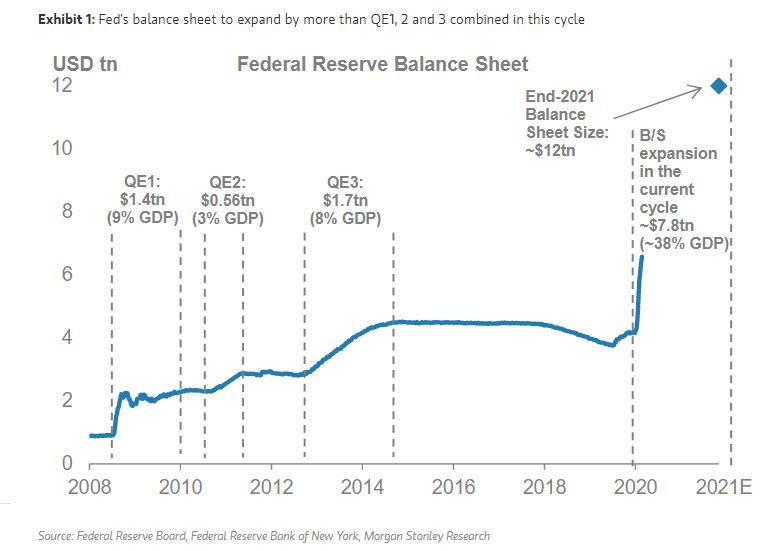
To begin with, the trigger for this recession is an exogenous shock in the form of a public health crisis, rather than the classic, endogenous adjustment triggered by rising imbalances. This also did not start out as a financial crisis, and the banking system is in better shape today than prior to the GFC. Moreover, this recession has prompted the most coordinated and aggressive monetary and fiscal easing that we have witnessed in modern times. For the G4 and China combined, fiscal deficits as a percentage of GDP will be 1.5 times GFC levels. Similarly, G4 central banks are aggressively expanding their balance sheets. The Fed’s balance sheet will expand by 38 percentage points of GDP, more than the 20 percentage points during QE1, 2 and 3 combined.
Hence, while global growth will trough at -7.5%Y in 2Q20 on our estimates (far below the -2.4%Y in 1Q09), global and DM output will reach pre-recession levels in four and eight quarters, respectively, as compared with six and fourteen quarters during the GFC.
A number of the high-frequency indicators we track suggest that the global economy is in the process of bottoming out. Consumers’ future expectations have improved, mobility trends have moved up from their troughs and consumer spending is contracting more slowly than in the early weeks of the outbreak. In the US, our IT services & payments analyst James Faucette highlights that credit card transactions data indicate that both transactions and sales have picked up in the past two weeks. Our read is that China’s economy bottomed in February, and we think the euro area has likely troughed in April with the US following suit from late April. Other regions such as CEEMEA and LatAm will bottom out later.
As economies reopen, allowing more workers to return to work, mobility trends and production levels will likely improve further, as should end demand with a lag. A phased reopening in the US and Europe is in the works for the coming weeks. In the US, some states have begun to reopen, and our US economics and biotechnology teams estimate that, by mid-May, 54% of the economy will be in a meaningful reopening phase. This estimate assumes that states will be able to reopen 28 days (Phase 2) after the peak in new confirmed coronavirus cases. European economies will also progressively reopen from early May onwards.
As we move towards this gradual reopening in parts of the world outside China, we have been closely observing developments in China to see how various sectors of the economy are normalising and how this experience may inform our outlook for the rest of the world. To be sure, our views are shaped by the path but not the duration and magnitude of recovery, considering the differences in the severity of the outbreak as well as the underlying composition of economic activity between the US, Europe and China.
In China, the manufacturing, infrastructure and construction sectors recovered relatively quickly. The manufacturing PMI is back in expansionary territory, while steel and cement demand and property sales are growing again in year-over-year terms, just ten weeks after the peak in new cases. Supply-side disruptions have eased quickly, and production levels have experienced a V-shaped recovery, which suggests that the manufacturing sectors in the US and Europe should be on a similar path post-reopening.
However, as the US and Europe are more consumption-based economies, it is the experience of the Chinese consumer that is drawing the most investor attention. Consumption in China is also showing signs of progress, but the pace of recovery has varied across different segments, and the phased relaxation of social distancing measures has dampened the overall pace to some extent.
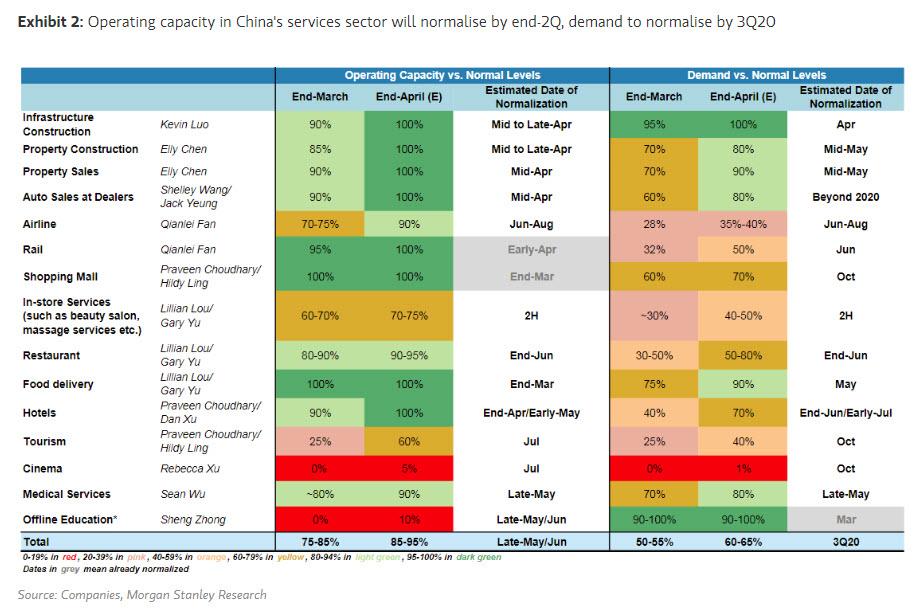
As you might expect, sales in China’s online retail channels (which account for 30% of total sales) are back in positive territory YoY, while traffic to shopping malls sits at 70% of normal levels (even though malls are now fully open). Smartphone sales have seen a V-shaped recovery and demand for tech products has improved on a broad front according to our Asia technology analyst Shawn Kim, but spending on other consumer discretionary products is still lagging somewhat. Consumer goods (staples, home appliances and apparel) companies expect normalisation by the end of June (i.e., moving back towards normal levels of YoY growth in 2H20). Restaurants have 50-80% of their customer base back, but night life venues are still closed in Tier 1 cities and cinemas remain dark until early June. Our China consumer analyst Lillian Lou expects these channels to fully reopen by the end of June/beginning of July, and traffic to normalise in 3Q20. For the US, our branded apparel & retail analyst Kimberly Greenberger expects that some US retail discretionary spending stores will open in May but a full reopening is likely only in June. She expects a 78-85% decline for the discretionary retail segment in April, but this will materially improve to a 30-45%Y decline for the May-July period and further to a 10-15%Y decline in August-October.
The reopening of economies has prompted concerns about a second wave of infections and potential double dip in the economy. We readily admit that many unknowns concerning the virus remain, but we do expect additional waves of infections to occur. However, we take comfort that the phased reopening, the scaling up of public health authorities’ ability to test and trace on a meaningful level, the development of medical solutions to treat and prevent the disease and the awareness of the population at large mean we have a much better chance to reduce the size and scope of future outbreaks.
There Is Now A Record 375 Million Barrels Of Oil Stored On Tankers
Last weekend we showed that as oil storage on land was rapidly filling up, a familiar sight was seen off the coast of Asia’s oil hub in Singapore: a record surge in tankers on anchor used as seaborne storage, and taking advantage of the supercontango just waiting for oil prices to rebound so they can deliver their (formerly) precious cargo.
So as more and more storage moves offshore, here is an update from Bank of America on the current status of the oil market as the “oil glut moves from tanks to tankers.”
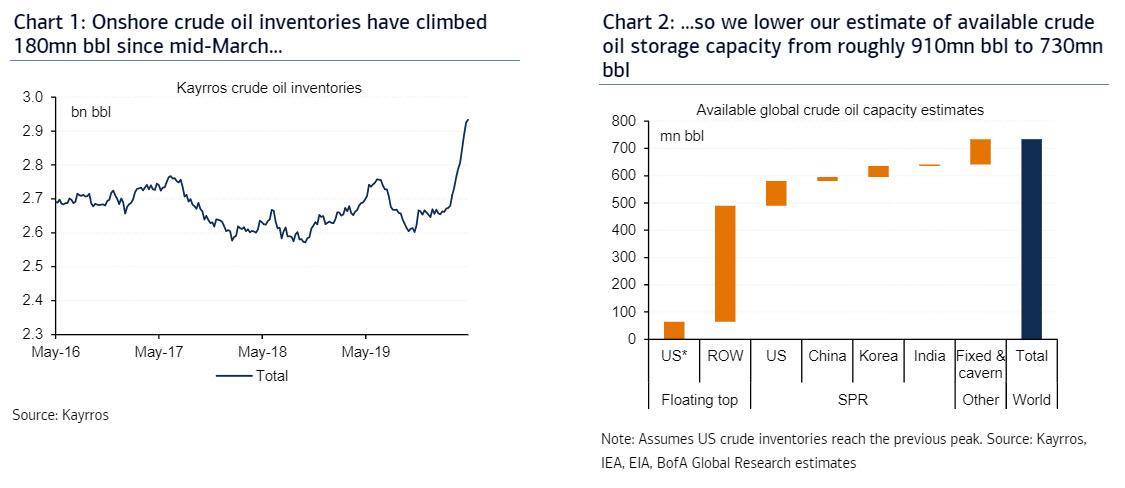
In the last five weeks, onshore inventories held in floating top tanks climbed 180mn bbl, suggesting that builds have averaged roughly 4.3mn b/d since mid-March. These inventory increases reduce BofA’s estimates for available onshore crude storage capacity from roughly 910mn bbl to 730 mn bbl (Chart 2), although the bank still believes that this capacity is unlikely to be fully utilized due to logistical constraints and other issues.
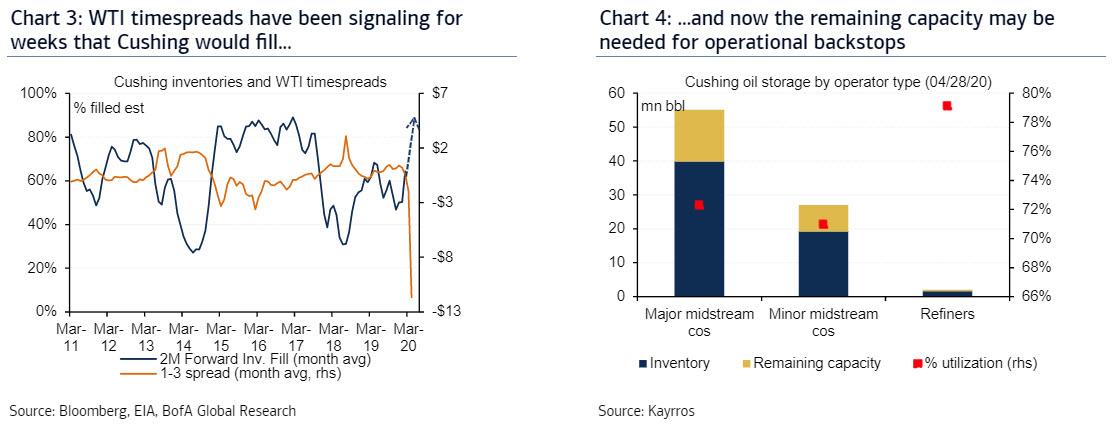
How did we get here? As has been extensively reported here and elsewhere, WTI timespreads signalled a massive build in Cushing inventories and stocks would likely reach their operational limits within a few weeks (Chart 3). More recently, the expiration of the May WTI contract demonstrated the lack of available capacity at the hub. Cushing inventory builds are set to slow dramatically as much of the remaining capacity may be needed as an operational backstop for pipeline issues and blending needs (Chart 4). Over the coming weeks and months, US inventory trends could even reverse as producers in Canada and the Bakken shut-in output and refiners increase runs on the back of the re-opening of the economy.
As Bank of America adds, land based crude oil inventories first surged in China, where the coronavirus outbreak originated (Chart 5). Since then, China’s inventories have stagnated while stocks in the US and elsewhere ticked higher. There is room for incremental builds in China going forward, especially if the government uses more commercial tank space for strategic petroleum reserves (Chart 6). Elsewhere, inventories in Europe and the Middle East remain relatively lower. In Europe, this may be due to the mothballing of some tank storage at refiners and terminals. So, actual storage utilization rates may be higher than the data suggests. In the Middle East, inventories have climbed in GCC countries but may also remain lower on average as these countries prefer to sell oil as exports before storing domestically. In the US, producers have leased 23mn bbl of the roughly 70mn bbl of available SPR capacity and added 1.1mn bbl to SPR storage last week.
Of course, in addition to land based storage, the market also uses tankers for crude oil storage as a spillover outlet. Crude oil on the water has risen by roughly 150mn bbl since the start of the year, to more than 1.2bn bbl (Chart 7). This is due to a combination of higher crude in transit stemming from OPEC’s oil price war and from increases in crude oil floating storage. Since mid-March, crude oil floating storage has grown by an estimated 91mn bbl, or roughly 2.2mn b/d (Chart 8). Asia and Europe saw the largest increases in floating storage, climbing 36mn bbl and 20mn bbl respectively over the same period.
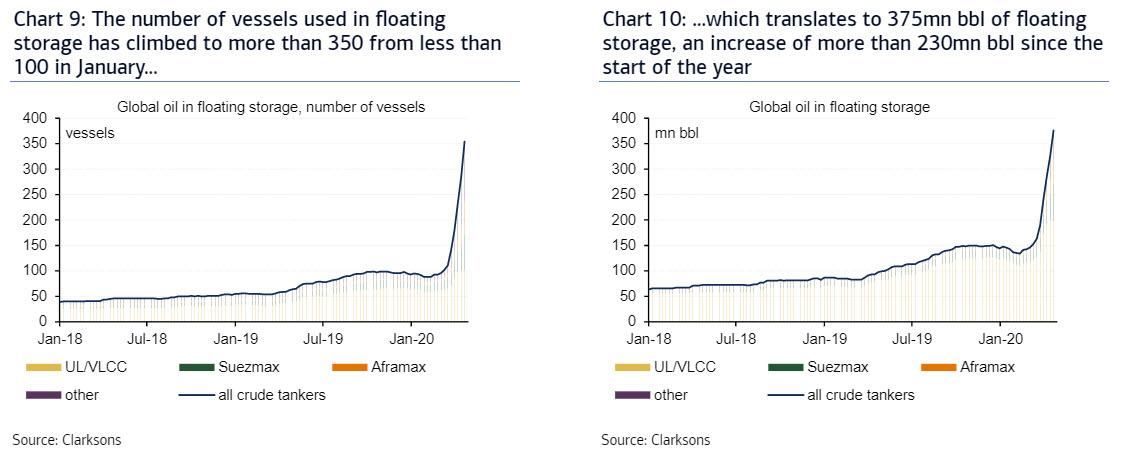
According to data from Clarksons, there are more than 350 vessels currently being used for floating oil (crude and product) storage globally (Chart 9). Of this total, roughly 100 are very large crude carriers (VLCC) and ultra-large crude carriers (ULCC). Total oil held in floating storage has risen to 375mn bbl, up 220mn bbl from mid-March and 230mn bbl from the start of the year (Chart 10). A majority of this storage has occurred on VLCCs and ULCCs, followed by Suezmax and Aframax vessels.
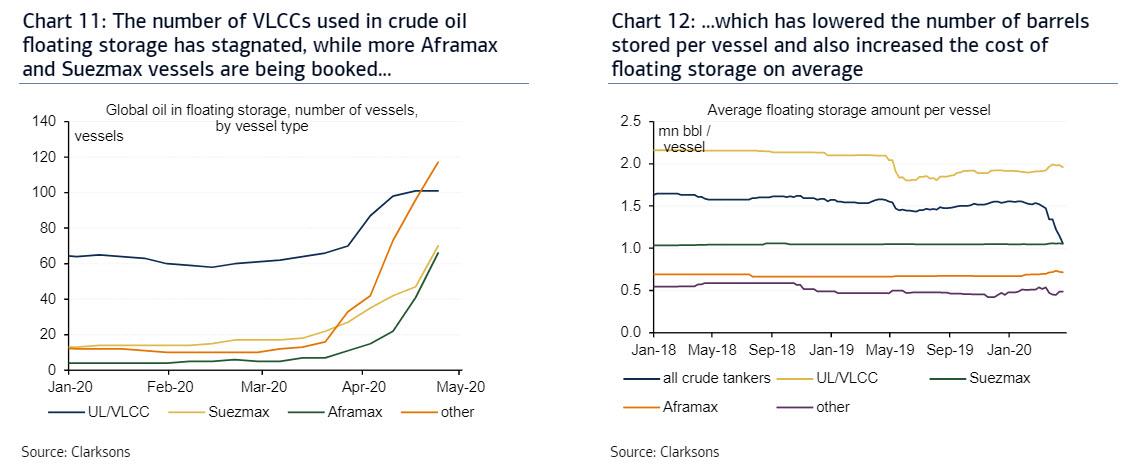
The first vessels booked for floating storage were primarily VLCCs and ULCCs, but demand for Suezmax and Aframax vessels has also increased dramatically since April (Chart 11). As traders utilize more of the smaller vessels, the average amount of floating storage per vessel has decreased, implying an increase in the average cost for floating storage. Since the beginning of the year, the average level of storage per vessel have collapsed from more than 1.5mn bbl to just 1mn bbl. (Chart 12). This rise in tanker rates for each ship type, combined with crude increasingly being stored on smaller vessels at the margin, is a double positive whammy on the marginal cost of crude storage and thus on the contango in the crude curves.
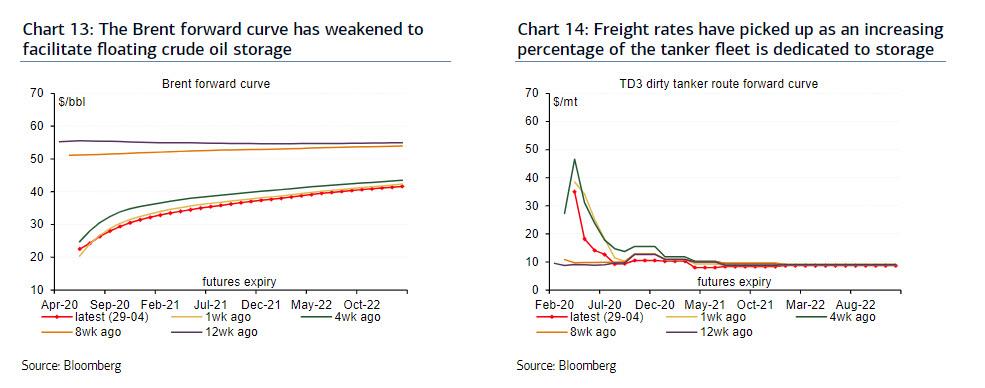
The abrupt demand contraction has forced crude oil forward curves into steep contango (Chart 13), with Brent 1-13 spreads widening to -$16/bbl at times to facilitate floating storage. As demand for freight picked up, dirty tanker rates spiked. The shape of the forward curve for the TD3 dirty tanker route (Middle East to Japan) was very flat just eight weeks ago (Chart 14), but the increase in demand from Saudi Arabia and from floating storage pushed front month rates up nearly 400%. More recently, rates have subsided somewhat but still remain exceptionally high compared to historical levels.
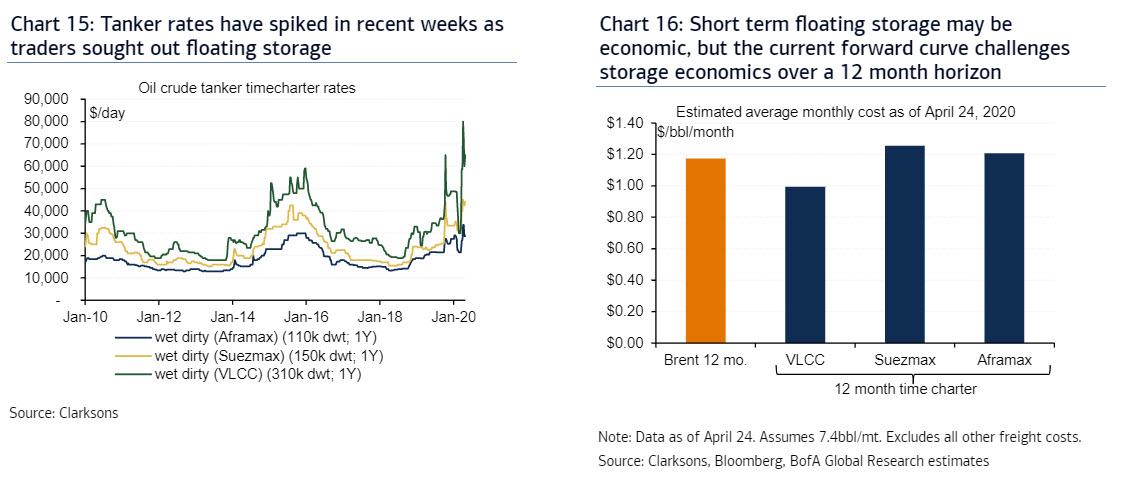
Freight rates have been exceptionally volatile, with VLCC 12 month time charters spiking to $80,000/day in early April and falling to around $65,000/day recently (Chart 15). The increase in smaller vessels has been less dramatic, with Suezmax and Aframax vessels peaking at $45,000/day and $34,000/day respectively. The very steep contango in the front of the Brent curve (e.g. 1-3m) has allowed for floating storage to be economical. Yet the 12 month contango in Brent was recently lower than the going rate for 12 month time charters for Suezmax and Aframax vessels. Additional pressure on Brent timespreads will be needed in order to encourage more floating storage using these types of vessels (Chart 16).
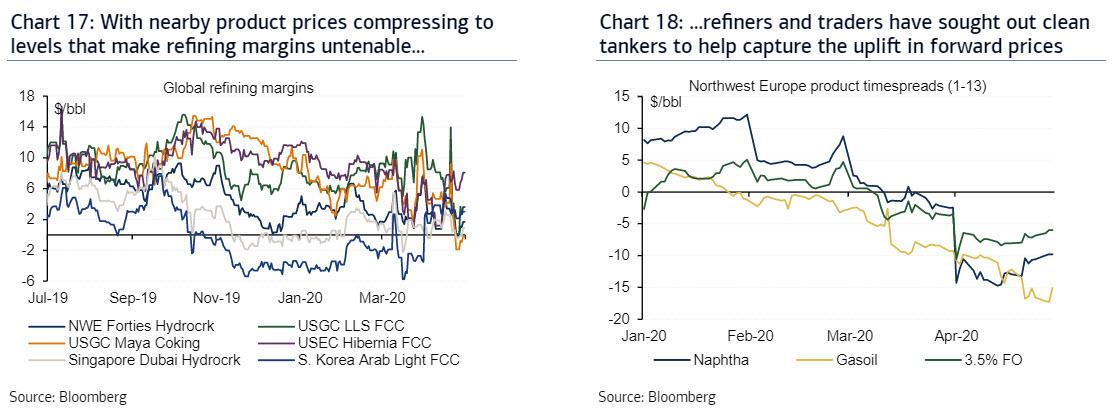
Refining margins have been exceptionally volatile since lockdowns began on a global scale (Chart 17). As refiners cut runs or shut down completely, margins experienced short term rebounds, but margins continue to trend towards zero on a spot basis as refined product inventories surge. In the US, product inventories have risen counter-seasonally and are now nearly 70mn bbl above year ago levels and 26mn bbl above previous five-year highs from 2016. It is no surprise that refined product markets have also developed their own supercontango (Chart 18), as prompt prices plummeted. Refiners have attempted to take advantage of the significant price improvement for forward product prices by storing products on land on and the water.
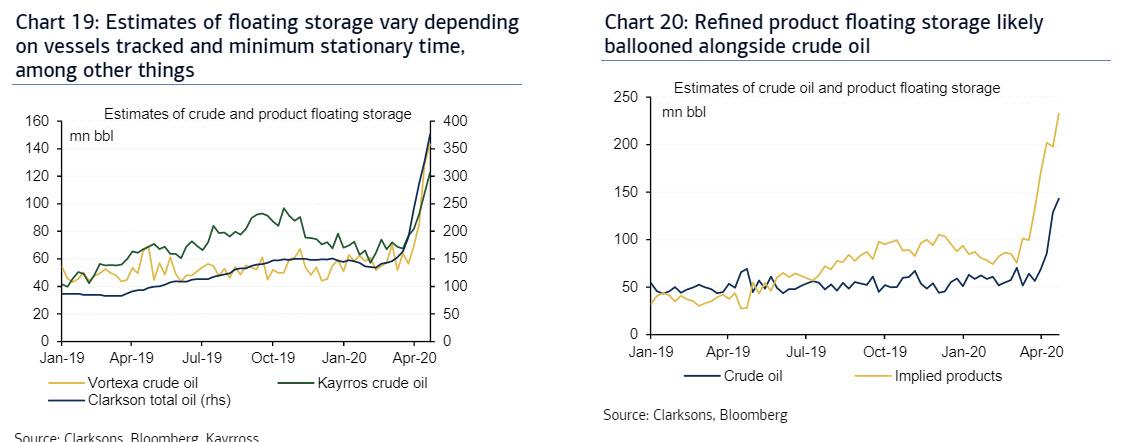
Estimates for floating storage vary depending on methodology. Some trackers classify floating storage as vessels that have remained idle for 10 days and others assume 14 days. The types of vessels tracked may also vary, leading to higher or lower floating storage levels. Nonetheless, all estimates point to rising volume on the water (Chart 19). Refined product floating storage is not well tracked, but Clarksons does track total tankers used for floating storage. Combining Clarksons data with other crude oil only floating storage data from Vortexa implies that refined product builds have been exceptional (Chart 20). Even if total levels of implied refined product floating storage are off, there is little doubt that product storage is on the rise.
The oil surplus was initially visible in dirty tanker freight rates, but clean tanker rates are now beginning to surge as refiners and traders seek to float unsold product volumes (Chart 21). With refined product prices like Singapore gasoline falling to $0.50/gal, shipping has become a disproportionately large component of the all-in cost of delivered fuel, making fuel movements exceptionally expensive. The economics for floating product storage varies dramatically depending on the contango of each product market and on the density of individual products. The recent surge in clean product tanker rates has challenged floating storage economics (Chart 22), but volatility in product forward curves should continue to offer opportunities for traders to float cargoes.
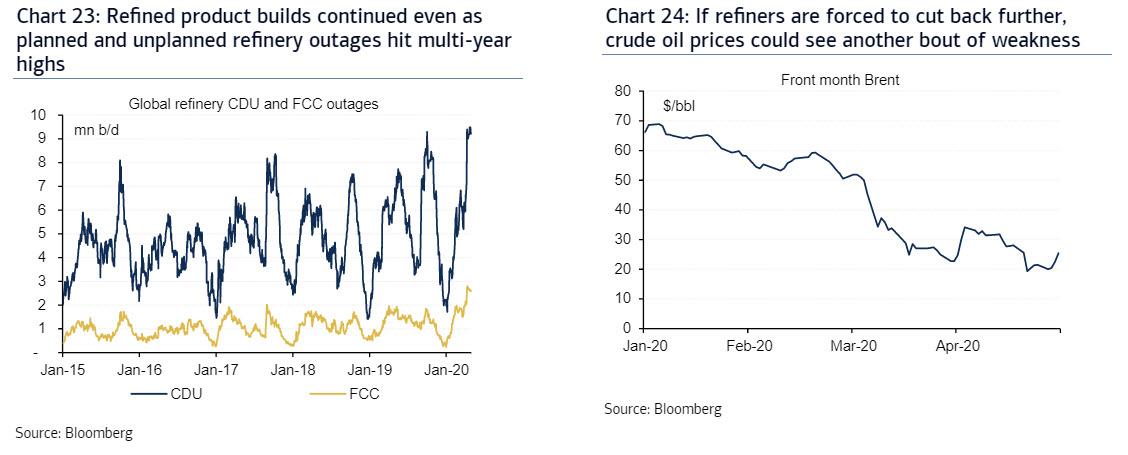
Another round of run cuts could bring renewed crude weakness. The global oil rout likely peaked in April as oil demand contracted by nearly 25mn b/d YoY. Now, countries are emerging from lockdown, boosting oil demand just when OPEC+ cuts are kicking in and producers elsewhere are cutting output. Even so, the market should remain in surplus for the remainder of 2Q20, resulting in continued, albeit slower crude oil and product builds. The oil market is forward looking and market balances look much better in 2H20 which should be supporting of prices. That said, with so much product moving into floating storage, we see risk of additional pressure on refining margins, even as global refinery outages hit record levels (Chart 23). Any further reduction in refinery demand for crude could ultimately result in renewed weakness for crude oil prices (Chart 24) and would likely warrant steeper contango.
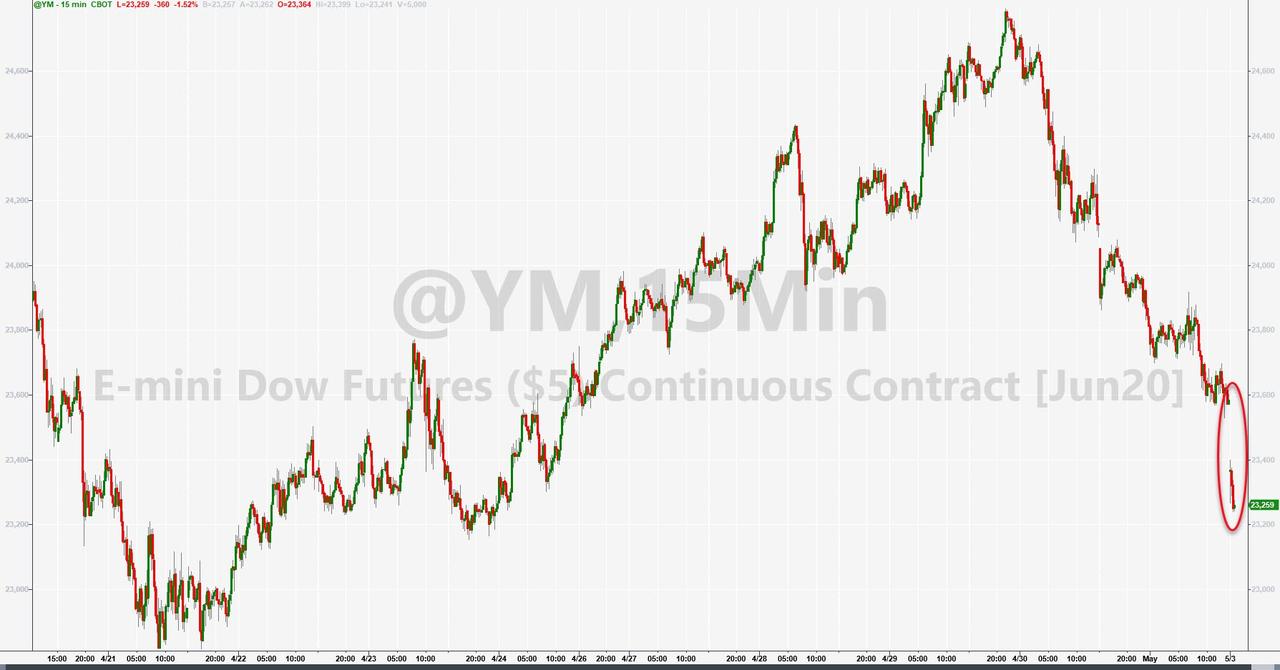
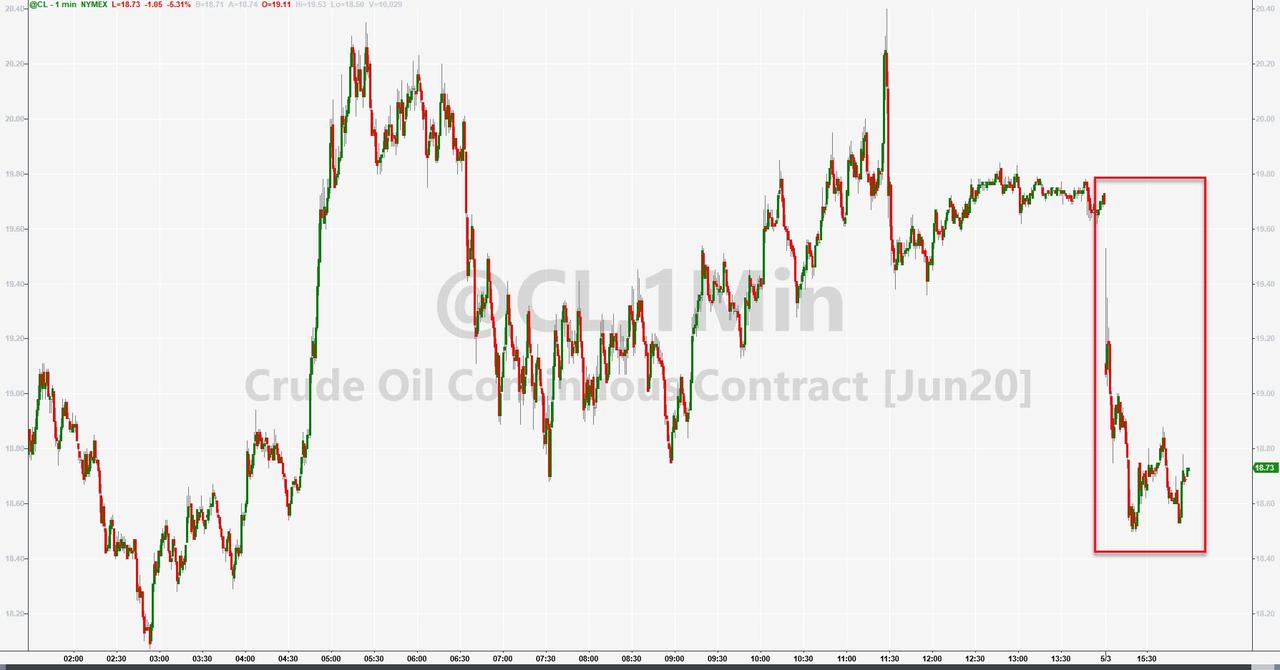
No Buffett buying spree, and no Federal bailout #4 (or is it 6?)… and the result – in admittedly thin liquidity – is US equity futures, crude oil futures, and offshore yuan are all dumping as Asian markets open…
Dow futures are down over 350 points…
WTI Crude is down over 5%…
And offshore yuan is ugly…
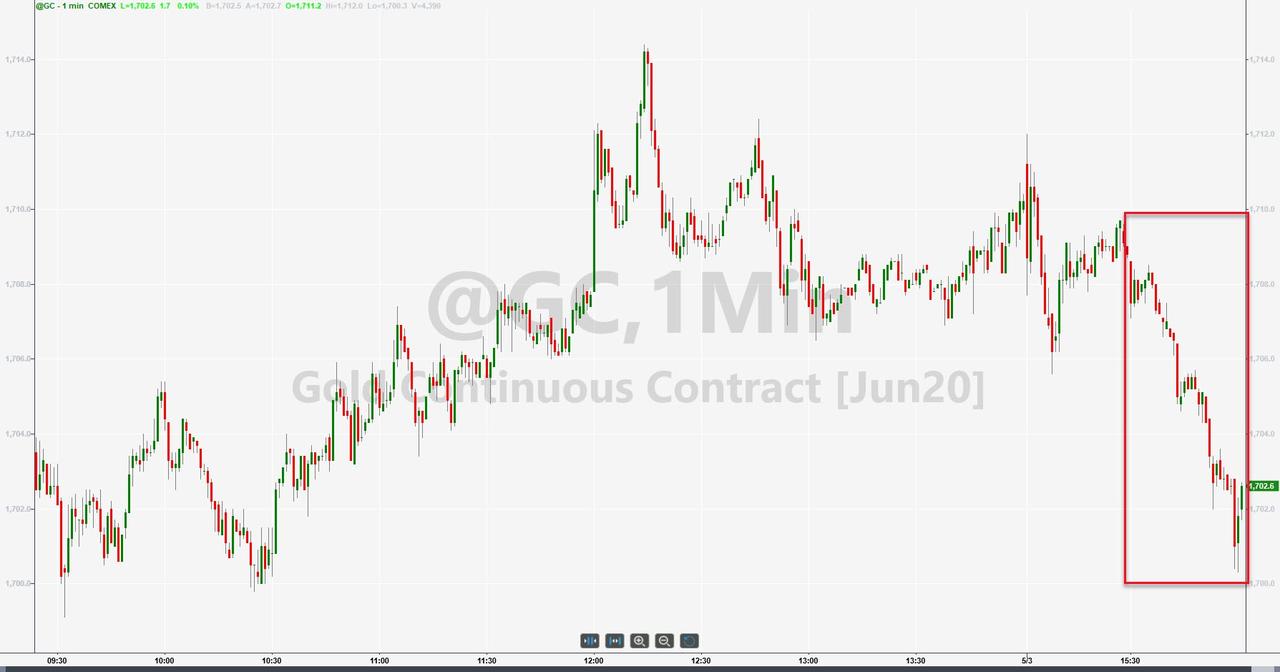
Gold is also under pressure and the dollar rallies, with futures testing $1700…
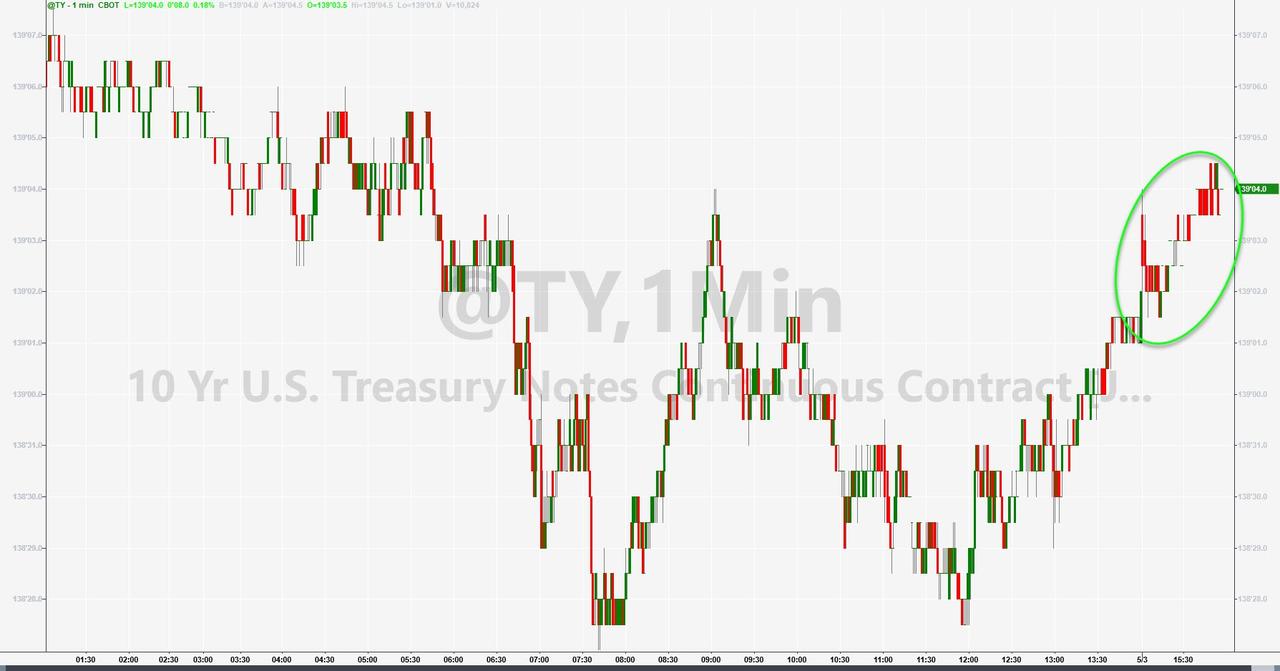
But, Bonds are modestly bid (futures open, cash closed)…