The Peoria County, Illinois, sheriff’s office has stopped the Green Door Video-Erotic Boutique from offering curbside service. Officials say the x-rated store does not qualify as an essential service under the state’s “shelter at home” order.
from Latest – Reason.com https://ift.tt/2xtkYlA
via IFTTT
Greek ‘Borat’ Returns To Explain Phase 2 Of China’s World Domination Plot
After a seven-year absence, having hunkered down following his European Crisis commentary success, Mr. Panos – the Greek ‘Borat’ – explains (with his ubiquitously shocking sense of reality) just what the Chinese are up to… a three-phase plot to dominate the world.
“…to have enough to run the world… they’re not sexy people so government ordered them to…”
And now Mr. Panos explains Phase 2: “make everything for the world.”
“Hey America, what you need? You need toys? … we will be Santa…The North Pole is in Wuhan.”
Phase 3 to follow…
Remember, under the code of the CCP, the morality of an act is determined by whether it advances or retards the goals of the regime: expansion, conquest and domination…
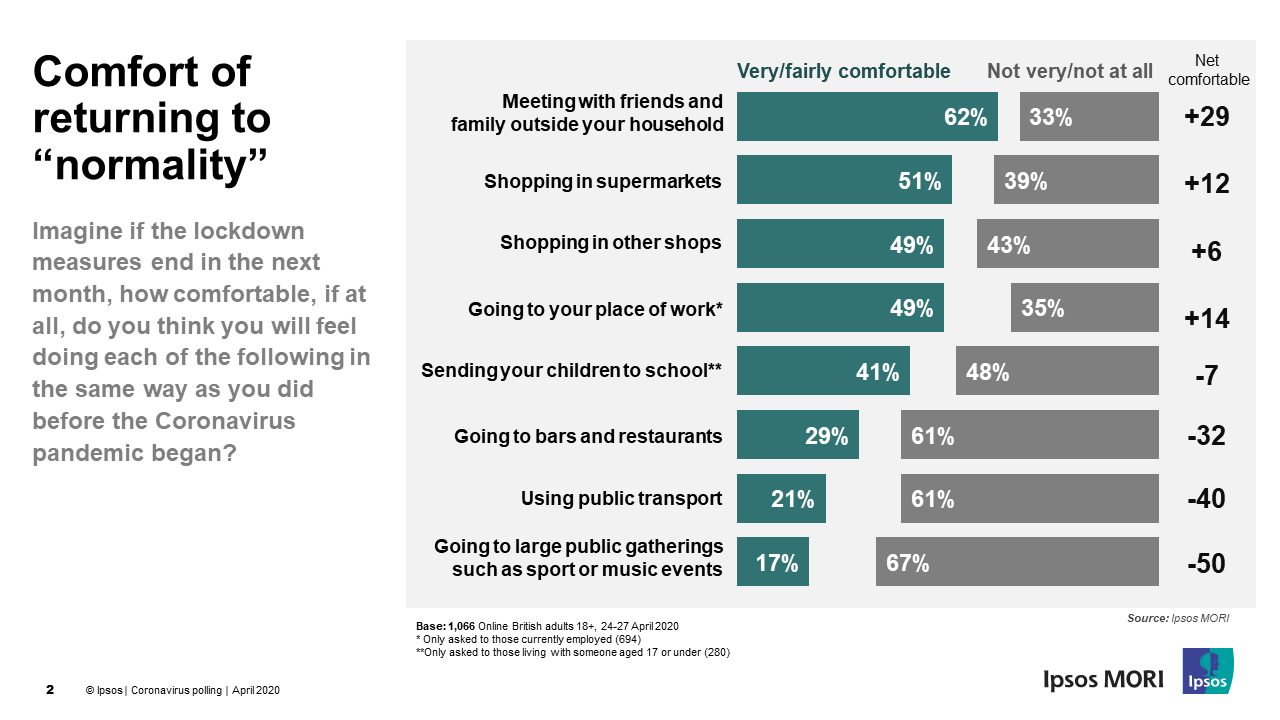
A new poll has found that even after the lockdown ends, a majority of Brits will still feel uncomfortable about going to bars and attending large social gatherings.
The survey by Ipsos Mori shows that 61% would be uncomfortable visiting bars or restaurants, with the same figure feeling uncomfortable about using public transport.
The poll also found that 67% would be uncomfortable attending large public gatherings such as sport or music events.
A majority still uncomfortable about sending their children to school despite strong evidence suggesting children cannot pass the coronavirus on to adults.
The poll numbers emphasize why the UK government has been hesitant to announce when lockdown measures will end, despite numerous other European countries having already done so.
Many people have been surprised by how compliant and obedient the British population has been in response to the lockdown, with many of them still afraid to go outside.
This is the case despite initial estimates that coronavirus could kill up to 500,000 people in the UK proving to be grossly exaggerated.
Meanwhile, it has been revealed that almost 200,000 Brits have used snitch hotlines to report their neighbors and others for violating lockdown and social distancing rules
* * *
My voice is being silenced by free speech-hating Silicon Valley behemoths who want me disappeared forever. It is CRUCIAL that you support me. Please sign up for the free newsletter here. Donate to me on SubscribeStar here. Support my sponsor – Turbo Force – a supercharged boost of clean energy without the comedown.
Greek Brothels To Reopen But Hookers And Clients Required To Wear Masks And Gloves
In Greece the discussion about “essential businesses” appears to have gone in a different direction than in the United States. While Americans are bickering over when to reopen malls, restaurants and casinos, Greece has managed to get its “most essential” businesses up – so to speak – and running. By which we of course mean brothels.
Brothels in Greece – where a global pandemic can’t possibly stop the local men from getting their dose of sex-for-sale – are set to re-open soon, however with a set of new laughably absurd protection measures, on top of the precautions one would already expect when visiting a brothel, according to The Newspaper.
Customers at brothels will be required to wear plastic masks and gloves while having sex, according to the Greek press. And in addition to the robust security already needed in a brothel, the additions of thermometers, disposable sheets and “frequent periodic disinfection” of the business will all be a part of post-coronavirus brothel life (it wasn’t immediately clear how s temperatures of both hookers and clients would be taken).
It does however beg the question: why weren’t disposable sheets and “frequent periodic disinfection” used to begin with?
But, we digress. This is just another example that no matter what the circumstances, sex sells and capitalism adapts.Back in March, we noted that one company had launched a “solution” to the loneliness of quarantine by offering antibacterial sex dolls.
The lesson for the US? If the Greeks are this insistent on going back to work, maybe there’s a win/win scenario: convert all those vacant WeWork offices into brothels and get all those millions of women “seeking arrangements” with wealthy sugar daddies to “work” legally: who knows, it could be the basis for a truly modern “New Deal” aimed at pulling the US out of its current depression.
The Eurozone economy is expected to collapse in 2020. In countries like Spain and Italy, the decline, more than 9%, will likely be much larger then emerging market economies. However, the key is to understand how and when will the eurozone economies recover.
There are three reasons why we should be concerned:
The eurozone was already in a severe slowdown in 2019. Despite massive fiscal and monetary stimulus, negative rates, and the ECB balance sheet above 40% of GDP, France and Italy showed stagnation in the fourth quarter and Germany narrowly escaped recession. The eurozone weakness started already in 2017 and disappointing economic figures continued throughout the next years. Many governments blamed the weakness on the Brexit and Trade War cards, but it was significantly more structural. The eurozone abandoned all structural reforms in 2014 when the ECB started its quantitative easing program (QE) and expanded the balance sheet to record-levels. Manufacturing PMIs were already in contraction, government spending remained too high and the elevated tax wedge weighed on growth and jobs. In 2019, almost 22% of the eurozone GDP gross added value came from Travel & Leisure, a sector that will unlikely come back anytime soon, while the exporting sector is also likely to suffer a prolonged weakness.
The banking sector is still weak. In the eurozone, 80% of the real economy is financed via the banking channel (compared to less than 15% in the United States). Eurozone banks still have more than 600 billion euro in non-performing loans (3.3% of total assets vs 1% in the U.S.), an almost unprofitable business with a poor return on tangible assets (ROTE) due to negative rates, and a significant challenge ahead, as most of the growth investments, in LatAm in particular, may reduce capital strength significantly in the next months. Most of the eurozone governments are relying on leveraging the banks’ balance sheets in their “recovery plans”. A massive increase in loans, even with some form of state guarantee, is likely to cause significant strains on lending capacity and solvency in the next years, even with massive TLTROs and capital requirement reductions.
Most of the recovery plans go to government current spending, and tax increases will surely impact growth and jobs. The eurozone tax wedge on jobs and investment is already very high. According to the Paying Taxes 2019 report, the majority of eurozone economies show widely uncompetitive taxation levels. As most governments will massively increase deficits to combat the Covid-19 crisis, there is a high likelihood of a massive increase in taxes that will make it more difficult to attract investment growth and jobs. Most of the recovery plans are also aimed at bailing out the past and letting the future die. There are massive bailout packages for traditional conglomerates and industries, but investment in technology and R&D continues to have high burdens and no support. Considering that the eurozone was already in contraction in the middle of the massive Juncker plan (that mobilized more than 400 billion euro in investments) and the large green policies implemented, it is safe to say that relying on a Green New Deal will unlikely boost growth or reduce debt. The main problem of these large investment plans is that they are politically directed and, as such, have a large tendency to fail, as we saw with the Jobs and Growth Plan of 2009.
Almost 30% of the eurozone labor force is expected to be under some form of unemployment scheme, be it temporary, permanent, or self-employed cessation of activity. After a decade of recovery from the past crisis, the eurozone still had almost double the unemployment rate of its large peers, the US, or China. Germany may recover jobs fast, but France, Spain or Italy, with important rigidities and tax burdens on job creation may suffer large unemployment levels for longer.
The eurozone also faces important challenges into a recovery due to its lack of technological and intellectual property leadership. Those two factors will help China and the U.S. recover faster, as well as the reality of having more flexible jobs market and higher support for entrepreneurial activity through attractive taxation. Considering the severity of the crisis, the eurozone is likely to need at last 10% of its GDP o rebuild the economy, but that figure is almost completely absorbed by the traditional sectors (airlines, autos, agriculture, tourism). Furthermore, the New Green deal initiative includes severe restrictions to travel and energy-intensive industries that may act as a brake on future growth.
The ECB policy was already unnecessarily expansionary in the past years, and now it runs out of tools to address the unprecedented challenge of recovery post-Covid-19. With negative rates, targetted liquidity programs, asset purchases of private and public debt, and a balance sheet that exceeds 42% of GDP of the eurozone, the best it can do is to disguise some risk, not eliminate it. We should also warn of adding massive monetary imbalances when demand for euros globally is acceptable but shrinking according to the Bank of International Settlements, and risk of redenomination remains in a politically unstable eurozone.
Our estimates show that, even with large fiscal and monetary stimulus, the eurozone economy will not recover its output and jobs until 2023, and rising debt to record highs as well as monetary imbalances due to massive supply of euros in a diminishing demand environment, may cause significant problems for the stability of the eurozone.
The eurozone needs to understand that if it decides to increase taxes to address the rising debt due to the Covid-19 response, its ability to recover will be irreparably damaged.
Trump, Brexit, trade war… the forces against globalisation have been gathering pace since 2008. Now the coronavirus threatens the knockout blow
That’s bad news for an economic giant that is one of its biggest beneficiaries
One of the more worrying consequences of the coronavirus is that it looks likely to become a catalyst for deglobalisation.
At the centre of this will be the decoupling of the Chinese economy with developed economies and the US in particular. The world’s three largest free economies – the European Union, the United States and Japan – are all drawing up separate plans to lure their companies out of China.
European Union trade commissioner Phil Hogan has called on companies to consider moving away from China; US President Donald Trump’s top economic adviser Larry Kudlow has said the government should pay the costs of American firms moving manufacturing back from China onto US soil; and Tokyo has unveiled a US$2.2 billion fund to tempt Japanese manufacturers back to Japan or even to Southeast Asia.
Coronavirus: Can China overcome global mistrust to lead the fight against Covid-19
Meanwhile, bills are piling up in the US Congress aimed at reducing America’s reliance on Chinese supply chains and pushing for a decoupling of the world’s two largest economies.
While these are recent moves, the truth is the debate on globalisation – and deglobalisation – began more than a decade ago in the wake of the global financial crisis of 2008.
After decades of globalisation in trade, capital flows and even people-to-people exchanges, the trend has reversed over the past decade as trade and financial integration stalled.
Protectionist tendencies are on the rise.Since 2008, G20 countries have added more than 1,200 restrictions on exports and imports. Britain’s decision to leave the EU, the election of Trump on a protectionist agenda, and the rising popularity of right-wing political parties in France, Italy and elsewhere are all examples of rising public discontent with the status quo.
Deglobalisation gained steam when Trump launched tariff wars against many of American’s trade partners, China in particular. Since the advent of the US-China trade war in the past two years there has been growing evidence of a sharp decrease in merchandise, capital and people-to-people flows.
Conventional wisdom suggests globalisation makes the world a better place to live as a whole, as free trade generally promotes global economic growth. Economic liberalisation creates jobs, makes companies more competitive, and lowers prices for consumers. Advances in technology and communications have made it easier than ever for people and businesses to stay connected.
Chinese farmers see livelihoods threatened by coronavirus pandemic and related economic slump
But globalisation is a complicated issue and its benefits and disadvantages are not equally shared. Globalisation is good for multinational corporations and Wall Street as it opens up opportunities to sell goods and services to much larger markets with greater profits. They also benefit from moving assembly lines to developing countries where production costs are lower.
The biggest problem for developed countries is that jobs are lost in the process. Supporters of globalisation point out that it has brought about cheaper imported goods. But this benefit does not offset the decline of jobs and therefore wages.
Another problem for developed countries is that they lose domestic fiscal revenue when countries move production elsewhere. In the US, the process has cost not only many jobs but also steadily increased the trade deficit and debt.
China has been the biggest beneficiary as its economic rise has come hand in hand with globalisation.
Since it joined the World Trade Organisation in 2001, China has leapfrogged France (in 2005), Britain (in 2006), Germany (in 2007) and Japan (in 2010) to become the world’s second-largest economy. This rise was thanks largely to open access to international markets and billions of dollars of foreign direct investment (FDI). China has for some years been the world’s top destination for FDI and this has played a critical role in making the country a global economic powerhouse, turning an agricultural backwater into the world’s manufacturing hub and largest merchandised goods exporter in just a few decades.
The flip side is that deglobalisation poses a very real risk for China, as its economic prospects have become so deeply intertwined with world markets.
US colleges face US$15 billion hit as Chinese students stay away amid coronavirus pandemic
Exports of goods and services accounted for 19.51 per cent of China’s GDP last year, according to the World Bank. While that figure is declining, it is still sizeable. Based on this, a 10-percentage-point decline in China’s exports might mean a decline of about 2 percentage points in GDP growth on average.
Exports employ 180 million workers, so any hit to the sector would also have a knock-on effect on investment, incomes, consumption and employment.
The outbreak of Covid-19 has further convinced the sceptics of globalisation by highlighting a flaw in supply chains. Developed economies have been made painfully aware that decades of deindustrialisation have resulted in greater risks in the areas of public health, national security and geopolitics.
Politicians, policymakers and business executives in developed economies have come to realise the hazard involved in overreliance on China for critical supplies, particularly for medical equipment, pharmaceuticals and medicines.
What has upset many in the West is the realisation that they were wrong to assume globalisation and democracy would go hand in hand. China’s meteoric economic rise, its pivot to more authoritarian rule and a more assertive stance on the international stage in recent years have proved such assumptions completely wrong.
Coronavirus: How badly is Covid-19 disrupting the oil industry in the US and beyond?
For China hawks in the West, the globalisation of the past few decades has seen the free West help create a communist monster, one that now poses the most severe challenge to established universal values and the global order.
That is why the Trump administration’s December 2017 National Security Strategy classified China as a strategic rival that aimed to “undermine the American economy, values and interests”. The EU has made a similar policy statement, identifying China as a “systemic rival”
The global economy as a whole will suffer from deglobalisation and the decoupling of the world’s largest economies if the flow of capital, investment and trade becomes less dynamic. But the escalating trade war and rising strategic competition between the US and China were fostering the deglobalisation trend even before the outbreak of the coronavirus pandemic. Covid-19 is only likely to accelerate the decoupling and therefore may well prove to be a historic turning point.
It seems unavoidable that the coronavirus will usher in a new era of economic development, both for China and the rest of the world.
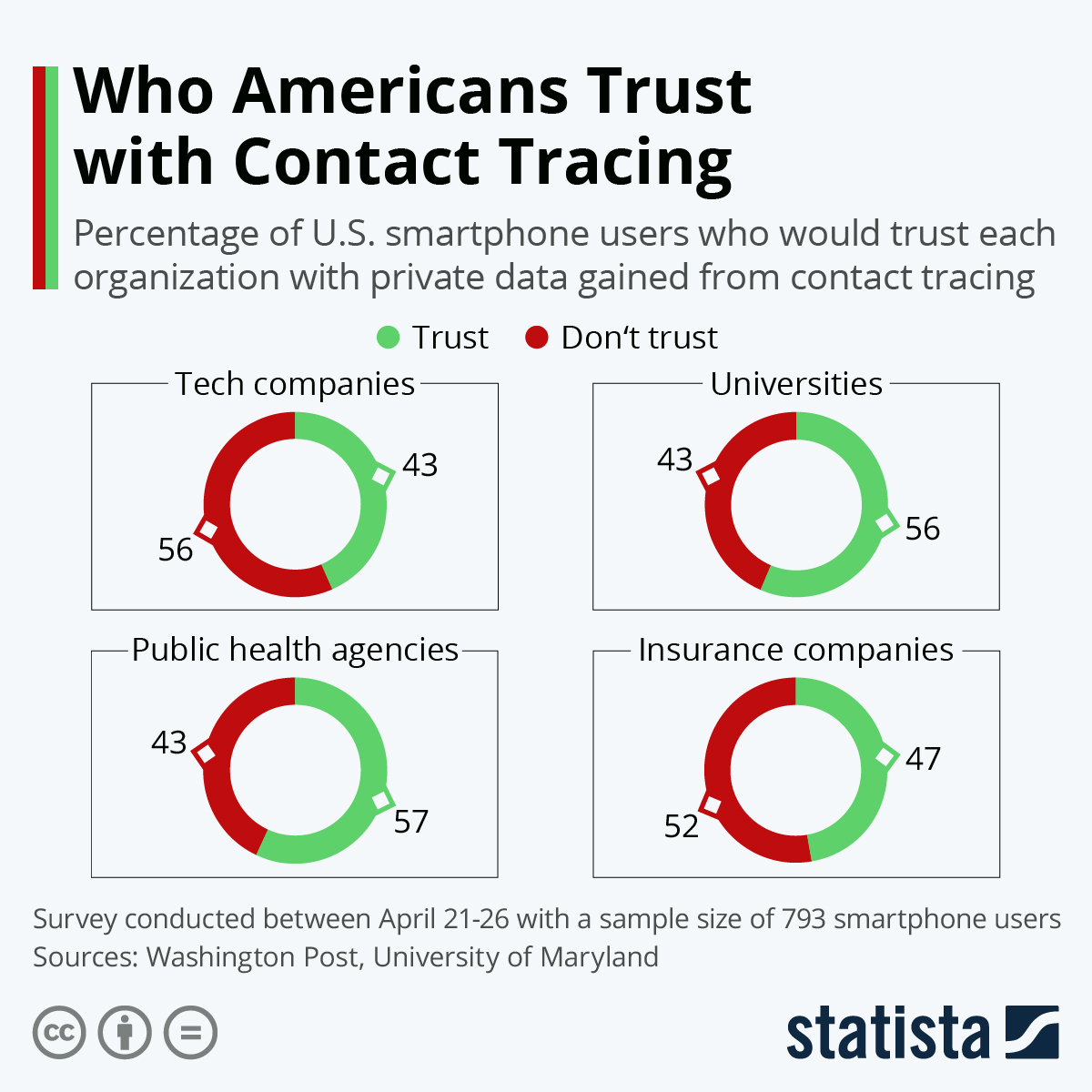
Majority Of Americans Don’t Trust Tech Companies With Contact-Tracing
With the idea of contact tracing as a plan to help re-open businesses and stop the spread of the COVID-19 virus, many Americans are skeptical about their privacy and how much data these tracing tools will collect on their lives.
Health insurance companies didn’t fare much better at 47 percent, while universities and public health agencies held a majority of trust with 56 percent and 57 percent, respectively.
As Statista’s Willen Roper notes,contact-tracing has been touted as one of the only plans that would allow people in the U.S. to begin re-opening measures without causing further outbreaks. Experts suggest around 60 percent of the population would need to participate in contact tracing in order to stop the spread of the virus. But in the same survey, only 50 percent of respondents said they would use a contact tracing app, with only 17 percent of those people saying they would definitely use it.
Many are weary of privacy concerns surrounding companies having access to location data and health records, despite Google and Apple creating strict privacy guidelines around their contact tracing tools. Encrypted data and a plethora of safeguards are said to exist within these contact tracing tools, but with large data breaches occurring almost annually with top tech companies, many are still cautious.
Because of the order, election officials for the first time tallied absentee ballots postmarked by Election Day, rather than just those received by then — underscoring the power of narrow court decisions to significantly shape which votes are counted.
Now, the Democratic Party is seeking to extend the Roberts Court’s latest ruling. (Yes, you read that right):
Democrats think they have secured a game-changing precedent from the Supreme Court’s 5-to-4 order. In the past week alone, lawsuits bankrolled by Democratic committees have been filed in four states seeking similar postmark rules and citing the Wisconsin opinion to bolster their argument. More cases are expected in the coming week….
Now, Democrats are citing the majority opinion in their latest round of litigation.
In addition to seeking postmarked-by standards, Democrats are aiming to secure free postage for ballots, ballot mailings to all registered voters and the right for third parties to collect ballots from voters, a controversial practice often called ballot harvesting.
“We’re saying, essentially, let’s take into account the pandemic. Let’s keep everybody safe,” said Eric H. Holder Jr., who served as attorney general in the Obama administration and heads a group that is financing new lawsuits in Texas and North Carolina.
May I speculate about another unanticipated consequences of RNC v. DNC? Interested parties will litigate to ensure the United States Postal Service postmarks more ballots. The Washington Post observed that some ballots were not postmarked at all:
Thousands of ballots were rejected because of postmark issues, The Post’s examination found. Hundreds were rejected because of a late postmark, but many hundreds more showed no postmark or an illegible one. In Milwaukee, that number was 390, and city election officials chose to count those ballots anyway. Most other localities discarded such ballots, even though many may have been posted on time.
Several election officials said that some post offices do not use postmarks with dates but that their hands were tied by the high court’s ruling.
In a statement, the U.S. Postal Service said its inspector general is conducting an investigation “regarding potential issues with absentee ballots in Wisconsin.”
Interested parties, I’m sure, will sue the USPS to ensure that ballots are postmarked properly. And what about illegible postmarks? Courts will have to decide how to assess the validity of various smeared postmarks. Say hello to the new hanging chads!
And what about election day? Interested parties routinely seek injunctions to keep polling locations open late. The usual rule: if you are in line, you can vote. Why not similar injunctions for post offices? Keep the postoffice, and the postmarks stamping till midnight, or later, to ensure late-delivered ballots are marked.
The Supreme Court may have unintentionally opened up a new frontier in election law.
And there are two unanswered questions in my mind. First, can a state court judge even issue an order to a federal postal official? McCulloch on the mind. Second, would a federal court have jurisdiction over state election law disputes?
Everyone, please think these issues through now, well before election day. You’re welcome.
from Latest – Reason.com https://ift.tt/2Stnuj6
via IFTTT
George W. Bush’s record in office became the subject of numerous tweets after a video message released Saturday from the former president elicited praise from some Democrats.
— George W. Bush Presidential Center (@TheBushCenter) May 2, 2020
In the video statement, shared on Twitter by the George W. Bush Presidential Center, Bush called on people to come together to face the “shared threat” of the coronavirus pandemic.
The former president said “we have faced times of testing before,” referencing the post 9/11 period when he said the nation rose “as one to grieve with the grieving” — a time period his administration rolled out its war on terror, which included a torture program.
Various progressive journalists pushed back, however, against those who appeared to be sanitizing Bush’s record and suggesting he was preferable to President Donald Trump.
Writing in 2018, Andy Worthington, investigative journalist and author of The Guantanamo Files, criticized…
“the bizarre propensity, on the part of those in the center and on the left of U.S. political life, to seek to rehabilitate the previous Republican president, George W. Bush.”
If you had told me four years ago that George W Bush would be a hero to Democrats I would have had you committed. This is absolute insanity. The man is a war criminal who also let thousands die during Katrina. https://t.co/6WunURPQzY
The nice little painter man who passed mints to Michelle Obama at a funeral is actually a mass murderer who belongs in front of a war crimes tribunal, not being praised for releasing web videos.
Worthington pointed to a Pew poll as Trump took office showing that 48% of American backed the use of torture in some circumstances, saying it was “a sign of the enduring power of the Bush administration’s bellicose pro-torture maneuverings in the wake of the 9/11 attacks.”
* * *
And Trump himself joined in the pile-on, but for different reasons.
.@PeteHegseth “Oh bye the way, I appreciate the message from former President Bush, but where was he during Impeachment calling for putting partisanship aside.” @foxandfriends He was nowhere to be found in speaking up against the greatest Hoax in American history!
Future Economy Class Cabins In Post-Corona World Could Look like This…
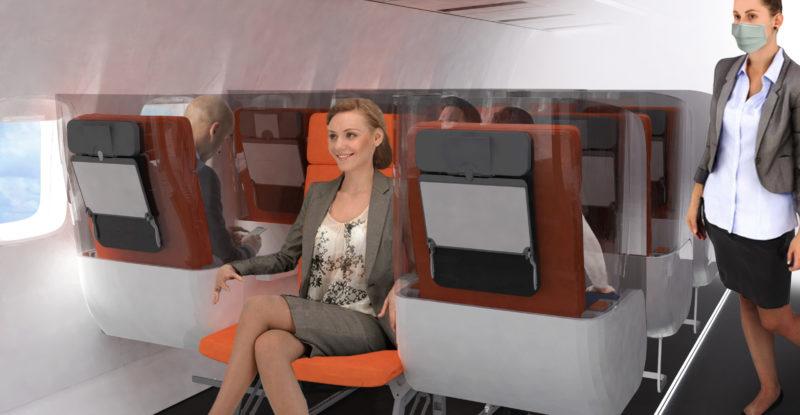
The future of economy class cabins on commercial jets could be reshaped because of the COVID-19 pandemic. New cabin seating arrangements have already been conceptualized by an Italian design firm this week that shows plastic shields and backward seats.
Aviointeriors has designed a “hygienic screen to cocoon passengers and keep them separate from their neighbors. Let’s take a look at Glassafe, a potential post-COVID-19 economy cabin modification,” reported Simple Flying.
Glassafe is a kit-level solution for airlines that can be installed on existing seats to make close passenger seating a reality while abiding by social distancing rules.
The company has also rolled out another concept. It is called Janus, a row of three seats where every middle seat is positioned backwards.
As shown in this view, Janus has a “wrap-around transparent barrier envelopes each passenger, providing a big plastic cocoon that protects from germs, bad breath, and fights for the armrest,” said Simple Flying.
The biggest challenge at the moment for major airlines is to make customers feel safe in a closed environment. And perhaps by restructuring the cabin with social distancing in mind, plastic shields and backwards seats could be the solution.
We noted on Friday morning that Ryanair CEO Michael O’Leary was unhappy with “idiotic” in-flight social distancing rules. He said Irish authorities forced his planes to eliminate the middle seat to comply with new regulations.
Perhaps O’Leary should give Aviointeriors a call about the Janus seating arrangement…