Global Stocks Tumble On Renewed US-China Tensions; US Airlines Plunge On Buffett Exit

Global Stocks Tumble On Renewed US-China Tensions; US Airlines Plunge On Buffett Exit

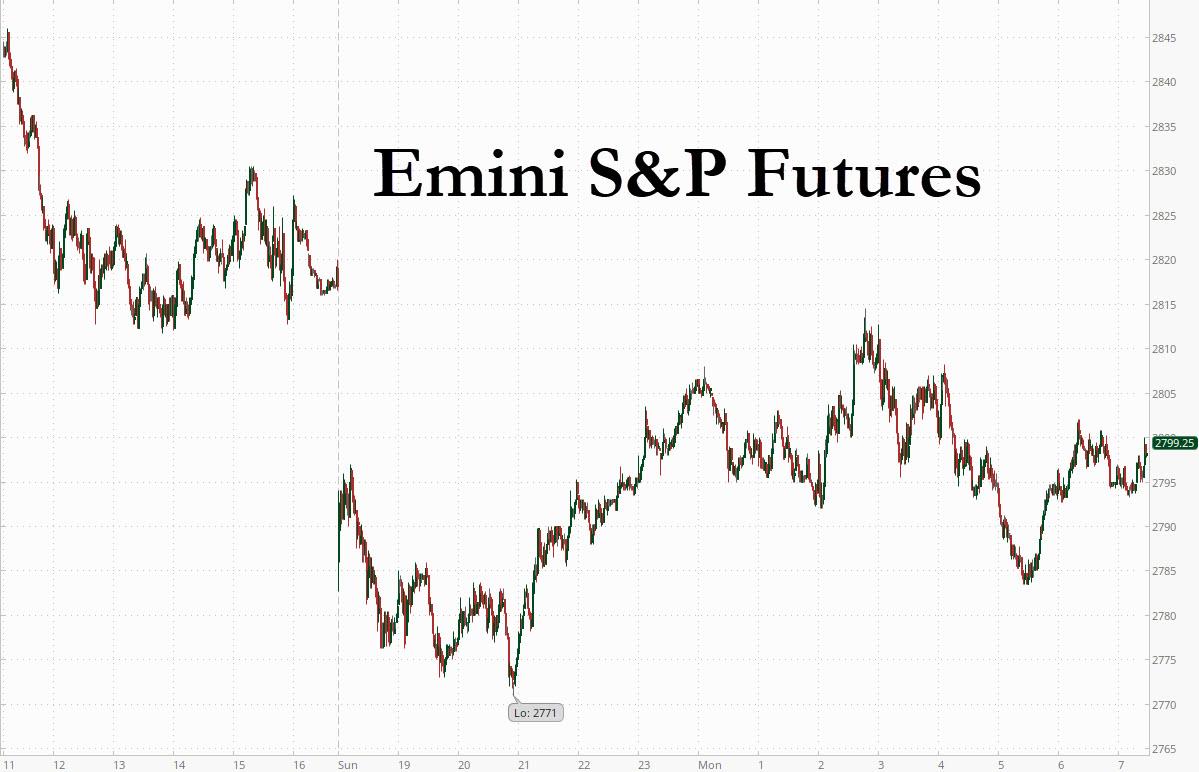
US equity futures, European stock markets and oil prices all fell on Monday as an escalating war of words between top U.S. officials and China over the origin of the coronavirus fuelled fears of a new trade war, derailing a rebound in global markets, while Buffett’s admission he had liquidated all his airline stocks sent the sector tumbling.

European shares – which were closed on Friday – slumped 2.5% in mid-morning trading, catching up to the Friday drop in the US with sectors sensitive to economic growth including oil and gas, automakers and banks falling between about 4% and 5.5%. Volatility gauges for European and American blue-chip stocks shot up to a two-week high while U.S. stock futures were about 1% in the red.
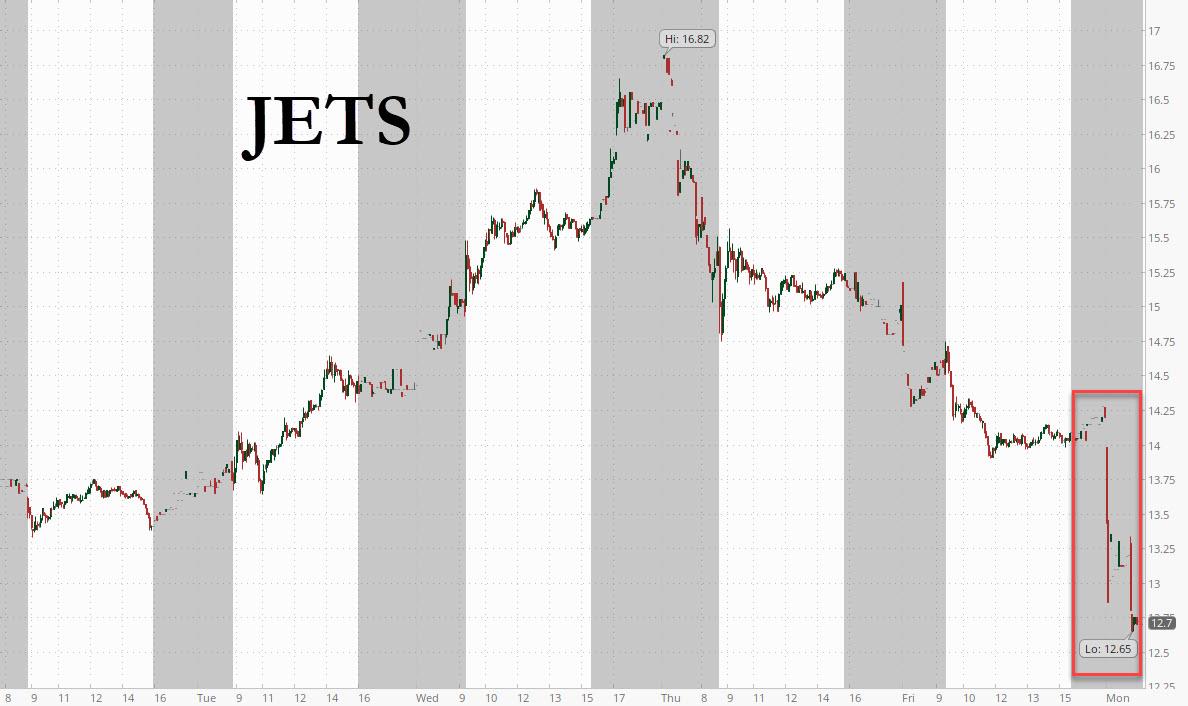
Delta Air Lines, American Airlines Group and United Airlines Holdings are among the biggest pre-market decliners after Warren Buffett said over the weekend Berkshire Hathaway sold out of the four top U.S. airlines, opining that the business has “changed in a very major way.”  The JETS airline ETF tumbled -10%.
In Europe, the Stoxx Europe 600 slumped, with all 19 industry sectors in the red and Ireland’s Ryanair Holdings Plc sinking as much as 11%. Earlier, MSCI’s broadest index of Asia-Pacific shares outside Japan fell 2.5%, pulled down by Hong Kong where the Hang Seng returned from a two-session holiday with its biggest drop in six weeks as traders caught up after a long weekend. China and Japan were closed for their own holidays. The Chinese yuan held most of Friday’s slide in offshore trading amid concern tensions with the U.S. would increase.

Emerging-market stocks suffered the biggest decline in six weeks as an increase intension between the U.S. and China dented demand for riskier assets.

U.S. Secretary of State Mike Pompeo said on Sunday there was “a significant amount of evidence” that the novel coronavirus emerged from a laboratory in the central Chinese city of Wuhan. An editorial in China’s Global Times said he was “bluffing” and called on the United States to present its evidence.

“Concern on the potential for another flare up between the U.S. and China is dominating price action,” RBC strategist Adam Cole said in a morning note. Simon Black, head of investment management at wealth management firm Dolfin said investors were also adjusting their forecasts for the depth of the economic damage the pandemic will inflict. “It’s also the economic reality sinking in,” he said, adding that a rebound by global equities of over 20% from lows hit in March was not likely to be sustainable.

President Donald Trump also renewed criticism of China for its handling of the coronavirus outbreak is raising concern over the future of the two countries’ trade deal, another potential risk for emerging markets already facing dwindling demand for exports.

This renews concerns on the trade war and the hegemonic dispute between the two countries, which we have been expecting to last for many months and to be a structural factor for EMs in the long run,” said Guillaume Tresca, a senior strategist at Credit Agricole SA in Paris. “Attention is now refocusing on the economic impact of the Covid crisis and the weak stance of many emerging-market countries.”

Elsewhere, companies listed on the pan-European STOXX 600 are currently expected to report a 40% decline in earnings in the second quarter. Manufacturing activity in the euro zone collapsed last month as government-imposed lockdowns to stop the spread of the new coronavirus forced factories to close and consumers to stay at home, a survey showed on Monday.

“We’ve just come off a rally of hopes, not a rally on fundamentals”, Black said, pointing to the massive monetary and fiscal stimulus pledged by governments and central banks around the world.

Recent economic data paints a dire picture of the global economy after weeks of lockdowns. In the United States, manufacturing plunged to an 11-year low last month and consumer spending collapsed. Some 30.3 million Americans have filed unemployment claims.

In FX, the US dollar rose against most major currencies amid fears that last year’s U.S.-China dispute would be reignited, this time over the origins of the pandemic that has stalled economies around the world. The euro was down 0.37% at $1.0933 and the pound retreated 0.72% to $1.2407.  EM currencies weakened, while sovereign bond yields were little changed. The Russian ruble, Indonesian rupiah and South Korean won led the currency declines as haven demand bolstered the U.S. dollar. With China’s onshore markets closed for a holiday, the yuan weakened as much as 0.3% against the dollar in offshore trading, before regaining ground.

In commodities, oil prices fell again, paring last week’s gains, on worries a global oil glut may persist even as lockdowns start to ease. West Texas Intermediate crude futures fell 5.5% to $18.69 a barrel while Brent crude futures were down 2.8% at $25.70. Spot gold was up 0.4% at $1,706.78 per ounce.

Expected data include factory orders and durable goods orders. Ferrari, Tyson, and AIG are among companies reporting earnings

Market Snapshot

  • S&P 500 futures down 1% to 2,794.00
  • STOXX Europe 600 down 2.5% to 329.09
  • MXAP down 1.6% to 142.99
  • MXAPJ down 2.6% to 459.62
  • Nikkei down 2.8% to 19,619.35
  • Topix down 2.2% to 1,431.26
  • Hang Seng Index down 4.2% to 23,613.80
  • Shanghai Composite up 1.3% to 2,860.08
  • Sensex down 5.6% to 31,835.04
  • Australia S&P/ASX 200 up 1.4% to 5,319.85
  • Kospi down 2.7% to 1,895.37
  • German 10Y yield rose 1.7 bps to -0.569%
  • Euro down 0.4% to $1.0938
  • Italian 10Y yield rose 0.6 bps to 1.589%
  • Spanish 10Y yield rose 6.1 bps to 0.784%
  • Brent futures down 2.7% to $25.72/bbl
  • Gold spot up 0.3% to $1,705.39
  • U.S. Dollar Index up 0.3% to 99.35

Top Overnight News from Bloomberg

  • A recovery from Europe’s factory shutdowns will be “frustratingly slow,” IHS Markit said in its monthly report. Markit’s index showed confidence dropped to a record low in April, and job cuts were the sharpest since 2009. The headline measure of euro-area activity fell to 33.4 — the lowest since the series began in 1997 — from 44.5 in March
  • The trade agreement President Donald Trump signed with China less than four months ago is falling short on a number of fronts, including Beijing’s promises of large agriculture and energy purchases. But the Trump administration so far has been hesitant to ramp up the pressure or back away from the deal altogether, even as the rhetoric on both sides heats up
  • Congress turns its attention this week to negotiations over another round of economic stimulus, with battle lines drawn over more than $1 trillion in additional spending floated by Democrats amid objections from Republicans and demands from President Donald Trump
  • Germany needs several more weeks to decide on a cash-for- clunkers program to counter a slump in car sales, according to Finance Minister Olaf Scholz
  • German’s top court will decide on Tuesday whether the nation can continue to participate in the ECB’s Public Sector Purchase Program, under which the central bank buys bonds of euro zone governments
  • Factory output across several Asian countries slumped to record lows in April, signaling a deeper contraction in the world’s manufacturing hub even as China begins restarting some operations
  • Japanese Prime Minister Shinzo Abe said he has decided to extend a nationwide state of emergency until May 31 to combat the spread of the coronavirus, in comments aired live by national broadcaster NHK
  • Researchers continue to debate how fast a coronavirus vaccine may be available as states and nations look for a fast track to recovery from the pandemic’s economic toll, with January or even the fall now on the timetable

Asian equity markets began the week mostly lower amid several holiday closures in the region and cautiousness ahead of this week’s risk events, with sentiment also dragged by a flare up at the inter-Korean border and as US-China trade tensions simmered with President Trump stating that tariffs would be the ultimate punishment for China and warned to end the trade deal if China doesn’t buy US goods. ASX 200 (+1.4%) was choppy with notable weakness in energy as crude prices resumed the rout brought on by oversupply concerns and with banking names initially pressured after Westpac reported a 62% drop in H1 net, although the big 4 bank eventually reversed its losses which helped the turnaround in the largest weighted financials sector and the index as a whole. KOSPI (-2.6%) gapped lower by over 2% at the open on geopolitical concerns after South Korea and North Korea exchanged gunfire at the demilitarized zone for the first time since 2014 which comes a day after North Korea Leader Kim made his first public appearance since rumours circulated that he may have died or was incapacitated, although the index is off its lows as reports also noted there were no casualties from the incident which could have been accidental. Hang Seng  (-4.2%) slumped as it played catch up from the extended weekend and ahead of today’s GDP which could show the largest contraction on record with Financial Services Secretary Chan suggesting GDP data could be worse than the GFC and Asian Financial Crisis which saw economic contractions of 7.8% and 8.3% respectively. The lack of participants added to the uninspired mood for Hong Kong and the region, with markets in mainland China to reopen on Wednesday due to Labor Day holidays and with Japanese participants returning on Thursday after Golden Week. Finally, Indian markets were the worst performers with the NIFTY and SENSEX both collapsing by as much as 5% after the government extended the nationwide lockdown for two weeks but will permit “considerable relaxations” in certain districts.

Top Asian News

  • Mainland Chinese Buyers Disappear From Hong Kong Real Estate
  • Japan Moves to Extend State of Emergency Until May 31
  • Time Runs Out on Shaky Hong Kong Businesses as Court Reopens

European equities opened with significant losses [Euro Stoxx 50 -3.3%], as the region catches up to Friday’s developments, namely on the US-China trade front, after its Labor Day holiday. US equity futures also post losses of ~1%, with the contracts pressured by a potential rollback in the US-China Phase One trade deal should China not adhere to purchases. UK’s FTSE 100 (-0.2%) index outperforms the region having had its Friday session whilst some downside could be cushioned by a softer Sterling. Sectors are lower across the board – with IT and Consumer Discretionary the laggards, albeit most of this overall downside would be on account of a chunk of Europe catching up to Friday’s trade. In terms of individual movers, BT (-1.4%) opened softer (but nursed some losses) amid reports Telefonica (+3.4%) is said to be in discussions with Liberty Global to combine their UK assets, O2 and Virgin Media, in a joint venture to challenge BT and Sky in the UK – Telefonica states that the Cos are in a negotiating phase and the group is currently not able to guarantee either the terms or probability of its success. Sources added that Liberty Global also reportedly approached Vodafone (-1.1%) regarding a merger, but talks are not currently active. Meanwhile, Fincantieri (+15.8%) was halted limit up after receiving a US Navy contract valued at USD 5.5bln. SocGen (-6.2%) shares see extra pressure as it expects to have provisions of EUR 3.5-5bln this year amid losses caused by the pandemic. CEO also sees CET1 ratio to drop to between 11-15%. Similarly, Thyssenkrupp (-14.5%) plumbs the depths as the Co. anticipates a cash-squeeze despite the lift unit sale. Elsewhere, Roche (+0.3%) remains resilient to the losses in the region after the group was awarded emergency approval in the US for a COVID-19 antibody test and expects production to hit high double-digit millions by June and 100mln later in the year. Finally, Royal Mail (+6.2%) is buoyed by reports that Czech billionaire Kretinsky reportedly bought a 5.35% stake in the Co., sparking speculation he could launch a takeover bid.

Top European News

  • ThyssenKrupp Sinks as Unit Bidders Said to Seek More Investors
  • Liberty, Telefonica in Talks to Build $30 Billion U.K. Arm
  • European Stocks Slump on New U.S.-China Tensions, Manufacturing
  • Germany’s New Cases, Number Of Deaths at Lowest in Five Weeks

In FX, the Greenback is back on a firmer footing after succumbing to somewhat more than the usual month end selling and remaining under pressure on Friday when US President Trump upped the ante against China via recriminations over the source of COVID-19 and the threat of retaliation. However, risk aversion has spread to the extent that the Buck has resumed a degree of safe-haven premium vs currency counterparts bar the Yen, with the DXY retaining a firmer grasp of the 99.000 handle within a 99.239-477 range.

  • JPY – As noted above, the Yen is resisting the broad trend of underperformance relative to the recovering Dollar, albeit in holiday-thinned trade due to Japan’s Greenery Day amidst the longer Golden Week vacation, as Usd/Jpy meanders in a tight band below 107.00.
  • GBP/EUR/CHF/NZD/CAD/AUD – Sterling has lost more of its seasonal bid, as the sell in May trend looks set to continue for a second day with Cable teetering above 1.2400 and Eur/Gbp testing resistance/psychological offers around 0.8800 ahead of the 50 DMA (0.8825) even though the Euro is struggling to keep hold of the 1.0900 handle vs the Greenback in wake of weak Eurozone manufacturing PMIs, ECB SPF downgrades and a worse than forecast Sentix survey. Technically, Eur/Usd is currently close to a Fib retracement at 1.0938 and supported ahead of the big figure that also coincides with the 30 DMA. Elsewhere, the Franc remains well shy of recent highs near 0.9600 circa 0.9650, but on the rebound in Eur/Chf cross terms around 1.0550 following mixed Swiss inputs from yet another big rise in bank sight deposits and better than expected, albeit still sub-50 manufacturing PMI. Meanwhile, the Kiwi, Aussie and Loonie are all nursing losses after conceding ground to their US rival with Nzd/Usd hovering just under 0.6050, Aud/Usd straddling 0.6400 and Usd/Cad pivoting 1.4100 amidst renewed declines in oil prices. The Kiwi has not gleaned much from S&P reaffirming NZ’s AA rating and positive outlook or more moves towards lifting lockdown, awaiting Q1 jobs data, while the Aussie appears hesitant ahead of the RBA, retail sales and the SOMP.
  • SCANDI/EM – The aforementioned downturn in crude is weighing on the Norwegian Crown alongside the ongoing PMI manufacturing contraction, though not as pronounced as in Sweden where the Krona is also unwinding more post-Riksbank gains. However, the Rand has derived some comfort from SA’s PMI beating consensus and deflecting attention away from bleak economic projections out of the Treasury Director, while the Lira is trying to pare losses off another multi-month low on the back of firmer than anticipated Turkish CPI in contrast to a deeper sub-50 manufacturing PMI.

In commodities, WTI and Brent front-month futures remain subdued but trade just off recent lows of USD 18.05/bbl and USD 25.50/bbl respectively. Desks note that the sentiment surrounding the complex is showing signs of improvement, with economies gradually reopening alongside a phase of lower global supply. “A combination of demand edging higher as we move through the remainder of the year, while supply is expected to slip, will likely push the global oil market into deficit over the second half of this year, allowing it to draw down the significant stock builds from the first half of this year.”, ING writes. That being said, markets have begun to factor in a potential escalation in US-China tensions – with President Trump floating an end to the trade pact should China not purchase US goods – which could weigh on sentiment as well as hit demand. WTI June lost further ground after hovering around USD 18.50/bbl and briefly breached support at USD 18.10/bbl, Brent July trades on either side of USD 26/bbl for a large part of the morning and holds onto losses of over 2%. Elsewhere, spot gold sees an underlying bid as losses across equities prompts inflows into the yellow metal – trading towards the top of its current USD 1693-1707/oz band. Copper prices meanwhile resumed its decline amid the broader risk-aversion and some producers are poised to resume operations.

US Event Calendar

  • 10am: Factory Orders, est. -9.35%, prior 0.0%; Factory Orders Ex Trans, prior -0.9%
  • 10am: Durable Goods Orders, est. -14.4%, prior -14.4%; Durables Ex Transportation, est. -0.2%, prior -0.2%
  • 10am: Cap Goods Orders Nondef Ex Air, est. 0.1%, prior 0.1%; Cap Goods Ship Nondef Ex Air, prior -0.2%

DB’s Jim Reid concludes the overnight wrap

So far in this lockdown I’ve only been out for local walks. However, on Friday afternoon I had to cycle to the post office to send something special delivery. While I queued outside I saw my first-ever social distancing fight. A van overtook two cyclists and then screeched to a halt in front of them and the two parties exchanged very loud and angry words about an earlier commotion. After a minute, the van driver got out and went up to one of the cyclists and for all the world it looked like he was going to hit him. However, he suddenly stopped about 2 meters away as if there was a force field there (May the fourth be with you today by the way) and continued shouting and gesturing at him. It was very odd to watch.

As we move very slowly towards the end of the most stringent lockdowns across the world markets are starting the week on the back foot after US tech gave up some ground at the back end of last week after earnings and also as tensions in the US/China relationship resurfaced as the blame game for covid-19 steps up. Given it’s a US election year this issue isn’t likely to go away, especially as Joe Biden has suggested that Mr Trump is weak on China. However, on Thursday night and Friday it became a more immediate topic as the Washington Post reported that the US had held preliminary discussions to punish China for its role in the virus outbreak that included the possibility of the US cancelling its debt obligations with China. There was an immediate denial from Larry Kudlow who confirmed that the full faith and credit of US debt obligations is ‘sacrosanct’. Nevertheless, the risk of a cold war between the two nations seems to be building.

Hinting at a more troubled world order in the future, yesterday US Secretary of State Michael Pompeo said on ABC TV that there was “enormous evidence” to suggest covid-19 began in a laboratory in Wuhan. When you think how nervous markets got about the US/China trade war then if this theme continues you can’t help thinking that the end game is far worse than it would be from a simple trade war. Very much one to watch.

Speaking overnight, President Trump also said tariffs would be “the ultimate punishment” and promised a “conclusive” report from the US government on the Chinese origins of the pandemic. He further said that the Phase 1 trade deal with China requires the country to purchase US goods and if they don’t, the US will terminate the agreement. Futures on the S&P 500 are down -0.61% as we type while the Hang Seng (-3.83%), Kospi (-1.61%), Taiwan’s Taiex (-2.20%) and India’s Nifty (-3.31%) are all in the red. Markets in Japan and China are closed for a holiday. In FX, the Norwegian krone is trading down -1.17% this morning while the Japanese yen is up +0.13%. Elsewhere, WTI oil prices are down -3.29% this morning.

In other weekend news, Saudi Arabia’s Tadawul index dropped -7.41% yesterday after the kingdom’s finance minister said that “painful” measures – including deep spending cuts – were needed to respond to the coronavirus crisis and crash in oil prices. On Friday, Moody’s changed the outlook on the country’s sovereign rating to negative while reaffirming the A1 rating. Elsewhere, Yohnap reported that North Korean troops fired at their South Korean counterparts in the demilitarized zone that divides the two countries for the first time in years.

Meanwhile, expect there to be some attention in markets today on Warren Buffett’s annual shareholder meeting on Saturday where he confirmed that he’d sold all of his airline stocks, saying “I don’t know if two or three years from now if as many people will fly as many passenger miles as they did last year”.

Returning to the virus, with the extra fatalities of the last few days, Covid-19 has now moved from 24th to 23rd in the worst pandemics in history measured in fatalities as a percentage of the global population (24 in total over 2000 years). Swine Flu in 2009 has now been surpassed. You can see the note here from a couple of weeks ago where we discussed the list. To reach 22 on this list fatalities would have to reach 626,100. Massive global mitigation is expected to keep Covid-19 at the lower end of our table. As we showed in the note a completely unmitigated global strategy could have put it as high as 13th on the list. We also showed what we think the global mortality rate will end up being based on various studies and discussed how the modern world has a very different tolerance for pandemics than at any time prior to the last few decades.

In terms of this week, the main symbolic highlight will be Friday’s US job numbers. We’ll also see PMIs in the early part of this week, 263 S&P 500 and Stoxx 600 companies reporting, more central bank meetings (including the BoE Thursday), and another Euro Area finance minister’s videoconference. If you want a potential black swan curveball event then the German Constitutional Court issues its final verdict on the ECB’s PSPP program tomorrow. What I know about the German constitutional legal system could be put on the back of a postage stamp and still leave some room. Nevertheless, the usual form here is a begrudging acceptance of the ECB’s involvement in financing member states and we all move on. However, one to keep a little attention on.

Ahead of payrolls Friday, DB’s US economists are forecasting an unprecedented -22m fall in nonfarm payrolls, which would by far be the biggest monthly decline in the data going back to 1939, with the previous record being ‘only’ a -1.959m decline back in September 1945 just as WWII ended. They’re also forecasting a rise in the unemployment rate to 18.0%, which would be the highest unemployment rate for the US since the same war. With the jobless numbers set to reach unprecedented levels, investors will also be paying attention to the more up-to-date weekly initial jobless claims from the US on Thursday, which will cover the week up to May 2. The previous 6 weeks have seen a total of over 30m claims, though the last 4 weeks in a row have seen a decline from the peak, offering hope that the most rapid period of job losses may have passed.

The other data that will gain attention this week are the PMI releases from around the world. Thanks to various public holidays, the releases will be more scattered this week, with PMIs from various G20 countries coming out each day. See the day-by-day calendar at the end for the full run down (along with all the other releases) but today sees the manufacturing numbers from those on Labour Day holiday on Friday.

Earnings season continues apace over the coming week, with 159 S&P 500 companies reporting and a further 104 in the STOXX 600. Highlights include AIG and Tyson Foods today, followed by Disney, Total, BNP Paribas and Fiat Chrysler tomorrow. Wednesday then sees reports from Novo Nordisk, PayPal, TMobile, General Motors, Credit Agricole, UniCredit and BMW. On Thursday, we’ll hear from Bristol Myers Squibb, Danaher, Raytheon Technologies, Linde, ArcelorMittal, AB InBev, Nintendo, Uber, IAG and Air France-KLM. Lastly on Friday, Wirecard, Siemens and Nomura will be announcing.

Reviewing last week now and in it we waved goodbye to April – the best month for the S&P 500 (+12.68%) since January 1987. The -2.81% fall on Friday though meant that the index closed the week down -0.21%, the smallest weekly in either direction since the first week of the year. There was a pullback in technology stocks as earnings of large-cap US companies, most notably Apple and Amazon, disappointed late in the week. Consequently the NASDAQ fell -0.34% on the week (-3.20% Friday). On the other hand, European equities rose on a shortened week, with many countries closed for Labour Day on Friday. The Stoxx 600 gained +2.37% over the five days but they’ll likely be some catch down today. Equity performance was fairly correlated on the week for those indices that were off on Friday, with the DAX up +5.08% (-2.22% Thursday), the Italian FTSE MIB gaining +4.93% (-2.09% Thursday), and the CAC rallying +4.07% (-2.12% Thursday). The FTSE, which was open on Friday, was up just +0.19% over the full week, after the -2.34% decline on Friday not helped by Shell (-14.24% on the week) cutting its dividend for the first time since 1945. Asian equity indices also saw shortened weeks outside of the Nikkei, which declined by -2.84% Friday to finish the week up +1.86%. The CSI 300 gained +3.04% on a 4 day week, while the Kospi rose +3.10% on a 3 day week. In other risk markets, oil rebounded after 3 weeks of losses. WTI futures rose +16.77% last week (+4.99% Friday) to $19.78/barrel as demand may be turning a corner at the same time that OPEC+ and non-members both enact production cuts. Brent crude rose +23.32% on the week (+4.63% Friday), just the second weekly gain in the last ten weeks.

55% of S&P 500 companies have now reported Q1 earnings. In aggregate earnings are missing by -2.5% (vs. beating by 3.4% in an average quarter) and have fallen 16.6% year-over-year. Blended EPS growth for the index looks set to contract by -13%, which would be the worst quarter since 2009. However this is driven by a large downside skew, with median company growth on track to be only modestly negative at -0.9%. Much like GDP earlier last week, these numbers are likely to be worse in Q2 because most of the shutdowns were enacted at the end of March.

With the pullback in US equities, the VIX rose +1.3pts to 37.19 last week (+3.0pts Friday). This was the first weekly rise since the SPX lows in the third week of March. Even as equity volatility increased slightly, credit spreads tightened slightly on the week – albeit complicated by the index rebalancing at the end of the month. US HY cash spreads were -33bps tighter on the week (+7bps Friday), while IG was -18bps tighter on the week (+1bp Friday). In Europe, HY cash spreads were -8bps tighter over the shortened week, while IG was -13bps tighter.

Much like equities, core sovereign bond yields in the US and Europe diverged slightly last week. US 10yr Treasury yields were up +1.1bps (-2.8bps Friday) to finish at 0.612%, 7.1bps from the March all-time lows. Meanwhile, 10yr Bund yields fell -11.3bps to -0.59%, the lowest since March 13. Gilt yields fell -4.3 bps over the 5 days (+1.8 bps Friday) to 0.248%, just 9bps from the all-time lows in early March. Euro debt diverged in a similar manner. Spanish and French sovereign debt were -11.6 and -2.0 bps tighter, respectively, to Bunds, while Italian debt traded +3.7bps wider after the decision by Fitch to downgrade the country’s credit rating to BBB- and an ECB meeting that disappointed on OMT guidance.

On the economic data front last Friday, UK mortgage approvals in March fell to their lowest level in seven years, while the final manufacturing PMI came in at 32.6, 0.3 below the flash reading. In the US, Markit Manufacturing PMIs were at 36.1 (36.7 expected), 0.8 below the flash reading of 36.9. At the same time the ISM Manufacturing PMI came in stronger than expected at 41.5 (36.0 expected), down from 49.1 last month. The ISM measures continue to see significant upside contribution from supplier delivery delays, but this is driven by supply chain disruption rather than stronger fundamentals. So difficult to read too much into this stronger reading.


Tyler Durden

Mon, 05/04/2020 – 07:59

via ZeroHedge News https://ift.tt/2z5nDm0 Tyler Durden
America Wasn’t Ready for Coronavirus

In many places in the U.S., it’s neither safe nor legal to conduct business right now due to the threat posed by the coronavirus pandemic (for more on this, see Editor in Chief Katherine Mangu-Ward’s “The Seen and the Unseen of COVID-19“). But the damage done by the virus has been made worse by an incompetent government response, impositions on people’s civil liberties, and an ongoing trade war with China. What follows is Reason‘s explanation of what went wrong and which rules, regulations, and parts of life people are getting the opportunity to rethink.

Red Tape Stymied Testing and Made the Coronavirus Pandemic Worse

Ronald Bailey

The United States is home to the most innovative biotech companies and university research laboratories in the world. That should have provided us with a huge advantage with respect to detecting and monitoring emerging cases of COVID-19 caused by the coronavirus pandemic. Public health officials had the opportunity to slow, if not contain, the outbreak: By tracing the contacts of diagnosed people and quarantining those who in turn tested positive, they could have severed the person-to-person chains of disease transmission.

South Korea demonstrates that such a campaign can work. While both countries detected their first cases of COVID-19 on January 20, the trajectories in the U.S. and South Korea have since sharply diverged. By the beginning of March, South Korea had “flattened the curve”—that is, substantially reduced the number of people being diagnosed each day with coronavirus infections—whereas the United States was still struggling to do so when this article went to press six weeks later.

South Korean health officials met on January 27 with private biomedical companies, urging them to develop coronavirus diagnostic tests and assuring them of speedy regulatory approval. The first commercial test was approved in that country a week later. South Korea’s now-famous drive-through testing sites were soon testing tens of thousands for the virus. By the first week in March, the country had tested more than 150,000 people, compared to just 2,150 in the United States. Testing and contact tracing helped daily diagnosed cases in South Korea peak at 909 on February 29.

In stark contrast, officials at the U.S. Food and Drug Administration (FDA) and the Centers for Disease Control and Prevention (CDC) stymied private and academic development of diagnostic tests. Much to the contrary, the CDC required that public health officials use only a diagnostic test designed by the agency. That test—released on February 5—turned out to be contaminated by a reagent that made it impossible for outside labs to tell if the virus was present in a sample or not. The CDC’s insistence on top-down centralized testing meant there were no available alternatives, which greatly slowed down disease detection just as the infection rate was accelerating.

This massive bureaucratic failure is a big part of why a larger proportion of Americans than of South Koreans will suffer and die from the viral illness.

On February 29, the FDA finally moved to allow academic labs and private companies to develop and deploy their own diagnostic tests. But in the meantime, the Trump administration had begun lying about the availability of tests. On March 2, FDA Commissioner Stephen Hahn declared that “by the end of this week, close to 1 million tests will be able to be performed.” During a tour of CDC headquarters on March 6, President Donald Trump asserted that “anyone who wants a test can get a test.” In fact, it took until the end of March for 1 million tests to be administered in the United States.

Once the FDA got out of the way, diagnostics companies LabCorp and Quest rolled out tests almost immediately. Many academic labs followed suit. Unfortunately, pent-up demand led to significant delays in reporting results.

By the end of March, companies such as Abbott Laboratories had introduced tests that report results in less than 15 minutes. But after four startups began offering at-home testing, promising to further improve access, an obstinate FDA shut them down.

The FDA has finally managed to smooth the way for private companies to begin introducing blood tests for antibodies to the virus produced by people’s immune systems. General population screening using these tests will reveal undetected cases, providing a better idea of the actual extent of the pandemic. The tests will also identify people who have recovered and probably can go safely back to their lives beyond quarantine.

In the absence of effective treatments for COVID-19, testing and contact tracing on a massive scale will be vital to restoring economic activity—assuming the epidemic is beaten back, in the meantime, by social distancing. But due to red tape, the coronavirus outbreak in the U.S. has turned out to be far more deadly than it could, and should, have been.


Beware ‘Temporary’ Emergency Restrictions on Liberty

Damon Root

State and local officials have taken sweeping emergency actions to combat the spread of COVID-19, including shelter-in-place orders, bans on large gatherings, and widespread business closures. Such measures may well fall under the traditional police powers of the states to regulate actions on behalf of public health, safety, and welfare. But even the most necessary of emergency actions may still pose a significant risk to liberty.

The U.S. experience during World War I offers a cautionary tale about how government restrictions passed in the heat of a national emergency can linger for years afterward—a lesson that must be quickly learned if we are to avoid repeating some grave mistakes in 2020.

When President Woodrow Wilson took the nation to war against Germany in 1917, he did so in the name of making the world safe for democracy. But the president also targeted certain enemies much closer to home. “There are citizens of the United States, I blush to admit,” Wilson said at the time, “who have poured the poison of disloyalty into the very arteries of our national life….The hand of our power should close over them at once.”

Seal Beach, California, on March 24

At Wilson’s urging, Congress passed the Espionage Act of 1917, a notorious law that effectively criminalized most forms of anti-war speech. Among those snared in its net was the left-wing leader Eugene Debs, who was arrested in 1918 and sentenced to 10 years in federal prison. His crime had been to exercise his First Amendment rights by giving a mildly anti-war speech at an afternoon picnic. In 1919, the same year that the U.S. government signed the peace treaty that formally ended World War I, the U.S. Supreme Court upheld Debs’ conviction for speaking out against the war. Debs would rot in federal prison until he was pardoned by President Warren G. Harding in 1921. As for the Espionage Act, while it has been amended several times over the years, it remains on the books.

State governments imposed various restrictions of their own. Nebraska’s legislature responded to America’s entry into the Great War by cracking down on the civil liberties of its German immigrant communities. Most notably, the state banned both public and private school teachers from instructing children in a foreign language. That law was aimed directly at the state’s extensive system of Lutheran parochial schools, where teachers and students commonly spoke German.

Robert Meyer, who taught the Bible in German at the Zion Evangelical Lutheran Parochial School, sued the state for violating his constitutional rights. But the Nebraska Supreme Court waved his objections away. “The salutary purpose of the statute is clear,” that court said. “The legislature had seen the baleful effects of permitting foreigners, who had taken residence in this country, to rear and educate their children in the language of their native land.”

The U.S. Supreme Court reversed that ruling in 1923. Thankfully, the rights of Meyer and others were ultimately restored. But the offending restriction was not eliminated until well after the war was over.

We should all be on guard to make sure that temporary COVID-19 restrictions—as necessary as they may be—remain temporary.


The Trade War Made Us Less Prepared To Handle This Crisis

Eric Boehm

President Donald Trump’s trade war with China has been costly for Americans—and the COVID-19 outbreak reveals that we might be paying with more than just our money.

What’s worse, the White House knew the risk it was running. “These products are essential to protecting health care providers and their patients every single day,” Matt Rowan, president of the Health Industry Distributors Association, told the Office of the U.S. Trade Representative in August 2018. At the time, the office was considering a wide-ranging set of new tariffs targeting hundreds of billions of dollars’ worth of annual imports from China. Among the products that would be hit with those higher duties were thermometers, breathing masks, hand sanitizer, patient monitors, and medical-grade personal protective equipment, including masks and sterile gloves. Those products “are a critical component of our nation’s response to public health emergencies,” Rowan warned.

Other medical professionals at the hearing similarly pleaded for the Trump administration to drop the proposed tariffs. Alternative suppliers could not be found quickly, they said, in no small part because Food and Drug Administration (FDA) approval was required before other sources could be used. The likely result of Trump’s proposed tariffs would be higher prices for medical gear and decreased availability of critical supplies.

The warnings went unheeded. The tariffs did what tariffs do.

In 2017, the last full year before Trump’s tariffs were imposed, more than a quarter of all medical equipment imported to the U.S. came from China. By 2019, imports of Chinese-made medical products had fallen by 16 percent, according to an analysis from the Peterson Institute for International Economics (PIIE), a trade-focused think tank. While U.S. imports from the rest of the world increased during the same period, according to PIIE, the increase was not sufficient to offset the tariff-induced decline in imports from China. It’s likely that hospitals drew down on existing inventories, hoping that the trade war would end before they had to restock.

“In many instances, Americans had no choice but to continue to buy from China, which meant paying an additional cost due to the tariff,” says Chad Bown, a senior fellow at the think tank. “Medical equipment cannot instantaneously sprout up at another plant in some other country.”

Trump’s so-called “phase one” trade deal with China, signed in December, did not lift tariffs on medical gear. But when the coronavirus outbreak reached America, the White House finally took action. On March 10, the administration quietly dropped its tariffs on Chinese-made medical equipment in a too-little, too-late effort to allow American hospitals to stock up as the coronavirus pandemic took hold. Later in the month, the White House announced it would postpone all other tariff payments for at least three months as a form of economic stimulus.

Together, those two actions are an admission of guilt. They demonstrate that the administration is well aware that tariffs are paid by Americans—and that they harmed America’s preparation for a pandemic. Trump’s reversals, says Bown, serve as “an implicit indictment of his administration’s own policy.”

Recall that officials were warned about exactly this possibility. Their hubris and economic illiteracy may well have led to the deaths of innocent Americans.

“It reveals the foolishness of the administration’s shoot-first-and-ask-questions-later approach” to the trade war, says Scott Lincicome, a trade lawyer and scholar with the Cato Institute. “There was clearly no thought given to how this would actually work in practice, and now you’re seeing the consequences.”


COVID-19 Makes the Case for Deregulation Everywhere You Look

Nick Gillespie

It didn’t take long after the coronavirus crisis began for the smart set to write off small-government types in articles with such snarky headlines as “There Are No Libertarians in a Pandemic.” By now, it seems more correct to believe there are only libertarians in a pandemic, including many public officials, who suddenly find themselves willing and able to waive all sorts of ostensibly important rules and procedures in the name of helping people out.

How else to explain the decision by the much-loathed and irrelevant-to-safety Transportation Security Administration (TSA) to allow family-sized jugs of hand sanitizer onto planes? The TSA isn’t going full Milton Friedman—it’s reminding visitors to its website “that all other liquids, gels and aerosols brought to a checkpoint continue to be allowed at the limit of 3.4 ounces or 100 milliliters carried in a one quart-size bag.” But it’s a start.

Something similar is going on in Massachusetts, a state well-known for high levels of regulation, including in the medical sector. Expecting a crush in health care needs due the coronavirus, Republican Gov. Charlie Baker has seen the light and agreed to streamline the Bay State’s recognition of “nurses and other medical professionals” who are registered in other parts of the United States, something that 34 states do on a regular basis.

As Walter Olson of the Cato Institute observes, that move “should help get medical professionals to where they are most needed, and it is one of many good ideas that should be kept on as policy after the pandemic emergency passes. After Superstorm Sandy in 2012, by contrast, when storm-ravaged ocean-side homeowners badly needed skilled labor to restore their premises to usable condition, local laws in places like Long Island forbade them to bring in skilled electricians even from other counties of New York, let alone other states.”

The group Americans for Tax Reform has published a list of more than 170 regulations that have been suspended in response to the current crisis: Secretary of Health and Human Services Alex Azar has waived certain laws in order to facilitate “telehealth,” or the use of videoconferencing and other technologies to allow doctors to see patients remotely; the Department of Education is making it easier for colleges and universities to move their classes online; cities are doing away with open-container restrictions and allowing home delivery of beer, wine, and spirits in places where it was previously prohibited; the Federal Emergency Management Agency belatedly permitted Puerto Rico and other U.S. territories to acquire personal protective equipment from sources outside the country; and on and on.

Fleetwood, Pennsylvania, on April 2

You can probably see where this is headed: If the policies above are worth tossing out in an emergency, maybe they ought to be sidelined during normal times too.

Situations like the 9/11 terrorist attacks and the coronavirus outbreak often open the door to naked power grabs whose terrible consequences stick around long after the events that inspired them. Governments rarely return power once they’ve amassed it. But if you listen carefully, you can hear them telling us which restrictions they realize can be safely tossed.

When the infection rates come down and life begins to get back to normal, it may be tempting just to go back to the way we were. Resist the temptation: Many of the rules we put up with every day are worth re-evaluating. And not only during an emergency.


The Coronavirus Stimulus Is a Crony Capitalist Dream

Elizabeth Nolan Brown

Crony capitalism triumphed as members of Congress voted in March on a massive COVID-19 response bill. The $2.3 trillion package was unanimously approved in the Senate before clearing the U.S. House of Representatives 419 to 6.

Getting the most attention in the new Coronavirus Aid, Relief, and Economic Security (CARES) Act is a stipulation that many Americans will be getting $1,200 apiece from Uncle Sam. People making less than $75,000 individually or $150,000 as a couple will receive the full amount, with prorated amounts available to single earners making up to $99,0000 and couples up to $198,000. Families with kids will get an additional $500 for every child 16 and under.

But the 880-page bill is also brimming with handouts for government-favored industries.

For airlines, the CARES Act includes a $25 billion grant plus $29 billion in loans and loan guarantees. Grant money is also available for agricultural companies, to the tune of $33.5 billion.

Government institutions—including some far removed from direct COVID-19 relief efforts—will also be getting cash infusions. For instance, the legislation includes $150 million for the National Endowment for the Arts and the National Endowment for the Humanities. The CARES Act also inexplicably provides $10.5 billion for the Department of Defense, though only $1.5 billion of that is directed at coronavirus-related National Guard deployment, and just $415 million is for vaccine and antiviral medicine research and development by the agency.

Rep. Justin Amash (I–Mich.), one of the few in Congress to vote against the CARES Act, rightly called it “corporate welfare” that “reflects government conceit. Only consumers, not politicians, can appropriately determine which companies deserve to succeed.”

Amash supports payments to individual Americans in this time of crisis but opposes the carve-outs for favored industries. If the federal government is going to spend $2 trillion, “then the best way to do it, by far, is a direct cash transfer that otherwise keeps government out of the way,” Amash tweeted.

The bill has been celebrated by many Democrats and Republicans as a measure to help working Americans and ordinary people in the face of the new coronavirus. But the corporatist bent means that ordinary people will be paying more in the long run for this “help.”

The total cost of the measure leaves every American “on the hook for over $6,000 in debt for these ‘investments,'” commented Libertarian Party Chairman Nicholas Sarwark on Twitter, “but it’s the businesses that will receive the rewards.” He called the measure a “socialist” bailout for “corporate cronies.”

Rep. Thomas Massie (R–Ky.) strikes a similar theme. “When we were attacked at Pearl Harbor, did we come up with a $2 trillion stimulus package, or did we declare a war on our enemies?” he asked. “We declared war on our enemies. Why have we not declared war on this virus? Why is our first instinct to make sure that the rich people get to keep all their riches?”


While Government Dithered, Private Companies and Philanthropists Swung Into Action

Scott Shackford

Microsoft founder and philanthropist Bill Gates saw the pandemic coming. In a February 28 New England Journal of Medicine article, he warned that “COVID-19 has started behaving a lot like the once-in-a-century pathogen we’ve been worried about.” He called for public health agencies across the board to take steps to slow the virus’s spread. He argued for the importance of accelerating work on treatments and vaccines.

At the same time, the U.S. Food and Drug Administration (FDA) was slowly—so very slowly—swinging into action. On February 4, the agency formally acknowledged the public emergency and agreed that the situation called for a quicker-than-usual response to entities seeking emergency approval for new COVID-19 diagnostic tests. Nevertheless, it took the FDA almost a whole month to provide guidance on exactly how laboratories and commercial companies could accelerate that process.

By then, private-sector leaders were already putting plans in motion. The first confirmed case of COVID-19 in the United States was in January in Washington state, where Gates’ philanthropic organization, the Bill and Melinda Gates Foundation, is based. On March 10, the Gates Foundation announced a partnership with MasterCard and Wellcome, a U.K.-based research charity, to commit $125 million to a “COVID-19 Therapeutics Accelerator” that hoped to speed up the response by “identifying, assessing, developing, and scaling-up treatments.” The private response would turn out to be critical. A group of Seattle doctors had already had to defy the U.S. Centers for Disease Control and Prevention in order to implement the tests that caught the virus’s arrival in America.

On the same day of the Gates Foundation announcement, the Kaiser Family Foundation, a nonprofit health policy think tank, put together a tracker showing how much private philanthropy was going into the worldwide response. The group calculated that at least $725 million had then been committed by private nonprofits, businesses, and foundations to aid in international relief efforts. Candid, a foundation that helps nonprofits and foundations connect to donors, calculated that $4.3 billion in grants had been funded by early April for coronavirus responses around the world.

Early on, much of the assistance was directed toward China. But as COVID-19 spread everywhere, so did private philanthropy and innovation. As hospitals and health providers ran out of face masks (thanks in part, again, to FDA regulations that made it hard to ramp up production in response to demand), businesses donated their unused stockpiles. Soon, the private sector was iterating novel solutions as well. Across the world, companies and crafters with access to 3D printers and sewing machines began designing and producing masks of their own.

The number of breathing devices at hospitals became one of the more dangerous chokepoints in the COVID-19 response, leading to rationing and difficult medical choices in areas with high concentrations of infections. Again, innovators went to work. In Italy, for example, volunteers reverse-engineered a respirator valve that was in short supply, began manufacturing it with a 3D printer, and donated a stock to local hospitals.

As the spread of COVID-19 shut down auto manufacturing in the United States, companies such as GM and Tesla stepped up to suggest repurposing some unused spaces in their plants to help produce more ventilators. While President Donald Trump was a big fan of this response, both logistical and bureaucratic barriers got in the way. Yet again, the FDA’s slow response was a problem. It wasn’t until March 23, when the FDA announced it was relaxing some guidelines that strictly regulated where, how, and with what materials ventilators could be manufactured, that this problem could even begin to be solved.

Meanwhile, the worldwide collapse of tourism due to the spread of COVID-19 left hotels and short-term rental services such as Airbnb bereft of customers. Some hotels near medical centers were converted into clinics. Others, like the Four Seasons Hotel in New York City, announced plans to let medical personnel responding to the pandemic stay there free of charge. Airbnb offered to waive its fees if its hosts would likewise volunteer to house medical personnel and aid workers responding to the crisis. The company claims to have gotten 20,000 such offers by the end of March.

Beyond the philanthropic response, the ability of citizens to abide by shelter-in-place or stay-at-home recommendations and continue to thrive is entirely due to private-sector responses. While some small restaurants have had to shut their doors, many others are surviving thanks to delivery services such as Grubhub, DoorDash, and Postmates. Mass runs on grocery stores cleared shelves of staples, but within a week America’s truck drivers and warehouse workers had gone into overdrive to get things back to a certain level of normalcy. There continued to be shortages of some goods, but even amid a deadly pandemic, almost no one had to worry about starving. For those stuck without companionship, Pornhub even offered one-month premium subscriptions for free.

The colossal response from the private sector most certainly helped make it possible for greater numbers of people to work from home, spend less time interacting with others, and “flatten the curve” to reduce the spread of COVID-19. While the government was still trying to figure out its messaging and untangle its bureaucracy, countless individuals, businesses, and community groups were quickly adapting to solve problems on the ground.

from Latest – Reason.com https://ift.tt/2ys1Tkd
via IFTTT

America Wasn’t Ready for Coronavirus

In many places in the U.S., it’s neither safe nor legal to conduct business right now due to the threat posed by the coronavirus pandemic (for more on this, see Editor in Chief Katherine Mangu-Ward’s “The Seen and the Unseen of COVID-19“). But the damage done by the virus has been made worse by an incompetent government response, impositions on people’s civil liberties, and an ongoing trade war with China. What follows is Reason‘s explanation of what went wrong and which rules, regulations, and parts of life people are getting the opportunity to rethink.

Red Tape Stymied Testing and Made the Coronavirus Pandemic Worse

Ronald Bailey

The United States is home to the most innovative biotech companies and university research laboratories in the world. That should have provided us with a huge advantage with respect to detecting and monitoring emerging cases of COVID-19 caused by the coronavirus pandemic. Public health officials had the opportunity to slow, if not contain, the outbreak: By tracing the contacts of diagnosed people and quarantining those who in turn tested positive, they could have severed the person-to-person chains of disease transmission.

South Korea demonstrates that such a campaign can work. While both countries detected their first cases of COVID-19 on January 20, the trajectories in the U.S. and South Korea have since sharply diverged. By the beginning of March, South Korea had “flattened the curve”—that is, substantially reduced the number of people being diagnosed each day with coronavirus infections—whereas the United States was still struggling to do so when this article went to press six weeks later.

South Korean health officials met on January 27 with private biomedical companies, urging them to develop coronavirus diagnostic tests and assuring them of speedy regulatory approval. The first commercial test was approved in that country a week later. South Korea’s now-famous drive-through testing sites were soon testing tens of thousands for the virus. By the first week in March, the country had tested more than 150,000 people, compared to just 2,150 in the United States. Testing and contact tracing helped daily diagnosed cases in South Korea peak at 909 on February 29.

In stark contrast, officials at the U.S. Food and Drug Administration (FDA) and the Centers for Disease Control and Prevention (CDC) stymied private and academic development of diagnostic tests. Much to the contrary, the CDC required that public health officials use only a diagnostic test designed by the agency. That test—released on February 5—turned out to be contaminated by a reagent that made it impossible for outside labs to tell if the virus was present in a sample or not. The CDC’s insistence on top-down centralized testing meant there were no available alternatives, which greatly slowed down disease detection just as the infection rate was accelerating.

This massive bureaucratic failure is a big part of why a larger proportion of Americans than of South Koreans will suffer and die from the viral illness.

On February 29, the FDA finally moved to allow academic labs and private companies to develop and deploy their own diagnostic tests. But in the meantime, the Trump administration had begun lying about the availability of tests. On March 2, FDA Commissioner Stephen Hahn declared that “by the end of this week, close to 1 million tests will be able to be performed.” During a tour of CDC headquarters on March 6, President Donald Trump asserted that “anyone who wants a test can get a test.” In fact, it took until the end of March for 1 million tests to be administered in the United States.

Once the FDA got out of the way, diagnostics companies LabCorp and Quest rolled out tests almost immediately. Many academic labs followed suit. Unfortunately, pent-up demand led to significant delays in reporting results.

By the end of March, companies such as Abbott Laboratories had introduced tests that report results in less than 15 minutes. But after four startups began offering at-home testing, promising to further improve access, an obstinate FDA shut them down.

The FDA has finally managed to smooth the way for private companies to begin introducing blood tests for antibodies to the virus produced by people’s immune systems. General population screening using these tests will reveal undetected cases, providing a better idea of the actual extent of the pandemic. The tests will also identify people who have recovered and probably can go safely back to their lives beyond quarantine.

In the absence of effective treatments for COVID-19, testing and contact tracing on a massive scale will be vital to restoring economic activity—assuming the epidemic is beaten back, in the meantime, by social distancing. But due to red tape, the coronavirus outbreak in the U.S. has turned out to be far more deadly than it could, and should, have been.


Beware ‘Temporary’ Emergency Restrictions on Liberty

Damon Root

State and local officials have taken sweeping emergency actions to combat the spread of COVID-19, including shelter-in-place orders, bans on large gatherings, and widespread business closures. Such measures may well fall under the traditional police powers of the states to regulate actions on behalf of public health, safety, and welfare. But even the most necessary of emergency actions may still pose a significant risk to liberty.

The U.S. experience during World War I offers a cautionary tale about how government restrictions passed in the heat of a national emergency can linger for years afterward—a lesson that must be quickly learned if we are to avoid repeating some grave mistakes in 2020.

When President Woodrow Wilson took the nation to war against Germany in 1917, he did so in the name of making the world safe for democracy. But the president also targeted certain enemies much closer to home. “There are citizens of the United States, I blush to admit,” Wilson said at the time, “who have poured the poison of disloyalty into the very arteries of our national life….The hand of our power should close over them at once.”

Seal Beach, California, on March 24

At Wilson’s urging, Congress passed the Espionage Act of 1917, a notorious law that effectively criminalized most forms of anti-war speech. Among those snared in its net was the left-wing leader Eugene Debs, who was arrested in 1918 and sentenced to 10 years in federal prison. His crime had been to exercise his First Amendment rights by giving a mildly anti-war speech at an afternoon picnic. In 1919, the same year that the U.S. government signed the peace treaty that formally ended World War I, the U.S. Supreme Court upheld Debs’ conviction for speaking out against the war. Debs would rot in federal prison until he was pardoned by President Warren G. Harding in 1921. As for the Espionage Act, while it has been amended several times over the years, it remains on the books.

State governments imposed various restrictions of their own. Nebraska’s legislature responded to America’s entry into the Great War by cracking down on the civil liberties of its German immigrant communities. Most notably, the state banned both public and private school teachers from instructing children in a foreign language. That law was aimed directly at the state’s extensive system of Lutheran parochial schools, where teachers and students commonly spoke German.

Robert Meyer, who taught the Bible in German at the Zion Evangelical Lutheran Parochial School, sued the state for violating his constitutional rights. But the Nebraska Supreme Court waved his objections away. “The salutary purpose of the statute is clear,” that court said. “The legislature had seen the baleful effects of permitting foreigners, who had taken residence in this country, to rear and educate their children in the language of their native land.”

The U.S. Supreme Court reversed that ruling in 1923. Thankfully, the rights of Meyer and others were ultimately restored. But the offending restriction was not eliminated until well after the war was over.

We should all be on guard to make sure that temporary COVID-19 restrictions—as necessary as they may be—remain temporary.


The Trade War Made Us Less Prepared To Handle This Crisis

Eric Boehm

President Donald Trump’s trade war with China has been costly for Americans—and the COVID-19 outbreak reveals that we might be paying with more than just our money.

What’s worse, the White House knew the risk it was running. “These products are essential to protecting health care providers and their patients every single day,” Matt Rowan, president of the Health Industry Distributors Association, told the Office of the U.S. Trade Representative in August 2018. At the time, the office was considering a wide-ranging set of new tariffs targeting hundreds of billions of dollars’ worth of annual imports from China. Among the products that would be hit with those higher duties were thermometers, breathing masks, hand sanitizer, patient monitors, and medical-grade personal protective equipment, including masks and sterile gloves. Those products “are a critical component of our nation’s response to public health emergencies,” Rowan warned.

Other medical professionals at the hearing similarly pleaded for the Trump administration to drop the proposed tariffs. Alternative suppliers could not be found quickly, they said, in no small part because Food and Drug Administration (FDA) approval was required before other sources could be used. The likely result of Trump’s proposed tariffs would be higher prices for medical gear and decreased availability of critical supplies.

The warnings went unheeded. The tariffs did what tariffs do.

In 2017, the last full year before Trump’s tariffs were imposed, more than a quarter of all medical equipment imported to the U.S. came from China. By 2019, imports of Chinese-made medical products had fallen by 16 percent, according to an analysis from the Peterson Institute for International Economics (PIIE), a trade-focused think tank. While U.S. imports from the rest of the world increased during the same period, according to PIIE, the increase was not sufficient to offset the tariff-induced decline in imports from China. It’s likely that hospitals drew down on existing inventories, hoping that the trade war would end before they had to restock.

“In many instances, Americans had no choice but to continue to buy from China, which meant paying an additional cost due to the tariff,” says Chad Bown, a senior fellow at the think tank. “Medical equipment cannot instantaneously sprout up at another plant in some other country.”

Trump’s so-called “phase one” trade deal with China, signed in December, did not lift tariffs on medical gear. But when the coronavirus outbreak reached America, the White House finally took action. On March 10, the administration quietly dropped its tariffs on Chinese-made medical equipment in a too-little, too-late effort to allow American hospitals to stock up as the coronavirus pandemic took hold. Later in the month, the White House announced it would postpone all other tariff payments for at least three months as a form of economic stimulus.

Together, those two actions are an admission of guilt. They demonstrate that the administration is well aware that tariffs are paid by Americans—and that they harmed America’s preparation for a pandemic. Trump’s reversals, says Bown, serve as “an implicit indictment of his administration’s own policy.”

Recall that officials were warned about exactly this possibility. Their hubris and economic illiteracy may well have led to the deaths of innocent Americans.

“It reveals the foolishness of the administration’s shoot-first-and-ask-questions-later approach” to the trade war, says Scott Lincicome, a trade lawyer and scholar with the Cato Institute. “There was clearly no thought given to how this would actually work in practice, and now you’re seeing the consequences.”


COVID-19 Makes the Case for Deregulation Everywhere You Look

Nick Gillespie

It didn’t take long after the coronavirus crisis began for the smart set to write off small-government types in articles with such snarky headlines as “There Are No Libertarians in a Pandemic.” By now, it seems more correct to believe there are only libertarians in a pandemic, including many public officials, who suddenly find themselves willing and able to waive all sorts of ostensibly important rules and procedures in the name of helping people out.

How else to explain the decision by the much-loathed and irrelevant-to-safety Transportation Security Administration (TSA) to allow family-sized jugs of hand sanitizer onto planes? The TSA isn’t going full Milton Friedman—it’s reminding visitors to its website “that all other liquids, gels and aerosols brought to a checkpoint continue to be allowed at the limit of 3.4 ounces or 100 milliliters carried in a one quart-size bag.” But it’s a start.

Something similar is going on in Massachusetts, a state well-known for high levels of regulation, including in the medical sector. Expecting a crush in health care needs due the coronavirus, Republican Gov. Charlie Baker has seen the light and agreed to streamline the Bay State’s recognition of “nurses and other medical professionals” who are registered in other parts of the United States, something that 34 states do on a regular basis.

As Walter Olson of the Cato Institute observes, that move “should help get medical professionals to where they are most needed, and it is one of many good ideas that should be kept on as policy after the pandemic emergency passes. After Superstorm Sandy in 2012, by contrast, when storm-ravaged ocean-side homeowners badly needed skilled labor to restore their premises to usable condition, local laws in places like Long Island forbade them to bring in skilled electricians even from other counties of New York, let alone other states.”

The group Americans for Tax Reform has published a list of more than 170 regulations that have been suspended in response to the current crisis: Secretary of Health and Human Services Alex Azar has waived certain laws in order to facilitate “telehealth,” or the use of videoconferencing and other technologies to allow doctors to see patients remotely; the Department of Education is making it easier for colleges and universities to move their classes online; cities are doing away with open-container restrictions and allowing home delivery of beer, wine, and spirits in places where it was previously prohibited; the Federal Emergency Management Agency belatedly permitted Puerto Rico and other U.S. territories to acquire personal protective equipment from sources outside the country; and on and on.

Fleetwood, Pennsylvania, on April 2

You can probably see where this is headed: If the policies above are worth tossing out in an emergency, maybe they ought to be sidelined during normal times too.

Situations like the 9/11 terrorist attacks and the coronavirus outbreak often open the door to naked power grabs whose terrible consequences stick around long after the events that inspired them. Governments rarely return power once they’ve amassed it. But if you listen carefully, you can hear them telling us which restrictions they realize can be safely tossed.

When the infection rates come down and life begins to get back to normal, it may be tempting just to go back to the way we were. Resist the temptation: Many of the rules we put up with every day are worth re-evaluating. And not only during an emergency.


The Coronavirus Stimulus Is a Crony Capitalist Dream

Elizabeth Nolan Brown

Crony capitalism triumphed as members of Congress voted in March on a massive COVID-19 response bill. The $2.3 trillion package was unanimously approved in the Senate before clearing the U.S. House of Representatives 419 to 6.

Getting the most attention in the new Coronavirus Aid, Relief, and Economic Security (CARES) Act is a stipulation that many Americans will be getting $1,200 apiece from Uncle Sam. People making less than $75,000 individually or $150,000 as a couple will receive the full amount, with prorated amounts available to single earners making up to $99,0000 and couples up to $198,000. Families with kids will get an additional $500 for every child 16 and under.

But the 880-page bill is also brimming with handouts for government-favored industries.

For airlines, the CARES Act includes a $25 billion grant plus $29 billion in loans and loan guarantees. Grant money is also available for agricultural companies, to the tune of $33.5 billion.

Government institutions—including some far removed from direct COVID-19 relief efforts—will also be getting cash infusions. For instance, the legislation includes $150 million for the National Endowment for the Arts and the National Endowment for the Humanities. The CARES Act also inexplicably provides $10.5 billion for the Department of Defense, though only $1.5 billion of that is directed at coronavirus-related National Guard deployment, and just $415 million is for vaccine and antiviral medicine research and development by the agency.

Rep. Justin Amash (I–Mich.), one of the few in Congress to vote against the CARES Act, rightly called it “corporate welfare” that “reflects government conceit. Only consumers, not politicians, can appropriately determine which companies deserve to succeed.”

Amash supports payments to individual Americans in this time of crisis but opposes the carve-outs for favored industries. If the federal government is going to spend $2 trillion, “then the best way to do it, by far, is a direct cash transfer that otherwise keeps government out of the way,” Amash tweeted.

The bill has been celebrated by many Democrats and Republicans as a measure to help working Americans and ordinary people in the face of the new coronavirus. But the corporatist bent means that ordinary people will be paying more in the long run for this “help.”

The total cost of the measure leaves every American “on the hook for over $6,000 in debt for these ‘investments,'” commented Libertarian Party Chairman Nicholas Sarwark on Twitter, “but it’s the businesses that will receive the rewards.” He called the measure a “socialist” bailout for “corporate cronies.”

Rep. Thomas Massie (R–Ky.) strikes a similar theme. “When we were attacked at Pearl Harbor, did we come up with a $2 trillion stimulus package, or did we declare a war on our enemies?” he asked. “We declared war on our enemies. Why have we not declared war on this virus? Why is our first instinct to make sure that the rich people get to keep all their riches?”


While Government Dithered, Private Companies and Philanthropists Swung Into Action

Scott Shackford

Microsoft founder and philanthropist Bill Gates saw the pandemic coming. In a February 28 New England Journal of Medicine article, he warned that “COVID-19 has started behaving a lot like the once-in-a-century pathogen we’ve been worried about.” He called for public health agencies across the board to take steps to slow the virus’s spread. He argued for the importance of accelerating work on treatments and vaccines.

At the same time, the U.S. Food and Drug Administration (FDA) was slowly—so very slowly—swinging into action. On February 4, the agency formally acknowledged the public emergency and agreed that the situation called for a quicker-than-usual response to entities seeking emergency approval for new COVID-19 diagnostic tests. Nevertheless, it took the FDA almost a whole month to provide guidance on exactly how laboratories and commercial companies could accelerate that process.

By then, private-sector leaders were already putting plans in motion. The first confirmed case of COVID-19 in the United States was in January in Washington state, where Gates’ philanthropic organization, the Bill and Melinda Gates Foundation, is based. On March 10, the Gates Foundation announced a partnership with MasterCard and Wellcome, a U.K.-based research charity, to commit $125 million to a “COVID-19 Therapeutics Accelerator” that hoped to speed up the response by “identifying, assessing, developing, and scaling-up treatments.” The private response would turn out to be critical. A group of Seattle doctors had already had to defy the U.S. Centers for Disease Control and Prevention in order to implement the tests that caught the virus’s arrival in America.

On the same day of the Gates Foundation announcement, the Kaiser Family Foundation, a nonprofit health policy think tank, put together a tracker showing how much private philanthropy was going into the worldwide response. The group calculated that at least $725 million had then been committed by private nonprofits, businesses, and foundations to aid in international relief efforts. Candid, a foundation that helps nonprofits and foundations connect to donors, calculated that $4.3 billion in grants had been funded by early April for coronavirus responses around the world.

Early on, much of the assistance was directed toward China. But as COVID-19 spread everywhere, so did private philanthropy and innovation. As hospitals and health providers ran out of face masks (thanks in part, again, to FDA regulations that made it hard to ramp up production in response to demand), businesses donated their unused stockpiles. Soon, the private sector was iterating novel solutions as well. Across the world, companies and crafters with access to 3D printers and sewing machines began designing and producing masks of their own.

The number of breathing devices at hospitals became one of the more dangerous chokepoints in the COVID-19 response, leading to rationing and difficult medical choices in areas with high concentrations of infections. Again, innovators went to work. In Italy, for example, volunteers reverse-engineered a respirator valve that was in short supply, began manufacturing it with a 3D printer, and donated a stock to local hospitals.

As the spread of COVID-19 shut down auto manufacturing in the United States, companies such as GM and Tesla stepped up to suggest repurposing some unused spaces in their plants to help produce more ventilators. While President Donald Trump was a big fan of this response, both logistical and bureaucratic barriers got in the way. Yet again, the FDA’s slow response was a problem. It wasn’t until March 23, when the FDA announced it was relaxing some guidelines that strictly regulated where, how, and with what materials ventilators could be manufactured, that this problem could even begin to be solved.

Meanwhile, the worldwide collapse of tourism due to the spread of COVID-19 left hotels and short-term rental services such as Airbnb bereft of customers. Some hotels near medical centers were converted into clinics. Others, like the Four Seasons Hotel in New York City, announced plans to let medical personnel responding to the pandemic stay there free of charge. Airbnb offered to waive its fees if its hosts would likewise volunteer to house medical personnel and aid workers responding to the crisis. The company claims to have gotten 20,000 such offers by the end of March.

Beyond the philanthropic response, the ability of citizens to abide by shelter-in-place or stay-at-home recommendations and continue to thrive is entirely due to private-sector responses. While some small restaurants have had to shut their doors, many others are surviving thanks to delivery services such as Grubhub, DoorDash, and Postmates. Mass runs on grocery stores cleared shelves of staples, but within a week America’s truck drivers and warehouse workers had gone into overdrive to get things back to a certain level of normalcy. There continued to be shortages of some goods, but even amid a deadly pandemic, almost no one had to worry about starving. For those stuck without companionship, Pornhub even offered one-month premium subscriptions for free.

The colossal response from the private sector most certainly helped make it possible for greater numbers of people to work from home, spend less time interacting with others, and “flatten the curve” to reduce the spread of COVID-19. While the government was still trying to figure out its messaging and untangle its bureaucracy, countless individuals, businesses, and community groups were quickly adapting to solve problems on the ground.

from Latest – Reason.com https://ift.tt/2ys1Tkd
via IFTTT

What American Life Will Look Like After The Corona-Crisis Ends

What American Life Will Look Like After The Corona-Crisis Ends

Authored by Kristin Tate, op-ed via The Hill,

A new age is dawning on our nation. For all of the major events of history, the engines of our economy and functions of our government have been upended by an invisible enemy. The death toll of our long lasting conflict in Vietnam has already been eclipsed, and markets are reacting with more fear than in 2008. This novel disease has had more impact on the average American than the largest stories of the last two decades, including wars in the Middle East, Sept. 11 and the real estate crash.

Cutting across ethnic, income and geographic lines, the coronavirus has disrupted American life well beyond any government edict by states or by Washington.

Most of the changes to our society that have emerged during the last two months have been negative. The massive shifts caused by the pandemic have acted as a mirror for wider underlying trends.

Look at the demise of local businesses. For years, the political mantra has been to support Main Street over Wall Street. However, social distancing and the internet have harmed small businesses. The National Federation of Independent Business reported that its optimism index fell in March by the sharpest rate since the survey started. Consumer spending also fell by around 18 percent over the first quarter, despite the shutdown restrictions happening in only the second half of March. The brick-and-mortar model is not only running independent stores into the risk of default but also could decimate many of the 1,100 malls all across the country.

In place of traditional shopping, online sales are the topic of the day. Amazon has seen an unprecedented boom thanks to the crisis. Online grocery sales have nearly doubled, while spending on video games has increased by 50 percent. Total online sales have increased 49 percent since the pandemic started. Physical sales outside of food have been heaviest in alcohol sales, increasing by a whopping 75 percent.

The housing market has shifted dramatically as well. One third of renters missed their payments last month, and things do not look any better for homebuyers. Lenders expect 15 million homeowners will default on their mortgage payments. Despite low interest rates, young families will likely not want to lock themselves into 30-year mortgages if their job prospects are unstable. The same goes for commercial real estate because the lack of consumer spending shorts businesses that must pay rent.

Our norms of social interaction are changing, even beyond wearing masks and gloves when venturing to the supermarket. Customary handshaking may become a thing of the past. A recent survey revealed that 31 percent of people said they do not plan to shake hands with others after the pandemic has passed. The elbow bump may be here to stay.

As Americans are glued to all the news on the coronavirus, our habits have also accelerated shifts in both radio and television, along with the demise of print media. National cable networks are bringing in additional viewers and scoring enormous prime-time numbers. The same goes for local news but with a major asterisk. Local news viewing is up 50 percent since the crisis started; however, advertising revenues have cratered.

The same cannot be said of newspapers, as dozens of publications fire hundreds of reporters and even suspend print altogether. One estimate has called the wave an “extinction-level event” for print journalism. The decline of commuting has also led to a sharp decrease in revenues and listenership for radio stations. For a public disgusted with national media, local newspapers and radio stations are now the closest thing to trusted media, but both these news elements may soon evaporate.

More directly related to the coronavirus, Americans are now taking their health more seriously. Increased demand for prescriptions and a shortage of raw medical materials from China have taken their toll. Drug costs have risen while the drug companies are pouring billions of dollars into several potential treatments and vaccines. The result has yet to be seen but may represent a profound shift toward the permanent increase in private and public investment in drug research and development. For the most part, these are not trends that Americans would like to embrace. Instead, they are elements of a new reality that we are forced to confront.

Americans have been far less affected by strife in recent generations. For many, this crisis has been a rude awakening — an age of true austerity with government control, swinging prices and the possible rationing of health care all part of our potential future. Hopefully, a combination of effective therapeutics and reopening the economy will offer us a chance to avoid a global depression. Much like the generation born after World War I was shaped by that conflict and the Spanish flu, hardening Americans to take on the Great Depression and World War II, here is the anvil on which the strength of our young people today will be tested or broken.

For the millions of Americans out of work and hundreds of thousands of shuttered small businesses, every day of this pandemic is an never-ending nightmare. But for all of our current struggles, there is an opportunity for each of us to persevere. Only our actions will show how we will ultimately define this period. We must not let the coronavirus define us.


Tyler Durden

Mon, 05/04/2020 – 06:00

via ZeroHedge News https://ift.tt/2W1xbY9 Tyler Durden

Global IPO Activity “Has Collapsed” Amid Market Turmoil

Global IPO Activity “Has Collapsed” Amid Market Turmoil

Several months ago (at the start of March), we pointed out how capital markets were becoming dislocated, credit markets were freezing, and economic paralysis was unfolding across the world as the pandemic worsened. This all resulted in a deep freeze of the global IPO market that continues to be lifeless even at the start of May. 

JPMorgan’s Cross-Asset Strategy desk, headed by John Normand, published a note on Friday titled “The role of alternative assets post COVID-19,” which states explicitly that global “M&A and IPO activity has collapsed” around the world, “as it always does in a recession.” 

Normand describes a “post COVID-19 environment” where “higher cost of funding plus more challenging IPO markets facing financial sponsors:” 

“The post COVID-19 environment diminishes the appeal of most Alternatives over the next year, but it could strengthen the medium-term thesis for some. The cyclical negative for parts of the complex like Private Equity and Credit is the earnings and default risk created by a deep recession, and the higher cost of funding plus more challenging IPO markets facing financial sponsors (chart 7). Parts of Real Estate (commercial property) and Infrastructure (ports, airports) also deserve a rethink as corporates reassess their location strategy and government restrictions plus individual preferences alter travel demand. But as in public markets, these challenges are somewhat offset by better entry levels for those with a Value tilt. By contrast, this cyclical environment could prove more profitable for hedge fund styles with a flexible mandates, which could explain why some styles like Macro ones have generated stable returns during recessions and stronger ones thereafter.” 

Normand adds color to the global economic crisis, stating the current recession is a “hybrid of natural disaster and leverage problem:” 

“Our view has been that the current recession is a hybrid of natural disaster and leverage problem (mainly in US corporates from their high level of debt, poor credit quality and falling margins pre-shock). Thus it is appropriate to expect a massive, initial growth surge in H2, at least an 18- month-long process to return to the prior level of growth, and disinflation into a new lower range on global core CPI. That environment can still support many asset prices under certain conditions at various points in the cycle: DM Credit because it is cheap and has a central bank backstop; DM Equites as earnings normalize and low bond yields underpin high multiples; EM Equities now for the region first out of the COVID-19 shock (Asia), and later for others; and Equity sectors and styles that are endgame winners in an environment that prioritizes resilience though technology, public health and less leverage (Tech, Comms, Healthcare, Quality).” 

In a separate report by Renaissance Capital, they noted the 2020 US IPO market just experienced its slowest March and April in nearly a decade, “as volatility essentially shut the IPO window.” It said only seven IPOs were seen in the last 60 days, a 70% plunge from the 15-year average of 23 IPOs. 

h/t Renaissance Capital

Since mid-March, the Emini S&P500 climbed a staggering 37% in 27 sessions on central bank liquidity and hopes the virus crisis has abated. However, a near 5% decline in the last several sessions could suggest another equity rout is ahead

Furter selling would pressure equity voltlity higher, leaving IPO markets in the US and across the world shut even longer. Will 2020 be a lost year? 


Tyler Durden

Mon, 05/04/2020 – 05:30

via ZeroHedge News https://ift.tt/3dd7tpn Tyler Durden

J. Crew Files For Bankruptcy As Covid Chaos Crushes Retailers

J. Crew Files For Bankruptcy As Covid Chaos Crushes Retailers

Update (May 4): J.Crew Group, Inc. filed for bankruptcy protection on Monday morning, unable to revive sales during the pandemic as much of the retail brick and mortar industry has been crushed by lockdowns. 

The New York-based clothing chain saw its parent company, Chinos Holdings, file for relief under Chapter 11 of the U.S. Bankruptcy Code in the U.S. Bankruptcy Court for the Eastern District of Virginia. As part of the reorganization, top creditors will seize control of the company by converting $1.65 billion of its debt into equity. The company secured $400 million in new financing from existing lenders, including Anchorage Capital Group, L.L.C., G.S.O. Capital Partners, and Davidson Kempner Capital Management L.P., among others. 

The reorganization will allow the company to “restructure its debt and deleverage its balance sheet, positioning J.Crew and Madewell for long-term success,” the company said in a press release. 

“This agreement with our lenders represents a critical milestone in the ongoing process to transform our business,” Jan Singer, J. Crew’s chief executive, said in a statement.

“Throughout this process, we will continue to provide our customers with the exceptional merchandise and service they expect from us, and we will continue all day-to-day operations, albeit under these extraordinary COVID-19-related circumstances. As we look to reopen our stores as quickly and safely as possible, this comprehensive financial restructuring should enable our business and brands to thrive for years to come,” Singer said. 

The pandemic has been absolutely disastrous for the retail industry. J.Crew was already suffering before lockdowns went into effect in early March. The company nearly avoided default in 2017, with a financial restructuring that shielded its Madewell brand from creditors.

Retailers have furloughed employees and shuttered stores as lockdowns have swept across the country. A March filing showed the company had 182 J. Crew stores, 140 Madewell stores, and 170 factory stores. 

J. Crew is not the only retailer on the brink. We suspect more bankruptcies could be seen this year.

* * *

Apparel company J. Crew may file for bankruptcy as soon as this weekend, according to CNBC, which notes that the privately held company is scrambling to secure $400 million in financing to fund operations after filing.

CNBC‘s sources, which spoke on condition of anonymity due to the disclosure of confidential information, say the plans are not yet finalized, and that the timing of the filing could change.

The New York-based retailer had already been struggling under a heavy debt load and sales challenges, as it suffered criticism that it fell out of touch with its once-loyal customers. In the past few years, the brand lost both its longtime design chief, Jenna Lyons, and famed retail executive Mickey Drexler.

Those challenges have been exacerbated by the coronavirus pandemic that has forced stores to shutter, throwing the retail industry into a state of disarray. –CNBC

The company currently operates 182 J. Crew retail stores and 140 Madewell stores aimed at a younger demographic, which was launched four years ago in the hopes of spinning it off in an IPO which could have helped surmount its crippling debt. The company faced pushback from creditors.

J Crew stunned Wall Street when it swung to a profit of $1.5 million for the fiscal year ended Feb. 1, compared with a $74.4 million loss a year earlier. Total revenues increased 2% to $2.54 billion, though gains were largely driven by the company’s Madewell denim-focused brand, while sales at J Crew have mostly languished.

According to Moody’s, J. Crew had roughly $2.5 billion in sales for its year ending Feb. 1, and an estimated $93 million in total liquidity as 2021 debt maturities approach. In 2011, the company was acquired by TPG Capital and Leonard Green & Partners for $3 billion.

The preppy retailers now-former CEO and longtime creative engine Mickey Drexler stepped aside in 2017 follow a debt swap that staved off a bankruptcy filing, and although his successors have at least managed to wring more growth out of Madewell, the leverage buyout that took the company private more than ten years ago left it with more debt than it can reasonably manage: A nearly $1.7 billion albatross.

Like every other US retailer, J Crew shut its stores in March along with most of its competitors. Sales have plunged, though some see green shoots in some preliminary foot-traffic data.

The company has laid off tens of thousands of workers, and it’s unclear how many of its stores will be operational when all of this is over.

When it became clear in March that the Madewell IPO wasn’t going to happen, J Crew started negotiating with a group of lenders as it scrambled to find capital to pay off a loan maturing later in 2020.

The company, which has been working with advisers from investment bank Lazard and law firm Weil Gotshal & Manges, has a $4 million payment due at the end of April which it says it cannot make.

The company restructured its debt outside of bankruptcy in 2017 in a controversial deal that swapped $500 million of bonds due in 2019 for new securities backed by the intellectual property behind the J.Crew brand. Its lenders include Anchorage Capital Group LLC and Blackstone Group Inc.’s GSO Capital Partners LP.

The company, which was founded in the early 1980s as a catalog retailer, has long been synonymous with the preppy look in the US.

Of course, this is just the latest bad news for the commercial real estate market and, by extension, the CMBX market which has already been battered by the crisis, making one newly minted Florida billionaire even richer.

While J Crew is more of a specialized retailer, mall anchor tenants – Neiman Marcus, JC Penny –  have been hit especially hard by the outbreak, as malls are transformed into ghost towns as whether or not they can reopen after the crisis will depend entirely on the government. Neiman Marcus is reportedly also in the process of finalizing talks with lenders to allow its stores to continue operating as it prepares a bankruptcy filing. And JC Penney, which is also reportedly preparing to file, is in talks for $1 billion in bankruptcy financing.

But as one twitter wit joked, the company might want to consider updating its website.


Tyler Durden

Mon, 05/04/2020 – 05:29

via ZeroHedge News https://ift.tt/2xlUCSv Tyler Durden

Is Sweden’s COVID-19 Handling A Failure Or A Success?

Is Sweden’s COVID-19 Handling A Failure Or A Success?

Authored by Mike Shedlock via MishTalk,

Sweden did not have a hard lockdown like its neighbors although people were advised to work from home when possible. It also banned nursing home visits on April 7.

Sweden says its model worked, but Numbers Suggest a Different Story.

Sweden’s Covid-19 deaths per capita are 3 to 6 times its Nordic neighbors.

Nordic Country Restrictions

Sweden vs Nordic Neighbor Deaths 

On a per capita basis, Sweden’s Covid-19 deaths are 3 to 5.5 times the other Nordic countries.

Sweden has just over 3 times the death rate of Denmark. But note Denmark’s population density disadvantage of 138:25.

Success or Failure?

Success is in the eyes of the beholder. 

A death rate 5.5x is acceptable to some but not others. 

But Sweden has a ton of pressure to under-report Covid deaths. I would be shocked if they didn’t.

Regardless, one can easily look at this data, ignore the undercounts (perhaps even factor some in), and conclude Sweden did the right thing. 

But how does that translate to the US?

Population Density of NYC

For comparison purposes, the Population Density of New York City is 26,403 people per square mile (10,194/km²), makes it the densest of any American municipality with a population above 100,000.

Manhattan’s population density is 66,940 people per square mile (25,846/km²), highest of any county in the United States

Sweden Not a Good Model 

Even if one is happy with Sweden’s results, it is not a representative model for large US cities.

R0 – Infection Transmission

Nate Silver has an Interesting Twitter Thread on R0, the the number of people someone will infect on average, if they catch it.

Nate Silver Followups

  1. The positive test rate, which I believe is a better metric than the raw number of + tests, continues to show slow, incremental improvement. But I do mean *slow*. It’s consistent with a nationwide R of around 0.9, where R>1 means the epidemic is growing & R<1 means it's shrinking.

  2. That is a national average, however. There are places like NY where there’s a reasonably steep decline (R of perhaps 0.7-0.8). In turn, there are likely to be other places where infections are still growing (R of perhaps 1.1 to 1.3) and it isn’t just an artifact of more testing.

  3. Overall, there isn’t a lot of room for error. A few states have had clear, sustained improvement and may have room in their R “budget” to relax restrictions. But for many others, even slight changes could bring R >1. Or R may be >1 already.

  4. That’s not to say it’s necessarily up to policymakers. I don’t care about the state capitol protests, which are an overplayed story. But it’s clear from e.g. mobility data that people are moving around more and abiding less strictly by social distancing.

  5. I wish we knew more about what this activity consisted of. Taking a nice, long drive to a non-crowded state park should be pretty safe, for instance. But pressure points seem to be outdoor activity in more crowded spaces, and small-to-medium-sized social gatherings.

Reopening Too Early 

At an R0 that’s well below 1, the disease will die out (but perhaps return later in the Autumn or Winter).

Ar R0 of 1, the current results can go on for a long time. 

An end to the lockdowns too early could easily send R0 back well above 0.

The latter is what everyone want to avoid.


Tyler Durden

Mon, 05/04/2020 – 05:00

via ZeroHedge News https://ift.tt/2W10IBm Tyler Durden