China Warns Of Possible Armed Conflict With US Over Coronavirus Backlash

China Warns Of Possible Armed Conflict With US Over Coronavirus Backlash

An internal report presented to Chinese President Xi Jinping and other top leaders concludes that global anti-China sentiment is at a level not seen since the 1989 Tiananmen Square crackdown, and recommends preparing for a worst-case scenario of armed conflict with the United States, according to Reuters, citing people familiar with the content of the document.

The report, created by the China Institutes of Contemporary Internal Relations (CICIR) – which is affiliated with the Ministry of State Security – suggests that the wave of anti-China sentiment is led by the United States, which sees China’s rise as a global superpower as a threat to Western democracies.

One of those with knowledge of the report said it was regarded by some in the Chinese intelligence community as China’s version of the “Novikov Telegram”, a 1946 dispatch by the Soviet ambassador to Washington, Nikolai Novikov, that stressed the dangers of U.S. economic and military ambition in the wake of World War Two.

Novikov’s missive was a response to U.S. diplomat George Kennan’s “Long Telegram” from Moscow that said the Soviet Union did not see the possibility for peaceful coexistence with the West, and that containment was the best long-term strategy. –Reuters

Reuters, which hasn’t seen the paper, couldn’t determine to what extent the report’s grim outlook reflects positions held by China’s state leaders, nor how much it might influence policy. That said, it suggests Beijing is taking the threat of global backlash over the coronavirus pandemic – which Western intelligence agencies suspect originated at a Wuhan biolab which was experimenting with bat coronavirus, and had previous concerns raised over the pandemic potential of such research.

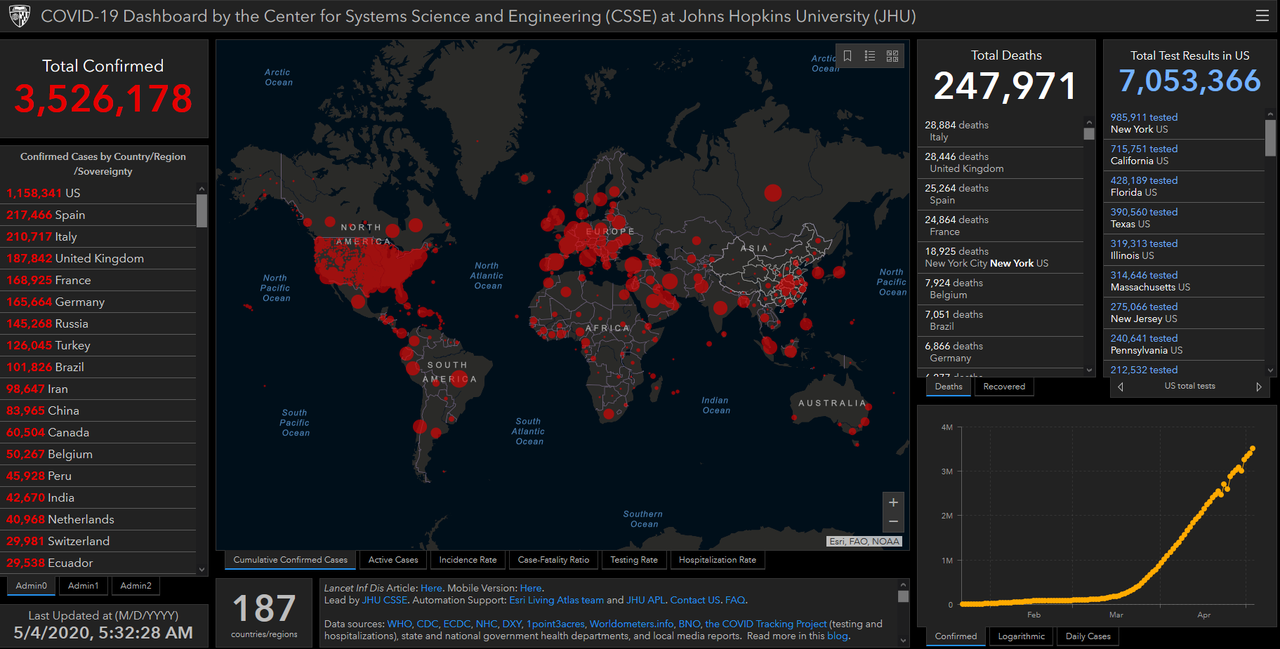
China’s early coverup of the outbreak – including silencing and/or disappearing whistleblowing doctors and journalists, lying about the transmissibility of the virus while hoarding personal protective equipment (PPE), quarantining Wuhan domestically while allowing international travel, and using the World Health Organization to run cover – has drawn global scorn as COVID has infected over 3.5 million and killed nearly 250,000 in five months.
Chinese officials had a “special responsibility” to inform their people and the world of the threat posed by the coronavirus “since they were the first to learn of it,” U.S. State Department spokeswoman Morgan Ortagus said in response to questions from Reuters.

Without directly addressing the assessment made in the Chinese report, Ortagus added: “Beijing’s efforts to silence scientists, journalists, and citizens and spread disinformation exacerbated the dangers of this health crisis.” –Reuters

President Trump in recent days has been ratcheting up criticism of Beijing, while threatening new tariffs on China. His administration has been considering retaliatory measures over the outbreak, according to the report – which warns that anti-China sentiment could also threaten their Belt and Road infrastructure initiatives, and that Washington could take advantage by offering financial and military support for regional allies, which would in turn make the security situation in Asia more volatile.

On Monday, Treasury Secretary Steven Mnuchin said that President Trump is reviewing options to penalize China, adding that he expects Beijing to meet their obligations under the phase one trade deal.
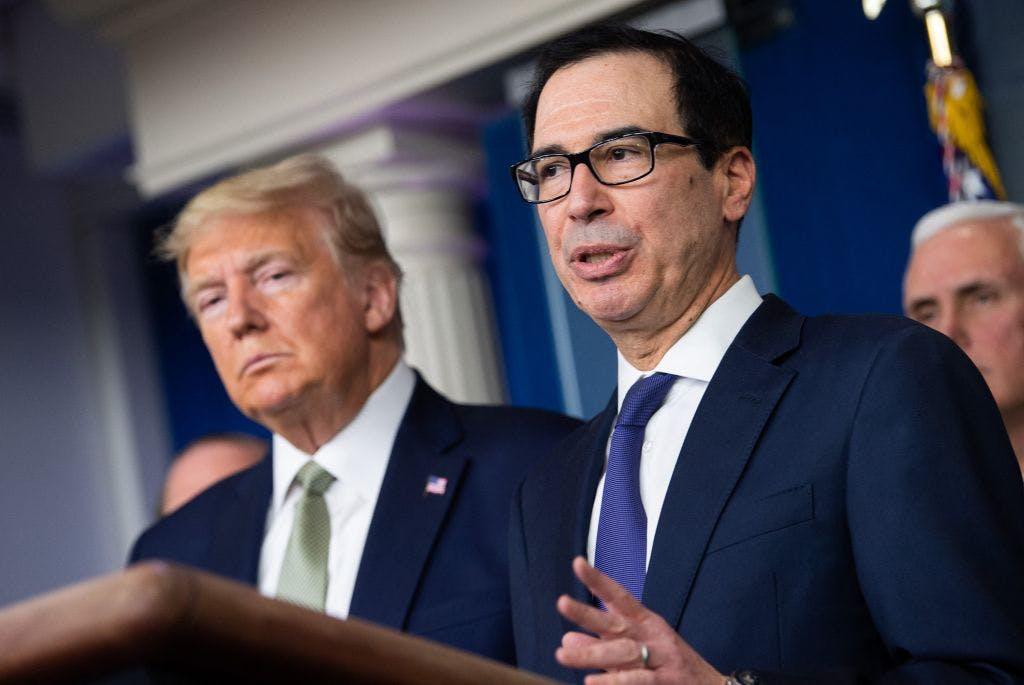
“I have every reason to expect that they honor this agreement, and if they don’t, there would be very significant consequences in the relationship and in the global economy as to how people would do business with them,” said Mnuchin.

As Reuters notes, China’s Xi has shaped the country’s military into a fighting force equipped to win modern wars – expanding air and naval capabilities and reach in a challenge to over 70 years of US dominance in Asia.
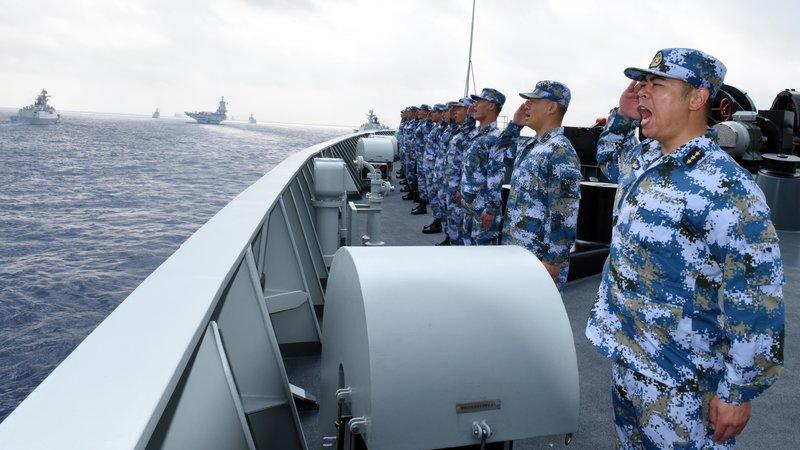
China’s foreign ministry is now calling for peace and cooperation, saying “the sound and steady development of China-U.S. relations” are in the best interests of both countries and the international community, and that “any words or actions that engage in political manipulation or stigmatization under the pretext of the pandemic, including taking the opportunity to sow discord between countries, are not conducive to international cooperation against the pandemic.

Trump, meanwhile, announced that he will cut off funding for the World Health Organization (WHO) for being “very China-centric.”

And while the world focuses on China’s response to the virus, Australia – where two scientists from the Wuhan Institute of Virology conducted coronavirus experiments overseas – has called for an international investigation into the origins and spread of COVID-19, while the so-called ‘five eyes’ Western intelligence agencies explore whether coronavirus escaped from the Wuhan lab – while operating under the assumption that it’s a non-modified virus of natural origin.


Tyler Durden

Mon, 05/04/2020 – 09:35

via ZeroHedge News https://ift.tt/2KZJSww Tyler Durden
Yields Jump After Apple Announces Another Massive 4-Tranche Buyback-Funding Bond Offering

Yields Jump After Apple Announces Another Massive 4-Tranche Buyback-Funding Bond Offering

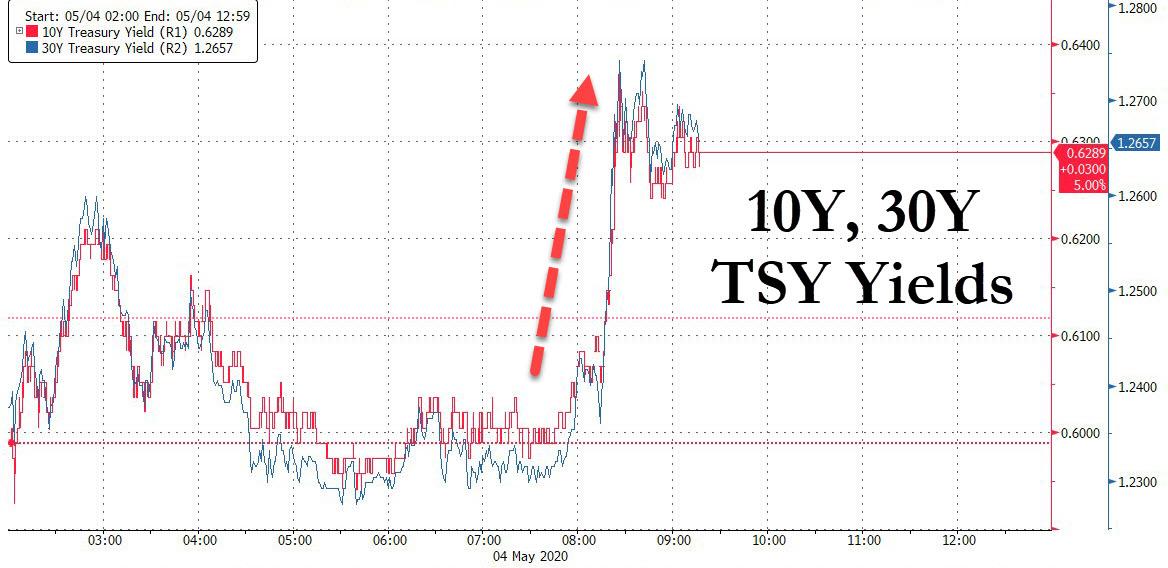
After a subdued overnight session, where investors flows were directed toward the bond complex and out of risk assets, moments ago we saw a sharp steepening move in Treasury yields across the curve, with 10Y and 30Y yields moving higher by 3-4bps.

The reason: a flurry of rate locks because at around 8:20am dealers announced that Apple was in the market with another massive multi-tranche bond offering joining Monday’s “burgeoning” IG credit issuance slate.

As Bloomberg reported, Apple’s offering includes 3Y, 5Y, 10Y and 30Y tranches, and will be used to fund the company’s newly announced $50 billion stock buyback expansion; additionally, continuing the record flood of bond issuance, Amgen and Starbucks also have slated issuance for Monday, with IG issuers are expected to raise $70b this week.

As a result, around 30k Jun20 TY contracts changed hand from 8:20am to 8:25am, highest volumes of the session, in move from 139-02 down to 138-28+ lows; 10-year yields moved up to 0.63%, ~2bp cheaper on the day, leaving 2s10s steeper with front-end yields little changed.


Tyler Durden

Mon, 05/04/2020 – 09:26

via ZeroHedge News https://ift.tt/3aWNeux Tyler Durden

53% More New Porsche Registrations Despite Corona Crisis, As Competition Suffers Heavy Losses

53% More New Porsche Registrations Despite Corona Crisis, As Competition Suffers Heavy Losses

Submitted by Raphael Adrian of Kryptoszene,

In January, roughly 53% more new Porsche vehicles were registered in Germany than in the same month of last year. The number of new vehicle registrations for all car manufacturers and brands fell by 7% over the same period. As shown in a new infographic from Kryptoszene.de, Porsche also suffered less severely in the first quarter than its German and international competitors.

Compared to the equivalent quarter last year, Porsche delivered 19.9% more vehicles within Europe, despite the current corona crisis. However, worldwide sales declined by 4.6%, as data in the published quarterly report show. This decrease is however lower than those of other automakers.

Global Tesla sales decreased by 12.8% against the first quarter of last year. Daimler’s sales were down 14.9% and BMW’s declined by much as 20.6%, according to reports published by the respective companies. Sales across the industry slumped 24.6%.

Porsche Proves its Resistance to Crisis

In February, Porsche was the only German car manufacturer to increase sales in the Federal Republic relative to the same month last year. Meanwhile, negative figures in America and China were nearly offset by flourishing business in Europe.

This is not the only way Porsche has been exceptional – the company’s employees all received a bonus of €9,700. Although Porsche is encouraging its employees to donate some of this amount, the measure has attracted some criticism. For example, Baden-Württemberg Minister for Economics, Labour and Housing Nicole Hoffmeister-Kraut (CDU), claimed that the car manufacturer was sending the wrong message: “In view of the fact that Porsche has currently applied for reduced working hours benefits, such lavish bonus payments certainly give off the wrong signal”.

Porsche has also donated €1.3 million to the Stuttgart Clinic and the Marienhospital. The money will be used to buy laboratory and X-ray equipment as well as protective masks.

As the infographics illustrate, Porsche has proven comparatively immune to the consequences of the corona pandemic. A comparison with other players in the automotive industry clearly demonstrates this. Nevertheless, the situation on the trading floor is causing uncertainty: since the February 19th stock market crash the price of Porsche shares has fallen by 31.44%.


Tyler Durden

Mon, 05/04/2020 – 09:19

via ZeroHedge News https://ift.tt/2VZl5in Tyler Durden

Key Events In This Just As Busy, Event-Filled Week

Key Events In This Just As Busy, Event-Filled Week

While last week saw an unprecedented pace of newsflow with a non-stop barrage of corporate earnings repots, economic data and central bank announcements, the news deluge continues for another week.

The main highlight this week, according to DB’s Jim Reid, will be Friday’s US job numbers. We’ll also see PMIs in the early part of this week, more companies reporting, more central bank meetings (including the BoE Thursday), and another Euro Area finance minister’s videoconference. We could also get a potential black swan curveball event then the German Constitutional Court issues its final verdict on the ECB’s PSPP program tomorrow. Consensus expects a begrudging acceptance of the ECB’s involvement in financing member states and we all move on. However, one to keep a little attention on.

Ahead of payrolls Friday, DB’s US economists are forecasting an unprecedented -22 million fall in nonfarm payrolls, which would by far be the biggest monthly decline in the data going back to 1939, with the previous record being ‘only’ a -1.959m decline back in September 1945 just as WWII ended. They’re also forecasting a rise in the unemployment rate to 18.0%, which would be the highest unemployment rate for the US since the same war. With the jobless numbers set to reach unprecedented levels, investors will also be paying attention to the more up-to-date weekly initial jobless claims from the US on Thursday, which will cover the week up to May 2. The previous 6 weeks have seen a total of over 30m claims, though the last 4 weeks in a row have seen a decline from the peak, offering hope that the most rapid period of job losses may have passed.

The other data that will gain attention this week are the PMI releases from around the world. Thanks to various public holidays, the releases will be more scattered this week, with PMIs from various G20 countries coming out each day. See the day-by-day calendar at the end for the full run down (along with all the other releases) but today sees the manufacturing numbers from those on Labor Day holiday on Friday.

Earnings season continues apace over the coming week, with 159 S&P 500 companies reporting and a further 104 in the STOXX 600.

Highlights include AIG and Tyson Foods today, followed by Disney, Total, BNP Paribas and Fiat Chrysler tomorrow. Wednesday then sees reports from Novo Nordisk, PayPal, TMobile, General Motors, Credit Agricole, UniCredit and BMW. On Thursday, we’ll hear from Bristol Myers Squibb, Danaher, Raytheon Technologies, Linde, ArcelorMittal, AB InBev, Nintendo, Uber, IAG and Air France-KLM. Lastly on Friday, Wirecard, Siemens and Nomura will be announcing.

So far, 55% of S&P 500 companies have reported Q1 earnings, and in aggregate earnings are missing by -2.5% (vs. beating by 3.4% in an average quarter) and have fallen 16.6% year-over-year. Blended EPS growth for the index looks set to contract by -13%, which would be the worst quarter since 2009. However this is driven by a large downside skew, with median company growth on track to be only modestly negative at -0.9%. Much like GDP earlier last week, these numbers are likely to be worse in Q2 because most of the shutdowns were enacted at the end of March.

Courtesy of Deutsche Bank, here is a day-by-day calendar of events

Monday

  • Data: April Manufacturing PMIs from Indonesia, South Korea, India, Turkey, Italy, France, Germany Euro Area, South Africa, Brazil and Mexico, US March factory orders, final March durable goods orders, nondefence capital goods orders ex air, Italy April new car registrations
  • Earnings: AIG, Tyson Foods

Tuesday

  • Data: April Services and composite PMIs from Australia, UK and US, UK April new car registrations, Euro Area March PPI, Canada March international merchandise trade, US March trade balance, April ISM non-manufacturing index
    Central Banks: Reserve Bank of Australia monetary policy decision, Fed’s Evans, Bostic and Bullard speak
  • Earnings: Disney, Total, BNP Paribas, Fiat Chrysler

Wednesday

  • Data: April Services and composite PMIs from India, Italy, France, Germany, Euro Area and Brazil, Germany March factory orders, UK April construction PMI, Euro Area March retail sales, US weekly MBA mortgage applications, US April ADP employment change
  • Central Banks: Brazilian central bank monetary policy decision, Fed’s Bostic speaks
  • Earnings: Novo Nordisk, PayPal, T-Mobile, General Motors, Credit Agricole, UniCredit, BMW

Thursday

  • Data: April services and composite PMIs from China and Russia, China April trade balance, UK final April GfK consumer confidence, Japan April monetary base, Germany March industrial production, April construction PMI, France March industrial production, trade balance, Italy March retail sales, US weekly initial jobless claims, preliminary Q1 nonfarm productivity, unit labour costs, March consumer credit
  • Central Banks: Bank of England and Norges Bank monetary policy decisions, Fed’s Harker speaks
  • Earnings: Bristol Myers Squibb, Danaher, Raytheon Technologies, Linde, ArcelorMittal, AB InBev, Nintendo, Uber, IAG, Air France-KLM
  • Other: EU Commission releases latest economic forecasts

Friday

  • Data: Japan March labour cash earnings, final April services and composite PMIs, Germany March trade balance, Canada April housing starts, net change in employment, unemployment rate, March building permits, US April change in nonfarm payrolls, unemployment rate, average hourly earnings, final march wholesale inventories
  • Central Banks: RBA releases quarterly statement on monetary policy
  • Earnings: Wirecard, Siemens, Nomura
  • Politics: Eurogroup video conference taking place

* * *

Focusing on just the US, the most important economic data releases next week are the ISM non-manufacturing index on Tuesday, the jobless claims report on Thursday, and the employment report on Friday. There are several scheduled speaking engagements by Fed officials this week. Here are the US-focused key events on a day by day basis:

Monday, May 4

  • 10:00 AM Factory Orders, March (GS -9.5%, consensus -9.2%, last flat); Durable goods orders, March final (last -14.4%); Durable goods orders ex-transportation, March final (last -0.2%); Core capital goods orders, March final (last +0.1%); Core capital goods shipments, March final (last -0.2%): We estimate factory orders declined by 9.5% in March following a flat reading in February. Durable goods orders fell in the March advance report.

Tuesday, May 5

  • 08:30 AM Trade balance, March (GS -$44.9bn, consensus -$44.2bn, last -$39.9bn); We estimate the trade deficit increased by $5.0bn in March to $44.9bn, reflecting a sharp widening in the goods trade deficit and our estimate of fewer services exports.
  • 10:00 AM ISM non-manufacturing index, April (GS 38.0, consensus 37.0, last 52.5); Our non-manufacturing survey tracker fell by 10.9pt to 34.7 in April, following soft regional service sector surveys. We expect the ISM non-manufacturing index to drop by 14.5pt to 38.0 in the April report.
  • 10:00 AM Chicago Fed President Charles Evans (FOMC non-voter) speaks; Chicago Fed President Charles Evans will provide a briefing to reporters on a conference call. Prepared text is not expected. Q&A is expected.
  • 02:00 PM Atlanta Fed President Raphael Bostic (FOMC non-voter) speaks; Atlanta Fed President Raphael Bostic will participate in a virtual discussion on affordable housing and aid for low-wage earners during and beyond the coronavirus pandemic. Prepared text is not expected. Audience Q&A is expected.
  • 02:00 PM St. Louis Fed President James Bullard (FOMC non-voter) speaks; St. Louis Fed President James Bullard will take part in webinar hosted by the National Association for Business Economics on the coronavirus pandemic. Prepared text is not expected. Media and audience Q&A is expected.

Wednesday, May 6

  • 08:15 AM ADP employment report, April (GS -19,000k, consensus -20,500k, last -27k); We expect a sharp drop in ADP payroll employment (-19mn, mom sa), reflecting the impact of higher jobless claims, lower oil prices, and other ADP model inputs. However, we believe the ADP report is likely to significantly understate the true pace of job loss due to model-fitting and the ADP employment panel structure itself (barring a change in methodology in the upcoming report). While we believe the ADP employment report holds limited value for forecasting the BLS nonfarm payrolls report, we find that large ADP surprises vs. consensus forecasts are directionally correlated with nonfarm payroll surprises.
  • 01:30 PM Atlanta Fed President Raphael Bostic (FOMC non-voter) speaks; Atlanta Fed President Raphael Bostic will participate in a webinar hosted by the USC Lusk Center for Real Estate on the Fed’s reaction to the coronavirus pandemic. Prepared text is not expected. Audience Q&A is expected.

Thursday, May 7

  • 8:30 AM Nonfarm productivity (qoq saar), Q1 preliminary (GS -5.7%, consensus -5.5%, last +1.2%); Unit labor costs, Q1 preliminary (GS +4.5%, consensus +3.8%, last +0.9%): We estimate non-farm productivity growth fell by 5.7% Q1 qoq saar (-0.6% yoy). This reflects relatively larger declines in business output than in hours worked in Q1. We expect Q1 unit labor costs—compensation per hour divided by output per hour—to increase to +4.5% qoq ar (+1.7% yoy).
  • 08:30 AM Initial jobless claims, week ended May 2 (GS 2,800k, consensus 3,000k, last 3,839k); Continuing jobless claims, week ended April 25 (consensus 19,600k, last 17,992k); We estimate initial jobless claims declined but remain elevated at 2,800k in the week ended May 2.;
  • 08:30 AM Atlanta Fed President Raphael Bostic (FOMC non-voter) speaks; Atlanta Fed President Raphael Bostic will participate in a webinar hosted by the South Florida Business Council on the financial implications of the coronavirus. Prepared text is not expected. Audience Q&A is expected.
  • 12:00 PM Minneapolis Fed President Neel Kashkari (FOMC voter) speaks; Minneapolis Fed President Neel Kashkari will speak with North Dakota Commerce Commissioner Michelle Kommer about the economic effects of the coronavirus. Prepared text is not expected. Audience Q&A is expected.
  • 04:00 PM Philadelphia Fed President Patrick Harker (FOMC voter) speaks; Philadelphia Fed President Patrick Harker will speak in a virtual discussion with the Chicago Council of Global Affairs on the Fed’s response to the coronavirus pandemic. Prepared text is expected. Audience Q&A is expected.

Friday, May 8

  • 08:30 AM Nonfarm payroll employment, April (GS -24,000k, consensus -21,300k, last -701k); Private payroll employment, April (GS -24,000k, consensus -21,700k, last +228k); Average hourly earnings (mom), April (GS +1.0%, consensus +0.3%, last +0.4%); Average hourly earnings (yoy), April (GS +4.0%, consensus +3.3%, last +3.1%); Unemployment rate, April (GS 14.0%, consensus 16.0%, last 4.4%): We estimate nonfarm payrolls declined by 24 million in April, reflecting a surge in business closures and temporary layoffs related to the coronavirus. Employment surveys have fallen sharply, and initial claims during the April payroll month rose by 23.4 million versus a year ago despite major filing delays in some states. Alternative data also indicate sharp declines in commuting patterns across the country. We also believe the BLS is likely to impute zero employment for many of the “non-essential” businesses that were unable to complete the survey this month—echoing the approach adopted in the aftermath of Hurricane Katrina.
  • While declining self-employment due to the virus suggests an even larger drop in the household survey measure of employment, we expect some individuals to classify themselves as “employed but not at work.” Additionally, we expect the participation rate to decline several points on account of the virus, which should also limit the magnitude of the increase in the jobless rate. Taken together, we estimate the unemployment rate rose almost 10 points to 14%. We estimate average hourly earnings increased 1.0% month-over-month and 4.0% year-over-year, reflecting a composition shift towards higher-paid workers that is partially offset by negative calendar effects.

Source: Deutsche Bank, Goldman, BofA


Tyler Durden

Mon, 05/04/2020 – 09:10

via ZeroHedge News https://ift.tt/2KWDLcb Tyler Durden

The Invisible Hand Of Markets Is Handcuffed To QE-Infinity… There Will Be Consequences

The Invisible Hand Of Markets Is Handcuffed To QE-Infinity… There Will Be Consequences

Authored by Bill Blain via Morning Porridge,

“Why that’s absurd, the wing is on the bird”

Economies are poised to crawl out from underneath the COVID rock. Across Europe and the States it’s not quite an economic spring, but there is a sense something more positive is underway. The UK gets a big announcement next Sunday detailing re-opening rules, new social distancing recommendations, and return-to-work advice. It won’t be business as usual – but it will be businesses.

There have been mistakes around the globe in how the coronavirus was handled. It has not been The End of The World the models predicted. Harry Hindsight is the best trader I ever knew… we didn’t know then what we know now.  

C-19 has been a massive test of political leadership. Scared electorates have accepted the lockdown choices that were made. Bad calls were made – but the critical thing is they were made. Generally, any leadership is better than none. (There are exceptions… I shall wash my mouth out with a bleach and chloroquine cocktail before naming any..)  Resources proved scarce, and much to joy of journalists who can’t find anything better to do, the buck for that stops at the top – for the time being.

We still don’t know what the Virus plans next.. what insidious grand plan to kill us all is coursing through its..  STOPIt’s an unthinking strand of RNA in a fatty protein shell that got lucky. 

The more we understand about how it functions and what it does, the better we can predict – we’re learning more every day. The experience of countries that didn’t lockdown, particularly Sweden, countries with better contact tracing, plus new drugs and therapies means we’re better prepared and more ready for round two. It’s a war we’re winning. We can prepare for the peace to follow… and face just how ruined the economic landscape is – its a quick clean up or a total rebuild?

I’m interested in how the real economic outlook unfolds. What will that mean for markets? 

It will be kind of ironic if the current rally proves a bear bounce and stocks now tumble just as we see the exit signs. 

The outlook for markets remains massively challenging. There is a very delicate balance underway: the market’s confidence in QE Infinity and Government fiscal support vs the real economic damage in terms of failing companies, dividend stops, rising unemployment and permanently broken supply chains. If that confidence breaks… then it’s a massive sell signal. 

The risks are compounded because of how distorted and overvalued markets were before this crisis even began. The ultimate mistake of the 2008 Global Financial Crisis may yet prove to be the market price distortions caused by QE were never unwound. These have keep bond prices high, interest rates artificially how, and though cheap debt and yield tourism, kept stock prices well above where they should be. We’ve been waiting for the invisible hand of markets to correct the imbalances for years – but they never did. The invisible hand of markets is handcuffed to QE Infinity!

Confidence all depends on how the news plays out in coming days – much of it is already nailed on as bad. There will be a record tumble in US Employment – from 3% to around 16% on Friday 7th May.  Markets will depend on whether the “illusion” of “Whatever it takes” Government and Central Bank action can be maintained. 

US earnings show around 14% y-o-y declines in earnings through Q1 – that figure will be magnified in Q2. New earnings this week will include GE – another top contender for the fall into Junk – which could weaken sentiment. Another Oil Shock or rising tensions with China won’t help. Across the globe companies are trying to fathom how quickly they can adjust “just-in-time-supply-chains” and prepare for the massive demand shock that’s underway as consumer confidence collapses in face of salary cuts, furloughs, redundancy and firms failing – there is an avalanche of bad news made up from millions of individual financial tragedies underway. 

There is also the issue of how much can Nations do? The Bank of England will likely announce or hint at enlarging QE – its already blasted through an unprecedented 1/3rd of the £200 bln emergency package that’s kept Gilts stable through the government’s spending promise splurge.

Would it matter if markets did break? The billions and trillions of QE Infinity and government support, plus the and associated Moral Hazard, is not an attractive look. How do you explain to electorates why their jobs are collapsing, yet the financial markets are having the ultimate party? A collapse in markets would have enormous knock-on effects into the banking sector, and especially asset management (where most risk resides). It would destroy savings and confidence. 

I suspect governments will react – much as they did following the last crisis – with new hastily conceived and ill-considered rules and regulations that will further damage functional markets. 

There will be consequences… 

Yoorp… a game to play…

In order to play the markets – the right call is to play the volatility of confidence. 

I was struck by this line in a bank’s global equity outlook: “We are structurally overweight countries with monetary and fiscal autonomy.” They could equally have written: “We are selling the **** out of Europe.” 

Europe and the Euro are goods example of great idea badly executed at the wrong time.. We know its decision-making processes are hamstrung by the EU constructs, the ECB’s political oversight, and national self-interest . It’s structures make strategic leadership slow and nebulous. Every major policy shift requires a crisis to precipitate it. There is no consensus on what the future should be: Unification vs Federal? Repeated crisis means prices collapse and spreads widen, before they snap back in on something like the Draghi “Do-Whatever-It-Takes” moment. 

The next few weeks are critical for Europe. The tensions between the struggling south desperate to spend their way out for crisis and the thrifty German-Dutch axis is being hampered by a lack of political direction (ahead of elections and the Merkel succession issue), and credibility. Southern Europe needs cash to bail them though a 15-20% collapse from zero tourism income. As economic pain spreads around the globe, expect a renewed immigrant crisis across the Med this year – requiring further cash for the poor south. 

In the absence of real decisions, and “kicking-the-can-down-the-road” non-decisions, European spreads will remain volatile, and commerce will continue to underperform. These are likely screaming buys at the lows on the basis a good crisis in Europe will eventually trigger a “hold-the-thing-together” response with some kind of Southern Europe bailout. But – it will be just enough to solve the immediate crisis, and leave full resolution of Euro imbalance effects to yet another day. 

The bottom line is Europe is a market game to play – buy low and wait for the “whatever-it-takes” bailout in whatever form it takes.


Tyler Durden

Mon, 05/04/2020 – 08:51

via ZeroHedge News https://ift.tt/3c8jmwY Tyler Durden

‘Economic Fallout Accelerated’ – Hong Kong Records Worst Contraction In History  

‘Economic Fallout Accelerated’ – Hong Kong Records Worst Contraction In History  

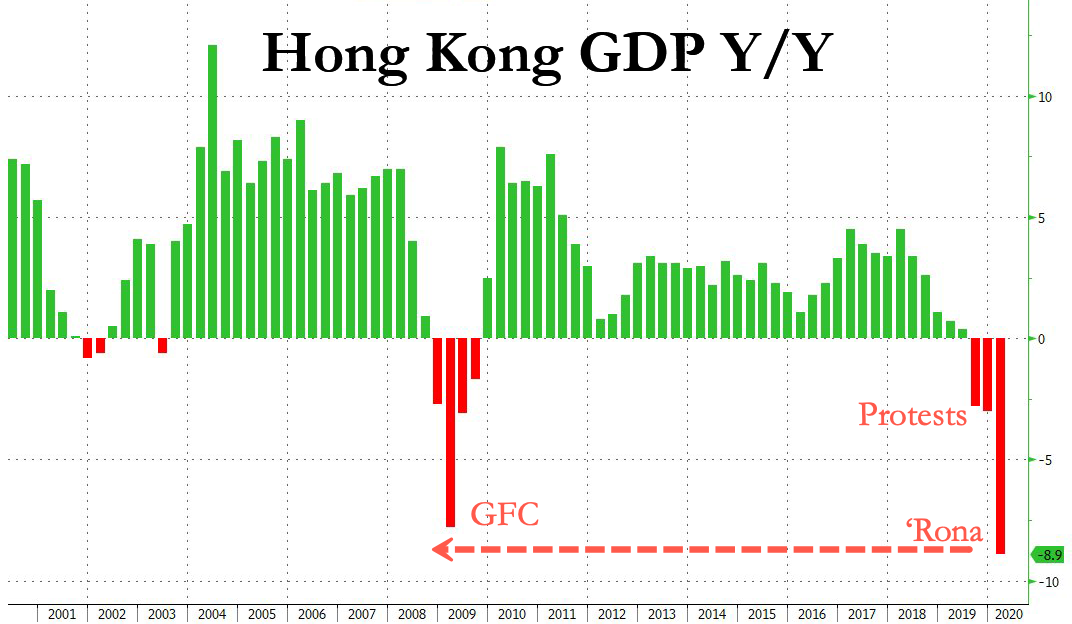
Hong Kong’s economy in the first quarter suffered its deepest annual contraction on record, plunging 8.9% YoY as the coronavirus pandemic dealt a heavy blow to business activity in the city, already suffering from a collapse in tourism and retail industries due to months of anti-government protests in late 2019. 

The Census and Statistics Department published 1Q GDP figures on Monday, revealing a decline in YoY growth trend for the third consecutive quarter. Preliminary data showed the 8.9% print was worst than 3Q98 when GDP plunged 8.3% during the Asian financial crisis, reported South China Morning Post. The final print is expected in late May.

Hong Kong Financial Secretary Paul Chan Mo-Po warned, “we are deep into recession” as the “economic situation is very challenging.”

He said on a QoQ comparison, GDP had contracted for four consecutive quarters, indicative of a deep decline in the economy that could soon surpass what was seen in the Asian financial crisis when there were five quarters of consecutive declines. 

“If we are able to work and unite together, not just to fight against the virus, but stimulate consumption and economic development, the economic situation will stabilise somewhat in the second quarter,” he said.

“If the global epidemic situation improves, we will be able to come out of recession gradually towards the end of this year.”

The city’s key growth drivers – exports, retail, and investments, have been severely damaged because of the slump. Exports plunged 9.7% in 1Q YoY due to supply chain disruptions across Asia

“The three locomotives broke down,” he said. “Unemployment hit a new high in March, the worst in about nine years.”

A government spokesperson on Monday said the recession deepened in 1Q20, as lockdowns crushed economic activity and supply chains. Virus-related shutdowns in the city have prevented mass protests, but the trade-off has broken tourism and retail industries.

“With the disease evolving into a pandemic in March, the economic fallout became even more severe,” the spokesperson said.

On a QoQ basis, 1Q GDP shrank around 5.3%, the steepest decline since records began in 1974. 

Beijing warned last week that Hong Kong was headed for the worst recession on record as full-year GDP forecasts were downgraded to between -4% to -7%. Estimates in February were roughly -1.5% contraction to +.50%, though the pandemic has undoubtedly created an economic shock that has roiled the city. 

There are some signs that the virus spread is slowing in Asia. However, Iris Pang, Greater China economist at ING, warned that “social distancing “will continue to hurt catering and shopping.” She warned that more Hong Kong protests are expected “over the summer holidays.” 

The deepening downturn in the city will likely weigh on consumer spending habits throughout the year. Uncertainty over job prospects will also damage consumer sentiment as the city is highly exposed to global trade. 

“Hong Kong’s near-term economic outlook is subject to very high uncertainties, hinging crucially on the evolving global public health and economic situations,” the government said in a statement. 

Financial relief for business and households is expected to push the city’s budget deficit this year to a record HK$276.6 billion ($35.68 billion), or about 9.5% of GDP.

The Hong Kong Retail Management Association recently warned that despite relief measures, nearly 25% of the 62,400 retail brick and mortar stores could close by the end of the year. 

It’s surprising that Hong Kong is experiencing one of the worst declines in the city’s history. Meanwhile, China has already shown signs of a recovery. How is that even possible? Unless China is lying about its economic recovery… 


Tyler Durden

Mon, 05/04/2020 – 08:35

via ZeroHedge News https://ift.tt/2L3o82x Tyler Durden

Federal Courts Enforcing State Law Against State Governments

I noted Saturday that the Sixth Circuit had temporarily blocked the Kentucky Governor’s limit on drive-in church services, based partly on the conclusion that the Governor’s order violate the Kentucky state Religious Freedom Restoration Act. The court also concluded that the order violated the federal Free Exercise Clause, but the Kentucky RFRA claim was an independent basis for the panel’s opinion (and in my view the stronger basis).

But this raises an important procedural question, which commenter Jeff Walden aptly identified: “[H]ow is a federal court judging the applicability of a state statute? Why isn’t it up to a Kentucky court to determine if their RFRA applies here?” And fortunately, I have the answer:

1. The federal court had “‘pendent’ claim jurisdiction—that is, jurisdiction over nonfederal claims between parties litigating other matters properly before the court.” The plaintiffs brought both a federal Free Exercise Clause claim and a state RFRA claim, so the court had jurisdiction to decide both.

2. Now a state can raise a sovereign immunity defense to block an injunction issued against the state ordering it to follow state law. But in this case, the Sixth Circuit wrote,

It bears noting that neither the Governor nor the Attorney General has raised sovereign immunity as a defense to this claim. See Pennhurst State Sch. & Hosp. v. Halderman, 465 U.S. 89, 102 (1984). That is within their rights, see Wis. Dep’t of Corr. v. Schacht, 524 U.S. 381, 389 (1998), and perhaps springs from a commendable recognition that, with or without a pandemic, no one wants to ignore state law in creating or enforcing these orders.

And remember: Lawyers’ true superpower is the power to turn every question into a question about procedure.

from Latest – Reason.com https://ift.tt/2Wt00vT
via IFTTT

Federal Courts Enforcing State Law Against State Governments

I noted Saturday that the Sixth Circuit had temporarily blocked the Kentucky Governor’s limit on drive-in church services, based partly on the conclusion that the Governor’s order violate the Kentucky state Religious Freedom Restoration Act. The court also concluded that the order violated the federal Free Exercise Clause, but the Kentucky RFRA claim was an independent basis for the panel’s opinion (and in my view the stronger basis).

But this raises an important procedural question, which commenter Jeff Walden aptly identified: “[H]ow is a federal court judging the applicability of a state statute? Why isn’t it up to a Kentucky court to determine if their RFRA applies here?” And fortunately, I have the answer:

1. The federal court had “‘pendent’ claim jurisdiction—that is, jurisdiction over nonfederal claims between parties litigating other matters properly before the court.” The plaintiffs brought both a federal Free Exercise Clause claim and a state RFRA claim, so the court had jurisdiction to decide both.

2. Now a state can raise a sovereign immunity defense to block an injunction issued against the state ordering it to follow state law. But in this case, the Sixth Circuit wrote,

It bears noting that neither the Governor nor the Attorney General has raised sovereign immunity as a defense to this claim. See Pennhurst State Sch. & Hosp. v. Halderman, 465 U.S. 89, 102 (1984). That is within their rights, see Wis. Dep’t of Corr. v. Schacht, 524 U.S. 381, 389 (1998), and perhaps springs from a commendable recognition that, with or without a pandemic, no one wants to ignore state law in creating or enforcing these orders.

And remember: Lawyers’ true superpower is the power to turn every question into a question about procedure.

from Latest – Reason.com https://ift.tt/2Wt00vT
via IFTTT

Spain’s Push To Extend Lockdown Sparks Political Standoff As Global Coronavirus Deaths Decline For 5th Day: Live Updates

Spain’s Push To Extend Lockdown Sparks Political Standoff As Global Coronavirus Deaths Decline For 5th Day: Live Updates

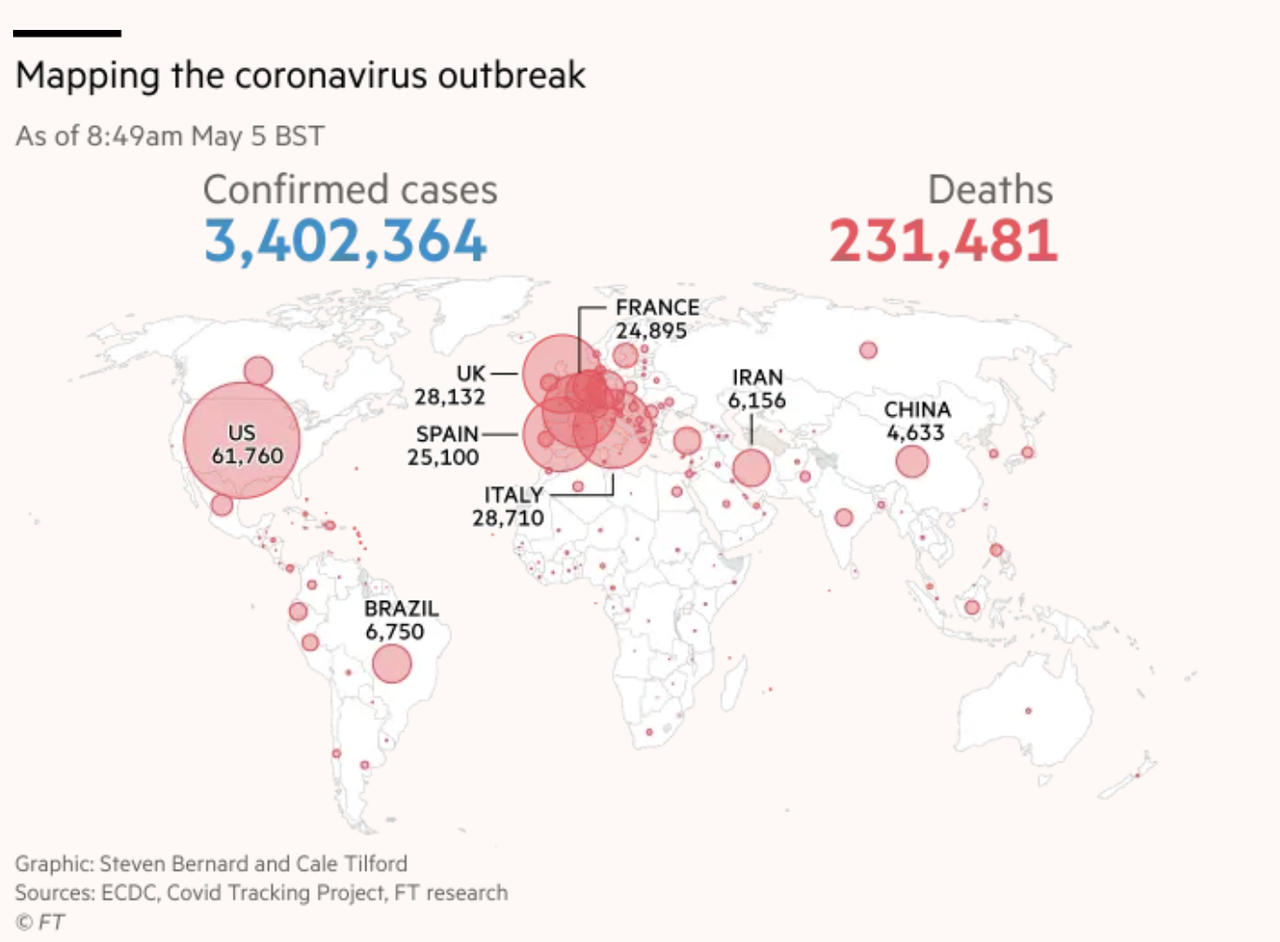
As most of the US and most of Europe start yet another week under lockdown, the FT reports that the rate of global coronavirus deaths slowed for the fifth straight day: The worldwide single-day total of deaths reported yesterday (typically, those deaths occurred during the prior 24 hour period) hit 3,481, falling for the fifth day in a row.

Sunday’s total represents the smallest daily increase in deaths since the end of March, reflecting trends seen in New York, the UK, Italy and elsewhere on Sunday.

Globally, the number of newly confirmed COVID-19 cases climbed by 82,260 yesterday, the biggest spike on a Sunday since the pandemic began. It brought the total number of ‘confirmed’ infections to 3.4 million, with hundreds of thousands more potentially left uncounted.

The US suffered an additional 1,158 deaths to push the total there to 61,760. This is the lowest daily figure since April 6, though the US still accounts for a third of all daily fatalities.

Meanwhile, in Japan, PM Shinzo Abe has made it official.

As was widely expected, Japanese PM Shinzo Abe officially extended Japan’s nationwide state of emergency – which had been due to expire on Wednesday – through May 31.

While Japan has escaped the massive death tolls seen in Europe and the US, the number of confirmed cases has exploded over the last month, a sign that the world’s third-largest economy is still struggling with the first wave of the virus, which has now burrowed deep into Japanese society, according to Nikkei.

While Tokyo hasn’t been devastated by the virus on the level of NYC or Wuhan, the spike in infections has left hospital systems strained around the country.

“Nearly one more month is needed to improve the medical system, which has been stretched thin,” Abe told reporters at a news conference on Monday evening. “The reduction of new infections has still not attained the necessary level.”

Abe promised that a panel would examine the effectiveness of the state of emergency, and if allowable, would order it to be lifted before the May 31 deadline if enough progress has been made.

While Japan ramps up its restrictions, Spain is heading for a political confrontation over its lockdown – possibly the most restrictive in Europe – as the death toll lingers near its lowest point since the outbreak began.

It had been taken as a given that PM Pedro Sanchez would manage to win the votes for a planned two-week extension of the lockdown. However, the main leader of the opposition in the Spanish Parliament – a lawmaker named Pablo Casado – claims his People’s Party (a center-right party) plans to vote against the extension, which gives Sanchez extraordinary power to rule by decree.

Sanchez argues that the lockdown must be lifted gradually to guarantee that the progress the country has made will be protected: According to health ministry figures released on Monday, the daily death toll remained at 164 for the second consecutive day, the lowest level since March 18, when the lockdown was just 3 days old.

For the first time in nearly 2 months, Iran is set to hold Friday prayers this week and has re-opened mosques in a handful of towns believed to pose a low risk to public health after about two months of closure. Though the reopenings come with rules: Worshippers can spend a maximum of half an hour in mosques and have to wear face masks and gloves.

Iran’s death toll reached 6,277 on Monday, up from 6,203 a day before. A total of 98,647 individuals have now tested positive.

Last night, a US intel leak appeared to confirm what many China hawks had already suspected: That China withheld information – like the confirmation of human-to-human transmission – and used the time to hoard PPE and other medical supplies, which would explain the inexplicable global shortage that seemed to already be in place by the time American buyers started finding that warehouses had already been mysteriously emptied.

Now, as the UK reconsiders its decision to allow telelcoms components manufactured by Huawei to be used as part of its 5G network, the British Defense Minister said Monday that China has some explaining to do about the US report cited above – though he added that there would be time for an inquiry after all of this is over.


Tyler Durden

Mon, 05/04/2020 – 08:18

via ZeroHedge News https://ift.tt/2ypMroQ Tyler Durden

Why Assets Will Crash

Why Assets Will Crash

Authored by Charles Hugh Smith via OfTwoMinds blog,

This is how it happens that boats that were once worth tens of thousands of dollars are set adrift by owners who can no longer afford to pay slip fees.

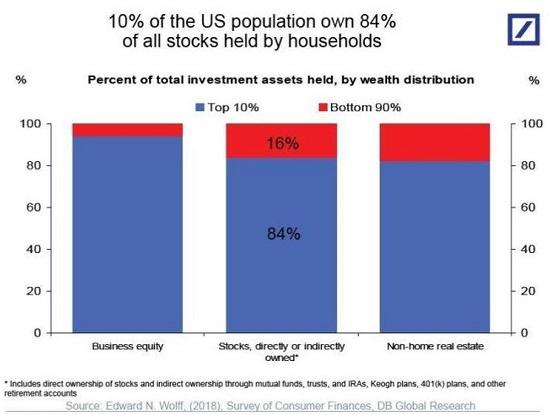
The increasing concentration of the ownership of wealth/assets in the top 10% has an under-appreciated consequence: when only the top 10% can afford to buy assets, that unleashes an almost karmic payback for the narrowing of ownership, a.k.a. soaring wealth and income inequality: assets crash.

Most of you are aware that the bottom 90% own very little other than their labor (tradeable only in full employment) and modest amounts of home equity that are highly vulnerable to a collapse of the housing bubble. (The same can be said of China’s middle class, only more so, as 75% of China’s household wealth is in real estate, more than double the percentage of wealth held in housing in U.S. households.)

As the chart illustrates, the top 10% own 84% of all stocks, over 90% of all business equity and over 80% of all non-home real estate. The concentration of ownership of assets such as vintage autos, collectibles, art, pleasure craft and second homes in the top 10% is likely even greater.

The more expensive the asset, the greater the concentration of ownership, as the top 5% own roughly 2/3 of all wealth, the top 1% own 40% and the top 0.1% own 20%. In other words, the more costly the asset, the narrower the ownership. (Total number of US households is about 128 million, so the top 5% is around 6 million households and the top 1% is 1.2 million households.)

This means the pool of potential buyers is relatively small, even if we include global wealth owners.

Since price is set on the margins, and assets like houses are illiquid, then we can anticipate all the markets for assets owned solely by the wealthy to go bidless–yachts, collectibles, vacation real estate–because the pool of buyers is small, and if that pool gets cautious due to a drop in net worth/unearned income, there won’t be any buyers except at the margins, at incredible discounts.

As we know, in a neighborhood of 100 homes currently valued ar $1 million each, when a desperate seller accepts $500,000, the value of the other 99 homes immediately drops to $500,000.

Since few of the current bubble-era asset valuations are supported by actual income fundamentals, then the sales price boils down to a very small number of potential buyers and what they’re willing to pay.

Houses have a value based on rent, of course, but rents will drop very quickly for the same reason: prices are set on the margins. The most desperate landlords will drop rents and re-set the rental market from the margins. If demand plummets (which it will as people can no longer afford rents in hot urban markets once they lose their jobs), then vacancies will soar and rents will crash as a few desperate landlords will take $1200/month instead of $2500/month.

Due to the multi-year building boom of multi-family buildings in hot job markets (which inevitably leads to an over-supply once the boom ends), there are now hundreds of vacancies where there were once only a few dozen, and thousands where there were previously only hundreds.

As millions of wait staff, bartenders, etc. who made good money in tips find their jobs have vanished, all the urban hotspots will see mass out-migration: Seattle, Portland, the S.F. Bay Area, L.A., NYC, Denver, etc. as demand for rentals will evaporate and rents will be set on the margins by the most desperate landlords. Everyone holding out for the previous bubble-era rent will have $0 income as their units are vacant.

Tech start-ups and Unicorns are melting like ice cubes in Death Valley, and tech-sector layoffs are already in the tens of thousands. This wave of highly paid techies losing their jobs will become a tsunami, further reducing the pool of people who can afford rents of $2,500 to $3,000 for a studio or one-bedroom apartment.)

The concentration of ownership generates a self-reinforcing feedback that further depresses prices: since the top 10% own most of the assets of the nation, they are most prone to a reversal of “the wealth effect.” As their assets soared in value, the top 10% felt wealthier and more confident in future gains, enabling them to borrow and spend freely on second homes, pleasure craft, new vehicles, collectibles, luxury travel, etc.

Once even one class of assets plummets in value–for example, the recent decline in the stock market– the wealth effect reverses and the top 10% feel poorer and less confident about future gains, and thus less enthused about borrowing and spending. The demand for other costly assets quickly evaporates, further reducing the wealth of the “ownership class,” which further reduces their desire and ability to buy bubble-era assets.

The high-priced assets owned by the top 10% will be the assets least in demand due to their high cost and potential for enormous losses: nothing loses value faster in a recession that narrowly owned assets such as vintage cars, art, vacation homes, yachts, etc.

Once assets start sliding in value, the reverse wealth effect quickly dries up demand for all asset classes with narrow ownership. Since these assets are illiquid–that is, the market for them is thin, with buyers few and far between–the prices are set by a very shallow pool of buyers and desperate sellers.

Consider a pleasure craft that retails new for $120,000. In the boom era of rising stocks and housing, a used boat might fetch $65,000. But as the wealth of the small pool of households able to buy and maintain a costly craft evaporates, the number of qualified buyers evaporates, too.

The seller might be aghast by an offer of $35,000 and reject it angrily. Six months later, he’s praying someone will take it off his hands for $15,000, and in another six months, he’ll accept $500 just to get out from underneath the insurance, slip-rental and licencing fees.

This is how it happens that boats that were once worth tens of thousands of dollars are set adrift by owners who can no longer afford to pay slip fees, and vacation homes are abandoned and auctioned off for overdue property taxes: the market for these luxuries dries up and blows away, i.e. goes bidless–there are no buyers at any price.

Once housing and real estate valuations fall, that will trigger a decline in the value of all other costly, narrowly owned assets, which will reinforce the reverse wealth effect.

This is the systemic payback for concentrating ownership of assets in the hands of the few: when their bubble-era priced assets plummet in value, the bottom falls out of all assets with narrow ownership. The price of superfluous assets such as boats, vintage cars, collectibles, art and vacation homes can quickly fall to a fraction of bubble-era valuations, destroying much of what was always fictional capital.

(For more on the intrinsic fragility of a system that concentrates ownership in the hands of the few, please read Our Inevitable Collapse: We Can’t Save a Fragile Economy With Bailouts That Increase Fragility May 1, 2020.)

The Federal Reserve reckons it can “save” the bubble-era valuations of junk bonds by being the “buyer of last resort,” but it will end up being the “only buyer,” effectively making the system even more fragile and prone to collapse.

The public will eventually have to decide if the nation’s central bank should be bailing out assets owned by the financial elite while the upper-middle class watches its assets collapse in value.

My COVID-19 Pandemic Posts

My recent books:

Audiobook edition now available:
Will You Be Richer or Poorer?: Profit, Power, and AI in a Traumatized World ($13)
(Kindle $6.95, print $11.95) Read the first section for free (PDF).

Pathfinding our Destiny: Preventing the Final Fall of Our Democratic Republic ($6.95 (Kindle), $12 (print), $13.08 ( audiobook): Read the first section for free (PDF).

The Adventures of the Consulting Philosopher: The Disappearance of Drake $1.29 (Kindle), $8.95 (print); read the first chapters for free (PDF)

Money and Work Unchained $6.95 (Kindle), $15 (print) Read the first section for free (PDF).

If you found value in this content, please join me in seeking solutions by becoming a $1/month patron of my work via patreon.com.


Tyler Durden

Mon, 05/04/2020 – 08:15

via ZeroHedge News https://ift.tt/35yaEWi Tyler Durden