Investing Legend Sees A Second Great Depression For Stocks By 2023

Investing Legend Sees A Second Great Depression For Stocks By 2023

The name of Kiril Sokoloff, author of the weekly WILTW (What I Learned This Week) newsletter through his advisory firm 13D Global Strategy & Research, needs no introduction on this website for the simple reason that over the past few years we have often published his highly insightful excerpts (most recently one month ago with “A Corporate-Debt Reckoning Is Coming“).

Which is why the latest “Lunch with the FT” feature by the FT’s Rana Foroohar may be of interest to readers curious about Sokoloff’s background and how over the past four decades he became one of the most closely sought after independent thinkers and strategists on Wall Street (he works out of St. Thomas in the US Virgin Islands, unaffiliated with any bank), and why his clients – which include Mukesh Ambani, Sam Zell and Raymond Kwok – are quite happy to pay thousands of dollars for a subscription.

We find 13D fascinating, and one of the world’s best newsletters for many reasons by the main one is that Sokoloff’s overarching philosophy – fiscally conservative, rational, measured – is congruent with ours: as the FT notes, Sokoloff “has been trying to make the financial elite see the dangers of seeking to solve the problems of debt with more debt“,  something we too have been doing since 2009 but obviously to absolutely no success.

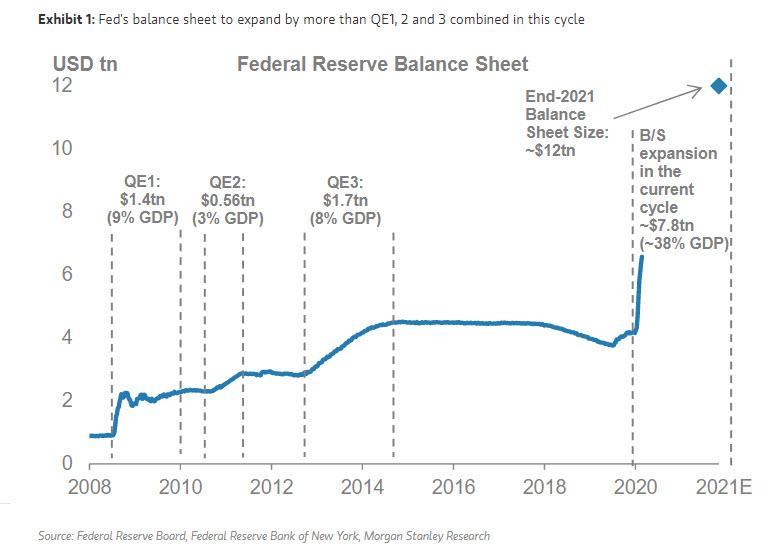
As the FT continues, “the topic is timelier than ever, given that central-bank balance sheets — already huge before Covid-19 — are headed into the stratosphere, as policymakers struggle to cope with the crisis, not to mention the popping of a debt bubble that grew for years before it.”

Sokoloff is, of course, referring to this.
In any event, we’ll let readers catch up on the FT’s profile of the WILTW author at their leisure, but we did want to highlight one particular aspect of his interview: namely what he believes may be in store.

As Foroohar writes, in preparation for her interview “I’ve been… reading Depression-era journalist Garet Garrett’s 1932 book A Bubble That Broke the World, recommended to me by Sokoloff as a primer for our age, since it covers how central-bank actions contributed to the debt-driven run-up to the stock market crash of 1929 and the Great Depression.”

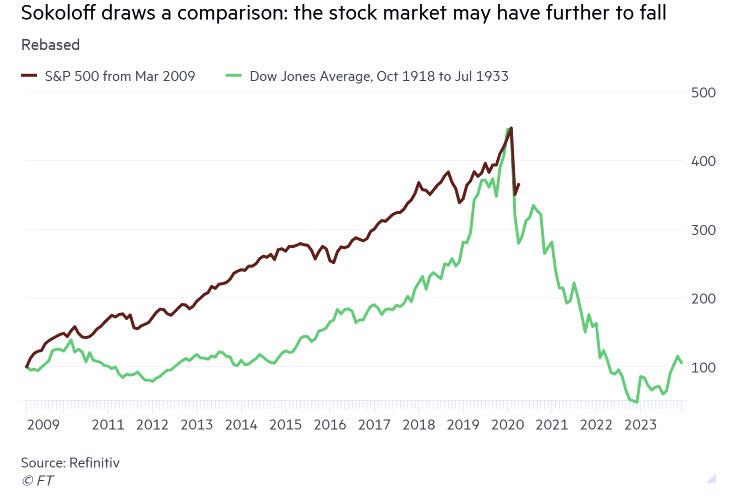
More apropos, Sokoloff also sent the author a chart which compares the Dow Jones between 1918 and 1932 to the current period, a chart which we have also shown repeatedly on this website in recent weeks, months and years. Why that particular chart? Because as the FT explains, it shows that “the rise and the fall are frighteningly similar to the period from 2009 onwards.”

If history is a guide, stocks have further to go before they hit bottom. That’s Sokoloff’s view, anyway. Then as now, he says, “central bankers were pushing on a string”, trying in vain to whip up a real economic recovery with monetary policy.

And here is what Sokoloff believes will what happens when, again, “central banks push on a string”:
How does Sokoloff – who has traditionally been upbeat, optimistic and generally bullish – justify his outlook so apocalyptic it could be taken from a post on that tinfoil conspiracy theory website Zero Hedge? Here’s how:

The more debt you add [via monetary and even some fiscal policy], the more unproductive the debt becomes,” says Sokoloff, who is now positioned at the dining table in front of his screen. It’s not a popular view these days. Austerity is out, and MMT — the notion that a country that controls its own currency can print it freely to fund deficit spending without worry — is in. (MMT stands for “modern monetary theory” or magic money tree”, depending on your viewpoint.) But Sokoloff believes the stimulus programmes being launched in the US, Europe and many other parts of the world will very likely end in tears.

“I think we’re at the beginning of a long-term period of deflation, falling prices and the loss of pricing power. The only way out of it will be to have a long period of austerity, and to get the US savings rate up dramatically.” He points as an example to the US in the period during the second world war, when federal budget deficits were high, well over 20 per cent of GDP in some years (compared to what may be some 20 per cent-plus by the end of this year) but the personal savings rates of Americans were positively Chinese — as high as 25 per cent including income gains from the war and net exports, as opposed to 8 per cent or so before the Covid-19 crisis — boosted by wartime rationing.

One-upping Sokoloff, we have created a better chart that more clearly lays out what happens if one tacks on the Great Depression outcome to the current Dow Jones. In short, we should see the Dow dropping to the Great Depression-equivalent low of roughly 10,000.
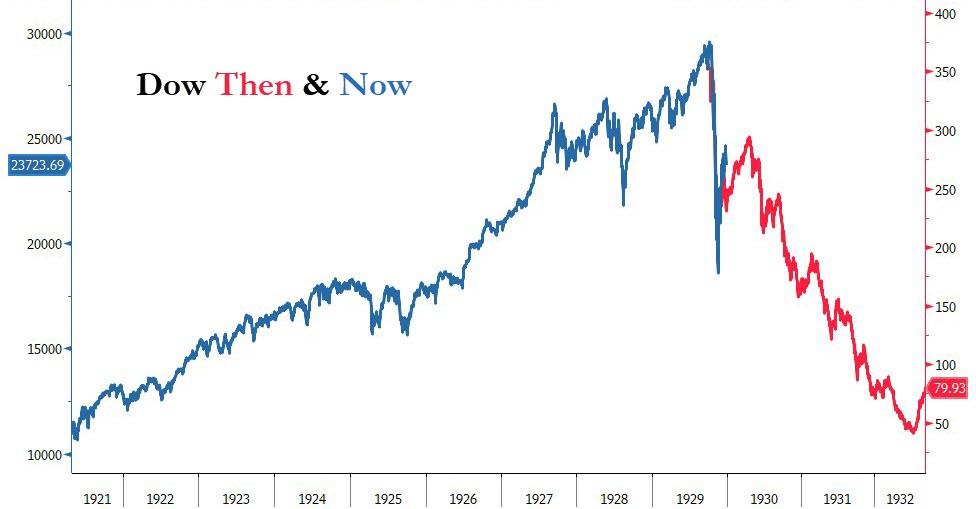
There is good news: after its plunged to all time lows, the Dow traded in a tight range for several years before eventually blasting off to unprecedented highs. What triggered it? Why World War II of course.

Which is why any true comparisons to the Great Depression era should also consider the cataclysmic event that ended it, and look forward to a similar outcome over the next few years. 


Tyler Durden

Sun, 05/03/2020 – 15:15

via ZeroHedge News https://ift.tt/2zaoYI7 Tyler Durden
Global US Dollar Shortage Rises As Emerging Markets Lose Reserves

Global US Dollar Shortage Rises As Emerging Markets Lose Reserves

Authored by Daniel Lacalle,

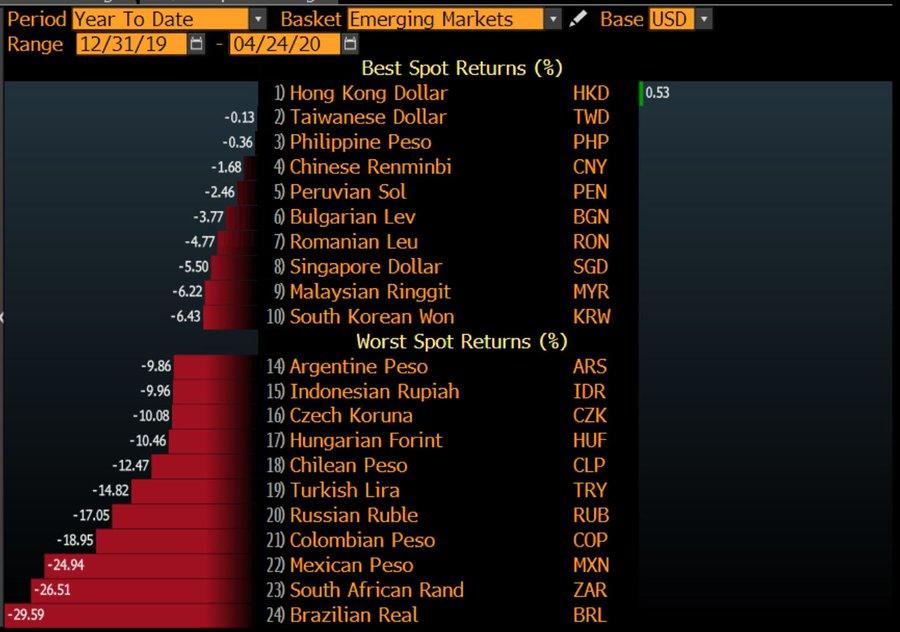
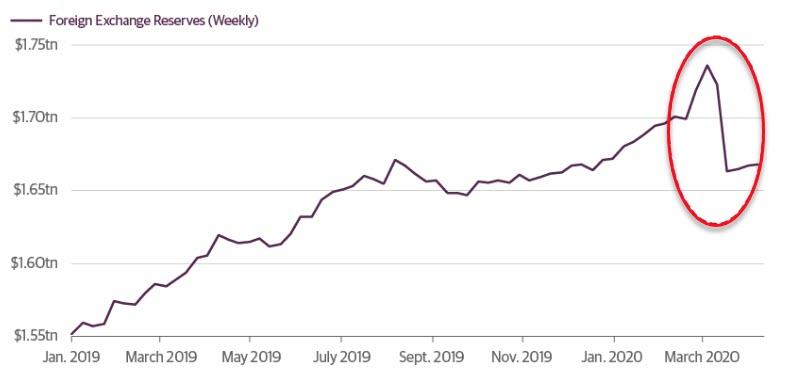
The pace at which emerging market economies are losing FX reserves is staggering. In March, emerging economies lost around $1.5 billion in foreign exchange reserves per day, according to Bloomberg.

Saudi Arabia alone lost $27 billion in reserves in March, according to Goldman Sachs, and it is one of the countries with the best capacity to endure the current crisis.

China, that still hods $3 trillion in FX reserves despite the crisis, is also among the strongest countries in FX reserves, but the apparently large level is offset by a large US-dollar denominated debt liability. As such, China’s 60% of China’s reserves are there to cover existing liabilities.

India is also one of the strong countries. As a large importer of commodities, the current slump in activity and lower commodity prices has allowed India to maintain a very healthy level of reserves.

Which countries are suffering the most? Argentina, Brazil, Mexico, South Africa, Turkey rank among the most impacted.

What is causing this collapse in reserves and rising dollar shortage?

  1. The decline in global trade and economic activity due to the forced lockdown weakens export revenues. The outlook for 2020 is bleak with trade possibly declining by between 13% and 32%., according to the World Trade Organization. Some recovery is expected in 2021, but the likelihood of recovering 2019 global trade activity before 2023 is small.

  2. The collapse in commodity prices destroys the trade balance of producer nations. Not only demand is falling to unprecedented levels, but storage is also filling up rapidly and overcapacity at producer nations is building to decade-highs. This problem is not happening just in oil and natural gas, but also in coal, aluminum, soja and, to a lesser extent, in copper.

  3. Local currency collapse leads to central bank intervention. Central banks in emerging economies were smart in 2008-2011 and kept their reserves at very good levels, significantly above foreign currency liabilities. However, the recent slump in many currencies relative to the dollar has caught many emerging market central banks unprepared. Despite the massive increase in the balance sheet of the Federal Reserve and almost unlimited quantitative easing, many emerging currencies have collapsed and led to their central banks to sell dollars to defend the currency, a big mistake. reserves fall, and the currency remains weak.

  4. Since 2009, many emerging markets have ignored the risk of building imbalances and have entered into large twin deficits (fiscal and trade), as well as issued record-level of US-dollar denominated debt because domestic and international investors did not want local currency risk. This means that emerging markets face a massive wall of US-dollar denominated maturities of more than $2 trillion in the next two years while refinancing and new debt requirements soar.

  5. The Federal Reserve will continue to increase money supply… But investors have abandoned the risky “carry-trade” of suing cheap dollars to buy high risk emerging market exposure. Understandably, investors have pulled more than $120 billion in emerging market financial assets in March.

The “Sudden Stop” in emerging economies that I warned of in my book Escape from the Central Bank Trap (BEP 2017) is happening in front of us. It means that even with massive easing from the Fed, many economies will not see a large flow of funds into local investments, and the countries with the largest fiscal and monetary imbalances simply stop receiving foreign funding.

Some readers may see this as a great opportunity for China to extend massive loans in Yuan to address the rising shortage of dollars. There is only one problem. The economies that face the sudden stop will sell those Yuan to buy US dollars and repay loan commitments which could create a risk of capital flights in China that the country cannot afford, especially when it is managing its reserve base as well as it can.

The only thing that can reverse the sudden stop or mitigate it is a return to normal economic activity. Even so, the likelihood of investors jumping on the “negative dollar carry trade” of the past is very low.


Tyler Durden

Sun, 05/03/2020 – 14:50

via ZeroHedge News https://ift.tt/2KUg1p7 Tyler Durden

Did FBI Operative’s Lie Launch Flynn Investigation, And Did IG Horowitz Run Cover?

Did FBI Operative’s Lie Launch Flynn Investigation, And Did IG Horowitz Run Cover?

For those who haven’t been paying attention, recently unsealed materials in the case against former Trump National Security Advisor Mike Flynn all but prove that the FBI set him up with a perjury trap (a ‘squeeze’ which even Bloomberg‘s Eli Lake says ‘undermines the rule of law’).

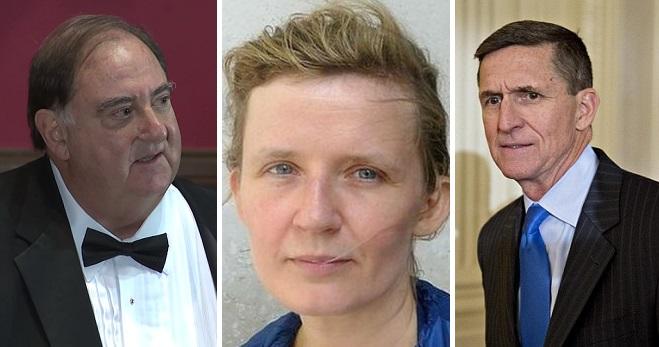
And as the case against Flynn continues to unravel, perhaps the most important dots have been connected by investigative researcher @JohnWHuber, better known as “Undercover Huber” on Twitter, who makes a cogent argument that Stefan Halper – the portly spy who the FBI used to conduct espionage on the Trump campaign during the 2016 US election – may have sparked the Flynn investigation after lying to the FBI.

What’s more, IG Michael Horowitz’s report makes no mention of the lie, or the recently-learned fact that the FBI tried to close the Flynn case, dubbed ‘Crossfire Razor’, in Jan. 2017, only for agent Peter Strzok to go ‘off the rails‘ and demand it not be closed.

Thread by Undercover Huber

Continued (emphasis ours):

  • According to the IG, Stefan Halper (referred to as “Source 2”) met with the Crossfire Hurricane team twice (in Aug 11 and 12, 2016) and told them “he had been previously acquainted with @GenFlynn”. *This was immediately before the FBI opened a case on Flynn on Aug 15, 2016*
  • The IG report is silent on anything Source 2 might have said specifically about Flynn. It’s also silent on the fact the Washington Field Office of the FBI tried to close the Flynn case on 01/04/2017. Both are going to be important in a second.
  • We now know from the FBI’s draft “Electronic Communication” dated 01/04/2017 (trying to close the Flynn CI case, stopped by Strzok at the direction of Comey, McCabe or both) confirms the “CH” team “contacted an established FBI CHS to query about” Gen Flynn & held a “debriefing”
  • Except that story is a *lie*. Halper wasn’t at that event. He witnessed nothing, because he wasn’t there. And the cab ride almost certainly didn’t happen either, because @RealSLokhova says she was picked up from the event by her Husband. And she’s willing to say that under oath.
  • There are multiple pictures of that Cambridge Seminar event (attended by about 20 people). Flynn was there, as was Richard Dearlove (former head of MI6), and Christopher Andrew (then mentor of @RealSLokhova and “unofficial” historian of MI5). But Halper wasn’t. Not in any photos.
  • Halper’s lawyers never challenged that statement. Even when the federal Judge dismissed @RealSLokhova’s case (for other reasons), he did not challenge that claim, only saying that “even assuming it was false” that Halper “attended” the dinner, it wasn’t defamatory to claim he did
  • And the FBI trying to close the case on Flynn is great evidence Halper’s “attendance” at this event so he could see this suspicious cab ride is false. The FBI never tried to interview @RealSLokhova, or anyone at the dinner. Why? Because it would have proven their own source lied.
  • FYI, WaPo, WSJ and NYT have all published stories claiming that Halper attended that Feb 2014 event. None have any evidence that’s true. All the stories are anonymously sourced to Halper or Halper’s buddies. There never will be any evidence Halper was there, because he wasn’t.
  • So when Halper told the FBI that he was “previously acquainted” with Flynn, and “witnessed” this suspicious cab ride, HE WAS LYING TO THE FBI. And at the time, he was a paid Confidential Human Source – the only one cited in the @carterwpage
     FISA, other than Steele.

    That’s big.

  • But what’s arguably bigger is WHEN Halper told this lie about Flynn. When else could Halper claimed to have been “acquainted” with Flynn if not this Feb 2014 dinner (the only time Flynn attended the Cambridge seminar Halper helped organize)?

  • Now, maybe Halper told the FBI about the dinner after the CI case was opened. But that’s NOT in the IG report, despite Halper’s other meetings with the FBI being in there. In fact the IG report says nothing about Halper and Flynn, other than what I quoted

  • In addition, FBI’s Jan 4, 2017 draft Closing EC doesn’t say when this “debriefing” with Halper happened  either. The wording sort of implies it was after the case was opened, but never says it

    So it is possible that a lie from Halper actually triggered opening the case on Flynn?

  • What else did the FBI have? Their own laughable “predicate” appears to be that Flynn worked for Trump, attended an RT dinner (at the time, @RepAdamSchiff
     had previously appeared on RT!), and was “linked” to Russians (Er, he was the former head of DIA under “Russian reset” Obama)

  • Ah, but all of those things were already true between Aug 1 and Aug 10, 2016, which is when the FBI opened cases on Page, Papadopoulos and Manafort – BUT NOT FLYNN. That didn’t happen until Aug 15. He’s the odd one out.

  • Flynn obviously already worked for Trump. He already had these “links”, and he’d already attended the RT dinner long ago. The thin gruel of Russian “links” and working for Trump was enough to open cases on all the others, but NOT Flynn.

  • But what did the FBI have extra before they opened the case? Stefan Halper telling them about being “previously acquainted” with Flynn – which almost certainly refers to that Feb 2014 Cambridge dinner, where he was never “acquainted” with Flynn at all.

  • Oh, & even if Halper told this lie *after* the case was opened on Flynn, the FBI mustn’t have found it credible because they never tried to properly investigate it, and then even tried to close the case anyway. So that means at best the lie came between Aug 15, 2016 & Jan 4, 2017

  • What else was happening between Aug 16 & Jan 17? Oh yeah, the FBI was using a person they should have suspected of lying to dirty people up – Halper – as a CHS wearing a wire on @carterwpage, @GeorgePapa19 and others, AND relying on Halper as “Source #2” in the FISA warrant apps

  • Then, incredibly after their own source lies to them about Flynn to dirty him up, the FBI have the audacity to charge Flynn with lying to them! Corrupt dirty cops isn’t an adequate description. And for all we know, Halper is STILL on Wray’s FBI books as a paid confidential source

  • Finally, IG Horowitz blew this line of inquiry, and didn’t mention anything about the FBI trying to close the case on Flynn in Jan 2017. Horowitz also admitted hasn’t seen any evidence that any of Halper’s information was ever corroborated during his entire time as an FBI source

  • Durham can do what the IG didn’t, and solve this mystery quite easily with a few interviews and record checks.

    Or, the DOJ/USG can keep Halper on his retainer and ignore this. Either way, we’ll know what’s up

    /ENDS


Tyler Durden

Sun, 05/03/2020 – 14:25

via ZeroHedge News https://ift.tt/2ymTLl5 Tyler Durden

Chicago Mayor Lori Lightfoot Warns Stay-At-Home Violators: ‘We Will Take You To Jail, Period’

Following reports of half a dozen parties being held around the Chicago area this weekend, Mayor Lori Lightfoot issued a sinister warning to stay-at-home violators: “We will take you to jail, period.”

She then proceeded to yell at a small group of teens who were hanging out in a parking lot across the street. It was a moment that brilliantly captured the collapse of common sense among government officials trying to enforce an extreme and increasingly unreasonable form of social distancing.

Lightfoot’s press conference on Saturday addressed the news that Chicago police had broken up several social events with more than 50 people in attendance on Friday. The authorities had learned that more parties were expected to take place on Saturday and Sunday.

“We will shut you down, we will cite you, and if we have to, we will arrest you,” said Lightfoot. “Don’t make us treat you like a criminal, but if you act like a criminal and you violate the law and refuse to do what’s necessary to save lives in the middle of a pandemic, we will take you to jail, period.”

Social events with a large number of attendees are not a good idea right now, given that the disease is still spreading. I can understand the mayor wanting to prevent these kinds of things, though it’s prudent to wonder whether threatening, arresting, and sending people to jail is ultimately in anyone’s best interest, since it’s likely to involve a lot of additional physical contact. Government officials need to understand that the willingness of citizens to obey shelter-at-home orders is not going to last forever, and lockdown enforcers need to think critically about how they will respond.

Immediately following the press conference, Lightfoot demonstrated that she isn’t thinking critically at all. The mayor walked across the street with her entourage and yelled at several teens who had dared to congregate outside that they needed to return to their homes. Several of the teens were wearing masks, and most were not standing very close together, meaning that this was low-risk behavior. It made no difference to Lightfoot, though.

Several videos of people going to parks and beaches all over the U.S. went viral on social media this weekend, prompting bouts of shaming from those who still support vigorous quarantining (even though many of the people being called out were indeed in compliance with social distancing). As nicer weather sets in, government officials should expect to see more people leaving their homes. It can’t be stopped. The right approach is to encourage reasonable social distancing: stay in small groups, remain six feet away from others when possible, wear masks in environments like grocery stores, and so on.

People need to apply common sense—and that goes for the people who are supposed to follow the rules, and for the people making them.

from Latest – Reason.com https://ift.tt/3fdRDNd
via IFTTT

The Coronavirus Will Make A Mirage Of Saudi Arabia’s Vision 2030

The Coronavirus Will Make A Mirage Of Saudi Arabia’s Vision 2030

Submitted by The New Arab,

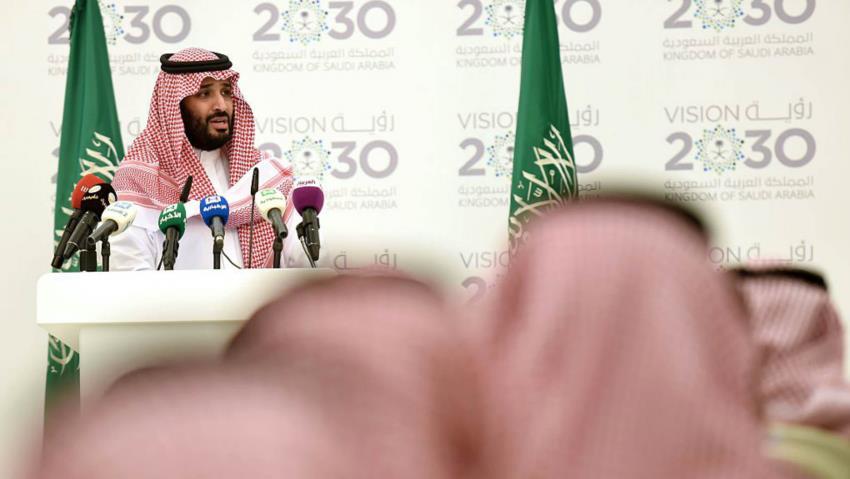
As Saudi Arabia struggles to salvage its ailing economy and move away from oil dependency, the coronavirus crisis has rendered Crown Prince Mohammad bin Salman’s (MbS) future ambitions even more fragile. And as the world faces the prospect of a global recession, there’s good reason to believe Saudi Arabia will not be spared.

As nations the world over moved into lockdown, reigning King Salman on 19 March warned that the kingdom faced a “more difficult” battle ahead amid the coronavirus crisis and oil price war with Russia, both of which put the Saudi kingdom’s very stability at risk. 

Though Saudi Arabia has presented itself as a leader in the battle against coronavirus, with King Salman hosting the G20 meeting on 26 March to address responding to the pandemic, Riyadh’s own emerging troubles and apparent mismanagement of the crisis were brushed over, in what was was largely a PR measure.

Saudi Arabia initially politicised the coronavirus pandemic, for instance cordoning off the Shia-majority Qatif region on 8 March, after pilgrims returned from Iran, and then blamed Iran for not managing the problem. One Saudi journalist even crudely accused Qatar of creating the virus to undermine Saudi Arabia’s Vision 2030 and the United Arab Emirates’ Dubai Expo 2020.

Furthermore, in a move which migrant advocates deemed inhumane, Saudi Arabia deported thousands of Ethiopian migrants in the first 10 days of April, as its economy contracted, risking further spreading the virus.

Reports suggesting that Saudi Arabia faces a staggering 200,000 recorded cases, and that up to 150 members of the royal family already have Covid-19, mean that the virus could shake the kingdom to its foundations. Such fears have forced Riyadh to act more seriously, imposing 24-hour curfews in major cities on 6 April, and creating a stimulus package of 120 billion Saudi riyals ($32 billion) to revitalise the economy and provide extra assistance to small and medium sized businesses.

This week in Saudi Arabia concerns over food shortages emerged, after promotional deals on food staples, including rice and vegetable oil were banned.

Yet Mohammed bin Salman’s ambitious Vision 2030, designed to diversify and “modernise” Riyadh’s economy while reducing its oil dependency, could be one of coronavirus’ greatest casualties. The scheme has already stagnated, highlighting the far-fetched prediction that by 2020 the kingdom would shift away from oil dependency – a far cry from the reality. 

More critically, MbS could lose out on one of his prized assets: the annual Hajj pilgrimage, due to take place from 28 July until 2 August this year.

The Hajj pilgrimage is a central element of Saudi Arabia’s economic prosperity, offering more immediate revenue than other new and so far unstable sources. The two holy cities of Mecca and Medina have long been used to legitimise Saudi Arabia, positioning itself as Islam’s patron.

Under MbS’ plan to shift away from oil, the annual Hajj pilgrimage started to bring in on average $12 billion per year, and revenues were forecast to reach $150 billion by 2022.

Yet unprecedented and shocking scenes of the Kaaba inside  Mecca’s empty Grand Mosque point to a grim reality for MbS’ plans. Even the deadly so-called Middle East Respiratory Syndrome (MERS) of 2012 did not force a cancellation of Hajj.

After halting travel to Mecca and Medina in late February, Saudi Hajj Minister Mohammed Banten on March 31 requested the roughly 2 million pilgrims to Hajj put their plans to make the trip in July and August on hold. Umrah, the ‘lesser’ but still significant pilgrimage which can take place annually, has also been indefinitely closed.

Experts believe that lockdowns ending and some normal activity resuming by summer 2020 is an absolute best case scenario, while others predict travel plans may not resume for longer. This threatens Riyadh with a loss of vital religious tourism revenue, after having built luxurious hotels to commercialise Hajj, and damaging MbS’ moves to further profit from the pilgrimage.

However, this is not the only impact of coronavirus on Saudi Arabia’s Vision 2030, which will face further disruptions in the short and medium term. Riyadh will have to put many business and tourism projects on hold, such as its $500 billion futuristic city, Neom.

As much of the world will likely fall into a recession, the International Monetary Fund (IMF) expects Saudi Arabia’s economy to contract 2.3 percent in 2020, with its non-oil GDP falling by 4 percent. Though less than the United States’ expected loss of 5.9 percent, Riyadh still stands to make long-term losses for its plans. A recession would impact investors’ desire to invest in Saudi Arabia, leaving Vision 2030 an even more distant prospect.

In fact, Riyadh’s economic vulnerability became clear after demand for oil plummeted amid the coronavirus crisis and the oil price war with Russia, creating the biggest oil shock since 1973 – which, in contrast to the current crisis – created higher oil prices.

Though both countries agreed to a mutually acceptable deal to cut production last week, oil prices are still arguably too low to revitalise Riyadh’s economic growth. Demand has fallen by between 25 and 35 million barrels per day – still much higher than the 9.7 billion barrels per day oil producing nations agreed to cut. Analysts are already warning that continued lower oil prices could further widen Saudi Arabia’s deficit.

More critically, Saudi Arabia’s price war with Russia revealed an ongoing dependency on oil economic development, while lower revenues mean less ability to invest in its non-oil sectors. With exports sinking, and limited hope for short-term recovery, Saudi Arabia is ultimately likely to struggle as a result.

Unlike other countries, Saudi Arabia has enough financial reserves to withstand this current crisis, though MbS will face an uphill battle to restore his vision. Already pursuing an erratic power-grab with another round of royal arrests in March, MbS has driven Saudi Arabia’s increasingly aggressive nationalist stance in parallel with these economic reforms.

Coronavirus will further trigger panic in MbS’ mind, likely leading to more irrational measures to protect his grip on power. More so than ever before, Saudi Arabia’s future looks increasingly fragile.


Tyler Durden

Sun, 05/03/2020 – 14:00

via ZeroHedge News https://ift.tt/2VWSbze Tyler Durden

Chicago Mayor Lori Lightfoot Warns Stay-At-Home Violators: ‘We Will Take You To Jail, Period’

Following reports of half a dozen parties being held around the Chicago area this weekend, Mayor Lori Lightfoot issued a sinister warning to stay-at-home violators: “We will take you to jail, period.”

She then proceeded to yell at a small group of teens who were hanging out in a parking lot across the street. It was a moment that brilliantly captured the collapse of common sense among government officials trying to enforce an extreme and increasingly unreasonable form of social distancing.

Lightfoot’s press conference on Saturday addressed the news that Chicago police had broken up several social events with more than 50 people in attendance on Friday. The authorities had learned that more parties were expected to take place on Saturday and Sunday.

“We will shut you down, we will cite you, and if we have to, we will arrest you,” said Lightfoot. “Don’t make us treat you like a criminal, but if you act like a criminal and you violate the law and refuse to do what’s necessary to save lives in the middle of a pandemic, we will take you to jail, period.”

Social events with a large number of attendees are not a good idea right now, given that the disease is still spreading. I can understand the mayor wanting to prevent these kinds of things, though it’s prudent to wonder whether threatening, arresting, and sending people to jail is ultimately in anyone’s best interest, since it’s likely to involve a lot of additional physical contact. Government officials need to understand that the willingness of citizens to obey shelter-at-home orders is not going to last forever, and lockdown enforcers need to think critically about how they will respond.

Immediately following the press conference, Lightfoot demonstrated that she isn’t thinking critically at all. The mayor walked across the street with her entourage and yelled at several teens who had dared to congregate outside that they needed to return to their homes. Several of the teens were wearing masks, and most were not standing very close together, meaning that this was low-risk behavior. It made no difference to Lightfoot, though.

Several videos of people going to parks and beaches all over the U.S. went viral on social media this weekend, prompting bouts of shaming from those who still support vigorous quarantining (even though many of the people being called out were indeed in compliance with social distancing). As nicer weather sets in, government officials should expect to see more people leaving their homes. It can’t be stopped. The right approach is to encourage reasonable social distancing: stay in small groups, remain six feet away from others when possible, wear masks in environments like grocery stores, and so on.

People need to apply common sense—and that goes for the people who are supposed to follow the rules, and for the people making them.

from Latest – Reason.com https://ift.tt/3fdRDNd
via IFTTT

“Ashy & Bloated”: Analysts Pore Over Kim Jong Un Photos For Clues To Mystery Absence

“Ashy & Bloated”: Analysts Pore Over Kim Jong Un Photos For Clues To Mystery Absence

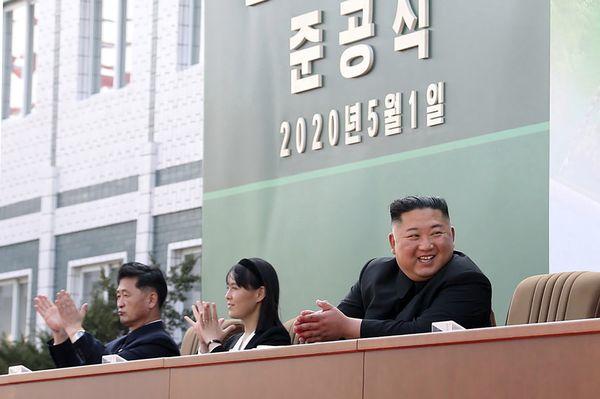
Trump somewhat controversially reacted to Kim Jong Un’s Friday public reemergence at a ceremony at Sunchon Phosphatic Fertilizer Factory as follows after a 20-day absence by tweeting, “I, for one, am glad to see he is back, and well!”

Pyongyang has vehemently denied both that the North Korean leader has recently suffered any health complications or that he had heart surgery in the first place. But analysts in the West have since been poring over the photo set released in state media. 

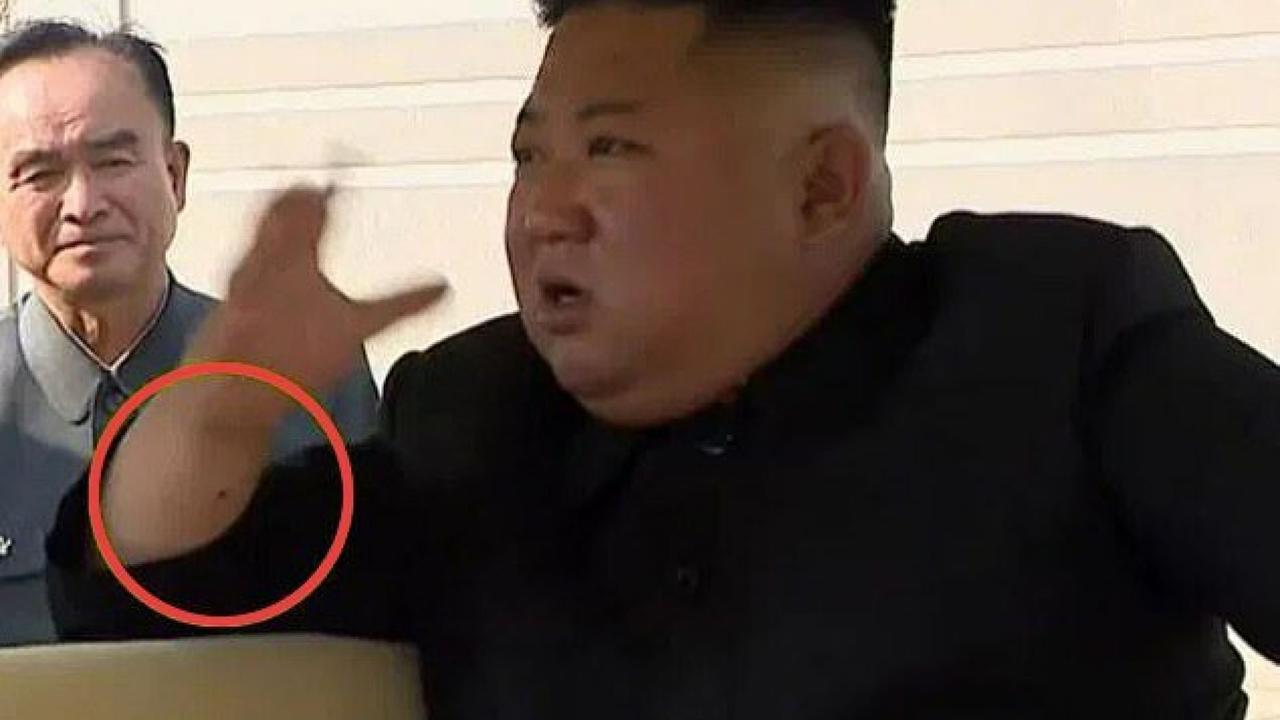
For starters, a new mark on his right wrist strongly suggests the 36-year old could have just gone through a procedure. Below are notable photos and new observations being circulated in media reports.

Small wrist puncture:

Fox News cites experts to make the following observation

“It looks like a right radial artery puncture … [which is] often used for access to the coronary arteries for stent placement,” one U.S.-trained medical professional told NK News, adding it appeared to be “about a week old.”

“It is hard to tell from the foreshortening of the photograph, but it seems a bit medial. It is not an IV [intravenous], which wouldn’t leave such a mark.”

A South Korea surgeon also told NK News that the mark on Kim’s arm “looks more plausible to be a procedure or check-up mark from a procedure on a heart-related issue.”

Closer examination of the video footage has revealed what appears to be a needle mark on Kim’s right wrist, a mark that medical experts say could indicate that Kim had a “cardiovascular procedure.”

Ashy and bloated:

A major medical procedure like heart surgery in most cases results in noticeable weight lost, but this didn’t appear to be the case in Kim’s latest public appearance.

Wearing a Mao suit and with a fresh hair cut, many observed that he’s not looking his best, but also doesn’t seem like someone on the verge of death days prior, as many unsubstantiated rumors and reports held.

Kim’s Sister:

It’s believed that should anything happen to Kim Jong Un, his younger sister Kim Yo Jong would likely take power. 

Notably she was the closest in proximity to the leader during Friday’s factory visit. Reports Bloomberg, “Such proximity is often used by North Korean propaganda organs to indicate the leader’s favor and might show that the worldwide discussion about her taking his place hadn’t damaged her standing.”

She, like here brother, is relatively young at 30-years old.

Kim Yo Jong, center, on May 1 at the ceremony, via KCNA/Korea News Service, AP/Bloomberg

Golf cart a sign of recovering from something?

Analysts have noted he rarely uses such short distance transport in official appearances. 

Could it suggest a fatigued or weakened health situation, or that he’s recovering from a procedure? Of course, it could be as simple as standard procedure at such a large complex as a fertilizer factory.

Threat of coronavirus

From the beginning of the great “where’s Kim” saga which began following his prior April 11 appearance, given he failed to show up at major public events like his grandfather’s birthday anniversary, a national event, it was suggested especially in South Korea media that he was taking precautions against coronavirus.

This also after one among his bodyguard entourage was reported to have tested positive for COVID-19. But in the newest footage, there are very few around with facemasks or protective gear, which signals Pyongyang’s consistent downplaying that the pandemic has impacted the country.

Some personnel working within the factory, however, are seen working at terminals with masks.

Interestingly, Kim is also seen smoking at one point in the official state media footage, unlikely in the event that had heart surgery days ago. 

Or also it could be intentionally meant to throw onlookers off in terms of just such a suspicion.

* * *

As we described from the start of our own initial reporting on the matter last month: First, it should be noted that the Western mainstream press often gets North Korea completely wrong — and in the case of the latest speculation a high degree of critical skepticism is warranted further given the initial source for the heart surgery claims was a US state-funded media outlet based in South Korea, the Daily NK website.

This appears to have happened yet again. No doubt Pyongyang enjoys when it can keep the outside world guessing and in a breathless state of speculation, only to later have a ‘last laugh’ when pundits get it wrong.


Tyler Durden

Sun, 05/03/2020 – 13:35

via ZeroHedge News https://ift.tt/3fgWYmM Tyler Durden

The Case Of General Flynn: Exposing Washington’s “Big Game Of Liars’ Poker”

The Case Of General Flynn: Exposing Washington’s “Big Game Of Liars’ Poker”

Authored by ‘Zman’ via TheZman.com,

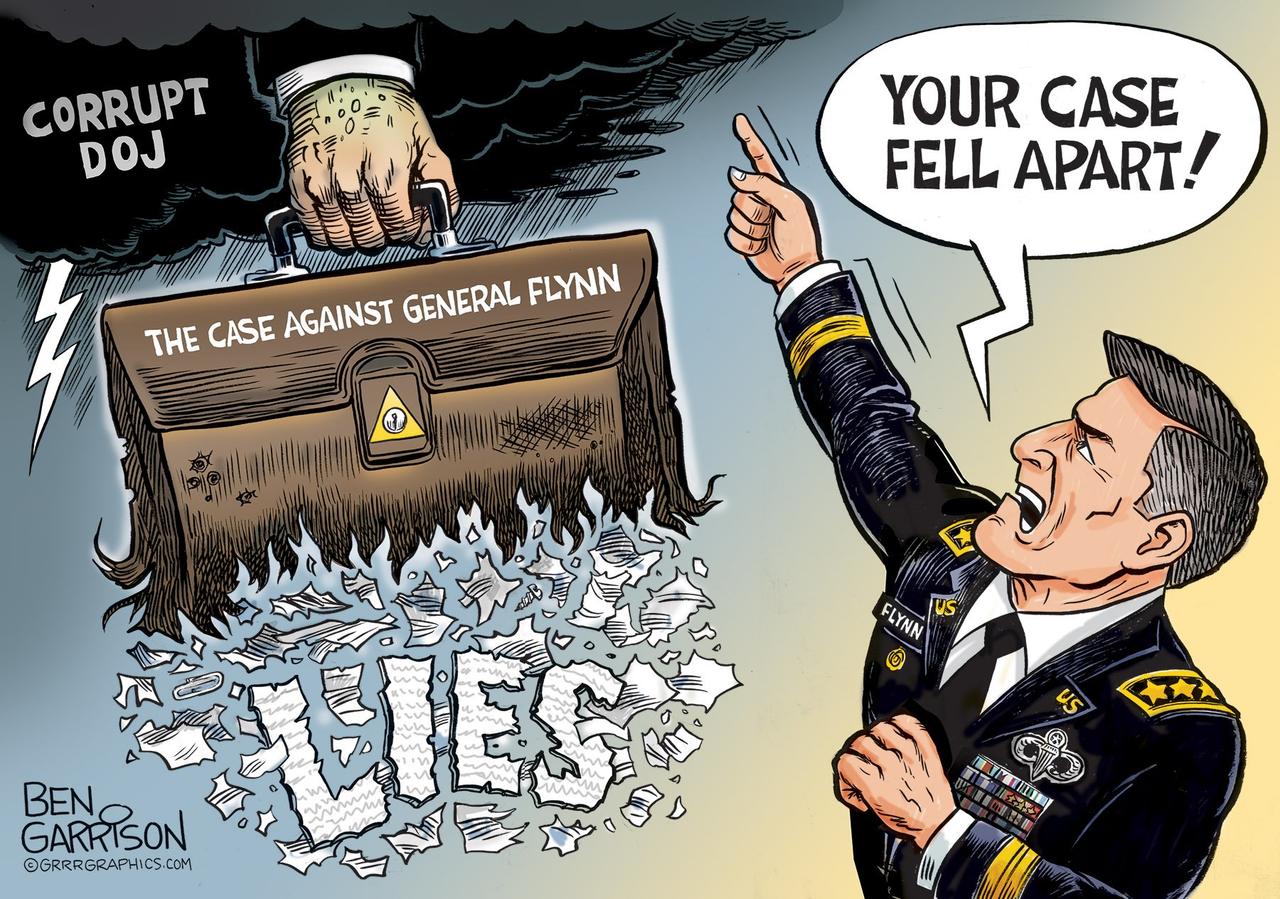
The case of General Flynn, which has dragged on for years now, may finally be reaching a denouement. He was charged with and pleaded guilty to making false statements to the FBI during the Russian collusion hoax. For reasons that have not been clear, he was never sentenced. Now it appears he may never see jail and will instead see his case dropped and his guilty plea vacated. New evidence shows he was framed by members of the FBI and Department of Justice.

As is standard procedure in this age, state media has been silent on the matter, but alternative media sources are reporting on the release of classified documents hidden by the government from Flynn’s defense team in violation of the law. Thousands of documents held by his former defense team and hidden from Flynn and his new attorney’s until now have also been released in what appears to be a damage control operation by the law firm Covington & Burling.

What these new FBI documents reveal is the FBI and Department of Justice carefully planned to entrap General Flynn by tricking him into making inaccurate statements about his activities during the campaign. They did this because they wanted to remove him from his post in the White House and hoped he could be manipulated into making accusations against other administrative officials. Then they systematically lied about what Flynn said to them in his interview with the FBI.

Compounding this is the fact that the FBI and Departmental of Justice systematically withheld all documents that could be used by Flynn in his defense. One way they did this was to hide them in the special counsel operation. This prevented anyone, not just Flynn’s defense team, from discovering the plot. The sudden release of long withheld documents by Covington & Burling suggest they may have been part of the plot to entrap Flynn and get him to plead guilty to a crime.

At this stage, only a partisan fanatic thinks the principals in this whole Russian collusion caper were operating in good faith. You could make the argument that their behavior was unethical, but not necessarily illegal. Even if their actions violated the law, you could argue they did so in the belief they were within the bounds of the law. With these new revelations, it is clear they knew they were breaking the law in an effort to frame General Flynn as part of a much larger conspiracy.

One thing that is now confirmed with these new revelations is that the Special Counsel was always just part of a larger effort to cover-up this conspiracy. In fact, that was the whole point of it. The FBI and DOJ officials involved in the conspiracy would hide all of the evidence inside the counsel’s operation. This would make it impossible for the defense lawyers to access and very difficult for Congress to access. It would also prevent the administration from looking into it.

Another outrageous aspect to this case is that it appears that Flynn’s original defense team, Covington & Burling, may have been in on the plot to frame him. It’s not all that clear at this point, but the best that can be said of their actions on behalf of their client is they are the worst law firm in the country. They exist because they have resources and know how things work in Washington. Despite this, they made the sorts of errors TV writers would find too ridiculous for a legal drama.

There’s also the fact that this sort of behavior by the FBI and DOJ is business as usual, which underscores the corruption. This is not a couple of renegades. This is just how things are done by the government. They frame people for crimes then work to prevent them from getting a proper defense. The FBI has a long history of framing the innocent, but it was always confined to the field offices. Now it is clear that the institution is rotten from the head to the tail. It is hopelessly corrupt.

It is also increasingly clear that the weaselly Rod Rosenstein was the man tasked with orchestrating the cover-up after the election. He manipulated Sessions and Trump into firing Comey and then agreeing to the Mueller charade. The only purpose to that operation was to cover up the illegal spying. Then there is Comey, who claimed under oath to be the guy who ordered the Flynn investigation. He may have arrogantly admitted to initiating multiple Federal crimes.

Of course, the big question in all of this is whether Washington is so hopelessly corrupt that none of this amounts to anything. In banana republics, the judge in the case would be assassinated or intimidated into ignoring the facts and sentencing Flynn to jail. We may not be there yet, but the lack of any substantive investigation into the FBI corruption suggests no one will be charged with anything. The principals in this scandal are now in high six figure positions in Washington, living the good life.

Now, it is possible that Bill Barr was not prepared for the scale of corruption that has been revealed in this case. He may have truly thought it was a few bad apples that went off on their own. Once the scale of the corruption was known, he had to change course and bring in outside help. It’s just as possible that he is part of the problem. He is friends will most of these people. His role in this could simply be part of the how Washington is neutralizing Trump and preparing him for expulsion.

There is one puzzle that gets no attention. Why would the government keep delaying Flynn’s sentencing after he agreed to the deal? They said he was cooperating, but he had nothing to offer them and they knew it. Perhaps he was just a prop to maintain the greater narrative of the Russian hoax. By dragging out his process they could feed fake news to state media, claiming it was from Flynn. That’s seems to be a too cute by half, given the reality in Washington, but it is possible.

Ineptitude is always a possibility. There’s also the fact that highly corrupt institutions tend to have lots of internal intrigue and conflict. The old line about thieves sticking together is a myth. The corrupt man has no honor. As a result, the last stage for the corrupt institution is when the people inside beginning to scheme against one another to the point where they undermined their mutual efforts. Maybe that’s where things are in Washington now. It’s just one big game of liar’s poker.


Tyler Durden

Sun, 05/03/2020 – 13:10

via ZeroHedge News https://ift.tt/2Sx9a9o Tyler Durden

Deadly “Murder Hornet” Swarms Arrive In North America

Deadly “Murder Hornet” Swarms Arrive In North America

We nearly sprayed Red Bull all over our screens last night when we stumbled across a New York Times story with the headline “‘Murder Hornets’ in the U.S.: The Rush to Stop the Asian Giant Hornet”.

Americans who were alive all the way back in the late 1990s (as well as the mid-2010s) probably recall the panic that erupted over the rise of the ‘africanized’ honeybee. The hyper-aggressive bees were reportedly wreaking havoc in South America while moving inexorably northward toward Texas.

Whatever happened next, nobody really remembers: the bees apparently gave up, or joined the Wu Tang Clan. We’re not really sure.

But as North America and South America struggle to suppress SARS-CoV-2, it appears a new breed of ‘killer bee’ has arrived – this time from Asia (Japan, to be exact). 

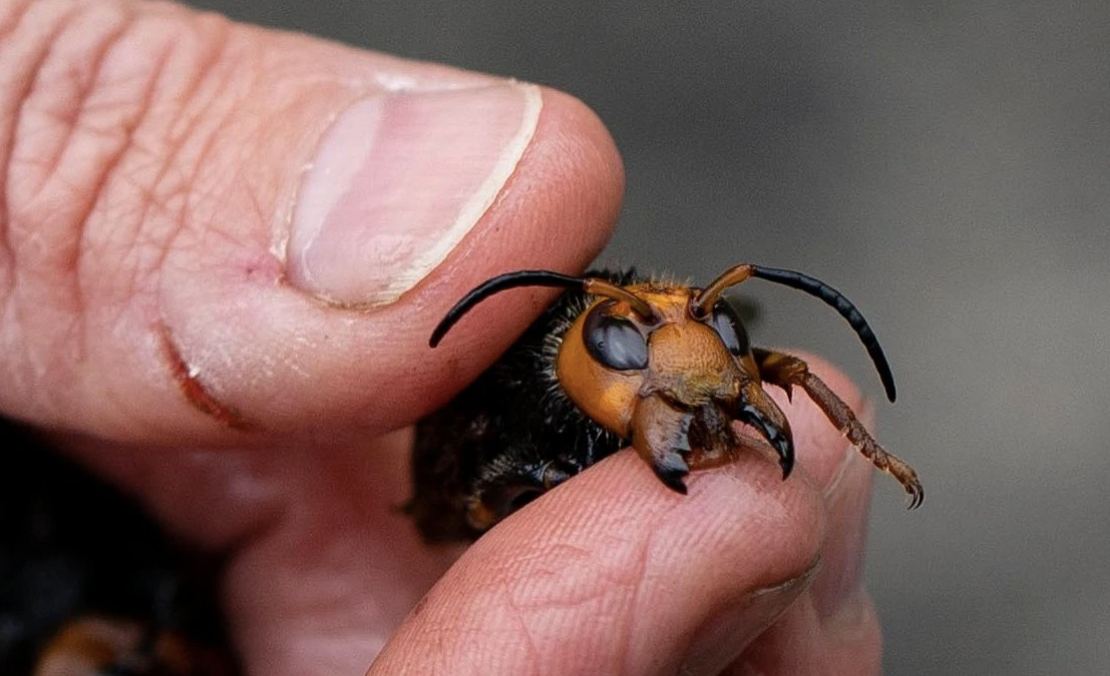
The Asian Giant Hornet – the Murder Hornet’s government name – is much larger and significantly more aggressive than its North American cousins. Queens can grow to be more than 2 inches wide. And the soldiers posses powerful venomous stingers. Only a handful of the bees have been officially cited in North America over the last year. But several reports of beehives being ‘plundered’ suggest swarms of the hornets might be active in the US.

One beekeeper who went to check on his hive one day only to find the entire colony had been brutally murdered. The heads of the soldiers had been seemingly twisted off their thoraxes and left behind as evidence of the attack. The beekeeper was stunned. In his decades of experience, he had never seen anything like it.

There was only one likely explanation.

In his decades of beekeeping, Ted McFall had never seen anything like it.

As he pulled his truck up to check on a group of hives near Custer, Wash., in November, he could spot from the window a mess of bee carcasses on the ground. As he looked closer, he saw a pile of dead members of the colony in front of a hive and more carnage inside – thousands and thousands of bees with their heads torn from their bodies and no sign of a culprit.

“I couldn’t wrap my head around what could have done that,” Mr. McFall said.

Only later did he come to suspect that the killer was what some researchers simply call the “murder hornet.”

Since the attack, scientists in the US have begun a full-scale search for any evidence of murder hornets. Should the invasive species be allowed to populate, the risks to our ecosystem are surprisingly high. Murder bees could wipe out the population of most North American honeybees.

For people who don’t understand how nature works, this NYT story explains how bees are essentially the foundation of the food supply chain because they help pollinate crops.

Since two Murder Hornets were discovered in Washington State not far from the ravaged hive, scientists are starting their search in the Pacific Northwest.

Mr. McFall still is not certain that Asian giant hornets were responsible for the plunder of his hive. But two of the predatory insects were discovered last fall in the northwest corner of Washington State, a few miles north of his property — the first sightings in the United States.
Scientists have since embarked on a full-scale hunt for the hornets, worried that the invaders could decimate bee populations in the United States and establish such a deep presence that all hope for eradication could be lost.

“This is our window to keep it from establishing,” said Chris Looney, an entomologist at the Washington State Department of Agriculture. “If we can’t do it in the next couple of years, it probably can’t be done.”

The NYT describes the hornet’s distinctive look as resembling a caricature of Spider-Man’s mask.

Beyond its size, the hornet has a distinctive look, with a cartoonishly fierce face featuring teardrop eyes like Spider-Man, orange and black stripes that extend down its body like a tiger, and broad, wispy wings like a small dragonfly.

Mr. Kornelis contacted the state, which came out to confirm that it was indeed an Asian giant hornet. Soon after, they learned that a local beekeeper in the area had also found one of the hornets.

Dr. Looney said it was immediately clear that the state faced a serious problem, but with only two insects in hand and winter coming on, it was nearly impossible to determine how much the hornet had already made itself at home.

Over the winter, state agriculture biologists and local beekeepers got to work, preparing for the coming season. Ruthie Danielsen, a beekeeper who has helped organize her peers to combat the hornet, unfurled a map across the hood of her vehicle, noting the places across Whatcom County where beekeepers have placed traps.

“Most people are scared to get stung by them,” Ms. Danielsen said. “We’re scared that they are going to totally destroy our hives.”

Wildlife officials in Vancouver assigned a local beekeeper the task of exterminating a hive of murder hornets discovered on Vancouver Island in British Columbia. The keeper tried to sneak up on the hive at night, when all the bees would be home. But he made a grave error that triggered what could have been a fatal assault.

Crews were able to track down the hive on Vancouver Island. Conrad Bérubé, a beekeeper and entomologist in the town of Nanaimo, was assigned to exterminate it.

He set out at night, when the hornets would be in their nest. He put on shorts and thick sweatpants, then his bee suit. He donned Kevlar braces on his ankles and wrists.

But as he approached the hive, he said, the rustling of the brush and the shine of his flashlight awakened the colony. Before he had a chance to douse the nest with carbon dioxide, he felt the first searing stabs in his leg — through the bee suit and underlying sweatpants.

“It was like having red-hot thumbtacks being driven into my flesh,” he said. He ended up getting stung at least seven times, some of the stings drawing blood.

Fortunately, the brave keeper was able to eliminate the colony, but not without suffering through the most painful mission of his career.

Jun-ichi Takahashi, a researcher at Kyoto Sangyo University in Japan, said the species had earned the “murder hornet” nickname there because its aggressive group attacks can expose victims to doses of toxic venom equivalent to that of a venomous snake; a series of stings can be fatal.

The night he got stung, Mr. Bérubé still managed to eliminate the nest and collect samples, but the next day, his legs were aching, as if he had the flu. Of the thousands of times he has been stung in his lifetime of work, he said, the Asian giant hornet stings were the most painful.

The mild temperatures of moist woods of Washington State present an ideal habitat for the ‘Murder Bees’ to breed. Entomologists have been setting traps in heavily wooded areas in hopes of catching a Queen looking for an ideal location to start a colony. So far, they haven’t had any luck – which is unfortunate since genetic testing has determined that there have likely been at least two “introductions” – ie established hives” – in the Pacific Northwest.

A genetic examination, concluded over the past few weeks, determined that the nest in Nanaimo and the hornet near Blaine were not connected, said Telissa Wilson, a state pest biologist, meaning there had probably been at least two different introductions in the region.

Dr. Looney went out on a recent day in Blaine, carrying clear jugs that had been made into makeshift traps; typical wasp and bee traps available for purchase have holes too small for the Asian giant hornet. He filled some with orange juice mixed with rice wine, others had kefir mixed with water, and a third batch was filled with some experimental lures — all with the hope of catching a queen emerging to look for a place to build a nest.

He hung them from trees, geo-tagging each location with his phone.

In a region with extensive wooded habitats for hornets to establish homes, the task of finding and eliminating them is daunting. How to find dens that may be hidden underground? And where to look, given that one of the queens can fly many miles a day, at speeds of up to 20 miles per hour?

We suspect the newfound interest in these scientists’ work will hopefully drive more resources their way, since most Americans (correctly) see the bugs as the stuff of nightmares.

Sometimes, reality can be just as funny as comedy.


Tyler Durden

Sun, 05/03/2020 – 12:45

via ZeroHedge News https://ift.tt/3c02c4d Tyler Durden

Don’t Expect Answers From Washington As The Fabric Of Society Unravels

Don’t Expect Answers From Washington As The Fabric Of Society Unravels

Authored by Bruce Wilds via Advancing Time blog,

One Face Of Unemployment Is Lost GDP

Unemployment has several faces. It will be interesting to see how America handles the massive unemployment caused not so much by COVID-19 but the government’s effort to hold employers responsible for the cost. When the government passed a law increasing employers’ responsibility for paying workers even when there was no work for them, businesses countered by mass firings. This was both the logical move and the only way most businesses could survive.

Over time the lack of gainful employment acts as a cancer upon society. Some of the poorly crafted legislation recently passed in the capital of our nation could be considered incentivizing people not to work. The evidence of this can be found in the reports of employees not wanting to return to work because they see themselves making just as much or even more money staying home or being unemployed. When we couple this with the fact many people are unmotivated when it comes to rushing off and working for “the man” it is fair to understand why some people have adopted the attitude, I won’t do that.

The evolution of the covid-19 crisis has disrupted supply chains and is starting to trigger food shortages across the country. It is causing many people to question whether an economic depression is unfolding as over 30 million people are now out of work after only six weeks. A matter of great speculation is just how rapidly the unemployment rate will fall back once this pandemic begins to subside.  Congress has decided to make it rather financially rewarding not to work, and millions upon millions of Americans are going to be more than happy to take advantage of that opportunity for as long as it lasts. It is only by creating a pathway that rewards those that wish to move upward on the social-economic ladder that this attitude can be changed.

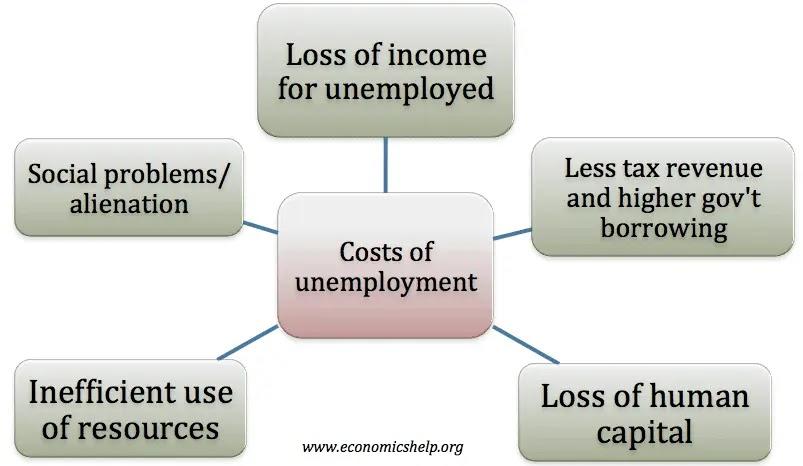
People tend to forget or push aside the matter of just how much unemployment cost society.

This cost takes many forms. There are economic and social costs in this situation. They include a slew of things from, lower on-the-job training to things such as alienation and lost GDP. This can result in homelessness, depression, and even increase drug or alcohol addiction.

Lurking behind all this is the fact that State governments get the money to pay claims by debiting the employer’s Unemployment Insurance account or by raising the employer’s UI taxes. A deduction in the account balance may also cause a rate increase, this means each claim assessed to an employer’s account can result in a tax rate increase in future years. The cost of an individual claim can be significant but the higher tax rate for a business often has a much greater long-term impact. Many states use a three-year moving period to assign a tax rate and an awarded unemployment claim can affect three years of UI tax rates. This means the average claim can increase an employer’s state tax premium from $4,000 to $7,000 over the course of three years.

These increased UI tax rates will have a huge impact on an employer’s bottom line in the near future and this is something that is not being addressed. Instead, the focus is on unemployment. The situation is considered so significant that the Coronavirus Aid, Relief, and Economic Security (CARES) Act has expanded unemployment benefits to self-employed and part-time workers through Pandemic Emergency Unemployment Assistance, which provides up to 39 weeks of benefits beginning on or after Jan. 27, 2020, and ending on or before Dec. 31, 2020.

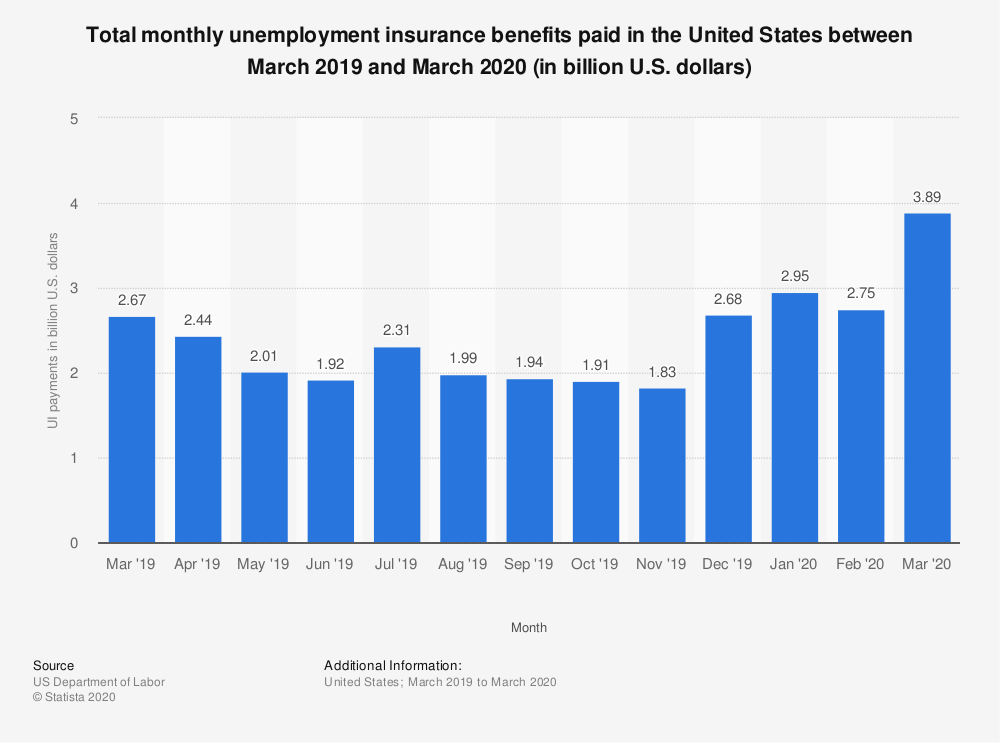
Above is a chart of what was paid out in recently in benefits. In March 2020, 3.89 billion U.S. dollars were paid out in unemployment benefits in the United States. This is an increase from February 2020, when 2.75 billion U.S. dollars were paid in unemployment benefits. This pales next to the more than 50 to 100 billion dollars we should expect to be paid out each month until this abates.

The ramifications resulting from this surge in unemployment have not yet been fully internalized, this is a huge deal. 

In the blink of an eye, the U.S. economy has wiped out all the job gains since the Great Recession and more. There were already 7.1 million unemployed Americans as of March 13, according to the U.S. Bureau of Labor Statistics. When this figure is combined with the newest job losses, we are looking at more than 33 million unemployed, or a real unemployment rate of 20.6%. This would be the highest level since 1934.

History shows that creating good sustainable jobs is no easy task. Considering the cost of massive unemployment is increased tax rates and social decay, it is time we face the great-conundrum of how best to save jobs. This massive unemployment surge poses a huge cultural shock that must not be ignored.

During the time ahead we should expect the fabric of society to be tested, it may even  unravel. Do not expect the answers to flow out of Washington but understand, now is the time we level the playing field between small and big business.

When all is said and done, Main Street matters more to most Americans than Wall Street.


Tyler Durden

Sun, 05/03/2020 – 12:20

via ZeroHedge News https://ift.tt/2Wm38th Tyler Durden