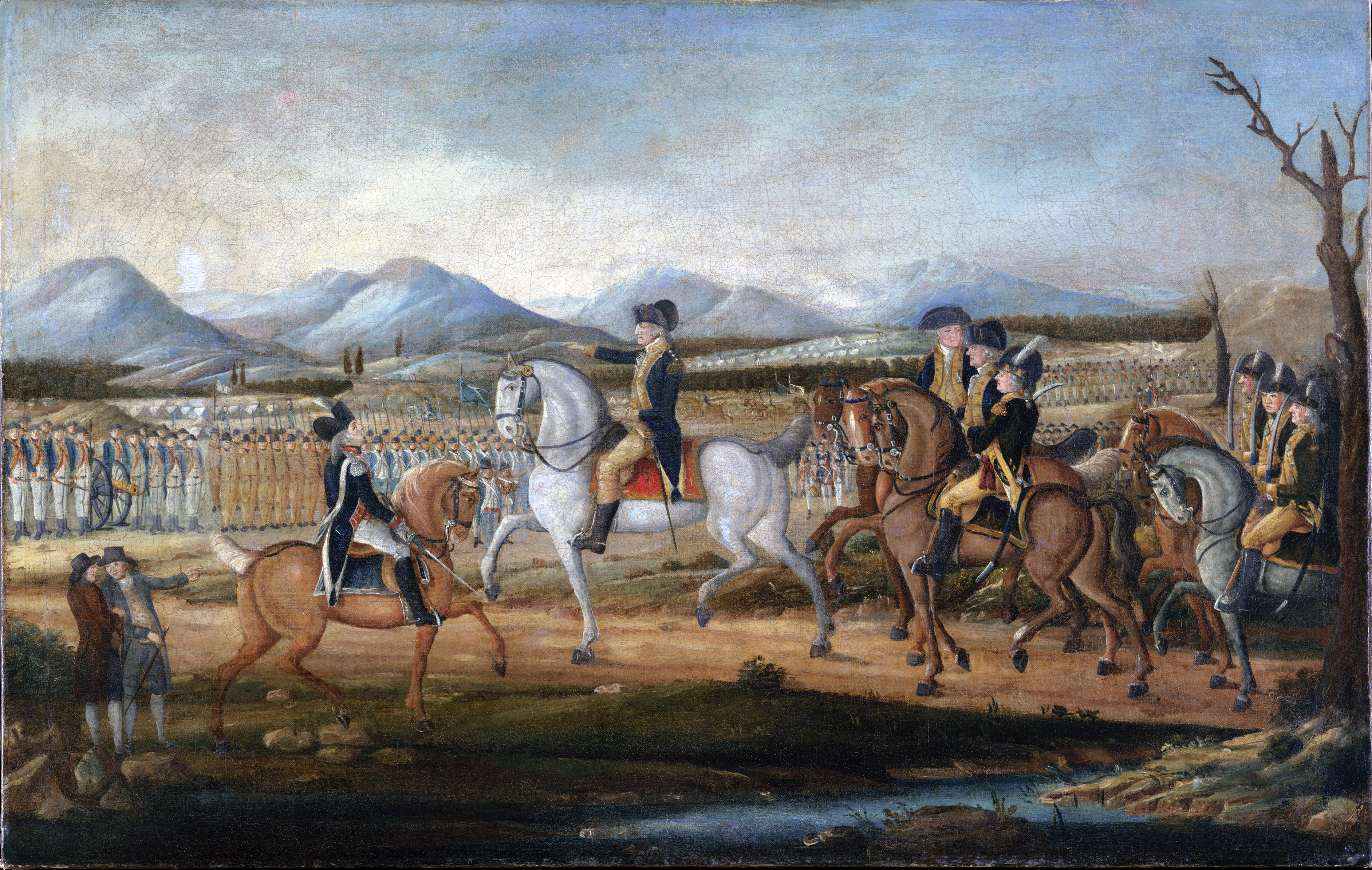
5/2/1927: Buck v. Bell decided.
from Latest – Reason.com https://ift.tt/2WxFjPt
via IFTTT
another site
5/2/1927: Buck v. Bell decided.
from Latest – Reason.com https://ift.tt/2WxFjPt
via IFTTT
Geopolitics Post-COVID-19
Authored by Alasdair Macleod via GoldMoney.com,
Before the coronavirus caused governments to impose lockdowns, whole economies, markets and even currencies were already on course to be destroyed by a vicious downturn in bank lending at a time of contracting trade and record debt. The additional strains from the virus have intensified the crisis further and quickened the pace of all aspects of monetary destruction.
The coronavirus has permitted America and other Western nations to adopt a war footing by restricting personal freedom in the interest of the state. As tensions against China rise and the global economic crisis escalates, these freedoms will be not be returned, being deemed to be against national interest.
This is an election year for America and the political system is already ramping up blame for the virus and her economic misfortunes against China. We are entering dangerous territory when politics mobilises hate against a supposed enemy by using propaganda tactics which are designed to stir up xenophobic anger.
How China responds will be crucial. Its leadership can defuse the situation with a few simple changes to its foreign policy, isolating America from her allies in the process. But does a highly bureaucratic communist leadership have the imagination to do so?
One thing is for sure: the world will be different when it emerges from the coronavirus crisis. Doubtless, on pain of likely death those over seventy years of age must remain prisoners in their own homes while the younger generations are tasked with the return to normality. All this is meant to be under government guidance of course. Over the coming months governments intend to save swathes of business sectors, such as banking, energy production, utilities and the rest, first by lending the money to pay the bills, and then by rescuing the failures, taking them into public ownership in many cases.
That is what the post-coronavirus environment can be expected to look like, if, as governments hope, the recovery is V-shaped. If not, then greater interventions will be visited on the population to protect it from itself.
While not necessarily intentioned, there has been and will continue to be a dramatic transfer of freedom from individuals to the state, which the state is always reluctant to let go when the crisis passes. The evocation of a war against the virus is to facilitate the transfer of peoples’ freedom to the state, because that is what is required to fight a war. But when it’s over, the bureaucrats’ instincts are never to return freedoms.
In the vast majority of cases, win or lose, following a war it is usual for a nation to retain the measures adopted, dropping none of them. It might be called a transitional economy, kept in place with all the war-time restrictions until an exit path, inevitably to greater socialism, can be devised. And for America there is a war still to be fought against China for global domination, justifying yet more control.
Welcome to the new post-coronavirus intensified socialism. As individuals we have given the state enormous power over our lives, which will almost certainly be consolidated. The direction of travel is clear. Not only can big brother censor us, but it can now track our movements more effectively than the old KGB. If you leave your home, leave your smartphone behind. Wear a wide-brimmed hat and change your gait, avoiding the cameras. Your money in the bank, or more correctly in your about-to-be-nationalised bank’s money credited to your account, can only be disposed of for state-regulated products by means of traceable transactions instead of old-fashioned cash.
Instead of the soviet, we have the nanny state. Nanny knows best. This is the real world of the 2020s. It is unnatural and will therefore eventually fail. In previous articles I have written about one aspect of its failure, and that is the impending collapse of unbacked state currencies. I have pointed out that central banks, and especially the Fed responsible for the world’s reserve currency, are embarking on an exercise in inflation designed, above all, to uphold the state by maintaining the values of its debt and therefore all other financial assets. If they fail, and they will because the task is too great, the currencies will fail as well, and remarkably quickly. Until then, free markets are a primal threat to the system and must not prevail.
Doubtless, deep state operatives everywhere believe that the threats from their own people can be contained. Taking that for granted, they are now moving on to contain threats from other states that don’t conform to the West’s democratic model. There is now much more propaganda coming out of America and the UK about the evil Chinese than the evil Chinese are disseminating about America and Britain.
The story being managed is of a devious state, somehow stealing our souls by selling us their technology. Mobile 5G puts China into our homes and controls our internet of everything. It will allow the Chinese to control us. What is not explained is why it is in China’s interest to abuse its customers in this way. What is not explained is why we, as individuals, will be better off not having Chinese goods and technology. And when Britain’s GCHQ intelligence and security division took Hua Wei’s equipment apart, they couldn’t find any evidence of Chinese state spyware anyway.
The irony in all this is that our democratic model, the nanny state, is cover for the same internal policies as those deployed by the Chinese, admittedly less vicious; but that is changing. Rather than communist-socialist, both Chinese communism and Western democracies are, properly defined, fascist-socialist. With communism, the state owns your cow and tells you what to do with it. With fascism, you own the cow and the state tells you what to do with it. In these simplistic, but not inaccurate terms, our governments increasingly follow the fascist creed adopted by the Chinese Communist Party after Mao’s death. Give it time and the intense Chinese-style suppression of free speech could become the defining feature of nanny’s management style as well.
Here we must note a fundamental truth. Socialists of either extreme do not see free markets as a rival, because they believe they are useful for progressing socialism towards desired ends. The true rival to your socialism is someone else’s socialism. Newly energised Western state socialism is to be pitted against Chinese state socialism. The World is about to get more dangerous.
Last week, US Secretary of State Mike Pompeo said China caused an enormous amount of pain and will pay a price for what they did with the coronavirus pandemic. On Tuesday, President Trump threatened to seek reparations from China for infecting Americans. This follows a 57-page memorandum, entitled Main Messages dated April 17, briefing Republican senators, which was headed by the following bullet points:
China caused this pandemic by covering it up, lying, and hoarding the world’s supply of medical equipment.
China is an adversary that has stolen millions of American jobs, sent fentanyl to the United States, and they send religious minorities to concentration camps.
My opponent is soft on China, fails to stand up to the Chinese Communist Party, and can’t be trusted to take them on.
I will stand up to China, bring our manufacturing jobs back home, and push for sanctions on China for its role in spreading this pandemic.
Clearly, the propaganda war being waged by America against China is undergoing a new lease of life. And it’s not just America: anti-Chinese belligerence is being ramped up through other national intelligence agencies. Even senior MPs in the UK’s Conservative Party and “useful idiots” in the media are now spouting renewed anti-Chinese propaganda.
On one level, American propaganda can be taken as a defence of President Trump, on the simplistic basis of finding someone else to blame for his administration’s increasingly desperate economic plight. But the danger is that the White House train has left the station in the direction of policy escalation with no means of stopping. In this election year someone must be blamed. To improve his ratings and following an established political tradition of diverting attention from the domestic scene, Trump must blame foreigners and China is the easiest target. We are rapidly moving in the direction of unintended consequences.
Meanwhile, we have to hope that President Xi does not take the American bait and escalate tensions from his side. Xi’s equanimity has set the pattern so far. He has made mistakes, and will almost certainly continue to do so, but his Sun Tzu strategy is making it difficult for the Americans: “If [the enemy] is in superior strength, evade him”.
Of one thing we can be reasonably certain, and that is in a new attack the Trump administration will escalate trade protectionism against China. It is a policy which will backfire on America. Assuming no change in the American people’s savings habits, the budget deficit leads almost directly to a trade deficit, the twin deficit syndrome. The trade deficit is not caused by unfair foreign competition, but as a simple matter of national accounting it is linked to inflationary funding of government spending. The temporary offset with respect to the inflationary effect on prices is the expansion of foreign production which ends up as imports at less inflated prices. Meanwhile, the US’s budget deficit is now set to grow substantially from its trillion-dollar baseline and in the light of recent economic developments it could easily more than double.
If the trade deficit is to be contained, then measures must be introduced to prevent import substitution. This is in accordance with enhanced nationalism, typified by Trump’s Make America Great Again slogan. Therefore, the likelihood of America extending trade protectionism beyond China as the economic crisis progresses is greater than it may currently appear.
Without lower prices for imported goods and consumption generally restricted to domestic production, inevitably prices for everything will rise at a faster pace. Therefore, at a time when food prices will almost certainly be rising sharply and causing political difficulties for Trump, price inflation for all aspects of consumer spending will be getting beyond the managed control of government statisticians.
Domestically, the combination of an escalating budget deficit and rising consumer prices will lead to higher interest rates and therefore increased US Treasury borrowing costs. The Fed will then be unable to control financial asset prices, the dollar will slide, and it could turn out to be electoral suicide. Trump may not realise it but in this election year he is conflating two opposing objectives: a geopolitical one against China to improve his political ratings and an economic one which can be expected to destroy them.
In the past, politicians in this position have responded by clamping down even further on free markets and personal freedom, evoking Hayek’s prophecy of the call for stronger leadership in his The Road to Serfdom. And with respect to foreign policy, imperialistic motivation intensifies, which we are already seeing.
Meanwhile, we must hope President Xi stays calm in the face of American self-harm.
China will have been aware that its persistent trade surplus with America would only be tolerated for so long. This realism has driven a longer-term strategy of focusing on a future with Asia and Europe, securing additional resources for these objectives from Africa and putting in infrastructure and transportation and communications links to bind the whole together. In doing so, America will become isolated, or even better as Sun Tzu’s ethereal spirit might conclude, the enemy has isolated itself.
In order to insulate from American sanctions, in recent years China has sought protection from a weaponised dollar. Together with Russia, it has built an Asian security and economic bloc in the form of the Shanghai Cooperation Organisation, where cross-border trade does not require dollar settlements.
As little as possible of China’s non-Asian financial transactions are conducted through the American banking system, having established a twin nexus of Hong Kong and London to develop offshore markets for the yuan. China also set up alternatives to American-controlled international development corporations and established Shanghai Connect, through which foreign capital could invest in Chinese and trans-Asian infrastructure projects free of exchange controls and Chinese taxes. And shrewdly, while the US effectively controlled paper suppression of the gold price, China deliberately began to dominate trading in physical bullion.
In any financial war, control of physical gold markets is the equivalent of a nuclear deterrent. Ultimately, paper gold counts for naught. China’s ownership of a trillion or so of US Treasury debt is a further tactical weapon, that if deployed could destroy the dollar by attacking US Treasury financing at its weakest point. American commentators who claim that the Treasury could always block Chinese sales of Treasury debt ignore the wider damage that would be done to the dollar as the reserve currency. For the Chinese, the write-off of its US Treasury assets would be the equivalent of a pawn sacrifice to capture a queen.
Post-virus, America is likely to find too late that China has abandoned the financial battlefield hitherto fought on the dollar’s ground. It means China ceasing a policy of appeasement in the interests of trade and abandoning a policy of doing nothing to undermine the reserve currency. This would be an important development, because the American deep state has always known that it is in China’s interest not to attack the dollar. But when China’s trade with America becomes severely restricted China will no longer need the dollar, buying energy and other commodities using the dollar as little as possible.
To a large extent China is already following this policy. But coronavirus has fundamentally altered the pace of development and relative strategic positions. From henceforth, both sides will assess not only by how much the opponent is weakened, but by how much itself has been weakened as well. China’s central government has the better finances compared with America’s: China’s central government debt to GDP of roughly 50% is against America’s 110%+, providing some balance to the dollar’s hegemony.[ii]Furthermore, China has a more authoritarian grip over its own people and is therefore stronger politically, compared with America crippled by the coronavirus in an election year.
By default, the assumption in US Government circles is that America can and will continue to spend whatever the nation requires for its military defence and intelligence gathering. The military-intelligence complex has successfully fought off attempts to restrict its funding and almost certainly assumes the resources it requires will continue to be forthcoming. Ever since the Second World War, foreign ventures have been funded by the expansion of unbacked money, and all limitations on this form of funding were removed in 1971, when the pretence of a gold standard was finally abandoned. The military has become accustomed to no accountability, financial or otherwise.
The demands on the US government for fiat money financing are now increasing rapidly to satisfy economic priorities, threatening to crowd out military funding and tip the battlefield against the Deep State in its financial war against China.
Langley may get the money it nominally needs, but will it be enough? By adopting President Trump’s trade policies into its geopolitical strategy against China, the military-intelligence complex has already contributed to a weakening of the economy, even before the coronavirus hit. All the coronavirus has done is brought forward and amplified the economic consequences of the trade and credit cycle downturn. No one in the administration appears to be aware that the trade tariff strategy against China is already causing major harm to the US economy, which ultimately finances the military-intelligence complex.
The infinite money-printing by the Fed to support the weakened economy through the coronavirus crisis, and to ensure financial assets maintain their values, threatens to collapse the dollar’s purchasing power. The US Treasury will be unable to fund all government activities except at far higher interest rates, throwing the government into a debt trap, for which the only outcomes are massive spending cuts or yet more inflationary financing.
In the face of an economic depression, spending cuts will be impossible. Consequently, America will be hampered in its financial war against China, unless the yuan collapses at the same rate. That seems unlikely. The high savings rate of the Chinese people offers it a degree of protection that the dollar lacks. When a significant proportion of consumers’ earnings are earmarked as savings instead of current spending, it leads to greater stability of the currency’s purchasing power. It is this difference which is reflected in the Japanese yen’s stability: The Bank of Japan prints money and Mrs Watanabe doesn’t spend it; she banks it. It can also be said of China, where savings of after-tax income are reportedly about 40%.
In the battle of the currencies, the dollar can be expected to lose purchasing power more rapidly than the yuan. Everyone’s concern should then be the Deep State’s actions as the dollar’s failure becomes more apparent. The Dr Strangeloves at Langley are not in the business of backing down, and China knows it. The answer can only be for China to become less militaristic and more mercantilist. Sun Tzu again: [A clever fighter] wins his battles by making no mistakes. Making no mistakes is what establishes the certainty of victory, for it means conquering an enemy that is already defeated.
To avoid those mistakes China should address its weakness in the propaganda aspect of the war. The Americans are on their way to convincing its five-eyes intelligence partners of China’s evil intent. As mentioned above, the British appear to be swinging onside with the Americans, following the granting of Hua Wei a reduced role in its 5G mobile network. Australia appears to be very supportive, particularly having been honoured with the five-eyes intelligence gathering on its Gold Coast in August 2018. Canada is heavily dependent on the US, and despite the positive relationship with China fostered by Trudeau Senior, Trudeau Junior dares not take China’s side. Only New Zealand has not bought the American Kool-Aid without reservations, despite threats to be expelled from membership.
For China, fences need to be mended to disarm and isolate the Americans, not least because America continues to undermine China’s relations with Western Europe, and it will need to keep the other South-East Asian nations onside. The strongest signal would be a change in policy with respect to Taiwan. By recognising its national status, China would be signalling to all its trading partners in the region it will respect national sovereignty. Abandoning the attempt to amend Hong Kong’s extradition treaty and moving to enhance the “one country, two systems” approach would be another powerful signal.
On trade, China should champion free trade and abandon all tariffs, including against American imports. Tariffs are simply a tax on one’s own people and given that the time has come to abandon America as an export market, there is little point in trying to use tariffs as a negotiating tool.
If China took these three measures, by and large it could weather criticism of internal policies, such as the suppression of Uyghurs.
Having left the EU with only trade terms broadly left to be agreed, Britain as an entrepôt has an overriding interest in free trade. Its best policy would be to abandon all trade agreements and all tariffs, but politics make that an unlikely choice and trade agreements will be negotiated instead.
With willing member nations of the Commonwealth trade agreements should be relatively simple. In principal, America is ready to fast-track a trade agreement, but with growing trade autarky on the American side, that prospect will recede. Increasingly, Britain will find itself torn between supporting American imperialism through the five-eyes intelligence agreement, likely to be a condition of a future US-UK trade agreement, and the economic benefits that flow from an unrestricted free-trading agreement with China.
It should be noted that Boris Johnson as London Mayor played a significant role in promoting London to China as an alternative international financial centre to New York, when he led a City of London trade delegation in October 2013. He summoned George Osborne, the then Chancellor of the Exchequer, and under the cover of a rapidly convened second trade delegation, Osborne met with senior Chinese leaders and agreed that London would act in that capacity.
This also explains Johnson’s current approach to China. He cannot be publicly supportive for fear of souring relations with the US but equally he understands the economic importance of a working relationship with China. His agreement to permit Hua Wei a role in Britain’s 5G network was a carefully balanced decision. Publicly, the Americans were very upset, but that clamour has died down only to be replaced by renewed calls from his own backbenches to backtrack on Hua Wei. These moves can only have been prompted by US intelligence sources with the connivance of their British counterparts.
From China’s point of view, there is a potential gap to exploit. If they can improve their propaganda effort on the lines recommended in this article, a pragmatic British government would drift away from an isolationist America towards free trade with China and the other members of the Shanghai Cooperation Organisation, which together with the nations yet to join represent over 40% of the world’s population. And where Britain goes, the rest of Europe is likely to follow.
But it will require China to rethink its stance on Taiwan and Hong Kong as a minimum. Dropping all tariffs, even against America, would be even better.
Tyler Durden
Sat, 05/02/2020 – 07:00
via ZeroHedge News https://ift.tt/3d9fXhs Tyler Durden
The coronavirus has broken everyone’s windows, and the glazier cannot leave his house to fix them.
In his classic essay, “That Which Is Seen, and That Which Is Not Seen,” Frédéric Bastiat describes a pane of glass smashed by a shopkeeper’s careless son. He imagines a crowd gathered around. “It is an ill wind that blows nobody good. Everybody must live,” the gawkers mutter comfortingly, “and what would become of the glaziers if panes of glass were never broken?”
Bastiat’s great contribution to popular economics was to succinctly and memorably ask his readers to look beyond the obvious, or seen, economic activity—the reglazing of the broken window—and consider also what has been foregone, the unseen. “As our shopkeeper has spent six francs upon one thing,” Bastiat patiently explains, “he cannot spend them upon another. It is not seen that if he had not had a window to replace, he would, perhaps, have replaced his old shoes, or added another book to his library.”
COVID-19, the disease caused by the novel coronavirus that originated in Wuhan, China, and has since swept across the globe, is the ill wind that blows nobody good. The window is broken, the glazier cannot come to fix it, and neither the cobblers nor the bookbinders have worked in weeks.
Human beings and markets thrive on certainty and predictability. Rule of law is preferable to rule by men for this reason. But while rule of law has not broken down in most affected countries—at least not yet—the rule of emergency order is far from desirable.
As things stand, most people and businesses are uncertain about not only what conduct is safe if they are to protect themselves and others from sickness and death, but also what is legal as they try to protect themselves from financial ruin.
Restaurateurs in Los Angeles, for instance, were ordered to close their dining rooms in order to prevent disease transmission. Those men and women, faced with deep freezers and pantries full of food in a city where many were struggling to get groceries, saw an obvious solution—they could temporarily become grocery stores. Unfortunately, that’s illegal. The city attempted to fix the problem by waiving the regulations prohibiting such storefront conversions but only managed to get halfway there, legalizing grocery delivery from those shops but not in-person purchasing.
In many places, shelter-in-place, curfew, quarantine, and lockdown orders have been difficult to interpret and spottily enforced, and the definition of “essential workers” who can continue to move about to do their jobs has been blurry and confusing. Law enforcement is empowered far beyond what the typical officer is equipped to handle. A Pennsylvania woman driving alone in her own car was pulled over and fined at the end of March for violating social distancing orders—never mind that the only person she had contact with on her drive was the cop who flagged her down. The fine was eventually dropped, but the uncertainty remains.
Texas law enforcement charged a teenager with making a “terroristic threat” during the first week in April after she posted a Snapchat of herself suggesting she would “infest” others in a Walmart. She did not, in fact, have COVID-19, nor did she act on her ambiguously worded comments. She was nonetheless booked and then released on a $20,000 bond with a 21-day quarantine order.
Even the various stimulus, aid, and rescue packages, totaling more than $3 trillion at the time of writing, are a source of uncertainty. While some of the larger industry bailouts were negotiated upfront by folks with lawyers who have done this before, individuals have no idea if or when their checks will come. And small businesses struggle to understand the terms and availability of the billions in loans meant to keep them afloat, even as Congress squabbles over authorizing yet another tranche of loans.
And there is an inexplicable clamor, even from those who least trust or respect the president, for him to more aggressively invoke the Defense Production Act to direct certain producers to manufacture needed medical equipment. The unseen costs of handing over production decisions in crucial industries to politicians and bureaucrats would be unthinkably huge—and largely unnecessary in a scenario where the best business and philanthropic minds have already bent their considerable resources to the same task.
In March, the Department of Justice requested that Congress allow the U.S. attorney general to ask courts to suspend court proceedings. These would have included “any statutes or rules of procedure otherwise affecting pre-arrest, post-arrest, pre-trial, trial, and post-trial procedures in criminal and juvenile proceedings and all civil process and proceedings,” and the move would have applied for up to a year following the end of a national emergency, Betsy Woodruff Swan reported in Politico.
Luckily, we are not yet so far gone that that seemed like a good idea. Sen. Mike Lee (R–Utah) tweeted “OVER MY DEAD BODY”; Senate Minority Leader Chuck Schumer (D–N.Y.) wrote, “Two Words: Hell No”; Rep. Alexandria Ocasio-Cortez (D–N.Y.) tweeted, “Absolutely not” and was then seconded by Doug Stafford, chief strategist for Sen. Rand Paul (R–Ky.), who quoted her and tweeted, “Agreed.” For now, this much at least remains predictable.
We do not know when public life and private business will once again be functioning in a way that approximates pre-coronavirus normality. We do not know how bad it will get before then. We do know that rolling back these incursions on civil and economic liberties will be the work of a generation—and that paying for the trillions in emergency spending authorized with little oversight and even less public debate will be the work of a generation as well.
In our desperate search for certainty, we obsessively track trend lines, wondering every day if that upward curve showing new coronavirus infections might be flattening. But the truth is that we aren’t even sure what happens after the curve goes flat. The nations that are ahead of the United States on this trajectory are mere weeks ahead. And the big breakthroughs may be days, weeks, or months away.
Much has been made of “deaths of despair” in recent years in the academic literature. But with the economy partially shuttered by government edict, we may well see a wave of such deaths that will make the earlier Rust Belt suicides and overdoses look like a statistical wobble.
These new deaths of despair will be in response to the windows that COVID-19 has broken—the parents and grandparents dead, the work of thousands of lives left unfinished, the educations suspended, the milestones postponed—but they will also be because the glazier cannot go to work to fix those broken windows and because the shoemaker and bookseller have no customers for their wares. As long as it is neither safe nor legal to conduct our normal business, even Bastiat’s seen economic activity is beyond our reach. The unseen doubly so.
There are some, even now, who fondly anticipate a world in which the lockdowns are lifted and every glazier is working full steam, busily repairing that which was broken. But the prospect of that busy industry must fill us with equal parts of hope and despair. The window can be replaced, but the unseen economic losses cannot be undone.
For Reason‘s package of COVID-19 content—how red tape stymied testing efforts, the lasting effects of emergency restrictions on liberty, why the stimulus package is a gift to crony capitalists everywhere, and more—go here.
from Latest – Reason.com https://ift.tt/2KQaekf
via IFTTT
The coronavirus has broken everyone’s windows, and the glazier cannot leave his house to fix them.
In his classic essay, “That Which Is Seen, and That Which Is Not Seen,” Frédéric Bastiat describes a pane of glass smashed by a shopkeeper’s careless son. He imagines a crowd gathered around. “It is an ill wind that blows nobody good. Everybody must live,” the gawkers mutter comfortingly, “and what would become of the glaziers if panes of glass were never broken?”
Bastiat’s great contribution to popular economics was to succinctly and memorably ask his readers to look beyond the obvious, or seen, economic activity—the reglazing of the broken window—and consider also what has been foregone, the unseen. “As our shopkeeper has spent six francs upon one thing,” Bastiat patiently explains, “he cannot spend them upon another. It is not seen that if he had not had a window to replace, he would, perhaps, have replaced his old shoes, or added another book to his library.”
COVID-19, the disease caused by the novel coronavirus that originated in Wuhan, China, and has since swept across the globe, is the ill wind that blows nobody good. The window is broken, the glazier cannot come to fix it, and neither the cobblers nor the bookbinders have worked in weeks.
Human beings and markets thrive on certainty and predictability. Rule of law is preferable to rule by men for this reason. But while rule of law has not broken down in most affected countries—at least not yet—the rule of emergency order is far from desirable.
As things stand, most people and businesses are uncertain about not only what conduct is safe if they are to protect themselves and others from sickness and death, but also what is legal as they try to protect themselves from financial ruin.
Restaurateurs in Los Angeles, for instance, were ordered to close their dining rooms in order to prevent disease transmission. Those men and women, faced with deep freezers and pantries full of food in a city where many were struggling to get groceries, saw an obvious solution—they could temporarily become grocery stores. Unfortunately, that’s illegal. The city attempted to fix the problem by waiving the regulations prohibiting such storefront conversions but only managed to get halfway there, legalizing grocery delivery from those shops but not in-person purchasing.
In many places, shelter-in-place, curfew, quarantine, and lockdown orders have been difficult to interpret and spottily enforced, and the definition of “essential workers” who can continue to move about to do their jobs has been blurry and confusing. Law enforcement is empowered far beyond what the typical officer is equipped to handle. A Pennsylvania woman driving alone in her own car was pulled over and fined at the end of March for violating social distancing orders—never mind that the only person she had contact with on her drive was the cop who flagged her down. The fine was eventually dropped, but the uncertainty remains.
Texas law enforcement charged a teenager with making a “terroristic threat” during the first week in April after she posted a Snapchat of herself suggesting she would “infest” others in a Walmart. She did not, in fact, have COVID-19, nor did she act on her ambiguously worded comments. She was nonetheless booked and then released on a $20,000 bond with a 21-day quarantine order.
Even the various stimulus, aid, and rescue packages, totaling more than $3 trillion at the time of writing, are a source of uncertainty. While some of the larger industry bailouts were negotiated upfront by folks with lawyers who have done this before, individuals have no idea if or when their checks will come. And small businesses struggle to understand the terms and availability of the billions in loans meant to keep them afloat, even as Congress squabbles over authorizing yet another tranche of loans.
And there is an inexplicable clamor, even from those who least trust or respect the president, for him to more aggressively invoke the Defense Production Act to direct certain producers to manufacture needed medical equipment. The unseen costs of handing over production decisions in crucial industries to politicians and bureaucrats would be unthinkably huge—and largely unnecessary in a scenario where the best business and philanthropic minds have already bent their considerable resources to the same task.
In March, the Department of Justice requested that Congress allow the U.S. attorney general to ask courts to suspend court proceedings. These would have included “any statutes or rules of procedure otherwise affecting pre-arrest, post-arrest, pre-trial, trial, and post-trial procedures in criminal and juvenile proceedings and all civil process and proceedings,” and the move would have applied for up to a year following the end of a national emergency, Betsy Woodruff Swan reported in Politico.
Luckily, we are not yet so far gone that that seemed like a good idea. Sen. Mike Lee (R–Utah) tweeted “OVER MY DEAD BODY”; Senate Minority Leader Chuck Schumer (D–N.Y.) wrote, “Two Words: Hell No”; Rep. Alexandria Ocasio-Cortez (D–N.Y.) tweeted, “Absolutely not” and was then seconded by Doug Stafford, chief strategist for Sen. Rand Paul (R–Ky.), who quoted her and tweeted, “Agreed.” For now, this much at least remains predictable.
We do not know when public life and private business will once again be functioning in a way that approximates pre-coronavirus normality. We do not know how bad it will get before then. We do know that rolling back these incursions on civil and economic liberties will be the work of a generation—and that paying for the trillions in emergency spending authorized with little oversight and even less public debate will be the work of a generation as well.
In our desperate search for certainty, we obsessively track trend lines, wondering every day if that upward curve showing new coronavirus infections might be flattening. But the truth is that we aren’t even sure what happens after the curve goes flat. The nations that are ahead of the United States on this trajectory are mere weeks ahead. And the big breakthroughs may be days, weeks, or months away.
Much has been made of “deaths of despair” in recent years in the academic literature. But with the economy partially shuttered by government edict, we may well see a wave of such deaths that will make the earlier Rust Belt suicides and overdoses look like a statistical wobble.
These new deaths of despair will be in response to the windows that COVID-19 has broken—the parents and grandparents dead, the work of thousands of lives left unfinished, the educations suspended, the milestones postponed—but they will also be because the glazier cannot go to work to fix those broken windows and because the shoemaker and bookseller have no customers for their wares. As long as it is neither safe nor legal to conduct our normal business, even Bastiat’s seen economic activity is beyond our reach. The unseen doubly so.
There are some, even now, who fondly anticipate a world in which the lockdowns are lifted and every glazier is working full steam, busily repairing that which was broken. But the prospect of that busy industry must fill us with equal parts of hope and despair. The window can be replaced, but the unseen economic losses cannot be undone.
For Reason‘s package of COVID-19 content—how red tape stymied testing efforts, the lasting effects of emergency restrictions on liberty, why the stimulus package is a gift to crony capitalists everywhere, and more—go here.
from Latest – Reason.com https://ift.tt/2KQaekf
via IFTTT
Why Didn’t The Constitution Stop This?
Authored by Robert Wright via The American Institute for Economic Research,
The genius of the U.S. Constitution is that the Framers, especially James Madison and Alexander Hamilton, saw it as a constraint on bad policymaking.
Given the number of really bad policies that various US governments and officials, from school boards to POTUS, have implemented, especially recently, it is high time to restore weakened or lost Constitutional restraints against arbitrary rule.

Five forces threaten Americans with destruction:
1) nature;
2) foreign powers;
3) the national government;
4) state and local governments;
5) themselves.
The threat from 3, 4, and 5 is double-edged, meaning that Americans can be harmed by the actions of those forces as well as by their inaction.
The national government, for example, can harm Americans by being insufficiently prepared for natural catastrophes and foreign incursions, as with Hurricanes Katrina and Rita and the 9/11 attacks. It can also harm Americans, though, by doing too much, as with the invasion of Iraq and the way-too-long occupation of Afghanistan. (Relying too much on FEMA instead of states or private initiatives may be another example, but less clear cut than the needless wars.)
The national and state governments are supposed to check each other’s power, so that if one overreaches, the other can thwart it. We usually think about this in terms of “states’ rights” but in fact federalism, as the concept is sometimes called, runs both ways: the states should check the national government when necessary but the national government should also check the power of the states when they overreach, as they sometimes do.
Advocates of states’ rights often cite the Tenth Amendment, which reads in its entirety “The powers not delegated to the United States by the Constitution, nor prohibited by it to the States, are reserved to the States respectively, or to the people.” Because the word “expressly” does not occur before “delegated” in the ratified version of the amendment, however, it is among the weakest parts of the Constitution.
Traditionally, though, the states retained primary control of so-called “police powers,” the powers that form the legal basis for the economic lockdowns that have imprisoned most Americans for over a month now. Books have been written about this stuff so obviously I cannot relate all the details and nuances involved but ultimately they matter little in the present case. The key point is that police powers, national, state, or local, do not provide carte blanche to governments. Specifically, the Constitution constrains state police powers in numerous ways.
Importantly, courts see Constitutional rights as tradeoffs between conflicting interests. So while the Constitution says that the national and state governments cannot infringe individual speech rights, they can pass laws that make it illegal for an individual, for example, to falsely yell “fire” in a crowded theater. The notion is that the property and natural rights of the theatergoers trump the free speech rights of the liar.
Similar restrictions apply to the right of assembly. All Americans have the right to assemble with other Americans for any lawful purpose but state police powers, the positive duty of states to protect the physical safety of assemblers and non-assemblers, mean that governments may restrict assemblies through permit systems.
Similar arguments are made to defend the pistol permit systems common in many states. They are bogus but show how far courts go to balance one person’s rights with those of others. If you believe that gun control laws should be followed because they are laws passed by democratically elected representatives you have missed the point of the Constitution, which, again, is to constrain policymakers, to protect individual Americans from the national and state governments and also other Americans.
Just because a majority wants some policy doesn’t mean that that policy is a good idea, after all. I imagine at one point in March 2020 a majority of Americans might have thought it a good idea to deport, tax, infect, or maybe even kill Chinese-Americans in order to make “them” pay for what “they” did to “us.” (I don’t want to link to evidence of that … just look at your social media feeds if you need evidence.) That is a typically ugly human reaction to trauma but one that would have been proven empirically wrong as well as morally bankrupt and economically inane (sunk costs). Thankfully, the Constitution remained strong enough to prevent that horror.
It did not, however, prove strong enough to prevent state governments from taking their police powers too far. They engaged in fancy word play to hide the fact that they acted without a shred of precedent. What they imposed is not a quarantine, which constrains the movement of sick people, nor a cordon sanitaire, which locks people into an afflicted area, nor a protective sequestration, which locks people out of an unafflicted area. Instead, they have implemented partial martial law (military rule essentially) by imprisoning Americans in their own homes without due process of law and stolen their property by shuttering their businesses. (Some recompense has been attempted but of course only bluntly and at a cost to all taxpayers, including those in states that did not shutter most businesses.)
Remember, just because a state has general police powers doesn’t mean it can do whatever it wants, whenever it wants, simply because its actions are popular, or passed into law, or urged by some scientist. Imagine, for example, if some executive thought everyone ought to drink bleach, crazy as that seems, and actually mandated it. Would you do it? (Hint: Don’t do it! Even if some guy in a suit or lab coat tells you that you must.) What if some leader believed that the coronavirus is spread primarily by clothing and mandated that we all go naked in public, except for our masks and gloves of course? Or if one thought an EMP (electromagnetic pulse) would solve the problem (and destroy all computers in the process)?
Any promulgation that violates the Constitution, in any way, shape, or form, is null and void. A federal judge has the authority to declare any state law or executive order unconstitutional and demand that it be revoked. Judges generally give governments broad leeway to protect “public health” but the policies must be rational and they must weigh the rights of all involved parties. Historically, many government epidemic responses never got litigated because the crises passed before suits could be brought and because quarantines, cordons, and sequestrations can make rational sense in specific situations. But, again, state governments for some reason have tried to combat the novel coronavirus with novel policies that come with huge negative side effects for everyone — workers, consumers, and taxpayers — and that have and will continue to cause deaths, minimization of which is the ostensible goal of lockdown policies.
Why draconian lockdown rules have not yet been deemed unconstitutional I still do not know, but the fact that a former federal judge who teaches at Harvard apparently does not know the difference between a quarantine and a lockdown might provide a clue.
Another clue might come from the fact that the courts, like the rest of the country, are run by the people most at risk of dying from COVID-19. But at least lawsuits have finally begun to be filed in significant numbers.
Once a federal court (especially SCOTUS, from which there is no appeal) declares a law unconstitutional, as SCOTUS has often done to state laws throughout US history, the political dynamic changes dramatically. States must comply or face that other side of federalism, where the U.S. government has the duty to protect American citizens from their own state governments under the 14th Amendment, one of the Constitution’s strongest.
The national government has intervened before, most dramatically during the Civil War, but as recently as the Civil Rights Movement. In 1957, President Dwight D. Eisenhower federalized the National Guard of Arkansas in order to enforce federal court rulings in Little Rock. Arkansas duly passed laws, highly popular laws, mandating the “social distancing” of people with different skin tones, but that did not matter because the federal government has to weigh all the Constitutional rights of all Americans. No matter what.
Similarly, President Lyndon B. Johnson federalized the Alabama National Guard in 1965 to protect peaceful protestors marching from Selma to Montgomery from Alabama state troopers. No joke, look it up.
Federalization of state military forces has plenty of precedent: Trump has already federalized some national guard units to help with coronavirus relief efforts in Washington, California, and New York (not to enforce lockdowns) and to “protect” the southern border, something that every president since Ronald Reagan, including President Barack Obama, has done. Richard Nixon federalized some units too, in 1970 in response to a US postal strike. President George Washington himself led federalized militia troops to put down a federal tax rebellion in western Pennsylvania in 1794.
If National Guard troops refused to follow the President’s orders, things could get ugly very quickly but hopefully matters will not come to that. After all, nobody (yet) wants to drag people from their homes, only to allow those who wish to engage in lawful commercial intercourse to do so, just like those students in Little Rock only wanted an equal education and those marchers simply wanted to exercise their First Amendment rights.
In a sense, then, Trump was right when he claimed that he has the authority to force states to re-open their economies, provided a federal judge declares state lockdowns unconstitutional and state governments refuse to comply with his or her order.
In that scenario, the Constitution itself can be blamed for causing a spike in COVID-19 deaths should one occur after reopening.
We will not be trading off lives for lucre at that point, we will be trading off lives for liberty, just as I argued at the outset of the crisis. Now, let a politician say that we must give up the Constitution to save one life. I dare him or her!
Tyler Durden
Sat, 05/02/2020 – 00:00
via ZeroHedge News https://ift.tt/3aXtGGm Tyler Durden
Macau Gaming Revenues Down 97% As Travel Restrictions Take Toll
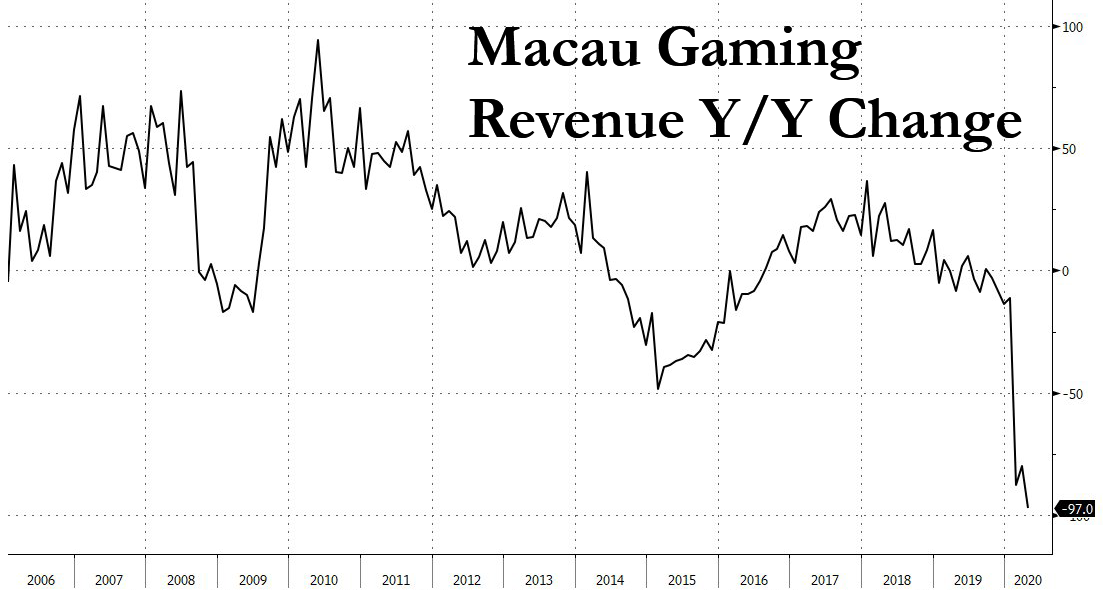
April gross gaming revenues at Macau casinos are down a staggering 96.8% year-on-year to MOP$754 million (US$87 million), as tourism to the gambling mecca has virtually disappeared due to travel restrictions barring the entry of all non-residents aside from those from mainland China, Hong Kong and Taiwan.
Meanwhile, China’s Guangdong Province introduced a mandatory 14-day quarantine for anyone returning from Macau, including Guangdong residents, according to Inside Asian Gaming.
For the first four months of 2020, Macau’s GGR is down 68.7% year-on-year to MOP$31.24 billion compared with MOP$99.74 billion over the same period in 2019.
Empty casinos
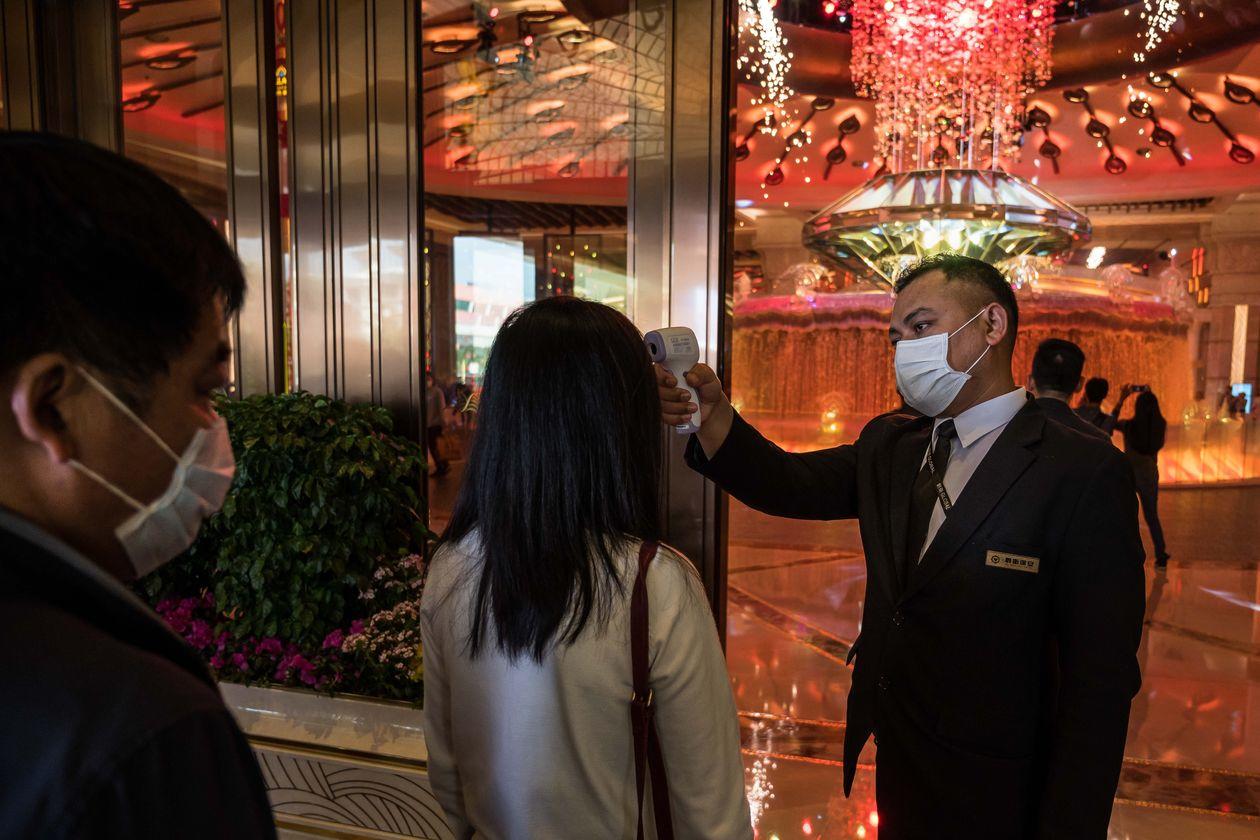
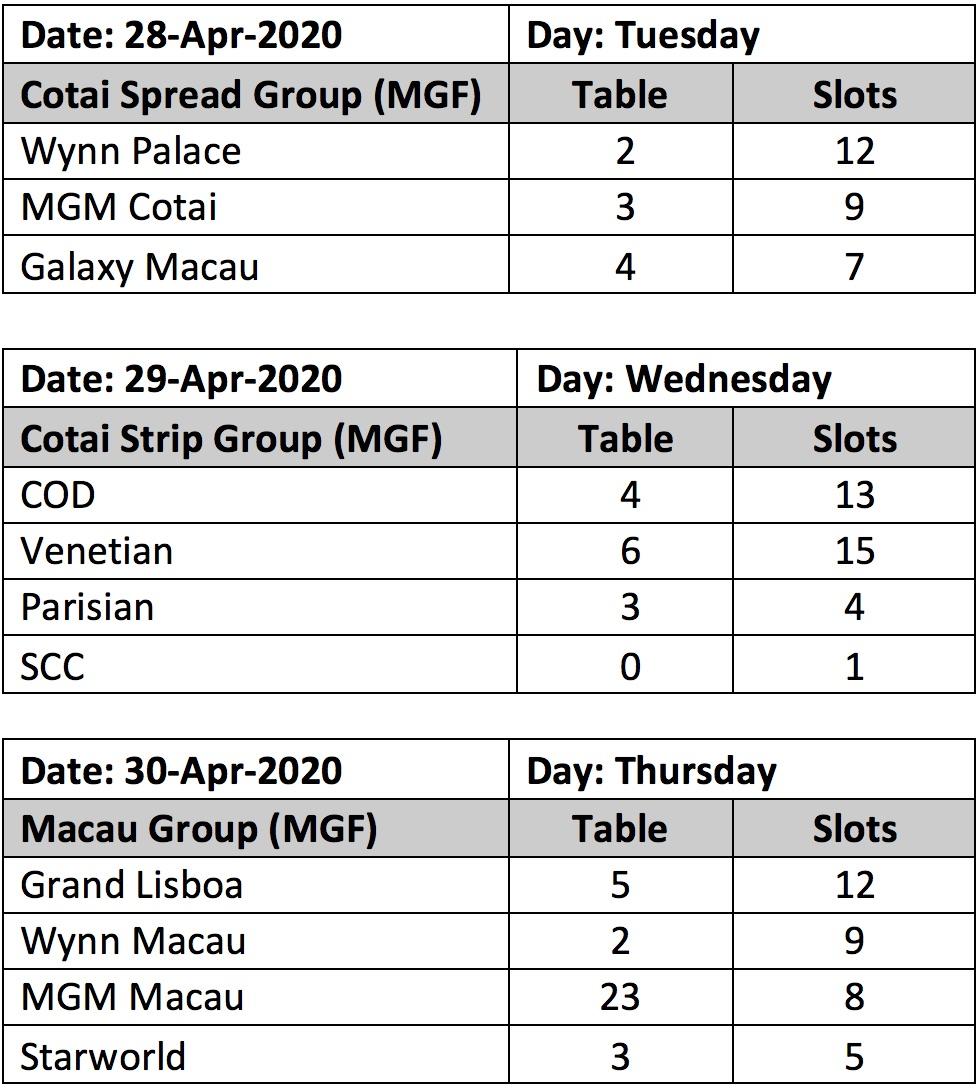
As IAG notes in a separate Friday report, Macau casinos are virtual ghost towns – with the MGM Macau seeing the most foot traffic for the third week in a row out of 11 properties surveyed.
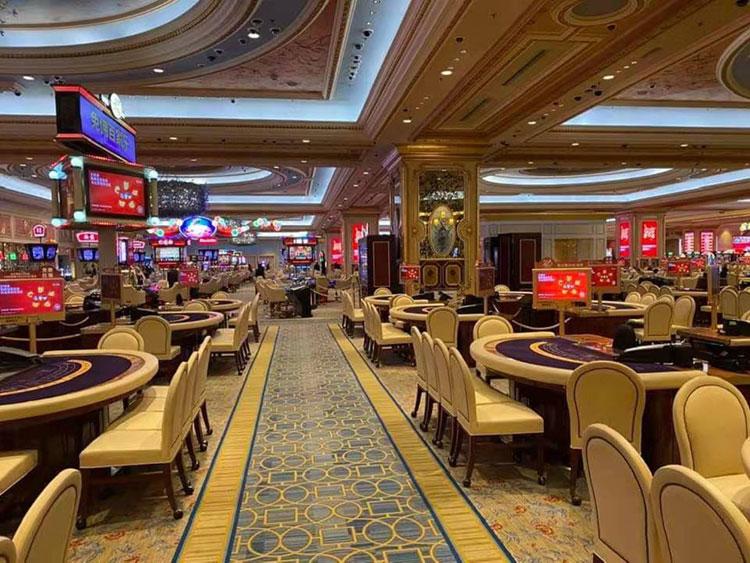
On average, each gaming floor had around five players (37%) on tables and nine players (63%) on slots. MGM Macau was by far the busiest with 23 players at the tables and eight on slots, while The Venetian Macao came in second best with eight at the tables and 15 on slots. Once again, Sands Cotai Central was quietest with only a single slots player. –Inside Asian Gaming
Macau has had 45 confirmed COVID-19 cases, 3,792 suspected cases, 37 recoveries, and zero deaths.
Tyler Durden
Fri, 05/01/2020 – 23:40
via ZeroHedge News https://ift.tt/35lDMQr Tyler Durden
There Is No Exit From COVID-19, Only Containment
Authored by M.K.Bhadrakumar via The Indian Punchline blog,
From this point, the buck stops with the Modi government, as the country trudges along the Covid highway. The political move to tap into the residual spirit of Indian federalism in our highly polarised polity helped so far, as the central government could inject into its decisions a look of national consensus. Whereas, the central government took all major decisions and most minor decisions.
However, the physical or material conditions vary from state to state while on the other hand, the time is approaching for the central government to make a thorny decision — when or how to restart the economy that was shut down almost overnight.

Clearly, an economy of India’s size won’t start back up simply because the government so decided. The refrain is that the restart will be gradual. But the devil lies in the details. Under what circumstances will businesses be allowed to reopen? It seems certain regions and businesses / industries may be put on a fast track. The MSME sector, which employs 12 crore workers need special attention.
However, defining a yardstick will be difficult because the economy is a complex web of supply chains and interlocking pieces with a dynamics of their own. In an interview with the BBC Radio last week, the owner of Mahindra & Mahindra said he just couldn’t see any possibility of his company becoming operational before May 2021, since, amongst other things, it doesn’t make sense to make cars without the numerous suppliers and sales outlets first reviving and, importantly, until consumer confidence revives.
Clearly, epidemiologists’ recommendations or the government’s decisions will not be the last word. If a manufacturer in Chennai depends on a part made in Ahmedabad, for example, where the virus is still spreading, a government fiat to start production becomes meaningless. Simply put, it is going to take much longer to thaw the economy than it took to freeze it.
Then, there is the co-relation between a phased reopening of the economy and public health benchmarks. The best that can be said about the lockdown is that it probably slowed down the spread of the virus. But we’re chasing a chimera here. The authenticity of the figures available is in serious doubt. No one is to blame because tracking the coronavirus is difficult in such abnormal conditions of lockout.
Today’s New York Times reported that the coronavirus death toll in the US is actually far higher than reported. The FT also came out with a stunning report today that Britain’s actual death toll could be plausibly in the region of 41000, as against hospital death data that show 17,337 people having died.
The plain truth is that there is no “exit strategy” possible out of the lockdown in the absence of a vaccine or a proven therapy.
“We will have to learn to live with the virus,” French Prime Minister Édouard Philippe put it starkly on April 28, while outlining his plan to start reopening the country at the National Assembly in Paris, until a vaccine or effective treatment is available.
This stark reality ought to leave with the Indian states a free hand to develop their own road maps and decide either to persist in lockdown or pull themselves out in different ways and at different speed. What cannot be overlooked is that all this is taking place under the threat of a second global wave or outbreak — a disaster scenario.
Epidemics come in waves. In the Spanish flu pandemic of 1918, the deadliest in history, the first wave was nothing in comparison with the virulent second wave, which left a horrific trail. No doubt, this is a Catch-22 situation — whether suppressing the virus further to stall a repeat outbreak or the lifting of restrictions quicker to limit the economic fallout should take precedence. The biggest risk is that you open too fast, too broadly.
The warning from Germany on lockdown easing conveys a sombre message. Only a week since the easing began in Germany with the reopening of shops (with all conceivable precautions put in place with characteristic Teutonic efficiency and thoroughness), it appears that Berlin may have to re-tighten its lockdown because the virus is spreading too fast.
The virus reproduction rate – measuring how many the average person with Covid-19 infects – increased to 1.0. (Any value above 1.0 is seen as leading to exponential increase in infections.) Chancellor Angela Merkel is on record that a rise to 1.2 ( of the so-called “RE number”) could mean hospitals reach a crisis point in July: “If we get to 1.2 people, so everyone is infecting 20 per cent more, out of five people one infects two and the rest one, then we will reach the limit of our healthcare system in July”.
Remember, this is one of the richest countries in the world — and a social democracy with a well developed healthcare system. It is a worrying sign. Surely, there are many variables swirling in the ether, and epidemiology is a complex business.
The bottom line is that with no vaccine or cure insight, the government will have to decide how many deaths would be acceptable to restore a shattered economy. If the “RE” number lifts after an easing of restrictions on 3rd May and we’re forced to back-pedal, the economic damage will be amplified, leave aside the potential to demoralise the public’s resolve.
Mass testing of asymptomatic people appears to be the defining measure of success globally in tackling the virus, but in India, we lack the infrastructure for it. Time and testing are key and the longer a quarantine can be extended the better, and the more testing made available, the easier it would be to properly calibrate a reopening and respond to any new outbreak. No doubt, waiting until comprehensive testing provides a better map of where the infection has spread.
Devi Sridhar, the chair of global public health at Edinburgh Medical School and director of the Global Health Governance program, recently tweeted on the three options open. Sridhar wrote:
“There are few short-term options.
1: Let the virus go and thousands die.
2: Lockdown and release cycles which will destroy economy and society.
3: Aggressive test, trace, isolate strategy supported with soft physical distancing.”
Having said that, the horrifying twin-reality still remains to be that an end to lockdown will by no means represent a return to normality, and, equally, a second, far more destructive wave is virtually an unavoidable possibility, notwithstanding the infection-reducing social distancing as a “new normal” in our daily life.
Under the circumstances, while dampening public expectations may not be the best option in politics, public morale is best sustained on the basis of transparent, realistic communication. This is a long haul. Make no mistake that in the absence of a safe and effective vaccine and/or a safe and effective drug to eliminate the COVID-19 infection once it has occurred, our narrative narrows down to a containment strategy attuned to Indian conditions, quintessentially – which, by no means, becomes an exit strategy.
Tyler Durden
Fri, 05/01/2020 – 23:20
via ZeroHedge News https://ift.tt/3fbsToN Tyler Durden
New Coronavirus Study Claims Outbreak Will Last Longer Than 2 Years As 2/3rds Of Humanity Infected
It’s been a while since we saw a study projecting an extremely dire endgame for the coronavirus outbreak.
Yet, as the battle over whether to reopen immediately or wait a few more weeks becomes almost universally-partisan, a non-peer-reviewed study out of the midwest projected that the virus could kick around for another 2 years, and that the outbreak won’t subside until more than 60% of the global population is immune, Bloomberg reports.
According to the research from the Center for Infectious Disease Research and Policy at the University of Minnesota, the coronavirus pandemic is likely to last as long as two years and won’t be controlled until about two-thirds of the world’s population is immune.
The report was written by CIDRAP director Michael Osterholm and medical director Kristen Moore, Tulane University public health historian John Barry, and Harvard epidemiologist Marc Lipsitch, whose name has appeared on other important coronavirus research and commentary.
Furthermore, because so many of those infected by the virus are asymptomatic or mostly asymptomatic, lockdowns and other aggressive measures might not be enough to stamp it out completely. This ‘invisibility’ is what makes SARS-CoV-2 such a challenging virus to contain.
This might help explain why Sweden’s approach has been so popular, while offering perhaps the best argument yet for why states might as well reopen. According to the researchers, the virus will likely keep on coming in waves perhaps until the end of 2022, or even longer, as drug companies scramble to develop a vaccine, or a cure.
Because of its ability to spread from person to person without the presence of symptoms, the virus will likely be much harder to control than the flu. The virus is deadlier than the flu, too – and certain mutated strains have been found to be significantly more virulent.
According to the report, people might actually be at their most infectious before symptoms even start to appear.
“Risk communication messaging from government officials should incorporate the concept that this pandemic will not be over soon,” they said, “and that people need to be prepared for possible periodic resurgences of disease over the next two years.”
That’s the last thing equity traders probably want to hear on Friday.
Tyler Durden
Fri, 05/01/2020 – 23:00
via ZeroHedge News https://ift.tt/2WfDGFK Tyler Durden
Oregon County Says “No Whites Allowed”
Authored by Simon Black via SovereignMan.com,
Are you ready for this week’s absurdity? Here’s our Friday roll-up of the most ridiculous stories from around the world that are threats to your liberty, your finances, and your prosperity… and on occasion, poetic justice.
Do you know what’s been missing from the government’s response to coronavirus?
You might think– ‘more testing kits’, or ‘honest information’.
Nope. According to at least one county in the US state of Oregon, the biggest issue right now is establishing “safe spaces” where no white people are allowed.

This is how Multnomah County, Oregon is rewarding its employees who are working during the pandemic: the county government announced that one of their departments will host “a grounding space for Black, Indigenous, and People of Color (BIPOC) employees to share, heal, connect, and get grounded in a space that is not dominated by whiteness.”
The safe-space was announced in a daily report to county employees fighting coronavirus.
When asked, a county spokesperson assured the public that it is perfectly legal to discriminate against their white employees.
She explained, “The space excludes no one. It is based on shared lived experience not identity. The same way our employee resource groups for veterans, parents, and people with a disability are based on life experience and not identity. All are welcome here.”
Except white people.
Try to wrap your mind around that double-speak.
Click here to read the full story.
* * *
Connecticut police will be testing a new “pandemic drone.”
It is so named because the drone is “equipped with a specialized sensor and vision systems that can display fever/temperature, heart and respiratory rates, as well as detect people sneezing and coughing in crowds, and wherever groups of people may work or congregate.”
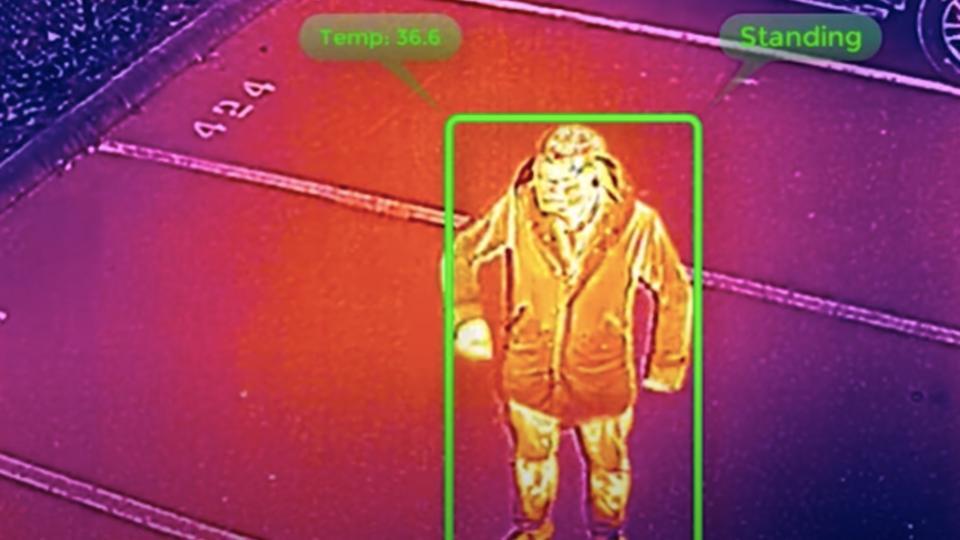
The company that builds the drones announced the partnership with police.
“The technology can accurately detect infectious conditions from a distance of 190 feet as well as measure social distancing for proactive public safety practices.”
If you already think the government expansion of power and surveillance has gone too far, just wait until Robocop gets involved.
Click here for the full story.
* * *
We have been talking about the World Health Organization a lot over the past couple weeks.
First, a WHO official said they will have to seperate families to stop coronavirus.
Then the WHO advocated banning alcohol during the lockdown to save lives.
We also highlighted the timeline of WHO failures as the virus spread globally.
The WHO once made a brutal murderer– former Zimbabwean dictator Robert Mugabe– one of its GOODWILL ambassadors.
Youtube is helping this corrupt and incompetent organization by banning any content which contradicts the WHO’s narrative.
Now, China decided to send an extra $30 million to the World Health Organization after the US announced a temporary funding freeze due to its missteps.
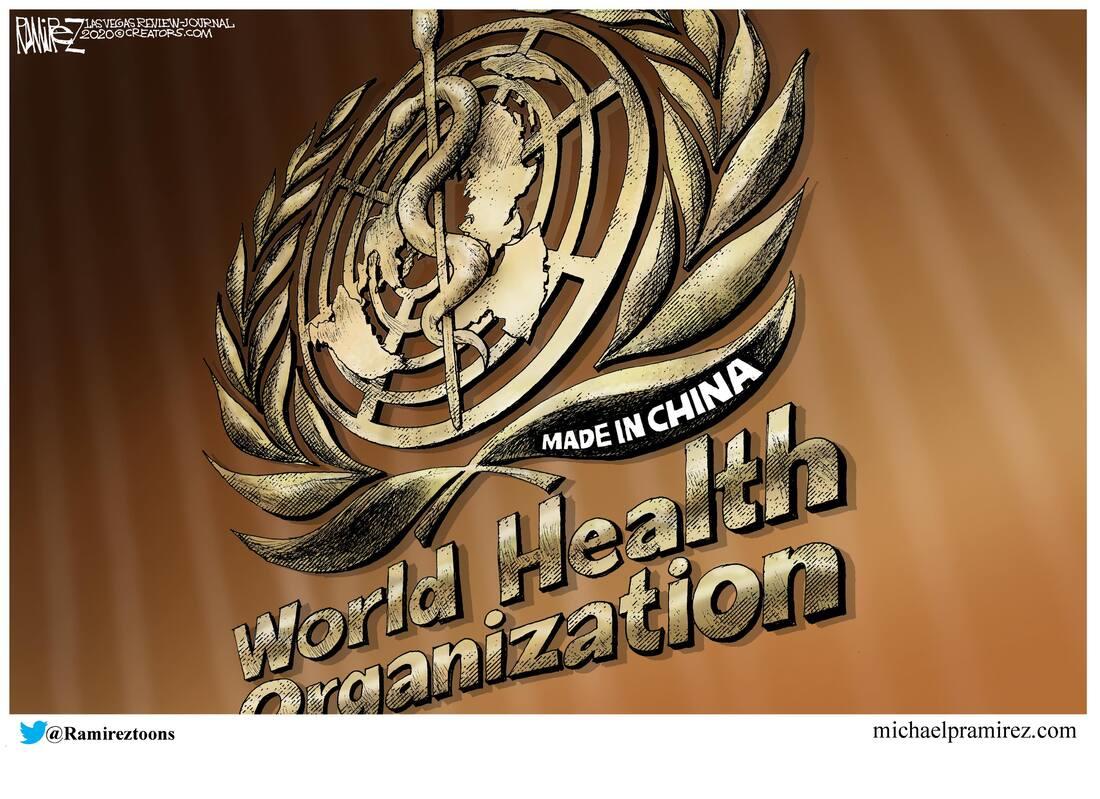
A Chinese official said the gift to WHO “reflects the support and trust of the Chinese government and people for the WHO”.
Just in case you needed another reason NOT to trust the World Health Organization.
Click here for the full story.
* * *
Tax revenue is drying up from a locked-down economy, at the same time spending is massively ballooning,
Over the past years we’ve asked rhetorically: if the US runs trillion dollar deficits during the best of times, what happens during the tough times?
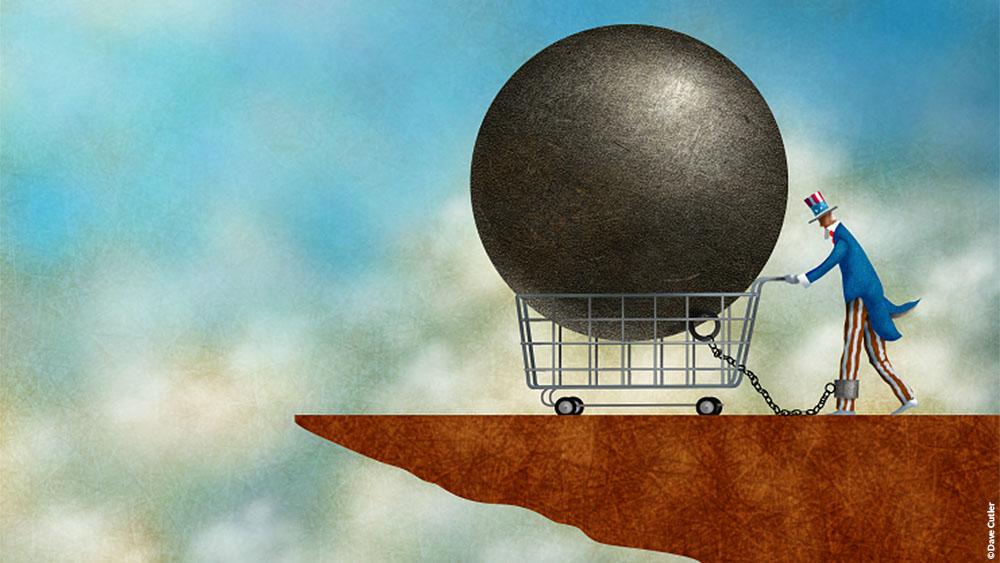
Now that the world has hit the tough times, and the answer to that question is no surprise:The Congressional Budget Office estimates that this year’s budget deficit will be $3.7 trillion.
That means the government will spend $3.7 trillion dollars more than they take in from taxes.
To put that number in context, $3.7 trillion constitutes almost 20% of the entire US economy.
Click here for the full story.
* * *
And to continue learning how to ensure you thrive no matter what happens next in the world, I encourage you to download our free Perfect Plan B Guide.
Tyler Durden
Fri, 05/01/2020 – 22:40
via ZeroHedge News https://ift.tt/3bWUKai Tyler Durden